Several examples in the literature demonstrate the application of MLS for beach monitoring. Lim et al. [
3] assessed the horizontal and vertical accuracy of MLS systems in sandy beach environments, comparing it to paved areas. Before boresight and lever arm adjustments, the mean errors were 0.22 m (x), 0.036 m (y), and 0.10 m (z), and after adjustments, they were improved to 0.06 m (x), 0.09 m (y), and 0.05 m (z). Donker et al. [
4] used MLS systems to perform 13 repeat surveys over 2.5 years to analyze changes in foredune structure and volume. After generating 1 m digital elevation models (DEMs), the morphology of the study site was analyzed. It was found that the vertical root mean square error (RMSE) of the surveys was about 0.01 m, and the volume error estimates were about 0.25 m
3/m. Gong [
5] used MLS to perform rapid post-storm damage assessments of New York and New Jersey after Hurricane Sandy. Results showed that MLS data can enhance airborne remote sensing data and typical ground survey data. It was also deemed to be useful in assessing sediment change, damaged structures, and reconstructing flood scenarios. Bitenc et al. [
1] used an MLS system to survey a 6 km beach on the Dutch coast to assess the accuracy of the resulting point cloud DEM. They found that their system could achieve a vertical RMSE of 0.05 m, and a DEM was available within two days of acquisition.
Uncrewed aircraft system (UAS) photogrammetric surveys are generally processed using structure-from-motion (SfM)/multi-view stereo (MVS) photogrammetry techniques (collectively referred to in this paper as SfM). SfM derives 3D structure from two-dimensional (2D) image sequences through movement of the camera, thereby providing different perspective views of the scene. By using the UAS as the moving platform, SfM can be implemented with an onboard camera by acquiring images with sufficient overlap. UAS is a relatively lower- cost survey method compared to traditional airborne remote sensing techniques for collecting high resolution 3D data of topography and land cover.
In the coastal zone, UAS-SfM has been applied to assess post-storm impacts and study geomorphologic processes such as shoreline change, erosion and deposition, and changes in beach-dune morphology [
6,
7]. This surveying method can provide high spatial and temporal resolution data of the beach and dune environment from a nadir view. Enwright et al. [
8] employed UAS-SfM to monitor a barrier island fronted by the Gulf of Mexico in Mississippi. They tested different methods of deriving digital surface models (DSMs), finding that a minimum bin algorithm resulted in higher vertical accuracy DSMs than interpolation. The final vertical RMSEs ranged from 0.095 m to 0.164 m. Che Mat and Tahar [
9] conducted four repeat surveys of a sandy beach with a DJI Phantom 3 (Nanshan, Shenzhen, China) on the east coast of Malaysia to create a DEM for modeling surf zone changes over time. The average final vertical accuracy was 0.419 m, and it was observed that the vertical error was higher in sandy areas. Rotnicka et al. [
7] used a fixed-wing UAS to survey a sandy beach and vegetated foredune system, comparing the UAS-SfM derived DEMs to a series of natural ground transects covering both vegetated and non-vegetated terrain. They found that the vertical RMSE of the survey was 0.06 m, but grass and other vegetation significantly affected the UAS-SfM-derived DEM accuracies, with only areas of sparse vegetation revealing accurate sediment budgets. Leal-Alves [
10] applied UAS-SfM to assess vulnerability of a beach in southern Brazil to inundation. The final DEM resolution was 0.12 m, while the vertical RMSE was 0.06 m. A bathtub model identified susceptible areas to sea level rise and inundation. Jeyaraj et al. [
6] implemented UAS-SfM to conduct two surveys to monitor sediment changes on a sandy beach, collecting a series of ground control points (GCPs) for model validation. They found that the two surveys had vertical RMSEs of 0.02 m and 0.01 m. By analyzing alongshore cross-shore transects. They quantified the impact of monsoon season on beach and foredune morphology, identifying significant volume and elevation changes. Van Alphen et al. [
11] applied UAS-SfM to assess volume change in a sandy beach after Hurricane Michael. They computed the pre-and post-volume of the study sites and the volume change after the hurricane by transect and by a raster-based method. Lastly, Nahon et al. [
2] combined MLS and UAS-SfM to monitor sandy beaches. They used the UAS data to address occluded features and serve as a form of ground truth validation to reduce the number of GCPs needed during a survey.
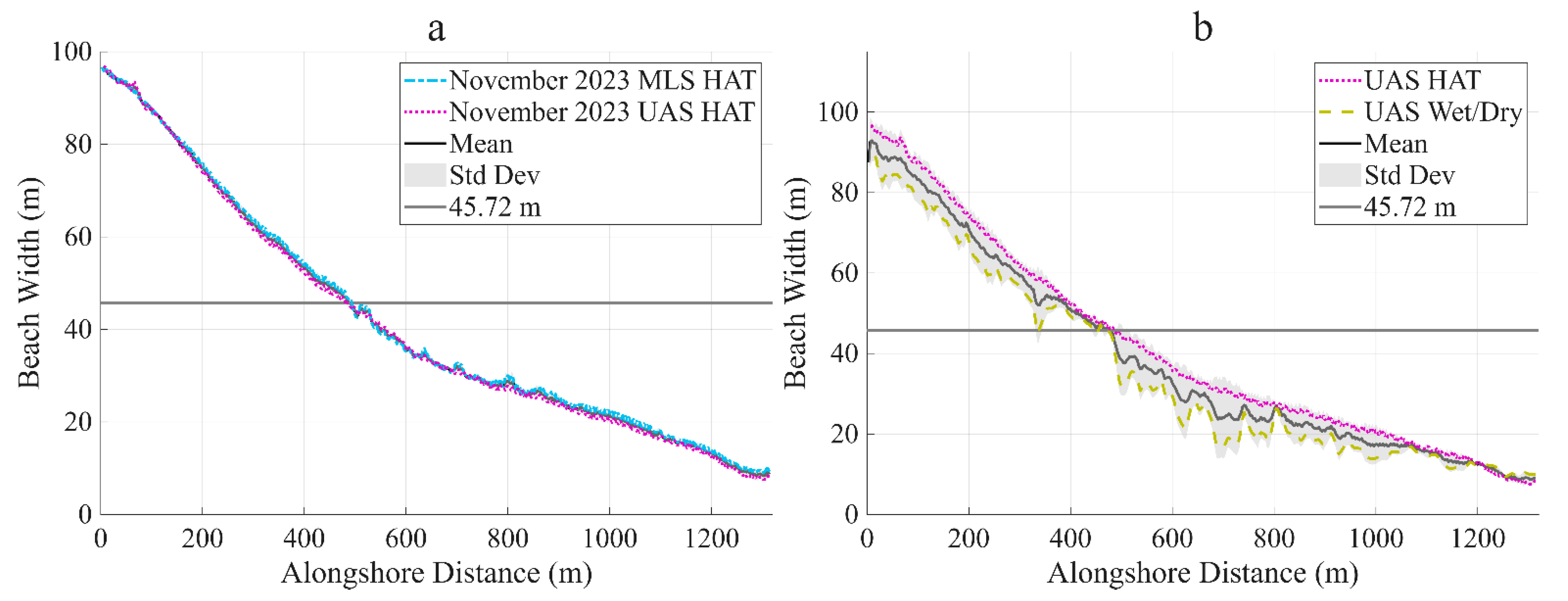
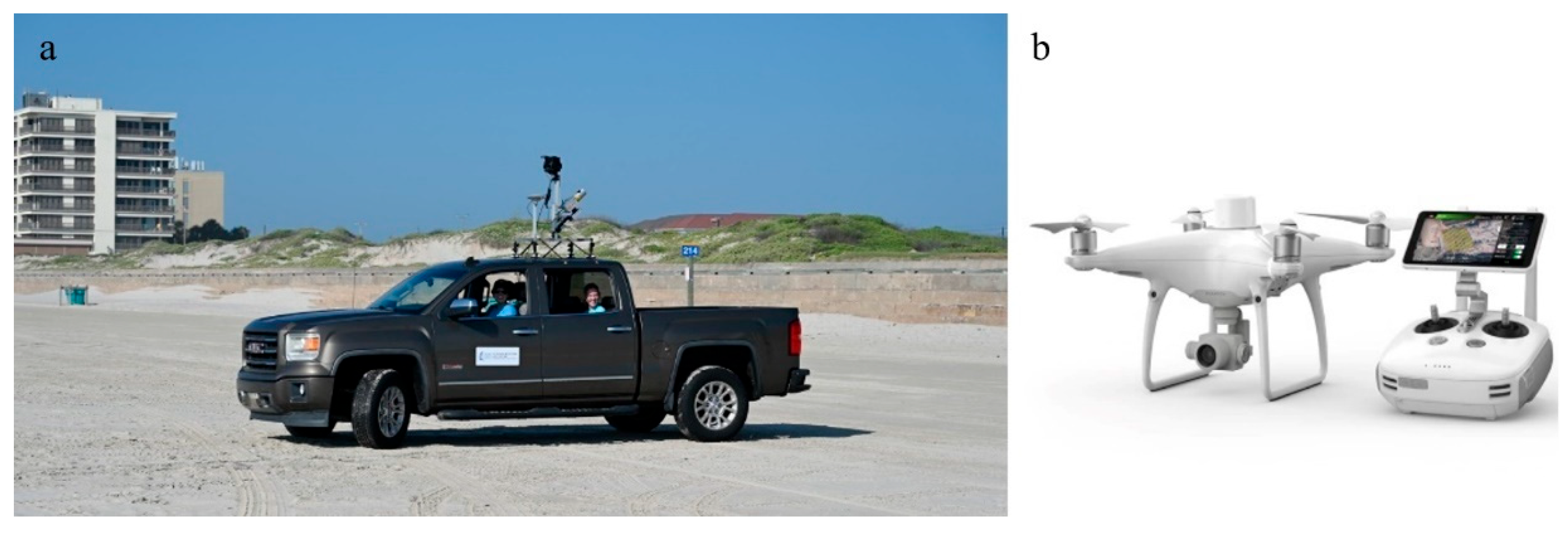
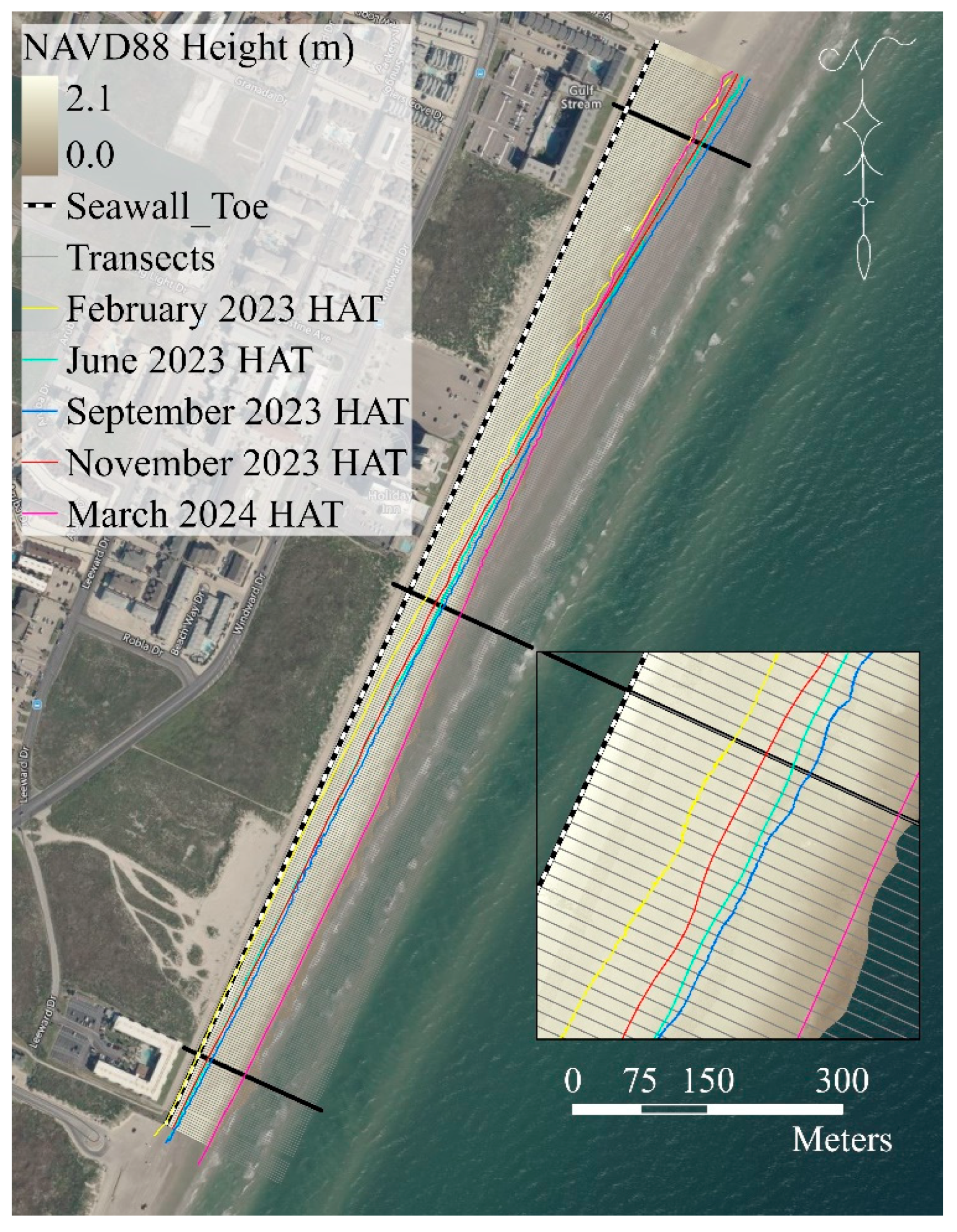
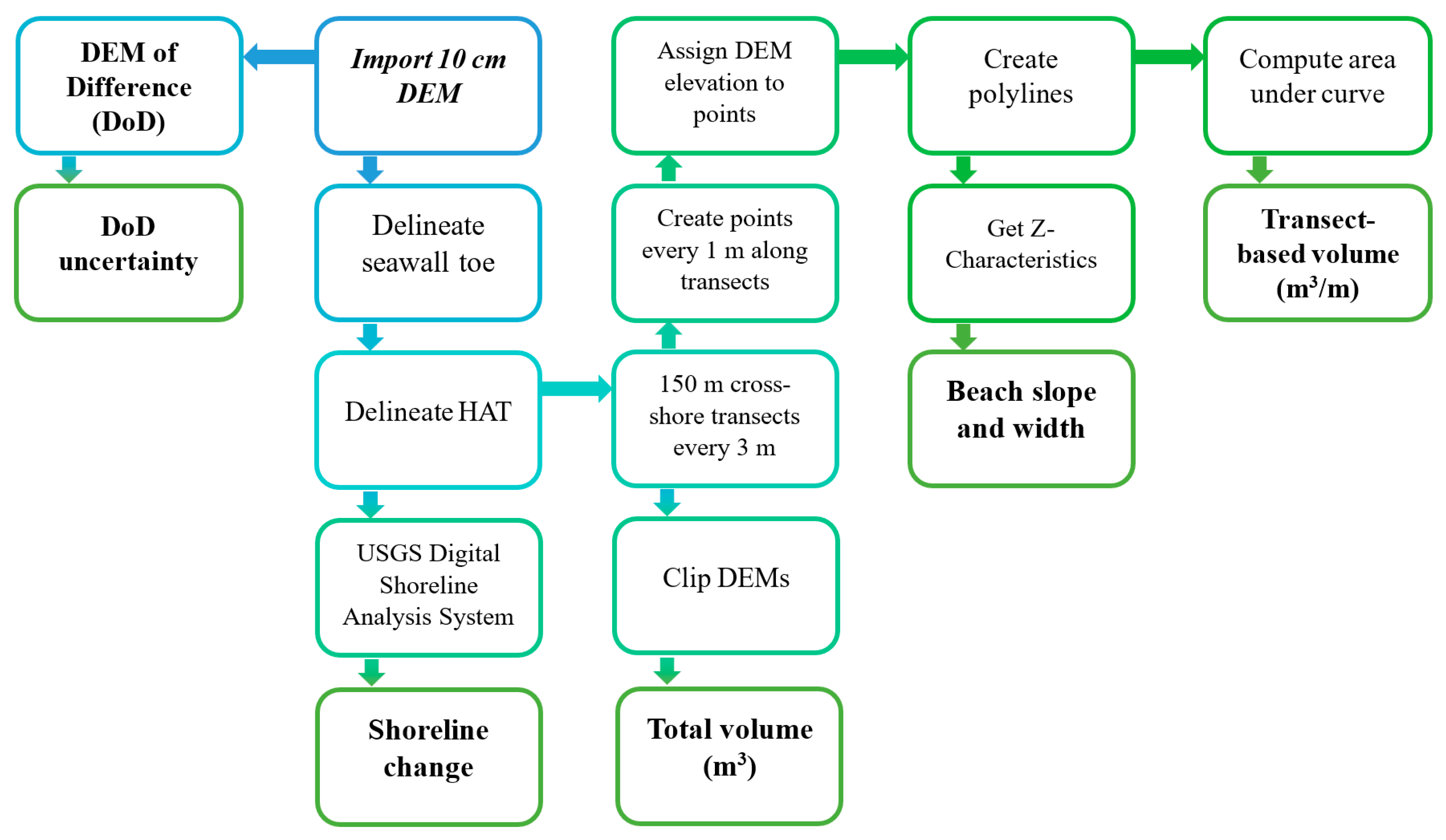
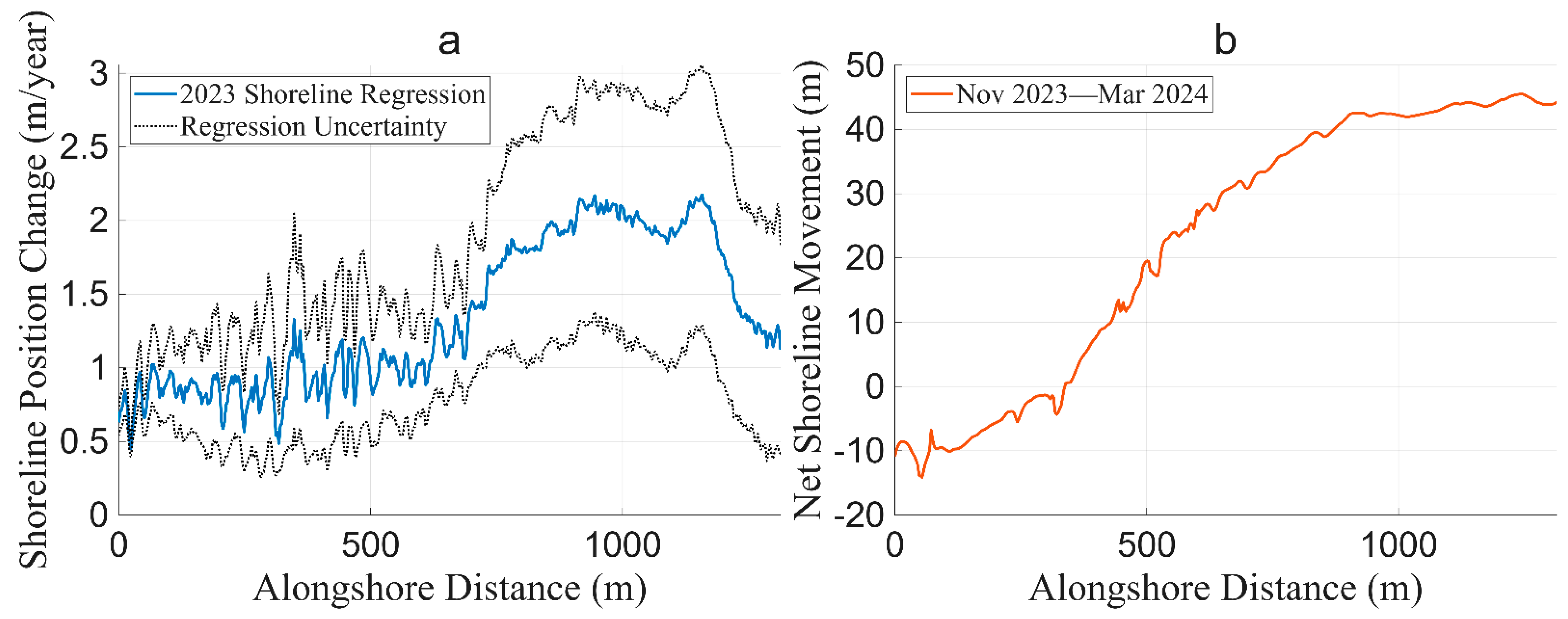
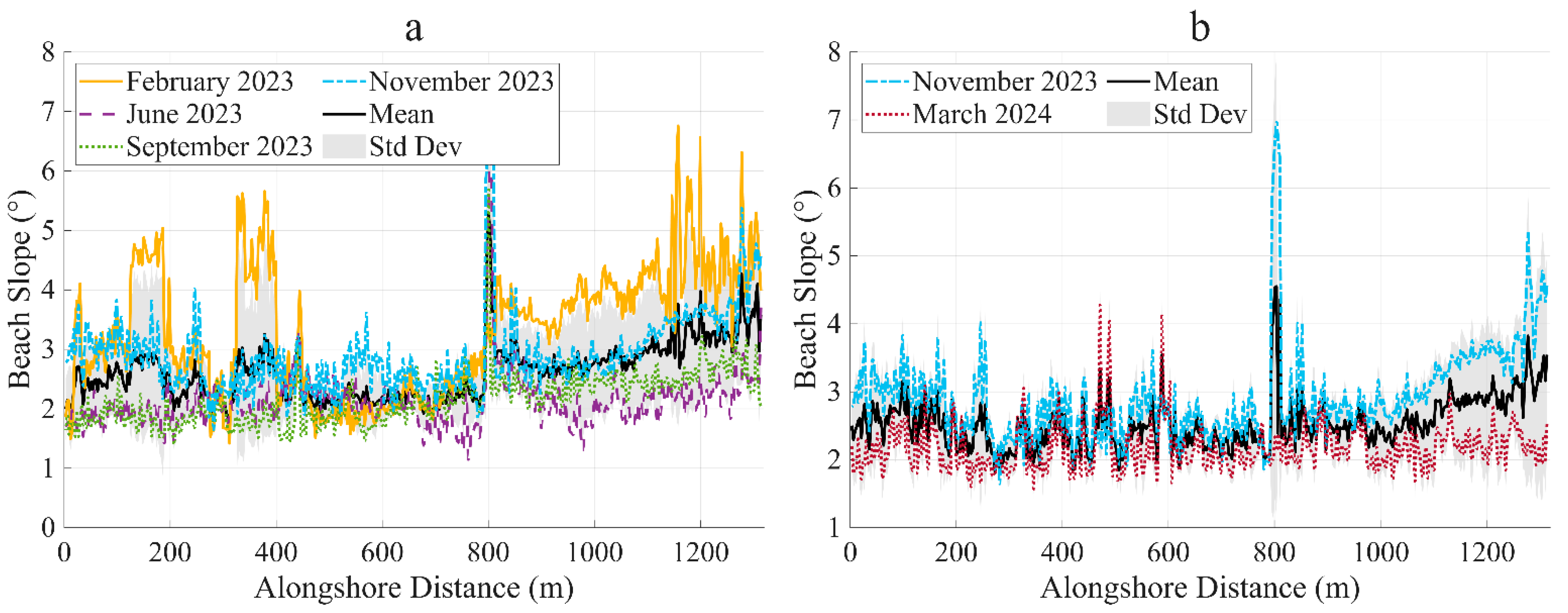
The goal of this study was to use a mapping-grade MLS system to examine variability of a sandy beach adjacent to a seawall on North Padre Island, Texas, USA, to inform management decisions. Beach width, shoreline change, erosion, and seasonal patterns were analyzed to inform policy and management decisions. A key focus was monitoring the shoreline to guide bollard placement. The initial objective was to monitor the MHW line relative to the toe of the seawall (the bottom of the bottom stair of the seawall). Due to MHW being submerged for every survey, an alternative shoreline proxy, highest astronomical tide (HAT) was chosen. UAS-SfM surveys were also conducted to compare with MLS surveys in terms of data acquisition; beach elevation and shoreline position measurement; and their utility for beach monitoring and management.
Study Site
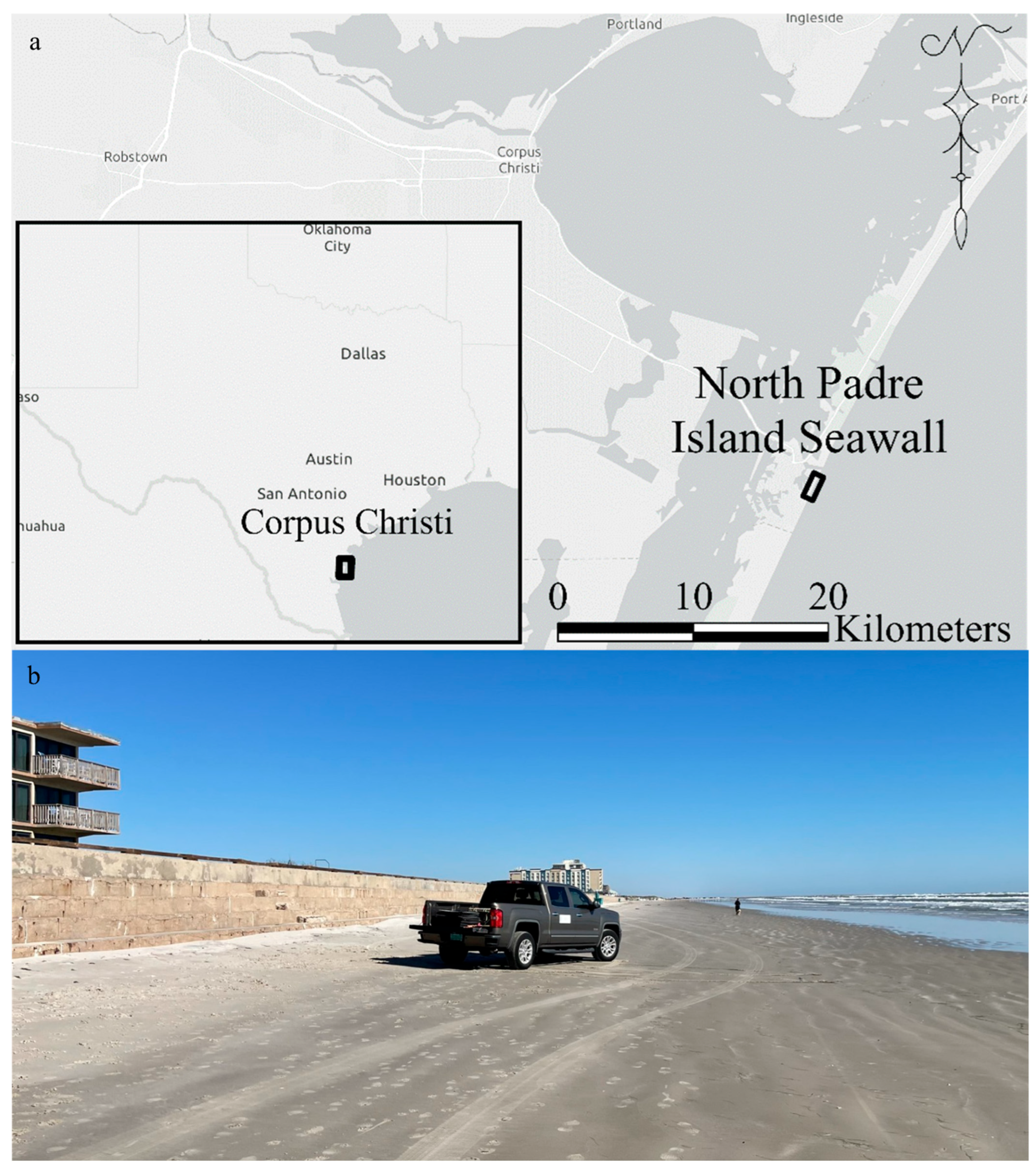
The North Padre Island (NPI) Seawall (
Figure 1) was built in 1967 using corporate funds, without permit authority, to protect a resort community, condominiums, and a series of hotels. The structure is approximately 1280 m long and 3.5 m tall, consisting of a concrete wall with steps running along its seaward face. It was not built at an exact parallel to the shoreline, with the southern end sitting closer to the waterline. After its construction, the seawall withstood two hurricanes: Hurricane Celia, a category 3 storm in 1970 and Hurricane Fern, as a Category 1 in 1971, with neither storm causing noticeable damage [
12]. Hurricane Allen made landfall in 1980 about 130 km south of the seawall as a Category 5 hurricane, with a storm surge that reached an elevation of 2.6 m and lasted about 48 h [
13]. The storm caused the seawalls’ foundation to fail due to long periods of inundation, wave runup and sediment loss in many parts of the structure [
14]. It was rebuilt shortly after and continues to be managed under shared, private ownership. Management of the surrounding beach is as follows: the portion seaward of the seawall toe is overseen by the City of Corpus Christi; the beach north of the seawall is managed by both the City of Corpus Christi and Nueces County Coastal Parks; and the section south of the structure falls under Nueces County jurisdiction [
12,
14].
The beach shoreward of the seawall (
Figure 1), extending north to Packery Channel and south to Bob Hall Pier, is heavily used by the public. It is popular with both locals and tourists, offers handicap access, and is significantly impacted by development. The construction of the seawall and adjacent jetties disrupted natural sediment dynamics, contributing to increased erosion along the southern portion and directly seaward of the structure [
12]. Williams [
14] noted that the Packery Channel jetties reduce northward sediment transport and promote sand accumulation south of the inlet. However, the stretch of beach from the mid-seawall southward lies beyond the zone protected by the jetties and has undergone consistent erosion. In fact, at both ends of the seawall, access roads are prone to flooding during storms and elevated water levels. Washover events at the southern access road promote erosion at the southern end of the seawall during these high-water episodes [
15]. To maintain beach access, especially for vehicles, sand is regularly mechanically redistributed to counter erosion [
14].
According to the Corpus Christi, TX [
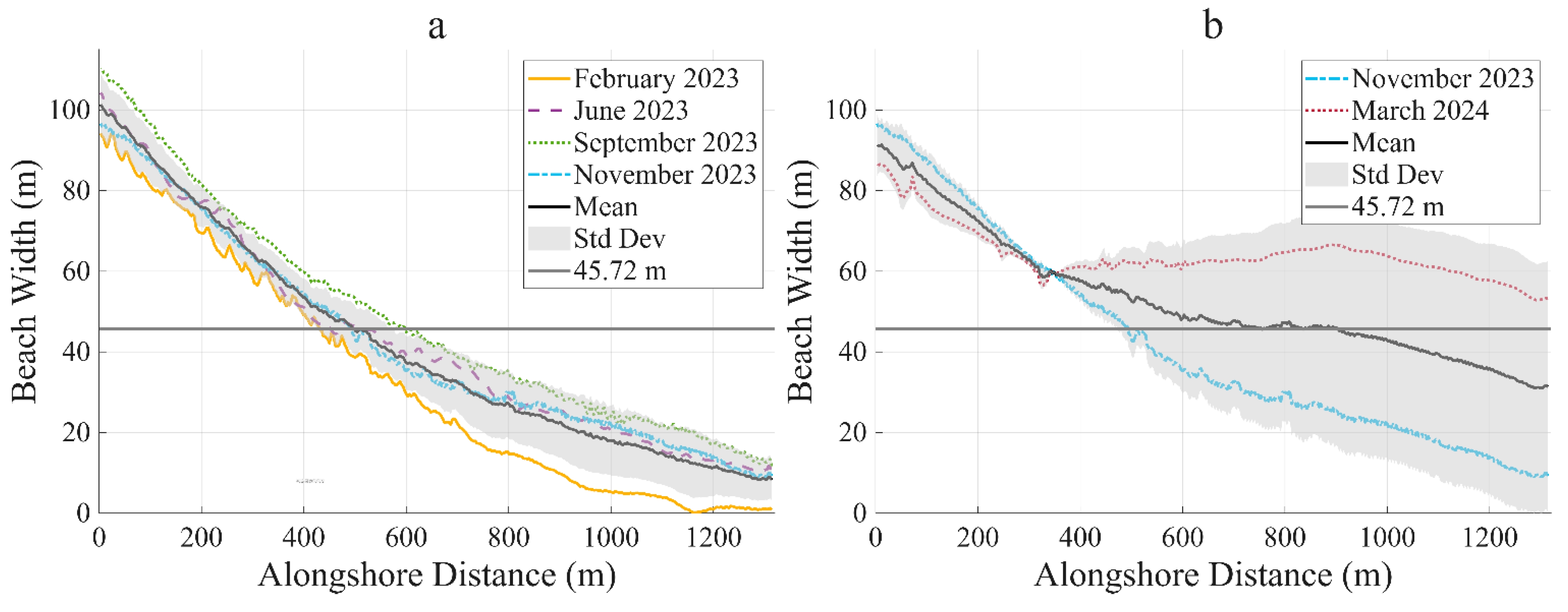
16] Ordinance No. S10-77, bollards must be placed perpendicular to the seawall to temporarily restrict vehicular access and maintain a safe beach environment for pedestrians if the mean high tide line (defined by mean high water (MHW), an elevation of 0.317 m North American Vertical Datum of 1988 (NAVD88) in this area) is less than 45.7 m (150 ft) [
17]. This ordinance does not account for tides, driving winds and other forces influencing wave runup. Because beach width fluctuates seasonally and annually, maintaining beach compliance can be challenging [
14]. However, the Texas Open Beaches Act states that the public has free and unrestricted right of ingress and egress for access to all state-owned beaches from the line of vegetation to the line of mean low tide [
18]. Once bollards are placed, the City of Corpus Christi must begin planning for beach restoration to the 45.72 m threshold to avoid violating this Act.
In addition to regular mechanical sand redistribution, occasional beach nourishment projects have been conducted in front of the NPI Seawall. Williams [
14] reported that two nourishments occurred prior to 2015 using sediment dredged from Packery Channel under a Beneficial Use of Dredge Material (BUDM) program. The first was completed during the construction of Packery Channel between 2004 and 2006, and the second was during the winters of 2011 to 2013. Following the channel’s construction, erosion rates decreased along the north end of the Seawall but remained high along the southern end. The most recent nourishment at the time of this study began on 25 November 2023 and was completed on 22 January 2024.
NPI is described as a “microtidal, low-energy coastline” by both [
12,
19]. The astronomical tides are primarily diurnal, with a mean range of tide of 40 cm (NOAA, 2004 [
17]), with June and July classified as low tidal months. However, tidal fluctuations in this area are largely wind-driven, inducing larger water change levels than meteorological tides, with mean annual wind speeds around 19 km/h [
19]. According to [
15,
20], wind direction along NPI varies seasonally, with bimodal wind patterns generally originating from the northeast during winter and from the southeast in summer, driving sediment transport in their respective directions. The predominant wind direction throughout most of the year is from the south-southeast. During the winter months, typically from about October/November through February, the winds shift from southeast to the northeast, with the arrival of cold fronts, locally known as “northers”. A spring transition occurs from approximately March through May, during which winds gradually shift from northeast to east and southeast. In the summer months, from about June through September, winds are persistent from the southeast. Lastly, a fall transition occurs from about September to October/November, during which southeasterly winds give way once again to northeasterly winds as frontal activity increases. These seasonal periods are approximate and may vary slightly from year to year depending on seasonal weather variability. Tissot and Dell, [
21] indicate that this area experiences a median significant wave height, with a range of 0.1 to 2.0 m and a typical wave period of 5.9 s, with a range of 2.1 to 11.5 s. The average water levels vary seasonally with highs in May and October and lows in July and January [
22]. Additionally, periods of high, onshore winds occur in the spring, further contributing to elevated water levels [
19,
20]. Extreme events, such as very high winds and the impact of tropical storms and hurricanes also lead to high water levels.
NPI is also oriented at an angle to the oncoming wave approach, with waves approaching and breaking diagonally along the shoreline from the southeast direction from north of NPI southward to a convergence zone near Big Shell beach on Padre Island National Seashore (PAIS) [
20]. This wave angled wave action, combined with wind forcing, drives longshore sediment transport parallel to the shoreline [
19]. Williams and Turner [
23] note that sediment transport is unobstructed along the open beach south of NPI, while the southern jetty of Packery Channel obstructs sediment flow, resulting in localized sediment accretion. Although seasonal reversals occur, the dominant direction of sediment transport at NPI is from south to north due to the prevailing south-southeasterly winds. In the winter, this pattern reverses, with sediment moving from north to south in response to north-northeasterly winds. According to Morton [
24], prior calculations estimated that gross littoral transport along Mustang Island and NPI ranges from approximately 725,000 and 925,000 yd
3/yr, while net southwesterly transport lies between 66,000 and 80,000 yd
3/yr. The sediment itself is made up of fine, brown sand as described in Morton [
12] and predominantly consists of quartz, with traces of rock fragments, feldspar, and minerals such as garnet, zircon, tourmaline, hornblende, and others [
19].




 ,
,