
Article

A Hybrid Strategy Combining Maritime Physical Data to the OpenSARShip RCS Statistics for Fast and Effective Vessel Detection in SAR Imagery

by
Ocione Dias do Nascimento Filho
1,*,
João Antônio Lorenzzetti
1,
Douglas Francisco Marcolino Gherardi
1,
Diego Xavier Bezerra
1 and
Rafael Lemos Paes
2
1
Instituto Nacional de Pesquisas Espaciais (INPE), São José dos Campos 12227-010, SP, Brazil
2
Estado-Maior da Aeronáutica (EMAER), Força Aérea Brasileira (FAB), Brasília 01552-001, DF, Brazil
*
Author to whom correspondence should be addressed.
Remote Sens. 2025, 17(23), 3891; https://doi.org/10.3390/rs17233891 (registering DOI)
Submission received: 12 September 2025 / Revised: 31 October 2025 / Accepted: 11 November 2025 / Published: 30 November 2025
(This article belongs to the Section Ocean Remote Sensing)

Highlights

What are the main findings?
  • The Hybrid Strategy achieved comparable detection performance to pure CFAR–GΓD (Recall = 86.6%) while reducing execution time by ~18×.
  • Integration of OpenSARShip backscatter statistics with environmental parameters (Wave Age) improved detection robustness and enabled preliminary vessel-size inference.
What are the implications of the main findings?
  • The Hybrid Strategy provides an efficient compromise between accuracy and computational cost, supporting scalable and near real-time vessel detection.
  • The proposed thresholds allow autonomous monitoring of cooperative and non-cooperative vessels, strengthening maritime domain awareness.

Abstract

Maritime surveillance has become increasingly relevant due to the growth of shipping, illegal fishing, and the need to monitor remote oceanic regions. Synthetic Aperture Radar (SAR) imagery supports this task under day-and-night and almost all-weather conditions. However, automatic ship detection in heterogeneous ocean environments still faces challenges, especially regarding computational cost. This study develops and compares approaches for detecting vessels in SAR imagery using radar backscatter statistics ( σ 0 ) to identify and characterize maritime targets. The OpenSARShip 2.0 dataset, which provides ship samples with AIS-based validation and reliable σ 0 estimates by type and size, was combined with maritime physical parameters such as wave age (from ERA5 reanalysis). The objective is to combine fast processing, robustness to sea variability, and inference capability regarding target size for operational applications. Four algorithms were evaluated: Rapid Thresholding (RT), based on OpenSARShip σ 0 values by ship length; Adjusted Rapid Thresholding (ART), with clutter-adapted thresholds; CFAR G Γ D, based on Gamma pdf modeling of ocean clutter; and a Hybrid Strategy combining RT with CFAR G Γ D. Results showed that CFAR G Γ D achieved the highest recall (87.4%) but at high computational cost, while the Hybrid Strategy (HS) offered comparable performance (Recall: 86.6%; F1-score: 74.8%) with 18× faster execution time. RT and ART were faster but less sensitive. These findings highlight the HS as an efficient compromise, supporting scalable, near-real-time vessel detection systems.

1. Introduction

Maritime surveillance plays a key role in border and national water security, the detection of oil or pollutant discharges, and the monitoring of remote oceanic areas [1]. Cooperative systems such as the Automatic Identification System (AIS) enable real-time vessel tracking; however, their effectiveness is limited by non-cooperative behavior, including intentional AIS disabling, which compromises the timely detection of irregular operations. Synthetic Aperture Radar (SAR) offers an effective alternative operating independently of illumination and weather conditions, allowing the detection of vessels even when AIS signals are absent [2]. On the flip side, SAR imagery is affected by speckle, and operational ship detection of sizable oceanic regions requires processing large data volumes with automatic algorithms.
Among these algorithms, Constant False Alarm Rate (CFAR) stands out for adaptivity and explicit control of the false-alarm rate (FAR) [3]. In CFAR-based methods, a detection threshold is derived from the statistical variability of the ocean-surface backscatter (sea clutter) to classify pixels as targets while maintaining a prescribed FAR. Despite their widespread use, conventional CFAR techniques face three main limitations in heterogeneous seas: (i) sensitivity to speckle, (ii) high computational cost for wide-scene processing, and (iii) limited adaptability to changing sea states that directly affect the normalized backscatter σ 0 [3]. Recent results show that combining CFAR with environmental parameters, for example, wave age (WA) derived from reanalysis, can improve performance; modeling sea clutter with the Generalized Gamma Distribution (G Γ D) has also reduced false alarms while preserving detection sensitivity [4,5,6,7].
This work compares vessel detection approaches for Sentinel-1 SAR imagery by combining different levels of complexity and adaptive clutter modeling. We evaluate: (1) Rapid Thresholding (RT), based on OpenSARShip 2.0 σ 0 statistics binned by ship-length ranges [8]; (2) Adjusted Rapid Thresholding (ART), which incorporates a minimum threshold adapted to local clutter characteristics [9]; (3) CFAR–G Γ D, using the generalized gamma model with WA-based adjustment [4,6,7]; and (4) a Hybrid Strategy (HS) that applies RT as a pre-filter and then runs CFAR–G Γ D only on regions of interest, reducing computation time. The comparison aims to establish operational criteria for scenarios with partial or absent cooperative data, balancing detection accuracy, vessel size inference, and computational efficiency to support scalable, near-real-time maritime monitoring systems.

2. Materials and Methods

2.1. Study Area

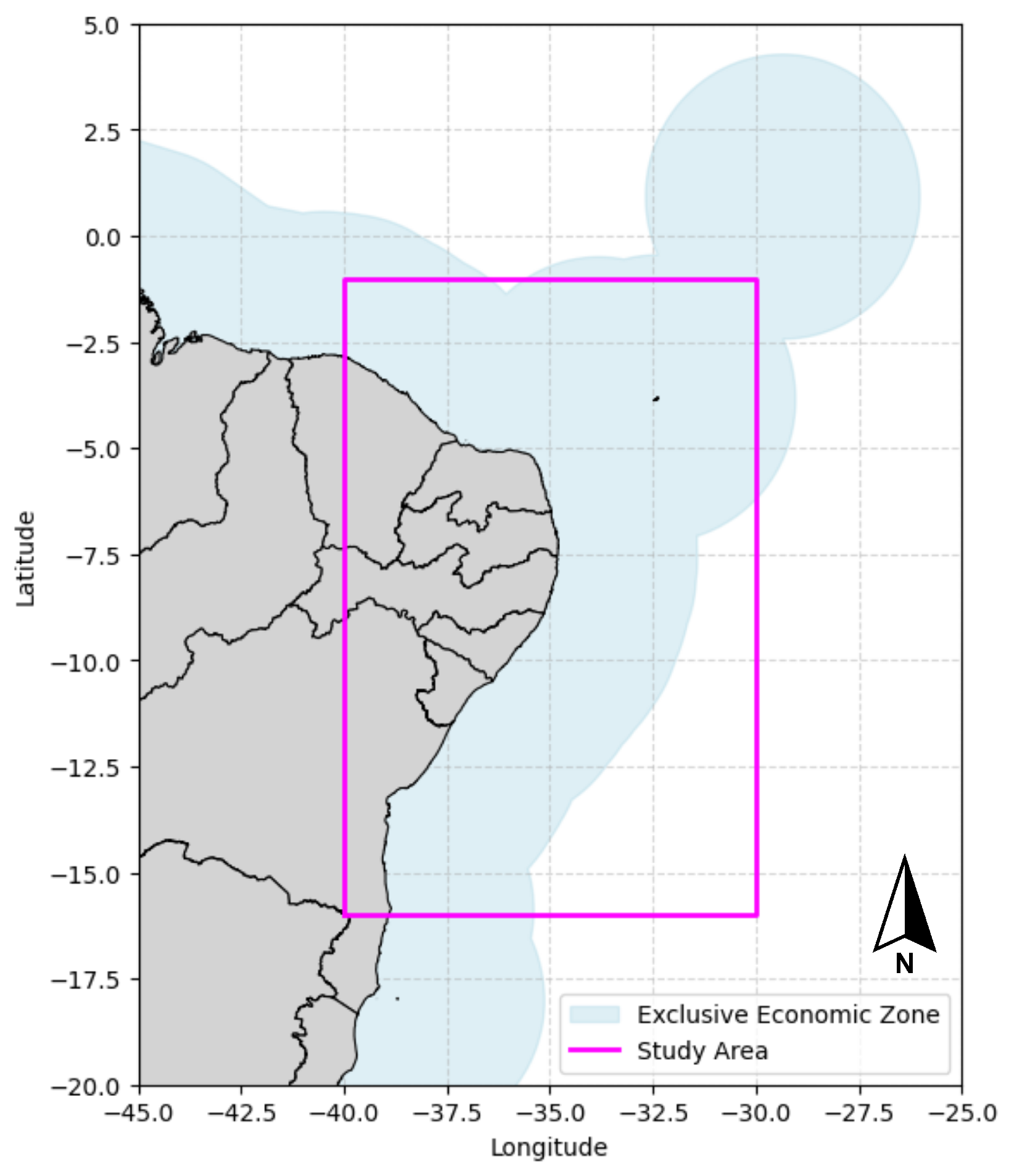
The study area is located in the offshore region of northeastern Brazil (16–1°S; 40–30°W), as illustrated in Figure 1, which is of strategic importance for maritime traffic and environmental vulnerability, as exemplified by the very large 2019 oil spill episode [10]. These conditions make the area a realistic and challenging scenario for testing and validating automatic maritime target detection algorithms using SAR imagery.
In this region, the Brazilian Exclusive Economic Zone (EEZ) extends beyond the territorial sea, granting the country sovereign rights for the exploration, conservation, and management of marine resources. The EEZ is also a critical area for surveillance and law enforcement, encompassing major shipping routes and fisheries of economic relevance [11]. Thus, integrating SAR-based monitoring with auxiliary data sources is essential for strengthening maritime domain awareness and ensuring environmental and resource protection within Brazilian jurisdiction.

2.2. Remote Sensing and Radar Cross-Section Data

This study employed 446 Sentinel-1A/B SAR images (Interferometric Wide Swath, VV polarization, C-band) acquired between October and November 2019, with 10 m pixel spacing, covering the oceanic region off the northeastern coast of Brazil [12]. The scenes were tiled into 20 × 20  km subsets and co-located with ERA5 reanalysis fields—with a 10 m wind speed (U10), a spectral peak wave period, and wave age (WA)—available hourly, with a maximum time lag of 30 min relative to the SAR acquisition time [5]. Radar cross-section (RCS) statistics were obtained from the OpenSARShip 2.0 dataset, derived from 8720 VV-polarized, radiometrically calibrated vessel chips associated with AIS data [8]. These data enabled the derivation of σ 0 distributions by vessel-length categories and corresponding thresholds, which were used both to support the target-detection algorithms and to validate vessel-size estimates.

2.3. Methodology

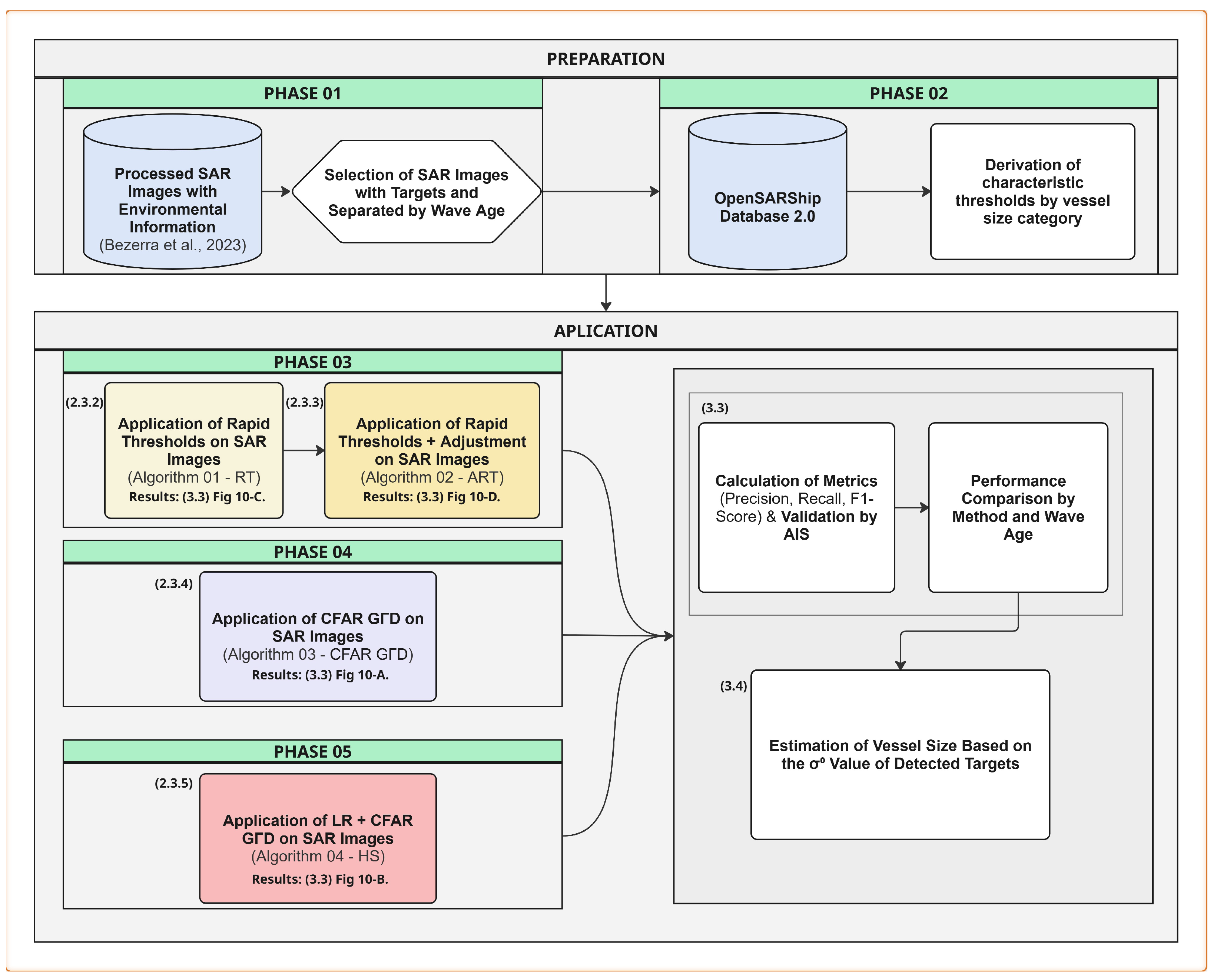
Target selection and algorithm comparison were performed in two main stages, (1) pre-processing, involving the selection of Sentinel-1 SAR subsets containing visually identifiable targets, classification by wave age (WA), and extraction of statistical σ 0 thresholds from the OpenSARShip 2.0 database by vessel-length category [8], and (2) application, comprising four detection algorithms: Rapid Thresholding (RT), Adjusted Rapid Thresholding (ART), Generalized Gamma-based CFAR (CFAR–G Γ D), and a Hybrid Strategy (HS). Candidate ship detections were grouped into clusters and subsequently validated using AIS data, enabling the calculation of performance metrics (Precision, Recall, and  F 1 -score) and the estimation of vessel lengths. The workflow shown in Figure 2 was designed to assess the effectiveness of the proposed methods under varying oceanographic conditions.

2.3.1. General Framework

All detection algorithms employed in this study (Rapid Thresholding (RT), Adjusted Rapid Thresholding (ART), Constant False Alarm Rate with Generalized Gamma Distribution (CFAR–G Γ D), and Hybrid Strategy (HS)) follow a common processing workflow designed for maritime target detection in Sentinel-1 SAR imagery.
First, each image is resampled to one-third of its original resolution to reduce computational cost while preserving the effective detectability of medium and large vessels. The backscatter coefficients ( σ 0 ) are expressed on the decibel (dB) scale, and a thresholding operation is applied according to the criterion defined by each algorithm (Section 2.3.2, Section 2.3.3, Section 2.3.4 and Section 2.3.5). The resulting binary maps are subjected to morphological segmentation using nine-connectivity, in which each pixel is considered connected to its eight neighboring pixels (in horizontal, vertical, and diagonal directions), grouping contiguous pixels that belong to the same physical target. Clusters with an area equal to a single pixel or with σ 0 < 10  dB are automatically discarded, as they represent isolated speckle or weak clutter responses. This threshold corresponds to the typical lower limit of ocean clutter in C-band Sentinel-1 scenes and was empirically verified within the study area.
For all valid clusters, descriptive metrics such as area, mean, maximum, and minimum σ 0 are calculated. Their geographic centroids are extracted using the georeferencing information contained in the SAR product metadata. Bounding boxes are then generated for each cluster and merged using a 150 m buffer radius, a value chosen based on the average beam footprint and apparent vessel width observed in the OpenSARShip 2.0 database. This step prevents redundant detections of multi-pixel targets and ensures consistency between detections and physical object dimensions.
This standardized post-processing pipeline allows fair comparison among algorithms, isolating differences related exclusively to threshold definition strategies, which are described in detail below.

2.3.2. Algorithm 1: Rapid Thresholding (RT)

The RT algorithm provides a low-cost preliminary detection mechanism that serves as a baseline method for fixed-threshold segmentation of maritime targets. Thresholds were derived from the OpenSARShip 2.0 database [8], which provides extensive σ 0 statistics across vessel-length categories. For each class, σ 0 distributions were analyzed to characterize the radar backscatter behavior as a function of vessel size. The 25th and 75th percentiles ( P 25 , P 75 ) were selected to represent the interquartile range (IQR) and mitigate the influence of extreme values. The final threshold was computed as the arithmetic mean of P 25 and P 75 , ensuring a balanced compromise between detection sensitivity and false-alarm control.
By operating entirely on the resampled σ 0 (dB) image, RT produces binary detection maps at a very low computational cost, suitable for large-scale or near-real-time maritime monitoring scenarios. This forms the conceptual foundation for the subsequent adaptive algorithms.

2.3.3. Algorithm 2: Adjusted Rapid Thresholding (ART)

The ART algorithm extends the RT method by introducing a context-dependent adjustment that dynamically adapts the detection threshold to local sea clutter conditions. This refinement is based on the formulation proposed by [9], where the effective threshold depends on the mean clutter level of the surrounding region.
σ min 0 = μ clutter · γ
where μ clutter is the mean local clutter (in linear scale), γ = 10 1.3 10 represents the contrast factor (1.3 dB) converted from the decibel scale into the linear scale, and σ min 0 is the adaptive threshold value (in linear scale).
This factor was determined through sensitivity tests over multiple Sentinel-1 scenes under distinct sea states, representing a balance between enhanced sensitivity to weak targets and resilience against noise amplification. This adaptation enables detection of low-contrast maritime objects, such as small vessels or partially immersed metallic structures, which may otherwise fall below a fixed threshold. The remaining steps (segmentation, filtering, and bounding-box merging) follow the standardized framework described in Section 2.3.1, ensuring methodological coherence and comparability with RT results.

2.3.4. Algorithm 3: Generalized Gamma Distribution CFAR (CFAR-G Γ D)

The CFAR–G Γ D algorithm replaces fixed or semi-adaptive thresholds with a statistically rigorous adaptive mechanism that maintains a Constant False Alarm Rate (CFAR) under heterogeneous ocean conditions. For each pixel under test (PUT), a  100 × 100 pixel sliding window is defined to characterize the surrounding background clutter. A 20 × 20 pixel guard region centered on the PUT is excluded to prevent contamination by target returns. These window dimensions were selected following Ref. [4], ensuring adequate statistical sampling given the ≈30 m/pixel spatial resolution of Sentinel-1 IW-GRD imagery.
Within each window, the clutter is modeled using the Generalized Gamma Distribution (G Γ D), the probability density function (PDF) of which is given by the following:
f ( x ) = | ν | k k μ Γ ( k ) x μ k ν 1 exp k x μ ν
where k (shape), ν (tail), and  μ (scale) are estimated from the log-cumulants of the local backscatter distribution. This parameterization allows for the flexible modeling of ocean clutter, which often deviates from Gaussian assumptions due to surface roughness and wind-induced variability.
The detection threshold ( T C F A R ) is then derived from a specified Probability of False Alarm (PFA = 10 4 ), a value commonly adopted in maritime surveillance applications. To further account for environmental variability, an adjustment factor (f) is applied based on the Wave Age (WA) classification:
f = 1.21 , for Young Waves ( YW ) 1.35 , for Mature Waves ( MW ) 1.45 , for Swell ( S )
These factors, derived from Ref. [4], compensate for the increased variance in σ 0 in more developed sea states, maintaining PFA stability across environmental regimes.
After thresholding, the detection map undergoes the same segmentation and filtering procedures described in Section 2.3.1. This adaptive statistical framework provides high sensitivity to weak or partially obscured targets, while minimizing false detections caused by spatially varying clutter.

2.3.5. Algorithm 4: Hybrid Strategy (HS)

The Hybrid Strategy (HS) algorithm combines the computational efficiency of RT with the statistical adaptability of CFAR–G Γ D, forming a two-stage framework optimized for large-scene maritime monitoring.
Stage 1—Pre-filtering:
A fixed 10  dB threshold is applied to the resampled σ 0 (dB) image, producing a candidate mask that eliminates low-backscatter regions dominated by ocean clutter. This value was derived from analyses of mean clutter levels in Sentinel-1 ocean scenes. The pre-filter drastically reduces the number of pixels to be processed in the adaptive phase.
Stage 2—Selective CFAR–G Γ D application: The CFAR–G Γ D algorithm (as detailed in Section 2.3.4) is executed only on the surviving candidate pixels, using the same 100 × 100 window, 20 × 20 guard region, and  PFA = 10 4 . The environmental adjustment factor f (based on Wave Age, WA) is again applied to maintain detection consistency across sea states.
The subsequent segmentation and bounding-box merging steps follow the standardized framework, ensuring full compatibility with the other algorithms. The complete step-by-step pseudocode of the Hybrid Strategy algorithm is presented in Algorithm 1.
Algorithm 1 Hybrid Strategy (HS)—Step-by-step pseudocode
Input: 
Sentinel-1 SAR image; window size; guard size; probability of false alarm (PFA); optional environmental factor f ( W A )
Output: 
Binary detection mask M, geographic centroids G, bounding boxes B
  1:
Read and calibrate SAR image to σ 0 (in dB)
  2:
Apply resampling and quality checks
  3:
Stage 1 (Pre-filter): generate candidate mask C ( I d B > 10 dB )
  4:
Initialize M 0
  5:
Stage 2 (Selective CFAR–G Γ D):
  6:
for each candidate pixel ( i , j ) where C [ i , j ] = 1  do
  7:
    Define analysis window and guard region around ( i , j )
  8:
    Estimate background statistics using Generalized Gamma model
  9:
    Compute adaptive detection threshold using the background model and PFA
10:
    Optionally adjust threshold using f ( W A )
11:
    if  I d B [ i , j ] > threshold  then
12:
           M [ i , j ] 1
13:
    end if
14:
end for
15:
Post-processing: label connected components and remove noise
16:
Extract target metrics, geographic centroids, and bounding boxes
17:
Export detection outputs
18:
return  M , G , B

2.3.6. Validation

Detection validation was performed through visual inspection of SAR images and comparison with available AIS records. Since AIS data were not present for all scenes, an auxiliary dataset was constructed by manually annotating visible targets. Two scenes with confirmed AIS correspondence were used to empirically validate this approach, as previously discussed in [4]. Detections were classified into the following categories using visual interpretation of detections:
True Positive (TP): Detections with spatial correspondence, confirming that the algorithm correctly identified a reported vessel.
False Positive (FP): Detections without spatial correspondence, which may represent false alarms or non-cooperative vessels.
False Negative (FN): Manually annotated clusters corresponding to vessels that were not detected by the algorithms, possibly due to low radar cross-section, adverse environmental conditions, or conservative thresholding.
Based on these categories, the following performance metrics were calculated [13]:
Precision = T P T P + F P
Recall = T P T P + F N
FN represents the cases where the model failed to detect actual targets. The F1-Score is the harmonic mean of Precision and Recall, representing a balanced measure of both. A high F1-Score is achieved only when both Precision and Recall are high.
F1-Score = 2 × Precision × Recall Precision + Recall
These metrics provide a quantitative assessment of the algorithm’s effectiveness, allowing for the identification of hit rates, missed detections, and false alarms under real operational conditions.

2.3.7. Nonlinear Fit Between σ 0 and Vessel Length

To investigate the statistical relationship between backscattering intensity ( σ 0 ) and the size of detected targets, a nonlinear regression was performed between the maximum σ 0 value (converted to dB·m2) and vessel length, using data from the OpenSARShip 2.0 database, in which real vessel dimensions are provided via AIS. The model used was of the form f ( x ) = a · x b + c , fitted using constrained nonlinear least squares implemented via the SciPy library. Model performance was evaluated through graphical comparison between empirical data points and the fitted curve, indicating, as expected, a positive trend in which σ 0 increases with vessel length but with a decreased increase for large ship sizes. Although this model was not used as a direct detection criterion, it provides quantitative support for the definition of σ 0 thresholds by length category and may be further explored for a preliminary automated vessel size estimation in detections lacking AIS correspondence.

3. Results

3.1. Characterization of SAR Subimages and Sea Clutter

A total of 145 Sentinel-1A ( 20 × 20 km) subimages containing visible maritime targets were analyzed. These were extracted from 37 distinct SAR products and were mostly concentrated in the continental shelf areas and along major maritime routes offshore NE Brazil. Scenes were stratified according to sea state based on Wave Age (WA), resulting in three classes: 87 Mature Waves (MWs), 49 Young Waves (YWs), and 9 Swell (S) subimages. This stratification enabled a comparative assessment of algorithm performance under varying surface roughness and sea clutter conditions.
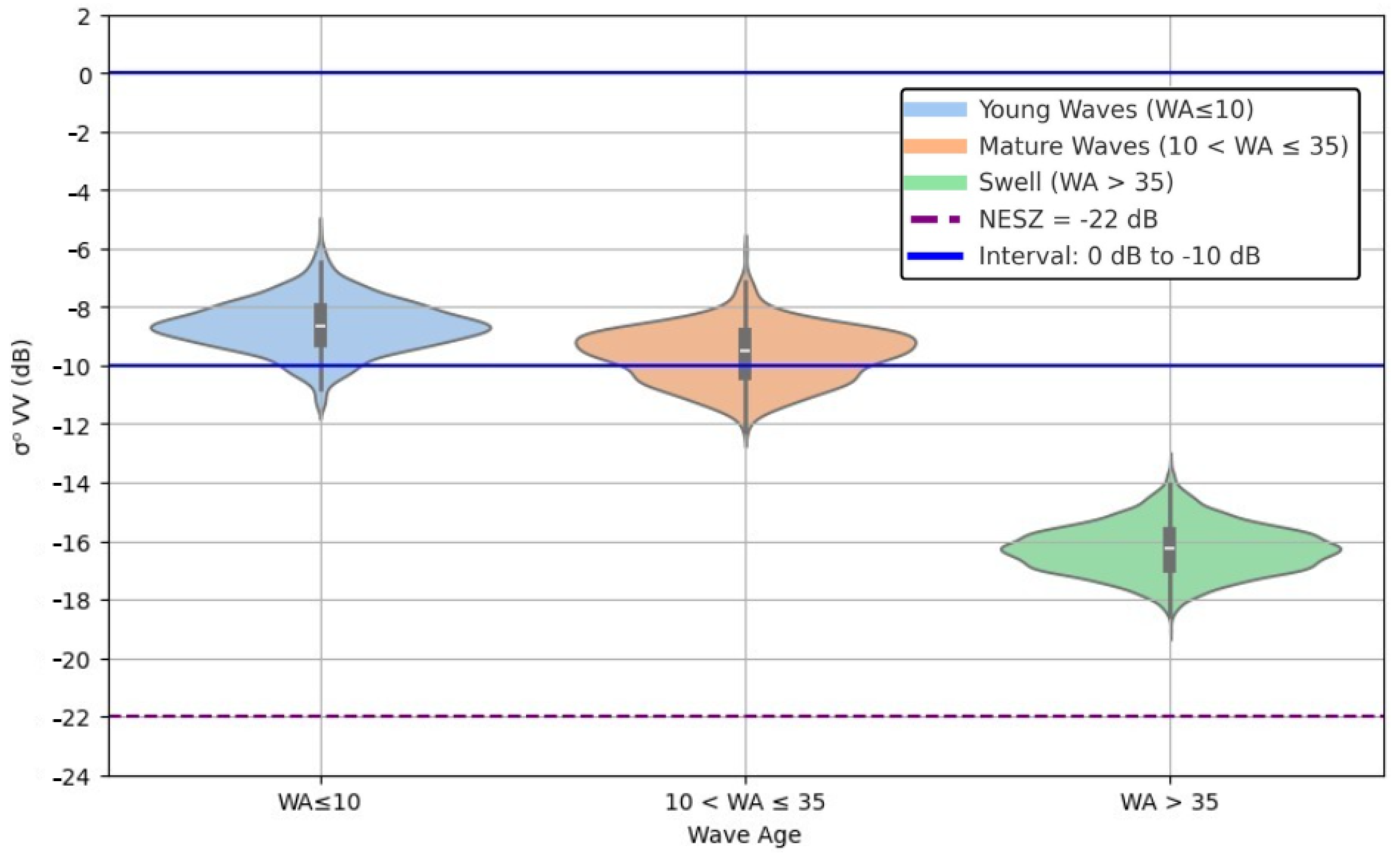
Additionally, a separate set of SAR images that visually presented no vessels was used to statistically isolate marine clutter, thereby avoiding contamination from point targets. The distribution of σ 0 values for each WA regime was visualized using violin plots, allowing the assessment of ocean backscatter variability and its comparison with the average σ 0 levels associated with vessels in the OpenSARShip database. Figure 3 illustrates these distributions, including the sensor’s Noise Equivalent Sigma Zero (NESZ) level and the minimum σ 0 range typically observed for real maritime targets.

3.2. Statistical Analysis of Maximum Backscatter by Vessel Size

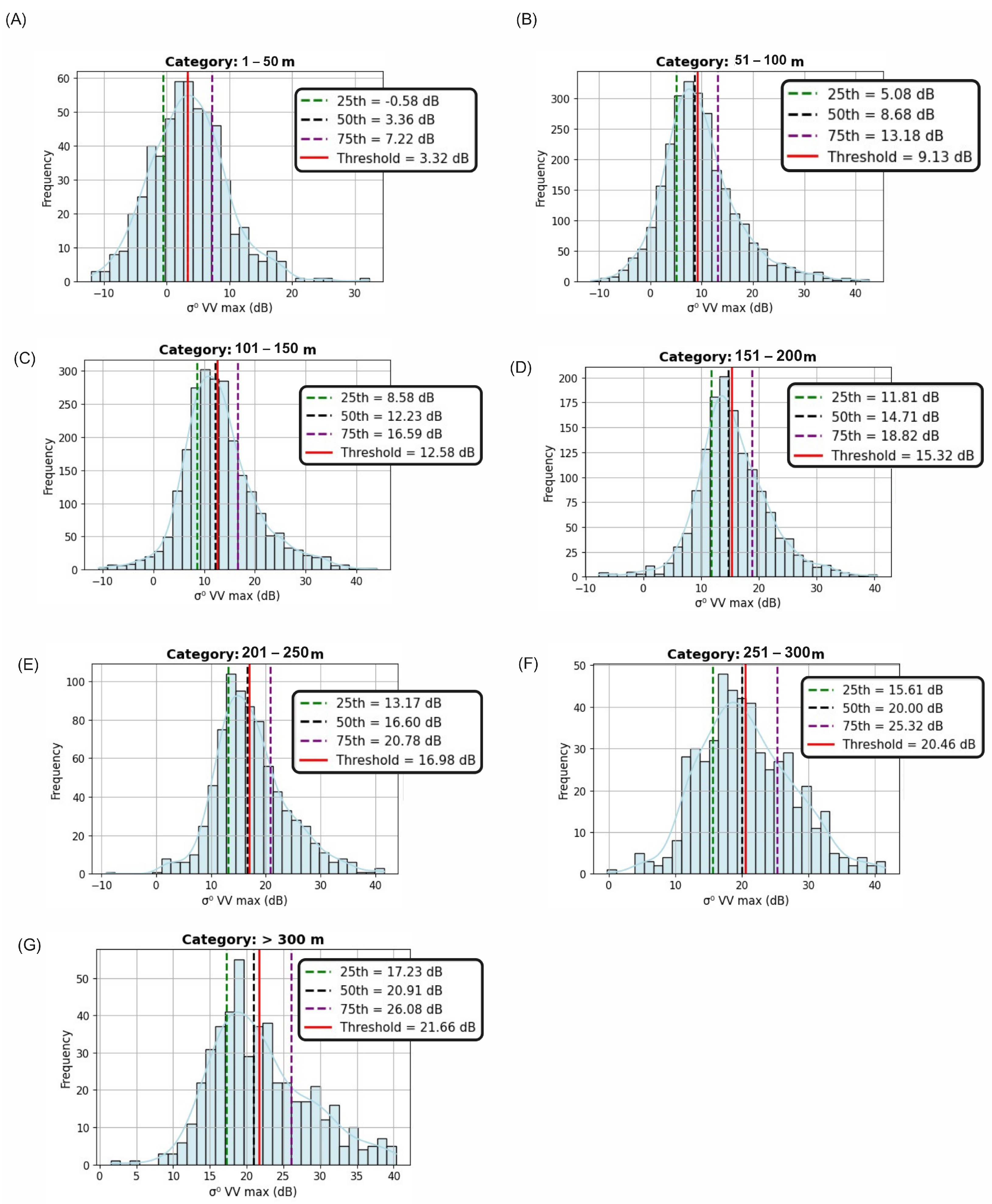
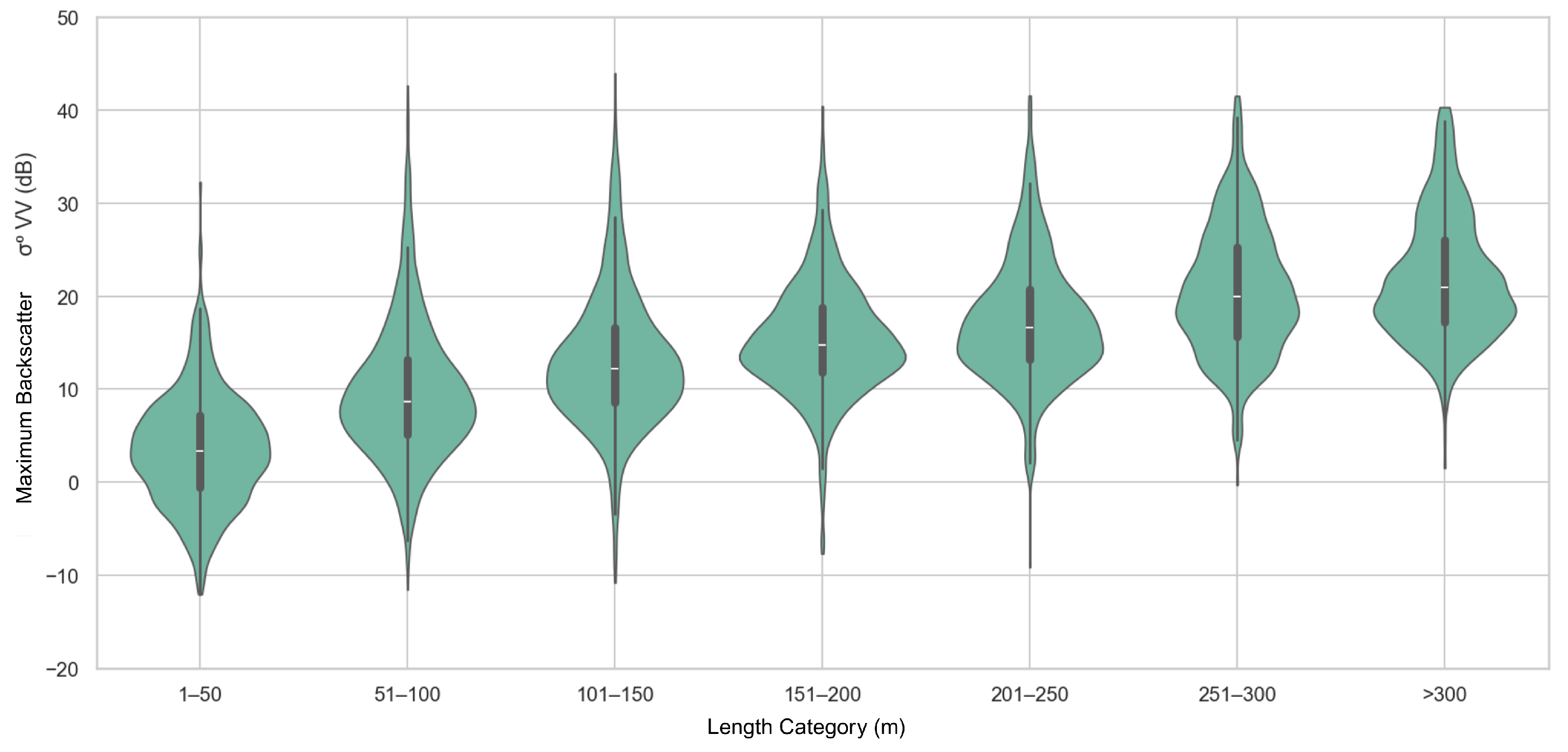
We used the OpenSARShip 2.0 database to investigate the relationship between maximum backscatter ( σ 0 ) and vessel size. For each length range, we calculated the statistical distributions of σ 0 (in dB) and defined conservative thresholds for each category. Figure 4 shows the smoothed histograms, which highlight the shift of the distributions toward higher σ 0 values as vessel size increases. Complementarily, the violin plots Figure 5 emphasize this same trend more clearly, illustrating how the dispersion of σ 0 values decreases for larger vessels, while smaller ones exhibit greater variability. This direct relationship between the two representations confirms that an increase in vessel size is associated with a higher RCS and more concentrated distributions.
To define rapid thresholds for each vessel length category, we conducted a detailed analysis of the statistical distributions of σ 0 . The thresholds were determined based on the interquartile range (IQR) of each class, taking into account the data dispersion and adjusting the limits to include most true targets while simultaneously reducing false positives. The P 25 and P 75 percentiles were used as references to characterize the extremes of the distribution, and the final thresholds were defined by the average of P 25 and P 75 , ensuring consistency across categories. This strategy seeks to balance detection sensitivity and false alarm control, making the thresholds suitable for operational applications.
The Table 1 presents the statistical descriptors obtained (including P 25 , median, P 75 , IQR, and the proposed thresholds), as well as the number of vessel samples in each class. These results provide the foundation for the rapid detection approach evaluated in the following sections and are directly related to the histograms in Figure 4 and the violin plots in Figure 5, which illustrate the distribution patterns that justify the adopted thresholds.

3.3. Overall Algorithm Performance

The pure CFAR–G Γ D achieved the highest performance in Recall (87.4%) and F1-score (73.55%), detecting the largest number of true targets. However, this came at the cost of the highest computational time, with an average execution time of 148 s per image (Intel® Core i9-10850K CPU—10 cores, 20 threads). The Hybrid CFAR–G Γ D yielded similar detection performance (Recall = 86.6%) but with a drastically reduced execution time—only 8.4 s on average (18× faster)—while maintaining high precision and the lowest FAR (0.0021 per km2, or about 1 false target for each 476 km2), meaning that it presents the best trade-off between robustness and efficiency. The RT and ART methods were the fastest (0.34 s and 1.2 s, respectively), but showed lower Recall, particularly for low-contrast targets. Among them, ART outperformed RT in Recall (74% vs. 52.8%), although this improvement came with a higher number of false positives, increasing the FAR to 0.0035 per km2; 1 FA for each 285 km2.
Table 2 and Table 3 detail the metric values for each algorithm, while Figure 4 visually presents the average execution times, highlighting the clear gradient of algorithmic complexity.
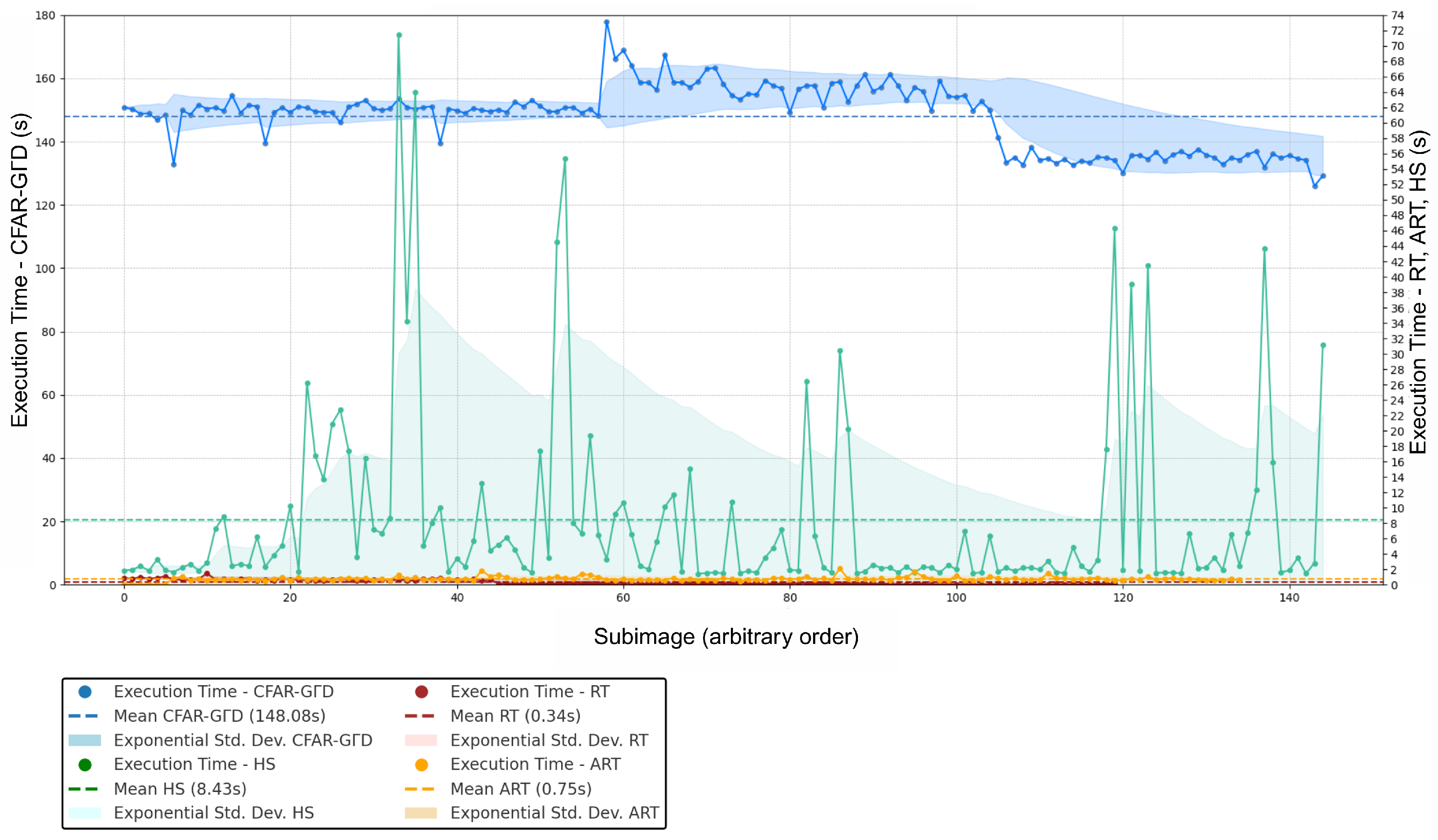
Figure 6 shows the average execution times for the four detection algorithms. A clear gradient of computational complexity is observed: CFAR–G Γ D is the slowest (approximately 150 s), followed by the Hybrid approach (approximately 8 s), while RT and ART operate under 2 s, with RT being nearly instantaneous.
The algorithm results stratified by Wave Age (WA) categories are presented in Table 4 and Table 5. In the Young Wave (YW) scenario, the ART algorithm produced the highest number of detections (120), followed by CFAR–G Γ D (104), Hybrid (92), and RT (76). In Mature Waves (MWs), ART again yielded the most detections (287), followed by RT (168), Hybrid (170), and CFAR–G Γ D (171). For Swell conditions (S), ART also led (36), followed by CFAR–G Γ D (40), Hybrid (38), and RT (16).
In terms of performance metrics, under Young Wave (YW) conditions, CFAR–G Γ D and the Hybrid approach achieved the highest Recall (87.5%) and F1-score (52.6%), while RT showed the highest Precision (30.4%). In Mature Waves (MWs), CFAR–G Γ D and the Hybrid method yielded the highest F1-scores (84.1% and 84.0%, respectively), with Precision values exceeding 81%. In Swell conditions (S), Recall reached 100% for both CFAR–G Γ D and Hybrid; however, Precision remained below 19%, resulting in F1-scores under 32% for all methods.
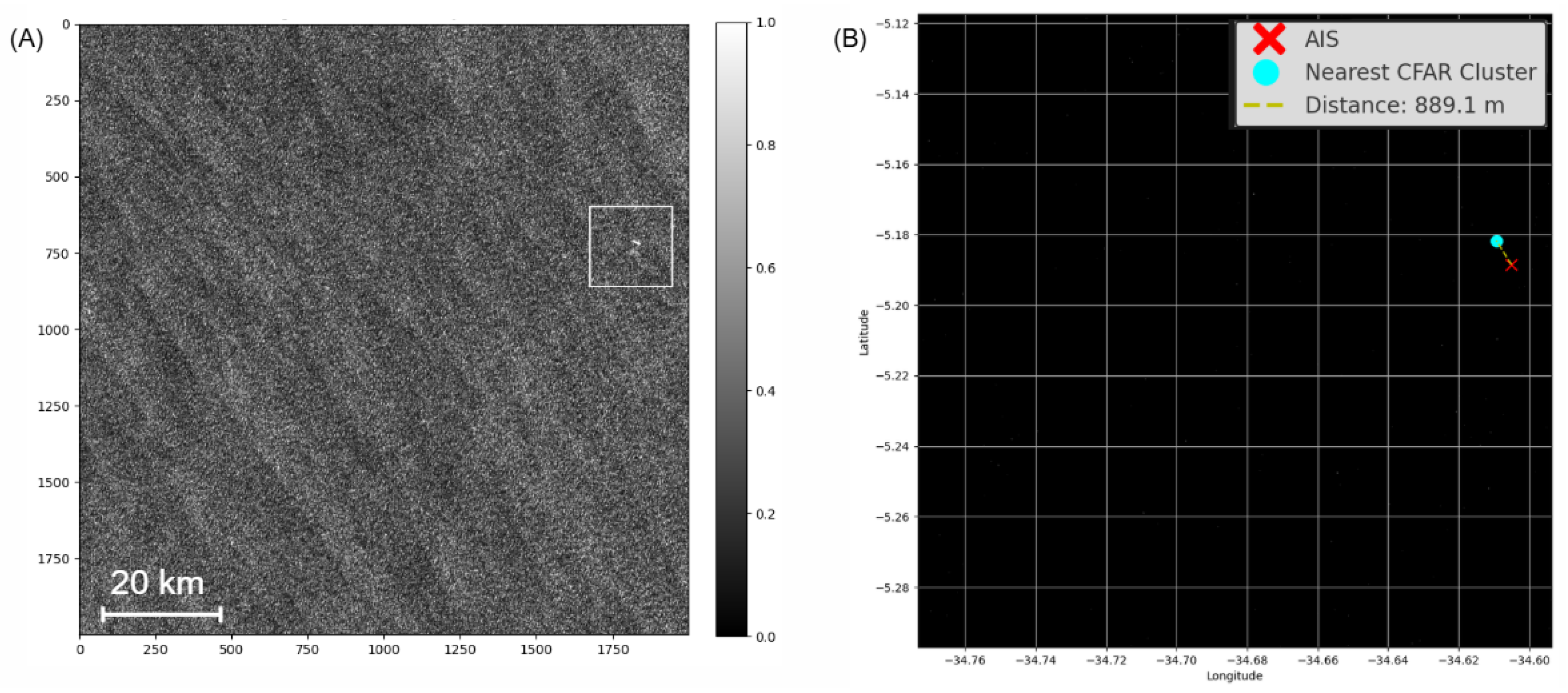
Detection validation was conducted using Sentinel-1A IW GRDH imagery (product B36D), acquired on 29 August 2019 at 08:01 UTC, in the coastal region of NE Brazil. In this scene, a direct spatial match was observed between the detected SAR cluster and the AIS record of the vessel ELENA (IMO 9336880), a bulk carrier measuring 225 m in length and 32 m in width, sailing under the flag of the Bahamas. The AIS data, obtained from the SISTRAM system of the Brazilian Navy, indicated a registered position at 07:59 UTC with a speed of 14 knots. This resulted in a spatial offset of approximately 889 m relative to the centroid of the SAR cluster—fully consistent with the vessel’s displacement over the 2 min interval between the AIS and SAR acquisitions. Figure 7 illustrates this validated detection, showing the spatial overlay of the AIS position (marked with a red “X”) and the detected SAR (CFAR–G Γ D) cluster (cyan circle), confirming the geospatial accuracy of the detection.
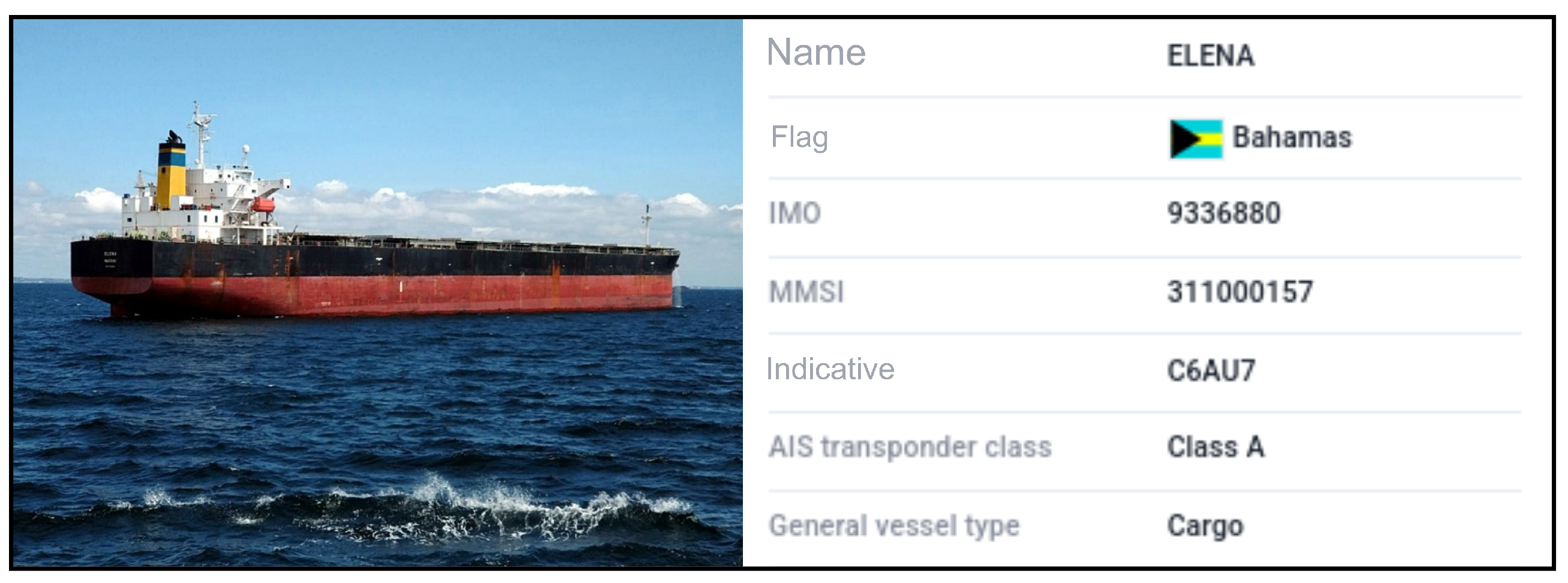
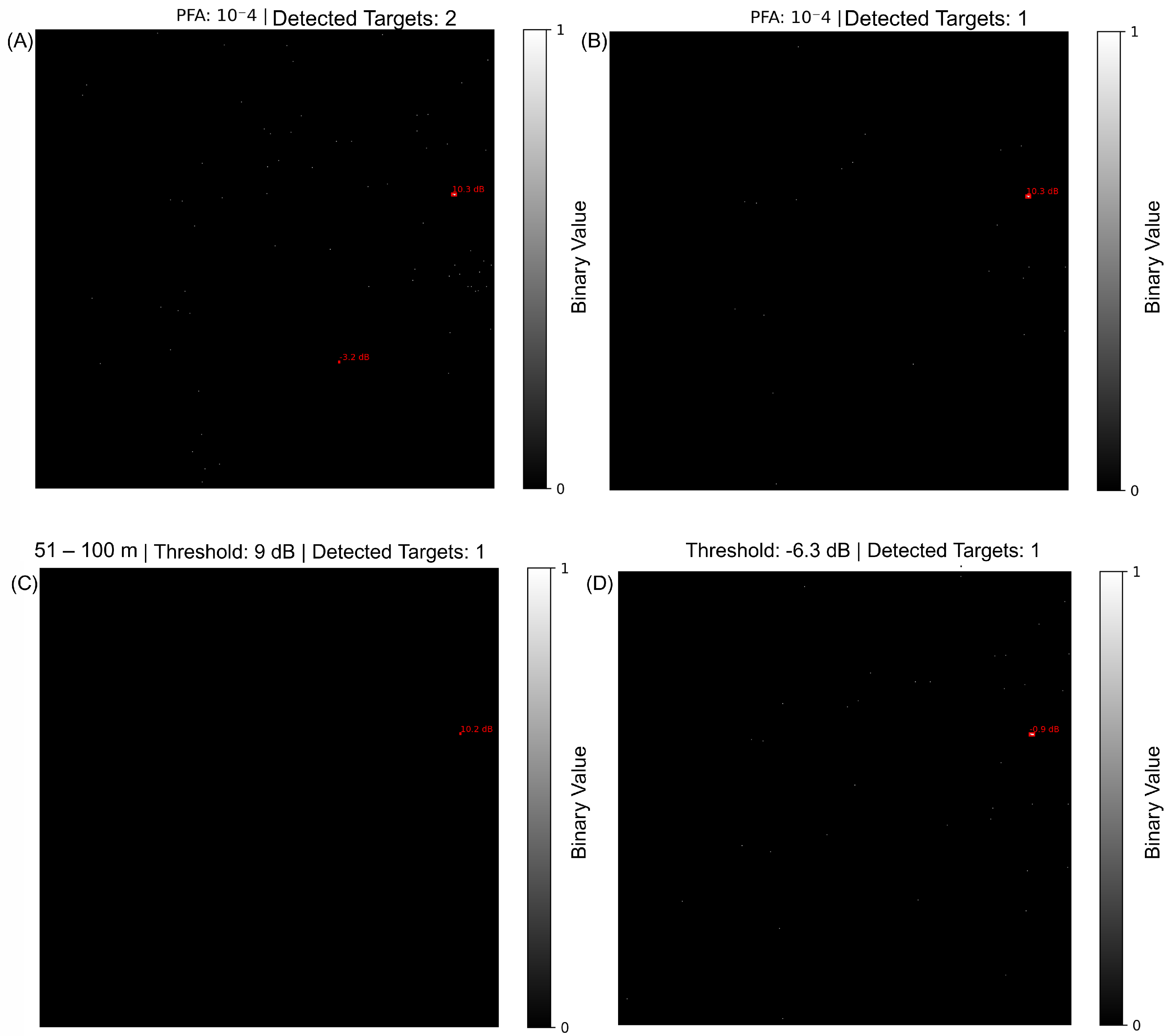
In the SAR image, the maximum backscatter associated with the target was approximately 10 dB, a high value characteristic of large metallic vessels. Figure 8 presents the details of the AIS record for the vessel ELENA (IMO 9336880), a bulk carrier measuring 225 m in length and 32 m in width, sailing under the flag of the Bahamas. All detection algorithms applied in this study successfully identified this target: CFAR–G Γ D, HS, RT and ART. A visual comparison of the binary masks generated by each method for the same scene is shown in Figure 9.
The CFAR–G Γ D algorithm detected two targets—only one of which matched the AIS record—indicating the occurrence of a false alarm. In contrast, the HS successfully eliminated the false positive and retained only the actual target, demonstrating greater robustness. The fixed-threshold methods (RT and ART) also correctly detected the cluster corresponding to the vessel ELENA, showing that vessels with high radar signatures can be identified even by simpler and more computationally efficient algorithms.

3.4. Estimation of Vessel Length from σ 0 Clusters

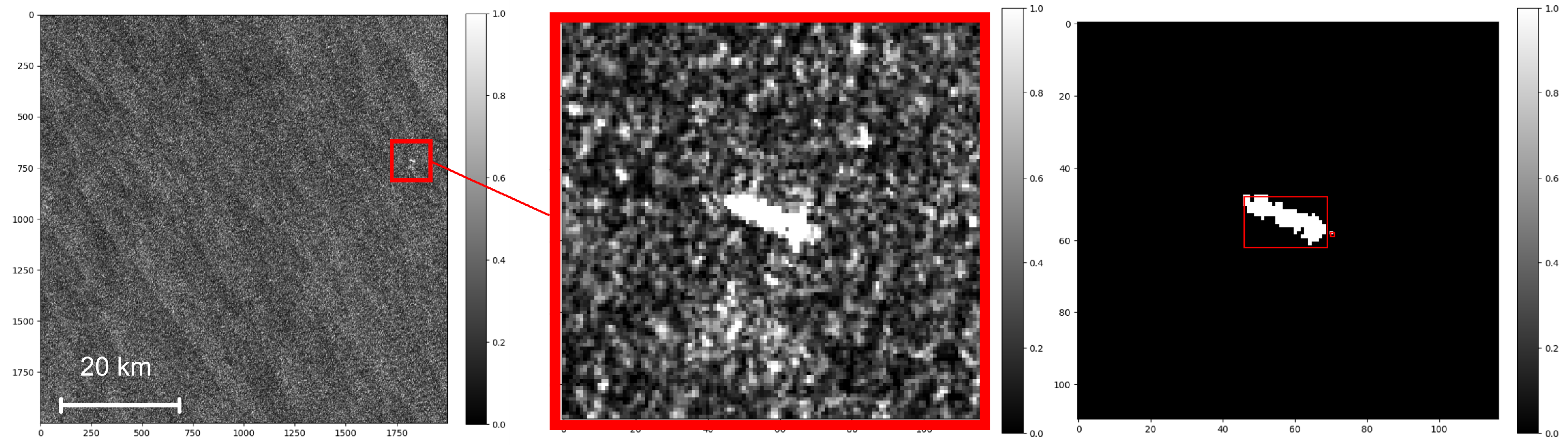
Vessel length estimation was performed based on the maximum σ 0 value observed within the SAR-detected clusters. The empirical model applied was a nonlinear relationship between σ 0 and length, defined as y = a L b + c , initially yielding a coefficient of determination of R 2 = 0.3062 [9,14] when applied to SAR image data. With the inclusion of 200 calibrated samples from the OpenSARShip 2.0 database [8], this value increased to R 2 = 0.412 . For a subset of 50 detected targets in the present study, the R 2 remained moderate, confirming the trend of correlation. In real-world examples validated by AIS data, such as the vessels Norgas Trader (119 m), Grand Sapphire (199 m), and Harmen Oldendorff (225 m), the automatic length estimates showed moderate relative error and good agreement with manual measurements taken from Sentinel-1A SAR imagery (10 m resolution) [12,14]. Figure 10 illustrates this procedure, in which the detected cluster extended across 20 pixels, corresponding to a manual length measurement of 200 m, while the automatic estimate yielded 192 m. Additionally, the conversion of σ 0 into RCS in dB·m2 was performed. For example, a cluster with σ 0 = 10 dB corresponds to an RCS of 30 dB·m2, which is consistent with the expected radar signature of medium to large-sized vessels.

4. Discussion

4.1. Comparison of Algorithms in the Context of the State of the Art

Vessel length estimation was performed based on the maximum σ 0 value observed within the SAR-detected clusters. The comparative evaluation of the four analyzed algorithms revealed distinct performance profiles, with direct implications for their operational application. CFAR–G Γ D demonstrated the highest Recall (87.4%), confirming its robustness in target detection, a result consistent with previous studies that highlight the efficiency of more flexible statistical models, such as the Generalized Gamma Distribution, for heterogeneous ocean environments [4,6,7]. However, the high computational cost for large scenes limits the use of this method in near real-time operational applications or large-scale processing, as previously emphasized by [3,15].
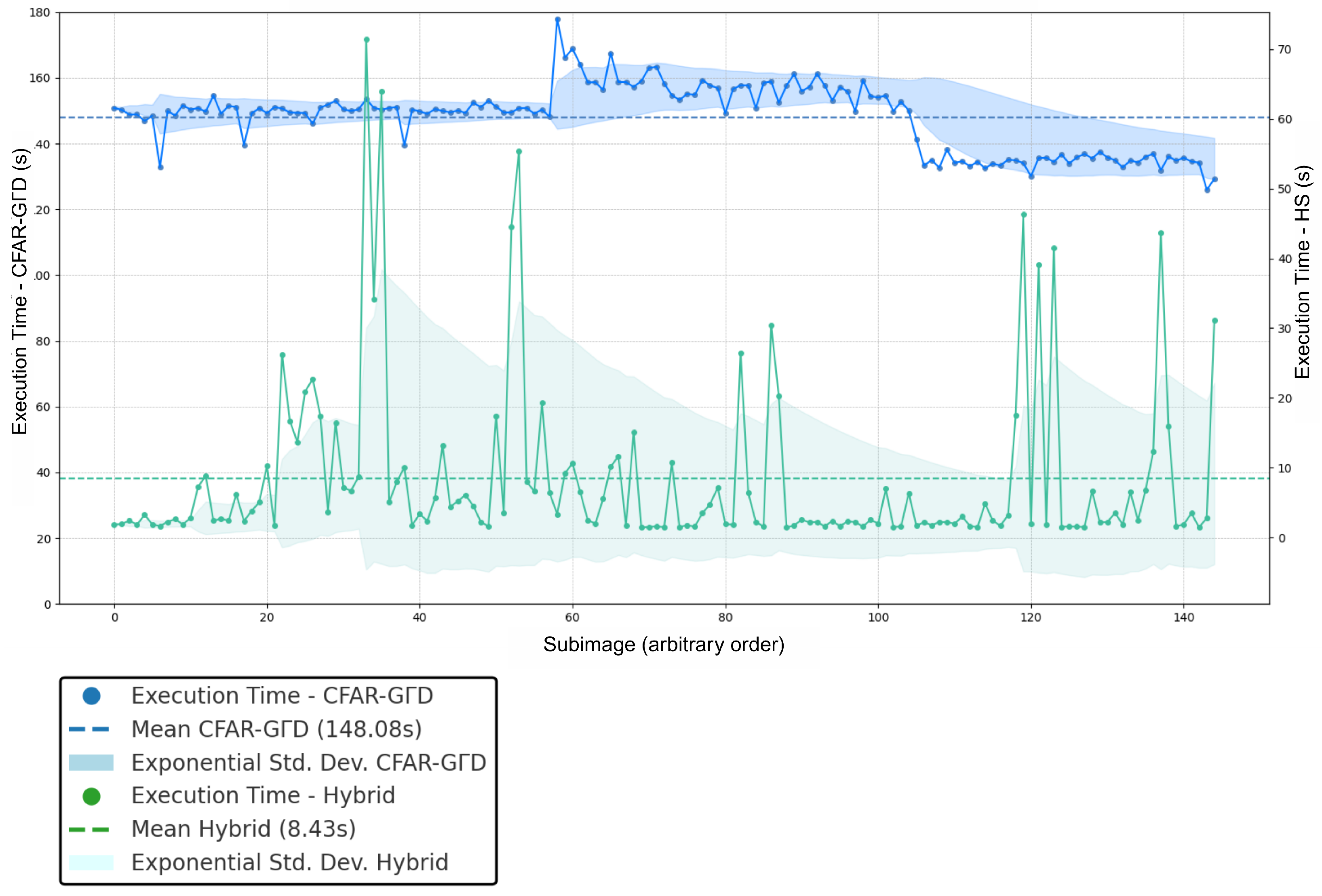
The proposed HS, which combines fast thresholding with the selective application of CFAR–G Γ D, achieved performance similar to that of the full method (Recall = 86.6%; F1-score = 74.8%) while reducing execution time by a factor of 18. This result demonstrates that the HS approach addresses the demand for operational solutions that reconcile high accuracy with computational efficiency, aligning with current trends in onboard detection and dynamic maritime traffic monitoring [16,17]. Figure 11 illustrates the comparison of execution times for CFAR–G Γ D and HS processing in 147 subimages ( 667 × 667 pixels) under different WA conditions. The average execution times of the CFAR–G Γ D and HS algorithms were 148 s and 8.4 s, respectively.
In addition to the results shown in Figure 11, a full Sentinel-1 IW scene corresponds to an area of approximately 250 × 250 km (≈62,500 km2). In our workflow, each full image was divided into 20 × 20 km (400 km2) sub-images, resulting in 156 tiles to be processed per scene. The CFAR–G Γ D algorithm required about 150 s (2.5 min) per sub-image on our system, whereas the proposed HS algorithm reduced this time by a factor of ∼18, to approximately 8 s per sub-image. Consequently, processing a full Sentinel-1 IW scene using the conventional CFAR approach would take roughly 6.5 h, while the HS algorithm completes the same task in about 21 min. This represents a highly significant reduction in execution time, regardless of the computational infrastructure used, confirming that the hybrid approach provides a practical pathway toward near-real-time processing and large-scale operational implementation. In practical terms, this means that the method can be executed continuously and automatically, processing large volumes of SAR data immediately after their reception, without relying on high-performance computational infrastructure.
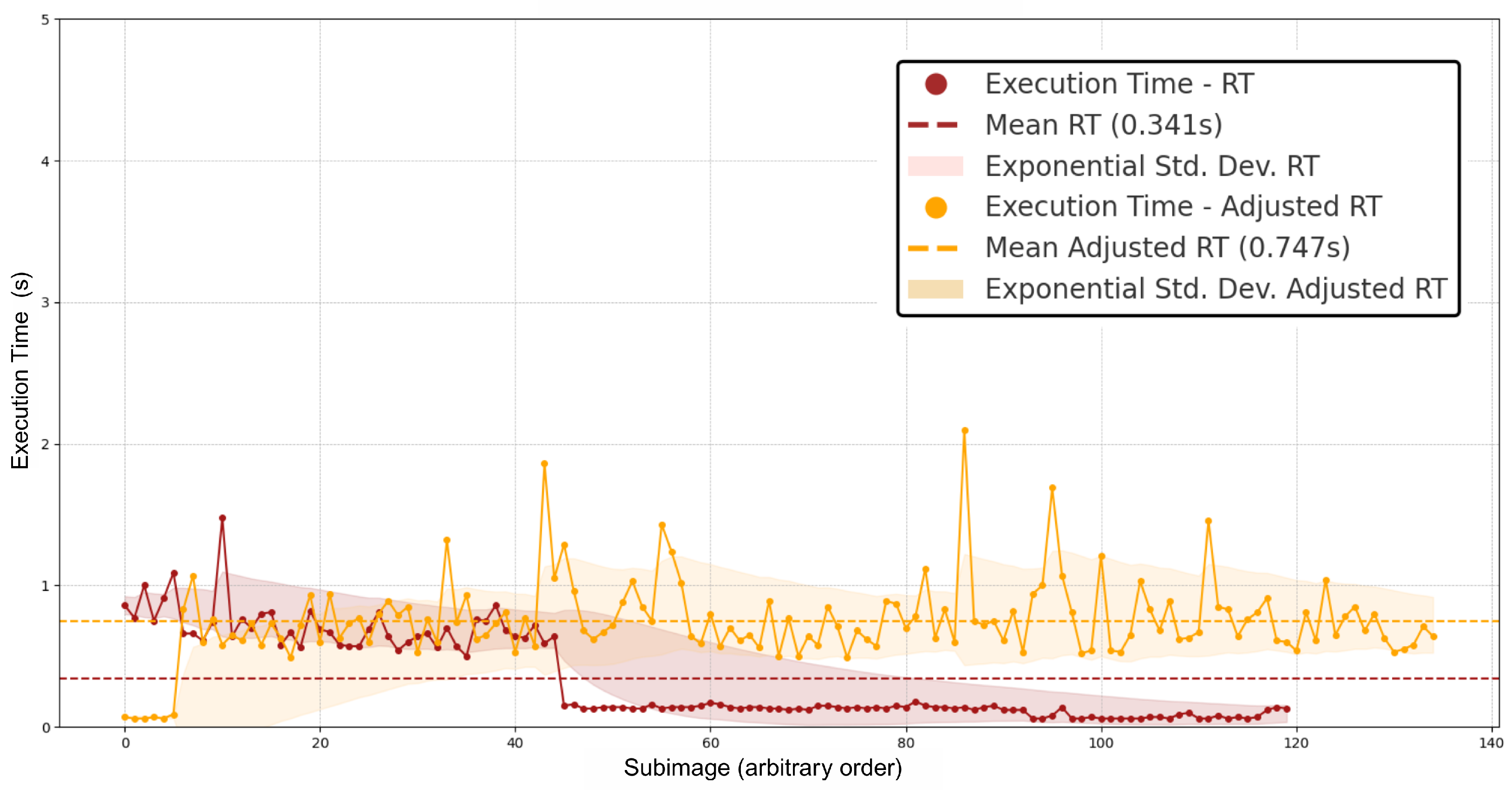
The RT method stood out for its low execution time (0.34 s per subimage), enabling initial screening and pre-filtering applications. However, its reduced Recall (52.8%) limits the detection of small targets or targets in areas with high clutter. The ART showed a 21% increase in Recall compared to RT, but at the cost of a high FAR (0.0035/km2). This behavior reflects a well-known trade-off between sensitivity and false alarm control, as previously discussed by Ref. [3]. Figure 12 illustrates the comparison of execution times for AFT and FT processing in subimages ( 667 × 667 pixels) under different WA conditions.
Overall, the results indicate that none of the evaluated algorithms is universally superior; each one presents specific advantages depending on the operational context. CFAR-G Γ D is recommended when the priority is to maximize detection, even at a high computational cost. The HS balances performance and scalability; CFAR-G Γ D maximizes detection; RT is useful as a fast pre-filter; and ART is suitable only when higher sensitivity is required.

4.2. Application of Thresholds by Vessel Length Class

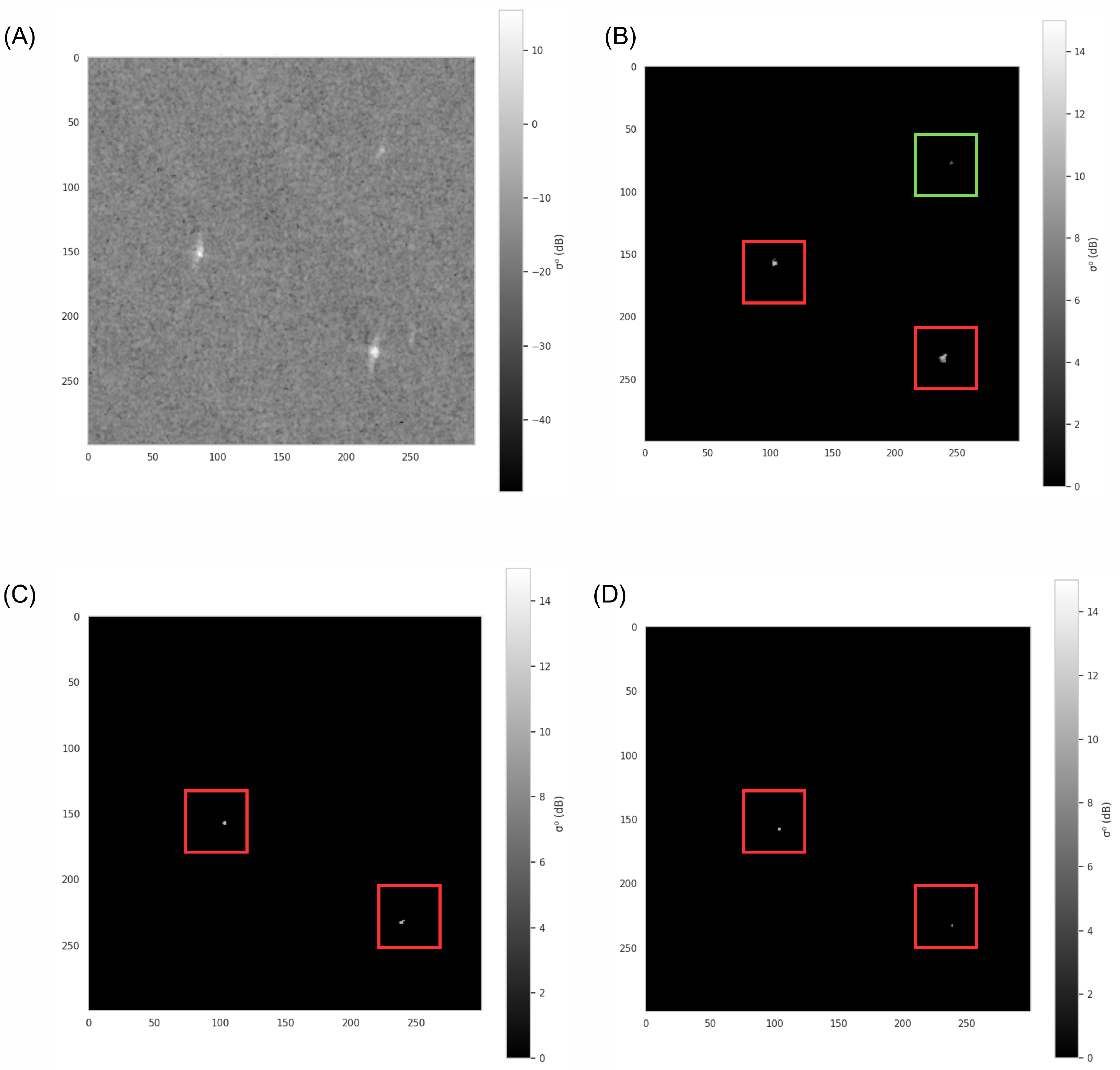
The direct application of thresholds derived from the OpenSARShip database [8], as illustrated in Figure 13, exhibited consistent behavior with the assumption that larger vessels tend to produce higher σ 0 backscatter values [9,18]. It can be observed that the targets highlighted by the red boxes remain visible even under high threshold levels (9 and 12 dB), suggesting that these regions exhibit σ 0 values compatible with vessels longer than 100 m.
As the applied threshold increases (from 3 dB to 12 dB), the pixel intensities in these categories progressively decrease, eventually reaching a point where targets are no longer detectable. This behavior reinforces the hypothesis that these targets exhibit backscatter values close to the 12 dB threshold, and are therefore consistent with vessels in the 101–150 m length category. In contrast, the green box (Figure 13B) highlights a target that becomes visible at a 3 dB threshold but disappears when the threshold is raised to 9 dB (Figure 13C). This indicates that the σ 0 value of this target lies between 3 and 9 dB, which is compatible with smaller vessels, likely in the 51–100 m range or even shorter.
These results confirm that the proposed radiometric thresholds are selective with respect to vessel size, enabling not only detection but also an initial inference of target length, even under swell conditions. This radiometric discrimination capability proves particularly valuable as a rapid preliminary screening step, enabling the prioritization of targets with a higher likelihood of being real vessels based solely on their σ 0 signature [9,18]. It represents a strategic asset in maritime monitoring scenarios with the partial or complete absence of cooperative data, such as AIS, thereby enhancing the autonomy and effectiveness of SAR-based surveillance systems.

4.3. Contributions to the Advancement of SAR-Based Ship Detection

The results obtained in this study highlight three main contributions to the advancement of automatic ship detection systems using SAR:
  • Integration of physical and statistical data: The combination of σ 0 statistics derived from OpenSARShip with environmental parameters (WA) improves algorithm performance without the need for complex models.
  • Operational efficiency: The Hybrid Strategy emerges as a viable alternative for near real-time monitoring, with potential for deployment in operational platforms.
  • Preliminary vessel size estimation: The proposed radiometric thresholds allow for the inference of the approximate size of vessels without exclusive reliance on AIS, providing a strategic advantage for non-cooperative monitoring.
These improvements are aligned with the works of [4,16,17], by strengthening the detection of non-cooperative vessels and encouraging the use of Hybrid approaches for greater coverage and scalability. In addition, as highlighted by [19,20], the importance of properly modeling clutter and considering the persistence of SAR information in operational scenarios is emphasized. Thus, this study consolidates a methodological foundation that combines statistical rigor, practical efficiency, and strategic value, paving the way for future investigations with different sensors and polarizations.
Although the results demonstrate advances, the study also highlights challenges such as the computational cost of CFAR–G Γ D and limited validation with AIS data. Based on these findings, the following perspectives stand out:
  • Integration with neural networks for reducing false positives and enabling adaptive post-classification, leveraging advances in ATR and CNNs applied to SAR [21], as well as pre-screening and efficient candidate validation approaches [22].
  • Transfer of the proposed thresholds to SAR sensors operating in different bands (X, L) and acquisition modes, supported by more robust and computationally efficient statistical estimators for the Gamma Distribution [7].
  • Incorporation of additional environmental variables, such as wind speed, sea state, and incidence angle, for dynamic threshold adjustment, broadening adaptability to heterogeneous ocean conditions.
  • GPU parallelization and optimized architectures for large-scale applications and near real-time monitoring, significantly reducing execution time.
Qualitative validation using AIS data from the SISTRAM system of the Brazilian Navy, where available, confirmed the spatial correspondence between detections and real vessels, strengthening the reliability of the methods. Additionally, the relationship between maximum backscatter (in dB·m2) and target length followed a logarithmic growth trend, with R 2 values between 0.31 and 0.41, supporting the proposed derivation of length-specific thresholds. However, this study faced noteworthy limitations: AIS validation was restricted to a single scene; although statistically sound, CFAR–G Γ D produced false positives in heterogeneous seas; and its computational cost still poses challenges for near-real-time scalability.

5. Conclusions

This study compared four approaches currently used for vessel detection using Sentinel-1 SAR imagery along the northeastern coast of Brazil: Rapid Thresholding (RT), Adjusted Rapid Thresholding (ART), CFAR–G Γ D, and a Hybrid Strategy that integrates RT and CFAR–G Γ D. The main innovation was the use of backscatter statistics from the OpenSARShip 2.0 database that allowed the determination of adaptive radiometric thresholds, serving both as a fast detection alternative and as support for CFAR-based methods.
The results revealed clear distinctions between the methods. The Hybrid Strategy stood out as the best compromise solution, reducing execution time by approximately 18 times, while maintaining detection performance comparable to pure CFAR, and achieving a lower FAR (0.0021/km2). The RT strategy was the fastest (0.34 s per subimage) and achieved the lowest false alarm rate (FAR = 0.0019/km2), but showed limited sensitivity, making it useful only as a preliminary filter. ART improved Recall by 21% over RT by adapting to ocean clutter, but had the highest FAR (0.0035/km2). CFAR–G Γ D proved to be the most robust in terms of detection, capturing all visible targets, including those missed by simple thresholding, yet it incurred a high computational cost (∼150 s per subimage) and was prone to false positives in noisy sea conditions.
In operational terms, the findings of this study reinforce that SAR-based vessel detection does not rely on a single algorithmic paradigm but benefits from the complementarity between classical radiometric thresholds and adaptive statistical models. The Hybrid Strategy exemplifies this balance by combining rapid detection with computational efficiency, meeting a key requirement for large-scale monitoring and near real-time applications. By integrating prior knowledge from open datasets such as OpenSARShip, with/without adaptive clutter modeling, the methodology contributes to the development of scalable maritime surveillance systems that remain effective in the absence of cooperative data such as AIS.
Based on these findings, the following future developments are proposed: (i) integration with neural networks for post-classification and false positive reduction; (ii) evaluation of threshold transferability using data from other SAR sensors; (iii) incorporation of additional environmental variables (wind, incidence angle geometry) into CFAR adjustment; (iv) expansion of validation using complete AIS time series; and (v) GPU-based parallelization to enable large-scale operational use.

Author Contributions

Conceptualization, O.D.d.N.F. and J.A.L.; methodology, O.D.d.N.F. and J.A.L.; software, O.D.d.N.F.; validation, O.D.d.N.F., J.A.L., D.X.B. and R.L.P.; formal analysis, O.D.d.N.F. and J.A.L.; investigation, O.D.d.N.F.; resources, J.A.L. and D.F.M.G.; data curation, O.D.d.N.F.; writing—original draft preparation, O.D.d.N.F.; writing—review and editing, J.A.L., D.F.M.G., D.X.B. and R.L.P.; visualization, O.D.d.N.F.; supervision, J.A.L. and D.F.M.G.; project administration, J.A.L.; funding acquisition, J.A.L. All authors have read and agreed to the published version of the manuscript.

Funding

This research was financed by the project “Development of a multi-user system for detection, forecasting, and monitoring of oil spills at sea—SisMOM”, proposed by the Instituto Nacional de Pesquisas Espaciais (INPE) and funded with resources from the Fundo Nacional de Desenvolvimento Científico e Tecnológico (FNDCT) through the Financiadora de Estudos e Projetos (FINEP), and managed by the Fundação de Ciência, Aplicações e Tecnologia Espaciais (FUNCATE).

Data Availability Statement

Data supporting the findings of this study are available from the authors upon reasonable request. The OpenSARShip 2.0 dataset is publicly accessible at https://opensar.sjtu.edu.cn/project.html (accessed on 29 October 2025). No new proprietary data were generated.

Acknowledgments

This work was supported by the The authors thank the SisMOM project teams for their technical support and contributions throughout this study. The authors also acknowledge the Coordenação de Aperfeiçoamento de Pessoal de Nível Superior (CAPES)—Finance Code 001 (grant No. 88887.829773/2023-00) for providing graduate scholarship support.

Conflicts of Interest

The authors declare no conflicts of interest. The funders had no role in the design of the study; in the collection, analyses, or interpretation of data; in the writing of the manuscript; or in the decision to publish the results.

References

  1. Hu, Y.; Li, Y.; Pan, Z. A Dual-Polarimetric SAR Ship Detection Dataset and a Memory-Augmented Autoencoder-Based Detection Method. Sensors 2021, 21, 8478. [Google Scholar] [CrossRef] [PubMed]
  2. Luo, C.; Zang, Y.; Guo, J.; Hu, Y.; Zhou, G.; You, H.; Ning, X. SAR-CDSS: A Semi-Supervised Cross-Domain Object Detection from Optical to SAR Domain. Remote Sens. 2024, 16, 940. [Google Scholar] [CrossRef]
  3. El-Darymli, K.; McGuire, P.; Power, D.; Moloney, C. Target Detection in Synthetic Aperture Radar Imagery: A State-of-the-Art Survey. J. Appl. Remote Sens. 2013, 7, 071598. [Google Scholar] [CrossRef]
  4. Bezerra, D.X.; Lorenzzetti, J.A.; Paes, R.L. Marine Environmental Impact on CFAR Ship Detection as Measured by Wave Age in SAR Images. Remote Sens. 2023, 15, 3441. [Google Scholar] [CrossRef]
  5. Hersbach, H.; Bell, B.; Berrisford, P.; Hirahara, S.; Horányi, A.; Muñoz-Sabater, J.; Nicolas, J.; Peubey, C.; Radu, R.; Schepers, D.; et al. ERA5 Glob. Reanalysis. Q. J. R. Meteorol. Soc. 2020, 146, 1999–2049. [Google Scholar] [CrossRef]
  6. Qin, X.; Zhou, S.; Zou, H.; Gao, G. A CFAR Detection Algorithm for Generalized Gamma Distributed Background in High-Resolution SAR Images. IEEE Geosci. Remote Sens. Lett. 2013, 10, 806–810. [Google Scholar] [CrossRef]
  7. Gao, G.; Ouyang, K.; Luo, Y.; Liang, S.; Zhou, S. Scheme of Parameter Estimation for Generalized Gamma Distribution and Its Application to Ship Detection in SAR Images. IEEE Trans. Geosci. Remote Sens. 2017, 55, 1812–1836. [Google Scholar] [CrossRef]
  8. Li, B.; Liu, B.; Huang, L.; Guo, W.; Zhang, Z.; Yu, W. OpenSARShip 2.0: A Large-Volume Dataset for Deeper Interpretation of Ship Targets in Sentinel-1 Imagery. In Proceedings of the IEEE 2017 SAR in Big Data Era: Models, Methods and Applications (BIGSARDATA), Beijing, China, 13–14 November 2017. [Google Scholar]
  9. Askari, F.; Zerr, B. An Automatic Approach to Ship Detection in Spaceborne Synthetic Aperture Radar Imagery: An Assessment of RADARSAT Ship Detection Capability. In SACLANT Undersea Research Centre Report; SR-338; SACLANT Undersea Research Centre: La Spezia, Italy, 2000. [Google Scholar]
  10. Nobre, P.; Lemos, A.T.; Giarolla, E.; Camayo, R.; Namikawa, L.; Kampel, M.; Rudorff, N.; Bezerra, D.X.; Lorenzzetti, J.; Gomes, J.; et al. The 2019 northeast Brazil oil spill: Scenarios. Ann. Braz. Acad. Sci. 2022, 94, e20210391. [Google Scholar] [CrossRef] [PubMed]
  11. Souza, J. Territorial sea, exclusive economic zone or continental shelf? Braz. J. Geophys. 1999, 17, 79–82. [Google Scholar] [CrossRef]
  12. European Space Agency (ESA). Sentinel-1 Observation Scenario. Available online: https://sentinels.copernicus.eu/copernicus/sentinel-1/acquisition-plans/observation-scenario-archive (accessed on 11 September 2025).
  13. Wei, D.; Du, Y.; Li, L. Target Detection Network for SAR Images Based on Semi-Supervised Learning and Attention Mechanism. Remote Sens. 2021, 13, 2686. [Google Scholar] [CrossRef]
  14. Hajduch, G.; Longépé, N.; Habonneau, J.; Le Bras, J.-Y. Progress in Automatic Ship Detection and Classification. In Proceedings of the SEASAR 2012, Tromsø, Norway, 18–22 June 2012. [Google Scholar]
  15. Crisp, D.J. The State-of-the-Art in Ship Detection in Synthetic Aperture Radar Imagery; Report DSTO-RR-0272; Defence Science and Technology Organisation: Canberra, Australia, 2004. [Google Scholar]
  16. Greidanus, H.; Alvarez, M.; Santamaria, C.; Thoorens, F.-X.; Kourti, N.; Argentieri, P. The SUMO Ship Detector Algorithm for Satellite Radar Images. Remote Sens. 2017, 9, 246. [Google Scholar] [CrossRef]
  17. Vespe, M.; Greidanus, H. SAR Image Quality Assessment and Indicators for Vessel and Oil Spill Detection. IEEE Trans. Geosci. Remote Sens. 2012, 50, 4726–4734. [Google Scholar] [CrossRef]
  18. Vachon, P.W.; Campbell, J.W.M.; Bjerkelund, C.A.; Dobson, F.W.; Rey, M.T. Ship Detection by the RADARSAT SAR: Validation of Detection Model Predictions. Can. J. Remote Sens. 1997, 23, 48–59. [Google Scholar] [CrossRef]
  19. Paes, R.L.; Lorenzzetti, J.A.; Gherardi, D.F.M. Detecção de Alvos na Superfície do Mar em Imagens SAR Orbitais: Verificação de Conceitos. In Proceedings of the XIV Simpósio Brasileiro de Sensoriamento Remoto, Natal, Brazil, 25–30 April 2009; pp. 6619–6626. [Google Scholar]
  20. Falqueto, L.E.; Paes, R.L.; Passaro, A. A Importância de Dados Polarimétricos para Detecção de Alvos Artificiais no Mar Utilizando Imagens SAR. Spectrum 2021, 22, 53–58. [Google Scholar] [CrossRef]
  21. Falqueto, L.E.; Paes, R.L.; Passaro, A. KNN e Rede Neural Convolucional para o Reconhecimento de Plataformas de Petróleo em Imagens SAR do Sentinel-1. Apl. Oper. Áreas Def. 2023, 24, 29–33. [Google Scholar]
  22. Huo, W.; Huang, Y.; Pei, J.; Zhang, Q.; Gu, Q.; Yang, J. Ship Detection from Ocean SAR Image Based on Local Contrast Variance Weighted Information Entropy. Sensors 2018, 18, 1196. [Google Scholar] [CrossRef] [PubMed]
Figure 1. Study area (magenta box) in the northeastern sector of Brazil that includes part of the Brazilian Exclusive Economic Zone (EEZ, light blue).
Remotesensing 17 03891 g001
Figure 2. The workflow devised to test different ship detection algorithms involved: (i) selection and classification of Sentinel-1 SAR image subsets with different wave age (WA); (ii) extraction of statistical σ 0 thresholds from the OpenSARShip 2.0 database; (iii) application of four detection algorithms (RT, ART, CFAR-G Γ D and HS); and (iv) validation of detections using AIS data to calculate accuracy metrics and estimate vessel sizes.
Remotesensing 17 03891 g002
Figure 3. Distributions of σ 0 values for each image classified by Wave Age (WA). NESZ represents the lowest signal level corresponding solely to sensor noise, and the blue horizontal lines indicate the minimum σ 0 range characteristic of vessels.
Remotesensing 17 03891 g003
Figure 4. Histograms of maximum backscatter ( σ 0 max , in dB) for each vessel length category derived from the OpenSARShip 2.0 database. The distributions show a progressive shift toward higher σ 0 values as vessel size increases, reflecting the direct relationship between radar cross section (RCS) and vessel length. Vertical dashed lines indicate the 25th ( P 25 ), 50th ( P 50 ), and 75th ( P 75 ) percentiles, while the solid red line represents the final threshold defined as the average of P 25 and P 75 .
Remotesensing 17 03891 g004
Figure 5. Violin plots of maximum backscatter ( σ max 0 , in dB) for each vessel length category derived from the OpenSARShip 2.0 dataset.
Remotesensing 17 03891 g005
Figure 6. Execution times for the four detection algorithms across all sub-images. The left vertical axis displays the execution time of the CFAR–G Γ D algorithm (blue), while the right axis shows the execution times of HS (green), ART (orange), and RT (red). Solid lines represent the execution time for each sub-image, and the shaded regions denote the exponential standard deviation around the mean value of each method.
Remotesensing 17 03891 g006
Figure 7. Visual detection and binary mask of AIS correspondence in the (A) Sentinel-1A subimage (IW GRDH mode) acquired on 29 August 2019 at 08:01 UTC in the coastal region near the municipality of Touros, Rio Grande do Norte, and in the (B) Binary mask overlay showing the geolocation of the AIS record (red “X” in the image) and the detected cluster (cyan blue circle in the image).
Remotesensing 17 03891 g007
Figure 8. AIS record of the vessel ELENA. Figure displaying identification data (IMO, MMSI, and callsign), transponder type (Class A) a nd vessel type (cargo), as well as flag information (Bahamas), length, and beam. Source: MarineTraffic (2025)).
Remotesensing 17 03891 g008
Figure 9. Comparison of detections in the scene with AIS correspondence. Binary detection masks shown for (A) CFAR-G Γ D, (B) HS, (C) RT, and (D) ART.
Remotesensing 17 03891 g009
Figure 10. Visual detection, zoomed into the region of interest (highlighted by red squares), and binary detection mask of the cluster. On the left is the Sentinel-1A subimage (IW GRDH mode) acquired on 29 August 2019 at 08:01 UTC in the coastal region near the municipality of Touros, Rio Grande do Norte; in the center is a zoomed-in view of the region of interest and on the right is the detected cluster (red rectangle).
Remotesensing 17 03891 g010
Figure 11. Execution time per subimage (667 × 667 pixels) for the CFAR-G Γ D algorithm (blue line) and the Hybrid Strategy (green line), evaluated over 147 subimages under different Wave Age conditions. Shaded areas represent the standard deviation relative to the mean values.
Remotesensing 17 03891 g011
Figure 12. Execution time per subimage (667 × 667 pixels) for the RT algorithm (red line) and the ART algorithm (yellow line), under different Wave Age conditions. Shaded areas indicate the standard deviation relative to the mean values.
Remotesensing 17 03891 g012
Figure 13. Application of direct thresholds based on vessel size categories in a SAR image with targets under swell conditions. (A) SAR image in dB with three target regions; (B) application of the 3 dB threshold (1–50 m); (C) application of the 9 dB threshold (51–100 m); and (D) application of the 12 dB threshold (101–150 m).
Remotesensing 17 03891 g013
Table 1. Proposed threshold (dB) by vessel length category, based on the σ 0 distribution from the OpenSARShip 2.0 database.
Category (m) P 25 (dB)Median (dB) P 75 (dB)IQRProposed Threshold (dB)Number of Vessels
1–50−0.583.367.22[ 0.58 –7.22]3551
51–1005.088.6813.18[5.08–13.18]92610
101–1508.5812.2316.59[8.58–16.59]132376
151–20011.8114.7118.82[11.81–18.82]151417
201–25013.1716.6020.78[13.17–20.78]17780
251–30015.6120.0025.32[15.61–25.32]20508
>30017.2320.9126.08[17.23–26.08]22478
Table 2. Overall detection results for each algorithm. The table includes the total detections, number of true positives (TPs), false positives (FPs), and false negatives (FN), as well as Precision, Recall, F1-score (all in %), and average execution time per image (in seconds).
AlgorithmDetectionsTPFPFNPrecision (%)Recall (%)F1-Score (%)Avg. Time (s)
CFAR–G Γ D3152351353463.587.473.55148.1
HS3002331213665.886.674.88.4
RT2601429012761.252.856.70.34
ART4431991877051.674.060.81.2
Table 3. False alarm analysis for each detection algorithm. The table reports the number of false positives (FPs), number of subimages analyzed, average false alarms per image (FARs), average number of pixels per image, image resolution (m), estimated area per image (km2), total area analyzed (km2), and the resulting false alarm rate per square kilometer (FAR/km2).
AlgorithmFPSubimagesFAR (Per Image)Pixels (Per Image)Resolution (m)Area (km2)Total Area (km2)FAR (km2)
CFAR–G Γ D1351450.93444,88930400.458,0580.0023
HS1211450.83444,88930400.458,0580.0021
RT901200.75444,88930400.448,0480.0019
ART1871321.42444,88930400.452,8520.0035
Table 4. Total detection results by Wave Age category, including the number of detections, true positives (TPs), false positives (FPs), and false negatives (FNs).
AlgorithmWave AgeDetectionsTPFPFN
RTYW76214819
RTMW16811534107
RTS16681
ARTYW120287312
ARTMW2871658757
ARTS366271
CFAR–G Γ DYW10435585
CFAR–G Γ DMW1711934429
CFAR–G Γ DS407330
HSYW9234476
HSMW1701924330
HSS387310
Table 5. Performance by Wave Age (WA) category for the four algorithms (RT, ART, CFAR–G Γ D and Hybrid).
AlgorithmWAPrecision (%)Recall (%)F1-Score (%)
RTYW30.452.538.5
RTMW77.251.862.0
RTS42.985.757.1
ARTYW27.770.039.7
ARTMW65.574.369.6
ARTS18.285.730.0
CFAR–G Γ DYW37.687.552.6
CFAR–G Γ DMW81.486.984.1
CFAR–G Γ DS17.5100.029.8
HSYW37.687.552.6
HSMW81.786.584.0
HSS18.4100.031.1
Disclaimer/Publisher’s Note: The statements, opinions and data contained in all publications are solely those of the individual author(s) and contributor(s) and not of MDPI and/or the editor(s). MDPI and/or the editor(s) disclaim responsibility for any injury to people or property resulting from any ideas, methods, instructions or products referred to in the content.