Evaluation of Multi-Source Satellite XCO2 Products over China Using the Three-Cornered Hat Method and Multi-Reference Comprehensive Comparisons

Highlights
- OCO-series XCO2 products (OCO-2/3) consistently outperform GOSAT and GOSAT-2 across China.
- The Three-Cornered Hat (TCH) proves highly robust for multi-satellite XCO2 uncertainty analysis.
- Clarifying the data-priority direction lays a superior data foundation for accurate CO2 monitoring across China.
- Breaking through the limitations of traditional assessment provides a powerful tool for gaining deeper insights into the reliability of satellite XCO2 products.
Abstract
1. Introduction
2. Materials and Methods
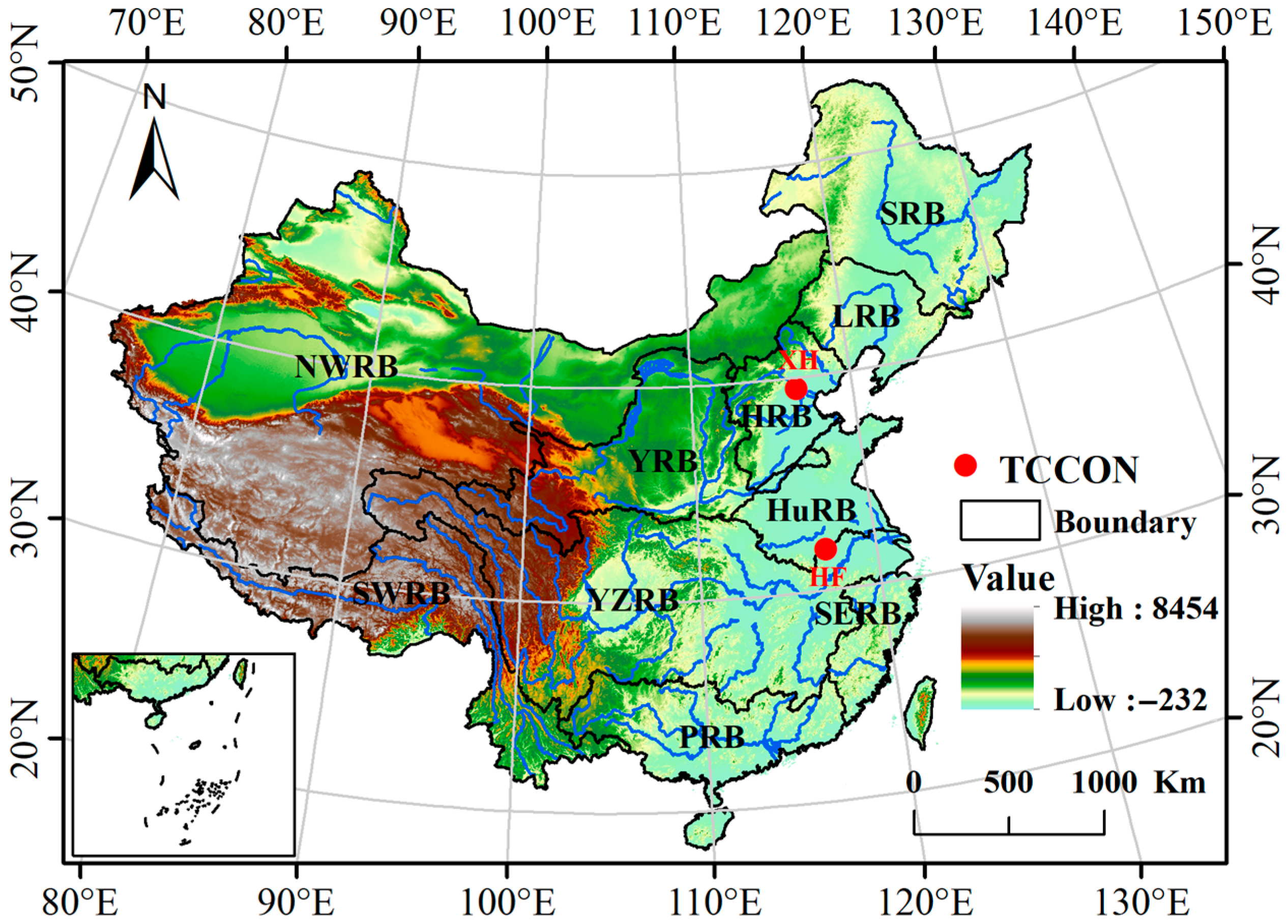
2.1. Study Area
2.2. Datasets
2.2.1. XCO2 Satellite Remote Sensing Products
2.2.2. TCCON Ground Station Observation XCO2
2.2.3. CarbonTracker 2022 Model Data
2.3. Method
2.3.1. Interpolation Method
2.3.2. Uncertainty Quantification and Analysis Method
2.3.3. Data Quality Assessment Indicators
3. Results
3.1. Spatial Coverage Analysis of Four XCO2 Satellites Remote Sensing Products
3.2. Accuracy Analysis of Four Satellites XCO2 Data
3.3. Annual Mean Spatial Distribution and Seasonal XCO2 Increments of Satellite XCO2
3.4. Uncertainty Analysis of Satellite XCO2 Data in Ten Major River Basins of China
4. Discussion
4.1. Analysis of Regional Differences in Satellite XCO2 Observation Data and the Influencing Mechanisms of Retrieval Accuracy
4.2. Validation of Multi-Satellite XCO2 Data Accuracy and Analysis of the Causes of Regional Discrepancies
4.3. Applicability of the TCH Method to Satellite XCO2 Data
4.4. Spatial Representativeness Limitation of Single-Station Validation and Its Impact on Conclusion Robustness
5. Conclusions
- (1)
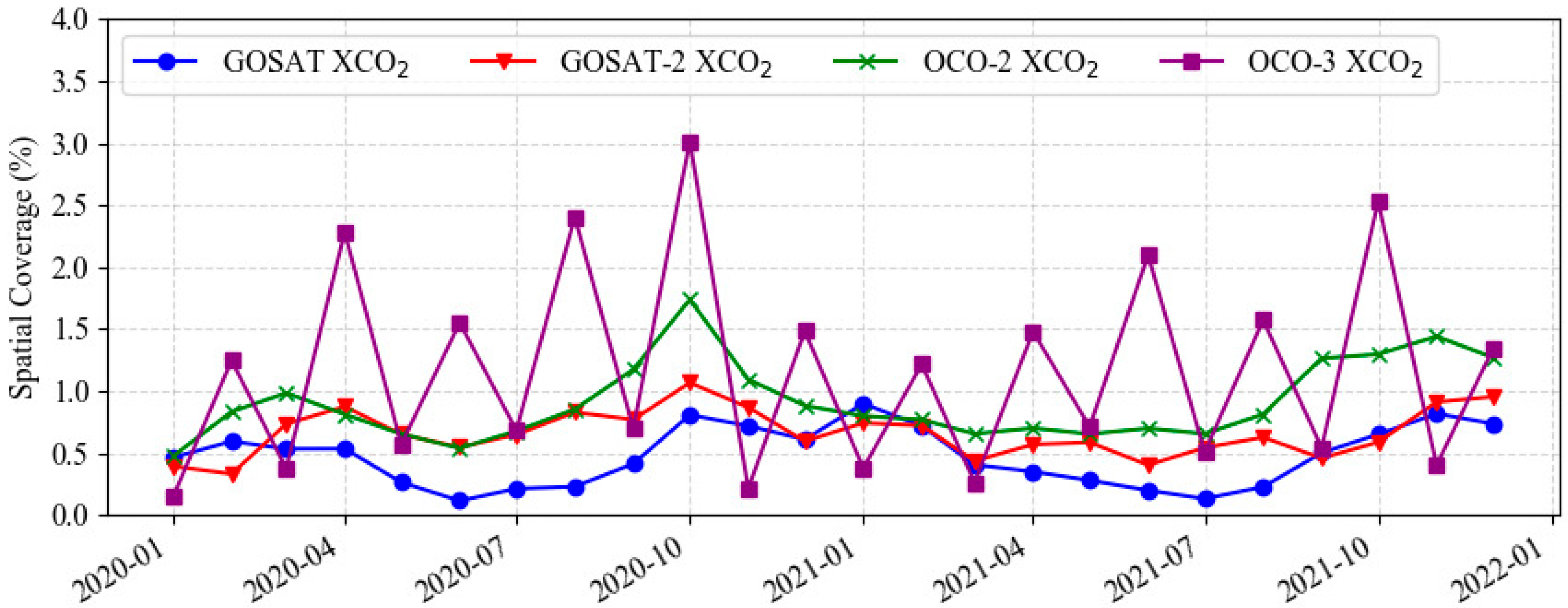
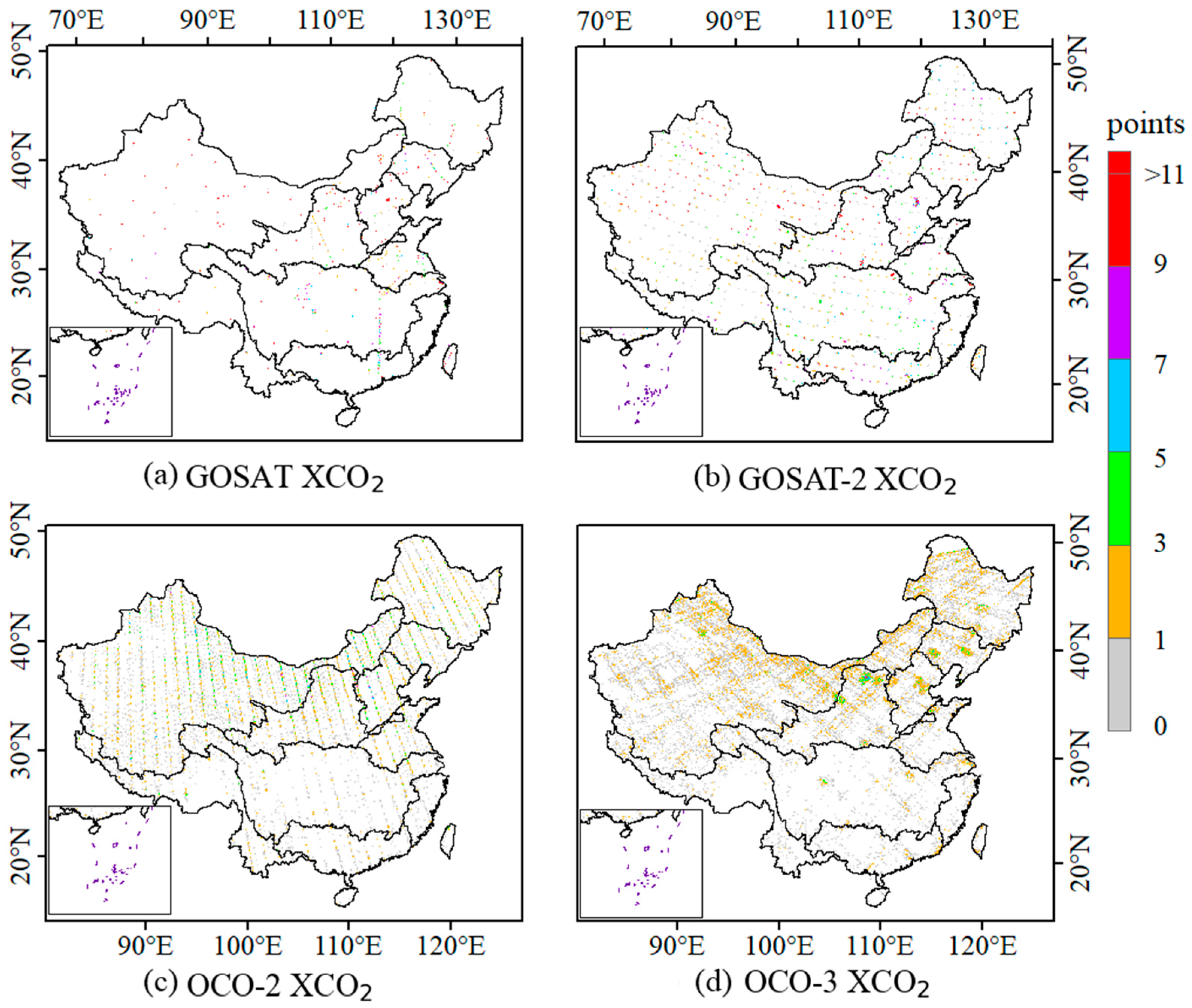
- The monthly spatial coverage rate of the four satellite XCO2 products across China is still insufficient. Among them, OCO-3 has the highest coverage rate, with a peak value of over 3%; OCO-2 ranks second, with a coverage rate of approximately 1%; and the coverage rates of GOSAT-2 and GOSAT are less than 1%.
- (2)
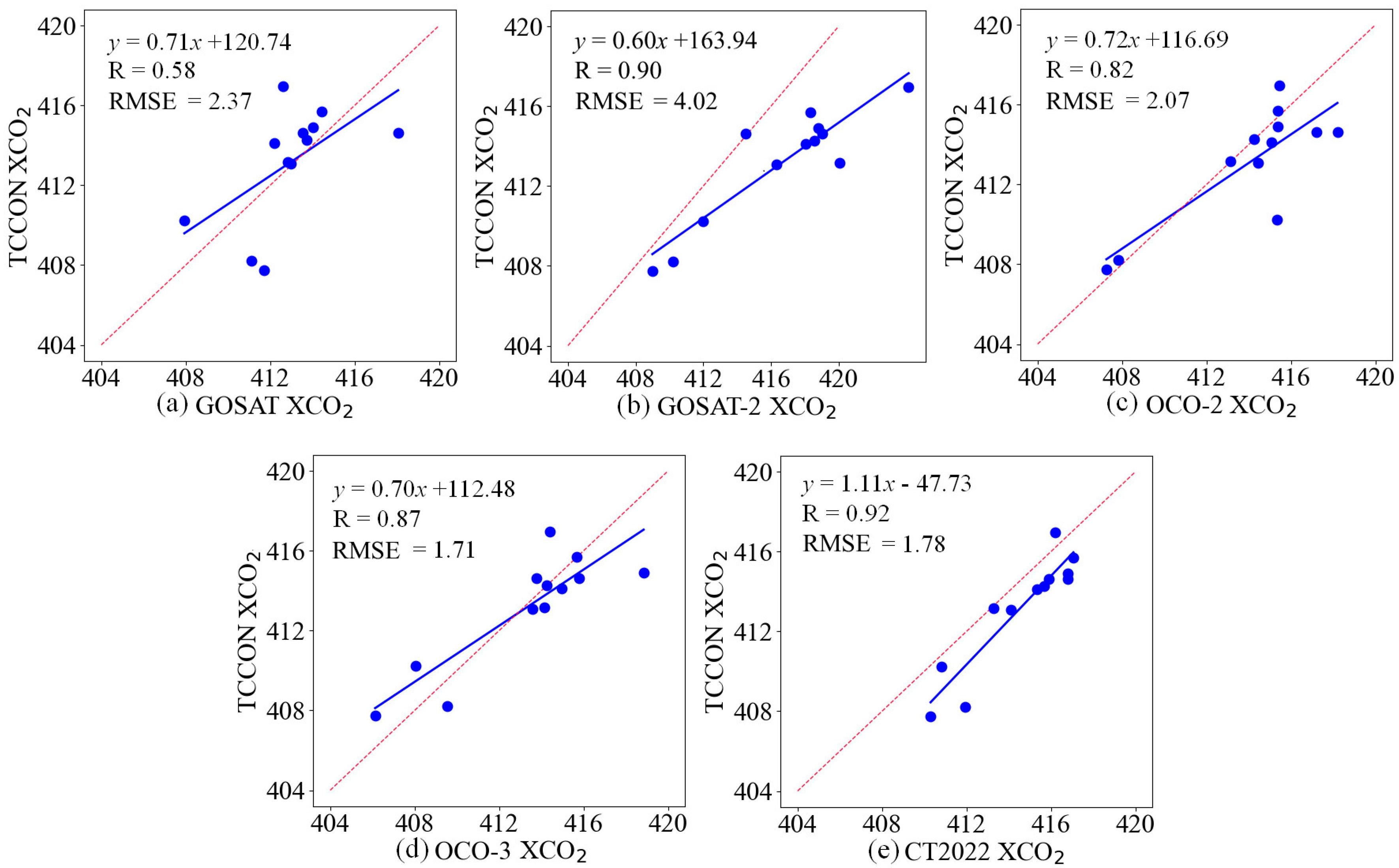
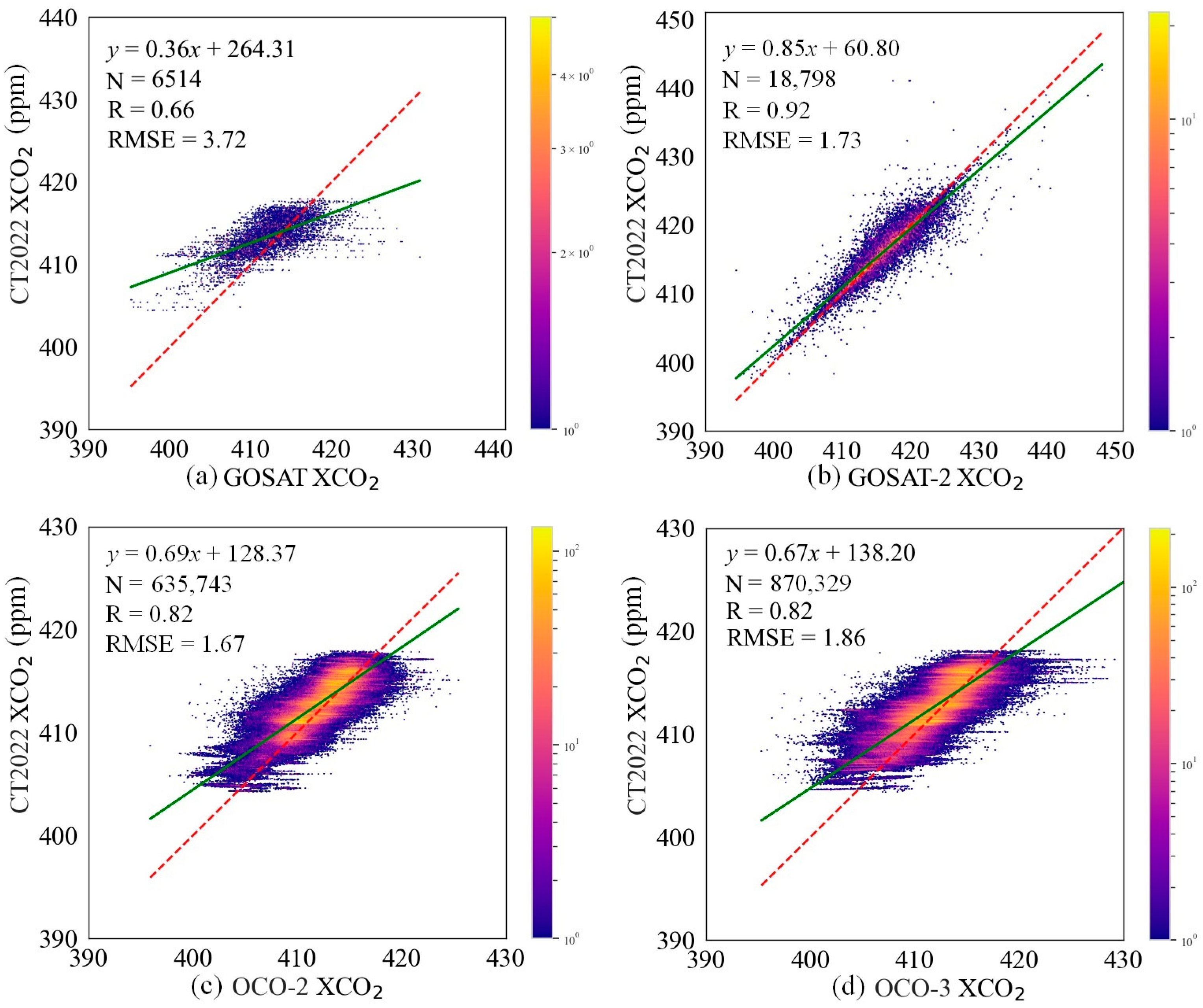
- In terms of overall accuracy, OCO-3 achieves the highest accuracy (RMSE = 1.71 ppm), followed by OCO-2 (2.03 ppm), while GOSAT-2 and GOSAT exhibit substantially larger errors (4.02 ppm and 2.37 ppm, respectively). In summary, the accuracy of XCO2 products from OCO-series is comprehensively ahead of that from GOSAT-series.
- (3)
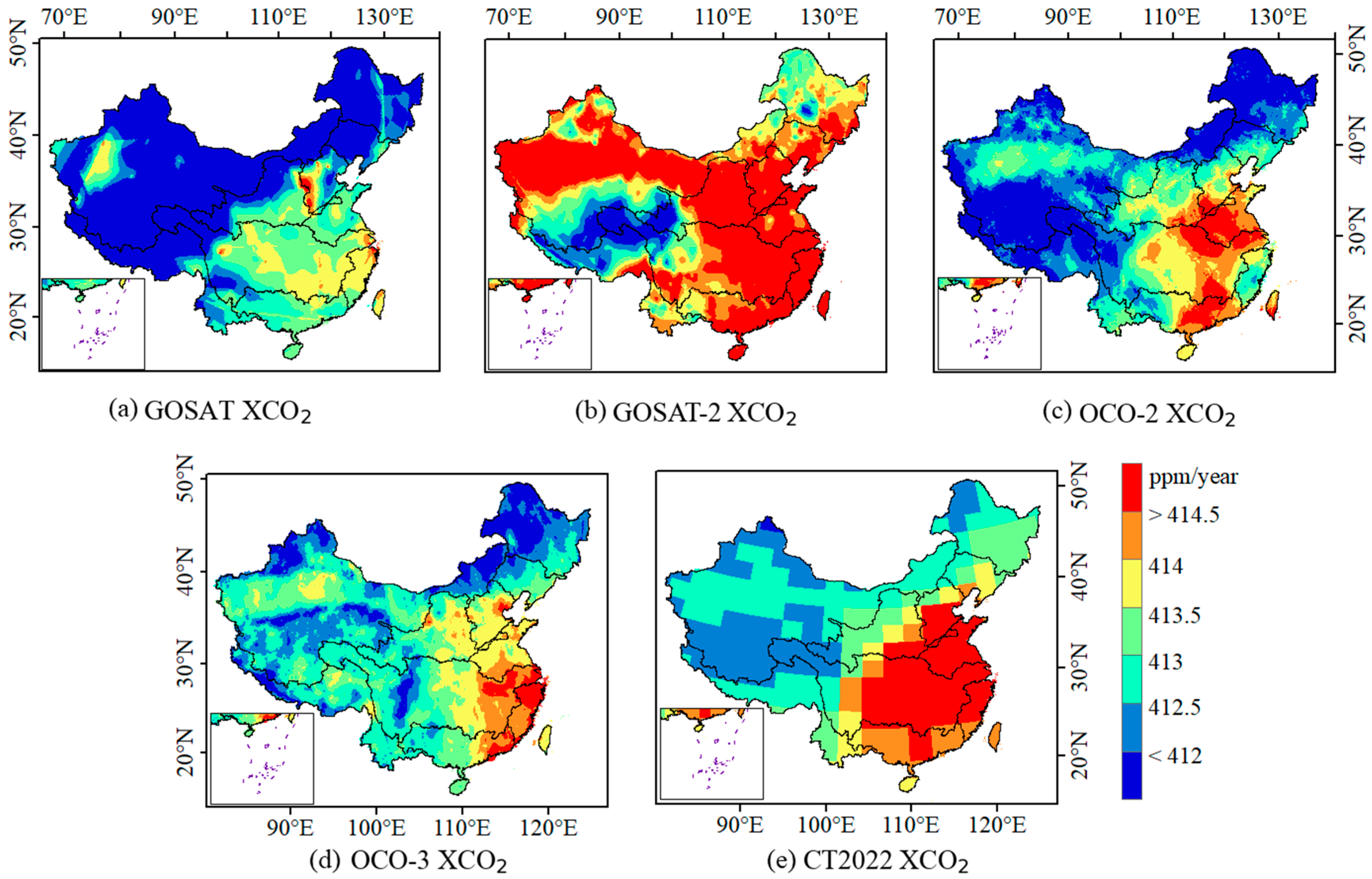
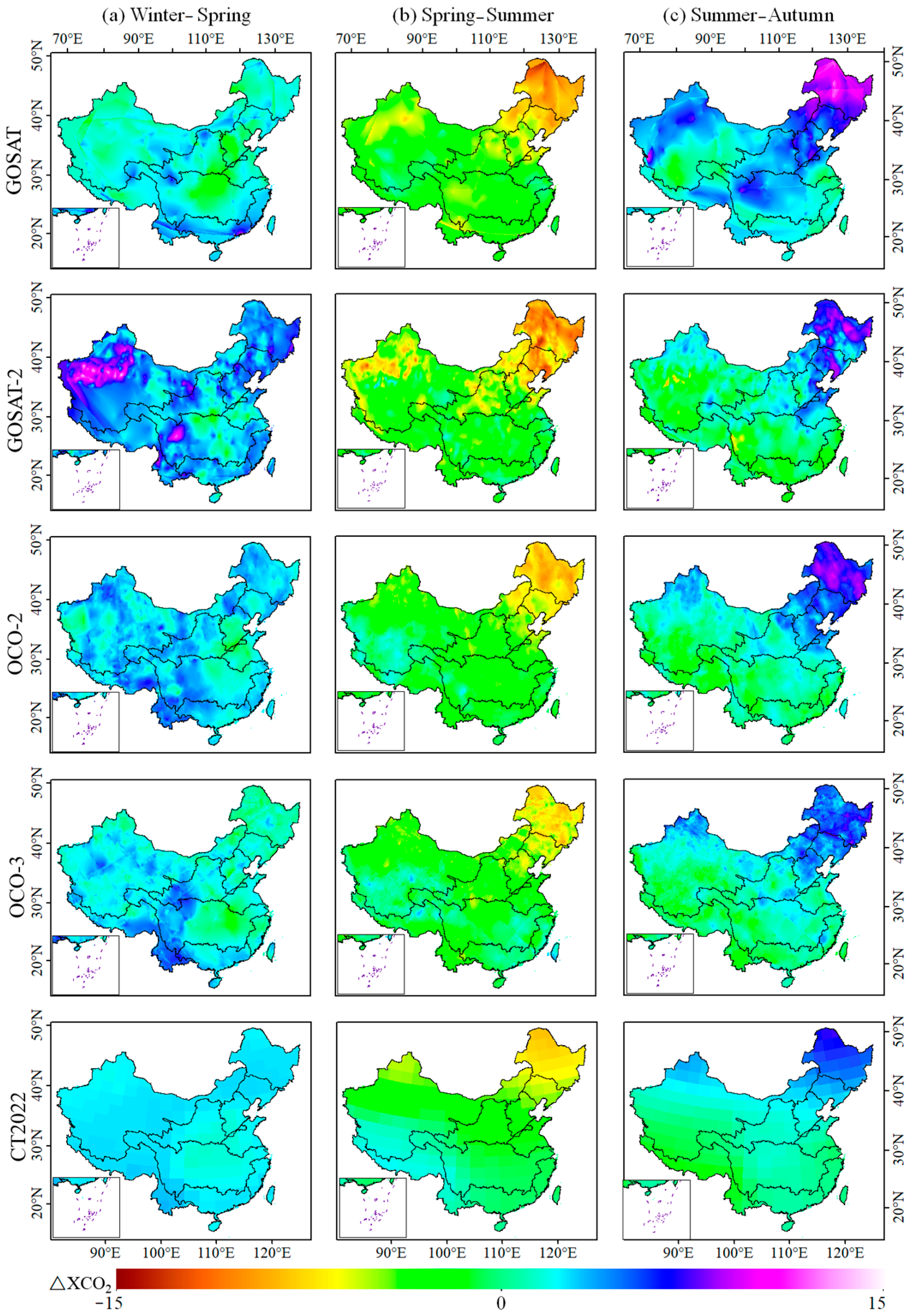
- The spatiotemporal distribution pattern of OCO-series shows the highest consistency with CT2022: OCO-3 performs the best, followed by OCO-2; GOSAT-2 has a systematic overestimation, while GOSAT shows an overall underestimation. On the seasonal scale, the ability of OCO-series to capture the dynamic changes of XCO2 is also significantly superior to that of GOSAT-series, among which OCO-3 has the most excellent capture accuracy.
- (4)
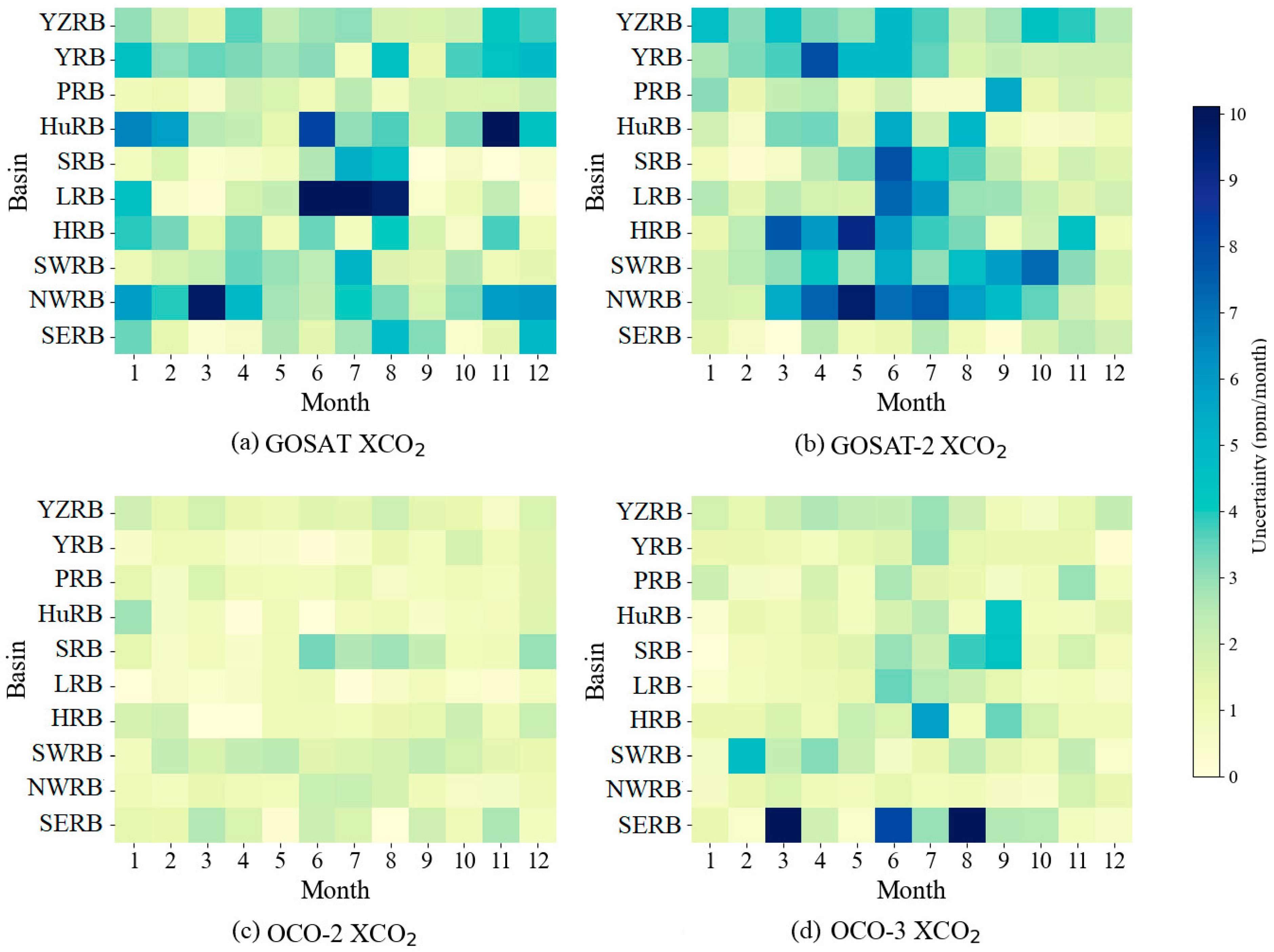
- The TCH demonstrates excellent applicability and reliability in the uncertainty analysis of XCO2 data. Moreover, its evaluation results are highly consistent with both TCCON and CT2022 reference data.
Supplementary Materials
Author Contributions
Funding
Data Availability Statement
Conflicts of Interest
Abbreviations
| CO2 | Carbon dioxide |
| XCO2 | Column-averaged CO2 dry-air mole fraction |
| CT | CarbonTracker |
| TCH | Three-Cornered Hat |
| GOSAT | Greenhouse Gases Observing Satellite |
| GOSAT-2 | Greenhouse Gases Observing Satellite 2 |
| OCO-2 | Orbiting Carbon Observatory 2 |
| OCO-3 | Orbiting Carbon Observatory 3 |
| TCCON | Total Carbon Column Observing Network |
| AIRS | Atmospheric Infrared Sounder |
| O2-A | Oxygen A-band |
| IPDA | integrated path differential absorption |
| TANSO-FTS | Thermal And Near-infrared Sensor for carbon Observation-Fourier Transform Spectrometer |
| TANSO-CAI | Thermal And Near-infrared Sensor for carbon Observation Cloud and Aerosol Imager |
| SWIR | Short-Wavelength InfraRed |
| SAMs | Snapshot Area Maps (SAMs) |
| NOAA | National Oceanic and Atmospheric Administration |
| OA | Ordinary Kriging |
| RMSE | Root Mean Square Error |
| R | Correlation Coefficient |
References
- Li, J.; Xi, M.; Wang, L.; Li, N.; Wang, H.; Qin, F. Vegetation Responses to Climate Change and Anthropogenic Activity in China, 1982 to 2018. Int. J. Environ. Res. Public Health 2022, 19, 7391. [Google Scholar] [CrossRef]
- Zhao, X.; Li, J.; Ruan, F.; Zou, Z.; He, X.; Zhou, C. Spatiotemporal Dynamics and Multi-Scenario Projections of the Land Use and Habitat Quality in the Yellow River Basin: A GeoDetector-PLUS-InVEST Integrated Framework for a Coupled Human–Natural System Analysis. Remote Sens. 2025, 17, 2181. [Google Scholar] [CrossRef]
- Li, J.; Xi, M.; Pan, Z.; Liu, Z.; He, Z.; Qin, F. Response of NDVI and SIF to Meteorological Drought in the Yellow River Basin from 2001 to 2020. Water 2022, 14, 2978. [Google Scholar] [CrossRef]
- Li, J.; Qin, F.; Wang, Y.; Zhao, X.; Yu, M.; Chen, S.; Jiang, J.; Wang, L.; Yan, J. Spatiotemporal Variation of Water Use Efficiency and Its Responses to Climate Change in the Yellow River Basin from 1982 to 2018. Remote Sens. 2025, 17, 316. [Google Scholar] [CrossRef]
- Paris Agreement. United Nations Treaty Series. Available online: https://treaties.un.org/Pages/ViewDetails.aspx?chapter=27&mtdsg_no=XXVII-7-d&src=TREATY (accessed on 12 December 2015).
- Toon, G.; Blavier, J.-F.; Washenfelder, R.; Wunch, D.; Keppel-Aleks, G.; Wennberg, P.; Connor, B.; Sherlock, V.; Griffith, D.; Deutscher, N.; et al. Total Column Carbon Observing Network (TCCON). In Proceedings of the Advances in Imaging, Vancouver, BC, Canada, 26–30 April 2009. [Google Scholar]
- Wunch, D.; Toon, G.C.; Wennberg, P.O.; Wofsy, S.C.; Stephens, B.B.; Fischer, M.L.; Uchino, O.; Abshire, J.B.; Bernath, P.; Biraud, S.C. Calibration of the total carbon column observing network using aircraft profile data. Atmos. Meas. Tech. 2010, 3, 1351–1362. [Google Scholar] [CrossRef]
- Wunch, D.; Wennberg, P.O.; Toon, G.C.; Connor, B.J.; Fisher, B.; Osterman, G.B.; Frankenberg, C.; Mandrake, L.; O’Dell, C.; Ahonen, P. A method for evaluating bias in global measurements of CO2 total columns from space. Atmos. Chem. Phys. 2011, 11, 12317–12337. [Google Scholar] [CrossRef]
- Velazco, V.; Morino, I.; Uchino, O.; Deutscher, N.; Bukosa, B.; Belikov, D.; Oishi, Y.; Nakajima, T.; Macatangay, R.; Nakatsuru, T. Total Carbon Column Observing Network Philippines: Toward Quantifying Atmospheric Carbon in Southeast Asia. Clim. Disaster Dev. J. 2017, 2, 1–12. [Google Scholar] [CrossRef]
- Hungershoefer, K.; Peylin, P.; Chevallier, F.; Rayner, P.; Klonecki, A.; Houweling, S.; Marshall, J. Evaluation of various observing systems for the global monitoring of CO2 surface fluxes. Atmos. Chem. Phys. 2010, 10, 10503–10520. [Google Scholar] [CrossRef]
- Baker, D.F.; Bösch, H.; Doney, S.C.; O’Brien, D.; Schimel, D.S. Carbon source/sink information provided by column CO2 measurements from the Orbiting Carbon Observatory. Atmos. Chem. Phys. 2010, 10, 4145–4165. [Google Scholar] [CrossRef]
- Wang, H.; Jiang, F.; Wang, J.; Ju, W.; Chen, J.M. Differences of the inverted terrestrial ecosystem carbon flux between using GOSAT and OCO-2 XCO2 retrievals. Atmos. Chem. Phys. Discuss. 2018, 19, 1–32. [Google Scholar] [CrossRef]
- Strow, L.L.; Hannon, S.E. A 4-year zonal climatology of lower tropospheric CO2 derived from ocean-only Atmospheric Infrared Sounder observations. J. Geophys. Res.-Atmos. 2008, 113, D18302. [Google Scholar] [CrossRef]
- Liu, Y.; Yang, D.; Cai, Z. A retrieval algorithm for TanSat XCO2 observation: Retrieval experiments using GOSAT data. Chin. Sci. Bull. 2013, 58, 1520–1523. [Google Scholar] [CrossRef]
- Abshire, J.B.; Ramanathan, A.K.; Riris, H.; Allan, G.R.; Sun, X.L.; Hasselbrack, W.E.; Mao, J.P.; Wu, S.; Chen, J.; Numata, K.; et al. Airborne measurements of CO2 column concentrations mad-e with a pulsed IPDA lidar using a multiple-wavelength-locked laser and HgCdTe APD detector. Atmos. Meas. Tech. 2018, 11, 2001–2025. [Google Scholar] [CrossRef]
- Li, Z.; Xie, Y.; Shi, Y.; Li, Q.; Cohen, J.; Zhang, Y.; Han, Y.; Xiong, W.; Liu, Y. A review of collaborative remote sensing observation of greenhouse gases and aerosol with atmospheric environment satellites. Nat. Remote Sens. Bull. 2022, 26, 795–816. [Google Scholar] [CrossRef]
- Kuze, A.; Suto, H.; Shiomi, K.; Kawakami, S.; Tanaka, M.; Ueda, Y. Update on GOSAT TANSO-FTS performance, operations, and data products after more than 6 years in space. Atmos. Meas. Tech. 2016, 9, 2445–2461. [Google Scholar] [CrossRef]
- Chen, Y.; Cheng, J.; Song, X. Global-scale evaluation of XCO2 products from gosat, OCO-2 and carbontracker using direct comparison and triple collocation method. Remote Sens. 2022, 14, 5635. [Google Scholar] [CrossRef]
- Mustafa, F.; Bu, L.; Wang, Q.; Ali, M.A.; Bilal, M.; Shahzaman, M.; Qiu, Z. Multi-year comparison of CO2 concentration from NOAA carbon tracker reanalysis model with data from GOSAT and OCO-2 over Asia. Remote Sens. 2020, 12, 2498. [Google Scholar] [CrossRef]
- Ohyama, H.; Yoshida, Y.; Matsunaga, T. CH4 and CO emission estimates for megacities: Deriving enhancement ratios of CO2, CH4, and CO from GOSAT-2 observations. Environ. Res. Lett. 2024, 19, 124025. [Google Scholar] [CrossRef]
- Janardanan Achari, R.; Maksyutov, S.S.; Wang, F. Methane emissions inferred from high-resolution inversion of GOSAT and GOSAT-2 along with surface observations. In Proceedings of the AGU Fall Meeting, Washington, DC, USA, 9–13 December 2024; p. A05-1. [Google Scholar]
- Ji, M.; Xu, Y.; Zhang, Y. Validation of remotely sensed XCO2 products with TCCON observations in East Asia. IEEE J-Sel. Top. Appl. Earth Obs. Remote Sens. 2024, 17, 7159–7169. [Google Scholar] [CrossRef]
- Li, T.; Zheng, X.; Liu, X. Enhancing Space-Based Tracking of Fossil Fuel CO2 Emissions via Synergistic Integration of OCO-2, OCO-3, and TROPOMI Measurements. Environ. Sci. Technol. 2024, 59, 1587–1597. [Google Scholar] [CrossRef]
- Zhang, L.; Cheng, T.; Yue, T. Quantitative analysis of spatiotemporal coverage and uncertainty decomposition in OCO-2/3 XCO2 across China. Atmos. Environ. 2024, 333, 120636. [Google Scholar] [CrossRef]
- Konovalov, I.B.; Golovushkin, N.A.; Mareev, E.A. Using OCO-2 Observations to Constrain Regional CO2 Fluxes Estimated with the Vegetation, Photosynthesis and Respiration Model. Remote Sens. 2025, 17, 177. [Google Scholar] [CrossRef]
- Wang, X.; Jiang, F.; Wang, H. The role of OCO-3 XCO2 retrievals in estimating global terrestrial net ecosystem exchanges. Atmos. Chem. Phys. 2025, 25, 867–880. [Google Scholar] [CrossRef]
- Yang, Y.; Zhou, M.; Wang, W. Quantification of CO2 Emissions from Three Power Plants in China Using OCO-3 Satellite Measurements. Adv. Atmos. Sci. 2024, 41, 2276–2288. [Google Scholar] [CrossRef]
- Nelson, R.R.; Cusworth, D.H.; Thorpe, A.K. Comparing point source CO2 emission rate estimates from near-simultaneous OCO-3 and EMIT observations. Adv. Atmos. Sci. 2024, 51, e2024GL113002. [Google Scholar] [CrossRef]
- Hong, X.; Zhang, C.; Tian, Y. First TanSat CO2 retrieval over land and ocean using both nadir and glint spectroscopy. Remote Sens. Environ. 2024, 304, 114053. [Google Scholar] [CrossRef]
- Zhu, S.; Yang, D.; Feng, L. Theoretical Potential of TanSat-2 to Quantify China’s CH4 Emissions. Remote Sens. 2025, 17, 2321. [Google Scholar] [CrossRef]
- Wu, S.; Wang, Y.; Zhang, L. A Random Forest-Based CO2 Profile Emulator for Real-Time Prior Profile Generation in TanSat XCO2 Retrieval. Remote Sens. 2025, 17, 2764. [Google Scholar] [CrossRef]
- Cogan, A.J.; Boesch, H.; Parker, R.J.; Feng, L.; Palmer, P.I.; Blavier, J.F.; Wunch, D. Atmospheric carbon dioxide retrieved from the Greenhouse gases Observing SATellite (GOSAT): Comparison with ground-based TCCON observations and GEOS-Chem model calculations. J. Geophys. Res.-Atmos. 2012, 117, D21301. [Google Scholar] [CrossRef]
- Das, S.; Kiel, M.; Laughner, J.; Osterman, G.; O’Dell, C.W.; Taylor, T.E.; Wunch, D. Comparisons of the v11.1 Orbiting Carbon Observatory-2 (OCO-2) XCO2 measurements with GGG2020 TCCON. Earth Space Sci. 2025, 12, e2024EA003935. [Google Scholar] [CrossRef]
- Guerlet, S.; Butz, A.; Schepers, D.; Basu, S.; Hasekamp, O.P.; Kuze, A.; Aben, I. Impact of aerosol and thin cirrus on retrieving and validating XCO2 from GOSAT shortwave infrared measurements. J. Geophys. Res.-Atmos. 2013, 118, 4887–4905. [Google Scholar] [CrossRef]
- Connor, B.; Bösch, H.; McDuffie, J.; Taylor, T.; Fu, D.; Frankenberg, C.; O’Dell, C.; Payne, V.H.; Gunson, M.; Pollock, R.; et al. Quantification of uncertainties in OCO-2 measurements of XCO2: Simulations and linear error analysis. Atmos. Meas. Tech. 2016, 9, 5227–5238. [Google Scholar] [CrossRef]
- Bie, N.; Lei, L.; Zeng, Z.; Cai, B.; Yang, S.; He, Z.; Wu, C.; Nassar, R. Regional uncertainty of GOSAT XCO2 retrievals in China: Quantification and attribution. Atmos. Meas. Tech. 2018, 11, 1251–1272. [Google Scholar] [CrossRef]
- Yang, H.; Li, T.; Wu, J.; Zhang, L. Inter-comparison and evaluation of global satellite XCO2 products. Geo-Spat. Inf. Sci. 2023, 28, 131–144. [Google Scholar] [CrossRef]
- Yang, Y.; Zhou, M.; Wang, W. The Inter-comparison of GOSAT, GOSAT-2 and OCO-2/3 XCO2 Measure-ments over East Asia and Validated with TCCON Observations. ESS Open Arch. 2025, in press. [CrossRef]
- Xu, L.; Chen, N.; Moradkhani, H.; Zhang, X.; Hu, C. Improving global monthly and daily precipitation estimation by fusing gauge observations, remote sensing, and reanalysis data sets. Water Resour. Res. 2020, 56, e2019WR026444. [Google Scholar] [CrossRef]
- Long, D. Global analysis of spatiotemporal variability in merged total water storage changes using multiple GRACE products and global hydrological models. Remote Sens. Environ. 2017, 192, 198–216. [Google Scholar] [CrossRef]
- Zuo, L.; Zou, L. Multi-scale analysis of six evapotranspiration products across China: Accuracy, uncertainty and spatiotemporal pattern. J. Hydrol. 2025, 650, 132516. [Google Scholar] [CrossRef]
- Liu, J. Uncertainty analysis of eleven multisource soil moisture products in the third pole environment based on the three-corned hat method. Remote Sens. Environ. 2021, 255, 112225. [Google Scholar] [CrossRef]
- Liu, J.; Ding, J.; Wang, J.; Zou, J.; Zhang, Z.; Bao, Q.; Wang, X.; Ge, X. Predicting the isotopic composition of precipitation in China via interpretable machine learning techniques. J. Hydrol. 2025, 663, 134190. [Google Scholar] [CrossRef]
- Dai, K.; Shen, S.; Cheng, C. Evaluation and analysis of the projected population of China. Sci. Rep. 2022, 12, 3644. [Google Scholar] [CrossRef]
- Suto, H.; Kataoka, F.; Kikuchi, N.; Knuteson, R.O.; Butz, A.; Haun, M.; Buijs, H.; Shiomi, K.; Imai, H.; Kuze, A. Thermal and near-infra-red sensor for carbon observation Fourier transform spectrometer2 (TANSO-FTS-2) on the Greenhouse gases Observing SATellite2 (GOSAT-2) during its first year in orbit. Atmos. Meas. Tech. 2021, 14, 2013–2039. [Google Scholar] [CrossRef]
- Taylor, T.E.; O’Dell, C.W.; Frankenberg, C.; Partain, P.T.; Cronk, H.Q.; Savtchenko, A.; Nelson, R.R.; Rosenthal, E.J.; Chang, A.Y.; Fisher, B.; et al. Orbiting Carbon Observatory-2 (OCO-2) cloud screening algorithms: Validation against collocated MODIS and CALIOP data. Atmos. Meas. Tech. 2016, 9, 973–989. [Google Scholar] [CrossRef]
- Eldering, A.; Taylor, T.E.; O’Dell, C.W.; Pavlick, R. The OCO-3 mission: Measurement objectives and expected performance based on 1 year of simulated data. Atmos. Meas. Tech. 2019, 12, 2341–2370. [Google Scholar] [CrossRef]
- Malina, E.; Veihelmann, B.; Buschmann, M.; Deutscher, N.M.; Feist, D.G.; Morino, I. On the consistency of methane retrievals using the Total Carbon Column Observing Network (TCCON) and multiple spectroscopic databases. Atmos. Meas. Tech. 2022, 15, 2377–2406. [Google Scholar] [CrossRef]
- Yang, D.; Boesch, H.; Liu, Y.; Somkuti, P.; Cai, Z.; Chen, X. Toward high precision XCO2 retrievals from TanSat observations: Retrieval improvement and validation against TCCON measurements. J. Geophys. Res.-Atmos. 2020, 125, e2020JD032794. [Google Scholar] [CrossRef] [PubMed]
- He, Z.; Lei, L.; Zhang, Y.; Sheng, M.; Wu, C.; Li, L.; Zeng, Z.C.; Welp, L.R. Spatio-Temporal Mapping of Multi-Sat-ellite Observed Column Atmospheric CO2 Using Precision-Weighted Kriging Method. Remote Sens. 2020, 12, 576. [Google Scholar] [CrossRef]
- Galindo, F.J.; Palacio, J. Post-processing ROA data clocks for optimal stability in the ensemble timescale. Metrologia 2003, 40, S237–S244. [Google Scholar] [CrossRef]
- Galindo, F.J.; Palacio, J. Estimating the instabilities of N correlated clocks. In Proceedings of the 31th Annual Precise Ti-me and Time Interval Systems and Applications Meeting, Dana Point, CA, USA, 7–9 December 1999; Institute of Navigation: Manassas, VA, USA, 1999; pp. 285–296. [Google Scholar]
- Fang, J.; Chen, B.; Zhang, H.; Dilawar, A.; Guo, M.; Liu, C.; Liu, S.; Gemechu, T.M.; Zhang, X. Global Evaluation and Intercomparison of XCO2 Retrievals from GOSAT, OCO-2, and TANSAT with TCCON. Remote Sens. 2023, 15, 5073. [Google Scholar] [CrossRef]
- Liang, A.; Gong, W.; Han, G. Comparison of satellite-observed XCO2 from GOSAT, OCO-2, and ground-based TCCON. Remote Sens. 2017, 9, 1033. [Google Scholar] [CrossRef]
- NIES GOSAT-2 Project. Summary of the Validation on GOSAT-2 TANSO-FTS-2 SWIR L2 Column Averaged Dry-Air Mole Fraction Product. Available online: https://prdct.gosat-2.nies.go.jp/ (accessed on 21 November 2022).
- National Institute for Environmental Studies (NIES). GOSAT-2 Quality Assessment Summary. Available online: https://earth.esa.int/eogateway/documents/20142/37627/Technical-Note-on-Quality-Assessment-for-GOSAT-2 (accessed on 9 August 2022).
- Kataoka, F.; Crisp, D.; Taylor, T.; O’Dell, C.; Kuze, A.; Shiomi, K.; Suto, H.; Bruegge, C.; Schwandner, F.; Rosenberg, R. The Cross-Calibration of Spectral Radiances and Cross-Validation of CO2 Estimates from GOSAT and OCO-2. Remote Sens. 2017, 9, 1158. [Google Scholar] [CrossRef]
- Kong, Y.; Chen, B.; Measho, S. Spatio-Temporal Consistency Evaluation of XCO2 Retrievals from GOSAT and OCO-2 Based on TCCON and Model Data for Joint Utilization in Carbon Cycle Research. Atmosphere 2019, 10, 354. [Google Scholar] [CrossRef]



| Satellite | GOSAT | GOSAT2 | OCO-2 | OCO-3 |
|---|---|---|---|---|
| Launch time | January 2009 | October 2018 | July 2014 | May 2019 |
| Sensor (km) | TANSO-CAI | TANSO-CAI2 | OCO-2 | OCO-3 |
| Spatial resolution | 10.5 km × 10.5 km | 9.7 km × 9.7 km | 1.29 km × 2.25 km | 1.29 km × 2.25 km |
| Revisit cycle | 3 days | 6 days | 16 days | - |
| Data source | NASA/ACOS | NASA/ACOS | NASA/OCO-2 | NASA/OCO-3 |
| Data version | ACOS_L2_Lite_FP_9r | ACOS_L2_Lite_FP_9r | ACOS_L2_Lite_FP_10r | ACOS_L2_Lite_FP_10r |
| URL | https://data2.gosat.nies.go.jp, accessed on 10 March 2025 | https://data2.gosat.nies.go.jp, accessed on 10 March 2025 | https://disc.gsfc.nasa.gov/, accessed on 17 August 2025 | https://disc.gsfc.nasa.gov/, accessed on 17 August 2025 |
Disclaimer/Publisher’s Note: The statements, opinions and data contained in all publications are solely those of the individual author(s) and contributor(s) and not of MDPI and/or the editor(s). MDPI and/or the editor(s) disclaim responsibility for any injury to people or property resulting from any ideas, methods, instructions or products referred to in the content. |
© 2025 by the authors. Licensee MDPI, Basel, Switzerland. This article is an open access article distributed under the terms and conditions of the Creative Commons Attribution (CC BY) license (https://creativecommons.org/licenses/by/4.0/).
Share and Cite
Ruan, F.; Qin, F.; Li, J.; Mu, W. Evaluation of Multi-Source Satellite XCO2 Products over China Using the Three-Cornered Hat Method and Multi-Reference Comprehensive Comparisons. Remote Sens. 2025, 17, 3869. https://doi.org/10.3390/rs17233869
Ruan F, Qin F, Li J, Mu W. Evaluation of Multi-Source Satellite XCO2 Products over China Using the Three-Cornered Hat Method and Multi-Reference Comprehensive Comparisons. Remote Sensing. 2025; 17(23):3869. https://doi.org/10.3390/rs17233869
Chicago/Turabian StyleRuan, Fengxue, Fen Qin, Jie Li, and Weichen Mu. 2025. "Evaluation of Multi-Source Satellite XCO2 Products over China Using the Three-Cornered Hat Method and Multi-Reference Comprehensive Comparisons" Remote Sensing 17, no. 23: 3869. https://doi.org/10.3390/rs17233869
APA StyleRuan, F., Qin, F., Li, J., & Mu, W. (2025). Evaluation of Multi-Source Satellite XCO2 Products over China Using the Three-Cornered Hat Method and Multi-Reference Comprehensive Comparisons. Remote Sensing, 17(23), 3869. https://doi.org/10.3390/rs17233869