


A Review of Artificial Intelligence and Remote Sensing for Marine Oil Spill Detection, Classification, and Thickness Estimation



Highlights
- A comprehensive review of recent advances in oil spill detection, classification, and thickness estimation from the perspectives of artificial intelligence (AI) and remote sensing (RS) technology.
- The open datasets and multi-source data fusion enhance model accuracy and generalization in oil spill detection, classification, and thickness estimation.
- AI–RS integration enables real-time, automated marine oil spill monitoring and rapid response.
- Future research should focus on explainable, adaptive, and cross-scene intelligent monitoring systems.
Abstract
1. Introduction
- 1.
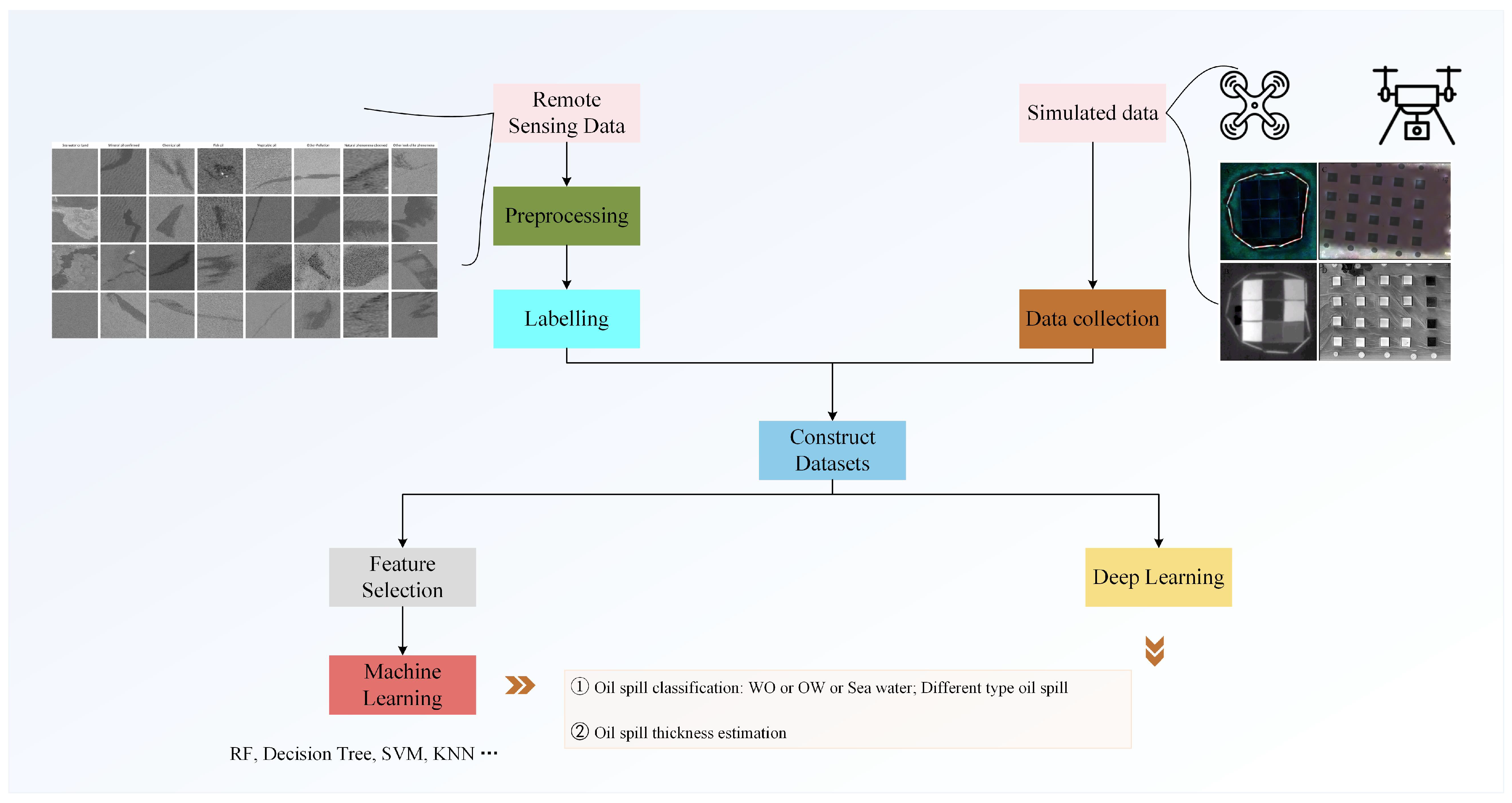
- We provide a comprehensive review of recent advances in applying AI and RS to oil spill detection, classification, and thickness estimation, highlighting the strengths, limitations, and complementary roles.
- 2.
- We summarize key publicly available datasets and data sources that support the oil spill RS monitor with AI methods.
- 3.
- From the aspects of tasks, data, and methods, we discuss major challenges and propose future directions for developing more accurate, real-time, and explainable marine oil spill monitoring systems.
2. Remote Sensing Data & Datasets
2.1. Remote Sensing Data
2.2. Datasets
3. Literature Review of Oil Spill Monitoring
3.1. RS for Oil Spill Detection
3.1.1. Optical RS for Oil Spill Detection
3.1.2. SAR for Oil Spill Detection
3.1.3. Thermal Infrared Oil Spill Detection
3.1.4. Multi-Source Data for Oil Spill Detection
3.2. RS for Oil Spill (Type) Classification and Thickness Estimation
3.2.1. Oil Spill (Type) Classification
3.2.2. Oil Spill Thickness Estimation
4. Discussion
4.1. Limitations
4.2. Future Directions
4.2.1. Explainable Artificial Intelligence (XAI)
4.2.2. Zero-Shot Oil Spill Detection with LLMs
4.2.3. Multi-Task Collaboration with LLMs
4.2.4. Enhancing Generalization Across Conditions
4.2.5. Developing Lightweight and Efficient Models
4.2.6. Advancing Multi-Source Data Fusion Strategies
5. Conclusions
Author Contributions
Funding
Data Availability Statement
Conflicts of Interest
References
- Beyer, J.; Trannum, H.C.; Bakke, T.; Hodson, P.V.; Collier, T.K. Environmental effects of the Deepwater Horizon oil spill: A review. Mar. Pollut. Bull. 2016, 110, 28–51. [Google Scholar] [CrossRef] [Scilit] [PubMed]
- Yin, L.; Zhang, M.; Zhang, Y.; Qiao, F. The long-term prediction of the oil-contaminated water from the Sanchi collision in the East China Sea. Acta Oceanol. Sin. 2018, 37, 69–72. [Google Scholar] [CrossRef] [Scilit]
- Kirkfeldt, T.S.; Frazão Santos, C. A review of sustainability concepts in marine spatial planning and the potential to supporting the UN sustainable development goal 14. Front. Mar. Sci. 2021, 8, 713980. [Google Scholar] [CrossRef] [Scilit]
- Al-Ruzouq, R.; Gibril, M.B.A.; Shanableh, A.; Kais, A.; Hamed, O.; Al-Mansoori, S.; Khalil, M.A. Sensors, features, and machine learning for oil spill detection and monitoring: A review. Remote Sens. 2020, 12, 3338. [Google Scholar] [CrossRef] [Scilit]
- NOAA. Marine Pollution Surveillance Program. 2025. Available online: https://www.ospo.noaa.gov/products/ocean/marinepollution/ (accessed on 25 October 2025).
- Carpenter, A. European Maritime Safety Agency CleanSeaNet Activities in the North Sea. In Oil Pollution in the North Sea; Springer: Berlin/Heidelberg, Germany, 2015; pp. 33–47. [Google Scholar]
- EMSA. CleanSeaNet Service. 2025. Available online: https://www.emsa.europa.eu/csn-menu.html (accessed on 25 October 2025).
- Copernicus Data Space Ecosystem. Copernicus Sentinel Program. 2025. Available online: https://browser.dataspace.copernicus.eu/ (accessed on 25 October 2025).
- Evanisko, T. Bilge Dumping: What it Is, Why You Should Care, and What Can Be Done; SkyTruth Report; 2020. Available online: https://skytruth.org/wp-content/uploads/2020/10/SkyTruth-Global-Bilge-Dumping-Report.pdf (accessed on 25 October 2025).
- Zhao, J.; Temimi, M.; Ghedira, H.; Hu, C. Exploring the potential of optical remote sensing for oil spill detection in shallow coastal waters-a case study in the Arabian Gulf. Opt. Express 2014, 22, 13755–13772. [Google Scholar] [CrossRef] [Scilit]
- Shi, J.; Jiao, J.; Lu, Y.; Zhang, M.; Mao, Z.; Liu, Y. Determining spectral groups to distinguish oil emulsions from Sargassum over the Gulf of Mexico using an airborne imaging spectrometer. ISPRS J. Photogramm. Remote Sens. 2018, 146, 251–259. [Google Scholar] [CrossRef] [Scilit]
- Sulma, S.; Prayogo, T.; Hartuti, M.; Afgatiani, P.M.; Herdanis, C.; Wijaya, A.D.; Parwati, E.; Kusuma, F.B.; Susantoro, T.M.; Faristyawan, R. Adaptive threshold from the Sentinel-2 oil spill index for oil spill detection. In Proceedings of the Eighth Geoinformation Science Symposium 2023: Geoinformation Science for Sustainable Planet, Yogyakarta, Indonesia, 28–30 August 2023; Volume 12977, pp. 255–263. [Google Scholar]
- Sun, Z.; Sun, S.; Zhao, J.; Ai, B.; Yang, Q. Detection of massive oil spills in sun glint optical imagery through super-pixel segmentation. J. Mar. Sci. Eng. 2022, 10, 1630. [Google Scholar] [CrossRef] [Scilit]
- Pérez-García, Á.; Horstrand, P.; López, J.F. Ndoi, a novel oil spectral index: Comparisons and results. In Proceedings of the 2022 12th Workshop on Hyperspectral Imaging and Signal Processing: Evolution in Remote Sensing (WHISPERS), Rome, Italy, 13–16 September 2022; pp. 1–5. [Google Scholar]
- Pelta, R.; Carmon, N.; Ben-Dor, E. A machine learning approach to detect crude oil contamination in a real scenario using hyperspectral remote sensing. Int. J. Appl. Earth Obs. Geoinf. 2019, 82, 101901. [Google Scholar] [CrossRef] [Scilit]
- Wang, B.; Shao, Q.; Song, D.; Li, Z.; Tang, Y.; Yang, C.; Wang, M. A spectral-spatial features integrated network for hyperspectral detection of marine oil spill. Remote Sens. 2021, 13, 1568. [Google Scholar] [CrossRef] [Scilit]
- Fingas, M.; Brown, C. Review of oil spill remote sensing. Mar. Pollut. Bull. 2014, 83, 9–23. [Google Scholar] [CrossRef] [Scilit]
- Satriano, V.; Ciancia, E.; Lacava, T.; Pergola, N.; Tramutoli, V. Improving the RST-OIL algorithm for oil spill detection under severe sun glint conditions. Remote Sens. 2019, 11, 2762. [Google Scholar] [CrossRef] [Scilit]
- Yang, J.; Hu, Y.; Ma, Y.; Li, Z.; Zhang, J. Research on oil spill pollution type identification using rpnet deep learning model and airborne hyperspectral image. In Proceedings of the IGARSS 2022—2022 IEEE International Geoscience and Remote Sensing Symposium, Kuala Lumpur, Malaysia, 17–22 July 2022; pp. 807–810. [Google Scholar]
- Huang, X.; Ma, Y.; Jiang, Z.; Yang, J. Hyperspectral remote sensing identification of marine oil emulsions based on the fusion of spatial and spectral features. Acta Oceanol. Sin. 2024, 43, 139–154. [Google Scholar] [CrossRef] [Scilit]
- Xie, M.; Gou, T.; Dong, S.; Li, Y. A semi-supervised model for fine-grained identification of oil emulsions on the sea surface using hyperspectral imaging. J. Indian Soc. Remote Sens. 2024, 52, 2083–2097. [Google Scholar] [CrossRef] [Scilit]
- Jiao, J.; Lu, Y.; Hu, C. Characterizing oil spills using deep learning and spectral-spatial-geometrical features of HY-1C/D CZI images. Remote Sens. Environ. 2024, 308, 114205. [Google Scholar] [CrossRef] [Scilit]
- Hilario, P.; de la Cruz, R.; Vergara, D.; Sabuito, A.; Borlongan, N.; Tabardillo, J. Monitoring Oil Spill Progression and Oil Spill Volume Using Satellite Images. ISPRS Ann. Photogramm. Remote Sens. Spat. Inf. Sci. 2023, 10, 1137–1142. [Google Scholar] [CrossRef] [Scilit]
- Wang, M.; Yang, J.; Liu, S.; Gu, Y.; Xu, M.; Ma, Y.; Zhang, J.; Wan, J. Quantitative inversion of oil film thickness based on airborne hyperspectral data using the 1DCNN_GRU model. IEEE Trans. Geosci. Remote Sens. 2023, 61, 4208616. [Google Scholar] [CrossRef] [Scilit]
- Chang, W.; Liu, B.; Zhang, Q. Oil slick extraction from hyperspectral images using a modified stacked auto-encoder network. In Proceedings of the Eleventh International Conference on Digital Image Processing (ICDIP 2019), Guangzhou, China, 10–13 May 2019; Volume 11179, pp. 805–811. [Google Scholar]
- Yang, J.; Wan, J.; Ma, Y.; Zhang, J.; Hu, Y. Characterization analysis and identification of common marine oil spill types using hyperspectral remote sensing. Int. J. Remote Sens. 2020, 41, 7163–7185. [Google Scholar] [CrossRef] [Scilit]
- Meng, L.; Yan, C.; Lv, S.; Sun, H.; Xue, S.; Li, Q.; Zhou, L.; Edwing, D.; Edwing, K.; Geng, X.; et al. Synthetic aperture radar for geosciences. Rev. Geophys. 2024, 62, e2023RG000821. [Google Scholar] [CrossRef] [Scilit]
- Solberg, A.S.; Brekke, C.; Solberg, R.; Husoy, P.O. Algorithms for oil spill detection in Radarsat and ENVISAT SAR images. In Proceedings of the IGARSS 2004. 2004 IEEE International Geoscience and Remote Sensing Symposium, Anchorage, AK, USA, 20–24 September 2004; Volume 7, pp. 4909–4912. [Google Scholar]
- Carvalho, G.d.A.; Minnett, P.J.; Ebecken, N.F.; Landau, L. Machine-learning classification of SAR remotely-sensed sea-surface petroleum signatures—Part 1: Training and testing cross validation. Remote Sens. 2022, 14, 3027. [Google Scholar] [CrossRef] [Scilit]
- Dong, S.; Feng, J. SAGPNet: A shape-aware and adaptive strip self-attention guided progressive network for SAR marine oil spill detection. Mar. Environ. Res. 2025, 204, 106904. [Google Scholar] [CrossRef] [Scilit] [PubMed]
- Prajapati, K.; Bhavsar, M.; Mahajan, A. GSCAT-UNET: Enhanced U-Net model with spatial-channel attention gate and three-level attention for oil spill detection using SAR data. Mar. Pollut. Bull. 2025, 212, 117583. [Google Scholar] [CrossRef] [Scilit] [PubMed]
- Chai, Y.; Han, X.; Wang, Y.; Luo, D.; Yang, J.; Chen, P.; Zheng, G. TransOilSeg: A Novel SAR Oil Spill Detection Method Addressing Data Limitations and Look-Alike Confusions. IEEE Trans. Geosci. Remote Sens. 2025, 63, 5206216. [Google Scholar] [CrossRef] [Scilit]
- Tian, W.; Shao, Y.; Yuan, J.; Wang, S.; Liu, Y. An experiment for oil spill recognition using RADARSAT-2 image. In Proceedings of the 2010 IEEE International Geoscience and Remote Sensing Symposium, Honolulu, HI, USA, 25–30 July 2010; pp. 2761–2764. [Google Scholar]
- Genovez, P.C.; Freitas, C.C.; Sant’Anna, S.J.; Bentz, C.M.; Lorenzzetti, J.A. Oil slicks detection from polarimetric data using stochastic distances between complex wishart distributions. IEEE J. Sel. Top. Appl. Earth Obs. Remote Sens. 2017, 10, 463–477. [Google Scholar] [CrossRef] [Scilit]
- Hassani, B.; Sahebi, M.R.; Asiyabi, R.M. Oil spill four-class classification using UAVSAR polarimetric data. Ocean. Sci. J. 2020, 55, 433–443. [Google Scholar] [CrossRef] [Scilit]
- Hammoud, B.; Ayad, H.; Fadlallah, M.; Jomaah, J.; Ndagijimana, F.; Faour, G. Oil thickness estimation using single-and dual-frequency maximum-likelihood approach. In Proceedings of the 2018 International Conference on High Performance Computing & Simulation (HPCS), Orléans, France, 16–20 July 2018; pp. 65–68. [Google Scholar]
- Garcia-Pineda, O.; Staples, G.; Jones, C.E.; Hu, C.; Holt, B.; Kourafalou, V.; Graettinger, G.; DiPinto, L.; Ramirez, E.; Streett, D.; et al. Classification of oil spill by thicknesses using multiple remote sensors. Remote Sens. Environ. 2020, 236, 111421. [Google Scholar] [CrossRef] [Scilit]
- Chaudhary, V.; Kumar, S. Dark spot detection for characterization of marine surface slicks using UAVSAR quad-pol data. Sci. Rep. 2021, 11, 8975. [Google Scholar] [CrossRef] [Scilit]
- Meng, T.; Nunziata, F.; Yang, X. Model-based oil slick thickness estimation using artificial neural network. In Proceedings of the IGARSS 2023—2023 IEEE International Geoscience and Remote Sensing Symposium, Pasadena, CA, USA, 16–21 July 2023; pp. 3994–3997. [Google Scholar]
- Yang, J.; Hu, Y.; Zhang, J.; Ma, Y.; Li, Z.; Jiang, Z. Identification of marine oil spill pollution using hyperspectral combined with thermal infrared remote sensing. Front. Mar. Sci. 2023, 10, 1135356. [Google Scholar] [CrossRef] [Scilit]
- Casciello, D.; Lacava, T.; Pergola, N.; Tramutoli, V. Robust Satellite Techniques for oil spill detection and monitoring using AVHRR thermal infrared bands. Int. J. Remote Sens. 2011, 32, 4107–4129. [Google Scholar] [CrossRef] [Scilit]
- De Kerf, T.; Gladines, J.; Sels, S.; Vanlanduit, S. Oil spill detection using machine learning and infrared images. Remote Sens. 2020, 12, 4090. [Google Scholar] [CrossRef] [Scilit]
- Li, K.; Yu, H.; Xu, Y.; Luo, X. Detection of oil spills based on gray level co-occurrence matrix and support vector machine. Front. Environ. Sci. 2022, 10, 1049880. [Google Scholar] [CrossRef] [Scilit]
- Li, K.; Yu, H.; Xu, Y.; Luo, X. Detection of marine oil spills based on HOG feature and SVM classifier. J. Sens. 2022, 2022, 3296495. [Google Scholar] [CrossRef] [Scilit]
- Ying, L.; Guo-xin, L.; Ji-jun, L.; Long, M. Potential analysis of maritime oil spill monitoring based on MODIS thermal infrared data. In Proceedings of the 2009 IEEE International Geoscience and Remote Sensing Symposium, Cape Town, South Africa, 12–17 July 2009; Volume 3. [Google Scholar]
- Jiang, Z.; Ma, Y.; Zhang, J.; Mao, X.; Du, K.; Zhang, L. Research on thermal infrared remote sensing detection of oil spill on sea surface. In Proceedings of the IGARSS 2022—2022 IEEE International Geoscience and Remote Sensing Symposium, Kuala Lumpur, Malaysia, 17–22 July 2022; pp. 7970–7973. [Google Scholar]
- Wang, M.; Yang, J.; Liu, S.; Wan, J.; Zhang, J. Thermal infrared detection of oil film thickness at sea: Airborne and portable thermal imagers are used in one experiment. In Proceedings of the IGARSS 2023—2023 IEEE International Geoscience and Remote Sensing Symposium, Pasadena, CA, USA, 16–21 July 2023; pp. 1853–1856. [Google Scholar]
- Jha, M.N.; Levy, J.; Gao, Y. Advances in remote sensing for oil spill disaster management: State-of-the-art sensors technology for oil spill surveillance. Sensors 2008, 8, 236–255. [Google Scholar] [CrossRef] [Scilit] [PubMed]
- Salberg, A.B.; Larsen, S.O.; Zortea, M. Multisource oil spill detection. In Proceedings of the Image and Signal Processing for Remote Sensing XIX, Dresden, Germany, 23–26 September 2013; Volume 8892, pp. 251–265. [Google Scholar]
- Garello, R.; Kerbaol, V. Oil pollution monitoring: An integrated approach. In Proceedings of the 2017 IEEE Workshop on Environmental, Energy, and Structural Monitoring Systems (EESMS), Milan, Italy, 24–25 July 2017; pp. 1–6. [Google Scholar]
- Carvalho, G.d.A.; Minnett, P.J.; Ebecken, N.F.; Landau, L. Classification of oil slicks and look-alike slicks: A linear discriminant analysis of microwave, infrared, and optical satellite measurements. Remote Sens. 2020, 12, 2078. [Google Scholar] [CrossRef] [Scilit]
- Trongtirakul, T.; Agaian, S.; Oulefki, A.; Panetta, K. Method for remote sensing oil spill applications over thermal and polarimetric imagery. IEEE J. Ocean. Eng. 2023, 48, 973–987. [Google Scholar] [CrossRef] [Scilit]
- La, T.V.; Pelich, R.M.; Li, Y.; Matgen, P.; Chini, M. Monitoring of Spatio-Temporal Variations of Oil Slicks via the Collocation of Multi-Source Satellite Images. Remote Sens. 2024, 16, 3110. [Google Scholar] [CrossRef] [Scilit]
- Shin, D.W.; Yang, C.S.; Choi, W.J. Oil Spill Detection Technique with Automatic Updating Using Deep Learning and Oil Spill Index. In Proceedings of the IGARSS 2023—2023 IEEE International Geoscience and Remote Sensing Symposium, Pasadena, CA, USA, 16–21 July 2023; pp. 4019–4022. [Google Scholar]
- Jiang, Z.; Zhang, J.; Ma, Y.; Mao, X.; Du, K. Research on Dual-driven Identification of Oil-spill Type based on Optical and Thermal Characteristics. IEEE Trans. Geosci. Remote Sens. 2024. [Google Scholar] [CrossRef] [Scilit]
- Fingas, M.; Brown, C.E. Review of oil spill remote sensing: The current state of the art. In Oil Spill Science and Technology; Springer: Berlin/Heidelberg, Germany, 2025; pp. 309–358. [Google Scholar]
- Jafarzadeh, H.; Mahdianpari, M.; Homayouni, S.; Mohammadimanesh, F.; Dabboor, M. Oil spill detection from Synthetic Aperture Radar Earth observations: A meta-analysis and comprehensive review. GIScience Remote Sens. 2021, 58, 1022–1051. [Google Scholar] [CrossRef] [Scilit]
- Temitope Yekeen, S.; Balogun, A.L. Advances in remote sensing technology, machine learning and deep learning for marine oil spill detection, prediction and vulnerability assessment. Remote Sens. 2020, 12, 3416. [Google Scholar] [CrossRef] [Scilit]
- Srinivasan, A.; Babu, V.J. Review of Applications of Artificial Intelligence and Drones in Oil Pollution in Seawater. J. Comput. Commun. 2025, 13, 17–34. [Google Scholar] [CrossRef]
- Prakash, N.; Zielinski, O. AI-enhanced real-time monitoring of marine pollution: Part 1-A state-of-the-art and scoping review. Front. Mar. Sci. 2025, 12, 1486615. [Google Scholar] [CrossRef] [Scilit]
- Samsuria, N.N.C.; Ismail, W.Z.W.; Nazli, M.N.W.M.; Aziz, N.A.A.; Ghazali, A.K. Problems, Effects, and Methods of Monitoring and Sensing Oil Pollution in Water: A Review. Water 2025, 17, 1252. [Google Scholar] [CrossRef] [Scilit]
- Chen, P.; Li, Y.; Liu, B.; Xu, J. Oil spill information exaction by laser fluorescence. In Proceedings of the 2014 IEEE Geoscience and Remote Sensing Symposium, Quebec City, QC, Canada, 13–18 July 2014; pp. 4355–4357. [Google Scholar]
- Chen, X.; Miao, Y.; Kusnierek, K.; Li, F.; Wang, C.; Shi, B.; Wu, F.; Chang, Q.; Yu, K. Potential of Multi-Source Multispectral vs. Hyperspectral Remote Sensing for Winter Wheat Nitrogen Monitoring. Remote Sens. 2025, 17, 2666. [Google Scholar] [CrossRef] [Scilit]
- Duan, P.; Lai, J.; Kang, J.; Kang, X.; Ghamisi, P.; Li, S. Texture-aware total variation-based removal of sun glint in hyperspectral images. ISPRS J. Photogramm. Remote Sens. 2020, 166, 359–372. [Google Scholar] [CrossRef] [Scilit]
- Yue, J.; Zhou, C.; Guo, W.; Feng, H.; Xu, K. Estimation of winter-wheat above-ground biomass using the wavelet analysis of unmanned aerial vehicle-based digital images and hyperspectral crop canopy images. Int. J. Remote Sens. 2021, 42, 1602–1622. [Google Scholar] [CrossRef] [Scilit]
- Zhao, G.; He, Y.; Wang, Z.; Wu, H.; Cheng, L. Generation of NIR Spectral Band from RGB Image with Wavelet Domain Spectral Extrapolation Generative Adversarial Network. Comput. Electron. Agric. 2024, 227, 109461. [Google Scholar] [CrossRef] [Scilit]
- Zhang, S.; Yuan, Y.; Wang, Z.; Li, J. The application of laser-induced fluorescence in oil spill detection. Environ. Sci. Pollut. Res. 2024, 31, 23462–23481. [Google Scholar] [CrossRef] [Scilit]
- Wang, S.; Xu, W.; Guo, T. Advances in thermal infrared remote sensing technology for geothermal resource detection. Remote Sens. 2024, 16, 1690. [Google Scholar] [CrossRef] [Scilit]
- Song, D.; Ding, Y.; Li, X.; Zhang, B.; Xu, M. Ocean oil spill classification with RADARSAT-2 SAR based on an optimized wavelet neural network. Remote Sens. 2017, 9, 799. [Google Scholar] [CrossRef] [Scilit]
- Wang, D.; Wan, J.; Liu, S.; Chen, Y.; Yasir, M.; Xu, M.; Ren, P. BO-DRNet: An improved deep learning model for oil spill detection by polarimetric features from SAR images. Remote Sens. 2022, 14, 264. [Google Scholar] [CrossRef] [Scilit]
- Welikanna, D.R.; Jin, S. A data driven oil spill mapping using GMM clustering and damping ratio on X-Press Pearl ship disaster in the Indian Ocean. Mar. Pollut. Bull. 2024, 203, 116392. [Google Scholar] [CrossRef] [Scilit]
- Zhao, D.; Tan, B. Multi-Scale Encoding (MSE) Method with Spectral Shape Information (SSI) for Detecting Marine Oil-Gas Leakages. Remote Sens. 2023, 15, 2184. [Google Scholar] [CrossRef] [Scilit]
- Arslan, N.; Majidi Nezhad, M.; Heydari, A.; Astiaso Garcia, D.; Sylaios, G. A principal component analysis methodology of oil spill detection and monitoring using satellite remote sensing sensors. Remote Sens. 2023, 15, 1460. [Google Scholar] [CrossRef] [Scilit]
- Vivone, G. Multispectral and hyperspectral image fusion in remote sensing: A survey. Inf. Fusion 2023, 89, 405–417. [Google Scholar] [CrossRef] [Scilit]
- Yang, J.; Ma, Y.; Hu, Y.; Jiang, Z.; Zhang, J.; Wan, J.; Li, Z. Decision fusion of deep learning and shallow learning for marine oil spill detection. Remote Sens. 2022, 14, 666. [Google Scholar] [CrossRef] [Scilit]
- Yang, J.; Wang, J.; Hu, Y.; Ma, Y.; Li, Z.; Zhang, J. Hyperspectral marine oil spill monitoring using a dual-branch spatial–spectral fusion model. Remote Sens. 2023, 15, 4170. [Google Scholar] [CrossRef] [Scilit]
- Zhang, N.; Yang, J.; Liu, S.; Ma, Y.; Zhang, J. Hyperspectral remote sensing identification of marine oil spills and emulsions using feature bands and double-branch dual-attention mechanism network. J. Oceanol. Limnol. 2024, 42, 728–743. [Google Scholar] [CrossRef] [Scilit]
- Marghany, M.; Hashim, M. Discrimination between oil spill and look-alike using fractal dimension algorithm from RADARSAT-1 SAR and AIRSAR/POLSAR data. Int. J. Phys. Sci 2011, 6, 1711–1719. [Google Scholar]
- Krestenitis, M.; Orfanidis, G.; Ioannidis, K.; Avgerinakis, K.; Vrochidis, S.; Kompatsiaris, I. Early identification of oil spills in satellite images using deep CNNs. In Proceedings of the International Conference on Multimedia Modeling, Thessaloniki, Greece, 8–11 January 2019; Springer: Berlin/Heidelberg, Germany, 2018; pp. 424–435. [Google Scholar]
- Krestenitis, M.; Orfanidis, G.; Ioannidis, K.; Avgerinakis, K.; Vrochidis, S.; Kompatsiaris, I. Oil spill identification from satellite images using deep neural networks. Remote Sens. 2019, 11, 1762. [Google Scholar] [CrossRef] [Scilit]
- Krestenitis, M.; Orfanidis, G.; Ioannidis, K.; Avgerinakis, K.; Vrochidis, S.; Kompatsiaris, I. Oil Spill Detection Dataset. 2025. Available online: https://m4d.iti.gr/oil-spill-detection-dataset/ (accessed on 25 October 2025).
- Zhu, Q.; Zhang, Y.; Li, Z.; Yan, X.; Guan, Q.; Zhong, Y.; Zhang, L.; Li, D. Oil spill contextual and boundary-supervised detection network based on marine SAR images. IEEE Trans. Geosci. Remote Sens. 2021, 60, 5213910. [Google Scholar] [CrossRef] [Scilit]
- Zhu, Q.; Zhang, Y.; Li, Z.; Yan, X.; Guan, Q.; Zhong, Y.; Zhang, L.; Li, D. Refined Deep-SAR Oil Spill (SOS) Dataset. 2025. Available online: https://zenodo.org/records/15298010 (accessed on 25 October 2025).
- Liu, X.; Li, Y.; Liu, X.; Zou, H. Dark spot detection from SAR images based on superpixel deeper graph convolutional network. Remote Sens. 2022, 14, 5618. [Google Scholar] [CrossRef] [Scilit]
- Liu, X.; Zhang, Y.; Zou, H.; Wang, F.; Cheng, X.; Wu, W.; Liu, X.; Li, Y. Multi-source knowledge graph reasoning for ocean oil spill detection from satellite SAR images. Int. J. Appl. Earth Obs. Geoinf. 2023, 116, 103153. [Google Scholar] [CrossRef] [Scilit]
- Trujillo-Acatitla, R.; Tuxpan-Vargas, J.; Ovando-Vázquez, C.; Monterrubio-Martínez, E. Marine oil spill detection and segmentation in SAR data with two steps deep learning framework. Mar. Pollut. Bull. 2024, 204, 116549. [Google Scholar] [CrossRef] [Scilit] [PubMed]
- De Kerf, T.; Sels, S.; Samsonova, S.; Vanlanduit, S. A dataset of drone-captured, segmented images for oil spill detection in port environments. Sci. Data 2024, 11, 1180. [Google Scholar] [CrossRef] [Scilit] [PubMed]
- Duan, P.; Kang, X.; Ghamisi, P.; Li, S. Hyperspectral remote sensing benchmark database for oil spill detection with an isolation forest-guided unsupervised detector. IEEE Trans. Geosci. Remote Sens. 2023, 61, 5509711. [Google Scholar] [CrossRef] [Scilit]
- Wu, W.; Wong, M.S.; Yu, X.; Shi, G.; Kwok, C.Y.T.; Zou, K. Compositional Oil Spill Detection Based on Object Detector and Adapted Segment Anything Model From SAR Images. IEEE Geosci. Remote Sens. Lett. 2024, 21, 4007505. [Google Scholar] [CrossRef] [Scilit]
- Jiao, Z.; Jia, G.; Cai, Y. A new approach to oil spill detection that combines deep learning with unmanned aerial vehicles. Comput. Ind. Eng. 2019, 135, 1300–1311. [Google Scholar] [CrossRef] [Scilit]
- Leifer, I.; Lehr, W.J.; Simecek-Beatty, D.; Bradley, E.; Clark, R.; Dennison, P.; Hu, Y.; Matheson, S.; Jones, C.E.; Holt, B.; et al. State of the art satellite and airborne marine oil spill remote sensing: Application to the BP Deepwater Horizon oil spill. Remote Sens. Environ. 2012, 124, 185–209. [Google Scholar] [CrossRef] [Scilit]
- Song, M.p.; Chang, M.; An, J.b.; Huang, J.; Lin, B. Active contour segmentation for hyperspectral oil spill remote sensing. In Proceedings of the International Symposium on Photoelectronic Detection and Imaging 2013: Imaging Spectrometer Technologies and Applications, Beijing, China, 25–27 June 2013; Volume 8910, pp. 539–543. [Google Scholar]
- Ren, K.; Lv, Y.; Gu, G.; Chen, Q. Calculation method of multiangle polarization measurement for oil spill detection. Appl. Opt. 2019, 58, 3317–3324. [Google Scholar] [CrossRef] [Scilit]
- Zhu, X.; Lu, Y.; Liu, J.; Ju, W.; Ding, J.; Li, M.; Suo, Z.; Jiao, J.; Wang, L. Optical Extraction of Oil Spills From Satellite Images Under Different Sunglint Reflections. IEEE Trans. Geosci. Remote Sens. 2022, 60, 4210714. [Google Scholar] [CrossRef] [Scilit]
- Zhao, D.; Tan, B.; Zhang, H.; Deng, R. Monitoring marine oil spills in hyperspectral and multispectral remote sensing data by the spectral gene extraction (SGE) method. Sustainability 2022, 14, 13696. [Google Scholar] [CrossRef] [Scilit]
- Xie, M.; Zhang, X.; Li, Y.; Han, B. Automatic detection of thin oil films on water surfaces in ultraviolet imagery. Photogramm. Rec. 2023, 38, 47–62. [Google Scholar] [CrossRef] [Scilit]
- Shi, L.; Zhao, C.; Fan, K.; Shi, Y.; Liu, P. Texture feature application in oil spill detection by satellite data. In Proceedings of the 2008 Congress on Image and Signal Processing, Sanya, China, 27–30 May 2008; Volume 4, pp. 784–788. [Google Scholar]
- Gai, Y.; Zhou, B.; Sun, Y.; Zhou, Y.; Li, W. Study on Extraction Methods of Ocean Surface Oil Spill using HJ-CCD Data. In Proceedings of the 2013 the International Conference on Remote Sensing, Environment and Transportation Engineering (RSETE 2013), Nanjing, China, 26–28 July 2013; Atlantis Press: Dordrecht, The Netherlands, 2013; pp. 754–757. [Google Scholar]
- Sun, G.; Ma, H.; Zhao, D.; Zhang, F.; Jia, L.; Sun, J. Oil spill image segmentation based on fuzzy C-means algorithm. In Proceedings of the 2015 International Conference on Computer Science and Intelligent Communication, Zhengzhou, China, 18–19 July 2015; Atlantis Press: Dordrecht, The Netherlands, 2015; pp. 406–409. [Google Scholar]
- Li, Y.; Cui, C.; Liu, Z.; Liu, B.; Xu, J.; Zhu, X.; Hou, Y. Detection and monitoring of oil spills using moderate/high-resolution remote sensing images. Arch. Environ. Contam. Toxicol. 2017, 73, 154–169. [Google Scholar] [CrossRef] [Scilit] [PubMed]
- Zhang, Z.; Yan, L.; Jiang, X.; Ding, J.; Zhang, F.; Jiang, K.; Shang, K. Exploring the potential of optical polarization remote sensing for oil spill detection: A case study of Deepwater Horizon. Remote Sens. 2022, 14, 2398. [Google Scholar] [CrossRef] [Scilit]
- Jiang, Q.; Ji, M.; Wang, J.; Sun, P. Remote sensing methods for striped marine oil spill detection in narrow ship channels. Ocean Eng. 2023, 289, 116162. [Google Scholar] [CrossRef] [Scilit]
- Duan, P.; Xie, Z.; Kang, X.; Li, S. Self-supervised learning-based oil spill detection of hyperspectral images. Sci. China Technol. Sci. 2022, 65, 793–801. [Google Scholar] [CrossRef] [Scilit]
- Cai, Y.; Chen, L.; Zhuang, X.; Zhang, B. Automated marine oil spill detection algorithm based on single-image generative adversarial network and YOLO-v8 under small samples. Mar. Pollut. Bull. 2024, 203, 116475. [Google Scholar] [CrossRef] [Scilit]
- Seydi, S.T.; Hasanlou, M.; Amani, M.; Huang, W. Oil spill detection based on multiscale multidimensional residual CNN for optical remote sensing imagery. IEEE J. Sel. Top. Appl. Earth Obs. Remote Sens. 2021, 14, 10941–10952. [Google Scholar] [CrossRef] [Scilit]
- Hu, T.; Yuan, J.; Wang, X.; Yan, C.; Ju, X. Spectral-Spatial Features Extraction of Hyperspectral Remote Sensing Oil Spill Imagery Based on Convolutional Neural Networks. IEEE Access 2022, 10, 127969–127983. [Google Scholar] [CrossRef] [Scilit]
- Du, K.; Ma, Y.; Jiang, Z.; Lu, X.; Yang, J. Detection of oil spill based on CBF-CNN using HY-1C CZI multispectral images. Acta Oceanol. Sin. 2022, 41, 166–179. [Google Scholar] [CrossRef] [Scilit]
- Sun, Z.; Yang, Q.; Yan, N.; Chen, S.; Zhu, J.; Zhao, J.; Sun, S. Utilizing deep learning algorithms for automated oil spill detection in medium resolution optical imagery. Mar. Pollut. Bull. 2024, 206, 116777. [Google Scholar] [CrossRef] [Scilit]
- Dong, S.; Feng, J. SGDBNet: A scene-class guided dual branch network for port UAV images oil spill detection. Mar. Pollut. Bull. 2024, 208, 117019. [Google Scholar] [CrossRef] [Scilit] [PubMed]
- Garcia-Pineda, O.; Zimmer, B.; Howard, M.; Pichel, W.; Li, X.; MacDonald, I.R. Using SAR images to delineate ocean oil slicks with a texture-classifying neural network algorithm (TCNNA). Can. J. Remote Sens. 2009, 35, 411–421. [Google Scholar] [CrossRef] [Scilit]
- Topouzelis, K.; Psyllos, A. Oil spill feature selection and classification using decision tree forest on SAR image data. ISPRS J. Photogramm. Remote Sens. 2012, 68, 135–143. [Google Scholar] [CrossRef] [Scilit]
- Zhao, P.; Yang, X.; Chen, Y.; Tong, L.; He, L. Feature extraction and classification of ocean oil spill based on SAR image. In Proceedings of the 2016 IEEE International Geoscience and Remote Sensing Symposium (IGARSS), Beijing, China, 10–15 July 2016; pp. 1488–1491. [Google Scholar]
- Vasconcelos, R.N.; Lentini, C.A.; Cunha Lima, A.T.; Mendonça, L.F.; Miranda, G.V.; Cambuí, E.C.; Costa, D.P.; Duverger, S.G.; Gouveia, M.B.; Lopes, J.M.; et al. Oil spill detection based on texture analysis: How does feature importance matter in classification? Int. J. Remote Sens. 2022, 43, 4045–4064. [Google Scholar] [CrossRef] [Scilit]
- Lentini, C.A.D.; Mendonça, L.F.F.D.; Conceicao, M.R.A.; Lima, A.T.; Vasconcelos, R.N.D.; Porsani, M.J. Comparison between oil spill images and look-alikes: An evaluation of SAR-derived observations of the 2019 oil spill incident along Brazilian waters. An. Acad. Bras. Cienc. 2022, 94, e20211207. [Google Scholar] [CrossRef] [Scilit]
- Fan, J.; Liu, C. Multitask gans for oil spill classification and semantic segmentation based on sar images. IEEE J. Sel. Top. Appl. Earth Obs. Remote Sens. 2023, 16, 2532–2546. [Google Scholar] [CrossRef] [Scilit]
- Hasimoto-Beltran, R.; Canul-Ku, M.; Méndez, G.M.D.; Ocampo-Torres, F.J.; Esquivel-Trava, B. Ocean oil spill detection from SAR images based on multi-channel deep learning semantic segmentation. Mar. Pollut. Bull. 2023, 188, 114651. [Google Scholar] [CrossRef] [Scilit]
- Song, H.; Huang, B.; Zhang, K. A globally statistical active contour model for segmentation of oil slick in SAR imagery. IEEE J. Sel. Top. Appl. Earth Obs. Remote Sens. 2013, 6, 2402–2409. [Google Scholar] [CrossRef] [Scilit]
- Najoui, Z.; Riazanoff, S.; Deffontaines, B.; Xavier, J.P. A statistical approach to preprocess and enhance c-band SAR images in order to detect automatically marine oil slicks. IEEE Trans. Geosci. Remote Sens. 2018, 56, 2554–2564. [Google Scholar] [CrossRef]
- Aghaei, N.; Akbarizadeh, G.; Kosarian, A. GreyWolfLSM: An accurate oil spill detection method based on level set method from synthetic aperture radar imagery. Eur. J. Remote Sens. 2022, 55, 181–198. [Google Scholar] [CrossRef] [Scilit]
- Lang, H.; Zhang, X.; Xi, Y.; Zhang, X.; Li, W. Dark-spot segmentation for oil spill detection based on multifeature fusion classification in single-pol synthetic aperture radar imagery. J. Appl. Remote Sens. 2017, 11, 015006. [Google Scholar] [CrossRef] [Scilit]
- Xu, J.; Cheng, M.; Li, B.; Chu, L.; Dong, H.; Yang, Y.; Qian, S.; Huang, Y.; Yuan, J. Oil Slick Identification in Marine Radar Image Using HOG, Random Forest and PSO. IEEE Geosci. Remote Sens. Lett. 2024. [Google Scholar] [CrossRef] [Scilit]
- Chehresa, S.; Amirkhani, A.; Rezairad, G.A.; Mosavi, M.R. Optimum features selection for oil spill detection in SAR image. J. Indian Soc. Remote Sens. 2016, 44, 775–787. [Google Scholar] [CrossRef] [Scilit]
- Zhou, H.; Peng, C. Oil spills identification in SAR image using mRMR and SVM model. In Proceedings of the 2018 5th International Conference on Information Science and Control Engineering (ICISCE), Zhengzhou, China, 20–22 July 2018; pp. 355–359. [Google Scholar]
- Ahmed, S.; ElGharbawi, T.; Salah, M.; El-Mewafi, M. Deep neural network for oil spill detection using Sentinel-1 data: Application to Egyptian coastal regions. Geomat. Nat. Hazards Risk 2023, 14, 76–94. [Google Scholar] [CrossRef] [Scilit]
- Song, D.; Wang, S.; Wang, B.; Chen, W.; Chen, L. HA-CP-Net: A Cross-Domain Few-Shot SAR Oil Spill Detection Network Based on Hybrid Attention and Category Perception. J. Mar. Sci. Eng. 2025, 13, 1340. [Google Scholar] [CrossRef] [Scilit]
- Jiang, J.; Tang, Z.; Chen, S.; Wei, X. Semi-supervised oil spill detection of SAR images based on pseudo-labelling. In Proceedings of the International Conference on Remote Sensing, Surveying, and Mapping (RSSM 2024), Wuhan, China, 12–14 January 2024; Volume 13170, pp. 264–270. [Google Scholar]
- Cui, G.; Fan, J.; Zou, Y. Enhanced unsupervised domain adaptation with iterative pseudo-label refinement for inter-event oil spill segmentation in SAR images. Int. J. Appl. Earth Obs. Geoinf. 2025, 139, 104479. [Google Scholar] [CrossRef] [Scilit]
- Shaban, M.; Salim, R.; Abu Khalifeh, H.; Khelifi, A.; Shalaby, A.; El-Mashad, S.; Mahmoud, A.; Ghazal, M.; El-Baz, A. A deep-learning framework for the detection of oil spills from SAR data. Sensors 2021, 21, 2351. [Google Scholar] [CrossRef] [Scilit]
- Zhang, J.; Feng, H.; Luo, Q.; Li, Y.; Zhang, Y.; Li, J.; Zeng, Z. Oil spill detection with dual-polarimetric Sentinel-1 SAR using superpixel-level image stretching and deep convolutional neural network. Remote Sens. 2022, 14, 3900. [Google Scholar] [CrossRef] [Scilit]
- Li, C.; Kim, D.j.; Park, S.; Kim, J.; Song, J. A self-evolving deep learning algorithm for automatic oil spill detection in Sentinel-1 SAR images. Remote Sens. Environ. 2023, 299, 113872. [Google Scholar] [CrossRef] [Scilit]
- Wang, D.; Song, S.; Yang, J.; Xu, M.; Song, D.; Guo, J.; Wan, J.; Liu, S. Marine oil spill detection using improved polarimetric feature based on polarization SAR image. Int. J. Remote Sens. 2024, 45, 911–929. [Google Scholar] [CrossRef] [Scilit]
- Soh, K.; Zhao, L.; Peng, M.; Lu, J.; Sun, W.; Tongngern, S. SAR marine oil spill detection based on an encoder-decoder network. Int. J. Remote Sens. 2024, 45, 587–608. [Google Scholar] [CrossRef] [Scilit]
- Li, B.; Xu, J.; Chu, L.; Yang, Y.; Huang, X.; Liu, P. Oil film semantic segmentation method in X-band marine radar remote sensing images. IEEE Geosci. Remote Sens. Lett. 2023, 20, 1503205. [Google Scholar] [CrossRef] [Scilit]
- Song, D.; Huang, Q.; Gao, H.; Wang, B.; Zhang, J.; Chen, W. Adaptive oil spill detection network for scene-based PolSAR data using dynamic convolution and boundary constraints. Int. J. Appl. Earth Obs. Geoinf. 2024, 130, 103914. [Google Scholar] [CrossRef] [Scilit]
- Zhai, J.; Mu, C.; Hou, Y.; Wang, J.; Wang, Y.; Chi, H. A dual attention encoding network using gradient profile loss for oil spill detection based on SAR images. Entropy 2022, 24, 1453. [Google Scholar] [CrossRef] [Scilit]
- Li, C.; Wang, M.; Yang, X.; Chu, D. DS-UNet: Dual-stream U-Net for oil spill detection of SAR image. IEEE Geosci. Remote Sens. Lett. 2023, 20, 4014905. [Google Scholar] [CrossRef] [Scilit]
- Zhang, K.; Zuo, W.; Zhang, L. FFDNet: Toward a fast and flexible solution for CNN-based image denoising. IEEE Trans. Image Process. 2018, 27, 4608–4622. [Google Scholar] [CrossRef] [Scilit]
- Dong, X.; Li, J.; Li, B.; Jin, Y.; Miao, S. Marine oil spill detection from low-quality SAR remote sensing images. J. Mar. Sci. Eng. 2023, 11, 1552. [Google Scholar] [CrossRef] [Scilit]
- Pisano, A.; De Dominicis, M.; Biamino, W.; Bignami, F.; Gherardi, S.; Colao, F.; Coppini, G.; Marullo, S.; Sprovieri, M.; Trivero, P.; et al. An oceanographic survey for oil spill monitoring and model forecasting validation using remote sensing and in situ data in the Mediterranean Sea. Deep. Sea Res. Part II Top. Stud. Oceanogr. 2016, 133, 132–145. [Google Scholar] [CrossRef] [Scilit]
- Du, K.; Ma, Y.; Li, Z.; Liu, R.; Jiang, Z.; Yang, J. MS3OSD: A Novel Deep Learning Approach for Oil Spills Detection Using Optical Satellite Multi-sensor Spatial-spectral Fusion Images. IEEE J. Sel. Top. Appl. Earth Obs. Remote Sens. 2025, 18, 8617–8629. [Google Scholar] [CrossRef] [Scilit]
- Nirchio, F.; Sorgente, M.; Giancaspro, A.; Biamino, W.; Parisato, E.; Ravera, R.; Trivero, P. Automatic detection of oil spills from SAR images. Int. J. Remote Sens. 2005, 26, 1157–1174. [Google Scholar] [CrossRef] [Scilit]
- Chen, Y.; Wang, Z. Marine oil spill detection from SAR images based on attention U-Net model using polarimetric and wind speed information. Int. J. Environ. Res. Public Health 2022, 19, 12315. [Google Scholar] [CrossRef] [Scilit]
- Amri, E.; Dardouillet, P.; Benoit, A.; Courteille, H.; Bolon, P.; Dubucq, D.; Credoz, A. Offshore oil slick detection: From photo-interpreter to explainable multi-modal deep learning models using SAR images and contextual data. Remote Sens. 2022, 14, 3565. [Google Scholar] [CrossRef] [Scilit]
- Liao, L.; Zhao, Q.; Song, W. Monitoring of oil spill risk in coastal areas based on polarimetric SAR satellite images and deep learning theory. Sustainability 2023, 15, 14504. [Google Scholar] [CrossRef] [Scilit]
- Ma, X.; Wang, Z.; Liu, Y. Ecological risk assessment of a coastal area using multi-source remote sensing images and in-situ sample data. Ecol. Indic. 2024, 158, 111470. [Google Scholar] [CrossRef] [Scilit]
- Lu, Y.; Shi, J.; Hu, C.; Zhang, M.; Sun, S.; Liu, Y. Optical interpretation of oil emulsions in the ocean–Part II: Applications to multi-band coarse-resolution imagery. Remote Sens. Environ. 2020, 242, 111778. [Google Scholar] [CrossRef] [Scilit]
- Loh, A.; Ha, S.Y.; Kim, D.; Lee, J.; Baek, K.; Yim, U.H. Development of a portable oil type classifier using laser-induced fluorescence spectrometer coupled with chemometrics. J. Hazard. Mater. 2021, 416, 125723. [Google Scholar] [CrossRef] [Scilit] [PubMed]
- Zhao, C.; Li, Y.; Xu, Q.; Wang, Y.; Xie, M.; Ji, X. Multi-Condition Classification of Oil Spill in Ice Areas Based on Laser-Induced Fluorescence. J. Fluoresc. 2025, 1–20. [Google Scholar] [CrossRef] [Scilit]
- Zhang, N.; Yang, J.; Zhang, J. Oil spills and emulsions identification using random forest model. In Proceedings of the IGARSS 2023—2023 IEEE International Geoscience and Remote Sensing Symposium, Pasadena, CA, USA, 16–21 July 2023; pp. 7594–7597. [Google Scholar]
- Li, Y.; Yu, Q.; Xie, M.; Zhang, Z.; Ma, Z.; Cao, K. Identifying oil spill types based on remotely sensed reflectance spectra and multiple machine learning algorithms. IEEE J. Sel. Top. Appl. Earth Obs. Remote Sens. 2021, 14, 9071–9078. [Google Scholar] [CrossRef] [Scilit]
- Jiang, Z.; Zhang, J.; Ma, Y.; Mao, X. Hyperspectral remote sensing detection of marine oil spills using an adaptive long-term moment estimation optimizer. Remote Sens. 2021, 14, 157. [Google Scholar] [CrossRef] [Scilit]
- Xie, M.; Li, Y.; Dong, S.; Zhang, B.; Gou, T. Fine-grained oil types identification based on reflectance spectrum: Implication for the requirements on the spectral resolution of hyperspectral remote sensors. IEEE Geosci. Remote Sens. Lett. 2022, 19, 1–5. [Google Scholar] [CrossRef] [Scilit]
- Wang, J.; Li, Z.; Yang, J.; Liu, S.; Zhang, J.; Li, S. A multilevel spatial and spectral feature extraction network for marine oil spill monitoring using airborne hyperspectral image. Remote Sens. 2023, 15, 1302. [Google Scholar] [CrossRef] [Scilit]
- Kang, X.; Deng, B.; Duan, P.; Wei, X.; Li, S. Self-supervised spectral–spatial transformer network for hyperspectral oil spill mapping. IEEE Trans. Geosci. Remote Sens. 2023, 61, 5507410. [Google Scholar] [CrossRef] [Scilit]
- Jiang, Z.; Zhang, J.; Ma, Y.; Mao, X.; Du, K.; Huang, X. Research on Cross-spatiotemporal Remote Sensing Detection of Marine Oil Spills and Emulsions based on Coupling Optical and Thermal Response Characteristics. IEEE Trans. Geosci. Remote Sens. 2024. [Google Scholar] [CrossRef] [Scilit]
- Agreement, B. Bonn Agreement Aerial Operations Handbook; Bonn Agreemement: London, UK, 2022; p. 11. [Google Scholar]
- Kieu, H.T.; Law, A.W.K. Determination of surface film thickness of heavy fuel oil using hyperspectral imaging and deep neural networks. Int. J. Remote Sens. 2022, 43, 997–1014. [Google Scholar] [CrossRef] [Scilit]
- Qin, H.; Dong, Y.; Cui, H.; Deng, J.; Ma, J. Online Oil Spill Monitoring Based upon a Shore-Based Hyperspectral Imaging (HIS) System. Anal. Lett. 2024, 57, 3068–3078. [Google Scholar] [CrossRef] [Scilit]
- Jiang, Z.; Ma, Y.; Yang, J. Inversion of the thickness of crude oil film based on an OG-CNN model. J. Mar. Sci. Eng. 2020, 8, 653. [Google Scholar] [CrossRef] [Scilit]
- Dongmei, S.; Bin, L.; Shouchang, C.; Yi, M.; Yajie, Z.; Chen, S.; Jianyong, C. Classification of the different thickness of the oil film based on wavelet transform spectrum information. Aquat. Procedia 2015, 3, 133–143. [Google Scholar] [CrossRef] [Scilit]
- Liu, B.; Li, Y.; Chen, P.; Zhu, X. Extraction of oil spill information using decision tree based minimum noise fraction transform. J. Indian Soc. Remote Sens. 2016, 44, 421–426. [Google Scholar] [CrossRef] [Scilit]
- Niu, Y.; Shen, Y.; Chen, Q.; Liu, X. Applicability of spectral indices on thickness identification of oil slick. In Proceedings of the Hyperspectral Remote Sensing Applications and Environmental Monitoring and Safety Testing Technology, Beijing, China, 9–11 May 2016; Volume 10156, pp. 446–453. [Google Scholar]
- Zhu, X.; Li, Y.; Zhang, Q.; Liu, B. Oil film classification using deep learning-based hyperspectral remote sensing technology. ISPRS Int. J.-Geo-Inf. 2019, 8, 181. [Google Scholar] [CrossRef] [Scilit]
- Yang, J.; Hu, Y.; Ma, Y.; Wang, M.; Zhang, N.; Li, Z.; Zhang, J. Combined retrieval of oil film thickness using hyperspectral and thermal infrared remote sensing. Remote Sens. 2023, 15, 5415. [Google Scholar] [CrossRef] [Scilit]
- Jie, G.; Jing, M. Inversion and Evaluation of Oil Thickness Based on a C-Band Microwave Experiment. IEEE Geosci. Remote Sens. Lett. 2024, 21, 1502305. [Google Scholar] [CrossRef] [Scilit]

| Satellite | Type | Revisit Time | Source | Launch Date | Spatial Resolution | Band | Download |
|---|---|---|---|---|---|---|---|
| RADARSAT-2 | SAR | 24 days | Canada | 2007 | 3–100 m | C-band | https://www.eodms-sgdot.nrcan-rncan.gc.ca/ accessed on 5 November 2025 |
| Gaofen-3 | SAR | 1–2 days | China | 2016 | 1–500 m | C-band | https://data.cresda.cn/#/ accessed on 5 November 2025 |
| ALOS-2 (PALSAR-2) | SAR | 14 days | JAXA (Japan) | 2014 | 3–100 m | L-band | https://www.eorc.jaxa.jp/ALOS/en/ accessed on 5 November 2025 |
| Cosmo-SkyMed | SAR | 1–4 days | Italy | 2007 | 1–100 m | X-band | https://www.e-geos.it/ accessed on 5 November 2025 |
| Envisat (ASAR) | SAR | 35 days | ESA (EU) | 2002 | 30–150m | C-band | https://earth.esa.int/eogateway/missions/envisat accessed on 5 November 2025 |
| Sentinel-1A/B | SAR | 6–12 days | ESA (EU) | 2014, 2016 | 10 m | C-band | https://browser.dataspace.copernicus.eu/ accessed on 5 November 2025 |
| Sentinel-2A/B | MSI | 5 days | ESA (EU) | 2015, 2017 | 10–60 m | VNIR, SWIR | https://browser.dataspace.copernicus.eu/ accessed on 5 November 2025 |
| MODIS (Terra/Aqua) | MSI | Daily | NASA (USA) | 1999, 2002 | 250–1000 m | VNIR, SWIR, TIR | https://ladsweb.modaps.eosdis.nasa.gov/ accessed on 5 November 2025 |
| VIIRS (Suomi-NPP, NOAA-20) | MSI | Daily | NASA/ NOAA (USA) | 2011, 2017 | 375–750 m | VNIR, SWIR, TIR | https://www.class.noaa.gov/ accessed on 5 November 2025 |
| HJ-1A/1B | MSI | 4 days | China | 2008 | 30 m | VNIR, SWIR | http://www.gscloud.cn/ accessed on 5 November 2025 |
| Landsat-8/9 | MSI, TIR | 16 days | NASA (USA) | 2013, 2021 | 15–100 m | VNIR, SWIR, TIR | https://earthexplorer.usgs.gov/ accessed on 5 November 2025 |
| Platform | Type | Country | Launch Date | Spatial Resolution | Spectral Bands | Download |
|---|---|---|---|---|---|---|
| AISA | HSI | Finland | 2000 | 2–5 m | VNIR (400–1000 nm), SWIR (1000–2500 nm) | https://www.specim.fi accessed on 5 November 2025 |
| AVIRIS | HSI | USA | 1987 | 4–20 m | 224 bands (400–2500 nm) | https://aviris.jpl.nasa.gov accessed on 5 November 2025 |
| AIRSAR | SAR | USA | 1988 | 5–20 m | P, L, and C-band (Polarimetric SAR) | https://airsar.jpl.nasa.gov accessed on 5 November 2025 |
| Source | Publication Year | Dataset Name | Task | Data Type | Sensor | Classes | Total Sample Number | Training Set | Validation Set | Test Set | Download Link |
|---|---|---|---|---|---|---|---|---|---|---|---|
| Krestenitis et al. [79,80,81] | 2019 | M4D | OSD | SAR | Sentinel-1 | Oil spill Look-alike Sea Surface Ship Land | 1100 | 1000 | - | 100 | https://m4d.iti.gr/oil-spill-detection-dataset/ accessed on 5 November 2025 |
| Zhu et al. [82,83] | 2021 | SOS | OSD | SAR | PALSAR Sentinel-1 | Oil Spill Non-Oil Spill | 3877 4193 | 3101 3354 | - - | 776 839 | https://doi.org/10.5281/zenodo.15298010 accessed on 5 November 2025 |
| Liu et al. [84] | 2022 | - | DSD | SAR | ASAR | Dark Spot | 5030 | 2898 | 1022 | 1019 | https://drive.google.com/drive/folders/12UavrntkDSPrItISQ8iGefXn2gIZHxJ6?usp=sharing accessed on 5 November 2025 |
| Liu et al. [85] | 2023 | - | OSD | SAR | ASAR | Oil Spill Non-Oil Spill | 35 (181) 35 (171, 550) | 18 (110) 18 (66, 264) | 10 (35) 10 (69, 005) | 7 (36) 7 (36, 281) | https://pan.baidu.com/s/1DDaqIljhjSMEUHyaATDIYA?pwd=qmt6 accessed on 5 November 2025 |
| Trujillo-Acatitla et al. [86] | 2024 | - | OSD | SAR | Sentinel-1 | Oil Spill Non-Oil Spill Look-alike | 2850 | 2400 | - | 450 | https://zenodo.org/records/8346860 accessed on 5 November 2025 |
| De Kerf et al. [87] | 2024 | Drone-OS | Port OSD | RGB | Dronematrix YACOB DJI Mavic2 | Oil Spill Water Other | 1268 | 811 | 203 | 254 | https://zenodo.org/record/10555314#.X9_j9uhKiUl accessed on 5 November 2025 |
| Duan et al. [88] | 2023 | HOSD | OSD | HSI | AVIRIS | Oil Spill Other | 18 | - | - | - | https://github.com/PuhongDuan/HOSD accessed on 5 November 2025 |
Disclaimer/Publisher’s Note: The statements, opinions and data contained in all publications are solely those of the individual author(s) and contributor(s) and not of MDPI and/or the editor(s). MDPI and/or the editor(s) disclaim responsibility for any injury to people or property resulting from any ideas, methods, instructions or products referred to in the content. |
© 2025 by the authors. Licensee MDPI, Basel, Switzerland. This article is an open access article distributed under the terms and conditions of the Creative Commons Attribution (CC BY) license (https://creativecommons.org/licenses/by/4.0/).
Share and Cite
Dong, S.; Feng, J.; Gu, Z.; Yin, K.; Long, Y. A Review of Artificial Intelligence and Remote Sensing for Marine Oil Spill Detection, Classification, and Thickness Estimation. Remote Sens. 2025, 17, 3681. https://doi.org/10.3390/rs17223681
Dong S, Feng J, Gu Z, Yin K, Long Y. A Review of Artificial Intelligence and Remote Sensing for Marine Oil Spill Detection, Classification, and Thickness Estimation. Remote Sensing. 2025; 17(22):3681. https://doi.org/10.3390/rs17223681
Chicago/Turabian StyleDong, Shaokang, Jiangfan Feng, Zhujun Gu, Kuan Yin, and Ying Long. 2025. "A Review of Artificial Intelligence and Remote Sensing for Marine Oil Spill Detection, Classification, and Thickness Estimation" Remote Sensing 17, no. 22: 3681. https://doi.org/10.3390/rs17223681
APA StyleDong, S., Feng, J., Gu, Z., Yin, K., & Long, Y. (2025). A Review of Artificial Intelligence and Remote Sensing for Marine Oil Spill Detection, Classification, and Thickness Estimation. Remote Sensing, 17(22), 3681. https://doi.org/10.3390/rs17223681

