PhixCam: A Tool to Georeference Images Captured by Visible Cameras with Applications for Volcano Monitoring

 , ,
, ,
Highlights
- Inadequate calibration of visible cameras can induce significant effects on our estimates of column height or the position of ballistic products and, therefore, on any derived volcanological parameter.
- PhixCam is a user-friendly program that allows volcanologists to georeference in the 3D space the position of objects tracked in visible camera frames, when a given transport plane is assumed.
- We have shown the operative potential of Phixcam, which provides data to volcano observatories that can be used to interpret the height of volcanic products when they are dispersed in specific directions, as well as the associated uncertainty.
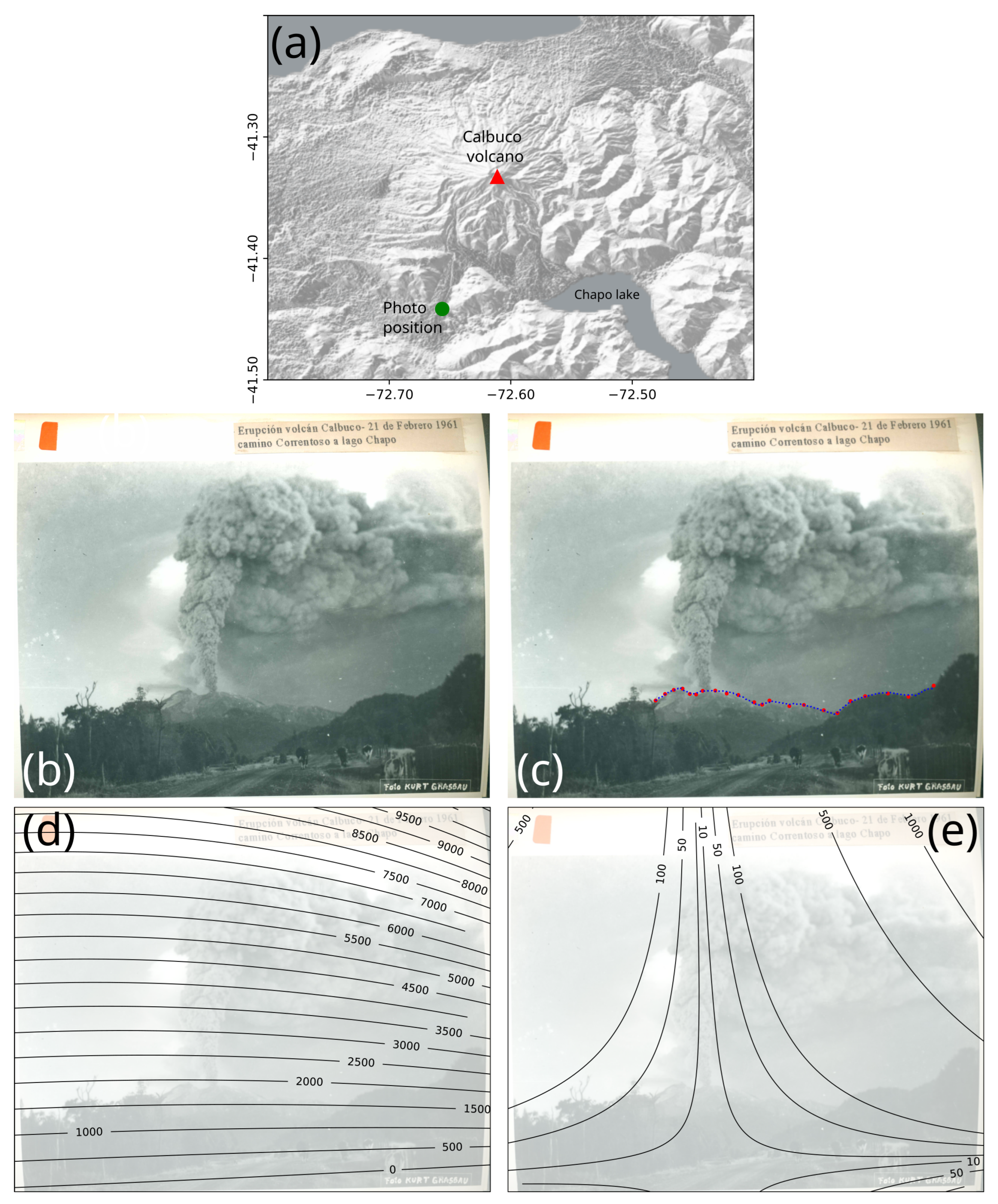
- This program can be adopted to analyze historical pictures of volcanic events and estimate their eruption source parameters.
Abstract
1. Introduction
2. Methods
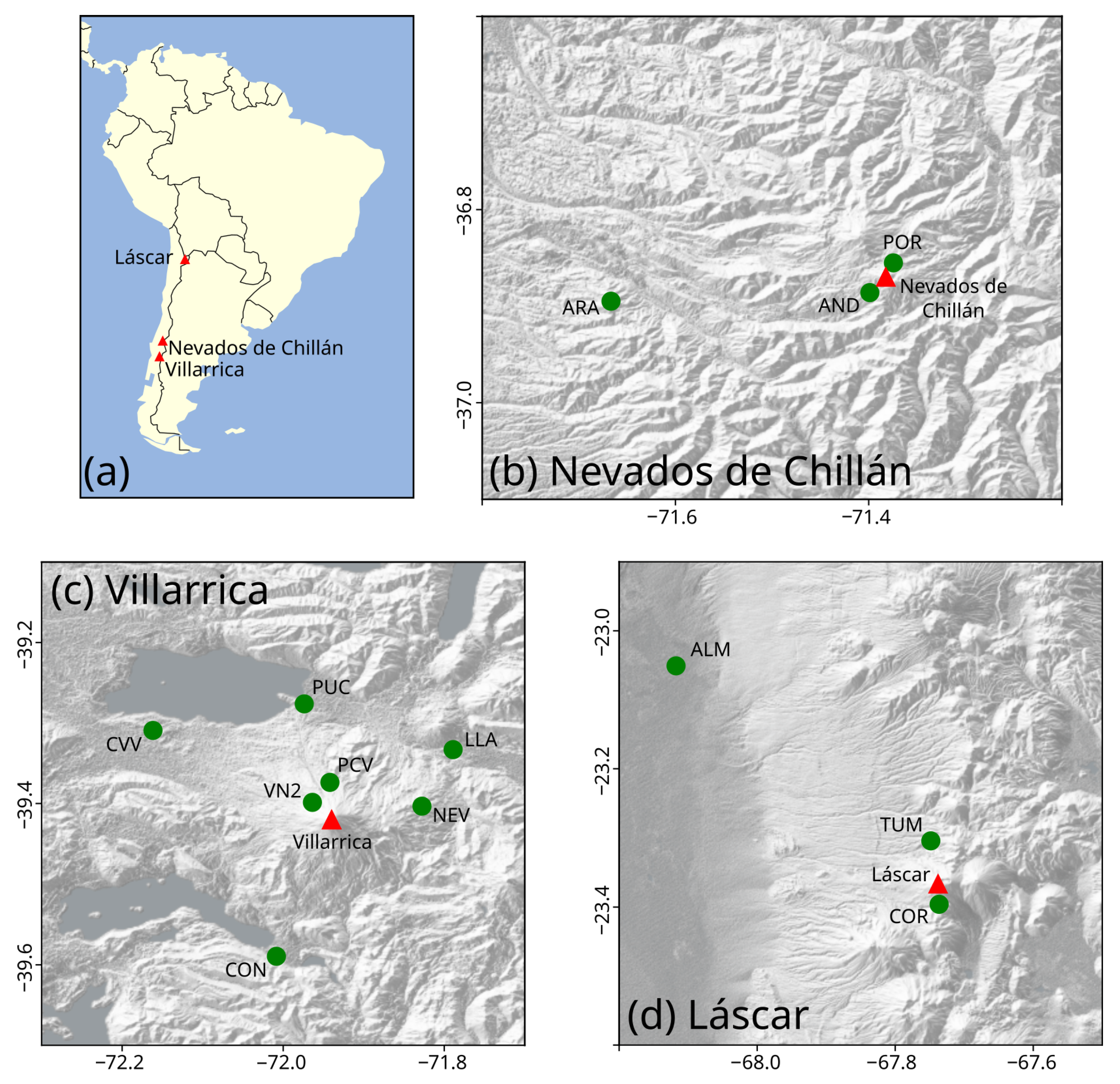
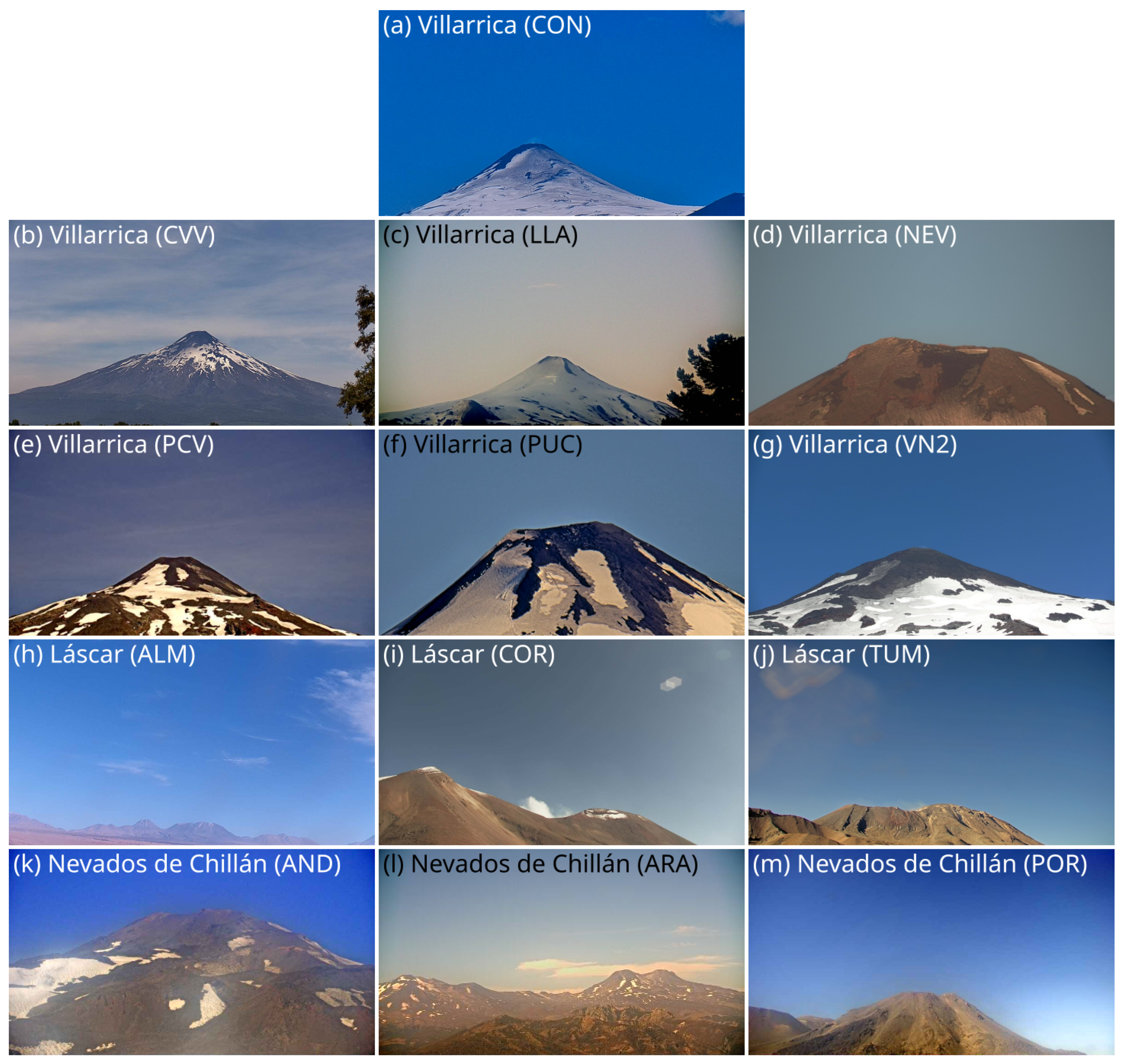
2.1. Visible Cameras and Topography Data
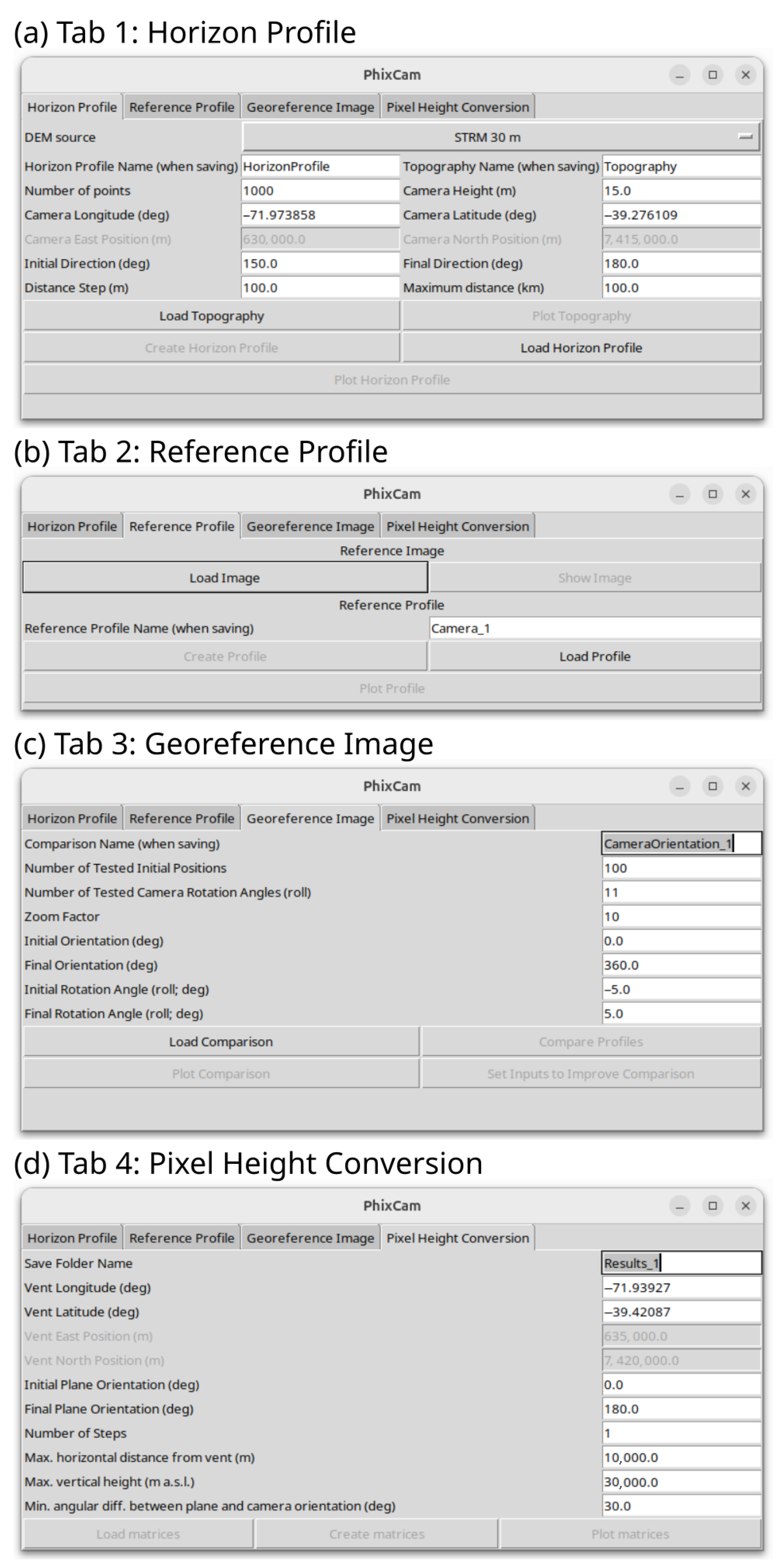
2.2. The Software
- (a)
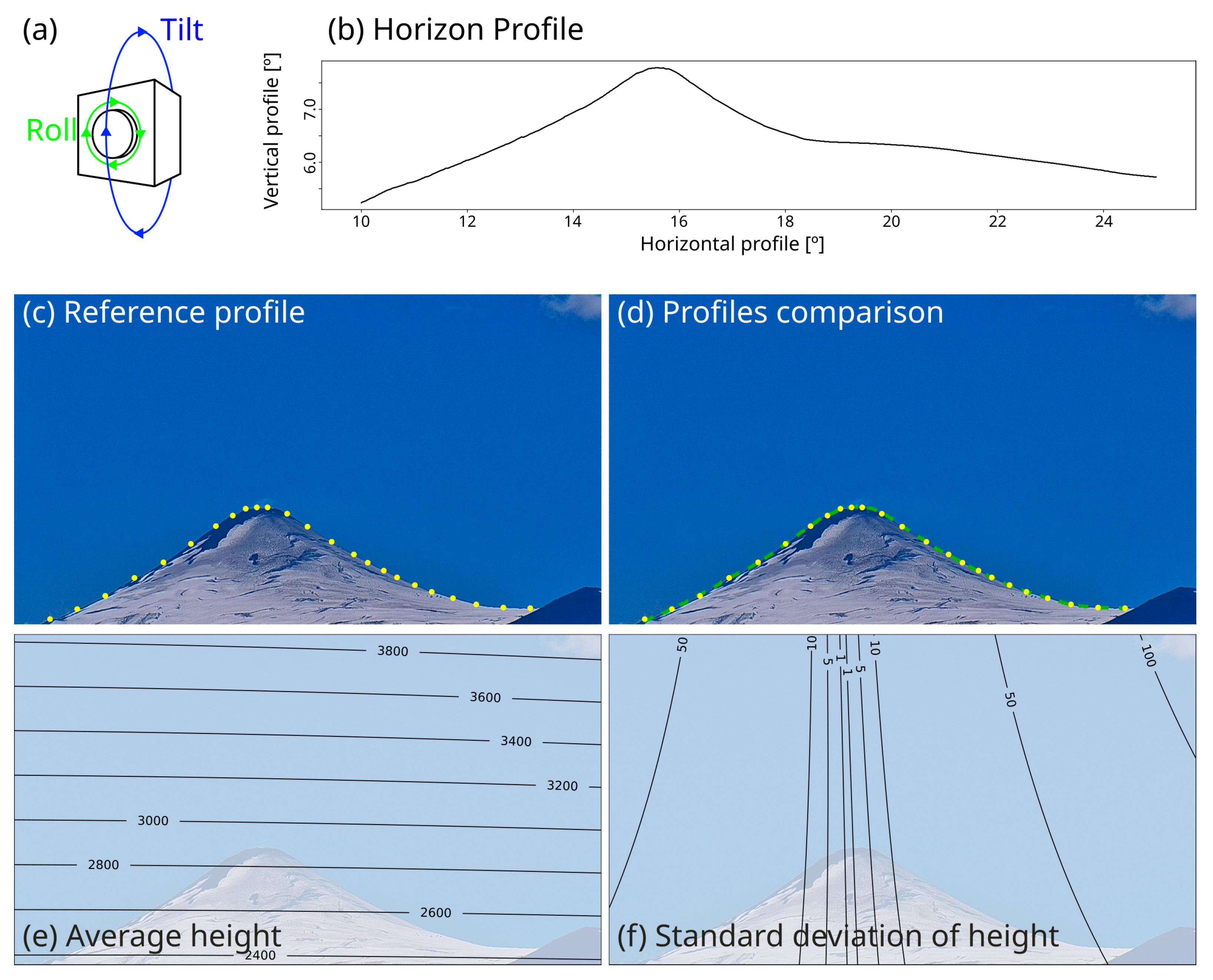
- Horizon Profile Module allows the user to set the camera position, a range for the observation direction and a few terms to define the required resolution of the horizon profile. Based on this data, the tool is able to import or download the topography and compute the horizon profile when an observer looks from the camera position in the range of directions defined by the user (Figure 4b). This information is recorded in two vectors with elements, and , which represent the pan and tilt angles of the horizon profile, respectively (see Figure 4b; is defined by the user, being equal to 2000 in all the calibrations presented here). The algorithm is simply an iterative procedure that computes, for variable observation angles from the camera position, the largest tilt inclination (Figure 4a) that intersect the imported/downloaded topography. The code also includes functions to load a previously computed horizon profile and to plot these data (Table 2).
- (b)
- Reference Profile Module allows the user to import a reference image of the visible camera under examination and trace manually, by means of a user-friendly, interactive graphical interface, the observed profile at the horizon (Figure 4c). The reference profile is saved in two vectors with elements, called and , that represent the horizontal and vertical coordinates in pixel units of the points outlined by the user in the reference image (see Figure 4c; ranges from 16 to 49 in the calibrations presented here). The code includes functions to load and plot this information as well (Table 2).
- (c)
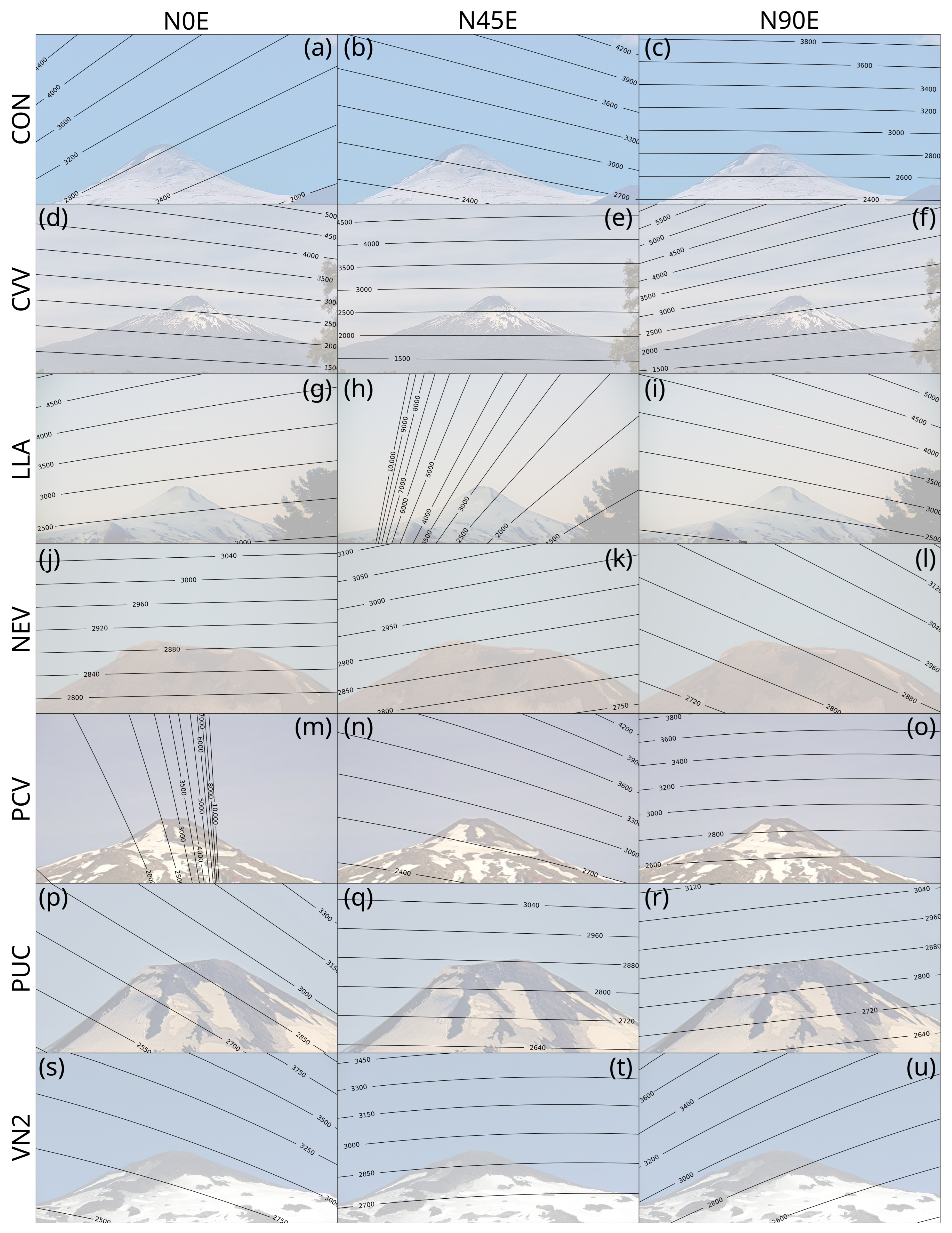
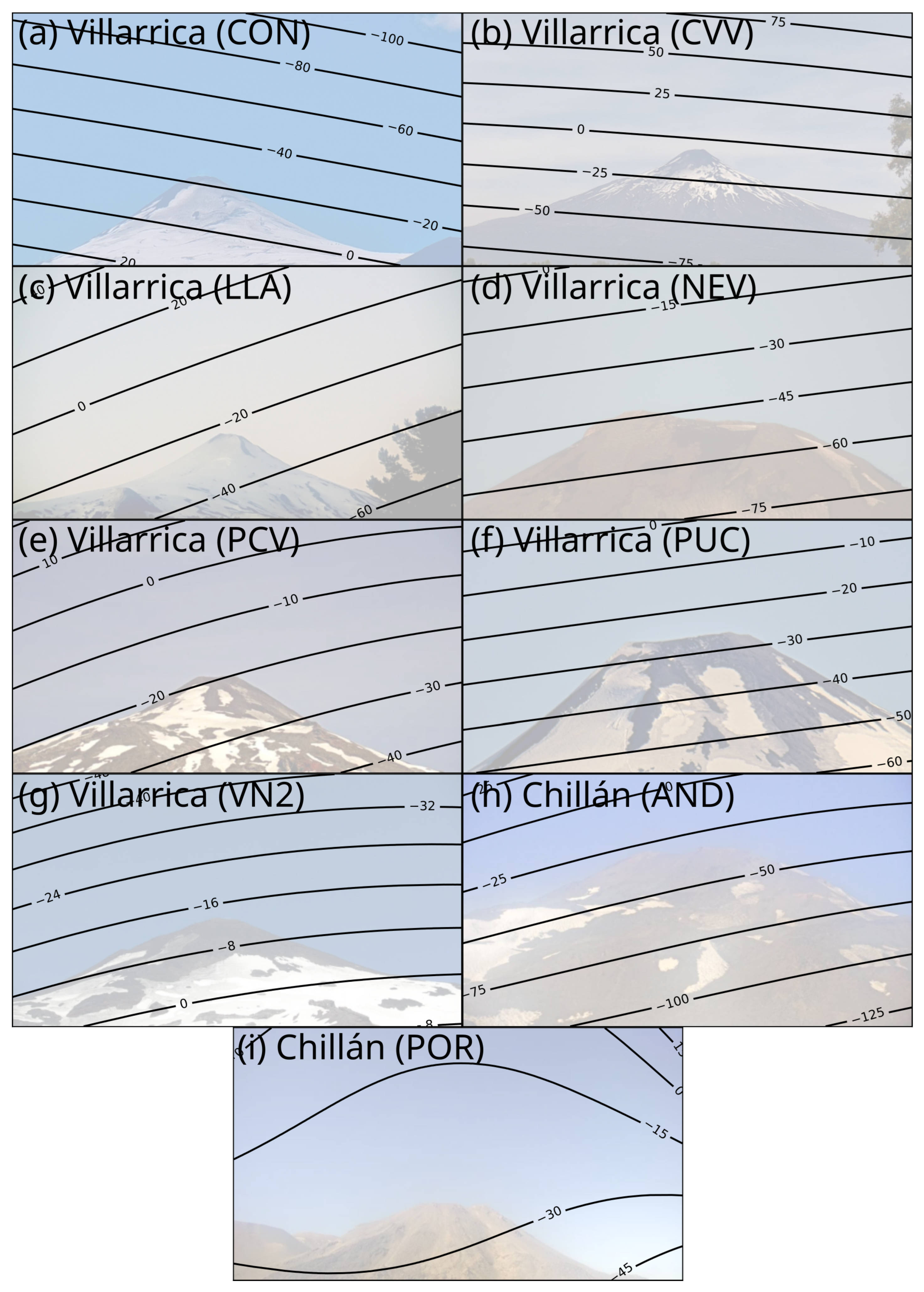
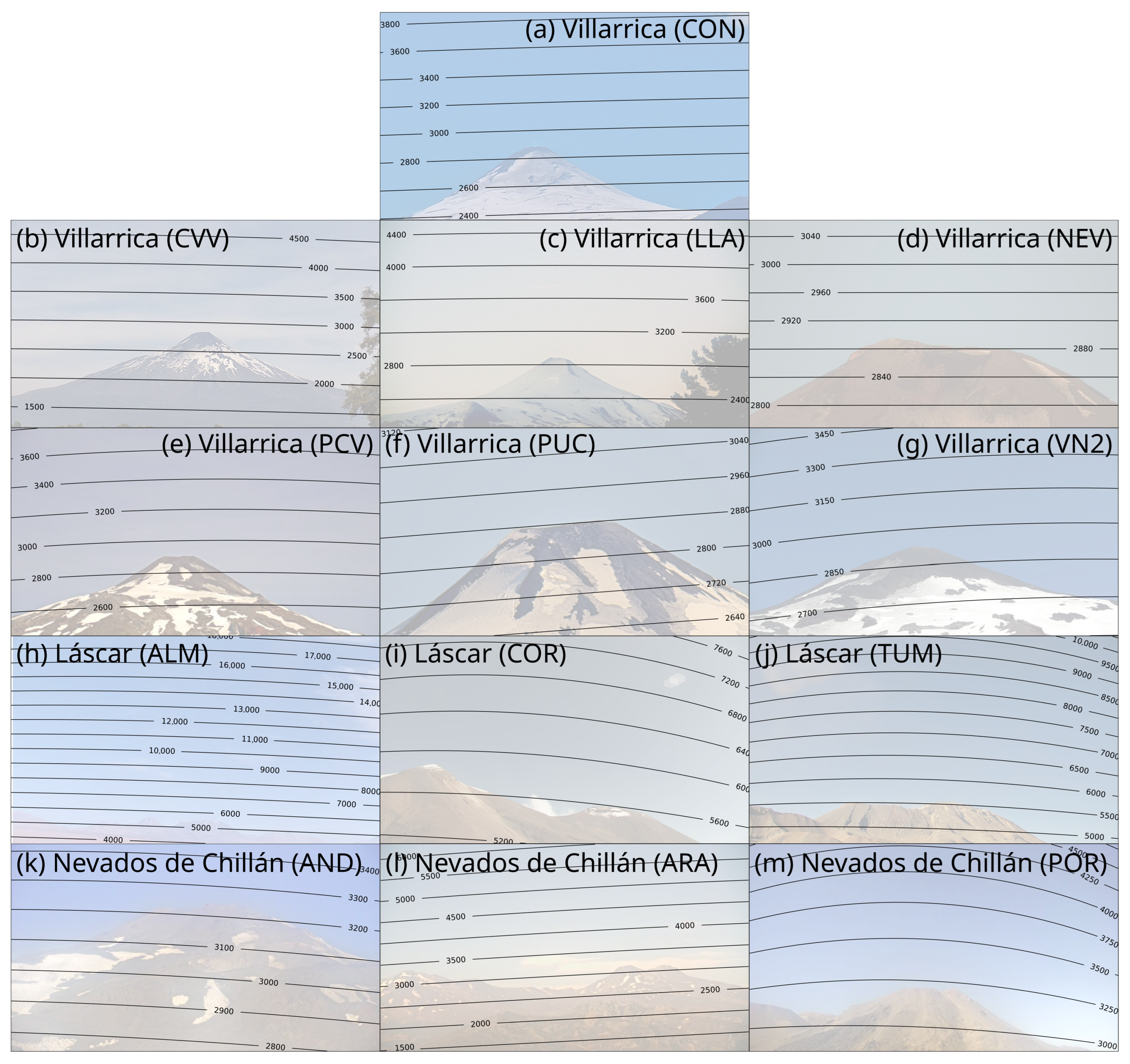
- Georeference Image Module permits the user to iterate over the horizon profile, considering different positions, zooms and rotations of the camera (tilt and roll), in order to fit these data to the reference profile. Thereby, the camera visual field is georeferenced, allowing assignation of a vector to each pixel of the captured images (Table 2 and Figure 4d). The algorithm consists of two stages.First, the code iterates over the observation direction () and the angle of view (). For each geometric configuration, the code recognizes the portion of the horizon profile actually framed, which is the subset of containing all the elements of in the interval . A third iteration parameter is then introduced: the tilt angle (), which is used to rotate the framed horizon profile with respect to a horizontal line, giving rise to a set of rotated, framed points that are controlled by three iteration variables: . Note that the iteration limits and steps are defined by the user; for the calibrations presented here, we adopted the default setup of the code. For each iteration cycle, we have two sets of points: the reference profile and the rotated, framed horizon profile . After the application of a normalization routine to set the same horizontal distance between the first and the last components of and , the software computes a series of simple statistical parameters that are sequentially analyzed to discard the geometric configurations that fit poorly the reference data. These statistical parameters, extracted from the normalized vectors and are: (1) ratio of total vertical variation to total horizontal variation in the framed profile, (2) linear term in a first-order polynomial fit, and (3) quadratic term in a second-order polynomial fit. From this iteration process, the code extracts a series of geometric configurations that are candidates to fit the reference profile.In the second stage, the algorithm iterates on the vicinity of these geometric configurations, reanalyzes the described statistical parameters and, for the geometric configurations that are not a priori discarded, the code minimizes the mean squared distance to recognizes the one that best fits the reference profile. Thereby, the code is able to extract the optimal set and thus identify issues related to camera leveling, which must be considered when these images are processed and used to quantify eruption parameters.
- (d)
- Pixel-Height Conversion Module permits to compute the height associated with each pixel of the captured image when a given vertical plane is intersected. This plane is expected to represent the emission plane of volcanic products. When volcanic plumes are analyzed, it is expected to be consistent with the wind field. When ballistic fragments are studied, this plane is related to the launch direction. Because this information is frequently unclear, this module allows the user to define a variation range for the azimuth of this plane and to statistically analyze the height of each pixel of the image in terms of different percentiles, average value and standard deviation (Table 2).
3. Results
4. Discussion
4.1. Operative Potential of PhixCam
- (a)
- Recognize the exact position of the image framed by a visible camera, including camera orientation and rotation angles (roll and tilt, Figure 4a).
- (b)
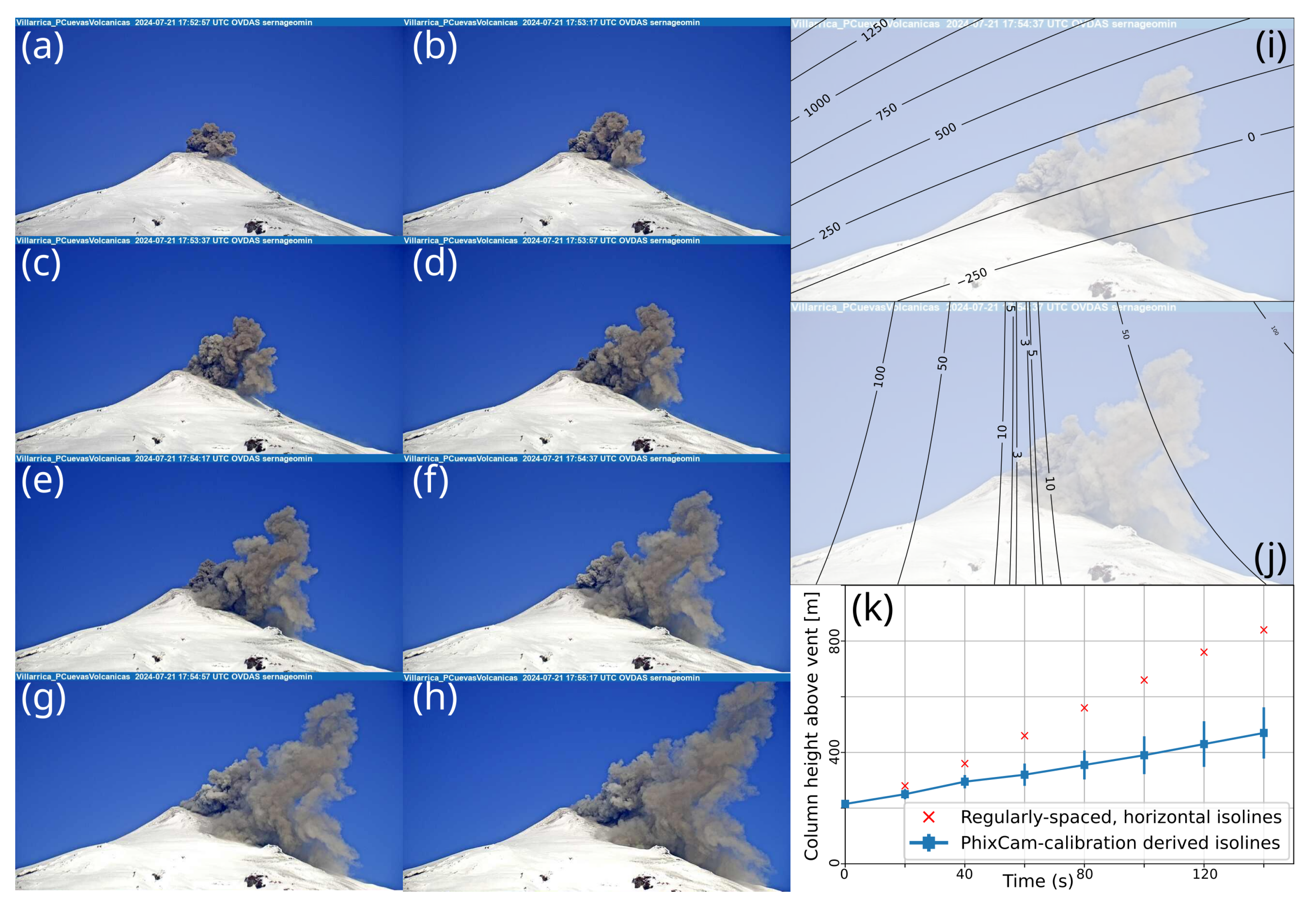
- Use this information to interpret each pixel of the images in terms of position above the crater when a given emission direction of volcanic products is considered.
- (c)
- Propagate the uncertainty in the emission direction of volcanic products to our estimates of eruption parameters such as plume height or distance reached by ballistic projectiles.
4.2. Analysis of Historical Data
5. Conclusions
Author Contributions
Funding
Data Availability Statement
Conflicts of Interest
References
- Calvari, S.; Intrieri, E.; Di Traglia, F.; Bonaccorso, A.; Casagli, N.; Cristaldi, A. Monitoring crater-wall collapse at active volcanoes: A study of the 12 January 2013 event at Stromboli. Bull. Volcanol. 2016, 78, 1–16. [Google Scholar] [CrossRef]
- Scollo, S.; Prestifilippo, M.; Bonadonna, C.; Cioni, R.; Corradini, S.; Degruyter, W.; Rossi, E.; Silvestri, M.; Biale, E.; Carparelli, G.; et al. Near-real-time tephra fallout assessment at Mt. Etna, Italy. Remote Sens. 2019, 11, 2987. [Google Scholar] [CrossRef]
- Forte, P.; Rodríguez, L.; Paz, M.P.J.; García, L.C.; Segura, Y.A.; Bustos, E.; Moya, C.P.; Espinoza, E.; Vallejo, S.; Agusto, M. Volcano monitoring in latin america: Taking a step forward: Preface to special issue on volcano observatories in Latin America. Volcanica 2021, 4, vii–xxxiii. [Google Scholar] [CrossRef]
- Budi-Santoso, A.; Beauducel, F.; Nandaka, I.G.M.A.; Humaida, H.; Costa, F.; Widiwijayanti, C.; Iguchi, M.; Métaxian, J.P.; Rudianto, I.; Rozin, M.; et al. The Merapi volcano monitoring system. In Merapi Volcano: Geology, Eruptive Activity, and Monitoring of a High-Risk Volcano; Springer: Berlin/Heidelberg, Germany, 2023; pp. 409–436. [Google Scholar]
- Hidalgo, S.; Bernard, B.; Mothes, P.; Ramos, C.; Aguilar, J.; Andrade, D.; Samaniego, P.; Yepes, H.; Hall, M.; Alvarado, A.; et al. Hazard assessment and monitoring of Ecuadorian volcanoes: Challenges and progresses during four decades since IG-EPN foundation. Bull. Volcanol. 2023, 86, 4. [Google Scholar] [CrossRef]
- Vásconez Müller, A.; Bernard, B.; Vasconez, F.J. Near-real-time ash cloud height estimation based on GOES-16 satellite imagery: A case study of the 2022–2023 eruption of Cotopaxi volcano, Ecuador. Volcanica 2024, 7, 405–419. [Google Scholar] [CrossRef]
- Patrick, M.R.; Kauahikaua, J.P.; Antolik, L. MATLAB tools for improved characterization and quantification of volcanic incandescence in Webcam imagery: Applications at Kilauea Volcano, Hawaii. US Geol. Surv. Tech. Methods 2010, 13, 1–16. [Google Scholar]
- Coltelli, M.; d’Aranno, P.J.; De Bonis, R.; Guerrero Tello, J.F.; Marsella, M.; Nardinocchi, C.; Pecora, E.; Proietti, C.; Scifoni, S.; Scutti, M.; et al. The use of surveillance cameras for the rapid mapping of lava flows: An application to Mount Etna Volcano. Remote Sens. 2017, 9, 192. [Google Scholar] [CrossRef]
- Scollo, S.; Prestifilippo, M.; Pecora, E.; Corradini, S.; Merucci, L.; Spata, G.; Coltelli, M. Eruption column height estimation of the 2011–2013 Etna lava fountains. Ann. Geophys. 2014, 57, S0214. [Google Scholar] [CrossRef]
- Barnie, T.; Hjörvar, T.; Titos, M.; Sigurðsson, E.M.; Pálsson, S.K.; Bergsson, B.; Ingvarsson, Þ.; Pfeffer, M.A.; Barsotti, S.; Arason, Þ.; et al. Volcanic plume height monitoring using calibrated web cameras at the Icelandic Meteorological Office: System overview and first application during the 2021 Fagradalsfjall eruption. J. Appl. Volcanol. 2023, 12, 4. [Google Scholar] [CrossRef]
- Aravena, A.; Carparelli, G.; Cioni, R.; Prestifilippo, M.; Scollo, S. Toward a Real-Time Analysis of Column Height by Visible Cameras: An Example from Mt. Etna, in Italy. Remote Sens. 2023, 15, 2595. [Google Scholar] [CrossRef]
- Alatorre-Ibargüengoitia, M.A.; Morales-Iglesias, H.; Ramos-Hernández, S.G.; Jon-Selvas, J.; Jiménez-Aguilar, J.M. Hazard zoning for volcanic ballistic impacts at El Chichón Volcano (Mexico). Nat. Hazards 2016, 81, 1733–1744. [Google Scholar] [CrossRef]
- Fitzgerald, R.; Tsunematsu, K.; Kennedy, B.; Breard, E.; Lube, G.; Wilson, T.; Jolly, A.; Pawson, J.; Rosenberg, M.; Cronin, S. The application of a calibrated 3D ballistic trajectory model to ballistic hazard assessments at Upper Te Maari, Tongariro. J. Volcanol. Geotherm. Res. 2014, 286, 248–262. [Google Scholar] [CrossRef]
- Selva, J.; Costa, A.; Sandri, L.; Macedonio, G.; Marzocchi, W. Probabilistic short-term volcanic hazard in phases of unrest: A case study for tephra fallout. J. Geophys. Res. Solid Earth 2014, 119, 8805–8826. [Google Scholar] [CrossRef]
- Tadini, A.; Pardini, F.; Bevilacqua, A.; Bernard, B.; Samaniego, P.; Vitturi, M.d.; Aravena, A.; Hidalgo, S.; Roche, O.; Azzaoui, N.; et al. Probabilistic tephra fallout hazard maps for Sangay volcano, Ecuador. Bull. Volcanol. 2025, 87, 1–23. [Google Scholar] [CrossRef]
- Williams, S.; Beckett, F.M.; Leadbetter, S.J.; Phillips, J.C.; Lee, A.; Wooodhouse, M.J. Incorporating eruption source parameter and meteorological variability in the generation of probabilistic volcanic ash hazard forecasts. J. Geophys. Res. Atmos. 2025, 130, e2024JD042280. [Google Scholar] [CrossRef]
- Baldo, M.; Bicocchi, C.; Chiocchini, U.; Giordan, D.; Lollino, G. LIDAR monitoring of mass wasting processes: The Radicofani landslide, Province of Siena, Central Italy. Geomorphology 2009, 105, 193–201. [Google Scholar] [CrossRef]
- Scollo, S.; Boselli, A.; Coltelli, M.; Leto, G.; Pisani, G.; Spinelli, N.; Wang, X. Monitoring Etna volcanic plumes using a scanning LiDAR. Bull. Volcanol. 2012, 74, 2383–2395. [Google Scholar] [CrossRef]
- Plank, S.; Nolde, M.; Richter, R.; Fischer, C.; Martinis, S.; Riedlinger, T.; Schoepfer, E.; Klein, D. Monitoring of the 2015 Villarrica volcano eruption by means of DLR’s experimental TET-1 satellite. Remote Sens. 2018, 10, 1379. [Google Scholar] [CrossRef]
- Coppola, D.; Laiolo, M.; Cigolini, C.; Massimetti, F.; Delle Donne, D.; Ripepe, M.; Arias, H.; Barsotti, S.; Parra, C.B.; Centeno, R.G.; et al. Thermal remote sensing for global volcano monitoring: Experiences from the MIROVA system. Front. Earth Sci. 2020, 7, 362. [Google Scholar] [CrossRef]
- Manzo, M.; Aiesi, G.; Boselli, A.; Consoli, S.; Damiano, R.; Di Donfrancesco, G.; Saraceno, B.; Scollo, S. Upgraded Three-Wavelength Lidar for Real-Time Observations of Volcanic Aerosol Optical and Microphysical Properties at Etna (Italy): Calibration Procedures and Measurement Tests. Sensors 2024, 24, 1762. [Google Scholar] [CrossRef]
- Di Bella, G.S.; Corradino, C.; Cariello, S.; Torrisi, F.; Del Negro, C. Advancing volcanic activity monitoring: A near-real-time approach with remote sensing data fusion for radiative power estimation. Remote Sens. 2024, 16, 2879. [Google Scholar] [CrossRef]
- Vásconez, F.; Moussallam, Y.; Harris, A.J.; Latchimy, T.; Kelfoun, K.; Bontemps, M.; Macías, C.; Hidalgo, S.; Córdova, J.; Battaglia, J.; et al. VIGIA: A thermal and visible imagery system to track volcanic explosions. Remote Sens. 2022, 14, 3355. [Google Scholar] [CrossRef]
- Ospina, C.; Narvaez, A.; Corchuelo, I. Field calibration of volcanic surveillance cameras. In Journal of Physics: Conference Series, Proceedings of the 5th Colombian Conference of Engineering Physics (V CNIF), Medellin, Colombia, 26–30 September 2016; IOP Publishing: Bristol, UK, 2017; Volume 850, p. 012010. [Google Scholar]
- Zhang, Z. Flexible camera calibration by viewing a plane from unknown orientations. In Proceedings of the Seventh IEEE International Conference on Computer Vision, Kerkyra, Greece, 20–27 September 1999; IEEE: Piscataway, NJ, USA, 1999; Volume 1, pp. 666–673. [Google Scholar]
- Antuña-Sánchez, J.C.; Román, R.; Bosch, J.L.; Toledano, C.; Mateos, D.; González, R.; Cachorro, V.; de Frutos, A. ORION software tool for the geometrical calibration of all-sky cameras. PLoS ONE 2022, 17, e0265959. [Google Scholar] [CrossRef] [PubMed]
- Stern, C.R. Active Andean volcanism: Its geologic and tectonic setting. Rev. Geol. Chile 2004, 31, 161–206. [Google Scholar] [CrossRef]
- Cembrano, J.; Lara, L. The link between volcanism and tectonics in the southern volcanic zone of the Chilean Andes: A review. Tectonophysics 2009, 471, 96–113. [Google Scholar] [CrossRef]
- Amigo, A. Volcano monitoring and hazard assessments in Chile. Volcanica 2021, 4, 1–20. [Google Scholar] [CrossRef]
- Benet, D.; Costa, F.; Pedreros, G.; Cardona, C. The volcanic ash record of shallow magma intrusion and dome emplacement at Nevados de Chillán Volcanic complex, Chile. J. Volcanol. Geotherm. Res. 2021, 417, 107308. [Google Scholar] [CrossRef]
- Cardona, C.; Gil-Cruz, F.; Franco-Marín, L.; San Martín, J.; Valderrama, O.; Lazo, J.; Cartes, C.; Morales, S.; Hernández, E.; Quijada, J.; et al. Volcanic activity accompanying the emplacement of dacitic lava domes and effusion of lava flows at Nevados de Chillán Volcanic Complex–Chilean Andes (2012 to 2020). J. Volcanol. Geotherm. Res. 2021, 420, 107409. [Google Scholar] [CrossRef]
- Gaete, A.; Walter, T.R.; Bredemeyer, S.; Zimmer, M.; Kujawa, C.; Franco Marin, L.; San Martin, J.; Bucarey Parra, C. Processes culminating in the 2015 phreatic explosion at Lascar volcano, Chile, evidenced by multiparametric data. Nat. Hazards Earth Syst. Sci. 2020, 20, 377–397. [Google Scholar] [CrossRef]
- Sernageomin. Ranking de riesgo específico de volcanes activos de Chile 2023. 2023. Available online: https://rnvv.sernageomin.cl/wp-content/uploads/sites/2/2023/10/Ranking-2023_tabloide_20231012.pdf (accessed on 13 July 2025).
- Farr, T.G.; Rosen, P.A.; Caro, E.; Crippen, R.; Duren, R.; Hensley, S.; Kobrick, M.; Paller, M.; Rodriguez, E.; Roth, L.; et al. The shuttle radar topography mission. Rev. Geophys. 2007, 45, RG2004. [Google Scholar] [CrossRef]
- Sparks, R. The dimensions and dynamics of volcanic eruption columns. Bull. Volcanol. 1986, 48, 3–15. [Google Scholar] [CrossRef]
- Carey, S.; Bursik, M. Volcanic plumes. In The Encyclopedia of Volcanoes; Elsevier: Amsterdam, The Netherlands, 2015; pp. 571–585. [Google Scholar]
- Biggs, J.; Pritchard, M.E. Global volcano monitoring: What does it mean when volcanoes deform? Elements 2017, 13, 17–22. [Google Scholar] [CrossRef]
- Acocella, V.; Ripepe, M.; Rivalta, E.; Peltier, A.; Galetto, F.; Joseph, E. Towards scientific forecasting of magmatic eruptions. Nat. Rev. Earth Environ. 2024, 5, 5–22. [Google Scholar] [CrossRef]
- Taddeucci, J.; Alatorre-Ibargüengoitia, M.; Cruz-Vázquez, O.; Del Bello, E.; Scarlato, P.; Ricci, T. In-flight dynamics of volcanic ballistic projectiles. Rev. Geophys. 2017, 55, 675–718. [Google Scholar] [CrossRef]
- Tsunematsu, K.; Ishii, K.; Yokoo, A. Transport of ballistic projectiles during the 2015 Aso Strombolian eruptions. Earth Planets Space 2019, 71, 1–14. [Google Scholar] [CrossRef]
- Degruyter, W.; Bonadonna, C. Improving on mass flow rate estimates of volcanic eruptions. Geophys. Res. Lett. 2012, 39. [Google Scholar] [CrossRef]
- Harris, A.J.; Ripepe, M.; Hughes, E.A. Detailed analysis of particle launch velocities, size distributions and gas densities during normal explosions at Stromboli. J. Volcanol. Geotherm. Res. 2012, 231, 109–131. [Google Scholar] [CrossRef]
- Engwell, S.; Mastin, L.G.; Bonadonna, C.; Barsotti, S.; Deligne, N.I.; Oladottir, B.A. Characterising, quantifying, and accessing eruption source parameters of explosive volcanic eruptions for operational simulation of tephra dispersion: A current view and future perspectives. Bull. Volcanol. 2024, 86, 67. [Google Scholar] [CrossRef]
- Klohn, E. The February 1961 eruption of Calbuco volcano. Bull. Seismol. Soc. Am. 1963, 53, 1435–1436. [Google Scholar] [CrossRef]
- Daga, R.; Guevara, S.R.; Poire, D.G.; Arribére, M. Characterization of tephras dispersed by the recent eruptions of volcanoes Calbuco (1961), Chaitén (2008) and Cordón Caulle Complex (1960 and 2011), in Northern Patagonia. J. S. Am. Earth Sci. 2014, 49, 1–14. [Google Scholar] [CrossRef]
- Grassau, K. Erupción del volcán Calbuco, camino Correntoso a lago Chepo. Donated by Elna Stange Ohlsen. 1961. Available online: https://www.memoriasdelsigloxx.cl/601/w3-article-85680.html (accessed on 13 July 2025).





| Camera ID | Volcano | Distance to Vent (km) | Image Dimensions | Angular Range of the Computed Horizon Profile 1 |
|---|---|---|---|---|
| CON | Villarrica | 10–25° | ||
| CVV | 115–130° | |||
| LLA | 220–240° | |||
| NEV | 250–265° | |||
| PCV | 150–200° | |||
| PUC | 160–175° | |||
| VN2 | 100–160° | |||
| ALM 2 | Lascar | 100–160° | ||
| COR 2 | –50° | |||
| TUM 2 | 130–210° | |||
| AND | Nevados de Chillán | 25–55° | ||
| ARA 2 | 60–100° | |||
| POR | 170–220° |
| Module | Function | Description |
|---|---|---|
| Horizon Profile | Load Topography | This function allows the user to download topographic data (SRTM 30 m) or load a DEM file in ascii format. The downloaded topographies are saved in the folder Topographies. |
| Plot Topography | This function permits the user to plot a previously loaded topography, where information about the camera position and an angular range for the field of view can be included. | |
| Create Horizon Profile | This function allows the user to compute the horizon profile when an observer looks from the camera position in a defined range of directions. Data is saved in the folder Horizons. | |
| Load Horizon Profile | It permits the user to load an already created horizon profile. | |
| Plot Horizon Profile | This function allows the user to plot data of an already created horizon profile. | |
| Reference Profile | Load Image | This function is used to import a reference image of the visible camera under study. The more common extensions of images are supported by PhixCam (jpg, jpeg, png, tiff). |
| Show Image | It allows the user to display a previously imported image of the visible camera under study. | |
| Create Profile | This function displays a previously imported image of the visible camera under study and allows the user to trace manually the observed topographic profile at the horizon. Data is saved in the folder ReferenceProfiles. | |
| Load Profile | It permits the user to load a previously created reference profile and the associated image. | |
| Plot Profile | This function permits the user to plot a previously created reference profile and the associated image. | |
| Georeference Image | Load Comparison | This function allows the user to import a file containing the information needed to georeference a visible camera. It includes rotation (tilt and roll) and angular range of the view field. |
| Compare Profiles | Based on a previously imported horizon profile and a reference profile, this function launches an iterative algorithm able to identify the portion of the horizon profile that fits better the reference information. Data is saved in the folder CameraOrientations. | |
| Plot Comparison | This function allows the user to plot both the horizon profile and the reference profile, projected on the reference image. It allows the user to evaluate the performance of the comparison procedure. | |
| Set Input To Improve Comparison | This function resets the input parameters displayed in this tab to improve a previously computed fit by iterating in its vicinity. | |
| Pixel Height Conversion | Load Matrices | This function allows the user to import the results of a set of pixel position-to-height conversion matrices. |
| Create Matrices | Based on a georeferenced camera, vent coordinates and a range of variation for the emission direction of volcanic products, the code computes the pixel position-to-height conversion matrices and saves them in the folder PixelHeightConversion. Average height, its standard deviation and different percentiles are also computed and saved. All these products have the same dimensions of the reference image. The output format is compatible with the program PHA [11]. | |
| Plot Matrices | It allows the user to plot a set of previously created pixel position-to-height conversion matrices. |
| Camera ID | Volcano | Roll Angle (°) 1 | View Field (°) 2 | Tilt Angle (°) 3 | Error Measure 4 |
|---|---|---|---|---|---|
| CON | Villarrica | – | |||
| CVV 5 | – | ||||
| LLA | – | ||||
| NEV | – | ||||
| PCV | – | ||||
| PUC | – | ||||
| VN2 | – | ||||
| ALM | Lascar | – | |||
| COR | – | ||||
| TUM | – | ||||
| AND 5 | Nevados de Chillán | – | |||
| ARA | – | ||||
| POR 5 | – |
| Camera ID | Volcano | Roll Angle (°) 1 | View Field (°) 2 | Tilt Angle (°) 3 | Error Measure 4 |
|---|---|---|---|---|---|
| CON | Villarrica | – | |||
| CVV | – | ||||
| LLA | – | ||||
| NEV | – | ||||
| PCV | – | ||||
| PUC | – | ||||
| VN2 | – | ||||
| AND | Nevados de Chillán | – | |||
| POR | – |
Disclaimer/Publisher’s Note: The statements, opinions and data contained in all publications are solely those of the individual author(s) and contributor(s) and not of MDPI and/or the editor(s). MDPI and/or the editor(s) disclaim responsibility for any injury to people or property resulting from any ideas, methods, instructions or products referred to in the content. |
© 2025 by the authors. Licensee MDPI, Basel, Switzerland. This article is an open access article distributed under the terms and conditions of the Creative Commons Attribution (CC BY) license (https://creativecommons.org/licenses/by/4.0/).
Share and Cite
Aravena, A.; Pedreros, G.; Bucchi, F.; Gutiérrez-Riquelme, M.; Cioni, R. PhixCam: A Tool to Georeference Images Captured by Visible Cameras with Applications for Volcano Monitoring. Remote Sens. 2025, 17, 3643. https://doi.org/10.3390/rs17213643
Aravena A, Pedreros G, Bucchi F, Gutiérrez-Riquelme M, Cioni R. PhixCam: A Tool to Georeference Images Captured by Visible Cameras with Applications for Volcano Monitoring. Remote Sensing. 2025; 17(21):3643. https://doi.org/10.3390/rs17213643
Chicago/Turabian StyleAravena, Alvaro, Gabriela Pedreros, Francisco Bucchi, Miguel Gutiérrez-Riquelme, and Raffaello Cioni. 2025. "PhixCam: A Tool to Georeference Images Captured by Visible Cameras with Applications for Volcano Monitoring" Remote Sensing 17, no. 21: 3643. https://doi.org/10.3390/rs17213643
APA StyleAravena, A., Pedreros, G., Bucchi, F., Gutiérrez-Riquelme, M., & Cioni, R. (2025). PhixCam: A Tool to Georeference Images Captured by Visible Cameras with Applications for Volcano Monitoring. Remote Sensing, 17(21), 3643. https://doi.org/10.3390/rs17213643