You are currently viewing a new version of our website. To view the old version click .
Remote Sensing
  • Technical Note
  • Open Access

24 October 2025

Cross-Validation of Surface Reflectance Between GF5-02 AHSI and EnMAP Across Diverse Land Cover Types

,
,
,
,
,
,
,
and
1
Land Satellite Remote Sensing Application Center, Ministry of Natural Resources, Beijing 100048, China
2
Key Laboratory of Precision Opto-Mechatronics Technology, Ministry of Education, School of Instrumentation and Optoelectronic Engineering, Beihang University, Beijing 100191, China
3
Beijing Satlmage Information Technology Co., Ltd., Beijing 100043, China
*
Author to whom correspondence should be addressed.

Highlights

What are the main findings?
  • GF5-02 AHSI and EnMAP surface reflectance products exhibit strong consistency across minerals, grasslands, and desert surfaces (R > 0.96, spectral angle < 0.08 rad).
  • Water bodies show notable discrepancies between the two sensors, mainly due to atmospheric correction strategies and sensor response differences.
What is the implication of the main finding?
  • The strong cross-sensor agreement demonstrates that GF5-02 data provide a solid basis for quantitative remote sensing and support foundational research on hyperspectral interoperability.
  • Identifying and addressing inconsistencies in low-reflectance environments lays essential groundwork for improving cross-mission interoperability and advancing the broader integration of hyperspectral data.

Abstract

Multi-source hyperspectral data are increasingly applied in environmental monitoring, precision agriculture, and geological exploration, yet differences in sensor characteristics hinder interoperability. This study presents a systematic cross-validation of surface reflectance between the German EnMAP mission and the Chinese GF5-02 Advanced Hyperspectral Imager (AHSI) across four representative land cover types: minerals in the East Tianshan Mountains, tropical grasslands in Hainan Danzhou, desert in Dunhuang, and inland salt lakes in Qinghai. Using EnMAP Level-2A products as reference, we evaluated GF5-02 reflectance with spectral angle (SA), root mean squared error (RMSE), relative RMSE (RRMSE), and correlation coefficient (R). Results show strong consistency for high- and medium-reflectance surfaces (R > 0.96, SA < 0.08 rad), while water bodies exhibit larger discrepancies (R = 0.82, SA = 0.34 rad), likely due to atmospheric correction and sensor response differences. Additional ground validation in the East Tianshan region confirmed the reliability and stability of GF5-02 data. Overall, GF5-02 demonstrates high consistency with EnMAP across most land cover types, supporting quantitative applications, though further improvements are needed for low-reflectance environments.

1. Introduction

In recent years, multi-source hyperspectral data have played an increasingly important role in applications such as environmental monitoring, precision agriculture, and geological exploration [1,2,3]. With their continuous narrow bands, high spectral resolution, and relatively fine spatial resolution, hyperspectral sensors provide rich spectral information that supports both quantitative inversion and qualitative identification of land surface features. However, variations in spectral response functions, radiometric calibration accuracy, and atmospheric correction procedures across different satellite platforms and sensors introduce inconsistencies, which in turn affect cross-sensor data fusion and joint applications. Therefore, evaluating the consistency of multi-source hyperspectral data is essential for ensuring interoperability, improving quantitative retrieval accuracy, and enhancing the comparability of derived products [4,5].
The German Environmental Mapping and Analysis Program (EnMAP) is one of the most advanced hyperspectral satellite missions, delivering Level-2A (L2A) surface reflectance products that undergo rigorous radiometric, geometric, and atmospheric corrections [6]. These products comply with internationally accepted quality standards and have been widely used in fine-scale environmental monitoring, vegetation parameter retrieval, and mineral identification [7,8,9]. To ensure high-quality data, the EnMAP team has established a comprehensive calibration and validation framework covering the full L1–L2 processing chain, supported by quarterly mission reports and global quality assessments [10,11]. Furthermore, cross-validation practices promoted by ESA and NASA have compared EnMAP data with those from PRISMA [12], DESIS [13], Sentinel-2 [14], and airborne hyperspectral sensors [15,16], often employing pseudo-invariant calibration sites (PICSs) and vicarious calibration to assess inter-mission radiometric comparability [17]. In addition, recent guidelines from CEOS/WGCV and community initiatives such as HYPSTAR and LANDHYPERNET emphasize automated ground networks and standardized uncertainty reporting to support multi-mission interoperability [18].
China has also made rapid progress in spaceborne hyperspectral observation, successfully launching several operational satellites with hyperspectral capabilities, including ZY-1 02D [19], GF5-02 [20], and ZY-1 02E [21]. GF5-02, equipped with the Advanced Hyperspectral Imager (AHSI), has undergone on-orbit radiometric performance assessments and uncertainty analyses, with cross-validation conducted at RadCalNet sites such as Baotou and Dunhuang to support its quantitative applications [20,22,23]. ZY-1 02D has advanced efficient algorithms for reflectance retrieval, denoising, and rapid processing, and has been cross-calibrated with GF-5 AHSI to improve radiometric accuracy [24]. Application-driven validation efforts have used near-contemporaneous ZY-1 02D/02E observations for soil and ecological parameter retrieval, and for environmental impact monitoring in wetlands, salinization areas, and lithological mapping [25,26].
Meanwhile, both Germany and China have carried out a series of multi-sensor cross-validation and interoperability studies to assess hyperspectral consistency. The EnMAP mission has been systematically compared with PRISMA, DESIS, and pseudo-invariant site analyses [15,16,27]. These efforts have established a mature cross-mission framework emphasizing harmonized quality assessment. In contrast, Chinese hyperspectral missions such as GF5-02 and ZY-1 02D have focused on domestic calibration and vicarious validation at sites such as Dunhuang, Baotou, and Gobi [19,20,22,23].
Despite these advances, several limitations remain. First, inter-mission harmonization between Chinese and European hyperspectral systems is still restricted by differences in atmospheric correction algorithms (e.g., Python(version 2.7)-based atmospheric correction [6] (PACO) for EnMAP vs. Fast Line-of-sight Atmospheric Analysis of Spectral Hypercubes [28] (FLAASH) for GF5-02), radiometric reference standards, and spectral response characterization. Second, discrepancies in radiometric scaling, spectral resampling, and preprocessing workflows often lead to residual differences in surface reflectance, even for identical targets. These challenges emphasize the need to establish a standardized, globally consistent verification framework to enhance inter-mission comparability and improve quantitative interoperability across hyperspectral satellite systems.
Building upon these considerations, this study uses EnMAP L2A products [27,29,30] as reference data and evaluates GF5-02 AHSI observations acquired in synchronous or near-synchronous conditions over representative land cover types in China. Land cover classes such as vegetation, water bodies, and rocks, which are widely representative across application domains and exhibit diverse spectral characteristics, serve as ideal targets for cross-sensor consistency assessments [24,31,32]. Multiple evaluation metrics, including spectral angle, root mean squared error, and correlation coefficient, are employed to systematically assess surface reflectance consistency. By comparing reflectance results across diverse land cover types, this study not only quantifies cross-sensor spectral agreement but also identifies sensor-specific strengths and limitations under different surface conditions. The results provide insights for algorithm optimization and support the broader interoperability and application of Chinese hyperspectral data in international contexts.

2. Materials and Methods

2.1. Satellite Sensors

EnMAP is an Earth observation mission dedicated to imaging spectroscopy operated by the German Aerospace Center (DLR). The mission relies on the hyperspectral imager (HSI), a pushbroom instrument that captures reflected signals from the Earth’s surface in the VNIR–SWIR spectral range (420–2450 nm). EnMAP acquires 224 spectral bands, with spectral sampling intervals of 6.5 nm in the VNIR and 10 nm in the SWIR, and provides a ground sampling distance of 30 m at nadir with a swath width of up to 30 km (Table 1) [33].
Table 1. DLR-EnMAP sensor characteristics.
EnMAP Level-2A (L2A) products, used in this study, provide atmospherically corrected surface reflectance tailored for both land and water applications. The atmospheric correction chain includes specular reflection detection, sun-glint correction over water surfaces, haze and cirrus identification and compensation, aerosol optical thickness retrieval, columnar water vapor estimation, and adjacency-effect corrections [6].
The Chinese hyperspectral observation satellite GF5-02 carries seven instruments, among which AHSI is designed for visible to shortwave infrared (VNIR–SWIR) imaging spectroscopy. The AHSI covers 387–1024 nm (VNIR) and 1009–2516 nm (SWIR) with a spectral resolution of <5 nm and <10 nm, respectively, providing 150 VNIR and 180 SWIR bands. It delivers 30 m spatial resolution at nadir and a swath width of 60 km, with a radiometric accuracy better than 7% (Table 2) [22,23].
Table 2. China-GF-5 02 AHSI characteristics.
GF5-02 AHSI supports diverse applications including mineral exploration, geological environment monitoring, vegetation and ecosystem assessment, water quality retrieval, and pollution monitoring, making it highly relevant for quantitative Earth observation.

2.2. Surface Reflectance Retrieval

The preprocessing of hyperspectral imagery consisted of three main steps: radiometric calibration, atmospheric correction, and geometric correction.
Radiometric calibration is a key step in hyperspectral data preprocessing, converting raw digital numbers ( D N ) into physically meaningful radiance. This process establishes the foundation for subsequent atmospheric correction and surface reflectance retrieval.
L = D N × g a i n ( λ ) + o f f s e t ( λ ) ,
where L denotes the at-sensor radiance at wavelength λ (W⋅m−2⋅sr−1⋅μm−1), D N is the digital number recorded by the sensor, g a i n ( λ ) and o f f s e t ( λ ) are wavelength-dependent calibration coefficients derived from ground-based calibration measurements; and λ represents the spectral wavelength. The gain factor converts D N values into physically meaningful radiance, while the offset accounts for sensor-related biases such as dark current and systematic noise. This calibration ensures that the raw image digital numbers are transformed into quantitative radiometric measurements, providing the necessary input for subsequent atmospheric correction and surface reflectance retrieval.
Atmospheric correction for GF5-02 AHSI was performed using the FLAASH algorithm [28]. The model can be expressed as:
L = A ρ 1 ρ e S + B ρ e 1 ρ e S + L a ,
where ρ is the true surface reflectance, ρ e is the average reflectance of the surrounding region, S is the atmospheric spherical albedo, L a is the path radiance, and A and B are coefficients dependent on atmospheric and illumination conditions.
For EnMAP data, atmospheric correction was conducted using the PACO processor [6]. PACO is a fully automated atmospheric correction module developed by DLR (Cologne, Germany) that converts EnMAP Level-1B radiance into Level-2A surface reflectance. It is based on MODTRAN-6 radiative transfer simulations and performs an iterative retrieval of atmospheric parameters such as aerosol optical thickness, column water vapor, and surface pressure. The algorithm employs a coupled inversion scheme that uses image-derived dark pixels and spectral features to optimize aerosol and water vapor estimates, while compensating adjacency effects using a spatial convolution approach. PACO also implements bidirectional reflectance and spectral response convolution to ensure spectral fidelity between adjacent bands. This physically based, pixel-wise retrieval framework ensures high radiometric accuracy and spectral consistency of EnMAP Level-2A products.
For water body analysis, the EnMAP aquatic Level-2A product is used instead of the standard PACO-processed surface reflectance. This product delivers remote sensing reflectance optimized for optically complex waters through EnMAP’s dedicated water processing chain [33]. The use of this specialized dataset ensures physically realistic reflectance representation in aquatic environments and enhances consistency with the GF5-02 retrievals.
Geometric correction was performed using the rational polynomial coefficients (RPCs) and ancillary metadata provided with the GF5-02 and EnMAP datasets. Each image was first orthorectified using a high-resolution digital elevation model (DEM) to remove terrain-induced distortions. Subsequently, an automated sub-pixel co-registration was applied using the AROSICS tool 1.10.2 (2024-02-13) (Automated and Robust Open-Source Image Co-Registration Software for Multi-Sensor Satellite Data) [34], which employs phase-correlation and adaptive matching strategies to refine spatial alignment between multi-sensor images. The resulting co-registration accuracy reached approximately 0.3 pixel. To further reduce the impact of potential sub-pixel offsets and sensor noise, reflectance comparisons were not performed strictly on a single-pixel basis. Instead, validation samples were selected within spectrally homogeneous surface areas identified by visual inspection and spectral uniformity analysis. For each site, mean reflectance values were extracted over 3 × 3 pixels neighborhoods centered on representative land cover targets. This approach minimizes residual geometric misregistration (typically <0.3 pixel) and enhances the robustness of statistical comparisons between EnMAP and GF5-02 reflectance data.

2.3. Accuracy Assessment

2.3.1. Spectral Band Matching

To ensure comparability during cross-validation, both spatial and spectral consistency were established between the two sensors. Because each sensor has a unique spectral response function (SRF), differences between the GF5-02 and EnMAP SRFs were explicitly accounted for. The GF5-02 reflectance spectra are convolved with EnMAP’s broader SRF using a Gaussian-weighted integration approach to generate spectrally equivalent reflectance values [24]. Prior to convolution, the SRFs of EnMAP are normalized to unit area to preserve reflectance energy. Each EnMAP band is modeled as a Gaussian function centered at its nominal wavelength λ0 with a full width at half maximum (FWHM) corresponding to the sensor’s spectral bandwidth. These parameters are obtained from the official EnMAP calibration file, ensuring that each band’s unique spectral sampling distance and bandwidth are accurately represented. The spectral convolution was then expressed as.
ρ G F r e s = ρ G F × S R F E n M A P S R F E n M A P ,
where ρ G F r e s denotes the surface reflectance after spectral resampling, while ρ G F represents the original (pre-resampling) reflectance. S R F E n M A P refers to the spectral response function associated with EnMAP, which characterizes the sensor’s spectral sensitivity and is used to weight the reflectance during the resampling process.

2.3.2. Spectral Similarity Metrics

The EnMAP reflectance spectrum is used as the reference, and the correlation coefficient ( R ) and root mean squared error ( R M S E ) are adopted as evaluation metrics for validating the corresponding land cover points in the dataset. The correlation coefficient quantifies the linear relationship between the ground-measured reflectance spectrum and the retrieved reflectance spectrum, and it is calculated as follows [35]:
R = C o v ( ρ G F r e s , ρ E n M A P ) D ( ρ G F r e s ) D ( ρ E n M A P ) ,
where ρ E n M A P is the vectors composed of the EnMAP-retrieved reflectance across all bands, C o v ( ρ G F r e s , ρ E n M A P ) denotes the covariance between vectors ρ G F r e s and ρ E n M A P ; and D ( ρ G F r e s ) and D ( ρ E n M A P ) represent the variances of ρ G F r e s and ρ E n M A P , respectively.
The root mean squared error (RMSE) [36] is used to evaluate the numerical deviation between two spectra. It is calculated as:
R M S E = 1 N i = 1 N ( ρ G F r e s , i ρ E n M A P , i ) 2 R R M S E = 1 N i = 1 N ( ρ G F r e s , i ρ E n M A P , i ρ E n M A P , i ) 2 ,
where ρ G F r e s , i and ρ E n M A P , i is the reflectance value of the retrieved spectrum at the i band, and N represents the number of spectral bands in EnMAP. In addition, the relative root mean squared error (RRMSE) can be used to further assess the relative deviation between two spectral curves.
The spectral angle (SA) [37] is employed for spectral classification and identification. Each pixel spectrum in the image is treated as a high-dimensional vector, and the similarity between two spectra is quantified by the angle between the corresponding vectors; a smaller angle indicates higher similarity.
θ ρ G F - r e s , ρ E n M A P = cos 1 ρ G F - r e s T × ρ E n M A P ρ G F - r e s T × ρ G F - r e s × ρ E n M A P T × ρ E n M A P

2.4. Validation Site Selection Strategy

To comprehensively evaluate the applicability of EnMAP and GF5-02 hyperspectral data in representative natural resource and ecological environment scenarios, four study areas are selected between 2024 and 2025. These areas cover four typical surface types, namely minerals, grassland, the Gobi Desert, and inland salt lakes/water bodies. The selected regions not only exhibit distinctive land-cover characteristics and strong representativeness but also differ significantly in spatial distribution and ecological function, which facilitates a multi-perspective assessment of the retrieval accuracy and applicability of different sensors. The basic logic underlying the site selection includes: (1) representativeness and stability of typical surface types; (2) data availability and temporal consistency of EnMAP and GF5-02; and (3) practical application value for ecological and resource monitoring. By covering diverse land-cover conditions and ecological functions, the selected sites enable a systematic and multi-perspective validation of sensor retrieval accuracy and applicability.
  • Area A: Eastern Tianshan Mineral Zone, Xinjiang
    Located between the Junggar and Tarim basins, the Eastern Tianshan region is one of the most important metallogenic belts in western China. The dominant land-cover types are exposed rocks and mineralized zones, including widespread granite, volcanic rocks, and ore belts. The region experiences a temperate continental climate with scarce precipitation (annual mean < 200 mm) and strong evaporation. Atmospheric conditions are predominantly dry with low aerosol optical thickness, making this site particularly suitable for mineral spectral characterization and quantitative sensor evaluation.
  • Area B: Grassland in Danzhou, Hainan
    Danzhou, situated in the northwestern part of Hainan Island, is characterized by a tropical monsoon maritime climate that is warm and humid throughout the year. The mean annual temperature ranges between 23–25 °C, and precipitation is abundant (~1800 mm annually). The land cover is dominated by tropical grassland and secondary vegetation with high vegetation coverage. Spectral signatures are strongly influenced by chlorophyll and water content. Owing to the relatively high atmospheric water vapor induced by maritime air masses, this site provides an ideal experimental environment for vegetation spectral retrieval and atmospheric correction under hot and humid conditions.
  • Area C: Gobi Pseudo-Invariant Calibration Site, Dunhuang, Gansu
    Located at the western end of the Hexi Corridor, Dunhuang is characterized by a temperate continental desert climate with extremely limited precipitation (~40 mm annually) and intense evaporation. The surface cover is dominated by Gobi bare land and gravel, which are spectrally stable and less affected by seasonal variation. As a result, this region has long been used for satellite calibration and pseudo-invariant target studies. With predominantly dry and cloud-free conditions and a high proportion of clear-sky days, the site is highly suitable for cross-sensor comparisons and long-term monitoring validation.
  • Area D: Dachaidan Salt Lake and Longyangxia Reservoir, Qinghai
    The Dachaidan Basin, located in the western Qaidam Basin, Qinghai Province, contains typical inland salt lakes such as Dachaidan Salt Lake, as well as Longyangxia Reservoir, an important water body in the upper reaches of the Yellow River. The climate is characterized as plateau arid, with low annual mean temperatures, scarce precipitation, and strong evaporation. The surface is highly heterogeneous, including open water, salt crust, and saline wetlands, which exhibit large spectral variability. Due to the high altitude, atmospheric transparency is generally high, though water vapor content is variable. These features make the region a valuable site for testing reflectance retrieval and atmospheric correction methods for water bodies and salt lakes.
Taken together, the four sites cover a wide spectrum of natural surfaces, from mineral-rich mountains and dense tropical vegetation to arid desert pseudo-invariant targets and high-altitude inland water bodies. This diversity ensures a robust and comprehensive evaluation of the applicability of EnMAP and GF5-02 hyperspectral data under varying environmental conditions. The geographical locations, typical land-cover types, and acquisition dates of the corresponding imagery are summarized in Table 3.
Table 3. Study areas and acquisition dates of the imagery used.
Although the acquisition dates of EnMAP and GF5-02 imagery differ by only several days (Table 3), all selected regions represent spectrally stable surfaces during the observation period. The mineral-rich and Gobi areas serve as pseudo-invariant calibration targets, while the inland water and salt-lake sites exhibit minimal short-term variability. The vegetation site (Danzhou) was observed on the same day by both sensors. Consequently, temporal effects on the spectral characteristics of the representative land-cover types are negligible, and the short acquisition intervals have an insignificant impact on the cross-validation analysis. Additionally, both EnMAP and GF5-02 acquire data under near-nadir viewing conditions, with viewing zenith angles generally below 10° and solar zenith differences within 5°. Such small geometric variations minimize potential BRDF-related discrepancies between the two datasets. Given the spectrally stable nature of the selected land-cover types and the short temporal intervals between acquisitions, the combined influence of viewing geometry and illumination differences on surface reflectance can be considered negligible for the present inter-sensor comparison.
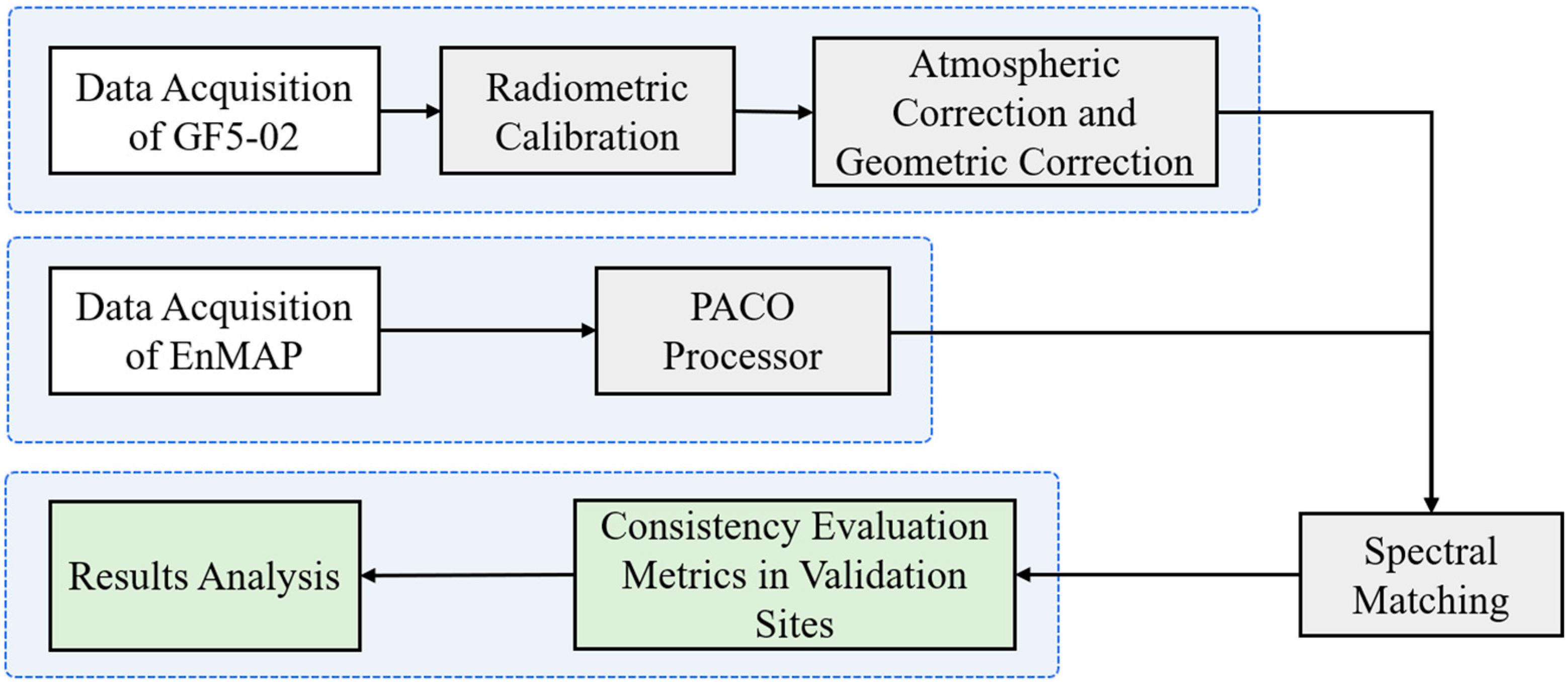
The overall methodological workflow of this study, including preprocessing and validation, is illustrated in Figure 1.
Figure 1. Overall methodological workflow for hyperspectral cross-validation.

3. Results

3.1. Reflectance Comparison and Spectral Consistency

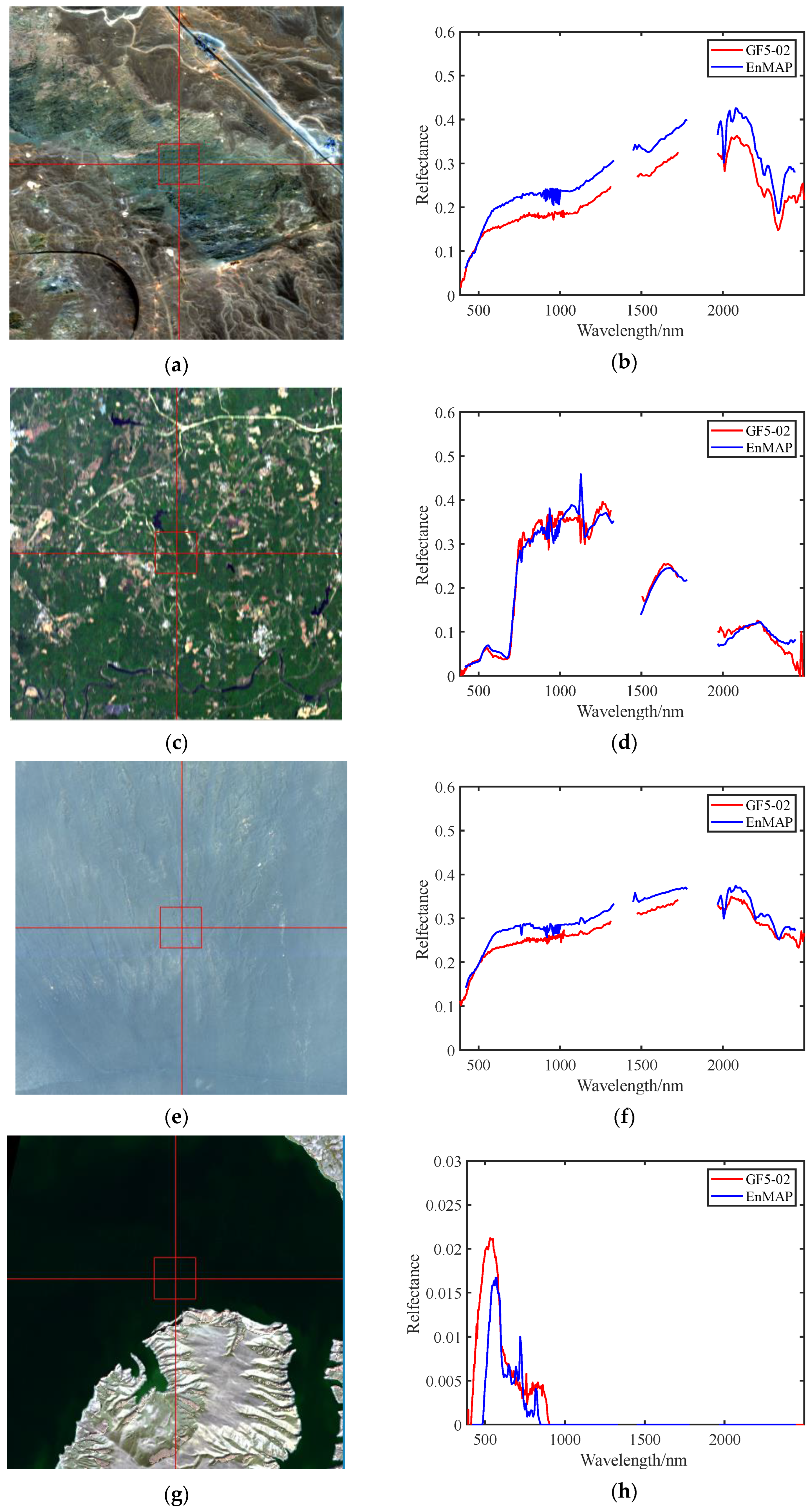
Figure 2 presents representative reflectance spectra and difference plots derived from GF5-02 AHSI and EnMAP L2A products across four typical land cover types, excluding the spectral regions affected by strong water vapor absorption. Overall, the reflectance spectra from the two sensors show consistent shapes, with major absorption features well aligned.
Figure 2. Typical land cover scenes and comparison of reflectance spectra for Eastern Tianshan (a,b), Danzhou grassland (c,d), Dunhuang desert (e,f), and Qinghai water body (g,h) using GF5-02 and EnMAP data. The red cross in the left images marks the location from which the spectrum on the right is extracted. The figure provides a qualitative comparison of spectral shape and magnitude for characteristic surface types to illustrate cross-sensor consistency, while detailed multi-point quantitative analyses are presented in Section 3.2 and Section 3.3. Background images are derived from GF5-02 AHSI imagery.
For minerals, grasslands, and desert surfaces, the spectral trends from the visible to shortwave infrared (SWIR) regions match closely, with smooth curves and minimal deviations. In particular, mineral absorption features beyond 2000 nm are highly consistent between the two datasets, which is crucial for lithological mapping and alteration mineral detection.
When the spectra are further analyzed by wavelength sub-ranges, we observe that in the visible domain (400–700 nm) the deviations remain below 0.02 reflectance units for most surfaces, reflecting stable radiometric calibration. In the near-infrared (700–1300 nm), vegetation exhibits slightly larger differences due to sensitivity to chlorophyll absorption and canopy structure, but the overall correlation remains above 0.96. In the SWIR domain (1300–2500 nm), both desert and mineral sites preserve strong absorption alignments, particularly around 2200 nm and 2300 nm, demonstrating the ability of both sensors to capture diagnostic mineral features.
By contrast, for low-reflectance targets such as water bodies, discrepancies become more pronounced, especially in the near-infrared (NIR) region, where GF5-02 reflectance tends to be systematically higher than EnMAP by approximately 0.005–0.01 reflectance units. This bias mainly arises from the different atmospheric correction algorithms applied to the two datasets. Both FLAASH (used for GF5-02) and PACO (used for EnMAP) are based on MODTRAN radiative transfer calculations but differ in their retrieval and compensation strategies. FLAASH estimates the water vapor column using a look-up table (LUT)-based approach that relates absorption-to-reference band radiance ratios, assuming a Lambertian surface and simplified adjacency treatment. This empirical scaling can lead to slight overcorrection in low-reflectance environments. In contrast, PACO applies a pixel-wise Atmospheric Pre-corrected Differential Absorption (APDA) [38] method, combining dense-dark-vegetation (DDV) aerosol retrieval [39] and adjacency-effect compensation through spatial convolution with scene geometry and DEM information. These distinctions lead PACO to produce marginally lower reflectance values over water surfaces, consistent with the observed offset.

3.2. Quantitative Metrics

To further quantify the consistency, four metrics—SA, RMSE, RRMSE, and R—are calculated from 30 validation samples across the four land cover types (Table 4). To ensure the results are not affected by residual atmospheric absorption, spectral bands strongly influenced by water vapor—centered around 1400 nm and 1900 nm—are excluded from the analysis, while all remaining valid bands within the 400–2500 nm range are used for quantitative evaluation.
Table 4. Quantitative comparison of surface reflectance between EnMAP and GF5-02 across four typical land cover types.
The results show that GF5-02 and EnMAP reflectance are strongly correlated, particularly for desert and grassland targets. For these two surface types, the correlation coefficients reach 0.9721 and 0.9649, respectively, while the corresponding spectral angles remain below 0.08 rad, indicating a high degree of spectral similarity across the full wavelength range. These findings suggest that both sensors capture the dominant reflectance features of arid soils and vegetated canopies with high fidelity, which is essential for quantitative applications such as biomass estimation and surface albedo retrieval.
The Eastern Tianshan mineral area exhibits the highest correlation (R = 0.9765), reflecting excellent consistency even in complex geological environments with diverse lithologies and strong absorption features in the SWIR region. In particular, diagnostic absorption bands beyond 2000 nm are nearly identical between the two sensors, confirming the capability of GF5-02 to support mineralogical mapping and lithological discrimination at a level comparable to EnMAP. This level of agreement demonstrates that GF5-02 can provide reflectance information comparable to EnMAP for geological mapping purposes. However, the reliable detection of subtle absorption features also depends on additional factors such as spectral calibration accuracy, radiometric stability, signal-to-noise ratio, and the sensitivity of atmospheric correction to parameter uncertainties, which warrant further investigation in future studies.
By contrast, water bodies present significantly weaker agreement. The spectral angle increases sharply to 0.3423 rad (≈19.61°), the correlation coefficient decreases to 0.8214, and the relative RMSE rises to nearly 48%. These discrepancies are especially pronounced in the near-infrared region, where EnMAP reflectance is systematically higher than that of GF5-02. A plausible explanation lies in the different atmospheric correction algorithms applied to the two datasets: GF5-02 uses FLAASH, whereas EnMAP employs PACO, each adopting distinct parameterizations for water vapor absorption and adjacency-effect compensation. FLAASH relies on a LUT-based retrieval of water vapor using the ratio of absorption to reference radiances, assuming a Lambertian surface and simplified adjacency correction, which may lead to slight overestimation of reflectance over dark targets. In contrast, PACO applies an APDA method combined with explicit adjacency-effect correction through spatial convolution. In addition, EnMAP applies a detector non-linearity correction in its radiometric calibration chain to mitigate response curvature at low radiance levels, whereas GF5-02 employs a linear calibration model based on laboratory and vicarious field calibration without explicit non-linearity terms. This difference in calibration strategy may further contribute to the reflectance offset observed over low-signal surfaces such as water bodies. Furthermore, the inherently low signal-to-noise ratio (SNR) and the limited effective spectral range of water-leaving reflectance (primarily below 900 nm) amplify the relative impact of radiometric noise, atmospheric retrieval errors, and sensor-specific response differences. Heterogeneity in the Qinghai validation sites, where saline crusts and shallow water coexist, may further contribute to residual discrepancies.
These results underscore that while GF5-02 and EnMAP achieve strong interoperability over medium- to high-reflectance surfaces such as minerals, desert, and vegetation, low-reflectance targets like water remain challenging. Addressing these challenges will require refined atmospheric correction strategies and potentially harmonized inter-sensor processing chains to improve the reliability of aquatic applications.

3.3. Regression Analysis

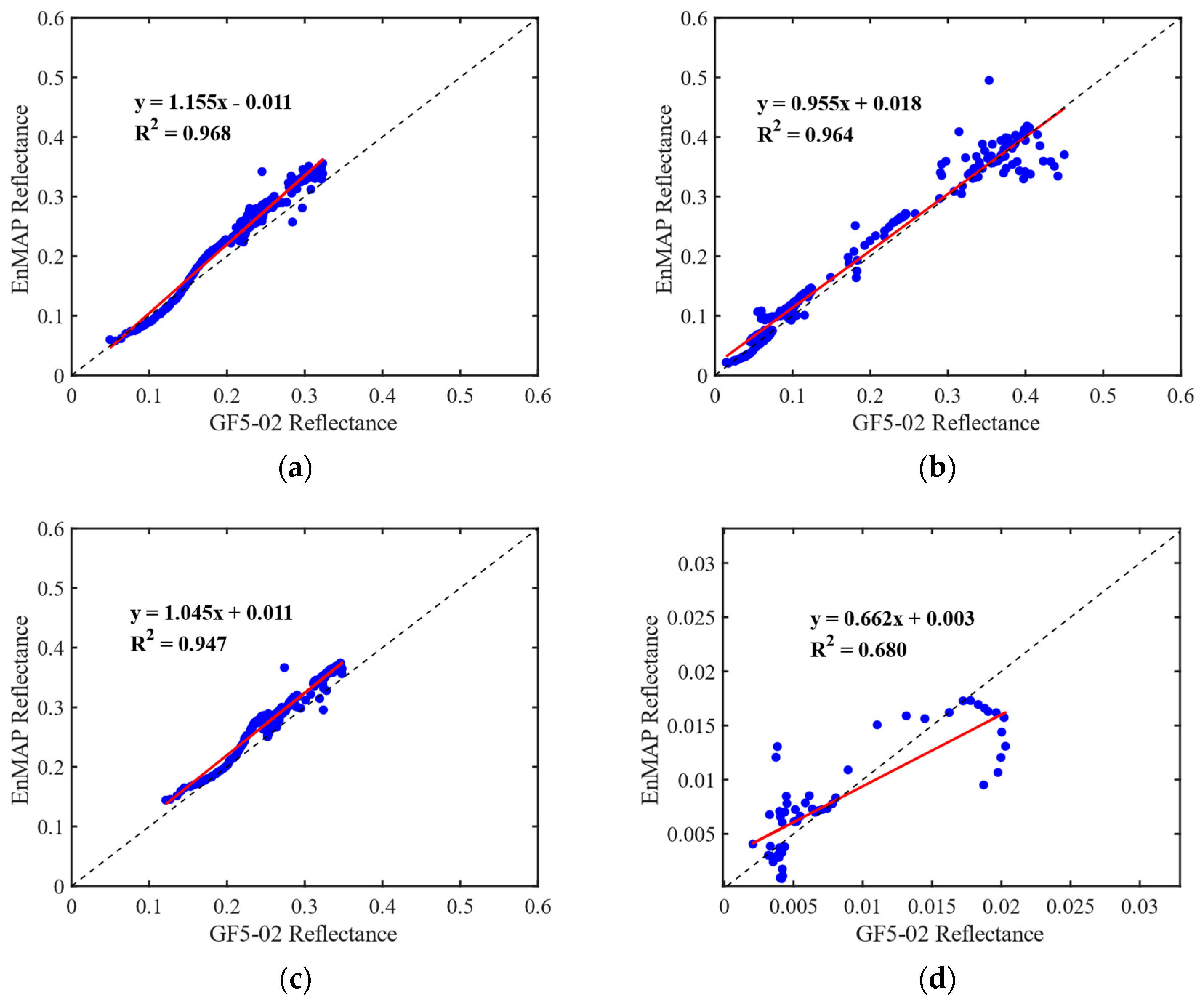
Regression analysis is performed by averaging 30 spectra per land cover type and plotting band-wise scatterplots between GF5-02 and EnMAP reflectance (Figure 3). For consistency, bands located within strong atmospheric water-vapor absorption regions near 1400 nm and 1900 nm are excluded prior to regression to ensure that the comparison reflects true sensor and algorithmic differences rather than atmospheric artifacts. The scatterplots show that most data points are distributed close to the 1:1 reference line, with regression slopes close to unity and small intercepts, indicating overall consistency.
Figure 3. Scatter plots of surface reflectance between GF5-02 AHSI and EnMAP for four representative scenes: (a) Eastern Tianshan, (b) Danzhou grassland, (c) Dunhuang desert, and (d) Qinghai water body. Each comparison is based on 30 spectrally homogeneous subregions (3 × 3 pixels) selected from the corresponding EnMAP and GF5-02 images. Blue dots represent the reflectance scatter points, the red line indicates the least-squares fitted line, and the black dashed line denotes the 1:1 reference line.
For grassland, desert, and mineral targets, the coefficients of determination (R2) all exceed 0.94, reflecting excellent linear agreement between GF5-02 and EnMAP reflectance. The scatterplots (Figure 3) show that most points are closely aligned with the 1:1 reference line, with regression slopes ranging from 0.95 to 1.15 and intercepts close to zero. This indicates that not only the spectral shapes but also the absolute reflectance values of GF5-02 are highly consistent with those of EnMAP, even across heterogeneous vegetation canopies and spectrally complex mineral assemblages. Such agreement provides confidence that GF5-02 data can be directly applied to biophysical parameter retrieval and mineralogical mapping without introducing significant cross-sensor biases.
In contrast, water bodies yield a markedly lower R2 value of 0.680, and the scatter distribution shows a systematic departure from the 1:1 line, particularly in the near-infrared region where reflectance values approach zero. This suggests that small absolute deviations in low-reflectance conditions can lead to disproportionately large relative errors, thereby reducing linear agreement. The observed bias is consistent with the reflectance offset noted earlier and is likely attributable to differences in atmospheric correction strategies, adjacency effects from surrounding bright saline crusts, and the intrinsic sensitivity of water reflectance to sensor noise and illumination conditions.
To further examine the wavelength-dependent consistency, Table 5 summarizes the correlation coefficients between GF5-02 and EnMAP reflectance within three major spectral sub-ranges (VIS: 400–700 nm; NIR: 700–1100 nm; SWIR: 1100–2500 nm), excluding bands affected by strong atmospheric absorption near 1400 nm and 1900 nm. The results show that the correlation remains high across all land-cover types in the VIS and SWIR regions (typically R > 0.95), indicating excellent radiometric consistency and stable cross-sensor spectral alignment. In the NIR domain, the correlation decreases slightly (R ≈ 0.91–0.94) for most surfaces and drops markedly for water (R = 0.6964), reflecting the higher sensitivity of this region to canopy structure, lower SNR, and residual water-vapor effects. These findings confirm that while both sensors achieve robust agreement for high- and medium-reflectance surfaces across the full spectral range, low-reflectance targets—particularly aquatic environments—remain more susceptible to atmospheric retrieval uncertainties and noise amplification.
Table 5. Pearson correlation coefficients (R) between GF5-02 and EnMAP reflectance averaged over three spectral sub-ranges. Bands affected by strong atmospheric water-vapor absorption (around 1400 nm and 1900 nm) are excluded.
Taken together, these regression results confirm that GF5-02 and EnMAP exhibit high agreement in spectral shape, correlation, and regression performance for most land cover types, especially for medium- and high-reflectance surfaces such as grasslands, deserts, and minerals. The high correlations observed in the VIS and SWIR regions further demonstrate the reliability of both sensors for quantitative retrieval of surface and mineralogical parameters. However, noticeable discrepancies remain in the NIR and aquatic environments, where the inherently low signal levels, limited effective spectral range, and higher sensitivity to atmospheric and adjacency effects reduce the overall consistency. These findings highlight the wavelength-dependent nature of cross-sensor differences and underline the need for harmonized atmospheric correction pipelines and targeted optimization strategies when applying GF5-02 data to aquatic and other low-reflectance environments.

3.4. Validation with Ground Measurements in the Eastern Tianshan

To further validate the consistency of GF5-02 hyperspectral data, two images acquired over the Eastern Tianshan region were analyzed, with acquisition dates of 2 March 2022 and 28 April 2023. Both images cover three historical in situ spectral measurement sites, where ground-based spectral measurements were originally collected on 31 July 2011. Although there is a temporal gap between the ground campaigns and the satellite acquisitions, the selected sites are dominated by exposed lithologies with highly stable spectral characteristics. Unlike vegetation or soils, these mineral assemblages show minimal seasonal or interannual variability, making them reliable reference targets for long-term sensor validation.
Ground-based surface reflectance data are obtained from field measurements conducted in 2011 using an Analytical Spectral Devices FieldSpec-3 [40] spectroradiometer (Analytical Spectral Devices, Incorporated, Boulder, CO, USA). The instrument covers the 350–2500 nm spectral range with a spectral sampling interval of 1 nm and a full width at half maximum (FWHM) of 3–10 nm. Measurements are performed under clear-sky, near-nadir conditions around local solar noon to minimize illumination variability. Each reflectance spectrum represented the mean of several scans collected over a 1 m × 1 m homogeneous area, with radiometric calibration using a Spectralon® reference panel (Labsphere Incorporated, North Sutton, NH, USA) before each measurement series.
The three validation sites represent distinct lithologies (Table 6): (1) quartz–muscovite schist (identified as garnet–biotite–quartz schist by thin-section analysis), (2) quartz porphyry (composed mainly of quartz, K-feldspar, and minor sericite), and (3) silicified and altered quartz porphyry (altered dacite).
Table 6. Locations and lithological descriptions of the three validation sites in the Eastern Tianshan.
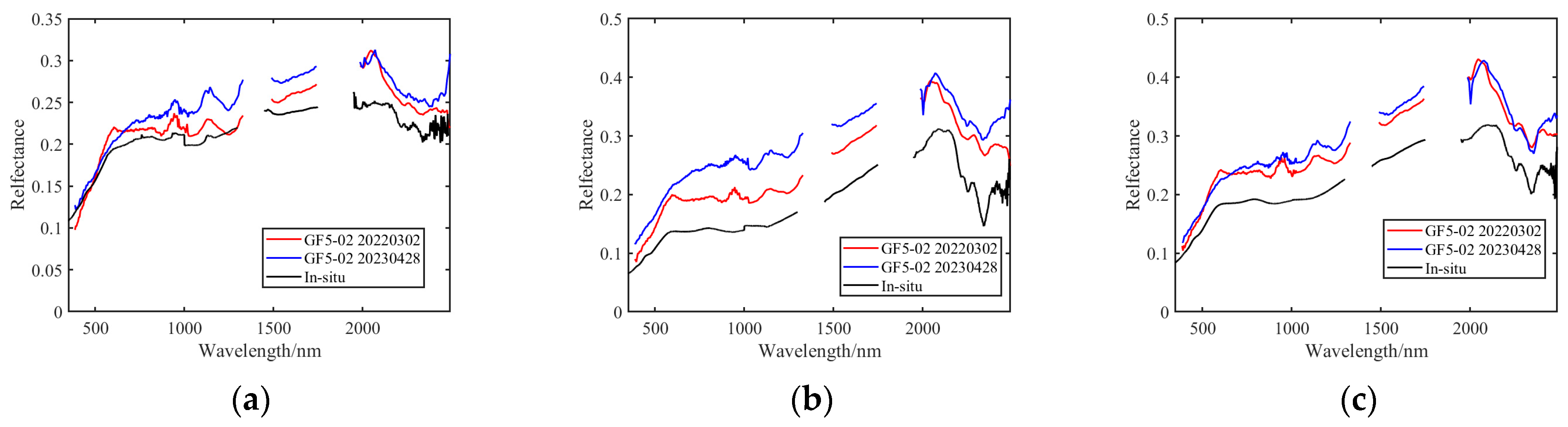
As shown in Figure 4, the reflectance curves derived from GF-5B closely match the in situ spectra across the entire wavelength range, capturing both the overall shape and the main absorption features.
Figure 4. Comparison between GF5-02 hyperspectral reflectance and in situ spectral measurements. Panels (ac) correspond to validation sites 1–3, respectively.
Quantitative comparisons between GF5-02 reflectance and the in-situ spectra are conducted using spectral angle (rad), RMSE, relative RMSE (%), and R. To ensure spectral consistency with the satellite observations, the ground spectra are convolved with the spectral response functions (SRFs) of GF5-02 using the same Gaussian-weighted integration method described in Section 2.3.1. The results are summarized in Table 7.
Table 7. Quantitative comparison between GF5-02 hyperspectral reflectance and in situ measurements at three validation sites.
The analysis indicates that:
  • Spectral consistency—The reflectance curves of all three validation sites closely match the in situ measurements, showing consistent absorption features and overall spectral trends.
  • Quantitative agreement—All validation sites achieved correlation coefficients above 0.96, with RMSE values below 0.1, confirming strong consistency between GF-5B and ground-based spectra.
  • Temporal stability—Comparisons between the two acquisition dates demonstrate stable sensor performance, as the spectral features, magnitudes, and trends remain highly consistent, underscoring the reliability of GF-5B during its on-orbit operation.

4. Discussion

The cross-validation analysis demonstrates that GF5-02 exhibits high radiometric consistency with EnMAP across a wide range of land-cover types, particularly for medium- and high-reflectance surfaces such as grasslands, deserts, and mineral-rich regions. The observed spectral correlations (R > 0.95 in VIS and SWIR) and small spectral angles (<0.08 rad) indicate that the GF5-02 reflectance products maintain both spectral shape fidelity and absolute radiometric agreement with the EnMAP L2A reference. These findings are consistent with previous cross-sensor intercomparisons, such as between PRISMA and EnMAP, which reported similar levels of agreement after atmospheric correction and spectral resampling [15]. This high consistency supports the use of GF5-02 data for quantitative biophysical parameter retrieval, mineral mapping, and cross-sensor time-series analyses. Moreover, the robust spectral alignment between the two sensors confirms the reliability of their radiometric calibration frameworks and the physical soundness of the FLAASH and PACO atmospheric correction algorithms when applied to stable terrestrial surfaces.
Despite the overall agreement, discrepancies become more pronounced in the near-infrared (NIR) and water scenes, where reflectance is intrinsically low and signal-to-noise ratios (SNRs) decrease significantly. The reduced correlation for aquatic environments (R = 0.6964 in the NIR) highlights the sensitivity of dark targets to atmospheric correction uncertainties, adjacency effects, and detector response non-linearities. EnMAP applies a non-linearity correction to compensate for radiometric response curvature at low signal levels, whereas GF5-02 relies on a linear calibration model based on vicarious field data. This calibration difference, combined with varying retrieval strategies for water vapor and adjacency compensation (FLAASH vs. PACO), likely contributes to the observed offsets.
A key strength of this study lies in its comprehensive multi-scene validation framework, integrating spectral and spatial evaluations to assess cross-sensor interoperability under diverse environmental conditions. The results provide quantitative evidence that GF5-02 can complement EnMAP for multi-sensor hyperspectral analyses. Nevertheless, several limitations should be acknowledged. First, temporal acquisition differences—though limited to a few days—may still introduce slight changes in illumination or atmospheric state, particularly over aquatic surfaces. Second, due to the lack of dedicated laboratory non-linearity characterization for GF5-02, reflectance deviations at low radiance levels remain a source of uncertainty. Future work should focus on (i) harmonized atmospheric correction pipelines for aquatic environments, (ii) dedicated SNR and BRDF characterization campaigns, and (iii) improved uncertainty propagation analyses following the QA4EO metrological framework [41]. These efforts would strengthen the quantitative interoperability of hyperspectral satellite constellations and advance the traceability of surface reflectance products for climate and Earth system monitoring.

5. Conclusions

In this study, EnMAP L2A reflectance products were used as reference data to systematically evaluate the surface reflectance consistency of GF5-02 across four representative land cover types: minerals, grassland, desert, and inland water bodies.
The results show that for high- and medium-reflectance surfaces (e.g., minerals, grassland, and desert), GF5-02 and EnMAP exhibit highly consistent spectral shapes, with strong correlations (R > 0.96) and small spectral angles (<0.08 rad), demonstrating robust interoperability and applicability for quantitative remote sensing. However, for low-reflectance targets such as water, the consistency decreases significantly, reflected in larger spectral angles, lower correlation coefficients, and higher RRMSE values. This discrepancy likely arises from differences in atmospheric correction models and sensor responses, compounded by the inherently low signal levels and the limited effective spectral range of water-leaving reflectance.
Additionally, the ground-based validation in the Eastern Tianshan confirmed the reliability and stability of GF5-02 reflectance products, further supporting their suitability for long-term quantitative applications.
Overall, GF5-02 and EnMAP exhibit strong agreement across most land cover types, supporting their combined use in quantitative remote sensing and cross-sensor studies. Nevertheless, further methodological improvements in atmospheric correction and radiometric harmonization are still required to enhance consistency in challenging environments, particularly over water and other low-reflectance surfaces.


Author Contributions

Conceptualization, S.L., Y.Z. and X.W.; methodology, S.L., Y.Z. and L.G.; software, Y.Z.; validation, S.L. and K.S.; formal analysis, Y.Z. and P.Z.; resources, S.L. and B.G.; data curation, S.L.; writing—original draft preparation, Y.Z.; writing—review and editing, S.L.; visualization, Y.Z. and B.X.; supervision, S.L. and J.L.; project administration, S.L. All authors have read and agreed to the published version of the manuscript.

Funding

This work was supported by the Special operating expenses of the Ministry of Natural Resources under Grant 102121201330000009008.

Data Availability Statement

No new data were created or analyzed in this study.

Conflicts of Interest

Author Jiaxing Liu was employed by the company Beijing Satlmage Information Technology Co., Ltd. The remaining authors declare that the research was conducted in the absence of any commercial or financial relationships that could be construed as a potential conflict of interest.

References

  1. Im, J.; Jensen, J.R. Hyperspectral Remote Sensing of Vegetation. Geogr. Compass 2008, 2, 1943–1961. [Google Scholar] [CrossRef]
  2. Kaufmann, H.; Förster, S.; Wulf, H.; Segl, K.; Guanter, L.; Bochow, M.; Heiden, U.; Müller, A.; Heldens, W.; Schneiderhan, T. Science Plan of the Environmental Mapping and Analysis Program (EnMAP); EnMAP Consortium: Potsdam, Germany, 2012. [Google Scholar]
  3. Kaufmann, H.; Segl, K.; Guanter, L.; Hofer, S.; Foerster, K.-P.; Stuffler, T.; Mueller, A.; Richter, R.; Bach, H.; Hostert, P. Environmental mapping and analysis program (EnMAP)—Recent advances and status. In Proceedings of the IGARSS 2008—2008 IEEE International Geoscience and Remote Sensing Symposium, Boston, MA, USA, 7–11 July 2008; pp. IV-109–IV-112. [Google Scholar]
  4. Albrecht, F.; Blaschke, T.; Lang, S.; Abdulmutalib, H.; Szabó, G.; Barsi, Á.; Batini, C.; Bartsch, A.; Kugler, Z.; Tiede, D.; et al. Providing data quality information for remote sensing applications. Int. Arch. Photogramm. Remote Sens. Spat. Inf. Sci. 2018, XLII-3, 15–22. [Google Scholar] [CrossRef]
  5. Gorroño, J.; Guanter, L.; Graf, L.V.; Gascon, F. A framework for the estimation of uncertainties and spectral error correlation in Sentinel-2 Level-2A data products. IEEE Trans. Geosci. Remote Sens. 2024, 62, 5634613. [Google Scholar] [CrossRef]
  6. de Los Reyes, R.; Langheinrich, M.; Schwind, P.; Richter, R.; Pflug, B.; Bachmann, M.; Müller, R.; Carmona, E.; Zekoll, V.; Reinartz, P.J.S. PACO: Python-based atmospheric correction. Sensors 2020, 20, 1428. [Google Scholar] [CrossRef] [PubMed]
  7. Chabrillat, S.; Foerster, S.; Segl, K.; Beamish, A.; Brell, M.; Asadzadeh, S.; Milewski, R.; Ward, K.J.; Brosinsky, A.; Koch, K. The EnMAP spaceborne imaging spectroscopy mission: Initial scientific results two years after launch. Remote Sens. Environ. 2024, 315, 114379. [Google Scholar] [CrossRef]
  8. Brell, M.; Guanter, L.; Segl, K.; Chabrillat, S.; Scheffler, D.; Soppa, M.; Bohn, N.; Gorrono, J.; Kokhanovsky, A.; Bracher, A. Assessment of Enmap Data Quality Through Global Product Validation Activities. Remote Sens. Environ. 2024; submitted. [Google Scholar]
  9. Brell, M.; Guanter, L.; Segl, K.; Scheffler, D.; Bohn, N.; Bracher, A.; Soppa, M.A.; Foerster, S.; Storch, T.; Bachmann, M. The EnMAP satellite—Data product validation activities. In Proceedings of the 2021 11th Workshop on Hyperspectral Imaging and Signal Processing: Evolution in Remote Sensing (WHISPERS), Amsterdam, The Netherlands, 24–26 March 2021; pp. 1–5. [Google Scholar]
  10. Pato, M.; Ingram, D.M.; Carmona, E. Lessons learned from EnMAP in-Orbit Calibration and Product Harmonization for Upcoming Space-Based Hyperspectral Missions; EnMAP Ground Segment/PCV Team. Available online: https://elib.dlr.de/206608/1/20241114_ESTEC_EnMAP_PCV.pdf (accessed on 21 October 2025).
  11. Carmona, E.; Chabrillat, S.; Fischer, S.; Habermeyer, M.; La Porta, L.; Mühle, H.; Pinnel, N.; Pato, M.; Wirth, K. ENMAP Operations Status. In Proceedings of the IGARSS 2024—2024 IEEE International Geoscience and Remote Sensing Symposium, Athens, Greece, 7–12 July 2024; pp. 292–295. [Google Scholar]
  12. Galeazzi, C.; Sacchetti, A.; Cisbani, A.; Babini, G. The PRISMA program. In Proceedings of the IGARSS 2008—2008 IEEE International Geoscience and Remote Sensing Symposium, Boston, MA, USA, 7–11 July 2008; pp. IV-105–IV-108. [Google Scholar]
  13. Alonso, K.; Bachmann, M.; Burch, K.; Carmona, E.; Cerra, D.; De los Reyes, R.; Dietrich, D.; Heiden, U.; Hölderlin, A.; Ickes, J. Data products, quality and validation of the DLR earth sensing imaging spectrometer (DESIS). Sensors 2019, 19, 4471. [Google Scholar] [CrossRef]
  14. Main-Knorn, M.; Pflug, B.; Louis, J.; Debaecker, V.; Müller-Wilm, U.; Gascon, F. Sen2Cor for sentinel-2. In Proceedings of the Image and Signal Processing for Remote Sensing XXIII, Warsaw, Poland, 11–14 September 2017; pp. 37–48. [Google Scholar]
  15. Musacchio, M.; Silvestri, M.; Romaniello, V.; Casu, M.; Buongiorno, M.F.; Melis, M.T. Comparison of ASI-PRISMA data, DLR-EnMAP data, and field spectrometer measurements on “Sale ‘e Porcus”, a salty pond (Sardinia, Italy). Remote Sens. 2024, 16, 1092. [Google Scholar] [CrossRef]
  16. Chakraborty, R.; Rachdi, I.; Thiele, S.; Booysen, R.; Kirsch, M.; Lorenz, S.; Gloaguen, R.; Sebari, I. A spectral and spatial comparison of satellite-based hyperspectral data for geological mapping. Remote Sens. 2024, 16, 2089. [Google Scholar] [CrossRef]
  17. Harshitha, M.A.; Leigh, L.; Kaewmanee, M.; Pathiranage, D.S.; Rueda, J.F.; Aaron, D.; Pinto, C.T. Absolute Vicarious Calibration, Extended PICS (EPICS) Based De-Trending and Validation of Hyperspectral Hyperion, DESIS, and EMIT. Remote Sens. 2025, 17, 1301. [Google Scholar]
  18. Morris, H.; Sinclair, M.; De Vis, P.; Bialek, A. Utilising LANDHYPERNET data products over a deciduous broadleaf forest to validate Sentinel-2 and Landsat surface reflectance products. Front. Remote Sens. 2024, 5, 1322760. [Google Scholar] [CrossRef]
  19. Niu, C.; Tan, K.; Wang, X.; Han, B.; Ge, S.; Du, P.; Wang, F. Radiometric cross-calibration of the ZY1-02D hyperspectral imager using the GF-5 AHSI imager. IEEE Trans. Geosci. Remote Sens. 2021, 60, 5519612. [Google Scholar] [CrossRef]
  20. Tang, H.; Xiao, C.; Chen, W.; Wu, T. On-orbit Spectral Calibration and Validation of GF5-02 Advanced Hyperspectral Imager. IEEE Geosci. Remote Sens. Lett. 2025, 22, 5506005. [Google Scholar] [CrossRef]
  21. Tang, H.; Xie, J.; Dou, X.; Zhang, H.; Chen, W. On-Orbit vicarious radiometric calibration and validation of ZY1-02E thermal infrared sensor. Remote Sens. 2023, 15, 994. [Google Scholar] [CrossRef]
  22. Yinnian, L.; Dexin, S.; Kaiqin, C.; Shufeng, L.; Mengyang, C.; Juan, Y. Evaluation of GF-5 AHSI on-orbit instrument radiometric performance. J. Remote Sens. 2020, 24, 352–359. [Google Scholar] [CrossRef]
  23. Tang, H.; Xiao, C.; Shang, K.; Wu, T.; Li, Q. Radiometric calibration of GF5-02 advanced hyperspectral imager based on RadCalNet Baotou site. Remote Sens. 2023, 15, 2233. [Google Scholar] [CrossRef]
  24. Lan, Q.; He, Y.; Han, Q.; Zhao, Y.; Li, W.; Xu, L.; Ming, D. A Fast and Efficient Denoising and Surface Reflectance Retrieval Method for ZY1-02D Hyperspectral Data. Remote Sens. 2025, 17, 1844. [Google Scholar] [CrossRef]
  25. Ding, S.; Zhang, X.; Shang, K.; Xiao, Q.; Wang, W.; Rehman, A.U. Removal of environmental influences for estimating soil texture fractions based on ZY1 satellite hyperspectral images. CATENA 2024, 236, 107713. [Google Scholar] [CrossRef]
  26. Ahmad, W.; Liu, L.; Guo, Z.; Khalil, Y.S.; Islam, N.U.; Islam, F. Lithological Classification Using ZY1-02D Hyperspectral Data by Means of Machine Learning and Deep Learning Methods in the Kohat–Pothohar Plateau, Khyber Pakhtunkhwa, Pakistan. Remote Sens. 2025, 17, 1356. [Google Scholar] [CrossRef]
  27. Carmona, E.; Alonso, K.; Bachmann, M.; Baur, S.; Brell, M.; Chabrillat, S.; De los Reyes, R.; Fischer, S.; Gerasch, B.; Guanter, L. Calibration and validation of the hyperspectral mission EnMAP: Results of the commissioning phase. In Proceedings of the IGARSS 2023—2023 IEEE International Geoscience and Remote Sensing Symposium, Pasadena, CA, USA, 16–21 July 2023; pp. 1030–1033. [Google Scholar]
  28. Cooley, T.; Anderson, G.; Felde, G.; Hoke, M.; Ratkowski, A.; Chetwynd, J.; Gardner, J.; Adler-Golden, S.; Matthew, M.; Berk, A.; et al. FLAASH, a MODTRAN4-based atmospheric correction algorithm, its application and validation. In Proceedings of the IEEE International Geoscience and Remote Sensing Symposium, Toronto, ON, Canada, 24–28 June 2002; pp. 1414–1418. [Google Scholar]
  29. Bachmann, M.; Storch, T. First nighttime light spectra by satellite—By EnMAP. Remote Sens. 2023, 15, 4025. [Google Scholar] [CrossRef]
  30. Bachmann, M.; Makarau, A.; Segl, K.; Richter, R. Estimating the influence of spectral and radiometric calibration uncertainties on EnMAP data products—Examples for ground reflectance retrieval and vegetation indices. Remote Sens. 2015, 7, 10689–10714. [Google Scholar] [CrossRef]
  31. Angelopoulou, T.; Chabrillat, S.; Pignatti, S.; Milewski, R.; Karyotis, K.; Brell, M.; Ruhtz, T.; Bochtis, D.; Zalidis, G. Evaluation of airborne hyspex and spaceborne PRISMA hyperspectral remote sensing data for soil organic matter and carbonates estimation. Remote Sens. 2023, 15, 1106. [Google Scholar] [CrossRef]
  32. Slade, G.; Fawcett, D.; Cunliffe, A.M.; Brazier, R.E.; Nyaupane, K.; Mauritz, M.; Vargas, S.; Anderson, K. Optical reflectance across spatial scales—An intercomparison of transect-based hyperspectral, drone, and satellite reflectance data for dry season rangeland. Drone Syst. Appl. 2023, 11, 1–20. [Google Scholar] [CrossRef]
  33. Storch, T.; Honold, H.-P.; Chabrillat, S.; Habermeyer, M.; Tucker, P.; Brell, M.; Ohndorf, A.; Wirth, K.; Betz, M.; Kuchler, M. The EnMAP imaging spectroscopy mission towards operations. Remote Sens. Environ. 2023, 294, 113632. [Google Scholar] [CrossRef]
  34. Scheffler, D.; Hollstein, A.; Diedrich, H.; Segl, K.; Hostert, P. AROSICS: An Automated and Robust Open-Source Image Co-Registration Software for Multi-Sensor Satellite Data. Remote Sens. 2017, 9, 676. [Google Scholar] [CrossRef]
  35. Asuero, A.G.; Sayago, A.; González, A.G. The correlation coefficient: An overview. Crit. Rev. Anal. Chem. 2006, 36, 41–59. [Google Scholar] [CrossRef]
  36. Hodson, T.O. Root mean square error (RMSE) or mean absolute error (MAE): When to use them or not. Geosci. Model Dev. 2022, 15, 5481–5487. [Google Scholar] [CrossRef]
  37. Yang, C.; Everitt, J.H. Using spectral distance, spectral angle and plant abundance derived from hyperspectral imagery to characterize crop yield variation. Precis. Agric. 2012, 13, 62–75. [Google Scholar] [CrossRef]
  38. Schläpfer, D.; Borel, C.C.; Keller, J.; Itten, K.I. Atmospheric precorrected differential absorption technique to retrieve columnar water vapor. Remote Sens. Environ. 1998, 65, 353–366. [Google Scholar] [CrossRef]
  39. Richter, R.; Schläpfer, D.; Müller, A. An automatic atmospheric correction algorithm for visible/NIR imagery. Int. J. Remote Sens. 2006, 27, 2077–2085. [Google Scholar] [CrossRef]
  40. Dugin, S.; Sybirtseva, O.; Golubov, S.; Dorofey, Y. Verification of multispectral data processing for the Sentinel-2A bands, field ASD FieldSpec® 3FR and UAV with the DJI STS-VIS. Ukr. J. Remote Sens. 2019, 21, 29–39. [Google Scholar] [CrossRef]
  41. Ottavianelli, G.; Davidson, M.; Gascon, F.; Goryl, P.; Isola, C.; Martimort, P.; Miranda, N.; Nieke, J.; Rizopoulou, K.; Rosich, B. An Overview of Current and Future ESA Activities Related to QA4EO. In Proceedings of the ESA Living Planet Symposium, Bergen, Norway, 28 June–2 July 2010; p. 208. [Google Scholar]
Disclaimer/Publisher’s Note: The statements, opinions and data contained in all publications are solely those of the individual author(s) and contributor(s) and not of MDPI and/or the editor(s). MDPI and/or the editor(s) disclaim responsibility for any injury to people or property resulting from any ideas, methods, instructions or products referred to in the content.

Article Metrics

Citations

Article Access Statistics

Multiple requests from the same IP address are counted as one view.