Article

InfraredStereo3D: Breaking Night Vision Limits with Perspective Projection Positional Encoding and Groundbreaking Infrared Dataset

1
Shijiazhuang Campus, Army Engineering University of PLA, Shijiazhuang 050003, China
2
77123 Units of PLA, Mianyang 621000, China
*
Author to whom correspondence should be addressed.
Remote Sens. 2025, 17(12), 2035; https://doi.org/10.3390/rs17122035
Submission received: 4 April 2025 / Revised: 5 June 2025 / Accepted: 7 June 2025 / Published: 13 June 2025
(This article belongs to the Collection Visible Infrared Imaging Radiometers and Applications)

Abstract

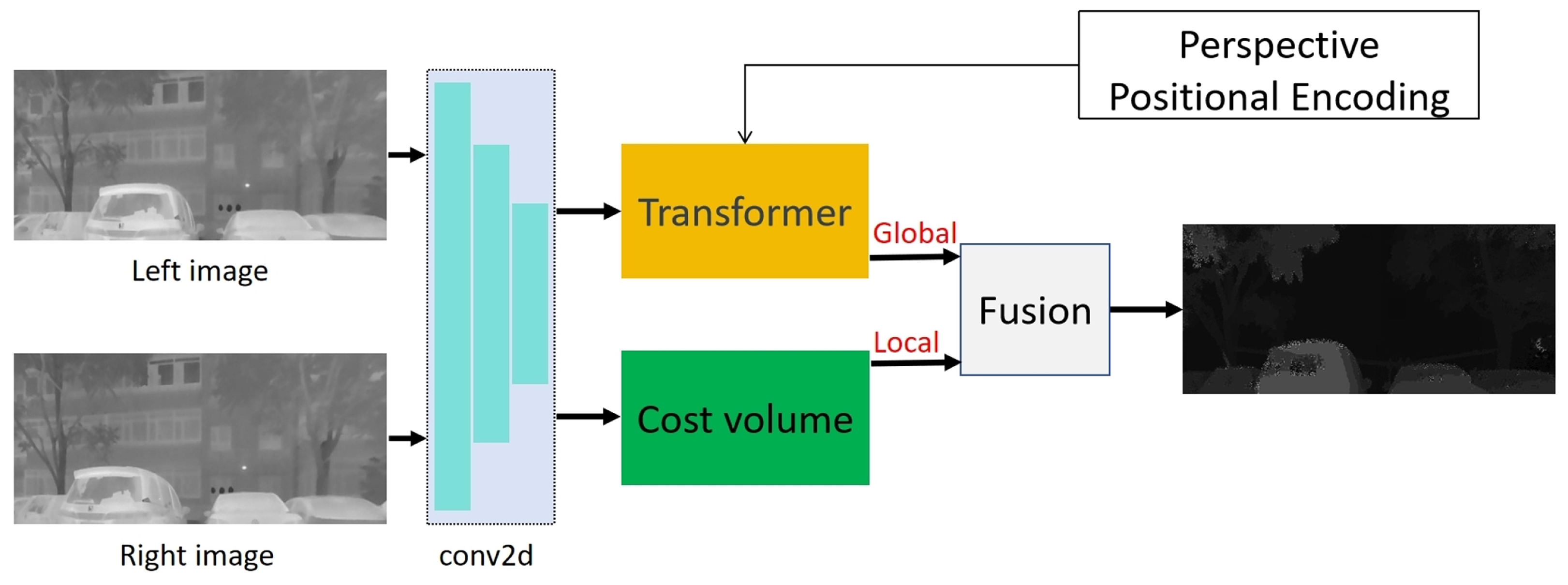
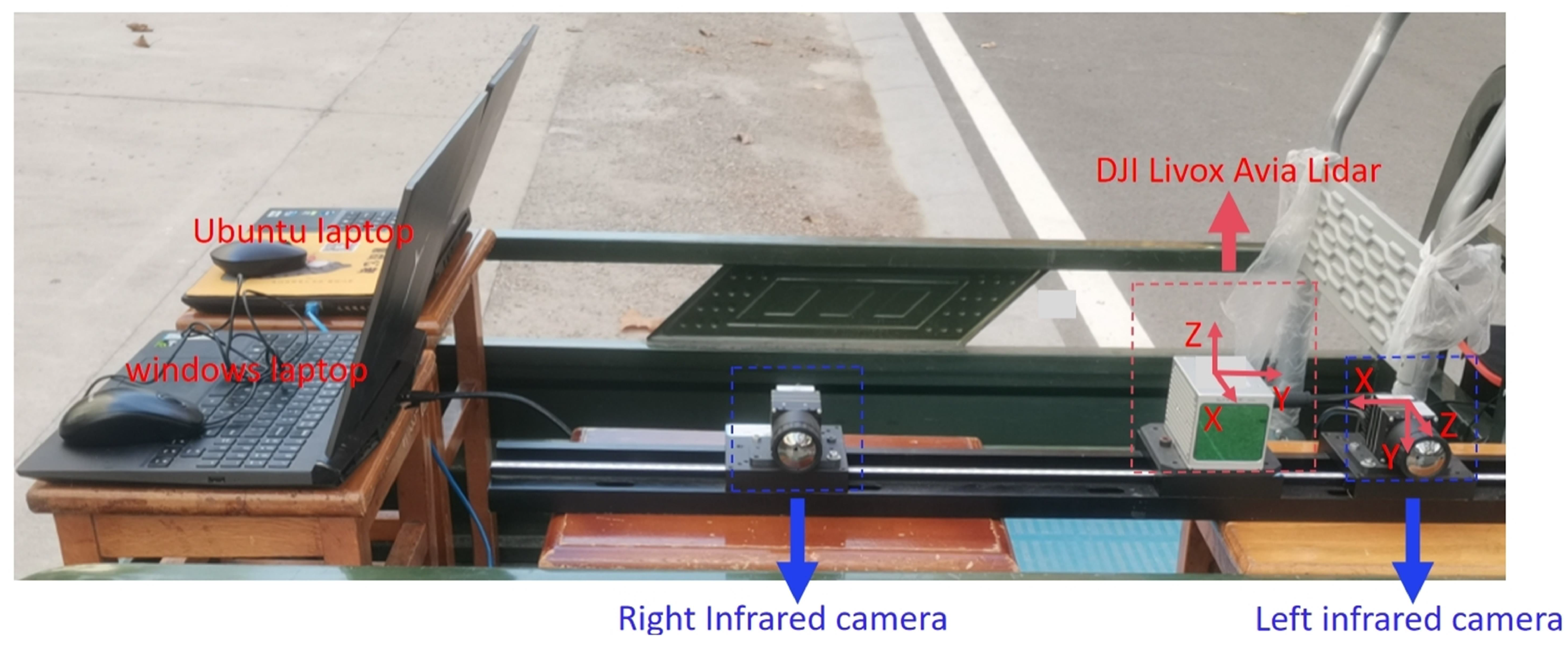
In fields such as military reconnaissance, forest fire prevention, and autonomous driving at night, there is an urgent need for high-precision three-dimensional reconstruction in low-light or night environments. The acquisition of remote sensing data by RGB cameras relies on external light, resulting in a significant decline in image quality and making it difficult to meet the task requirements. The method based on lidar has poor imaging effects in rainy and foggy weather, close-range scenes, and scenarios requiring thermal imaging data. In contrast, infrared cameras can effectively overcome this challenge because their imaging mechanisms are different from those of RGB cameras and lidar. However, the research on three-dimensional scene reconstruction of infrared images is relatively immature, especially in the field of infrared binocular stereo matching. There are two main challenges given this situation: first, there is a lack of a dataset specifically for infrared binocular stereo matching; second, the lack of texture information in infrared images causes a limit in the extension of the RGB method to the infrared reconstruction problem. To solve these problems, this study begins with the construction of an infrared binocular stereo matching dataset and then proposes an innovative perspective projection positional encoding-based transformer method to complete the infrared binocular stereo matching task. In this paper, a stereo matching network combined with transformer and cost volume is constructed. The existing work in the positional encoding of the transformer usually uses a parallel projection model to simplify the calculation. Our method is based on the actual perspective projection model so that each pixel is associated with a different projection ray. It effectively solves the problem of feature extraction and matching caused by insufficient texture information in infrared images and significantly improves matching accuracy. We conducted experiments based on the infrared binocular stereo matching dataset proposed in this paper. Experiments demonstrated the effectiveness of the proposed method.
Keywords: infrared binocular; dataset; perspective projection infrared binocular; dataset; perspective projection