Article

InSAR Modeling and Deformation Prediction for Salt Solution Mining Using a Novel CT-PIM Function

1
Laboratory of Radar Remote Sensing Applications, Changsha University of Science & Technology, Changsha 410114, China
2
Hunan Key Laboratory of Remote Sensing of Ecological Environment in Dongting Lake Area, Changsha 410114, China
3
School of Traffic and Transportation Engineering, Changsha University of Science & Technology, Changsha 410114, China
4
School of Electrical and Information Engineering, Changsha University of Science & Technology, Changsha 410114, China
5
School of Geosciences and Info-Physics, Central South University, Changsha 410083, China
*
Author to whom correspondence should be addressed.
Remote Sens. 2022, 14(4), 842; https://doi.org/10.3390/rs14040842
Submission received: 7 January 2022 / Revised: 6 February 2022 / Accepted: 8 February 2022 / Published: 10 February 2022

Abstract

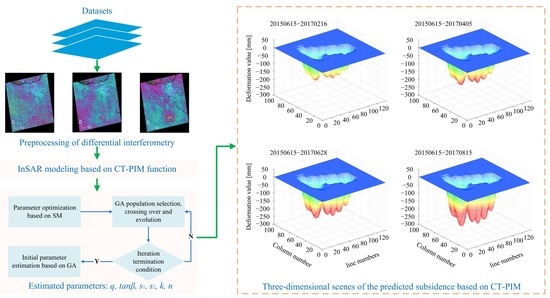
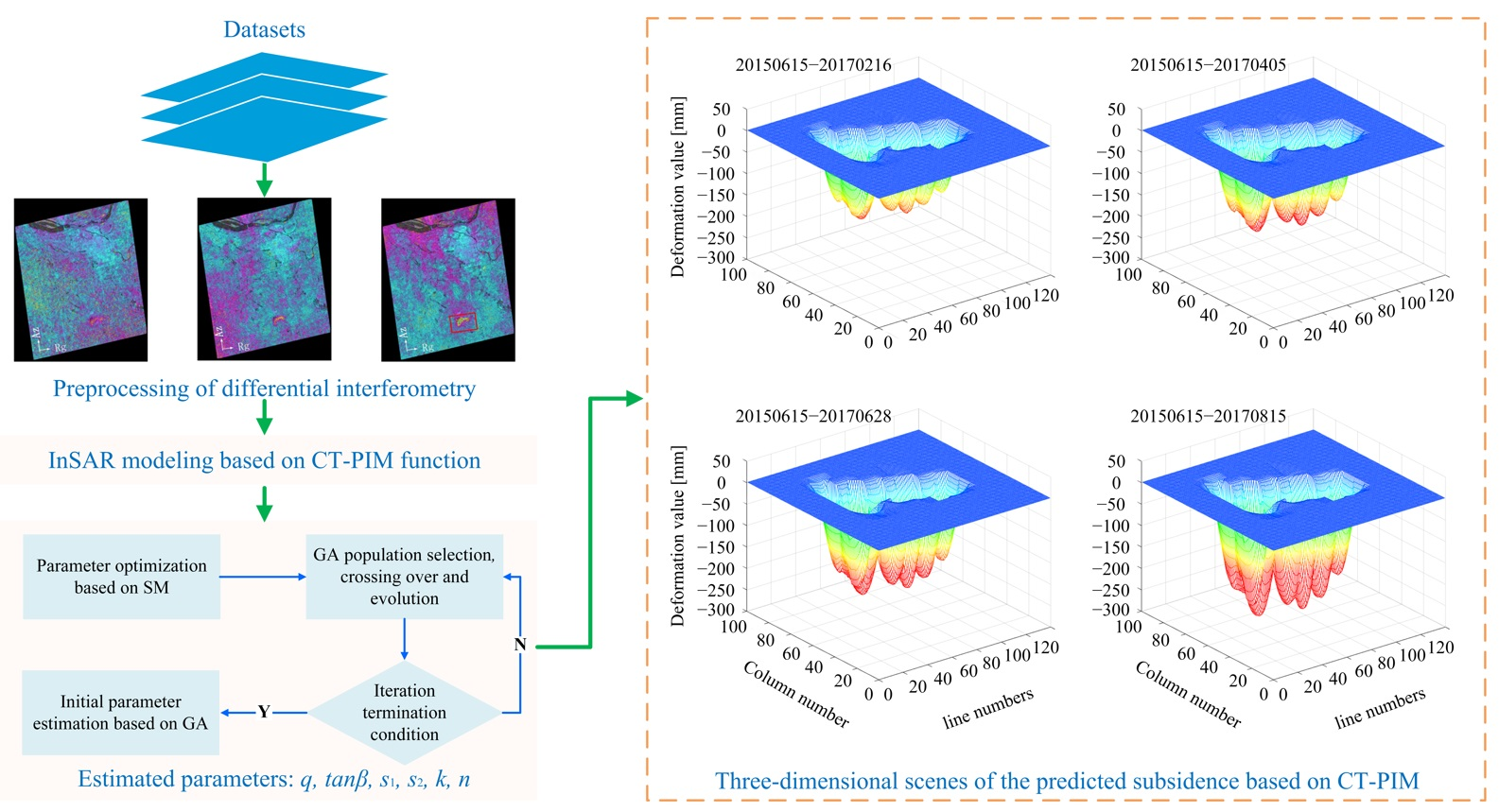
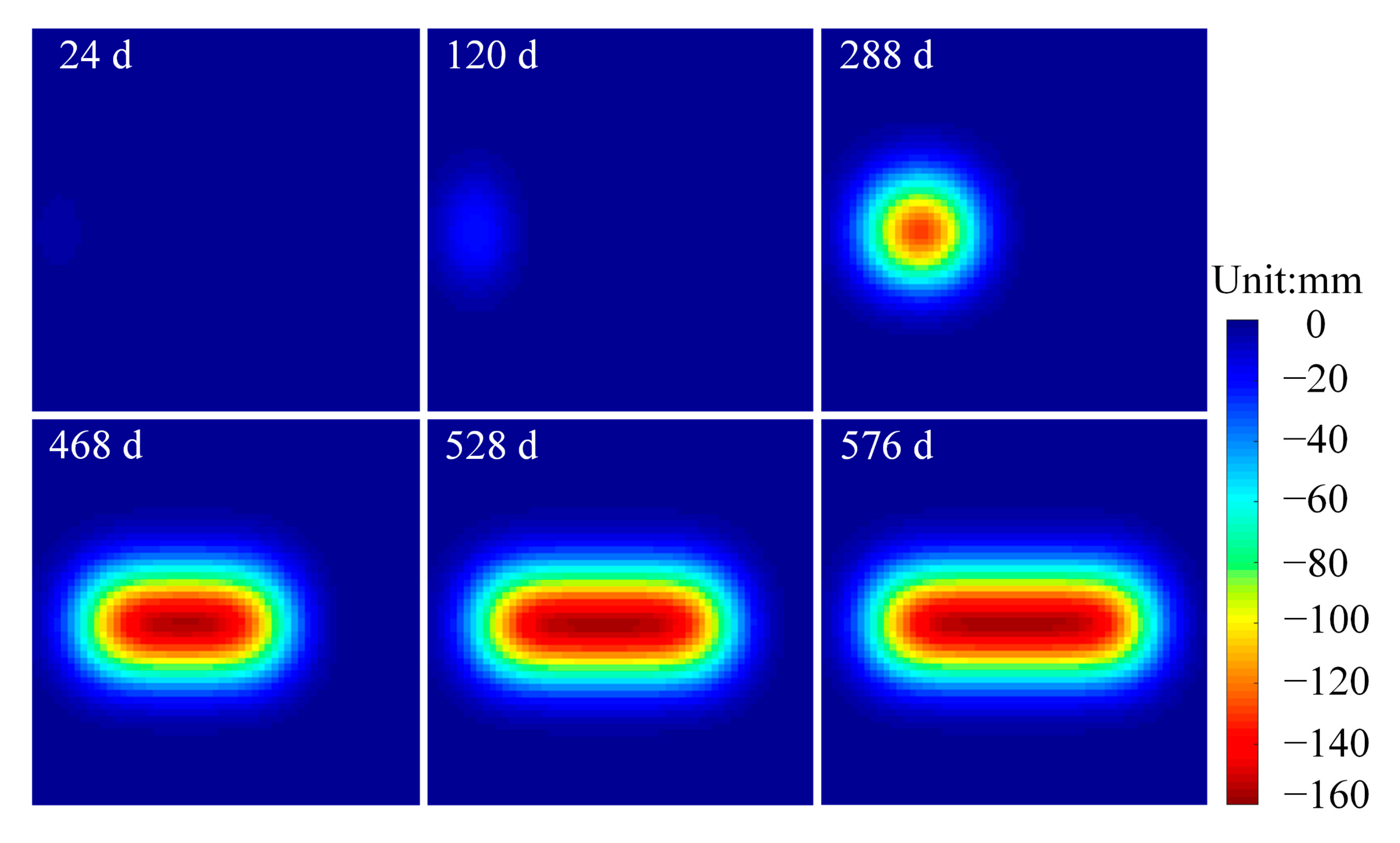
Deformation prediction for a salt solution mining area is essential to mining environmental protection. The combination of Synthetic Aperture Radar Interferometry (InSAR) technique with Probability Integral Method (PIM) has proven to be powerful in predicting mining-induced subsidence. However, traditional mathematical empirical models (such as linear model or linear model combined with periodical function) are mostly used in InSAR approaches, ignoring the underground mining mechanisms, which may limit the accuracy of the retrieved deformations. Inaccurate InSAR deformations will transmit an unavoidable error to the estimated PIM parameters and the forward predicted subsidence, which may induce more significant errors. Besides, theoretical contradictory and non-consistency between InSAR deformation model and future prediction model is another limitation. This paper introduces the Coordinate-Time (CT) function into InSAR deformation modeling. A novel time-series InSAR model (namely, CT-PIM) is proposed as a substitute for traditional InSAR mathematical empirical models and directly applied for future dynamic prediction. The unknown CT-PIM parameters can be estimated directly via InSAR phase observations, which can avoid the error propagation from the InSAR-generated deformations. The new approach has been tested by both simulated and real data experiments over a salt mine in China. The root mean square error (RMSE) is determined as ±10.9 mm, with an improvement of 37.2% compared to traditional static PIM prediction method. The new approach provides a more robust tool for the forecasting of mining-induced hazards in salt solution mining areas, as well as a reference for ensuring the environment protection and safety management.
Keywords: InSAR; mine; land subsidence; time series deformation; model InSAR; mine; land subsidence; time series deformation; model
Graphical Abstract