Technical Note

Glacier Mass Loss Simulation Based on Remote Sensing Data: A Case Study of the Yala Glacier and the Qiyi Glacier in the Third Pole


1
Department of Earth Sciences, University of Gothernburg, 41320 Gothenburg, Sweden
2
Aerospace Information Research Institute, Chinese Academy of Sciences, Beijing 100053, China
*
Author to whom correspondence should be addressed.
Remote Sens. 2022, 14(20), 5190; https://doi.org/10.3390/rs14205190
Submission received: 4 September 2022 / Revised: 12 October 2022 / Accepted: 13 October 2022 / Published: 17 October 2022

Abstract

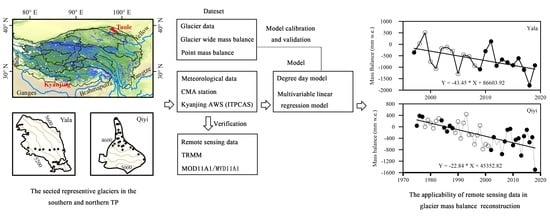
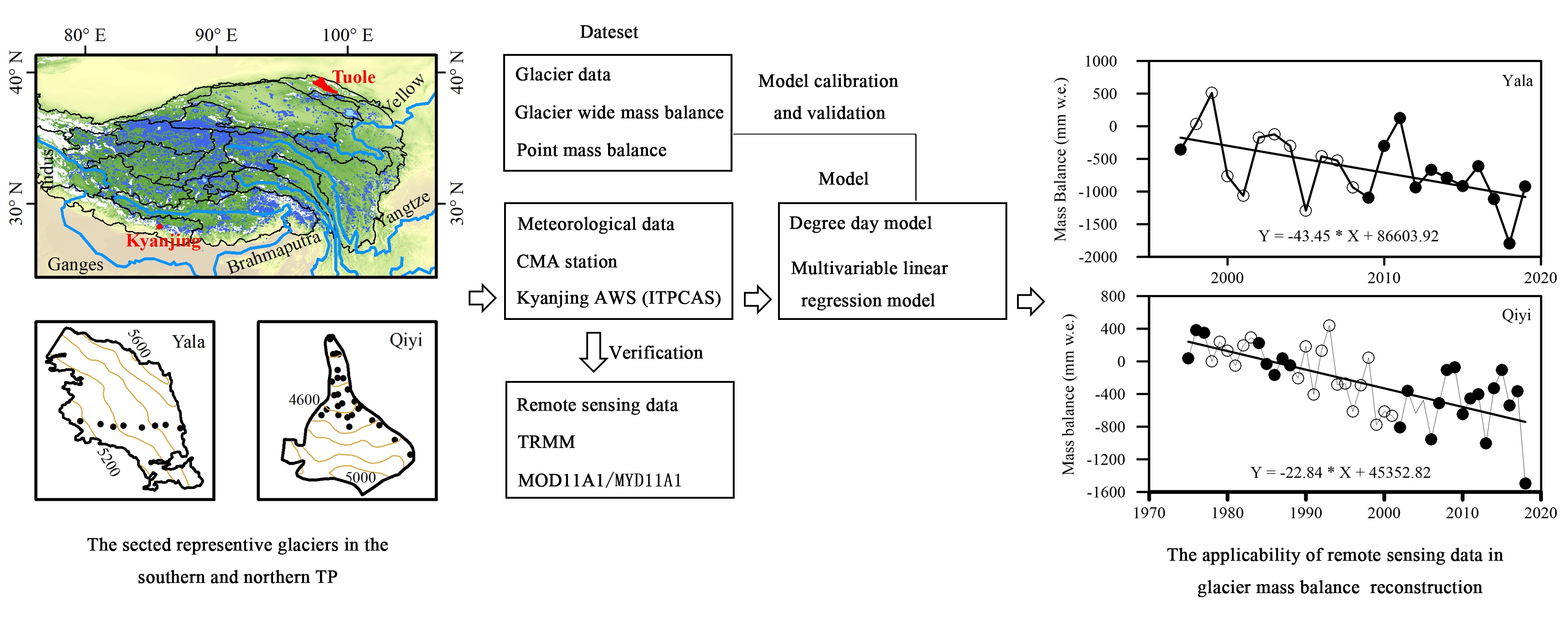
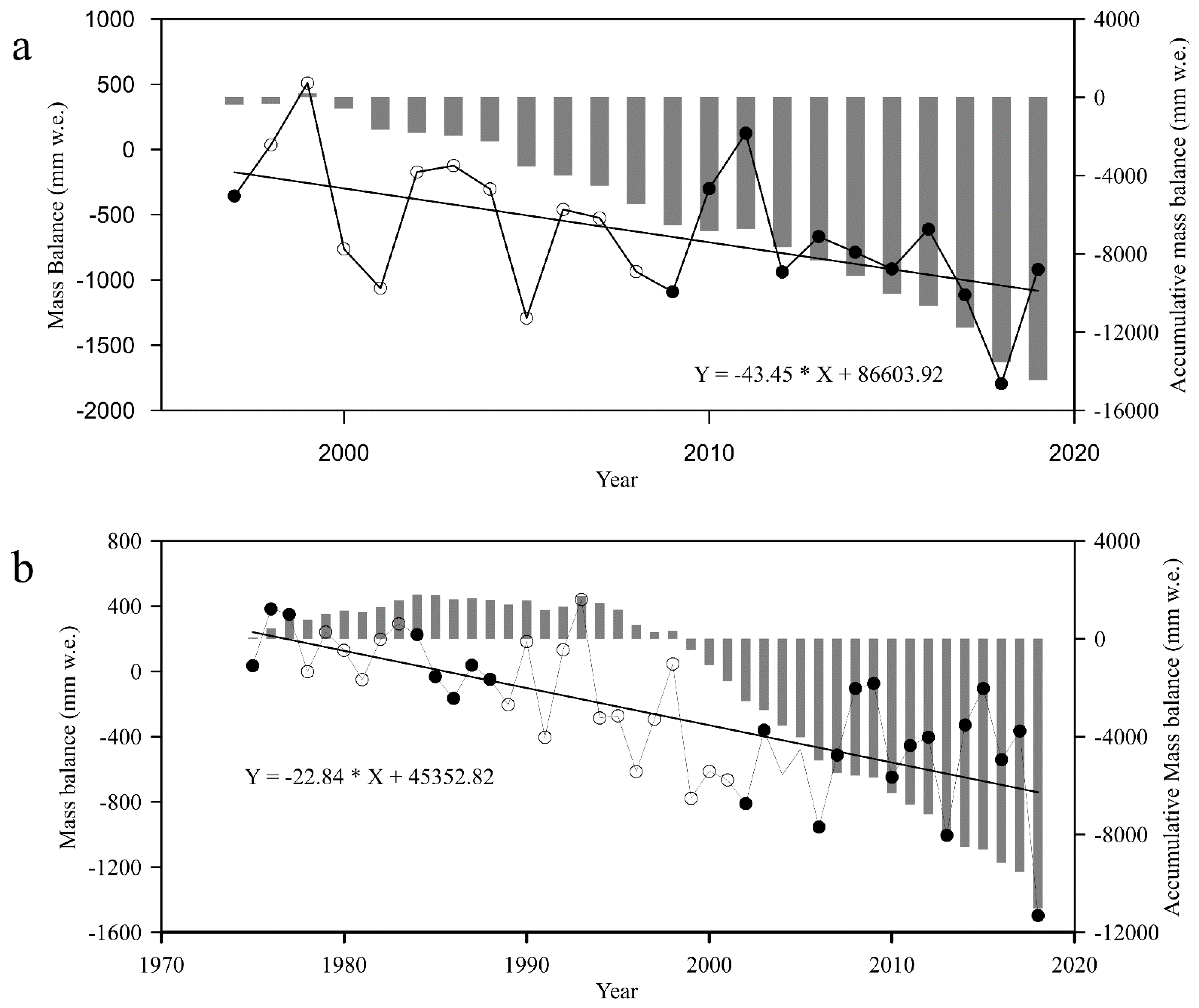
The climate warming over the Third Pole is twice as large as that in other regions and glacier mass loss is considered to be more intensive in the region. However, due to the vast geographical differences, the characteristics of glacier mass loss might be very different between different parts of the Third Pole, such as between the southern and northern Third Pole. It is, therefore, very important to clarify the characteristics of glacier mass loss between different parts of the Third Pole, particularly between the southern and northern Third Pole. We selected the Yala Glacier in the Central Himalayas and the Qiyi Glacier in the Qilian Mountains to study the different characteristics of glacier mass loss between the southern and northern Third Pole using remote sensing data and in situ data. Based on the results, we found that the Yala Glacier has not only been in a status of mass loss but also in a status of intensive and accelerating mass loss. Our analysis showed that the average multi-year mass loss of the Yala Glacier is −736 mm w.e.a−1, with a maximum of −1815 mm w.e.a−1. At the same time, the Qiyi Glacier has experienced a mild glacier mass loss process compared with the Yala Glacier. The Qiyi Glacier’s mass loss is −567 mm w.e.a−1 with a maximum of −1516 mm w.e.a−1. Our results indicate that the mass loss of the Yala Glacier is much stronger than that of the Qiyi Glacier. The major cause of the stronger mass loss of the Yala Glacier is from the decrease of glacier accumulation associated with precipitation decrease under the weakening Indian monsoon. Other factors have also contributed to the more intensive mass loss of the Yala Glacier.
Keywords: Third Pole; in-situ and remote sensing data; modeling; glacier mass Third Pole; in-situ and remote sensing data; modeling; glacier mass
Graphical Abstract