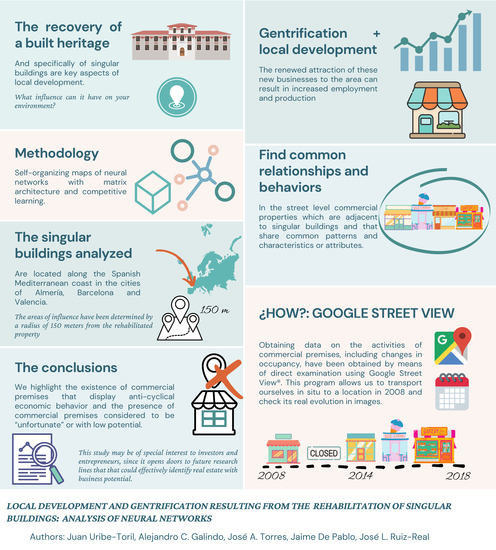
Local Development and Gentrification Resulting from the Rehabilitation of Singular Buildings: Analysis of Neural Networks

 ,
,  ,
,  and
and 
Abstract
Share and Cite
Uribe-Toril, J.; Galindo, A.C.; Torres, J.A.; De Pablo, J.; Ruiz-Real, J.L. Local Development and Gentrification Resulting from the Rehabilitation of Singular Buildings: Analysis of Neural Networks. Remote Sens. 2021, 13, 1500. https://doi.org/10.3390/rs13081500
Uribe-Toril J, Galindo AC, Torres JA, De Pablo J, Ruiz-Real JL. Local Development and Gentrification Resulting from the Rehabilitation of Singular Buildings: Analysis of Neural Networks. Remote Sensing. 2021; 13(8):1500. https://doi.org/10.3390/rs13081500
Chicago/Turabian StyleUribe-Toril, Juan, Alejandro C. Galindo, José A. Torres, Jaime De Pablo, and José L. Ruiz-Real. 2021. "Local Development and Gentrification Resulting from the Rehabilitation of Singular Buildings: Analysis of Neural Networks" Remote Sensing 13, no. 8: 1500. https://doi.org/10.3390/rs13081500
APA StyleUribe-Toril, J., Galindo, A. C., Torres, J. A., De Pablo, J., & Ruiz-Real, J. L. (2021). Local Development and Gentrification Resulting from the Rehabilitation of Singular Buildings: Analysis of Neural Networks. Remote Sensing, 13(8), 1500. https://doi.org/10.3390/rs13081500