Article

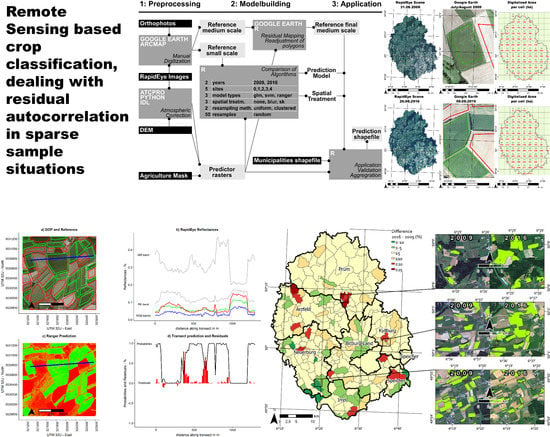
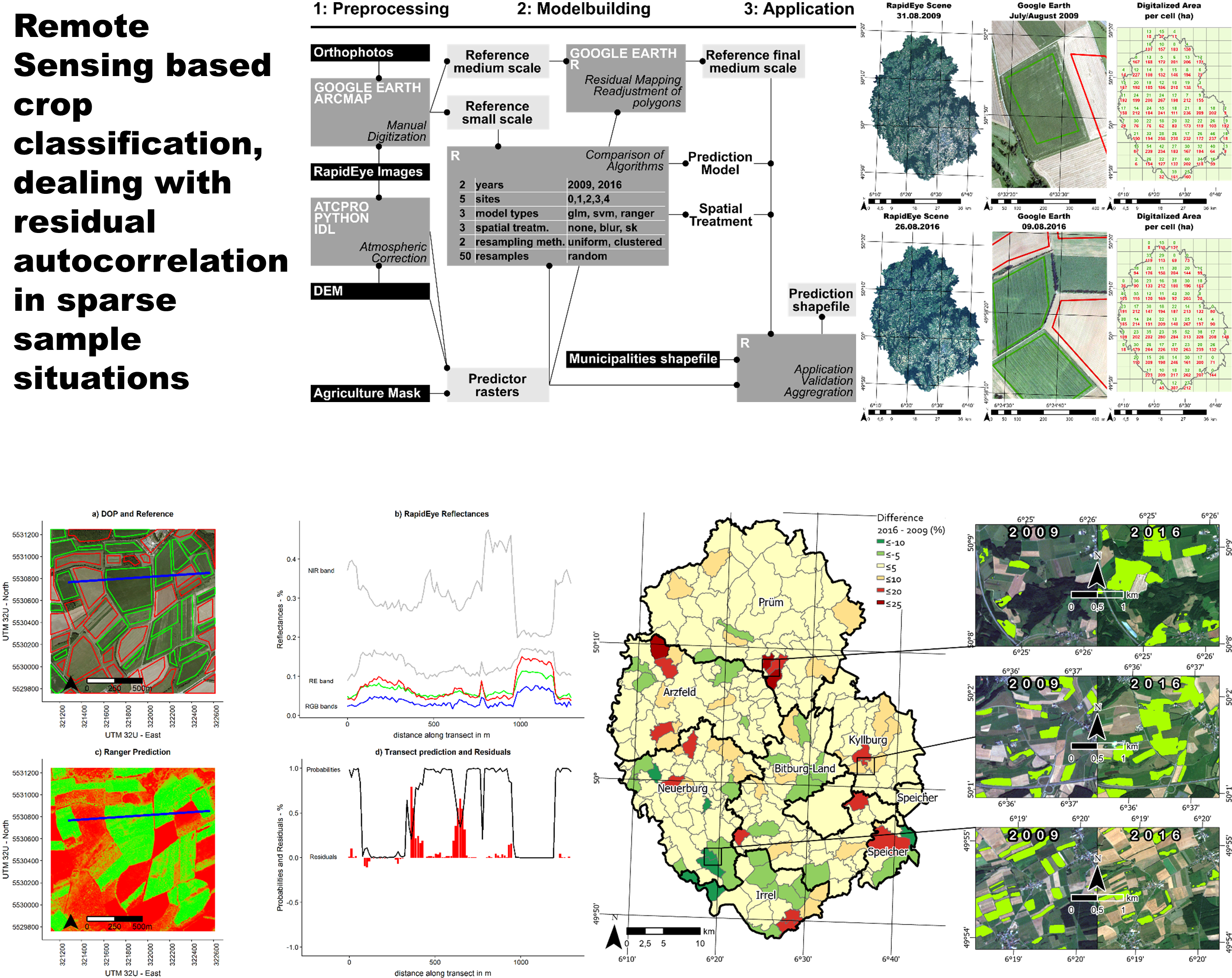
Remote Sensing Based Binary Classification of Maize. Dealing with Residual Autocorrelation in Sparse Sample Situations

1
Department of Remote Sensing and Geoinformatics, Faculty of Regional and Environmental Sciences, University of Trier, Campus II, D-54286 Trier, Germany
2
Department of Soil Science, Faculty of Regional and Environmental Sciences, University of Trier, Campus II, D-54286 Trier, Germany
*
Author to whom correspondence should be addressed.
Remote Sens. 2019, 11(18), 2172; https://doi.org/10.3390/rs11182172
Submission received: 24 July 2019 / Revised: 10 September 2019 / Accepted: 11 September 2019 / Published: 18 September 2019
(This article belongs to the Section Remote Sensing in Agriculture and Vegetation)

Abstract

In order to discuss potential sustainability issues of expanding silage maize cultivation in Rhineland-Palatinate, spatially explicit monitoring is necessary. Publicly available statistical records are often not a sufficient basis for extensive research, especially on soil health, where risk factors like erosion and compaction depend on variables that are specific to every site, and hard to generalize for larger administrative aggregates. The focus of this study is to apply established classification algorithms to estimate maize abundance for each independent pixel, while at the same time accounting for their spatial relationship. Therefore, two ways to incorporate spatial autocorrelation of neighboring pixels are combined with three different classification models. The performance of each of these modeling approaches is analyzed and discussed. Finally, one prediction approach is applied to the imagery, and the overall predicted acreage is compared to publicly available data. We were able to show that Support Vector Machine (SVM) classification and Random Forests (RF) were able to distinguish maize pixels reliably, with kappa values well above 0.9 in most cases. The Generalized Linear Model (GLM) performed substantially worse. Furthermore, Regression Kriging (RK) as an approach to integrate spatial autocorrelation into the prediction model is not suitable in use cases with millions of sparsely clustered training pixels. Gaussian Blur is able to improve predictions slightly in these cases, but it is possible that this is only because it smoothes out impurities of the reference data. The overall prediction with RF classification combined with Gaussian Blur performed well, with out of bag error rates of 0.5% in 2009 and 1.3% in 2016. Despite the low error rates, there is a discrepancy between the predicted acreage and the official records, which is 20% in 2009 and 27% in 2016.
Keywords: crop classification; spatial autocorrelation; Regression Kriging crop classification; spatial autocorrelation; Regression Kriging
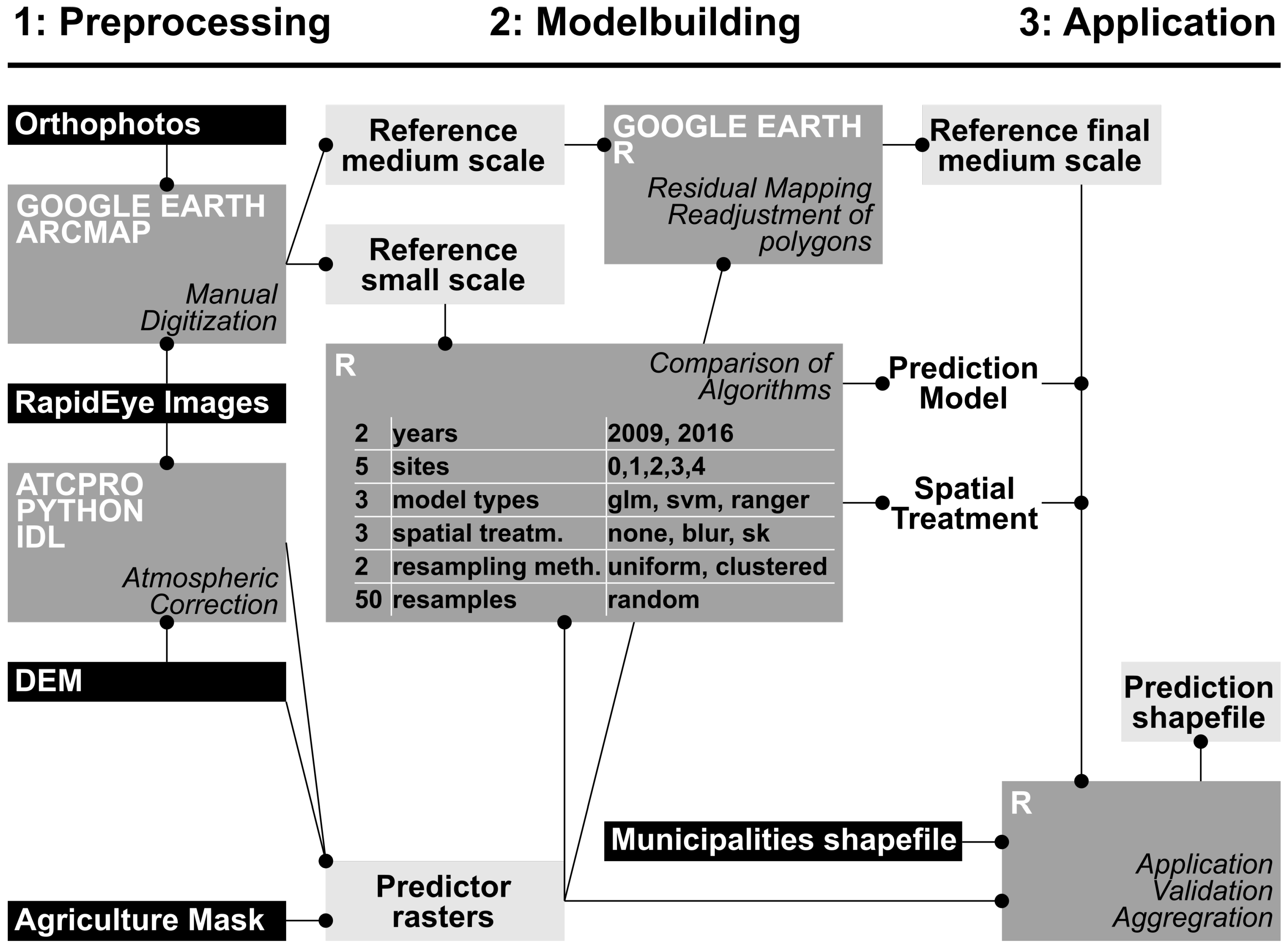
Graphical Abstract