Article

How Do Mega Projects Alter the City to Be More Sustainable? Spatial Changes Following the Seoul Cheonggyecheon Restoration Project in South Korea
1
Department of Civil and Environmental Engineering, Seoul National University, Gwanak-ro 1, Gwanak-gu, Seoul 08826, Korea
2
Department of Civil and Environmental Engineering, Integrated Research Institute of Construction and Environmental Engineering, Seoul National University, Gwanak-ro 1, Gwanak-gu, Seoul 08826, Korea
*
Authors to whom correspondence should be addressed.
Sustainability 2016, 8(11), 1178; https://doi.org/10.3390/su8111178
Submission received: 27 September 2016 / Revised: 9 November 2016 / Accepted: 9 November 2016 / Published: 16 November 2016
(This article belongs to the Section Sustainable Urban and Rural Development)

Abstract

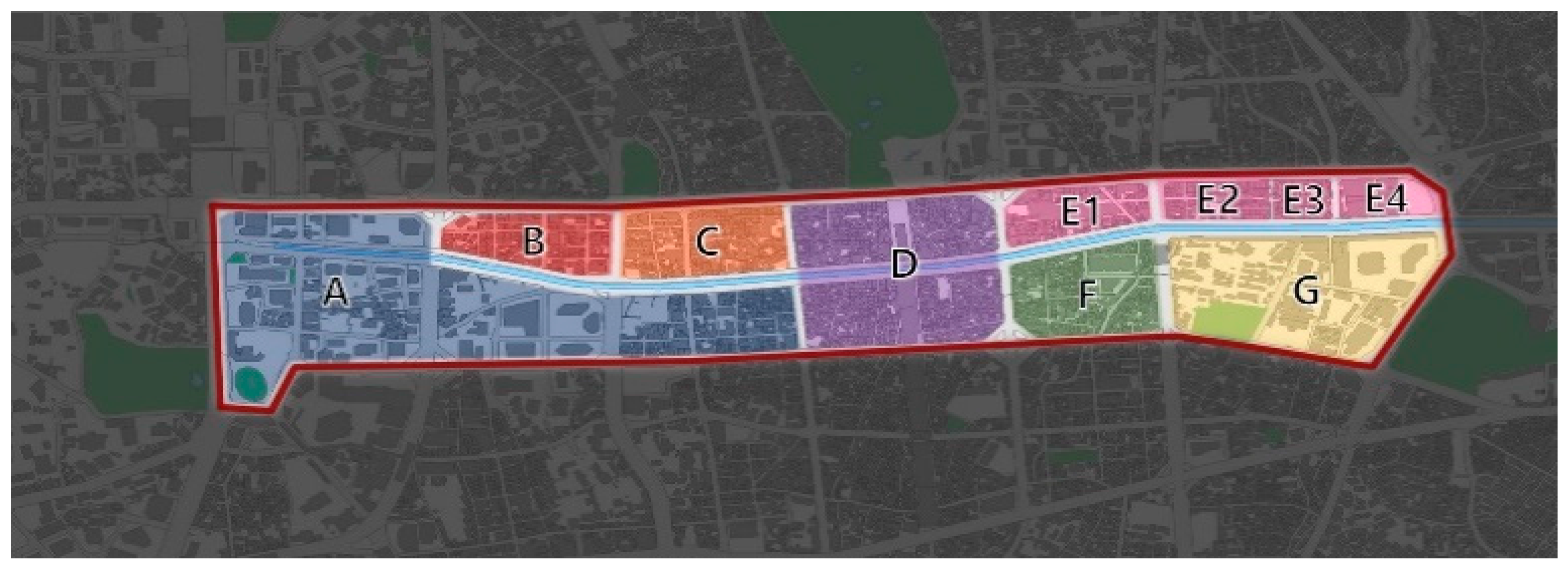
Urban megaprojects change the city in various ways over a long period of time. These changes may be very clear and calculable, but it is the changes that follow which are unpredictable and extensive. Especially in fast-changing cities like Seoul, Korea, projects like the Cheonggyecheon Restoration have massive effects on the surrounding environment. The purpose of this study is to analyze the spatial changes in the downtown area after the Cheonggycheon Restoration Project (2005). The economic; social, and physical effect and the outcome of the restoration project have been studied before the restoration, but the actual changes that occurred afterwards were understudied. Since subsequent spatial changes in the surrounding area occur over a long period, continuous observation on the physical effects should be made. Thus, unlike most studies that focus on the immediate before and after effect of the Cheonggycheon Restoration Project, this study focuses on the ten years of physical changes that followed the restoration. The study covers roughly fourteen large blocks, which were divided into seven categories based on current land use and the historical background of the city form. Physical changes of newly-built buildings, the number of renovations or building extensions, and socio-spatial changes, such as the rise and fall of urban industries, changes in building use, and overall changes in the characteristic of the blocks, were analyzed in accordance with their historical development of the city form. Commemorating the 10th anniversary of the Cheonggyecheon Restoration project, this study provides a better understanding of the overall effect of the project.
Keywords: mega project; urban morphology; spatial changes; Cheonggyecheon; Seoul; urban regeneration mega project; urban morphology; spatial changes; Cheonggyecheon; Seoul; urban regeneration