1. Introduction
Hydrogen produced with net zero CO
2 emissions (H
2NZ) is vital to the energy transition, notably around the decarbonisation of hard-to-electrify industrial sectors and heavy transport, but potentially for multiple uses, including heating [
1]. Often overlooked is that there are different means of producing H
2NZ—some technologies more advanced than others, but each with a diverse set of possible trade-offs.
The Global Hydrogen Production Technologies Center, known as HyPT [
2], will explore and advance four H
2NZ production technologies:
Water electrolysis with integration of renewable energy, focusing on:
- a.
anion-exchange membranes (AEM)
- b.
solid-oxide electrolysis cell (SOEC)
Methane pyrolysis with solid carbon as a value-added co-product.
Photocatalytic solar water splitting.
The goal is for each technology to contribute towards meeting H2NZ production targets of 1$ per kg cost. However, beyond economic considerations, the impacts of these technologies within communities may differ significantly in terms of energy source needs, water use, and land use. With technological advances is a need to understand the implications of these technologies and communicate the different trade-offs, benefits, and burdens they may trigger. This requires an interdisciplinary approach with social science and engineering, seeking ways to work together to solve complex problems.
In exploring H
2NZ trade-offs and impacts, energy justice, with its grounding in equitable distribution, due process, and recognition [
3], could provide a useful lens. However, despite the rapid growth and diversity within the energy justice literature, hydrogen is frequently missing from studies of energy justice [
4]. The lack of engagement with engineers with this body of literature is also noticeable, with the most recent studies emanating from social science and management fields [
4]. Interdisciplinarity is often called for in addressing today’s complex problems, with a call to look beyond technocentric solutions [
5,
6]. However, it has been noted that the literature is more multi- than inter-disciplinary and ‘largely silent’ on how engineering can ‘educate’ itself and integrate with other disciplinary viewpoints [
7]. This paper notes calls for better integration between social, technical, and justice themes in energy transitions [
8,
9,
10]. It seeks to meet the challenge of interdisciplinarity through concepts of energy justice for new hydrogen systems. Recent studies highlight the need for intersectional research as the H
2NZ economy advances, with calls for research to deepen its engagements with sustainability frameworks [
11,
12], with H
2NZ offering promise for sustainable development of justice challenges to be addressed [
13].
The overall aim is to harness the potential of H2NZ engineering for a socially and environmentally just energy transition.
The novelty of this paper is in directly incorporating justice dimensions with innovative science and engineering in an active research project. It expands what is considered ‘engineering’ to embrace social considerations within its own remit and encourage transdisciplinary thinking.
A literature review explores energy justice and the new concept of ‘hydrogen justice.’ Hydrogen justice emanates from the energy justice literature but warrants separate consideration. As well as specific risks and concerns and opportunities, unlike many other fuels, H
2NZ can potentially be produced anywhere there is water and a renewable energy source, giving scope for a wider pool of recipients and to diversify energy systems [
13,
14]. However, if hydrogen production is to be introduced at scale, it will require new global systems and new infrastructure that compete with or drive out existing systems. There will be significant impacts on resource allocation across the water–energy–food nexus. In particular, as hydrogen production often draws upon water resources, there are perceived and real issues about freshwater use allocation and water justice; the allocation of resources is fundamental and embodied in justice assessments. There is also a focus on new international power dynamics from these new systems and risks of neocolonial patterns, which a hydrogen-specific lens helps to highlight and address.
A workshop of expert engineers working on the H
2NZ technologies is used to highlight the potential impacts of their technologies. With a focus on hydrogen production, a series of questions to challenge the technologies is then designed. In principle, justice considerations can be operationalised at different stages of hydrogen projects, including feasibility, design and stakeholder engagement stages. In a similar study involving water systems [
15], a framework of justice-based questions was to be used at the feasibility stage and then re-visited throughout the project. It is also expected to have value at the stakeholder engagement stage. In both instances, the questions become a tool to uncover concerns amongst impacted communities and open the door to conversations to mitigate or eliminate those concerns. There is also scope for these frameworks to be incorporated into Responsible Research and Innovation approaches, with questions being used as prompts rather than tickboxes or checklists [
16]. It provides engineering with practical tools and guidance to navigate the social space around new infrastructure engineering.
The paper explores the following research question:
Using the results from the research questions, the paper aids the process of framing problems and evaluating solutions beyond the immediate technical challenges. It is designed to align with Sustainable Development Goal 7 (Affordable and Clean Energy, [
17]).
The paper is structured as follows:
Section 2 addresses the literature relevant to hydrogen and justice.
Section 3 and
Section 4 discuss the methodology and the data from the workshop.
Section 5 discusses the proposed questions to interrogate the technologies and feedback from interviews. The conclusion in
Section 6 discusses opportunities, limitations, and next steps for this work.
2. Literature Review
There is existing literature that compares some of the different hydrogen production technologies and use-cases, although these comparisons often address issues around the performance of the technologies and their operation [
18,
19], sometimes including economic impacts and costs [
19]. Social impacts are less frequently noted, and where they are, they are addressed through proxies or, for example, through concepts such as the ‘social cost of carbon’ [
20], where the cost of carbon produced is linked to the environmental damage caused. What is missing is a means of undertaking a comparison of technologies with a justice lens to enable a view of the trade-offs that might be experienced by communities beyond economic assessments.
This paper is at the intersection of new hydrogen technologies and a just transition. Whilst the principles of energy justice are discussed in
Section 2.1 to cater for a multi-disciplinary readership, the focus in
Section 2.2 onwards will be on more recent developments that help form a concept of hydrogen justice.
2.1. Energy Justice
Energy justice addresses equity and fairness in relation to energy infrastructure systems. There are different conceptualisations, although the dominant theory, sometimes called the triumvirate approach, draws upon three interconnected dimensions of environmental justice as articulated by Schlosberg. These dimensions are equitable distribution (distributive justice), due process (procedural justice) and recognition (justice by recognition) [
3,
21]. The demands of recognition in terms of cultural identity and accessible participation are particularly noted [
3] and underpin that fair processes and engagement are fundamental to a fair distribution.
The issue to be addressed is how this language and thinking translate and integrate into engineering problem-framing and solution generation.
Principles of equitable distribution, deriving from work by John Rawls [
22,
23], resonate when thinking about physical, engineered infrastructure and could offer meaningful connections between justice principles and engineering problem-framing. Infrastructure systems, at their core, are about the distribution of resources into society. Questions of who receives that distribution, who does not, who bears the burden, who decides and how, and whose views are recognised, respected, and considered, become highly relevant in a just society. When engineering an infrastructure system, decisions are being made about how those resources are going to be allocated. A sense of being wronged or of an injustice (rightly or wrongly) can often be seen in responses to infrastructure change. For example, local communities face ‘burdens’ of new physical infrastructure that are not seen as offset by benefits (distribution), perceived as imposed without consent or of not being listened to (due process and recognition: for example, in the hydrogen context see [
24]. These community objections are pejoratively referred to as NIMBYism on occasion, but this reductive view fails to appreciate a real and understandable sense of injustice [
25]. More pressingly, it can fail to anticipate and work to mitigate injustice and tailor solutions accordingly.
Additional dimensions have been suggested to add to the three dimensions of justice. Cosmopolitan justice views all humans as ‘world citizens’ of equal worth [
26,
27], prompting an analysis of impacts across borders [
28]. Cosmopolitanism may not be a dimension of justice but instead a principle that prescribes the scale of how other dimensions of justice are viewed; it acts as a prompt when applying the three justice dimensions to look beyond local scales and impacts.
Restorative justice looks at how to redress historic injustices [
28,
29]. This could be particularly potent in exploring the impacts of colonialism, looking deeper into systemic and embedded prejudices. For restorative justice, linkages to other dimensions of justice are helpfully articulated in a study on energy system change, indigenous populations, and confronting relationships with power:
Empowering impacted communities to lead in the design, implementation, and maintenance of socially, culturally, and regionally appropriate energy technologies can provide a pathway to just distribution of benefits and burdens and creates a pathway to restorative justice.
(Lee et al., 2023 [
30], p. 3)
The dimensions of justice need to be applied to an endless variety of circumstances and contexts. To do so, justice needs to be sufficiently elastic a term to work in different scenarios, but at the same time risks becoming ‘a potentially corruptible concept, highly vulnerable to political agendas’ [
4]. It is also argued that the articulation of the moral underpinning of claims of what is just or unjust can be lacking or insufficiently justified in the energy justice literature [
21,
31,
32]. Further issues are raised about different conclusions being drawn depending upon the moral framework or perspective (e.g., [
21]) or if viewed at different scales and over time [
32].
The problem with concepts of justice can be illustrated with reference to the climate crisis. Here, changes to meet global pressures for sustainable, net-zero infrastructure are needed to preserve humanity’s future, but this may clash with local livelihoods dependent on fossil fuels today. Different scales and time may lead to different perceptions of what is ‘just’, but applying justice dimensions may help those issues to be articulated and frame an energy dilemma with a wider lens. In other words, justice dimensions can be applied to air and anticipate potential conflicts. However, going further and using them as a tool to resolve conflicts through forming a judgment on what is ‘right’ becomes more problematic. As a result, the tenets of the justice approach have been criticised for a lack of philosophical underpinning to capture the depth and nuance of ethical issues [
31,
33]. The authors in Wood et al. [
33], however, acknowledge the tensions between aiming for a complex and nuanced understanding of justice and creating a framework that is simply too complex to be useful.
To counter these criticisms, it is made clear that energy justice here is a tool for the purposes of examining different hydrogen systems. It is not used to form judgements on whether an intervention is just or unjust or ‘right’ or ‘wrong.’ Further, the dimensions of justice used are clearly defined to allow for scrutiny. As with many of the ‘wicked’ problems of the Anthropocene, there are often messy and incomplete answers [
34], but by engaging with principles of justice, it may be that hidden trade-offs and impacts can be brought to light by providing a structure to draw in different scales and perspectives. It is also intended for the framework to be amended and adapted over time, and as learning and reflection take place. What is sought is to apply the principles so potential benefits, detriments and trade-offs can be identified and articulated for greater openness and accountability. It draws upon existing studies that highlight energy justice as an analytical tool for framing energy conflicts (e.g., [
35]) and that do not prescribe to a single notion of what is just or good [
21].
2.2. Hydrogen Justice
The use of hydrogen as a fuel is one of a range of solutions that could help decarbonise global energy systems if it can be produced economically, at scale, and with net zero emissions. As with any major energy transition, the implications of a move to hydrogen are social as well as technical. To give recent examples, the social concerns and perceptions of new hydrogen systems are exemplified in the Whitby Hydrogen Village trial. The proposed hydrogen system was to replace existing gas systems with hydrogen piped into homes. Concerns were raised, including safety and a sense that the community was shouldering the burden of an experiment rather than pioneering a new technology that would benefit them [
36,
37].
The energy justice literature has yet to fully embrace hydrogen systems.
There are journal articles that make valuable contributions to energy justice in a hydrogen context and with attention to the three founding dimensions of energy justice already articulated (e.g., [
13,
38]). Looking for concepts for a distinct ‘hydrogen justice’ that expand beyond existing literature on energy justice is more limited. In a Scopus literature search, only two journal articles used the phrase ‘hydrogen justice’ in the title, abstract or keywords. The first most recent paper focuses on different green hydrogen sociotechnical imaginaries rather than justice dimensions [
6]. The second paper by Muller, Tunn and Kalt [
32] is credited with introducing the concept of ‘hydrogen justice’ as an analytical tool and should therefore be a focus of attention when examining the expansion of energy justice into hydrogen systems. It seeks to examine justice challenges with a focus on a global green hydrogen transition [
6,
39].
In defining hydrogen justice, the paper draws upon features of environmental justice and dimensions of energy justice, water justice, and climate justice. Six dimensions of justice are suggested. These include the four dimensions discussed in
Section 2.1 as procedural, distributive, recognitional and restorative justice components, mostly from a global systems perspective. A global perspective raises important questions of impact. For example, questions are raised over whether hydrogen will be produced and used at source, transported after production or (more likely) a combination of the two. This in turn raises issues over local and global supply chains, technology and knowledge transfers and governance arrangements—and so distributional benefits and burdens across different scales.
By drawing from the wider literature, the Muller, Tunn and Kalt paper [
32] expands the framing of justice to include two further dimensions, ‘relational’ and ‘epistemic’ justice.
Relational justice raises questions of cross-sector impacts and asks, “how does resource-intensive hydrogen production interfere with human–water and human–land relations?” [
39]. Justice based upon a sense of place and informed by relationships with land has been considered a means of decolonialising energy systems and justice conceptions [
40] and opposes a siloed attitude to energy systems that can fail to acknowledge wider water–energy–food (or land) systems.
Relational justice might be an avenue to address another criticism of justice and rights discourse, and that is its anthropocentricity. There is a risk in a human rights-based approach of denigrating the impacts on non-humans. In climate and environmental justice terms, Schlosberg has articulated the issue.
When we interrupt, corrupt, or defile the potential functioning of ecological support systems, we do an injustice not only to human beings but also to all of those non-humans that depend on the integrity of the system for their own functioning. It is the disruption and increasing vulnerability of the integrity of ecosystems that is at the heart of the injustice of climate change, for example, both in terms of its impact on vulnerable human communities and non-human nature. The treatment—or abuse—of human and non-human individuals and systems is based on the same loss of the ability to function.
(Schlosberg, 2013 [
41], p. 44)
This articulation seeks to rebalance the narrative to incorporate non-human impacts and human relationships with the wider ecosystems.
Hydrogen systems are negatively framed in the Muller, Tunn and Kalt paper [
32] with a reference to production being ‘resource-intensive’ and as ‘interference’ without discussion and as if those terms were universally accepted as correct. A general negativity in framing of energy infrastructure, and a lack of balance and attention to the opportunities change can bring, has been noted elsewhere [
42], to which could be added a lack of a nuanced understanding and attention to engineering data and input.
For example, the issue of resource allocation is a serious one, but water resource requirements vary across hydrogen production technologies and may be low or minimal relative to other sectors [
43]. The risk in the way this is presented is that hydrogen is seen as a negative intrusion. It is more likely to bring a balance of positive opportunities and negative impacts. The issue is how we account for the trade-offs and how we are open and accountable in relation to the potential benefits and detriments a new system will bring? There is a potential to improve systems and remedy injustices when bringing about infrastructure system change. Restorative justice dimensions are potential cases in point. Restorative justice in the Muller, Tunn and Kalt paper [
32] asks how hydrogen economies may deepen historical injustices, including deeply embedded issues linked to colonialism. In a similar vein to relational justice, this could be adapted to include how a new infrastructure system could be designed to take a step to remedy past injustices.
In answering these questions, the importance of the sixth suggested dimension around epistemic justice—how knowledge transfers take place and whose knowledge over land use or energy production counts—becomes pivotal. It draws in other dimensions in terms of relational justice, due process and recognition but adds an additional dimension to flag the importance of whose knowledge is valued. Examples may include prioritising certain forms of knowledge, scientific, for example, over indigenous knowledges and following calls for epistemic diversity in solving complex problems [
44].
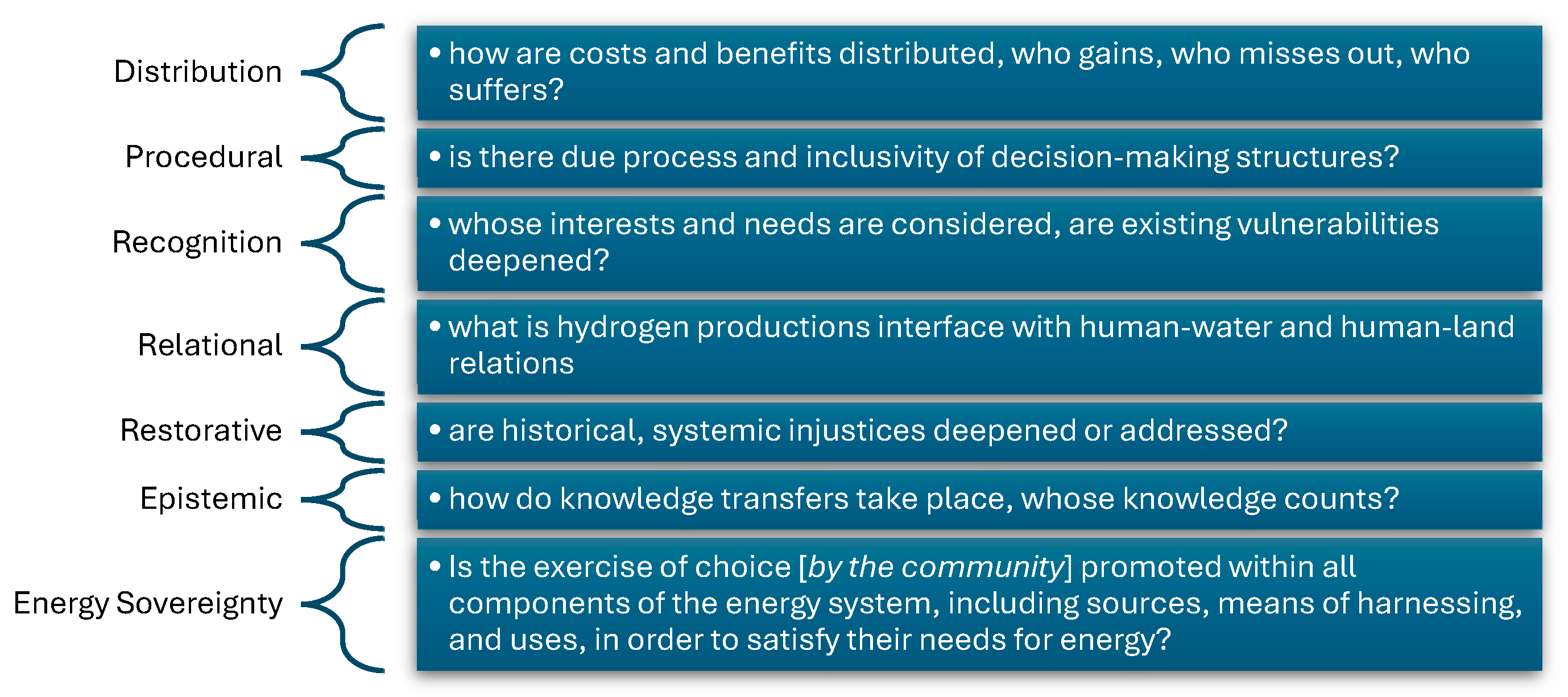
Overall, the six dimensions, distribution, procedural, recognition, relational, restorative, and epistemic, can be used to provide a basis to ask questions around new hydrogen infrastructure systems. These questions can be designed to look for both opportunities and challenges.
2.3. Justice, Indigenous Groups and the Role of Sovereignty
The issue of energy sovereignty, the right to self-determine energy systems, is a body of work that touches upon similar issues to energy justice. Whilst the emphasis may be different, both justice and sovereignty are involved with a ‘just’ energy transition [
45].
A key area where these cross-over issues are explored is in relation to resource extraction. It is recognised that green hydrogen could bring about more equitable energy systems, but there are risks of exploitation [
13,
42]. Sovereignty concerns help explore the embedded structures that continue to operate to the detriment of indigenous communities [
46,
47,
48]. Issues include the impacts of mining of critical minerals [
49] and concerns over the use of resources from the global south for hydrogen production that is exported to the global north, for example, [
13,
39]. The extraction of resources can be an extraction of power, control, and sovereignty [
42]. The extraction of resources and location of the production versus the location of use of hydrogen raises questions beyond technological questions of transport and storage to far wider implications.
The interconnectivity with energy justice is an area where more studies are required [
50], but there are strands of thinking that can be drawn upon. A conceptual framework for energy sovereignty is proposed by Timmermann and Noboa [
45], where themes of recognition are included and democratic control, such as procedural and recognition justice. There are also strong themes relating to relationships and responsibility to the land, such as stewardship and self-sufficiency, that could have similar underpinnings to relational and epistemic justice. The links to dimensions of justice, including to non-humans, are neatly seen in the paper by Schelly et al. [
43], for example, respecting different ontological foundations, including what sovereignty means. There are relational and epistemic features of justice here, suggesting a strong potential cohesion with justice issues.
Instead of asking questions about what is efficient, what will be socially accepted by communities or markets, or how access will be distributed, the ontological foundations in the teachings of Anishinaabe as described below encourage us to ask how we are relating to the wind, the water, and the lands in our harvesting of energy and whether our energy systems are designed to respect the sovereignty of all beings on the earth.
The energy sovereignty literature offers an opportunity to address another criticism of energy justice discourse, that it has Westernised views of justice that might not accord or do justice to non-Westernised communities, including indigenous communities and those in the Global South [
50]. This has links to concepts of epistemic justice.
In a recent study, energy justice provides a useful tool to analyse shifting policies and tensions within a renewable energy programme for indigenous populations in Northern Australia [
52]. However, the question also raised for future consideration is whether sovereignty and self-determination could provide a more incisive understanding of whether energy justice is achieved [
52]. The question becomes whether the new energy systems being implemented provide energy security and are done with (not to) the community and in line with principles of self-determination. For indigenous communities, questions of sovereignty represent the extent to which the community has self-determination in terms of their energy requirements. Viewing this with a justice lens, the issue becomes not one of energy availability but of freedom in terms of self-determination to improve well-being. Further work could explore the extent to which sovereignty and self-determination become a measure of a just system.
2.4. Summary
Drawing these complicated strands together, it becomes possible to see how using dimensions of justice and sovereignty could be a means of interrogating and comparing different technologies. The dimensions become questions for analysing a technical change. These could form preliminary questions for a research team when framing problems and examining potential solutions.
Drawing upon definitions of the justice dimensions, the dimensions could be adapted and articulated as follows (
Figure 1).
3. Materials and Methods
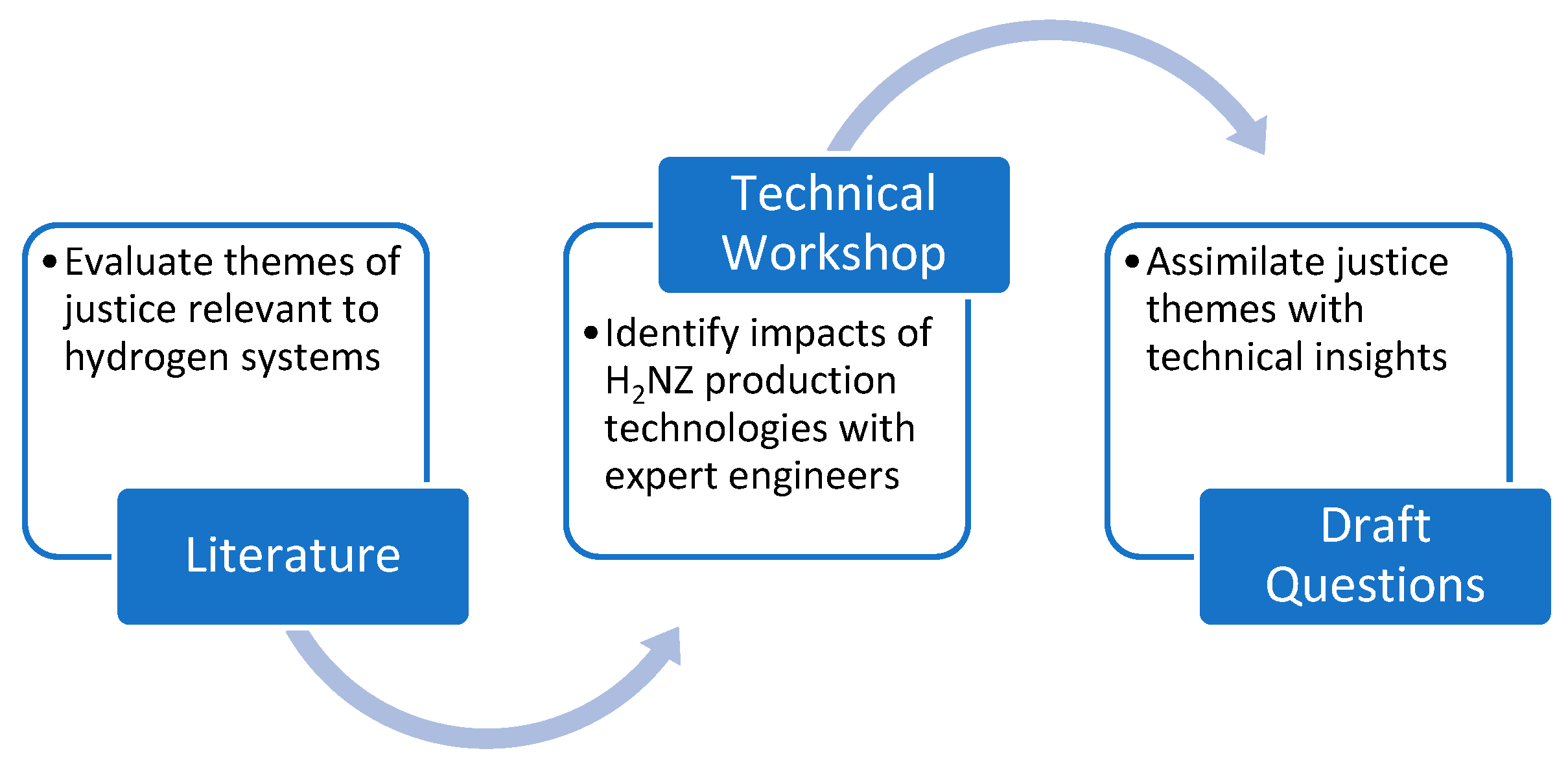
This paper explores how justice principles could be used and incorporated to support the design of hydrogen systems for a just transition. This involves integrating justice literature with potential technological impacts. The methodology chosen to achieve this is illustrated in
Figure 2.
Technical Workshop
The review of literature in
Section 2 enabled an articulation of justice dimensions and sovereignty (
Figure 1). At the same time, an understanding of the nuances and impacts across different hydrogen production technologies is required. Integrating technical aspects of the HyPT Center research programme has challenges, as the novel hydrogen production technologies explored in HyPT Center are in development. By the nature of new and novel research, written data on the system and its functioning is limited. The pool of potential experts in each technology is also limited.
To understand the technologies and the potential areas of impact, and importantly, how they are likely to compare, a workshop took place, drawing on one expert engineer representing each of the four technologies. The selection criteria were expertise in engineering from industry or academia, that had applied research experience in the technologies being explored. By the nature of innovation, there are few experts to draw upon and fewer who would be willing and available. One to two representatives for each technology were to be sought, and all of the technologies had to be represented. To be selected, the participant needed a thorough knowledge of the technology, as shown by their current research work, and/or recent publications, and was based in the UK. Ethical processes and approvals from Cranfield University Research Ethics and Integrity Committee under review reference CURES/22317 were followed, and informed consent was obtained for each participant. The workshop was chaired and supported by social scientists within the HyPT team, bringing the workshop team to six participants in keeping with focus group research [
54]. The workshop was tasked with identifying the impacts of their work. The workshop duration was 3 h. The workshop started with an introduction section where the participants were given scope to talk about their technologies. An unexpected benefit of the workshop was the comments from participants that they had not had the opportunity to dynamically engage with other experts to think about their technology against other technologies, particularly in terms of comparisons across resource use. The opening introduction to each technology enabled that comparison in a small group setting. The workshop then took participants through a series of open questions with prompts. Although discussions were allowed to develop, the pre-agreed prompts ensured that key issues from the literature around water, energy use, land use, and materials were explored. There were no disagreements between the participants as the technologies were not competing with each other. Instead, how the technologies could offer different solutions was allowed to materialise. The conclusion section involved agreeing on outputs from the session. The results are discussed in
Section 4.
The themes from the workshop were taken forward to cross-reference with the justice principles taken from the literature. The justice and sovereignty themes and the technical themes were drawn together. Each dimension of justice was considered with each impact in mind. Questions were drafted to address the justice dimensions and the potential impacts.
The results from the workshop and interviews are discussed in more detail in
Section 4. The results were taken forward and cross-referred with the justice dimensions.
4. Results: Workshop
The in-person workshop took place over half a day with six engineering experts in hydrogen production technologies to explore the impacts of hydrogen production technologies. Differences in potential applications were explored with short narratives created to be explored and built upon:
Photocatalysis requires adequate sunlight. It requires significant areas of land for the solar plant and a source of water. It may suit off-grid applications.
With advanced research, the current inefficiencies of water electrolysis are being reduced. The two technologies explored, AEM and solid oxide electrolysis, differed in terms of purity of water requirements, land use, and energy consumption. The heat requirements were higher for solid oxide electrolysis. There was the potential for less use of critical minerals than existing PEM technologies.
Methane pyrolysis does not split water but methane. It produces carbon rather than CO2. The carbon was a potential high-value by-product. As it uses less water, it may be more suited to water-stressed environments. It has high heat requirements, which may also be attractive for integration with heat sources from nearby industrial processes.
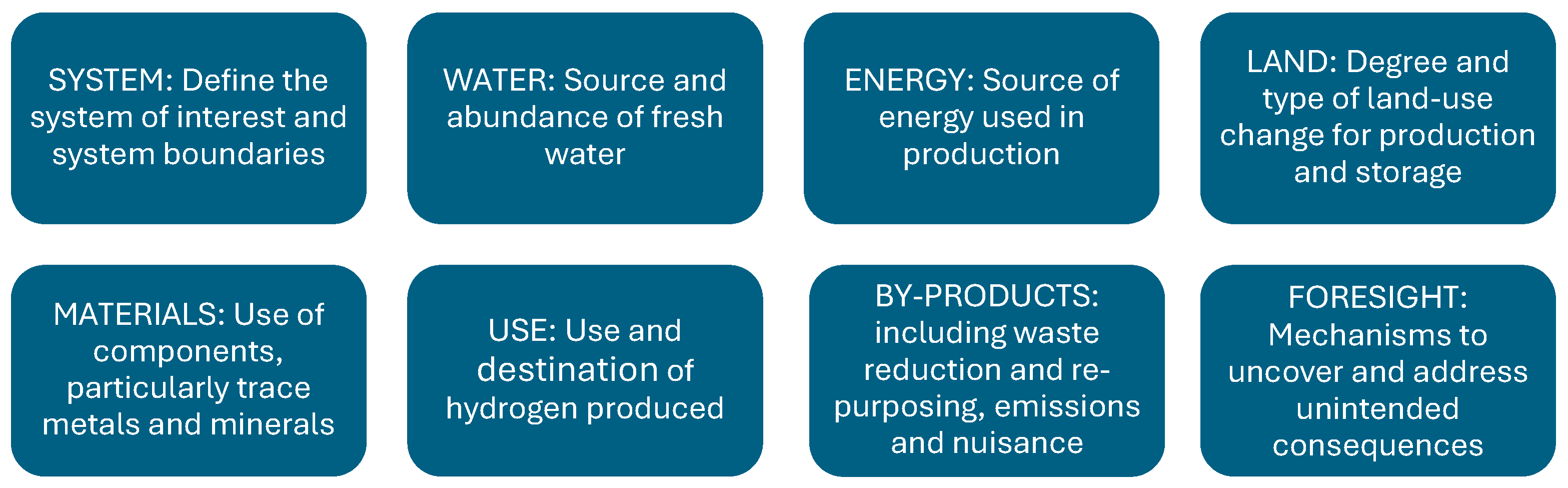
From these pen portraits, potential justice tensions can already be envisaged. There are clear differences between land and water use, for example, between the technologies. What cannot be determined is how they would impact in different contexts, and this requires questions to be asked of each impacted community. For some participants, it was the first time they had considered the difference in impacts across technologies. To add to the complexity, the technologies are at varying degrees of technical readiness level (TRL) with limited available data on how they will perform. The technical dimensions suggested by workshop participants are summarised in
Figure 3. The aim was not to have a definitive list but to start with narratives and build a framework to work with and adapt.
The first (systems) and last dimensions (foresight) accept that energy systems are complex and require a systems thinking approach. The engineered system needs to be clear about what is within scope and what is outside. The boundaries could include geographical, administrative, and temporal, amongst others. This area involved asking questions to understand the context and impacts on the place. Here, the social scientists also added questions on governance of the system to understand the processes to manage change. On the issue of complexity, unintended consequences (positive and negative) should be anticipated, and mechanisms should be in place to try to reflect and be alert to that, and this was addressed in ‘foresight.’
The remaining dimensions address the impact areas. The water–energy–food nexus is represented through considerations of water, energy, and land use. Accepting criticism of an overly anthropocentric approach, these items could and should include environmental and ecosystem assessments.
The components used in the production techniques also differed, with some technologies using expensive or rare components, bringing issues of supply chain and cost as well as potential implications for how and where they are sourced. The complex issues around critical minerals are starting to be explored [
49], and participants were alive to these issues. Again, there were differences between the technologies, and where rare or expensive materials such as platinum were in use, although part of the research programme included finding alternatives. This suggests that the matrix could also be used longitudinally, with differences in responses over time as the HyPT research programme progresses.
The key unknowns about a hydrogen ecosystem are not just around production but also how the hydrogen is used, transported, or stored. This is influenced by where the hydrogen produced is used. This could be local, for example, produced on site for an industrial application, or transported internationally. The impacts on local communities may be different.
Issues around ‘waste’ were also raised by workshop delegates in terms of eliminating harmful impacts through to re-purposing them as an asset. Specific to hydrogen production might be methane pyrolysis, for example, with concerns around methane emissions, through to exploring the monetisation of carbon by-products. It was decided under this theme to include emissions and nuisance as other undesirable outputs and use the label ‘by-products’ rather than ‘waste.’ Answers to these questions could precede more detailed environmental impact assessments and life cycle analyses and function as a useful early overview. It should provide a concise and precise description of the experimental results, their interpretation, and the experimental conclusions that can be drawn.
5. Discussion: Proposed Questions
The purpose is to engage with engineering teams and provide a tool enabling consideration and anticipation of conflicts and opportunities. It follows positive feedback on a similar tool used in engineering in the water sector [
55]. This matrix does not intend to replace engagement with communities but provides a structured entry point for engagement. The newness, scale, and resourcing of a global H
2NZ system inevitably lead to a range of serious tensions as well as opportunities, which these questions aim to illuminate. Whilst other energy or water systems might not draw upon all of these questions, it is hoped that some could be used or adapted to other new infrastructure systems. It is envisaged that the questions would be asked of each technology and comparisons made. This would support the uncovering of potential concerns and opportunities for each technology in turn. The framework will not, on its own, determine what is right, just, or better. What it will do is air the different potential impacts of the technologies in areas that matter most. This will enable stakeholders, communities and decision-makers to make informed decisions that are right for them.
Drawing the dimensions of technical impacts and justice together, questions were formed, integrating thinking from social scientists and the engineering teams. Drafting these questions also made it clear that answering them would be a multi-disciplinary task, in keeping with their complexity. The drawing of themes and drawing questions is an approach that has worked in the past.
Distributive Justice
Whose needs are being met and whose are not? Who will be impacted?
Beyond CO2, how do the technologies differ in the emissions or by-products produced? How are those emissions or by-products managed or re-purposed?
Where will the H2NZ plant be located and why? What are the spatial needs and preferred location of this technology?
Where are the potential burdens of the development felt, e.g., pollution, nuisance? How does this compare with the distribution of benefits?
What is the anticipated use-case(s) for the H2NZ produced?
If there is existing fossil fuel dependency, are there plans to transition to renewable energy, and what challenges are identified for fossil fuel-dependent communities? How does this project support those plans?
Are the distributional justice aspirations of the project measured and achieved, or new issues highlighted?
Procedural Justice
Where are the administrative and jurisdictional boundaries?
What planning processes apply, and who are the recognised stakeholders?
Is competition between user groups and with non-user groups likely? How are conflicts anticipated and addressed?
Does the proposal align with local land, water, and energy policies and plans?
Justice by Recognition
Who is recognised as a stakeholder? Does this include all water, land, and energy user groups? Are vulnerable or hard-to-reach communities included?
How are the rights of ecosystems recognised?
What cultural, social, or environmental features are of importance to stakeholders locally?
Relational Justice
What are the important geographic features and boundaries?
What are the freshwater needs for the technology, and where would the fresh water be sourced? Are the water needs higher or lower than existing energy production systems?
What are the energy sources for the region in question?
Is there an abundant green energy source to power the H2NZ processes, whilst ensuring the current and future needs of other energy-users are met?
How are needs of competing land-users addressed? Are vulnerable groups, non-humans and future generations considered?
What mechanisms are there to gather feedback on the social and environmental impacts (and respond to them)?
Restorative Justice
Are there components sourced from the global south? How is responsible innovation managed in this respect?
Are biases in the siting of infrastructure perpetuated or addressed?
Are biases in the use and allocation of resources perpetuated or addressed?
Are restorative justice aims achieved, or new issues highlighted?
Epistemic Justice
Energy Sovereignty
What are the requirements for the technology in terms of use of rare or critical minerals? Where are they sourced?
Will the H2 produced be used locally? If not used locally, where will it be transported to and how?
Will the project improve energy security for the region?
Are there alternative means (including non-technical) of achieving the same aims as this project? Are energy sovereignty, choice and self-determination honoured?
The questions were triggered by considerations of justice dimensions and technological impacts together. One key assumption is that the technologies all meet economic and production targets of 1$ per kg cost and are assessed on that basis so techno-economic assessments are not included (although the data from the questions will be useful in addressing those issues).
The questions where input from science and engineering would be most useful are highlighted in
bold. The questions presuppose a place-based connection to a new technology in keeping with the project, so new physical infrastructure. This may explain why most questions focus upon distributive and relational issues, where benefits and burdens and impacts on surroundings are more visible. It is also clear that some questions could be construed within more than one dimension of justice. This is not considered an issue and respects that dimensions of justice are interlinked [
31].
It is anticipated that the answers will help draw out different trade-offs between the technologies to aid discussion on their suitability for different communities and contexts. The answers to the questions will differ depending on the technology and can challenge conventional views of hydrogen systems. This common view of hydrogen systems is seen as universally water-intensive, for example [
13]. It may be explored as the engineering teams advise that water use will differ substantially and may be less than existing systems in some instances. It also encourages a context-sensitive approach and informed choice for stakeholders. The questions should elicit responses that look at water, land and energy requirements, differences in nuisance levels and by-products. There will be different trade-offs, and stakeholder preferences for different trade-offs can be explored.
It also challenges the one-size-fits-all approach to infrastructure and encourages discussion on different technologies. Systems such as photocatalytic water splitting could work off-grid in more remote communities answering issues of energy access.
Reflecting and amending the questions is encouraged and should be explored with impacted communities. It is a starting point for engagement with innovative technologies when there might be little else to work from. It is anticipated that the process, engaging experts in a structured workshop to discuss the impacts of new, unexplored technologies, could be replicated. The anticipated results of the application of the framework are to highlight opportunities, trade-offs, and conflicts systematically and with wider systems in mind. This should provide a base for the development of context-sensitive interventions.
6. Conclusions
Considering the questions posed at the start of the paper, dimensions of justice and sovereignty can be articulated in a way to guide questions of an energy transition project. Integrated with different technical impacts, those questions can be drafted as a tool to help project teams articulate the tensions and trade-offs of proposed interventions. This offers a means for engineering to engage with concepts of justice and integrate them into best practice for context-sensitive solutions.
The questions encourage problem-solving with a wider system framing and thinking. It helps to re-frame a problem from an engineering perspective from a narrow technical issue that needs to be resolved, to a societal issue with wider impacts. There are different hydrogen production technologies, and the impacts and opportunities will also be different. This type of thinking, social and technological together, might give us a better chance of acknowledging nuances in technologies as well as ensuring trade-offs are understood to better align with the values of communities in each context. The process of an expert workshop in identifying potential issues was a useful starting point. When technologies are new, untested, or in development, it is difficult to be specific about the potential impacts of that technology once it is implemented. It is also a potentially helpful precursor for engagement with communities where the framework can be adapted and refined.
The questions can also identify differences in hydrogen production technologies and discourage blanket, negative commentary covering all forms of hydrogen production. Differences in water use, for example, are starting to be explored, as are mineral and land use, amongst other features. It is also noted that the work focuses upon hydrogen production, as this was considered the biggest area of contrast and impact socially between the technologies.
Developing the questions through challenges, and there are limitations within this study to reflect upon. The technologies are being developed with small amounts of data on real-world impacts. There is also a small pool of experts with knowledge of both the technologies now and where they might go with further research. This meant there was a reliance on a small pool of individuals and their expert views as opposed to quantifiable data. The questions themselves were not extracted directly from the literature, workshop, or interviews, but were influenced by themes drawn from them. There is a degree of subjectivity in how the questions were formed, opening issues of bias. To address this, interviews were used to challenge views on what was important. It is also intended that the questions will change and adapt as they are taken forward into fieldwork. It was the first time participants had considered the wider impacts of their work or had the opportunity to sit down and compare technologies with experts working on other technologies. It was therefore a useful exercise, but cannot be considered a final list. It will need to be reviewed and improved.
There are limitations in the literature that this paper does not resolve, although it seeks to address them. Engagement with energy sovereignty is not yet fully explored in the energy justice literature, and means of gaining community views on what this means to them in the context of a hydrogen transition are to be explored further. The history of indigenous rights and injustices in relation to energy systems is a subject matter for HyPT but is not addressed in depth here, as it will be addressed in future work.
As a tool for engineering research, the process and questions reframe the technologies with wider systems and impacts of an engineering intervention in mind. It draws out implications that may not otherwise be aired when conventionally focusing upon a narrow technical issue. Its structure also encourages solution generation that is context-specific and alive to issues that impact communities. It seeks to embed a socio-technical mindset needed to take engineering forward as it rises to the complex problems of the Anthropocene.
Author Contributions
Conceptualization, E.A.S. and N.B.-O.; methodology, E.A.S. and N.B.-O.; validation, E.A.S. and N.B.-O.; formal analysis, E.A.S.; investigation, E.A.S.; resources, N.B.-O.; data curation, E.A.S.; writing—original draft preparation, E.A.S.; writing—review and editing, E.A.S. and N.B.-O.; visualization, E.A.S. and N.B.-O.; supervision, N.B.-O.; project administration, N.B.-O.; funding acquisition, N.B.-O. All authors have read and agreed to the published version of the manuscript.
Funding
The authors acknowledge the support of UKRI-EPSRC under grant reference EP/Y026098/1, through the Building a Green Future theme and the International Science Partnerships Fund. This support is provided via the Global Hydrogen Production Technologies (HyPT) Center, an international partnership jointly funded by Australia, Canada, the UK, and the US.
Institutional Review Board Statement
The study was conducted in accordance with the Research and Ethics protocols of Cranfield University and approved by Cranfield University Research Ethics and Integrity Committee (protocol code CURES 22317, 29 May 2024).
Informed Consent Statement
Informed consent was obtained from all subjects involved in the study.
Data Availability Statement
Data supporting this study are included within the article.
Acknowledgments
The authors acknowledge and thank Barije Fetau and the HyPT research for their support in conducting this study.
Conflicts of Interest
The authors declare no conflicts of interest. The funders had no role in the design of the study; in the collection, analyses, or interpretation of data; in the writing of the manuscript; or in the decision to publish the results.
References
- Dept of Energy Security and Net Zero. Hydrogen Update to the Market; Dept of Energy Security and Net Zero: London, UK, 2025.
- Cranfield University Global Hydrogen Production Technologies (HyPT) Center. Available online: https://hyptcenter.asu.edu/ (accessed on 9 March 2026).
- Schlosberg, D. Defining Environmental Justice: Theories, Movements, and Nature/David Schlosberg; Oxford University Press: Oxford, UK, 2007. [Google Scholar]
- Jenkins, K.E.H.; Sovacool, B.K.; Mouter, N.; Hacking, N.; Burns, M.-K.; McCauley, D. The Methodologies, Geographies, and Technologies of Energy Justice: A Systematic and Comprehensive Review. Environ. Res. Lett. 2021, 16, 043009. [Google Scholar] [CrossRef]
- Hanusch, F.; Schad, M. Hydrogen Research: Technology First, Society Second? GAIA-Ecol. Perspect. Sci. Soc. 2021, 30, 82–86. [Google Scholar] [CrossRef]
- Virens, A. Green Hydrogen Futures: Tensions of Energy and Justice within Sociotechnical Imaginaries. Energy Res. Soc. Sci. 2024, 114, 103587. [Google Scholar] [CrossRef]
- Witmer, A.-P. The Influence of Development Objectives and Local Context upon International Service Engineering Infrastructure Design. Int. J. Technol. Manag. Sustain. Dev. 2018, 17, 135–150. [Google Scholar] [CrossRef] [PubMed]
- Sareen, S.; Haarstad, H. Bridging Socio-Technical and Justice Aspects of Sustainable Energy Transitions. Appl. Energy 2018, 228, 624–632. [Google Scholar] [CrossRef]
- Shrimpton, E.A.; Balta-Ozkan, N. A Systematic Review of Socio-Technical Systems in the Water–Energy–Food Nexus: Building a Framework for Infrastructure Justice. Sustainability 2024, 16, 5962. [Google Scholar] [CrossRef]
- Jenkins, K.; Sovacool, B.K.; McCauley, D. Humanizing Sociotechnical Transitions through Energy Justice: An Ethical Framework for Global Transformative Change. Energy Policy 2018, 117, 66–74. [Google Scholar] [CrossRef]
- Dua, R.; Shabaneh, R. An Expert Opinion-Based Perspective on Emerging Policy and Economic Research Priorities for Advancing the Low-Carbon Hydrogen Sector. Energy Sustain. Dev. 2025, 88, 101774. [Google Scholar] [CrossRef]
- Edwards, R.; Howe, J.; Font-Palma, C. Accelerating Sustainability Transitions: The Case of the Hydrogen Agenda in the North West Region of England. Sustain. Sci. Pract. Policy 2022, 18, 428–442. [Google Scholar] [CrossRef]
- Patonia, A. Green Hydrogen and Its Unspoken Challenges for Energy Justice. Appl. Energy 2025, 377, 124674. [Google Scholar] [CrossRef]
- International Renewable Energy Agency. Geopolitics of the Energy Transformation; International Renewable Energy Agency: Abu Dhabi, United Arab Emirates, 2025. [Google Scholar]
- Shrimpton, E.A.; Hunt, D.V.L.; Rogers, C.D.F. A Governance Framework for Implementation of Scientific and Engineering Innovation in Buried Infrastructure Systems. Front. Sustain. Cities 2022, 4, 765577. [Google Scholar] [CrossRef]
- Goñi, J.I.; Rodrigues, E.; Parga, M.J.; Illanes, M.; Millán, M.J. Tooling with Ethics in Technology: A Scoping Review of Responsible Research and Innovation Tools. J. Responsible Innov. 2024, 11, 2360228. [Google Scholar] [CrossRef]
- United Nations SDGs. Available online: https://sdgs.un.org/goals (accessed on 20 April 2023).
- El-Shafie, M. Hydrogen Production by Water Electrolysis Technologies: A Review. Results Eng. 2023, 20, 101426. [Google Scholar] [CrossRef]
- Nnabuife, S.G.; Darko, C.K.; Obiako, P.C.; Kuang, B.; Sun, X.; Jenkins, K. A Comparative Analysis of Different Hydrogen Production Methods and Their Environmental Impact. Clean Technol. 2023, 5, 1344–1380. [Google Scholar] [CrossRef]
- Acar, C.; Dincer, I. Comparative Assessment of Hydrogen Production Methods from Renewable and Non-Renewable Sources. Int. J. Hydrogen Energy 2014, 39, 1–12. [Google Scholar] [CrossRef]
- Wood, N.; Roelich, K. Substantiating Energy Justice: Creating a Space to Understand Energy Dilemmas. Sustainability 2020, 12, 1917. [Google Scholar] [CrossRef]
- Rawls, J. Justice as Fairness: Political Not Metaphysical. Philos. Public Aff. 1985, 14, 223–251. [Google Scholar]
- Rawls, J. A Theory of Justice; Revised edition; Oxford University Press: Oxford, UK, 1999. [Google Scholar]
- BBC News Ellesmere Port Hydrogen Heating Trial Scrapped after Protests. Available online: https://www.bbc.co.uk/news/uk-england-merseyside-66165484 (accessed on 5 February 2025).
- Carley, S.; Konisky, D.M.; Atiq, Z.; Land, N. Energy Infrastructure, NIMBYism, and Public Opinion: A Systematic Literature Review of Three Decades of Empirical Survey Literature. Environ. Res. Lett. 2020, 15, 093007. [Google Scholar] [CrossRef]
- Suboticki, I.; Heidenreich, S.; Ryghaug, M.; Skjølsvold, T.M. Fostering Justice through Engagement: A Literature Review of Public Engagement in Energy Transitions. Energy Res. Soc. Sci. 2023, 99, 103053. [Google Scholar] [CrossRef]
- Heffron, R.J.; McCauley, D.; Sovacool, B.K. Resolving Society’s Energy Trilemma through the Energy Justice Metric. Energy Policy 2015, 87, 168–176. [Google Scholar] [CrossRef]
- Heffron, R.J.; Mccauley, D. Critical Review What Is the “Just Transition”? Geoforum 2017, 88, 74–77. [Google Scholar] [CrossRef]
- Castro-Diaz, L.; Lopez, M.C.; Moore, S.; Radonic, L.; Hodbod, J.; Moran, E. Multidimensional and Multitemporal Energy Injustices: Exploring the Downstream Impacts of the Belo Monte Hydropower Dam in the Amazon. Energy Res. Soc. Sci. 2024, 113, 103568. [Google Scholar] [CrossRef]
- Lee, D.; Schelly, C.; Gagnon, V.S.; Smith, S.; Tiwari, S. Preferences and Perceived Barriers to Pursuing Energy Sovereignty and Renewable Energy: A Tribal Nations Perspective. Energy Res. Soc. Sci. 2023, 97, 102967. [Google Scholar] [CrossRef]
- Wood, N. Problematising Energy Justice: Towards Conceptual and Normative Alignment ☆. Energy Res. Soc. Sci. 2023, 97, 2214–6296. [Google Scholar] [CrossRef]
- Van Uffelen, N.; Taebi, B.; Pesch, U. Revisiting the Energy Justice Framework: Doing Justice to Normative Uncertainties. Renew. Sustain. Energy Rev. 2024, 189, 113974. [Google Scholar] [CrossRef]
- Wood, N.; van Uffelen, N.; Frigo, G.; Melin, A.; Milchram, C.; Lee, J.; Bessa, S. Strengthening the Foundations of Energy Justice Scholarship: What Can Philosophy Contribute? Energy Res. Soc. Sci. 2024, 117, 103699. [Google Scholar] [CrossRef]
- Chester, M.V.; Allenby, B. Infrastructure as a Wicked Complex Process. Elem.-Sci. Anthr. 2019, 7, 21. [Google Scholar] [CrossRef]
- Sovacool, B.K.; Dworkin, M.H. Global Energy Justice; Cambridge University Press: Cambridge, UK, 2014. [Google Scholar]
- Fisher, J. Hydrogen Heating Trial Treats Us like Guinea Pigs-Residents. Available online: https://www.bbc.co.uk/news/science-environment-64028510 (accessed on 13 April 2026).
- Cortinovis, N. Why Navajo Activists Oppose a Proposed Hydrogen Pipeline That Could Be the World’s Longest. Available online: https://eu.azcentral.com/story/news/local/arizona-environment/2025/04/26/navajo-activists-oppose-proposed-hydrogen-pipeline/83298173007/ (accessed on 13 April 2026).
- Bindi, J.; Bartolomei, F.; Pellegrini-Masini, G.; Agostini, A.; Padovan, D. Assessing Social Impacts and Energy Justice along Green Hydrogen Supply Chains: A Capability-Based Framework. Energy Res. Soc. Sci. 2025, 126, 104149. [Google Scholar] [CrossRef]
- Müller, F.; Tunn, J.; Kalt, T. Hydrogen Justice. Environ. Res. Lett. 2022, 17, 115006. [Google Scholar] [CrossRef]
- Tornel, C. Decolonizing Energy Justice from the Ground up: Political Ecology, Ontology, and Energy Landscapes. Prog. Hum. Geogr. 2023, 47, 43–65. [Google Scholar] [CrossRef]
- Schlosberg, D. Theorising Environmental Justice: The Expanding Sphere of a Discourse. Environ. Polit. 2013, 22, 37–55. [Google Scholar] [CrossRef]
- Fladvad, B. Infrastructuring Environmental (in)Justice: Green Hydrogen, Indigenous Sovereignty and the Political Geographies of Energy Technologies. Geogr. Helv. 2023, 78, 493–505. [Google Scholar] [CrossRef]
- Beswick, R.R.; Oliveira, A.M.; Yan, Y. Does the Green Hydrogen Economy Have a Water Problem? ACS Energy Lett. 2021, 6, 3167–3169. [Google Scholar] [CrossRef]
- Williams, S.; Doyon, A. Justice in Energy Transitions. Environ. Innov. Soc. Transit. 2019, 31, 144–153. [Google Scholar] [CrossRef]
- Timmermann, C.; Noboa, E. Energy Sovereignty: A Values-Based Conceptual Analysis. Sci. Eng. Ethics 2022, 28, 54. [Google Scholar] [CrossRef]
- Suagee, D.B. The Climate Crisis, the Renewable Energy Revolution, and Tribal Sovereignty. In Tribes, Land, and the Environment; Krakoff, S., Rosser, E., Eds.; Routledge: London, UK, 2012; pp. 43–73. [Google Scholar]
- Forbis, R.E.; DeMasters, M.M. Tribal Sovereignty: The Struggle to Balance Traditions of Environmental Stewardship with Modern-Era Energy Resource Development; University Press of Colorado: Denver, CO, USA, 2016. [Google Scholar]
- Raimi, D.; Davicino, A. Securing Energy Sovereignty: A Review of Key Barriers and Opportunities for Energy-Producing Native Nations in the United States. Energy Res. Soc. Sci. 2024, 107, 103324. [Google Scholar] [CrossRef]
- Carr-Wilson, S.; Pattanayak, S.K.; Weinthal, E. Critical Mineral Mining in the Energy Transition: A Systematic Review of Environmental, Social, and Governance Risks and Opportunities. Energy Res. Soc. Sci. 2024, 116, 103672. [Google Scholar] [CrossRef]
- Castán Broto, V.; Baptista, I.; Kirshner, J.; Smith, S.; Neves Alves, S. Energy Justice and Sustainability Transitions in Mozambique. Appl. Energy 2018, 228, 645–655. [Google Scholar] [CrossRef]
- Schelly, C.; Gagnon, V.; Arola, K.; Fiss, A.; Schaefer, M.; Halvorsen, K.E. Cultural Imaginaries or Incommensurable Ontologies? Relationality and Sovereignty as Worldviews in Socio-Technological System Transitions. Energy Res. Soc. Sci. 2021, 80, 102242. [Google Scholar] [CrossRef]
- Cain, A. Energy Justice of Sociotechnical Imaginaries of Light and Life in the Bush. Renew. Sustain. Energy Transit. 2024, 5, 100073. [Google Scholar] [CrossRef]
- Laldjebaev, M.; Sovacool, B.K. Energy Security, Poverty and Sovereignty: Complex Interlinkages and Compelling Implications. In International Energy and Poverty; Routledge: London, UK, 2015; pp. 121–136. [Google Scholar]
- Denscombe, M. The Good Research Guide; Open University Press: Maidenhead, UK, 2010. [Google Scholar]
- Shrimpton, E.A.; Hunt, D.; Rogers, C.D.F. Justice in (English) Water Infrastructure: A Systematic Review. Sustainability 2021, 13, 3363. [Google Scholar] [CrossRef]
| Disclaimer/Publisher’s Note: The statements, opinions and data contained in all publications are solely those of the individual author(s) and contributor(s) and not of MDPI and/or the editor(s). MDPI and/or the editor(s) disclaim responsibility for any injury to people or property resulting from any ideas, methods, instructions or products referred to in the content. |