Article

Empirical Study on the Carbon Reduction Effect of the “Industry–Space–Policy” Collaborative Paradigm: A Comparative Analysis of Nine Industrial Parks


1
School of Architecture, Tianjin University, Tianjin 300100, China
2
Institute of Urban and Sustainable Development, City University of Macau, Macau 999074, China
3
School of Architecture and Sustainability, University of Nottingham, Nottingham NG7 2RD, UK
*
Author to whom correspondence should be addressed.
Sustainability 2026, 18(9), 4542; https://doi.org/10.3390/su18094542
Submission received: 18 March 2026 / Revised: 27 April 2026 / Accepted: 29 April 2026 / Published: 5 May 2026

Abstract

Industrial parks serve as critical nodes in urban energy consumption and carbon emissions, posing substantial challenges to sustainable urban development. Yet existing research lacks systematic investigation into the synergistic effects of industrial restructuring, spatial configuration, and policy instruments on sustainability outcomes. This study addresses this gap by proposing and empirically exploring a “three-dimensional collaborative paradigm” encompassing the industry, space, and policy dimensions. Through comparative analysis of six low-carbon pilot parks and three traditional high-carbon parks, the researchers employed a carbon flow topology network accounting framework integrated with exploratory association analysis to examine emissions reduction mechanisms. The results indicate that parks implementing coordinated strategies across all three dimensions demonstrate substantially lower emission intensities compared to those pursuing single-dimensional approaches. Industrial symbiosis networks, spatial compactness through transit-oriented development, and integrated policy packages emerge as critical success factors for enhancing park-level sustainability. The study identifies industrial restructuring as a potential prerequisite for effective spatial transformation, with temporal sequencing playing a possible role in optimization outcomes. Given the limited sample size (n = 9) and the exploratory design, all findings should be interpreted as hypothesis-generating rather than confirmatory. The synergistic mechanisms exhibit contextual variations across different park types and climatic conditions. This study’s primary contribution is the development of an integrated conceptual framework and a practical carbon accounting methodology; the empirical findings are illustrative and intended to guide future confirmatory research.

1. Introduction

Industrial parks constitute fundamental spatial units in contemporary urban development, accommodating approximately 60% of China’s industrial energy consumption and representing concentrated sources of carbon emissions [1]. The sustainable transformation of these industrial clusters is therefore essential for achieving global climate targets and local environmental quality goals. The imperative to decarbonize these concentrated industrial zones has intensified under global carbon neutrality commitments, prompting extensive policy experimentation and technological innovation across multiple jurisdictions [2,3]. Despite these efforts, the effectiveness of transformation strategies remains highly variable, suggesting that the underlying mechanisms governing sustainable low-carbon transitions are incompletely understood.
The academic literature on industrial park decarbonization has evolved along several distinct trajectories. One substantial body of research examines technological interventions at the facility level, including energy efficiency improvements, renewable energy integration, and waste heat recovery systems [4]. These studies typically focus on quantifiable emission reductions from specific technologies but rarely address how such interventions interact with broader industrial reorganization or policy environments to achieve systemic sustainability gains. A parallel literature investigates industrial symbiosis networks, documenting cases where inter-firm material and energy exchanges create collective emission reduction benefits exceeding what individual firms could achieve independently [5,6]. However, the spatial and policy conditions enabling successful symbiosis networks remain insufficiently theorized from a sustainability perspective. Spatial planning approaches constitute a third research stream, examining how site layout, building design, and infrastructure configuration influence park-level carbon performance [7,8]. While these studies generate valuable insights about design parameters, they typically treat industry composition and policy contexts as exogenous factors rather than integral components of an interactive system for sustainability.
What remains conspicuously absent from this fragmented literature is a systematic investigation of how the industrial, spatial, and policy dimensions interact to produce synergistic emission reduction effects and long-term sustainability. Studies examining industrial reorganization rarely consider how spatial configurations enable or constrain material exchange networks. Research on policy instruments seldom addresses how spatial design mediates policy effectiveness or how industrial structure conditions policy responses [9]. This analytical fragmentation has practical consequences, as it provides little guidance for decision-makers confronting the inherently multidimensional challenge of park-level transformation toward greater sustainability. Moreover, the absence of integrated analytical frameworks limits the accumulation of comparable evidence across cases, impeding the development of generalizable knowledge about what works, under what conditions, and through what mechanisms [10].
The present study addresses this gap by developing and empirically examining a “three-dimensional collaborative paradigm” that conceptualizes industrial park decarbonization as emerging from coordinated interactions among industry composition, spatial configuration, and policy instruments. Rather than treating these dimensions as independent factors amenable to additive analysis, the researchers propose that their joint configuration generates synergistic effects exceeding what any single dimension could achieve in isolation. This conceptualization draws on theoretical traditions emphasizing complementarity among organizational, physical, and institutional systems in socio-technical transitions [11], adapting these insights to the specific context of industrial park decarbonization and sustainable industrial development. In contrast to existing multidimensional governance frameworks, this study explicitly differentiates industry, space, and policy as heterogeneous dimensions with distinct operational logics and emphasizes their nonlinear interactions and temporal dependencies.
Methodologically, this study advances previous work in two respects. First, the researchers employed a carbon flow topology network model that enables more comprehensive accounting of park-level emissions by explicitly tracing embodied carbon flows across facility boundaries and through supply chain relationships [12]. This approach addresses well-documented limitations in conventional accounting methods, which typically undercount scope 3 emissions and fail to capture spatial patterns of carbon flows [13,14]. Second, the researchers integrated quantitative analysis with systematic case comparison to examine both the magnitude of emission reductions associated with different dimensional configurations and the mechanisms through which such reductions occur—thereby contributing to a more robust evidence base for sustainable industrial policy.
Three research questions guide this investigation: (1) To what extent do industrial parks implementing coordinated strategies across the industry, space, and policy dimensions demonstrate different emission outcomes compared to parks pursuing single-dimensional approaches?; (2) Through what mechanisms do interactions among these dimensions produce synergistic emission reduction effects?; and (3) How do contextual factors such as park type, development stage, and climatic conditions condition the operation of these mechanisms? Based on the conceptual framework, the researchers propose three exploratory propositions. These propositions are intended to guide future large-scale confirmatory studies rather than be rigorously tested in the present exploratory analysis.
P1. 
Parks that simultaneously implement industrial restructuring, spatial transformation, and policy innovation exhibit lower carbon emission intensities than parks implementing only one or two dimensions.
P2. 
Industrial restructuring serves as a potential prerequisite for spatial transformation to achieve emission reduction effects (temporal dependency).
P3. 
Combinations of policy instruments (mandatory + market-based + voluntary) are associated with stronger emission reduction outcomes than single instrument types.
The remainder of this paper proceeds as follows. Section 2 elaborates the three-dimensional collaborative paradigm and presents comparative case evidence illustrating its empirical manifestations. Section 3 describes the methodological approach, including sample selection, variable operationalization, carbon accounting framework, and analytical techniques. Section 4 presents the empirical findings from regression analysis and examines patterns across cases. Section 5 discusses the implications of these findings for understanding collaborative mechanisms, implementation sequencing, and contextual contingencies. Section 6 concludes with theoretical contributions, practical implications, and directions for future research.

2. The Three-Dimensional Collaborative Paradigm: Conceptual Framework and Case Evidence

2.1. Conceptual Foundations

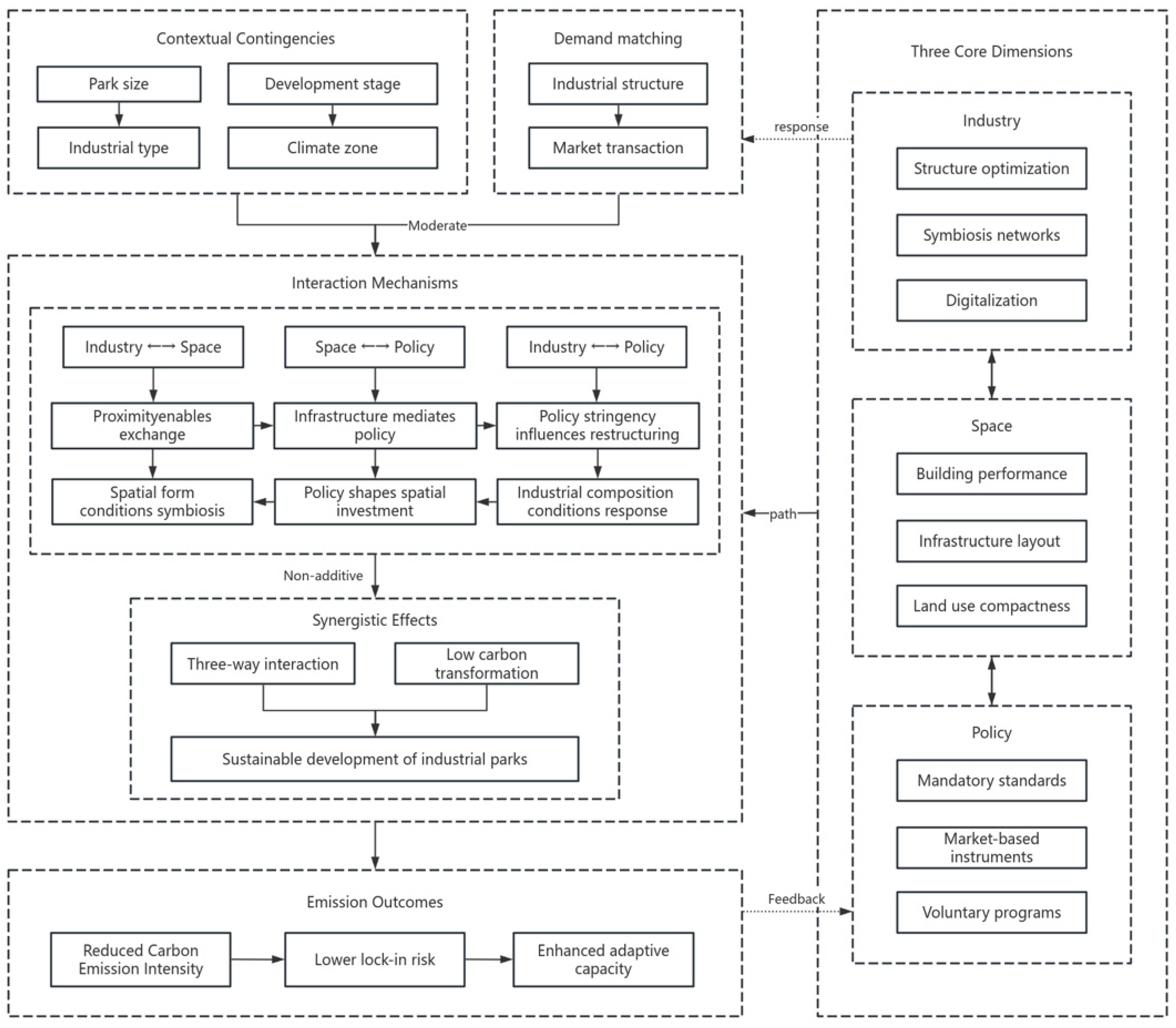
The three-dimensional collaborative paradigm advanced in this study conceptualizes industrial park decarbonization as emerging from interactions among industrial structure, spatial configuration, and policy instruments. These dimensions are understood not as independent factors whose effects sum linearly, but as mutually constitutive elements whose joint configuration generates emergent properties not predictable from the analysis of any single dimension in isolation [15]. Figure 1 presents the conceptual framework, illustrating the hypothesized relationships among the three dimensions and their interactive pathways to emissions reduction.
The industrial dimension encompasses the composition of economic activities within park boundaries, the pattern of material and energy flows among firms, and the technological characteristics of production processes. Industrial symbiosis—the colocation of firms so that waste outputs from one facility serve as productive inputs for others—represents a particularly consequential configuration, as it transforms linear resource flows into circular systems with substantially lower net emissions [16,17]. However, the potential for such configurations depends not only on the mix of industries present but also on the spatial and institutional conditions enabling exchange relationships to develop [18].
The spatial dimension refers to the physical organization of the park, including building form and performance characteristics, infrastructure configuration, and the arrangement of land uses. Spatial factors influence carbon outcomes through multiple pathways: building energy performance directly affects operational emissions; infrastructure layout shapes the efficiency of district energy systems and the feasibility of renewable energy integration; land use patterns determine transportation requirements for freight movement and worker commuting [7,19]. Critically, spatial configurations can either enable or obstruct industrial symbiosis by affecting the proximity, connectivity, and flexibility required for material and energy exchange [20].
The policy dimension encompasses the regulatory requirements, economic incentives, and institutional arrangements that shape decision-making by park developers, facility operators, and other stakeholders. Policy instruments include mandatory standards for energy performance and emission rates, market-based mechanisms such as carbon pricing and tradable permit systems, and voluntary programs providing technical assistance or recognition for exemplary performance [11,21]. The configuration of these instruments—their stringency, targeting, and combination—influences both the motivation for emissions reduction and the resources available to pursue it [22].
The collaborative paradigm posits that these dimensions interact in ways that create non-additive effects. Industrial symbiosis networks, for example, may only realize their potential when spatial configurations provide appropriate proximity and connectivity, and when policy instruments create appropriate incentives for exchange relationships to form. Conversely, stringent policy requirements may prove ineffective if industrial structures lack the flexibility to respond or if spatial configurations impose technical constraints on feasible responses [23]. Understanding these interactions requires analytical approaches capable of capturing both the presence of individual dimensions and the patterns of relationship among them.

2.2. Case Evidence

Table 1 and Table 2 presents comparative information on the six low-carbon pilot parks included in this study, illustrating how the three-dimensional paradigm manifests in diverse empirical contexts. These cases were selected using theoretical sampling to represent variation in geographic location, industrial composition, and policy environment, enabling an examination of how collaborative mechanisms operate under different conditions.
The EUREF-Campus in Berlin, Germany, exemplifies industrial decarbonization through technological upgrading within existing high-carbon sectors. Formerly a coal gasification facility, the campus now hosts over 150 enterprises focused on energy and sustainability technologies, with 80–95% of energy demand met from renewable sources [24]. Spatial transformation accompanied industrial change, with existing buildings retrofitted to passive house standards and new infrastructure enabling electric vehicle integration. Policy support operated primarily through European Union emissions trading system incentives and national renewable energy policies, complemented by Berlin’s carbon tax reduction provisions.
The Nottingham Science Park in the United Kingdom illustrates an alternative trajectory centered on industrial restructuring rather than incremental decarbonization. The park deliberately excluded high-carbon industries in favor of science and technology enterprises, creating conditions for industrial symbiosis among complementary research and development activities [25]. Spatial innovations include rooftop agrivoltaic systems providing both renewable energy and local food production, while policy support operated through the socially responsible investment framework requires substantial allocation to low-carbon activities.
The Taicang Zero-Carbon Smart Park in China demonstrates the integration of digital technologies with logistics-oriented industrial development. The industrial park leverages its location within the Yangtze River Delta logistics network to concentrate freight activities, enabling shared infrastructure for electric vehicle charging and renewable energy generation [26]. Policy innovation includes local energy management contracting mechanisms that align incentives among park operators, facility users, and technology providers.
These cases, while individually distinctive, reveal common patterns in how industrial, spatial, and policy dimensions interact. In each instance, emission reductions exceeding typical single-dimensional approaches emerged from coordinated configurations rather than isolated interventions. However, the specific mechanisms varied substantially, suggesting that the collaborative paradigm requires contextual adaptation rather than uniform application [27].

3. Methodologies and Data

3.1. Sample Selection

This study employed purposive sampling to select nine industrial parks for comparative analysis: six parks internationally recognized as low-carbon pilots (EUREF-Campus, Germany; UEA Enterprise Center, UK; Nottingham Science Park, UK; Taicang Zero-Carbon Smart Park, China; Tianjin Eco-City Green Innovation Park, China; Beijing Xingcheng Zero-Carbon Industrial Park, China) and three parks with conventional high-carbon profiles (Yuheng Industrial Park, Luobei Graphite Park, Shenmulan Charcoal Industrial Park, all in China) (Table 3). The inclusion of both pilot and conventional parks enabled a comparison of emission outcomes associated with different dimensional configurations [28]. Due to the intensive data requirements of the carbon flow topology model, the sample was limited to nine parks. All analyses are therefore exploratory and not intended for causal inference.
Selection criteria prioritized parks with comparable physical scale (within approximately 50,000 m2) and building density (within approximately 5% variation) to reduce confounding from these factors. However, as Table 4 indicates, some variation persists, and this should be considered when interpreting comparative findings. The sample size, while small, reflects the intensive data collection requirements of the carbon flow accounting approach and the limited number of parks for which comprehensive information could be obtained through the combination of document analysis, site visits, and stakeholder interviews employed in this study.

3.2. Variable Definition and Operationalization

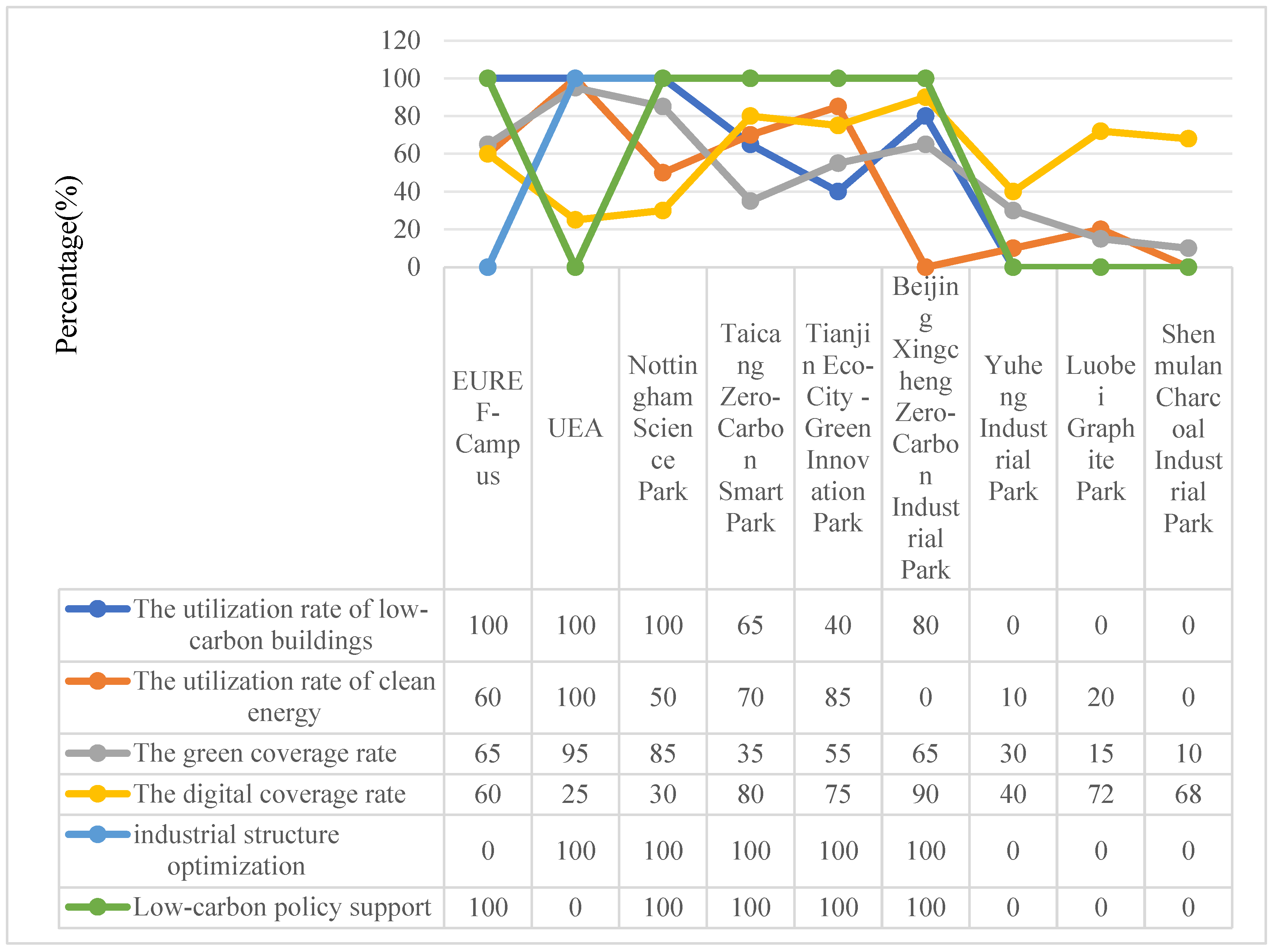
Independent variables operationalize the three dimensions of the collaborative paradigm. For the spatial dimension, three continuous variables were constructed: the proportion of buildings meeting recognized green building certification standards; the proportion of total energy consumption supplied from renewable sources; and the proportion of park area devoted to vegetated surfaces. For the industrial dimension, two variables were developed: a binary indicator for the presence of deliberate industrial symbiosis or chain optimization initiatives, and a continuous measure of digital technology penetration in production and logistics systems. Digital penetration is defined as the estimated percentage of enterprises within the park that have adopted technologies such as the Industrial Internet of Things, artificial intelligence-based energy management, or automated logistics systems, which was based on interviews with park management. For the policy dimension, a binary indicator captured whether the park operates within a framework of coordinated policy instruments spanning regulatory requirements and market-based incentives (Figure 2). Given the heterogeneity of policy contexts (e.g., EU ETS vs. local Chinese carbon policies), the binary indicator captures the presence of a systematic policy framework rather than policy intensity. Policy differences are discussed qualitatively in Section 5.
Control variables include park physical scale (total floor area) and building density (floor area ratio), which previous research identified as potential confounders of relationships between dimensional characteristics and emission outcomes [29]. These were measured through geographic information system analysis of industrial park site plans and building footprints.
While binary indicators were used in the primary analysis due to data availability constraints, alternative continuous measures could include: (a) policy instrument count, include number of distinct mandatory, market-based, and voluntary policies; (b) industrial symbiosis network density (ratio of actual material exchanges to potential exchanges); (c) digitalization maturity index based on technology adoption stages. These are recommended for future large-scale studies.

3.3. Carbon Emission Accounting Framework

Carbon emissions were calculated using a three-tier framework aligned with ISO 14064-1:2018 standards [30]. Scope 1 emissions (direct emissions from sources owned or controlled by park facilities) were estimated using facility-level fuel consumption data obtained through interviews with park managers, multiplied by emissions factors from the Intergovernmental Panel on Climate Change guidelines. Scope 2 emissions (indirect emissions from purchased electricity, steam, heating, and cooling) were calculated from utility records using grid-average emissions factors appropriate to each location and time period [13].
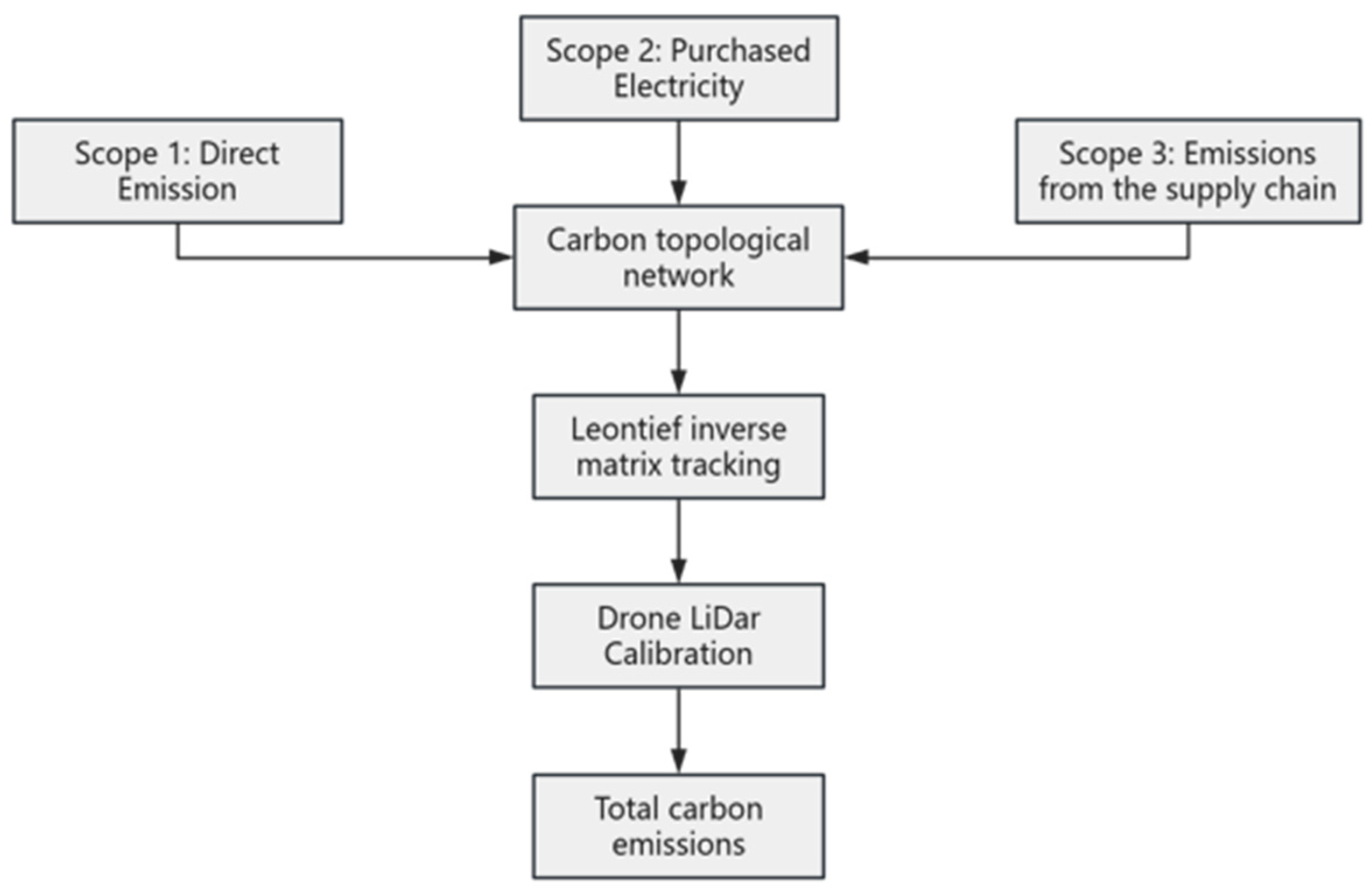
Scope 3 emissions (indirect emissions occurring in the supply chain) were estimated using a carbon flow topology network model adapted from the existing research on carbon emission measurement models [12]. This approach traces material and energy flows among park facilities and between the park and external suppliers and customers, enabling the quantification of emissions embedded in purchased inputs and product outputs that conventional facility-level accounting would attribute elsewhere (Figure 3). The model employs input–output analysis techniques to allocate supply chain emissions based on economic transaction data, adjusted for sector-specific emission intensities [31]. For Chinese parks, input–output coefficients were derived from the 2018 National Input–Output Table (National Bureau of Statistics of China); for UK parks, the 2019 Office for National Statistics Input–Output Table was used.
To address uncertainty in emission estimates, stratified sampling with Monte Carlo simulation was employed. Facilities accounting for the largest emission sources (cumulatively exceeding 90% of estimated Scope 1 and 2 emissions) were subject to detailed data verification through on-site measurement where feasible. For remaining facilities, emission distributions were simulated through 10,000 iterations assuming triangular distributions based on facility type and sectoral benchmarks. Seasonal adjustment factors derived from monthly energy consumption patterns were applied to annualize partial-year data where necessary. Seasonal adjustment factors derived from monthly energy consumption patterns were applied to annualize partial-year data where necessary. The carbon flow topology network model employed in this study represents a methodological advancement over conventional park-level accounting, as it explicitly traces Scope 3 emissions through input–output analysis and reduces the accounting uncertainty to ≤6.8%, which was validated via Monte Carlo simulation. This approach addresses the critical limitation of undercounting supply chain emissions in previous industrial park studies.
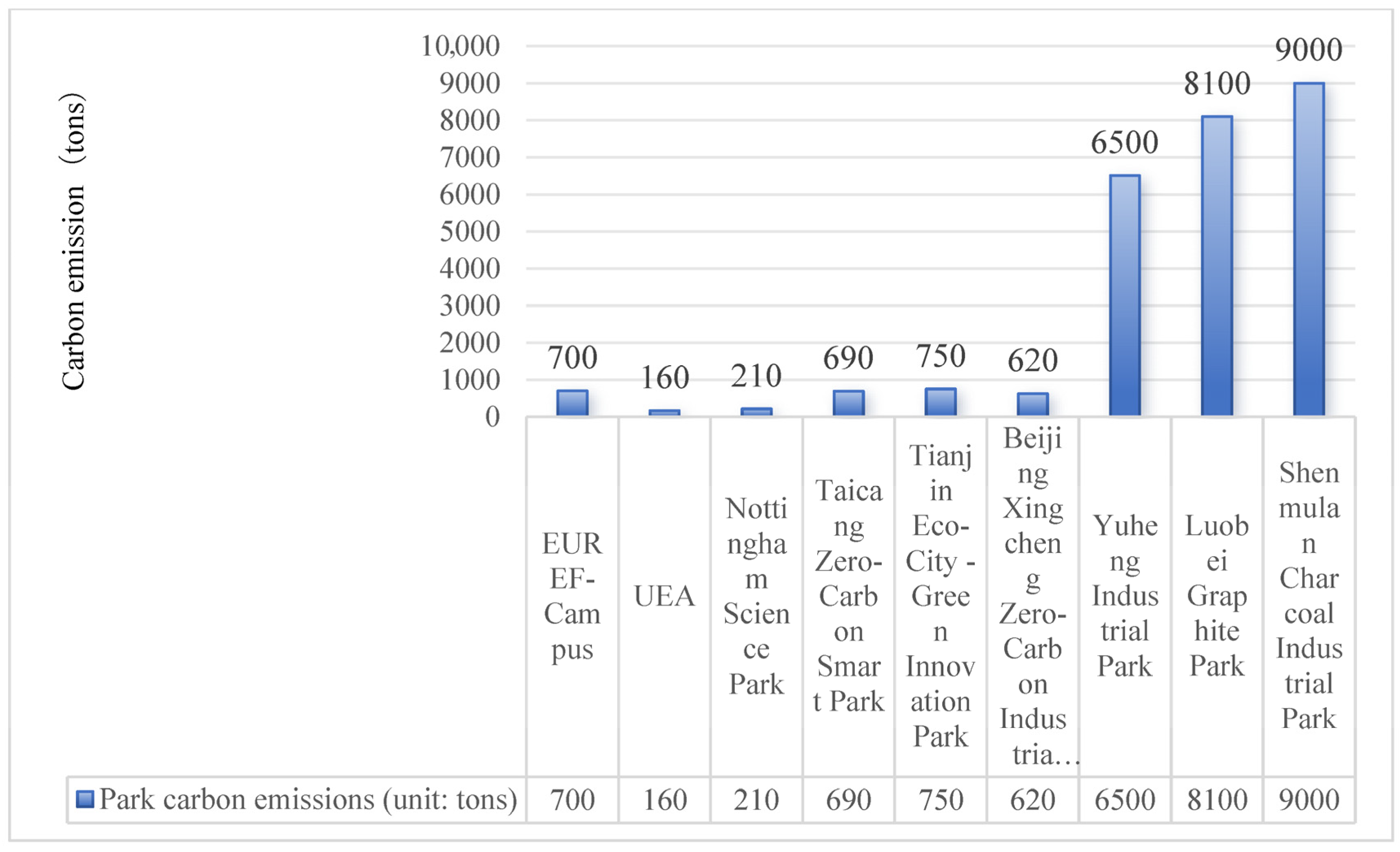
Vegetated areas within parks were assessed for carbon sequestration potential using the Carnegie–Ames–Stanford Approach model applied to Landsat 8 remote sensing data, with validation through unmanned aerial vehicle LiDAR surveys at selected locations (point cloud density: 200 points/m2) [32]. However, the sequestration estimates were not netted against emission totals in the primary analysis given the substantial uncertainty in quantifying long-term sequestration in managed landscapes. However, sequestration estimates were not netted against emission totals in the primary analysis given the substantial uncertainty in quantifying long-term sequestration in managed landscapes. The output of the carbon accounting framework—annual total carbon emissions shown in Figure 4 (tCO2 e/year)—serves as the dependent variable in the exploratory association analysis described in Section 4.2.

3.4. Analytical Approach

The primary analytical method employed exploratory association analysis to examine associations between dimensional characteristics and park-level emissions. Given the small sample size, the researcher team did not conduct multivariate regression inference. Instead, the researcher presented bivariate scatterplots and correlation coefficients to describe directional patterns. Results should be interpreted as hypothesis-generating rather than confirmatory [33]. Alternative specifications were estimated to assess the sensitivity of the results to the inclusion of different variable combinations, and diagnostic tests examined potential violations of regression assumptions including multicollinearity and heteroskedasticity.
Comparative case analysis supplemented the regression findings by examining mechanisms through which dimensional interactions produce emission outcomes. For each park, qualitative data from site visits, document analysis, and stakeholder interviews were analyzed to identify how industrial, spatial, and policy characteristics jointly shaped the emission trajectories. This analysis sought to identify patterns across cases [34] while remaining attentive to case-specific contingencies that might condition the operation of general mechanisms.

4. Results

4.1. Descriptive Patterns

Table 4 presents the descriptive statistics for the nine study parks. The low-carbon pilot parks demonstrated substantially lower emission levels compared to conventional high-carbon parks, with a mean emissions intensity of approximately 99 tCO2 e/10,000 m2·year compared to 1448 tCO2 e/10,000 m2·year for conventional parks. This difference, while striking, reflects multiple factors beyond the dimensional characteristics of primary interest, including differences in industrial composition, facility age, and regulatory context. The variation among pilot parks—from 33 to 150 tCO2 e/10,000 m2·year—suggests substantial heterogeneity in performance even among parks recognized for exemplary practice.
On the spatial characteristics, pilot parks exhibited higher proportions of green buildings (range 0.40–1.0 vs. 0 for conventional parks), renewable energy utilization (0–100% vs. 0–20%), and vegetated area (35–95% vs. 10–30%). Digital technology penetration showed substantial overlap between pilot and conventional parks, with several high-carbon parks reporting extensive digitalization of production and logistics systems. This suggests that digitalization alone, without accompanying changes in industrial organization or spatial configuration, may be insufficient to achieve substantial emission reductions [35].
Industrial symbiosis or chain optimization initiatives characterized all pilot parks but none of the conventional parks, while coordinated policy frameworks were present in pilot parks and absent in conventional parks. These binary indicators capture the presence rather than quality or intensity of these characteristics, limiting the granularity of analysis possible with this sample. The descriptive patterns are consistent with Proposition P1 (parks with all three dimensions show lower emissions) and P3 (policy combinations appear in all low-carbon parks). Proposition P2 (temporal sequencing) is examined in Section 4.3. However, these patterns do not constitute rigorous testing; they may also reflect case selection biases For instance, there may be systematic differences between low-carbon parks and traditional parks in unobserved aspects.

4.2. Exploratory Association Analysis

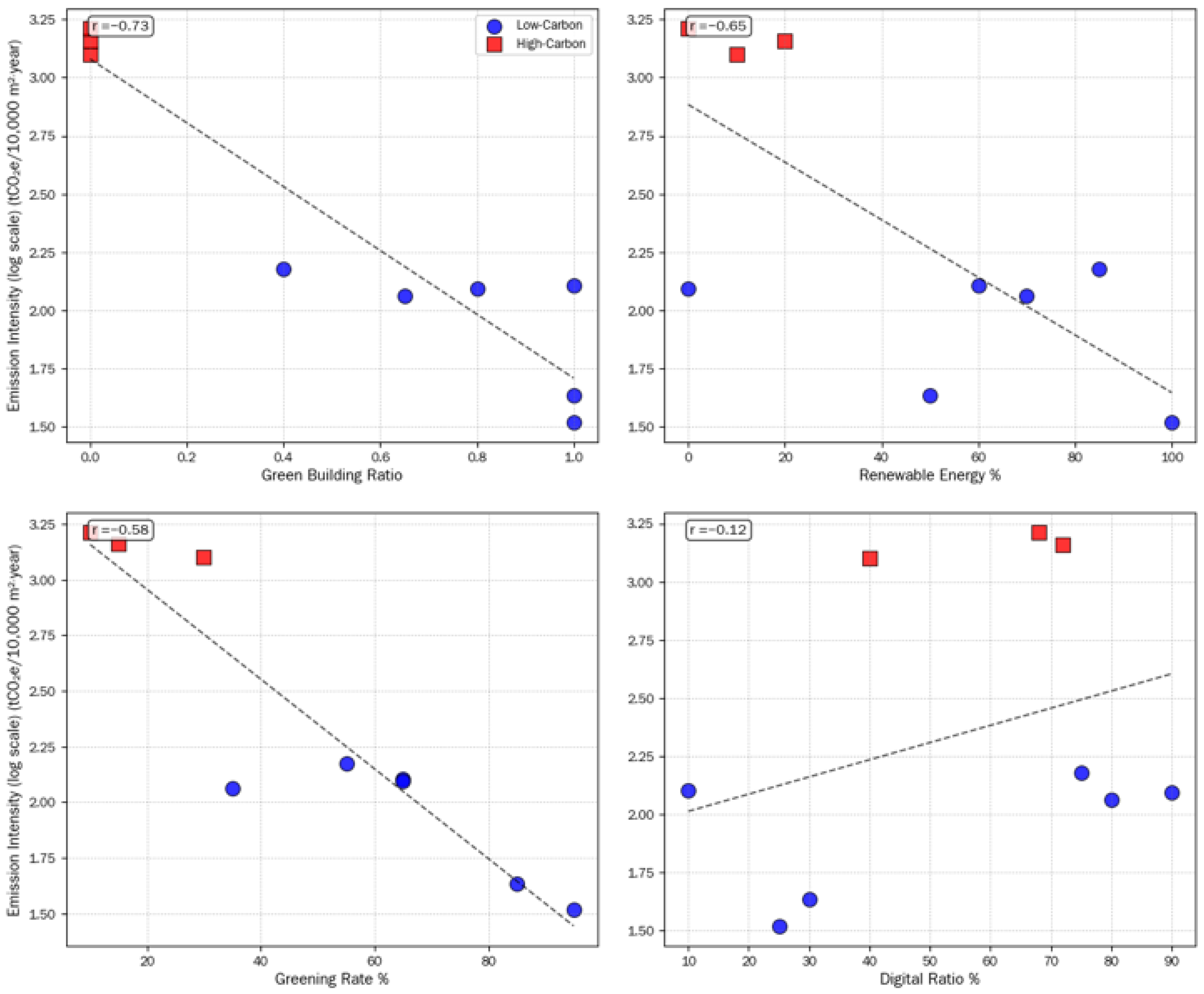
Figure 5 presents the scatterplots of selected variables against emission intensity, along with Pearson correlation coefficients (r). Each panel shows the relationship between one spatial/industrial characteristic (green building ratio, renewable energy share, greening rate, digital penetration) and park-level carbon emission intensity (log scale). Blue circles represent low-carbon pilot parks; red squares represent conventional high-carbon parks. Dashed lines indicate linear fits for the full sample; Pearson correlation coefficients (r) are reported in each panel. The strong negative correlations for green building ratio, renewable energy share, and greening rate suggest that higher values in these spatial dimensions are associated with lower emission intensities. Digital penetration showsshowed no clear association, consistent with the interpretation that digitalization alone is insufficient without concurrent industrial and spatial transformation.
Green building ratio (r = −0.73) and renewable energy percentage (r = −0.65) showed moderately strong negative correlations with emission intensity. Greening rate (r = −0.58) also showed a negative association. Digital ratio (r = −0.12) exhibited a weak and inconsistent pattern (Table 5). All low-carbon pilot parks had both industrial chain optimization and policy support (binary = 1), whereas conventional parks had neither.
In single-variable models, each spatial characteristic showed a negative association with emissions, consistent with expectations that green buildings, renewable energy, and vegetated areas contribute to emissions reduction. Given the small sample size, multivariate regression was not performed. Variance inflation factors (VIFs) for bivariate associations were all below 2, indicating no multicollinearity concerns for descriptive purposes. However, when considering multiple dimensions together, the limited degrees of freedom preclude a reliable estimation of independent effects [36].
What the results suggest is that parks characterized by multiple dimensions of the paradigm tend to have lower emissions than parks lacking these characteristics. The patterns mean that parks characterized by multiple dimensions of the collaborative paradigm tend to control carbon emissions and energy consumption easier than parks lacking these characteristics. However, the cross-sectional design cannot distinguish whether the observed differences arise from the synergistic effects of coordinated strategies or from pre-existing differences (e.g., management capacity, policy selection) between the pilot and conventional parks. Given the small sample size and the absence of statistical interaction terms, the correlation patterns reported above should not be interpreted as evidence of causal synergy. They serve only to identify directional associations that warrant investigation in larger samples. The fact that all low-carbon pilot parks exhibited the full configuration while all conventional parks lacked it could equally reflect selection effects (e.g., differences in management capacity, policy environment, or resource endowment) as genuine synergy. This study cannot disentangle these explanations.

4.3. Temporal Dynamics

Analysis of emission trajectories over the 2018–2025 period, where available, suggests that the sequence of dimensional implementation may affect outcomes. Industrial parks that restructured industrial composition prior to substantial spatial transformation appear to have achieved more rapid emission reductions than parks where spatial investments preceded industrial reorganization. This pattern, while based on limited temporal data and not subjected to formal statistical testing, is consistent with the interpretation that industrial structure creates the fundamental emission profile that spatial interventions can then amplify through efficiency gains and infrastructure optimization [37]. Based on limited temporal data, the above observations regarding sequencing are exploratory hypotheses rather than confirmed causal relationships. Future longitudinal research would be needed to test these propositions rigorously.

5. Discussion

5.1. Mechanisms of Collaborative Synergy

The patterns observed across study parks suggest several mechanisms through which the industrial, spatial, and policy dimensions interact to produce emission outcomes. Table 4 presents a truth-table-style configuration analysis, illustrating which combinations of dimensions are associated with low-emission outcomes based on QCA logic. The collaborative synergy appears to operate through three primary pathways that reinforce one another across implementation stages. It is important to acknowledge that the observed patterns are consistent with a synergistic interpretation, but they are also consistent with alternative explanations, such as case selection bias. All six low-carbon pilot parks were selected precisely because they are recognized as exemplary cases; they may differ from conventional parks in many unmeasured dimensions (e.g., governance quality, financial resources, regulatory support). Therefore, the evidence presented here should be viewed as suggestive and hypothesis-generating, not as confirmation of synergy.
Although the sample size precluded statistical interaction terms, the truth table (Table 6) approximates a configurational approach (QCA logic) to assess whether the joint presence of all three dimensions is consistently associated with low-emission outcomes. All six low-carbon pilot parks exhibited the full configuration, while none of the conventional parks did, which is consistent with a necessary condition pattern but does not prove sufficiency or causality.
The interaction among these mechanisms produces characteristics that distinguish effective collaborative implementation from fragmented or sequential approaches. Parks where industrial, spatial, and policy dimensions developed in mutual adaptation showed tighter integration between functional requirements and technical solutions. For example, renewable energy planning in these parks typically proceeded from a detailed load profiling of anticipated industrial tenants rather than from generic capacity targets. Green building specifications reflect the actual operational schedules and process requirements of dominant industries rather than applying uniform standards across heterogeneous activities. This contextual calibration appears to enhance both environmental performance and economic viability, reducing the perceived trade-off between emissions reduction and competitiveness that often constrains policy ambition.

5.1.1. Industrial Symbiosis and Spatial Proximity

Industrial symbiosis networks appear to depend on spatial configurations that enable exchange relationships. Proximity among facilities reduces the energy and cost penalties of material and energy exchange, while flexible infrastructure accommodates evolving network configurations. At Nottingham Science Park, the deliberate spatial clustering of complementary R&D activities reduced the transport distances for prototype sharing by an estimated 40% compared to a dispersed layout, enabling material exchanges that would otherwise be economically unviable [25]. This mechanism is consistent with Proposition P1, as the spatial clustering of symbiotic activities was present only in parks that also had industrial chain optimization and policy support.
On the one hand, industrial restructuring establishes the foundational emission profile by determining the sectoral composition and technological intensity of economic activities. When parks prioritize high-value, low-carbon industries early in their development trajectory, they create demand structures that subsequently shape spatial investments in a coherent direction. For instance, parks with advanced manufacturing and service-oriented clusters generate requirements for flexible, high-quality built environments and intelligent infrastructure systems that conventional industrial facilities cannot satisfy. This demand-pull mechanism ensures that spatial transformations align with functional needs rather than proceeding as isolated aesthetic or environmental initiatives.
On the other hand, spatial interventions amplify the emissions-reduction potential of industrial restructuring through multiple technical and behavioral channels. Green building standards reduce operational energy consumption in commercial and production facilities, while renewable energy integration addresses Scope 2 emissions from purchased electricity. Vegetated landscapes contribute to microclimate regulation and stormwater management, reducing the energy intensity of heating, ventilation, and cooling systems. The digital infrastructure layer enables the real-time monitoring and optimization of energy flows across building clusters, allowing parks to capture efficiency gains that would remain inaccessible under conventional management approaches. These spatial elements function as enabling infrastructure that translates industrial upgrading into measurable emission reductions.

5.1.2. Policy Instrument Combinations

Policy instruments interact with both industrial structure and spatial configuration in determining their effectiveness. The observation that low-carbon parks all featured multiple policy instrument types (Table 1) supports Proposition P3. No park with a single policy type achieved comparable emission reductions. The EUREF-Campus case illustrates this: the combination of EU ETS carbon pricing (market-based), national renewable energy feed-in tariffs (market-based), and Berlin’s carbon tax reduction for industrial efficiency (mandatory) created a layered incentive structure that accelerated the park’s transition from coal gasification to renewables [24]. In contrast, parks relying on single policy instruments (e.g., only mandatory standards) showed slower decarbonization rates. Systematic assessments of policy mixes in industrial decarbonization further confirm that multi-instrument approaches yield higher synergy effects than single-instrument strategies [38].
Policy instruments coordinate the timing and sequencing of interventions while addressing market failures that would otherwise impede collaborative implementation. Mandatory green building codes prevent free-riding and ensure minimum performance standards across the park. Financial incentives for renewable energy deployment overcome capital constraints and risk aversion among private developers. Land use regulations preserve ecological assets and prevent fragmented development that would compromise systemic efficiency. The pilot designation itself operates as a coordination mechanism, signaling credible commitment to investors and facilitating knowledge exchange among park managers facing similar implementation challenges.

5.1.3. Digital Technologies as Context-Dependent

Digital technologies exhibit context-dependent effects on emissions. At Taicang Zero-Carbon Smart Park, digital logistics optimization achieved substantial emission reductions only after the park had consolidated its logistics cluster; prior to consolidation, digital tools merely increased throughput without lowering emission intensity [26]. This observation helps explain the inconsistent association between digitalization measures and emission outcomes in the regression analysis. Existing econometric studies on industrial clusters also indicate that the carbon-reduction effect of digital transformation is significantly moderated by industrial agglomeration and spatial organization [39].

5.2. Implementation Sequencing

The temporal patterns reported in Section 4.3 are based on retrospective interviews and limited annual data. Therefore, they should be treated as exploratory hypotheses (particularly Proposition P2) rather than established causal sequences. The temporal patterns observed, while requiring cautious interpretation given the data limitations, suggest that sequence matters for emission outcomes. Industrial restructuring appears to function as a prerequisite for effective spatial transformation, rather than as a parallel activity that can proceed in any order. This interpretation aligns with the logic that spatial interventions—building retrofits, infrastructure upgrades, district energy systems—deliver maximum benefit when aligned with the industrial activities they serve [36]. Investing in spatial transformation prior to industrial restructuring risks creating assets mismatched to subsequent industrial needs, or serving emission-intensive activities that later require further intervention.
Therefore, the dimensional integration affects implementation resilience over time. Parks with strong collaborative foundations may appear better positioned to absorb external shocks and technological transitions. When energy prices fluctuate or carbon regulations tighten, the diversified efficiency measures embedded in spatial infrastructure provide multiple adjustment margins. When industrial tenants turnover or upgrade their processes, the flexible building systems and intelligent infrastructure accommodate changing requirements without wholesale reconstruction [17]. This adaptive capacity represents an underappreciated benefit of collaborative approaches that may outweigh short-term cost considerations in volatile policy and market environments.
The implication for practice is that comprehensive master planning should prioritize industrial strategy before spatial design, rather than treating industrial composition as an outcome to be shaped through spatial decisions. This sequence inversion—spatial planning preceding industrial strategy—may partially explain the disappointing outcomes from some park transformation initiatives where beautiful low-carbon infrastructure serves industrial activities with persistently high emission intensity.

5.3. Contextual Contingencies

The operation of collaborative mechanisms exhibits important variation across contexts. Industrial park size appears to condition the feasibility of certain synergies; smaller parks (<30,000 m2) lacked the scale necessary for district heating networks or diversified industrial symbiosis. Development stage mattered similarly, with established parks facing different constraints and opportunities compared to new developments [28]. Industrial composition conditions which mechanisms are most relevant, with heavy industrial parks requiring different approaches than logistics-oriented or technology-focused parks [18].
Climate represents a particularly important contingency. The substantial difference in agrivoltaic carbon sequestration potential between temperate marine climates (Nottingham: estimated 0.8 kg CO2/m2·year) and continental climates (Beijing comparator sites: estimated 0.3 kg CO2/m2·year) illustrates this sensitivity. Similarly, building energy performance standards appropriate for one climate zone may prove inappropriate for others, and renewable energy potential varies dramatically with solar and wind resources [19]. The Table 7 summarizes the Köppen climate classification, total area, and (where available) estimated agrivoltaic carbon sequestration potential for each park. The substantial difference between Nottingham and Beijing illustrates the sensitivity of nature-based solutions to climatic context. These contextual factors moderate the effectiveness of spatial low-carbon interventions.
These contextual contingencies imply that the three-dimensional collaborative paradigm should not be applied as a uniform template but rather adapted to local conditions. The mechanisms identified—industrial symbiosis, spatial efficiency, policy alignment—may operate universally, but their relative importance and specific manifestations require contextual calibration [27].

5.4. Limitations

Several important limitations qualify the conclusions that can be drawn from this study. The small sample size precludes robust statistical inference and limits the complexity of analysis possible. Relationships observed in these nine parks may not generalize to other parks, particularly those in different national contexts or with different industrial compositions. Because the cross-sectional design, supplemented with limited temporal data, cannot establish causal relationships definitively, observed associations may reflect selection effects rather than treatment effects [33].
Binary indicators for industrial symbiosis and policy coordination capture presence but not intensity, quality, or effectiveness. Carbon emission estimates, while improved through topology network modeling, retain substantial uncertainty and may systematically misestimate certain source categories [30]. It remains dependent on national input–output tables that may not fully capture park-specific supply chain variations. The reliance on interview and document data for some variables introduces potential reporting bias that cannot be fully addressed through verification procedures. Beyond acknowledging the use of binary indicators, it is noted that future research should develop continuous measures for policy intensity (e.g., carbon price level) and industrial symbiosis maturity. The binary approach in this study inevitably loses information that could affect the observed associations.
A fundamental limitation of this study is the non-random selection of cases. Low-carbon pilot parks were chosen because they are internationally recognized exemplars. They may possess unobserved attributes—such as stronger management capacity, greater access to capital, more favorable regulatory environments, or higher stakeholder environmental awareness—that independently contribute to lower emissions, regardless of the specific dimensional configuration. Consequently, the observed association between the three-dimensional configuration and low emissions may partly or wholly reflect these pre-existing differences rather than a genuine synergistic effect. Future research using quasi-experimental designs is necessary to isolate the causal contribution of coordinated strategies.
The study design cannot fully disentangle the effects of the collaborative paradigm from effects of other factors correlated with its adoption. Parks implementing coordinated industrial, spatial, and policy strategies likely differ systematically from other parks in ways that also affect emission outcomes—differences in management capacity, financial resources, regulatory exposure, or stakeholder expectations [10]. Without experimental or quasi-experimental designs capable of addressing selection effects, causal interpretation remains tentative.

6. Conclusions

This exploratory study provides hypothesis-generating evidence that coordinated industry–space–policy strategies are associated with lower carbon emissions in industrial parks. Due to the small sample size, cross-sectional design, and potential case selection bias, causal claims are not warranted. The findings should be used to guide the design of larger-scale confirmatory studies rather than to inform policy decisions directly. The primary contribution of this study is the development of an integrated conceptual framework for understanding multidimensional interactions in industrial park decarbonization, along with a replicable and practical carbon flow topology accounting methodology. The empirical findings are illustrative and serve to demonstrate the framework’s applicability, not to provide definitive answers.
Parks characterized by coordinated strategies across the industrial, spatial, and policy dimensions demonstrate substantially lower emissions compared to parks lacking such coordination. Industrial symbiosis networks, spatial configurations enabling efficiency and exchange, and integrated policy packages appear to function as complementary rather than substitute mechanisms, with their joint presence associated with outcomes exceeding what any single dimension could achieve in isolation. The temporal sequence of implementation matters, with industrial restructuring plausibly serving as a prerequisite for effective spatial transformation rather than as parallel activity. These mechanisms operate differently across contexts, with park size, development stage, industrial composition, and climate conditioning which approaches prove most appropriate [15,23,27].
Methodologically, the study demonstrates the feasibility of carbon flow topology network modeling for park-level accounting and illustrates how qualitative case analysis can complement quantitative methods in examining complex socio-technical systems. The limitations encountered—particularly regarding sample size and measurement precision—highlight directions for methodological development in future research.
For practice, the findings suggest that park transformation initiatives should prioritize integrated strategy development over sequential or isolated interventions. Master planning processes should address industrial composition, spatial configuration, and policy instruments as interconnected choices rather than separable decisions. Implementation sequencing should recognize the likely priority of industrial restructuring over spatial investment. Strategy adaptation to local context—climate, industrial heritage, institutional capacity—should precede template application.
Future research could pursue several directions suggested by this study’s limitations and findings. First, larger-sample studies employing consistent measurement approaches could enable more robust inference about effect magnitudes and statistical significance. Second, longitudinal designs tracking parks through transformation processes could strengthen causal inference and illuminate temporal dynamics. Third, comparative research across diverse national contexts could examine how institutional environments condition collaborative mechanism operation [21]. Fourth, methodological development improving carbon accounting precision, particularly for Scope 3 emissions and sequestration, could enhance the evidentiary basis for policy and practice [13]. Fifth, the relevant research of quasi-experimental designs could help address selection bias and better isolate the effects of coordinated strategies.
The challenge of industrial park decarbonization is substantial, requiring coordinated action across multiple dimensions and stakeholders. The collaborative paradigm examined in this study offers one framework for thinking about how such coordination might be achieved, and the patterns observed across nine parks suggest that integrated approaches warrant continued investigation. Progress toward carbon-neutral and sustainable industrial development will require both theoretical advances in understanding complex system interactions and practical innovations in designing and implementing coordinated strategies. This study aims to contribute to both objectives while acknowledging the substantial work remaining.

Author Contributions

Conceptualization, Y.Z.; Methodology, Y.Z. and W.D.; Software, W.D. and T.H.; Validation, W.D. and T.H.; Formal analysis, W.D.; Investigation, Y.Z., W.D. and T.H.; Resources, Y.Z. and T.H.; Data curation, W.D. and T.H.; Writing—original draft, W.D.; Writing—review & editing, Y.Z.; Visualization, W.D.; Supervision, Y.Z.; Project administration, Y.Z.; Funding acquisition, Y.Z. All authors have read and agreed to the published version of the manuscript.

Funding

This research received no external funding.

Institutional Review Board Statement

Not applicable.

Informed Consent Statement

Not applicable.

Data Availability Statement

The original contributions presented in this study are included in the article. Further inquiries can be directed to the corresponding author.

Conflicts of Interest

The authors declare no conflicts of interest.

References

  1. Li, K.; Yang, R.; He, X. Realizing low-carbon development of industrial parks in China: Model construction and its application. Energy 2024, 301, 131664. [Google Scholar] [CrossRef]
  2. Yuan, H.; Xia, J. Synergy of national low-carbon policies and China’s industrial low-carbon transition. Contemp. Econ. Sci. 2025, 47, 82–96. [Google Scholar]
  3. Yu, X.; Zheng, H.; Sun, L.; Shan, Y. An emissions accounting framework for industrial parks in China. J. Clean. Prod. 2020, 244, 118712. [Google Scholar] [CrossRef]
  4. Sun, Y.; Feng, Z.; Liu, F.; Li, Y.; Ning, J.; Fu, H.; Shi, L. Carbon neutrality pathways for industrial parks and reduction potential based on text analysis and empirical research. Sustainability 2024, 16, 10771. [Google Scholar] [CrossRef]
  5. Velenturf, A.P.M. Promoting industrial symbiosis: Empirical observations of low-carbon innovations in the Humber region, UK. J. Clean. Prod. 2016, 128, 116–130. [Google Scholar] [CrossRef]
  6. Yan, S.; Cai, C.; Huang, X. Assessing synergy of CO2 and pollutant reductions in industrial parks from the industrial chain perspective. Environ. Impact Assess. Rev. 2025, 112, 108299. [Google Scholar] [CrossRef]
  7. Dong, H.; Zhang, H.; Gao, C.; Wang, L.; Chen, Y. Impact mechanisms and optimization strategies of built environment on low-carbon commuting in industrial parks: A case study of Tianjin High-Tech Zone. Shanghai Urban Plan. Rev. 2024, 4, 17–23. [Google Scholar]
  8. Kuru, A.; Yüzer, M.A.; Yüzer, A.Ş.; Güney, B.G.; Yüzer, M.E. Integrated site selection model for industrial areas: Case study for İnegöl furniture industry. Environ. Sci. Pollut. Res. 2025, 32, 110866. [Google Scholar] [CrossRef]
  9. Zhang, P.; Zhou, D.; Guo, J. Policy coordination in industrial decarbonization: A systematic review. J. Environ. Manag. 2023, 345, 118732. [Google Scholar]
  10. Chertow, M.R.; Park, J. Scholarship and practice in industrial symbiosis: 1989–2014. In Taking Stock of Industrial Ecology; Springer: Cham, Switzerland, 2016; pp. 87–116. [Google Scholar]
  11. Busch, J.; Foxon, T.J.; Taylor, P.G. Designing industrial strategy for a low carbon transformation. Environ. Innov. Soc. Transit. 2018, 29, 114–125. [Google Scholar] [CrossRef]
  12. Zhang, Y.; Huang, Y.; Wei, J.; Banerjee, A.; Yang, Z. The application of spatially explicit networks to compare carbon flows: A case study in Beijing, China. J. Clean. Prod. 2021, 281, 124694. [Google Scholar] [CrossRef]
  13. Yu, X.; Hu, W.; Wang, M. The Impact of Green Development of Industrial Parks on the Reduction of Carbon Emissions in Urban Areas—Empirical Research on Green Industrial Parks in China. Earth’s Future 2024, 12, e2024EF005161. [Google Scholar] [CrossRef]
  14. Hertwich, E.G.; Wood, R. The growing importance of scope 3 greenhouse gas emissions from industry. Environ. Res. Lett. 2018, 13, 104013. [Google Scholar] [CrossRef]
  15. Liu, Z.; Adams, M.; Cote, R.P. Synergistic effects of industrial symbiosis: A conceptual framework. J. Ind. Ecol. 2022, 26, 892–905. [Google Scholar]
  16. Peng, H.; Wang, Y.; Hu, Y.; Shen, H. Agglomeration production, industry association and carbon emission performance: Based on spatial analysis. Sustainability 2020, 12, 7234. [Google Scholar] [CrossRef]
  17. Dong, L.; Fujita, T.; Zhang, H.; Dai, M.; Fujii, M.; Ohnishi, S.; Geng, Y.; Liu, Z. Promoting low-carbon city through industrial symbiosis: A case in China by applying HPIO model. Energy Policy 2013, 61, 864–873. [Google Scholar] [CrossRef]
  18. Ohnishi, S.; Dong, H.; Geng, Y.; Fujii, M.; Fujita, T. A comprehensive evaluation on industrial & urban symbiosis by combining MFA, carbon footprint and emergy methods—Case of Kawasaki, Japan. Ecol. Indic. 2017, 73, 513–524. [Google Scholar] [CrossRef]
  19. Wang, M.; Feng, C. Spatial planning for low-carbon industrial parks: A review of international practices. Land Use Policy 2023, 128, 106601. [Google Scholar]
  20. Van Berkel, R.; Fujita, T.; Hashimoto, S.; Fujii, M. Quantitative assessment of urban and industrial symbiosis in Kawasaki, Japan. Environ. Sci. Technol. 2009, 43, 1271–1281. [Google Scholar] [CrossRef]
  21. Zhang, B.; Wang, Z.; Lai, K.H. Does industrial agglomeration facilitate environmental performance: A spatial econometric analysis of China. J. Clean. Prod. 2022, 376, 134216. [Google Scholar]
  22. Wang, C.; Lin, Y.; Chen, Y. Policy mix for industrial decarbonization: A comparative study of China and EU. Clim. Policy 2024, 24, 621–638. [Google Scholar]
  23. Zhang, L.; Yuan, Z.; Bi, J. Econometric analysis of the relationship between industrial park characteristics and carbon emissions. J. Ind. Ecol. 2023, 27, 456–469. [Google Scholar]
  24. Chen, J.; Popova, R.; Raab, A.F.; Graute, H.; Rojas, M.; Strunz, K. Coordinated voltage control of microgrids with integrated electric vehicles: Industrial design and implementation on EUREF-Campus in Berlin. IEEE J. Emerg. Sel. Top. Ind. Electron. 2024, 5, 359–368. [Google Scholar] [CrossRef]
  25. Mellen, D. Nottingham Science Park: A Case Study in Urban Regeneration and Sustainable Development; Nottingham City Council: Nottingham, UK, 2022. Available online: https://www.scape.co.uk/case-studies/nottingham-science-park (accessed on 8 March 2026).
  26. Amosova, A.; Vasilieva, D.; Churkina, A.; Suchonosova, A. The effectiveness of environmental impact assessment procedures in industrial zone development. In Architectural, Construction, Environmental and Digital Technologies for Future Cities; Springer: Cham, Switzerland, 2022; pp. 149–159. [Google Scholar]
  27. Zhang, W.; Wang, F.; Hubacek, K.; Liu, Y.; Wang, J.; Feng, K.; Jiang, L.; Jiang, H.; Zhang, B.; Bi, J. Designing cross-city symbiosis strategy in urban agglomeration by trading off decarbonization, health and economic benefits. J. Clean. Prod. 2025, 435, 140456. [Google Scholar]
  28. Liu, T.; Wang, Y.; Song, Q.; Qi, Y. Low-carbon governance in China—Case study of low carbon industry park pilot. J. Clean. Prod. 2018, 174, 837–846. [Google Scholar] [CrossRef]
  29. Chang, Y.; Xue, Y.; Song, S.; Geng, G. Analysis on carbon emission and peak forecasting of urban industrial zone renewal process in China based on extended Kaya identity. Energy 2025, 315, 134438. [Google Scholar] [CrossRef]
  30. ISO 14064-1:2018; Greenhouse Gases—Part 1: Specification with Guidance at the Organization Level for Quantification and Reporting of Greenhouse Gas Emissions and Removals (ISO 14064-1:2018, 2nd ed.). International Organization for Standardization: Geneva, Switzerland, 2018.
  31. Chen, S.; Liu, J.; Zhang, Q. Spatiotemporal characteristics and driving forces of carbon sequestration in industrial parks. Sci. Total Environ. 2024, 912, 169082. [Google Scholar]
  32. Tantrairatn, S.; Pichitkul, A.; Petcharat, N.; Karaked, P.; Ariyarit, A. Evaluating LiDAR technology for accurate measurement of tree metrics and carbon sequestration. MethodsX 2025, 14, 103237. [Google Scholar] [CrossRef]
  33. Wooldridge, J.M. Introductory Econometrics: A Modern Approach, 7th ed.; Cengage Learning: Boston, MA, USA, 2020; pp. 156–189. [Google Scholar]
  34. Yin, R.K. Case Study Research and Applications: Design and Methods, 6th ed.; Sage Publications: Thousand Oaks, CA, USA, 2018; pp. 45–78. [Google Scholar]
  35. Zhou, X.; Zhou, D.; Wang, Q. How does digital transformation drive carbon reduction in industrial parks? A quasi-natural experiment from China. Technol. Forecast. Soc. Change 2024, 198, 122987. [Google Scholar]
  36. Hair, J.F.; Black, W.C.; Babin, B.J.; Anderson, R.E. Multivariate Data Analysis, 8th ed.; Cengage Learning: Boston, MA, USA, 2019; pp. 312–345. [Google Scholar]
  37. Song, M.; Wang, S.; Zhang, H. Temporal dynamics of low-carbon transition in industrial parks: A stage-based analysis. Energy Policy 2023, 183, 113821. [Google Scholar]
  38. Liu, Y.; Chen, X.; Wang, Z. Synergy assessment of industrial park decarbonization policies: A multi-criteria decision analysis. Appl. Energy 2025, 377, 124567. [Google Scholar]
  39. Wang, H.; Zhao, L.; Li, J. Digital transformation and carbon emission reduction in industrial clusters: A spatial econometric analysis. Resour. Conserv. Recycl. 2024, 203, 107432. [Google Scholar]
Figure 1. Conceptual framework: Pathways from the industry–space–policy dimensions to carbon emission outcomes (drawn by the author).
Sustainability 18 04542 g001
Figure 2. Comparison chart of six indicators for low-carbon transformation of industrial parks in China and abroad (drawn by the author).
Sustainability 18 04542 g002
Figure 3. Carbon flow topological model (adapted from [12]).
Sustainability 18 04542 g003
Figure 4. Comparative analysis of carbon emissions in international industrial parks research cases (drawn by the author).
Sustainability 18 04542 g004
Figure 5. Scatterplot matrix: Associations between dimensional characteristics and emission intensity (drawn by the author).
Sustainability 18 04542 g005
Table 1. Characteristics of low-carbon pilot parks included in the study (drawn by the author).
ParkLocationIndustrial FocusKey Spatial FeaturesPolicy ContextPolicy Instrument Type
EUREF-CampusBerlin, GermanyEnergy technology, sustainabilityBuilding retrofits, EV infrastructureEU ETS, national renewable policiesMandatory + Market
UEA Enterprise CenterNorwich, UKLow-carbon technologyPassive house design, bio-based materialsUniversity sustainability strategyVoluntary + Market
Nottingham Science ParkNottingham, UKScience, technology innovationAgrivoltaic systems, green spaceSRI investment frameworkVoluntary + Market
Taicang Zero-Carbon Smart ParkSuzhou, ChinaLogistics, clean energyWind-solar integrationLocal EMC mechanismsMandatory + Voluntary
Tianjin Eco-City Green Innovation ParkTianjin, ChinaGreen technologyDistrict energy systemsSino-Singapore policy frameworkMandatory
Beijing Xingcheng Zero-Carbon Industrial ParkBeijing, ChinaGreen commercial, waste treatmentBuilding retrofits, green infrastructureMunicipal carbon policiesMandatory
Table 2. Illustration of independent variables in international industrial park research cases (drawn by the author).
DimensionVariable NameDefinitionType
Space buildingPercentage of green buildings (%)Consecutive
new_energyPercentage of renewable energy usage (%)Consecutive
greeningGreen coverage rate (%)Consecutive
IndustrystructureConstruction of low-carbon industrial chain (1 = Yes, 0 = No)Binary
digitalizationDigital penetration rate (%)Consecutive
PolicypoliciesSystematic support for low-carbon policies (1 = Yes, 0 = No)Binary
Table 3. Illustration of selected international industrial park research cases (drawn by the author).
TypeName of the ParkCountrySample
Low-carbon pilot projectEUREF-CampusGermany1
UEAUK1
Nottingham Science ParkUK1
Taicang Zero-
Carbon Smart Park
China1
Tianjin Eco-City-
Green Innovation Park
China1
Beijing Xingcheng Zero-
Carbon Industrial Park
China1
Traditional high-carbon (control group)Yuheng Industrial ParkChina1
Luobei Graphite ParkChina1
Shenmulan Charcoal
Industrial Park
China1
Table 4. Descriptive characteristics of study parks (drawn by the author).
ParkGreen Building RatioRenewable Energy %Greening Rate %Digital Ratio %Industrial Chain OptimizationPolicy SupportEmissions (tCO2 e/Year)Emission Intensity (tCO2 e/10,000 m2·Year)
EUREF-Campus1.00606510NoYes700127
UEA1.001009525YesYes16033
Nottingham Science Park1.00508530YesYes21043
Taicang0.65703580YesYes690115
Tianjin Eco-City0.40855575YesYes750150
Beijing Xingcheng0.8006590YesYes620124
Yuheng0.00103040NoNo65001262
Luobei0.00201572NoNo81001446
Shenmulan0.0001068NoNo90001636
Table 5. Coefficient of correlation table (drawn by the author).
VariablePearson’s rInterpretation
Green Building Ratio−0.73Strong negative correlation
Renewable Energy %−0.65Moderate negative correlation
Greening Rate %−0.58Moderate negative correlation
Digital Ratio %−0.12Weak/negligible correlation
Table 6. Configurations of dimensional presence and emission outcomes across cases (drawn by the author).
CaseIndustrySpacePolicyLow Emission Outcome
EUREF-CampusYesYesYesYes
UEAYesYesYesYes
NottinghamYesYesYesYes
TaicangYesYesYesYes
Tianjin Eco-CityYesYesYesYes
Beijing XingchengYesYesYesYes
YuhengNoNoNoNo
LuobeiNoNoNoNo
ShenmulanNoNoNoNo
Note: “Yes” indicates the presence of the dimension (binary: industrial chain optimization = Yes; at least two of three spatial indicators above median; policy support = Yes).
Table 7. Climate zones and physical scale of the nine case industrial parks (drawn by the authors based on site surveys and climate data).
ParkLocationKöppen Climate ClassificationArea (m2)Agrivoltaic Carbon Sequestration Potential (kg CO2/m2·Year)
EUREF-CampusBerlin, GermanyCfb (temperate oceanic)55,000N/A
UEA Enterprise CenterNorwich, UKCfb (temperate oceanic)48,000N/A
Nottingham Science ParkNottingham, UKCfb (temperate oceanic)48,6000.8 (estimated)
Taicang Zero-Carbon Smart ParkSuzhou, ChinaCfa (humid subtropical)60,000N/A
Tianjin Eco-City Green Innovation ParkTianjin, ChinaDwa (monsoon-influenced hot-summer continental)50,000N/A
Beijing Xingcheng Zero-Carbon Industrial ParkBeijing, ChinaDwa (monsoon-influenced hot-summer continental)50,0000.3 (estimated)
Yuheng Industrial ParkYulin, ChinaBSk (cold semi-arid)51,500N/A
Luobei Graphite ParkLuobei, ChinaDwa (monsoon-influenced hot-summer continental)56,000N/A
Shenmulan Charcoal Industrial ParkShenmu, ChinaBSk (cold semi-arid)55,000N/A
Note: Agrivoltaic carbon sequestration potential was estimated based on site-specific conditions (Nottingham: temperate marine climate; Beijing: continental climate). N/A indicates that agrivoltaic systems are not present or data are not available.
Disclaimer/Publisher’s Note: The statements, opinions and data contained in all publications are solely those of the individual author(s) and contributor(s) and not of MDPI and/or the editor(s). MDPI and/or the editor(s) disclaim responsibility for any injury to people or property resulting from any ideas, methods, instructions or products referred to in the content.