Rural Tourism and Ecosystem Recovery in the Yangtze River Delta: Spatial Coupling and Influencing Factors

Abstract
1. Introduction
2. Materials and Methods
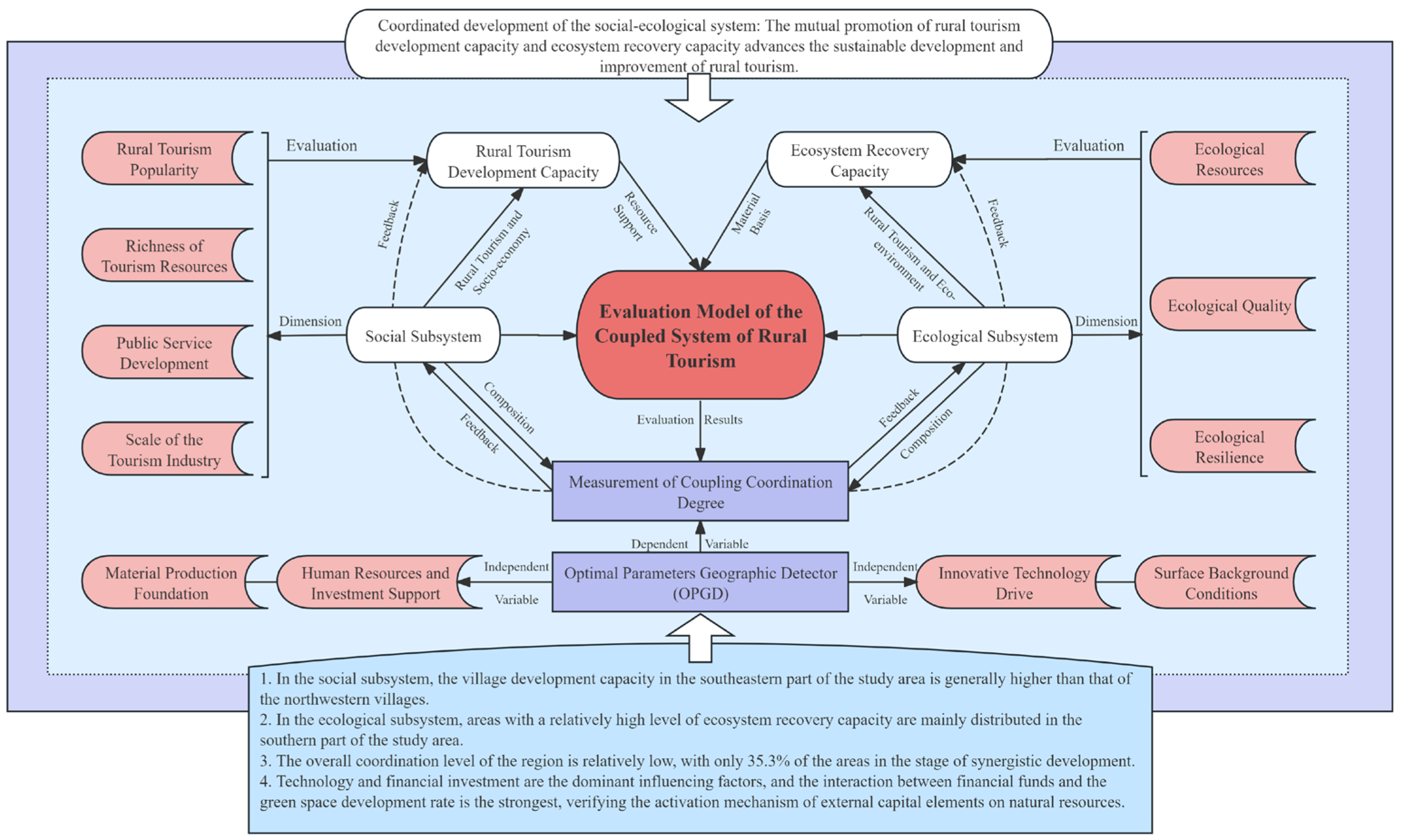
2.1. Theoretical Model
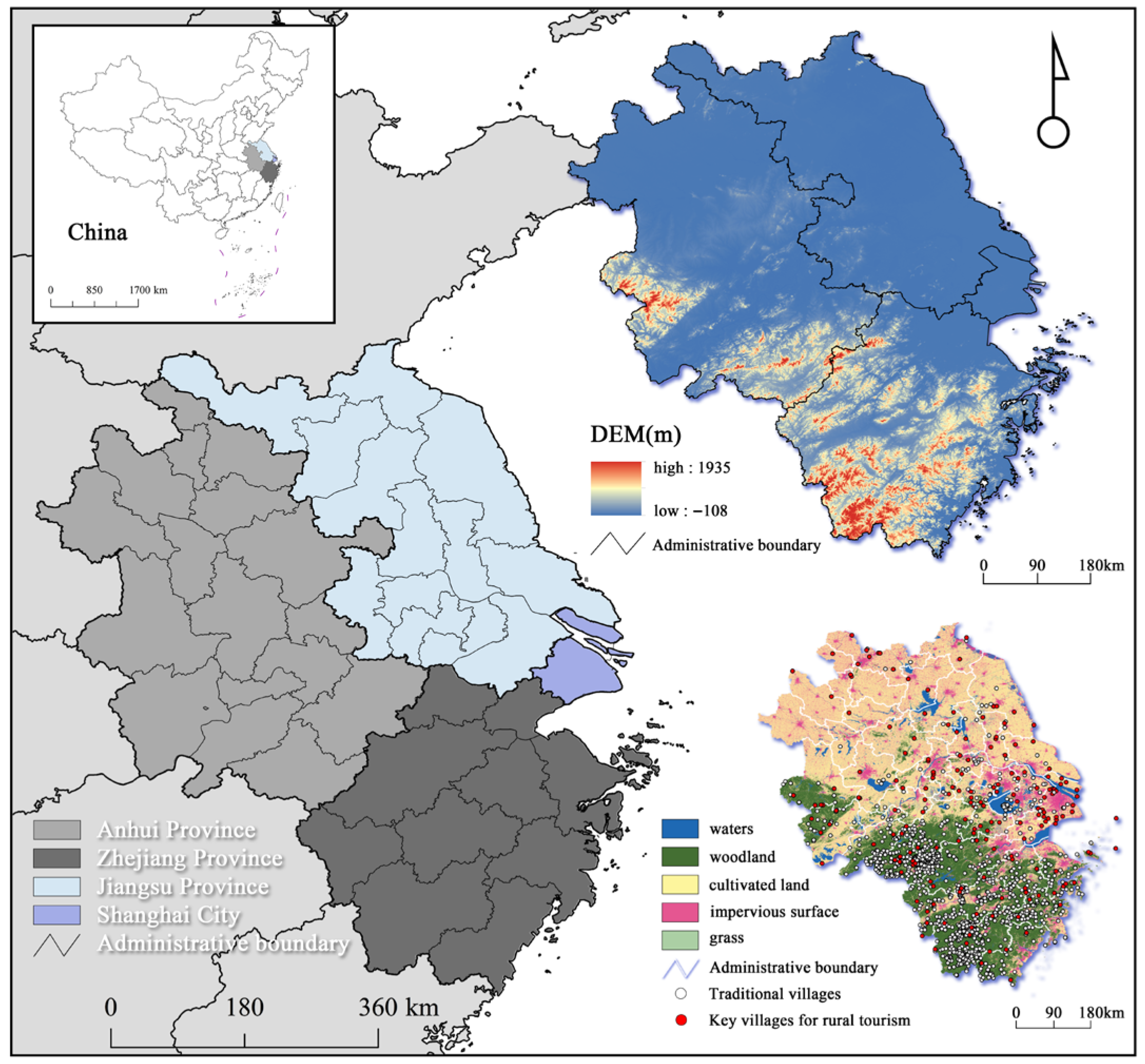
2.2. Study Area
2.3. Data Sources
2.4. Social-Ecological” Evaluation Framework for Rural Tourism
2.4.1. Evaluation Method for the Social Subsystem of Rural Tourism
2.4.2. Evaluation Method for the Ecological Subsystem of Rural Tourism
2.5. Coupling Coordination Degree Model
2.6. Optimal Parameters Geographic Detector (OPGD) Model
3. Results and Analysis
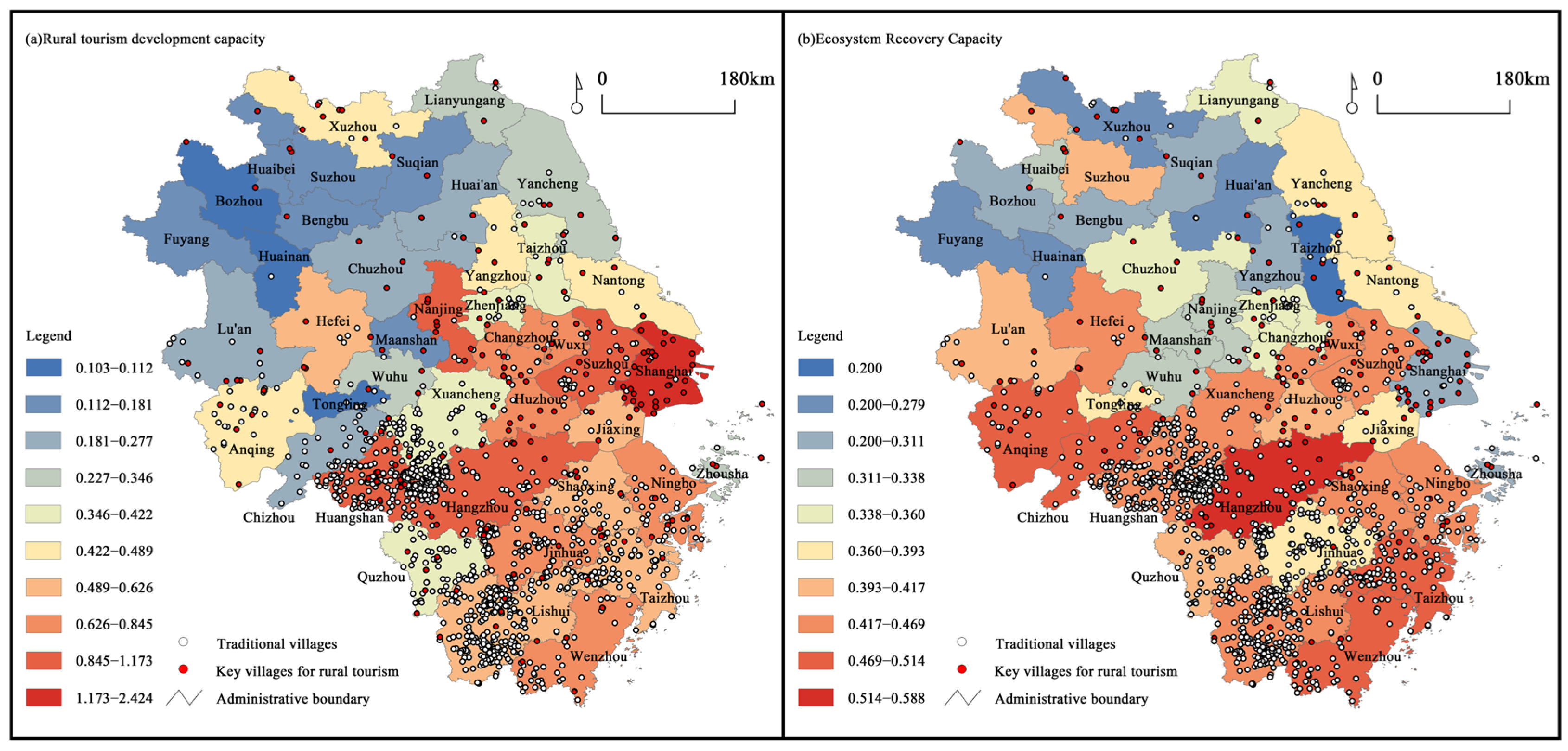
3.1. Evaluation Results of the Coupled System of Rural Tourism
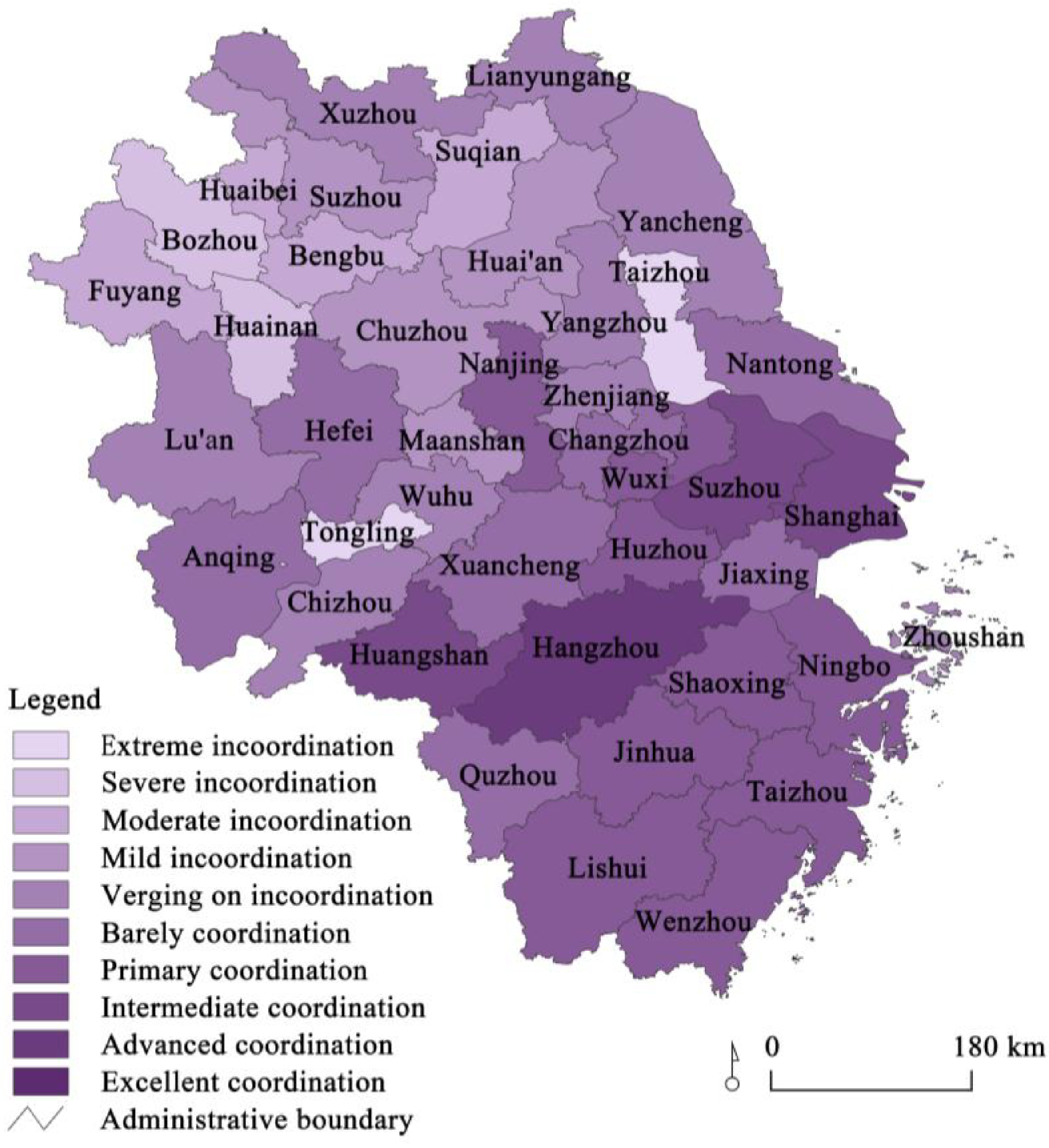
3.2. Coupling Coordination Relationship of the Coupled System of Rural Tourism
3.3. Associated Factors of the Coupling Coordination of the Coupled System
3.3.1. Single-Factor Detection Results
3.3.2. Interaction Detection Results
4. Discussion
4.1. Spatial Characteristics of Associated Factors
4.2. Factor Interaction and Value Transformation of Natural Resources
4.3. Differentiated Governance Strategies
5. Conclusions
Author Contributions
Funding
Institutional Review Board Statement
Informed Consent Statement
Data Availability Statement
Conflicts of Interest
References
- Zhang, J.; Cenci, J.; Becue, V. A Preliminary Study on Industrial Landscape Planning and Spatial Layout in Belgium. Heritage 2021, 4, 1375–1387. [Google Scholar] [CrossRef] [Scilit]
- Tian, Y.; Liu, Y.; Liu, X.; Kong, X.; Liu, G. Restructuring rural settlements based on subjective well-being (SWB): A case study in Hubei province, central China. Land Use Policy 2017, 63, 255–265. [Google Scholar] [CrossRef] [Scilit]
- Tian, Y.; Liu, Y.; Kong, X. Restructuring rural settlements based on mutualism at a patch scale: A case study of Huangpi District, central China. Appl. Geogr. 2018, 92, 74–84. [Google Scholar] [CrossRef] [Scilit]
- Yin, J.; Wang, D.; Li, H. Spatial optimization of rural settlements in ecologically fragile regions: Insights from a Coupled System. Habitat Int. 2023, 138, 102854. [Google Scholar] [CrossRef] [Scilit]
- Lu, L.; Ren, Y.; Zhu, D.; Cheng, J.; Yang, X.; Yang, Z.; Yao, G. Research framework and outlook of rural tourism guiding rural revitalization. Geogr. Res. 2019, 38, 102–118. [Google Scholar]
- Wang, H.; Lu, X. A Comparative Study on the Promoting Effects of Different Tourism Development Models on Rural Revitalization: Case Studies from Two Typical Villages in China. Sustainability 2025, 17, 714. [Google Scholar] [CrossRef] [Scilit]
- Gao, J.; Zhang, L. Exploring the dynamic linkages between tourism growth and environmental pollution: New evidence from the Mediterranean countries. Curr. Issues Tour. 2021, 24, 49–65. [Google Scholar] [CrossRef] [Scilit]
- Yan, X.; Luo, M.; Zhong, C. Evaluation of rural tourism development level based on entropy-weighted grey correlation analysis: The case of Jiangxi Province. Grey Syst. Theory Appl. 2023, 13, 677–700. [Google Scholar] [CrossRef] [Scilit]
- Holling, C.S. Resilience and stability of ecological systems. Annu. Rev. Ecol. Syst. 1973, 4, 1–23. [Google Scholar] [CrossRef] [Scilit]
- Ostrom, E. A general framework for analyzing sustainability of social-ecological systems. Science 2009, 325, 419–422. [Google Scholar] [CrossRef] [Scilit]
- Kachniewska, M.A.; Vikneswaran Nair, A.P.K.P. Tourism development as a determinant of quality of life in rural areas. Worldw. Hosp. Tour. Themes 2015, 7, 500–515. [Google Scholar] [CrossRef] [Scilit]
- Petrović, M.; Vujko, A.; Gajić, T.; Vuković, D.B.; Radovanović, M.; Jovanović, J.M.; Vuković, N. Tourism as an Approach to Sustainable Rural Development in Post-Socialist Countries: A Comparative Study of Serbia and Slovenia. Sustainability 2017, 10, 54. [Google Scholar] [CrossRef] [Scilit]
- Lin, E.H.; Yang, C.; Zheng, Y.; Chen, Q.H. The radiative effect of rural living environment on rural tourism development. Stat. Decis. 2020, 36, 89–91. [Google Scholar] [CrossRef]
- Katelieva, M.; Muhar, A. Heritage tourism products based on traditional nature-related knowledge: Assessment of cultural, social, and environmental factors in cases from rural Austria. J. Herit. Tour. 2022, 17, 631–647. [Google Scholar] [CrossRef] [Scilit]
- Li, R.Y. Evaluation method of agricultural sports tourism circular economy benefits based on AHP-BP neural network from the perspective of low-carbon ecology. Pak. J. Agric. Sci. 2024, 61, 433–443. [Google Scholar]
- Hassan, T.H.; Salem, A.E.; Abdelmoaty, M.A. Impact of Rural Tourism Development on Residents’ Satisfaction with the Local Environment, Socio-Economy and Quality of Life in Al-Ahsa Region, Saudi Arabia. Int. J. Environ. Res. Public Health 2022, 19, 4410. [Google Scholar] [CrossRef] [Scilit] [PubMed]
- Demir, S.; Atanur, G. The prioritization of natural-historical based ecotourism strategies with multiple-criteria decision analysis in ancient UNESCO city: Iznik-Bursa case. Int. J. Sustain. Dev. World Ecol. 2019, 26, 329–343. [Google Scholar] [CrossRef] [Scilit]
- Wang, Y.P. The realization path of carbon neutrality in rural tourism destinations from the perspective of ecological civilization. Soc. Sci. 2025, 3, 90–96. (In Chinese) [Google Scholar]
- Wang, D.; Li, D.Z. The cognition of the spatial art forms of tourist villages based on ecological engineering and sustainable development. Ecol. Chem. Eng. S-Chem. I Inz. Ekol. S 2021, 28, 581–595. [Google Scholar] [CrossRef] [Scilit]
- Yu, J. Research on the Evaluation of Ecological Environment Quality in Rural Tourism Areas. Fresenius Environ. Bull. 2021, 30, 10738–10747. [Google Scholar]
- Li, L.; Ye, X.J.; Wang, X.L. Evaluation of Rural Tourism Carrying Capacity Based on Ecological Footprint Model. Wirel. Commun. Mob. Comput. 2022, 10, 4796908. [Google Scholar] [CrossRef] [Scilit]
- Wang, X.; Huang, J.Y. Study on Evaluation of Ecological Characteristics in Rural Tourist Destination. In Proceedings of the 2016 International Conference on Strategic Management (ICSM 2016), Chengdu, China, 10–11 March 2016. [Google Scholar]
- Fang, S.Q.; Ou, K.H.; Xiong, J.; Teng, R.; Han, L.; Zhou, X.; Ma, H. The coupling coordination between rural public services and rural tourism and its causative factors: The case study of southwestern China. PLoS ONE 2023, 18, e0290392. [Google Scholar] [CrossRef] [Scilit]
- Liu, Y.J.; Tang, J.X.; Ma, X.F. Study On The Coupling Of Rural Beauty Construction And Rural Tourism Development Based On Ecological Perspective. Fresenius Environ. Bull. 2021, 30, 11167–11172. [Google Scholar]
- Gao, R.L.; Zheng, S.Y. Coupling coordination between agriculture and tourism in the Qinba Mountain area: A case study of Shanyang County, Shanxi Province. Environ. Dev. Sustain. 2024, 26, 31859–31878. [Google Scholar] [CrossRef] [Scilit]
- Liu, H.N.; Tan, Z.X.; Xia, Z.C. The Coupling Coordination Relationship and Driving Factors of the Digital Economy and High-Quality Development of Rural Tourism: Insights from Chinese Experience Data. Land 2024, 13, 1734. [Google Scholar] [CrossRef] [Scilit]
- Jing, W.L.; Zhang, W.; Luo, P.P.; Wu, L.; Wang, L.; Yu, K. Assessment of Synergistic Development Potential between Tourism and Rural Restructuring Using a Coupling Analysis: A Case Study of Southern Shaanxi, China. Land 2022, 11, 1352. [Google Scholar] [CrossRef] [Scilit]
- Zhang, W.; Zhang, L. Research on the coupling and coordination of harmonious rural construction and integration of agriculture and tourism. Sci. Rep. 2025, 15, 33804. [Google Scholar] [CrossRef] [Scilit] [PubMed]
- Ma, L.; Long, H.; Tu, S.; Zhang, Y. Characteristics of change and vitalization pathways of poor villages based on multifunctional rural development theory: A case study of Zahan Village in Hainan Province. Prog. Geogr. 2019, 38, 1435–1446. [Google Scholar] [CrossRef] [Scilit]
- Zhou, X.; Deng, J. Unbalanced and inadequate development of rural tourism destinations and the types of areal systems in China. Acta Geogr. Sin. 2024, 79, 515–533. [Google Scholar] [CrossRef]
- Liu, Q.; Zhao, H. Value, challenges, and pathways of environmental audit in the high-quality development of rural eco-tourism. Soc. Sci. 2025, 2, 76–81. (In Chinese) [Google Scholar]
- Wu, Y.; Sun, Y.; Zhou, C.; Li, Y.; Wang, X.; Yu, H. Spatial–Temporal Characteristics of Carbon Emissions in Mixed-Use Villages: A Sustainable Development Study of the Yangtze River Delta, China. Sustainability 2023, 15, 15060. [Google Scholar] [CrossRef] [Scilit]
- Zhao, W.; Jiang, C. Analysis of the Spatial and Temporal Characteristics and Dynamic Effects of Urban-Rural Integration Development in the Yangtze River Delta Region. Land 2022, 11, 1054. [Google Scholar] [CrossRef] [Scilit]
- Sun, Y.; Hou, G. Analysis on the Spatial-Temporal Evolution Characteristics and Spatial Network Structure of Tourism Eco-Efficiency in the Yangtze River Delta Urban Agglomeration. Int. J. Environ. Res. Public Health 2021, 18, 2577. [Google Scholar] [CrossRef] [Scilit] [PubMed]
- Zhao, H.Y.; Zheng, J.N.; Ma, S.H.; Zhao, L.; Xu, P.; Li, J. Spatial distribution and influencing factors analysis of national key rural tourism villages in the Yangtze River Delta region based on geographically weighted regression. PLoS ONE 2023, 18, e0291614. [Google Scholar] [CrossRef] [Scilit] [PubMed]
- Tan, J.; Wang, K.; Gan, C.; Ma, X. The Impacts of Tourism Development on Urban–Rural Integration: An Empirical Study Undertaken in the Yangtze River Delta Region. Land 2023, 12, 1310. [Google Scholar] [CrossRef] [Scilit]
- Guo, Y.R.; Zhu, L.; Zhao, Y.Z. Tourism entrepreneurship in rural destinations: Measuring the effects of capital configurations using the fsQCA approach. Tour. Rev. 2023, 78, 834–848. [Google Scholar] [CrossRef] [Scilit]
- Zhang, Z.H.; Li, P.X.; Wang, X.Y.; Ran, R.; Wu, W. New energy policy and new quality productive forces: A quasi-natural experiment based on demonstration cities. Econ. Anal. Policy 2024, 84, 1670–1688. [Google Scholar] [CrossRef] [Scilit]
- Cao, J.; Xie, X. Urban-rural integration of agriculture and tourism innovation boosting Chinese modernization: A case study of Tianma International Tourism Festival. Tour. Trib. 2025, 40, 10–12. [Google Scholar]
- Luo, L.; Qin, J.; Yang, J. Spatial distribution and structure analysis of key rural tourism villages in southwest China. Chin. J. Agric. Resour. Reg. Plan. 2022, 43, 260–269. (In Chinese) [Google Scholar]
- Abreu, I.; Nunes, J.M.; Mesias, F.J. Can Rural Development Be Measured? Design and Application of a Synthetic Index to Portuguese Municipalities. Soc. Indic. Res. 2019, 145, 1107–1123. [Google Scholar] [CrossRef] [Scilit]
- Yi, B.; Shi, H.; Zeng, D.; Li, L.; Peng, X. Analysis and comprehensive evaluation of drought stress on rice growth based on the RAGA-PPC model. People’s Pearl River 2026, 47, 107–118. (In Chinese) [Google Scholar]
- Espezua, S.; Villanueva, E.; Maciel, C.D.; Carvalho, A. A Projection Pursuit framework for supervised dimension reduction of high dimensional small sample datasets. Neurocomputing 2015, 149, 767–776. [Google Scholar] [CrossRef] [Scilit]
- Neupane, R.; Anup, K.C.; Aryal, M.; Rijal, K. Status of ecotourism in Nepal: A case of Bhadaure-Tamagi village of Panchase area. Environ. Dev. Sustain. 2021, 23, 15897–15920. [Google Scholar] [CrossRef] [Scilit] [PubMed]
- Wang, Y.; Ao, H.; Wu, T.; Liu, J. Research on the construction of an analytical framework for rural tourism resource development based on grounded theory. Chin. J. Agric. Resour. Reg. Plan. 2025, 46, 250–264. [Google Scholar]
- Shen, W.; Chen, Y.L.; Cao, W.W.; Yu, R.; Rong, P.; Cheng, J. Spatial pattern and its influencing factors of national-level cultural heritage in China. Herit. Sci. 2024, 12, 384. [Google Scholar] [CrossRef] [Scilit]
- Rao, Y.F.; Zou, Y.F.; Yi, C.F.; Luo, F.; Song, Y.; Wu, P. Optimization of rural settlements based on rural revitalization elements and rural residents’ social mobility: A case study of a township in western China. Habitat Int. 2023, 137, 102851. [Google Scholar] [CrossRef] [Scilit]
- Liu, W.X.; Xue, Y.; Shang, C. Spatial distribution analysis and driving factors of traditional villages in Henan province: A comprehensive approach via geospatial techniques and statistical models. Herit. Sci. 2023, 11, 185. [Google Scholar] [CrossRef] [Scilit]
- Yu, Z.D.; Zhu, X.L.; Liu, X.T. Characterizing metro stations via urban function: Thematic evidence from transit-oriented development (TOD) in Hong Kong. J. Transp. Geogr. 2022, 99, 103299. [Google Scholar] [CrossRef] [Scilit]
- Pot, F.J.; van Wee, B.; Tillema, T. Perceived accessibility: What it is and why it differs from calculated accessibility measures based on spatial data. J. Transp. Geogr. 2021, 94, 103090. [Google Scholar] [CrossRef] [Scilit]
- Wang, Z.; Zhang, X. Evaluation of tourism industry resilience and non-stationarity of driving factors based on the PSR model: A case study of the Yellow River Basin. Hum. Geogr. 2023, 38, 88–97. [Google Scholar] [CrossRef]
- Wang, S.J.; Zhang, X.L.; Yang, Z.F.; Ding, J.; Shen, Z.Y. Projection pursuit cluster model based on genetic algorithm and its application in Karstic water pollution evaluation. Int. J. Environ. Pollut. 2006, 28, 253–260. [Google Scholar] [CrossRef] [Scilit]
- Shaw, K. The Rise of the Resilient Local Authority? Local Gov. Stud. 2012, 38, 281–300. [Google Scholar] [CrossRef] [Scilit]
- Hong, P.; Schmid, B.; De Laender, F.; Eisenhauer, N.; Zhang, X.; Chen, H.; Craven, D.; De Boeck, H.J.; Hautier, Y.; Petchey, O.L.; et al. Biodiversity promotes ecosystem functioning despite environmental change. Ecol. Lett. 2022, 25, 555–569. [Google Scholar] [CrossRef] [Scilit] [PubMed]
- He, X.; Yan, Y.; Shi, C. Impact of digital economy on the resilience of tourism industry in the Yangtze River Delta effects and mechanism. Geogr. Geo-Inf. Sci. 2026, 42, 132–142. (In Chinese) [Google Scholar]
- Nong, X.Z.; Shao, D.G.; Zhong, H.; Liang, J. Evaluation of water quality in the South-to-North Water Diversion Project of China using the water quality index (WQI) method. Water Res. 2020, 178, 115781. [Google Scholar] [CrossRef] [Scilit] [PubMed]
- Jiang, Z.; Xia, A. Rural tourism geography driven by Hakka culture and ecological resources under the background of rural revitalization: A case study of Shangyou County, Jiangxi Province. Sci. Technol. Ind. 2025, 25, 202–209. [Google Scholar]
- Xie, X.L.; Zhou, G.A.; Yu, S.B. Study on Rural Ecological Resilience Measurement and Optimization Strategy Based on PSR-“Taking Weiyuan in Gansu Province as an Example”. Sustainability 2023, 15, 5462. [Google Scholar] [CrossRef] [Scilit]
- Gillson, L.; Dirk, C.; Gell, P. Using long-term data to inform a decision pathway for restoration of ecosystem resilience. Anthropocene 2021, 36, 100302. [Google Scholar] [CrossRef] [Scilit]
- Hodgson, D.; McDonald, J.L.; Hosken, D.J. What do you mean, ‘resilient’? Trends Ecol. Evol. 2015, 30, 503–506. [Google Scholar] [CrossRef] [Scilit]
- Liu, N.N.; Ma, Z.J. Ecological restoration of coastal wetlands in China: Current status and suggestions. Biol. Conserv. 2024, 291, 110513. [Google Scholar] [CrossRef] [Scilit]
- Colding, J. Ecological land-use complementation’ for building resilience in urban ecosystems. Landsc. Urban Plan. 2007, 81, 46–55. [Google Scholar] [CrossRef] [Scilit]
- Peng, J.; Liu, Y.; Wu, J.; Lv, H.; Hu, X. Linking ecosystem services and landscape patterns to assess urban ecosystem health: A case study in Shenzhen City, China. Landsc. Urban Plan. 2015, 143, 56–68. [Google Scholar] [CrossRef] [Scilit]
- Wang, X.; Wu, W. Measurement of coupling coordination between new quality productive forces and higher education development and analysis of its driving factors. High. Educ. Dev. Eval. 2025, 41, 11–21. [Google Scholar]
- Chen, H.; Xiao, Y. Spatiotemporal Evolution and Influencing Factors ofthe Coupling Coordination between Digital Economy and High-Quality Development of Public Services. J. Beijing Norm. Univ. (Soc. Sci.) 2025, 5, 147–160. (In Chinese) [Google Scholar]
- Tan, W.; Ye, Y.; Xiao, R. Research on the impact of land landscape patterns on grain yield in Africa. Prog. Geogr. 2025, 44, 2172–2187. [Google Scholar] [CrossRef] [Scilit]
- Du, S.; Wang, G.; Zhang, D.; Sun, H.; Jin, B.; Liu, Y. Study on Spatial Differentiation Patterns and Influence Mechanisms of Traditional Villages in Qinghai Province. Areal Res. Dev. 2026, 15, 3. (In Chinese) [Google Scholar]
- Zhang, M.; Tang, X. Spatio-Temporal Evolution Pathways and Driving Mechanisms of Farmland Non-Agricultural Conversion in Gansu Province Based on Optimal Parameter-Based Geographical Detector. Chin. J. Agric. Resour. Reg. Plan. 2026, 14, 2347. (In Chinese) [Google Scholar]
- Yang, Y.; Ding, Z.; Ge, J.; Wu, Y.; Wang, Y. Coupling and coordinating relationship between rural tourism informatization and regional tourism economy in Jiangsu Province. Econ. Geogr. 2018, 38, 220–225. [Google Scholar] [CrossRef]
- Zhang, X.; Shen, Y. Chinese modernization of agriculture-tourism integration promoting common prosperity: Based on the perspective of urban-rural integration development. J. Shanxi Univ. (Philos. Soc. Sci. Ed.) 2025, 48, 36–47. [Google Scholar]
- Li, X. On the study of villagers’ fellow ship and social cognition in developed rural tourism minority nationality villages. Guangxi Ethn. Stud. 2010, 1, 184–188. (In Chinese) [Google Scholar]
- Xiong, D.; Liu, J. Potential ecological advantages, effective grassroots governance and development mechanism of eco-tourism industry: A case study of summer tourism industry in Shanbao community, Tongzi County, Guizhou Province. J. Nat. Resour. 2024, 39, 788–803. [Google Scholar] [CrossRef] [Scilit]
- Cui, J.; Xiao, X. Research on financial support policies and their effects on urban-rural integrated development in Japan. Contemp. Econ. Jpn. 2023, 42, 1–13. [Google Scholar] [CrossRef]
- Xue, J.; Ding, Z.; Yin, Z. Spatiotemporal Evolution and Driving Factors of New-Quality Industrial Productive Forces in the YellowRiver Basin. Areal Res. Dev. 2026, 15, 13512. (In Chinese) [Google Scholar]
- Cui, P. Administrative intervention and advantage strengthening: A study on the industry-building behavior of township governments under the background of projects going to the countryside. J. Beijing Univ. Technol. (Soc. Sci. Ed. ) 2024, 24, 69–82. [Google Scholar] [CrossRef]
- Yin, P.; Li, R.; Wang, S.; Wang, F.; Duan, P. The impact of digital technology innovation on rural tourism public services and its spatial effect. Econ. Geogr. 2026, 46, 256–265. (In Chinese) [Google Scholar]
- Wu, J.X.; Wang, X.Z.; Ramkissoon, H.; Wu, M.Y.; Guo, Y.Z.; Morrison, A.M. Resource Mobilization and Power Redistribution: The Role of Local Governments in Shaping Residents’ Pro-Environmental Behavior in Rural Tourism Destinations. J. Travel Res. 2024, 63, 1442–1458. [Google Scholar] [CrossRef] [Scilit]
- Chen, K.; Li, Q.Y.; Shoaib, M.; Ameer, W.; Jiang, T. Does improved digital governance in government promote natural resource management? Quasi-natural experiments based on smart city pilots. Resour. Policy 2024, 90, 104721. [Google Scholar] [CrossRef] [Scilit]
- Wang, L.; Zhang, K.; Ma, G. Whether Resource Endowment Can Be Converted IntoInnovation Advantages of Regions? Res. Financ. Econ. Issues 2023, 11, 31–46. (In Chinese) [Google Scholar]



| Criterion | Indicator | Principles of Computing | Description of Variables | Reference |
|---|---|---|---|---|
| Rural Tourism Popularity | X1: Rating of key tourist villages | Ki: Comprehensive rating of key tourist villages in the i-th city; Vij: Individual rating of the j-th key tourist village in the i-th city; ni: Number of key tourist villages in the i-th city; N: Total number of key tourist villages in the entire YRD region. | [44] | |
| X2: Review volume of key tourist villages | Mi: Comprehensive review volume of key tourist villages in the i-th city; Cij: Individual review count of the j-th key tourist village in the i-th city; ni: Number of key tourist villages in the i-th city; N: Total number of key tourist villages in the entire YRD region. | [45] | ||
| X3: Popularity index of key tourist villages | Hi: Comprehensive popularity index of key tourist villages in the i-th city; Hij: Individual popularity value of the j-th key tourist village in the i-th city; ni: Number of key tourist villages in the i-th city; N: Total number of key tourist villages in the entire YRD region. | [45] | ||
| Richness of Tourism Resources | X4: Distribution of intangible cultural heritage | Fyi: Spatial density of intangible cultural heritage in the i-th city; Fi: Total number of intangible cultural heritage projects in the i-th city; Si: Administrative area of the i-th city. | [46] | |
| X5: Distribution of key cultural relics | Wui: Spatial density of key cultural relics in the i-th city; Wi: Total number of key cultural relics in the i-th city; Si: Administrative area of the i-th city. | [47] | ||
| X6: Distribution of key villages | Czi: Spatial density of key villages in the i-th city; Zi: Total number of key villages in the i-th city; Si: Administrative area of the i-th city. | [48] | ||
| X7: Distribution of traditional villages | Cti: Spatial density of traditional villages in the i-th city; Ti: Total number of traditional villages in the i-th city; Si: Administrative area of the i-th city. | [48] | ||
| X8: Distribution of tourism-related commercial and amusement facilities | Lsi: Spatial density of tourism-related commercial and amusement facilities in the i-th city; Bi: Total number of tourism-related commercial and amusement facilities in the i-th city; Si: Administrative area of the i-th city. | [49] | ||
| Public Service Development | X9: Distribution of public service facilities (living, transportation, medical) | Gfi: Spatial density of public service facilities in the i-th city; Gi: Total number of public service facilities in the i-th city; Si: Administrative area of the i-th city. | [49] | |
| X10: Road network accessibility | Kdi: Road network accessibility index of the i-th city; Si: Administrative area of the i-th city; Lip: Total length of the p-th type of road in the i-th city; ωp: Weight coefficient of the p-th type of road; p: Iteration variable for road types (p = 1, 2, 3, 4), corresponding to: p = 1: Elevated and expressways; p = 2: Main roads; p = 3: Secondary roads; p = 4: Branch roads. | [50] | ||
| Scale of the Tourism Industry | X11: Tourism revenue | Ei: Comprehensive level of tourism revenue in the i-th city; Sriγ: Total tourism revenue of the i-th city in the γ-th year; γ: Year iteration variable, corresponding to 2021, 2022, 2023; O: Statistical year span, where O = 3. | [51] | |
| X12: Proportion of tourism in the tertiary industry | Pi: Proportion of tourism in the tertiary industry of the i-th city; Sriγ: Total tourism revenue of the i-th city in the γ-th year; Bziγ: Gross Domestic Product (GDP) of the tertiary industry of the i-th city in the γ-th year; γ: Year iteration variable, corresponding to 2021, 2022, 2023; O: Statistical year span, where O = 3. | [51] | ||
| X13: Number of tourists | Ai: Average total number of received tourists in the i-th city; αiγ: Total number of tourist arrivals in the i-th city in the γ-th year; γ: Year iteration variable, corresponding to 2021, 2022, 2023; O: Statistical year span, where O = 3. | [51] |
| Indicator | X1 | X2 | X3 | X4 | X5 | X6 | X7 | X8 | X9 | X10 | X11 | X12 | X13 |
|---|---|---|---|---|---|---|---|---|---|---|---|---|---|
| Vector Value | 0.698 | 0.161 | 0.062 | 0.357 | 0.231 | 0.107 | 0.174 | 0.076 | 0.012 | 0.333 | 0.333 | 0.006 | 0.184 |
| Criterion | Indicator | Principles of Computing | Description of Variables | Reference |
|---|---|---|---|---|
| Ecological Resources | Proportion of cultivated land | Gdi: Proportion of cultivated land in the i-th region; Gi: Area of cultivated land in the i-th region; Si: Administrative area of the i-th region. | [4] | |
| Proportion of forest land | Ldi: Proportion of forest land in the i-th region; Li: Area of forest land in the i-th region; Si: Administrative area of the i-th region. | [4] | ||
| Proportion of grassland | Cdi: Proportion of grassland in the i-th region; Ci: Area of grassland in the i-th region; Si: Administrative area of the i-th region. | [4] | ||
| Proportion of water bodies | Sdi: Proportion of water bodies in the i-th region; Qi: Area of water bodies in the i-th region; Si: Administrative area of the i-th region. | [4] | ||
| Ecological quality | Biodiversity | Bi: Biodiversity index of the i-th city; βij: Biodiversity value of the j-th raster cell within the administrative boundary of the i-th city; μi: Total number of valid raster cells within the i-th city. | [54] | |
| PM2.5 | PMi: PM2.5 index of the i-th city; Hij: PM2.5 value of the j-th raster cell within the administrative boundary of the i-th city; μi: Total number of valid raster cells within the i-th city. | [55] | ||
| Water quality monitoring index | SCi: Comprehensive water quality monitoring index of the i-th city; JCiγ: Water quality monitoring index of the i-th city in the γ-th year; γ: Year iteration variable, corresponding to 2021, 2022, 2023; O: Statistical year span, where O = 3. | [56] | ||
| Ecological Resilience | Ecosystem adaptability | Sy: Calculation result of ecosystem adaptability for each research unit; PD: Patch Density; LPI: Largest Patch Index; SHDI: Shannon’s Diversity Index; SHEI: Shannon’s Evenness Index. | [4] | |
| Ecosystem Recoverability | Sh: Ecosystem recovery capacity; Ai: Area of different land use types; SXi: Relative coefficient of different land use types. | [4] |
| LUT | Cultivated Land | Forest Land | Grassland | Water Bodies | Construction Land |
|---|---|---|---|---|---|
| Relative Coefficient | 0.3 | 0.6 | 0.8 | 0.8 | 0.2 |
| Developmental Stage | Incoordination Stage | Transition Stage | Coordination Stage | |||||||
|---|---|---|---|---|---|---|---|---|---|---|
| Coordination Level | Extreme Incoordination | Serious Incoordination | Moderate Incoordination | Mild Incoordination | On the Verge of Incoordination | Barely Coordination | Primary Coordination | Intermediate Coordination | Good Coordination | Excellent Coordination |
| CCD Range | (0.0~ 0.1) | [0.1~ 0.2) | [0.2~ 0.3) | [0.3~ 0.4) | [0.4~ 0.5) | [0.5~ 0.6) | [0.6~ 0.7) | [0.7~ 0.8) | [0.8~ 0.9) | [0.9~ 1.0) |
| Dimension | Impact Factor | q-Statistic | p-Value |
|---|---|---|---|
| Material production foundation | Per capita disposable income of rural residents | 0.2506 | 0.007 |
| Comprehensive grain production capacity | 0.2371 | 0.004 | |
| Per capita total power of agricultural machinery | 0.3037 | 0.002 | |
| Human resources and investment support | Demographic structure | 0.1290 | 0.021 |
| Local public budget expenditure | 0.4414 | 0.000 | |
| Rural greening rate | 0.1828 | 0.012 | |
| Average years of schooling for rural residents | 0.2266 | 0.003 | |
| Innovative technology drive | Level of rural informatization | 0.3129 | 0.004 |
| Cable TV coverage rate | 0.1983 | 0.004 | |
| Government investment in science and technology | 0.4606 | 0.000 | |
| Surface background conditions | Area of soil erosion | 0.2096 | 0.023 |
| Green space development rate | 0.0540 | 0.037 | |
| Soil organic matter content | 0.3055 | 0.000 |
Disclaimer/Publisher’s Note: The statements, opinions and data contained in all publications are solely those of the individual author(s) and contributor(s) and not of MDPI and/or the editor(s). MDPI and/or the editor(s) disclaim responsibility for any injury to people or property resulting from any ideas, methods, instructions or products referred to in the content. |
© 2026 by the authors. Licensee MDPI, Basel, Switzerland. This article is an open access article distributed under the terms and conditions of the Creative Commons Attribution (CC BY) license.
Share and Cite
Gui, Z.; Liu, G.; Xia, T.; Ding, J. Rural Tourism and Ecosystem Recovery in the Yangtze River Delta: Spatial Coupling and Influencing Factors. Sustainability 2026, 18, 4532. https://doi.org/10.3390/su18094532
Gui Z, Liu G, Xia T, Ding J. Rural Tourism and Ecosystem Recovery in the Yangtze River Delta: Spatial Coupling and Influencing Factors. Sustainability. 2026; 18(9):4532. https://doi.org/10.3390/su18094532
Chicago/Turabian StyleGui, Zifan, Guicheng Liu, Tong Xia, and Jie Ding. 2026. "Rural Tourism and Ecosystem Recovery in the Yangtze River Delta: Spatial Coupling and Influencing Factors" Sustainability 18, no. 9: 4532. https://doi.org/10.3390/su18094532
APA StyleGui, Z., Liu, G., Xia, T., & Ding, J. (2026). Rural Tourism and Ecosystem Recovery in the Yangtze River Delta: Spatial Coupling and Influencing Factors. Sustainability, 18(9), 4532. https://doi.org/10.3390/su18094532