Article

Environmental Policy and ESG Greenwashing

School of Economics, Xiamen University, Xiamen 361005, China
*
Author to whom correspondence should be addressed.
Sustainability 2026, 18(9), 4524; https://doi.org/10.3390/su18094524
Submission received: 12 March 2026 / Revised: 27 April 2026 / Accepted: 1 May 2026 / Published: 4 May 2026

Abstract

Soil is a vital component of the natural environment, yet soil pollution control has recently been a critical bottleneck in environmental protection. Since 2016, China has been implementing the Soil Pollution Prevention and Control Action Plan (SPPCAP), an environmental policy that reinforces the regulation of soil polluters and helps improve the legitimacy of environmental governance. Employing panel data on Chinese listed firms from 2011 to 2021, this study assesses the impact of the SPPCAP on Environmental, Social, and Governance (ESG) greenwashing using a difference-in-differences approach. We find a robust result that the SPPCAP significantly reduces corporate ESG greenwashing. The mechanism tests reveal that the SPPCAP reduces ESG greenwashing by mitigating managerial myopia and promoting clean production strategies from both product and factor dimensions. The heterogeneity analyses indicate that the effect is more pronounced in regions with a better business environment, stricter environmental judicialization, and heavier soil pollution, as well as in more competitive and downstream industries. The additional analysis suggests that reduced ESG greenwashing induced by the SPPCAP contributes to sustainable growth. Our findings highlight the role of soil environmental governance within environmental governance systems and provide evidence on how environmental policies improve substantive ESG performance as a pathway to sustainability-oriented transformation.

1. Introduction

China has undergone remarkable economic development and emerged as a major driving force of global economic growth. Over the past two decades, China’s average annual real GDP growth rate has hovered around 5%, which is notably higher than the global average of 2.9%. Nevertheless, it has imposed unprecedented and mounting pressure on the ecological environment, triggering widespread concerns over ecological degradation and environmental imbalance. To tackle such environmental challenges, China has implemented a wide range of environmental policies that serve not only as an instrument for governmental authorities to enforce environmental supervision, but also as a means to break through and alleviate the inherent tensions between economic development and environmental protection [1]. Considerable progress has been achieved in the prevention and control of air pollution and water pollution, thanks to their high detectability and the maturity of their regulatory mechanisms.
Nevertheless, less fundamental progress has been made in the prevention and control of soil pollution. Because soil is a critical sink for most environmental pollutants, with diverse and complex pollution sources, the scale of pollutant accumulation in soil ecosystems is far from negligible [2]. In particular, intensive industrial emissions have resulted in widespread and severe soil contamination across the country. Soil pollutants, predominantly heavy metals and hazardous toxic chemicals, not only degrade the inherent properties of the soil environment, impair agricultural productivity and compromise the quality of ecological products, but also pose persistent and irreversible threats to human health via direct environmental exposure and indirect bioaccumulation effects along the food chain [3]. Furthermore, they can disrupt the stability of soil ecosystems and ultimately undermine the functional integrity and security of the entire natural ecosystem [4]. More importantly, overlooking environmental governance pertaining to soil is likely to trigger cross-media migration and transformation of water and air pollutants, inducing secondary pollution of contaminated sites and rendering the long-term sustainability of existing achievements in pollution prevention and control unattainable [5]. Therefore, the prevention and control of soil pollution has emerged as a prominent weak link in the advancement of national ecological security and stands as a vital prerequisite for the achievement of authentic sustainable development.
The central government has introduced clear and binding strategic directives to step up source-oriented prevention and control of soil pollution and targeted governance of soil environments. The Soil Pollution Prevention and Control Action Plan (SPPCAP) was officially issued in 2016. As a top-level arrangement under the central leadership’s ecological and environmental governance blueprint, soil pollution prevention and control has been formally incorporated as a core task into national strategies for ecological and environmental protection, with four major strategic actions, including protection, prevention, control, and remediation, designated as the top priorities for current-stage soil environmental governance, reflecting the central government’s resolve to tackle persistent soil pollution risks. Given that, for polluters, the prevention and control of soil pollution poses far greater challenges in terms of technical complexity and remediation costs compared with that of air and water pollution [6], the SPPCAP represents not only an indispensable strategic initiative to advance the battle against soil pollution, but also a targeted upgrade to environmental supervision over polluters. Distinct from conventional environmental policies targeting atmospheric and aquatic pollutants, the landmark SPPCAP imposes stricter compliance obligations, clearer liability rules, and more comprehensive oversight on firms generating soil-related pollution risks, directly targeting the loopholes that enable polluting firms to engage in superficial and symbolic environmental practices, a common form of greenwashing. It can be expected that the SPPCAP will effectively deter polluting firms from building deceptive and superficial eco-friendly facades, incentivizing them to replace perfunctory compliance with substantive environmental governance actions, and ultimately striking a sustainable balance between economic benefits and ecological protection.
Against this backdrop, by filling the regulatory gap in soil environmental governance, the SPPCAP can exert a more targeted and binding impact on corporate environmental misconduct compared with conventional air and water environmental policies. To address this concern, this study conducts empirical analysis based on theoretical foundations. Using the introduction of the SPPCAP in 2016 as a quasi-natural experiment, we establish an econometric model using a sample of companies listed on the Shanghai and Shenzhen A-share markets from 2011 to 2021, a symmetric five-year observation window around the policy year, and investigate the impact of the SPPCAP on ESG greenwashing. We find that the SPPCAP significantly reduces corporate ESG greenwashing. The mechanism analyses reveal that this effect operates by mitigating managerial myopia and promoting clean production strategies in both output and input dimensions. The heterogeneity analyses show that the effect varies significantly across regions with different business environments, environmental judicialization, and soil pollution, as well as across industries with differing market competition and position in the industry chain. Furthermore, the curbing effect of the SPPCAP on corporate ESG greenwashing fosters the realization of corporate sustainable development.
The marginal contributions are as follows. First, we extend the studies on China’s soil environmental governance. Soil is one of the most critical natural environments, serving as the foundation for agricultural production, ecological balance, and terrestrial ecosystem stability. Soil environmental governance is an important part of the environmental policy system; however, it has been a prominent weak link for a long time. With increasing environmental regulations, some studies directly focus on various types of environmental pollution, such as water pollution [7,8] and air pollution [9,10], while others indirectly center on fiscal and taxation support for environmental protection, including environmental tax [11], green finance [12], and green credit [13]. However, this literature primarily focuses on the environmental issues that are more obvious and intuitive. In contrast, due to the inherent characteristics of soil, soil pollution is usually more concealed and less noticeable, leading to a relative scarcity of studies that pay attention to soil environmental governance. Based on this, this study uses the difference-in-differences method to assess the impact of the Soil Pollution Prevention and Control Action Plan on corporate behavior choices. This will not only differentiate soil-specific environmental governance from other types of environmental regulatory instruments but also supplement the assessment of environmental regulation by incorporating the soil environment.
Second, we broaden the literature on the consequences of environmental policies. While previous research has studied the impact on technology innovation [14,15], total factor productivity [16], and financing cost [17], little discussion has been made on the environmental opportunism of firms, except Hu et al. (2023) [11], Zhang (2023) [18], and Zhang (2023) [19]. They center on the impact of environmental tax reform, environmental monitoring power transition, and low-carbon city pilot policy on greenwashing, a typical type of environmental opportunistic behavior, respectively. In reality, an increasing number of firms are accused of having commitments to environmental or social issues that are inconsistent with their actual activities. As a result, one of the most important criteria for judging the success of environmental policies is the impact on corporate greenwashing. Based on this, this study investigates the impacts of environmental regulation on corporate greenwashing to uncover substantive environmental performance concealed behind superficial green facades. This will offer a new perspective on how environmental policies affect firm behaviors, specifically from the viewpoint of greenwashing, and also enable a more accurate assessment of the effectiveness of environmental policies.
Third, we supplement a systematic discussion on the dynamic adjustment of the production process in the context of environmental policies. Existing studies have extensively examined the impacts on core indicators such as corporate green innovation [20,21] and green total factor productivity [22,23], both of which fall within the scope of green transition. Nevertheless, they are confined to the outcome indicators of green transition, without conducting a detailed analysis on how internal production resources are reallocated and how production links are adjusted in response to environmental policy shocks. Based on this, this study divides the production process into output side and input side. Only by incorporating both sides simultaneously can we have a deeper understanding of factor usage within a product, although some literature has discussed separately from the output side [24] and the input side [10]. On the output side, we explore the adjustment in product supply categories, such as clean products and polluting products. On the input side, we focus on the adjustment in the demand for production factors, including clean factors and polluting factors such as fossil fuels. By examining the changes in the source of production, this study will supplement the internal mechanisms through which the corporate production process responds to environmental policies. This will break the limitation of existing literature that only emphasizes outcomes while neglecting processes, as well as fill the research gap regarding the interactive relationship between internal resource allocation and environmental policies.
Fourth, we move beyond the conventional focus on short-term behavioral responses and offer the lasting implications of environmental policies. The relevant literature stops at identifying the direct policy effects on firm behaviors, without extending the analysis to the subsequent consequences. Based on this, after verifying that environmental policies can generate environmental benefits by encouraging firms to improve substantive ESG practices and reduce ESG greenwashing, we further explore whether such policy-induced effects contribute to corporate sustainable development, which is the core of maintaining long-term market value and competitiveness. By incorporating the long-term perspective, this study will complete a theoretical and empirical chain that connects environmental policy, greenwashing, and sustainable development, and also enable us to verify the rationality of firms’ contemporaneous behavioral choices.
The subsequent sections are organized as follows. Section 2 is the literature review. Section 3 is the policy background and theoretical analysis. Section 4 is the research design. Section 5 presents the empirical results and analysis. Section 6 is the conclusions and discussion.

2. Literature Review

2.1. Research on Environmental Policy Impacts

Research into the impacts of environmental policies has increased in recent years and is primarily concentrated into two strands. The first strand centers on the environmental and social benefits of environmental policies, and it has been broadly concluded that environmental policies can curb pollutant emissions, improve air and water quality [9,10], promote public health, reduce mortality rate, and further extend life expectancy [25,26]. The second strand focuses on the economic effects of environmental policies, rooted in two classical theoretical frameworks. Specifically, some studies analyze the impacts on corporate relocation decisions and regional industrial structure adjustments based on the pollution haven hypothesis [27,28], while others investigate the effects on corporate technological innovation and productivity in light of the Porter hypothesis [14,15]. Notably, these studies are confined to the prevention and control of air and water pollution, which are relatively observable.

2.2. Research on Corporate Greenwashing

Although there has not yet been a unified definition or a measurement for greenwashing, scholars have reached a consensus on its core essence, which lies in conveying false signals to stakeholders through exaggeration, misleading, concealment, or deception [29], thereby inducing stakeholders to form an optimistic perception of environmental performance [30]. The underlying motive is to construct a positive corporate image of social and environmental responsibility with the purpose of external impression management [31,32]. Accordingly, identifying greenwashing essentially rests on differentiating between symbolic and substantive environmental practices [33,34].
A growing body of academic research has centered on exploring the key determinants driving corporate greenwashing behaviors and covers a wide spectrum of internal and external influencing factors. On the one hand, internal firm-level attributes mainly encompass executive traits [35], corporate digitalization level [36,37], as well as the application of artificial intelligence technologies [38,39]. On the other hand, external stakeholder pressures and institutional constraints also exert impacts. These include public scrutiny and pressures exerted via social media [40,41], retail investors [42] and institutional investors [43], supply chains [44], and formal institutional constraints represented by fiscal and financial policies [11], alongside informal institutional factors such as comment letters issued by stock exchanges [45], industry association [46], and cultural milieu [47,48].
Despite its potential to boost short-term corporate financial performance [49] and market valuation [50], greenwashing tends to distort both security analysts’ and auditors’ assessments and forecasts of corporate earnings and risks, resulting in compromised valuation accuracy [51,52]. Furthermore, it misleads investors, causes irrational investment decisions, and even elevates the risk of a stock price crash in the capital markets [53,54]. In addition, it undermines the credibility of green brands and dampens consumer purchase willingness [55], ultimately triggering crises of social trust and ethical integrity [56,57] and hindering the advancement of overall social welfare [58].

2.3. Research Gap

Despite substantial research on both environmental policy impacts and corporate greenwashing, evidence examining the causal link between environmental policies and corporate greenwashing remains scarce in existing literature. The most relevant work to our research is Hu et al. (2023) [11], Zhang (2023) [18], and Zhang (2023) [19]. Notably, these studies neglected the more concealed and latent pollution categories, such as soil contamination, and the latter failed to explore the underlying mechanisms. Besides, prior research failed to investigate the internal resource adjustment, as well as to verify the long-term effects of government-led environmental policies, leaving critical research gaps for further exploration. This study addresses these gaps by developing an integrated framework that links environmental policy on soil to ESG greenwashing, wherein the underlying mechanisms, heterogeneity factors, and economic consequences are explored.

3. Policy Background and Theoretical Analysis

3.1. Policy Background

Air, water, and soil are the three essential elements of the natural environment, serving as the foundation for human life and production. China successively implemented the Air Pollution Prevention and Control Action Plan in June 2013 and the Water Pollution Prevention and Control Action Plan in February 2015, proposing specific requirements for improving air and water quality, but little attention has been devoted to soil environmental protection. Compared with air and water pollution, soil pollution is more concealed, and its effects are more delayed, accumulative, and irreversible, making its remediation more challenging once it arises. It also has multiple and widespread sources, including exhaust gas, wastewater, and solid waste from industrial and mining operations, as well as agricultural inputs from sewage irrigation, chemical fertilizers, pesticides, and plastic mulch. According to the National Soil Pollution Survey Bulletin in 2014, the soil environment in China was concerning and has become a prominent weak link in national ecological security and the construction of ecological civilization.
On 28 May 2016, the State Council of China issued the Soil Pollution Prevention and Control Action Plan (abbreviated and hereafter referred to as the SPPCAP), marking a significant step in China’s efforts to ensure soil environmental protection through mandatory measures tailored to soil for the first time. According to public data from the Ministry of Ecology and Environment (MEE), subsequent to the introduction of this policy, the MEE, in collaboration with relevant authorities, launched an inspection and remediation campaign targeting key regulated industries that use cadmium and other heavy metals. Over 13,000 firms were inspected, with nearly 2000 pollution sources identified for remediation. By 2019, nearly 700 of them had completed remediation, effectively cutting off the spread of soil contaminants.
The Soil Pollution Prevention and Control Action Plan exhibits distinct features. Firstly, given the weak foundation of soil pollution prevention and control, it places greater emphasis on utilizing digital technology to conduct soil environment surveys and enables authorities to grasp various land uses, particularly the soil conditions of key polluting sectors. Secondly, in recognition of the hazards posed by soil pollution to food safety and residential environments, it prioritizes soil security and risk control measures. Thirdly, in terms of soil remediation and restoration, it more explicitly defines the responsibilities and obligations of soil polluters while enforcing lifelong accountability and encourages multi-stakeholder participation and oversight through diverse and accessible channels. The SPPCAP is systematically establishing a tripartite framework for soil pollution prevention and control, characterized by government leadership, corporate accountability, and societal supervision. It is a significant advancement in China’s environmental governance capacity and establishes the institutional foundations for a green economic transition.

3.2. Theoretical Analysis

The Soil Pollution Prevention and Control Action Plan mandates that firms disclose soil environmental information, especially negative information such as pollutant names, emission methods, emission concentrations, total emissions, and the construction and operation of pollution control facilities. Firms that fail to meet compliance standards after remediation efforts will face legally mandated suspension of operations or permanent shutdown, with their names publicly disclosed, measures that are designed to reduce the difficulty of external stakeholders detecting soil environmental misconduct. Moreover, compared with the measures for the prevention and control of air pollution and water pollution, the SPPCAP encourages public reporting of illegal soil environmental violations, such as unauthorized discharge of wastewater, waste residues, and sludge. There are multiple access channels, including the 12369 reporting hotline, letters, emails, government websites, WeChat platforms, and provisions for environmental litigation. These serve as effective tools for external supervision of the soil environment [59,60], and raise public awareness of environmental governance pertaining to soil [61]. This is because, as put forward by negativity bias theory in psychology, individuals exhibit a greater sensitivity to negative information than to positive information [62,63]. According to stakeholder theory, firms have to take their stakeholders into consideration in the pursuit of value maximization [64,65]. Specifically, they can cultivate stakeholders’ trust through verifiable compliance and substantive participation in environmental stewardship [66]. Once a firm’s false and deceptive compliance are detected, it will incur cascading penalties; for instance, the firm’s reputation will be damaged, consumers tend to shift their product preference to firms with good ESG performance, and investors are more likely to divest from firms with poor ESG performance [67]. Therefore, by amplifying the costs and risks associated with soil environmental misconducts, the SPPCAP forces firms to fulfill environmental and social responsibilities, improve substantive ESG performance, and ultimately reduce ESG greenwashing. Hence, this study proposes the following hypothesis:
Hypothesis 1. 
The SPPCAP significantly reduces corporate ESG greenwashing.
Under the principal–agent framework, the inherent separation of ownership and control in modern corporations creates a misalignment of interests between shareholders (principals) and managers (agents), giving rise to Type I agency conflicts. Effective environmental governance requires long-term investments in human capital, upgrading production infrastructure, and advancing productivity, which yield returns only over extended periods [68]. However, pressured by performance metrics and stock prices, managers tend to prioritize short-term profits at the expense of long-term gains, thereby deviating from the objective of corporate value maximization and leading to underinvestment in environmental management and other sustainability-oriented initiatives. Unlike the requirements for air and water environmental governance, the SPPCAP explicitly introduces a lifelong accountability and dual-penalty system for soil polluters, enforcing the principle of “the polluter pays”. The lifelong accountability extends managers’ legal and reputational pressures into the long run, discouraging myopic decisions and encouraging long-term sustainable investments [69]. Under the dual-penalty system, both the firm and its responsible persons are held liable. It strengthens shareholders’ oversight of powerful managers, raises the cost of opportunistic behavior for managers, and constrains managers from prioritizing short-term profits over environmental obligations. Besides, given that soil is immobile compared with mobile air and water, it is easier to identify the liable parties in soil pollution cases [70]. Therefore, the SPPCAP functions as a long-term supervision mechanism and imposes long-term environmental governance pressure on managers.
In addition, soil pollution is more concealed, with its information fragmented and incomplete. The SPPCAP not only mandates the investigation of soil quality across all land use categories and the identification of contaminated sites and associated risks within key regulated industries but also requires the establishment of an integrated monitoring network and centralized data management system. These efforts intensify regulatory oversight of soil environments, compelling managers to prioritize environmental performance [71]. Therefore, by strengthening accountability, investigation, and monitoring for soil pollution, the SPPCAP can prevent managers from fabricating environmental information or cutting down environmental investment in pursuit of immediate interests, thereby curbing their environmental opportunism and making them involuntarily participate in and even exert additional efforts towards their environmental and social responsibilities. As a result, ESG greenwashing behaviors decrease. Hence, this study proposes the following hypothesis:
Hypothesis 2. 
The SPPCAP can reduce corporate ESG greenwashing by mitigating managerial myopia.
When confronted with environmental policies, firms are more likely to seek to reduce compliance costs by prioritizing internal resource reallocation rather than implementing other cost-incurring measures [72]. They are motivated to reallocate their limited production resources. Meanwhile, the SPPCAP places greater emphasis on the potential hazards of soil contamination to food safety and the living environment. It requires polluters to enhance their awareness and capacity for pollution risk control while improving environmental quality. This also imposes stricter requirements on the reallocation of internal resources within firms, that is, production and operational activities, and encourages firms to reduce pollution emissions by adjusting their production strategies. More importantly, unlike other types of environmental pollution and the corresponding regulatory requirements, the control and remediation of soil pollution is a relatively long-term and gradual process. The SPPCAP does not mandate rapid completion by polluters within a short period and fully accounts for the heterogeneity across soil types and land users. Consequently, firms are more likely to be incentivized to engage in long-term environmental protection and are less likely to engage in environmental opportunism to superficially comply with policy requirements under regulatory pressure [19] and thus are more inclined to implement pollution prevention at the source.
From an output perspective, firms can expand their production of clean products while scaling down that of polluting ones. On the other hand, they can adjust the introduction and withdrawal of different products by phasing out old products with low efficiency and high emissions and introducing new ones with high efficiency and low emissions [24]. Specifically, single-product firms can shift from pollution-intensive to clean production, while multi-product firms can increase the share of clean products and decrease that of polluting ones. This shift will facilitate clean production, increase substantive ESG practices, and thereby reduce ESG greenwashing.
Beyond adjustments to product portfolios, firms can also reconfigure their factor structures from an input perspective. Heterogeneity in production technologies across firms leads to significant variation in pollution emission intensity [73]. For instance, pollution-intensive industries exhibit higher reliance on fossil fuel inputs during production. Under the regulatory pressure imposed by the SPPCAP, firms may restructure their factor inputs by substituting pollution-intensive inputs with cleaner alternatives. They can increase the demand for ecologically sustainable production inputs, such as energy-saving and renewable energy substitutes, making the production process more environmentally friendly. This transition enables firms to achieve the entire reduction in pollution emission across all environmental media, including both aqueous and atmospheric discharges [74]. It will also facilitate substantive ESG stewardship and promote genuine green transformation throughout the production process, which is conducive to reducing ESG greenwashing. Hence, this study proposes the following hypotheses:
Hypothesis 3a. 
The SPPCAP can reduce corporate ESG greenwashing by adjusting product structure towards cleanliness.
Hypothesis 3b. 
The SPPCAP can reduce corporate ESG greenwashing by adjusting factor structure towards cleanliness.
Hypothesis 3. 
The SPPCAP can reduce corporate ESG greenwashing by promoting clean production strategies.
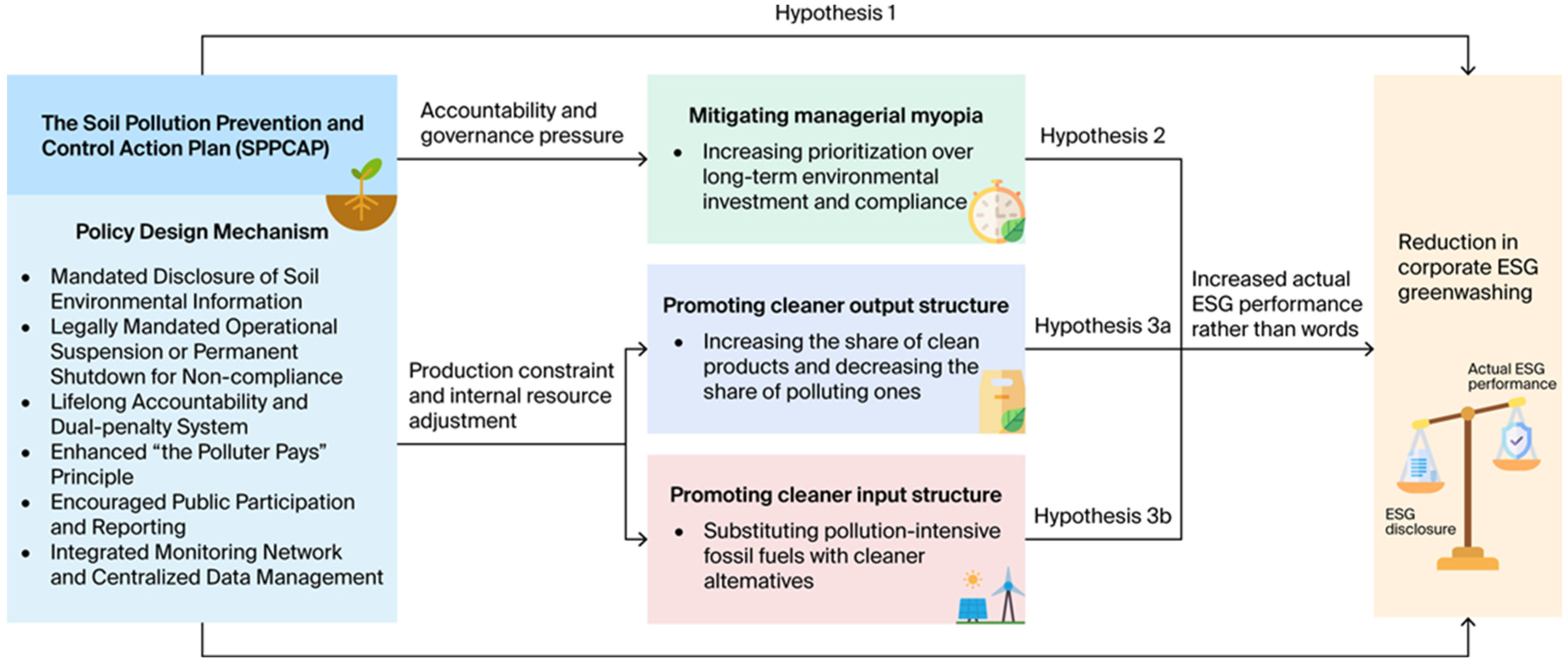
The theoretical framework is illustrated in Figure 1.

4. Research Design

4.1. Methodology

To investigate the impact of the soil environmental policy on corporate greenwashing behavior, this study adopts the Soil Pollution Prevention and Control Action Plan in 2016 as a quasi-natural experiment and constructs the following difference-in-differences (DID) model:
greenwashingit = β0 + β1 treati × postt + λControls + μi + ηt + γc + εit
where the subscripts i, t, c indicate firm, year, and city, respectively. The dependent variable, greenwashingit, is the level of corporate ESG greenwashing. treati is the treatment variable. postt is the policy timing variable. Controls are a vector of control variables. μi, ηt, γc are the firm-, year-, and city-level fixed effects, respectively. εit is the error term. Since the SPPCAP is industry-specific, standard errors are clustered at the industry level to mitigate the potential interference among firms within the same industry. Our coefficient of interest is β1, which captures the difference in ESG greenwashing level between the treated and the control firms before and after the SPPCAP.

4.2. Variable Definition and Measurement

4.2.1. Dependent Variable

Corporate ESG greenwashing refers to the fact that firms use the ESG label as a marketing strategy to pursue superficial improvements in ESG practices, obscure mediocre or poor actual ESG performance, and create a misleadingly favorable ESG image. It is achieved through selective disclosure of ESG-related information without taking substantive measures for ESG improvement [34,43,75]. Previous studies have proposed several methods to quantify corporate greenwashing, including content analysis [19,76] and questionnaire surveys [77]. Nevertheless, such methods suffer from notable limitations. They are generally poorly applicable to large sample research and are highly vulnerable to manual coding biases and respondents’ subjective interference. These drawbacks undermine the authenticity and credibility of the measurement [78]. Following the mainstream approach in extant studies, we construct an ESG greenwashing measurement based on authoritative, independent third-party databases, which feature broader sample coverage and higher data objectivity. It is originated from the core definition of ESG greenwashing and was developed by comparing the gap between a firm’s disclosed ESG practice and its actual ESG performance [18,43,79,80,81,82,83]. The specific calculation formula is as follows:
greenwashingit = (ESGdisclosureitmean_ESGdisclosureit)/sd_ESGdisclosureit
− (ESGperformanceitmean_ESGperformanceit)/sd_ESGperformanceit
where ESGdisclosure denotes the ESG disclosure, mean_ESGdisclosure denotes the yearly industry mean of ESG disclosure, and sd_ESGdisclosure denotes the yearly industry standard deviation of ESG disclosure. ESGperformance denotes the actual ESG performance, mean_ESGperformance denotes the yearly industry mean of actual ESG performance, and sd_ESGperformance denotes the yearly industry standard deviation of actual ESG performance. They are both industry-standardized indicators and reflect a firm’s position relative to its peers in the distribution of ESG disclosure and actual ESG performance, respectively. This measurement aligns with the core definition of ESG greenwashing, which refers to the divergence between a firm’s words and real actions in ESG matters. A larger value of greenwashing indicates a higher level of ESG greenwashing.
The rationale underlying this ESG-based measurement is elaborated as follows. Corporate ESG practices have become an increasingly critical determinant in investment and financing decisions alongside the rapid growth of ESG practices. However, China’s capital markets are dominated by retail investors who suffer from information asymmetry when evaluating firms’ ESG performance [84]. The awareness of corporate environmental and social responsibility remains underdeveloped [85]. These conditions create strong incentives for firms to conduct ESG greenwashing, a strategic form of low-cost impression management, so as to secure returns from capital markets. Moreover, the standardized ESG framework enables a multi-dimensional evaluation covering environmental (E), social (S), and governance (G) pillars. Environmental policies can not only directly affect the E pillar but also indirectly affect the S pillar through adjusting production processes and the G pillar through adjusting internal governance arrangements, thereby demonstrating close interconnection among the three pillars [86]. Therefore, adopting the integrated ESG system as the benchmark for greenwashing measurement can facilitate a more holistic and accurate assessment of authentic corporate performance.
In terms of evaluating ESG disclosure levels, we adopt the ESG score sourced from the Bloomberg database, given that a large body of research has utilized the Bloomberg ESG score to quantify the extent of corporate ESG disclosure. The Bloomberg database is characterized by its provision of extensive and standardized ESG data on a global scale, which guarantees its credibility and consistency with international criteria. It encompasses a wide range of key disclosure metrics, such as direct carbon dioxide emissions, total water usage, and hazardous waste discharge, and is constructed based on corporate voluntary disclosures. Importantly, the Bloomberg ESG score reflects the quantity of disclosed ESG information and the efforts in external image building of firms, with a particular emphasis on the comprehensiveness and transparency of public ESG reporting. However, it does not necessarily reflect the substance of firms’ ESG practices [43,83,87,88,89].
With respect to evaluating actual ESG performance levels, scholars focusing on the Chinese context typically adopt the ESG index from Sino-Securities Index Information Service (Huazheng), a leader in establishing ESG performance benchmarks within the Chinese market. The Huazheng ESG index integrates international ESG criteria, such as greenhouse gas emissions, renewable energy utilization, waste treatment, and employee turnover, with the unique characteristics of the Chinese market, including poverty alleviation initiatives and regulatory enforcement, and covers all A-share listed firms in China. Specifically, grounded in the Chinese institutional and market context, each firm is evaluated based on 130 metrics, and the scores are aggregated, weighted, and standardized in line with the corresponding industry sector. The Huazheng ESG score is distinguished by its broad coverage and timely updates. It also features specialized sub-indices designed to track the actual financial and environmental performance of Chinese firms, as well as to verify whether firms’ operational activities generate tangible ecological benefits [36,90]. Notably, it places greater emphasis on the substantive behaviors and performance outcomes of firms in the ESG domain, which makes it more consistent with the actual operational status of firms [18,49,79,80,81,91].
The validity of this ESG greenwashing measurement is primarily grounded in several considerations. First, it is conceptually consistent with the essence of ESG greenwashing. Disclosure-oriented indicator reflects the scale of ESG reporting and symbolic compliance, whereas the performance-oriented indicator reflects the substantive outcomes in the ESG dimension. The discrepancy between the two indicators serves as a reasonable proxy for assessing the degree of inconsistency between a firm’s ESG words and actions, which accurately captures the core nature of ESG greenwashing. Second, this measurement demonstrates widespread academic recognition, authoritative data support, and robust practical applicability. It relies on publicly accessible, high-quality ESG databases. The independent third-party rating agencies, such as Bloomberg (reflecting what corporations say) and Huazheng (reflecting what corporations do), have been extensively adopted in mainstream empirical studies [81]. Third, this measurement enables cross-firm and cross-industry comparisons on the basis of unified standardized data. In this study, the mean divergence between the two ESG ratings is 0.147, confirming their high overall consistency and ensuring sound comparability [92,93]. Unlike measurements relying on a single data source, this dual-source comparison approach not only avoids systematic errors arising from single-data reliance but also precisely identifies ESG greenwashing rooted in the misalignment between ESG commitments and actions. Therefore, this measurement lays a fundamental premise for the objectivity and credibility of the ESG greenwashing indicator [79].
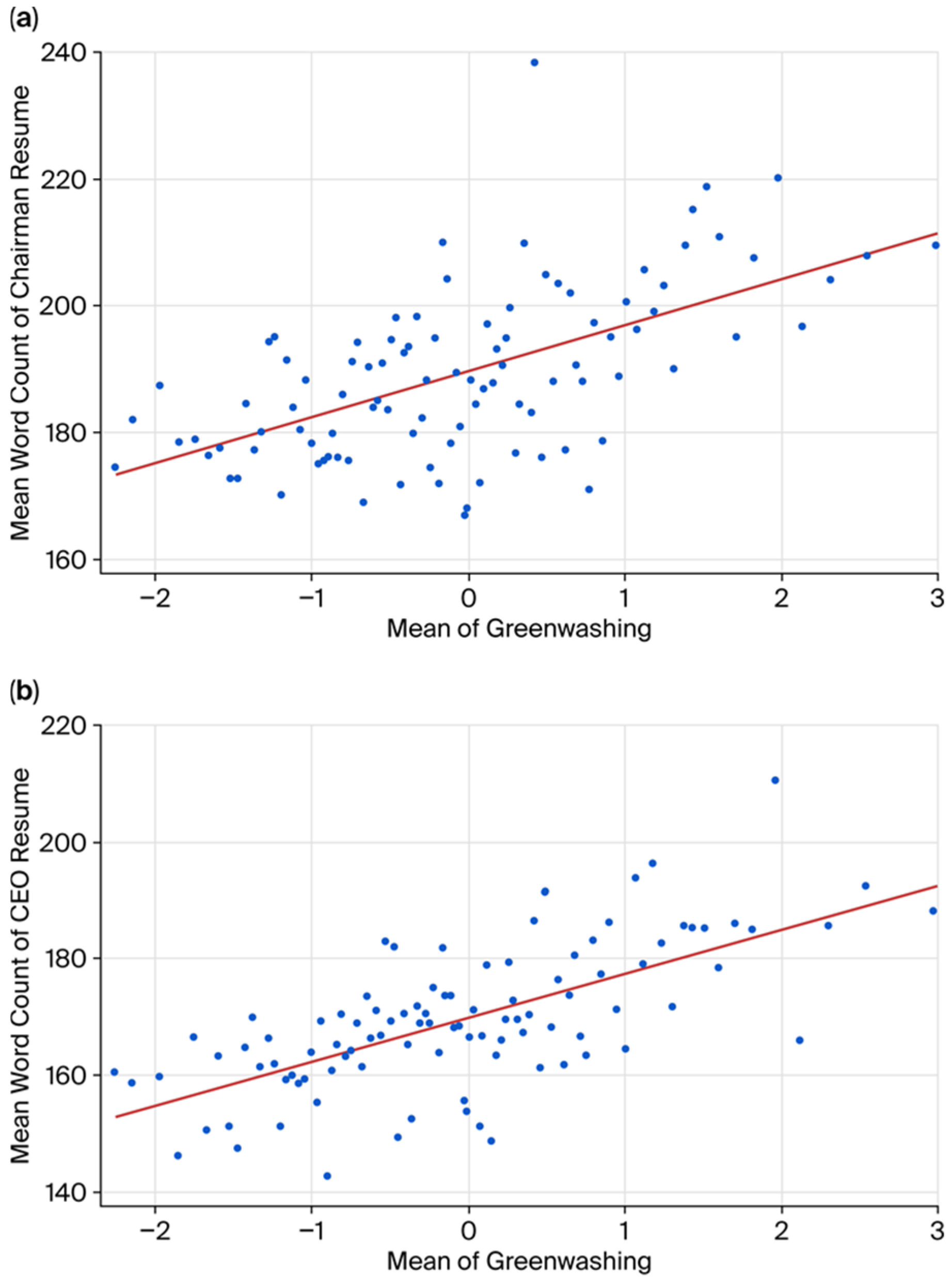
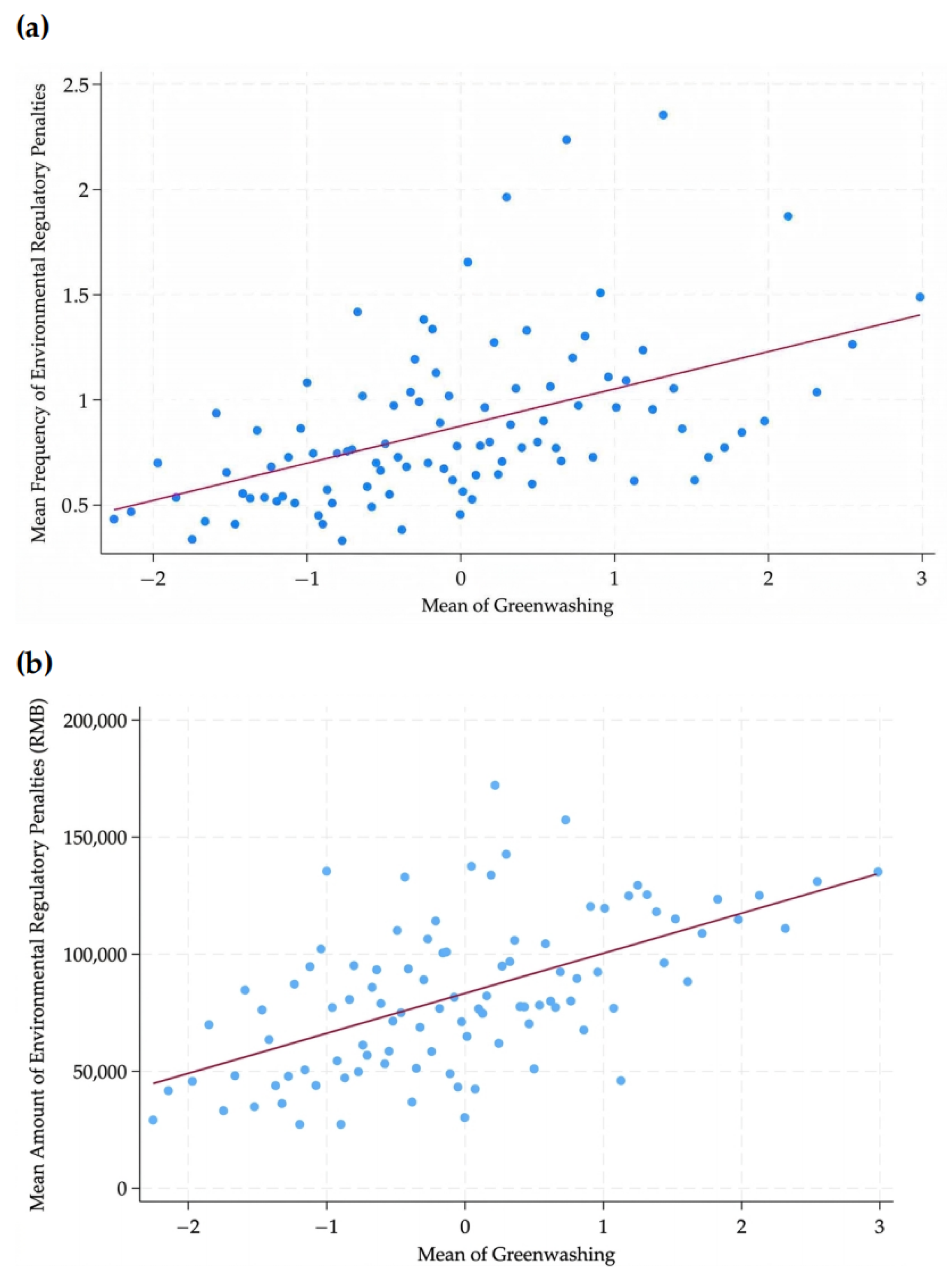
Furthermore, to ensure that the ESG greenwashing indicator constructed in this study effectively reflects corporate ESG greenwashing, we conduct additional validity tests from two dimensions. First, following the idea of Li (2018) [51], firms engaging in ESG greenwashing tend to exhibit a stronger tendency toward self-promotion rather than taking concrete actions. To verify this, we examine the correlation between firms’ self-promotion tendency and their ESG greenwashing indicator. The self-promotion tendency is proxied by the word count in the resumes of firms’ two key decision-makers, the chairman of the board and the CEO. More resume word count suggests a greater tendency of corporate self-promotion. As illustrated in Figure 2, there is a positive correlation, suggesting that firms with a higher degree of greenwashing have a stronger self-promotion tendency. Secondly, drawing on Cheng and Yang et al. (2026) [79], firms engaging in greenwashing are likely to attract regulatory scrutiny and thus face a higher risk of penalties. To this end, we examine the correlation between the environmental regulatory penalties received by firms and their ESG greenwashing indicator. As shown in Figure 3, firms with a higher degree of greenwashing receive greater frequency and amount of regulatory penalties. Collectively, these results confirm that the ESG greenwashing indicator constructed in this study can effectively identify corporate false ESG disclosure and poor actual ESG performance, thereby validating the measurement of our ESG greenwashing indicator and laying a solid empirical foundation for subsequent causal inference.

4.2.2. Core Independent Variable

postt identifies the timing before or after the Soil Pollution Prevention and Control Action Plan with a value of 0 before 2016 and 1 afterward. The policy explicitly targets the following seven industries: (1) non-ferrous metal ore mining and beneficiation, (2) non-ferrous metal smelting, (3) petroleum extraction, (4) petroleum refining, (5) chemical manufacturing, (6) coking, and (7) electroplating, given that the pollution emissions of these industries pose significant threats to soil quality and public health. Special environmental enforcement for firms in such industries is carried out, focusing on monitoring heavy metals such as cadmium, mercury, arsenic, lead, and chromium, as well as persistent organic pollutants and volatile organic compounds generated during the production process. These industries are uniformly included in the key regulatory scope and subject to the same policy-oriented regulatory stringency. Therefore, the firms in these key regulated industries are classified as the treatment group (treati = 1), while the others are the control group (treati = 0).

4.2.3. Control Variables

We incorporate a series of control variables into the regression model that may impact ESG greenwashing. Firm-level controls include firm size, firm age, operating cash flow, operating income per capita, ownership concentration, return on assets, and proportion of fixed assets. We also include city-level controls such as GDP, share of tertiary sector value-added, and fiscal pressure. The definitions are detailed in Table 1.

4.3. Data and Sample

This study employs A-share listed companies in China’s Shanghai and Shenzhen stock exchanges from 2011 to 2021 as the research sample. The Shanghai and Shenzhen A-share markets are two of the largest stock markets in China, characterized by their substantial market capitalization and diverse investor base, serving as a reliable indicator of the domestic economy and capital market operation. In contrast, the B-share market primarily targets foreign investors with a distinct orientation and investor structure. Therefore, we restrict the sample to the firms listed in the Chinese A-share market. The research period 2011–2021 is selected based on the following considerations. Firstly, ESG data for Chinese firms was scarce prior to 2010 and became accessible since the Bloomberg database initiated its ESG coverage in 2011. The year 2011 is also widely regarded as the beginning of the digital economy era without the aftermath of the global financial crisis. Secondly, given that the SPPCAP was implemented in 2016, terminating the sample in 2021 can maintain symmetry in the pre- and post-policy windows. More importantly, China’s Ministry of Ecology and Environment issued the Administrative Measures for the Mandatory Disclosure of Corporate Environmental Information in December 2021, which took effect from 2022. It established a mandatory framework for corporate environmental information disclosure by rigorously specifying disclosure entities, contents, and timelines and penalties for non-compliance, which may induce substantive changes in corporate environmental disclosure, and cause estimation bias if post-2021 observations are included in the research sample. Therefore, to mitigate confounding effects from major institutional changes, this study establishes a symmetric five-year observation window around the policy implementation year.
Data on ESG greenwashing are sourced from the Bloomberg and Huazheng databases and calculated manually. Other firm-level data are from the China Stock Market and Accounting Research (CSMAR) database and calculated manually. City-level data are obtained from the China City Statistical Yearbook and calculated manually. To ensure the accuracy of the findings, we exclude the financial industry because of its incomparability with non-financial industries in terms of business models and accounting standards, and drop firms classified as special treatment (ST) or particular transfer (PT) due to a lack of financial information. We also remove firms with missing financial data or with liabilities exceeding assets. We winsorize all continuous variables at the upper and lower 1% level to mitigate the influence of extreme observations.

4.4. Descriptive Statistics

Table 1 presents the descriptive statistics of the main variables. The mean of the dependent variable is −0.015, consistent with existing research that the average level of ESG greenwashing is neutral [18,79,80,81]. The standard deviation is 1.118, suggesting significant differences in ESG greenwashing among listed firms. The mean of the treatment variable is 0.139, indicating that approximately 14% of the sample is affected by the SPPCAP. Other variables show no abnormalities, ruling out the impact of outliers. The variance inflation factors (VIF) of the explanatory variables are less than 3, suggesting that no multicollinearity.

5. Empirical Results and Analysis

5.1. Benchmark Analysis

Table 2 presents the estimation results based on Equation (1). The regression coefficients of the interaction term, treat × post, are significant and negative at the 5% level. Taking column (3), which includes all control variables and fixed effects as an example, the coefficient of the treat × post is −0.1041. It indicates that ESG greenwashing has reduced in the treated firms by approximately 10% compared with the control firms since the SPPCAP was issued. Therefore, Hypothesis 1 is supported that the SPPCAP can curb corporate ESG greenwashing.

5.2. Parallel Trend Test

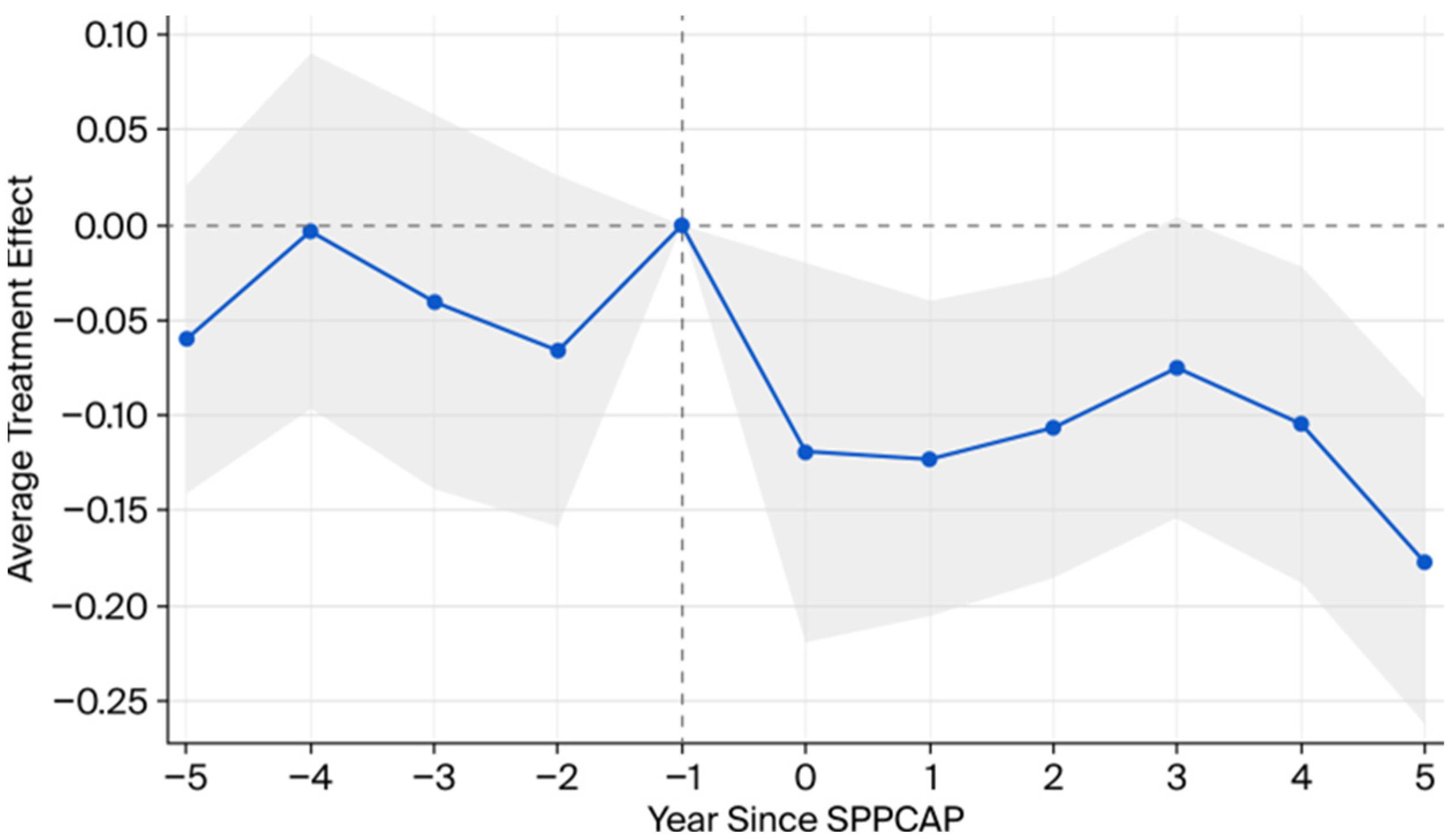
The DID regression results need to meet the parallel trend assumption, that is, there is no statistically significant difference in ESG greenwashing levels between the treatment and control groups prior to the SPPCAP. We designate the year 2015, the year preceding the SPPCAP, as the baseline year. As illustrated in Figure 4, the coefficients of treat × post are negative but not statistically significant before 2016, indicating that there is no difference in ESG greenwashing between the treatment and control groups prior to the SPPCAP, supporting the parallel trend assumption. The coefficients are significantly negative throughout the post-2016 period, showing a persistent inhibitory effect on ESG greenwashing.

5.3. Endogeneity Discussions

To reinforce the causal link between the SPPCAP and ESG greenwashing reduction, we will investigate the sources of endogeneity issues, including measurement error, omitted variables, selection bias, and reverse causality, so as to address endogeneity concerns and improve the credibility of research findings.

5.3.1. Measurement Error Discussion

To mitigate endogeneity arising from measurement error, we adopt alternative measurements of the dependent variable and re-conduct the regression analysis. First, drawing on the ESG greenwashing construction method proposed by Taddeo et al. (2026) [83], we use percentile rank transformation instead of normalized transformation, which is defined as follows:
greenwashing1it = P_ESGdisclosureitP_ESGperformanceit
where P_ESGdisclosureit and P_ESGperformanceit denote the percentage of firms having an ESG disclosure and actual ESG performance less than firm i at year t, respectively. Compared with normalized transformation, percentile rank transformation better focuses on the relative position of firms. It also ensures the robustness of the indicator against non-normal distributions and the presence of outliers. As shown in column (1) of Table 3, the coefficient of treat × post is significantly negative. This suggests that our results are not sensitive to the distributional assumptions typical of ESG data and validates the generalizability across datasets and rating systems.
Second, we replace the Huazheng ESG performance scores with the Asset4 ESG performance scores to evaluate corporate actual ESG performance following the construction method proposed by Yu et al. (2020) [43]. It is obtained from the Thomson Reuters database. Besides, in line with Taddeo et al. (2026) [83], we also use the ESG Combined scores, which incorporate any ESG controversies that firms may have encountered, as an alternative proxy for actual ESG performance. It should be noted that matching Chinese firms’ ESG disclosure scores from the Bloomberg database with their ESG performance scores from the Thomson Reuters database results in substantial sample loss. We then re-calculate the ESG greenwashing indicator in Equation (2), denoted as greenwashing2 and greenwashing3, respectively. The regression results in columns (2) and (3) of Table 3 suggest that the coefficients of treat × post is significantly negative, indicating that the measurement of ESG greenwashing is not subject to specific data sources.
Furthermore, considering that greenwashing firms have a say–do gap, we compare the number of environmental strategic information with that of environmental action information in the annual reports of listed firms, which is extracted from the Juchao Information Network manually. The related keywords are selected from Li (2018) [51]. We use the segmentation library to segment the texts and remove stop words in Python software (version 3.9), and then calculate the keyword frequency. A dummy variable of say–do gap is constructed, with a value of 1 if the frequency of environmental strategic information is more than that of environmental action information, and 0 otherwise. Additionally, we use environmental protection investment (EPI) as a proxy for substantive environmental protection practice, because it is the investment expenditure aimed at preventing pollution and reflects the ability to reduce resource consumption and pollution emission [94]. We use the natural logarithm of EPI plus one (EPI1) and the ratio of EPI to total assets (EPI2) to measure EPI. The data are extracted from construction-in-progress project information in the annual reports of listed firms. The regression results are in columns (4) to (6) of Table 3. The SPPCAP makes firms take more substantive environmental actions and reduces the say–do gap, reducing ESG greenwashing directly. Therefore, the findings are robust to measurement error.

5.3.2. Omitted Variable Discussion

Considering that not all control variables are included due to model simplicity and data availability, we employ Oster test to address the endogeneity problem arising from omitted variables [95]. Under the specification including omitted variables where goodness-of-fit is defined as 1.3 times the benchmark R2, we will examine: (1) whether the range of the estimated coefficients (β) contains 0, given the assumption that the ratio of the correlation between omitted variables and dependent variable to the correlation between included variables and dependent variable (δ) equals to 1. (2) whether the absolute value of δ is greater than 1 when β is constrained to 0. As presented in Table 4, the estimated coefficient β falls within the criterion range, and δ equals −13.8344, suggesting that the coefficient of treat × post would be 0 only if the impact of omitted variables exceeds 13.8 times that of included explanatory variables, which is highly implausible in practice. In summary, the findings are not influenced by omitted variables.

5.3.3. Selection Bias Discussion

First, the research sample is concentrated on the listed firms that voluntarily disclose ESG information and does not incorporate other listed firms that do not disclose ESG information or unlisted firms owing to limited data availability. It may cause selection bias. To address this issue, we employ the Heckman two-stage model. In the first stage, we construct a selection equation and conduct a probit regression. The dependent variable is a dummy variable indicating whether a firm engages in ESG greenwashing. The exogenous variable added is the annual average precipitation in the city where the firm is located, and all other variables are the same as those in Equation (1). In the second stage, the inverse Mills ratio (IMR) derived from the first stage is incorporated into Equation (1) for re-estimation. As shown in column (1) of Table 5, the coefficient of the IMR is significantly positive, suggesting the existence of a selection bias issue. The coefficient of the treat × post is significantly negative, but its absolute value is larger than that in the baseline, which means that the unobserved selection effect tends to attenuate the observed estimated effect in the baseline model. However, it still confirms that the SPPCAP significantly reduces ESG greenwashing.
Second, since firms in heavily polluting industries are more likely to be targeted by environmental policies, and firms with good ESG practices are more likely to comply with environmental policies, the results may also suffer from selection bias. To address this issue, we employ the Propensity Score Matching (PSM) method. Specifically, we adopt nearest-neighbor matching and radius matching, respectively, using all control variables as covariates to ensure that the treatment and control groups have no systematic differences. The balance test results are presented in Appendix A. The differences in covariates between the two groups decrease after re-matching, with absolute values of standardized bias less than 10% and t-statistics not significant, suggesting that the matching variables and matching method are reasonable. We re-estimate the DID model after removing the unmatched samples. The results are in columns (2) and (3) of Table 5. The coefficients of the core independent variable are significantly negative at the 1% level, confirming the baseline results.

5.3.4. Reverse Causality Discussion

We have addressed the endogeneity issues from multiple aspects, but there may still be reverse causality. Corporate ESG greenwashing may accelerate the introduction of government-led environmental policies, which, in turn, triggers estimation bias. To alleviate endogeneity arising from reverse causality, we adopt an instrumental variable approach. We construct a time-varying instrumental variable (denoted as IV), defined as the product of the number of key regulated firms in all industries except the one where the firm is located in the corresponding year. In terms of the relevance requirement of the instrumental variable, the greater the number of key regulated firms in other industries, the lower the possibility that the focal firm will be subject to key supervision. This is because government regulatory resources and attention are typically limited, and thus there is an inverse relationship in the regulatory intensity across different industries [96]. When substantial human, material, and administrative regulatory resources are allocated to other industries, the regulatory attention received by the industry where the focal firm is located will inevitably decline. In terms of the exogeneity requirement of the instrumental variable, the situation of other industries has no direct causal relationship with the production, operation, and strategic decision-making of the industry where the focal firm is located. The key supervision events in other industries will neither directly affect the situation of the industry where the focal firm is located nor directly change the behaviors of firms in this industry, such as ESG greenwashing. The regression results are in Table 6. Column (1) reports the first-stage regression results, where the coefficient of IV is significantly negative at the 1% level, confirming a negative correlation between the number of key regulated firms in other industries and regulatory supervision status of the focal firm. Column (2) presents the exclusiveness test. The coefficient of treat × post is statistically significant, and that of IV is statistically insignificant, suggesting that the instrumental variable has no direct effect on ESG greenwashing. Column (3) shows the second-stage regression results, where the coefficient of treat × post is significantly negative at the 5% level. In addition, the LM-test and F-test results show that there is no problem of underidentification and weak identification. Therefore, the conclusion that the SPPCAP reduces corporate ESG greenwashing is valid after accounting for the endogeneity issue, such as reverse causality.

5.4. Robustness Checks

5.4.1. Anticipation Effect Test

The randomness of policy shocks can enhance the effectiveness of DID estimation. If firms in the key regulated industries had already formed an expectation of being impacted by the SPPCAP policy before its implementation, they might have adjusted their behaviors in advance. Such pre-emptive adjustments would lead to estimation bias. To address this issue, we adopt the following two methods to conduct the anticipation effect test. First, we introduce the interaction term between the dummy variable of one year before the SPPCAP and the treatment group (pre_treat × post) into the baseline regression model to examine whether there is an anticipation effect among firms in the period before the SPPCAP. Second, drawing on the practices of Wooldridge (2023) [97], we exclude the sample of one period before the SPPCAP to avoid potential anticipation effect near the policy implementation time. The estimation results are shown in Table 7. The coefficient of pre_treat × post is not statistically significant, and the coefficient of treat × post remains robust after deleting the sample of the period before the policy. It can be concluded that before the implementation of the SPPCAP, firms did not have a significant anticipation effect on this policy shock.

5.4.2. Placebo Test

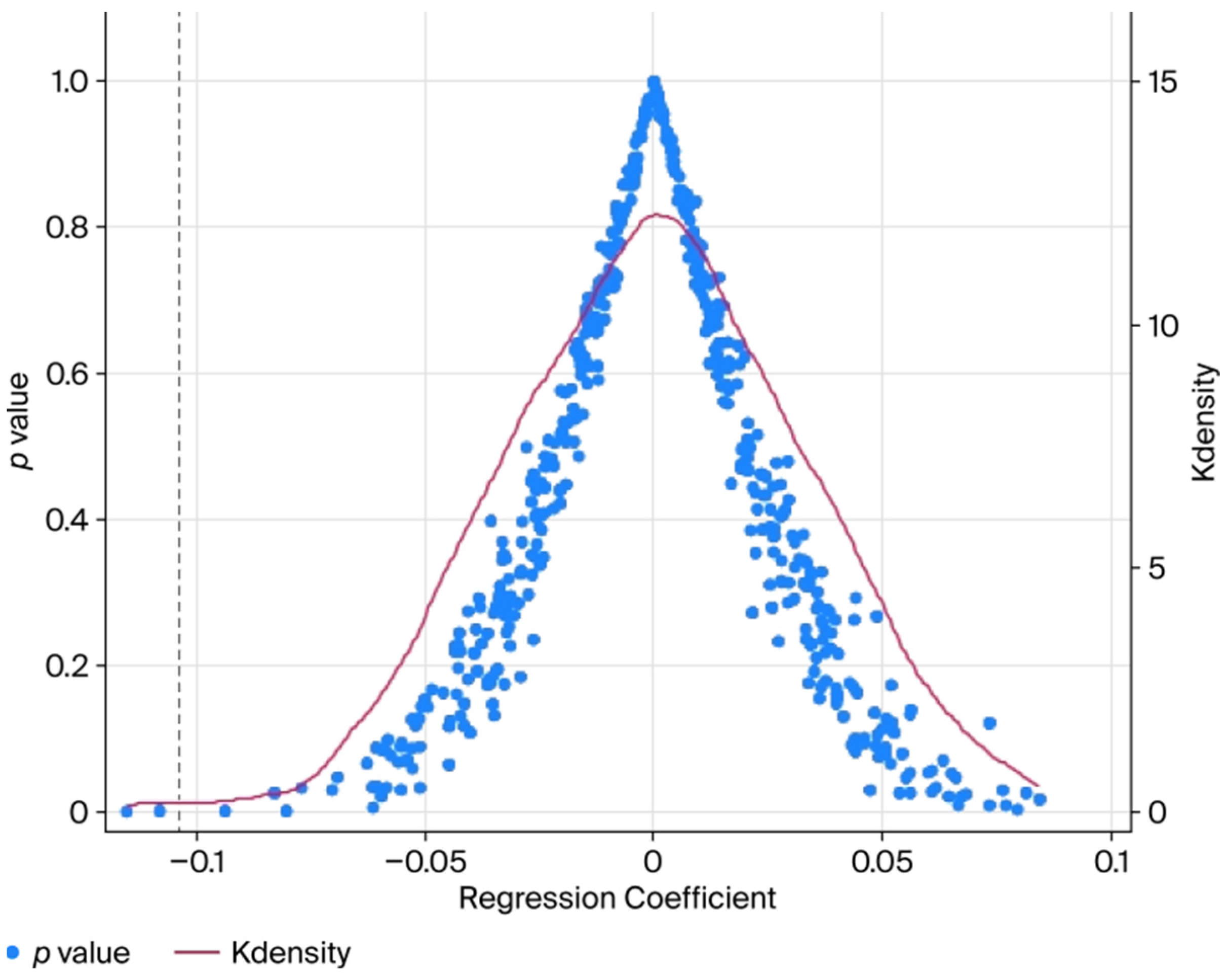
To further rule out the possibility that the effect is driven by other unobservable random factors, this study designs a placebo test following Ferrara et al. (2012) [98]. We randomly select treatment and control groups and SPPCAP timing. This process is repeated 500 times to generate a set of placebo treat × post variables. Their distribution is shown in Figure 5. The coefficients are centered around 0 and in a normal distribution, and most p-values are greater than 0.10, indicating that the coefficients are not significant at the 10% level. This confirms that the inhibitory impact of the SPPCAP on corporate ESG greenwashing is not caused by random confounding factors.

5.4.3. Alternative Regression Models

  • Generalized Quantile Regression (GQR). It was proposed by Powell (2020) [99] and treats individual fixed effects and error terms as an integrated whole. It ensures the indivisibility of error terms, overcomes the interference of individual fixed effects, and thus improves the interpretive power of regression coefficients. Moreover, the interpretive power of the regression coefficients at each quantile remains whether control variables are included or not. Therefore, this method can mitigate the potential endogeneity. It can also estimate the heterogeneous treatment effects of the policy, making up for the deficiency of the traditional difference-in-differences (DID) method, which can only estimate the average treatment effect of the policy.
Specifically, for the instrumental variables in the GQR, we choose the product of the distance from the location of listed firms to the printing bureaus in the Ming and Qing dynasties and the annual CPI, as well as the city-level annual ventilation coefficient. Firstly, printing bureaus were mainly located in naturally formed bamboo-producing areas, most of which had good natural ecological environments, and polluting firms tended to stay away from these areas, thus satisfying the relevance assumption of instrumental variables. With the introduction of modern Western printing technology, these printing bureaus had closed down by the late Qing Dynasty and would not affect the behavior of contemporary enterprises, while meeting the exogeneity assumption of instrumental variables [100]. Since the distance is time-invariant, it is converted into a time-variant variable by multiplying it by the CPI of the corresponding year. Secondly, in regions with a smaller ventilation coefficient, the monitored concentration of pollutants may be higher, making them more likely to be targeted by the SPPCAP, thus satisfying the relevance requirement. The ventilation coefficient is determined by geographical and meteorological conditions and does not directly affect the response to the policy, meeting the exogeneity requirement. Table 8 reports the GQR results. The coefficient of the core independent variable is significantly positive only at the 0.10 quantile, while it is significantly negative at the 0.2–0.9 quantiles, fluctuating within the range of [−0.0146, −0.1519]. This indicates that the inhibitory effect of the SPPCAP on ESG greenwashing becomes more pronounced as ESG greenwashing increases, suggesting that the SPPCAP has heterogeneous treatment effects.
  • Double Machine Learning (DML). To further improve the unbiased estimation of policy treatment effects under finite sample conditions, we adopt the double machine learning (DML) method proposed by Chernozhukov et al. (2018) [101], employing different regression algorithms, including Neural Network, Elastic Net, and Random Forest. The results in Table 9 show that the coefficients of treat × post are all significantly negative. Therefore, we can obtain a qualitatively consistent conclusion that the SPPCAP significantly reduces ESG greenwashing, although there are differences across algorithms.

Table 9. Alternative regression model: DML.
VariablesGreenwashing
(1)(2)(3)
Neural NetworkElastic NetRandom Forest
treat × post−0.627 ***−0.0958 *−0.137 **
(0.122)(0.0511)(0.067)
ControlsYesYesYes
Firm FEYesYesYes
Year FEYesYesYes
City FEYesYesYes
N10,96610,96610,966
Note: * p < 0.10, ** p < 0.05, *** p < 0.01. Robust standard errors in parentheses.
  • Adding a triple interaction term. The identification strategy relies on industry-level treatment assignment, considering that the SPPCAP explicitly targets specific industries based on soil pollution risks. However, there is a risk that firms within treated industries that do not actually generate significant soil pollution are incorrectly classified as treated, introducing measurement error that could bias the estimates. To distinguish the pollution degree at the firm level as much as possible, following prior research [10], we establish the following model.
greenwashingit = φ0 + φ1 treati × postt × ln(intensityi2015) + φ2 postt × ln(intensityi2015) + λControls + μi + ηt + γc + εit
where ln(intensityi2015) denotes the natural logarithm of waste emission intensity (i.e., emissions per unit of operating income) for firm i at year 2015, one year before the implementation of the SPPCAP. Given that firm-level data on soil pollution emission is not publicly available and soil serves as the ultimate sink for most pollutants, we use air pollution using COD emission intensity and SO2 emission intensity to measure waste emission intensity [8], denoted as ln(CODi2015) and ln(SO2i2015), respectively. We incorporate these two variables to account for firm-specific pollution emission levels. Other variables are the same as those in Equation (1). The coefficient φ1 can measure the response of ESG greenwashing among high-pollution-intensity firms within key regulated industries after the implementation of SPPCAP. The regression results are reported in Table 10. The estimated coefficients on the treat × post × ln(COD) and treat × post × ln(SO2) variables are negative and statistically significant. These results imply that ESG greenwashing in regulated and high-pollution-intensity firms declines relative to low-intensity firms in regulated or non-regulated industries, robust to potential measurement error caused by industry-level treatment assignment.

5.4.4. Excluding Confounding Policies

Firstly, we remove firms in Beijing–Tianjin–Hebei urban agglomeration, as these areas are more heavily polluted and have higher-intensity environmental policies. Secondly, we account for the staggered introduction of other environmental policies. The Air Pollution Prevention and Control Action Plan in 2013 has been regarded as the most stringent air environmental policy in China. To mitigate its effect, we construct a dummy variable (air) into Equation (1), which takes the value of 1 if a firm falls within the key regulated industries under such policy and the observation year is 2013 or later, and 0 otherwise. The effect of the Water Pollution Prevention and Control Action Plan (water) issued in 2015 is mitigated in the same way; We rule out the impact of the new Environmental Protection Law that officially took effect on 1 January 2015. We construct a dummy variable (epl), which takes the value of 1 if a firm belongs to a heavily polluting industry and the observation year is 2015 or later, and 0 otherwise. We account for the effect of China’s Central Environmental Inspection campaign implemented by the Ministry of Ecology and Environment since 2016. We construct a dummy variable (cei), which takes the value of 1 if a firm is located in the province inspected by the Central Environmental Inspection team during and after the inspection year, and 0 otherwise. We then incorporate these confounding variables into Equation (1) for regression. We also exclude the impact of the Blue Sky Defense War, first proposed by the Chinese government in December 2017. We add the dummy variable for its implementation to Equation (1) for regression, denoted as blue. It equals 1 if the firm is located in the key regions of the Blue Sky Defense War, such as the Beijing-Tianjin-Hebei areas, the Yangtze River delta, and the Fen–Wei plain, and in the year 2018 or later, and 0 otherwise. Considering that some regulatory frameworks and pilot policies, such as green finance reform, were issued at the provincial level, province-year fixed effects are further included in the regression model. The results are presented in Table 11. The coefficients of treat × post remain significantly negative, indicating that the effect of the SPPCAP on reducing ESG greenwashing is not affected by concurrent policies.

5.5. Mechanism Tests

We have concluded that the SPPCAP can curb corporate ESG greenwashing. We will explore the underlying mechanisms in this section.

5.5.1. The Channel of Mitigating Managerial Myopia

The SPPCAP has intensified government-led efforts through establishing lifelong accountability and dual-penalty systems, as well as strengthening soil environment monitoring and investigation for soil polluters. These measures have increased long-term environmental pressure for corporate management, constrained managers from prioritizing short-term profits over long-term environmental investments and thus helped curb ESG greenwashing.
For the measurement of managerial myopia, we adopt text analysis, a mainstream approach in extant literature [102,103,104]. Specifically, we obtain the Management Discussion and Analysis (MD&A) section of corporate annual reports, which are crawled from the Juchao website and converted into TXT format using Python software (version 3.9). We employ the Jieba Chinese word segmentation module to segment the MD&A texts and remove stop words. We then construct a short-term-oriented seed word set and expand the word set via the Word2Vec technique. Managerial myopia is calculated as the ratio of the frequency of short-term-related keywords to the total word count in the MD&A section, and is multiplied by 100, denoted as myopia. A higher value of myopia indicates a higher level of managerial myopia. To ensure the robustness of this text-based measurement, we utilize managerial power as an alternative proxy for managerial myopia. This is because managers with greater power are more prone to engaging in self-interested activities and thus exhibit more pronounced short-sighted tendencies [105]. It is constructed in principal component analysis based on multiple corporate governance variables, including CEO duality and tenure, board size, inside director proportion, and management shareholding ratio, denoted as myopiaalter. The validity of these two measurements is verified in Appendix B. To test this mechanism, we establish a two-stage model following the methodology of Di Giuli and Laux (2022) [106], Kim et al. (2021) [107], and Wang et al. (2024) [108].
Mit = α0 + α1 treati × postt + λControls + μi + ηt + γc + εit
greenwashingit = δ0 + δ1 M_hatit + λControls + μi + ηt + γc + ξit
where M denotes mechanism variables. M_hat denotes the fitting mechanism variables derived from Equation (5). Other variables are the same as those in Equation (1). Equation (5) is the first-stage test that indicates the effect of the SPPCAP on mechanism variables. Equation (6) is the second-stage test that indicates the impact of the affected mechanism variable on ESG greenwashing. The regression results are reported in Table 12. The first-stage results in columns (1) and (3) show significantly negative coefficients of treat × post, indicating that the SPPCAP reduces the degree of managerial myopia. The first-stage results in columns (2) and (4) show significantly positive coefficients of the fitting mechanism variables (myopia and myopiaalter), suggesting that reduced managerial myopia induced by the SPPCAP reduces ESG greenwashing. Therefore, Hypothesis 2 is supported that the SPPCAP reduces corporate ESG greenwashing through mitigating managerial myopia.

5.5.2. The Channel of Promoting Clean Production Strategies

When confronted with regulatory pressure, firms have incentives to adjust internal resources to cut costs. They are likely to reallocate their production resources through substituting clean ones for polluting ones, facilitating the green transition of the production process. Therefore, substantive green actions increase, and ESG greenwashing decreases accordingly. We will investigate the adjustments in the production process from both the output (product) and input (factor) perspectives.
  • Regarding to the product adjustment in intensive and extensive margins, there is a data availability constraint at the product level. Considering that export products are an important means of production adjustment and differentiated competition, we focus on export products [109]. They are obtained from the China Customs Import and Export database. We match it with Chinese A-share listed firms by firm names. It should be noted that a certain number of firm observations are lost during the matching process with the sample of A-share listed firms. However, the final matched sample scale remains sufficiently large because the China Customs Import and Export database is extremely large in scale. We establish the following model:
Yiht = θ0 + θ1 treati × postt + θ2 treati × postt × cleanh + λControls + μh + ηt + γc + εiht
where the subscripts i, h, t denote the firm, HS 8-digit product, and year, respectively. The dependent variables Yiht are the dummy variables indicating the incumbency (incumiht), entry (entryiht), and exit (exitiht) of export products, respectively. According to Elrod and Malik [24], incumiht equals 1 if the firm i continuously exports the product h in year t, and 0 otherwise. entryiht equals 1 if the product h of firm i is not exported in year t − 1 but exported in year t, and 0 otherwise. exitiht equals 1 if the product h of firm i is exported in year t − 1 but not exported in year t, and 0 otherwise. Cleanh is the dummy variable indicating the clean product. It equals 1 if the export product h is a clean product, and 0 otherwise, according to Han et al. (2024) [110]. μh is the product-level fixed effect. Other variables are the same as in Equation (1). As reported in Table 13, column (1) indicates that the SPPCAP significantly increases the incumbency of clean products compared with polluting ones in the treated firms, which supports that the SPPCAP promotes product portfolio adjustment toward cleanliness at the intensive margin. Column (3) shows that the SPPCAP significantly increases the exit of polluting products and decreases the exit of clean products, suggesting that the SPPCAP inhibits pollution-oriented product adjustment at the extensive margin. Although the core coefficients on product entry in column (2) are not statistically significant, the above findings together indicate that firms become more reluctant to abandon clean products and more willing to sustain environmentally friendly product lines, which directly reflects a strategic shift toward cleaner production. These suggest a decrease in the share of polluting products and an increase in the share of clean products in the product mix after the implementation of the SPPCAP. Therefore, firms restructure their product portfolios toward cleanliness in response to the SPPCAP. This adjustment of products falls within the scope of substantive ESG practices and directly reduces ESG greenwashing. Therefore, Hypothesis 3a is verified.
Beyond the change in product mix, the product switching level will also change with the SPPCAP. This is because the resources released by products exiting the market will be re-allocated and partially used for other products. Firms will optimize their resource allocation by eliminating polluting products with high environmental costs and retaining clean products with low environmental costs, thereby leading to product switching and further realizing the overall upgrading of product quality. Drawing on the method of Bernard et al. (2010) [111], we calculate the firm-level product switching rate as follows.
switchit = (addprodit + dropprodit)/totalprodit
where addprodit denotes the number of new products entering the market of firm i in year t. dropprodit denotes the number of products exiting the market of firm i in year t. totalprodit denotes the total number of products of firm i in year t. switchit denotes the product switching rate of firm i in year t. We will examine the change in product switching with the SPPCAP by replacing the dependent variable with product switching rate in Equation (1), and the results are reported in columns (4) and (5) of Table 13. The coefficients of treat × post are significantly positive, indicating that the SPPCAP significantly promotes the product switching within the firm, improves the efficiency of internal resource allocation, and further promotes the overall upgrading of product quality, contributing to actual ESG practices.
  • As for the changes in the demand for production inputs, the data are sourced from the National Tax Survey database, which is jointly collected by the State Administration of Taxation of China and the Ministry of Finance of China, and provides detailed information on resource consumption and pollutant emission. We match it with Chinese A-share listed firms by firm names. However, it is acknowledged that the number of matched firms is fewer than that in the baseline regression due to differences in the statistical ranges of firms. We replace the dependent variable in Equation (1) with the natural logarithm of one plus the consumption of coal, oil, natural gas, other polluting gaseous fuels, and non-energy materials and intermediate goods, denoted as coal, oil, gas, fuel, and nonenergy, respectively. As reported in Table 14, the demand for fossil fuels, including coal, oil, and natural gas, does not change; the demand for other polluting gaseous fuels decreases; and the demand for non-energy materials and intermediate goods increases. Besides, we further examine pollutant emission change, given that the consumption of fossil fuels can generate pollutants such as SO2. The results in column (6) indicate that pollutant emissions decrease with the introduction of the SPPCAP, verifying the policy’s effectiveness in curbing polluting activities to some extent. Therefore, the SPPCAP increases the demand for non-energy inputs and promotes a cleaner input structure. This adjustment to factors also falls within the scope of substantive ESG practices and directly reduces ESG greenwashing. Therefore, Hypothesis 3b is verified.
Combined with the SPPCAP-induced changes from both product and factor dimensions, we can see that since the introduction of the SPPCAP, firms have retained production lines for clean products and increased the share of clean factors used in clean products. Consequently, production processes have become cleaner, indicating an increase in actual ESG practices and thus a reduction in ESG greenwashing. Hypothesis 3 is supported.

5.6. Heterogeneity Analysis

We will examine whether the SPPCAP has differentiated effects based on the heterogeneous characteristics of firms in this section.

5.6.1. Business Environment Heterogeneity

Under a poor business environment, firms tend to resort to rent-seeking to evade unfavorable social responsibilities and will not be subject to condemnation or penalties even if their misconduct is exposed. It is expected that the SPPCAP can exert a weaker effect on curbing ESG greenwashing in a poorer business environment. Based on the Rankings of Political and Business Relationships in Chinese Cities in 2020, we define cities ranked in the top 40 as those with a good business environment and the others with a poor business environment, according to Li et al. (2023) [112]. The data are obtained from the National Academy of Development and Strategy at Renmin University of China. The results in columns (1) and (2) of Table 15 reveal that the coefficient of treat × post is more significant and negative in regions with a good business environment, consistent with our expectation.

5.6.2. Environmental Judicialization Heterogeneity

Establishing environmental courts is an important way to strengthen environmental judicial capacity. The trial results of environmental courts have legal enforceability. Environmental regulatory authorities must impose penalties on the liable parties in environmental pollution disputes in accordance with the court’s trial results, thereby helping reduce the collusion between local governments and polluters under the pressure of economic growth. The establishment of environmental courts can also provide more efficient and convenient judicial channels for the public with environmental rights claims, and thereby enhances the public’s confidence in seeking judicial remedies for environmental pollution. Therefore, environmental judicialization, represented by the establishment of environmental courts, plays a positive role in promoting pollution control, which can curb environmental misconduct and further reduce ESG greenwashing. According to whether the city where the firm is located has established an environmental court in the corresponding year, we divide the sample into two groups: one with a high level of environmental judicialization, where an environmental court has been established, and the other with a low level of environmental judicialization, where no environmental court has been established. The results in columns (3) and (4) of Table 15 show that in regions with an established environmental tribunal, the coefficient of treat × post is more significant and negative. It indicates that the SPPCAP can curb ESG greenwashing more effectively under higher environmental judicialization.

5.6.3. Market Competition Heterogeneity

In a competitive market, firms have low profit margins and are motivated to improve their ESG performance and green activities to reduce environmental compliance costs, gain support from stakeholders, and enhance competitive advantages [113]. We expect that firms with lower market power will take more environmental actions under the SPPCAP. The Herfindahl–Hirschman index is a measurement of market power. We divide the sample based on their annual industry median. The subgroup results in columns (5) and (6) of Table 15 show that the coefficient of treat × post is more significant and negative in more competitive industries, suggesting that market competition amplifies the positive effect of the SPPCAP on ESG greenwashing reduction.

5.6.4. Industry Chain Position Heterogeneity

Reputation theory indicates that the participation in corporate ESG performance signals to customers the firm’s commitment to sustainable development and also conveys to consumers a message that the firm is reliable and caring, which in turn boosts corporate reputation, helps gain more customer resources and more stable relationships, and ultimately promotes sales growth [114]. Considering that such reputational pressure can affect consumers’ trust and stability, a question arises: Does the SPPCAP drive firms to engage in more actual ESG practices when they have more direct interactions with consumers? To address the question, the samples are classified into upstream firms, which have less direct interaction with consumers, and downstream firms, which have more direct interaction with consumers [61]. The results are in columns (7) and (8) of Table 15. The impact is more significant and negative in the downstream than in the upstream, indicating that consumer-facing firms contribute to a greater reduction in ESG greenwashing under the SPPCAP.

5.6.5. Soil Pollution Distribution Heterogeneity

Firstly, in terms of agricultural pollution distribution, it is heavier in southern areas than in northern areas, because background values of soil heavy metals are higher and agricultural activities are more intensive in southern areas, particularly in Jiangsu, Hunan, and Guizhou provinces [115]. We split the sample into southern and northern regions based on the Qinling-Huaihe line. As shown in columns (9) and (10) of Table 15, the SPPCAP has a more significant effect on curbing ESG greenwashing in southern areas. Secondly, in terms of industrial pollution distribution, industrial activities are the primary source of soil contamination and exert detrimental shocks on soil ecosystems. We quantify the spatial distribution of industrial activities using the regional industrial share, which is calculated as the ratio of the city-level gross output value of industrial firms above a designated size to the national total. It can reflect the degree of industrial activity concentration, with a higher value indicating greater spatial concentration of industrial activities and consequently more intensive pollution accumulation. Due to data limitations, we partition the sample based on the median value in 2015, one year prior to the implementation of the SPPCAP. As demonstrated in columns (11) and (12) of Table 15, the soil environmental policy exhibits a more significant inhibitory effect on ESG greenwashing in regions with higher industrial activity concentration. Therefore, the SPPCAP can provide more incentives for enterprises to reduce ESG greenwashing in regions with more severe soil contamination.

5.7. Additional Analysis

We have known that the SPPCAP can curb pseudo-environmental behaviors such as ESG greenwashing and promote substantive resolution of environmental issues, leading to an improvement in environmental performance. However, it remains unclear whether reduced ESG greenwashing driven by the SPPCAP will contribute to the goal of achieving sustainable growth in the future.
Corporate sustainable growth refers to a firm’s comprehensive capacity to realize quantitative and qualitative development in the long term, which is assessed on the basis of its historical operating performance and pre-determined business development goals [116,117]. We construct corporate sustainable growth indicators in Higgins model (1977) [118] and Van Horne’s static model (1988) [119], both of which are widely recognized and representative models for measuring corporate sustainable growth so far. The rationale for selecting these two indicators are as follows. Greenwashing can detrimentally impact the development of the overall business. On the one hand, firms engaging in greenwashing directly mislead customers, investors, and other stakeholders by deliberately exaggerating or manipulating their ESG performance, leading to biased decision-making of stakeholders and even negative public sentiment [80]. On the other hand, the occurrence of greenwashing indirectly undermines stakeholders’ trust in firms that have substantive green businesses [120]. Consequently, the reputation and brand value of all firms will be damaged, and ultimately, their market competitiveness and operational sustainability are impaired in the long run. We can see that greenwashing behavior of a single firm entails a critical yet overlooked consequence, disrupts the fair environment within the industry, and hinders the normal business activities of the entire industry. The two sustainable growth indicators can capture such unexpected economic consequences of greenwashing by accounting for stakeholders’ attitudes and responses under uncertain conditions, while satisfying the criteria of objectivity and data availability. Therefore, they are reasonable proxies for corporate sustainable growth. Specifically, the Higgins model defines sustainable growth rate as the maximum growth rate of a firm’s sales without depleting its financial resources, while the Van Horne model considers sustainable growth rate as the largest growth percentage of a firm’s sales under a certain operating and debt-to-dividend ratio, regarding it as a target value rather than an actual value. Despite minor differences in setting, the two models have the same theoretical logic and adopt the maximum growth rate of sales as the core measurement of sustainable growth rate [121]. The specific formulas are as follows:
SGR_Higgins = P × A × T × R
SGR_VanHorne = P × A × T × R/(1 − P × A × T × R)
where SGR_Higgins and SGR_Higgins denote the sustainable growth rate in the Higgins and Van Horne models, respectively. P denotes profit margin. A denotes asset turnover. T denotes leverage factor. R denotes earnings retention rate. Drawing on the ideas of Equations (5) and (6), we establish the following regression model:
greenwashingit = β0 + β1 treati × postt + λControls + μi + ηt + γc + εit
SGR_Higginsit+n (SGR_VanHorneit+n) = Φ0 + Φ1 greenwashing_hatitλControls + μi + ηt + γc + ωit
where greenwashing_hat denotes the fitting value derived from Equation (11), which is also the baseline regression model (Equation (1)). All the variables are defined as in Equation (1). Equation (11) is regarded as the first-stage test that indicates the impact of the SPPCAP on ESG greenwashing. Equation (12) is the second-stage test that indicates the impact of the affected ESG greenwashing induced by the SPPCAP on sustainable growth. Setting n to be 2 or larger allows us to capture the long-term effects. Corresponding to n being 0, 1, 2, and 3, the observation periods of the variables SGR_Higgins and SGR_VanHorne are years 2011–2021, 2012–2022, 2013–2023, and 2014–2024, respectively. The regression results are reported in Table 16. Columns (1) and (6) present the baseline regression results, replicated from column (3) of Table 2. Columns (2) to (5) and (7) to (10) show that the reduction in ESG greenwashing induced by the SPPCAP does not affect corporate sustainability in the current period but promotes corporate sustainable growth in the long run. The negative relationship between greenwashing_hat and SGR_Higgins or SGR_VanHorne is in accordance with two foundational theories. From the perspective of impression management theory, greenwashing, a low-cost impression management tool, will eventually be exposed and damage corporate reputation and stakeholder trust. From the perspective of cognitive dissonance theory, the divergence between ESG disclosure and actual ESG performance will trigger stakeholders’ cognitive dissonance and distort their decision-making. These two mechanisms will result in pessimistic market expectations, exert adverse shocks on firms, and ultimately hinder sustainability.
Therefore, the SPPCAP can not only generate environmental benefits by improving substantive ESG practices and reducing spurious ESG greenwashing, but also promote sustainable growth from an economic perspective, thereby achieving a win-win balance between economic development and environmental protection. This conclusion has been supported by interdisciplinary studies that environmental policies or governance help mitigate ecological damage without sacrificing economic viability [122], and yield co-benefits across economic, environmental, and social domains [123,124].

6. Conclusions and Discussion

6.1. Main Conclusions

Among various types of environmental pollution, soil pollution is more difficult to detect due to its extensive pollution sources, lagged effects, and accumulative characteristics. Soil pollution prevention and control is more critical to encourage polluters to adopt substantive environmental action rather than symbolic environmental compliance, as it enhances the overall effectiveness of environmental governance and facilitates the pathway to green transition. Therefore, it is of great significance to explore how soil environmental governance affects corporate green or pseudo-green practices. Taking the Soil Pollution Prevention and Control Action Plan in 2016 as a quasi-natural experiment, this study investigates how this environmental policy affects corporate ESG greenwashing using data of Chinese A-share listed firms over the period 2011–2021, a symmetric five-year window around the policy implementation. We find that the SPPCAP significantly reduces corporate ESG greenwashing. This inhibitory effect is achieved through the channels of mitigating managerial myopia and promoting clean production strategies from both output and input aspects. The effect of the SPPCAP on curbing corporate ESG greenwashing is more pronounced in regions with a better business environment, stricter environmental judicialization, and heavier soil pollution, and in more competitive and downstream industries. Furthermore, the SPPCAP’s inhibitory effect on ESG greenwashing contributes to the improvement of corporate sustainable growth.

6.2. Policy Implications

Based on the research findings, this study has some policy recommendations. First is leveraging the asymmetry in the policy implementation. The impact of the SPPCAP on ESG greenwashing differs across firms, industries, and regions. Accordingly, policymakers should provide targeted support and guidance for firms with heterogeneous attributes. For instance, in heavily soil-polluted areas, subsidies should be increased to compensate for pollution abatement costs and enhance local firms’ incentives to make substantive efforts in pollution prevention and control. Meanwhile, governments should guard against subsidy fraud by refining subsidy criteria and strengthening ex-post monitoring over subsidy utilization.
Second is advancing soil environmental governance systems. Specifically, an ESG rating system tailored to corporate soil management should be established. Given that the high concealment and time-lag nature of soil pollution makes real-time monitoring impractical, such an ESG rating system can integrate soil-related ESG performance into external financing decisions. This enables the capital market to exert pressure on polluting firms by linking financing access to their soil governance performance. Additionally, efforts should be accelerated to establish a big data platform for soil management. By leveraging advanced data analytics and monitoring technologies, this platform can improve the efficiency of collecting and analyzing land use information, as well as stakeholder feedback regarding soil environment quality. Furthermore, an ex-post accountability mechanism for soil pollution should be established. Given the challenges in identifying historical polluters and the long timelines required for soil remediation, policymakers should strengthen regulatory deterrence by enforcing mandatory verification of soil pollution records and imposing severe penalties for non-compliance.
Third is promoting corporate green transition. The SPPCAP makes firms improve substantive ESG performance and reduce ESG greenwashing, and ultimately facilitates sustainable growth. Therefore, policymakers should highlight the positive impact of environmentally friendly practices on long-term sustainability, curb environmental opportunism, and foster systemic green transition across products, services, and business models. This will help achieve the win-win goal of economic development and environmental conservation.

6.3. Further Research

This study has the following limitations that suggest promising directions for future research. First, the empirical setting is confined to firms listed on China’s A-share market, which may limit the generalizability of the findings. Future research could extend the sample to include overseas companies for cross-country comparisons under different environmental regulatory frameworks, particularly in the context of soil environmental policies, and explore how such policies influence corporate ESG greenwashing. This would help assess the external validity of the findings.
Second, the lack of micro-level data on firm-specific soil pollution emission prevents us from further quantifying the extent of soil pollution at the firm level and tracking the dynamics of corresponding governance practices. Future research could adopt more micro-level approaches, such as field surveys and questionnaire investigations, to collect first-hand data. Additionally, modern information technologies such as big data analytics and cloud computing could be utilized. This would enable more in-depth analyses of environmental governance at the firm level.
Third, this study focuses primarily on ESG-oriented greenwashing behavior, and in line with authoritative literature, we define such behavior as the discrepancy between firms’ publicly disclosed ESG information and their actual ESG performance. Nevertheless, corporate greenwashing manifests in far more diverse, covert, and complex forms than this single-dimensional measurement can capture. Future research could prioritize refining and diversifying greenwashing measurement methods and incorporate multi-dimensional and nuanced metrics that align with the heterogeneous nature of real-world greenwashing tactics. This would enable more targeted and comprehensive analyses of corporate environmental opportunism.

Author Contributions

Conceptualization, Y.H. and J.Z.; methodology, Y.H.; validation, L.Y. and J.Z.; formal analysis, Y.H. and L.Y.; investigation, Y.H.; writing—original draft preparation, Y.H.; writing—review and editing, L.Y. and J.Z.; supervision, J.Z.; funding acquisition, J.Z. All authors have read and agreed to the published version of the manuscript.

Funding

This research was funded by the Humanities and Social Sciences of Ministry of Education Planning Fund, grant number 24YJA790086, and the Social Science Foundation of Fujian Province, grant number FJ2024B021.

Institutional Review Board Statement

Not applicable.

Informed Consent Statement

Not applicable.

Data Availability Statement

The original contributions presented in this study are included in the article. Further inquiries can be directed to the corresponding author.

Conflicts of Interest

The authors declare no conflicts of interest. The funders had no role in the design of the study; in the collection, analyses, or interpretation of data; in the writing of the manuscript; or in the decision to publish the results.

Abbreviations

The following abbreviations are used in this manuscript:
SPPCAPSoil Pollution Prevention and Control Action Plan

Appendix A

Table A1. Balance test (nearest-neighbor matching).
VariablesBefore or After MatchingMeanStandardized Bias (%)t-Test
Treatment GroupControl Groupt-Statisticp-Value
sizeBefore8.56518.44279.13.330.001
After8.56518.5745−0.7−0.190.846
ageBefore2.48232.4228.52.930.003
After2.48232.4973−2.1−0.610.543
cfoBefore0.06320.05965.31.870.062
After0.06320.06103.20.880.380
psalesBefore14.19714.04416.65.960.000
After14.19714.212−1.6−0.440.661
top1Before38.09637.334.71.710.088
After38.09638.218−0.8−0.210.837
roaBefore0.04410.0534−14.7−5.360.000
After0.04410.04390.3−0.080.934
farBefore0.31950.211863.822.180.000
After0.31950.3248−3.2−0.790.430
gdpBefore17.46518.276−73.0−27.560.000
After17.46517.489−2.2−0.600.551
thirdBefore49.40556.678−51.8−19.180.000
After49.40549.89−3.5−0.980.328
fiscalBefore−0.0677−0.0476−24.4−8.190.000
After−0.0677−0.07002.90.780.436
Table A2. Balance test (radius matching).
VariablesBefore or After MatchingMeanStandardized Bias (%)t-test
Treatment GroupControl Groupt-Statisticp-Value
sizeBefore8.56518.44279.13.330.001
After8.56468.5722−0.6−0.160.876
ageBefore2.48232.4228.52.930.003
After2.4822.491−1.3−0.360.717
cfoBefore0.06320.05965.31.870.062
After0.06320.06310.10.030.974
psalesBefore14.19714.04416.65.960.000
After14.19614.223−3.0−0.800.423
top1Before38.09637.334.71.710.088
After38.08738.247−1.0−0.270.788
roaBefore0.04410.0534−14.7−5.360.000
After0.04410.0447−1.0−0.270.788
farBefore0.31950.211863.822.180.000
After0.31930.3239−2.7−0.680.499
gdpBefore17.46518.276−73.0−27.560.000
After17.46517.495−2.7−0.720.472
thirdBefore49.40556.678−51.8−19.180.000
After49.42150.091−4.8−1.350.177
fiscalBefore−0.0677−0.0476−24.4−8.190.000
After−0.0677−0.07002.20.590.557

Appendix B

We verify the validity of the text-based managerial myopia measurement and the managerial power-based alternative measurement as follows.
Social psychology theory posits that language reflects an individual’s thoughts, cognitions, perceptions, and inherent traits. Through examining textual word choices and lexical frequency in linguistic expression, researchers can capture an individual’s underlying psychological tendencies and latent consciousness [125,126]. In the domain of textual analysis, word frequency has long been regarded as a classic and reliable tool for measuring concepts, and it reflects the emphasis a document places on a particular word. Therefore, textual information can provide a credible and effective approach to quantifying managerial traits [127].
The CEO or chairman of a firm plays a dominant role in the firm’s decision-making. The information they disclose directly reflects their cognition and preferences. The Management Discussion and Analysis (MD&A) section is an interpretive analysis required by government authorities. It covers management’s review of the firm’s operating performance during the reporting period, the business plans for the next phase, as well as opportunities, challenges, and risks the firm may face in its future development. Previous studies have demonstrated the reliability of using MD&A texts to characterize managerial traits. For example, Park et al. (2019) [128] used MD&A texts from U.S.-listed firms to measure managerial overconfidence. Wang et al. (2026) [129] used MD&A texts from Chinese listed firms to measure managerial risk perception. Therefore, the myopia-related words captured from MD&A texts can reflect the myopia traits of the management, particularly the CEO or chairman of a firm. The text-based measurement of managerial myopia is widely recognized and applied in mainstream academic research [102,103,104].
We further conduct an additional validity test to ensure the validity of our managerial myopia measurement. Referring to Tunyi et al. (2023) [130], management myopia is correlated with R&D investment. This is because myopic managers tend to cut R&D expenditure and other discretionary expenses to meet short-term earnings targets [131]. Therefore, we examine the correlation between our managerial myopia indicator and R&D intensity, where R&D intensity is calculated as the ratio of R&D expenditure to total assets. As shown in Figure A1, there is a negative correlation, suggesting that firms with more myopic managers have lower R&D intensity. This verifies that the text-based indicator constructed in this study can identify managerial myopia, thereby laying a reliable empirical foundation for mechanism tests.
Figure A1. Correlation between text-based managerial myopia and R&D intensity. The samples are divided into 100 groups based on the percentile of text-based managerial myopia level. The x-axis represents the mean of text-based managerial myopia within each percentile group. The y-axis represents the mean of R&D intensity within corresponding percentile group.
Sustainability 18 04524 g0a1
In terms of managerial power, its validity can be verified based on the managerial power theory. When corporate power is highly centralized among top executives, they may abuse their authority to pursue self-serving interests such as excessive remuneration, at the expense of firms’ long-term strategic goals, because greater power enables them to manipulate internal governance mechanisms and resources to maximize personal interests [132]. Powerful managers are inclined to prioritize short-term performance-boosting projects over long-term sustainable development, even if such initiatives have substantial risks and undermine corporate long-term value. For example, powerful managers discourage innovative activities and R&D investment, which are crucial for sustainable development but do not yield immediate returns [133]. In this sense, managerial power can, to some extent, serve as a reasonable proxy to gauge the degree of managerial myopia [105].
Collectively, the above evidence verifies the validity of the text-based managerial myopia indicator and managerial power as the alternative indicator, laying a solid foundation for mechanism tests.

References

  1. Zhang, K.M.; Wen, Z.G. Review and challenges of policies of environmental protection and sustainable development in China. J. Environ. Manag. 2008, 88, 1249–1261. [Google Scholar] [CrossRef] [PubMed]
  2. Cachada, A.; Rocha-Santos, T.; Duarte, A.C. Soil and pollution: An introduction to the main issues. In Soil pollution; Academic Press: Cambridge, MA, USA, 2018; pp. 1–28. [Google Scholar] [CrossRef]
  3. Zhou, Z.; Liu, J.; Zeng, H.; Zhang, T.; Chen, X. How does soil pollution risk perception affect farmers’ pro-environmental behavior? The role of income level. J. Environ. Manag. 2020, 270, 110806. [Google Scholar] [CrossRef]
  4. Huang, Y.; Chen, Q.; Deng, M.; Japenga, J.; Li, T.; Yang, X.; He, Z. Heavy metal pollution and health risk assessment of agricultural soils in a typical peri-urban area in southeast China. J. Environ. Manag. 2018, 207, 159–168. [Google Scholar] [CrossRef]
  5. Zhao, C.; Song, X.; Shen, P.; Pang, B.; Chen, C. Current situation analysis and future path research of soil pollution prevention and control in China. Environ. Prot. 2021, 49, 42–45. [Google Scholar] [CrossRef]
  6. Tang, X.; Li, Q.; Wu, M.; Lin, L.; Scholz, M. Review of remediation practices regarding cadmium-enriched farmland soil with particular reference to China. J. Environ. Manag. 2016, 181, 646–662. [Google Scholar] [CrossRef]
  7. Greenstone, M.; Hanna, R. Environmental regulations, air and water pollution, and infant mortality in India. Am. Econ. Rev. 2014, 104, 3038–3072. [Google Scholar] [CrossRef]
  8. Huang, Y.; Jiang, M.; Bai, Y.; Zhao, P.; Wang, Q. Coordination or contradiction: Evidence from water and air pollution regulation in China. Energy Econ. 2023, 127, 107048. [Google Scholar] [CrossRef]
  9. Fowlie, M.; Holland, S.P.; Mansur, E.T. What do emissions markets deliver and to whom? Evidence from southern California’s NOx trading program. Am. Econ. Rev. 2012, 102, 965–993. [Google Scholar] [CrossRef]
  10. Mao, J.; Wang, C.; Yin, H. Corporate responses to air quality regulation: Evidence from a regional environmental policy in China. Reg. Sci. Urban Econ. 2023, 98, 103851. [Google Scholar] [CrossRef]
  11. Hu, S.; Wang, A.; Du, K. Environmental tax reform and greenwashing: Evidence from Chinese listed companies. Energy Econ. 2023, 124, 106873. [Google Scholar] [CrossRef]
  12. Lee, C.C.; Song, H.; An, J. The impact of green finance on energy transition: Does climate risk matter? Energy Econ. 2024, 129, 107258. [Google Scholar] [CrossRef]
  13. Li, Y.; Shi, Y.; Wang, Q.; Zhang, J.; Zhao, K. Green credit policy and the cost of equity: Evidence from China. Appl. Econ. Lett. 2025, 32, 17521–17755. [Google Scholar] [CrossRef]
  14. Yang, Q.; Gao, D.; Song, D.; Li, Y. Environmental regulation, pollution reduction and green innovation: The case of the Chinese Water Ecological Civilization City Pilot policy. Econ. Syst. 2021, 45, 100911. [Google Scholar] [CrossRef]
  15. Zhuge, L.; Freeman, R.B.; Higgins, M.T. Regulation and innovation: Examining outcomes in Chinese pollution control policy areas. Econ. Model. 2020, 89, 19–31. [Google Scholar] [CrossRef]
  16. Yang, G.; Ding, Z.; Wang, H.; Zou, L. Can environmental regulation improve firm total factor productivity? The mediating effects of credit resource allocation. Environ. Dev. Sustain. 2023, 25, 6799–6827. [Google Scholar] [CrossRef]
  17. Bacchiocchi, A.; Ille, S.; Giombini, G. The effects of a green monetary policy on firms financing cost. J. Econ. Interact. Coord. 2024, 19, 727–757. [Google Scholar] [CrossRef]
  18. Zhang, D. Can environmental monitoring power transition curb corporate greenwashing behavior? J. Econ. Behav. Organ. 2023, 212, 199–218. [Google Scholar] [CrossRef]
  19. Zhang, G. Regulatory-driven corporate greenwashing: Evidence from “low-carbon city” pilot policy in China. Pac. Basin Financ. J. 2023, 78, 101951. [Google Scholar] [CrossRef]
  20. Lin, J.; Cao, X.; Dong, X.; An, Y. Environmental regulations, supply chain relationships, and green technological innovation. J. Corp. Financ. 2024, 88, 102645. [Google Scholar] [CrossRef]
  21. Peng, D.; Kong, Q. Corporate green innovation under environmental regulation: The role of ESG ratings and greenwashing. Energy Econ. 2024, 140, 107971. [Google Scholar] [CrossRef]
  22. Cheng, Z.; Kong, S. The effect of environmental regulation on green total-factor productivity in China’s industry. Environ. Impact Assess. Rev. 2022, 94, 106757. [Google Scholar] [CrossRef]
  23. Zheng, H.; Wu, S.; Zhang, Y.; He, Y. Environmental regulation effect on green total factor productivity in the Yangtze River Economic Belt. J. Environ. Manag. 2023, 325, 116465. [Google Scholar] [CrossRef]
  24. Elrod, A.A.; Malik, A.S. The effect of environmental regulation on plant-level product mix: A study of EPA’s cluster rule. J. Environ. Econ. Manag. 2017, 83, 164–184. [Google Scholar] [CrossRef]
  25. Chen, S.; Guo, C.; Huang, X. Air pollution, student health, and school absences: Evidence from China. J. Environ. Econ. Manag. 2018, 92, 465–497. [Google Scholar] [CrossRef]
  26. He, G.; Fan, M.; Zhou, M. The effect of air pollution on mortality in China: Evidence from the 2008 Beijing Olympic Games. J. Environ. Econ. Manag. 2016, 79, 18–39. [Google Scholar] [CrossRef]
  27. Cheng, Y.; Du, K.; Yao, X. Restructuring and relocation of polluting industries under air pollution control: Evidence from industrial investment flows between Chinese cities. China Econ. Rev. 2024, 83, 102099. [Google Scholar] [CrossRef]
  28. Yu, Y.; Sun, P.; Xuan, Y. Do Constraints on local governments’ environmental targets affect industrial transformation and upgrading? Econ. Res. J. 2020, 55, 57–72. [Google Scholar]
  29. Delmas, M.A.; Burbano, V.C. The drivers of greenwashing. Calif. Manag. Rev. 2011, 54, 64–87. [Google Scholar] [CrossRef]
  30. Lyon, T.P.; Montgomery, A.W. The means and end of greenwash. Organ. Environ. 2015, 28, 223–249. [Google Scholar] [CrossRef]
  31. Yang, Q.; Geng, R.; Feng, T. Does the configuration of macro- and micro-institutional environments affect the effectiveness of green supply chain integration? Bus. Strategy Environ. 2020, 29, 1695–1713. [Google Scholar] [CrossRef]
  32. Yang, Z.; Nguyen, T.T.H.; Nguyen, H.N.; Nguyen, T.T.N.; Cao, T.H. Greenwashing behaviours: Causes, taxonomy and consequences based on a systematic literature review. J. Bus. Econ. Manag. 2020, 21, 1486–1507. [Google Scholar] [CrossRef]
  33. Donia, M.B.L.; Sirsly, C.A.T. Determinants and consequences of employee attributions of corporate social responsibility as substantive or symbolic. Eur. Manag. J. 2016, 34, 232–242. [Google Scholar] [CrossRef]
  34. Walker, K.; Wan, F. The harm of symbolic actions and greenwashing: Corporate actions and communications on environmental performance and their financial implications. J. Bus. Ethics 2012, 109, 227–242. [Google Scholar] [CrossRef]
  35. Cucari, N.; Esposito De Falco, S.; Orlando, B. Diversity of board of directors and environmental social governance: Evidence from Italian listed companies. Corp. Soc. Responsib. Environ. Manag. 2018, 25, 250–266. [Google Scholar] [CrossRef]
  36. Jia, F.; Du, K.; Chen, L.; Lim, M.K.; Cheng, Y. The side effects of corporate digitalization on corporate social responsibility: A fraud triangle perspective. Br. J. Manag. 2025, 36, 1360–1373. [Google Scholar] [CrossRef]
  37. Zhan, X.; Lian, X.; Dai, S. Correcting or concealing? The impact of digital transformation on the greenwashing behavior of heavily polluting enterprises. Sustainability 2025, 17, 356. [Google Scholar] [CrossRef]
  38. Ren, X.; Hu, S.; Sun, X.; Zhou, D. The impact of artificial intelligence on corporate greenwashing: Evidence from the Chinese listed firms. J. Account. Lit. 2025; in press. [CrossRef]
  39. Tian, X.; Shi, D. Facilitating or inhibiting: A study on the impact of artificial intelligence on corporate greenwashing. Sustainability 2025, 17, 2154. [Google Scholar] [CrossRef]
  40. Lyon, T.P.; Montgomery, A.W. Tweetjacked: The impact of social media on corporate greenwash. J. Bus. Ethics 2013, 118, 747–757. [Google Scholar] [CrossRef]
  41. Long, L.; Wang, C.; Zhang, M. Does social media pressure induce corporate hypocrisy? Evidence of ESG greenwashing from China. J. Bus. Ethics 2025, 197, 311–338. [Google Scholar] [CrossRef]
  42. Li, W.; Mao, Z.; Ren, X.; Liang, J. Retail investor attention: Guardian of corporate ESG integrity or catalyst for greenwashing? Energy Econ. 2025, 144, 108361. [Google Scholar] [CrossRef]
  43. Yu, E.P.; Van Luu, B.; Chen, C.H. Greenwashing in environmental, social and governance disclosures. Res. Int. Bus. Financ. 2020, 52, 101192. [Google Scholar] [CrossRef]
  44. Testa, F.; Boiral, O.; Iraldo, F. Internalization of environmental practices and institutional complexity: Can stakeholders pressures encourage greenwashing? J. Bus. Ethics 2018, 147, 287–307. [Google Scholar] [CrossRef]
  45. Xiong, J.; Yang, Z.; Wang, Q.S. Can non-punitive regulation curb corporate greenwashing? Evidence from a word embedding model. Res. Int. Bus. Financ. 2025, 76, 102861. [Google Scholar] [CrossRef]
  46. Partzsch, L.; Zander, M.; Robinson, H. Cotton certification in sub-Saharan Africa: Promotion of environmental sustainability or greenwashing? Glob. Environ. Chang. 2019, 57, 101924. [Google Scholar] [CrossRef]
  47. Roulet, T.J.; Touboul, S. The intentions with which the road is paved: Attitudes to liberalism as determinants of greenwashing. J. Bus. Ethics 2015, 128, 305–320. [Google Scholar] [CrossRef]
  48. Cislak, A.; Cichocka, A.; Wojcik, A.D.; Milfont, T.L. Words not deeds: National narcissism, national identification, and support for greenwashing versus genuine proenvironmental campaigns. J. Environ. Psychol. 2021, 74, 101576. [Google Scholar] [CrossRef]
  49. Li, W.; Li, W.; Seppänen, V.; Koivumäki, T. Effects of greenwashing on financial performance: Moderation through local environmental regulation and media coverage. Bus. Strategy Environ. 2023, 32, 820–841. [Google Scholar] [CrossRef]
  50. Chen, P.; Dagestani, A.A. Greenwashing behavior and firm value: From the perspective of board characteristics. Corp. Soc. Responsib. Environ. Manag. 2023, 30, 2330–2343. [Google Scholar] [CrossRef]
  51. Li, Z. Will cheap talk on environmental responsibility get punished? J. World Econ. 2018, 41, 167–188. [Google Scholar] [CrossRef]
  52. Huang, R. Does enterprises’ greenwashing affect auditors’ decision making? Audit. Res. 2020, 3, 57–67. [Google Scholar]
  53. Hendijani Zadeh, M.; Hammami, A. ESG greenwashing and stock price crash risk: A channel analysis. Appl. Econ. 2025; in press. [CrossRef]
  54. Zhu, Z.; Tian, Y.; Zhao, X.; Huang, H. Green washing, green bond issuance, and the pricing of carbon risk: Evidence from A-share listed companies. Sustainability 2025, 17, 4788. [Google Scholar] [CrossRef]
  55. Isac, N.; Javed, A.; Radulescu, M.; Cismasu, I.D.L.; Yousaf, Z.; Serbu, S.R. Is greenwashing impacting on green brand trust and purchase intentions? Mediating role of environmental knowledge. Environ. Dev. Sustain. 2024, 27, 21329–21346. [Google Scholar] [CrossRef]
  56. Gatti, L.; Pizzetti, M.; Seele, P. Green lies and their effect on intention to invest. J. Bus. Res. 2021, 127, 228–240. [Google Scholar] [CrossRef]
  57. Sajid, M.; Zakkariya, K.A.; Suki, N.M.; Islam, J.U. When going green goes wrong: The effects of greenwashing on brand avoidance and negative word-of-mouth. J. Retail. Consum. Serv. 2024, 78, 103773. [Google Scholar] [CrossRef]
  58. Daga, S.; Yadav, K.; Singh, D.; Pamucar, D.; Simic, V. Unveiling greenwashing: Analyzing the interaction of factors discouraging ESG greenwashing through TISM and MICMAC. J. Environ. Manag. 2025, 380, 124850. [Google Scholar] [CrossRef] [PubMed]
  59. Buntaine, M.T.; Greenstone, M.; He, M.G.; Liu, M.; Wang, S.; Zhang, B. Does the squeaky wheel get more grease? The direct and indirect effects of citizen participation on environmental governance in China. Am. Econ. Rev. 2024, 114, 815–850. [Google Scholar] [CrossRef]
  60. Wang, T.; Chen, H. Study on the issue of legal responsibility for environmental restoration. People’s Procur. Semimon. 2018, 10–14. Available online: https://d.wanfangdata.com.cn/periodical/CiBQZXJpb2RpY2FsQ0hJU29scjkyMDI2MDQyODE2MzExMRINcm1qYzIwMTgxMDAwMxoIemo1NDVxOWE%3D (accessed on 11 March 2026).
  61. Tao, Y.; Wang, D.; Ye, Y.; Wu, H.; Zhang, Y. The role of public environmental concern on corporate social responsibility: Evidence from search index of web users. Energy Econ. 2023, 126, 107041. [Google Scholar] [CrossRef]
  62. Baumeister, R.F.; Bratslavsky, E.; Finkenauer, C.; Vohs, K. Bad is stronger than good. Rev. Gen. Psychol. 2001, 5, 32–3370. [Google Scholar] [CrossRef]
  63. Bebbington, K.; Macleod, C.; Ellison, T.M.; Fay, N. The sky is falling: Evidence of a negativity bias in the social transmission of information. Evol. Hum. Behav. 2017, 38, 92–101. [Google Scholar] [CrossRef]
  64. Gómez-Bezares, F.; Przychodzen, W.; Przychodzen, J. Bridging the gap: How sustainable development can help companies create shareholder value and improve financial performance. Bus. Ethic Eur. Rev. 2017, 26, 1–17. [Google Scholar] [CrossRef]
  65. Wassmer, U.; Dussauge, P. Value creation in alliance portfolios: The benefits and costs of network resource interdependencies. Eur. Manag. Rev. 2011, 8, 47–64. [Google Scholar] [CrossRef]
  66. Donaldson, T. Value creation and CSR. J. Bus. Econ. 2023, 93, 1255–1275. [Google Scholar] [CrossRef]
  67. Chen, Y.; Ren, Y.S.; Narayan, S.; Huynh, N.Q.A. Does climate risk impact firms’ ESG performance? Evidence from China. Econ. Anal. Policy 2024, 81, 683–695. [Google Scholar] [CrossRef]
  68. Reynaert, M. Abatement strategies and the cost of environmental regulation: Emission standards on the European car market. Rev. Econ. Stud. 2021, 88, 454–488. [Google Scholar] [CrossRef]
  69. Wang, M. Can environmental regulations change the environmental behaviour of local leaders and enterprises? Evidence using the accountability audit of natural resources in China. Local Gov. Stud. 2024, 50, 352–374. [Google Scholar] [CrossRef]
  70. Wei, Y.; Gan, Z.; Cheng, J.; Zhang, H. Study on eco-friendly land use. China Land Sci. 2021, 35, 27–34. [Google Scholar]
  71. Grossman, G.M.; Helpman, E. Growth, trade, and inequality. Econometrica 2018, 86, 37–83. [Google Scholar] [CrossRef]
  72. Yang, T.; Gu, G. Could heterogeneous environmental regulations improve the quality of economic growth? Evidence from resource reallocation in China. Environ. Dev. Sustain. 2025, 28, 12987–13017. [Google Scholar] [CrossRef]
  73. Barrows, G.; Ollivier, H. Cleaner firms or cleaner products? How product mix shapes emission intensity from manufacturing. J. Environ. Econ. Manag. 2018, 88, 134–158. [Google Scholar] [CrossRef]
  74. Fullerton, D.; Heutel, G. The general equilibrium incidence of environmental mandates. Am. Econ. J. Econ. Policy 2010, 2, 64–89. [Google Scholar] [CrossRef]
  75. Seele, P.; Gatti, L. Greenwashing revisited: In search of a typology and accusation-based definition incorporating legitimacy strategies. Bus. Strategy Environ. 2017, 26, 239–252. [Google Scholar] [CrossRef]
  76. Testa, F.; Miroshnychenko, I.; Barontini, R.; Frey, M. Does it pay to be a greenwasher or a brownwasher? Bus. Strateg. Environ. 2018, 27, 1104–1116. [Google Scholar] [CrossRef]
  77. Szabo, S.; Webster, J. Perceived greenwashing: The effects of green marketing on environmental and product perceptions. J. Bus. Ethics 2021, 171, 719–739. [Google Scholar] [CrossRef]
  78. Hu, P.; Li, X.; Li, N.; Wang, Y.; Wang, D.D. Peeking into corporate greenwashing through the readability of ESG disclosures. Sustainability 2024, 16, 2571. [Google Scholar] [CrossRef]
  79. Cheng, Z.; Yang, Y. Environmental Courts and Corporate ESG Greenwashing. Int. J. Financ. Econ. 2026; in press. [CrossRef]
  80. Ma, Y.; Feng, G.F.; Yin, Z.J.; Chang, C.P. ESG disclosures, green innovation, and greenwashing: All for sustainable development? Sustain. Dev. 2025, 33, 1797–1815. [Google Scholar] [CrossRef]
  81. Su, Y.; Zhu, C.; Albitar, K. Market competition and corporate ESG greenwashing: A perspective from new entrants. Bus. Strategy Environ. 2025, 35, 2266–2294. [Google Scholar] [CrossRef]
  82. Dorfleitner, G.; Utz, S. Green, green, it’s green they say: A conceptual framework for measuring greenwashing on firm level. Rev. Manag. Sci. 2024, 18, 3463–3486. [Google Scholar] [CrossRef]
  83. Taddeo, S.; Regoli, A.; Weber, O.; Carè, R. Green Talk, Costly Walk: The Financial Cost of Greenwashing. Bus. Strategy Environ. 2026; in press. [CrossRef]
  84. Malmendier, U.; Shanthikumar, D. Are small investors naive about incentives? J. Financ. Econ. 2007, 85, 457–489. [Google Scholar] [CrossRef]
  85. Du, X. How the market values greenwashing? Evidence from China. J. Bus. Ethics 2015, 128, 547–574. [Google Scholar] [CrossRef]
  86. Taddeo, S.; Agnese, P.; Busato, F. Rethinking the effect of ESG practices on profitability through cross-dimensional substitutability. J. Environ. Manag. 2024, 352, 120115. [Google Scholar] [CrossRef] [PubMed]
  87. Cerciello, M.; Busato, F.; Taddeo, S. The effect of sustainable business practices on profitability. Accounting for strategic disclosure. Corp. Soc. Responsib. Environ. Manag. 2023, 30, 802–819. [Google Scholar] [CrossRef]
  88. Eliwa, Y.; Aboud, A.; Saleh, A. Board gender diversity and ESG decoupling: Does religiosity matter? Bus. Strategy Environ. 2023, 32, 4046–4067. [Google Scholar] [CrossRef]
  89. Tamimi, N.; Sebastianelli, R. Transparency among S&P 500 companies: An analysis of ESG disclosure scores. Manag. Decis. 2017, 55, 1660–1680. [Google Scholar] [CrossRef]
  90. Ren, G.; Jing, M.; Wang, Z. True Green or Fake Green? The impact of ESG rating disagreement on corporate greenwashing behavior. Bus. Ethics Environ. Responsib. 2025; in press. [CrossRef]
  91. Deng, B.; Peng, Z.; Albitar, K.; Ji, L. Top management team stability and ESG greenwashing: Evidence from China. Bus. Strategy Environ. 2025, 34, 450–467. [Google Scholar] [CrossRef]
  92. He, X.; Jing, Q.; Chen, H. The impact of environmental tax laws on heavy-polluting enterprise ESG performance: A stakeholder behavior perspective. J. Environ. Manag. 2023, 344, 118578. [Google Scholar] [CrossRef]
  93. Zhang, M.; He, W. Encouraging or inhibiting: Can analyst attention reduce corporate greenwashing behavior? Econ. Anal. Policy 2025, 85, 943–962. [Google Scholar] [CrossRef]
  94. Zhang, K.; Pan, Z.; Janardhanan, M.; Patel, I. Relationship analysis between greenwashing and environmental performance. Environ. Dev. Sustain. 2023, 25, 7927–7957. [Google Scholar] [CrossRef]
  95. Oster, E. Unobservable selection and coefficient stability: Theory and evidence. J. Bus. Econ. Stat. 2019, 37, 187–204. [Google Scholar] [CrossRef]
  96. Ensor, T.; Weinzierl, S. Regulating health care in low-and middle-income countries: Broadening the policy response in resource constrained environments. Soc. Sci. Med. 2007, 65, 3553–3566. [Google Scholar] [CrossRef]
  97. Wooldridge, J.M. Simple approaches to nonlinear difference-in-differences with panel data. Econom. J. 2023, 26, C31–C66. [Google Scholar] [CrossRef]
  98. Ferrara, E.L.; Chong, A.; Duryea, S. Soap operas and fertility: Evidence from Brazil. Am. Econ. J. Appl. Econ. 2012, 4, 1–31. [Google Scholar] [CrossRef]
  99. Powell, D. Quantile treatment effects in the presence of covariates. Rev. Econ. Stat. 2020, 102, 994–1005. [Google Scholar] [CrossRef]
  100. Tang, X.; Wang, L.; Ning, B.; Li, W. Gentlemen make money righteously: Research on the impact of confucian culture on corporate tax avoidance. China J. Manag. 2024, 21, 445–453. [Google Scholar]
  101. Chernozhukov, V.; Chetverikov, D.; Demirer, M.; Duflo, E.; Hansen, C.; Newey, W.; Robins, J. Double/debiased machine learning for treatment and structural parameters. Econom. J. 2018, 21, C1–C68. [Google Scholar] [CrossRef]
  102. Chen, C.; Wang, T.; Jia, X. Short-termism in financial decision-making: Uncovering the influence of managerial myopia on corporate financial asset allocation through MD&A textual analysis. Int. Rev. Financ. Anal. 2023, 90, 102900. [Google Scholar] [CrossRef]
  103. Tong, Z.; Zhang, B.; Wu, Z.; Ma, J. Managerial myopia and firms’ competitive strategies: The inhibitory effect on differentiation. J. Bus. Res. 2026, 208, 116087. [Google Scholar] [CrossRef]
  104. Wang, X.; Wang, D.; Zhao, Y. Managerial time orientation, corporate resource allocation, and firm resilience. J. Knowl. Econ. 2024, 15, 19989–20018. [Google Scholar] [CrossRef]
  105. Wang, X.; Zhao, J.; Liu, H. Blinded by power: Managerial power and greenwashing. Rev. Manag. Sci. 2026; in press. [CrossRef]
  106. Di Giuli, A.; Laux, P.A. The effect of media-linked directors on financing and external governance. J. Financ. Econ. 2022, 145, 103–131. [Google Scholar] [CrossRef]
  107. Kim, Y.; Su, L.N.; Wang, Z.; Wu, H. The effect of trade secrets law on stock price synchronicity; Evidence from the inevitable disclosure doctrine. Account. Rev. 2021, 96, 325–348. [Google Scholar] [CrossRef]
  108. Wang, Q.; Liu, T.; Zhong, X. Digital innovation, investment efficiency and total factor productivity: Evidence from enterprise digital patents. Appl. Econ. 2024, 56, 8183–8197. [Google Scholar] [CrossRef]
  109. Eckel, C.; Iacovone, L.; Javorcik, B.; Neary, J.P. Multi-product firms at home and away: Cost-versus quality-based competence. J. Int. Econ. 2015, 95, 216–232. [Google Scholar] [CrossRef]
  110. Han, G.; Liu, T.; Pang, M. Green credit policy and green reconfiguration of export products of Chinese enterprises. J. Quant. Technol. Econ. 2024, 41, 89–110. [Google Scholar] [CrossRef]
  111. Bernard, A.B.; Redding, S.J.; Schott, P.K. Multiple-product firms and product switching. Am. Econ. Rev. 2010, 100, 70–97. [Google Scholar] [CrossRef]
  112. Li, Y.; Cao, C.; Chu, E. Reform of the local debt management system and digital transformation of enterprises. Econ. Perspect. 2023, 79–94. Available online: http://kdd.epsnet.com.cn/documentDetail?aId=1484057&keyword=%E5%9C%B0%E6%96%B9%E5%80%BA%E7%AE%A1%E7%90%86%E4%BD%93%E5%88%B6%E6%94%B9%E9%9D%A9%E4%B8%8E%E5%AE%9E%E4%BD%93%E7%BB%8F%E6%B5%8E%E5%8F%91%E5%B1%95 (accessed on 11 March 2026).
  113. Wang, Q.; Xu, Y. Can industry competition stimulate enterprises ESG performance? Int. Rev. Financ. Anal. 2025, 104, 104274. [Google Scholar] [CrossRef]
  114. Xu, H.; Li, Y.; Lin, W.; Wang, H. ESG and customer stability: A perspective based on external and internal supervision and reputation mechanisms. Humanit. Soc. Sci. Commun. 2024, 11, 1–14. [Google Scholar] [CrossRef]
  115. Huang, Y.; Wang, L.; Wang, W.; Li, T.; He, Z.; Yang, X. Current status of agricultural soil pollution by heavy metals in China: A meta-analysis. Sci. Total Environ. 2019, 651, 3034–3042. [Google Scholar] [CrossRef] [PubMed]
  116. Isnurhadi; Sulastri; Saftiana, Y.; Jie, F. Banking industry sustainable growth rate under risk: Empirical study of the banking industry in ASEAN countries. Sustainability 2022, 15, 564. [Google Scholar] [CrossRef]
  117. Yang, P.; Yoon, J.Y.; Jin, S. Green drive force, energy efficiency, and corporate sustainable development. Sustainability 2025, 17, 8630. [Google Scholar] [CrossRef]
  118. Higgins, R. How much growth can a firm afford? Financ. Manag. 1977, 6, 3–16. [Google Scholar] [CrossRef]
  119. Van Horne, J.C. Sustainable growth modeling. J. Corp. Financ. 1988, 1, 19–24. [Google Scholar]
  120. Choudhury, R.R.; Islam, A.F.; Sujauddin, M. More than just a business ploy? Greenwashing as a barrier to circular economy and sustainable development: A case study-based critical review. Circ. Econ. Sustain. 2024, 4, 233–266. [Google Scholar] [CrossRef]
  121. Wang, N.; Li, D.; Cui, D.; Ma, X. Environmental, social, governance disclosure and corporate sustainable growth: Evidence from China. Front. Environ. Sci. 2022, 10, 1015764. [Google Scholar] [CrossRef]
  122. Sun, G.; Kelomae, J.M.; Li, T.; Hu, M.; Cheng, L.; Liu, S. Valorization of PET waste via glycolysis-derived polyol into high performance polyurethane-modified asphalt: Performance optimization and sustainability assessment. Int. J. Adhes. Adhes. 2026, 147, 104287. [Google Scholar] [CrossRef]
  123. Di, D.; Fang, H.; Zhang, Z.; Lin, K.; Liu, M.; Jia, H. Multi-objective optimization framework for enhancing the sustainability and resilience of green-grey infrastructure: A perspective incorporating the impact of pipeline siltation on flood simulation. J. Clean. Prod. 2026, 538, 147382. [Google Scholar] [CrossRef]
  124. Jiang, C.; Wang, Y.; Yang, Z.; Zhao, Y. Do adaptive policy adjustments deliver ecosystem-agriculture-economy co-benefits in land degradation neutrality efforts? Evidence from southeast coast of China. Environ. Monit. Assess. 2023, 195, 1215. [Google Scholar] [CrossRef] [PubMed]
  125. Miller, D.T.; Ross, M. Self-serving biases in the attribution of causality: Fact or fiction? Psychol. Bull. 1975, 82, 213–225. [Google Scholar] [CrossRef]
  126. Pennebaker, J.W.; Mehl, M.R.; Niederhoffer, K.G. Psychological aspects of natural language use: Our words, our selves. Annu. Rev. Psychol. 2003, 54, 547–577. [Google Scholar] [CrossRef]
  127. Muslu, V.; Radhakrishnan, S.; Subramanyam, K.R.; Lim, D. Forward-looking MD&A disclosures and the information environment. Manag. Sci. 2014, 61, 931–948. [Google Scholar] [CrossRef]
  128. Park, K.H.; Byun, J.; Choi, P.M.S. Managerial overconfidence, corporate social responsibility activities, and financial constraints. Sustainability 2019, 12, 61. [Google Scholar] [CrossRef]
  129. Wang, J.; Nie, C.; Jin, S. Climate risk perception and firms’ energy productivity: Evidence from China. Systems 2026, 14, 238. [Google Scholar] [CrossRef]
  130. Tunyi, A.A.; Areneke, G.; Hussain, T.; Agyemang, J. From performance to horizon: Managements’ horizon and firms’ investment efficiency. Rev. Account. Financ. 2024, 23, 419–446. [Google Scholar] [CrossRef]
  131. Chen, X.; Cheng, Q.; Lo, A.K.; Wang, X. CEO contractual protection and managerial shorttermism. Account. Rev. 2015, 90, 1871–1906. [Google Scholar] [CrossRef]
  132. Shahab, Y.; Ntim, C.G.; Ullah, F.; Yugang, C.; Ye, Z.W. CEO power and stock price crash risk in China: Do female directors’ critical mass and ownership structure matter? Int. Rev. Financ. Anal. 2020, 68, 101457. [Google Scholar] [CrossRef]
  133. Wang, L.; Liu, Z.Y.; Wang, Y.X.; Ai, W.; An, Y.B. Executive compensation incentives and corporate R&D investments: An analysis based on the moderating effect of managerial power. Emerg. Mark. Financ. Trade. 2023, 59, 2664–2693. [Google Scholar] [CrossRef]
Figure 1. Theoretical framework.
Sustainability 18 04524 g001
Figure 2. Correlation between greenwashing and self-promotion. (a) The samples are divided into 100 groups based on the percentile of ESG greenwashing level. The x-axis represents the mean of ESG greenwashing within each percentile group. The y-axis represents the mean of resume word count for board chairman within corresponding percentile group. (b) The samples are divided into 100 groups based on the percentile of ESG greenwashing level. The x-axis represents the mean of ESG greenwashing within each percentile group. The y-axis represents the mean of resume word count for CEO within corresponding percentile group.
Sustainability 18 04524 g002
Figure 3. Correlation between greenwashing and environmental regulatory penalties. (a) The samples are divided into 100 groups based on the percentile of ESG greenwashing level. The x-axis represents the mean of ESG greenwashing within each percentile group. The y-axis represents the mean frequency of environmental regulatory penalties within corresponding percentile group. (b) The samples are divided into 100 groups based on the percentile of ESG greenwashing level. The x-axis represents the mean of ESG greenwashing within each percentile group. The y-axis represents the mean amount of environmental regulatory penalties within corresponding percentile group.
Sustainability 18 04524 g003
Figure 4. Results of the parallel trend test. The shadow represents the 95% confidence interval of the average treatment effect.
Sustainability 18 04524 g004
Figure 5. Results of the placebo test.
Sustainability 18 04524 g005
Table 1. Descriptive statistics of the main variables.
VariablesDefinitionNMeanS.D.MinMaxVIF
greenwashingESG greenwashing10,925−0.01591.1156−2.25533.1106
treattreatment variable10,9250.13860.34550.00001.0000
postpolicy timing variable10,9250.51280.49990.00001.0000
treat × postpolicy variable10,9250.07930.27020.00001.00001.06
sizefirm size = ln(employment)10,9258.46301.32962.302613.22281.13
agefirm age = ln(the observation year − the establishment year + 1)10,9252.43660.73700.00003.33221.16
cfooperating cash flow = operating net cash flow/total assets10,9250.06010.0689−0.13250.25831.50
psalesoperating income per capita = ln(operating income/employment)10,92514.06490.92939.737519.90861.16
top1ownership concentration = shareholding percentage of the top one shareholder10,92537.445616.25048.260077.38001.10
roareturn on assets = net profits/total assets10,9250.05200.0630−0.16450.25391.54
farfixed assets ratio = net fixed assets/total assets10,9250.22690.17960.00000.95421.27
gdpln(GDP)215018.16341.101215.396519.81372.82
thirdtertiary sector value-added/GDP215055.654513.952210.150083.87002.40
fiscalfiscal pressure = (fiscal revenue-fiscal expenditure)/GDP2150−0.05040.0891−2.22980.06711.28
Table 2. Baseline regression results.
VariablesGreenwashing
(1)(2)(3)
treat × post−0.0684 **−0.0941 **−0.1041 **
(0.0338)(0.0364)(0.0431)
size −0.0710 **−0.0754 **
(0.0300)(0.0316)
age 0.02850.0328
(0.0750)(0.0733)
cfo 0.4561 **0.4336 *
(0.2214)(0.2214)
psales 0.02390.0272
(0.0410)(0.0404)
top1 0.00240.0020
(0.0024)(0.0025)
roa −0.0657−0.0082
(0.2526)(0.2436)
far 0.4278 **0.4364 **
(0.1649)(0.1683)
gdp −0.0291
(0.1366)
third 0.0059
(0.0072)
fiscal −0.2617
(0.2357)
constant−0.0105 **−0.02310.1558
(0.0049)(0.7432)(2.4915)
Firm FEYesYesYes
Year FEYesYesYes
City FENoNoYes
N10,92510,92510,925
adj. R20.44380.44550.4486
Note: * p < 0.10, ** p < 0.05. Clustered standard errors at the industry level in parentheses.
Table 3. Measurement error discussion: alternative dependent variable.
Variables(1)(2)(3)(4)(5)(6)
Grennwashing1Grennwashing2Grennwashing3Say–Do GapEPI1EPI2
treat × post−0.0252 **−0.2262 ***−0.2246 ***−0.0711 ***1.7106 ***0.0929 *
(0.0124)(0.0670)(0.0725)(0.0196)(0.3836)(0.0550)
ControlsYesYesYesYesYesYes
Firm FEYesYesYesYesYesYes
Year FEYesYesYesYesYesYes
City FEYesYesYesYesYesYes
N10,9252398239810,82016,26416,264
adj. R20.39690.50670.50360.57810.23540.0748
Note: * p < 0.10, ** p < 0.05, *** p < 0.01. Clustered standard errors at the industry level in parentheses.
Table 4. Omitted variable discussion: Oster test.
Test MethodsAssumptionStandard JudgementActual ResultsPass
(1)1.3 R2, δ = 1β ≠ 0β ∈ [−0.2648, −0.1041]Yes
(2)1.3 R2, β = 0|δ| > 1δ = −13.8344Yes
Table 5. Selection bias discussion: Heckman and PSM tests.
Variables(1)(2)(3)
HeckmanNearest-Neighbor Matching (1:5)Radius Matching (0.01)
treat × post−0.3246 ***−0.1084 ***−0.1099 **
(0.1121)(0.0360)(0.0424)
IMR2.2575 **
(1.1135)
ControlsYesYesYes
Firm FEYesYesYes
Year FEYesYesYes
City FEYesYesYes
N10,60010,79810,754
adj. R20.45150.00780.4473
Note: ** p < 0.05, *** p < 0.01. Clustered standard errors at the industry level in parentheses.
Table 6. Reverse causality discussion: instrumental variable method.
Variables(1)(2)(3)
First StageExclusivenessSecond Stage
Treat × PostGreenwashingGreenwashing
IV−0.5004 ***0.1204
(0.0787)(0.0826)
treat × post −0.0838 *−0.3244 **
(0.0456)(0.1458)
ControlsYesYesYes
Firm FEYesYesYes
Year FEYesYesYes
City FEYesYesYes
N10,92510,92510,925
adj. R20.64710.44870.0029
Note: * p < 0.10, ** p < 0.05, *** p < 0.01. Clustered standard errors at the industry level in parentheses. Kleibergen–Paap rk LM statistic [p-value] is 3.741 [0.0531]. Cragg–Donald Wald F statistic is 884.170. Kleibergen–Paap rk Wald F statistic {critical value} is 40.431 {16.38}.
Table 7. Results of the anticipation effect test.
VariablesGreenwashing
(1)(2)
treat × post−0.1037 **−0.1073 **
(0.0427)(0.0495)
pre_treat × post0.0139
(0.0391)
ControlsYesYes
Firm FEYesYes
Year FEYesYes
City FEYesYes
N10,9259843
adj. R20.44860.4490
Note: ** p < 0.05. Clustered standard errors at the industry level in parentheses.
Table 8. Alternative regression model: GQR.
Dependent Variable: Greenwashing
(1)(2)(3)(4)(5)(6)(7)(8)(9)
Quantile0.10.20.30.40.50.60.70.80.9
treat × post0.0947
***
−0.0146
***
−0.0779
***
−0.1070
***
−0.1069
***
−0.1519
***
−0.1518
***
−0.0607
***
−0.0974
***
(0.0050)(0.0037)(0.0050)(0.0217)(0.0055)(0.0158)(0.0113)(0.0064)(0.0217)
ControlsYesYesYesYesYesYesYesYesYes
Firm FEYesYesYesYesYesYesYesYesYes
Year FEYesYesYesYesYesYesYesYesYes
City FEYesYesYesYesYesYesYesYesYes
N10,53510,53510,53510,53510,53510,53510,53510,53510,535
Note: *** p < 0.01. All columns are estimated using Markov Chain Monte Carlo (MCMC) method.
Table 10. Alternative regression model: adding triple interaction term.
VariablesGreenwashing
(1)(2)
treat × post × ln(COD)−0.1666 ***
(0.0493)
post × ln(COD)−0.1143 ***
(0.0394)
treat × post × ln(SO2) −0.0905 ***
(0.0207)
post × ln(SO2) −0.0977 ***
(0.0255)
ControlsYesYes
Firm FEYesYes
Year FEYesYes
City FEYesYes
N10,92510,925
adj. R20.44980.4500
Note: *** p < 0.01. Clustered standard errors at the industry level in parentheses.
Table 11. Excluding confounding policies.
VariablesGreenwashing
(1)(3)(4)(5)(6)(7)(8)
Mitigating
Beijing–Tianjin–Hebei
Mitigating
Air Environmental Policy
Mitigating Water Environmental
Policy
Mitigating
Environmental
Protection Law
Mitigating Central Environmental
Inspection
Mitigating Blue Sky Defense WarMitigating Other Pilot Policies
treat × post−0.0745 *−0.1105 **−0.1245 **−0.1522 ***−0.1037 **−0.1037 **−0.1368 **
(0.0433)(0.0450)(0.0498)(0.0500)(0.0433)(0.0433)(0.0575)
air 0.0225
(0.0382)
water 0.0666
(0.0507)
epl 0.0773 *
(0.0462)
cei 0.0403
(0.0736)
blue 0.0403
(0.0736)
ControlsYesYesYesYesYesYesYes
Firm FEYesYesYesYesYesYesYes
Year FEYesYesYesYesYesYesYes
City FEYesYesYesYesYesYesYes
N918110,92510,92510,92510,92510,92510,925
adj. R20.43980.44860.44870.44870.44870.44860.4499
Note: * p < 0.10, ** p < 0.05, *** p < 0.01. Clustered standard errors at the industry level in parentheses. Column (8) includes province-year fixed effects.
Table 12. Mechanism test: mitigating managerial myopia.
Variables(1)(2)(3)(4)
MyopiaGreenwashingMyopiaalterGreenwashing
treat × post−0.0254 ** −0.0896 ***
(0.0109) (0.0310)
myopia_hat 4.1269 **
(1.7493)
myopiaalter_hat 1.2921 **
(0.5345)
ControlsYesYesYesYes
Firm FEYesYesYesYes
Year FEYesYesYesYes
City FEYesYesYesYes
N10,82010,82010,46110,461
adj. R20.46950.44840.69610.4485
Note: ** p < 0.05, *** p < 0.01. Clustered standard errors at the industry level in parentheses.
Table 13. Mechanism test: promoting cleaner product structure.
Variables(1)(2)(3)(4)(5)
IncumEntry Exit Switchln (Switch)
treat × post−0.0067−0.01840.0252 ***0.0921 *0.0643 *
(0.0220)(0.0199)(0.0091)(0.0497)(0.0356)
treat × post × clean0.0892 *−0.0406−0.0486 ***
(0.0465)(0.0471)(0.0132)
ControlsYesYesYesYesYes
Product/Firm FEYesYesYesYesYes
Year FEYesYesYesYesYes
City FEYesYesYesYesYes
N23,82823,82823,828867867
adj. R20.31740.16920.27630.78630.7639
Note: * p < 0.10, *** p < 0.01. Clustered standard errors at the firm-HS4 digit product level in parentheses in columns (1) to (3). Clustered standard errors at the industry level in parentheses in columns (4) to (5).
Table 14. Mechanism test: promoting cleaner factor structure.
Variables(1)(2)(3)(4)(5)(6)
CoalOilGasFuelNonenergyPollutant Emission
treat × post1.1450−0.12930.2203−2.2207 ***1.9319 ***−0.0085 *
(0.985)(1.2947)(0.3898)(0.7695)(0.6934)(0.0044)
ControlsYesYesYesYesYesYes
Firm FEYesYesYesYesYesYes
Year FEYesYesYesYesYesYes
City FEYesYesYesYesYesYes
N828734710736515010,673
adj. R20.10940.19130.20910.25390.57510.8914
Note: * p < 0.10, *** p < 0.01. Clustered standard errors at the industry level in parentheses.
Table 15. Results of the heterogeneity analysis.
Greenwashing
VariablesBusiness EnvironmentEnvironmental JudicializationMarket Competition
(1)(2)(3)(4)(5)(6)
GoodPoorHighLowHighLow
treat × post−0.2692 **0.0616−0.0990 *−0.1847−0.1220 ***0.0305
(0.1329)(0.0793)(0.0581)(0.1285)(0.0371)(0.1360)
ControlsYesYesYesYesYesYes
Firm FEYesYesYesYesYesYes
Year FEYesYesYesYesYesYes
City FEYesYesYesYesYesYes
N718233916908349588521942
adj. R20.47370.40110.51840.46450.45120.4569
VariablesIndustry chain positionAgricultural pollution distributionIndustrial pollution distribution
(7)(8)(9)(10)(11)(12)
downstreamupstreamnorthsouthhighlow
treat × post−0.0927 *−0.1217−0.0088−0.2115 ***−0.1198 *−0.0689
(0.0515)(0.0770)(0.1343)(0.0692)(0.0691)(0.1431)
ControlsYesYesYesYesYesYes
Firm FEYesYesYesYesYesYes
Year FEYesYesYesYesYesYes
City FEYesYesYesYesYesYes
N428165613921699995761022
adj. R20.46740.45300.46060.44290.45500.4190
Note: * p < 0.10, ** p < 0.05, *** p < 0.01. Clustered standard errors at the industry level in parentheses.
Table 16. Results of the additional analysis.
Variables(1)(2)(3)(4)(5)
SGR_Higgins
Greenwashingt periodt + 1 periodt + 2 periodt + 3 period
treat × post−0.1041 **
(0.0431)
greenwashing_hat 0.0551−0.4606 ***−0.5637 ***−0.6244 ***
(0.1773)(0.0934)(0.1283)(0.1531)
ControlsYesYesYesYesYes
Firm FEYesYesYesYesYes
Year FEYesYesYesYesYes
City FEYesYesYesYesYes
N10,92510,92510,92510,9239721
adj. R20.44860.13490.05850.05570.0507
Variables(6)(7)(8)(9)(10)
SGR_VanHorne
greenwashingt periodt + 1 periodt + 2 periodt + 3 period
treat × post−0.1041 **
(0.0431)
greenwashing_hat 0.0316−0.6619 ***−0.7565 ***−0.6983 ***
(0.1834)(0.1681)(0.1303)(0.2028)
ControlsYesYesYesYesYes
Firm FEYesYesYesYesYes
Year FEYesYesYesYesYes
City FEYesYesYesYesYes
N10,92510,92510,92510,9239721
adj. R20.44860.09290.01550.02410.0114
Note: ** p < 0.05, *** p < 0.01. Clustered standard errors at the industry level in parentheses.
Disclaimer/Publisher’s Note: The statements, opinions and data contained in all publications are solely those of the individual author(s) and contributor(s) and not of MDPI and/or the editor(s). MDPI and/or the editor(s) disclaim responsibility for any injury to people or property resulting from any ideas, methods, instructions or products referred to in the content.