1. Introduction
With the continued expansion of the global economy, the tension between growth and environmental constraints has become increasingly apparent. The frequent occurrence of extreme weather events, record-breaking global temperatures, and accumulating ecological risks have elevated “green and low-carbon transformation” from a policy option to a development imperative (World Meteorological Organization, 2025). Firms sit at the heart of this transition: while they are key engines of economic growth and employment, they also account for the bulk of energy consumption and pollution emissions [
1]. As a result, whether public policy can successfully guide firms away from “high consumption, high emissions” toward “high efficiency, low carbon” has become a central question in sustainable development research [
2].
To confront this challenge, environmental governance frameworks around the world are gradually shifting from single policy instruments to policy mixes [
3]. China provides an important institutional setting for examining this issue. In recent years, green finance reform and environmental protection tax reform have advanced in parallel, forming two representative policy instruments in the process of corporate green transition. Specifically, the Green Finance Policy improves the availability of financing for green projects through instruments such as green credit and green bonds, thereby supporting firms’ green investment and green R&D [
4]. By contrast, the Environmental Protection Tax Policy internalizes pollution externalities, raises the marginal cost of high-emission activities, and strengthens firms’ incentives for emissions reduction and technological upgrading [
5]. In terms of policy attributes, the former mainly functions as a supportive policy instrument, whereas the latter mainly operates as a constraining policy instrument. Although both policies are oriented toward the common goal of green and low-carbon transition, they work through different mechanisms. When they are implemented simultaneously in the same time period and geographic space, firms may face both stronger transition pressure and greater transition capacity, making a synergistic policy effect possible [
6,
7]. This raises an important question: do the Green Finance Policy and the Environmental Protection Tax Policy actually generate a synergistic effect in practice? If so, through what mechanisms does such a synergistic effect influence Corporate Green Technology Innovation?
A growing body of research has examined green finance, environmental taxation, and corporate green innovation. With respect to green finance, Irfan et al. (2022) [
8] found that green finance significantly promotes green innovation and operates through channels such as R&D investment. Liu et al. (2025) [
9] further showed that green finance pilot policies help improve corporate green innovation performance. Wang et al. (2026) [
10], focusing on green credit policies, argued that such policies can promote corporate sustainable innovation by alleviating financing constraints and optimizing resource allocation. With respect to environmental taxation, Wang et al. (2024) [
11] found that environmental protection tax reform significantly affects corporate green technology innovation. Yin et al. (2025) [
12] further showed that the Environmental Protection Tax can promote corporate green innovation by increasing R&D investment and strengthening emissions-reduction pressure. Meanwhile, studies on policy mixes suggest that the linkage among different policy instruments is not always a simple linear addition; rather, its actual effect often depends on policy objectives, implementation conditions, and firms’ response capacity. Nevertheless, existing studies still focus mainly on identifying the effects of single policies, and relatively little attention has been paid to the synergistic effect of the Green Finance Policy and the Environmental Protection Tax Policy when implemented jointly [
13]. Moreover, most existing findings are derived from city- or regional-level data, while direct firm-level evidence remains limited [
6]. In addition, substantial differences exist across industries, regions, and firm types, and the transmission mechanisms, realization conditions, and boundary effects of policy synergy have yet to be systematically identified.
Accordingly, this study uses Shanghai and Shenzhen A-share listed companies from 2011 to 2022 to estimate a multi-period difference-in-differences model that isolates the Synergistic Effect of the environmental protection tax pilots and green finance on Corporate Green Technology Innovation.
The marginal contributions of this study are threefold. First, this study is the first to examine the synergistic effect of the Green Finance Policy and the Environmental Protection Tax Policy among Chinese A-share listed firms, thereby extending the existing literature, which has mainly focused on single-policy effects or macro-level evidence. Second, this study employs a multi-period DID [
14,
15,
16] framework under staggered policy implementation and combines it with parallel trend tests, endogeneity treatments, and multiple robustness checks, thereby strengthening causal identification in a policy-mix setting. Third, this study further investigates the transmission mechanisms, heterogeneity, and additional economic consequences of the synergistic effect, thus providing new micro-level evidence on how supportive financial policies and constraining environmental regulations jointly shape Corporate Green Technology Innovation, while also offering empirical implications for optimizing the coordinated design of green finance and environmental protection tax policies.
2. Policy Background
China’s institutional push for green transition rests on two parallel policy tracks: one is the constraining environmental regulation embodied by the Environmental Protection Tax, and the other is the supportive financial policy represented by the Green Finance Reform and Innovation Pilot Zones. Although their implementation timetables do not perfectly coincide, the two tracks overlap in time and operate through complementary mechanisms, thus creating a real-world setting in which the synergistic effects of the policy mix can be identified.
The Environmental Protection Tax was officially launched in 2018, building on the pollution discharge fee system that had been in place since 1979. While the discharge fee played a foundational role in the early stages of environmental governance, it suffered for years from low levy standards, strong administrative discretion, and weak enforcement, which limited its incentive effect on emission reductions [
17]. Against this backdrop, China transformed the fee into a tax, incorporating pollution control into the tax law framework and markedly strengthening institutional enforcement. To avoid excessive disruption to firms and local economy, the reform largely followed the tax burden neutrality principle, ensuring continuity with the legacy discharge fee in terms of taxable entities, scope, and calculation methods.
Building on the existing framework, the Environmental Protection Tax introduced several institutional upgrades relative to the preceding pollution discharge fee. First, its legal status was elevated from an administrative levy to a statutory tax, which raised the cost of evasion and underreporting for firms. Second, tax collection responsibilities shifted from environmental agencies to the tax authorities, enhancing administrative independence and procedural standardization while narrowing discretionary space. Third, the central government sets a tax-rate range, and local governments determine the specific standard within that band, which has produced differentiated rate paths across regions―some jurisdictions increased their effective levy, while others largely retained previous levels. These regional differences in enforcement intensity provide a critical foundation for later quasi-natural experimental identification.
Running parallel to the cost-increasing regulatory instruments is the Green Finance Reform and Innovation Pilot Zone initiative. In 2017, China launched the first batch of pilot zones in Zhejiang, Jiangxi, Guangdong, Guizhou, and Xinjiang, with the central aim of strengthening the financial system’s capacity to allocate capital to green activities. Instruments such as green credit and green bonds are used to steer funds toward low-pollution, low-energy projects while constraining the financing expansion of high-pollution activities. According to data from the People’s Bank of China, green loans and green bonds in the pilot zones expanded rapidly after the policy’s rollout, signaling that green finance has materially reshaped the regional supply of capital.
Thus, from a policy-mechanism perspective, the Environmental Protection Tax constrains firms primarily by raising the costs associated with pollution-intensive pathways, while green finance policy supports the transition by easing financing constraints for green projects. When implemented in tandem, firms face both stronger emission-reduction pressure and greater financial feasibility of green investment. It is precisely this constraint plus support policy mix that forms the background for investigating the synergistic effect of green finance and the environmental protection tax on corporate green technology innovation.
3. Theoretical Framework and Literature Review
3.1. Theoretical Framework
Among different regulatory instruments, the Environmental Protection Tax Policy (ETP) is a typical market-incentive environmental regulation. By internalizing pollution costs through statutory taxation, ETP raises the cost of maintaining pollution-intensive production paths and strengthens firms’ incentives to undertake green transformation [
18,
19]. This logic is closely related to the Porter Hypothesis, which suggests that properly designed environmental regulation may stimulate firms to innovate and upgrade production processes, thereby partially offsetting compliance costs through technological improvement.
Green Finance Policy (GFP) plays a different theoretical role. According to the sustainable development view, green finance facilitates the transition toward environmentally friendly production methods by channeling financial resources toward cleaner technologies and green projects [
20,
21,
22,
23]. Green finance can ease financing constraints, improve access to long-term capital, and support firms’ green investment and green R&D [
24]. Therefore, GFP mainly works from the support side: it improves the feasibility of green transformation by strengthening firms’ financial capacity to undertake green technological adjustment.
Institutional theory further suggests that institutions shape firm behavior through regulatory, normative, and cognitive structures [
18]. In the context of this study, ETP and GFP affect firms through different but related channels. ETP increases the pressure to transform, whereas GFP improves the resource conditions for transformation. If firms face tax-induced compliance pressure but lack sufficient financial support, they may respond through passive compliance or short-term adjustment. By contrast, when firms are simultaneously exposed to environmental tax pressure and green financial support, they are more likely to translate such pressure into actual green R&D and green technological innovation. In this sense, green finance may strengthen the effectiveness of environmental taxation by reducing the adjustment costs associated with regulatory compliance and by supporting firms’ innovation response [
24,
25].
Since the two policies act on different margins of firms’ decision making, their joint implementation may reshape Corporate Green Technology Innovation in a way that differs from either policy operating alone. This conceptual framework provides the theoretical basis for the hypotheses and empirical analysis developed in the following sections.
3.2. Effects of Environmental Protection Tax Policy
Environmental protection tax policy fundamentally internalizes the external costs of pollution and resource consumption through the tax system, forcing firms to bear environmental responsibility under profit constraints. Compared to traditional administrative mandates, environmental taxes emphasize the continuous effect of price signals, deploying both levies on polluting activities and tax incentives for clean production and green investments [
26,
27]. Theoretically, environmental taxes alter relative prices and returns, redirecting factors from high-pollution sectors toward low-pollution, low-energy activities and thus providing institutional constraint and incentive for green transformation [
28].
Existing research on the general effects of environmental taxes has concentrated along three strands. The first is the environmental effect: most studies show that environmental taxes can curb pollution in the short run and positively influence air quality and environmental governance [
17,
29]. The second is the economic effect: the impact of environmental taxation on firm performance and total factor productivity remains mixed, with existing studies reporting heterogeneous effects across time horizons, enterprise attributes, industry characteristics, and regional institutional conditions [
30,
31]. The third is the structural effect: environmental taxes raise the cost of high-emission activities, prompting firms to undertake process upgrades and technological substitution, thereby steering industry structure toward a greener, low-carbon orientation [
32,
33,
34].
After China replaced the pollution discharge fee with the Environmental Protection Tax in 2018, research on the policy’s effects expanded substantially. Existing studies generally affirm its environmental governance benefits, yet disagreement remains regarding its economic and innovation consequences. Some studies argue that the tax raises firms’ compliance costs, potentially crowding out R&D resources and suppressing green innovation; others contend that stronger tax constraints increase abatement pressure and strengthen long-term expectations, thereby encouraging firms to innovate in order to reduce future tax burdens [
35,
36]. Additional evidence suggests that this relationship may be nonlinear, such as a U-shaped pattern of “initial inhibition followed by promotion,” indicating that the tax effect is not unidirectional or linearly transmitted [
37].
With a sharper focus on green innovation, the literature has moved beyond the question of “whether it promotes innovation” to “through which mechanisms it does so.” On the one hand, the Environmental Protection Tax may increase the cost of polluting production pathways and push firms to raise green R&D investment, generating an innovation-compensation effect. On the other hand, it may also induce strategic responses, where patent quantity expands faster than innovation quality improves. Recent studies further emphasize that firm heterogeneity and regional institutional environments are critical for policy transmission, with policy responses differing significantly across ownership types, firm size, and regional conditions [
38,
39].
The existing literature shows that the innovation effect of environmental taxes is theoretically important but empirically contested. Although considerable progress has been made in understanding whether environmental taxes promote green innovation, less attention has been paid to how such effects may change when environmental taxation is implemented together with other policy instruments. This makes it necessary to examine the role of environmental taxes within a broader policy-mix framework at the firm level.
3.3. Effects of Green Finance Policy
A substantial body of research has examined the economic effects of green finance policies. Conceptually, green finance policy is an institutional arrangement that embeds environmental constraints and sustainability objectives into financial resource allocation. It primarily channels funds toward low-pollution, low-energy, and clean-production activities through instruments such as green credit, green bonds, green funds, and green investment, thereby supporting economic activity while advancing ecological protection and environmental governance [
40]. In terms of transmission channels, on the one hand, green finance can ease funding constraints for green projects and lower financing barriers for green investment and green R&D [
41]. On the other hand, through a resource-allocation effect, it can raise financing costs for heavily polluting sectors and redirect capital from high-pollution, low-efficiency activities toward green industries and cleaner production, thereby facilitating industrial restructuring and energy-structure optimization [
42,
43]. In addition, green finance policy may improve firms’ external financing conditions through technological-innovation effects, strengthen the continuity of green R&D, and ultimately promote green productivity and environmental performance [
44,
45]. Regarding outcomes, many studies find that green finance policy contributes to green economic growth, higher resource-use efficiency, and improved environmental quality [
46,
47]. However, other studies caution that such effects are not universally positive: in heavily polluting and energy-intensive firms, green credit policies may operate through financing penalties and investment suppression, constraining business operations and capital expansion [
48,
49,
50]. These findings suggest that although green finance policy is broadly green-oriented, its actual effects remain contingent on firm characteristics, financial structures, and external institutional conditions.
Building on this literature, whether green finance policy can further promote corporate green technology innovation, and through which channels, remains an open question. Although existing studies have addressed this issue, their conclusions are not fully consistent. One stream argues that by improving financing access for green projects, reducing capital costs, and strengthening the stability of long-term investment, green finance can stimulate firms’ green R&D spending and increase green innovation output [
51,
52]. Another stream suggests that green finance policies may function more as screening and constraint mechanisms: they place capital pressure on firms that do not meet green standards, while their innovation-promoting effect is subject to clear conditional limits and may even induce resource misallocation and short-term investment contraction in some contexts [
50,
53]. Overall, the existing literature has extensively examined the general effects of green finance on economic growth, environmental performance, and firm behavior, yet micro-level evidence remains limited on how green finance affects corporate green technology innovation, whether this effect is stable, and whether stronger effects emerge when green finance is implemented alongside constraining policies such as environmental taxes.
Therefore, as the Green Finance Reform and Innovation Pilot Zones continue to expand, it is necessary to systematically evaluate the effects of green finance policies at the firm level and further identify their synergistic impact when implemented jointly with the Environmental Protection Tax policy.
3.4. Synergies of the Policy Mix
As environmental governance objectives become increasingly complex, a single policy instrument is no longer sufficient to simultaneously deliver emission reduction, innovation promotion, and resource-allocation optimization. The parallel use of multiple policy instruments has therefore become increasingly common, giving rise to policy mixes. Existing studies suggest that interactions among policy instruments may generate different outcomes, including additive effects, offsetting effects, and synergistic effects; in other words, the actual effect of a policy mix may be equal to, weaker than, or stronger than the simple sum of single-policy effects [
54]. For this reason, policy-mix analysis has become an important tool for addressing complex real-world governance challenges [
55], and has gradually expanded across multiple fields, including environmental governance, innovation incentives, and sustainability transitions [
56].
From a theoretical perspective, one important reason why different policy instruments may generate synergistic effects is that they often operate at different stages of firms’ decision-making processes. Constraining policies alter firm behavior by increasing pollution-emission costs and compliance pressure, whereas supportive policies improve the resource conditions for transformation through subsidies, financial support, and innovation incentives. When these two types of policies are aligned in policy orientation, implementation timing, and transmission mechanisms, they can work simultaneously on both the demand side and the supply side, thereby producing a combined effect stronger than that of any single policy instrument. Acemoglu et al. (2012) [
57], based on numerical simulation, show that combining environmental regulation with fiscal subsidy policies can generate a multiplier effect on technological innovation. Compared with a standalone tax policy or subsidy policy, a joint tax-subsidy policy can deliver higher social welfare and higher investment in green innovation. The underlying logic is as follows: on the demand side, environmental taxes raise the external cost of conventional pollution-intensive pathways, forcing firms to continuously improve new technologies and increasing expected returns to green innovation; on the supply side, R&D subsidies or tax incentives reduce firms’ green innovation costs, thereby strengthening innovation investment incentives. The feedback loop between these two policy types links the supply and demand of green innovation, so the mixed effect is typically stronger than a one-sided policy effect [
56].
However, policy synergy should not be assumed automatically. Different policy instruments may also interact in a substitutive or weakly coordinated manner. If implementation timing is misaligned, firms may face stronger regulatory pressure before sufficient financial support becomes available, which may weaken the expected innovation response. In addition, under certain conditions, firms may react to policy pressure through compliance-driven or strategic patenting rather than substantive technological upgrading. This implies that the effect of a policy mix depends not only on whether policy objectives are consistent, but also on whether policy timing, implementation arrangements, and firm-level response incentives are effectively coordinated.
Existing studies on environmental policy and green innovation have already identified the effects of individual policy instruments in considerable depth. Relevant evidence indicates that low-carbon city pilots, traditional environmental regulation, and carbon trading policies can all significantly affect green innovation [
58,
59]. This suggests that prior research has provided a solid understanding of how single policies incentivize green innovation. However, the literature has paid insufficient attention to the additional green-innovation gains that may arise from policy interaction and policy synergy. On the one hand, most existing studies on low-carbon policy coordination remain at the macro level of cities or regions. On the other hand, micro-level evidence on how different policy tools jointly shape firm green innovation behavior is still relatively limited. Moreover, existing research has paid relatively less attention to the possibility that policy interaction may also involve substitution effects, timing mismatch, or strategic compliance responses. This gap implies that the incremental effect of policy mixes on green technological innovation has not yet been fully revealed. For this reason, further research centered on policy mixes is necessary: it should identify the synergistic relationships among policies at the firm level, assess whether policy combinations generate stronger green technological innovation effects than single policies, and further clarify the mechanisms, boundary conditions, and potential coordination frictions of such synergy.
4. Research Hypotheses
4.1. The Impact of ETP on Corporate Green Technology Innovation
The relationship between environmental regulation and green innovation has long been a central issue in both environmental economics and innovation economics. Existing studies generally classify environmental regulatory instruments into two categories: market-based instruments, which alter firms’ relative costs through price or quantity signals, such as the Environmental Protection Tax, carbon taxes, and emissions trading; and command-and-control instruments, which regulate firm behavior through administrative standards and mandatory constraints. Compared with command-and-control instruments, market-based instruments place greater emphasis on continuous incentives and marginal adjustment and are therefore more likely to influence firms’ innovation decisions in a dynamic setting [
60]. Jaffe and Palmer (1997) [
61] further advanced the “narrow Porter hypothesis,” arguing that environmental regulation can be transformed into an innovation incentive when policy design is appropriate, and implementation is effective.
From a policy-mechanism perspective, innovation-oriented environmental policies can be broadly categorized into two channels: technology-push and demand-pull. The former reduces firms’ private innovation costs through subsidies, tax incentives, and R&D support, whereas the latter increases the relative returns to successful innovation through environmental taxes, environmental standards, and intellectual property protection [
62,
63]. The existing literature generally views these two types of policies as complementary rather than substitutive [
64]. In the case of the Environmental Protection Tax, its primary function is to internalize the external costs of pollution. As tax collection and enforcement intensify, firms’ compliance costs rise and may crowd out innovation resources in the short run, thereby generating a cost-pressure effect [
65]. At the same time, the tax continuously increases the marginal cost of high-emission production modes, reshaping firms’ payoff comparison among pollution discharge, pollution control, and technological upgrading.
Furthermore, the effect of the Environmental Protection Tax on green innovation is not confined to cost pressure alone; it may also generate innovation incentives through firms’ internal reallocation of resources. Existing studies find that the Environmental Protection Tax can induce firms to increase R&D investment, which serves as an important mediating channel through which green innovation is enhanced [
66]. At the same time, the tax may improve firms’ digital capabilities and ESG governance, thereby strengthening their ability to identify, absorb, and transform green technologies and ultimately increasing green innovation output [
67]. Using provincial panel data, Song et al. (2020) [
68] show that environmental taxes can promote green product innovation. Evidence from heavily polluting firms likewise supports this transmission path from tax pressure to governance improvement and then to green innovation [
69].
Based on the above analysis, this paper proposes Hypothesis 1:
Hypothesis 1. The ETP enhances Corporate Green Technology Innovation.
4.2. The Impact of GFP on Corporate Green Technology Innovation
The key way in which green finance policy affects corporate green technology innovation lies in its ability to reshape the financing availability and allocation rules for green projects. Green innovation is typically characterized by large investment requirements, long payback periods, severe information asymmetry, and high risk, which means that firms often face more pronounced financing constraints when undertaking green R&D [
70]. After the establishment of the Green Finance Reform and Innovation Pilot Zones, financial institutions tend to direct more credit resources, bond financing, and other forms of financial support toward green projects, thereby increasing firms’ access to external financing for green innovation activities [
71]. At the same time, if firms seek to obtain sustained green financial support, they must raise the intensity of green project investment and strengthen their green performance, which in turn encourages greater R&D spending and stronger incentives for green technology innovation [
72]. In addition, green finance policies can ease firms’ financial pressure during the green innovation process by extending financing maturity, lowering financing costs, and offering differentiated interest-rate support, thereby enhancing firms’ willingness to engage in green R&D and technological innovation [
73,
74]. Beyond direct financing support, green finance policy may also improve firms’ debt maturity structure and provide more stable long-term capital for green transformation, alleviating the common mismatch of “short-term borrowing for long-term investment” in green innovation and thereby strengthening firms’ capacity for sustained green R&D and technological upgrading.
Beyond the role of financial institutions, the effect of green finance policy also operates through signaling mechanisms that shape government support and market expectations. By emphasizing firms’ green behavior, green finance policy sends positive signals to local governments and external markets, thereby increasing firms’ likelihood of obtaining fiscal subsidies, policy support, and external recognition, while also reducing the risk and uncertainty associated with green innovation. Existing studies generally argue that green finance and green innovation are not independent of one another, but rather mutually reinforcing instruments such as green funds, green insurance, and green credit can promote green innovation by directing social capital toward clean production and green technologies [
75,
76]. To be sure, some studies also point out that for heavily polluting and energy-intensive firms, green finance may take the form of financing compression and credit tightening, thereby constraining innovation [
48,
77]. Overall, however, the underlying mechanism suggests that green finance policy is more likely to promote corporate green technology innovation by easing financing constraints, improving resource allocation, and strengthening signaling effects.
Based on the above analysis, this paper proposes Hypothesis 2:
Hypothesis 2. The GFP enhances corporate green technology innovation.
4.3. The Analysis of the Synergistic Effect Between ETP and GFP on Corporate Green Technology Innovation
Green innovation is characterized by both knowledge spillovers and positive environmental externalities, which often create a structural divergence between private costs and social returns. As a result, a single policy instrument may be insufficient to generate adequate incentives for all firms [
78]. For heavily polluting firms, the cost of undertaking green innovation is often higher than the short-term returns from continuing pollution-intensive production paths, which further weakens their incentive to engage in green innovation voluntarily [
79]. Market mechanisms alone are therefore insufficient to correct this failure, making the joint use of different policy instruments necessary [
57]. According to Tinbergen’s rule, the number of policy instruments should match the number of policy objectives. Faced with a transition task that simultaneously involves both environmental and innovation goals, relying solely on a single constraining policy or a single supportive policy is often inadequate; effective incentives must instead be formed through coordinated support from both the constraint side and the support side.
Environmental Protection Tax Policy primarily strengthens firms’ pressure to pursue green transformation by internalizing the external costs of pollution, thereby increasing the costs of both pollutant emissions and regulatory non-compliance [
80]. Recent studies further show that environmental tax reform may affect not only the scale of green innovation, but also its quality, thereby reshaping firms’ innovation incentive structure [
81]. However, the effects of Environmental Protection Tax Policy in isolation are not stable. Some recent studies suggest that, under certain conditions, it may even inhibit green innovation, whereas an appropriate policy mix can help mitigate such negative effects [
82]
Green Finance Policy, by contrast, primarily supports firms’ green R&D and green transformation by improving the financing availability of green projects, lowering financing costs, and stabilizing the supply of medium- and long-term capital. Recent studies show that green finance can significantly enhance both the quantity and quality of corporate green innovation, with the key mechanisms including the alleviation of financing constraints and the increase in R&D investment [
83]. Local green finance policies can also promote corporate green innovation by easing financing constraints and reducing information asymmetry [
84]. At the same time, green finance policies may improve firms’ ESG performance and governance environment, thereby creating more favorable external conditions for green innovation [
85].
Accordingly, Environmental Protection Tax Policy and Green Finance Policy act on different constraint channels in firms’ green transformation: the former raises the cost of “not transforming,” while the latter strengthens firms’ capacity to transform. Both policies are oriented toward green and low-carbon development, yet they operate through different mechanisms, corresponding respectively to cost constraints and financial support, and therefore display clear complementarity. Recent studies further suggest that green taxation and green public finance exert interconnected effects on innovation and should not be examined in isolation [
86]. Cross-instrument policy mixes may also generate stronger green innovation effects than single policies through complementary mechanisms, although such effects do not arise automatically and must still be identified within specific contexts [
87]. On this basis, when Green Finance Policy and Environmental Protection Tax Policy overlap in the same period and location, they are more likely to jointly enhance corporate green technology innovation.
Based on the above analysis, this paper proposes Hypothesis 3:
Hypothesis 3. The synergy between EPT and GFP enhances corporate green technology innovation.
4.4. The Mechanism Analysis of the Dual Policy Effect on Corporate Green Technology Innovation
Green technology innovation is characterized by large investment requirements, long payback periods, and high uncertainty and risk, making it more dependent on stable external financing support than general innovation activities. Existing studies show that external financing conditions significantly affect firms’ innovation input and innovation performance [
88,
89]. Compared with general technological innovation, green technology innovation not only requires sustained investment in the R&D stage, but also demands coordinated resource allocation across production, process upgrading, and equipment transformation. It is therefore more vulnerable to financing constraints. For small and medium-sized firms, continuous and low-cost external financing is especially important [
90].
From the perspective of green finance, Fu et al. (2024) [
91] find that green finance policy can promote green technology innovation by easing financing constraints and increasing science and technology expenditure. Green credit helps improve firms’ investment and financing conditions [
44], while financing constraints constitute an important mediating channel through which green finance affects green innovation [
92,
93,
94]. In the context of this study, the Environmental Protection Tax strengthens firms’ pressure to pursue green transformation by raising the cost of pollution emissions, but it may also increase compliance expenditure in the short run. Green finance, by contrast, improves firms’ financing conditions by providing green credit and other forms of green financial support. Therefore, the synergistic effect of the two policies is more likely to translate environmental regulatory pressure into actual green innovation investment by alleviating financing constraints.
R&D investment constitutes the most direct resource base for corporate innovation. The Environmental Protection Tax raises the marginal cost of pollution-intensive production, thereby strengthening firms’ incentive to reduce future compliance costs through technological progress. Green finance, in turn, provides a more stable medium- and long-term source of funding for green R&D by improving financing conditions and optimizing debt maturity structure. Existing studies show that one important mediating mechanism through which green finance promotes technological innovation is the increase in R&D investment [
90,
95]. Green finance can also improve both the quantity and the quality of green innovation, with R&D investment serving as a key transmission channel [
83]. At the same time, from the perspective of signaling theory, the implementation of green policies sends identifiable signals to society, encouraging firms to take environmental performance and social responsibility more seriously [
96]. This, in turn, stimulates R&D investment and promotes corporate green innovation. Under the joint influence of the two policies, firms face both stronger innovation pressure and better resource conditions for innovation, making them more likely to increase green R&D investment and generate green technology innovation outputs.
Based on the above analysis, this paper proposes Hypotheses 4 and 5:
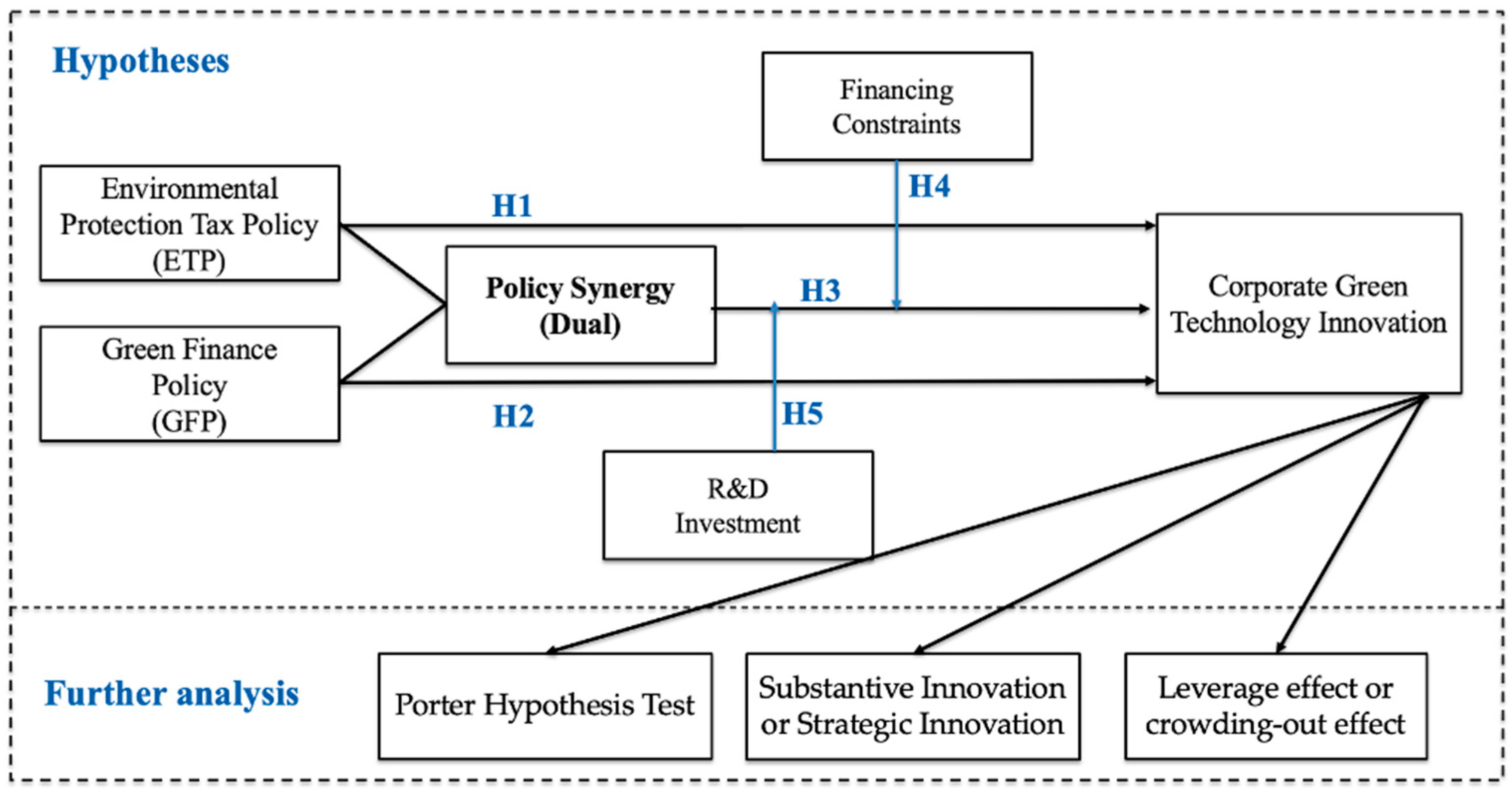
Hypothesis 4. The synergy between EPT and GFP promotes corporate green technology innovation by alleviating financing constraints.
Hypothesis 5. The synergy between EPT and GFP promotes corporate green technology innovation by strengthening R&D investment.
The conceptual model in this research is shown in
Figure 1.
5. Materials and Methods
5.1. Model Specification
To identify the net effect of the dual-policy shock arising from the joint implementation of the Green Finance Policy and the Environmental Protection Tax Policy on Corporate Green Technology Innovation, this study adopts a multi-period difference-in-differences (DID) model, which is widely used in policy evaluation research to identify the net effect of policy shocks by comparing changes between treatment and control groups over time [
97,
98]. This approach is appropriate in the present setting because the two policies were implemented across different regions and years, thereby forming a staggered policy-adoption structure. In this framework, cities exposed to the relevant policy implementation are treated as the treatment group, while cities not yet exposed to the policy in the same period serve as the control group.
The baseline specification is as follows:
where
,
, and
denote firm, city, and year, respectively. The dependent variable
measures the level of Corporate Green Technology Innovation of firm
located in city
in year
.
represents the set of firm-level and city-level control variables.
and
denote firm fixed effects and year fixed effects, respectively, controlling for time-invariant firm characteristics and macro-level shocks that may affect Corporate Green Technology Innovation. Standard errors are clustered at the firm level to address within-group correlation and serial correlation commonly encountered in panel DID settings [
99].
and
denote the Green Finance Policy and the Environmental Protection Tax Policy, respectively, and
is a dummy variable indicating whether city
is simultaneously subject to both policies in year
.
Equations (1)–(3) are used to examine the separate effects of the two individual policies and their synergistic effect. Specifically, Equation (1) reports the effect of the Green Finance Policy alone, Equation (2) reports the effect of the Environmental Protection Tax Policy alone, and Equation (3) provides a preliminary estimate of the synergistic effect captured by
. Building on these separate estimations, Equation (4) incorporates
,
, and
into a unified framework, to identify the incremental effect of policy synergy after accounting for the standalone effects of the two constituent policies. Therefore, Equation (4) serves as the main specification in the subsequent analysis. In this setting, the coefficient on
reflects whether the joint implementation of the two policies generates an additional synergistic effect on Corporate Green Technology Innovation. A significantly positive coefficient indicates complementary policy synergy, whereas an insignificant or negative coefficient suggests that the overlap fails to produce an additional innovation effect and may instead reflect policy crowding-out or implementation frictions [
100].
5.2. Variables
5.2.1. Dependent Variable
Corporate green technology innovation (RGPA) is used as the dependent variable in this study. Following Kong [
51], RGPA is measured as the natural logarithm of one plus the number of green invention patent applications in the current year. The definition is:
where
denotes the number of green invention patent applications filed by firm i in year t. This measure better captures substantive green innovation capability and helps avoid the “innovation quality identification bias” that may arise when broader patent categories are used.
5.2.2. Independent Variables
The core explanatory variables in this study are the Green Finance Policy (GFP), the Environmental Protection Tax Policy (ETP), and their synergy term Dual. The identification of the policy synergy effect in this paper primarily relies on a multi-period difference-in-differences framework, which serves as the main empirical strategy of the study [
101]. Since the two policies were implemented in different regions and years, they form a staggered policy-adoption setting. Following this logic, GFP and ETP are first constructed according to their respective treatment scope and implementation timing, and Dual is then defined as the synergy term between the two policy indicators.
First,
is used to capture the implementation of the Green Finance Policy. Following the official list of green finance reform and innovation pilot zones, cities located in the approved pilot areas are coded as the treatment group. Since different pilot areas entered the policy implementation stage in different years, the policy timing is assigned according to the actual year in which each city entered the pilot program. Therefore,
is defined as:
where
indicates whether city c belongs to a Green Finance Policy pilot area, and Post1_ct indicates whether year t falls in or after the implementation period of the Green Finance Policy in that city. In this study, the main green finance pilot cities entered the implementation period in 2017, while Lanzhou entered in 2019.
Second,
is used to capture the implementation of the Environmental Protection Tax Policy. Following the existing literature, this study defines the treatment group as cities located in provinces that raised the air-pollutant tax standard after the implementation of the Environmental Protection Tax Law. Accordingly,
is defined as:
where
indicates whether city
is in a province that increased the environmental tax standard, and
indicates whether year t falls in or after the implementation period of the Environmental Protection Tax Policy. Since the Environmental Protection Tax Law came into effect in 2018, the post-policy period begins in 2018 for the corresponding treatment regions.
On this basis, the core explanatory variable
is constructed as the interaction between
and
:
Thus, equals 1 when city is simultaneously under the implementation period of both the Green Finance Policy and the Environmental Protection Tax Policy in year t, and 0 otherwise. In this way, and capture the standalone effects of the two constituent policies, while captures the synergistic effect. Therefore, within the multi-period DID framework, Dual serves as the key treatment variable for identifying whether the joint implementation of the two policies generates a policy synergy effect on Corporate Green Technology Innovation.
5.2.3. Control Variables
To reduce omitted variable bias, this study controls for both firm-level and city-level characteristics. Firm-level control variables include firm size (Size), firm age (Age), Tobin’s Q (TQ), leverage (Lev), return on assets (ROA), the shareholding ratio of the largest shareholder (Top1), and the proportion of independent directors (Indep), revenue growth (Growth), state ownership (SOE), board size (Board), and chair–CEO duality (Duality).
City-level control variables include per capita GDP (GDP), industrial structure (Industry), regional tax burden (Tax), and regional financial development (Finance).
The definitions and measurement methods of all variables are summarized in
Table 1.
5.3. Data
This study uses Chinese A-share listed companies in the Shanghai and Shenzhen stock markets from 2011 to 2022 as the research sample. The data are processed as follows:
- (1)
Observations with missing firm-level control variables are excluded.
- (2)
Firms with listing status designated as “ST” or “*ST” are removed.
- (3)
Firms registered outside mainland China are excluded.
- (4)
Firms with substantial missing values in indicators required for key variable construction are dropped.
- (5)
To reduce the influence of extreme values, continuous variables are winsorized at the 1% level on both tails.
- (6)
A small number of missing city-level control observations are supplemented using linear interpolation.
The pilot regions and implementation timing of the Green Finance Reform and Innovation Pilot Zones and the Environmental Protection Tax reform are manually compiled from policy documents and official announcements released on the Chinese government portal. Firm-level and city-level data are mainly obtained from the China Stock Market and Accounting Research Database (CSMAR), the China Research Data Services Platform (CNRDS), and various issues of the China City Statistical Yearbook. After the above processing, the final sample consists of 3435 listed firms and 26,691 firm-year observations.
6. Results and Discussion
6.1. Descriptive Statistics
The descriptive statistics of the main variables are reported in
Table 2. The results show that the maximum value of Corporate Green Technology Innovation (RGPA) is 4.419, the minimum value is 0, the mean is 0.642, and the standard deviation is 1.015, indicating substantial variation in green technology innovation across firms. The mean value of the Dual policy variable (Dual) is 0.025, suggesting that approximately 2.5% of the firm-year observations in the sample are jointly affected by the Green Finance Policy and the Environmental Protection Tax Policy. The mean value of the Green Finance Policy variable (GFP) is 0.035, while the mean value of the Environmental Protection Tax Policy variable (ETP) is 0.389, indicating that the coverage of the green finance pilot is relatively limited, whereas the Environmental Protection Tax Policy applies to a much broader set of observations. The descriptive statistics of the other control variables are generally consistent with the existing literature and observed economic reality, providing a sound data foundation for the subsequent regression analysis.
6.2. Benchmark Regression
Table 3 reports the estimation results of the baseline regressions examining the impact of the joint implementation of the Green Finance Policy and the Environmental Protection Tax Policy on corporate green technology innovation (RGPA). Column (1) includes only the green finance policy variable (GFP) together with firm and year fixed effects. The coefficient on GFP is positive and statistically significant at the 1% level, indicating that the green finance policy significantly promotes corporate green technology innovation. This finding suggests that improved access to green credit and financial resources encourages firms to increase investments in green technological activities. In practical terms, this result implies that policy support from the financial side can effectively translate into greater green innovation input and output at the firm level. Therefore, the results in Column (1) provide empirical support for Hypothesis 1.
Column (2) introduces the environmental protection tax policy variable (ETP) under the same fixed-effects specification. The coefficient on ETP is positive and significant at the 5% level, indicating that the environmental protection tax policy also contributes to promoting corporate green technology innovation. This result supports the view that environmental taxation can create regulatory pressure and cost incentives that encourage firms to adopt cleaner technologies and improve environmental performance. In other words, the tax policy does not merely increase compliance pressure, but also appears to induce firms to respond through innovation adjustment. Accordingly, the results in Column (2) support Hypothesis 2.
Column (3) reports the baseline specification by introducing the interaction variable Dual, which captures the joint implementation of the two policies, while controlling for firm-level and city-level characteristics. The coefficient on Dual is positive and statistically significant at the 1% level, suggesting that the overlapping implementation of green finance policy and environmental protection tax policy significantly enhances corporate green technology innovation. Since the dependent variable is measured as ln(1 + green invention patent applications), the positive coefficient also indicates that the effect is economically meaningful rather than merely statistically detectable, implying a sizable increase in green invention patenting when firms are simultaneously exposed to the two policy environments. This finding provides preliminary support for Hypothesis 3.
Column (4) further includes GFP, ETP, and Dual simultaneously in the same regression framework to disentangle the independent effects of individual policies from their combined impact. The coefficient on Dual remains significantly positive at the 1% level and its magnitude remains relatively stable, indicating that the positive effect of policy synergy persists even after controlling for the individual policy effects. In substantive terms, the estimated coefficient on Dual in Column (4) suggests that other things being equal, the joint implementation of the two policies is associated with an increase of about 26% in green invention patent applications. It indicates that the overlap between green finance support and environmental tax pressure generates a meaningful improvement in firms’ green innovation performance. The result provides stronger evidence in support of Hypothesis 3.
Overall, the coefficient on Dual remains significantly positive across different specifications. Taken together, the baseline results indicate not only that the policy synergy effect is statistically robust, but also that its economic magnitude is substantial at the firm level. These baseline results provide strong evidence that the synergistic implementation of green finance policy and environmental protection tax policy significantly promotes corporate green technology innovation, laying the foundation for subsequent parallel-trend tests, endogeneity analyses, and robustness checks.
6.3. Parallel Trend Test
The validity of the DID design hinges on the parallel trend’s assumption. Following Wu et al. (2025) [
1], this study adopts an event-study framework to test pre-trends for the Environmental Protection Tax Policy (ETP), the Green Finance Policy (GFP), and the dual-policy (Dual) specifications:
where
,
, and
denote firm, city, and year, and
is the event-time indicator relative to the policy start year. Observations earlier than four years before treatment are collapsed into
. Controls, fixed effects, and clustered standard errors are consistent with the baseline model.
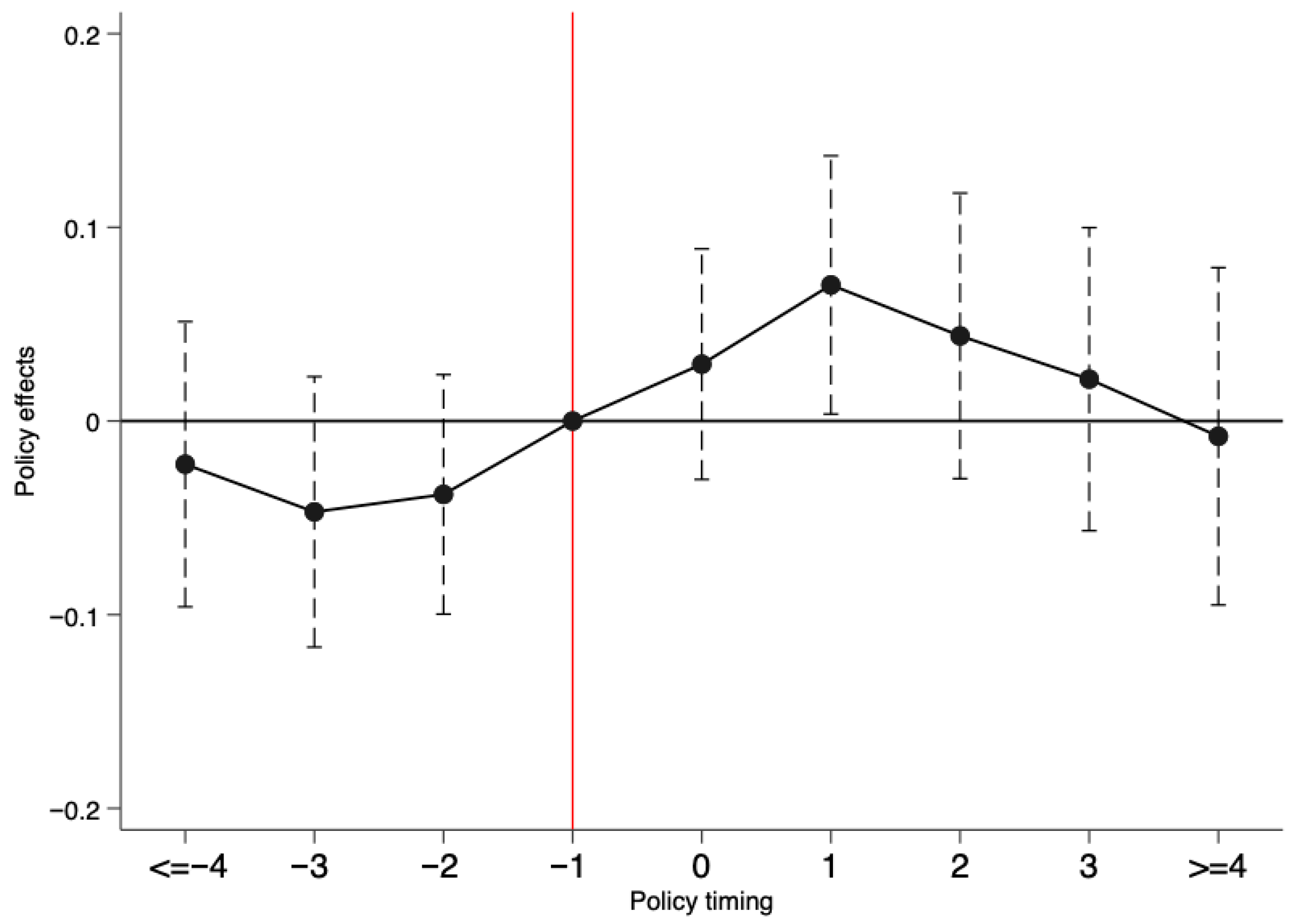
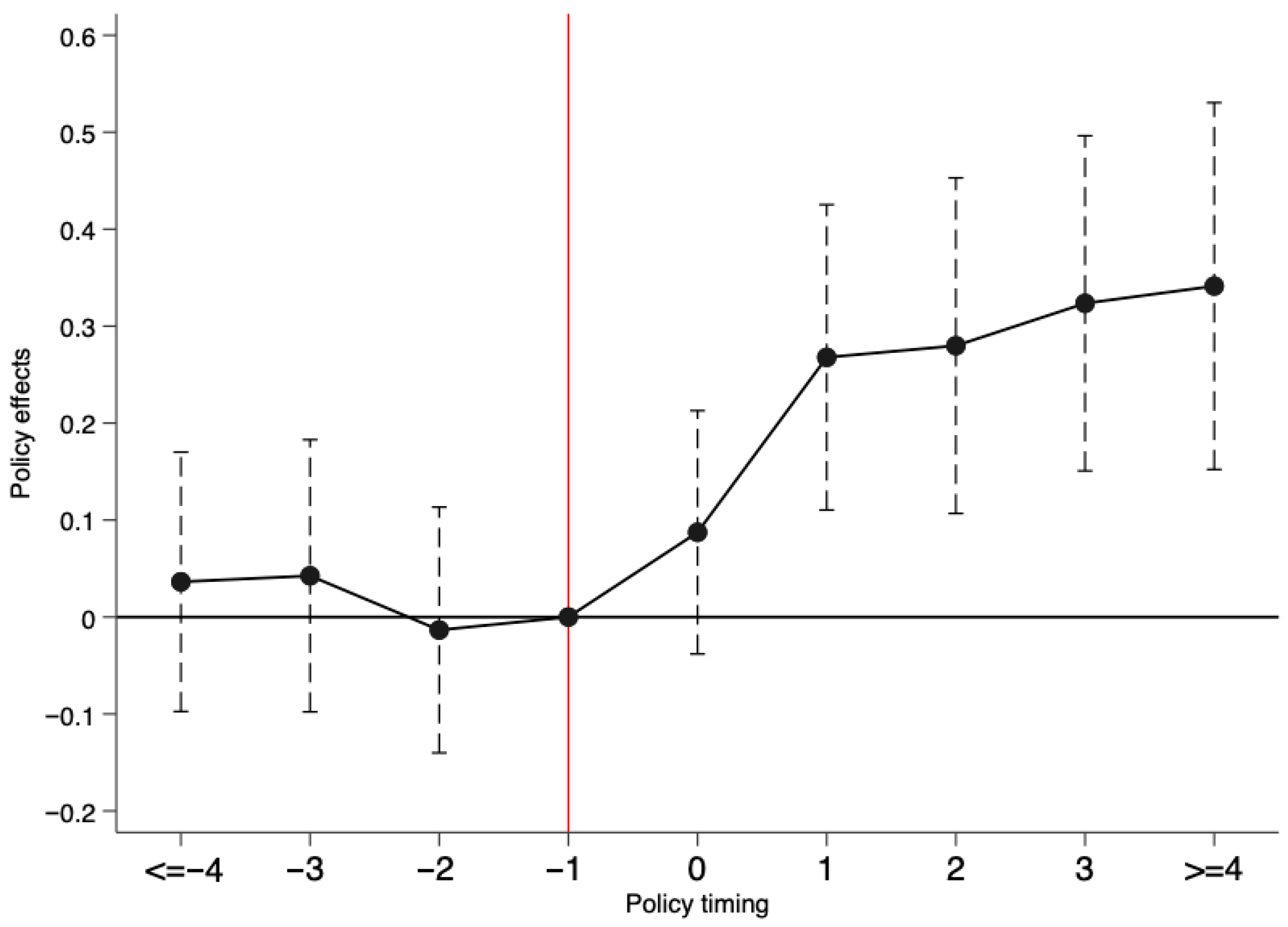
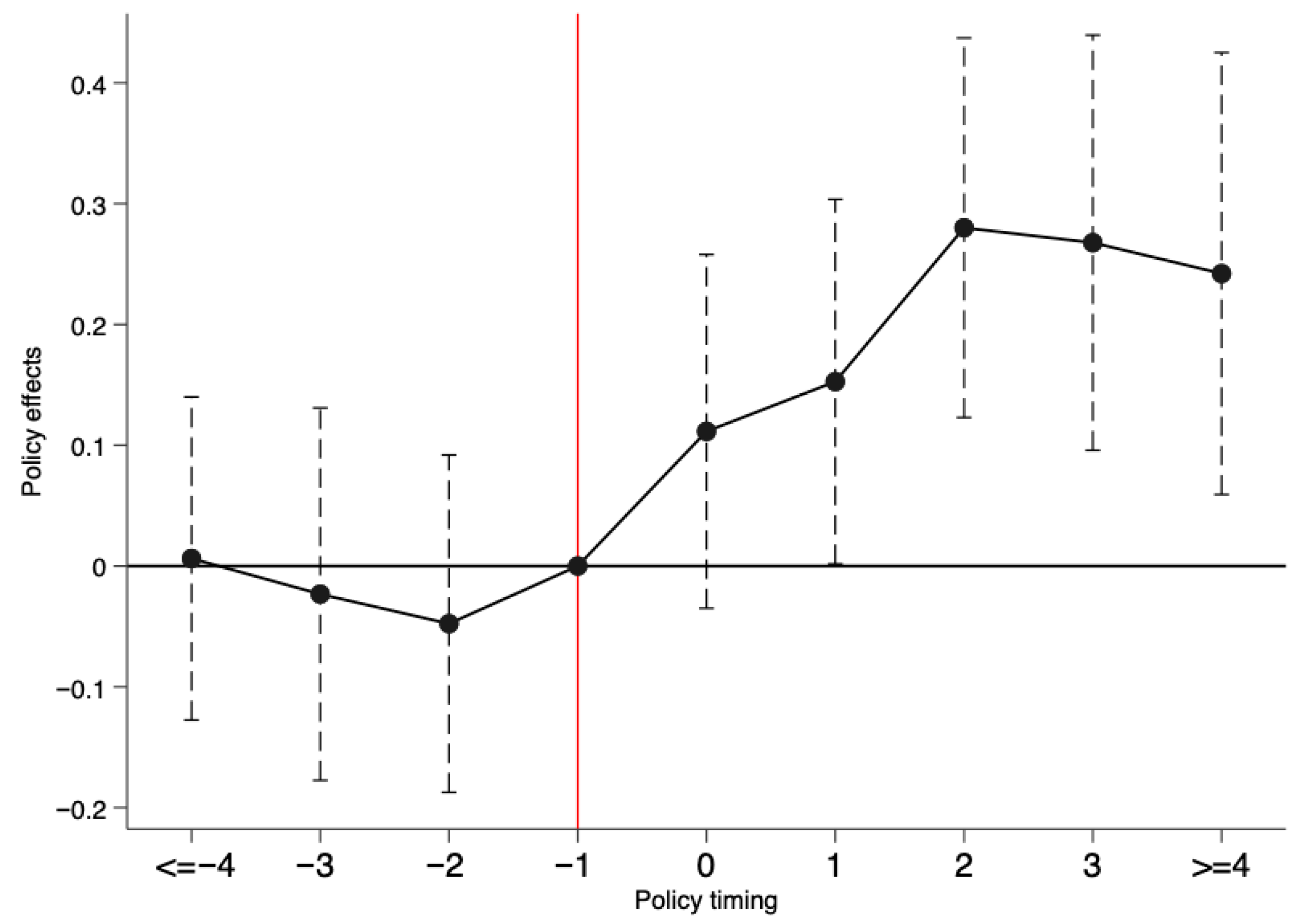
As shown in
Figure 2,
Figure 3 and
Figure 4, the pre-policy coefficients are jointly insignificant and display no systematic pre-trend under the ETP, GFP, and Dual specifications, supporting the parallel trends assumption. After implementation, the dynamic coefficients turn positive. For ETP and GFP, post-policy effects become positive and remain stable, while the dual-policy specification shows a clearer and more persistent increase. In particular, the post-treatment coefficients under Dual are positive from the first year and remain relatively stable thereafter, indicating that the green finance–environmental tax synergy generates a sustained effect on corporate green technology innovation rather than a short-lived fluctuation.
6.4. Endogenous Analysis
Although this study treats the joint implementation of the green finance and environmental protection tax pilots as a quasi-natural experiment and controls for firm and year fixed effects in the baseline regressions, endogeneity concerns may remain. First, the selection of pilot cities is unlikely to be fully random. Pre-existing differences in financial development, industrial structure, and governance capacity may affect both the probability of policy adoption and firms’ green technology innovation, creating sample self-selection bias. Second, unobserved time-varying factors may still influence both policy implementation and innovation outcomes, leading to omitted-variable bias. Third, if the policy–innovation linkage is nonlinear, a conventional linear specification may introduce model misspecification bias. To address these issues, this study applies three complementary approaches: instrumental variables (IV), PSM-DID, and double machine learning (DML).
6.4.1. IV Method
To enhance empirical reliability, this study adopts an instrumental variable (IV) approach. Following Yin et al. (2025) [
66], this study uses the natural logarithm of annual urban green coverage area, measured as the built-up green coverage area in hectares, as the baseline instrumental variable. In addition, the logarithm of city-level bird-report counts is introduced as an auxiliary instrument. Specifically, the instrumental variables are constructed as follows:
where
denotes the built-up green coverage area of city
in year
, and
denotes the total number of bird-observation reports recorded in city
in year
. The green-area data are obtained from the China Urban Construction Statistical Yearbook and merged into the firm-year sample by city and year. The bird-report data are obtained from the China Bird Watching Center website and likewise merged into the firm-year sample by city and year.
Regarding relevance, built-up green coverage area reflects the ecological endowment and green-space infrastructure of a city. Cities with larger green coverage areas usually indicate stronger local emphasis on environmental protection and greener urban governance, which makes them more likely to provide favorable conditions for the coordinated implementation of Green Finance Policy and Environmental Protection Tax Policy and therefore more likely to enter the dual-policy overlap state. Similarly, bird-report counts reflect the intensity of local ecological observation activity and environmental participation. Cities with more active bird-observation reporting tend to exhibit stronger environmental attention and ecological engagement, which is also conducive to local policy coordination and increases the likelihood of policy overlap.
Regarding exogeneity, both GreenArea and BirdReports are city-level ecological and environmental-condition variables rather than firm-level economic choices. Built-up green coverage area is largely shaped by long-term urban planning and ecological governance [
12,
66], while bird-report activity reflects the broader local ecological observation environment. These factors are unlikely to directly determine an individual firm’s contemporaneous green innovation decision. Moreover, after controlling for firm-level and city-level covariates and further absorbing firm and year fixed effects, the possibility that these instruments affect Corporate Green Technology Innovation through alternative direct channels is substantially reduced.
Table 4 reports the 2SLS results based on GreenArea and BirdReports. Column (1) presents the first-stage regression, where the coefficients of GreenArea and BirdReports on the endogenous variable Dual are 0.024 and 0.005, respectively, both statistically significant at the 1% level, confirming strong relevance. Column (2) reports the second-stage estimates. After controlling for firm fixed effects, year fixed effects, and firm- and city-level controls, the coefficient on Dual is 4.094 and remains significantly positive at the 1% level, consistent in direction with the baseline results. The Kleibergen–Paap rk LM statistic is 36.092 (
p < 0.001), rejecting under-identification. The Cragg–Donald Wald F statistic is 42.465 and the Kleibergen–Paap rk Wald F statistic is 17.297, indicating that weak-instrument concerns are limited. In addition, the Hansen J statistic is 0.071 with a
p-value of 0.790, suggesting that the overidentifying restrictions cannot be rejected. Overall, the IV results support the validity of the instruments and further confirm the robustness of the positive effect of policy synergy on Corporate Green Technology Innovation.
6.4.2. PSM-DID
To enhance the comparability between pilot and non-pilot areas, this study further applies the PSM-DID approach to mitigate potential endogeneity concerns. Specifically, firm-level and city-level control variables are used as matching covariates, and the control group is constructed using 1:4 nearest-neighbor matching. Based on the matched sample, this study re-estimates the impact of policy synergy on Corporate Green Technology Innovation.
As reported in
Table 5, the coefficient on Dual remains positive and statistically significant after matching. The estimated coefficient is 0.211 and significant at the 5% level, indicating that the core conclusion remains robust after improving the comparability between the treatment group and the control group.
6.4.3. Double Machine Learning Method
The double machine learning method proposed by Bodory et al. (2022) [
102] is used to address potential model misspecification and further validate the causal effect of the dual-pilot policy on corporate green technology innovation. Compared with conventional regression frameworks, DML is better suited to high-dimensional settings, as it flexibly handles variable selection and functional-form uncertainty, thereby reducing bias in causal identification.
This study implements a partially linear DML model with a LASSO learner and five-fold cross-fitting, controlling for firm and year fixed effects and clustering standard errors at the firm level. To test robustness to functional-form flexibility, the control set is expanded from first-order terms to second-order and third-order polynomial terms. As reported in
Table 6, the estimated coefficients of Dual are 0.320 (SE = 0.075), 0.326 (SE = 0.075), and 0.336 (SE = 0.075), all significant at the 1% level. The estimates are highly consistent in sign and magnitude, indicating that under more flexible functional-form assumptions and data-driven variable selection, the positive effect of policy synergy on corporate green technology innovation remains robust.
6.5. Robustness Test
6.5.1. Placebo Test
Following Ferrara et al. (2012) [
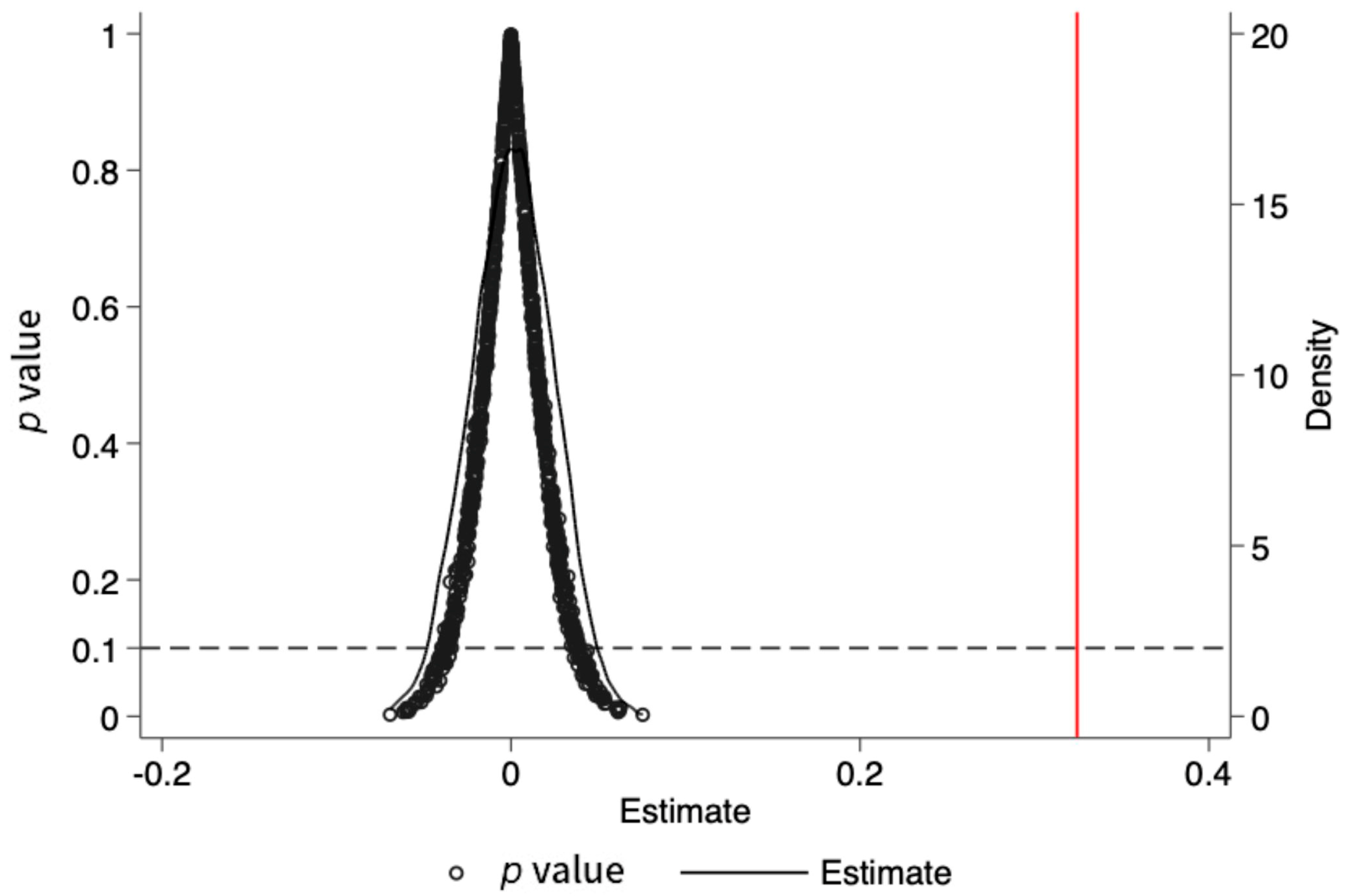
103], this study conducts a permutation test by generating placebo policy shocks. Keeping the model specification unchanged, we re-estimate the regression 1000 times and examine the distribution of placebo coefficients and their corresponding
p-values. As shown in
Figure 5, the placebo coefficients are tightly centered around zero, and most placebo p-values lie above the 0.1 threshold. By contrast, the actual Dual estimate from the baseline regression (approximately 0.32, marked by the red line) lies clearly in the right tail of the placebo distribution. This pattern indicates that the baseline effect is unlikely to be driven by random noise and supports the statistical identification of the policy synergy effect.
6.5.2. Excluding Concurrent Policies
Considering that multiple concurrent policies may have been implemented during the sample period, this study further controls for a series of policy variables, including the National Innovative City Pilot (innovation_city), the Comprehensive Financial Reform Pilot Zone (finance_reform), the Carbon Emissions Trading Pilot (carbon_emission), and the Energy-Conservation Pilot (energy_conservation).
First, to exclude the confounding effect of innovation-related policies, this study introduces the interaction term between Dual and the National Innovative City Pilot (Interaction1 = Dual × innovation_city) [
104]. Since innovation-related policies may affect firms’ green technology activities through local innovation support and policy incentives, failing to account for them may bias the estimated policy synergy effect. As shown in column (1) of
Table 7, Interaction1 is not statistically significant. Although the coefficient on Dual remains positive, it is not statistically significant in this specification, suggesting that the synergistic effect is not amplified by the innovative city pilot policy.
Second, to rule out the interference of broader financial reform policies, this study includes the interaction term between Dual and the Comprehensive Financial Reform Pilot Zone (Interaction2 = Dual × finance_reform) [
105]. As reported in column (2) of
Table 7, Interaction2 is not statistically significant, while the coefficient on Dual remains significantly positive at the 1% level. This indicates that the estimated policy synergy effect cannot be explained by the shock induced by general financial reform policies.
Third, to exclude potential interference from carbon trading and energy-conservation policies, this study further includes the interaction terms between Dual and the Carbon Emissions Trading Pilot (Interaction3 = Dual × carbon_emission) [
106] and between Dual and the Energy-Conservation Pilot (Interaction4 = Dual × energy_conservation). Columns (3) and (4) show that both interaction terms are statistically insignificant. In column (3), the coefficient on Dual remains positive but becomes statistically insignificant, whereas in column (4) the coefficient on Dual remains positive and significant at the 5% level. These results suggest that the estimated synergistic effect is not driven by either the carbon-trading pilot or the energy-conservation pilot.
Overall, after interacting Dual with these concurrent policies one by one, none of the additional interaction terms is statistically significant. At the same time, the coefficient on Dual remains positive in all specifications and remains statistically significant in the specifications controlling for broader financial reform and energy-conservation policies. Taken together, these results suggest that the positive effect of the joint implementation of the Green Finance Policy and the Environmental Protection Tax Policy is not simply a reflection of other concurrent policy shocks, and the main conclusion therefore remains robust.
6.5.3. Alternative Measures of the Dependent Variable
Existing studies show that the measurement of green innovation may significantly affect policy-evaluation results. If only a single indicator is used, it may blur the distinction between the expansion of innovation activity and the improvement of innovation outcomes [
107,
108]. Considering that the measurement of the dependent variable may influence the robustness of the main findings, this study adopts alternative measures of the dependent variable and re-estimates the baseline model as a robustness check.
First, following Bellemare and Wichman [
109], this study applies the inverse hyperbolic sine (IHS) transformation to the number of green invention patent applications and denotes the transformed variable as GI_New. The regression results reported in column (1) of
Table 8 show that the coefficient on Dual is 0.291 and is significant at the 1% level, indicating that the promoting effect of the dual-policy synergy on corporate green innovation remains robust under the IHS specification.
Second, this study uses the granted green invention patent indicator (GI_Grant) as an alternative measure.
This variable is defined as the natural logarithm of one plus the number of granted green invention patents. Compared with patent applications, patent grants generally undergo a stricter examination process and can better reflect the realizability and technological content of innovation outcomes; they can therefore serve as a more quality-oriented measure. As shown in column (2) of
Table 8, the coefficient on Dual is 0.272 and significant at the 1% level, which is consistent with the baseline regression in both sign and significance.
Taken together, after replacing the dependent variable, the estimated coefficients on Dual remain significantly positive and consistent with the baseline results. This suggests that the core conclusion, namely that the synergy between the Green Finance Policy and the Environmental Protection Tax Policy significantly promotes Corporate Green Technology Innovation, does not depend on a single measurement approach, and therefore remains robust.
6.5.4. Additional Robustness Tests
Further robustness checks are conducted to strengthen the credibility of the baseline findings. Specifically, seven additional tests are implemented.
- (1)
City-by-year trend terms are added to absorb time-varying city-level shocks that may affect firms’ green technology innovation.
- (2)
Industry-by-year trend terms are included to account for industry-specific cyclical and technology-cycle fluctuations.
- (3)
The clustering level is adjusted by clustering standard errors at the industry level.
- (4)
The clustering level is adjusted by clustering standard errors at the provincial level.
- (5)
The sample is restricted to 2015–2021 to mitigate potential serial-correlation concerns associated with a relatively long panel.
- (6)
Direct-controlled municipalities (Beijing, Tianjin, Shanghai, and Chongqing) are excluded to rule out the influence of their special administrative status.
- (7)
Firms with zero total green invention patent applications over the full sample period are excluded to ensure that the results are not driven by firms without meaningful green innovation activity.
The corresponding estimates are reported in
Table 9, Columns (1)–(7). Across all specifications, the coefficient on Dual remains positive and statistically significant, ranging from 0.206 to 0.233. More specifically, the coefficient is 0.225 after adding city-by-year trends, 0.232 after adding industry-by-year trends, 0.231 when clustering standard errors at the industry level, and 0.231 when clustering at the provincial level. When the sample is restricted to 2015–2021, the coefficient on Dual is 0.222. After excluding direct-controlled municipalities, the coefficient is 0.206, and after excluding firms with zero green invention patent applications throughout the sample period, it is 0.233.
These results are informative in several respects. First, the coefficients remain stable after controlling for city-specific and industry-specific time trends, suggesting that the baseline findings are unlikely to be driven by unobserved local shocks or sectoral trend differences. Second, the positive effect of Dual persists when the clustering level is adjusted, indicating that the statistical significance of the baseline result does not depend on a particular way of estimating standard errors. Third, the coefficient remains significantly positive after restricting the sample period and after excluding municipalities and non-innovative firms, which suggests that the main conclusion is not driven by special regions, by the full-panel structure, or by firms with persistently zero green innovation output.
Overall, both the sign and the significance of Dual remain stable across these additional tests. This indicates that the estimated synergy effect of the Green Finance Policy and the Environmental Protection Tax Policy on Corporate Green Technology Innovation is robust to a wide range of alternative specifications and sample restrictions.
7. Mechanism Analysis
The focus is placed on two mechanisms that are supported by the empirical evidence, namely financing constraints and R&D investment.
Following the classical three-step mediation approach, the mechanism analysis is specified as follows:
where
denotes Corporate Green Technology Innovation of firm
in city
and year
;
is the dual-policy synergy variable;
represents the mediating variable, including the financing constraint index (WW) and R&D intensity (innovation_cost);
is the set of control variables;
and
denote firm and year fixed effects, respectively; and
is the error term.
Financing constraints are measured by the WW index following Whited and Wu (2006) [
110], where a higher value indicates tighter financing constraints.
where CF is the ratio of net operating cash flow to total assets;
is a cash-dividend dummy (1 if the firm pays cash dividends in the current year, 0 otherwise);
is the ratio of long-term debt to total assets;
is the natural logarithm of total assets;
is the industry-average sales growth rate (based on the CSRC industry classification, using two-digit codes for manufacturing and one-digit codes for other industries); and
is the firm’s sales growth rate. A higher WW value indicates tighter financing constraints.
R&D intensity is measured by the ratio of R&D expenditure to operating revenue (innovation_cost), which reflects the level of firms’ R&D resource allocation and investment effort.
The results are reported in
Table 10. Columns (1)–(3) examine the financing-constraint channel. Column (1) reports the total effect of Dual on RGPA, which is significantly positive. Column (2) shows that Dual significantly reduces the WW index, indicating that policy synergy alleviates firms’ financing constraints. Column (3) further includes both Dual and WW in the regression of RGPA. The coefficient on WW is significantly negative, and the coefficient on Dual declines from 0.324 to 0.311, indicating that financing constraints play a partial mediating role. The indirect effect is estimated at 0.0126, accounting for approximately 3.89% of the total effect.
Columns (4)–(6) examine the R&D-investment channel. The results show that Dual significantly increases firms’ R&D intensity. After innovation_cost is included in the outcome equation, its coefficient is significantly positive, while the coefficient on Dual declines from 0.259 to 0.250. The corresponding indirect effect is 0.0090, accounting for approximately 3.46% of the total effect. This indicates that R&D investment also serves as a partial mediating channel.
Overall, the mechanism analysis suggests that the coordinated implementation of Green Finance Policy and Environmental Protection Tax Policy promotes Corporate Green Technology Innovation partly by alleviating financing constraints and strengthening firms’ R&D investment. These findings provide more rigorous evidence on how the policy synergy effect is transmitted at the firm level. Therefore, Hypothesis 4 and Hypothesis 5 are supported.
8. Heterogeneity Analysis and Further Analysis
8.1. Firm Heterogeneity
A further question arises as to whether this policy effect is uniformly distributed across different types of firms. If the policy impact is concentrated within specific firm groups, this would suggest that, while improving overall efficiency, the policy mix may also generate structural differentiation. Accordingly, this section conducts firm-level heterogeneity analyses to identify which types of firms are more capable of transforming the dual-policy shock into green innovation outputs.
Following the approach of Hope et al. (2020) [
111], treated firms are divided into size-based, ESG-based, and ownership-based subgroups, and each subgroup is regressed separately against the control group. Specifically, firms are classified as large or small based on the median operating revenue (Size_big = 1 if revenue exceeds 2.02 × 10
9), firms are grouped by ESG performance using the sample median of ESG scores (ESG_high = 1 if ESG ≥ 5), and firms are divided into SOEs vs. non-SOEs. In addition, firms are further grouped by digital transformation intensity, where Digital_high = 1 if the CSMAR digital transformation index exceeds the sample median (34.7664).
The regression results in
Table 11 reveal substantial heterogeneity in the dual-policy synergy effect across firm characteristics. The coefficient on Dual is positive and significant in all groups, but larger in SOE (0.415 ***) than non-SOE (0.245 **), higher in high-ESG firms (0.410 ***) than low-ESG firms (0.221 ***), higher in large firms (0.376 ***) than small firms (0.175 *), and higher in high-digital firms (0.364 ***) than low-digital firms (0.234 **). Bootstrap-based Fisher tests further show that coefficient differences are significant for ESG groups (
p = 0.039) and size groups (
p = 0.017), marginally significant for SOE groups (
p = 0.042), and significant at the 10% level for digitalization groups (
p = 0.082). Overall, these results indicate that the policy synergy effect is stronger among firms with higher governance quality, larger scale, state ownership, and stronger digital capability.
From a policy perspective, enhancing the breadth and equity of policy coverage requires complementary support for smaller, lower-ESG, and non-SOE firms, as well as firms with weaker digital capabilities. Addressing their constraints in financing, governance, and organizational capacity would improve the overall effectiveness and inclusiveness of policy transmission.
8.2. Industry Heterogeneity
This study conducts industry-level heterogeneity analyses along two dimensions: pollution intensity and industrial classification. In terms of pollution attributes, based on the Guidelines for the Industry Classification of Listed Companies (2012 Revision) issued by the China Securities Regulatory Commission (CSRC), the Industry Classification Management Catalogue for Environmental Verification of Listed Companies issued by the former Ministry of Environmental Protection, and the Guidelines for Environmental Information Disclosure of Listed Companies, the sample is divided into heavily polluting and non-heavily polluting industries. In terms of industrial attributes, firms are classified into manufacturing and non-manufacturing sectors according to the Guidelines for the Industry Classification of Listed Companies (2012 Revision). Under a consistent specification controlling for firm-level covariates, firm fixed effects, and year fixed effects, the policy synergy coefficient is estimated separately for each subgroup to examine whether the dual-policy effect varies across industry characteristics.
The results in
Table 12 show clear heterogeneity. The coefficient on Dual is 0.223 in heavily polluting industries and 0.373 * in non-heavily polluting industries. In manufacturing sectors, the coefficient is 0.212 *, whereas in non-manufacturing sectors it is 0.511 *. The Fisher test for the manufacturing and non-manufacturing split indicates a statistically significant coefficient difference (0.299 ***). Overall, the policy synergy effect is much stronger in non-heavily polluting and non-manufacturing industries, suggesting that industry characteristics significantly shape the transmission of the dual-policy effect.
This heterogeneity is economically interpretable. First, firms in heavily polluting and manufacturing sectors generally face higher compliance costs, tighter financing conditions, and greater technical retrofit difficulty. When exposed to policy shocks, they tend to allocate resources toward end-of-pipe treatment, compliance upgrades, and emission-standard fulfillment. As a result, marginal funds available for frontier green R&D may be crowded out in the short run, leading to a pattern in which compliance-oriented investment precedes innovation-oriented investment. Second, manufacturing firms usually have higher fixed-asset intensity and longer technology-upgrade cycles. Green technology substitution often requires integrated production-line adjustment and extended construction periods, making it difficult for policy incentives to translate quickly into observable patent outputs. Third, non-heavily polluting and non-manufacturing firms typically have shorter technology cycles, more flexible R&D organization, and lower adjustment costs. These characteristics allow them to convert green finance support and environmental tax pressure into green innovation more rapidly.
Overall, the industry heterogeneity results suggest that the short-term innovation dividends from dual-policy coordination are concentrated in sectors with lower adjustment costs and higher technological substitution elasticity. In contrast, in capital-intensive and heavily polluting sectors, the policy effect is more likely to appear as gradual and lagged innovation responses rather than immediate patent outcomes.
8.3. Regional Heterogeneity
To identify spatial differences in the transmission of the dual-policy synergy effect, this study conducts subgroup analyses along three dimensions: environmental regulatory attention, financial development, and intellectual-property protection The grouping strategy is as follows. First, regional environmental regulatory attention is measured by the frequency of green-transition keywords in municipal government work reports, and regions are divided into high and low environmental-attention groups using the sample median (data source: CNRDS). Second, regional financial development is proxied by the ratio of total deposits and loans of financial institutions to regional GDP, and regions are divided into high and low financial-development groups using the median. Third, intellectual-property protection is proxied by whether a city is designated as a National IP Demonstration City, dividing firms into IP-high and IP-low groups. For each classification, treated firms within each subgroup are estimated separately against the control group under the baseline specification.
The regression results are reported in
Table 13. The coefficient on Dual is significantly positive in the high environmental-attention group (0.291 ***) but not significant in the low-attention group (0.304). It is significantly positive in the high financial-development group (0.412 ***) but not significant in the low-development group (0.115). Likewise, the coefficient is significantly positive in the high IP-protection group (0.283 ***) but not significant in the low-IP group (0.511). These findings indicate that the synergy effect does not operate automatically across regions; instead, it depends on the strength of local regulatory attention, financial resources, and institutional protection for innovation.
This spatial heterogeneity is economically interpretable. Regions with stronger regulatory attention tend to enforce policies more consistently, creating stable expectations that encourage firms to respond through innovation rather than short-term compliance. Regions with higher financial development provide more accessible credit and financial instruments, allowing firms to translate policy signals into R&D inputs more effectively. Stronger IP protection increases the expected returns to innovation, making green R&D more attractive and reducing the risk of expropriation. By contrast, in regions with weaker regulatory attention, financial depth, or IP protection, policy shocks are more likely to remain at the cost-constraint level and fail to translate into sustained green innovation.
Overall, the regional heterogeneity results reveal a pronounced condition-dependent pattern in the dual-policy synergy effect. Regions characterized by stronger regulatory attention, deeper financial systems, and better IP protection are better positioned to realize the innovation dividends generated by policy coordination, whereas the effect is weaker or statistically insignificant in regions where these conditions are lacking.
8.4. Further Analysis
A further set of questions then arises: Can this innovation-promoting effect be translated into efficiency gains? Do the innovation outcomes mainly take the form of quantity expansion or quality improvement? If short-term efficiency does not improve, is the policy shock more consistent with a leverage effect or a crowding-out effect? To address these issues, the following subsection conducts three sets of further analyses.
8.4.1. Porter Hypothesis Test
The Porter Hypothesis argues that appropriately designed environmental regulation can stimulate innovation and, under certain conditions, improve firms’ competitiveness and productivity through innovation-compensation effects [
112]. Following Jaffe and Palmer [
61], the weak version of the Porter Hypothesis suggests that environmental regulation can stimulate technological innovation, whereas the strong version requires that the induced innovation be sufficient to offset compliance costs and ultimately improve productivity or firm performance [
61].
Existing studies generally suggest that the innovation-inducing effect of environmental regulation is the most consistently supported part of the Porter Hypothesis, whereas productivity improvement is more conditional and often depends on policy design, institutional setting, and adjustment time [
2,
113]. In particular, Lanoie et al. (2008) [
113] show that the contemporaneous effect of environmental regulation on productivity may be negative, while the effect may become weaker or even positive once lagged adjustment is taken into account. Recent studies based on Chinese firms and regions further confirm that the realization of Porter-type effects is sensitive to regulatory flexibility, institutional environment, and innovation structure [
114,
115,
116].
In the context of this study, the positive effect of policy synergy on Corporate Green Technology Innovation, as established in the baseline and robustness analyses, is consistent with the weak Porter Hypothesis. Whether this innovation effect can be translated into productivity improvement, however, remains an empirical question. To examine this issue, firm-level total factor productivity (TFP) is used as the dependent variable. Specifically, five alternative TFP measures are employed: TFP_OP (Olley–Pakes method), TFP_LP (Levinsohn–Petrin method), TFP_OLS (ordinary least squares production-function method), TFP_FE (fixed-effects production-function method), and TFP_GMM (GMM-based production-function method). These measures are widely used to address endogeneity in production-function estimation and to improve the robustness of productivity measurement.
The results in
Table 14 show that the coefficient on Dual is −0.123, −0.116, −0.131, −0.134, and −0.113 across the five TFP measures, and all coefficients are statistically significant. This indicates that, within the sample period, although policy synergy significantly promotes green innovation, its short-term productivity effect remains negative.
This result is consistent with the Porter Hypothesis literature, which suggests that innovation may respond earlier than productivity and that the compensation effect often involves a time lag [
2,
113]. The joint implementation of the Green Finance Policy and the Environmental Protection Tax Policy may induce firms to increase green R&D, equipment renewal, process adjustment, and organizational restructuring. These changes strengthen innovation incentives, but they may also raise production and compliance costs in the short run. As a result, the innovation effect may appear earlier, whereas the productivity effect may be delayed. This interpretation is also consistent with studies showing that the realization of Porter-type effects depends not only on whether innovation is stimulated, but also on whether such innovation is sufficiently substantive and whether institutional conditions allow innovation gains to be gradually transformed into efficiency improvements [
114,
115].
8.4.2. Substantive Innovation or Strategic Innovation
After establishing that the dual-policy synergy significantly promotes Corporate Green Technology Innovation, it is still necessary to determine whether this effect is reflected more in substantive innovation or in strategic innovation. Existing studies suggest that policy incentives do not necessarily improve the technological content and practical value of innovation at the same time. Under multiple institutional pressures such as tax incentives, subsidies, and performance assessment constraints, firms may respond more quickly by engaging in innovation activities with lower entry thresholds and shorter output cycles. As a result, policy shocks may sometimes induce the growth of low-complexity or marginal patents without necessarily generating parallel improvements in higher-value innovation [
117,
118,
119]. Against this background, this study further examines whether the dual-policy effect mainly promotes substantive green innovation or strategic green innovation.
To this end, total green patent applications are further decomposed into substantive innovation and strategic innovation. Green invention patents generally involve higher technological content, stricter examination standards, and stronger knowledge-creation attributes, and are therefore more closely associated with substantive innovation. By contrast, green utility model patents involve lower application thresholds and shorter authorization cycles and are more likely to capture firms’ strategic responses to policy incentives. Based on this distinction, three outcome variables are constructed. First,
measures the total number of green patent applications and captures the overall level of green innovation. Second,
measures green utility model patent applications and is used to characterize green strategic innovation. Third,
measures the logarithm of the total citations of green invention patents and is used to capture substantive green innovation. Specifically,
where
denotes the number of green invention patent applications of firm
in year
,
denotes the number of green utility model patent applications, and
denotes the total citations of green invention patents. Since invention-patent citations better reflect the technological influence and practical value of innovation output, they are used here as a proxy for substantive green innovation.
Table 15 reports the empirical results. Column (1) shows that the coefficient on Dual for the total green patent applications variable
is 0.252 and significant at the 1% level, indicating that the dual-policy synergy significantly increases overall green innovation output. Column (2) shows that the coefficient on Dual for green utility model patents
is −0.026, but statistically insignificant, suggesting that the dual-policy synergy does not significantly stimulate green strategic innovation. Column (3) shows that the coefficient on Dual for green invention patent citations
is 0.353 and significant at the 5% level, indicating that the dual-policy synergy significantly enhances substantive green innovation.
The further-analysis results show that the dual-policy synergy significantly increases overall green innovation output and substantive green innovation but does not significantly promote strategic green innovation. These findings suggest that the innovation effect of the dual-policy synergy is not mainly reflected in lower-threshold, short-cycle strategic patenting, but is more strongly associated with substantive green innovation. In other words, the coordinated implementation of the Green Finance Policy and the Environmental Protection Tax Policy not only expands firms’ green innovation activities, but also contributes more to innovation outcomes with stronger technological content and higher innovation value. This finding is consistent with the baseline result that Dual significantly promotes Corporate Green Technology Innovation.
8.4.3. Leverage Effect or Crowding-Out Effect
The baseline regressions show that the dual-policy synergy significantly increases corporate green technology innovation (RGPA). A further question is whether this improvement reflects a leverage effect. Overall innovation expands together with green innovation—or a crowding-out effect, in which firms reallocate existing innovation resources toward green innovation without expanding total innovation activity. Existing studies propose two competing mechanisms:
- (1)
Leverage effect: regulatory pressure strengthens innovation incentives and technological upgrading, prompting firms to increase R&D beyond existing efforts, thereby raising both green innovation and overall innovation.
- (2)
Crowding-out effect: under tighter constraints, firms shift existing R&D resources and human capital from other innovation activities toward green innovation, so green innovation rises but total innovation does not necessarily expand [
36,
120,
121].
To distinguish between these mechanisms, this study re-estimates the model using total firm innovation and total invention innovation as dependent variables. Specifically,
The second measure is emphasized because the baseline dependent variable is based on green invention patents.
The results in
Table 16 show that after the dual-policy implementation, Dual is not statistically significant in either regression. Combined with the baseline finding that Dual significantly promotes green technology innovation, this suggests that the dual-policy synergy does not significantly expand firms’ overall innovation frontier. Instead, it is more consistent with a crowding-out effect, whereby firms reallocate existing innovation resources toward green innovation. In other words, the observed increase in green innovation reflects a reorientation of innovation direction rather than a parallel expansion of total innovation activity. This interpretation is also consistent with the earlier Porter-hypothesis test: the strong Porter effect is not supported, implying that within the current sample period the dual-policy synergy primarily strengthens green innovation orientation rather than broader innovation expansion or efficiency improvement.
9. Conclusions and Policy Recommendations
Against the backdrop of China’s dual-carbon goals and high-quality development agenda, a key issue in policy evaluation and institutional optimization is how Green Finance Policy and Environmental Protection Tax Policy jointly affect Corporate Green Technology Innovation. Using data on Chinese A-share listed firms from 2011 to 2022, this study treats the overlapping implementation of the Green Finance Reform Pilot and the Environmental Protection Tax reform as a quasi-natural experiment, and systematically examines the effects of policy synergy on Corporate Green Technology Innovation, its underlying mechanisms, heterogeneity, and further economic consequences. The main findings are as follows. (1) Both the Green Finance Policy and the Environmental Protection Tax Policy individually promote Corporate Green Technology Innovation, and their joint implementation generates an even stronger synergistic effect. After controlling for firm fixed effects, year fixed effects, and multidimensional control variables, the coefficients on GFP, ETP, and the synergy term remain positive, with the synergy term significantly positive and robust. This result is further supported by parallel-trend tests, PSM-DID, IV estimation, double machine learning, placebo tests, and multiple robustness checks, indicating that the policy-mix effect is not driven by random shocks or model misspecification. (2) The dual-policy synergy promotes Corporate Green Technology Innovation mainly through two channels: alleviating financing constraints and strengthening R&D investment. The mechanism tests show that the synergy term significantly reduces the financing constraint index and significantly increases R&D intensity, suggesting that green finance and the Environmental Protection Tax Policy may jointly influence firms’ green innovation process from both the “support side” and the “constraint side”. (3) The policy effect is significantly heterogeneous. At the firm level, the synergy effect is stronger among large firms, high-ESG firms, state-owned enterprises, and digitally advanced firms; at the industry level, it is more pronounced in non-heavily polluting and non-manufacturing sectors; and at the regional level, it is stronger in regions with higher regulatory attention, stronger financial development, and stronger intellectual-property protection, implying clear dependence on firm capabilities, industry technological paths, and regional institutional conditions. (4) Further analysis reveals a stage-specific pattern characterized by coexistence of a substantive-innovation enhancement and short-run efficiency crowding-out. On the one hand, the synergistic policy significantly increases green innovation and improves innovation quality, supporting the weak Porter hypothesis. On the other hand, regressions using total factor productivity as the dependent variable do not show short-run efficiency gains, and total innovation does not expand, so the strong Porter hypothesis is not supported within the current sample period.
Based on the above findings, this study proposes the following policy implications.
First, strengthen the coordinated design of green finance and environmental taxation. Compared with advancing single policy instruments separately, improving consistency in policy objectives, implementation timing, and supporting rules may help reduce policy frictions and strengthen the effectiveness of policy synergy at the firm level.
Second, strengthen support for substantive green innovation. Policymakers may further improve the matching mechanism among green credit, green bonds, and tax incentives around key green technology breakthroughs and green invention-related activities, to better support substantive green technological progress.
Third, strengthen differentiated supporting measures to improve policy inclusiveness. For small and medium-sized enterprises, low-ESG firms, heavily polluting industries, and regions with weaker financial development or institutional support, measures such as credit enhancement, digital green service platforms, and improved environmental governance capacity may help lower policy-absorption barriers and reduce disparities in policy gains.
Fourth, mitigate short-run efficiency crowding-out and facilitate the transformation of innovation into productivity. For industries with high transition costs and strong path dependence, smoother transition schedules and more targeted support for technological upgrading are needed to reduce short-run compliance cost shocks, improve the industrialization and efficiency conversion of green innovation, and promote a gradual transition from the weak Porter effect to the strong Porter effect.
10. Limitations and Future Research
There are several possible limitations of this study. First, our sample is limited to Chinese A-share listed companies. Although this helps ensure the consistency and comparability of firm-level data, it also means that the findings of this paper should be interpreted mainly within the context of listed firms in China. Therefore, future research is necessary to understand to what extent the findings and conclusions of this paper apply to small and medium-sized enterprises, non-listed firms, and firms in other institutional settings.
Second, this study mainly measures Corporate Green Technology Innovation based on patent-related indicators. Although this is the most feasible and widely used measurement approach within our research setting, it may not fully capture other forms of green innovation undertaken by firms. Future research can try to broaden the scope of green innovation measurement by including other types of innovation, such as green process innovation, organizational innovation, and managerial innovation.
Third, this study examines the productivity effect of policy synergy within a relatively limited observation period. Although the results show that policy synergy significantly promotes green innovation, the short-term effect on productivity remains negative. This may reflect transitional adjustment costs and the lagged realization of innovation benefits. Therefore, future research may further extend the time horizon and examine whether the productivity effect of policy synergy changes over the longer run.
In conclusion, it is hoped that this study will encourage more scholars to explore how green finance and environmental regulation jointly affect firms’ green innovation and performance, so as to further enrich research on policy synergy and corporate green transformation.