Sustainable Hydrochar Production from Biomass via Conventional Hydrothermal Carbonization: Optimization, Characterization, and Adsorption Capacity on Cu2+

 ,
,  , ,
, ,
Abstract
1. Introduction
1.1. Experimental Design
Statistical Design of Experiments Using MINITAB 19
2. Materials and Methods
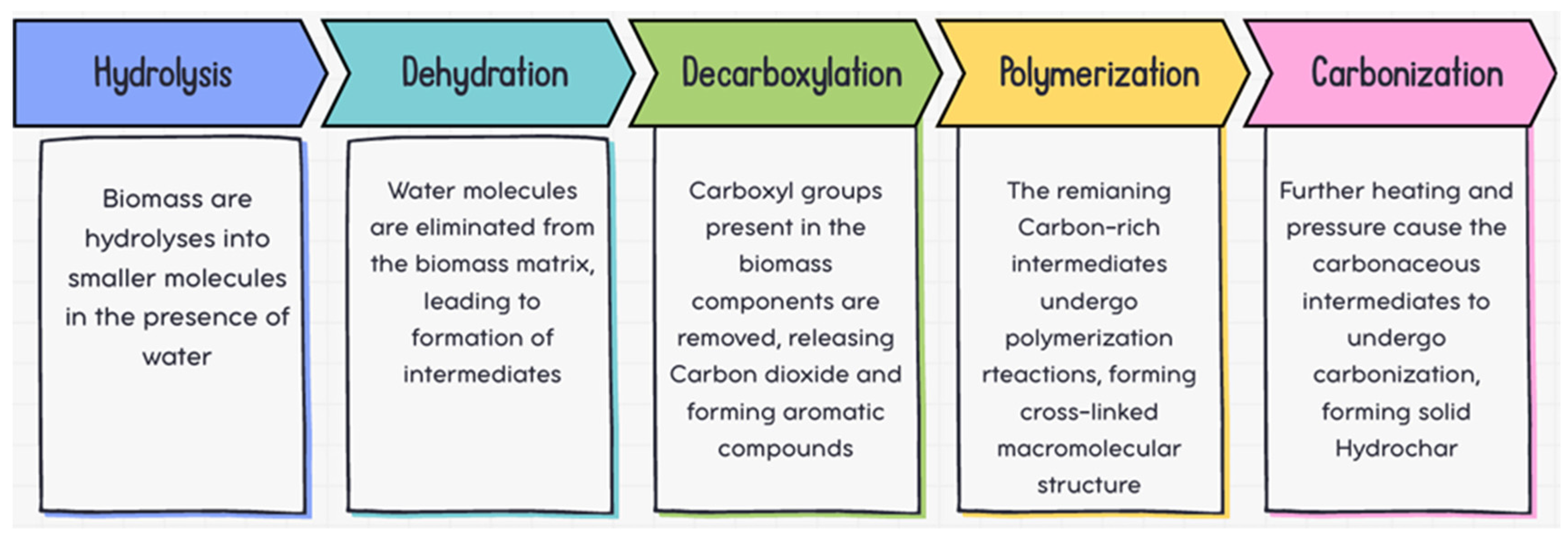
2.1. Hydrochar Sample Preparation
2.2. Design of Experiments (DOE) and Optimization Procedure
- Central Composite Design [CCD]
| Factors: | 2 | Replicates: | 1 |
| Base runs: | 12 | Total runs: | 12 |
| Base blocks: | 1 | Total blocks: | 1 |
| Two-level factorial: Full factorial | |||
| Cube points: | 4 | ||
| Center points in cube: | 5 | ||
| Axial points: | 4 | ||
| Center points in axial: | 0 | ||
| α: 1.41421 | |||
2.3. Batch Adsorption Experiments (Cu2+)
2.4. Characterization Techniques
2.5. Adsorption Data Analysis
2.6. Calculating the Yield
3. Results & Discussion
3.1. Experimental Design Using CCD
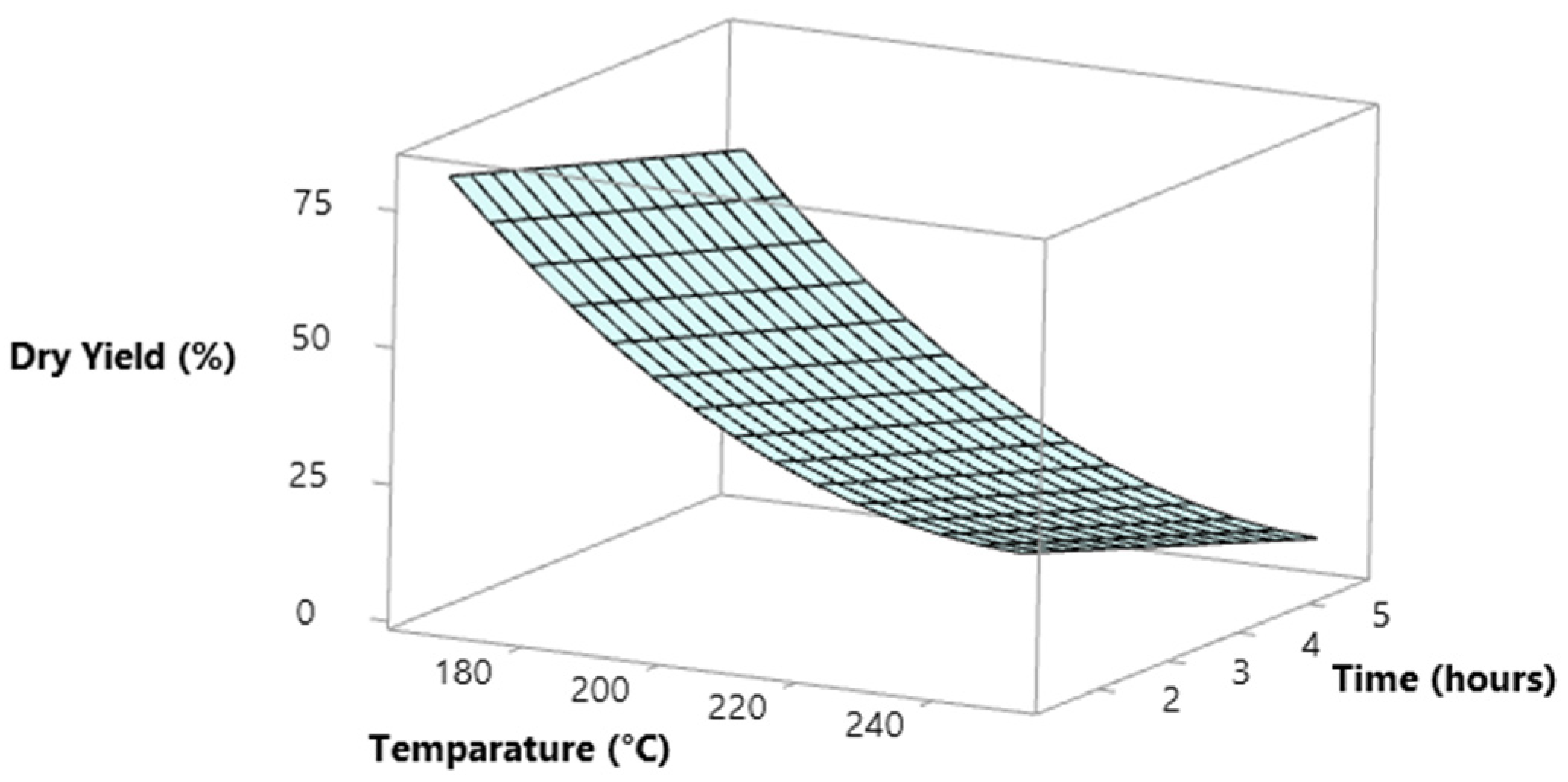
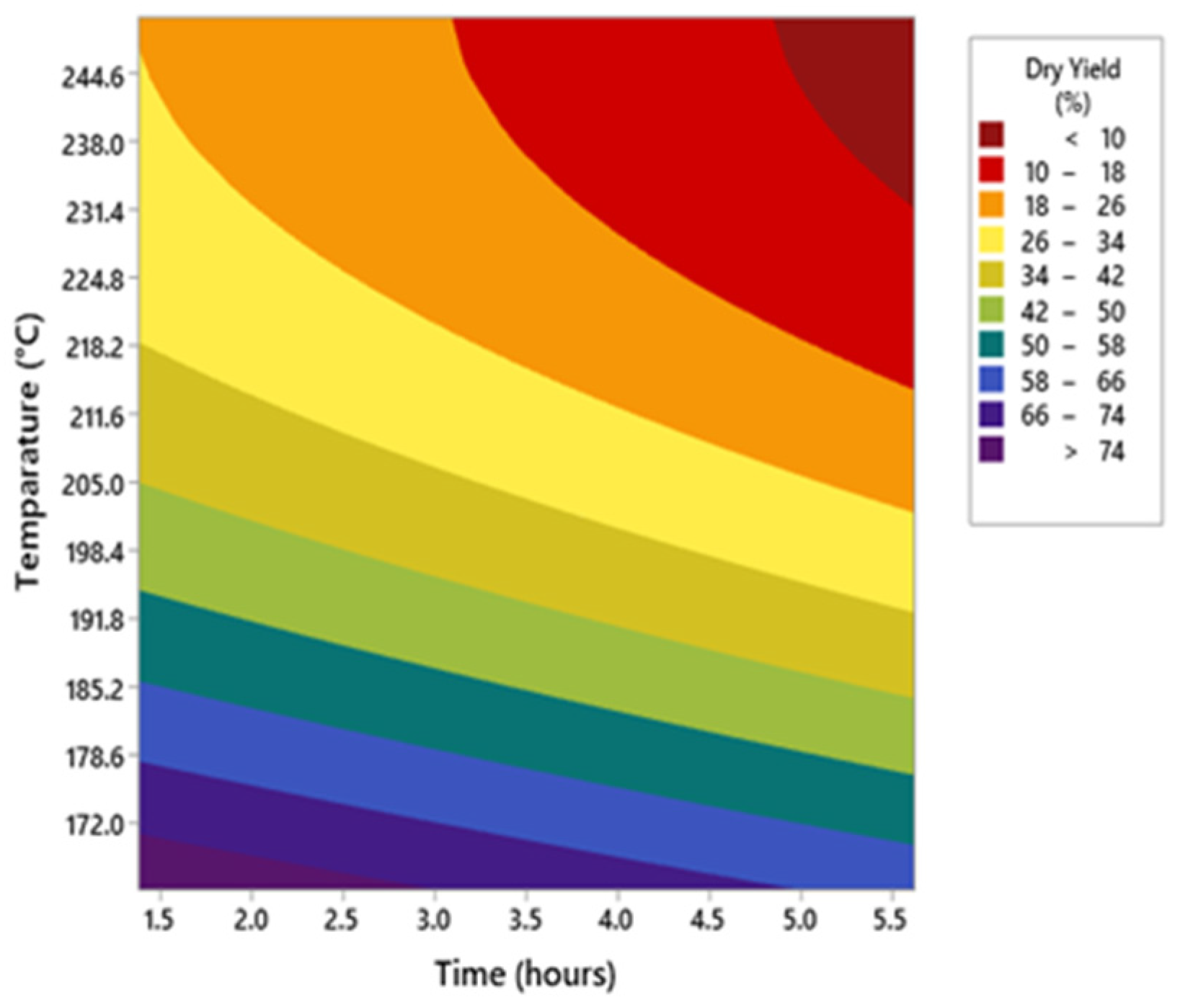
3.1.1. Quadratic Regression Model
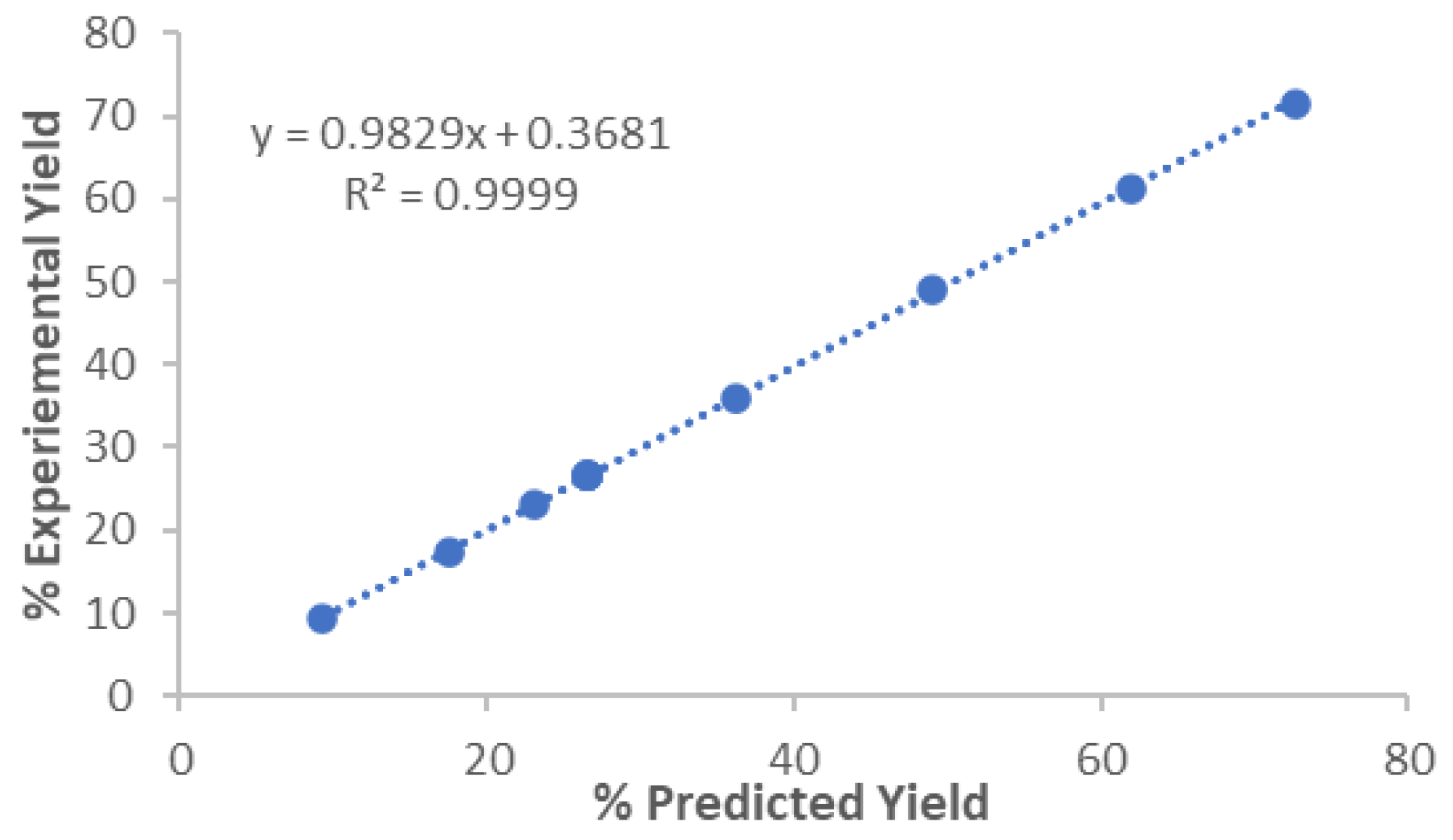
3.1.2. Model Summary
3.1.3. Analysis of Variance (ANOVA)
3.1.4. Lack-of-Fit Analysis
3.1.5. Optimization Solution
3.1.6. Optimal Conditions for Maximum Yield of Dry Hydrochar
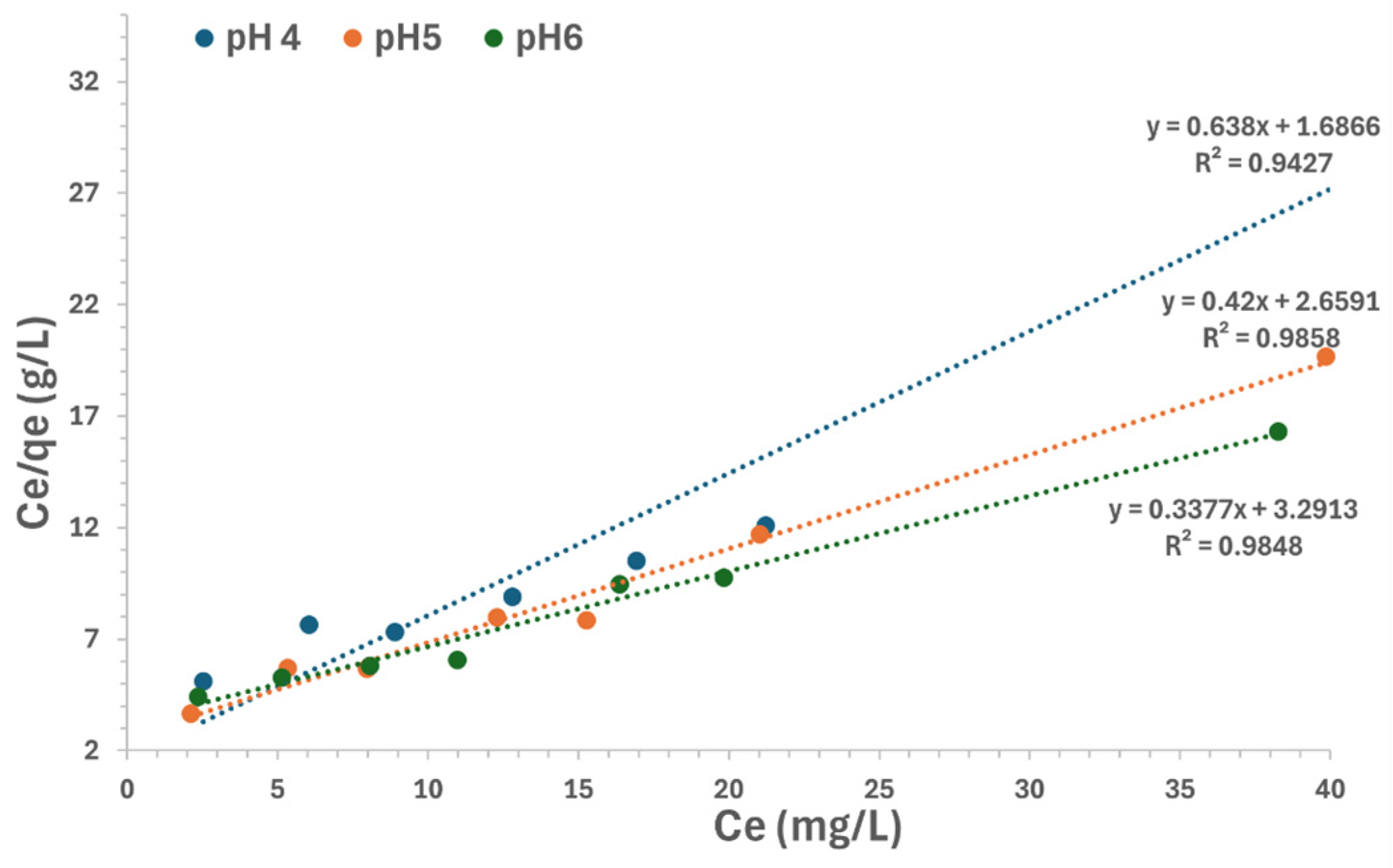
3.2. Adsorption Isotherm Models
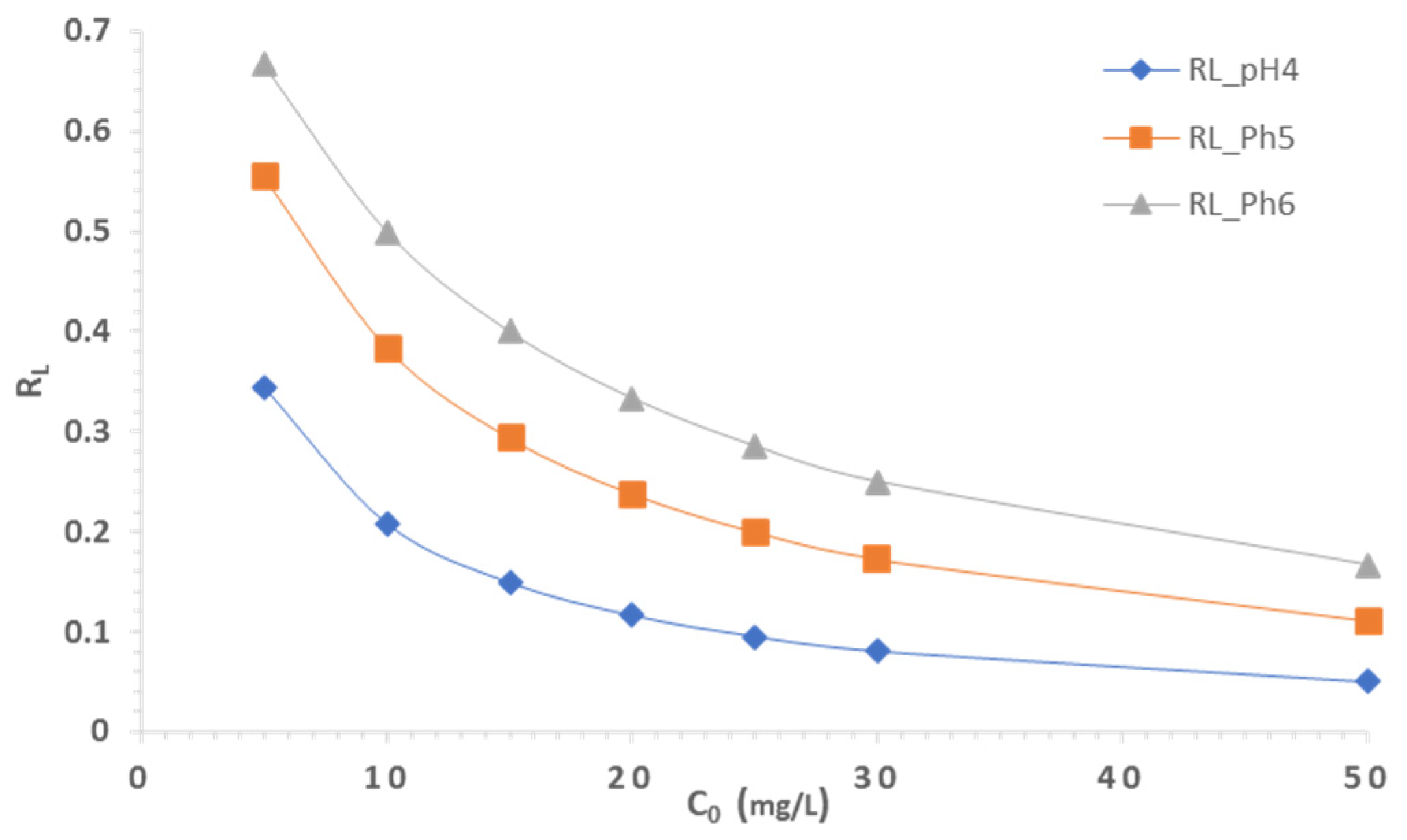
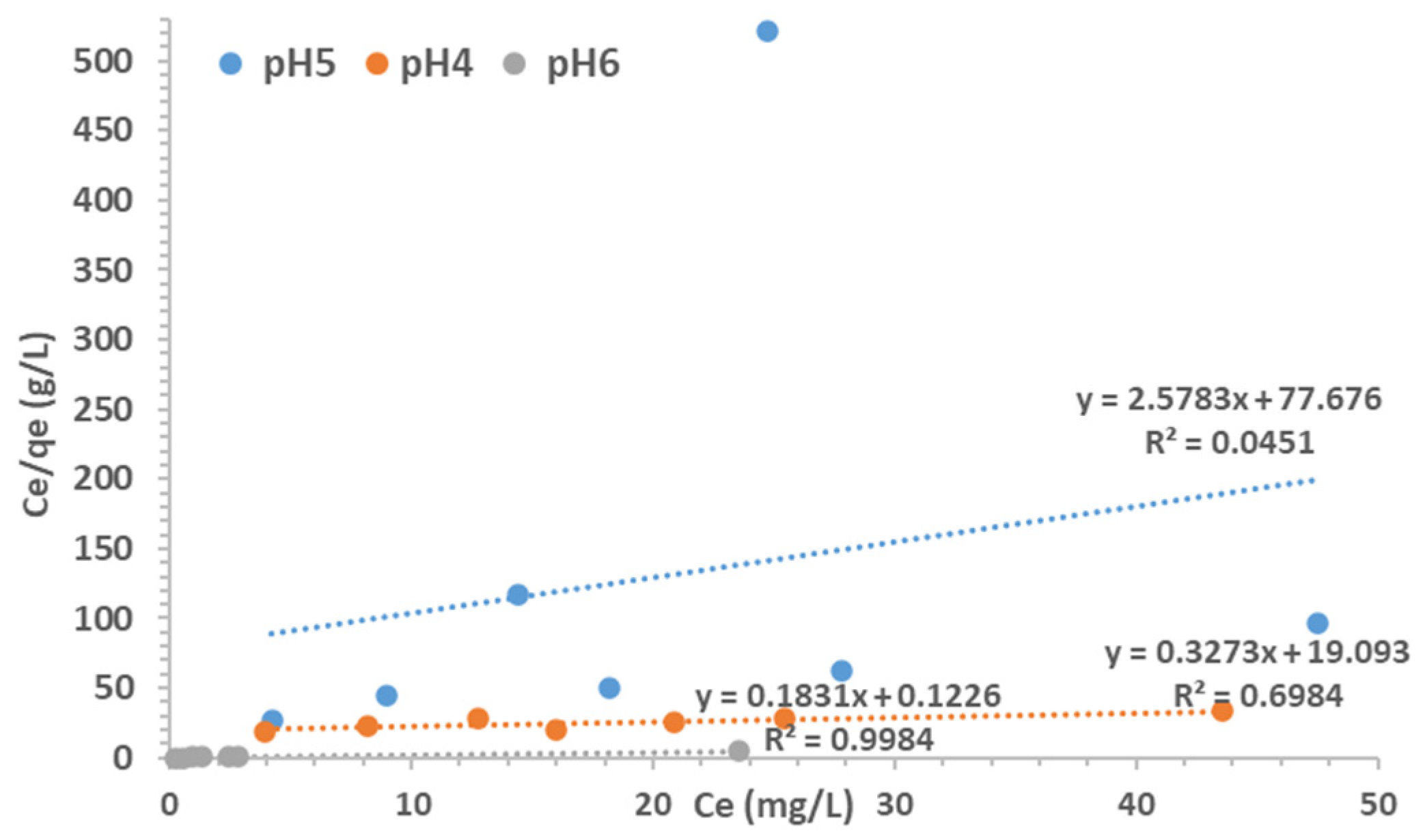
- Langmuir Model
- The Langmuir Separation Factor,
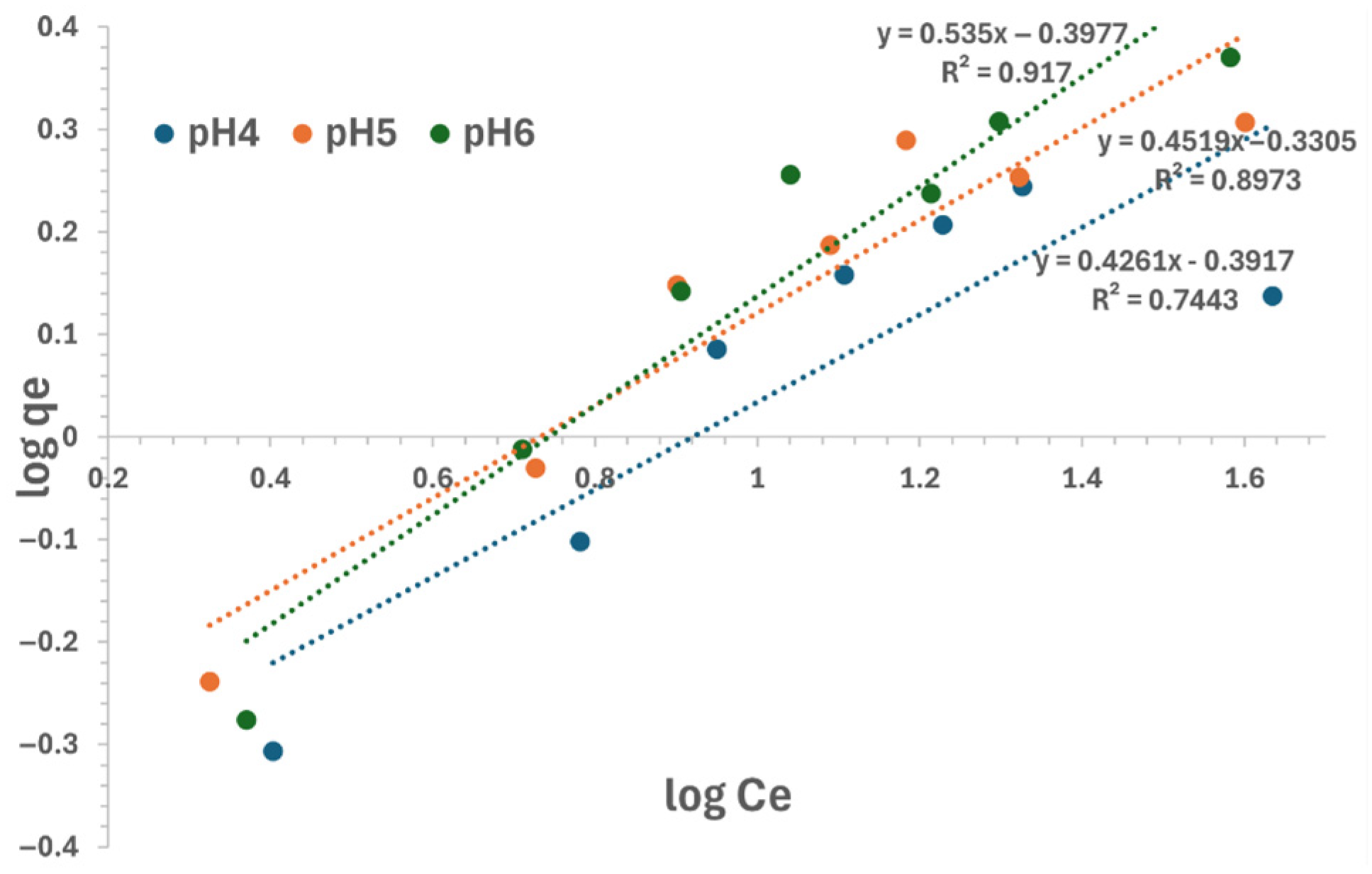
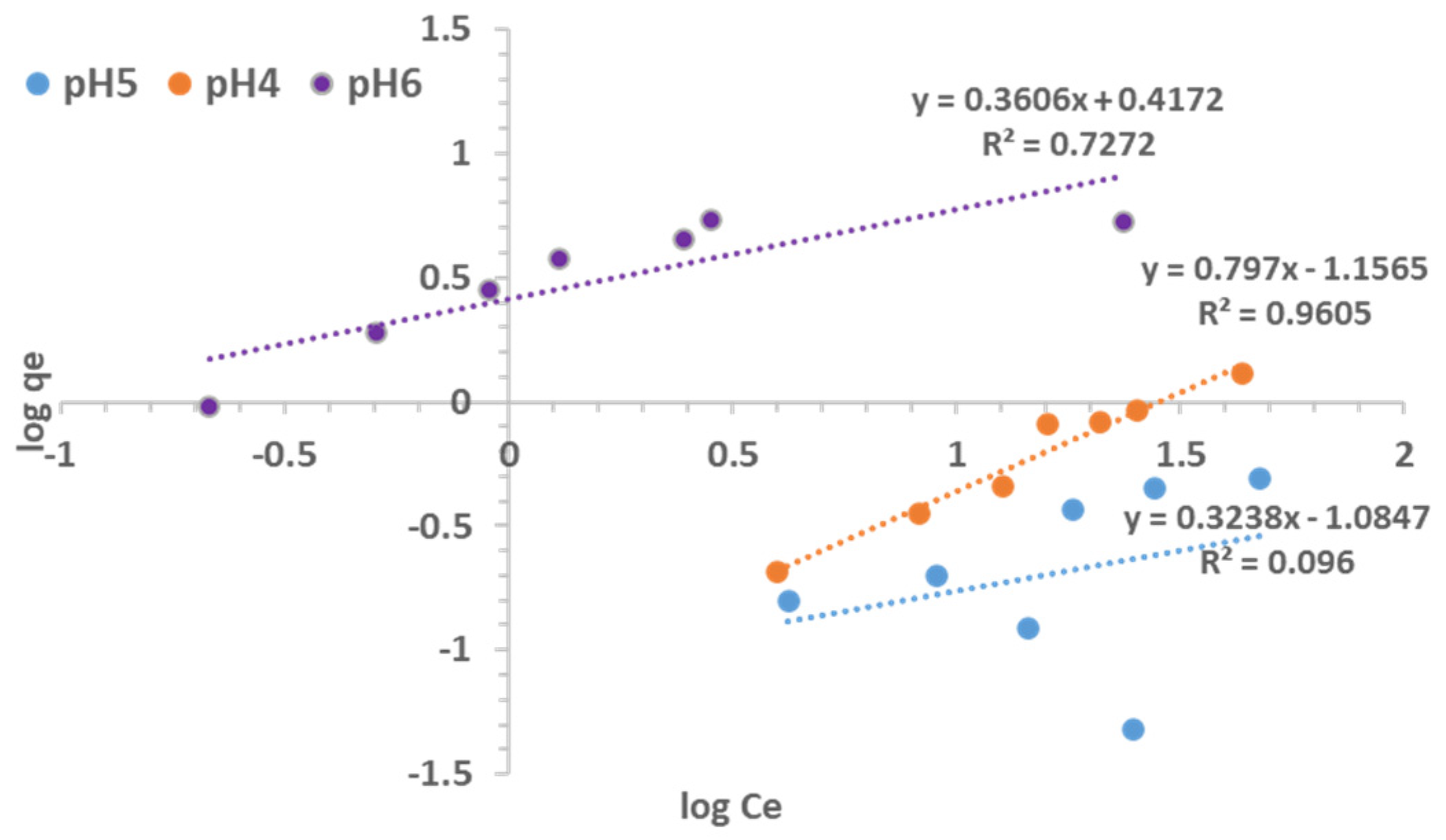
- Freundlich Model
Model Fits for Samples A–D
3.3. Study of the Physicochemical Properties of Hydrochar
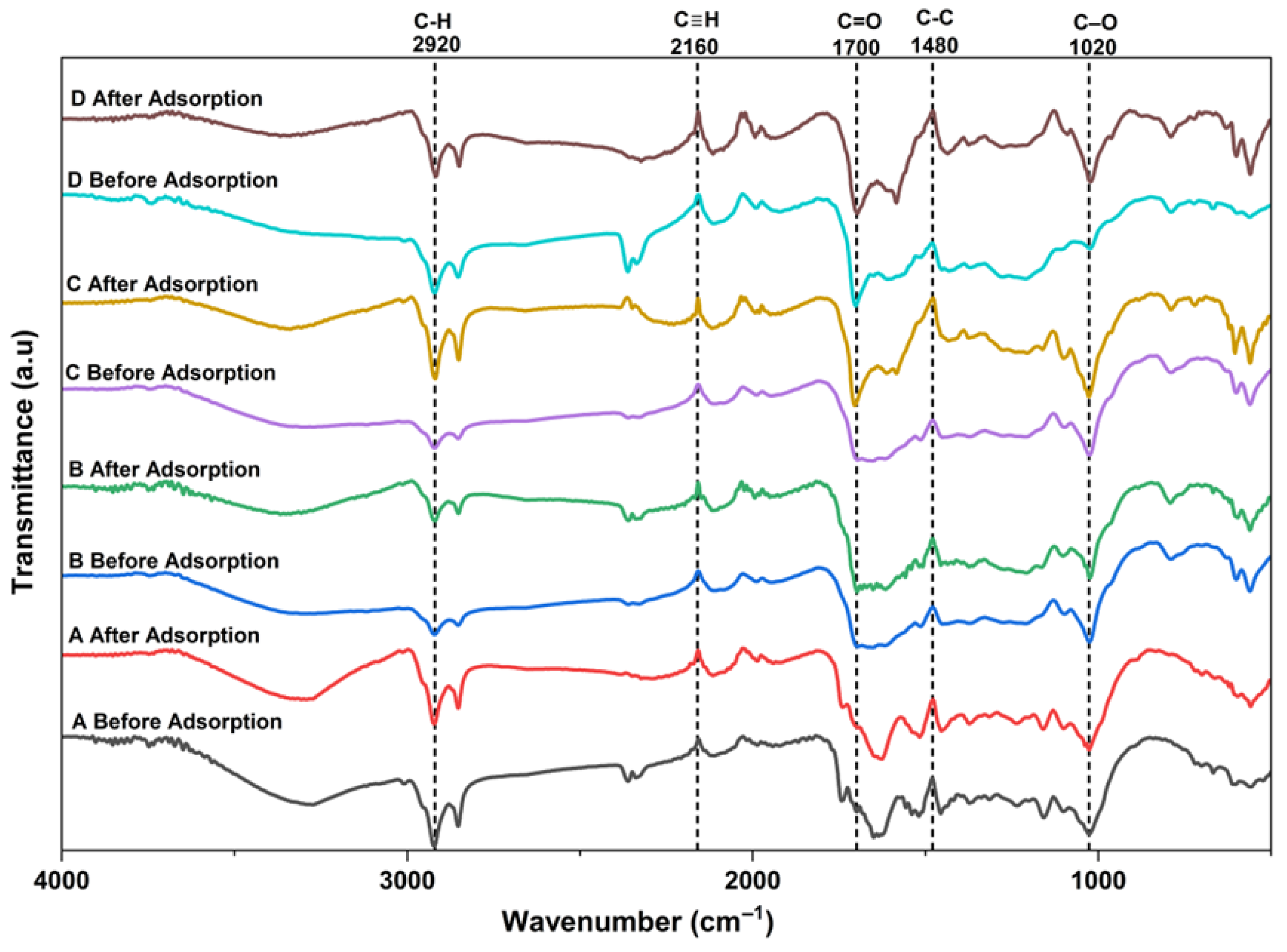
3.3.1. FTIR—Fourier-Transform Infrared Spectroscopy
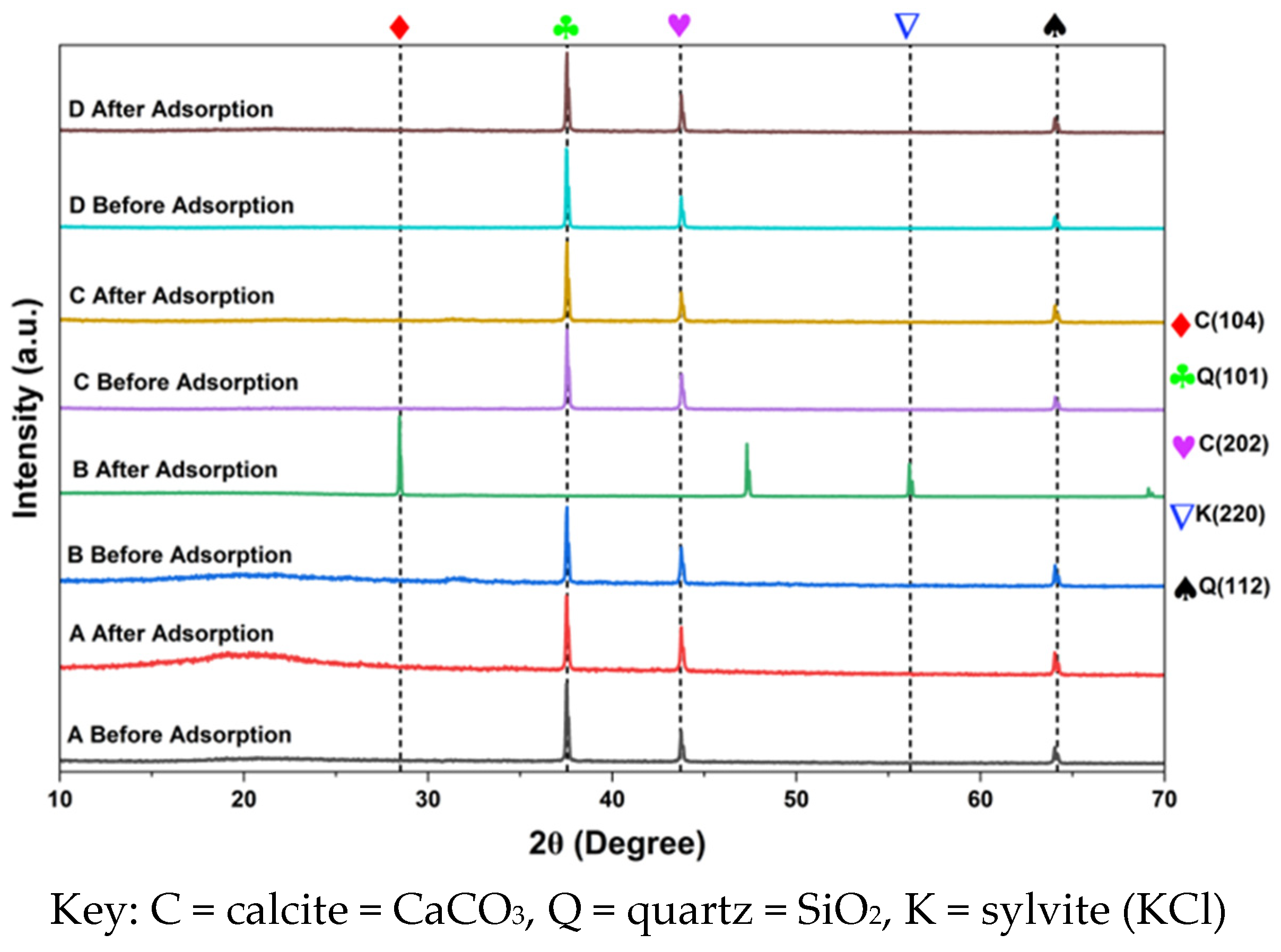
3.3.2. XRD Analysis
3.3.3. Elemental Composition and Mineral Oxides (XRF)
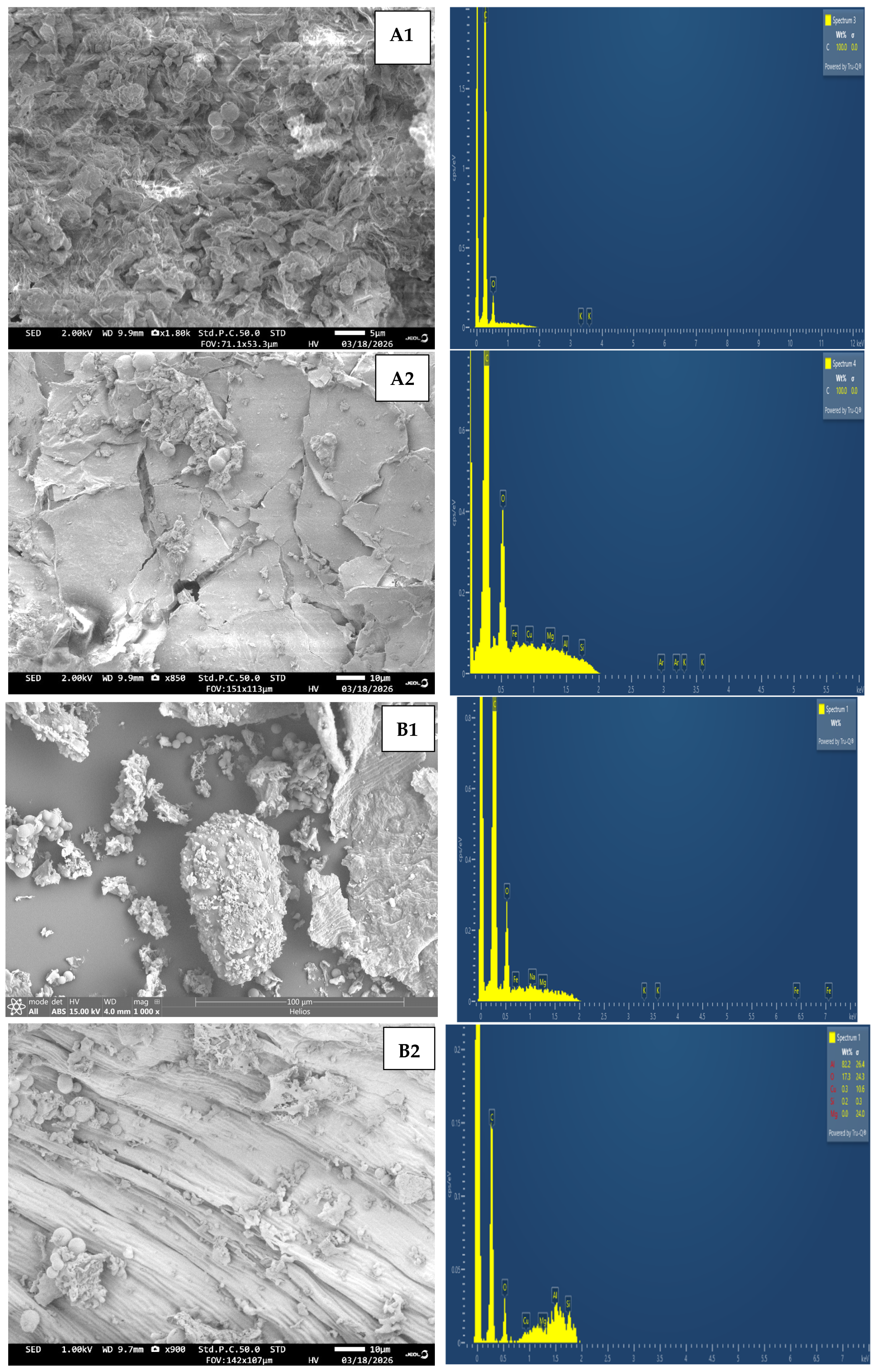
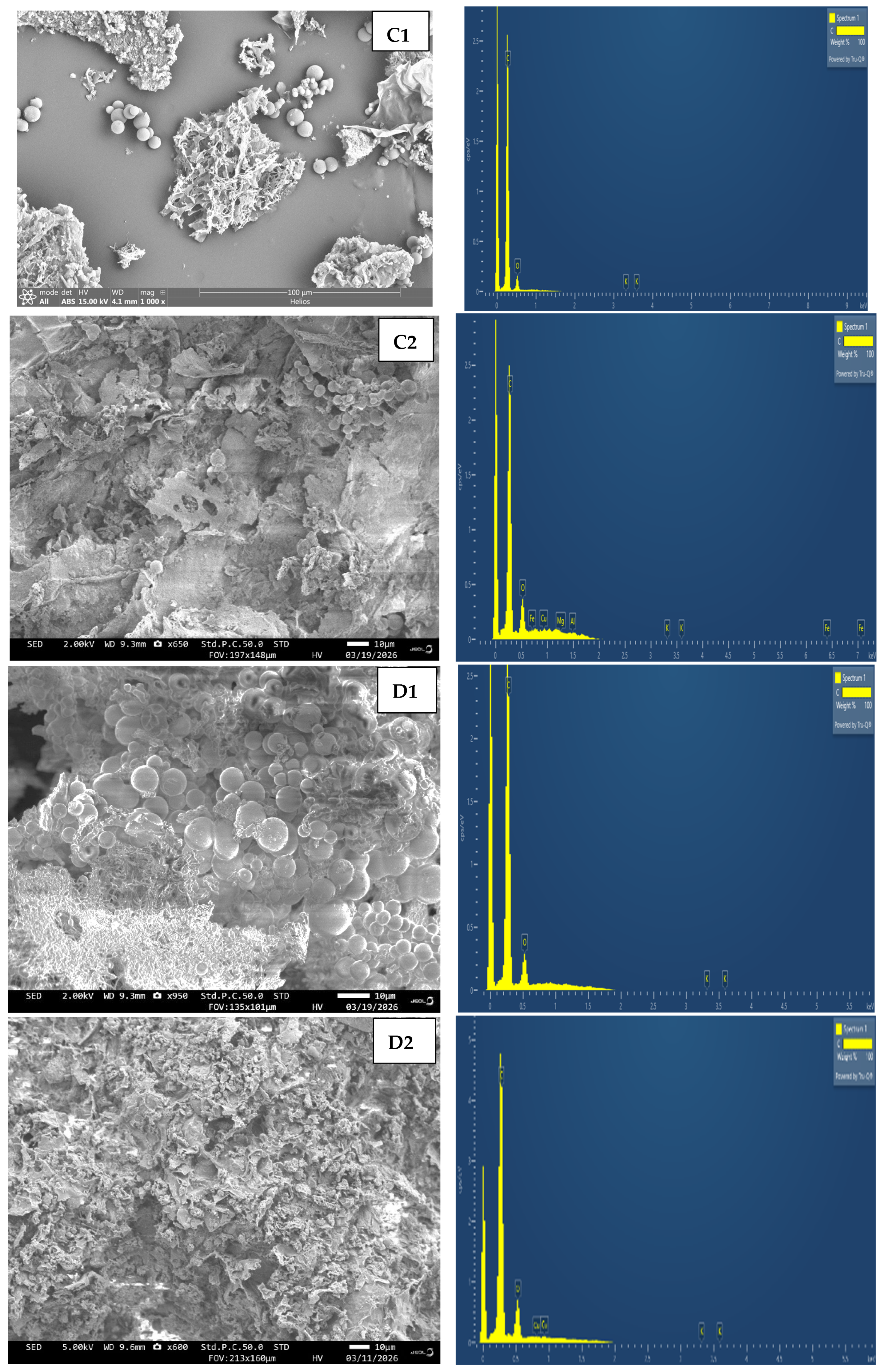
3.3.4. SEM-EDS Analysis
Surface Morphology Before Adsorption (Pristine Samples)
Surface Morphology Post-Adsorption
EDS Analysis Pre-Adsorption
Post-Adsorption EDS Analysis
4. Conclusions
Author Contributions
Funding
Institutional Review Board Statement
Informed Consent Statement
Data Availability Statement
Acknowledgments
Conflicts of Interest
References
- Ojewumi, M.E.; Chen, G. Microwave-Mediated Hydrothermal Carbonization (MWHTC) of food waste for conversion-ready feedstocks. Biofuels 2025, 16, 775–788. [Google Scholar] [CrossRef]
- Chauhan, S.S.; Dikshit, P.K.S. Optimization of batch study parameters for the adsorption of lead (II) ions onto spent tea grains. AQUA—Water Infrastruct. Ecosyst. Soc. 2023, 72, 996–1024. [Google Scholar]
- Mohammed, Y.; Faruruwa, M.; Muhammad, A.; Haruna, A. Kinetics and thermodynamics of heavy metal adsorption using activated carbon developed from Doum palm seeds. J. Basics Appl. Sci. Res. 2024, 2, 177–194. [Google Scholar] [CrossRef]
- Yang, R.; Feng, S.; Jin, D.; Wang, Y.; Li, D.; Liang, Y.; Wu, J. Removing DOM from chloride modified hydrochar could improve Cu2+ adsorption capacity from aqueous solution. Chemosphere 2023, 342, 140202. [Google Scholar]
- Babeker, T.M.A.; Lv, S.; Wu, J.; Zhou, J.; Chen, Q. Insight into Cu (II) adsorption on pyrochar and hydrochar resultant from Acacia Senegal waste for wastewater decontamination. Chemosphere 2024, 356, 141881. [Google Scholar] [CrossRef]
- Ahamad, Z.; Ahmed, M.; Mashkoor, F.; Nasar, A. Chemically modified Azadirachta indica sawdust for adsorption of methylene blue from aqueous solutions. Biomass Convers. Biorefinery 2024, 14, 19929–19946. [Google Scholar] [CrossRef]
- Shehzad, M.K.; Ali, A.; Qasim, S.; Mumtaz, A.; Hussain, M.A.; Fawy, K.F.; Nishan, U.; Azhar, I.; Abbas, M.A.; Abba, A. Sustainable remediation of cadmium using succinate-functionalized glucoxylan from chia (Salvia hispanica) seeds hydrogel. J. Ind. Eng. Chem. 2026, 157, 591–608. [Google Scholar] [CrossRef]
- Liang, M.; Xue, M.; Shi, Y.; Cai, J.; Yang, X.; Jin, C.; Chen, Z.; Xu, M. Valorizing industrial and agricultural wastes into a high-performance composite for remediation of heavy metal-contaminated tailing sands. Environ. Res. 2025, 285, 122414. [Google Scholar] [CrossRef] [PubMed]
- Fayad, E.; Alsunbul, M.; Alazragi, R.S.; Ebada, A.; Ali, H.; Mubarak, M.F. Magnetic chitosan kaolinite cellulose nanofibril cryogel beads for efficient removal of methylene blue from water. Sci. Rep. 2025, 15, 41178. [Google Scholar] [CrossRef] [PubMed]
- Alprol, A.E.; Manaa, A.; Basaham, A.S.; Ghandour, I.M.; El-Regal, M.A.A.; El-Metwally, M.E. Optimized removal of methylene blue from wastewater using an activated Carbon-Zinc Oxide-Ammonia composite. Sci. Rep. 2025, 15, 38834. [Google Scholar] [CrossRef]
- Wells, C.S.; Hambleton, R.K. Model fit with residual analyses. Handb. Item Response Theory 2016, 2, 395–413. [Google Scholar]
- Antony, J. Design of Experiments for Engineers and Scientists; Elsevier: Amsterdam, The Netherlands, 2023. [Google Scholar]
- Miao, X.; Ma, Y.; Sun, X.; Zhao, H. Residual strength prediction of hydrogen-blended natural gas pipelines based on incremental knowledge distillation. Energy 2025, 341, 139456. [Google Scholar] [CrossRef]
- Ighalo, J.O.; Akaeme, F.C.; Georgin, J.; de Oliveira, J.S.; Franco, D.S. Biomass hydrochar: A critical review of process chemistry, synthesis methodology, and applications. Sustainability 2025, 17, 1660. [Google Scholar] [CrossRef]
- Wang, X.; Duo, J.; Jin, Z.; Yang, F.; Lai, T.; Collins, E. Effects of Hydrothermal Carbonization Conditions on the Characteristics of Hydrochar and Its Application as a Soil Amendment: A Review. Agronomy 2025, 15, 327. [Google Scholar] [CrossRef]
- Bhattacharya, A. Effect of low temperature on dry matter, partitioning, and seed yield: A review. In Physiological Processes in Plants Under Low Temperature Stress; Springer: Singapore, 2022; pp. 629–734. [Google Scholar]
- Rashidin, N.I.Z.; Khalid, Z.M. Analysis of the Effects of Extraction Temperatures and Reaction Times on Agricultural Product Yield Percentages. Proc. Sci. Math. 2023, 17, 48–62. [Google Scholar]
- Chandrakar, H.; Singh, R. Effect of temperature on growth, quality, yield attributing characters and yield of rice–A review. Int. J. Env. Clim. Change 2023, 13, 804–814. [Google Scholar]
- Liu, C.; Balasubramanian, P.; Li, F.; Huang, H. Machine learning prediction of dye adsorption by hydrochar: Parameter optimization and experimental validation. J. Hazard. Mater. 2024, 480, 135853. [Google Scholar] [CrossRef] [PubMed]
- Roslan, S.Z.; Zainol, M.M.; Bikane, K.; Syed-Hassan, S.S.A. Hydrothermal carbonization of sewage sludge for hydrochar production: Optimization of operating conditions using Box-Behnken design coupled with response surface methodology. Biomass Convers. Biorefinery 2025, 15, 10109–10125. [Google Scholar]
- Danso-Boateng, E.; Fitzsimmons, M.; Ross, A.B.; Mariner, T. Response surface modelling of methylene blue adsorption onto seaweed, coconut shell and oak wood hydrochars. Water 2023, 15, 977. [Google Scholar] [CrossRef]
- Hou, G.; Alkhayyat, A.; Almalkawi, A.; Yadav, A.; Shreenidhi, H.; Saini, V.; Shomurotova, S.; Singh, D.; Jain, V.; Smerat, A. Development of robust machine learning models to estimate hydrochar higher heating value and yield based upon biomass proximate analysis. Bioresour. Bioprocess. 2025, 12, 138. [Google Scholar] [CrossRef]
- Marzban, N.; Libra, J.A.; Hosseini, S.H.; Fischer, M.G.; Rotter, V.S. Experimental evaluation and application of genetic programming to develop predictive correlations for hydrochar higher heating value and yield to optimize the energy content. J. Environ. Chem. Eng. 2022, 10, 108880. [Google Scholar] [CrossRef]
- Solih, F.A.; Buthiyappan, A.; Hasikin, K.; Aung, K.M.; Raman, A.A.A. Optimization-driven modelling of hydrochar derived from fruit waste for adsorption performance evaluation using response surface methodology and machine learning. J. Ind. Eng. Chem. 2025, 141, 328–339. [Google Scholar] [CrossRef]
- Cheng, C.; Guo, Q.; Ding, L.; Raheem, A.; He, Q.; Lam, S.S.; Yu, G. Upgradation of coconut waste shell to value-added hydrochar via hydrothermal carbonization: Parametric optimization using response surface methodology. Appl. Energy 2022, 327, 120136. [Google Scholar] [CrossRef]
- Zhong, J.; Zhu, W.; Sun, J.; Mu, B.; Wang, X.; Xue, Z.; Cao, J. Hydrothermal carbonization of coking sludge: Formation mechanism and fuel characteristic of hydrochar. Chemosphere 2024, 346, 140504. [Google Scholar] [CrossRef]
- Lucian, M.; Volpe, M.; Gao, L.; Piro, G.; Goldfarb, J.L.; Fiori, L. Impact of hydrothermal carbonization conditions on the formation of hydrochars and secondary chars from the organic fraction of municipal solid waste. Fuel 2018, 233, 257–268. [Google Scholar] [CrossRef]
- Roslan, S.Z.; Zainudin, S.F.; Mohd Aris, A.; Chin, K.B.; Musa, M.; Mohamad Daud, A.R.; Syed Hassan, S.S.A. Hydrothermal carbonization of sewage sludge into solid biofuel: Influences of process conditions on the energetic properties of hydrochar. Energies 2023, 16, 2483. [Google Scholar] [CrossRef]
- Ungureanu, N.; Vlăduț, N.-V.; Biriș, S.-Ș.; Gheorghiță, N.-E.; Ionescu, M. Biomass pyrolysis pathways for renewable energy and sustainable resource recovery: A critical review of processes, parameters, and product valorization. Sustainability 2025, 17, 7806. [Google Scholar] [CrossRef]
- Parvari, E.; Mahajan, D.; Hewitt, E.L. A Review of Biomass Pyrolysis for Production of Fuels: Chemistry, Processing, and Techno-Economic Analysis. Biomass 2025, 5, 54. [Google Scholar] [CrossRef]
- Parimelazhagan, V.; Sharma, P.; Tiwari, Y.; Santhana Krishna Kumar, A.; Ayyakannu Sundaram, G. Recycling of Walnut Shell Biomass for Adsorptive Removal of Hazardous Dye Alizarin Red from Aqueous Solutions Using Magnetic Nanocomposite: Process Optimization, Kinetic, Isotherm, and Thermodynamic Investigation. ChemEngineering 2025, 9, 40. [Google Scholar] [CrossRef]
- Mu, L.; Wang, Z.; Wu, D.; Zhao, L.; Yin, H. Prediction and evaluation of fuel properties of hydrochar from waste solid biomass: Machine learning algorithm based on proposed PSO–NN model. Fuel 2022, 318, 123644. [Google Scholar] [CrossRef]
- Igwegbe, C.A.; Rasaq, W.A.; Ovuoraye, P.E.; Kosiorowska, K.; Białowiec, A. Predictive modeling and optimization of hydrochar properties from food waste hydrothermal carbonization using machine learning techniques. Bioresour. Technol. 2025, 439, 133282. [Google Scholar] [CrossRef]
- Liu, Q.; Zhang, G.; Yu, J.; Kong, G.; Cao, T.; Ji, G.; Zhang, X.; Han, L. Machine learning-aided hydrothermal carbonization of biomass for coal-like hydrochar production: Parameters optimization and experimental verification. Bioresour. Technol. 2024, 393, 130073. [Google Scholar] [CrossRef]
- Kaya, E.Y.; Ali, I.; Ceylan, Z.; Ceylan, S. Prediction of higher heating value of hydrochars using Bayesian optimization tuned Gaussian process regression based on biomass characteristics and process conditions. Biomass Bioenergy 2024, 180, 106993. [Google Scholar] [CrossRef]
- Marzban, N.; Libra, J.A.; Ro, K.S.; Moloeznik Paniagua, D.; Rotter, V.S.; Sturm, B.; Filonenko, S. Hydrochar stability: Understanding the role of moisture, time and temperature in its physiochemical changes. Biochar 2024, 6, 38. [Google Scholar] [CrossRef]
- Xie, S.; Zhang, T.; You, S.; Mukherjee, S.; Pu, M.; Chen, Q.; Wang, Y.; Ali, E.F.; Abdelrahman, H.; Rinklebe, J. Applied machine learning for predicting the properties and carbon and phosphorus fate of pristine and engineered hydrochar. Biochar 2025, 7, 19. [Google Scholar] [CrossRef]
- Sarker, T.R.; Nanda, S.; Dalai, A.K. Parametric studies on hydrothermal gasification of biomass pellets using Box-Behnken experimental design to produce fuel gas and hydrochar. J. Clean. Prod. 2023, 388, 135804. [Google Scholar] [CrossRef]
- Kohzadi, S.; Marzban, N.; Godini, K.; Amini, N.; Maleki, A. Effect of hydrochar modification on the adsorption of methylene blue from aqueous solution: An experimental study followed by intelligent modeling. Water 2023, 15, 3220. [Google Scholar] [CrossRef]
- Ghasemzadeh, R.; Abdoli, M.A.; Bozorg-Haddad, O.; Pazoki, M. Optimizing the effect of hydrochar on anaerobic digestion of organic fraction municipal solid waste for biogas and methane production. J. Environ. Health Sci. Eng. 2022, 20, 29–39. [Google Scholar] [CrossRef]
- Zhang, W.; Zhou, J.; Liu, Q.; Xu, Z.; Peng, H.; Leng, L.; Li, H. A novel intelligent system based on machine learning for hydrochar multi-target prediction from the hydrothermal carbonization of biomass. Biochar 2024, 6, 19. [Google Scholar] [CrossRef]
- Yang, D.; Yang, Q.; Yang, R.; Zhou, Y.; He, Y. Co-Production of Furfural, Xylo-Oligosaccharides, and Reducing Sugars from Waste Yellow Bamboo Through the Solid Acid-Assisted Hydrothermal Pretreatment. Catalysts 2025, 15, 325. [Google Scholar] [CrossRef]
- Chien, S.-C.; Wang, H.; Al Farra, A.; Megido, L.; González-LaFuente, J.M.; Shiju, N.R. Towards circular plastics: Chemical recycling of high-density polyethylene-rich municipal waste using hydrothermal liquefaction. Chem. Eng. J. 2025, 520, 165513. [Google Scholar] [CrossRef]
- Zhang, Y.; Jiang, Q.; Xie, W.; Wang, Y.; Kang, J. Effects of temperature, time and acidity of hydrothermal carbonization on the hydrochar properties and nitrogen recovery from corn stover. Biomass Bioenergy 2019, 122, 175–182. [Google Scholar] [CrossRef]
- Guerra-Que, Z.; López-Margalli, K.S.; Urrieta-Saltijeral, J.M.; Silahua-Pavón, A.A.; Martínez-García, H.; García-Alamilla, P.; Córdova-Pérez, G.E.; Arévalo-Pérez, J.C.; Torres-Torres, J.G. Activated carbon synthesised from lignocellulosic cocoa pod husk via alkaline and acid treatment for methylene blue adsorption: Optimisation by response surface methodology, kinetics, and isotherm modelling. RSC Adv. 2025, 15, 47231–47254. [Google Scholar] [CrossRef]
- Soundararjan, S.; Kannan, S.; Geetha, K.; Jeevakarunya, C.; Sundaram, M.; Saiyathibrahim, A.; Santhosh, A.J. Experimental study on wear performance of dissimilar aluminium alloy FSW joints optimized by RSM and desirability approach. Eng. Rep. 2025, 7, e70402. [Google Scholar] [CrossRef]
- Al-Husban, Y.; Al-Ghriybah, M.; Gaeid, K.S.; Takialddin, A.S.; Handam, A.; Alkhazaleh, A.H. Optimization of the Residential Solar Energy Consumption Using the Taguchi Technique and Box-Behnken Design: A Case Study for Jordan. Int. J. Energy Convers. 2023, 11. [Google Scholar] [CrossRef]
- Jasim, D.J.; Ali, A.B.; Qali, D.J.; Mahdy, O.S.; Salahshour, S.; Eftekhari, S.A. Using design of experiment via the linear model of analysis of variance to predict the thermal conductivity of Al2O3/ethylene glycol-water hybrid nanofluid. Int. J. Thermofluids 2024, 24, 100829. [Google Scholar] [CrossRef]
- Lamidi, S.; Olaleye, N.; Bankole, Y.; Obalola, A.; Aribike, E.; Adigun, I. Applications of Response Surface Methodology (RSM) in Product Design, Development, and Process Optimization; IntechOpen: London, UK, 2022. [Google Scholar]
- Fakkaew, K.; Koottatep, T.; Polprasert, C. Effects of hydrolysis and carbonization reactions on hydrochar production. Bioresour. Technol. 2015, 192, 328–334. [Google Scholar] [CrossRef]
- Soh, M.; Khaerudini, D.S.; Yiin, C.L.; Chew, J.J.; Sunarso, J. Physicochemical and structural characterisation of oil palm trunks (OPT) hydrochar made via wet torrefaction. Clean. Eng. Technol. 2022, 8, 100467. [Google Scholar] [CrossRef]
- Kumar, A.; Saini, K.; Bhaskar, T. Hydochar and biochar: Production, physicochemical properties and techno-economic analysis. Bioresour. Technol. 2020, 310, 123442. [Google Scholar] [CrossRef]
- Zhang, B.; Biswal, B.K.; Zhang, J.; Balasubramanian, R. Hydrothermal treatment of biomass feedstocks for sustainable production of chemicals, fuels, and materials: Progress and perspectives. Chem. Rev. 2023, 123, 7193–7294. [Google Scholar] [CrossRef]
- Xu, S.; Chen, J.; Peng, H.; Leng, S.; Li, H.; Qu, W.; Hu, Y.; Li, H.; Jiang, S.; Zhou, W. Effect of biomass type and pyrolysis temperature on nitrogen in biochar, and the comparison with hydrochar. Fuel 2021, 291, 120128. [Google Scholar] [CrossRef]
- Leng, L.; Yang, L.; Leng, S.; Zhang, W.; Zhou, Y.; Peng, H.; Li, H.; Hu, Y.; Jiang, S.; Li, H. A review on nitrogen transformation in hydrochar during hydrothermal carbonization of biomass containing nitrogen. Sci. Total Environ. 2021, 756, 143679. [Google Scholar] [CrossRef] [PubMed]
- Chen, S.; Tang, X.; Chen, J.; Xue, Y.; Wang, Y.; Xu, D. Regulation of slow-release performance of high-sugar biomass waste filter mud and sugarcane bagasse by co-hydrothermal carbonization and potential evaluation of hydrochar-based slow-release fertilizers. Biomass Bioenergy 2025, 193, 107557. [Google Scholar] [CrossRef]
- Luo, Y.; Mi, T.; Huang, F.; Liu, Y.; Liu, Q.; Xin, S.; Liu, X. Hydrothermal carbonization of herbal medicine waste: Process parameters optimization, secondary char formation and its effect on hydrochar properties. J. Environ. Manag. 2025, 379, 124819. [Google Scholar] [CrossRef]
- Jin, M.; Zhou, Q.; Fu, L.; Wu, W. Application of Biochar-Based Catalysts for Soil and Water Pollution Control. Top. Catal. 2024, 68, 591–614. [Google Scholar] [CrossRef]
- Masoumi, S.; Borugadda, V.B.; Nanda, S.; Dalai, A.K. Hydrochar: A review on its production technologies and applications. Catalysts 2021, 11, 939. [Google Scholar] [CrossRef]
- Chen, Y.; Hu, C.; Deng, D.; Li, Y.; Luo, L. Factors affecting sorption behaviors of tetracycline to soils: Importance of soil organic carbon, pH and Cd contamination. Ecotoxicol. Environ. Saf. 2020, 197, 110572. [Google Scholar] [CrossRef]
- Wang, T.; Liu, W.; Xiong, L.; Xu, N.; Ni, J. Influence of pH, ionic strength and humic acid on competitive adsorption of Pb (II), Cd (II) and Cr (III) onto titanate nanotubes. Chem. Eng. J. 2013, 215, 366–374. [Google Scholar] [CrossRef]
- Huang, D.; Xu, B.; Wu, J.; Brookes, P.C.; Xu, J. Adsorption and desorption of phenanthrene by magnetic graphene nanomaterials from water: Roles of pH, heavy metal ions and natural organic matter. Chem. Eng. J. 2019, 368, 390–399. [Google Scholar] [CrossRef]
- Chakraborty, R.; Asthana, A.; Singh, A.K.; Jain, B.; Susan, A.B.H. Adsorption of heavy metal ions by various low-cost adsorbents: A review. Int. J. Environ. Anal. Chem. 2022, 102, 342–379. [Google Scholar] [CrossRef]
- Awual, M.R.; Rahman, I.M.; Yaita, T.; Khaleque, M.A.; Ferdows, M. pH dependent Cu (II) and Pd (II) ions detection and removal from aqueous media by an efficient mesoporous adsorbent. Chem. Eng. J. 2014, 236, 100–109. [Google Scholar] [CrossRef]
- Flórez, E.; Jimenez-Orozco, C.; Acelas, N. Unravelling the influence of surface functional groups and surface charge on heavy metal adsorption onto carbonaceous materials: An in-depth DFT study. Mater. Today Commun. 2024, 39, 108647. [Google Scholar] [CrossRef]
- Kheradmand, A.; Negarestani, M.; Kazemi, S.; Shayesteh, H.; Javanshir, S.; Ghiasinejad, H. Adsorption behavior of rhamnolipid modified magnetic Co/Al layered double hydroxide for the removal of cationic and anionic dyes. Sci. Rep. 2022, 12, 14623. [Google Scholar] [CrossRef]
- Tang, Q.; Yin, Z.; Wang, R.; Zhu, W.; Zhang, Z.; Wang, Y.; Yang, Z.; Liu, F.; Yang, W. New strategy to remove phosphate from low concentration solution by MOFs-modified resin: High affinity and thermal desorption. Chem. Eng. J. 2023, 465, 142864. [Google Scholar] [CrossRef]
- Jeppu, G.P.; Clement, T.P. A modified Langmuir-Freundlich isotherm model for simulating pH-dependent adsorption effects. J. Contam. Hydrol. 2012, 129, 46–53. [Google Scholar] [CrossRef]
- Mesquita, M.; e Silva, J.V. Preliminary study of pH effect in the application of Langmuir and Freundlich isotherms to Cu–Zn competitive adsorption. Geoderma 2002, 106, 219–234. [Google Scholar] [CrossRef]
- Hu, H.; Zhang, J.; Wang, T.; Wang, P. Adsorption of toxic metal ion in agricultural wastewater by torrefaction biochar from bamboo shoot shell. J. Clean. Prod. 2022, 338, 130558. [Google Scholar] [CrossRef]
- Butyrskaya, E. Understanding the mechanism of monolayer adsorption from isotherm. Adsorption 2024, 30, 1395–1406. [Google Scholar] [CrossRef]
- Liu, X.; Wu, M.; Li, C.; Yu, P.; Feng, S.; Li, Y.; Zhang, Q. Interaction structure and affinity of zwitterionic amino acids with important metal cations (Cd2+, Cu2+, Fe3+, Hg2+, Mn2+, Ni2+ and Zn2+) in aqueous solution: A theoretical study. Molecules 2022, 27, 2407. [Google Scholar] [CrossRef]
- Long, J.; Zhu, L.; Qian, Y.; Wang, L.; Qiao, H. Influence of Zn2+ and Cu2+ on colloidal biochar aggregation kinetics and the underlying mechanisms. Colloid Polym. Sci. 2026, 261, 127701. [Google Scholar] [CrossRef]
- Guo, X.; Wang, J. A novel monolayer adsorption kinetic model based on adsorbates “infect” adsorbents inspired by epidemiological model. Water Res. 2024, 253, 121313. [Google Scholar] [CrossRef] [PubMed]
- Hamid, U.; Chen, C.-C. Adsorption Thermodynamics for Process Simulation. Langmuir 2024, 40, 23583–23597. [Google Scholar] [CrossRef]
- Pereira, S.K.; Kini, S.; Prabhu, B.; Jeppu, G.P. A simplified modeling procedure for adsorption at varying pH conditions using the modified Langmuir–Freundlich isotherm. Appl. Water Sci. 2023, 13, 29. [Google Scholar] [CrossRef]
- Valenzuela, I.E.; Valencia, S.; Muñoz-Acevedo, J.C.; Paim, A.P.S.; Pabón-Gelves, E. Adsorptive removal of losartan, bisphenol A, and triclosan in aqueous solutions using a graphene oxide-enhanced MOF-Zn composite. Environ. Sci. Pollut. Res. 2025, 32, 25992–26015. [Google Scholar] [CrossRef]
- Abugu, H.O.; Eze, I.S.; Ukwueze, N.N.; Abib, L.; Olaleye, A.M.; Dinneya-Onuoha, E. Thermal modification of Lagenaria breviflora seed husk for efficient sequestration of aqueous bound Ni (II): Mechanism and performance evaluation. Biomass Convers. Biorefinery 2026, 16, 77. [Google Scholar] [CrossRef]
- Tang, C.; Dong, H. The effects of Cu2+ adsorption on surface dissolution of albite. Colloids Surf. A. Physicochem. Eng. Asp. 2022, 644, 128832. [Google Scholar] [CrossRef]
- Firmansyah, M.L.; Abdel-Azeim, S.; Ullah, N. Efficient adsorption of methyl red, methyl orange and bromothymol blue by polyamine resin: Role of linearity and size of carboxylate in enhanced encapsulation and molecular matching. J. Mol. Liq. 2024, 411, 125792. [Google Scholar] [CrossRef]
- Piasecki, W.; Lament, K. Application of Surface Complexation Modeling to Investigate the Mechanism of Cu2+ Adsorption on TiO2, Al2O3, and SiO2 Under High Surface Coverage. Molecules 2024, 29, 5595. [Google Scholar] [CrossRef]
- Raheem, A.; Rahman, N.; Khan, S. Monolayer adsorption of ciprofloxacin on magnetic inulin/Mg–Zn–Al layered double hydroxide: Advanced interpretation of the adsorption process. Langmuir 2024, 40, 12939–12953. [Google Scholar] [CrossRef] [PubMed]
- Ymele-Ngwikam, N.; Tchieno, F.M.M.; Dai-Yang, L.; Pengou, M.; Gatcha-Bandjun, N.; Sambang, L.M.; Nanseu-Njiki, C.P.; Ngameni, E. Low-Cost Adsorption of Methylene Blue Dye Using Raw Guinea Fowl Eggshell Powder: Process Optimization, Kinetic Modeling, and Isotherm Analysis. Chem. Afr. 2026, 9, 8. [Google Scholar] [CrossRef]
- Aghazadeh, V.; Barakan, S.; Bidari, E. Determination of surface protonation-deprotonation behavior, surface charge, and total surface site concentration for natural, pillared and porous nano bentonite heterostructure. J. Mol. Struct. 2020, 1204, 127570. [Google Scholar] [CrossRef]
- Yang, J.; Li, B.; Li, J.; Song, H.; Duan, S.; Jia, L. Theoretical study of shale gas adsorption under the action of moisture and temperature, including analysis of the relevant adsorption mechanisms and thermodynamics. Ind. Eng. Chem. Res. 2023, 63, 617–635. [Google Scholar] [CrossRef]
- Scheufele, F.B.; Módenes, A.N.; Borba, C.E.; Ribeiro, C.; Espinoza-Quiñones, F.R.; Bergamasco, R.; Pereira, N.C. Monolayer–multilayer adsorption phenomenological model: Kinetics, equilibrium and thermodynamics. Chem. Eng. J. 2016, 284, 1328–1341. [Google Scholar] [CrossRef]
- Zhang, J.-W.; Mariska, S.; Pap, S.; Tran, H.N.; Chao, H.-P. Enhanced separation capacity of carbonaceous materials (hydrochar, biochar, and activated carbon) toward potential toxic metals through grafting copolymerization. Sep. Purif. Technol. 2023, 320, 124229. [Google Scholar] [CrossRef]
- Kozyatnyk, I.; Yakupova, I. Impact of chemical and physical treatments on the structural and surface properties of activated carbon and hydrochar. ACS Sustain. Chem. Eng. 2025, 13, 2500–2507. [Google Scholar] [CrossRef]
- Yang, M.; Chen, X.; Wang, Y.; Ding, L.; Yu, G.; Wang, F. Study on degradation pathway of macromolecules and mechanistic insights of hydrochar formation during hydrothermal treatment: From model compounds to food waste. Biomass Bioenergy 2025, 202, 108196. [Google Scholar] [CrossRef]
- Wang, M.; You, X.-Y. Efficient adsorption of antibiotics and heavy metals from aqueous solution by structural designed PSSMA-functionalized-chitosan magnetic composite. Chem. Eng. J. 2023, 454, 140417. [Google Scholar] [CrossRef]
- Kouznetsova, T.; Ivanets, A.; Prozorovich, V.; Hosseini-Bandegharaei, A.; Tran, H.N.; Srivastava, V.; Sillanpää, M. Sorption and mechanism studies of Cu2+, Sr2+ and Pb2+ ions on mesoporous aluminosilicates/zeolite composite sorbents. Water Sci. Technol. 2020, 82, 984–997. [Google Scholar] [CrossRef]
- Tsade, H.; Murthy, H.; Muniswamy, D. Bio-sorbents from agricultural wastes for eradication of heavy metals: A review. J. Mater. Env. Sci. 2020, 11, 1719–1735. [Google Scholar]
- Qi, Y.; Wei, D.; Shi, G.-M.; Zhang, M.; Qi, Y. Amorphous/nanocrystalline carbonized hydrochars with isomeric heterogeneous interfacial polarizations for high-performance microwave absorption. Sci. Rep. 2019, 9, 12429. [Google Scholar] [CrossRef]
- Liu, X.; Zheng, Y.; Liu, Z.; Ding, H.; Huang, X.; Zheng, C. Study on the evolution of the char structure during hydrogasification process using Raman spectroscopy. Fuel 2015, 157, 97–106. [Google Scholar] [CrossRef]
- Zhang, L.H.; Shi, Y.; Wang, Y.; Shiju, N.R. Nanocarbon catalysts: Recent understanding regarding the active sites. Adv. Sci. 2020, 7, 1902126. [Google Scholar] [CrossRef]
- Liu, M.; Liu, Y.; Chen, Q.; Li, X.; Wen, L.; Chen, X.; Ding, D.; Wang, G.; Zhao, Y.; Chen, Y. Catalytic activation of peroxymonosulfate by intrinsic defects in amorphous carbon: Enhanced electronic transfer and oxygen-functional groups. Sep. Purif. Technol. 2024, 344, 127224. [Google Scholar] [CrossRef]
- Hossain, M.S.; Ahmed, S. Crystallographic characterization of naturally occurring aragonite and calcite phase: Rietveld refinement. J. Saudi Chem. Soc. 2023, 27, 101649. [Google Scholar] [CrossRef]
- Ulakpa, W.C.; Adaeze, I.M.; Chimezie, O.A.; Olaseinde, A.A.; Odeworitse, E.; Onoriode, E.; Sarafa, O.A.; Olutoye, M.A.; Dim, P.; Siddique, M. Synthesis and characterization of calcium oxide nanoparticles (CaO NPS) from snail shells using hydrothermal method. J. Turk. Chem. Soc. Sect. A. Chem. 2024, 11, 825–834. [Google Scholar] [CrossRef]
- Francis, A.A. Ecologic and economic motives for transforming calcium-based food wastes into sustainable value-added products: A review. Environ. Sci. Pollut. Res. 2025, 32, 428–451. [Google Scholar] [CrossRef]
- Li, W.; Tao, E.; Hao, X.; Li, N.; Li, Y.; Yang, S. MMT and ZrO2 jointly regulate the pore size of graphene oxide-based composite aerogel materials to improve the selective removal ability of Cu (II). Sep. Purif. Technol. 2024, 331, 125506. [Google Scholar] [CrossRef]
- Jin, Y.; Zhang, M.; Jin, Z.; Wang, G.; Li, R.; Zhang, X.; Liu, X.; Qu, J.; Wang, H. Characterization of biochars derived from various spent mushroom substrates and evaluation of their adsorption performance of Cu (II) ions from aqueous solution. Environ. Res. 2021, 196, 110323. [Google Scholar] [CrossRef] [PubMed]
- He, X.; Zhang, T.; Xue, Q.; Zhou, Y.; Wang, H.; Bolan, N.S.; Jiang, R.; Tsang, D.C. Enhanced adsorption of Cu (II) and Zn (II) from aqueous solution by polyethyleneimine modified straw hydrochar. Sci. Total Environ. 2021, 778, 146116. [Google Scholar] [CrossRef]
- Jiang, X.; Peng, C.; Fu, D.; Chen, Z.; Shen, L.; Li, Q.; Ouyang, T.; Wang, Y. Removal of arsenate by ferrihydrite via surface complexation and surface precipitation. Appl. Surf. Sci. 2015, 353, 1087–1094. [Google Scholar] [CrossRef]







| Factors/Variables | Symbol | Minimum | Maximum |
|---|---|---|---|
| Time (hours) | X1 | 2 | 5 |
| Temperature (°C) | X2 | 180 | 250 |
| Run | Time (Hours) (X1) | Temp (°C) (X2) | Dry Yield Experimental (%) | Predicted Yield % | Residual |
|---|---|---|---|---|---|
| 1 | 5 | 250 | 9.30 | 9.280 | 0.0200 |
| 2 | 3.5 | 215 | 26.57 | 26.568 | 0.0019 |
| 3 | 1.38 | 215 | 36.16 | 35.849 | 0.3105 |
| 4 | 5.62 | 215 | 17.51 | 17.376 | 0.1335 |
| 5 | 3.5 | 215 | 26.57 | 26.568 | 0.0019 |
| 6 | 3.5 | 215 | 26.57 | 26.568 | 0.0019 |
| 7 | 2 | 250 | 23.05 | 23.000 | 0.0495 |
| 8 | 3.5 | 215 | 26.57 | 26.568 | 0.0019 |
| 9 | 5 | 180 | 49.00 | 48.884 | 0.1154 |
| 10 | 3.5 | 215 | 26.57 | 26.568 | 0.0019 |
| 11 | 3.5 | 166 | 72.65 | 71.529 | 1.1207 |
| 12 | 2 | 180 | 62.04 | 61.305 | 0.7348 |
| Statistic | Value |
|---|---|
| S | 0.319 |
| R2 (%) | 99.98 |
| Adjusted R2 (%) | 99.97 |
| Predicted R2 (%) | 99.84 |
| Source | DF | Adj SS | Adj MS | F-Value | p-Value |
|---|---|---|---|---|---|
| Model | 5 | 3707.34 | 741.47 | 7289.82 | 0.000 |
| Linear | 2 | 3372.90 | 1686.45 | 16,580.47 | 0.000 |
| Time (h) | 1 | 308.16 | 308.16 | 3029.66 | 0.000 |
| Temp (°C) | 1 | 3064.74 | 3064.74 | 30,131.29 | 0.000 |
| Square | 2 | 344.77 | 172.38 | 1694.81 | 0.000 |
| Time (h) × Time (h) | 1 | 0.00 | 0.00 | 0.03 | 0.864 |
| Temp (°C) × Temp (°C) | 1 | 343.13 | 343.13 | 3373.55 | 0.000 |
| 2-Way Interaction | 1 | 0.42 | 0.42 | 4.15 | 0.088 |
| Time (h) × Temp (°C) | 1 | 0.42 | 0.42 | 4.15 | 0.088 |
| Error | 6 | 0.61 | 0.10 | * | * |
| Lack-of-Fit | 2 | 0.61 | 0.31 | * | * |
| Pure Error | 4 | 0.00 | 0.00 | * | * |
| Total | 11 | 3707.95 | * | * |
| Time (h) | Temperature (°C) | Predicted Dry Yield (%) | Composite Desirability |
|---|---|---|---|
| 2.80 | 165.5 | 71.53 | 1.000 |
| Sample ID | Description | Reason for the Selection |
|---|---|---|
| A | Food waste was carbonized at 166 °C for 3.5 h | Lowest temperature and the highest dry hydrochar yield |
| B | Food waste was carbonized at 215 °C for 1.35 h | Lowest residence time |
| C | Food waste was carbonized at 215 °C for 3.5 h | Most occurring |
| D | Food waste was carbonized at 250 °C for 5 h | Highest temperature and lowest yield |
| Sample A | Langmuir Model | Freundlich Model | Best Fit Model | ||||||
|---|---|---|---|---|---|---|---|---|---|
| pH | Qmax (mg/g) | (L/mg) | R2 | RSME | n | R2 | RSME | ||
| 4 | 1.57 | 0.38 | 0.9427 | 0.236 | 2.35 | 0.41 | 0.7443 | 0.308 | Langmuir |
| 5 | 2.38 | 0.16 | 0.9858 | 0.122 | 2.21 | 0.47 | 0.8973 | 0.236 | Langmuir |
| 6 | 2.96 | 0.10 | 0.9848 | 0.112 | 1.87 | 0.40 | 0.9170 | 0.236 | Langmuir |
| Sample B | Langmuir Model | Freundlich Model | Best Fit Model | ||||||
|---|---|---|---|---|---|---|---|---|---|
| pH | Qmax (mg/g) | (L/mg) | R2 | RMSE (mg/g) | n | R2 | RMSE | ||
| 4 | 3.055 | 0.0171 | 0.6984 | 0.0693 | 2.39 | 0.363 | 0.9605 | 0.4802 | Freundlich |
| 5 | 3.77 | 0.0230 | 0.0451 | 0.9587 | 1.41 | 0.137 | 0.096 | 0.9771 | Poor fit |
| 6 | 5.46 | 1.50 | 0.9984 | 0.3744 | 2.77 | 2.61 | 0.7272 | 1.3581 | Langmuir |
| Sample C | Langmuir Model | Freundlich Model | Best Fit Model | ||||||
|---|---|---|---|---|---|---|---|---|---|
| pH | Qmax (mg/g) | (L/mg) | R2 | RMSE | n | R2 | RMSE | ||
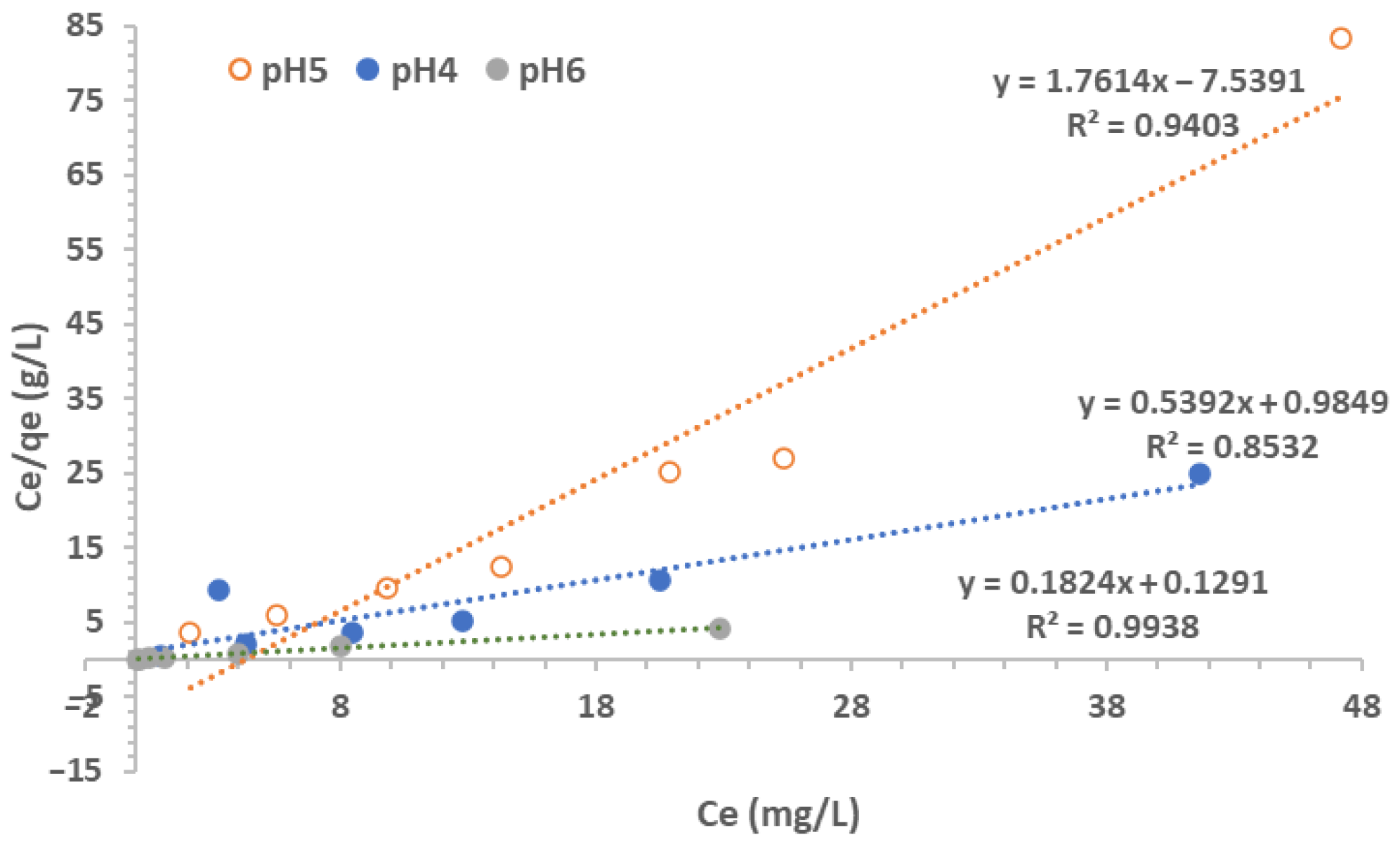
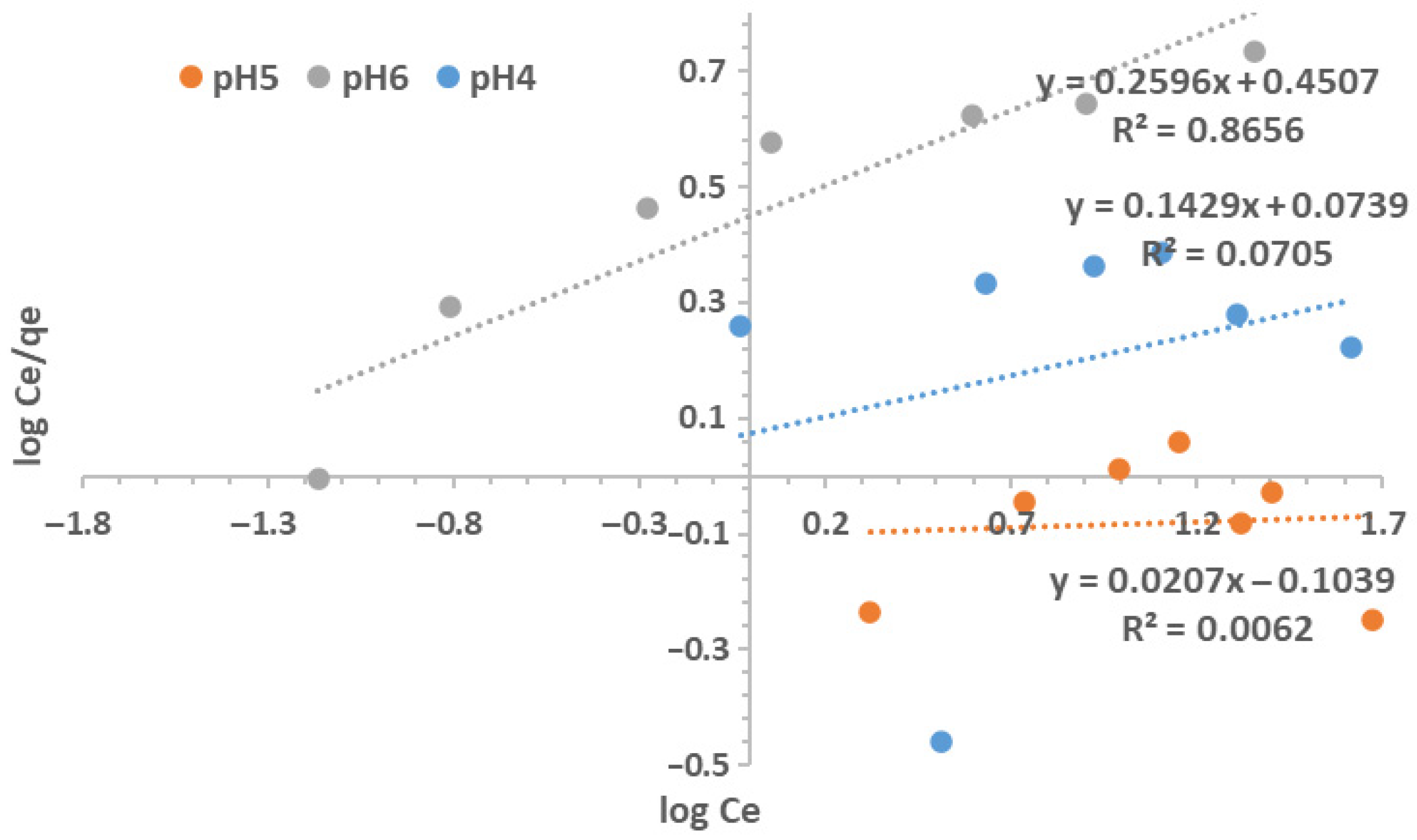
| 4 | 1.854 | 0.5477 | 0.8532 | 0.7709 | 7.00 | 1.18 | 0.0705 | 0.6732 | Langmuir |
| 5 | 0.923 | −17.50 | 0.9403 | 335.99 | 48.31 | 0.787 | 0.0062 | 0.2020 | Langmuir |
| 6 | 5.48 | 1.41 | 0.9938 | 0.5020 | 3.85 | 2.83 | 0.8656 | 0.5752 | Langmuir |
| Sample D | Langmuir Model | Freundlich Model | Best Fit Model | ||||||
|---|---|---|---|---|---|---|---|---|---|
| pH | Qmax (mg/g) | (L/mg) | R2 | RMSE | n | R2 | RMSE | ||
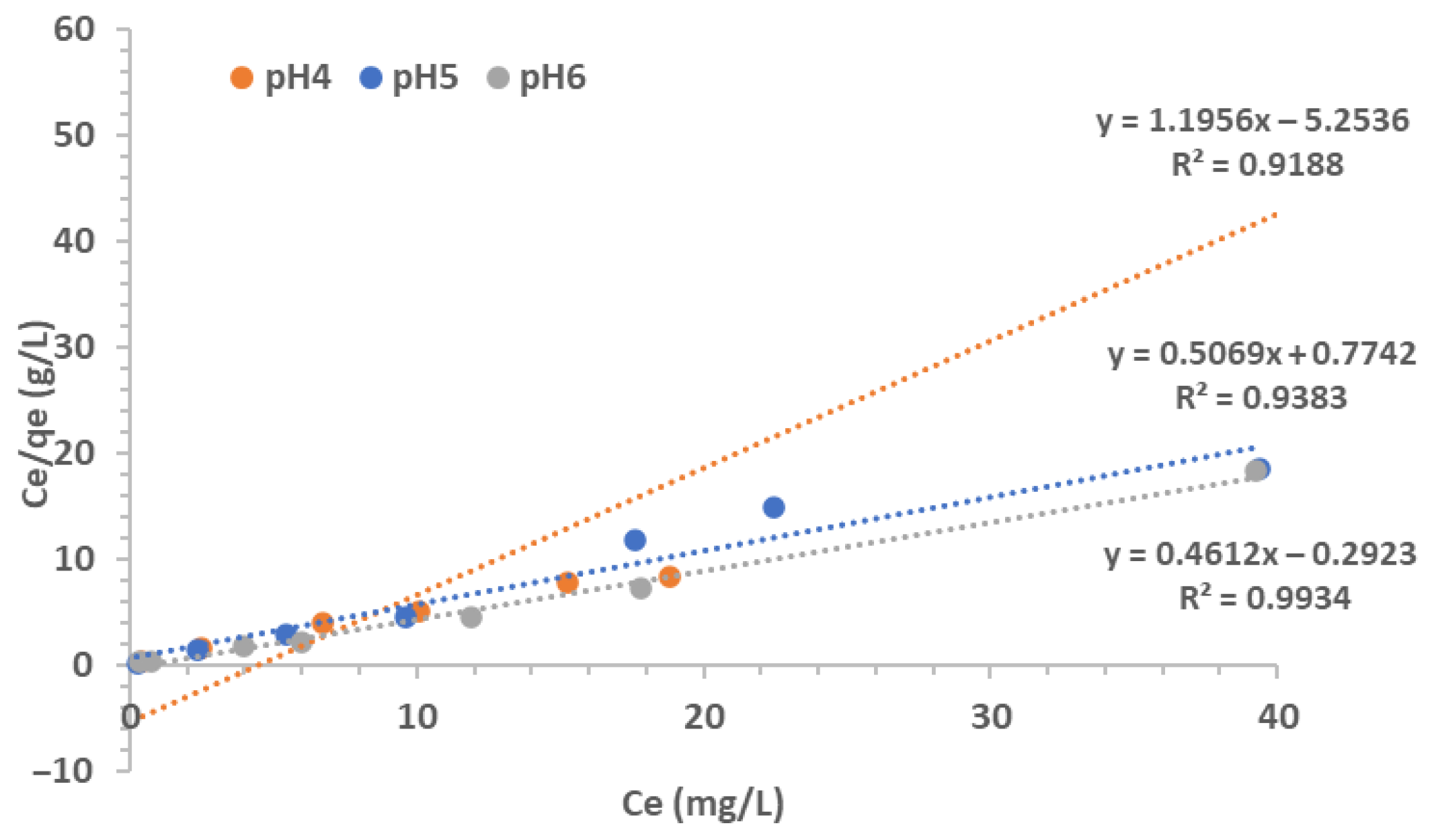
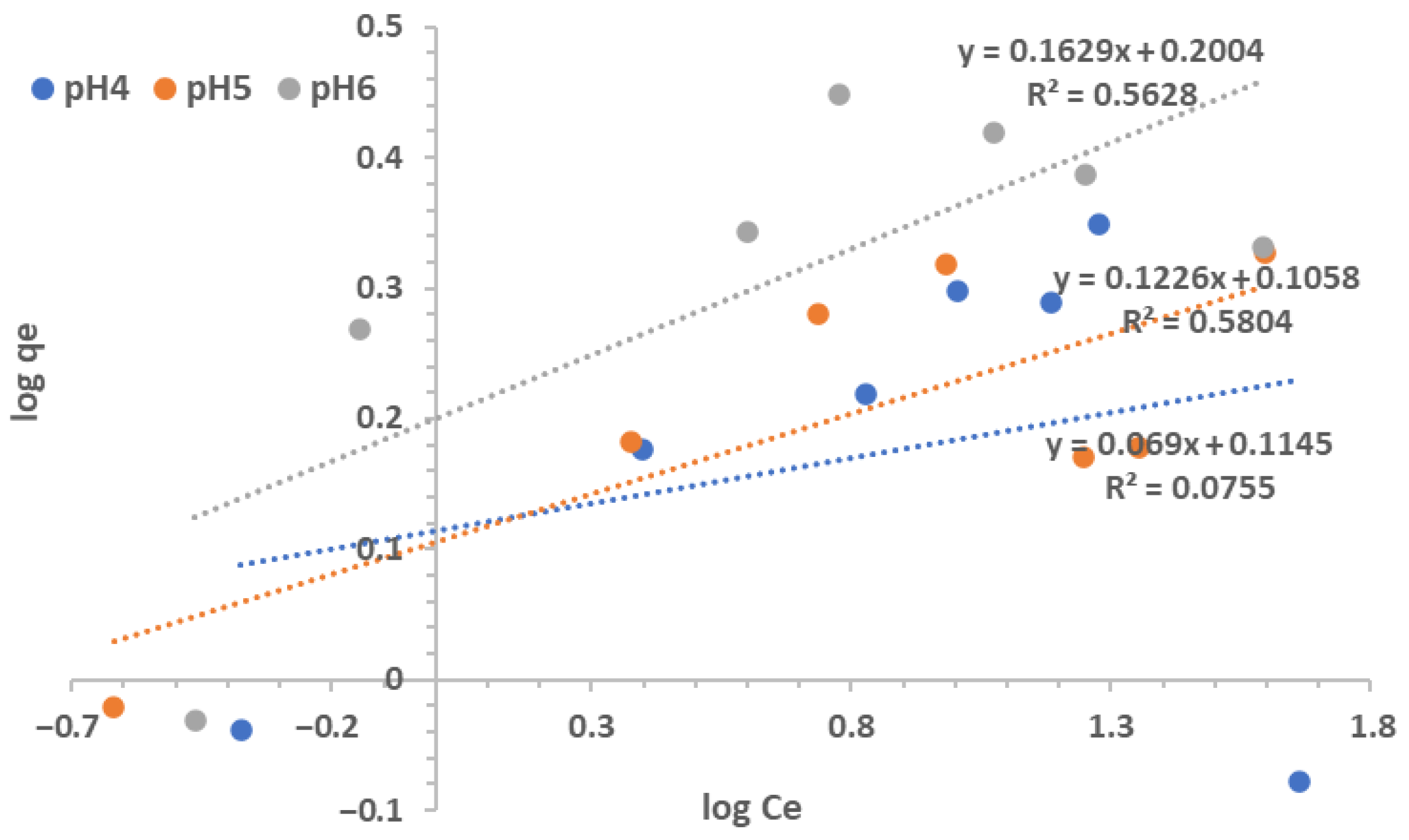
| 4 | 0.836 | −0.228 | 0.9188 | 1.2249 | 14.49 | 1.30 | 0.0755 | 0.4829 | Langmuir |
| 5 | 1.973 | 0.655 | 0.9383 | 0.4025 | 8.15 | 1.28 | 0.5804 | 0.2821 | Langmuir |
| 6 | 2.17 | −1.58 | 0.9934 | 3.5313 | 6.14 | 1.59 | 0.5628 | 0.4511 | Langmuir |
| Sample | Ca (%) | K (ppm) | P (%) | S (%) | Si (ppm) | Al (ppm) | Mg (ppm) | Fe (ppm) | Cu (ppm) |
|---|---|---|---|---|---|---|---|---|---|
| A Before | 1.396 | 386.1 | 0.173 | 1.036 | 962.6 | 109.3 | 9.1 | 824.3 | Native |
| A After | 0.504 | 219.4 | 0.168 | 1.275 | 1420 | 192.2 | 1.5 | 748.4 | ↑ Cu |
| B Before | 9.070 | 156.2 | 0.847 | 0.494 | 532.4 | 126.9 | 37.9 | 376.5 | Native |
| B After | 4.811 | 123.0 | 0.350 | 0.540 | 779.8 | 96.8 | 15.1 | 373.6 | ↑ Cu |
| C Before | 14.55 | 247.8 | 1.310 | 0.399 | 590.9 | 147.6 | 148.2 | 726.7 | Native |
| C After | 13.79 | 136.7 | 0.723 | 0.416 | 639.2 | 87.6 | 30.5 | 401.0 | ↑ Cu |
| D Before | 2.35 | 304.0 | 0.305 | 0.470 | 879.5 | 69.1 | 9.6 | 377.1 | Native |
| D After | 2.345 | 132.2 | 0.315 | 0.400 | 742.3 | 73.9 | 17.1 | 265.2 | ↑ Cu |
| Sample | SiO2 (ppm) | Al2O3 (ppm) | MgO (ppm) | P2O5 (%) | SO4 (%) | K2O (ppm) | CaCO3 (%) | Fe2O3 (ppm) |
|---|---|---|---|---|---|---|---|---|
| A Before | 962.6 | 109.3 | 9.1 | 0.173 | 1.036 | 386.1 | 1.396 | 824.3 |
| A After | 1420 | 192.2 | 1.5 | 0.168 | 1.275 | 219.4 | 0.504 | 748.4 |
| B Before | 532.4 | 126.9 | 37.9 | 0.847 | 0.494 | 156.2 | 9.070 | 376.5 |
| B After | 779.8 | 96.8 | 15.1 | 0.350 | 0.540 | 123.0 | 4.811 | 373.6 |
| C Before | 590.9 | 147.6 | 148.2 | 1.310 | 0.399 | 247.8 | 14.55 | 726.7 |
| C After | 639.2 | 87.6 | 30.5 | 0.723 | 0.416 | 136.7 | 13.79 | 401.0 |
| D Before | 879.5 | 69.1 | 9.6 | 0.305 | 0.470 | 304.0 | 2.35 | 377.1 |
| D After | 742.3 | 73.9 | 17.1 | 0.315 | 0.400 | 132.2 | 2.345 | 265.2 |
Disclaimer/Publisher’s Note: The statements, opinions and data contained in all publications are solely those of the individual author(s) and contributor(s) and not of MDPI and/or the editor(s). MDPI and/or the editor(s) disclaim responsibility for any injury to people or property resulting from any ideas, methods, instructions or products referred to in the content. |
© 2026 by the authors. Licensee MDPI, Basel, Switzerland. This article is an open access article distributed under the terms and conditions of the Creative Commons Attribution (CC BY) license.
Share and Cite
Ojewumi, M.E.; Chen, G.; Sachith, B.M.; Badisa, V.L.D.; Mwashote, B.M.; Rathore, R.S.; Ojewumi, O.E.; Odum, B. Sustainable Hydrochar Production from Biomass via Conventional Hydrothermal Carbonization: Optimization, Characterization, and Adsorption Capacity on Cu2+. Sustainability 2026, 18, 4450. https://doi.org/10.3390/su18094450
Ojewumi ME, Chen G, Sachith BM, Badisa VLD, Mwashote BM, Rathore RS, Ojewumi OE, Odum B. Sustainable Hydrochar Production from Biomass via Conventional Hydrothermal Carbonization: Optimization, Characterization, and Adsorption Capacity on Cu2+. Sustainability. 2026; 18(9):4450. https://doi.org/10.3390/su18094450
Chicago/Turabian StyleOjewumi, Modupe E., Gang Chen, Bhagyashree Mahesha Sachith, Veera L. D. Badisa, Benjamin M. Mwashote, Rajesh S. Rathore, Omotayo E. Ojewumi, and Bismark Odum. 2026. "Sustainable Hydrochar Production from Biomass via Conventional Hydrothermal Carbonization: Optimization, Characterization, and Adsorption Capacity on Cu2+" Sustainability 18, no. 9: 4450. https://doi.org/10.3390/su18094450
APA StyleOjewumi, M. E., Chen, G., Sachith, B. M., Badisa, V. L. D., Mwashote, B. M., Rathore, R. S., Ojewumi, O. E., & Odum, B. (2026). Sustainable Hydrochar Production from Biomass via Conventional Hydrothermal Carbonization: Optimization, Characterization, and Adsorption Capacity on Cu2+. Sustainability, 18(9), 4450. https://doi.org/10.3390/su18094450