1. Introduction
Economic evaluation in mining projects is inherently affected by uncertainty, as both costs and revenues evolve over time with changing market conditions and operational performance. In open-pit gold mining, uncertainties related to commodity prices, ore grades, recovery rates, and operating costs can significantly influence project outcomes. When such uncertainties are not properly considered, investment decisions based on deterministic assumptions may lead to suboptimal or economically unfavorable results [
1,
2,
3].
In recent years, there has been increasing recognition that mining project evaluation should be considered within a broader sustainability framework. In this context, economic sustainability refers not only to maximizing financial returns but also to maintaining stable and efficient project performance under uncertainty while improving resource utilization and reducing operational inefficiencies. Previous studies have emphasized the importance of integrating environmental, social, and economic dimensions in mining systems, particularly through sustainability-oriented decision-making approaches and innovation-driven processes [
4,
5]. In this respect, integrating uncertainty analysis into economic evaluation can also be viewed as a sustainability tool that supports more efficient and responsible resource utilization in mining projects.
To address uncertainty in project evaluation, probabilistic methods such as sensitivity analysis and Monte Carlo simulation have been widely adopted. These approaches enable decision-makers to quantify the impact of uncertain parameters on project performance and to evaluate risk more realistically compared to deterministic methods [
6,
7,
8,
9]. In particular, recent developments in Monte Carlo-based risk assessment highlight the growing importance of simulation techniques in improving the robustness of investment decisions [
10]. Beyond economic evaluation, such approaches also contribute to sustainability assessment by enabling the analysis of resource efficiency and risk under uncertainty.
Economic risk assessment in mining projects has been addressed using various analytical and probabilistic approaches in the literature. In addition to Monte Carlo simulation, methods such as stochastic programming, Bayesian-based modelling, and moment-based analytical approaches have been applied to evaluate uncertainty and support decision-making under risk [
11,
12,
13]. These approaches offer different perspectives on uncertainty modelling, ranging from optimization-based frameworks to probabilistic inference techniques. However, many of these methods require complex model structures or extensive datasets, which may limit their practical applicability in real mining projects.
Compared to these approaches, Monte Carlo simulation provides a flexible and widely applicable framework that allows for the explicit representation of uncertainty in key economic variables [
14]. It is particularly suitable for evaluating risk in capital-intensive mining projects where multiple uncertain inputs influence financial outcomes. The present study builds on this approach by integrating probabilistic economic evaluation with a sustainability-oriented perspective, focusing on resource efficiency and risk-informed investment decision-making.
Compared with stochastic programming and Bayesian-based approaches, Monte Carlo simulation requires fewer structural assumptions and can be implemented more directly within a project-level cash flow model [
11,
12,
13]. Method-of-moments approaches may provide useful analytical approximations, while cost-based indicators such as levelized cost metrics can support comparative evaluation; however, these approaches do not always provide the same level of detail in representing the full distribution of economic outcomes. For the purposes of this study, Monte Carlo simulation was preferred because it allows the direct propagation of uncertainty in key input variables and supports scenario-based evaluation of NPV and IRR in a practical and transparent manner.
At the mine planning level, recent research has highlighted the need to integrate economic evaluation with operational and environmental considerations. For instance, optimization approaches for open-pit mining increasingly incorporate ecological costs, slope stability, and economic benefits simultaneously, reflecting a shift toward more sustainable mine planning practices [
13]. In addition, improvements in processing performance and recovery rates directly influence both project profitability and resource efficiency, particularly in gold mining systems [
15].
Despite these developments, there remains a lack of practical and flexible frameworks that combine economic risk analysis with sustainability-oriented decision-making in real mining case studies. Many existing studies focus either on technical optimization or on high-level sustainability assessments, with limited integration between uncertainty modelling and operational decision processes [
16,
17,
18].
Recent studies have further emphasized the need to connect economic evaluation, uncertainty analysis, and sustainability assessment in resource-based systems. In gold mining, sustainability-oriented assessment methods have been used to evaluate resource use, energy efficiency, and environmental burden across different extraction systems [
19]. In parallel, Monte Carlo-based economic risk assessment has also been applied in other investment contexts to quantify the effects of technological, environmental, and economic uncertainties on financial outcomes [
20]. These studies support the relevance of uncertainty-aware evaluation frameworks for improving decision-making under risk.
Previous studies have also explored uncertainty in mining project evaluation using different modelling approaches [
2,
3,
21]. This study addresses this gap by developing a risk-based decision-support framework that integrates economic risk analysis with sustainability-oriented evaluation in open-pit gold mining. Unlike conventional approaches that focus primarily on deterministic economic indicators, the proposed framework explicitly incorporates uncertainty into investment analysis and links economic performance with resource efficiency. As such, the study contributes to sustainability tools by providing a practical and flexible approach to support sustainable resource utilization and more resilient decision-making in mining projects. In this context, sustainability is addressed primarily from the perspective of economic performance and resource utilization under uncertainty, using measurable indicators derived from probabilistic analysis, particularly NPV, IRR, and recovery-related performance metrics, while broader environmental and social dimensions are acknowledged as important extensions for future research.
Accordingly, the study aims to examine how uncertainty in key economic parameters influences the financial performance of open-pit gold mining projects, and to evaluate the extent to which probabilistic simulation can improve investment risk assessment compared to conventional deterministic approaches. In addition, the analysis explores how improvements in recovery performance affect both economic outcomes and resource efficiency under uncertain conditions. These objectives define the analytical scope of the study and provide the basis for the proposed risk-based evaluation framework.
2. Materials and Methods
2.1. Case Study and Economic Parameters
To establish the simulation model, the key parameters affecting project economics must first be identified. These parameters are used as input variables for both sensitivity analysis and Monte Carlo simulation. Each factor needs to be associated with a base value and an appropriate probability distribution. Below,
Table 1 outlines the key factors. As aforementioned, the base values are derived from recent operational data from an open-pit gold mine in Kyrgyzstan, with strict adherence to data privacy protocols, anchoring the simulation within the current context of the mining project.
2.2. Net Present Value Calculation
The primary objective of this study is to model the economic outcomes based on the parameters that NPV depends on, aiming to approximate real-world scenarios.
The NPV calculations were implemented in Python (version 3.9, Python Software Foundation, Wilmington, DE, USA) using a custom function developed for this study. The function computes annual cash flows based on production parameters and applies the discounted cash flow method to estimate project NPV. The main Python implementation used for the calculations is provided in
Appendix A, while additional supporting scripts and functions are presented in
Appendix B,
Appendix C and
Appendix D.
Following the definition of input parameters, annual cash flows and NPV were calculated using the discounted cash flow approach as given in Equation (1).
where
r represents the discount rate (assumed as 7% in this study),
Fₖ denotes the cash flow at period
k, and
I0 represents the initial investment. The discount rate is applied consistently throughout the economic evaluation and simulation model.
In addition to NPV, the Internal Rate of Return (IRR) was calculated for each simulation scenario to evaluate project profitability under uncertainty. IRR represents the discount rate at which the NPV becomes zero and is widely used as a complementary indicator for evaluating investment performance in mining projects.
Separate copies of the yearly cash flow arrays are used in the NPV and IRR calculations to avoid unintended modification of the same data structure during sequential computations, ensuring consistency between the two financial indicators.
The discount rate (r) was assumed as 7% in this study, representing a commonly adopted benchmark in mining project evaluation. This value reflects a moderate level of investment risk and is consistent with typical industry practices for long-term mining investments.
It should be noted that the appropriate discount rate may vary depending on country-specific risk factors, including political and economic conditions. In the present study, the discount rate was treated as a fixed parameter in order to isolate the effects of key operational and market-related uncertainties on project performance.
The mine life was estimated by dividing the total reserve tonnage by the planned annual ore production rate, resulting in a mine life of approximately 15 years for a production rate of 1.5 million tons per year [
1,
2,
3].
For the purposes of this study, the discount rate was treated as a fixed parameter in order to isolate the effects of key operational and market-related variables on project performance. While the discount rate and grade variability may influence NPV, incorporating their uncertainty was considered beyond the scope of the present analysis. The dataset and initial modelling structure used in this study were adapted from previous work conducted by the author [
22].
2.3. Sensitivity Analysis
In order to systematically explore the sensitivity of the NPV to variations in input parameters, sensitivity analysis was performed by varying each input parameter by ±10%. This deliberate range was chosen based on the inherent nature of certain input parameters, such as recovery rates or costs, where extreme values may lack practicality.
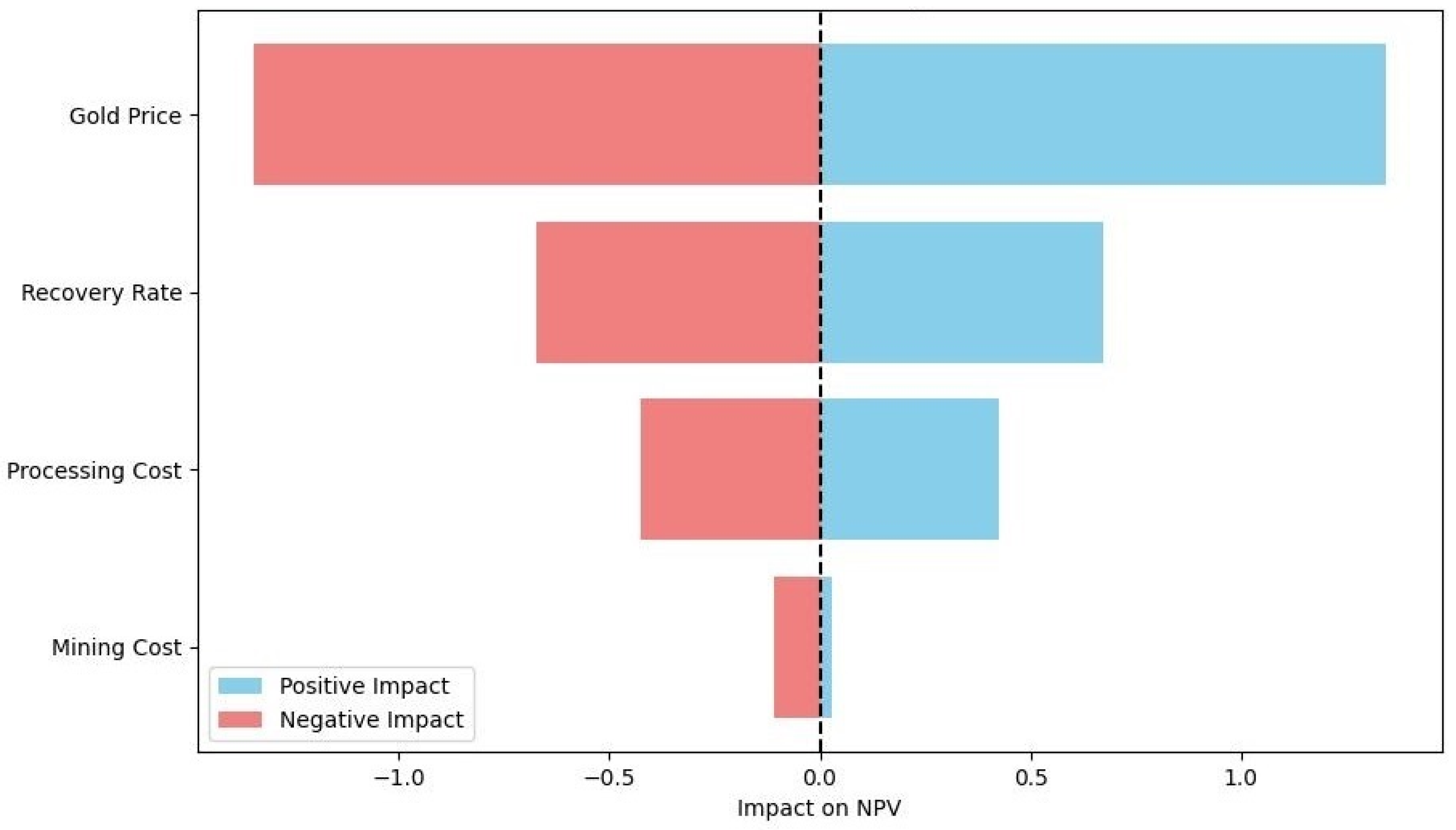
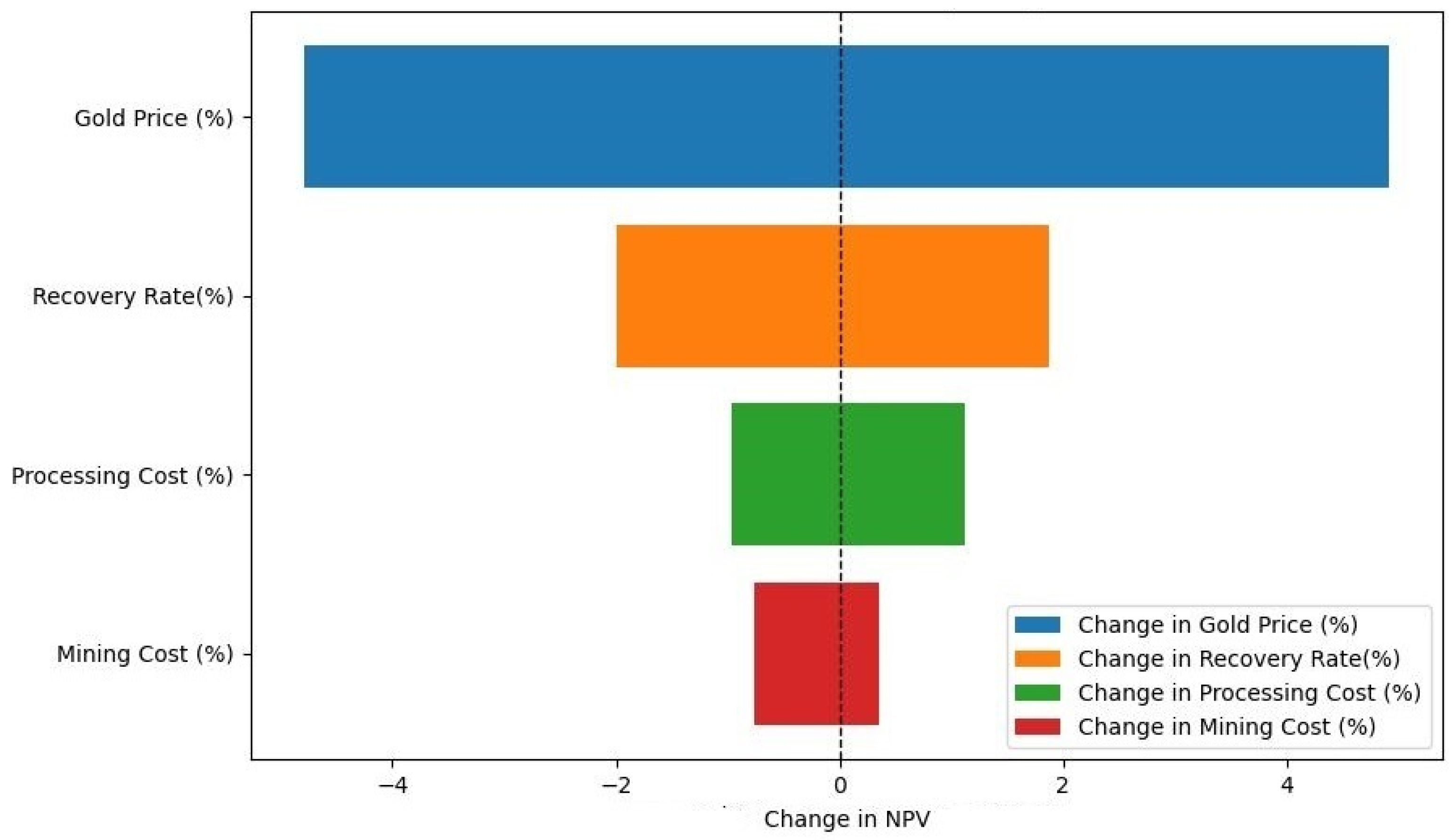
To assess the degree of impact each parameter holds, visualizing the resulting dataset becomes instrumental. Tornado diagrams were generated to visualize the relative influence of each parameter on NPV.
Figure 1 and
Figure 2 illustrate the resultant tornado plots of the aforementioned model in Python and resulting data obtained from the same model within an integrated mining software.
The results indicate that gold price is the most influential parameter affecting project NPV, followed by recovery rate.
Based on the sensitivity analysis results, the input variables can be ranked according to their relative influence on project NPV. Gold price was identified as the most influential parameter, followed by recovery rate and mining cost, while the remaining variables showed comparatively smaller effects. This ranking provides a practical basis for prioritizing key parameters in risk evaluation and scenario analysis.
This finding is anticipated, given the substantially higher value of gold compared to other parameters, with its unit measured in grams per ton. As a result, for every ton of ore, considering the average grade of 1.6 g per ton, its impact is 1.6 times greater than that of the other parameters.
2.4. Convergence Analysis
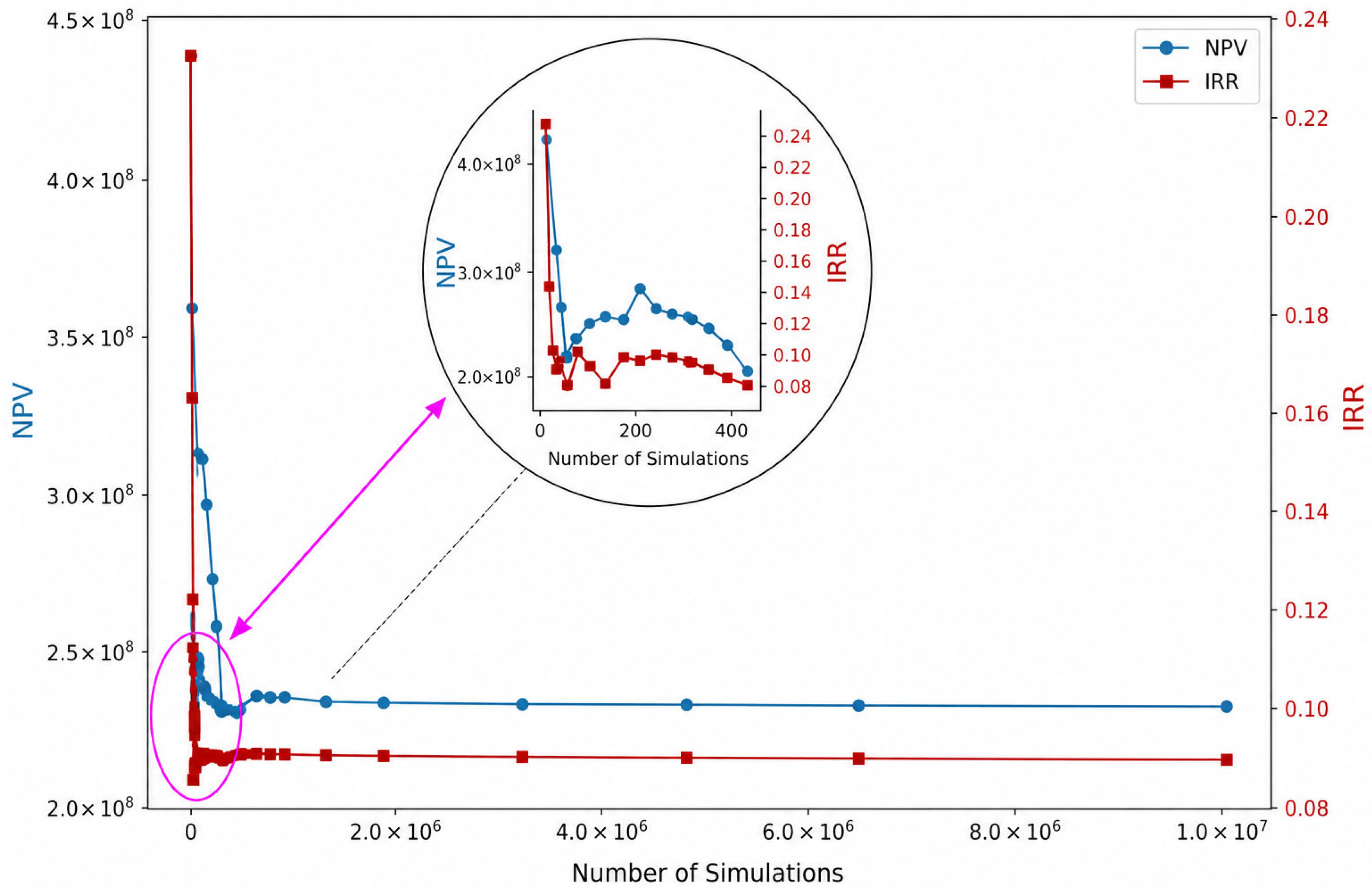
To evaluate whether the selected number of Monte Carlo iterations provides stable and reliable estimates, a convergence analysis was conducted for both NPV and IRR.
As the number of simulations increases, the variability in NPVs decreases and the results converge toward stable estimates. A similar convergence behavior is observed for IRR, indicating increased consistency of the simulated financial indicators with higher iteration counts.
In addition to financial indicators, computational time was also evaluated. Increasing the number of simulations improves result stability but leads to longer execution times. Therefore, an appropriate number of iterations should be selected to balance accuracy and computational efficiency.
Table 2 presents the results of the convergence analysis. The results show that both NPV and IRR values stabilize as the number of simulations increases, with significantly reduced variability at higher iteration levels.
Figure 3 illustrates the convergence behavior of NPV and IRR as the number of simulations increases. When the number of simulations is low, noticeable variability is observed in both indicators. As the number of simulations increases, the values gradually stabilize. NPV converges toward approximately 220,000,000 USD, while IRR approaches a value close to 9.1%. This pattern indicates that the variation in the simulated financial metrics decreases with increasing iteration count.
Based on the convergence behavior observed in
Table 2 and
Figure 3, 1,000,000 simulations were considered sufficient to obtain stable and reliable estimates of NPV and IRR.
3. Monte Carlo Simulation
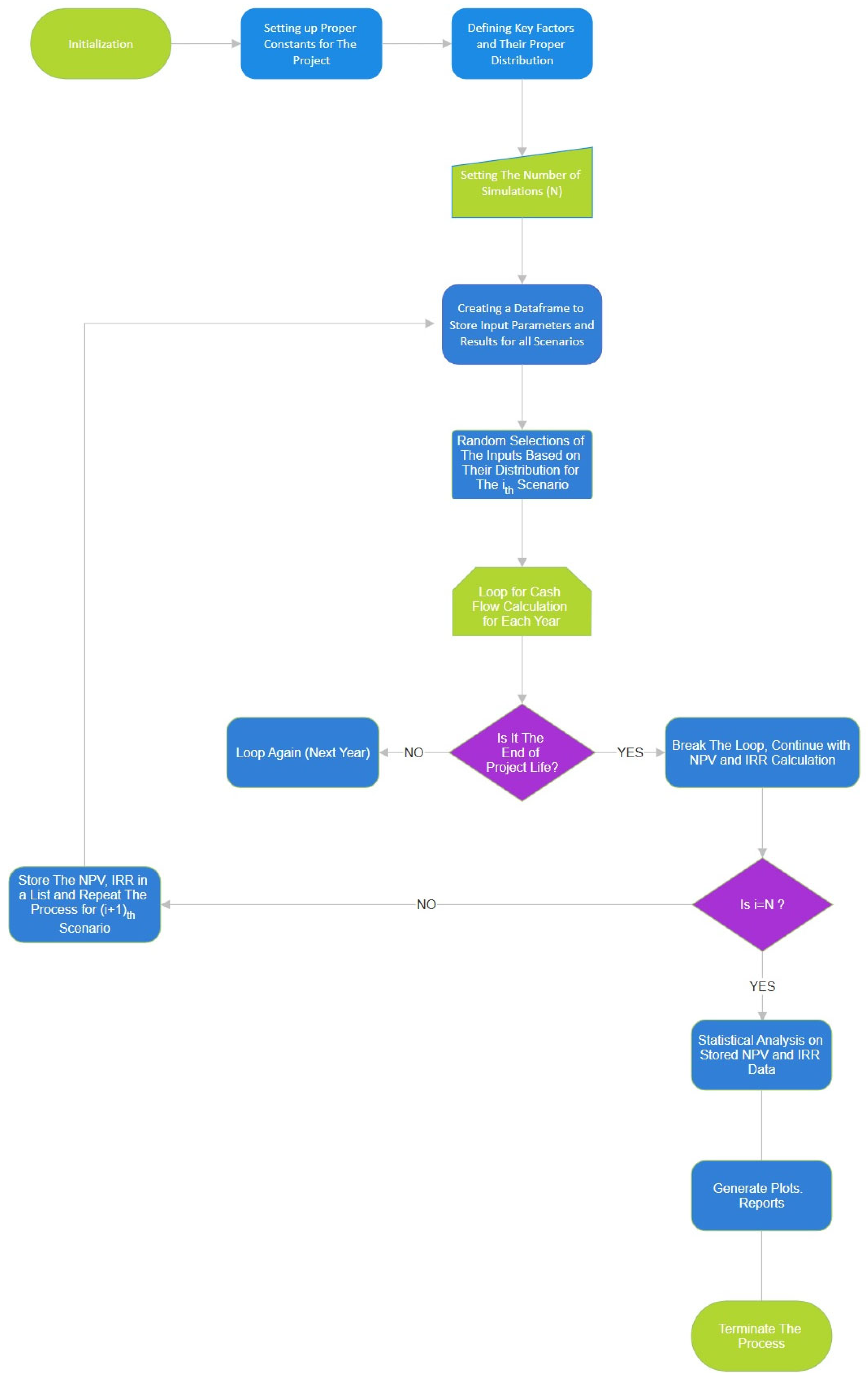
The proposed modelling framework also enables the evaluation of economic sustainability by linking financial performance with resource efficiency and recovery improvement under uncertainty. Following the sensitivity analysis, Monte Carlo simulation (MCS) was applied to the financial model in order to evaluate the effects of uncertainty on project economic performance. A notable advantage of employing the MCS lies in its flexibility to increase the number of simulations for factors identified as most sensitive to NPV and IRR, as indicated by the results of the sensitivity analysis. The schematic flowchart presented in
Figure 4 elucidates the logical framework implemented in the Python script within the context of this study.
The Monte Carlo simulation approach relies on generating multiple sets of random inputs to represent a wide range of possible scenarios. The thoughtful choice of distributions and the implementation of weighted random selection contribute to the robustness and realism of the simulation, enabling analysts to explore a spectrum of possible outcomes and make well-informed decisions in the face of uncertainty.
The scheduled production plan, aligned with the project’s life span as presented in
Table 3, has been seamlessly integrated into the script.
Probability distributions were assigned to the key economic parameters based on available operational data and engineering judgment. Gold price was modeled using a normal distribution to reflect market fluctuations, while mining and processing costs were represented using triangular distributions based on minimum, most likely, and maximum estimates. The recovery rate was also modeled using a triangular distribution reflecting operational variability in the processing plant.
In the present model, gold price, mining cost, processing cost, and recovery rate were sampled independently. This assumption was adopted to keep the simulation structure transparent and to isolate the individual contribution of the main uncertain inputs. Although some degree of correlation may exist among these variables in real projects, a defensible empirical correlation structure could not be established from the available project data. For this reason, independent sampling was retained in the current analysis in order to avoid introducing arbitrary correlation assumptions into the model.
In this study, ore grade was represented using a fixed average value (1.6 g/t) in order to isolate the effects of key economic and operational variables on project performance. While grade variability is recognized as a major source of uncertainty in gold mining projects, incorporating its stochastic behaviour was considered beyond the scope of the present analysis.
In addition to the variables considered in this study, other sources of uncertainty such as exchange rate fluctuations, geopolitical conditions, and economic policy uncertainty may also influence the economic performance of mining projects. These factors have been increasingly recognized in the literature as important components of investment risk in resource-based industries, particularly in developing or emerging economies [
23,
24,
25].
In the present study, these variables were not explicitly incorporated into the simulation framework to maintain a focused modelling structure and to isolate the effects of key operational and market-related parameters such as gold price, recovery rate, and mining cost. While the inclusion of macroeconomic and geopolitical risk factors could provide additional insights, their modelling would require more complex assumptions and reliable datasets, which were beyond the scope of the current analysis.
Nevertheless, the proposed framework is sufficiently flexible to accommodate additional risk factors, and future applications may extend the model to incorporate such uncertainties where appropriate data are available.
This incorporation allows the system to dynamically select the predetermined production amount for a given year. It is worth noting that while the scheduled production plan is currently treated as a fixed variable linked to the project timeline, it could alternatively be introduced as a variable with its own probability distribution. However, for the sake of simplicity and to mitigate unnecessary complexity, such an attempt has not been pursued in the current implementation.
The Monte Carlo simulation framework is initialized using present values and evolves according to the probabilistic distributions assigned to the input parameters. This flexibility is crucial, particularly for parameters such as price, where turbulence can swiftly shift investments from profit to loss.
The stochastic nature of Monte Carlo simulation allows different probability distributions to be assigned to input parameters, enabling a more realistic representation of uncertainty in the financial model.
The Monte Carlo simulation was performed using 1,000,000 iterations. For each scenario:
The Monte Carlo simulation was implemented in Python. For each scenario, random samples were generated for the input parameters according to their assigned probability distributions. Annual cash flows were then calculated for each year of the project life, and the corresponding NPV and IRR values were estimated. The simulation process was repeated for the predefined number of iterations. For each simulation scenario, the corresponding Internal Rate of Return (IRR) was also calculated based on the generated cash flow series.
All simulations were performed using Python with the NumPy and numpy-financial libraries. The complete Python implementation used in the simulation is provided in
Appendix C and
Appendix D.
During each iterative step, the algorithm systematically evaluates whether the current fiscal year is equivalent to the designated lifespan of the project. Should this condition prove true, the iteration is terminated, facilitating the subsequent computation of both NPV and IRR predicated upon the input parameters specific to that particular scenario. Conversely, should the condition be false, the algorithm proceeds to the subsequent fiscal year, initiating a recurrent cycle until the termination of the scenario coincides with the conclusion of the project’s designated lifespan.
The NPV and IRR values for each scenario are stored, and the loop continues to the next scenario, repeating the process.
The simulation process continues until the predefined number of scenarios is completed.
4. Discussion
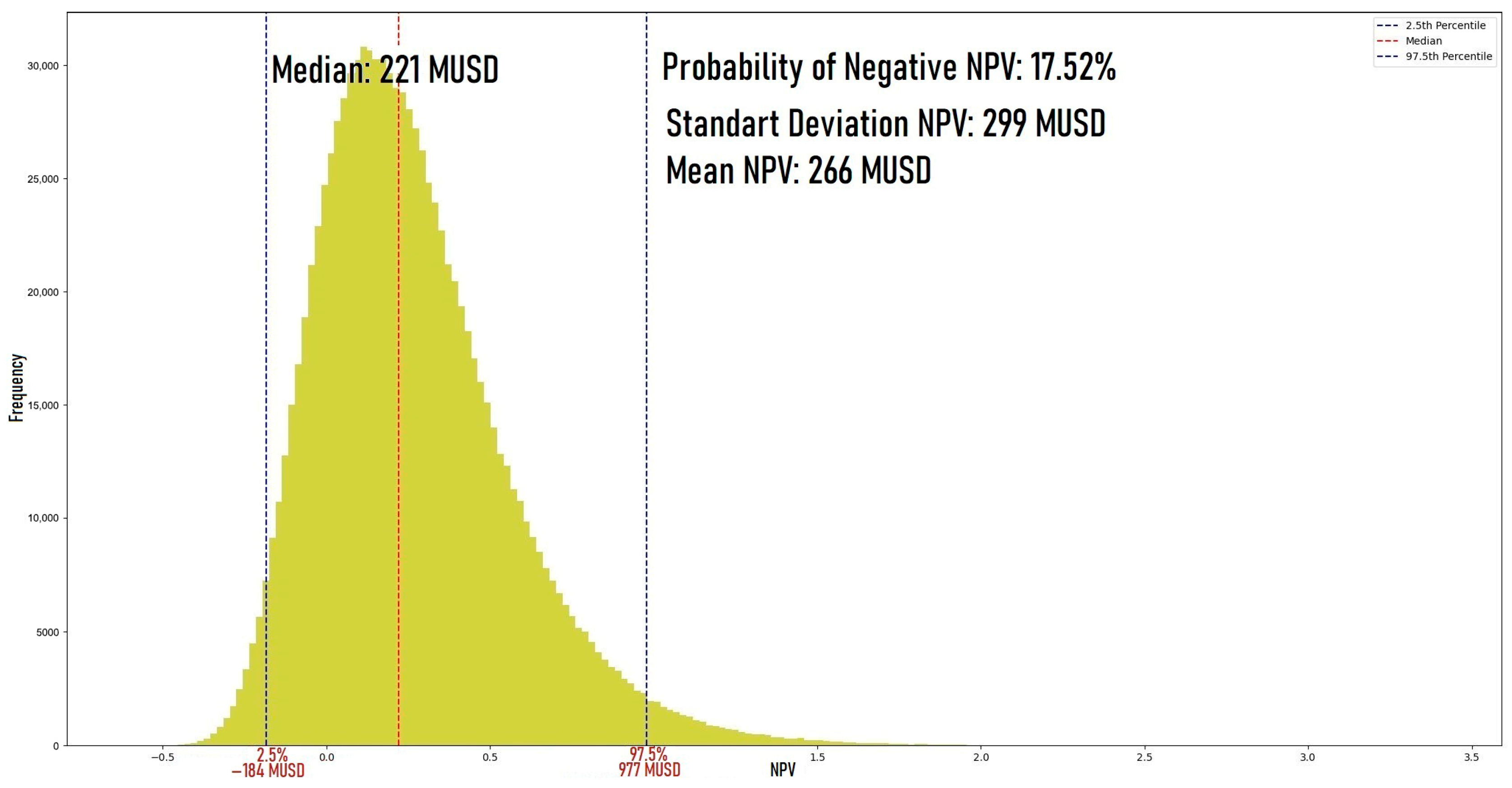
The results obtained from the Monte Carlo simulation clearly show the significant impact of uncertainty on the economic evaluation of open-pit mining projects. As illustrated in
Figure 5, the NPV distribution spans a wide range of possible outcomes, from strongly negative to highly positive values. Although the median NPV indicates a positive expected performance, the presence of probability of negative NPV (17.52%) highlights the financial risks associated with the project. This result confirms that relying solely on deterministic evaluations may lead to overly optimistic conclusions, as also reported in previous studies on mining project risk and uncertainty [
6,
7,
8,
9].
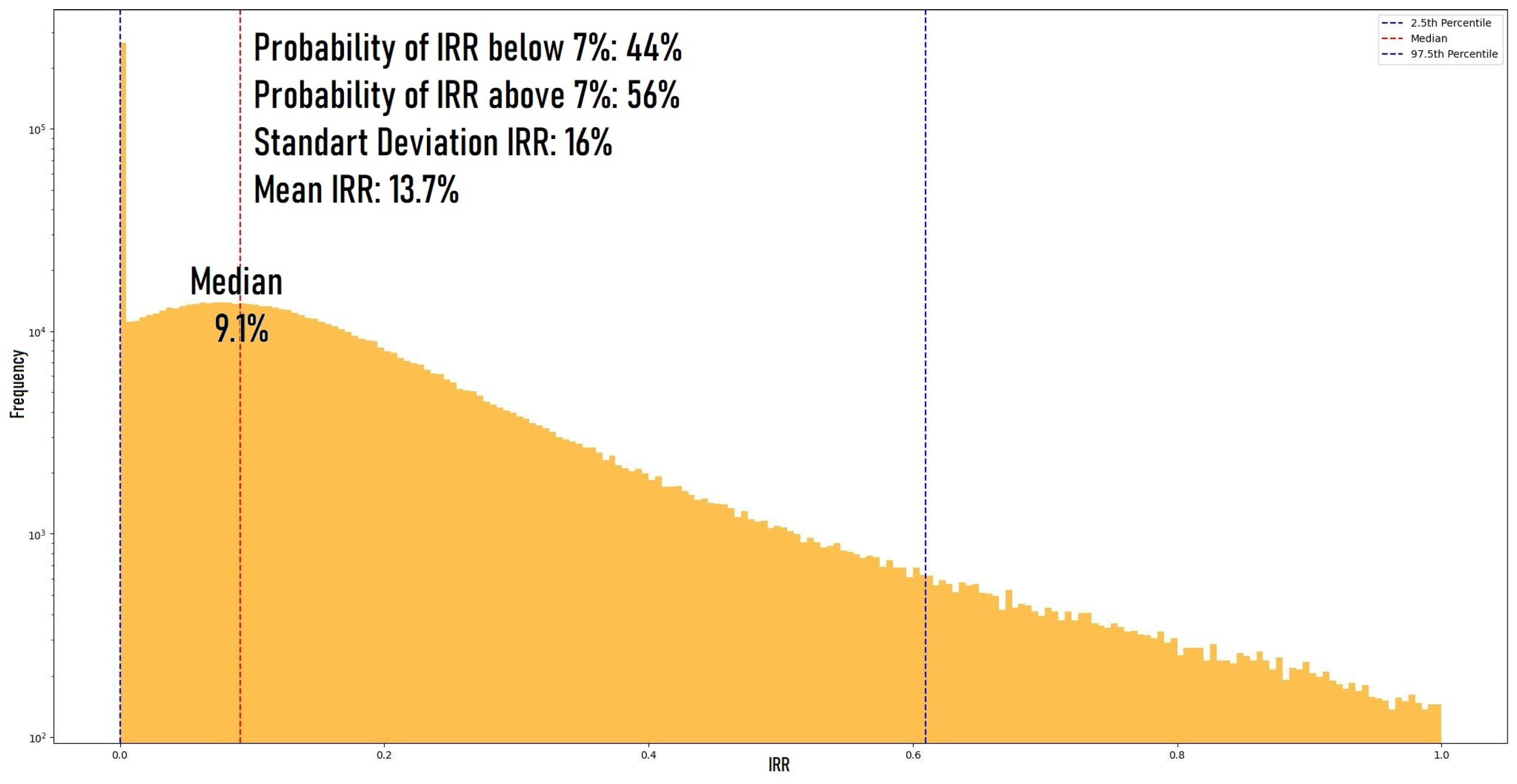
Similarly, the distribution of IRR values presented in
Figure 6 provides further insight into the variability of project performance. The median IRR of approximately 9.1% represents a moderate expected return; however, the probability distribution reveals that a substantial proportion of scenarios fall below commonly accepted investment thresholds. This variation reflects the sensitivity of project performance to fluctuations in key economic parameters, particularly gold price and recovery rate.
Compared to deterministic approaches, the probabilistic framework applied in this study allows the combined effects of multiple uncertain variables to be evaluated simultaneously. This allows decision-makers to move beyond single-value estimates and better understand the range of possible outcomes, which is essential for more robust investment planning in mining projects.
From a sustainability perspective, the results demonstrate that improvements in processing performance—especially recovery rate—have a dual impact. On the one hand, higher recovery rates lead to increased economic returns, as reflected in the improved NPV distributions. On the other hand, they contribute to more efficient utilization of mineral resources by reducing material losses. This finding is consistent with recent studies emphasizing the role of process optimization and efficiency in sustainable mining systems [
15,
16].
This interpretation is also consistent with recent sustainability assessment studies in gold mining, where improvements in resource and energy efficiency are considered important pathways for reducing environmental burden and improving the overall sustainability performance of mining systems [
19]. Although the present study does not directly quantify environmental indicators, the economic evaluation of recovery improvement provides a practical basis for linking investment decisions with more efficient resource utilization.
The results also underline the importance of incorporating uncertainty into feasibility studies. By explicitly quantifying the probability of unfavorable outcomes, the proposed framework supports more transparent and informed investment decisions. This is particularly relevant for long-term mining projects, where uncertainty in market conditions and operational parameters can significantly influence financial performance.
In addition to the indicators used in this study, alternative risk measures such as Value at Risk (VaR) and Conditional Value at Risk (CVaR) are widely used in financial risk analysis to assess downside risk and tail behavior of distributions [
26,
27]. In the present study, the risk-return profile was evaluated based on the probabilistic distribution of NPV and IRR, which was considered sufficient within the scope of the analysis. The inclusion of such metrics, as well as additional indicators such as break-even analysis, may be considered in future studies.
Therefore, these advanced risk metrics were not included in the present analysis. Nevertheless, their integration into the proposed framework represents a valuable direction for future research, particularly for studies focusing on extreme risk quantification.
In addition, the flexibility of the modelling approach allows different investment scenarios to be evaluated under consistent assumptions. The case study results suggest that technological improvements, such as mill upgrades, not only enhance economic performance but also support more efficient resource use. This reinforces the role of uncertainty-based economic evaluation as a sustainability tool in mining decision-making.
It should be noted that ore grade was treated as a fixed parameter in this study. Given that grade directly influences revenue, its variability may significantly affect project valuation. Therefore, the reported results should be interpreted within this assumption. Incorporating stochastic grade variability would likely increase the spread of the NPV distribution and could influence risk estimates. This represents an important direction for future research.
The choice of discount rate also represents a simplifying assumption in the present analysis. While country-specific risk factors may justify higher discount rates in certain contexts, the selected value was intended to provide a consistent basis for comparing simulation outcomes. Incorporating discount rate variability could further improve the robustness of the analysis and represents a potential extension for future work.
Another simplifying assumption of the simulation framework is that the main stochastic inputs were sampled independently. In practice, some of these variables may be partially correlated, particularly under broader macroeconomic conditions affecting both commodity prices and operating costs. Ignoring such correlations may influence the spread of simulated outcomes and may lead to under- or over-estimation of project risk. In the present study, independent sampling was preferred because the available dataset did not provide a sufficiently robust basis for estimating a reliable correlation matrix. This assumption should therefore be considered when interpreting the results, and future applications of the framework may incorporate correlation structures where adequate data are available.
In addition, the robustness of the simulation framework is influenced by the choice of probability distributions assigned to the input variables. In this study, commonly used distributions such as normal and triangular forms were adopted based on parameter characteristics. While alternative distributional assumptions may lead to variations in the simulated outputs, the general trends observed in the results are expected to remain consistent. Future studies may further explore the sensitivity of the results to alternative distribution assumptions to enhance model robustness.
The modelling framework is based on a set of simplifying assumptions that were intentionally adopted to maintain transparency and interpretability of the simulation results. In particular, the use of a fixed ore grade, independent sampling of stochastic inputs, and a constant discount rate allows the model to isolate the effects of key economic and operational variables on project performance.
While these assumptions may limit the representation of real-world complexity, they provide a controlled analytical structure in which the relative influence of individual parameters can be more clearly evaluated. Introducing additional layers of model complexity, such as correlated variables or stochastic grade modelling, would require more extensive data and could introduce additional sources of uncertainty.
For this reason, the selected assumptions are considered appropriate for the scope of the present study, while their limitations have been explicitly acknowledged and identified as areas for future research.
The robustness of the model was also evaluated through complementary checks. The convergence analysis demonstrated that both NPV and IRR stabilize as the number of simulation iterations increases, indicating that the selected number of simulations is sufficient for reliable estimation. In addition, the deterministic discounted cash flow (DCF) result obtained from the mean values of the input parameters was found to be consistent with the central tendency of the simulated NPV distribution. These results support the internal consistency of the model and the stability of the simulation outcomes [
28].
Formal statistical tests and confidence-interval-based inference were not the primary focus of this study, as the analysis is based on simulation-driven distributional evaluation rather than parameter estimation. In this context, the probabilistic distributions of NPV and IRR, together with convergence behavior and downside-risk measures, were considered sufficient to support decision-making under uncertainty. This approach is consistent with common practice in simulation-based economic risk analysis, where the emphasis is placed on the interpretation of output distributions rather than on inferential statistical testing.
Overall, the proposed approach provides a practical and adaptable framework for evaluating mining investments under uncertainty. From a sustainability perspective, the contribution of the study is centered on the economic pillar of sustainability, with a particular focus on resource efficiency and risk-informed decision-making.
In this context, the integration of uncertainty analysis into economic evaluation allows decision-makers to assess not only expected financial performance but also the likelihood of unfavorable outcomes. This contributes to more responsible investment decisions by reducing the risk of inefficient resource allocation and avoiding economically unsustainable project configurations.
In this study, this relationship is operationalized through the probabilistic evaluation of NPV and IRR, together with the analysis of recovery-related improvements, which serve as measurable proxies for economic performance and resource efficiency under uncertainty.
Furthermore, the results demonstrate that improvements in recovery performance can enhance both economic outcomes and resource utilization by reducing metal losses. This establishes a direct link between economic risk analysis and sustainability through more efficient use of extracted resources.
While environmental and social dimensions are not explicitly quantified in the present study, the proposed framework provides a practical basis for economically sustainable decision-making and can be extended in future studies to incorporate broader sustainability indicators.
5. Practical Implications
A key decision considered in this study was whether upgrading the mill plant to improve the recovery rate would be economically justified. Investors needed to evaluate whether the additional investment required for this enhancement would translate into higher project profitability. The uncertainty surrounding this decision prompted the utilization of a flexible financial modeling script, empowered by Monte Carlo simulation. After the investigation into the technological enhancement’s effect on the recovery rate and the associated costs, it was assessed that this enhancement is projected to improve the recovery rate to 85% in exchange for a $30,000,000 investment.
In this study, these two scenarios were evaluated to compare the future outcomes of each. The MCS, capturing the inherent uncertainties, played a crucial role in providing a comprehensive understanding of the financial landscape associated with each decision. This approach allows the variability in recovery rate and associated costs to be incorporated into the financial model and enables comparison of possible future project outcomes. The resulting financial distributions, illustrated through histograms and statistical analyses, provide investors with valuable insights for making informed decisions regarding the technological enhancement investment.
The scripting approach allowed for the dynamic modeling of various scenarios by adjusting recovery rate intervals and factoring in additional investments. Through repeated simulations, the potential impact of technological enhancements on the project’s financial outcomes was gauged. This iterative process facilitated a nuanced understanding of the associated risks and benefits.
The flexibility embedded in the scripting methodology afforded decision-makers the ability to explore a spectrum of possibilities, ranging from optimistic projections to more conservative estimates. By visualizing the simulated results, investors gained valuable insights into the range of potential outcomes under different conditions.
This decision-making framework exemplifies the practical utility of Monte Carlo simulation in guiding strategic investments. It serves as a testament to the adaptability and foresight enabled by advanced simulation techniques, providing decision-makers with a comprehensive toolkit for evaluating the financial implications of substantial changes to the project.
In the context of the mill factory enhancement scenario, a comprehensive simulation was conducted over 1,000,000 iterations with specific parameters. As a baseline reference, a deterministic discounted cash flow (DCF) analysis was also performed using the mean values of the input parameters. The resulting deterministic NPV was found to be consistent with the central tendency of the simulated NPV distribution, supporting the internal consistency of the model.
In order to ensure consistency in the comparison, both the base case and the enhanced scenario were evaluated using the same modelling structure and simulation framework. The enhanced scenario differs only in the recovery-related parameters, while all other input variables and assumptions remain unchanged. This approach allows the observed differences in NPV and IRR to be directly attributed to the improvement in recovery performance, providing a more transparent basis for scenario comparison.
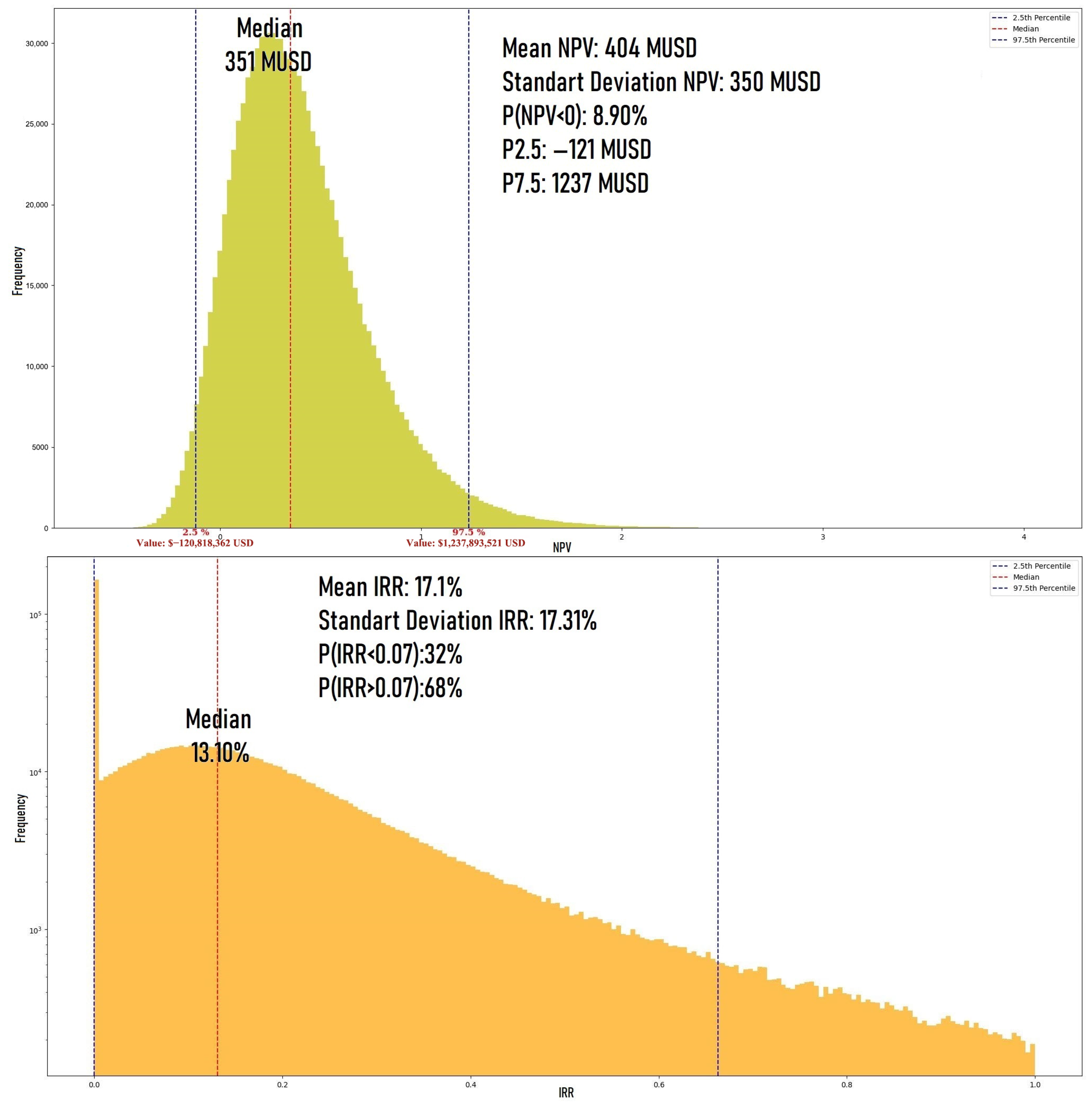
The simulation results indicate that the enhanced scenario yields a median NPV of approximately 351 million USD and an IRR of about 13%, as shown in
Figure 7. The results also suggest a lower probability of negative NPV outcomes compared to the base case, indicating that the technological enhancement reduces the overall financial risk of the project.
From a sustainability perspective, the ability to evaluate investment decisions under uncertainty provides a more reliable basis for resource allocation, particularly in capital-intensive projects such as mill upgrades.
6. Conclusions
This study developed a risk-based financial modelling framework for evaluating the economic sustainability of an open-pit gold mining project by integrating sensitivity analysis with Monte Carlo simulation. The results demonstrate that uncertainty has a significant impact on project performance, and that probabilistic approaches provide a more realistic representation of financial outcomes compared to deterministic methods.
The simulation results indicate that the project remains economically viable under most scenarios, with a median NPV of approximately 220 million USD. However, the probability of negative NPV (17.52%) highlights the financial risks associated with long-term mining investments. The findings also show that gold price and recovery rate are the most influential parameters affecting project value.
The comparison of alternative investment scenarios reveals that improving mill processing performance leads to substantial economic benefits. The enhanced scenario results in a higher NPV (≈351 million USD) and IRR (13%), demonstrating that technological improvements can significantly increase project profitability while reducing financial risk.
Without incorporating uncertainty-based analysis, such investment decisions would likely rely on deterministic estimates. This may lead to suboptimal capital allocation and overlooked downside risks. In this case, failing to incorporate uncertainty could result in significant economic losses or missed opportunities for improving project performance. Moreover, lower recovery rates in the base scenario would lead to increased material losses, negatively affecting resource efficiency and, consequently, the sustainability of the mining operation.
From a broader perspective, the results show that integrating uncertainty into financial evaluation is not only a methodological improvement but also an important component of economically sustainable mining practice. By enabling more informed and risk-aware decision-making, the proposed framework supports both economic performance and more efficient utilization of mineral resources.
For similar mining projects, particularly those involving high capital investments and significant geological or market uncertainty, the adoption of such probabilistic approaches is strongly recommended. The ability to evaluate multiple scenarios and quantify financial risk provides decision-makers with a more robust basis for selecting optimal investment strategies.
In this context, the proposed framework contributes to sustainability assessment tools by supporting the economic pillar of sustainability through risk-based evaluation under uncertainty. Environmental and social dimensions were not explicitly modelled in the present study and should be integrated in future work to provide a more comprehensive sustainability assessment.