Transforming Workplace Irritation into Well-Being Through Positive Solitude and Social Interactions—An Attention Recovery Perspective

Abstract
1. Introduction
2. Literature Review and Hypotheses
2.1. Attention Restoration Theory
2.2. Workplace Irritation and Recovery Pathways
2.3. The Mediating Roles of Positive Solitude and Social Interactions
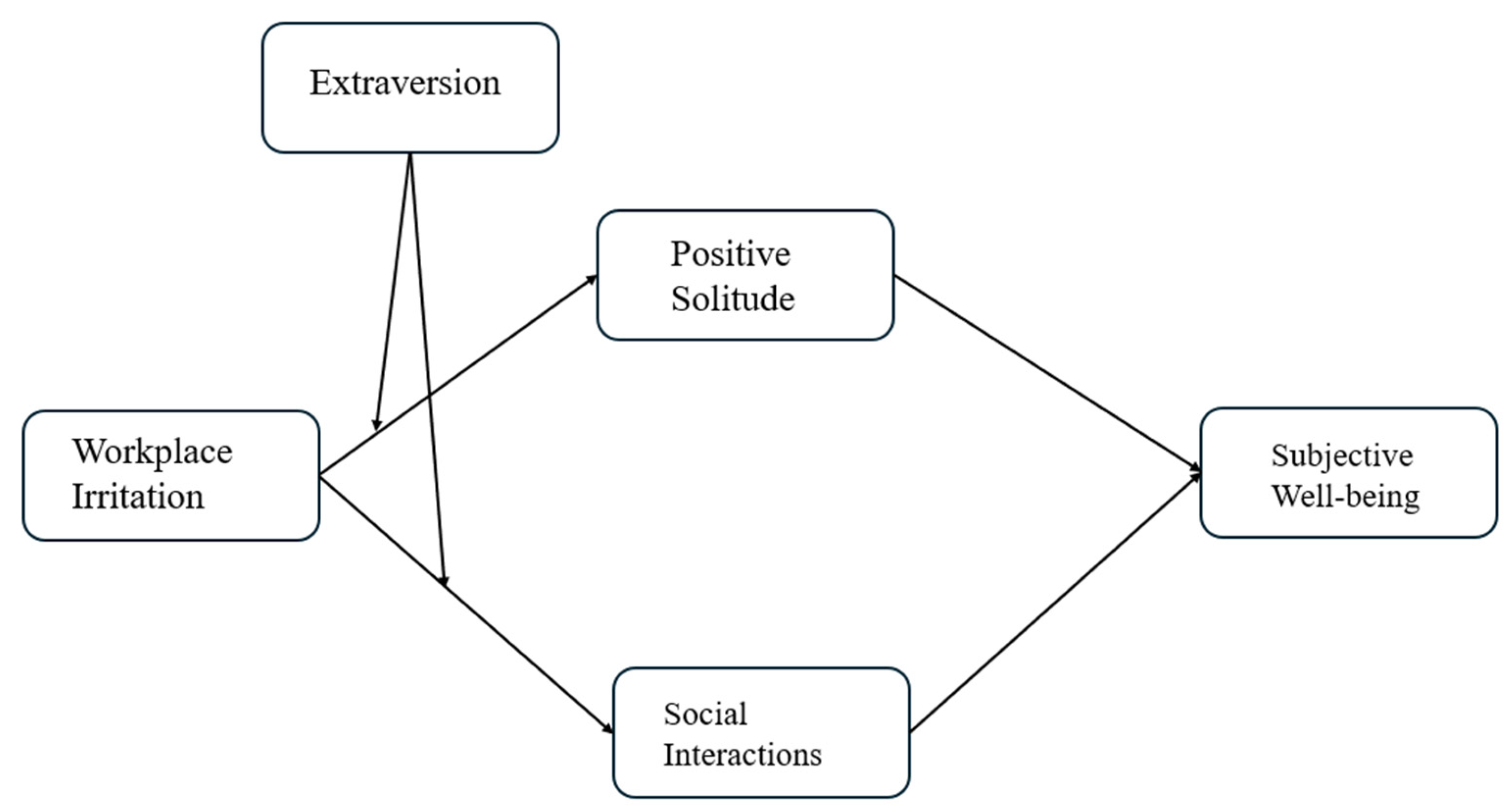
2.4. The Moderating Role of Extraversion
3. Method
4. Measures
4.1. Participants
4.2. Common Method Bias
4.3. Descriptive Statistics
4.4. Comparison Models
4.5. Hypothesis Testing
5. Discussion
5.1. Theoretical Implications
5.2. Practical Implications
5.3. Limitations and Future Research Directions
6. Conclusions
Author Contributions
Funding
Institutional Review Board Statement
Informed Consent Statement
Data Availability Statement
Conflicts of Interest
Appendix A

| Variable | Category | Frequency (n) | Percentage (%) |
|---|---|---|---|
| Gender | Male | 176 | 49.4 |
| Female | 180 | 50.6 | |
| Education | Junior high school or below | 30 | 8.4 |
| High school | 75 | 21.1 | |
| Junior college/vocational college | 71 | 19.9 | |
| Bachelor’s degree | 132 | 37.1 | |
| Master’s degree or above | 48 | 13.5 | |
| Years in current industry | Less than 1 year | 33 | 9.3 |
| 1–3 years | 113 | 31.7 | |
| 3–5 years | 133 | 37.4 | |
| More than 5 years | 77 | 21.6 | |
| Average weekly working hours | Less than 20 h | 32 | 9.0 |
| 20–30 h | 61 | 17.1 | |
| 30–40 h | 70 | 19.7 | |
| More than 40 h | 193 | 54.2 | |
| Years working with supervisor | Less than 3 months | 60 | 16.9 |
| 3–12 months | 116 | 32.6 | |
| 1–3 years | 126 | 35.4 | |
| More than 3 years | 54 | 15.2 |
| Variable | Factor Loading | CR |
|---|---|---|
| Workplace irritation 1 | 0.814 | 0.943 |
| Workplace irritation 2 | 0.813 | |
| Workplace irritation 3 | 0.823 | |
| Workplace irritation 4 | 0.814 | |
| Workplace irritation 5 | 0.815 | |
| Workplace irritation 6 | 0.836 | |
| Workplace irritation 7 | 0.828 | |
| Workplace irritation 8 | 0.830 | |
| Positive solitude 1 | 0.831 | 0.938 |
| Positive solitude 2 | 0.813 | |
| Positive solitude 3 | 0.828 | |
| Positive solitude 4 | 0.827 | |
| Positive solitude 5 | 0.838 | |
| Positive solitude 6 | 0.812 | |
| Positive solitude 7 | 0.834 | |
| Social interactions 1 | 0.847 | 0.921 |
| Social interactions 2 | 0.868 | |
| Social interactions 3 | 0.880 | |
| Social interactions 4 | 0.856 | |
| Extraversion 1 | 0.899 | 0.916 |
| Extraversion 2 | 0.894 | |
| Extraversion 3 | 0.864 | |
| Subject well-being 1 | 0.879 | 0.958 |
| Subject well-being 2 | 0.852 | |
| Subject well-being 3 | 0.887 | |
| Subject well-being 4 | 0.872 | |
| Subject well-being 5 | 0.897 | |
| Subject well-being 6 | 0.864 | |
| Subject well-being 7 | 0.874 |
References
- Kharb, P.; Kumar, R. Strategies for Mitigating Job Stress and Improving Job Satisfaction in the Hotel Industry: A Multidimensional Approach with Reference to Delhi-NCR. Int. J. Hosp. Manag. Sci. 2023, 1, 116–127. [Google Scholar]
- Mohr, G.; Müller, A.; Rigotti, T.; Aycan, Z.; Tschan, F. The Assessment of Psychological Strain in Work Contexts: Concerning the Structural Equivalency of Nine Language Adaptations of the Irritation Scale. Eur. J. Psychol. Assess. Off. Organ Eur. Assoc. Psychol. Assess. 2006, 22, 198–206. [Google Scholar] [CrossRef]
- Cartwright, S.; Cooper, C.L. Managing Workplace Stress; Sage: Thousand Oaks, CA, USA, 1997; Volume 1. [Google Scholar]
- Eisenberger, R.; Huntington, R.; Hutchison, S.; Sowa, D. Perceived organizational support. J. Appl. Psychol. 1986, 71, 500. [Google Scholar] [CrossRef]
- Johari, F.S. Work-related stress and coping strategies: A systematic literature review. Int. J. Acad. Res. Bus. Soc. Sci. 2020, 10, 1016–1032. [Google Scholar] [CrossRef] [PubMed]
- Kaplan, R.; Kaplan, S.; Brown, T. Environmental preference: A comparison of four domains of predictors. Environ. Behav. 1989, 21, 509–530. [Google Scholar] [CrossRef]
- Kaplan, S. The restorative benefits of nature: Toward an integrative framework. J. Environ. Psychol. 1995, 15, 169–182. [Google Scholar] [CrossRef]
- Kaplan, S.; Berman, M.G. Directed attention as a common resource for executive functioning and self-regulation. Perspect. Psychol. Sci. 2010, 5, 43–57. [Google Scholar] [CrossRef]
- Sonnentag, S.; Kuttler, I.; Fritz, C. Job stressors, emotional exhaustion, and need for recovery: A multi-source study on the benefits of psychological detachment. J. Vocat. Behav. 2010, 76, 355–365. [Google Scholar] [CrossRef]
- Wütschert, M.S.; Pereira, D.; Schulze, H.; Elfering, A. Working from home: Cognitive irritation as mediator of the link between perceived privacy and sleep problems. Ind. Health 2021, 59, 308–317. [Google Scholar] [CrossRef]
- Berto, R. The role of nature in coping with psycho-physiological stress: A literature review on restorativeness. Behav. Sci. 2014, 4, 394–409. [Google Scholar] [CrossRef]
- Bellini, D.; Barbieri, B.; Loi, M.; Mondo, M.; De Simone, S. The restorative quality of the work environments: The moderation effect of environmental resources between job demands and mindfulness. Soc. Sci. 2023, 12, 375. [Google Scholar] [CrossRef]
- Ohly, H.; White, M.P.; Wheeler, B.W.; Bethel, A.; Ukoumunne, O.C.; Nikolaou, V.; Garside, R. Attention Restoration Theory: A systematic review of the attention restoration potential of exposure to natural environments. J. Toxicol. Environ. Health Part B 2016, 19, 305–343. [Google Scholar] [CrossRef]
- Bardoel, E.A.; Drago, R. Acceptance and strategic resilience: An application of conservation of resources theory. Group Organ. Manag. 2021, 46, 657–691. [Google Scholar] [CrossRef]
- Jabeen, Q.; Nadeem, M.S.; Raziq, M.M.; Sajjad, A. Linking individuals’ resources with (perceived) sustainable employability: Perspectives from conservation of resources and social information processing theory. Int. J. Manag. Rev. 2022, 24, 233–254. [Google Scholar] [CrossRef]
- Sonnentag, S.; Cheng, B.H.; Parker, S.L. Recovery from work: Advancing the field toward the future. Annu. Rev. Organ. Psychol. Organ. Behav. 2022, 9, 33–60. [Google Scholar] [CrossRef]
- Jones, L.; Nguyen, T.V.; Thomas, V.; Weinstein, N.; Hewings, R.; Smith, M.D. Positive Connections and Solitude: Contribution to Loneliness Interventions and Policy Development; Buckinghamshire New University: Wycombe, UK, 2023. [Google Scholar]
- Lehmann-Willenbrock, N. Dynamic interpersonal processes at work: Taking social interactions seriously. Annu. Rev. Organ. Psychol. Organ. Behav. 2025, 12, 133–158. [Google Scholar] [CrossRef]
- Hilbert, M.; Binnewies, C.; Berkemeyer, L. Synergies between recovery from work and restorative environments for sustainable development: An integrative theoretical perspective. Gr. Interakt. Organ. Z. Angew. Organ. GIO 2024, 55, 201–207. [Google Scholar] [CrossRef]
- Fodstad, E.C.; Erga, A.H.; Pallesen, S.; Ushakova, A.; Erevik, E.K. Personality traits as predictors of recovery among patients with substance use disorder. J. Subst. Use Addict. Treat. 2024, 162, 209360. [Google Scholar] [CrossRef]
- Sonnentag, S.; Reinecke, L.; Mata, J.; Vorderer, P. Feeling interrupted—Being responsive: How online messages relate to affect at work. J. Organ. Behav. 2018, 39, 369–383. [Google Scholar] [CrossRef]
- Russell, E.; Woods, S.A.; Banks, A.P. Tired of email? Examining the role of extraversion in building energy resources after dealing with work-email. Eur. J. Work. Organ. Psychol. 2022, 31, 440–452. [Google Scholar] [CrossRef]
- Demerouti, E.; Bakker, A.B. The job demands-resources model: Challenges for future research. SA J. Ind. Psychol. 2011, 37, a974. [Google Scholar] [CrossRef]
- Kerksieck, P.; Kujanpää, M.; de Bloom, J.; Brauchli, R.; Bauer, G.F. A new perspective on balancing life domains: Work–nonwork balance crafting. BMC Public Health 2024, 24, 1099. [Google Scholar] [CrossRef]
- Yan, H.; Huang, X.; Qian, C.; Chen, B. When lonely employees are productive: An intervention study on workplace mindfulness and job autonomy. Curr. Psychol. 2024, 43, 23036–23052. [Google Scholar] [CrossRef]
- Naor, L.; Mayseless, O. The Wilderness Solo Experience: A Unique Practice of Silence and Solitude for Personal Growth. Front. Psychol. 2020, 11, 547067. [Google Scholar] [CrossRef] [PubMed]
- Rydstedt, L.W.; Johnsen, S.Å.K. Towards an integration of recovery and restoration theories. Heliyon 2019, 5, e02023. [Google Scholar] [CrossRef]
- Chan, P.H.; Howard, J.; Eva, N.; Tse, H.H. A systematic review of at-work recovery and a framework for future research. J. Vocat. Behav. 2022, 137, 103747. [Google Scholar] [CrossRef]
- Garmendia, P.; Fernández-Salinero, S.; Holgueras González, A.I.; Topa, G. Social support and its impact on job satisfaction and emotional exhaustion. Eur. J. Investig. Health Psychol. Educ. 2023, 13, 2827–2840. [Google Scholar] [CrossRef]
- Chesney, M.A.; Neilands, T.B.; Chambers, D.B.; Taylor, J.M.; Folkman, S. A validity and reliability study of the coping self-efficacy scale. Br. J. Health Psychol. 2006, 11, 421–437. [Google Scholar] [CrossRef]
- Strassburger, C.; Wachholz, F.; Peters, M.; Schnitzer, M.; Blank, C. Organizational leisure benefits—A resource to facilitate employees’ work-life balance? Empl. Relat. 2023, 45, 585–602. [Google Scholar] [CrossRef]
- Zautra, A.J.; Arewasikporn, A.; Davis, M.C. Resilience: Promoting Well-Being Through Recovery, Sustainability, and Growth. Res. Hum. Dev. 2010, 7, 221–238. [Google Scholar] [CrossRef]
- Lukaszewski, A.W. Extraversion. In Encyclopedia of Personality and Individual Differences; Springer: Cham, Switzerland, 2020; pp. 1514–1519. [Google Scholar]
- Blevins, D.P.; Stackhouse, M.R.D.; Dionne, S.D. Righting the balance: Understanding introverts (and extraverts) in the workplace. Int. J. Manag. Rev. IJMR 2022, 24, 78–98. [Google Scholar] [CrossRef]
- Nguyen, T.V.T.; Weinstein, N.; Ryan, R.M. Who enjoys solitude? Autonomous functioning (but not introversion) predicts self-determined motivation (but not preference) for solitude. PLoS ONE 2022, 17, e0267185. [Google Scholar] [CrossRef] [PubMed]
- Nguyen, T.V.T.; Ryan, R.M.; Deci, E.L. Solitude as an approach to affective self-regulation. Personal. Soc. Psychol. Bull. 2018, 44, 92–106. [Google Scholar] [CrossRef]
- Weinstein, N.; Hansen, H.; Nguyen, T.V. Who feels good in solitude? A qualitative analysis of the personality and mindset factors relating to well-being when alone. Eur. J. Soc. Psychol. 2023, 53, 1443–1457. [Google Scholar] [CrossRef]
- Santos, D.B.A. The Well-Being Revolution: An Integrative, Scientific, and Practical Guide for a Happier Life. Doctoral Dissertation, University of Pennsylvania, Philadelphia, PA, USA, 2024. [Google Scholar]
- Wickett, R.; Muhlert, N.; Niven, K. The influence of personality on interpersonal emotion regulation in the context of psychosocial stress. Int. J. Environ. Res. Public Health 2023, 20, 3073. [Google Scholar] [CrossRef]
- Jolly, P.M.; Kong, D.T.; Kim, K.Y. Social support at work: An integrative review. J. Organ. Behav. 2021, 42, 229–251. [Google Scholar] [CrossRef]
- Di Pompeo, I.; D’aurizio, G.; Burattini, C.; Bisegna, F.; Curcio, G. Positive mood induction to promote well-being and health: A systematic review from real settings to virtual reality. J. Environ. Psychol. 2023, 91, 102095. [Google Scholar] [CrossRef]
- Brislin, R.W. Back-Translation for Cross-Cultural Research. Ph.D. Dissertation, The Pennsylvania State University, Philadelphia, PA, USA, 1969. [Google Scholar]
- Gralla, M.S.; Guendel, H.; Mueller, A.; Braehler, E.; Häuser, W.; Kruse, J.; Muschalla, B.; Rigotti, T.; Strauss, B.; Balint, E.M. Validation of the irritation scale on a representative German sample: New normative data. Sci. Rep. 2023, 13, 15374. [Google Scholar] [CrossRef]
- Ost Mor, S.; Palgi, Y.; Segel-Karpas, D. The definition and categories of positive solitude: Older and younger adults’ perspectives on spending time by themselves. Int. J. Aging Hum. Dev. 2021, 93, 943–962. [Google Scholar] [CrossRef]
- Sonnentag, S.; Arbeus, H.; Mahn, C.; Fritz, C. Exhaustion and lack of psychological detachment from work during off-job time: Moderator effects of time pressure and leisure experiences. J. Occup. Health Psychol. 2014, 19, 206. [Google Scholar] [CrossRef]
- Tang, C.M.F.; Lam, D. The role of extraversion and agreeableness traits on Gen Y’s attitudes and willingness to pay for green hotels. Int. J. Contemp. Hosp. Manag. 2017, 29, 607–623. [Google Scholar] [CrossRef]
- Agyeiwaah Bangwayo-Skeete, P.; Opoku, E.K. The impact of migrant workers’ inclusion on subjective well-being, organizational identification, and organizational citizenship behavior. Tour. Rev. 2024, 79, 250–265. [Google Scholar] [CrossRef]
- Kock, F.; Berbekova, A.; Assaf, A.G. Understanding and managing the threat of common method bias: Detection, prevention and control. Tour. Manag. 2021, 86, 104330. [Google Scholar] [CrossRef]
- Steed, L.B.; Swider, B.W.; Keem, S.; Liu, J.T. Leaving work at work: A meta-analysis on employee recovery from work. J. Manag. 2021, 47, 867–897. [Google Scholar] [CrossRef]
- Dormann, C.; Zapf, D. Social stressors at work, irritation, and depressive symptoms: Accounting for unmeasured third variables in a multi-wave study. J. Occup. Organ. Psychol. 2002, 75, 33–58. [Google Scholar] [CrossRef]
- Baethge, A.; Rigotti, T. Interruptions to workflow: Their relationship with irritation and satisfaction with performance, and the mediating roles of time pressure and mental demands. Work. Stress 2013, 27, 43–63. [Google Scholar] [CrossRef]
- Huang, J.L.; Bramble, R.J.; Liu, M.; Aqwa, J.J.; Ott-Holland, C.J.; Ryan, A.M.; Lounsbury, J.W.; Elizondo, F.; Wadlington, P.L. Rethinking the association between extraversion and job satisfaction: The role of interpersonal job context. J. Occup. Organ. Psychol. 2016, 89, 683–691. [Google Scholar] [CrossRef]
- Judge, T.A.; Zapata, C.P. The person–situation debate revisited: Effect of situation strength and trait activation on the validity of the Big Five personality traits in predicting job performance. Acad. Manag. J. 2015, 58, 1149–1179. [Google Scholar] [CrossRef]
- Palgi, Y.; Segel-Karpas, D.; Ost Mor, S.; Hoffman, Y.; Shrira, A.; Bodner, E. Positive Solitude Scale: Theoretical Background, Development and Validation. J. Happiness Stud. 2021, 22, 3357–3384. [Google Scholar] [CrossRef]
- Ilies, R.; Bono, J.E.; Bakker, A.B. Crafting well-being: Employees can enhance their own well-being by savoring, reflecting upon, and capitalizing on positive work experiences. Annu. Rev. Organ. Psychol. Organ. Behav. 2024, 11, 63–91. [Google Scholar] [CrossRef]
- Tang, P.M.; Klotz, A.; McClean, S.; Lee, R. From natural to novel: The cognition-broadening effects of contact with nature at work on creativity. J. Manag. 2024, 50, 2490–2533. [Google Scholar] [CrossRef]
- Lilius, J.M. Recovery at work: Understanding the restorative side of “depleting” client interactions. Acad. Manag. Rev. 2012, 37, 569–588. [Google Scholar] [CrossRef]
- Asselineau, A.; Grolleau, G.; Mzoughi, N. Quiet environments and the intentional practice of silence: Toward a new perspective in the analysis of silence in organizations. Ind. Organ. Psychol. 2024, 17, 326–340. [Google Scholar] [CrossRef]
- Bennett, A.A.; Gabriel, A.S.; Calderwood, C.; Dahling, J.J.; Trougakos, J.P. Better together? Examining profiles of employee recovery experiences. J. Appl. Psychol. 2016, 101, 1635. [Google Scholar] [CrossRef] [PubMed]
- Saito, H.; Lee, A.; Bui, H.T.; Baum, T. Fostering employee well-being and workplace recovery in the hospitality industry: The role of supportive break times at work. J. Hosp. Tour. Manag. 2024, 61, 91–100. [Google Scholar] [CrossRef]
- Tu, M.H.; Chi, N.W. How and when abusive supervision leads to recovery activities: The recovery paradox and the conservation of resources perspectives. J. Organ. Behav. 2024, 45, 558–575. [Google Scholar] [CrossRef]
- Wilmot, M.P.; Wanberg, C.R.; Kammeyer-Mueller, J.D.; Ones, D.S. Extraversion advantages at work: A quantitative review and synthesis of the meta-analytic evidence. J. Appl. Psychol. 2019, 104, 1447. [Google Scholar] [CrossRef] [PubMed]
- Ashkanasy, N.M.; Dorris, A.D. Emotions in the workplace. Annu. Rev. Organ. Psychol. Organ. Behav. 2017, 4, 67–90. [Google Scholar] [CrossRef]


| Variable | Mean | SD | AVE | 1 | 2 | 3 | 4 | 5 |
|---|---|---|---|---|---|---|---|---|
| 1. Workplace irritation | 4.69 | 1.35 | 0.67 | 0.81 | ||||
| 2. Positive Solitude | 4.60 | 1.36 | 0.68 | 0.68 ** | 0.82 | |||
| 3. Social Interactions | 4.51 | 1.51 | 0.74 | 0.42 ** | 0.45 ** | 0.86 | ||
| 4. Extraversion | 4.67 | 1.61 | 0.79 | 0.59 ** | 0.54 ** | 0.49 ** | 0.88 | |
| 5. Subjective Well-being | 4.33 | 1.63 | 0.77 | 0.55 ** | 0.53 ** | 0.44 ** | 0.41 ** | 0.87 |
| Model | Descriptions | χ2 | df | χ2/df | RMSEA | TFI | CFI | SRMR |
|---|---|---|---|---|---|---|---|---|
| Model 1 | Five factors: WI, PS, SI, EX, SWB. | 429.445 | 367 | 1.170 | 0.022 | 0.993 | 0.992 | 0.029 |
| Model 2 | Four factors: WI, PS, SI, EX+SWB. | 1197.981 | 371 | 3.229 | 0.079 | 0.909 | 0.890 | 0.099 |
| Model 3 | Three factors: WI, PS, SI+EX+SWB. | 2049.605 | 374 | 5.480 | 0.112 | 0.815 | 0.799 | 0.116 |
| Model 4 | Two factors: WI, PS+SI+EX+SWB. | 3249.594 | 376 | 8.643 | 0.147 | 0.683 | 0.658 | 0.115 |
| Model 5 | One factor: WI+PS+SI+EX+SWB. | 3991.475 | 377 | 10.587 | 0.164 | 0.601 | 0.571 | 0.116 |
| Model | Standardised Effect (β) | SE | p | LL 95% CI | UL 95% CI |
|---|---|---|---|---|---|
| WI → PS | 0.73 ** | 0.04 | 0.01 | 0.64 | 0.80 |
| WI → SI | 0.47 ** | 0.05 | 0.01 | 0.36 | 0.57 |
| WI →PS → SWB | 0.16 ** | 0.06 | 0.01 | 0.06 | 0.28 |
| WI → SI → SWB | 0.10 ** | 0.03 | 0.01 | 0.05 | 0.17 |
| Index of moderated mediation | |||||
| WI * EX →PS → SWB | −0.01 | 0.02 | 0.66 | −0.04 | 0.02 |
| WI * EX →SI → SWB | 0.08 ** | 0.03 | 0.01 | 0.03 | 0.15 |
| Model | Standardised Effect (β) | SE | LL 95% CI | UL 95% CI |
|---|---|---|---|---|
| Bootstrapping results for conditional effects of WI on SI at different levels of EX | ||||
| −1 SD Low EX | 0.12 | 0.09 | −0.05 | 0.31 |
| 0 SD Medium EX | 0.45 | 0.10 | 0.25 | 0.63 |
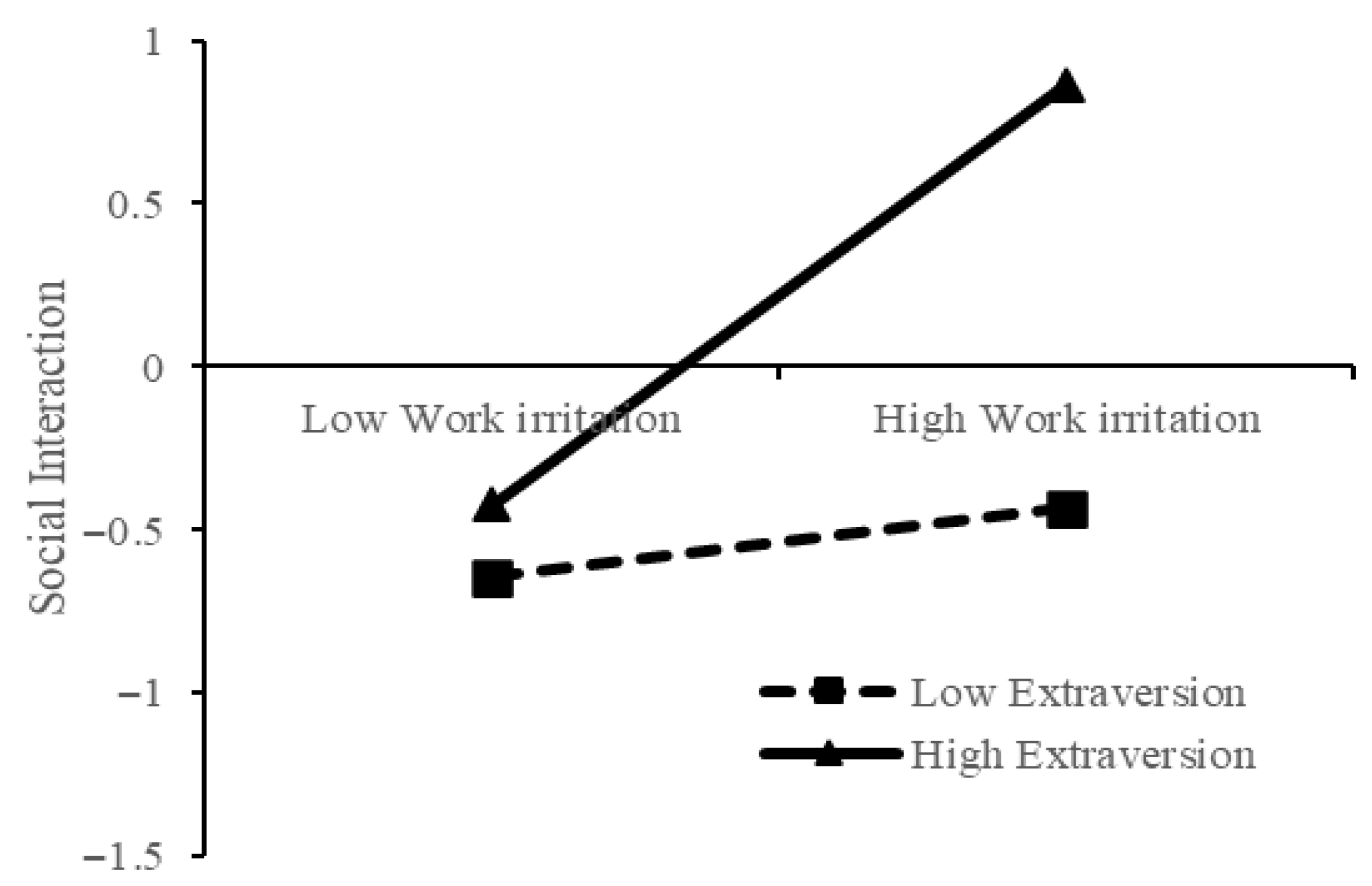
| +1 SD High EX | 0.79 | 0.16 | 0.44 | 0.99 |
Disclaimer/Publisher’s Note: The statements, opinions and data contained in all publications are solely those of the individual author(s) and contributor(s) and not of MDPI and/or the editor(s). MDPI and/or the editor(s) disclaim responsibility for any injury to people or property resulting from any ideas, methods, instructions or products referred to in the content. |
© 2026 by the authors. Licensee MDPI, Basel, Switzerland. This article is an open access article distributed under the terms and conditions of the Creative Commons Attribution (CC BY) license.
Share and Cite
Zhu, Y.; Wang, Y.; Zhu, L.; Feng, Q.; Chen, S.; Tang, J. Transforming Workplace Irritation into Well-Being Through Positive Solitude and Social Interactions—An Attention Recovery Perspective. Sustainability 2026, 18, 4446. https://doi.org/10.3390/su18094446
Zhu Y, Wang Y, Zhu L, Feng Q, Chen S, Tang J. Transforming Workplace Irritation into Well-Being Through Positive Solitude and Social Interactions—An Attention Recovery Perspective. Sustainability. 2026; 18(9):4446. https://doi.org/10.3390/su18094446
Chicago/Turabian StyleZhu, Yanni, Yunhan Wang, Liangliang Zhu, Qiaoyan Feng, Songhong Chen, and Juan Tang. 2026. "Transforming Workplace Irritation into Well-Being Through Positive Solitude and Social Interactions—An Attention Recovery Perspective" Sustainability 18, no. 9: 4446. https://doi.org/10.3390/su18094446
APA StyleZhu, Y., Wang, Y., Zhu, L., Feng, Q., Chen, S., & Tang, J. (2026). Transforming Workplace Irritation into Well-Being Through Positive Solitude and Social Interactions—An Attention Recovery Perspective. Sustainability, 18(9), 4446. https://doi.org/10.3390/su18094446