1. Introduction
The pursuit of sustainable tourism development has emerged as a central imperative in the global policy arena. The United Nations World Tourism Organization (UNWTO) has explicitly positioned sustainable tourism as a structural pathway for achieving multiple Sustainable Development Goals (SDGs)—in particular, SDG 8, SDG 11, and SDG 17—calling on destination managers to balance economic vitality, socio-cultural integrity, and long-term visitor engagement [
1]. Within this framework, destination sustainability extends far beyond environmental stewardship: it demands the cultivation of enduring economic resilience and the capacity to generate meaningful tourism value over time, rather than reproducing the familiar pattern of rapid growth followed by stagnation. Butler’s foundational Tourist Area Life Cycle model [
2] issued an early structural warning in this regard—destinations that fail to renew their appeal risk irreversible decline once the initial wave of visitor enthusiasm recedes.
Against this backdrop, the rapid diffusion of digital technology has introduced both unprecedented opportunities and acute new sustainability risks for tourism destinations. The transformation of the tourism information ecosystem—from printed guidebooks and travel agencies to social media platforms and user-generated content—has been extensively documented in the literature [
3,
4]. Digital platforms enable destinations to achieve mass awareness at minimal cost, and the rise of mobile internet has further dissolved traditional spatiotemporal barriers, enabling real-time, immersive engagement across the globe [
5]. However, this digital diffusion simultaneously exposes destinations to the volatility of algorithmic attention economies, in which visibility is inherently transient and audience loyalty is structurally fragile. As Gössling [
6] critically observed, the relationship between digital technology and sustainable tourism is characterized by deep affordances that often accelerate consumption in ways that are misaligned with long-term sustainability imperatives. The very speed at which digital networks amplify a destination’s image can generate a self-reinforcing cycle of over-visitation followed by rapid disenchantment, a digital-era expression of the boom-and-bust lifecycle that Butler’s TALC model anticipated decades ago.
Nowhere is this sustainability paradox more vividly illustrated than in the emergent phenomenon of “internet-famous cities” in contemporary China. Destinations such as Zibo and Harbin have achieved explosive national and international visibility through viral social media content, generating record-breaking tourism revenues within compressed timeframes [
7]. Yet the very mechanisms that catalyze such rapid ascent render this growth inherently precarious unless grounded in substantive experiential foundations. Consequently, the fundamental tension between short-term viral growth and long-term structural decline constitutes the core research problem of this study: how can destinations convert ephemeral digital traffic into enduring place attachment to achieve sustainable visitor loyalty?
Emotional value emerges as the pivotal mediator in this sustainability transition. Since Pine and Gilmore [
8] argued that advanced economies are fundamentally shifting to the staging of memorable experiences, scholars have increasingly recognized that it is the depth and authenticity of emotional engagement, rather than visitor volume, that constitutes the sustainable foundation of tourism destinations. In digitally mediated environments, emotional value is the quality that enables destinations to transcend the transience of viral attention, cultivating place identity and affective dependence that motivate revisitation and positive word-of-mouth dissemination [
9]. Tussyadiah and Fesenmaier [
10] demonstrated that digitally mediated tourism content does not merely transmit information but actively co-constructs affective expectations that shape on-site experience—a dynamic that fundamentally links digital content strategies to sustainable destination outcomes. More recently, technology-enhanced tourism experiences have been shown to generate stronger and more durable emotional bonds [
11], suggesting that digital empowerment, when strategically directed, can serve as an instrument of sustainability.
However, existing scholarship has yet to integrate these insights into a coherent analytical framework. The dynamic mechanisms through which digital technology systematically produces, transmits, and deepens emotional value across the full arc of the tourism journey, and the ways in which this emotional architecture can be strategically governed to support long-term sustainability, remain substantially underexplored.
This study addresses this gap by taking the phenomenal Harbin tourism boom as an empirical case. To provide a coherent analytical lens, we establish a hierarchical theoretical framework. Sense of Place Theory serves as our primary theoretical anchor, elucidating the ultimate goal of sustainable destination governance: enduring place attachment. This core theory is supported by three secondary mechanisms: Symbolic Interactionism (providing the micro-foundation for symbol decoding), Tourism Dramaturgy (explaining interpersonal performance), and Consumer Society Theory (situating these emotions within the logic of symbolic exchange). By integrating these perspectives, the study clarifies the sociological logic through which digital technology functions as a container for the production and sedimentation of sustainable emotional value.
Employing a mixed-methods strategy that combines semi-structured interviews with Grey Panel Relational Clustering (GPRC) analysis, this research explicitly aims to: (1) identify and characterize the structural emotional trajectories of distinct tourist typologies; (2) reveal the multi-track synergistic mechanisms through which digital technology and emotional value co-produce durable tourist–destination relationships; and (3) construct an integrated governance model that guides destinations in transitioning from ephemeral “landscape attraction” to deep “emotional identification.”
The findings offer both theoretical contributions and actionable governance insights. Specifically, this study contributes to the literature in three concrete ways: (1) proposing an integrated emotional value-driven closed-loop framework for destination sustainability; (2) constructing an empirically grounded typology of three distinct tourist emotional trajectories; and (3) identifying three differentiated Virtual–Real synergistic paths that offer direct and practical implications for sustainable tourism governance.
2. Literature Review
2.1. Research on the Online–Offline Synergistic Mechanism in Tourism Enabled by Digital Technology
With the continuous development of internet technology, the advent of the digital information age is quietly transforming the development of the global tourism industry [
6]. Digital technology has transcended the scope of mere technical tools to become a core force reshaping spatiotemporal relationships and social interactions in tourism [
12]. China’s digital transformation is profoundly altering the industrial boundaries and production modes of tourism, significantly influencing its development patterns. Digital tourism is regarded as the instigator of virtual tourism industrial clusters [
13]. Existing studies point out that digital technology has broken the physical boundaries of traditional tourism, constructing a new tourism space characterized by a “virtual–physical dual-layer nesting.” Within this spatial structure, the tourism experience is no longer confined to offline physical presence but extends to online digital presence, realizing the instant gathering and deep interaction between tourists and destinations in virtual space. This technological empowerment not only promotes the transformation of the tourism industry from a linear chain to a networked synergistic operation, but also profoundly reconstructs the logic of tourism symbol production and dissemination.
Regarding the synergistic mechanism, scholars have focused on the mediating role of social media as a “symbolic transmission field.” Tourists share travel experiences through internet platforms, displaying their unique cognitions and feelings about destinations [
4], thereby transforming individual perceptions into consumable digital symbols (Tourist-Generated Content, TGC). Surveys indicate that over 60% of tourists report their travel plans are inspired by social media content [
14]. The empowering effect of TGC on destination image dissemination is becoming increasingly prominent, as tourists have transitioned from mere experiencers to core subjects of destination image communication. In the study of the Tanhualin Historical and Cultural Block, researchers [
15] pointed out that the essence of modern tourism lies in the mutual construction of online symbolic architecture and offline physical experience; officials and tourists realize the value co-production of digital content through an interaction chain of “creation–curation–dissemination”. Cao further noted, in his research on Tibet’s tourism image-shaping, that media forms such as short videos construct an online mimetic environment with strong visual impact through high-density symbolic output, providing rich decision-making references and imaginative materials for potential tourists [
16], thus promoting the long-term development of Tibet’s tourism industry.
Furthermore, research on “media dependency” and “virtual–real interaction” is deepening. Scholars have found that tourists’ media contact and usage behaviors significantly affect the cognitive and affective images of destinations, including visitation behaviors on online platforms [
17], technical applications of various media [
18], and contact frequency with traditional media [
19]. The use of digital media such as social networking sites, apps, and smartphones can indirectly influence travel intentions by shaping perceived experiences [
18], building trust attitudes [
20], and reinforcing destination preferences [
21]. Meanwhile, studies reveal that in tourism decision-making scenarios, tourists’ active application, participation, and deep involvement with media demonstrate clear characteristics of media dependency. Some scholars explicitly focus on “dependency” itself, noting that tourism platforms can cultivate user habits to gradually form a dependency relationship [
22]. Evidently, a symbiotic relationship of two-way interaction exists between tourists and digital media, and the synergistic development path of tourism practices across online and offline platforms is gradually being perfected. However, existing research largely focuses on traffic attraction at the marketing level; the deep sociological mechanism of how digital technology drives the transformation of online emotional expectations into offline authentic experiences remains to be further explored.
2.2. Research on the Impact of Emotional Value in Tourism Scenarios
The tourism industry is fundamentally an “emotional industry” focused on affective experiences and spiritual satisfaction. Emotional value has increasingly become the core nexus connecting tourism product supply with tourists’ emotional needs. In recent years, the term “emotional value” has spread widely within the industry, and its role has become increasingly prominent. Traditionally, the literature on consumer behavior defined emotional value through a utilitarian lens, as the affective utility derived from a cost–benefit calculus. However, this study argues that such a transactional definition is inadequate for understanding the deep, co-created attachments in contemporary digital tourism. Therefore, this paper explicitly discards the marketing-centric definition and adopts a strict sociological perspective. Here, emotional value is conceptualized as the ‘emotional energy’ [
23] and affective resonance that drives human–place interactions. It is not merely a post-purchase feeling, but the core structural mediator that translates virtual digital symbols into enduring offline place attachment.
On one hand, emotional value has become a core element in reshaping tourism attractions and the destination’s “persona.” The traditional resource-oriented tourism model is shifting toward an emotion-oriented one. Wang pointed out that “emotional value” possesses distinct characteristics of immediacy, concreteness, and interactivity. He advocates creating and maintaining tourists’ positive emotional experiences and resonance through cultural tourism IPs to move people with emotion [
24]. He also noted that the explosion of “Zibo Barbecue” (a viral culinary tourism phenomenon in China) was not solely due to the food itself, but due to social emotional resonance triggered by events like “students repaying kindness” and the city’s vitality. Regarding the Harbin ice and snow tourism fever, Li mentioned that Harbin achieved a transformation from a resource-based entity to a play-based entity by cultivating a “Hospitality-oriented city character”. Its essence lies in the high-intensity supply of emotional value satisfying tourists’ emotional needs for respect and care [
25]. In a comparative study of the tourism surges in Zibo and Harbin, Sun pointed out that the key to success for both cities lay in constructing an emotional community shared by hosts and guests through approachable interactive methods [
26].
On the other hand, emotional value has a significant driving effect on tourism consumption behavior. This drive is reflected not only in immediate consumption decisions but also throughout the entire process of immersive experience and post-trip dissemination. Unlike material consumption, emotional consumption in tourism contexts focuses more on self-actualization and spiritual pleasure [
27]. Song et al. found that positive emotions such as pleasure and excitement can significantly enhance tourists’ willingness to pay to sustain the intensity of the emotional experience [
28]. Research on Red Tourism also indicates that reinforcing the emotional atmosphere through scene creation can effectively enhance tourists’ immersion and identification, thereby translating into substantive consumption behaviors [
29].
In summary, emotional value has formed a complete chain from triggering motivation and enhancing experience to driving consumption, serving as the key to understanding contemporary “phenomenal” tourism waves.
2.3. Literature Commentary
Through a systematic review of the existing literature, it is evident that academia has accumulated rich research results around the two major themes of “digital technology empowerment” and “tourism emotional value.” These studies not only profoundly reveal the reshaping role of digital technology in tourism marketing, information dissemination, and industrial boundaries but also accurately identify the core status of emotional value as an emerging driving force in tourism consumption, laying a solid theoretical foundation for understanding the transformation of the contemporary tourism industry.
However, there remains a distinct gap between these two research strands. First, the two strands are relatively segregated. Research on digital technology tends to focus on the marketing effects of instrumental rationality, while research on emotional value is often confined to unidimensional measurements in psychology or economics. Few studies place both within the same framework to explore how digital technology serves as an “emotional container” and “transmission pipeline” to realize the flow and transformation of emotional value between online virtual spaces and offline physical spaces. Second, there is a lack of sociological analysis regarding the deep generative mechanisms. Existing studies on hot cases like Harbin mostly remain at the level of descriptive phenomena such as “pampering fans” or “good service,” lacking a systematic elucidation from a sociological perspective on the dynamic closed-loop mechanism of “symbol construction–dissemination–drive–feedback.”
In summary, while the existing literature thoroughly documents the marketing impact of digital platforms, it largely overlooks the sociological transformation of emotions within these spaces. To bridge this gap, this study proposes a ‘Technology–Space–Emotion’ governance framework governed by a clear operational logic. In this framework, algorithmically amplified digital symbols act as the ‘Input’; the socio-cultural performance and affective resonance between hosts and guests serve as the ‘Processing mechanism’; and the sedimentation of sustainable place identity emerges as the ultimate ‘Output.’ By tracking this flow, we can shift the academic focus from transient traffic analysis to enduring emotional governance.
The existing literature has extensively discussed the transition from resource-centric to emotion-centric tourism. To avoid redundancy, this study situates these macro-trends within the literature review, while the following section focuses exclusively on the internal logical connections between specific sociological theories to construct our analytical lens.
3. Theoretical Framework
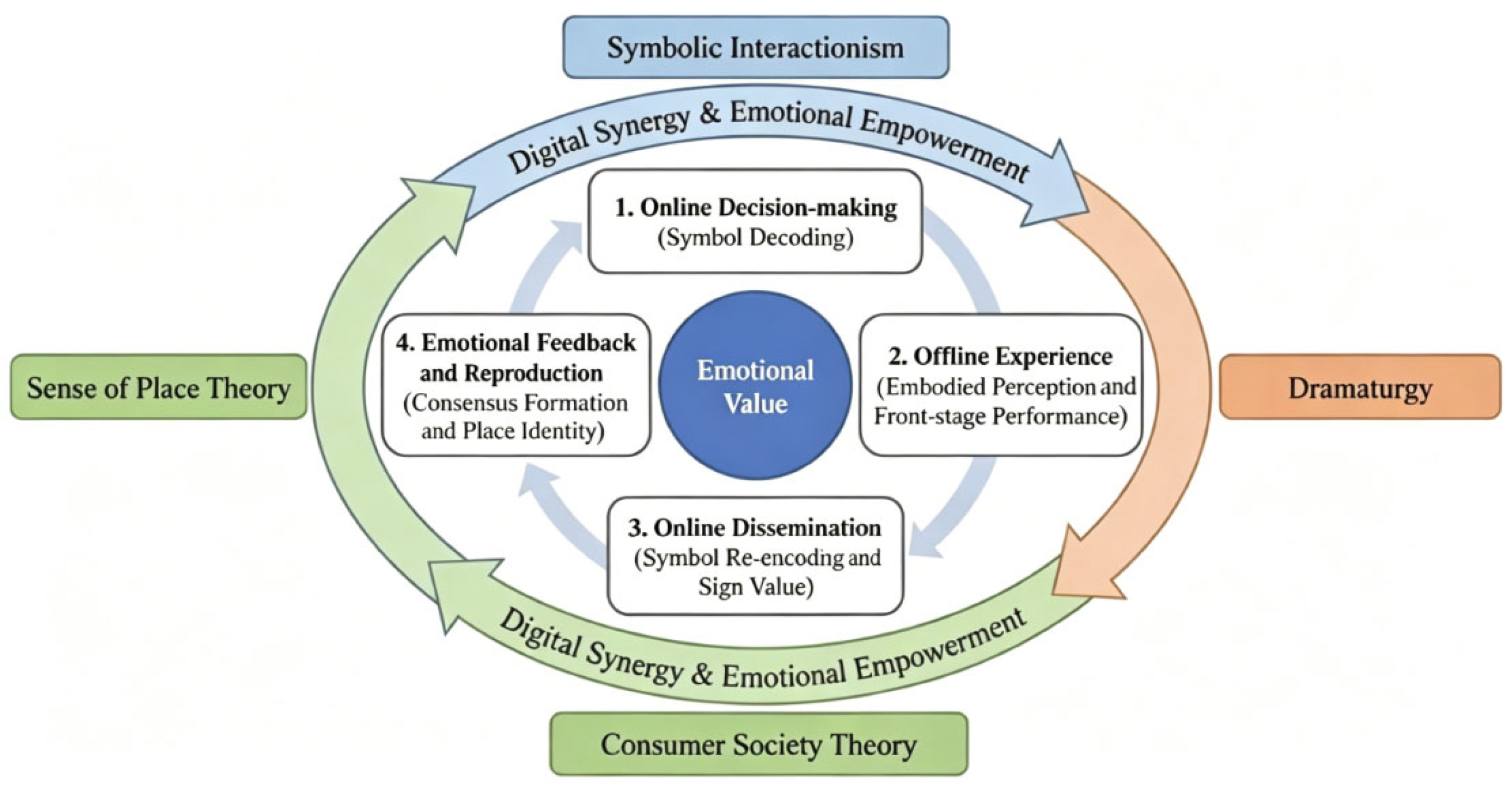
Instead of treating the four theories as parallel explanations, this study constructs a hierarchical framework with Sense of Place Theory at its core. Symbolic Interactionism and Tourism Dramaturgy serve as supporting mechanisms to explain the ‘performance’ and ‘meaning-making’ phases of the digital–emotional loop, while Consumer Society Theory provides the systemic context for digital synergy.
To provide a coherent analytical lens, this study defines ‘emotional value’ as the unified affective mediating power that facilitates the transition from virtual symbolic cognition to enduring place attachment. While this affective energy manifests in stage-specific forms (e.g., ‘meaning consensus’ during symbol decoding, ‘performed energy’ during embodied interaction, and ‘sign value’ during symbolic exchange), these are not four independent concepts but structural transformations of the same underlying emotional energy flow as it traverses different social contexts. The terminal outcome—stable place attachment—represents the crystallization and sedimentation of this accumulated emotional energy into enduring psychological structures. Rather than treating the four theories as fragmented explanations, we construct a hierarchical framework where Sense of Place Theory acts as the terminal anchor. These theories were selected to cover the full micro-to-macro arc of the tourism journey: Symbolic Interactionism provides the micro-foundation for symbol decoding (Input: Information; Output: Meaning Consensus); Tourism Dramaturgy explains the transition from virtual expectations to embodied performances (Input: Meaning Consensus/Script; Output: Performed Experience); Consumer Society Theory situates these emotions within the logic of symbolic capital exchange (Input: Experience; Output: Sign Value); and finally, these elements co-produce a stable spatial–psychological connection. This internal logical interaction ensures that emotional value flows continuously through the ‘Technology–Space–Emotion’ closed-loop.
Transcending the limitations of a single theoretical perspective, this study establishes emotional value as the core nexus and integrates Symbolic Interactionism, Tourism Dramaturgy, Consumer Society Theory, and Sense of Place Theory to construct a progressive analytical framework. These four theories are not isolated superimpositions but correspond distinctly to different operational mechanisms within the digital tourism closed-loop: “Online Decision-making–Offline Experience–Online Dissemination–Emotional Feedback.” Together, they reveal how emotional value transforms from a virtual symbol into a tangible driving force for consumption, ultimately reshaping the human–land relationship and crystallizing into enduring place identity, which is shown in
Figure 1.
3.1. Symbolic Interactionism Perspective: Generation of Emotional Value and Consensus Formation
Within the proposed hierarchy, Symbolic Interactionism serves as the micro-foundation for the emotional loop. It explains the initial phase where tourists decode digital symbols into a ‘meaning consensus’ (Output), which acts as the necessary psychological prerequisite for subsequent offline actions.
Symbolic Interactionism Theory posits that society is an organic unified whole, where interactions between individuals and objects are invariably mediated by symbols. When confronting various objects, individuals do not passively accept their intrinsic attributes; instead, they actively interpret or adjust them into symbols that align with their own cognitions and needs, thereby shaping their social behavioral choices. Furthermore, the influence of an object on individual social behavior depends not on its objective content or functional attributes, but on the symbolic significance the individual endows it with—significance linked to personal experience and expectations. It is this subjectively constructed symbolic meaning that drives individual behavioral decision-making and interaction modes. Within this framework, Symbolic Interactionism primarily elucidates the “meaning construction” process of emotional value.
Symbolic Interactionism provides a micro-perspective for understanding the generation mechanism of emotional value in digital tourism. In digital tourism scenarios, the connotation and function of tourism symbols have extended significantly. They are no longer confined to traditional landscape labels but have metamorphosed into composite carriers with a core of “Emotion + Scene.” The essence of interaction between individuals is the resonance and supplementation of emotional value, which ultimately forms a consensus of meaning at the group level, laying the foundation for the transformation from online cognition to offline action.
In tourism practice, emotional value realizes the conversion from online symbols to offline actions through symbol production. Official entities and content creators act as “Encoders,” decoding abstract service concepts and city characteristics and re-encoding them into concrete, easily disseminable emotional symbols. Tourists, as “Decoders,” do not passively receive information; rather, based on their own emotional deficits and psychological expectations, they engage in personalized interpretation and meaning endowment of these symbols. The interaction between individuals evolves into the resonance and confirmation of emotional value. This interaction aggregates rapidly in cyberspace, forming a meaning consensus at the group level: “going to a certain place” is redefined as “going to acquire a specific emotional experience.” Thus, the logical leap from online symbolic cognition to offline action intention is completed.
Once tourists form expectations based on emotional symbols and arrive at the destination, the field of interaction shifts from the virtual network to the physical space. This necessitates the introduction of Tourism Dramaturgy to explain the realization and fulfillment of emotional value.
3.2. Tourism Dramaturgy Perspective: Circulation of Emotional Value and Practical Transformation
Building upon the ‘meaning consensus’ generated in the previous phase, Tourism Dramaturgy functions as the mediating mechanism. It explains how tourists use that consensus as a ‘script’ to engage in ‘performed experiences’ (Output) on the physical destination stage.
Dramaturgical Theory likens society to a stage where everyone is an actor playing different roles and completing performances in various situational fields. In the 1970s, MacCannell [
30] pioneered the integration of Tourism Dramaturgy into the tourism domain. Dennison Nash noted in his work that “leisure travelers, whether individuals or groups, can be seen as persons playing important roles in a tourism drama. The dramatic setting also includes various hosts, transportation personnel, guides, and those who make their trip possible” [
31]. In research on Tourism Dramaturgy, Yu pointed out that both hosts and tourists complete their respective performances under the arrangement of a script [
32]; everyone is an actor on the stage. Chronis argued that the essence of tourism destination construction is to provide a scene for stories, transforming originally unremarkable spaces into attractive and unique places [
33]. Consequently, in the tourism industry, enterprises and producers consciously or unconsciously apply Dramaturgical Theory to product design and presentation to inject new vitality into the sector.
The introduction of Tourism Dramaturgy aims to reveal how emotional value achieves cross-spatial flow and diffusion through “Front Stage Performance.” In the double-layer space constructed by digital technology, social media platforms constitute a massive “Front Stage.” Unlike traditional landscape displays, the core of the front stage performance in the digital era lies in the “visualization of emotional experience.” Communicators (actors), adhering to the logic of web traffic (the script), use dramatic and exaggerated expressions to transform implicit emotional experiences into explicit visual spectacles and narrative performances. This performance constructs a highly attractive mimetic environment, generating a strong sense of immersion and a desire for “presence” among the audience. According to dramaturgical logic, the audience’s viewing behavior translates into a “social mimicry” motivation—a desire to enter the offline physical stage, replicate the online “script,” and play the protagonist personally. After the offline experience concludes, tourists transform their own experiences into new performance materials and feed them back to the online front stage, forming a reinforcing loop of “Watching Performance–Offline Mimicry–Material Feedback–Circular Performance,” which drastically accelerates the dissemination efficiency of emotional value.
The completion of the experience does not signify the end. In the digital era, tourists’ immediate experiences are converted into new content for dissemination. The driving force behind this behavior requires explanation through Consumer Society Theory.
3.3. Consumer Society Perspective: The Symbolic Closed-Loop of Emotional Consumption
These performed experiences are then situated within the macro-logic of Consumer Society Theory. This mechanism explains how individual emotions are converted into ‘sign value’ and symbolic capital (Output) through social media dissemination, sustaining the digital–emotional loop.
Consumer Society Theory provides a macro-dynamic explanation for tourists’ offline behavior and willingness to pay. Jean Baudrillard pointed out that the essence of consumption is the consumption of signs (symbols). In the digital tourism boom, the logic of tourist consumption has undergone a fundamental displacement: from pursuing use value to chasing sign value. In this study, emotional value is regarded as a form of scarce “Symbolic Capital.” The reason tourists are willing to pay for premium services is essentially to consume the emotional symbols of “being respected” and “being healed,” thereby filling the emotional void of modern life. Crucially, this consumption behavior possesses significant characteristics of “conspicuousness” and “sociality.” By posting the consumption process on social media, tourists not only complete the closed-loop of emotional experience but also achieve self-identity confirmation and the accumulation of social capital. Therefore, emotional value becomes the key converter connecting online symbolic seduction with offline physical consumption, driving the industrial upgrade of tourism from “selling resources” to “selling emotions.”
From the core logic of digital tourism symbol consumption, the dual value of specific tourism symbols is consistently driven by online–offline linked emotional value consumption. Those viral labels are not mere marketing gimmicks but emotional symbol carriers that precisely dock with digital tourism consumption demands. At the online level, official entities use scenario-based digital content to transform core emotions into disseminable consumption symbols, directly addressing the pain point of contemporary consumers willing to “pay for emotions” due to emotional deficits. Upon contact with relevant content, audiences convert the goal of “acquiring specific emotional experiences” into clear consumption intentions, thereby completing pre-consumption online behavior. At the offline level, a series of targeted services ground the consumption expectations corresponding to online emotional symbols into authentic experiences, realizing the offline consumption fulfillment of emotional value. Returning to the online level, consumers transform their personal emotional consumption experiences into consumption symbols on social platforms through sharing, thereby gaining identity recognition and completing the closed-loop of emotional value consumption.
With the continuous consumption and circulation of emotional symbols, the relationship between people and space undergoes a qualitative change, eventually condensing into a stable emotional connection at the psychological level.
3.4. Sense of Place Theory: The Spatial Localization of Emotional Connection
As the primary theoretical anchor of this study, Sense of Place Theory integrates the preceding outputs—meaning consensus, performed experience, and sign value. It explains the final consequence: how these transient emotional flows crystallize into stable ‘place attachment’ and enduring identity, achieving the ultimate goal of sustainable governance.
Sense of Place Theory constitutes the final anchor point of this framework, explaining how emotional value transforms momentary traffic into long-term place identification.
Sense of Place, defined as the subjective feeling of people regarding place experiences, represents a universal emotional connection that satisfies basic human needs [
9]. From the perspective of its genesis, it is a connection gradually constructed during the interaction between people and places. Some scholars view Sense of Place as a unidimensional concept of human–land emotion, while others regard it as a multidimensional concept comprising place attachment, place identity, and place dependence. Jorgensen and Stedman argued that place identity and place dependence are more closely related to Sense of Place than place attachment [
9]. Rose posited that the intensity of Sense of Place acts like individual identity recognition, where the place gradually becomes an organic component of the self [
34], becoming part of self-identity; that is, Sense of Place encompasses place identity. In summary, Sense of Place is the mutual shaping of space and emotion.
In digital tourism, the creation of Sense of Place breaks through the traditional limitation of “long-term spatial interaction,” establishing emotional connections rapidly through emotional value. Emotional value constructs a deep connection between space and emotion, promoting the transformation of online emotion into offline action. Traditional geography holds that the formation of Sense of Place relies on long-term residence or repeated spatial interaction; however, in the context of digital tourism, emotional value performs a function of “time compression.” This study proposes that a high-intensity supply of emotional value can transcend spatiotemporal limits, establishing a deep emotional connection between people and places within an extremely short period. When physical space is infused with high-density emotional services and humanistic care, it rapidly transforms into a “place” with unique meaning and emotional warmth. This emotion-driven Sense of Place is no longer based on mere geographical familiarity but on emotional dependence and identification. This deep emotional accumulation allows the destination to transcend the rise and fall of “internet celebrity” cycles, establishing stable psychological coordinates in the minds of tourists and achieving spatial reshaping from “transient traffic monetization” to “sustained destination longevity.”
The theoretical framework constructed in this study systematically integrates the four theoretical perspectives of Symbolic Interactionism, Tourism Dramaturgy, Consumer Society Theory, and Sense of Place Theory. It reveals the core driving role of emotional value in the online–offline synergy of digital tourism. These four perspectives elucidate the dynamic processes of generation, transmission, transformation, and solidification of emotional value from different dimensions, collectively forming a holistic analytical framework for understanding the driving mechanism of emotional value in digital tourism. This promotes the deep transformation of tourism destinations from functional value supply to emotional value creation, laying a solid theoretical foundation for subsequent empirical research.
4. Research Design
The purposive inclusion of local residents (N = 5) alongside non-local tourists (N = 11) is theoretically grounded in the logic of ‘Value Co-creation.’ In Harbin’s digital tourism boom, local residents transitioned from mere inhabitants to active service providers and emotional mobilizers (e.g., volunteering free rides). Consequently, tracking their emotional trajectories is essential, as the destination’s emotional value is fundamentally co-created through the intersecting interactions between hosts and guests. Furthermore, regarding the inclusion of traffic-driven occupations (e.g., vloggers), this study views them not as sampling biases but as representative ‘Prosumers’ (producer-consumers) in the digital era, whose highly instrumental behaviors constitute a vital, structural dimension of contemporary destination ecologies. It should also be noted that, due to the small sample size inherent in the qualitative grey approach, traditional large-sample statistical tests for inter-group significant differences (e.g., between locals and tourists) lack statistical power. Instead, the study relies on the geometric trajectory tracking capabilities of Grey Relational Analysis to identify holistic behavioral typologies.
Sampling principles: We explicitly clarified that sampling followed the principles of ‘theoretical sampling’ and ‘maximum variation,’ deliberately seeking diversity in age (20–52), gender (8 female, 8 male), occupation (student, teacher, civil servant, driver, retiree, entrepreneur, etc.), and geographic origin (11 cities + Harbin locals). The goal was not statistical representativeness but analytical generalizability through maximum informational richness.
It is important to acknowledge that the specific emotional symbols identified in this study—such as the discourse surrounding ‘South Little Potato’—are shaped by China’s unique social media ecosystem and institutional governance structures. However, while these cultural manifestations are context-specific, the underlying mechanisms of Virtual–Real synergy and emotional identification are expected to be applicable to a wider range of emerging tourism destinations globally. By recognizing these localized symbols as expressions of universal emotional drivers, this framework offers a transferable model for sustainable governance in diverse cultural settings.
Digital technology is profoundly reshaping the deep logic of tourism consumption through “emotional symbols.” Emotional value has ascended to become the key hub connecting online virtual cognition with offline authentic experience, and further serves as the core engine driving tourism consumption decisions and the reproduction of meaning. To accurately examine this dynamic panorama, this study integrates theoretical perspectives such as Symbolic Interactionism and Tourism Dramaturgy to construct a mixed-methods research strategy combining Semi-structured Interviews and Grey Panel Relational Clustering Analysis.
Semi-structured interviews serve as the core method of qualitative research, aiming to deeply excavate the subjective experiences and meaning construction of interviewees in specific contexts through open-ended questioning. In this study, given the high implicitness and fluidity of emotional value, retrospective interviews covering the full process allow for the acquisition of individual psychological motivations, behavioral details, and emotional turning points across different stages, providing solid “thick data” support for revealing the micro-operating mechanisms of the closed-loop.
Grey Panel Relational Clustering Analysis is an effective tool in Grey System Theory for handling “small samples and poor information” and dynamic time-series data. Since in-depth interviews make it difficult to obtain large-scale samples, and this study focuses on the dynamic evolutionary trajectories of individuals across four temporal stages, traditional large-sample statistical methods have limited applicability. Grey Panel Relational Clustering analysis not only has low requirements for sample size (usually N > 4), but can also keenly capture the geometric similarity of different samples in time series. Introducing this method aims to transform qualitative interview narratives into computable panel data, objectively identifying the behavioral pattern classifications of different tourist groups within the emotional closed-loop.
This study adopts a “Qualitative Thick Description + Quantitative Induction” mixed research strategy. First, semi-structured interviews are used to obtain authentic experience texts of tourists throughout the process. Second, Grounded Theory is applied to encode the texts, refining core categories and establishing quantitative scoring standards. Finally, the Grey Panel Relational Clustering model is introduced to longitudinally track and classify tourists’ emotional flow trajectories, thereby constructing a dynamic driving mechanism model.
4.1. Semi-Structured Interviews and Coding
This study followed the principles of theoretical sampling and maximum variation, continuously adjusting the sampling strategy during data collection until theoretical saturation was reached. Ultimately, 16 interviewees with significant differences were selected, including 11 non-local tourists and 5 local residents. The interviews focused on the interviewees’ real psychological changes and behavioral feedback across the four stages of “Online Decision-making–Offline Experience–Online Dissemination–Emotional Feedback,” providing a solid textual basis for subsequent quantitative modeling. The demographic characteristics of the interviewees are shown in
Table 1.
Specifically, the initial participants were recruited through a dual approach: on-site intercepts at iconic attractions in Harbin (e.g., Harbin Ice and Snow World, Central Street) and online snowball sampling via dominant social media platforms (e.g., Xiaohongshu, Douyin). To ensure the validity of the research, the following strict inclusion criteria were applied: participants must have (1) personally visited Harbin or actively participated in the local tourism service provision during the winter tourism boom of 2023–2024, and (2) actively engaged with digital platforms (either by searching for information, sharing experiences, or participating in online discussions) regarding Harbin tourism. The semi-structured interviews were conducted either in-person or via online video/voice calls (e.g., WeChat, Tencent Meeting), depending on the participants’ geographical availability. The interviews lasted between 30 and 60 min, with an average duration of approximately 45 min.
To ensure analytical rigor and trustworthiness, the coding process was facilitated using the qualitative data analysis software NVivo 12. Initially, two researchers independently coded the interview transcripts line-by-line. Following the independent coding phase, intercoder reliability was assessed by comparing the generated initial codes. Any discrepancies or disagreements in coding and categorization were thoroughly discussed and reconciled through consensus meetings. When an agreement could not be reached, a third senior researcher was consulted to make the final determination, thereby minimizing subjective bias and ensuring the objective validity of the coding framework.
4.1.1. Open Coding
Open coding serves as the core phase in qualitative research, designed to extract primary concepts from raw interview transcripts, preliminarily classify and label fragmented information, and establish the foundation for subsequent axial and selective coding. In this study, textual materials related to the online–offline synergistic interaction of digital tourism were extracted from the interview data and condensed into semantic labels. These labels were then further refined around specific coding elements to generate preliminary concepts. Through multiple rounds of coding, revision, and optimization, a total of 46 initial concepts were formed. Subsequently, based on the logical connections between the research core viewpoints and these concepts, 12 categories were distilled and summarized.
4.1.2. Axial Coding
Axial coding builds upon the foundation of open coding, utilizing inductive and deductive methods to distill the main categories that best reflect the research theme. In this study, the initial concepts and categories derived from the open coding phase were mapped back to the original data texts. By iteratively examining the logical relationships—including inclusion, parallelism, and causality—among these initial concepts and categories, and exploring their underlying connections, four Main Categories were formed: the Online Decision-making Phase, the Offline Experience Phase, the Online Dissemination Phase, and the Emotional Feedback Phase. The results of the open coding and categorization are presented in
Table 2.
4.1.3. Selective Coding
Selective coding aims to identify the “Core Category” that governs all other categories through systematic organization and abstraction, and to construct a clear “Story Line” to elucidate the deep-seated logic behind the phenomenon. Through repeated comparison and logical abstraction of the aforementioned 12 axial categories, this study finally established the core category as: “The Driving Mechanism of the Emotional Value-Driven Closed-Loop Embedded with Digital Technology.” This category reveals that in the context of digital cultural tourism, emotional value has transcended the landscape itself to become the fundamental link connecting virtual symbols with physical experiences, serving as the deep driving force propelling tourists through the entire process from “online attention” to “place identity.”
Centering on this core category, this study constructed a complete story line of the flow of emotional value in Harbin tourism. In the Online Decision-making Phase (T1) of the digital field, potential tourists are not passive information receivers but demonstrate high-intensity “Symbol Decoding Proactivity.” By generating deep “Emotional Resonance” with anthropomorphic labels such as “Southern Little Potato”, individuals transform the abstract city image into concrete psychological expectations, thereby generating an urgent “Behavioral Drive,” completing the first leap from virtual symbols to physical actions. When tourists enter the Offline Experience Phase (T2), tourism activities evolve into a verification of the pre-set online script. Harbin not only achieved “Script Consistency” through the perfection of facilities but, more critically, realized an explosive growth in experiential value through “Unexpected Emotional Premium” derived from help from strangers and unexpected heartwarming services. Supplemented by effective service recovery measures, this ensured the positive continuation of emotional flow. High-concentration emotional experiences seek a cathartic outlet in the Online Dissemination Phase (T3). Tourists choose to disseminate information through public or private channels based on different “Self-presentation Strategies.” This process is not only a record of individual emotions but also a process of “Symbol Reproduction”—User-Generated Content (UGC) becomes new emotional symbols, feeding back into the online traffic pool. Finally, in the Emotional Feedback Phase (T4), transient emotional experiences settle into stable psychological structures. Tourists establish deep “Spatial Emotional Dependence” and lasting “Relational Connections” with the destination, and exhibit extremely high “Value Maintenance Proactivity,” marking the transformation from mere consumers to individuals with a spiritual sense of belonging to the destination.
4.1.4. Theoretical Saturation Test
This study employed the reserved sample testing method during the initial coding phase. Out of the total 16 interview transcripts, 13 were randomly selected to construct the theoretical model, while 3 transcripts (IDs: FT-14, FT-15, FT-16) were reserved for saturation testing. The results indicated that the categories within the model had been extensively developed. No new significant categories or relationships were identified regarding the four established main categories, nor were any new constituent elements discovered within them. Consequently, this study posits that the aforementioned theoretical model has achieved completeness in terms of category richness and logical integrity, signifying that theoretical saturation has been attained.
4.2. Grey Panel Relational Clustering Model
Addressing the characteristics of dynamic emotional experience, small sample size, and incomplete information in this study, the Grey Panel Relational Clustering Model from Grey System Theory is introduced.
4.2.1. Data Quantification Strategy
Based on the coding results, this study established a 1–10 point quantitative scoring system, transforming qualitative descriptions into ordinal variables as input data for the grey panel model. To achieve dimensional reduction and focus, the 12 sub-categories (A1–A12) derived from Grounded Theory were used as secondary evaluation indicators, and the 4 main categories (T1–T4) as primary observation dimensions. The final score for each dimension is derived from a comprehensive assessment of the interviewee’s performance intensity across the three sub-categories belonging to that dimension. The specific scoring standards are presented in
Table 3.
To mitigate the inherent subjectivity in converting qualitative categories into 1–10 scores, the scoring process was conducted independently by two researchers based on the predefined rubrics (
Table 3). Any scoring discrepancies greater than one point were resolved through discussion or by consulting a third senior researcher. Furthermore, to ensure the robustness of the clustering results, an informal sensitivity check was considered. Because the Grey Panel Relational Clustering method relies on the geometric similarity of the trajectory curves (the shape of the emotional changes) rather than the absolute numerical values, the algorithm is inherently robust to slight subjective variations (e.g., ±1 point) in the assigned scores. This characteristic ensures that minor scoring biases do not alter the fundamental typological categorization.
To ensure the reliability of the scoring process, we implemented a rigorous inter-rater reliability protocol. We randomly selected 5 interview transcripts (representing approximately 30% of the sample) and had two researchers independently rate them based on the refined behavioral anchors in
Table 3. The resulting Intra-class Correlation Coefficient (ICC) was 0.89, indicating excellent consistency. This model is appropriate because our two raters are the specific raters of interest (fixed effect), not a random sample from a larger population of raters. The overall ICC (3, 1) = 0.89 indicates excellent inter-rater consistency according to the widely adopted benchmarks: ICC < 0.40 = poor; 0.40–0.59 = fair; 0.60–0.74 = good; 0.75–1.00 = excellent. For the remaining 11 transcripts, all scoring was conducted through a cross-checking mechanism, where any discrepancies greater than 1 point were resolved through consensus meetings guided by a third senior researcher.
4.2.2. Matrix Representation of Panel Data
Scoring Example: Interviewee FT-05 stated regarding the T2 (Offline Experience) stage: ‘The ice sculptures were impressive, but the chaotic queues didn’t match the viral videos… it was just okay.’ This statement was scored as Medium (6 points) on the T2 dimension. The rationale: (a) the interviewee acknowledged functional delivery (‘impressive’), satisfying the Medium criterion of ‘functional needs met’; (b) but explicitly noted the absence of emotional surprise (‘just okay’), with no behavioral evidence of ‘unexpected emotional premium’ required for a High score; (c) the statement contains no active complaint or sense of being ‘trapped,’ ruling out a Low score. Both raters independently assigned 6 points; no consensus discussion was required.
Because the Grey Panel Relational Clustering method relies on the geometric similarity of the trajectory curves (the shape of the emotional changes across T1–T4) rather than the absolute numerical values, the algorithm is inherently robust to slight subjective variations (e.g., ±1 point) in the assigned scores. Two tourists who score (4, 6, 8, 9) and (5, 7, 9, 10), respectively, would still exhibit near-identical trajectory shapes (both show a peak at T2, a dip at T3, and recovery at T4), producing a high relational degree and being clustered together. This geometric focus means that the typological classification is determined by the pattern of emotional change, not by whether a rater assigns a 7 or an 8 to a particular dimension. This characteristic provides an additional structural safeguard for the reliability of the clustering results, complementing the ICC-based procedural reliability reported above.
Based on the established quantitative scoring standards, this study treats the 16 interviewees as panel units and the four temporal stages of the emotional value-driven closed-loop as observation indicators. The Grey Panel Data Matrix
A is constructed as follows in Equation (1):
where the row vector
Xi (
i = 1, 2, …, 16) represents the emotional trajectory of the
i-th interviewee, and the column vector
Tk (
k = 1, 2, 3, 4) represents the four temporal stages of the emotional value-driven closed-loop.
4.2.3. Grey Absolute Relational Degree Algorithm
The calculation process follows standard Grey System Theory procedures and involves three core steps:
We normalized the starting points of all emotional trajectories to zero. This ensures that the comparison focuses on the magnitude of change and evolutionary trends rather than absolute scoring baselines. Let the original emotional trajectory sequence be
Xi = (
xi (1),
xi (2),
xi (3),
xi (4)), then the zero-image sequence is denoted as
.
At this point, the starting point of all sequences is = 0.
- 2.
Calculation of Sequence Integral Area
Connect the discrete emotional score points to form a polyline and calculate the geometric area enclosed between this polyline and the zero axis. According to the trapezoidal area formula, the approximate integral area
of sequence
on the interval [
1,
4] is calculated using Equation (3):
Similarly, calculate the integral area for another tourist sample j.
- 3.
Calculation of the Integral Area of Difference
Calculate the integral area of the difference curve between sequence
and
. This indicator reflects the degree of deviation in geometric shape between the two emotional trajectories using Equation (4):
- 4.
Calculation of Grey Absolute Relational Degree
Based on the above area values, calculate the Grey Absolute Relational Degree
between tourist sample
i and tourist sample
j using Equation (5):
where
∈ (0, 1]. A value closer to 1 indicates that the emotional flow trajectories of the two tourists throughout the process are more similar, suggesting a higher probability of belonging to the same behavioral pattern.
While Grey Panel Relational Clustering is highly suitable for our small-N, panel-like data, two inherent limitations should be noted. First, the method primarily focuses on the geometric similarity of the emotional trajectories rather than their absolute levels. Although this aligns perfectly with our aim to identify relational patterns and trends, it implies that some nuances in absolute emotional intensity may be lost during the clustering process. Second, given the relatively small sample size (N = 16), the three derived clusters should be interpreted as theoretically meaningful typologies rather than statistically representative market segments of the broader tourist population.
It is crucial to clarify the methodological nature of this quantitative conversion and subsequent Grey Panel Relational Clustering. As the quantitative scores (1–10) are derived from the exact same interview data used for the initial qualitative coding, they do not represent an independent data source. Therefore, this clustering process is not an independent statistical validation of the tourist typologies. Rather, it serves strictly as a descriptive technique. Its function is to provide a supporting mathematical framework to represent, track, and group the geometric trajectories of the qualitatively defined categories. Consequently, while the findings are theoretically grounded, they require separate quantitative validation.
- 5.
Construction of Relational Matrix and Clustering
The relational degrees between all 16 interviewees were calculated in a pairwise manner to construct the Grey Relational Matrix R. Setting the clustering threshold 0.85, when , tourist i and tourist j are judged to be of the same type. Finally, typical tourist groups are identified through hierarchical clustering.
The clustering threshold of 0.85 was not selected arbitrarily; rather, it was deliberately established by balancing the mathematical conventions of Grey System Theory with the theoretical interpretability of the sociological phenomena. In Grey Relational Analysis, while a baseline of > 0.6 generally indicates meaningful correlation, setting a highly rigorous threshold of 0.85 ensures strict intra-group geometric homogeneity among the emotional trajectories. During the preliminary analysis phase, sensitivity testing revealed that a lower threshold (e.g., 0.75) resulted in theoretical blurring—merging distinct instrumental behaviors with genuine empathetic responses—thereby compromising the analytical clarity. Conversely, a higher threshold (e.g., 0.95) caused excessive fragmentation, preventing the abstraction of macro-sociological typologies. Thus, 0.85 serves as the optimal equilibrium point, mathematically isolating the three distinct synergistic paths while preserving the conceptual integrity of the tourist typologies required for the sustainable governance framework.
6. Conclusions and Discussion
Taking the phenomenal Harbin tourism boom as an empirical case, this study employed a mixed-methods approach combining semi-structured interviews and Grey Panel Relational Clustering analysis to construct and validate the model of the “Online–Offline Synergistic Closed-Loop Driven by Emotional Value.” Grounded in Symbolic Interactionism, Tourism Dramaturgy, Consumer Society Theory, and Sense of Place Theory, and situated within an explicit sustainable destination development framework, the findings reveal that under the deep embedding of digital technology, tourism activity has undergone a fundamental transformation, from traditional spatial movement and landscape consumption to a practice of emotional mobilization and symbolic co-construction involving multiple actors. This transformation holds direct and consequential implications for the long-term sustainability of tourism destinations navigating the structural volatility of platform-driven attention economies.
6.1. Theoretical Contributions: Toward a Sustainable Digital Tourism Governance Framework
In the tourism field deeply embedded with digital technology, emotional value has transcended the functional attributes of landscapes or services, becoming the key medium connecting online cognition with offline action and the core driving force for tourism consumption and meaning reproduction.
First, this study reconceptualizes digital technology as an instrument of sustainable destination governance rather than merely a marketing channel. In contrast to prior research that treats digital platforms primarily as tools for traffic acquisition, this study demonstrates that digital technology systematically mediates the production, circulation, and sedimentation of emotional value across the full tourism journey, functioning as the connective tissue of a sustainable destination ecosystem. This finding directly advances the theoretical integration of digital empowerment and sustainable tourism governance, an integration that existing scholarship has been slow to formalize. By establishing emotional value as the critical mediator between online symbolic engagement and offline place attachment, this study provides a theoretically grounded explanation for why some destinations successfully convert viral attention into lasting visitor loyalty while others remain trapped in Butler’s stagnation stage, which is a key mechanism through which sustainable destination trajectories are determined in the digital age.
Second, this study corrects the homogeneous view of tourist motivation prevalent in existing research by proposing a “typological” logic of sustainable engagement. Through Grey Panel Relational Clustering, three distinct tourist groups were identified—the Full-Link Empathy Type, the Pragmatic Verification Type, and the Traffic-Driven Co-conspirator Type—each exhibiting structurally different patterns of emotional investment, on-site engagement, and post-visit advocacy. This typological differentiation carries direct implications for sustainable destination management: it demonstrates that the sustainability of a destination’s visitor base is not a function of aggregate visitor volume but of the compositional balance among tourist types. Destinations whose visitor bases are dominated by Full-Link Empathy and Pragmatic Verification types are structurally better positioned for long-term sustainability, as these groups generate stable place attachment and durable word-of-mouth rather than the ephemeral symbolic consumption associated with Traffic-Driven types. This insight reframes sustainable visitor management from a capacity-control problem to an emotional engagement quality problem.
Third, the three-dimensional synergistic mechanism identified in this study—Virtual–Real Isomorphism (Emotional Resonance Path), Virtual–Real Complementarity (Trust Sedimentation Path), and Virtual–Real Symbiosis (Symbolic Reconstruction Path)—provides a structurally differentiated account of how emotional value sustains destination vitality across different temporal and relational scales. Crucially, this framework reveals that sustainable destination resilience depends not on any single synergistic path but on the dynamic co-presence and mutual reinforcement of all three. The Resonance Path generates the initial heat and expectation necessary to overcome destination inertia; the Complementarity Path consolidates the trust and reputation that constitute the destination’s long-term economic foundation; and the Symbiosis Path accelerates the circulation of emotional symbols, broadening the destination’s reach within attention economies. Together, these three paths constitute the affective architecture of sustainable destination governance in the digital era.
A preliminary cross-case comparison lends further support to the structural transferability of this tripartite framework while revealing important destination-specific variations. Zibo’s barbecue tourism phenomenon—another event-driven, digitally amplified case in China—shares the same three-path structure: emotional symbols were co-constructed via social media, offline experiences generated ‘unexpected emotional premiums,’ and user-generated content fed back into the symbolic pool. However, the relative salience of each path diverges. Harbin’s core emotional trigger is primarily visual-spectacular (ice and snow landscapes), which amplifies the Isomorphism path—tourists seek to visually verify the online spectacle in person. Zibo’s trigger, by contrast, is narrative-moral (‘college students repaying kindness’), which amplifies the Complementarity path—tourists seek to experience the authenticity behind the moral narrative. This divergence suggests that while the tripartite framework is structurally generalizable across emerging viral destinations, the dominant synergistic path is shaped by the nature of the core emotional symbol, not merely the intensity of digital amplification. This insight refines the framework from a universal template into a diagnostic tool: destination managers can identify which path is likely dominant based on their symbolic profile, and allocate governance resources accordingly.
An instructive contrast is offered by mature cultural destinations such as Xi’an and Chengdu, which have transcended the ‘viral’ stage and developed enduring brand identities no longer dependent on single viral events.
6.2. Practical Implications: A Strategy System for Emotional Value Management and Long-Term Development
The findings carry direct and multi-layered implications for sustainable tourism destination governance. First, destination managers should reframe their strategic orientation from “traffic harvesting” to “emotional value governance.” The findings confirm that sustainable visitation is not built through algorithmic reach but through the deliberate design, delivery, and renewal of high-quality emotional experiences that generate place attachment across all three tourist typologies. This reorientation directly supports the UNWTO’s call for tourism governance models that prioritize long-term visitor well-being and community–destination relationships over short-term volume metrics. Second, destination governance systems should be differentiated by tourist type. The structurally distinct emotional trajectories of the three identified groups suggest that a one-size-fits-all emotional management strategy is inherently limited. Full-Link Empathy types require environments saturated with authentic interpersonal warmth and cultural spontaneity; Pragmatic Verification types require reliable service delivery and transparent expectation management; Traffic-Driven types require creative infrastructure that channels their instrumental content production toward narratives that authentically represent the destination’s cultural value rather than algorithmically optimized spectacle. Third, destinations should invest in digital feedback loop systems that convert real-time emotional data from visitor interactions into continuous service optimization, enabling the dynamic renewal of emotional value.
6.3. Closing: From Transient Traffic to Enduring Sustainable Value
Overall, by dissecting the Harbin case, this study confirms that under the empowerment of digital technology, emotional value has ascended to be the “Core Engine” driving the online–offline synergistic operation of tourism. This finding confirms a fundamental transformation in tourism research and practice paradigms: from static “Resource-Centric” to dynamic “Human-Centric,” and from single “Functional Supply” to composite “Emotional Connection.” Our findings indicate that, in emerging internet-famous destinations with contexts similar to Harbin, only by deeply understanding and meticulously governing the differentiated emotional journeys of different types of tourists can destinations achieve the leap from ‘Transient Traffic’ to ‘Enduring Value’. Furthermore, this case suggests that sustainable tourism governance must evolve to integrate digital responsiveness with genuine emotional empathy.
Furthermore, while this framework is fundamentally grounded in emotional and digital governance, its implications extend directly to the broader environmental and sociocultural dimensions of sustainability. Environmentally, strategically guiding ‘Traffic-Driven’ tourists through digital platforms can effectively disperse tourist flows and spatial concentration, thereby mitigating the ecological pressures and physical crowding associated with overtourism. In the sociocultural dimension, fostering ‘Enduring Value’ through authentic emotional connections enhances mutual understanding and respect between tourists and local residents, significantly supporting community well-being and host–guest harmony. Ultimately, these emotionally governed synergistic paths align closely with broader global targets, particularly SDG 12 (Responsible Consumption and Production), by promoting more mindful, culturally respectful, and sustainable tourist behaviors.
These emotionally governed synergistic paths align with UNWTO targets through structurally distinct mechanisms. Regarding SDG 8.9, the three tourist typologies contribute differentially to sustainable employment: Type I tourists generate stable, culture-affirming demand through deep emotional bonds; Type II tourists provide resilient, low-cost visitor streams through trust-based referral networks; and Type III tourists, if strategically governed, can be channeled from ephemeral traffic generators into longer-term cultural advocates, thereby preventing the employment volatility associated with boom-and-bust tourism cycles. Regarding SDG 12.b, each synergistic path generates distinct monitoring instruments: the Isomorphism path produces expectation–experience consistency data; the Complementarity path yields longitudinal trust sedimentation metrics; and the Symbiosis path provides real-time platform analytics that can serve as early-warning systems for sustainable destination management.
6.4. Limitations and Future Research
While the proposed emotional governance framework, typology, and virtual–real synergistic paths are theoretically generalizable, their exact composition, specific features, and salience must be interpreted with caution. To confirm their broader applicability, these elements should be further validated in other destinations, particularly in non-Chinese cultural contexts and non-‘internet-famous’ traditional tourism destinations, where different governance structures and digital ecosystems may shape distinct emotional trajectories.
Second, because the quantitative scoring and Grey Relational Clustering used in this study served primarily as a descriptive technique based on the original interview pool, they do not constitute an independent validation. Researchers are strongly encouraged to conduct separate, independent quantitative studies—such as large-scale surveys with new respondent pools—to statistically validate the tourist typology identified here.
This study’s contribution to sustainability lies not in providing quantitative sustainability metrics, but in offering a theoretical framework that explicates how emotional governance mechanisms serve specific SDGs. We acknowledge that the current measurement of sustainability outcomes remains qualitative (e.g., revisit intentions, word-of-mouth propensity). Future research is encouraged to develop operationalizable ‘emotional sustainability indicators’ that can directly serve SDG 12.b’s monitoring mandate. Promising candidates include: (a) a Revisit Intention Index disaggregated by tourist type, measuring the long-term economic resilience contribution of each typology to SDG 8.9; (b) an Emotional Attachment Scale adapted from place attachment literature, quantifying the depth of human-place bonds; (c) UGC Emotional Polarity Tracking, using natural language processing to monitor sentiment trends across platforms as a real-time sustainability barometer; and (d) a Typological Composition Ratio tracking the proportional balance among the three tourist types over time, serving as a structural indicator of destination health.
Finally, it is crucial to explicitly acknowledge the boundary conditions of this study to prevent the overgeneralization of its conclusions. First, Harbin represents a highly specific, season-driven (winter) case operating within the unique political, institutional, and cultural context of China’s destination governance. Therefore, the claim that emotional value functions as the ‘key medium’ may not seamlessly apply to fundamentally different socio-political contexts or destination types, such as rural destinations in Europe. Second, the proposed ‘digital feedback loop systems’ inherently assume a high level of tourist digital literacy and robust internet infrastructure. This governance model may be ineffective or entirely inapplicable in destinations with weak internet penetration or among tourist demographics that do not actively use social media. Third, implementing these emotionally driven synergistic paths requires considerable municipal budget, sustained policy support, and strong administrative capacity, which may pose significant barriers for smaller or under-resourced destinations. Future research must test this framework across destinations of varying sizes, seasons, and international political contexts to further delineate its generalizability.
Looking forward, several promising directions for future research emerge. First, future studies could apply this emotional closed-loop framework to destinations at different stages of the Tourism Area Life Cycle (TALC) or those with varying digital profiles to test its boundary conditions. Second, researchers are encouraged to combine the qualitative–grey approach used in this study with large-scale quantitative surveys or behavioral data (e.g., social media platform analytics) to statistically examine the prevalence and distribution of the three identified tourist types. Finally, given that sustainable tourism is inherently a co-created experience, future inquiries should explore how the emotional trajectories of local residents and tourism service workers intersect and co-evolve with those of tourists.