Article

Does Environmental Protection Tax Promote Urban Green Total Factor Productivity? Evidence from China

1
School of Economics and Management, Qiqihar University, Qiqihar 161006, China
2
School of Finance, Harbin University of Commerce, Harbin 150028, China
3
School of Economics and Management, Wuyi University, Jiangmen 529020, China
*
Author to whom correspondence should be addressed.
Sustainability 2026, 18(9), 4323; https://doi.org/10.3390/su18094323
Submission received: 22 March 2026 / Revised: 14 April 2026 / Accepted: 21 April 2026 / Published: 27 April 2026

Abstract

Green total factor productivity (GTFP) serves as an important measure of whether high-quality economic growth is achieved in a manner consistent with environmental sustainability. The environmental protection tax (EPT) promotes GTFP by incentivizing firms to reduce emissions and upgrade technology, thereby fostering synergy between economic development and environmental governance. Using an unbalanced panel of 280 cities from 2013 to 2022, we treat the differential EPT shock generated by provincial tax-rate increases after the implementation of the Environmental Protection Tax Law. The results can be summarized as follows: (1) EPT significantly increases urban GTFP, indicating that the policy facilitates coordinated economic–environmental development; (2) technological innovation and government environmental governance capacity both act as channels through which EPT indirectly raises GTFP; (3) the promotive effect of EPT is stronger under higher fiscal pressure; and (4) the positive impact is more evident in regions with medium-to-low tax rates and in non-resource-based cities. Overall, this study enriches the theoretical and empirical evidence on the effects of EPT on GTFP and offers useful implications for refining EPT design and advancing regional green development.

1. Introduction

Environmental issues have become a major global challenge. With the acceleration of industrialization and urbanization, resource consumption and environmental pollution have become increasingly severe [1,2]. Problems such as climate change, air pollution, water scarcity, and biodiversity loss not only threaten the sustainability of ecosystems but also profoundly impact global economic development and human quality of life [3,4]. Against this backdrop, how to protect the environment and reduce resource consumption while achieving economic growth has become a core issue that countries worldwide urgently need to address. GTFP, as a comprehensive indicator of resource utilization efficiency and environmental sustainability, provides a feasible path for addressing this challenge [5]. Unlike traditional measures of economic growth, GTFP not only focuses on the increase in economic output but also considers the impact of environmental costs and resource consumption, offering a more comprehensive evaluation of whether a country or region has effectively reduced its environmental burden while achieving economic growth [6]. Improving GTFP is essential for fostering economic growth while simultaneously reducing environmental pollution, conserving resources, and advancing green and sustainable development. In recent years, China has experienced rapid economic expansion but continues to face severe environmental degradation and resource scarcity. According to United Nations data, China is now the world’s largest carbon emitter, accounting for more than 28% of global carbon emissions. Meanwhile, persistent challenges such as water shortages and air pollution have significantly affected the quality of life for its citizens. Although notable progress has been made in environmental protection, China’s GTFP remains relatively low, reflecting deep structural tensions between economic growth and environmental preservation. To address these challenges, the Chinese government has introduced a series of policies designed to promote green development and improve resource-use efficiency. For instance, the Ecological Civilization Construction Goal Evaluation and Assessment Method issued in 2013 called for optimizing resource allocation and advancing a green, low-carbon transformation. Furthermore, the 14th Five-Year Plan for Ecological and Environmental Protection released in 2019 emphasized strengthening green technological innovation and expanding the application of green technologies to enhance GTFP. Consequently, improving GTFP has become a central concern for policymakers and scholars seeking to reconcile China’s economic growth with its environmental sustainability goals.
The factors influencing GTFP are multifaceted, encompassing various fields such as economics, society, and technology. For instance, factors like market distortions [7], digital transformation [8], environmental regulation [9], green credit [10], digitalization [11], green finance [12], and government attention to the environment [13] all impact GTFP from different perspectives. These factors directly or indirectly enhance green production efficiency by optimizing resource allocation, promoting technological innovation, or adjusting industrial structures. However, unlike these factors, institutional factors have unique characteristics in influencing GTFP. Institutional factors typically provide clear constraints and incentives for economic behavior through the formulation and enforcement of rules, with long-term, mandatory, and universally applicable features. This allows institutional factors not only to fundamentally change resource utilization methods but also to play a far-reaching role in promoting green development on a broader scale. In recent years, increasing attention has been paid to how policy interventions affect GTFP. Existing studies show that pilot e-commerce city programs have contributed to improvements in urban GTFP, mainly through industrial upgrading, lower non-productive costs, and stronger incentives for green innovation [14]. Research also suggests that smart city pilot policies have significantly enhanced China’s GTFP, with their effect operating largely through technological progress in green development [15]. In addition, policies such as carbon emissions trading schemes [16] and low-carbon city initiatives [17] have also been found to promote GTFP.
Unlike the aforementioned policies, EPT, as an environmental regulation tool based on market mechanisms, has its unique features [18]. On the one hand, it internalizes pollution costs into the production costs of enterprises through economic leverage, thereby incentivizing enterprises to reduce pollution emissions through technological innovation and transformation of production methods. On the other hand, its legal enforceability and universal applicability ensure the standardized implementation of the policy, and the allocation of revenue to local governments stimulates local governments’ enthusiasm for environmental governance. This comprehensive characteristic, which integrates economic, legal, and policy incentives, gives EPT a unique advantage in promoting GTFP.
As industrialization and urbanization accelerate, environmental pollution has become increasingly severe, and traditional command-and-control approaches to environmental protection have proven inadequate for achieving sustainable development. Against this backdrop, China formally implemented the EPT in 2018 as a market-based environmental policy tool. The EPT aims to internalize pollution costs through price signals, thereby encouraging firms to enhance green technological innovation and adopt cleaner production methods to achieve a “win–win” outcome of emission reduction and economic growth. However, systematic empirical research on the mechanisms and effects of the EPT on GTFP remains limited. To fill this gap, this study exploits the implementation of the EPT as a quasi-natural experiment and examines its consequences at the city level. We focus on cities for three reasons. First, cities are the key interface where industrial activity, environmental regulation, and public fiscal response intersect. Second, although the EPT directly affects firms through pollution-pricing incentives, its implementation, enforcement coordination, revenue retention, and environmental expenditure response are all closely tied to local governments. A city-level perspective therefore makes it possible to capture both the production-side response of firms and the governance-side response of local authorities. Third, compared with provincial-level studies, city-level analysis preserves richer variation in industrial structure, fiscal pressure, environmental governance conditions, and resource endowments, allowing a more precise assessment of how differentiated EPT implementation translates into urban GTFP. Specifically, this study employs a panel-data framework to achieve four objectives. First, it evaluates the overall effect of EPT implementation on urban GTFP. Second, it investigates whether green technological innovation and government environmental governance capacity serve as transmission channels, while also examining the moderating role of fiscal pressure. Third, it explores whether the policy effect varies across regions with different tax-rate levels and between resource-based and non-resource-based cities. Fourth, it provides empirical support for improving EPT design in ways that better promote green and sustainable development. Using panel data for Chinese cities from 2013 to 2022 and adopting a difference-in-differences (DID) strategy, this paper identifies both the direct and indirect pathways through which the EPT influences GTFP, thereby offering evidence for refining China’s green tax system and advancing high-quality development. Existing studies have examined the relationship between the EPT and GTFP from multiple perspectives. For instance, some scholars have applied Bayesian spatiotemporal models to assess the regional effects of the EPT and found that the policy significantly improved regional GTFP, with green technological innovation acting as one of the underlying channels [19]. Other studies have pointed out that adjustments to environmental tax and fee collection standards have had a positive effect on both the extensive and intensive margins of green technological innovation by firms. This finding further supports the “Porter Hypothesis,” suggesting that environmental regulations can incentivize companies to achieve green transformation through innovation [20]. Additionally, some research examining the overall effect of environmental regulation has found that provincial GTFP increased after the policy implementation. This conclusion also verifies the “Porter Hypothesis,” showing that moderate environmental regulation can effectively stimulate green innovation among companies, and through technological progress and pollution control, promote improvements in GTFP [21].
Existing studies have shown that environmental regulation can affect green total factor productivity through multiple channels, including technological upgrading, resource reallocation, and pollution reduction. However, the existing literature still has two important limitations. First, research on the EPT has focused mainly on firm-level or provincial-level outcomes, such as green innovation, productivity, or emission reduction, while relatively limited attention has been paid to the city level. This omission matters because cities are the scale at which enterprise behavior, local environmental governance, and fiscal incentives interact most directly. Second, prior studies have tended to emphasize the direct effects of environmental taxation, while paying less attention to how EPT may influence urban green productivity through the joint operation of firm-side innovation incentives and local government governance incentives. In particular, although the Porter Hypothesis suggests that properly designed environmental regulation may stimulate innovation and improve productivity, and fiscal federalism highlights the role of local fiscal incentives and budget constraints in shaping government behavior, these two perspectives have rarely been integrated into a unified empirical framework for evaluating the urban effects of EPT. This paper seeks to fill this gap.
The marginal contributions of this paper are reflected in three key aspects. First, it expands the research scope by introducing an innovative hierarchical perspective. Existing studies have primarily focused on the effects of the EPT at the enterprise or provincial level, often overlooking the complex interaction mechanisms that occur at the city level—a crucial unit of economic activity and environmental governance. This paper is the first to employ the city as the unit of analysis, constructing a panel data model to systematically examine the overall effect of the EPT on GTFP, thereby filling an important gap in city-level research. Second, this study conducts an in-depth exploration of the underlying mechanisms. Prior research has mainly addressed the direct impact of the EPT without fully clarifying how it operates through two key channels—technological innovation, government environmental governance capacity, and fiscal pressure—to influence GTFP. This dual-chain framework enriches our understanding of how environmental taxation drives green productivity. Third, the paper conducts a multidimensional heterogeneity analysis. Existing studies have paid limited attention to how EPT’s effects vary across different contexts. This study empirically tests the policy’s performance in regions with high versus low tax rates and in resource-based versus non-resource-based cities, revealing the adaptability and optimization potential of the EPT across diverse institutional settings and socio-economic conditions.
The rest of the paper is organized as follows: Section 2 provides the policy background and literature review; Section 3 discusses the theoretical analysis and research hypotheses; Section 4 outlines the model setting and variable definitions; Section 5 presents the empirical results; Section 6 includes the extension analysis; and the final section summarizes the empirical findings and offers relevant policy recommendations.

2. Institutional Background and Research Hypotheses

2.1. Institutional Background

2.1.1. Details of the EPT

The EPT is an important economic tool for addressing environmental pollution. Its theoretical foundation dates back to the “Pigovian tax” proposed by Pigou in 1920 [22]. This theory seeks to internalize the external costs of pollution by imposing taxes on polluting activities while granting tax incentives for environmentally friendly behavior, thereby encouraging economic agents to reduce emissions. In early practices, Finland introduced a carbon tax on fuel and electricity in 1920, and Denmark began taxing household carbon emissions in 1922, marking the initial exploration of environmental taxes in practical applications. Although China’s EPT started relatively late, the country has long been concerned with environmental governance. In 1979, the “Environmental Protection Law of the People’s Republic of China (Trial)” first explicitly set forth provisions for charging fees on pollutant emissions. In 1982, the State Council issued the “Interim Measures for Charging Pollutant Discharge Fees,” officially establishing the pollutant discharge fee system, which was continuously optimized thereafter. However, the discharge fee system gradually revealed several issues, such as excessive administrative intervention, insufficient enforcement, and low fee standards that failed to effectively curb pollution. Some enterprises even expanded production scale to offset the costs of pollution fees, leading to reverse incentives.
To address these issues and improve environmental governance, China passed the Environmental Protection Tax Law in 2016, which was officially implemented in 2018. This law marked the full implementation of EPT and achieved significant breakthroughs in several areas compared to the previous pollutant discharge fee system [23]: (1) EPT is implemented under the Environmental Protection Tax Law, which has significantly higher legal authority than the administratively based discharge fee system, thus enhancing the policy’s enforceability and mandatory nature. (2) EPT is based on the original discharge fee standards, but local governments are allowed to increase the tax rates according to local economic conditions and environmental needs, with the rate not exceeding 10 times the minimum standard. This flexibility helps tailor the policy to the economic development and environmental needs of different regions. (3) The tax collection is managed by the tax department, while environmental monitoring is handled by the ecological environment department. This clear division of responsibilities enhances the efficiency and transparency of tax administration. (4) Building on the previous discharge fee exemptions, a new provision for a 75% reduction in tax rates was added, further incentivizing enterprises to adopt active emission reduction measures. (5) Unlike the previous system where discharge fee revenue was split between central and local governments in a 1:9 ratio, the entire revenue from EPT is allocated to local governments. This adjustment significantly boosts local governments’ enthusiasm and engagement in environmental governance.
Although the EPT follows the “tax burden shifting” principle, resulting in minimal overall changes in tax revenue, its tax base has expanded to cover air pollutants, water pollutants, solid waste, and industrial noise, providing a more comprehensive coverage. Additionally, different regions have set varying tax rates according to their environmental capacity and economic conditions, creating a landscape where low, medium, and high tax rate regions coexist. For instance, regions such as Beijing and Tianjin implement higher tax rates, while areas like Heilongjiang and Jilin maintain lower tax rates to balance the burden on businesses. The implementation of the EPT not only signals a strengthening of environmental regulation but also provides support for the Porter Hypothesis, which holds that higher pollution costs can stimulate firms to undertake green technological innovation and thereby generate both environmental and economic gains. Recent policy experience further suggests that the EPT has contributed to stronger environmental awareness among firms, accelerated technological upgrading, and improved resource allocation. Overall, the introduction of EPT marks an important step in China’s shift from administrative measures to a legal and market-based approach in environmental governance. Under the dual goals of environmental protection and green development, the EPT not only serves as an effective instrument for pollution control but also provides new impetus for high-quality development and ecological civilization building.
From an international perspective, China’s EPT belongs to a broader family of market-based environmental policy instruments designed to internalize pollution costs through pricing mechanisms. In many OECD and European countries, environmentally related taxes have long been used as an important policy tool, while the European Union has also developed a large-scale carbon-pricing architecture through the EU Emissions Trading System (EU ETS). Sweden, for example, has combined carbon taxation with emissions trading, thereby establishing a relatively mature system of environmental price signals. By contrast, the United States has historically relied more heavily on command-and-control environmental regulation under federal law, although market-based instruments have also played an important role in selected areas, such as the Acid Rain Program and California’s Cap-and-Invest Program. Compared with these policy arrangements, China’s EPT exhibits a distinctive institutional configuration: it is implemented under a unified national legal framework, allows local governments limited discretion in setting tax rates according to local conditions, and allocates tax revenues to local governments, thereby linking pollution pricing with local fiscal and governance incentives. This combination makes the Chinese case especially valuable for examining how environmental taxation may shape green development not only through firm-level cost and innovation responses but also through local government environmental governance.

2.1.2. Extensions of the Environmental Protection Tax

In the theoretical framework, the EPT aligns closely with Porter’s logic of innovation offset effects leading to competitive advantage through several institutional design features. First, through an adjustable tax-rate mechanism that internalizes pollution costs, the EPT increases firms’ compliance burdens and thereby strengthens their incentives to invest in green R&D and production process improvements. The resulting efficiency gains from these technological innovations serve to offset the higher environmental compliance costs. Second, by allocating all tax revenues to local governments, EPT strengthens the positive linkage between local fiscal incentives and environmental performance. This encourages governments to implement targeted support measures—such as green development funds and technology subsidies—while enforcing rigorous, enterprise-specific regulations, thereby accelerating the diffusion of green technologies and enhancing firms’ competitive advantages in the market. Finally, EPT’s transparent and efficient tax collection and enforcement system reduces opportunities for rent-seeking, ensures a level playing field, and further motivates a broad range of firms to engage in green innovation. Together, these mechanisms explain how rising compliance costs trigger innovation, which in turn creates green competitive advantages and ultimately improves GTFP, providing a clear Porter-based perspective on EPT’s working mechanism and a solid theoretical foundation for empirical testing.
Within the broader policy landscape, the EPT can both complement and conflict with other environmental regulations, and its ultimate impact on GTFP hinges on the design and coordination of these measures. First, EPT and the Emissions Trading System share closely aligned objectives: while EPT internalizes pollution costs, the ETS uses market pricing to incentivize emissions reductions. When deployed in tandem, they impose dual constraints at both the production source and the emission endpoint, compelling firms to accelerate green technology innovation and adjust investment decisions, thereby producing synergistic gains in GTFP. Second, when linked with government green subsidies or fiscal transfers, a portion of EPT revenues can be redirected to support clean technology R&D and demonstration projects, easing firms’ short-term compliance burdens and reinforcing their long-term innovation incentives—creating a closed loop of “tax—subsidy—innovation.” Third, conflicts may arise when EPT intersects with traditional command-and-control mechanisms such as administrative or discharge permitting: if permit standards do not rise in step with tax-rate settings, firms may face contradictory compliance signals—tax authorities demand stronger pollution controls while environmental agencies maintain lenient discharge limits—undermining GTFP gains by creating execution friction. To maximize EPT’s positive effects, a top-down design approach is needed to establish unified environmental performance evaluations and dynamic adjustment mechanisms, ensuring that taxation, trading, subsidies, and permitting tools share consistent goals and integrated processes. This alignment will uphold compliance rigor and innovation incentives in concert, driving technological progress and resource optimization and ultimately fostering sustained improvements in GTFP.

2.2. Research Hypotheses

2.2.1. EPT Can Promote the Improvement of GTFP

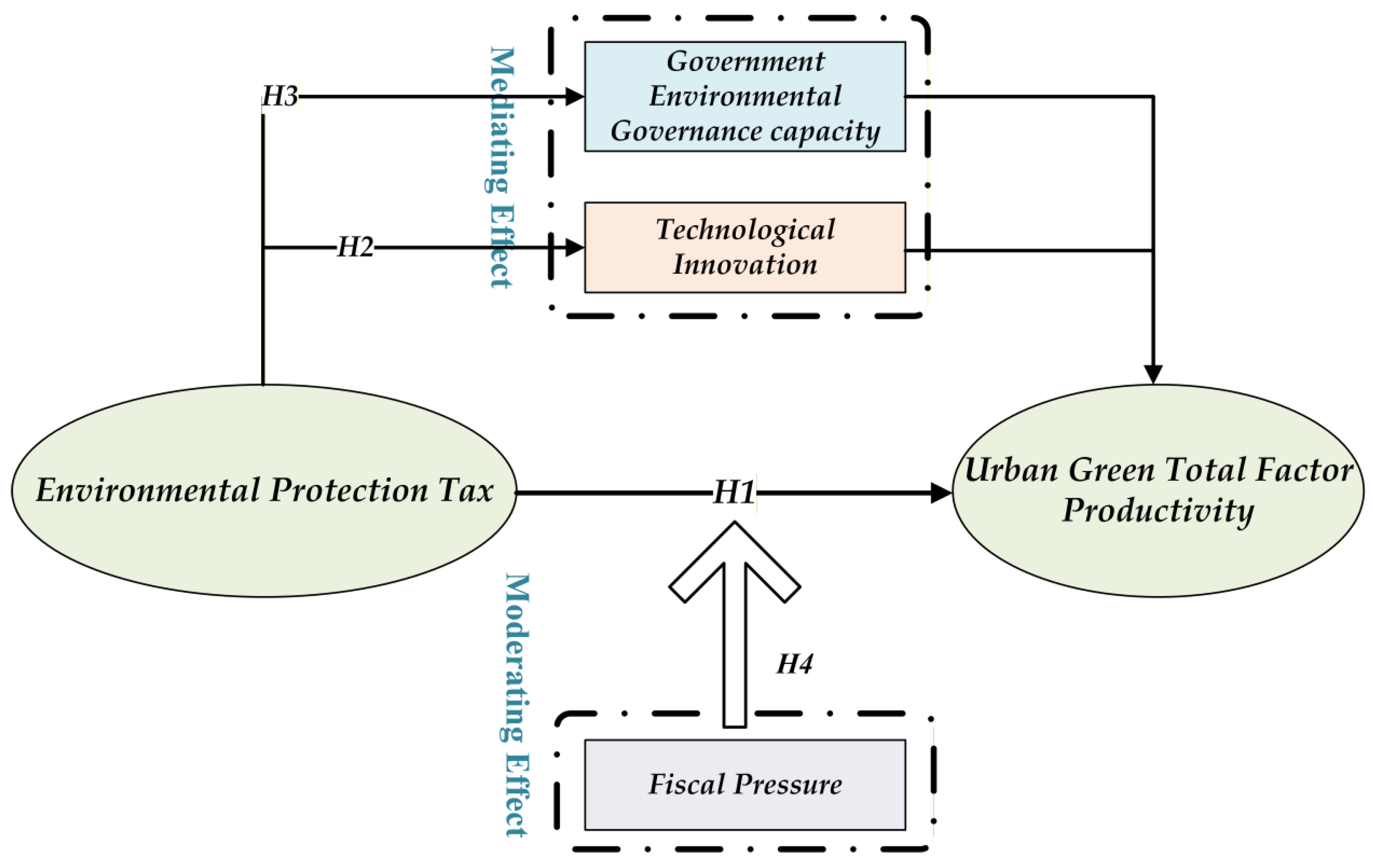
As an essential market-based environmental policy, the EPT promotes urban GTFP through two interrelated channels: the firm-level mechanism that stimulates green innovation and the government-level mechanism that enhances environmental governance capacity. The institutional design of the EPT—including its legal authority, flexible tax rate setting, transparent collection, preferential incentives, and local revenue allocation—provides both market and administrative foundations for green transformation.
At the firm level, EPT transforms external environmental pressure into internal innovation momentum. The Environmental Protection Tax Law grants the policy higher legal authority and enforcement power than the former discharge fee system, reducing the inefficiency of environmental regulation caused by local government–enterprise collusion [24]. Facing higher pollution costs, enterprises improve production efficiency and optimize resource allocation to reduce emissions. Meanwhile, the preferential policy offering a 75% tax reduction for compliant or low-emission firms provides strong financial incentives for green R&D and process upgrading, fostering a clustering effect of green innovation [25]. Through these cost–incentive mechanisms, EPT encourages firms to shift from extensive growth to cleaner, innovation-driven production, thereby improving GTFP.
At the government level, EPT strengthens local environmental governance through legal, fiscal, and administrative channels. The law allows provinces to adjust tax rates within statutory bands (up to ten times the minimum) according to local conditions [26], enabling differentiated yet adaptive regulation—higher rates in developed regions to promote deep abatement, and lower rates in less-developed areas to ease adjustment costs [27]. The joint collection model between tax and environmental departments enhances transparency and reduces information asymmetry, while the full retention of EPT revenues by local governments, replacing the former 1:9 sharing ratio, significantly raises their fiscal incentives for environmental protection and green investment. Consequently, local authorities become more proactive in enforcing pollution control, improving infrastructure, and supporting green industries—further promoting sustainable productivity growth.
In summary, the EPT simultaneously drives firm-level green innovation and government-level governance improvement, forming a dual mechanism that enhances both economic efficiency and environmental performance. Accordingly, we propose Hypothesis 1:
H1: 
EPT can effectively promote the improvement of urban GTFP.

2.2.2. Channel Evidence

Technological innovation constitutes an important firm-level channel through which the EPT enhances GTFP. As a process that improves production efficiency and lowers resource consumption through the development and application of new technologies [28], technological innovation allows firms to transform environmental constraints into sources of competitive advantage. Under the EPT, the taxation of pollution emissions raises firms’ environmental compliance costs, creating a market-based incentive to innovate. Facing the dual pressures of regulatory costs and profitability, firms are encouraged to seek technological breakthroughs to reduce both emissions and tax burdens [29]. This mechanism is consistent with the Porter Hypothesis, which argues that well-designed environmental regulation can stimulate innovation that offsets compliance costs. Through cleaner production processes and improved energy efficiency, enterprises achieve a “win–win” outcome of higher productivity and lower pollution [30]. Technological innovation can also improve the efficiency of factor allocation. Through the development and adoption of energy-saving and emission-reducing technologies, firms are able to reconfigure traditional inputs such as labor and capital toward greener production, thereby enhancing overall productivity [31]. In this way, the EPT acts as both a constraint and an incentive, channeling firms toward sustainable innovation paths that expand the production frontier and improve GTFP. Accordingly, Hypothesis 2 is proposed as follows:
H2: 
EPT can indirectly promote the improvement of GTFP by incentivizing technological innovation.
The EPT promotes urban GTFP not only by shaping firm behavior but also by enhancing local governments’ environmental governance capacity. As a fiscal and regulatory reform, the EPT redesigns the incentive structure of local authorities through its tax base, rate-setting flexibility, differentiated exemptions, and revenue retention mechanism, thereby improving the efficiency and sustainability of environmental governance. First, EPT establishes explicit and measurable price signals for pollution control. By including air, water, solid waste, and noise within the tax base and authorizing provinces to set rates within statutory ranges (air: 1.2–12 yuan; water: 1.4–14 yuan per pollution-equivalent unit), the law allows governments to link tax policy directly to local environmental targets. This “pricing-for-control” mechanism aligns fiscal instruments with environmental performance objectives, motivating local authorities to implement more active pollution abatement measures. Second, the law introduces a transparent system of differentiated reductions and exemptions. Emissions below 30% and 50% of the standard are taxed at 25% and 50% of the statutory rate, respectively, while compliant public wastewater and solid-waste treatment facilities are temporarily exempt. These arrangements encourage local governments to invest in environmental infrastructure such as sewer systems, centralized treatment, and monitoring networks, thereby enhancing the efficiency of public environmental expenditure and promoting coordinated pollution reduction. Third, EPT reallocates fiscal incentives by granting full revenue retention to local governments—replacing the 1:9 central–local sharing rule under the previous fee system. This reform enhances fiscal autonomy and establishes a stable, predictable revenue base for environmental initiatives, thereby enforcing stricter budget discipline and ensuring more sustained environmental spending. Consequently, local governments have stronger incentives to enforce environmental standards, expand investment in green industries, and support sustainable development. Finally, the coordination between tax and environmental authorities enhances regulatory efficiency. The joint collection and monitoring framework reduces information asymmetry, improves compliance verification, and ensures that fiscal and administrative instruments operate synergistically. As governance capacity rises—through better infrastructure, monitoring systems, and enforcement—pollution intensity declines, uncertainty in compliance decreases, and firm-level innovation is further supported. These cumulative improvements in environmental governance generate long-term gains in urban GTFP [32]. Accordingly, we propose Hypothesis 3:
H3: 
The EPT promotes GTFP by enhancing government environmental governance capacity.

2.2.3. Moderating Effect

Fiscal pressure plays an important moderating role in determining the effectiveness of the EPT. According to the theory of fiscal federalism, under a decentralized system, fiscal stress can reshape local governments’ incentive structures by compelling them to optimize resource allocation and improve spending efficiency to maintain governance performance [33,34]. In this context, EPT—whose revenues are entirely retained by local governments—becomes not only a regulatory instrument but also a fiscal lever linking environmental governance and local financial capacity. When fiscal pressure is high, local governments face tighter budget constraints and are thus motivated to maximize the efficiency of limited fiscal resources. On the one hand, they tend to strengthen tax collection and enforcement under the EPT framework to expand the effective tax base and increase environmental revenues. The resulting increase in the cost of pollution and compliance intensity further enhances firms’ incentives for green innovation and cleaner production. On the other hand, constrained budgets encourage “precision spending,” prompting governments to prioritize environmental infrastructure, public governance capacity, and the diffusion of energy-saving and emission-reducing technologies. This targeted investment strategy improves the marginal productivity of public environmental spending and complements the market incentives induced by the EPT [35]. Conversely, when fiscal pressure is low and revenues are abundant, local governments may display softer budget constraints and weaker incentives to enforce environmental taxation or optimize expenditure structure, which can attenuate the EPT’s overall effectiveness. Therefore, fiscal pressure acts as a catalyst that strengthens the transmission of EPT’s regulatory and incentive effects through both the firm-level and government-level channels. On this basis, Hypothesis 4 is proposed:
H4: 
As fiscal pressure increases, the EPT’s promotive effect on urban green total factor productivity becomes stronger.
In summary, Figure 1 presents the theoretical framework developed in this paper.

3. Research Design

3.1. Empirical Model

3.1.1. DID Model

The DID model has significant advantages compared to traditional econometric models. Traditional models typically rely on cross-sectional or time-series data, which can reveal correlations between variables but often struggle to effectively control for endogeneity issues, such as selection bias. By comparing changes over time between the treatment and control groups, the DID model enables a more accurate identification of policy effects and helps mitigate endogeneity concerns [36,37,38]. Therefore, DID models are widely used in policy evaluation, economics, and social sciences, especially when assessing the impacts of policy interventions on economic, social, or environmental outcomes, providing more reliable estimates.
This paper examines the effect of the EPT on GTFP. To this end, we employ a DID model to identify the impact of the policy before and after its implementation. Following the empirical strategy of Beck et al. (2010), we construct treatment and control groups and compare their changes over time to assess the effect of the EPT on GTFP [39]. The model is specified as follows:
Y i t = β 0 + β 1 T r e a t e d i × P o s t i t + λ C o n t r o l s i t + ν i + τ t + ε i t
In Equation (1), Yit represents the GTFP of city i in year t. Treatedi is a dummy variable equal to 1 for treated cities and 0 for control cities. Postit is a post-policy indicator that equals 1 in the post-EPT period and 0 otherwise. The interaction term Treatedi × Postit is the core explanatory variable of interest and identifies the net effect of the EPT on urban GTFP. Controlsit denotes a vector of control variables. The model also includes city fixed effects, year fixed effects, and a random disturbance term.

3.1.2. Channel Analysis Model

To explore the potential pathways through which the EPT may affect urban GTFP, this paper conducts a channel analysis. Specifically, we examine whether EPT is associated with changes in technological innovation and government environmental governance, and whether these variables are in turn correlated with GTFP. This approach provides mechanism-related evidence that is consistent with the hypothesized transmission channels, although it should not be interpreted as fully identified causal mediation in a strict sense.
Y i t = β 0 + β 1 T r e a t e d i × P o s t i t + λ C o n t r o l s i t + ν i + τ t + ε i t M i t = β 0 + β 1 T r e a t e d i × P o s t i t + λ C o n t r o l s i t + ν i + τ t + ε i t Y i t = β 0 + β 1 T r e a t e d i × P o s t i t + β 2 M i t + λ C o n t r o l s i t + ν i + τ t + ε i t
In which M is the mediator, primarily including technological innovation and government environmental governance capacity.

3.1.3. Moderation Effect Model

The moderation effect model is used to examine whether the relationship between the independent variable and the dependent variable varies with the moderator variable [40]. In other words, the moderation effect model aims to test whether, under different conditions, the moderator variable alters the strength or direction of the relationship between the independent variable and the dependent variable.
This paper uses the moderation effect model to examine whether the impact of EPT on GTFP is moderated by certain factors (such as fiscal pressure). Specifically, the paper explores the role of fiscal pressure in the relationship between EPT and GTFP. The moderation effect model typically uses interaction terms to represent the moderation effect. The specific model setup is as follows:
Y i t = β 0 + β 3 T r e a t e d i × P o s t i t × D i t + β 1 T r e a t e d i × P o s t i t + β 2 D i t + λ C o n t r o l s i t + ν i + τ t + ε i t
In which D is the moderator variable, primarily including fiscal pressure.

3.2. Variable

3.2.1. Dependent Variable

Green Total Factor Productivity: Based on existing literature [41], this paper measures GTFP using the super-efficiency SBM-GML model. This model has significant advantages over traditional total factor productivity measurement methods. First, the Super Efficiency Slack-Based Measure (SBM) model overcomes the limitation of traditional DEA models that cannot differentiate between decision units with an efficiency value of 1, thereby more accurately measuring the relative differences in green production efficiency among different cities. Second, the Global Malmquist-Luenberger (GML) index can consider changes in environmental pollution constraints and production efficiency from a dynamic perspective. It not only captures the impact of technological progress on production efficiency but also reflects the contribution of pollutant emission reductions to green development efficiency [42]. Therefore, the Super Efficiency SBM-GML model is suitable for this study’s context as it accurately measures GTFP while integrating the characteristics of green development and environmental protection.
When selecting the input–output indicators, this paper combines theoretical relevance with city-level data availability. Specifically, labor, capital, and energy are selected as input indicators because they capture the core production factors underlying urban economic activity. Real GDP is used as the desired output because it reflects the level of economic performance generated by these inputs. At the same time, smoke, wastewater, and sulfur dioxide are included as undesired outputs because they capture the major environmental costs associated with urban production and are closely related to the regulatory objectives of environmental protection policy. By jointly incorporating desired and undesired outputs, the SBM-GML framework is able to reflect the essence of green total factor productivity, namely the ability to achieve economic growth while reducing environmental burden.
This input–output design is also consistent with the measurement approach commonly adopted in the related literature [43]. More importantly, these indicators are available at the city level and can be matched consistently over time, which makes them suitable for the panel setting of this study. Therefore, the SBM-GML model provides a reasonable and operational framework for measuring urban GTFP in the context of China’s environmental governance and green development. At the same time, this paper does not assume perfect measurement precision. City-level pollution and statistical data may still be affected by reporting inconsistencies across yearbooks, differences in local statistical practices, and occasional gaps in disclosure across years and cities. Therefore, although the selected indicators provide a reasonable and widely used basis for measuring urban GTFP, some measurement error may still remain. This point is further discussed in the limitations section. The specific definitions of the input–output indicators and data sources are detailed in Table 1, providing solid data support and theoretical basis for measuring GTFP.

3.2.2. Independent Variables

Environmental Protection Tax: In this study, the treatment group is defined as cities located in provinces that increased the statutory tax rates for air pollutants after the implementation of the Environmental Protection Tax Law. According to the official policy documents, 17 provinces adjusted the relevant tax rates upward, and cities located in these provinces are treated as the policy-exposed group in the baseline analysis. The control group consists of cities located in provinces that did not raise the corresponding statutory tax rates during the study period. Since the Environmental Protection Tax Law officially came into force in 2018, the post-policy period began in 2018. Accordingly, the core explanatory variable EPT is constructed as the interaction between the treatment-group indicator (Treat) and the post-policy indicator (Post). To improve transparency, we consistently use this DID-based definition throughout the empirical analysis. Therefore, EPT should be understood as a differential policy-exposure indicator rather than a simple policy dummy. It is important to note that after the implementation of the Environmental Protection Tax Law, 16 provinces (cities) in China raised the tax rate for air pollutants (See Appendix A.1) [44].

3.2.3. Control Variables

Following prior studies [45,46,47], this paper includes industrial structure, fiscal revenue and expenditure, healthcare level, scientific expenditure, and educational expenditure as control variables to account for other factors that may affect the baseline results. Detailed definitions of these variables are reported in Table 2.

3.2.4. Channel Variable

Technological Innovation (TI): Following prior studies [48,49], this paper measures technological innovation using two proxy variables: the number of granted invention patents per capita and the number of granted green invention patents per capita. These indicators are adopted because invention patents can effectively capture the level of regional innovation and technological progress, while scaling by population helps account for differences in regional size. By normalizing patent counts by population, the measures better reflect per capita innovation output and reduce potential bias arising from population disparities across regions.
Government environmental governance (GEGC). We proxy this variable by the ratio of energy conservation and environmental protection expenditure to the local general public budget [50]. Under a hard budget constraint, this indicator reflects the government’s budgetary priority and fiscal commitment to environmental governance. It captures an important expenditure-based dimension of local environmental governance, including spending on monitoring, environmental infrastructure, wastewater and solid-waste treatment, information disclosure, and related public environmental services. Using a share rather than an absolute amount also helps reduce incomparability arising from city size, price levels, and fiscal cycles, thereby improving cross-city and intertemporal comparability. At the same time, we acknowledge that this measure does not fully capture broader dimensions of governance quality, such as institutional effectiveness, enforcement intensity, or regulatory stringency. It should therefore be interpreted as an expenditure-based proxy for environmental governance effort rather than as a comprehensive measure of overall environmental governance capacity.

3.2.5. Moderating Variable

Fiscal pressure (fp): Following [51], this study measures fiscal pressure by the ratio of local general public budget expenditure to local general public budget revenue. A higher value of this indicator reflects tighter fiscal constraints and thus greater fiscal pressure.

3.2.6. Sources

Given that the EPT was formally implemented in 2018, this study uses the period 2013–2022 as the sample window. To ensure data completeness and the accuracy of the analysis, cities with missing data were excluded during the sample selection process. After this screening, valid data from 280 cities were obtained, resulting in a total of 2242 samples. The final sample of 280 cities and 2242 city-year observations is meaningful in both scientific and empirical terms (see Appendix A.2). From an empirical perspective, the sample provides sufficient cross-sectional and temporal variation to support the DID identification strategy, as it includes both pre-policy and post-policy observations as well as treated and untreated cities. From a scientific perspective, the sample covers cities with substantial heterogeneity in industrial structure, fiscal conditions, environmental governance, tax-rate intensity, and resource endowments, which is important for examining not only the average effect of the EPT on urban GTFP, but also its heterogeneous effects across different institutional and economic settings. Although some observations were dropped because of missing data, the final sample still covers a wide range of Chinese cities and retains substantial regional and structural variation, providing a solid basis for the baseline, mechanism, and heterogeneity analyses.
The data used in this study are obtained from multiple official and authoritative sources. Specifically, the policy information used to construct the EPT variable is collected from official Chinese government websites and policy documents. This is consistent with the institutional arrangement of the Environmental Protection Tax Law, under which provincial-level governments determine and adjust the specific applicable tax rates for taxable air and water pollutants within the statutory range. City-level socioeconomic and fiscal variables are mainly drawn from the China City Statistical Yearbook and other official statistical yearbooks. The China City Statistical Yearbook, compiled by the National Bureau of Statistics, is an official annual statistical publication that reports major city-level indicators collected from the relevant departments of each city. Patent data are taken from the CNRDS database. Missing observations mainly arise when some city-year information is unavailable, not reported in a comparable form in the yearbooks, or cannot be matched consistently across variables and years. In such cases, the corresponding observations are excluded from the baseline sample rather than imputed, so as to preserve the consistency of measurement and the comparability of the empirical analysis.
The data used in this study are subject to the following limitations: first, because the latest annual statistical yearbook was not available at the time of writing, 2022 serves as the cut-off for the sample period, preventing the inclusion of more recent data; second, missing values were not imputed but rather led to the exclusion of the corresponding cities, which may weaken sample representativeness and the robustness of the analysis. However, these limitations do not compromise the validity of the study’s conclusions.
Table 3 presents the descriptive statistics for this study. The mean value of EPT is 0.242, indicating that 24.2% of the full city-year observations are treated observations in the post-policy period.

4. Empirical Results

4.1. Multicollinearity Check and Correlation Matrix

Table 4 reports the correlation matrix of the main variables and the multicollinearity test results. Overall, the pairwise correlations among the explanatory variables remain within a reasonable range and do not suggest the presence of serious multicollinearity. Although the correlation between fis and edu is relatively high (0.7839), the correlations among the remaining variables are generally moderate. In particular, the correlations between the core explanatory variable EPT and the control variables are relatively small in magnitude, indicating that the policy variable is not strongly linearly associated with the other regressors. The variance inflation factor (VIF) results further support this conclusion. Specifically, the VIF values for EPT, is, fis, hos, sci, and edu are 1.11, 1.40, 3.11, 1.51, 1.15, and 3.38, respectively, with a mean VIF of 1.94. All VIF values are well below the conventional threshold of 10, and the corresponding 1/VIF values all exceed 0.1, suggesting that multicollinearity is not a serious concern and that the regression model is appropriate for the subsequent analysis.

4.2. Baseline Regression

Table 5 reports the results of the baseline regression analysis. Columns (2) to (4) present the stepwise regression results. Column (2), which excludes control variables, shows that the coefficient on EPT is 0.0995 and statistically significant, indicating that, relative to cities in provinces that did not raise the relevant tax rates, cities exposed to stronger EPT shocks experienced a significant increase in GTFP after 2018. As control variables are gradually added, the estimated coefficient on EPT remains positive and statistically significant, and the changes in magnitude are relatively small, suggesting that the main finding is robust to the inclusion of additional covariates. In the preferred specification, the estimated coefficient on EPT is about 0.115, accounting for roughly 8.5% of the sample mean of GTFP (1.345). This suggests that the effect of the policy is not only statistically significant but also economically meaningful. Overall, these results support Hypothesis 1 and suggest that stronger EPT exposure has significantly promoted urban GTFP. The control variables are included as standard covariates to account for observable city-level differences and to improve the robustness of the estimated policy effect; accordingly, the main analytical focus of this paper remains on the coefficient of EPT rather than on the individual interpretation of all control coefficients.

4.3. Parallel Trends Test

The parallel trends test is a key step in assessing the validity of the DID design. A central assumption of the DID approach is that, in the absence of the policy intervention, the treatment and control groups would have followed similar pre-policy trends. If this assumption holds, any divergence observed after policy implementation can be attributed to the policy rather than to pre-existing differences in trends. Accordingly, the parallel trends test examines whether the treatment and control groups exhibited systematically different trajectories before the policy was introduced [52,53,54].
To test the parallel trends assumption, this paper adopts an event-study framework to examine the dynamic evolution of the treatment and control groups around the time of policy implementation. This approach makes it possible to assess whether the two groups exhibited similar pre-policy trends. The model is specified as follows in Equation (4):
Y i t = k = 5 , k 1 4 β k T r e a t e d ( k ) + λ C o n t r o l s i t + ν i + τ t + ε i t
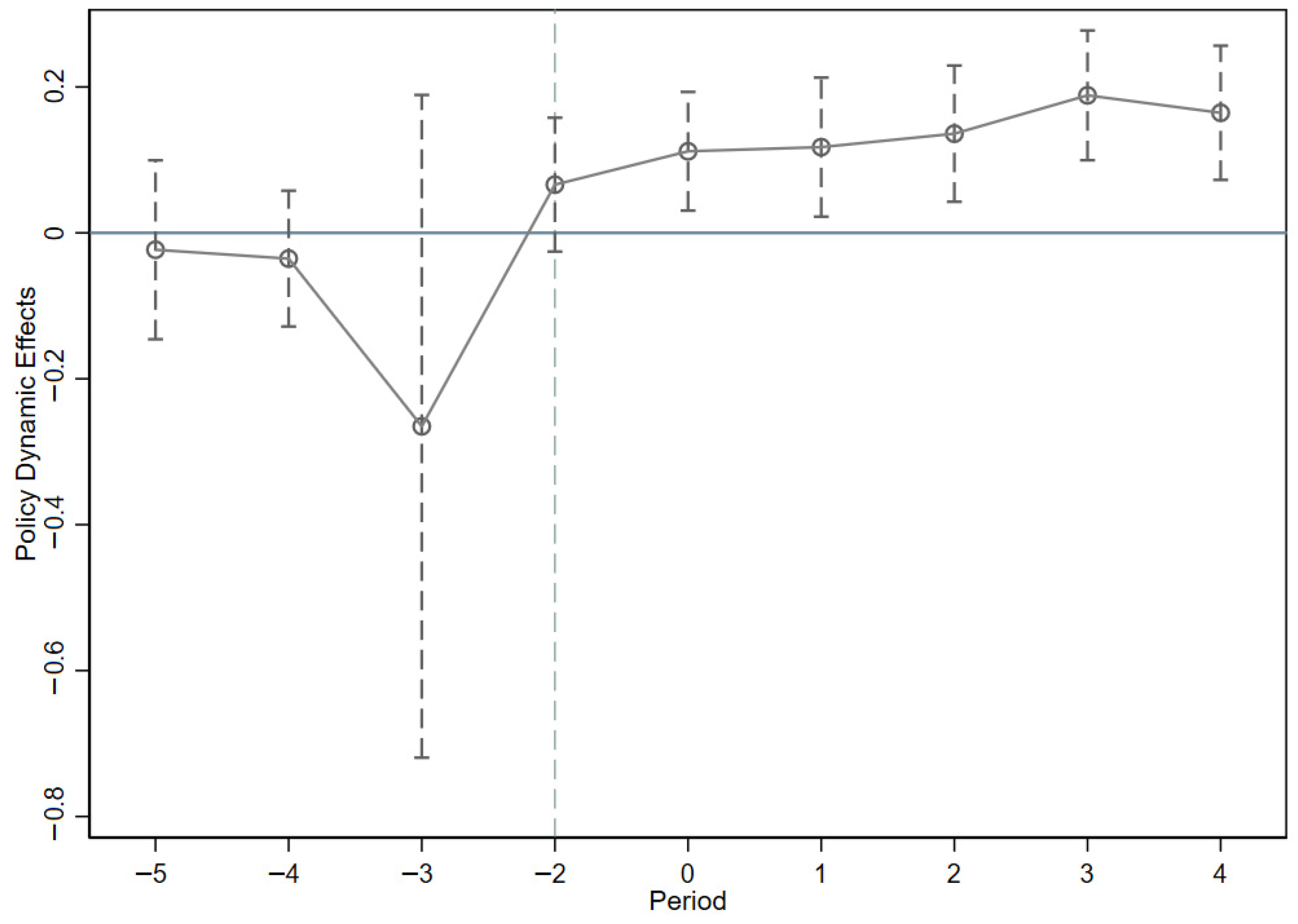
To avoid perfect multicollinearity, this paper selects the year before the policy implementation as the baseline group, meaning the variable for k = −1 is not included in the regression equation. Aside from this adjustment, the rest of the model specification remains the same as in the baseline regression. Figure 2 reports the results of the parallel trends test. The estimated dynamic coefficients for the pre-policy periods (Period < 0) are all close to zero, and their confidence intervals include zero, indicating that there were no statistically significant differences in pre-policy trends between the treatment and control groups. Table 6 presents the confidence intervals for the parallel trends test. This suggests that the change trajectories of the two groups before the policy were essentially parallel, which aligns with the parallel trends assumption of the DID model. Therefore, the parallel trends test in this paper is considered valid, providing robustness for the use of the DID method in evaluating policy effects.

4.4. Robustness Test

4.4.1. Placebo Test

The placebo test is a method used to assess the robustness of a model, aiming to rule out the possibility that the research results are due to random factors or model specification biases. In the DID model, the placebo test typically involves constructing a “pseudo-policy” variable to verify the model’s reliability. If the estimated coefficient on the placebo policy variable is insignificant, this provides additional support for the robustness of the actual policy effect. Following La Ferrara et al. (2012), this paper randomly generates 1000 placebo policy dummies based on the distribution of the EPT variable in the baseline regression [55]. These placebo variables are then introduced into the baseline model for re-estimation, and the significance of their coefficients is examined. This procedure helps assess whether the estimated policy effect could be driven by random chance, thereby strengthening the credibility and robustness of the results.
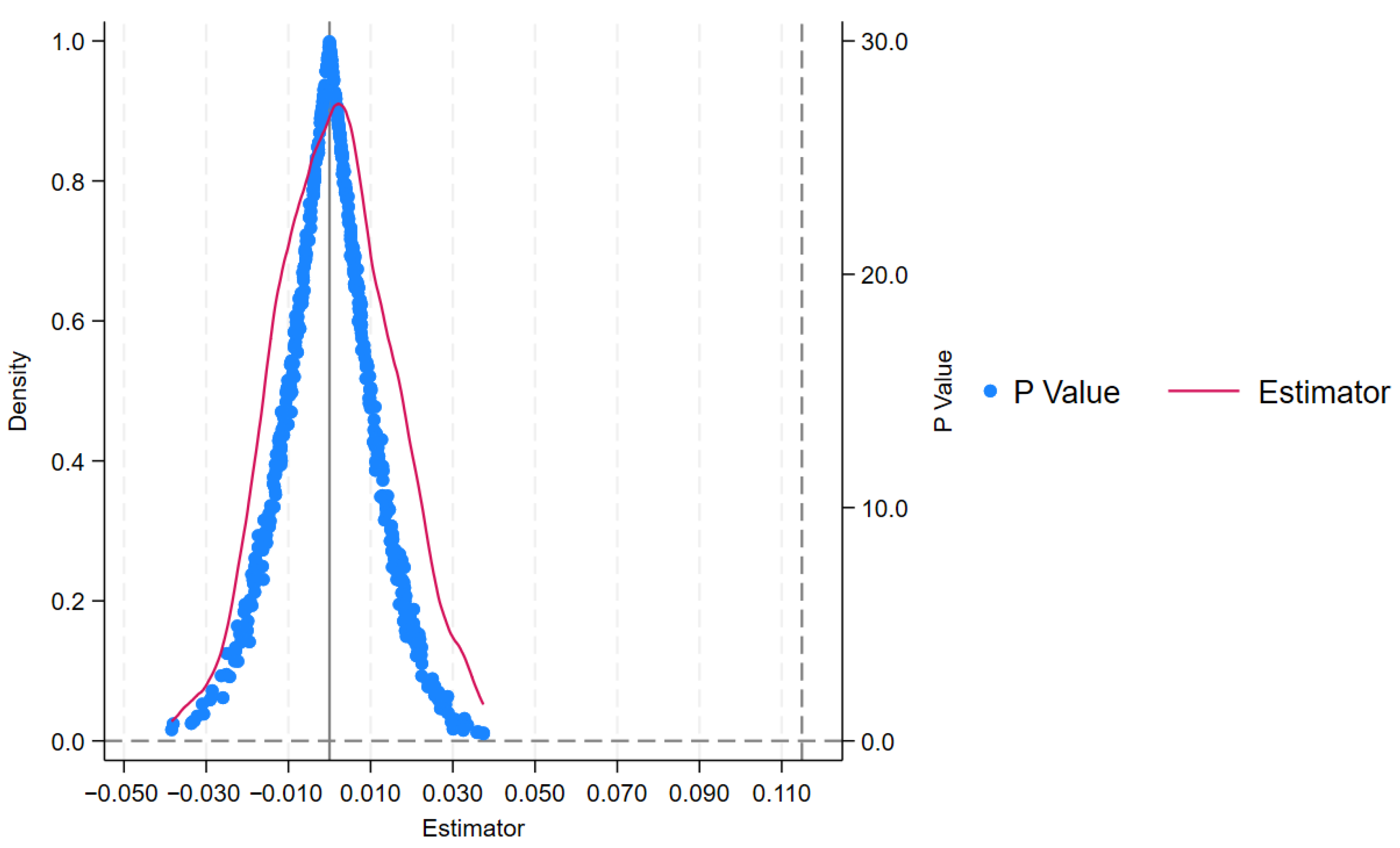
The results of the placebo test are presented in Figure 3, where the horizontal axis represents the estimated coefficients of the pseudo-policy dummy variable and the vertical axis represents the density distribution of these estimates. In this robustness test, the treatment dummy was randomly reassigned to cities 500 times (without replacement) to simulate the distribution of policy effects that would occur purely by chance, while keeping the model specification and sample structure unchanged. Figure 3 shows that the estimated coefficients from the placebo assignments are approximately symmetrically distributed around zero, with the majority of them being statistically insignificant. The density curve (red line) forms a sharp peak near zero, and none of the randomly generated coefficients approach the magnitude of the actual estimated policy effect. This indicates that the observed positive effect of the EPT on GTFP in the baseline regression does not arise from random shocks, sample noise, or model misspecification. Moreover, the blue dots in the figure represent the kernel density of the simulated p-values, which are concentrated at high levels (above 0.1), further confirming that the pseudo-policy estimations fail to produce significant results under random assignment. Together, these findings verify that the estimated treatment effect is statistically distinct from random outcomes and thus reflects a genuine causal relationship between EPT implementation and improvements in urban green total factor productivity.

4.4.2. PSM

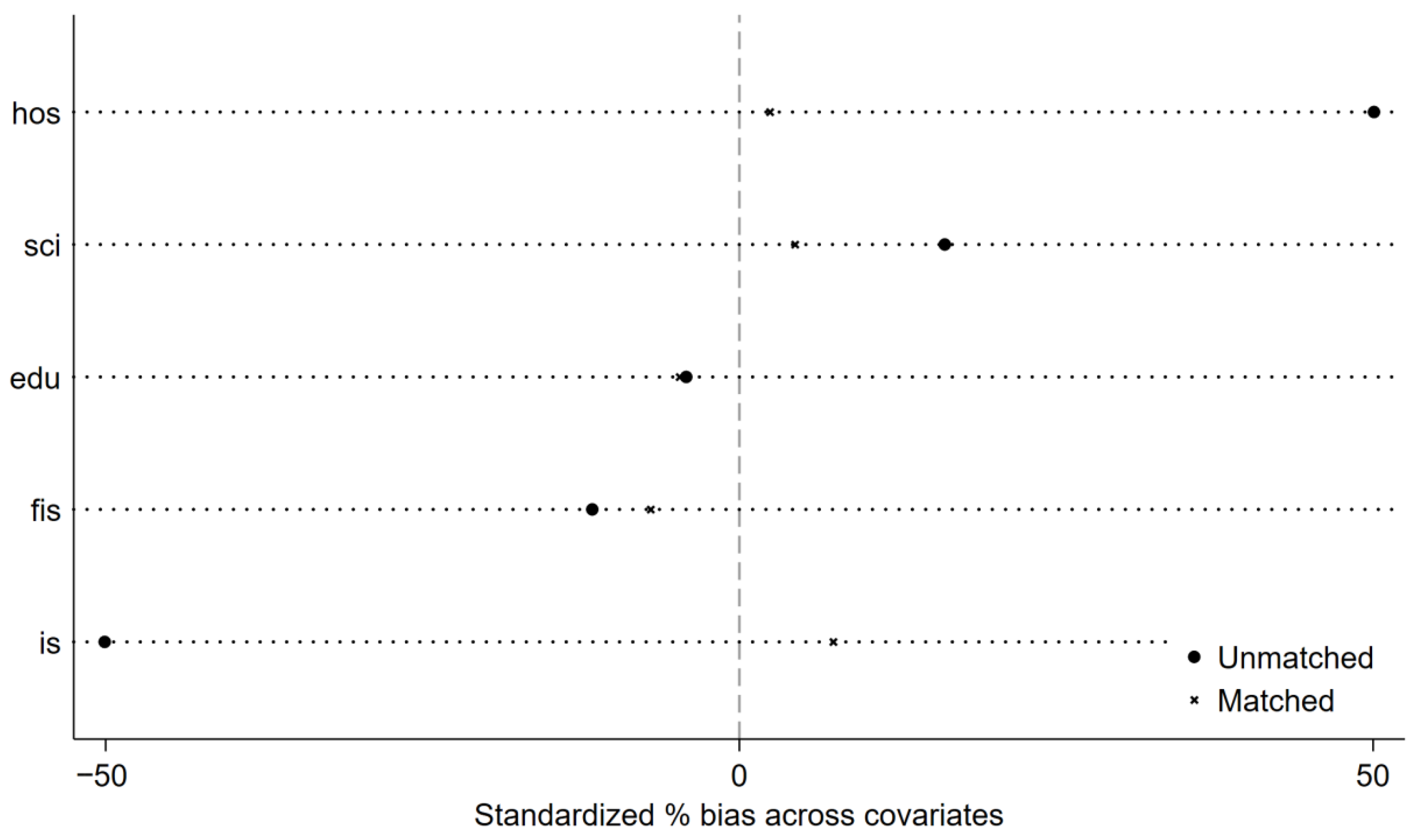
In the DID model, PSM can be used to further reduce the heterogeneity between the treatment and control groups before the policy implementation, ensuring similarity between the two groups on key covariates and enhancing the robustness of the DID model. The matching results are presented in Figure 4, which plots the standardized percentage bias across key covariates before and after matching. As shown in Figure 4, after matching (denoted as Matched), the standardized bias of the main covariates—such as industrial structure (is), fiscal expenditure (fis), education level (edu), scientific research input (sci), and healthcare level (hos)—is substantially reduced and converges toward zero. Compared with the pre-matching results (Unmatched), the differences between the treatment and control groups are markedly smaller, indicating a significant improvement in covariate balance. Specifically, all standardized biases fall within the ±10% range after matching, meeting the commonly accepted balance criterion in the PSM literature. This demonstrates that the matching procedure effectively removes systematic differences between the two groups on key observable characteristics. As a result, the matched sample becomes more comparable between the treatment and control groups, allowing the subsequent DID estimation to identify the causal effect of the EPT on urban GTFP more reliably.
After excluding unmatched observations, we re-estimate the model using the matched sample. As reported in column (1) of Table 7, the coefficient on EPT remains significantly positive, indicating that the positive effect of the EPT on GTFP is robust to potential sample selection bias.

4.4.3. Exclusion of Concurrent Policies

Because other concurrent policies may also affect GTFP, such as low-carbon city pilots, smart city pilots, and carbon emissions trading pilots, this paper excludes cities covered by these programs and re-estimates the model separately. As shown in columns (2) to (4) of Table 7, the coefficient on EPT remains significantly positive. This indicates that the positive effect of the EPT on GTFP is not driven by these concurrent policies, further supporting the robustness of the main findings.

4.4.4. Alternative EPT Settings

In the baseline specification, the treatment and control groups are defined based on whether the tax rate on air pollutants increased. Given that the EPT also applies to water pollutants, this study further redefines the treatment status using changes in water pollutant tax rates and re-estimates the regression model. The results in column (1) of Table 8 show that the coefficient on EPT_w remains significantly positive, indicating that the main conclusions are robust to this alternative grouping criterion.

4.4.5. Alternative GTFP Measurement

In the baseline regression, GTFP is measured using the super-efficiency SBM-GML model. To address potential concerns about measurement choice, this paper further recalculates GTFP using the super-efficiency DDF-GML model and re-estimates the regression. As shown in column (2) of Table 8, the coefficient on EPT remains significantly positive, indicating that the main findings are robust to an alternative measure of GTFP.

4.4.6. Clustered Standard Errors

In the baseline regression, robust standard errors are employed. To account for potential within-city correlation and obtain more reliable statistical inference, this paper further re-estimates the model using standard errors clustered at the city level. As reported in column (3) of Table 8, the coefficient on EPT remains significantly positive, indicating that the main findings are robust to clustering at the city level.

4.4.7. Adding City-Specific Time Trends

To further assess the robustness of our estimates, we augmented the regression model by adding city-time interaction terms to control for city-specific linear time trends, and then re-estimated the model. As shown in Column (4) of Table 8, the coefficient on the EPT is 0.0161 and remains highly significant at the 1% level. This finding indicates that even after accounting for each city’s underlying developmental trajectory, the positive effect of EPT on GTFP remains robust.

4.4.8. Multiple Imputation

In the baseline regressions, missing values are handled through listwise deletion, which may reduce sample representativeness and lead to selection bias. To examine robustness, we apply multiple imputation to the missing observations and, without changing the variable definitions or model specification, construct a balanced panel of 280 cities over the period 2013–2022. As reported in column (5) of Table 8, the coefficient on EPT in the imputed sample is 0.0246 and remains statistically significant at the 1% level, with both the sign and magnitude broadly consistent with the baseline results. These findings suggest that the main conclusions remain robust after addressing potential bias arising from missing-data treatment.

4.4.9. Extending the Sample Period

Given that the EPT was implemented in 2018, the baseline sample covers data only through 2022. To address concerns that the post-policy observation window may be relatively short, we extend the sample period to 2023 and re-estimate the model without changing the variable definitions or empirical specification. As reported in column (6) of Table 8, the coefficient on EPT is 0.0287 and remains statistically significant at the 1% level, with both sign and magnitude broadly consistent with the baseline results. This suggests that the main findings are robust to an extended sample period.

4.5. Channel Analysis

4.5.1. Channel Evidence on Technological Innovation and Government Environmental Governance

Columns (1) to (5) of Table 9 report the results of the channel evidence for technological innovation. The regression coefficients for both EPT and technological innovation (TI and GI) are significantly positive, indicating that technological innovation does indeed play a mediating role between EPT and GTFP. Furthermore, the Sobel Z value is 2.881 and 3.906, and the confidence interval calculated using the Bootstrap method does not include 0, which further confirms the significance of the mediating effect of technological innovation. The additional test is reported in Appendix A.3. Therefore, Hypothesis 2 is validated.
Columns (6) and (7) of Table 9 report the channel evidence using government environmental governance capacity (GEGC) as the mediating variable. Column (6) shows that the coefficient on EPT in the GEGC regression is significantly positive, indicating that the EPT significantly increases the share of local fiscal expenditure devoted to energy conservation and environmental protection. In column (7), after including both GEGC and EPT in the GTFP equation, both coefficients remain significantly positive, suggesting that, in addition to its direct effect, EPT also promotes GTFP through the channel of strengthening spending on energy conservation and environmental protection.

4.5.2. Moderating Role of Fiscal Pressure

Column (8) of Table 9 presents the test of the moderating effect of fiscal pressure. EPT_fp denotes the interaction between the EPT and fiscal pressure. The significantly positive coefficient on the interaction term suggests that higher fiscal pressure strengthens the positive effect of the EPT on urban GTFP, thus supporting the corresponding hypothesis.

4.6. Discussion of Empirical Results

The findings of this study are consistent with existing literature, which not only reinforces the robustness of our results but also further validates the applicability of the Porter Hypothesis at the city level in China. Specifically, we find that the EPT significantly enhances GTFP, in close agreement with the empirical results reported by [56], demonstrating that moderate market-based environmental regulation can improve GTFP by incentivizing firms’ technological innovation and pollution control. Building on this common finding, our analysis deepens the understanding of policy mechanisms by uncovering the mediating role of green technological innovation, government environmental governance capacity and the moderating effect of fiscal pressure.
In practice, the Taicang Chemical Industrial Park in Jiangsu Province provides a compelling case study. Since its inclusion under the EPT framework in 2018, the park’s firms have adopted green technologies such as zero-discharge wastewater treatment and low-GWP refrigerant replacements, alongside stringent “one-enterprise, one-policy” regulatory oversight. Monitoring data indicate that nitrogen oxide emissions declined by 25% within two years—aligning with local reduction targets—while driving improvements in regional GTFP. This real-world example illustrates how EPT can simultaneously spur green innovation and enhance productivity, offering empirical support for the policy’s broader application.

5. Heterogeneity Analysis

The heterogeneity results further suggest that the effectiveness of the EPT depends not only on the existence of environmental taxation itself, but also on whether local economic and institutional conditions allow firms and governments to transform regulatory pressure into green productivity gains.

5.1. Tax Rate Levels

Since the implementation of the “Environmental Protection Tax Law of the People’s Republic of China” in 2018, various provinces have introduced specific tax rates for air pollutants and water pollutants subject to the tax. However, because regions differ in environmental carrying capacity, pollution intensity, and their economic, social, and ecological development objectives, the applicable tax rates are not uniform across locations. As a result, the effects of the EPT may vary across regions with different tax-rate levels. Previous studies have shown that environmental tax policies can generate a double dividend by delivering both economic and environmental benefits [57,58]. However, this does not necessarily mean that higher tax rates are always better [59,60]. On the contrary, implementing EPT at a reasonable tax rate may be more beneficial for the improvement of GTFP.
Based on this framework, the study categorizes the sample into three groups: high-tax regions (where the tax rate approaches or reaches the statutory upper limit of 6–12 yuan), medium-tax regions (with rates between the lower and upper limits, i.e., 2–6 yuan), and low-tax regions (aligned with the national minimum standard of 1.2–1.4 yuan). The classification criteria are drawn from the Chinese government website (https://www.gov.cn/zhengce/2018-01/11/content_5255478.htm, accessed on 20 April 2026). Regression analyses are then conducted separately for each group. The regression results are shown in columns (1) to (3) of Table 10. In the medium-tax and low-tax regions, the coefficients of EPT are 0.0877 and 0.2625, respectively, and both are statistically significant.
The productivity consequences of environmental taxation do not necessarily increase monotonically with tax intensity. In line with the logic of the Porter Hypothesis, environmental regulation is more likely to stimulate innovation and efficiency improvement when it imposes sufficient pressure to induce adjustment, but not such a high burden that firms’ short-run adaptive capacity is overwhelmed. In medium-to-low tax regions, firms may be better able to respond to EPT through technological upgrading, cleaner process adoption, and resource reallocation, thereby translating policy pressure into higher green productivity. By contrast, in high-tax regions, the immediate compliance burden may become disproportionately large, especially for pollution-intensive firms, reducing the scope for innovation compensation and weakening the productivity-enhancing effect of the tax. A second explanation lies in the interaction between tax intensity and local implementation conditions. Higher statutory tax rates do not automatically translate into more effective green transformation. Where industrial structures are more pollution-intensive, technological substitution is more difficult, or compliance costs are especially high, stronger tax pressure may initially generate output compression rather than efficiency improvement. In such settings, firms may devote more resources to short-term compliance or cost absorption than to innovation and green upgrading. By contrast, moderate tax burdens may provide a more favorable balance between regulatory stringency and adjustment feasibility, allowing firms to internalize environmental costs without losing the capacity to innovate.

5.2. Resource Endowments

To further examine heterogeneity arising from differences in urban industrial structure, we follow the National Sustainable Development Plan for Resource-Based Cities (2013–2020) issued by the State Council (hereinafter referred to as “the Plan”) to classify cities as resource-based and non-resource-based. Resource-based cities are those whose economic growth primarily depends on the extraction and processing of natural resources such as coal, oil, nonferrous metals, and natural gas, while non-resource-based cities feature diversified industrial structures and rely more on manufacturing and services. Although the Plan’s reference period ends in 2020, the industrial base of resource-oriented cities is relatively path-dependent and stable over time; therefore, this classification remains valid for our sample. According to the Plan, 126 cities are identified as resource-based and 154 as non-resource-based within the study sample, distributed mainly across the three major resource belts: the northeast (Heilongjiang, Jilin, Liaoning), the midwest (Shanxi, Shaanxi, Inner Mongolia), and parts of the southwest (Guizhou, Sichuan, Yunnan). These areas are characterized by a dominance of energy-intensive and heavy industries. The regression results reported in columns (4) and (5) of Table 10 show that the coefficient of EPT is statistically insignificant for resource-based cities but positive and significant (0.0646) for non-resource-based cities. This indicates that the positive effect of the EPT on GTFP is more pronounced in regions with diversified industrial structures.
The weaker response of resource-based cities can be understood in terms of structural rigidity and adjustment elasticity. Resource-based cities are typically characterized by stronger dependence on extractive and heavy industries, higher capital specificity, longer production cycles, and greater reliance on energy-intensive production. In such contexts, environmental tax pressure is less easily converted into rapid technological substitution or factor reallocation, because firms face stronger path dependence and fewer short-run alternatives to their existing production structure. The sunk costs of existing assets and the concentration of local industrial systems further reduce the flexibility of firms to respond to environmental price signals through innovation or restructuring. By contrast, non-resource-based cities usually have more diversified industrial systems, greater market competition, and more flexible production structures. These features increase the elasticity of adjustment to environmental taxation and make it easier for firms to respond through cleaner technology adoption, efficiency improvement, and organizational upgrading. In addition, diversified urban economies are often more conducive to technology diffusion, inter-industry spillovers, and the reallocation of capital and labor toward less polluting sectors. As a result, the regulatory pressure created by EPT is more likely to be translated into observable gains in green total factor productivity in non-resource-based cities.

6. Conclusions and Policy Recommendations

6.1. Conclusions

The EPT was officially implemented in 2018. Using changes in air pollutant tax rates to distinguish the treatment group from the control group, this study analyzes an unbalanced panel of 280 cities over the period 2013–2022 and employs a DID model to examine the relationship between the EPT and urban GTFP. In addition, the study explores the mediating roles of technological innovation and government environmental governance capacity, as well as the moderating role of fiscal pressure. The main findings are as follows. First, the EPT significantly improves urban GTFP, suggesting that the policy contributes positively to the coordination between economic development and environmental protection. Second, technological innovation and government environmental governance capacity act as important transmission channels through which the EPT enhances GTFP. Third, the positive effect of the EPT on urban GTFP becomes stronger as fiscal pressure increases. Fourth, the policy effect is more pronounced in regions with low-to-moderate tax rates and in non-resource-based cities. These findings suggest that an appropriate tax-rate design can improve policy effectiveness. Overall, the results provide both theoretical and empirical support for further refining the EPT and offer useful implications for local governments seeking to formulate differentiated policies to promote green development.

6.2. Discussion

Compared with international experiences, China’s EPT shares a similar “pollution pricing–innovation incentive” logic with Sweden’s carbon tax and the European Union Emissions Trading System (EU ETS), yet it exhibits distinctive institutional features. First, its implementation follows a unified, mandatory national model that compels firms to respond immediately. Second, its fiscal design allows for local revenue retention, strengthening local governments’ incentives for environmental governance. Third, it has a broader policy scope, forming a multi-level governance framework that operates alongside carbon trading mechanisms. Unlike Sweden’s gradual and moderate carbon tax approach, the EPT’s strong regulatory nature generates more pronounced short-term effects while also revealing nonlinear compliance costs and enforcement disparities in high-tax regions. Overall, China’s experience suggests that the effectiveness of environmental taxation depends not only on the tax rate itself but also on the alignment between institutional enforcement capacity and governance effectiveness. Going forward, optimizing tax rate structures, enhancing coordination between enforcement and fiscal incentives, and gradually integrating the EPT with the carbon market will be essential to achieving the “double dividend” of environmental improvement and economic growth.

6.3. Limitations and Future Directions

Although this study provides an in-depth city-level analysis of the impact of the EPT on GTFP and offers evidence on the underlying channels, several limitations should be acknowledged. First, some key variables—particularly green technological innovation—are measured using macro-level indicators such as patent counts, which may not fully reflect innovation quality, technological applicability, or the actual depth of green transformation. As a result, the estimated channel effects may be measured with error. Second, the measurement of both GTFP and government environmental governance is subject to data-related constraints. Although the Super Efficiency SBM-GML framework allows this study to jointly consider economic performance and environmental burden, city-level pollution indicators may still suffer from reporting inconsistencies across statistical sources and local yearbooks. Likewise, the expenditure-based proxy for government environmental governance mainly captures the fiscal commitment of local governments to environmental protection, rather than broader dimensions such as institutional effectiveness, enforcement quality, or regulatory stringency. Third, while the paper provides mechanism-related evidence on technological innovation and government environmental governance, these results should be interpreted as channel evidence rather than fully identified causal mediation, given the limits of mechanism identification under the current DID framework. Fourth, because the analysis focuses on representative Chinese cities, the external validity of the findings for other national or regional contexts remains to be tested, especially where institutional arrangements, market conditions, and policy environments differ substantially. Finally, this paper does not examine potential spatial spillover effects across geographically adjacent cities, such as pollution transfer, policy imitation, or intercity industrial relocation, which may also shape the broader impact of the EPT.
These limitations also point to several promising avenues for future research. Building on these limitations, several directions for future research deserve attention. First, future studies could move from the city level to the firm or plant level to identify more precisely how the Environmental Protection Tax (EPT) affects green innovation quality, pollution-abatement investment, production restructuring, and firm-level productivity. Such micro-level evidence would help clarify the behavioral mechanisms that underlie the aggregate city-level effects documented in this paper. Second, as more recent data become available, future research could examine the longer-term dynamic effects of the EPT and assess whether its influence persists, strengthens, or weakens over time. In addition, the EPT does not operate in isolation. Its interaction with other environmental and green-development policies—such as carbon emissions trading, green finance, and low-carbon city initiatives—also deserves further investigation. Third, future work could explore possible spatial spillover effects across cities, including industrial relocation, pollution transfer, technological diffusion, and policy imitation, so as to provide a more complete understanding of the broader regional consequences of environmental taxation.

6.4. Policy Recommendations

We propose the following three policy recommendations.
First, maintain the stability and continuity of the Environmental Protection Tax system so as to reinforce long-term and predictable green constraints. The effectiveness of the Environmental Protection Tax depends not only on the tax system itself, but also on whether it can continuously deliver stable and clear environmental price signals. Compared with short-term and campaign-style administrative measures, the advantage of a tax instrument lies in its ability to impose a relatively persistent cost constraint, thereby guiding firms to gradually adjust their production modes, optimize resource allocation, and form relatively stable expectations regarding green development. Therefore, during policy implementation, attention should be paid to maintaining the continuity and predictability of the Environmental Protection Tax system, so as to avoid weakening the long-term response of firms and local governments to green transformation due to frequent policy changes or inconsistent enforcement standards.
Second, the implementation of the Environmental Protection Tax should emphasize moderation and differentiation, and should avoid simply equating tax intensity with policy strength. Environmental taxation does not necessarily promote green transformation more effectively when the tax rate is higher. Its policy effect depends on the degree of fit among environmental constraints, firms’ adaptive capacity, and local development conditions. Accordingly, in both policy implementation and future optimization, greater attention should be paid to the coordination between tax-rate arrangements and local industrial structure, development stage, and affordability. Rather than relying solely on heavier tax burdens to strengthen regulation, policymakers should adopt a more moderate, precise, and well-paced institutional design, so that the Environmental Protection Tax can impose effective constraints while still preserving the necessary space for firms’ technological adjustment and green upgrading.
Third, strengthen the transmission mechanisms through which the Environmental Protection Tax promotes technological innovation and improvements in environmental governance, so as to enhance the conditions under which policy effects can be realized. Whether the Environmental Protection Tax can truly be translated into improvements in green productivity depends not only on the tax instrument itself, but also on whether effective interaction can be formed between the firm side and the government side. To this end, it is necessary to further improve the support system for green technological innovation and to strengthen firms’ incentives to undertake technological upgrading related to energy conservation, emissions reduction, cleaner production, and process optimization. At the same time, local governments should improve the execution capacity and efficiency of environmental governance, and strengthen the coordination among environmental investment, regulatory enforcement, and public governance. Only when firms’ green adjustment capacity and local governments’ governance support capacity are improved simultaneously can the institutional effectiveness of the Environmental Protection Tax be more fully realized.

Author Contributions

All authors contributed to the study conception and design. Material preparation, data collection and analysis were performed by J.W., Y.W., S.Z. and N.L. The first draft of the manuscript was written by J.W. and Y.W. and all authors commented on previous versions of the manuscript. All authors have read and agreed to the published version of the manuscript.

Funding

This research was funded by the Basic Research Business Fund for Provincial Universities of Heilongjiang, under the projects “Research on the Optimization of China’s Agricultural Product Trade Structure from the Perspective of Digital Economy” (Project No. 145109323) and “Application of Digital Twin Systems in Smart Water Conservancy” (Project No. 145209316); the Heilongjiang Provincial Education Science “14th Five-Year Plan” 2023 Key Project “Research on the Innovation Practice of the Curriculum System of International Economics and Trade Major in Local Universities under the Background of Digital Education” (Project No. GJB1423179); and the National Statistical Science Research Project “Statistical Monitoring Research on the Resilience of Private Enterprises Empowered by Artificial Intelligence” (Grant No. 2025LY036).

Institutional Review Board Statement

Not applicable.

Informed Consent Statement

Not applicable.

Data Availability Statement

All data used in this study are available from the corresponding author upon request.

Acknowledgments

During the preparation of this manuscript, the author(s) used stata 18 for the purposes of regress. The authors have reviewed and edited the output and take full responsibility for the content of this publication.

Conflicts of Interest

The authors have no relevant financial or non-financial interests to disclose.

Abbreviations

The following abbreviations are used in this manuscript:
GTFPGreen total factor productivity
EPTEnvironmental protection tax

Appendix A

Appendix A.1. Provincial Comparison of Sewage Fees and Environmental Protection Tax Rates in China

Table A1. Comparison of sewage fee and environmental tax by province in China.
ProvinceAtmospheric PollutantsWater Pollutants
Sewage FeeEnvironmental Protection TaxSewage FeeEnvironmental Protection Tax
BeijingSulphur dioxide,
nitrogen oxides
10
12COD 10, ammonia
nitrogen 12
14
TianjinSulphur dioxide
6.30, nitrogen
oxides 8.50
10COD 7.50, ammonia
nitrogen 9.50
12
Hebei2.4Primary pollutant 9.6 and other
pollutants 4.8; Secondary pollutant 6 and
other pollutants 4.8; Tertiary pollutant
4.8
2.8Primary pollutant 9.6 and other
pollutants 4.8; Secondary pollutant 6 and
other pollutants 4.8; Tertiary pollutant
4.8
ShanghaiSulphur dioxide,
nitrogen oxides 4
2018: sulphur dioxide 6.65, nitrogen
oxides 7.6, other pollutants 1.2; 2019:
COD, ammonia 3COD, ammonia nitrogen 4.8, Class I water
pollutants 1.4, others 1.4
ShandongSulphur dioxide,
nitrogen oxides 6,
other 1.2
Sulphur dioxide, nitrogen oxides 6, other
pollutants 1.2
COD, ammonia nitrogen
and five heavy metals 1.4
COD, ammonia nitrogen and five heavy metals3,
other pollutants 1.4
Jiangsu3.6Nanjing 8.4, Wuxi, Changzhou, Suzhou,
Zhenjiang 6, other areas 4.8
4.2Nanjing 8.4, Wuxi, Changzhou, Suzhou,
Zhenjiang 7, other areas 5.6
Zhejiang1.2Four heavy metal pollutants 1.8, other
pollutants 1.2
1.4Five heavy metals, COD and ammonia nitrogen
1.8, other pollutants 1.4
Sichuan1.23.91.42.8
Shanxi1.21.81.42.1
Hunan1.22.41.43
Henan1.24.81.45.6
Guizhou, Hainan1.22.41.42.8
Guangdong, Guangxi1.21.81.42.8
Tibet0.61.20.71.4
Chongqing1.22018–2020: 2.4, 2021: 3.51.42018–2020: 3, 2021: 3
Fujian1.21.21.4Five heavy metals, COD and ammonia nitrogen
1.5, other pollutants 1.4
Hubei2.4Sulphur dioxide, nitrogen oxides 2.4,
other pollutants 1.2
2.8Five heavy metals, COD, total phosphorus,
ammonia nitrogen 2.8, other pollutants 1.4
Anhui1.21.2Five heavy metals, COD
and ammonia nitrogen
1.4
1.4
Heilongjiang, Liaoning, Jilin,
Jiangxi, Gansu, Qinghai,
Shaanxi, Ningxia, Xinjiang
1.21.21.41.4
Yunnan1.22018: 1.2, 2019: 2.81.42018: 1.4, 2019: 3.5
Inner MongoliaSulphur dioxide,
nitrogen oxides
1.2
2018: 1.2, 2019: 1.8, 2020: 2.41.42018: 1.4, 2019: 3.5

Appendix A.2. Sample Construction Process

To improve transparency, Table A2 reports the sample construction process used in this study. The initial sample consists of 297 city-level units observed over the period 2013–2022, yielding 2970 city-year observations. The first screening step excludes cities with missing GTFP data, which reduces the sample to 280 cities and 2800 city-year observations. The second screening step excludes observations with missing values in the control variables required for the baseline regressions. After this procedure, the final analytical sample is an unbalanced panel containing 280 cities and 2242 city-year observations. This pattern indicates that the main source of sample reduction comes from data availability rather than from selective sample design. In particular, the number of cities remains unchanged after the second step, while the number of city-year observations declines further, suggesting that missing control-variable information mainly affects data completeness across years within cities rather than the overall city coverage of the sample.
Table A2. Sample construction process.
StepDescriptionNumber of CitiesNumber of City-Year Observations
1Initial sample of city-level units, 2013–20222972970
2Excluded due to missing GTFP data2802800
3Excluded due to missing control-variable data2802242
4Final analytical sample2802242

Appendix A.3. Additional Channel Evidence Using Firm-Normalized Technological Innovation

To further examine whether the innovation-related results are sensitive to the normalization strategy, this paper conducts an additional channel analysis using a firm-normalized technological innovation indicator. Specifically, FTI is measured as the ratio of the number of granted invention patents to the number of firms. Compared with the population-normalized innovation measure used in the main text, this alternative specification is more directly linked to firm-level innovation intensity and helps reduce the potential influence of differences in regional economic scale. This additional analysis therefore provides a useful complement to the baseline channel analysis.
Table A3 reports the corresponding results. Column (1) examines whether the EPT is associated with higher firm-normalized technological innovation. Column (2) further includes FTI in the baseline GTFP regression to assess whether the results remain consistent with the proposed innovation channel.
Table A3. Environmental Protection Tax and Firm-Normalized Technological Innovation.
(1)(2)
FTIGTFP
EPT0.4781 **0.5121 **
(2.1921)(2.2812)
FTI 0.1231 *
(1.7821)
ControlsNOYES
Year FEYESYES
City FEYESYES
N22422242
Adj R20.48190.5128
Note: t statistics in parentheses * p < 0.1, ** p < 0.05.
As shown in Table A3, the coefficient on EPT in Column (1) is positive and statistically significant, indicating that stronger EPT exposure is associated with higher firm-normalized technological innovation. This suggests that the positive innovation response to the tax is not limited to population-normalized measures, but also appears when innovation output is scaled by the number of firms.
In Column (2), after including FTI in the regression, the coefficient on FTI is positive and statistically significant, while the coefficient on EPT remains significantly positive. These results are consistent with the view that technological innovation is an important channel through which EPT is associated with higher urban green total factor productivity. At the same time, this evidence should be interpreted as supplementary channel evidence rather than as fully identified causal mediation.

References

  1. Liu, X.; Lu, D.; Zhang, A.; Liu, Q.; Jiang, G. Data-Driven Machine Learning in Environmental Pollution: Gains and Problems. Environ. Sci. Technol. 2022, 56, 2124–2133. [Google Scholar] [CrossRef] [PubMed]
  2. Ren, S.; Du, M.; Bu, W.; Lin, T. Assessing the Impact of Economic Growth Target Constraints on Environmental Pollution: Does Environmental Decentralization Matter? J. Environ. Manag. 2023, 336, 117618. [Google Scholar] [CrossRef] [PubMed]
  3. Liao, L.; Du, M.; Chen, Z. Environmental Pollution and Socioeconomic Health Inequality: Evidence from China. Sust. Cities Soc. 2023, 95, 104579. [Google Scholar] [CrossRef]
  4. Tang, P.; Jiang, Q.; Mi, L. One-Vote Veto: The Threshold Effect of Environmental Pollution in China’s Economic Promotion Tournament. Ecol. Econ. 2021, 185, 107069. [Google Scholar] [CrossRef]
  5. Song, M.; Du, J.; Tan, K.H. Impact of Fiscal Decentralization on Green Total Factor Productivity. Int. J. Prod. Econ. 2018, 205, 359–367. [Google Scholar] [CrossRef]
  6. Yu, D.; Li, X.; Yu, J.; Li, H. The Impact of the Spatial Agglomeration of Foreign Direct Investment on Green Total Factor Productivity of Chinese Cities. J. Environ. Manag. 2021, 290, 112666. [Google Scholar] [CrossRef]
  7. Lin, B.; Chen, Z. Does Factor Market Distortion Inhibit the Green Total Factor Productivity in China? J. Clean Prod. 2018, 197, 25–33. [Google Scholar] [CrossRef]
  8. Wang, J.; Liu, Y.; Wang, W.; Wu, H. How Does Digital Transformation Drive Green Total Factor Productivity? Evidence from Chinese Listed Enterprises. J. Clean Prod. 2023, 406, 136954. [Google Scholar] [CrossRef]
  9. Li, B.; Wu, S. Effects of Local and Civil Environmental Regulation on Green Total Factor Productivity in China: A Spatial Durbin Econometric Analysis. J. Clean Prod. 2017, 153, 342–353. [Google Scholar] [CrossRef]
  10. Wang, C.; Wang, L. Green Credit and Industrial Green Total Factor Productivity: The Impact Mechanism and Threshold Effect Tests. J. Environ. Manag. 2023, 331, 117266. [Google Scholar] [CrossRef]
  11. Gao, D.; Li, G.; Yu, J. Does Digitization Improve Green Total Factor Energy Efficiency? Evidence from Chinese 213 Cities. Energy 2022, 247, 123395. [Google Scholar] [CrossRef]
  12. Meng, Y.; Yu, J.; Yu, Y.; Ren, Y. Impact of Green Finance on Green Total Factor Productivity: New Evidence from Improved Synthetic Control Methods. J. Environ. Manag. 2024, 372, 123394. [Google Scholar] [CrossRef]
  13. Du, J.; Zhong, Z.; Shi, Q.; Wang, L.; Liu, Y.; Ying, N. Does Government Environmental Attention Drive Green Total Factor Productivity? Evidence from China. J. Environ. Manag. 2024, 366, 121766. [Google Scholar] [CrossRef] [PubMed]
  14. Cao, X.; Deng, M.; Li, H. How Does E-Commerce City Pilot Improve Green Total Factor Productivity? Evidence from 230 Cities in China. J. Environ. Manag. 2021, 289, 112520. [Google Scholar] [CrossRef] [PubMed]
  15. Jiang, H.; Jiang, P.; Wang, D.; Wu, J. Can Smart City Construction Facilitate Green Total Factor Productivity? A Quasi-Natural Experiment Based on China’s Pilot Smart City. Sust. Cities Soc. 2021, 69, 102809. [Google Scholar] [CrossRef]
  16. Zhang, S.; Cheng, L.; Ren, Y.; Yao, Y. Effects of Carbon Emission Trading System on Corporate Green Total Factor Productivity: Does Environmental Regulation Play a Role of Green Blessing? Environ. Res. 2024, 248, 118295. [Google Scholar] [CrossRef]
  17. Cheng, J.; Yi, J.; Dai, S.; Xiong, Y. Can Low-Carbon City Construction Facilitate Green Growth? Evidence from China’s Pilot Low-Carbon City Initiative. J. Clean Prod. 2019, 231, 1158–1170. [Google Scholar] [CrossRef]
  18. Fang, G.; Yang, K.; Chen, G.; Tian, L. Environmental Protection Tax Superseded Pollution Fees, Does China Effectively Abate Ecological Footprints? J. Clean Prod. 2023, 388, 135846. [Google Scholar] [CrossRef]
  19. Kong, L.; Li, Z.; Liu, B.; Xu, K. The Impact of Environmental Protection Tax Reform on Low-Carbon Total Factor Productivity: Evidence from China’s Fee-to-Tax Reform. Energy 2024, 290, 130216. [Google Scholar] [CrossRef]
  20. Yang, Z.; Zeng, Q.; Wang, Y. The Impact of Environmental Protection Tax on Green Total Factor Productivity: China’s Exceptional Approach. Environ. Dev. Sustain. 2024, 27, 27733–27760. [Google Scholar] [CrossRef]
  21. Yao, C.; Xi, B. Does Environmental Protection Tax Improve Green Total Factor Productivity? Experimental Evidence from China. Environ. Sci. Pollut. Res. 2023, 30, 105353–105373. [Google Scholar] [CrossRef] [PubMed]
  22. Pigou, A.C. The Economics of Welfare; Macmillan and Co.: London, UK, 1920. [Google Scholar]
  23. Wang, Y.; Xu, S.; Meng, X. Environmental Protection Tax and Green Innovation. Environ. Sci. Pollut. Res. 2023, 30, 56670–56686. [Google Scholar] [CrossRef] [PubMed]
  24. Boyd, G.A.; McClelland, J.D. The Impact of Environmental Constraints on Productivity Improvement in Integrated Paper Plants. J. Environ. Econ. Manag. 1999, 38, 121–142. [Google Scholar] [CrossRef]
  25. Porter, M.E.; van der Linde, C. Toward a New Conception of the Environment-Competitiveness Relationship. J. Econ. Perspect. 1995, 9, 97–118. [Google Scholar] [CrossRef]
  26. Yang, S.; Wang, C.; Lyu, K.; Li, J. Environmental Protection Tax Law and Total Factor Productivity of Listed Firms: Promotion or Inhibition? Front. Environ. Sci. 2023, 11, 1152771. [Google Scholar] [CrossRef]
  27. Wang, J.; Pan, Y.; Tang, D. Environmental Protection Tax Reform in China: A Catalyst or a Barrier to Total Factor Productivity? An Analysis through a Quasi-Natural Experiment. Sustainability 2024, 16, 6712. [Google Scholar] [CrossRef]
  28. Lin, S.; Xiao, L.; Wang, X. Does Air Pollution Hinder Technological Innovation in China? A Perspective of Innovation Value Chain. J. Clean Prod. 2021, 278, 123326. [Google Scholar] [CrossRef]
  29. Li, J.; Li, S. Environmental Protection Tax, Corporate ESG Performance, and Green Technological Innovation. Front. Environ. Sci. 2022, 10, 982132. [Google Scholar] [CrossRef]
  30. Wang, J.; Dong, X.; Dong, K. Does Renewable Energy Technological Innovation Matter for Green Total Factor Productivity? Empirical Evidence from Chinese Provinces. Sustain. Energy Technol. Assess. 2023, 55, 102966. [Google Scholar] [CrossRef]
  31. Jiakui, C.; Abbas, J.; Najam, H.; Liu, J.; Abbas, J. Green Technological Innovation, Green Finance, and Financial Development and Their Role in Green Total Factor Productivity: Empirical Insights from China. J. Clean Prod. 2023, 382, 135131. [Google Scholar] [CrossRef]
  32. Fan, W.; Yan, L.; Chen, B.; Ding, W.; Wang, P. Environmental Governance Effects of Local Environmental Protection Expenditure in China. Resour. Policy 2022, 77, 102760. [Google Scholar] [CrossRef] [PubMed]
  33. Oates, W.E. An Essay on Fiscal Federalism. J. Econ. Lit. 1999, 37, 1120–1149. [Google Scholar] [CrossRef]
  34. Weingast, B.R. Second Generation Fiscal Federalism: The Implications of Fiscal Incentives. J. Urban Econ. 2009, 65, 279–293. [Google Scholar] [CrossRef]
  35. Peng, F.; Wang, L.; Peng, L.; Wu, H. Local Government Fiscal Squeeze, Environmental Regulation and Firms’ Polluting Behavior: Evidence from China. Econ. Model. 2023, 125, 106343. [Google Scholar] [CrossRef]
  36. Baker, A.C.; Larcker, D.F.; Wang, C.C.Y. How Much Should We Trust Staggered Difference-in-Differences Estimates? J. Financ. Econ. 2022, 144, 370–395. [Google Scholar] [CrossRef]
  37. Card, D.; Krueger, A.B. Minimum Wages and Employment: A Case Study of the Fast Food Industry in New Jersey and Pennsylvania; National Bureau of Economic Research: Cambridge, MA, USA, 1993. [Google Scholar]
  38. Imbens, G.W.; Wooldridge, J.M. Recent Developments in the Econometrics of Program Evaluation. J. Econ. Lit. 2009, 47, 5–86. [Google Scholar] [CrossRef]
  39. Beck, T.; Levine, R.; Levkov, A. Big Bad Banks? The Winners and Losers from Bank Deregulation in the United States. J. Finance 2010, 65, 1637–1667. [Google Scholar] [CrossRef]
  40. Baron, R.M.; Kenny, D.A. The Moderator–Mediator Variable Distinction in Social Psychological Research: Conceptual, Strategic, and Statistical Considerations. J. Personal. Soc. Psychol. 1986, 51, 1173–1182. [Google Scholar] [CrossRef]
  41. Andersen, P.; Petersen, N.C. A Procedure for Ranking Efficient Units in Data Envelopment Analysis. Manag. Sci. 1993, 39, 1261–1264. [Google Scholar] [CrossRef]
  42. Pastor, J.T.; Lovell, C.A.K. A Global Malmquist Productivity Index. Econ. Lett. 2005, 88, 266–271. [Google Scholar] [CrossRef]
  43. Lyu, Y.; Wang, W.; Wu, Y.; Zhang, J. How Does Digital Economy Affect Green Total Factor Productivity? Evidence from China. Sci. Total Environ. 2023, 857, 159428. [Google Scholar] [CrossRef] [PubMed]
  44. Wang, L.; Ma, P.; Song, Y.; Zhang, M. How Does Environmental Tax Affect Enterprises’ Total Factor Productivity? Evidence from the Reform of Environmental Fee-to-Tax in China. J. Clean Prod. 2023, 413, 137441. [Google Scholar] [CrossRef]
  45. Chen, M.; Su, Y.; Piao, Z.; Zhu, J.; Yue, X. The Green Innovation Effect of Urban Energy Saving Construction: A Quasi-Natural Experiment from New Energy Demonstration City Policy. J. Clean Prod. 2023, 428, 139392. [Google Scholar] [CrossRef]
  46. Han, H.; Gu, R.; Yang, Y. Impacts of Low-Carbon City Pilot Policy on Ecological Well-Being Performance across Chinese Cities: A Spatial Difference-in-Difference Analysis. Sust. Cities Soc. 2025, 118, 105864. [Google Scholar] [CrossRef]
  47. Lyu, J.; Liu, T.; Cai, B.; Qi, Y.; Zhang, X. Heterogeneous Effects of China’s Low-Carbon City Pilots Policy. J. Environ. Manag. 2023, 344, 118329. [Google Scholar] [CrossRef]
  48. Karmaker, S.C.; Hosan, S.; Chapman, A.J.; Saha, B.B. The Role of Environmental Taxes on Technological Innovation. Energy 2021, 232, 121052. [Google Scholar] [CrossRef]
  49. Zhong, S.; Zhou, Z.; Gao, W. Impact of Regional Finance Reform and Innovation Policies on Green Innovation in Pilot Cities: A Quasi-Natural Experiment. Econ. Anal. Policy 2025, 85, 888–911. [Google Scholar] [CrossRef]
  50. Wang, E.; Cao, Q.; Ding, Y.; Sun, H. Fiscal Decentralization, Government Environmental Preference and Industrial Green Transformation. Sustainability 2022, 14, 14108. [Google Scholar] [CrossRef]
  51. Wang, R.; Zhang, Q. Local Governments’ Fiscal Pressure and the Dependence on Polluting Industries in China. China World Econ. 2017, 25, 109–130. [Google Scholar] [CrossRef]
  52. Li, P.; Lu, Y.; Wang, J. Does Flattening Government Improve Economic Performance? Evidence from China. J. Dev. Econ. 2016, 123, 18–37. [Google Scholar] [CrossRef]
  53. Guo, Q.; Zhong, J. The Effect of Urban Innovation Performance of Smart City Construction Policies: Evaluate by Using a Multiple Period Difference-in-Differences Model. Technol. Forecast. Soc. Chang. 2022, 184, 122003. [Google Scholar] [CrossRef]
  54. Callaway, B.; Sant’Anna, P.H.C. Difference-in-Differences with Multiple Time Periods. J. Econom. 2021, 225, 200–230. [Google Scholar] [CrossRef]
  55. La Ferrara, E.; Chong, A.; Duryea, S. Soap Operas and Fertility: Evidence from Brazil. Am. Econ. J. Appl. Econ. 2012, 4, 1–31. [Google Scholar] [CrossRef]
  56. Kong, L.; Yao, Y.; Xu, Y.; Xu, K. The Impact of China’s Environmental Protection Tax Reform on Green Total Factor Productivity. Technol. Anal. Strateg. Manag. 2025, 1–17. [Google Scholar] [CrossRef]
  57. Fernández, E.; Pérez, R.; Ruiz, J. Optimal Green Tax Reforms Yielding Double Dividend. Energy Policy 2011, 39, 4253–4263. [Google Scholar] [CrossRef]
  58. Wesseh, P.K.; Lin, B. Modeling Environmental Policy with and without Abatement Substitution: A Tradeoff between Economics and Environment? Appl. Energy 2016, 167, 34–43. [Google Scholar] [CrossRef]
  59. Aydin, C.; Esen, Ö. Reducing CO2 Emissions in the EU Member States: Do Environmental Taxes Work? J. Environ. Plan. Manag. 2018, 61, 2396–2420. [Google Scholar] [CrossRef]
  60. Bonnet, C.; Bouamra-Mechemache, Z.; Corre, T. An Environmental Tax Towards More Sustainable Food: Empirical Evidence of the Consumption of Animal Products in France. Ecol. Econ. 2018, 147, 48–61. [Google Scholar] [CrossRef]
Figure 1. Theoretical framework.
Sustainability 18 04323 g001
Figure 2. Parallel trends test results: The horizontal axis represents the policy implementation time, and the vertical axis represents the magnitude of the coefficients.
Sustainability 18 04323 g002
Figure 3. Placebo test results. The horizontal axis reports the estimated coefficients. The left vertical axis shows the p-values, ranging from 0 to 1, while the right vertical axis shows the kernel density of the estimated coefficients, ranging from 0 to 30. The vertical dashed line marks the actual estimated coefficient from the baseline regression, and the horizontal dashed line indicates the p-value threshold.
Sustainability 18 04323 g003
Figure 4. Balance test results.
Sustainability 18 04323 g004
Table 1. Input–Output Indicators for GTFP.
Primary IndicatorSecondary IndicatorTertiary IndicatorData Source
InputLabor InputNumber of employees at year-end (in ten thousand people)National Bureau of Statistics of China and Statistical Yearbooks of Provinces and Municipalities in China
Capital InputCapital stock (in ten thousand yuan)
Energy InputElectricity consumption (in kilowatt-hours)
OutputDesired OutputActual GDP (in hundred million yuan)
Undesired OutputSmoke (in tons)
Wastewater (in tons)
Sulfur Dioxide (in ten thousand tons)
Table 2. Variable definitions.
NameAbbreviationDefinition
Dependent VariableGreen Total Factor ProductivityGTFPSee Section 3.2.1
Independent VariableEnvironmental Protection TaxEPTDID treatment indicator equal to Treat × Post, where Treat equals 1 for cities located in provinces that raised the statutory tax rates for air pollutants after the implementation of the Environmental Protection Tax Law, and Post equals 1 for years 2018 and thereafter.
Control VariablesIndustrial StructureisValue-added of the secondary industry/GDP
Fiscal Revenue and Expenditurefis(Total local fiscal general budget revenue + expenditure)/GDP
Healthcare LevelhosNumber of physicians/Registered population
Scientific Expenditure LevelsciScience expenditure/GDP
Education Expenditure LeveleduEducation expenditure/GDP
Moderating VariableFiscal PressurefpLocal general public budget expenditure as a share of local general public budget revenue
Channel VariableTechnological InnovationTINumber of granted invention patents/Registered population
Green InnovationGINumber of green invention patents/Registered population
Government Environmental Governance CapacityGEGCEnergy conservation and environmental protection expenditure as a share of the local general public budget
Table 3. Descriptive statistics.
VariableNMeanSDMinMaxData Sources
GTFP22421.3450.5670.1786.168See Section 3
EPT22420.2420.42901Chinese Government Website
is (%)224244.2510.6510.6879.36National Bureau of Statistics of China and Statistical Yearbooks of Provinces and Municipalities in China
fis22420.2790.0990.0780.819
hos (per 1000 people)224225.6712.107.06398.33
sci22420.0030.00300.063
edu22420.0340.0160.0090.139
fp22422.8442.9490.96415.82
GEGC22420.02520.01400.00390.0851
TI22426.0223.7400.84146.77CNRDS
GI22420.1290.30104.873
Note: is is reported as a percentage, and hos is measured as the number of physicians per 10,000 registered population. The remaining ratio-based variables are uniformly reported in ratio form.
Table 4. Multicollinearity Test Results and Correlation matrix of main variables.
VariableEPTisfishosscieduMean VIF
VIF1.111.403.111.511.153.381.94
1/VIF0.9050.7170.3220.6630.8690.296
GTFPEPTisfishossciedu
GTFP1
EPT0.02481
is0.06540.20411
fis0.2835−0.0469−0.44351
hos−0.3370.2233−0.131−0.18171
sci−0.10210.0711−0.05710.03520.33371
edu0.3734−0.0168−0.35870.7839−0.402−0.13761
Table 5. Baseline regression analysis results.
(1)(2)(3)(4)(5)(6)(7)
GTFPGTFPGTFPGTFPGTFPGTFPGTFP
EPT0.0959 ***0.0995 ***0.1169 ***0.1144 ***0.1153 ***0.1155 ***0.1148 ***
(3.6624)(4.7438)(5.2835)(5.2510)(5.0637)(5.0615)(5.0160)
is0.0112 *** −0.0098 ***−0.0104 ***−0.0103 ***−0.0104 ***−0.0108 ***
(9.4963) (−6.1786)(−6.1603)(−5.6303)(−5.6440)(−5.7612)
fis0.7879 *** 0.20260.18170.18600.0736
(4.2151) (1.2824)(1.0133)(1.0375)(0.2977)
hos−0.0091 *** −0.0029 *−0.0029 *−0.0028
(−8.4349) (−1.7132)(−1.7308)(−1.6120)
sci0.2374 1.68361.0170
(0.0635) (0.5808)(0.3232)
edu9.2287 *** −1.6086
(7.7054) (−0.8430)
_cons−2.1660 ***−1.3641 ***−0.9537 ***−0.8724 ***−0.7924 ***−0.7933 ***−0.7527 ***
(−24.482)(−184.67)(−13.708)(−8.9413)(−6.9437)(−6.9501)(−6.4522)
Year FENOYESYESYESYESYESYES
City FENOYESYESYESYESYESYES
N2242224222422242224222422242
Adj R20.21520.77960.78220.78240.79230.79230.7924
Note: t statistics in parentheses * p < 0.1, *** p < 0.01. Column (1) reports the OLS regression results, while Columns (2)–(7) present the regression results of the two-way fixed effects models. The table below follows the same format.
Table 6. Confidence intervals for the parallel trends test.
PeriodCoefficientt95% Conf. Interval
Lower Confidence LimitUpper Confidence Limit
Treat (−5)−0.0232−0.3704−0.14590.0995
Treat (−4)−0.0353−0.7431−0.12830.0578
Treat (−3)−0.2652−1.1448−0.71940.1891
Treat (−2)0.06611.4128−0.02570.1579
Treat (0)0.1118 ***2.69650.03040.1932
Treat (1)0.1175 **2.41800.02220.2128
Treat (2)0.1360 ***2.85740.04270.2294
Treat (3)0.1885 ***4.15880.09960.2774
Treat (4)0.1646 ***3.50840.07260.2566
ControlsYES
Year FEYES
City FEYES
N2242
Adj R20.7946
Note: t statistics in parentheses ** p < 0.05, *** p < 0.01.
Table 7. Robustness test I.
(1)(2)(3)(4)
PSM-DIDLow-CarbonSmartCarbon-Right
EPT0.1228 ***0.1306 ***0.2092 ***0.1269 ***
(5.4474)(5.4939)(7.3219)(5.1541)
is−0.0100 ***−0.0094 ***−0.0112 ***−0.0143 ***
(−5.3006)(−4.9831)(−5.2315)(−7.0367)
fis0.1191−0.0963−0.3986−0.0639
(0.5704)(−0.3727)(−1.1278)(−0.2546)
hos−0.0018−0.0031 *−0.0008−0.0023
(−1.1412)(−1.7652)(−0.3623)(−1.3045)
sci−0.21191.16820.41023.9784
(−0.0701)(0.3599)(0.1319)(0.8506)
edu−2.7956−0.4887−0.2334−2.0871
(−1.5594)(−0.2527)(−0.0942)(−1.0393)
_cons−0.8194 ***−0.8353 ***−0.7427 ***−0.6032 ***
(−7.1074)(−7.0343)(−5.3448)(−4.8741)
Year FEYESYESYESYES
City FEYESYESYESYES
N2131203414321906
Adj R20.79920.78970.76860.7640
Note: t statistics in parentheses * p < 0.1, *** p < 0.01.
Table 8. Robustness test II.
(1)(2)(3)(4)(5)(6)
GTFPGTFPGTFPGTFPGTFPGTFP
EPT_w0.1211 ***
(5.1346)
EPT 0.0029 ***0.1148 ***0.0161 ***0.0246 ***0.0287 ***
(3.0940)(2.7052)(3.1227)(3.528)(2.9836)
is−0.0110 ***0.0001−0.0108 ***−0.0106 ***0.0020 **0.0016 *
(−5.8191)(0.6518)(−3.4848)(−5.3328)(2.276)(1.8241)
fis0.04650.0417 **−0.07360.22440.0356 *0.0318
(0.1862)(2.4646)(−0.2079)(0.6939)(1.754)(0.9821)
hos−0.00280.0004 **−0.00280.00040.0012 *0.0015 **
(−1.6246)(2.3665)(−1.0666)(0.3258)(1.721)(2.3810)
sci0.5098−0.4793 *1.01702.29920.78231.2712 *
(0.1643)(−1.7947)(0.2398)(0.9528)(0.9251)(1.7281)
edu−1.9118−0.3000−1.60861.66341.21970.9265 *
(−0.9974)(−1.5521)(−0.5999)(0.8098)(0.9716)(1.8231)
_cons−0.7721 ***0.9929 ***−0.7527 ***−1.0086 ***−1.7852 ***1.2702 ***
(−6.5876)(78.6202)(−3.9741)(−7.7771)(−4.2816)(−5.2892)
YearYESYESYESYESYESYES
CityYESYESYESYESYESYES
City#YearNONONOYESNONO
N224219842242224228002472
Adj R20.79250.18230.79240.91910.82650.7438
Note: “City#Year” denotes city-specific time trends. t statistics in parentheses * p < 0.1, ** p < 0.05, *** p < 0.01.
Table 9. Results of the mechanism analysis.
(1)(2)(3)(4)(5)(6)(7)(8)
GTFPTIGTFPGIGTFPGEGCGTFPGTFP
EPT0.1148 ***1.0313 ***0.1440 ***0.0501 ***0.1355 ***0.7843 **0.5629 **0.0318 **
(5.0160)(5.6316)(6.4505)(6.4534)(5.9840)(2.3478)(2.1795)(2.1314)
TI 0.0289 ***
(6.3388)
GI 0.4128 ***
(4.3684)
GEGC 0.0357 ***
(3.2671)
EPT_fp 0.0490 ***
(2.9527)
fp 0.0088 *
(1.7258)
is−0.0108 ***0.0862 ***−0.0079 ***0.0059 ***0.0083 ***−0.3586 ***−0.6414 ***0.5723 **
(−5.7612)(5.6024)(−4.0771)(7.6258)(4.2794)(−3.0223)(−3.3757)(1.9816)
fis0.07364.8952 ***0.2446−0.2360 ***−0.17111.7897 ***−1.7486 ***0.2768
(0.2977)(4.0277)(1.0332)(−3.8764)(−0.7058)(3.3229)(−3.3199)(0.2318)
hos−0.00280.0631 ***−0.00080.0029 ***0.00160.0145 **0.0144 **0.0128
(−1.6120)(3.4916)(−0.4849)(3.8895)(0.9537)(2.0302)(2.0167)(1.2350)
sci1.0170114.884 ***4.58736.0109 ***3.49851.0522 ***1.0376 ***2.1722
(0.3232)(2.9252)(1.2853)(3.5828)(1.0556)(−3.2117)(3.7196)(0.7622)
edu−1.608677.5392 ***0.97324.8102 ***0.3772−0.5613 ***0.6640 ***0.2891
(−0.8430)(4.9670)(0.5117)(6.3666)(0.1962)(−3.0448)(3.0555)(0.1723)
_cons−0.7527 ***−5.3805 ***−0.9279 ***−0.3643 ***−0.9031 ***1.2282 ***1.7665 ***−0.2671 ***
(−6.4522)(−6.0229)(−7.8103)(−7.4989)(−7.5014)(3.3341)(3.0025)(−3.2318)
Year FEYESYESYESYESYESYESYESYES
City FEYESYESYESYESYESYESYESYES
N22422242224222422242224222422242
R20.79240.85590.80320.82350.79610.63280.78210.8726
Sobel Z 2.881 ***3.906 ***
Bootstrap Confidence interval [0.00212, 0.02177][0.00691, 0.03328]
Note: t statistics in parentheses * p < 0.1, ** p < 0.05, *** p < 0.01.
Table 10. Heterogeneity analysis.
(1)(2)(3)(4)(5)
High Tax RateMedium Tax RateLow Tax RateResource-Based CitiesNon-Resource-Based Cities
EPT0.01140.0877 **0.2625 ***0.04930.1089 **
(0.1522)(2.1573)(4.6340)(1.4009)(2.0228)
is−0.0041−0.0073 ***−0.0167 ***−0.0187−0.0267 ***
(−0.6900)(−2.8068)(−4.7778)(−0.9765)(−3.0012)
fis1.6457 *0.5218 *−0.7551 **0.9276 **−0.1854
(1.7654)(1.7891)(−1.9714)(2.3678)(−1.2517)
hos−0.0176 **−0.00250.0020−0.0245−0.0289
(−2.3525)(−0.9211)(1.2046)(−0.3425)(−0.9872)
sci35.2253−4.2624−0.3184−2.6781.286
(1.3539)(−0.8007)(−0.0936)(−0.8934)(0.2387)
edu5.8858−3.2358−2.6625−0.4527−1.3527
(0.9128)(−1.3657)(−0.8700)(−0.7619)(−0.1092)
_cons−1.6043 ***−0.9698 ***−0.3080−0.9823 ***−0.3422 ***
(−3.6526)(−5.7741)(−1.3780)(−2.9870)(−3.2347)
YearYESYESYESYESYES
CityYESYESYESYESYES
N35510238638791363
Adj R20.64730.84280.79640.82900.9156
Note: t statistics in parentheses * p < 0.1, ** p < 0.05, *** p < 0.01.
Disclaimer/Publisher’s Note: The statements, opinions and data contained in all publications are solely those of the individual author(s) and contributor(s) and not of MDPI and/or the editor(s). MDPI and/or the editor(s) disclaim responsibility for any injury to people or property resulting from any ideas, methods, instructions or products referred to in the content.