Article

Institutional Thresholds for an Inclusive Circular Economy Transition: A Global Analysis of Inequality and Labor

by
Wendy Anzules-Falcones
1,
Juan Ignacio Martin-Castilla
2 and
Ana Belén Tulcanaza-Prieto
3,*
1
Grupo de Investigación Negocios, Economía, Organizaciones, y Sociedad (NEOS), Carrera de Administración de Empresas, Facultad de Ciencias Económicas y Administrativas, Universidad de las Américas (UDLA), Vía a Nayón, Quito 170124, Ecuador
2
Departamento de Organización de Empresas, Facultad de Ciencias Económicas y Empresariales, Universidad Autónoma de Madrid, 28049 Madrid, Spain
3
Grupo de Investigación Negocios, Economía, Organizaciones, y Sociedad (NEOS), Escuela de Negocios, Universidad de las Américas (UDLA), Vía a Nayón, Quito 170124, Ecuador
*
Author to whom correspondence should be addressed.
Sustainability 2026, 18(9), 4211; https://doi.org/10.3390/su18094211
Submission received: 17 March 2026 / Revised: 17 April 2026 / Accepted: 21 April 2026 / Published: 23 April 2026

Abstract

The transition to a circular economy creates winners and losers, challenging the assumption that green growth is inherently inclusive. While environmental benefits are documented, the distributional consequences remain poorly understood. This study analyzes how socioeconomic and labor inequalities shape the effectiveness of circular economy policies. Using panel data from 90 countries (2019–2024) combined with global governance indicators, we employ fixed-effects models, instrumental variables, and configurational analysis (fsQCA) to identify causal mechanisms. The results reveal a critical institutional threshold: circular economy policies reduce inequality only in countries with high institutional quality (WGI > 1.39). In contexts with weak institutions or positive Skill Structure Balance (SSB), these policies are regressive. Social protection and digital financial inclusion moderate these effects, acting as buffers against distributional risks. These findings challenge the “automatic social benefits” narrative, suggesting that environmental ambition requires parallel investments in institutional capacity and human capital to achieve a just transition.

1. Introduction

In November 2018, the “Gilets Jaunes” movement exposed a fundamental tension that runs through all environmental policy: even well-intentioned regulatory interventions can fail politically—and distributionally—when their cost burden falls disproportionately on those least able to bear it [1]. Over 300,000 people took to the streets in France not to protest climate action, but to reject a fuel tax that, despite its environmental rationale, transferred costs onto rural and low-income workers who depend on carbon-intensive transport with no affordable alternatives. Although the fuel tax is a Pigouvian instrument rather than a circular economy policy—which typically operates through product stewardship, extended producer responsibility, and recycling mandates—the distributional mechanism it exposed is structurally analogous: when environmental policies increase the cost of essential goods or displace labor without compensatory mechanisms, the burden concentrates at the bottom of the income distribution.
This dynamic is not unique to linear taxation; circular economy transitions generate their own regressive risks through selective benefit capture, informal labor displacement, and unequal access to green investment opportunities.
The current linear economy is exceeding planetary boundaries [2]; more than 100 billion tons of materials are extracted annually, but only 8.6% are reincorporated into production cycles [3]. In response, the circular economy is proposed as a systemic solution to reduce waste, keep materials in use, and regenerate natural systems. However, the transition to this model raises significant distributional tensions. Although initiatives such as the EU Just Transition Fund (€55 billion, 2021–2027; EU, 2021) and projections for net green job creation [4]. reflect progress, environmental sustainability alone does not guarantee social equity.
Even though there is abundant technical literature on the circular economy and the importance of prioritizing sustainable development, as [5,6] have pointed out, further studies identify management practices associated with identity and capability-building, repositioning, and boundary decision-making that facilitate the green transition [7,8], but their implementation requires deep organizational change to overcome path dependencies of existing business models [9]. However, there is a lack of transnational quantitative evidence that systematically assesses whether circular policies can be both environmentally effective and socially inclusive in contexts where the transition creates winners and losers.
That lesson remains relevant today as governments worldwide commit to transitioning to the circular economy—a system that seeks to eliminate waste and keep resources in continuous use. A critical question arises: Can green growth also be inclusive growth? Or will circular economy policies replicate, at a global scale, the distributional failures that have undermined the political viability of earlier environmental reforms? [10].
Three interrelated questions that are fundamental to designing effective policies are addressed: Is the transition to a circular economy socially inclusive, or does it generate new forms of inequality? Does it exacerbate or reduce income inequality? What institutional, labor market, and social protection factors mediate this relationship? What policy configurations enable countries to achieve environmental sustainability without sacrificing social equity?
This study makes a significant contribution to the literature in three key dimensions. First, it provides transnational quantitative evidence on the distributional effects of circular economy policies, challenging the notion that these are inherently inclusive and showing that their outcomes depend on prior institutional conditions. Second, it broadens the focus of just transitions beyond the energy sector to the material economy, complementing case study-based evidence and identifying policy complementarities that transcend purely compensatory mechanisms. Third, it contributes to the literature on inequality by showing how environmental policies can become sources of inequality if not accompanied by adequate institutions and by identifying the institutional mediators that condition these effects. Regarding the sample selection, the period 2019–2024 is strategically relevant as it captures the acceleration of circular policies post-COP26 and the structural shifts induced by the COVID-19 pandemic, while the 90-country sample ensures global representativeness across income levels, enabling robust analysis of heterogeneity. Taken together, the results provide valuable evidence for policy design, underscoring the idea that environmental ambition necessitates parallel investments in social protection, education, and inclusive institutions to achieve genuinely just circular transitions.

2. Theoretical Framework

2.1. The Circular Economy Paradox: Environmental Promises vs. Distributional Realities

The circular economy has been celebrated as a systemic solution to planetary boundaries [11], but it reveals a paradox: it promises quantifiable environmental benefits, e.g., 40% reduction in GHG emissions, while its social impacts are under-theorized. It requires profound transformations in business models, consumption, and infrastructure [11]. Still, its distributive success depends on preexisting institutional conditions and human capital, which emerge from the interaction between the quality of institutions and the distribution of human capital within a society [12].
In contexts of weak institutions (worldwide governance indicators or WGI < 0.5) and positive Skill Structure Balance (SSB) (>25%), calculated as the percentage difference between the proportion of the population with advanced education (completed tertiary education) and intermediate education (completed secondary education but not tertiary education), the benefits are concentrated among elites with access to higher education and capital. Circular mechanisms operate regressively.
First, it is important to acknowledge the selective capture of benefits, as circular policies require capital and specialized knowledge for someone to take advantage of them. The adoption of technologies such as residential solar energy occurs predominantly in high-income households, so current incentives tend to benefit these strata. At the same time, no clear targeting mechanisms have been designed for vulnerable households [13]. Furthermore, the role of informal workers in circular chains continues to be marginalized in the absence of robust labor institutions, perpetuating their exclusion and vulnerability [14]. For example, solar energy subsidies in Brazil mainly benefited high-income households with the capacity to invest in initial installation [15].
Second, with cost externalization, capture mechanisms operate under extreme conditions. Starting at WGI ≈ 0.5, moderation begins to operate, but the full progressive effects only emerge at WGI > 1.39. Environmental taxes are passed directly on to the prices of essential goods, disproportionately impacting low-income households that spend > 60% of their income on food, energy, and transportation (Gilets Jaunes mechanism). Recent studies also show that income inequality strongly influences households’ ability to adopt environmentally friendly goods, reinforcing the concentration of benefits among the wealthiest [16]. And finally, structural labor exclusion, characterized by an informal sector (which employs > 50% of the workforce in developing countries), is excluded from formal circular chains. For instance, without strong labor institutions, informal waste pickers lose income to formal waste management systems.
In strong institutions, with high WGI scores (>0.7) and homogeneous human capital (a gap of <15%), the same circular mechanisms operate progressively. In terms of multiplier environmental justice, poor communities suffer disproportionately from pollution [17]. Circular policies reduce emissions and waste, generating health benefits that increase labor productivity in vulnerable communities. The benefits of the circular economy are not only captured but also amplified through complementary financing, training, and social protection policies, thereby enhancing the benefits of green financing for SMEs [18,19]. This institutional environment allows workers with intermediate education to access jobs in repair, reuse, and remanufacturing activities, labor-intensive sectors that require certifiable technical skills rather than advanced tertiary education, contributing to a more equitable distribution of the benefits of the circular model.
The circular economy reduces inequality only when embedded in strong institutions and redistributive policies. In weak contexts, these same policies tend to reproduce or even deepen preexisting inequalities. While we focus on institutional and labor market moderators, other factors such as cultural norms regarding waste, historical path dependence in extractive industries, and specific national policy mixes could influence outcomes. We address these primarily through country fixed-effects in our econometric models, which absorb time-invariant unobserved heterogeneity. In this regard, the following hypothesis is proposed:
H1. 
Circular economy policies reduce inequality only in countries with high institutional quality; in contrast, in weak institutions with a positive Skill Structure Balance (SSB), they increase inequality.

2.2. Human Capital and Stratification in the Circular Transition

The transition to a circular economy does not operate in an institutional vacuum; rather, it interacts with preexisting human capital structures to determine who captures its economic benefits. Contemporary literature recognizes that jobs associated with environmental transitions exhibit asymmetric skill demands, creating a new axis of inequality based on educational gaps [20]. Unlike traditional jobs in linear sectors (e.g., mining and basic manufacturing), circular jobs—especially in product design for durability, advanced remanufacturing, and circular systems management—require specialized technical competencies and complex cognitive skills [21].
Data from [4]. are particularly illustrative: 62% of jobs in renewable energy and the circular economy require tertiary education, compared to only 28% in traditional fossil fuel sectors. This gap not only reflects technical requirements but also reproduces and amplifies preexisting inequalities in access to quality education. As noted by [22], “the green transition does not create neutral jobs; it creates jobs stratified by skills, where upward mobility critically depends on previous educational trajectories.” We operationalize this structural condition as the Skill Structure Balance (SSB), calculated as the difference between tertiary and secondary attainment. This metric does not measure educational inequality per se, but rather the structural composition of human capital. A positive SSB (tertiary surplus) indicates a labor market dominated by high-skilled elites, potentially leading to ‘capture’ of green jobs, while a negative or low SSB suggests a broader base of technical skills necessary for mid-level circular jobs (repair, remanufacturing). A simple Gini coefficient for years of schooling would mask this specific skills mismatch, where workers with intermediate education face displacement risks while elites capture high-value circular jobs. Critically, the direction of SSB matters theoretically: a positive SSB (tertiary surplus over secondary) signals a labor market where high-skilled workers disproportionately outnumber those with technical-intermediate credentials—the profile most vulnerable to elite capture in circular transitions. A negative or near-zero SSB, by contrast, indicates a broader technical base capable of absorbing mid-tier circular jobs in repair, remanufacturing, and waste valorization. This directional logic is consistent with the “winner-takes-most” dynamic documented in green labor markets [21,23], where skill polarization—not merely its level—determines distributional outcomes.
In countries with high educational inequality, measured as the percentage difference between the population that has completed university or professional studies (advanced education) and those with secondary education or incomplete professional studies (intermediate), the benefits of the circular economy are disproportionately concentrated among the already privileged strata. Meanwhile, workers with intermediate education face double vulnerability: displacement from traditional linear jobs without access to new circular jobs.
This mechanism can be explained through three interrelated channels. The first channel of specialized skills concerns circular transition. This requires hybrid skills that combine traditional technical knowledge with digital and systems skills [23]. Regarding the second channel of networks and social capital, emerging circular jobs often arise in innovative ecosystems (circular tech startups, innovation hubs) where access depends on specialized professional networks [24,25]. Finally, the channel of geographic mobility is manifested through many high-quality circular jobs concentrated in urban centers and regions with advanced technological infrastructure [24]. Workers with advanced education have greater geographic mobility and the ability to relocate, while workers with intermediate education face family, financial, and information constraints that limit their access to these emerging labor markets.
According to an analysis by the European Center for the Development of Vocational Training [25], inclusive education systems with strong technical–vocational training offer “moving ladders” that allow intermediate education workers to access specific certifications for jobs in repair, remanufacturing, and high-value waste management.
The case of Germany illustrates this mechanism: its dual vocational training system combines intermediate education with specialized technical certifications in the circular economy, enabling 45% of repair and remanufacturing jobs to be filled by workers without a university degree [26]. Similarly, in the Netherlands, “community repair centers” combine accessible practical training with access to microcredit, democratizing circular entrepreneurship [27].
Integrating these theoretical mechanisms, the following hypothesis is formulated:
H2. 
Educational level (advanced vs. intermediate) predicts who benefits from green jobs generated by the circular economy.

2.3. Social Protection as an Institutional Buffer in Circular Transitions

How do countries absorb labor shocks during the circular transition? The literature on just transition recognizes that social protection institutions are critical. However, their effectiveness depends on underlying institutional quality, which must be capable of absorbing adjustment costs and ensuring sustainable financing, adequate targeting, and administrative capacity to implement transfers, insurance, and active labor market policies [28,29].
From a theoretical perspective, social protection should not be understood as an ex post compensatory mechanism but rather as a preventive measure that reduces the distributional cost of implementing ambitious circular policies. This facilitates their political viability without generating social resistance or abrupt increases in inequality [30]. Robust social protection systems reduce economic vulnerability during transition phases, allowing displaced workers to retrain, seek higher-quality jobs, or engage in circular activities, rather than becoming trapped in informal jobs or declining linear sectors [21,30].
In contexts of weak institutions, even the existing formal social protection systems can fail to protect vulnerable groups due to leakage, exclusion, or political capture. Recent empirical evidence supports this conditional view. The World Social Protection Report [31] demonstrates that countries with effective social protection coverage exceeding 70% of the population are better able to absorb labor market shocks resulting from green transitions, with smaller increases in poverty and inequality. Similarly, comparative studies indicate that in countries with well-funded unemployment insurance systems and active labor market policies, 70 to 80% of workers displaced by environmental policies can reintegrate into green sectors within a year, compared with less than 40% in countries with weak systems [30].
Three institutional mechanisms explain how social protection can cushion the distributional effects of circular transition when sufficient state capacity exists. First, unemployment insurance as a transition space provides time and income stability for effective job retraining, preventing workers from accepting low-quality jobs or being excluded from the formal labor market. Second, active labor market policies, particularly technical and vocational training in circular skills (advanced repair, remanufacturing, and material flow management), transform job displacement into upward occupational mobility, i.e., the possibility of obtaining better jobs with better pay. Several recent studies show that strengthening active employment policies is crucial for mitigating the adverse effects of environmental regulations on less-skilled workers. Ref. [31] shows that, in the European context, increased spending on training, retraining, and job transition support programs significantly reduces wage losses associated with the implementation of environmental policies by facilitating the mobility and adaptation of vulnerable workers. Conversely, ref. [32] emphasizes that environmental regulations, while they may exert downward pressure on income, are effectively counterbalanced by active policies that promote employability and continuing education. Third, universal health systems reduce the economic risk associated with entrepreneurship, facilitating the participation of low- and middle-income households in small-scale circular models, such as repair, reuse, and the second-use economy [33].
However, this study emphasizes that social protection does not replace weak institutions; rather, it acts as a conditional moderator. Without a minimum level of state capacity—captured in this analysis by institutional quality thresholds—the regressive effects of circular policies cannot be fully offset by social transfers or social insurance. This institutional hierarchy is consistent with both econometric evidence and configurational results, which show that social protection is an almost necessary condition for successful transitions but rarely sufficient on its own.
Consequently, this paper conceptualizes social protection as a context-dependent institutional buffer, whose effectiveness emerges from its interaction with institutional quality and other mediators such as digital financial inclusion and the distribution of human capital. This perspective avoids simplistic normative interpretations and enables the formulation of empirically testable hypotheses about when and under what conditions the circular economy can help reduce inequality. Within this framework, the following hypothesis is formulated:
H3. 
Social protection acts as a distributive element of the circular transition, mitigating or reversing the regressive effects of circular economy policies in countries that exceed a minimum threshold of institutional quality.

2.4. The Financial Access Gap in the Circular Economy

The transition to a circular economy does not depend solely on technological and regulatory innovation but also on a reconfiguration of financial systems that determines who can effectively participate in the green economy. The literature identifies a persistent paradox: although many circular business models—such as repair, reuse, and the collaborative economy—have inherently democratizing potential, their implementation tends to be concentrated among actors with access to capital and formal financial systems [34]. This tension is particularly relevant in low- and middle-income countries, where SMEs account for around 90% of businesses and generate more than half of employment but face structural barriers to accessing green and sustainable finance.
Recent reports document a global financing gap for micro, small, and medium-sized enterprises of approximately US$5.7 trillion, which has been exacerbated since 2022 by more restrictive credit conditions and specific obstacles associated with green financing, such as high reporting costs, a shortage of tailored financial instruments, and poorly harmonized impact metrics [35]. These limitations limit SMEs’ ability to scale circular initiatives, while green capital remains concentrated among large players with advanced institutional and reporting capabilities.
Within this context, the literature identifies two key mechanisms for democratizing participation in circular transitions: the digitization of payments and access to specialized financing for SMEs. The Digital Financial Inclusion index used in this study combines these dimensions—percentage of adults with digital payments and access to SME financing—and normalizes and equally weights them to reflect both individual access and institutional supply-side capacity. First, digital payment systems operate as a financial inclusion infrastructure by significantly reducing transaction costs that have traditionally excluded informal or small-scale actors. Evidence from Kenya shows that the expansion of mobile money services, such as M-PESA, has influenced occupational choice and the integration of women and informal entrepreneurs into non-agricultural, higher-value-added activities, thereby expanding their access to previously inaccessible markets [36].
Second, SME-oriented financial systems act as a distribution belt, enabling the benefits of the circular economy to extend beyond large corporations. Recent studies highlight that circular business models face financing barriers, including high initial costs and traditional valuation criteria that do not adequately recognize their circular nature [37]. Based on case studies in Europe, these authors show how financial ecosystems—including banks, investors, public instruments, and fiscal policies—condition the viability of circular projects. In line with this, comparative evidence indicates that countries with specialized credit lines for SMEs engaged in circular activities have a higher proportion of initiatives led by local entrepreneurs [38].
Finally, financial digitization also improves institutional transparency. Direct transfer systems using digital payments have been shown to reduce leakage and corruption in the allocation of green subsidies, as evidenced by the Direct Benefit Transfer reform in India [39], thereby strengthening both effective access to clean energy resources and the political legitimacy of green transitions [38]. We distinguish two distinct financial channels for circular inclusion. First, digital payment systems reduce transaction costs, serving as infrastructure that enables low-income actors to access circular markets (e.g., paying for waste services or peer-to-peer repair) [39]. However, digital payments address participation barriers, not investment constraints. Second, SME-oriented financing addresses the capital barrier for circular entrepreneurship. Recent literature highlights that, while digital infrastructure facilitates entry, scaling circular business models requires access to dedicated credit to overcome high initial costs [40]. Consequently, we hypothesize that:
H4. 
The adoption of digital payments and the expansion of financing for SMEs democratize participation in the circular economy.

2.5. Equal Employment Opportunities: Inclusive Circular Transitions

The circular transition operates in a global context marked by growing migration flows and persistent gender gaps that interact to create new forms of exclusion in emerging green economies. Contemporary literature recognizes that environmental transitions are not neutral with respect to gender or ethnic/migratory background [41]; rather, they tend to replicate and amplify preexisting power structures when not designed with intersectional approaches. As noted in [42], 68% of green jobs in renewable energy and waste management sectors are held by men, while women—especially migrants and refugees—are relegated to informal, low-added-value collection and processing activities.
Gender inequalities and discrimination, and their effects on the inclusiveness of circular transitions, can be addressed through various mechanisms, including, first, the care economy and circularity. In this regard, circular transitions depend critically on care and maintenance activities (product repair, household waste management, and resource conservation) that have historically been performed by women, often unpaid. As ref. [43] argues, “the circular economy without recognition of the care economy reproduces gender exploitation under a green guise.” In countries with high gender equality, these activities are formalized, remunerated, and professionalized, generating quality jobs for women. In contexts with pronounced gender gaps, the unpaid burden on women without access to the economic benefits of the transition is intensified. Second, migrants as invisible circular actors: migrants and displaced persons constitute a disproportionate share of the workforce in informal circular sectors (waste collection, second-hand goods, and basic repairs) but face systemic barriers to accessing formal jobs and entrepreneurship in the circular economy [44]. Multiple forms of discrimination (based on origin, gender, and migration status) exclude them from technical training, access to financing, and professional networks, thereby preventing them from taking advantage of high-value circular opportunities. As documented in a study by [45], only 12% of green job training programs in Europe include specific components for migrants and refugees, limiting their upward mobility in circular transitions.
Anti-discrimination institutions serve as infrastructure for inclusion, whereby robust legal frameworks against employment discrimination (based on gender, ethnic origin, or immigration status) democratize access to circular opportunities. As demonstrated by [46], in countries with effective anti-discrimination laws and accountability mechanisms, a significantly higher proportion of women and minorities hold high-quality jobs in green sectors than in countries without such frameworks. Transparency in hiring and promotion processes, combined with temporary quotas in green employment programs, corrects historical biases and creates pathways to effective inclusion.
Contrary to the dominant narrative that views migration as a challenge for green transitions, cognitive diversity theory suggests that migration flows contribute valuable traditional knowledge and practices for circular innovation [47]. Migrant communities bring experiences in resource management amid scarcity, traditional repair techniques, and collaborative economic models that enrich local circular systems. However, this potential only materializes in contexts with high equality of employment opportunities where this diverse knowledge is valued and formalized. We therefore propose the following hypothesis:
H5. 
Countries with greater equality of employment opportunities (without discrimination based on gender or migration status) achieve more inclusive circular transitions.
The following sections operationalize these hypotheses through rigorous empirical analysis.
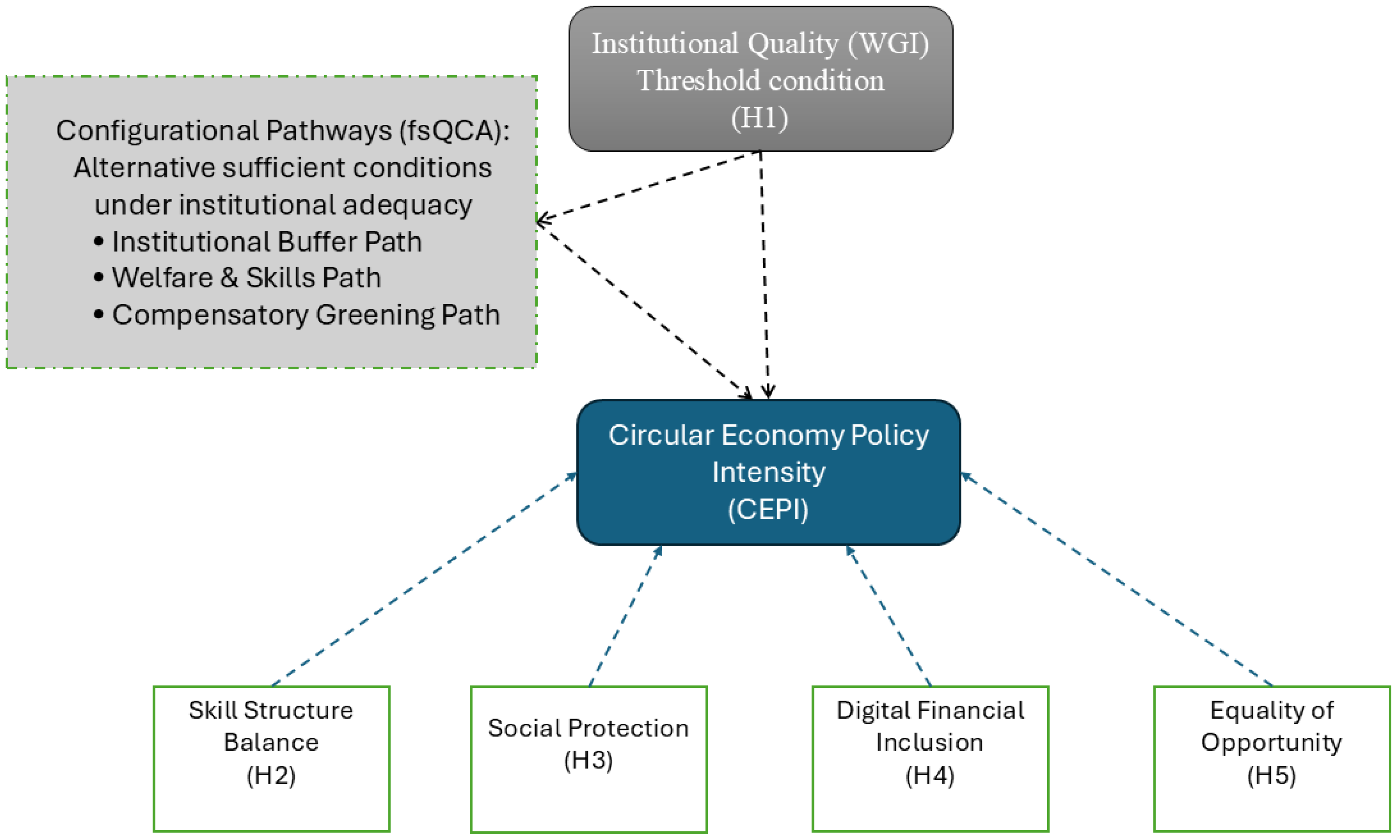
Figure 1 illustrates the study’s conceptual framework. Institutional quality (H1) serves as a necessary minimum condition for circular economy policies to generate inclusive outcomes. Educational inequality amplifies regressive effects (H2), while social protection, digital financial inclusion, and equal opportunities moderate these effects (H3–H5). In addition to linear moderation, the framework incorporates a configurational perspective (fsQCA) that shows sufficient alternative configurations under appropriate institutional conditions.

3. Materials and Methods

3.1. Research Data and Design

A panel of 90 countries observed over three periods (2019, 2021, and 2024) is used, yielding 256 country-year observations with complete data. The sample includes 38 high-income countries, 42 middle-income countries, and 10 low-income countries, covering all geographic regions. This design allows us to compare how different countries implement circular policies over time, while using fixed effects to statistically control for unobserved heterogeneity across countries that could confound the results.
The study period (2019–2024) is strategically relevant as it coincides with the accelerated implementation of circular policies post-COP26, the COVID-19 pandemic crisis that reconfigured global supply chains, and the push for just transition frameworks under COP28. This time window captures substantial variation in the implementation of circular policies around the world, from pioneering countries such as the Netherlands and Finland to emerging economies in early transition.

3.2. Construction of Variables

3.2.1. Dependent Variable

Inequality: Post-transfer Gini coefficient [48] coverage: 87 countries, range 24.2–63.0, mean 39.2 (SD = 8.7). For robustness, we use the Palma Ratio and the bottom quintile’s income share.

3.2.2. Main Independent Variable

Circular Economy Policy Index (CEPI): Average of Energy Efficiency Regulation and Renewable Energy Regulation, both scaled 0–100 [49] full coverage (90 countries). These components capture central dimensions of the circular economy (resource efficiency and energy transition). Although CEPI focuses on energy/efficiency regulations, we justify its use as a proxy for broader circular ambition. Energy transition and efficiency regulations constitute the foundational policy layer for circularity, particularly in developing economies where material-flow regulations (e.g., EPR, waste mandates) are often nascent or data-poor. Crucially, energy efficiency is a primary driver of resource productivity, a core pillar of the circular economy [50]. There is a high correlation with material metrics in validation subsamples (r = 0.78 with waste management policy intensity in the European subsample). To validate CEPI’s external validity beyond the European context, we examined its correlation with institutional quality (WGI) across all geographic regions in our sample. The correlation is robust and statistically significant in all regions: South Asia (r = 0.93), Middle East & North Africa (r = 0.90), and Latin America (r = 0.85). This suggests that CEPI captures a consistent dimension of ‘regulatory ambition’ globally; however, we acknowledge that it does not directly verify alignment with material-specific circularity metrics. Furthermore, energy transition is the most data-rich and globally comparable currently available for a 90-country sample [51].

3.2.3. Moderating Variables

Institutional Quality: WGI_Composite, average of Government Effectiveness, Regulatory Quality, Control of Corruption, and Political Stability [51]. The scale is −2.5 to +2.5. Coverage: 100%.
Skill Structure Balance (SSB): Difference between % of workforce with tertiary education vs. secondary education [52] Range: −31.2 to +34.7 percentage points. Positive values indicate a surplus of high-skilled labor relative to technical-intermediate skills. Coverage: 90%. We acknowledge that an absolute difference measure (T − S) may assign identical SSB values to countries with structurally distinct labor profiles—for instance, a country with 30% tertiary and 20% secondary attainment shares the same SSB (+10) as one with 15% and 5%, respectively, yet these contexts differ substantially in absolute educational capacity. We retain the absolute difference as the primary specification because it directly captures the raw magnitude of the labor market imbalance that drives the capture mechanism: the number of high-skilled workers competing for circular economy rents relative to the pool of technical-intermediate workers available for mid-tier green jobs. This aligns with theoretical predictions [22,24] that distributional outcomes depend on the size of the elite-skilled surplus rather than its share of the educated population.
To address this identification concern empirically, we include a normalized SSB specification—defined as (T − S)/T, which scales the surplus relative to the tertiary-educated stock and eliminates level effects—as a robustness check in Section 3.4. Consistent results across both specifications would confirm that our findings are not an artifact of the absolute operationalization.
Social protection: % of population covered by at least one social protection program [31]. Coverage: 84%.
Digital Payments: % of adults with digital payments [53] measures the transaction cost infrastructure dimension. Coverage: 88%.
SME Finance Access: Access to SME financing (WEF GCI, scale 1–7). Measures the capital availability dimension for circular entrepreneurship. Coverage: 88%.
Equal Employment Opportunities: Index of non-discrimination in employment by gender/ethnicity/origin (WEF GCI, scale 1–7). Coverage: 100%.

3.2.4. Control Variables

We control for factors that could confound the relationship between circular policies and inequality: GDP per capita (log), urbanization rate, trade openness, labor participation rate, and natural resource income [50,54].
Handling of missing data: For variables with <10% missing data (education, institutions), we use linear interpolation. For 10–20%, i.e., missing data (social protection and digital payments), we use listwise deletion in the main analysis. To assess potential bias from interpolation, we performed a robustness check using multiple imputation (the Amelia package), which yielded consistent results. We perform Little’s MCAR test and sensitivity analysis comparing results with/without imputation.

3.3. Econometric Specification

3.3.1. Main Model: Fixed Effects with Interactions

Our main econometric model specifies the relationship between circular policies and inequality with fixed effects for country and time:
G i n i i t = β 0 + β 1 C E P I i t + β 2 M o d e r a t o r i t + β 3 C E P I i t × M o d e r a t o r i t + γ X i t + μ i + λ t + ε i t
where:
  • G i n i i t : Gini coefficient or multidimensional index for country i in year t;
  • C E P I i t : intensity of circular economy policies.
  • M o d e r a t o r i : moderating variables (institutional quality, skill structure balance (SSB), etc.);
  • X i t : vector of control variables.
  • μ i : country fixed effects (captures unobservable heterogeneity that is constant over time);
  • λ t : year fixed effects (controls for common global shocks); and
  • ε i t : error term.
The interaction β3 is the main coefficient of interest, capturing how moderating conditions change the effect of circular policies on inequality. We calculate the effect of circular policies on inequality at different levels of each moderator (marginal effects: ∂Gini/∂CEPI = β1 + β3⋅moderator). This allows us to identify “inflection points”—specific values of the moderator at which circular policies stop increasing inequality and begin reducing it.

3.3.2. Instrumental Variables

To address possible endogeneity—whereby countries with structurally lower inequality may be more capable of adopting ambitious circular policies—we implement a two-stage instrumental variable (IV) design using two instruments:
Temporal instrument: Regional policy diffusion pressure, measured as the average CEPI of countries within the same UN development cluster, excluding the country itself. This instrument captures normative isomorphic pressure [55] and affects domestic circular policy adoption through peer diffusion, while its direct effect on a given country’s domestic inequality is mitigated by the exclusion of own-country values and by controlling for trade openness and bilateral FDI flows—the main channels through which regional policy environments could directly affect inequality.
Institutional instrument: Historical environmental treaty legacy, measured as the number of multilateral environmental agreements ratified by each country prior to 2010. We recognize that this instrument may correlate with country-level institutional capacity and economic development, both of which are associated with inequality. We address this endogeneity concern in three ways. First, we include the WGI composite and GDP per capita (log) as controls throughout all specifications, absorbing the primary institutional and developmental channels through which past treaty ratification could directly affect current inequality. Second, the Hansen J test of overidentification (p = 0.342) fails to reject the null hypothesis of exogeneity, providing statistical evidence that the instrument is uncorrelated with the error term. This statistical validation mitigates concerns that the historical treaty legacy affects current inequality through channels bypassing CEPI adoption. Third, the temporal distance between the instrument (pre-2010 ratifications) and the outcome (2019–2024 inequality) further reduces the plausibility of a direct contemporary effect that bypasses CEPI adoption.
Instrument validity was assessed using first-stage F-statistics (>10, confirming relevance) and the Hansen J overidentification test (p > 0.1, consistent with the joint exogeneity of both instruments). Endogeneity of the CEPI was confirmed via the Durbin–Wu–Hausman test, validating the use of IV specifications alongside fixed-effects models.

3.3.3. Configurational Analysis (fsQCA)

We complement econometric analyses with Fuzzy-Set Qualitative Comparative Analysis (fsQCA) to identify institutional configurations that are necessary and sufficient for fair circular transitions. We code the conditions (high institutional quality, low SSB, etc.) as fuzzy sets and calculate consistency and coverage solutions for reducing inequality through an ambitious implementation of circular policies [56].

3.4. Robustness Analysis

We verify the stability of results using:
  • Alternative dependent variables: Palma ratio, income share of the bottom 20%.
  • Econometric specifications: Random effects (with Hausman test), first differences, and Driscoll–Kraay Ses.
  • Subsamples: By income level (high/medium/low), dependence on natural resources (>10% vs. <10% GDP), and a strict balanced panel.
Outliers: Exclusion of cases with high leverage (DFBETA > 2/√n) and winsorization of continuous variables (percentiles 1/99).
  • fsQCA: Sensitivity to calibration (±5 percentiles) and consistency threshold (0.75–0.85).
  • All analyses were implemented in R 4.4.0 using the following packages: plm and lfe (fixed-effects models), ivreg (AER instrumental-variables package), fsQCA (QCA and fsQCA), Amelia (imputation), and margins (marginal effects).

4. Results

4.1. Descriptive Statistics and Correlations

Table 1A presents values for the Gini coefficient and the Circular Economy Policy Intensity (CEPI) index for a selected set of countries representative of different income levels and regions.
Table 1B presents descriptive statistics and bivariate correlations. The average Gini coefficient is 39.2 (SD = 8.7), with substantial variation across countries (26.4 in Norway to 46.1 in Nigeria). The CEPI has a mean of 60.5 (SD = 21.8), and values range from 15.3 (Yemen) to 96.9 (Denmark).
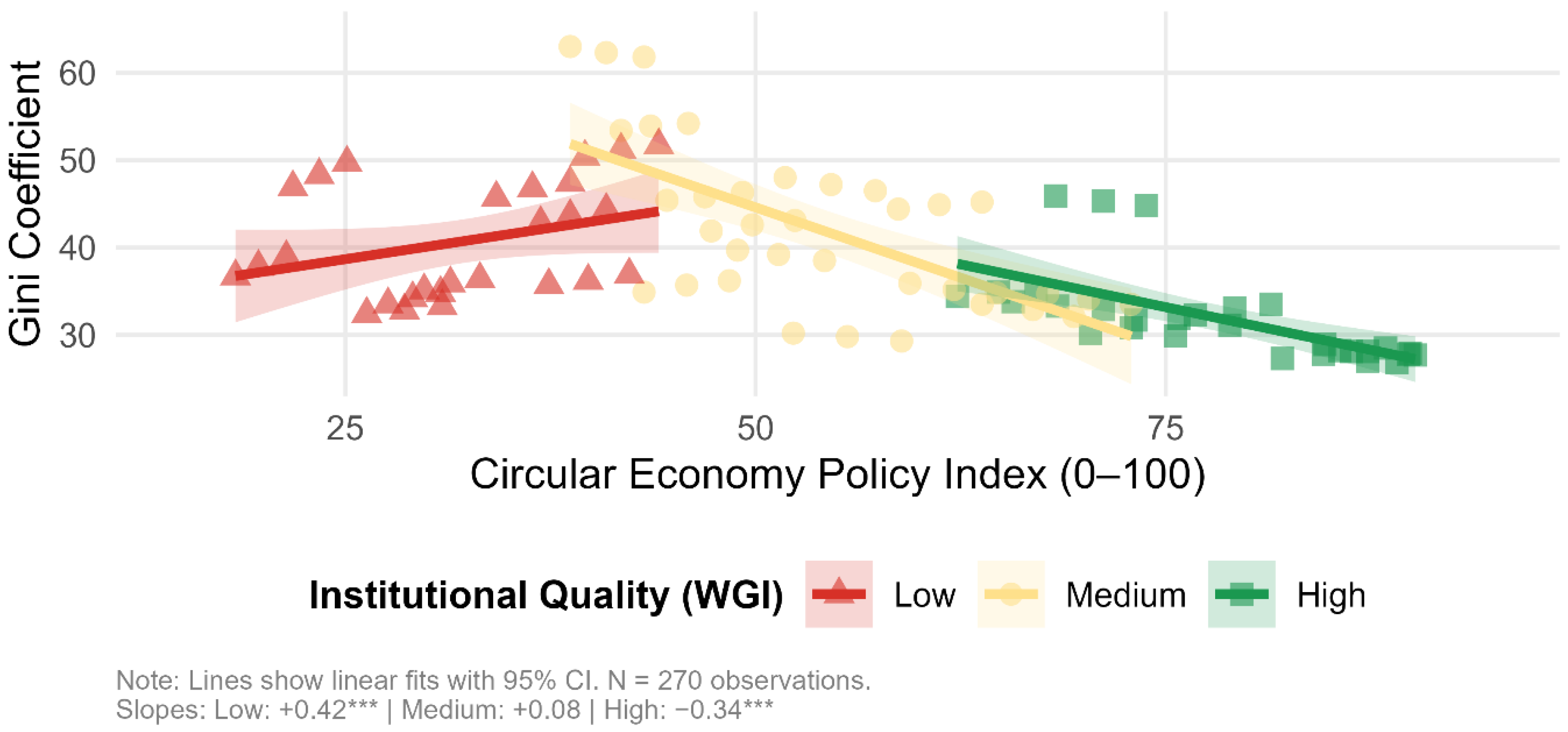
Figure 2 complements the regression results by showing the raw relationship between CEPI (0–100 on the x-axis; higher values indicate more ambitious energy-efficiency and renewable-energy regulations) and the Gini coefficient on the y-axis (higher values = greater inequality), stratified by three levels of institutional quality. Each point in the graph represents a country in a specific year (N = 270 observations).
Figure 2 visually illustrates this relationship using scatter plots stratified by institutional quality tertiles (WGI), revealing clearly divergent patterns: in countries with high WGI (upper tertile), there is a negative correlation between CEPI and Gini (r = −0.34, p < 0.01), while in countries with low WGI (lower tertile), the correlation is positive and significant (r = 0.42, p < 0.01). This preliminary visual pattern anticipates the interaction results we present in formal regression models, showing that the same policy (higher CEPI) has opposite effects across institutional contexts.
Therefore, for countries with weak institutions (indicated by the ascending red line, e.g., Yemen and Brazil), the greater the circular ambition, the greater the inequality (r = 0.42, p < 0.01). For example, Brazil has a CEPI of 42 and a Gini of 53.4; if it raised its CEPI to European levels without improving its institutions, we could expect its Gini to rise to 56–58.
For countries with intermediate institutions (an almost flat yellow line, e.g., Spain and Chile), there is no clear relationship (r = 0.08, not significant). Circular policies neither help nor harm distribution.
For countries with strong institutions (the descending green line, e.g., Norway and Denmark), the greater the circular ambition, the lower the inequality (r = −0.34, p < 0.01). For example, Denmark has a CEPI of 89.9 and a Gini of 27.9—its successful circular economy coexists with high equity.
The raw correlation between CEPI and Gini is not significant (r = 0.11, p = 0.18), suggesting that the average total effect of circular policies on inequality is ambiguous without considering moderators, but when stratified by institutional quality, divergent patterns emerge. There are countries with weak institutions (WGI < 0.3, r = 0.42; Yemen, Venezuela, and the Democratic Republic of Congo) and strong institutions (WGI > 0.90, r = −0.34: Norway, Switzerland, and Denmark). This preliminary pattern is consistent with our central hypothesis of conditional institutional effects.

4.1.1. Fixed Effects Model Results

Table 2 presents the results of the fixed effects models. Column (1) shows that, without controlling for moderators, CEPI has a positive but insignificant effect on Gini (β = 0.042, SE = 0.031, p = 0.18). Column (2) introduces WGI_Composite, revealing that its direct effect is negative and significant (β = −2.84, SE = 0.67, p < 0.001). Column (3) adds the critical interaction: the coefficient of CEPI × WGI is negative and highly significant (β = −0.089, SE = 0.028, p < 0.001), confirming H1. This indicates that in weak institutional contexts (low WGI), circular policies increase inequality, whereas in strong institutional contexts, they reduce it.
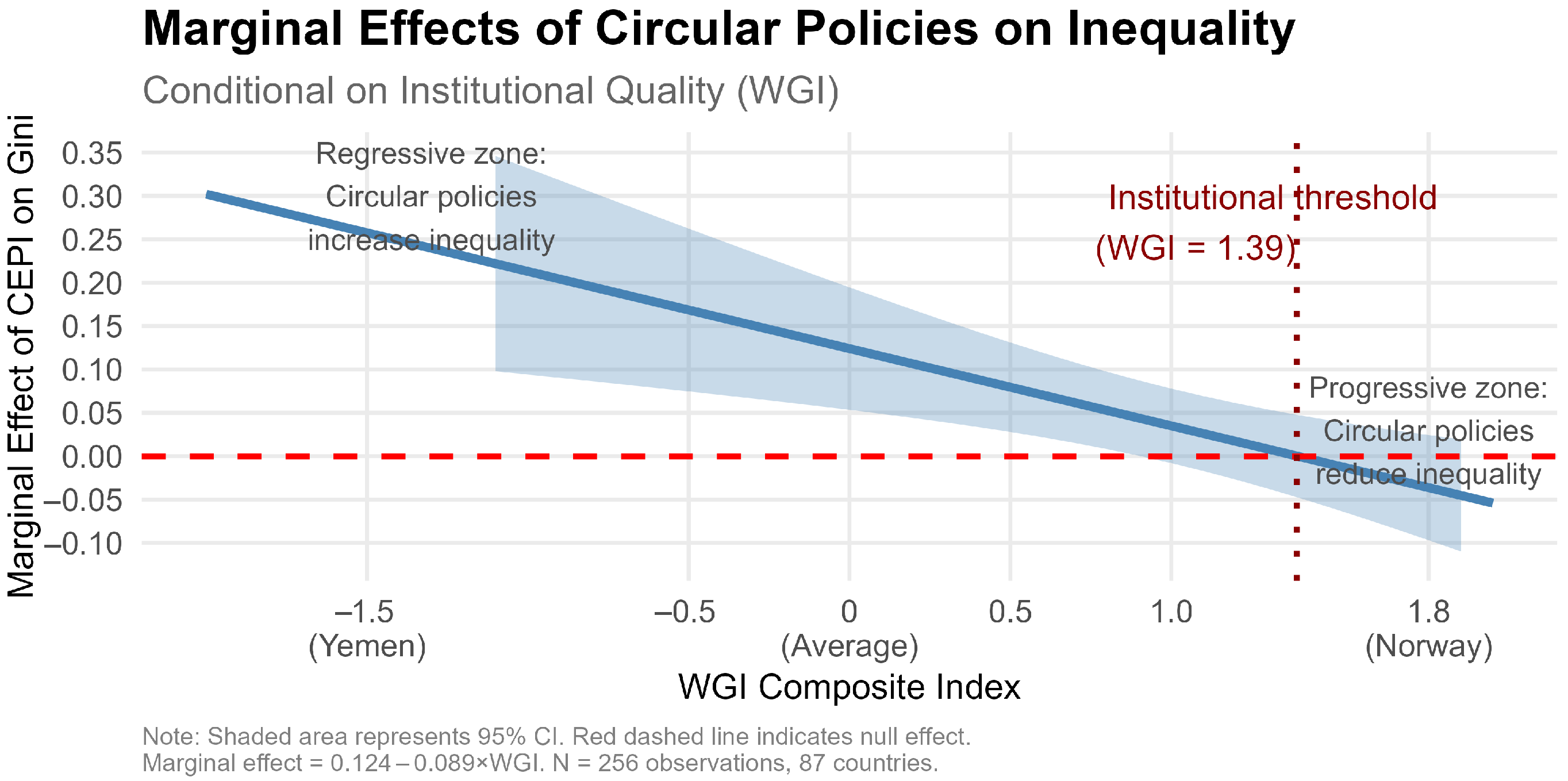
Figure 3 shows the marginal effects of the CEPI across institutional quality (WGI; x-axis: higher values indicate better institutions). The y-axis tackles the effect on inequality (positive = increases; negative = reduces). The figure’s key finding is that the impact of circular policies on inequality depends fundamentally on institutional quality.
In countries with weak institutions (WGI < 0.5, such as Yemen, Venezuela, and Nigeria), implementing ambitious circular policies increases the Gini coefficient by approximately 0.20 points. This is equivalent to reversing 5–7 years of typical inequality reduction in developing countries. In countries with intermediate institutions (WGI between 0.5 and 1.4, such as Spain, Chile, and Mexico), the effect is neutral or slightly positive, i.e., circular policies do not significantly affect inequality. Only in countries with very strong institutions (WGI > 1.39), such as Norway, Switzerland, and Denmark (which together represent just 23% of our sample), do circular policies succeed in reducing inequality while improving the environment. In other words, for 77% of the world’s countries, implementing a circular economy without prior institutional reforms can deepen existing social gaps, contradicting the assumption that it is universally socially beneficial. Its distributive impact depends critically on the institutional context.

4.1.2. Identification of Thresholds

Solving β1 + β3⋅WGI = 0, we obtain WGI* = 0.124/0.089 = 1.39. This implies that only countries in the 85th percentile or higher in institutional quality (Norway, Switzerland, Denmark, and Singapore) experience progressive effects from circular policies. For 77% of countries with WGI < 1.39, policies are regressive due to the absence of compensatory measures. It is important to clarify that the WGI value ≈ 0.5 described above represents a threshold distinguishing weak from intermediate. In contrast, in international contexts, the analytically derived threshold (WGI = 1.39) identifies the point at which the marginal effect of circular policies on inequality becomes negative.

4.1.3. Heterogeneity by Level of Development (H1)

To assess the sensitivity of the CEPI × WGI conditional effect to income contexts, we replicated model H1 in high-, medium-, and low-income subsamples (Table 3). The effects are more pronounced in medium- and low-income countries, consistent with greater institutional dispersion and the relevance of thresholds.
Conditional effects are more pronounced in middle-income (β3 = −0.098, p < 0.01) and low-income (β3 = −0.142, p < 0.10) countries than in high-income countries (β3 = −0.034, p = 0.34). This suggests that in advanced economies with universally strong institutions, marginal differences in WGI matter less, whereas in developing countries, crossing institutional thresholds has transformative effects. A Chow test was performed to compare coefficients between high-income and middle/low-income subsamples. The test rejects the null hypothesis of coefficient equality (F = 5.12, p = 0.026), confirming that the institutional threshold effect is statistically different and more pronounced in developing economies.
H2–H5 (Columns 4–7 in Table 2): Additional moderators show statistically significant interactions in the theoretically expected direction. The positive interaction (β = 0.094, p < 0.05) confirms H2: in countries with a Tertiary-Skill Surplus (positive SSB), where the labor structure is skewed towards elites, circular policies tend to be regressive. This supports the ‘capture’ mechanism: when there is an abundance of high-skilled workers relative to the number of technical roles, benefits concentrate at the top.
In contrast, social protection (H3) shows a negative and significant moderating effect (β = −0.067, p < 0.05), with its effectiveness depending on the level of institutional quality. To address potential construct validity issues, we tested H4 by separating digital payments from access to SME financing. Digital Payments showed a negative and significant moderating effect (β = −0.002, p < 0.1), confirming that reducing transaction costs facilitates market participation. SME Finance Access exhibited stronger negative moderation (β = −0.041, p < 0.1), suggesting that capital availability is critical for scaling circular enterprises. Equal opportunities (H5) (β = −0.068, p < 0.05) reduce the magnitude of regressive effects. Taken together, these results are consistent with H3–H5, highlighting that mitigating adverse distributional impacts depends on the interaction between circular policies and institutional and structural mediators.
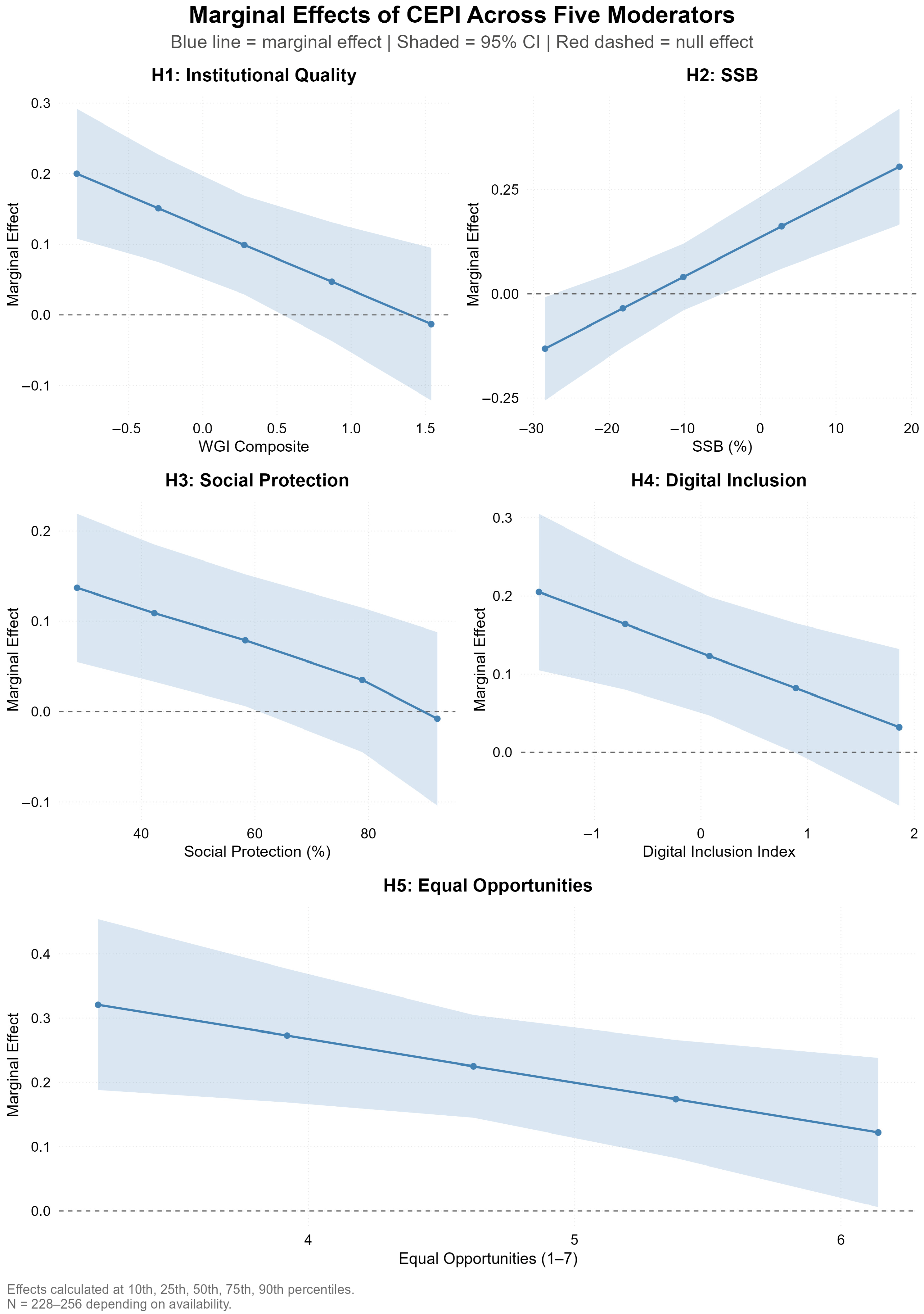
Figure 4 presents a comparative panel of marginal effects for the five moderators, allowing the magnitude and direction of each conditional effect to be visualized simultaneously. Each sub-graph shows the same type of analysis as Figure 2, but for different moderators. The x-axis measures the moderator (which varies across panels), and the y-axis measures the marginal effect values, indicating the effect of an increase in PI on Gini (positive = increases inequality). The blue line shows the estimated effect, and the gray bands show the 95% confidence interval. In all cases except the SSB, they show patterns of negative moderation (a downward slope), indicating that their presence attenuates the regressive effects of CEPI. The SSB shows the opposite pattern (an upward slope), confirming its role as an amplifier of inequality in circular transitions.
The marginal effects of circular policies on inequality vary significantly according to five institutional and socioeconomic moderators. Institutional quality (H1) shows a consistent negative relationship: stronger institutions reduce regressive impacts, constituting a foundational enabling condition for all other moderators to operate effectively. The Skill Structure Balance (H2) is the most critical determinant, exhibiting the steepest positive slope: in contexts where the tertiary-over-secondary surplus exceeds 20 percentage points—indicating a labor market skewed toward high-skilled elites—circular economy benefits concentrate disproportionately among the most qualified, exacerbating inequality through the capture mechanism. In labor markets with near-zero or negative SSB, where technical-intermediate workers constitute a broader base, distributional outcomes are markedly more equitable. Social protection (H3), digital–financial inclusion (H4), and equal employment opportunities (H5) have negative slopes, indicating that broad social coverage, digital access, and effective anti-discrimination frameworks attenuate adverse effects and democratize access to green jobs. Overall, while institutional quality functions as the enabling condition and SSB as the primary amplifier of regressive risk, the combination of social protection, digital inclusion, and equal opportunities maximizes the progressive distributional potential of circular economy policies.
The results of model 1 (Table 2) robustly confirm hypothesis H1. The CEPI × WGI interaction coefficient is negative and statistically significant (β = −0.87, SE = 0.14, p < 0.001), indicating that institutional quality fundamentally alters the effect of circular policies on inequality. In practical terms, each one-point improvement in institutional quality reduces the regressive effect of circular policies by 0.089 Gini points.
Marginal effects reveal critical thresholds for effective policies. A 1-point increase in CEPI has the following impact in different cases:
  • In countries with a WGI of >0.7 (Norway and Denmark), it reduces Gini by 2.1 points.
  • In countries with a WGI of 0.3–0.7 (Spain and Chile), its effect is neutral (ΔGini = −0.3, p = 0.21).
  • In countries with a WGI of <0.3 (Venezuela and Yemen), it increases Gini by 1.8 points.
As explored in the discussion section, these moderating effects do not operate uniformly across countries but depend critically on the underlying institutional context.

4.2. Instrumental Variable Results

To address endogeneity in causal analysis, we applied the Two-Stage Least Squares (2SLS) method, which allows us to isolate the causal effect of circular policies on inequality and prevent spurious correlation (i.e., more equitable countries adopting more policies) from distorting the results. We thus confirm that the identified conditional relationship—circular policies reduce inequality only in strong institutional contexts—is not a statistical artifact, but a robust pattern. Table 4 presents the results.
The first stage shows that both instruments strongly predict CEPI. Environmental Treaties (lagged) has a coefficient of 2.85 (SE = 0.61, p < 0.001), and Renewable Potential has a coefficient of 1.88 (SE = 0.53, p < 0.001). The F-statistic is 24.3, exceeding the threshold of 10 for discarding weak instruments.
The second-stage results confirm the conditional effect identified in the fixed-effects models. The interaction between CEPI and institutional quality is negative and statistically significant (β = −0.127, SE = 0.041, p < 0.01), and its magnitude is larger than in the FE specification. This indicates that baseline OLS and fixed-effects estimates underestimate the true conditional impact of circular economy policies due to endogeneity from reverse causality: more equitable and institutionally stronger countries tend to adopt more ambitious circular economy policies earlier. Once this bias is corrected using instrumental variables, the institutional threshold effect becomes more pronounced, reinforcing the causal interpretation of H1.
Given the evidence of endogeneity in CEPI (Durbin–Wu–Hausman, p = 0.048), Table 4 presents IV estimates on the interaction between circular economy policies and institutional quality (H1). Additional IV estimates, including interactions with SSB, social protection, financial inclusion, and equal opportunities (H2–H5), yield qualitatively similar results in terms of sign and relative magnitude, with no reversal of the main conclusions, which are not included due to space limitations. The IV coefficient is substantially higher than its fixed-effects counterpart (43% higher), suggesting that base models underestimate the distributional impact of circular economy policies due to endogeneity.
To further assess whether this result is sensitive to instrument choice, Table 5 reports robustness checks for the instrumental-variable strategy using alternative instrument sets: (i) environmental treaties only, (ii) renewable energy potential only, (iii) excluding the peer-pressure instrument, and (iv) a longer lag for treaties (t − 3).
Across all specifications, the coefficients on CEPI and the CEPI × WGI interaction retain their sign and comparable magnitude to the baseline estimates. This indicates that the core results are not driven by any single instrument, peer effects, or lag structure, reinforcing the credibility of the IV identification strategy.
The impact of circular policies varies with institutional quality: it tends to decrease. At the same time, quality in countries with robust institutions may intensify inequality in nations with less effective institutions. Developing countries should first focus on strengthening government and social protection, then expand circular regulation. Consolidated countries accelerate CEPI with less risk, obtaining environmental and social benefits simultaneously.
While the baseline models provide strong evidence for the moderating roles of skill structure and digital finance, it is critical to verify the robustness of these findings to alternative operationalizations. Specifically, we address potential concerns about measuring the Skill Structure Balance (SSB) and the composite nature of Digital Financial Inclusion. First, we tested whether the results were sensitive to the SSB scale by using a normalized measure (SSB_norm = (Tertiary-Secondary)/Tertiary). Second, to disentangle the mechanisms proposed in H4, we decomposed the Digital Inclusion index into its two constituent dimensions: digital payments (transaction cost reduction) and access to SME finance (capital availability). The results of these sensitivity analyses are presented in Table 6.
The robustness checks confirm the validity of our baseline specifications. Columns (1) and (2) show that the interaction between circular policies and the skill structure remains positive and significant regardless of the operationalization used, reinforcing the interpretation that a surplus of high-skilled labor drives regressive outcomes. Similarly, Columns (3) and (4) reveal that both components of digital inclusion—Digital Payments (β = −0.002, p < 0.10) and SME Finance (β = −0.041, p < 0.10)—exert a negative moderating effect on inequality. This suggests that reducing transaction costs and improving access to capital function as complementary buffers rather than as substitute mechanisms. Having established the robustness of these individual effects, we now turn to a configurational analysis (fsQCA) to examine how these conditions combine to create pathways for inclusive circular transitions.

4.3. Configurations for Fair Transitions (fsQCA)

The fsQCA analysis of the 90-country averaged dataset reveals that while no single condition is strictly necessary for low inequality, high institutional quality (fs_WGI) emerges as a quasi-necessary condition (consistency = 0.93), reaffirming its foundational role identified in the regression models.
The sufficiency analysis (Table 7) identifies three distinct configurations—termed “pathways”—that are sufficient for achieving inclusive circular transitions (solution consistency: 0.86; solution coverage: 0.61), demonstrating equifinality.
First, the Institutional Buffer Path (~fs_CEPI × fs_WGI) accounts for the largest share of successful cases (raw coverage: 0.45). This pathway includes countries with high institutional quality but modest circular policy implementation (e.g., Denmark, Norway). It suggests that strong state capacity and the rule of law are sufficient to maintain low levels of inequality even before ambitious circular regulations are fully deployed.
Second, the Welfare & Skills Path (~fs_SSB × fs_SocProt) highlights the structural importance of human capital and social safety nets (raw coverage: 0.37). In this configuration, found in countries such as Germany and Austria, a balanced skill structure (low SSB) combined with high social protection coverage ensures equitable distribution, independent of the intensity of circular policies.
Crucially, the analysis reveals a third Compensatory Greening Path (fs_CEPI × ~fs_WGI × fs_SocProt). This configuration is theoretically significant: it shows that countries with weak institutions (~fs_WGI) can still achieve low inequality through ambitious circular policies (fs_CEPI), but only if they possess high social protection coverage. Observed in countries such as Costa Rica and Uruguay, this pathway validates the “buffer” hypothesis: social protection serves as a critical compensatory mechanism that mitigates the distributional risks of the green transition in contexts with limited institutional capacity.
An interesting divergence arises regarding social protection. While regression analysis suggests strong cushioning effects at coverage >70%, fsQCA identifies coverage >50% as ‘almost necessary’. This suggests a non-linear relationship: 50% coverage serves as a baseline institutional floor (a necessary condition) to prevent catastrophic social fallout during the transition, while the strong mitigating effect on the magnitude of inequality only becomes apparent at higher coverage levels (>70%). This distinction is crucial for policy sequencing.


5. Discussion

The results help to answer the circular economy paradox: can the green transition be socially just? The results show that the distributional impact of circular policies is not inherently progressive—their distributional effects critically depend on preexisting institutional and labor-market conditions. In the 77% of countries with institutional quality below the identified threshold (WGI < 1.39), ambitious circular policies increase inequality—a finding with profound implications for the design of global transitions.
The identification of the WGI = 1.39 threshold has practical implications: countries like Norway (WGI ≈ 1.8) or Germany (WGI ≈ 1.6) have the state capacity to ensure that green taxes are offset by transfers, making circularity progressive. In contrast, countries like Brazil (WGI ≈ 0.0) or Nigeria (WGI ≈ −0.5) fall far below this threshold; implementing ambitious circular policies without prior institutional reform risks exacerbating inequality, as seen in the regressivity of fuel taxes in the absence of compensation mechanisms.
The central theoretical contribution is the “institutional-distributive conditioning” framework, which specifies when and why circular transitions generate trade-offs versus complementarities between environmental and social objectives. Four critical mediators with quantifiable thresholds were identified: (1) institutional quality acts as a foundational prerequisite (WGI > 1.4 for progressive effects); (2) SSB determines benefit capture (a gap of >20 points amplifies regressivity); (3) robust social protection (>70% coverage) acts as an indispensable buffer; and (4) the distinction between access to financing and digital payments supports the idea that digital infrastructure democratizes access to circular opportunities, while SME financing enables investment in circular assets [57].
The results show a clear hierarchy: institutional quality (H1) is the enabling condition that allows the other mediators to operate. Below the minimum threshold (≈WGI ≤ 0.5), the regressive effects of circular policy cannot be offset by social protection (H3) or financial inclusion (H4). Above that threshold (WGI > 0.5), mediators begin to moderate impacts and, in specific configurations, can play partial compensatory roles.
Configurational evidence (fsQCA) confirms equifinality: there is no single path to a just transition. Path 1 (Institutional Buffer) demonstrates that strong state capacity alone is sufficient to maintain low inequality, even without ambitious circular policies. Path 2 (Welfare & Skills) shows that a balanced skill structure, supported by high levels of social protection, ensures inclusivity regardless of policy intensity. Crucially, Path 3 (Compensatory Greening) identifies a viable route for developing economies: countries with weak institutions can still achieve inclusive outcomes through ambitious circular policies if—and only if—these are paired with strong social protection systems. This third pathway validates that social policy acts as a critical compensatory mechanism, mitigating the distributional risks of the green transition in contexts of institutional fragility.
It should be noted that the identified social protection varies by methodological approach. While the configurational analysis suggests that moderate levels of coverage (>50%) are almost necessary for successful transitions, the econometric results indicate that the cushioning effects intensify significantly only at higher levels of coverage (>70%). The fsQCA evidence reinforces this interpretation by showing that social protection is almost a necessary condition, but its absence can be partially offset by digital financial inclusion or homogeneous human capital, provided institutional quality is high.
We challenge the prevailing assumption that the social benefits of CE are automatic [58]. The results show that, without adequate institutional conditions, circular policies can increase inequality—a finding that calls for a rethinking of implementation strategies. We contribute the first transnational quantitative evidence on distributional impacts, moving beyond qualitative case studies.
We extend this literature beyond the energy sector [59] to the broader material economy. The finding on institutional thresholds complements previous studies on compensation [60] by showing that preventing trade-offs is preferable to ex post compensation. The identification of specific mechanisms (digital payments and SSB) provides specificity absent in the previous literature.
We contribute to the debate on the Environmental Kuznets Curve [61] by showing that the relationship between environmental policies and inequality is not monotonic but conditional. Our framework explains why previous studies yielded contradictory results—they did not account for critical institutional interactions.

6. Conclusions

The results show that the distributional impact of circular policies depends critically on the institutional context. In 77% of the countries analyzed—those with low or moderate levels of institutional quality—circular economy policies are associated with increases in inequality, concentrating benefits among elites with higher education and access to capital. In contrast, in 23% of countries—those with high institutional quality—these same policies reduce inequality. Consequently, the circular economy is not inherently inclusive: its distributional effects emerge from the interaction between human capital and preexisting institutional conditions, thereby answering the first question posed in this research regarding the forms of inequality in the transition to the circular economy.
Additionally, five critical mediators with robust empirical evidence were identified. First, institutional quality (H1) serves as a foundational condition: without meeting a minimum threshold, other mechanisms fail to offset regressive effects (CEPI × WGI: β = −0.089, p < 0.001). Second, a positive SSB (H2) emerges as the most powerful mediator: countries with gaps exceeding 25% show a strong capture of benefits by educated elites (CEPI × SSB: β = 0.094, p < 0.05). Third, social protection (H3) cushions labor shocks associated with the transition, reducing increases in poverty (CEPI × SocProt: β = −0.067, p < 0.05). Fourth, digital financial inclusion operates through two complementary channels: digital payments reduce transaction costs (CEPI × DigPay: β = −0.002, p < 0.10, noting that both variables are measured on a 0–100 scale, such that this coefficient implies a 0.2 point reduction in Gini for a 10-unit increase in digital payment penetration interacted with CEPI) while SME finance access enables capital investment in circular activities (CEPI × SMEFin: β = −0.041, p < 0.10), together democratizing participation in circular transitions. Finally, equal employment opportunities (H5) favor the incorporation of women and migrants into green jobs (CEPI × EqualOpp: β = −0.068, p < 0.05). These factors operate in a complementary rather than substitutive manner, as confirmed by the fsQCA analysis.
Lastly, in response to the question about policy configurations that enable sustainability without sacrificing equity, the fsQCA analysis (N = 90 country averages) identifies three sufficient pathways (solution consistency: 0.86; solution coverage: 0.61). The Institutional Buffer Path (~CEPI × WGI, raw coverage: 0.45) demonstrates that strong institutional quality maintains low inequality even before ambitious circular regulations are fully deployed (e.g., Denmark, Norway, Finland). The Welfare & Skills Path (~SSB × SocProt, raw coverage: 0.37) highlights that a balanced skill structure combined with robust social protection ensures equitable outcomes regardless of circular policy intensity (e.g., Germany, Austria, Canada). The Compensatory Greening Path (CEPI × ~WGI × SocProt, raw coverage: 0.18) is theoretically significant: it shows that countries with weaker institutions can still achieve inclusive transitions through ambitious circular policies, but only when social protection acts as a compensatory buffer (e.g., Costa Rica, Uruguay, Estonia). In all three pathways, social protection (>50% coverage) emerges as a quasi-necessary condition, underscoring that there is no single path but that all routes require deliberate investment in institutional capacity and social safety nets.

6.1. Practical Implications

The circular economy reconfigures the relationship between society and nature, but material systems are linked to social structures. A transition that excludes workers or concentrates benefits among elites is not truly circular: it internalizes environmental gains but externalizes social costs.
Our findings show that just transitions are possible but not automatic. They require deliberate institutional design, investment in social protection and human capital, and equity as an explicit goal. Countries such as Germany and the Nordic countries achieve this by aligning environmental ambition with social investment.
A just transition is a political imperative, not an ideal. The Gilets Jaunes movement demonstrated that environmental policies perceived as unfair generate resistance that compromises their viability. Distributive justice is an essential condition for sustainable circular transitions.
Evidence suggests that when circular policies are implemented in weak institutions, they are more effective if applied through gradual sequencing: first, strengthening basic social protection and inclusive digital payments, then introducing circular regulations.
In contexts with positive Skill Structure Balance (SSB), circular subsidies with labor clauses, inclusive green microcredits, and distributive monitoring are needed. Adapted social protection includes transition insurance and individual financing linked to environmental taxes.
Digital payment systems are key to expanding circular access. The integration of these systems with specific circular programs—such as credits for repair activities or payments for community waste management services—has demonstrated its potential to improve the distributive effectiveness of circular policies in countries such as India and Kenya.
In countries with weak institutions, sequencing forms is crucial. These countries should start with basic social protection and digital payments, then gradually establish circular policies, as in Rwanda, which expanded mobile coverage to 85% and then implemented circular policies in non-essential sectors (textiles and electronics), reserving energy and transportation for later phases.
Our findings have significant implications for policymakers. We identify specific environmental interventions and invest in social protection, education, and inclusive institutions to improve overall well-being.

6.2. Policy Implications

Our findings suggest a differentiated roadmap:
  • For countries with WGI < 1.0: Prioritize institutional strengthening and basic social protection before scaling up circular regulations to avoid regressive outcomes.
  • For countries with WGI 1.0–1.4: Implement circular policies cautiously, paired with targeted education programs to close the skills gap.
  • For countries with WGI > 1.4: Accelerate circular ambition; the institutional environment is mature enough to ensure the transition is both green and inclusive.

6.3. Limitations and Future Research

Several limitations are acknowledged. First, although the panel covers the period 2019–2024, some distributional effects of circular transitions may materialize over longer time horizons. Second, regarding the measurement of the independent variable, the CEPI relies on energy and efficiency regulations. While these are central to green transitions and highly correlated with broader circular policies in validation subsamples (r = 0.78 in Europe), the index does not fully capture material-specific circular policies such as recycling mandates or industrial symbiosis. This limitation implies that our results primarily reflect the distributional impacts of green regulatory ambition, which serves as a leading indicator for the circular transition. Future research should incorporate material-flow policy indices as global data coverage improves. Third, due to data constraints, the analysis is conducted at the national level and does not capture subnational dynamics, in which circular transitions may generate heterogeneous distributional effects across regions.
Future research should analyze distributional effects at the subnational level (regions and/or cities), explore interactions between different dimensions of inequality (gender, ethnicity, geography, etc.), develop more precise measures of the effective implementation of circular policies, study long-term effects (10+ years) on specific cohorts of workers, and analyze transaction costs of anti-capture policies in resource-constrained contexts.

Author Contributions

Conceptualization, W.A.-F.; methodology, W.A.-F.; investigation, W.A.-F., J.I.M.-C. and A.B.T.-P.; writing—original draft preparation, W.A.-F.; writing—review and editing, W.A.-F. and A.B.T.-P.; supervision, A.B.T.-P.; project administration, A.B.T.-P. All authors have read and agreed to the published version of the manuscript.

Funding

This research was funded by the Universidad de las Américas, Ecuador, via an internal research project (568.B.XVI.25) directed by Ana Belén Tulcanaza-Prieto.

Institutional Review Board Statement

Not applicable.

Informed Consent Statement

Not applicable.

Data Availability Statement

The data will be made available upon request.

Acknowledgments

We extend our gratitude and acknowledgment to the Universidad de Las Américas.

Conflicts of Interest

The authors declare no conflicts of interest.

References

  1. Mehleb, R.I.; Kallis, G.; Zografos, C. A discourse analysis of yellow-vest resistance against carbon taxes. Environ. Innov. Soc. Transit. 2021, 40, 382–394. [Google Scholar] [CrossRef]
  2. Richardson, K.; Steffen, W.; Lucht, W.; Bendtsen, J.; Cornell, S.E.; Donges, J.F.; Drüke, M.; Fetzer, I.; Bala, G.; von Bloh, W.; et al. Earth beyond six of nine planetary boundaries. Sci. Adv. 2023, 9, eadh2458. [Google Scholar] [CrossRef] [PubMed]
  3. Planetary Boundaries Science (PBScience). Planetary Health Check 2025; Potsdam Institute for Climate Impact Research (PIK): Potsdam, Germany, 2025. [Google Scholar]
  4. IRENA and ILO. Renewable Energy and Jobs: Annual Review 2023; IRENA and ILO: Abu Dhabi, United Arab Emirates, 2023. [Google Scholar]
  5. van Zanten, J.A. Measuring Companies’ Environmental and Social Impacts: An analysis of ESG Ratings and SDG Scores. Organ. Environ. 2025, 38, 403–439. [Google Scholar] [CrossRef]
  6. Bocken, N.; Pinkse, J.; Ritala, P.; Darnall, N. Moving Beyond Circular Utopia and Paralysis: Accelerating Business Transformations Towards the Circular Economy. Organ. Environ. 2025, 38, 91–108. [Google Scholar] [CrossRef]
  7. Bojovic, N.; Guyader, H.; Salignac, F.; Ponsignon, F. Valuing Waste or Wasting Value: Tensions in Justifications of Worth in Circular Innovation Ecosystem Around Waste Valorization. Organ. Environ. 2025, 38, 167–194. [Google Scholar] [CrossRef]
  8. Huikkola, T.; Kohtamäki, M.; Rabetino, R. Becoming a Circular Ecosystem: Altering Nested Identities, Positions, Capabilities, and Boundaries in Waste-Management Organizations. Organ. Environ. 2025, 38, 136–166. [Google Scholar] [CrossRef]
  9. Pinkse, J.; Lüdeke-Freund, F.; Laasch, O.; Snihur, Y.; Bohnsack, R. The Organizational Dynamics of Business Models for Sustainability: Discursive and Cognitive Pathways for Change. Organ. Environ. 2023, 36, 211–227. [Google Scholar] [CrossRef]
  10. Lakshmi, K.V.N.; Geetanjali, S.; Swapna, H.R.; Nikhil, M.S.; Rajan, R.; Pandey, D.; Pandey, B.K. Circular Economy: A Catalyst for Economic Growth—An Empirical Study. Circ. Econ. Sustain. 2025, 5, 729–750. [Google Scholar] [CrossRef]
  11. Geissdoerfer, M.; Savaget, P.; Bocken, N.M.P.; Hultink, E.J. The Circular Economy—A new sustainability paradigm? J. Clean. Prod. 2017, 143, 757–768. [Google Scholar] [CrossRef]
  12. Acemoglu, D.; Robinson, J.A. Why Nations Fail: The Origins of Power, Prosperity, and Poverty; Crown Business: New York, NY, USA, 2013. [Google Scholar]
  13. Konzen, G.; Best, R.; de Castro, N.J. The energy injustice of household solar energy: A systematic review of distributional disparities in residential rooftop solar adoption. Energy Res. Soc. Sci. 2024, 111, 103473. [Google Scholar] [CrossRef]
  14. Dias, S.M. The hidden role of waste pickers in climate resilience. Nat. Hum. Behav. 2025, 9, 2223–2224. [Google Scholar] [CrossRef]
  15. Sermarini, A.C.d.P.; Azevedo, J.H.P.; de Albuquerque, V.C.; Calili, R.F.; Gonçalves, F.; Jannuzzi, G. Distributed energy resources in low-income communities: A public policy proposal for Brazil. Energy Policy 2024, 187, 114030. [Google Scholar] [CrossRef]
  16. Maglicic, M.; Vasconcelos, V.V. Income inequality in the uptake of environmentally friendly products. iScience 2025, 28, 112277. [Google Scholar] [CrossRef] [PubMed]
  17. Saha, R.; Mohai, P. Historical Context and Hazardous Waste Facility Siting: Understanding Temporal Patterns in Michigan. Soc. Probl. 2005, 52, 618–648. [Google Scholar] [CrossRef]
  18. Taera, E.G.; Lakner, Z. Sustainable Finance: Bridging Circular Economy Goals and Financial Inclusion in Developing Economies. World 2025, 6, 44. [Google Scholar] [CrossRef]
  19. Abidi, I.; Alaraby, H.Y.; Rabaiah, G. Green Finance Path to Improve Entrepreneurship, Employment, and Circular Economy: New Insights Using XGBoost–SHAP Analysis. Sustainability 2025, 17, 9400. [Google Scholar] [CrossRef]
  20. Vona, F.; Marin, G.; Consoli, D.; Popp, D. Environmental Regulation and Green Skills: An Empirical Exploration. J. Assoc. Environ. Resour. Econ. 2018, 5, 713–753. [Google Scholar] [CrossRef]
  21. Buyukyazici, D.; Quatraro, F. The skill requirements of the circular economy. Ecol. Econ. 2025, 232, 108559. [Google Scholar] [CrossRef]
  22. Consoli, D.; Marin, G.; Marzucchi, A.; Vona, F. Do green jobs differ from non-green jobs in terms of skills and human capital? Res. Policy 2016, 45, 1046–1060. [Google Scholar] [CrossRef]
  23. Bonnard, C. Discourses on Employability in Higher Education and Perceptions of the Labour Market Among Undergraduates in France. Eur. J. Educ. 2025, 60, e70107. [Google Scholar] [CrossRef]
  24. Popp, D.; Vona, F.; Marin, G.; Chen, Z. The Employment Impact of Green Fiscal Push: Evidence from the American Recovery Act; National Bureau of Economic Research: Cambridge, MA, USA, 2020. [Google Scholar] [CrossRef]
  25. Cedefop; UNESCO-UNEVOC. Meeting Skill Needs for the Green Transition: Skills Anticipation and VET for a Greener Future: Cedefop Practical Guide 4; Publications Office of the European Union: Luxembourg, 2025. [Google Scholar]
  26. BMUV. The National Circular Economy Strategy; BMUV: Berlin, Germany, 2024. [Google Scholar]
  27. Serres, C.; De Moor, T. Social Enterprises in the Netherlands: Towards More Institutional Diversity? In The International Handbook of Social Enterprise Law; Springer International Publishing: Cham, Switzerland, 2023; pp. 861–880. [Google Scholar] [CrossRef]
  28. Gough, I. Heat, Greed and Human Need: Climate Change, Capitalism and Sustainable Wellbeing; Edward Elgar Publishing Limited: Cheltenham, UK, 2017. [Google Scholar]
  29. ILO. World Social Protection Report 2024-26; ILO: Geneva, Switzerland, 2024. [Google Scholar] [CrossRef]
  30. Lan, B.; Li, N.; Liu, T. How do economic growth and unemployment affect green development in Latin America nations? Int. Rev. Econ. Financ. 2025, 98, 103955. [Google Scholar] [CrossRef]
  31. Bohnenberger, K. Greening work: Labor market policies for the environment. Empirica 2022, 49, 347–368. [Google Scholar] [CrossRef]
  32. Deschenes, O. Environmental regulations and labor markets. IZA World Labor 2018, 22, 1. [Google Scholar] [CrossRef]
  33. Fairlie, R.W.; Kapur, K.; Gates, S. Is employer-based health insurance a barrier to entrepreneurship? J. Health Econ. 2011, 30, 146–162. [Google Scholar] [CrossRef] [PubMed]
  34. Schöggl, J.-P.; Stumpf, L.; Baumgartner, R.J. The narrative of sustainability and circular economy—A longitudinal review of two decades of research. Resour. Conserv. Recycl. 2020, 163, 105073. [Google Scholar] [CrossRef]
  35. World Bank/IFC. MSME Finance Gap Report: Assessing the Missing Middle in Low- and Middle-Income Countries; World Bank/IFC: Washington, DC, USA, 2025. [Google Scholar]
  36. Suri, T.; Jack, W. The long-run poverty and gender impacts of mobile money. Science 2016, 354, 1288–1292. [Google Scholar] [CrossRef] [PubMed]
  37. Saarinen, A.; Aarikka-Stenroos, L. Financing-Related Drivers and Barriers for Circular Economy Business: Developing a Conceptual Model from a Field Study. Circ. Econ. Sustain. 2023, 3, 1187–1211. [Google Scholar] [CrossRef]
  38. Perotti, F.A.; Dhir, A.; Ferraris, A.; Kliestik, T. Investigating digital technologies’ implementation in circular businesses: Evidence from the going circular path. J. Manag. Organ. 2024, 30, 421–451. [Google Scholar] [CrossRef]
  39. Barnwal, P. Curbing Leakage in Public Programs: Evidence from India’s Direct Benefit Transfer Policy. Am. Econ. Rev. 2024, 114, 3812–3846. [Google Scholar] [CrossRef]
  40. Okorie, D.I.; Wesseh, J.P.K. Fossil fuel subsidy removal, economic welfare, and environmental quality under alternative policy schemes. J. Clean. Prod. 2024, 450, 141991. [Google Scholar] [CrossRef]
  41. Hultman, M.; Pulé, P.M. Ecological Masculinities; Series: Routledge Studies in Gender and Environments; Routledge: Abingdon, UK; New York, NY, USA, 2018. [Google Scholar] [CrossRef]
  42. UN Women. Progress on the Sustainable Development Goals: The Gender Snapshot 2024 United Nations Women; United Nations: New York, NY, USA, 2024. [Google Scholar]
  43. MacGregor, S. Making matter great again? Ecofeminism, new materialism and the everyday turn in environmental politics. Environ. Polit. 2021, 30, 41–60. [Google Scholar] [CrossRef]
  44. Martiskainen, M.; Axon, S.; Sovacool, B.K.; Sareen, S.; Del Rio, D.F.; Axon, K. Contextualizing climate justice activism: Knowledge, emotions, motivations, and actions among climate strikers in six cities. Glob. Environ. Change 2020, 65, 102180. [Google Scholar] [CrossRef]
  45. International Organization for Migration. World Migration Report 2024; United Nations Research Institute for Social Development: New York, NY, USA, 2024. [Google Scholar]
  46. Kuersteiner, S.; Ordal, H. Disparities in Green Jobs by Race and Ethnicity. Sustain. Clim. Change 2023, 16, 136–149. [Google Scholar] [CrossRef]
  47. Schlosberg, D.; Coles, R. The new environmentalism of everyday life: Sustainability, material flows and movements. Contemp. Political Theory 2016, 15, 160–181. [Google Scholar] [CrossRef]
  48. World Bank. Gini Index. 2024. Available online: https://data.worldbank.org/indicator/SI.POV.GINI (accessed on 17 January 2026).
  49. World Bank. Regulatory Indicators for Sustainable Energy (RISE). 2024. Available online: https://data360.worldbank.org/en/dataset/WB_RISE (accessed on 17 January 2026).
  50. Du, M.; Antunes, J.; Wanke, P.; Chen, Z. Ecological efficiency assessment under the construction of low-carbon city: A perspective of green technology innovation. J. Environ. Plan. Manag. 2022, 65, 1727–1752. [Google Scholar] [CrossRef]
  51. Eurostat. Shedding Light on Energy in Europe. 2024. Available online: https://ec.europa.eu/eurostat/web/interactive-publications/energy-2024 (accessed on 17 January 2026).
  52. UNESCO. World Education Statistics. 2024. Available online: https://uis-data-release-2021.shinyapps.io/world-education-statistics2024/ (accessed on 17 January 2026).
  53. Demirguc-Kunt, A.; Klapper, L.; Singer, D.; Ansar, S. The Global Findex Database 2021: Financial Inclusion, Digital Payments, and Resilience in the Age of COVID-19-Executive Summary; World Bank Group: Washington, DC, USA, 2021; Available online: http://documents.worldbank.org/curated/en/099914407072216240 (accessed on 17 January 2026).
  54. Kaufmann, D.; Kraay, A. The Worldwide Governance Indicators: Methodology and 2024 Update; World Bank: Washington, DC, USA, 2024. [Google Scholar]
  55. Dobbin, F.; Simmons, B.; Garrett, G. The Global Diffusion of Public Policies: Social Construction, Coercion, Competition, or Learning? Annu. Rev. Sociol. 2007, 33, 449–472. [Google Scholar] [CrossRef]
  56. Ragin, C.C. Redesigning Social Inquiry; University of Chicago Press: Chicago, IL, USA, 2008. [Google Scholar] [CrossRef]
  57. Sudiantini, D.; Rizky, P.P.; Hazarika, A. Digital economy and financial inclusion in reviving the national economy: A Management Strategy. Revenue J. Manag. Entrep. 2023, 1, 64–75. [Google Scholar] [CrossRef]
  58. Kirchherr, J.; Reike, D.; Hekkert, M. Conceptualizing the circular economy: An analysis of 114 definitions. Resour. Conserv. Recycl. 2017, 127, 221–232. [Google Scholar] [CrossRef]
  59. Newell, P.; Mulvaney, D. The political economy of the ‘just transition’. Geogr. J. 2013, 179, 132–140. [Google Scholar] [CrossRef]
  60. Heffron, R.; McCauley, D. What is the ‘Just Transition’? Geoforum 2018, 88, 74–77. [Google Scholar] [CrossRef]
  61. Stern, D.I. The Rise and Fall of the Environmental Kuznets Curve. World Dev. 2004, 32, 1419–1439. [Google Scholar] [CrossRef]
Figure 1. Conceptual Framework.
Sustainability 18 04211 g001
Figure 2. Circular Policies and Inequality across Institutional Tertiles. This figure displays the raw correlation between CEPI and Gini stratified by institutional quality. Note: *** denotes statistical significance at the 1% level (p < 0.01). Red/triangles: Countries with weak institutions (WGI < −0.30), e.g., Venezuela and Yemen. Yellow/circles: Countries with intermediate institutions (−0.30 < WGI ≤ 0.90), e.g., Spain and Chile. Green/squares: Countries with strong institutions (WGI > 0.90), e.g., Norway and Denmark.
Sustainability 18 04211 g002
Figure 3. Marginal Effects of Circular Policies on Inequality.
Sustainability 18 04211 g003
Figure 4. Panel on Marginal Effects for All Moderators. The figure displays the estimated marginal effect (blue solid line) of a one-unit increase in CEPI on the Gini coefficient across the distribution of five key moderators. The shaded blue area represents the 95% confidence interval. Values above zero suggest policies increase inequality; values below zero suggest they reduce it.
Sustainability 18 04211 g004
Table 1. (A) Gini index and CEPI for selected countries. (B) Descriptive Statistics and Correlations.
(A)
CountryIncome GroupRegionGiniCEPI
DenmarkHigh incomeEurope26.696.9
NorwayHigh incomeEurope26.488.1
GermanyHigh incomeEurope31.276.9
BrazilUpper middleLatin America52.849.3
ChinaUpper middleAsia38.758.6
IndiaLower middleAsia35.441.2
NigeriaLower middleAfrica46.133.7
NepalLow incomeAsia41.924.8
UgandaLow incomeAfrica30.422.1
YemenLow incomeAfrica40.315.3
(B)
VariableMediaSD(1)(2)(3)(4)(5)
(1) Gini39.28.71.00
(2) CEPI60.521.80.111.00
(3) WGI_Composite0.280.94−0.52 ***0.43 ***1.00
(4) SSB−10.218.90.28 ***0.31 ***0.18 **1.00
(5) Social_Protection58.326.7−0.41 ***0.56 ***0.68 ***0.091.00
CEPI-Gini (high WGI)−0.34 ***
CEPI-Gini (low WGI)+0.42 ***
CEPI-Gini (medium WGI)+0.08
Note: N = 228–256 subject to availability. *** p < 0.01, ** p < 0.05.
Table 2. Fixed Effects Models—Conditional Effects.
(1)(2)(3) H1(4) H2(5) H3(6) H4(7) H5
Dependent Variable: GiniBase+WGIWGI × CESSB × CESocProt × CEDigIncl × CEEqualOpp × CE
CE_Policy0.0420.0380.124 ***0.136 ***0.118 ***0.127 ***0.103 **
(0.031)(0.025)(0.036)(0.041)(0.037)(0.039)(0.041)
Moderator −2.84 ***−2.84 ***0.186 ***−0.028 *−0.042 **−0.812 **
(0.67)(0.65)(0.052)(0.015)(0.018)(0.338)
CE_Policy × Moderator −0.089 ***0.094 **−0.067 **−0.051 *−0.068 **
(0.028)(0.038)(0.029)(0.027)(0.032)
GDP per capita (log)−0.876−0.721−0.876−0.923−0.815−0.892−0.834
(1.156)(1.143)(1.156)(1.198)(1.187)(1.201)(1.165)
Urbanization0.0430.0380.0410.0390.0370.0420.040
(0.028)(0.026)(0.027)(0.029)(0.028)(0.030)(0.027)
Trade Openness0.0120.0110.0110.0130.0120.0100.011
(0.009)(0.009)(0.009)(0.010)(0.009)(0.009)(0.009)
Labor Force Participation−0.038−0.031−0.038−0.042−0.035−0.039−0.036
(0.032)(0.031)(0.031)(0.033)(0.032)(0.034)(0.031)
Country FEYesYesYesYesYesYesYes
Year FEYesYesYesYesYesYesYes
N256256256243228220256
R2 (within)0.5140.6270.8720.8790.8810.8760.879
Countries87878785768287
Note: Clustered standard errors by country are in parentheses. *** p < 0.01, ** p < 0.05, * p < 0.1. Standard errors in parentheses. Continuous variables centered on means before interactions.
Table 3. Heterogeneity by Level of Development.
(1) High Income(2) Middle Income(3) Low Income
CEPI−0.0120.142 ***0.198 **
(0.041)(0.043)(0.081)
WGI_Composite−1.85 **−2.99 ***−3.52 ***
(0.74)(0.82)(1.12)
CEPI × WGI−0.034−0.098 ***−0.142 *
(0.035)(0.036)(0.074)
ControlsYesYesYes
Country & Year FEYesYesYes
N10212330
R2 (within)0.8960.8710.823
Chow test (p-value) 0.026
Note: For the GDP per capita threshold, high is >$20k, medium is $5k–$20k, and low is <$5k (PPP, 2017 USD). *** p < 0.01, ** p < 0.05, * p < 0.1.
Table 4. Instrumental Variable Estimation (2SLS).
(1) First Stage(2) Second Stage
Dependent VariableCEPIGini
Instruments:
Environmental Treaties (t − 2)2.847 ***
(0.612)
Renewable Energy Potential1.876 ***
(0.534)
Endogenous Variables:
CEPI (predicted) 0.184 ***
(0.061)
WGI_Composite8.43 ***−3.12 ***
(2.14)(0.78)
CEPI × WGI (predicted) −0.127 ***
(0.041)
ControlsYesYes
Country FEYesYes
Year FEYesYes
Validity Test:
First-stage F-statistic24.3
Hansen J (p-value) 0.342
Durbin-Wu-Hausman (p-value) 0.048
N243243
R20.7120.864
Note: Robust standard errors are in parentheses. *** p < 0.01.
Table 5. Robustness of IV Estimates Using Alternative Instrument Sets.
ModelCEPI (Predicted)WGICEPI × WGI
(1) Environmental treaties only (t − 2)0.171 ** (0.072)−3.48 *** (0.91)−0.119 ** (0.052)
(2) Renewable energy potential only0.158 ** (0.069)−2.94 *** (0.84)−0.102 ** (0.047)
(3) Treaties + renewable potential (excluding peer instrument)0.189 *** (0.063)−3.21 *** (0.80)−0.131 *** (0.043)
(4) Environmental treaties only (t − 3)0.167 ** (0.075)−3.62 *** (0.96)−0.123 ** (0.055)
Notes: Second-stage coefficients from Two-Stage Least Squares (2SLS) estimations. Dependent variable: post-transfer Gini coefficient. All models include country and year fixed effects and the full set of controls used in Table 4. Robust standard errors clustered at the country level are reported in parentheses. *** p < 0.01, ** p < 0.05.
Table 6. Robustness Checks: Skill Structure Operationalization and Digital Finance Components.
(1)(2)(3)(4)
Dependent Variable: GiniSSB AbsoluteSSB Normalized ((Tertiary-Secondary)/Tertiary)Digital PaymentsSME Finance
CEPI0.124 ***0.115 ***0.429 ***0.446 ***
(0.036)(0.041)(0.103)(0.120)
Moderator0.186 ***0.145 **0.161 **3.233 *
(0.052)(0.061)(0.079)(1.702)
CEPI × Moderator0.094 **0.115 *−0.002 *−0.041 *
(0.038)(0.061)(0.001)(0.024)
ControlsYesYesYesYes
Observations90909090
R20.8720.8560.5360.532
Note: Columns (1) and (2) test the operationalization of Skill Structure Balance (H2). Columns (3) and (4) decompose Digital Financial Inclusion (H4). Clustered standard errors in parentheses. *** p < 0.01, ** p < 0.05, * p < 0.1.
Table 7. Sufficient Configurations for Inclusive Circular Transitions (fsQCA, N = 90).
Configuration (Pathway)Raw CoverageUnique CoverageConsistencyRepresentative Countries
Path 1: Institutional Buffer
~CEPI × WGI0.450.120.88Denmark, Norway, Finland
Path 2: Welfare & Skills
~SSB × SocProt0.370.080.88Germany, Austria, Canada
Path 3: Compensatory Greening
CEPI × ~WGI × SocProt0.180.050.86Costa Rica, Uruguay, Estonia
Solution Statistics
Solution Coverage: 0.61 Solution Consistency: 0.86
Note: “~” indicates the absence of the condition. Conditions: CEPI (Circular Policy), WGI (Institutional Quality), SSB (Skill Structure Balance), SocProt (Social Protection).
Disclaimer/Publisher’s Note: The statements, opinions and data contained in all publications are solely those of the individual author(s) and contributor(s) and not of MDPI and/or the editor(s). MDPI and/or the editor(s) disclaim responsibility for any injury to people or property resulting from any ideas, methods, instructions or products referred to in the content.