Article

From Waste to Wealth: Factors Influencing the Adoption of Upcycled Foods in China

School of Management, Universiti Sains Malaysia, George Town 11700, Malaysia
*
Author to whom correspondence should be addressed.
Sustainability 2026, 18(9), 4195; https://doi.org/10.3390/su18094195
Submission received: 26 February 2026 / Revised: 13 April 2026 / Accepted: 16 April 2026 / Published: 23 April 2026

Abstract

Upcycled foods, produced from edible side-streams that would otherwise be discarded, offer a promising pathway toward circular and sustainable food systems. However, consumer acceptance in China remains limited. Drawing on the Theory of Planned Behaviour (TPB) and integrating eco-wellness awareness and cultural values, this study examines the drivers of Chinese consumers’ acceptance of upcycled foods. Survey data from 612 consumers across multiple provinces were analysed using structural equation modelling. The results show that attitude is the strongest predictor of purchase intention, followed by subjective norms and perceived behavioural control. Health awareness and consumer innovativeness significantly enhance both attitude and perceived behavioural control, while environmental awareness primarily strengthens perceived behavioural control. Collectivism positively influences all TPB components, whereas frugality strengthens attitude and subjective norms only. Perceived risk plays a limited role. The findings highlight the importance of health-oriented and culturally grounded communication strategies for promoting circular food consumption in China.

1. Introduction

A significant portion of food destined for human consumption is wasted along the supply chain, presenting a formidable challenge to global sustainability [1,2]. Globally, approximately one-third of all food produced, around 931 million tons annually, is wasted from production to consumption, presenting significant challenges to economic stability, environmental sustainability, and resource management. This waste, accounting for 8–10% of global greenhouse emissions, incurs roughly 1 trillion USD in economic costs, 700 billion USD in environmental damages, and 900 billion USD in social costs, emphasizing the critical need for effective resource management [3,4].
In response, significant international and national measures have been adopted to mitigate food waste. The 2030 Agenda for Sustainable Development, for instance, aims to halve per capita food waste and decrease food losses by 2030, underscoring a commitment to global sustainability [5,6]. Moreover, specific national legislations like China’s Anti-food Waste Law (2021) focus on reducing waste within the catering sector, aligning local initiatives with broader global objective [7]. These efforts are critical in addressing the multifaceted impacts of food waste, driving forward more sustainable consumption and production practices worldwide.
Amid these efforts, upcycled food production emerges as an innovative and effective strategy. Defined by The Upcycled Foods Definition Task Force in 2020, upcycled foods utilize ingredients that would typically not reach the consumer, such as food industry by-products, damaged produce, and preparation scraps. These are then transformed into value-added products that not only reduce waste but also reintroduce valuable nutrients into the food chain [8,9]. Upcycled food production, therefore, not only aligns with but actively supports the achievement of the United Nations Sustainable Development Goals and adheres to measures such as China’s Anti-food Waste Law, enhancing both environmental sustainability and economic and social development.
The conversion of waste into valuable food products presents substantial benefits, particularly in regions such as China. Upcycled foods contribute to enhancing food security by rendering nutritious options more economically accessible and fortifying the robustness of the food system. Within the hierarchy of food waste management, the production of upcycled food is prioritized above the utilization of waste as animal feed [10]. It ranks only below waste prevention and the redistribution of unused food, establishing it as an essential component of comprehensive strategies aimed at effectively mitigating food waste.
However, upcycled foods, a novel category distinct from traditional and organic foods, confront challenges such as public acceptability due to their innovative use of by-products and side-streams [11]. As a relatively new and under-researched area, there is scant information on consumer responses to these products, and knowledge and understanding remain limited in countries like New Zealand, the UK, and Italy [12]. The success of upcycled foods largely depends on consumer support, emphasizing the need for more extensive research, particularly in contexts that differ from the Western focus seen in existing studies.
Research on consumer attitudes towards upcycled foods has largely centred on Western countries like the US, UK, and Italy, overlooking Eastern perspectives, particularly in China where minimal research exists. To date, only two studies have been conducted in China: one on how mental simulation learning strategies can improve consumer perceptions and intentions, and another comparing consumer attitudes in the US and China [12,13]. Despite these initial efforts, prior studies have primarily focused on isolated mechanisms, such as mental simulation or cross-cultural differences, rather than systematically examining the combined influence of psychological and socio-cultural factors on consumer attitudes. Furthermore, key constructs such as consumer innovativeness, food technology neophobia, perceived risk, and trust have rarely been integrated within a unified framework.
In addition, important cultural dimensions, particularly frugality and collectivism, have not been systematically incorporated into empirical models. These limitations constrain a more comprehensive understanding of consumer decision-making in emerging markets. In contrast to prior studies that adopt fragmented or single-factor approaches, this study adopts a holistic perspective.
Additionally, the cultural emphasis on frugality in Chinese society is often underrepresented in Western research. Unlike Western cultures that may prioritize individual consumption and luxury, Chinese culture has a long-standing tradition of frugality, influencing consumer behaviour and decision-making processes. This cultural trait affects how products are marketed and consumed, often favouring practicality and cost-effectiveness over extravagance [11].
Empirical evidence confirms this relationship. For instance, recent studies demonstrate that frugality-oriented consumption behaviour is significantly associated with sustainable consumption practices, particularly among younger consumer groups [14]. Moreover, frugality has been identified as a core motivational factor driving sustainable consumer practices in contemporary consumption contexts (e.g., Ganglmair-Wooliscroft et al. [15]). In addition, broader empirical research indicates that reduced consumption patterns—closely related to frugality—are positively linked to environmental sustainability and resource conservation outcomes.
The collectivist nature of Chinese society also plays a crucial role in shaping consumer behaviour. In contrast to the individualistic orientation of Western cultures, collectivism in China emphasizes group harmony, family ties, and community well-being. This collectivist mindset affects consumer preferences and loyalty, often leading to decisions that consider the broader impact on family and society [16]. Empirical research has demonstrated that collectivist values significantly promote environmentally responsible and sustainable consumption behaviours, as individuals are more likely to prioritise collective welfare over individual benefits (e.g., [17,18]). For instance, purchasing decisions may be influenced by the desire to maintain social harmony and uphold family honour.
These cultural influences—frugality and collectivism—also deeply influence consumer acceptance of innovative food solutions such as upcycled foods [19]. Frugality leads consumers to appreciate the cost-effectiveness and waste reduction offered by upcycled foods, aligning with a broader societal commitment to resource conservation. Meanwhile, collectivism influences consumer decisions by emphasizing the impacts on community and environmental health [20]. Understanding these cultural dimensions is crucial for assessing the potential acceptance and success of upcycled foods among Chinese consumers, as they provide a comprehensive framework for analysing how deeply ingrained cultural values can shape market dynamics and consumer behaviour towards sustainable innovations [21].
Additionally, recent food safety scandals in China have further complicated consumer behaviour. Unlike in the West, where regulatory frameworks are generally more trusted, Chinese consumers exhibit heightened scepticism and caution due to past food safety issues [22]. This scepticism impacts the adoption of sustainable and innovative products, such as upcycled foods, which require substantial trust in their safety and benefits [11].
These foods, introduced as sustainable alternatives, often face scepticism regarding their safety and quality, thereby escalating consumer perceptions of risk [23]. This environment underscores the importance of exploring Consumer Innovativeness—defined as an individual’s readiness to adopt new products, ideas, and experiences—and Food Technology Neophobia, characterized by a reluctance to embrace new food technologies [24]. This backdrop not only highlights the unique challenges faced by upcycled foods in the Chinese market but also calls for a detailed examination of the factors influencing consumer acceptance and trust towards these products [19].
Environmental awareness also plays a crucial role, with a deepening concern for issues such as waste reduction and sustainable practices [25]. For Chinese consumers, enhanced environmental awareness may amplify the perceived benefits of upcycled foods, which utilize otherwise wasted ingredients [26]. This perception promotes such choices as proactive steps towards environmental sustainability, thereby diminishing the risks associated with these novel products [27].
Amid rising income levels in China, heightened awareness of health issues is evident due to the prevalence of chronic diseases like diabetes, affecting approximately 140.9 million individuals [28], and cardiovascular diseases impacting around 330 million as of 2021 [29]. This awareness drives consumers to meticulously evaluate the safety and health benefits of new products like upcycled foods. Recognizing these foods as both safe and potentially beneficial boosts consumer willingness to purchase and embrace new food technologies. This shift reflects a broader trend towards health consciousness in response to the national health crisis, highlighting the deep connection between health concerns and food technology acceptance. Accordingly, this study aims to develop and empirically test an integrated framework to examine the joint effects of psychological factors, cultural influences, and eco-wellness awareness on consumer attitudes and purchase intentions towards upcycled foods in China, employing a quantitative approach using PLS-SEM. To further operationalise these objectives, the study addresses the following research questions (RQs):
RQ1: This study examines how key psychological factors influence consumer attitudes and purchase intentions towards upcycled foods.
RQ2: This study investigates the role of cultural influences, particularly frugality and collectivism, in shaping Chinese consumers’ attitudes towards upcycled foods.
RQ3: This study explores how eco-wellness awareness, including environmental and health awareness, affects Chinese consumers’ attitudes towards upcycled foods.
By addressing these questions, this study aims to propose strategies that encourage sustainable food consumption and thus contribute to reducing the environmental impact of the food industry while fostering sustainable market evolution in China. This study provides both theoretical and practical insights into consumer behaviour and offers actionable strategies to enhance the acceptance and adoption of upcycled foods in China.
The structure of the remainder of the paper is organized as follows: Section 2 provides a comprehensive literature review and the development of hypotheses; Section 3 introduces the research methodology; Section 4 presents the results of the empirical investigation in detail; Section 5 discusses all findings; Section 6 outlines the study’s theoretical contributions and managerial implications, and Section 7 concludes with study limitations and directions for future research.

2. Literature Review and Hypothesis Development

2.1. Research on Upcycled Food Consumption

2.1.1. Psychological Factors and Consumer Trust

The growing interest in upcycled food has led to increasing research on its consumer acceptance, with psychological factors consistently identified as key determinants of purchase intentions. Among these factors, consumer trust has emerged as a critical driver. Existing studies generally agree that trust enhances consumer acceptance and can moderate the influence of socio-demographic characteristics on purchasing behaviour [11,30].
However, prior research differs in its conceptualisation of trust. While some studies emphasise its direct effect on purchase intention, others highlight its moderating role within broader decision-making processes. This inconsistency suggests that the mechanisms through which trust influences consumer behaviour remain insufficiently explored. Furthermore, most studies examine trust in isolation, without integrating it with other psychological constructs.
Therefore, there is a need for a more comprehensive framework that considers trust alongside other key determinants of consumer behaviour in the context of upcycled food.

2.1.2. Consumer Innovativeness and Food Technology Neophobia (FTN)

Consumer innovativeness and food technology neophobia (FTN) are widely recognised as important yet contrasting determinants of consumer acceptance of novel food products. Prior research generally indicates that innovativeness facilitates the adoption of new products, while FTN acts as a barrier by increasing uncertainty and resistance (Nazzaro et al. [30]).
Nevertheless, empirical findings remain mixed. While some studies suggest that higher innovativeness promotes positive attitudes towards innovative food products, others report that excessive novelty may generate uncertainty and reduce acceptance (Hellali and Koraï [31]). Similarly, FTN is consistently associated with negative attitudes, yet its interaction with other psychological factors remains underexplored.
These inconsistencies highlight the need to examine innovativeness and FTN within an integrated framework to better understand their combined influence on consumer behaviour towards upcycled foods.

2.1.3. Perceived Risks

Perceived risk is another important determinant of consumer behaviour, particularly in the context of novel food products such as upcycled foods. Existing studies consistently show that perceived risks related to health, food safety, and environmental concerns negatively influence consumer acceptance (e.g., [32,33]).
However, prior research has primarily focused on identifying types of perceived risks rather than examining how these risks interact with other psychological and cultural factors. As a result, the broader role of perceived risk within a comprehensive behavioural framework remains insufficiently understood.
This suggests the need for a more integrated approach that considers perceived risk alongside other determinants of consumer decision-making.

2.1.4. Cultural Influences

Cultural factors, particularly frugality and collectivism, are widely recognised as important determinants of sustainable consumption behaviour in China. Prior studies generally indicate that frugality encourages resource efficiency and cautious purchasing, while collectivism promotes responsiveness to social norms and collective welfare (Grasso et al. [12]; Campos et al. [34]). In the Chinese context, frugality is deeply embedded in daily practices, such as repurposing leftover food and extending product lifecycles through repair, reflecting a broader cultural emphasis on resource efficiency [35].
However, despite this general consensus, existing research remains largely descriptive and lacks systematic empirical integration within a unified analytical framework. In addition, most studies rely on cross-cultural comparisons, with limited attention given to how these cultural dimensions operate within specific contexts such as China.
Furthermore, prior research highlights notable differences between cultural contexts. While collectivist cultures are often associated with stronger pro-environmental behaviour, individualistic cultures tend to emphasise personal benefits such as health and cost savings to motivate sustainable consumption [36]. In such contexts, frugality is often framed as an individual lifestyle choice, as reflected in practices such as minimalist consumption and second-hand purchasing in Western societies [37]. These differences suggest that the influence of cultural values is context-dependent rather than universal.
Consequently, existing studies provide fragmented insights and lack an integrated understanding of how cultural values interact with psychological factors in shaping sustainable consumption behaviour. Therefore, this study addresses this gap by systematically integrating cultural dimensions with psychological determinants to better explain consumer behaviour towards upcycled foods in China.
Recent studies increasingly recognise that upcycled foods possess both environmental and health value, highlighting the dual role of eco-wellness awareness in shaping consumer behaviour. While existing research consistently suggests that environ-mental and health considerations positively influence consumer acceptance, these factors are often examined separately rather than as an integrated construct [36,38].
This fragmented approach limits the understanding of how combined eco-wellness perceptions influence consumer decision-making, particularly in emerging markets such as China. Therefore, further research is needed to examine eco-wellness awareness as a unified construct within a comprehensive behavioural framework.
Overall, the literature suggests that psychological factors, cultural influences, and eco-wellness awareness are important in shaping consumer acceptance of upcycled foods. However, existing studies tend to adopt fragmented and descriptive approaches, focusing on individual factors rather than providing an integrated explanation of consumer behaviour.
Moreover, there is limited research that simultaneously examines these factors within the Chinese context, particularly in relation to upcycled foods. Therefore, this study develops an integrated framework that combines psychological, cultural, and eco-wellness factors to address these gaps and provide a more comprehensive under-standing of consumer attitudes and purchase intentions.

2.2. Theoretical Background

2.2.1. Introduction to the Theory of Planned Behaviour

The Theory of Planned Behaviour (TPB) is widely recognised as a robust framework for explaining and predicting consumer behaviour, particularly in the food consumption context. TPB posits that behavioural intention is the primary determinant of actual behaviour, which is shaped by three key components: attitude, subjective norms, and perceived behavioural control [39,40].
While prior studies consistently support the explanatory power of TPB, its application has largely focused on general consumption behaviours, with relatively limited attention to emerging food categories such as upcycled foods. This suggests the need to further extend TPB to better capture the unique characteristics of novel and sustainability-oriented products.

2.2.2. Application of TPB in Food Industry Contexts

Existing research demonstrates that TPB has been successfully applied across various food-related contexts, including fast-food consumption and green food purchasing, where attitudes, social influences, and perceived control play significant roles in shaping consumer intentions [41,42].
However, prior studies differ in the extent to which TPB can fully explain consumer decision-making in sustainability contexts. While some research highlights its strong predictive capability, others suggest that TPB alone may not adequately capture the complexity of environmentally driven behaviours, particularly when ethical and value-based considerations are involved [11,27].
This indicates that TPB may require further extension to better account for sustainability-related consumption, such as upcycled food.

2.2.3. TPB’s Extended Applications

To address these limitations, researchers have extended TPB by incorporating additional constructs such as moral norms, environmental concern, and personal responsibility, which have been shown to improve the model’s explanatory power in sustainable consumption contexts [27,43].
Despite these advancements, existing extensions often focus on specific variables in isolation rather than integrating multiple psychological and contextual factors within a unified framework. As a result, the comprehensive understanding of consumer behaviour in emerging sustainability domains remains limited.

2.2.4. Empirical Support and Challenges

Empirical research supports TPB’s effectiveness in contexts such as reducing food waste and promoting green food purchasing, highlighting the critical roles of attitudes, norms, and control perceptions [44,45]. Despite these successes, the model faces challenges in measuring actual behaviour, often leading to a focus on intentions rather than actions. This gap suggests a need for further research, particularly in integrating additional factors like environmental values and consumer efficacy into the TPB framework [46,47].
In conclusion, TPB provides a valuable perspective for examining the factors influencing consumer behaviour towards upcycled food. By utilizing this theoretical framework, stakeholders can more effectively tailor their strategies to integrate upcycled products into the consumer market. Future research that expands traditional TPB constructs to include environmental and ethical considerations will enhance our understanding of consumer motivations in this emerging sector, facilitating more targeted and effective interventions.

2.3. Consumer Trust, and Attitude

Trust is defined as consumers’ perception of the dependability and capability of a service provider to deliver on their promises regarding product attributes [48]. In the context of upcycled foods, consumer trust can be challenging due to limited awareness and a lack of knowledge about the product attributes of these foods [11,49]. Trust is essential in the communication process, facilitating the effectiveness of information by making it appear more reliable, thus simplifying consumer decision-making processes [50]. Trust also reduces perceived health risks and increases consumer confidence in products [51].
Research shows that trust is a precursor to developing positive attitudes and is significant in influencing consumer intentions. Studies have found that trust in information sources like mass media can significantly affect consumer intentions toward sustainable foods such as functional foods, plant-based meat alternatives [52]. Furthermore, trust has been shown to act as a bridge between the information consumers receive and their purchase intentions [53]. Additionally, trust has been demonstrated to influence attitudes toward problem-solving [54].
Given the complexities associated with the relatively new and lesser-understood category of upcycled food, building consumer trust is essential. The lack of knowledge and awareness about upcycled foods necessitates focused research on how trust formation can influence consumer attitudes towards these products.
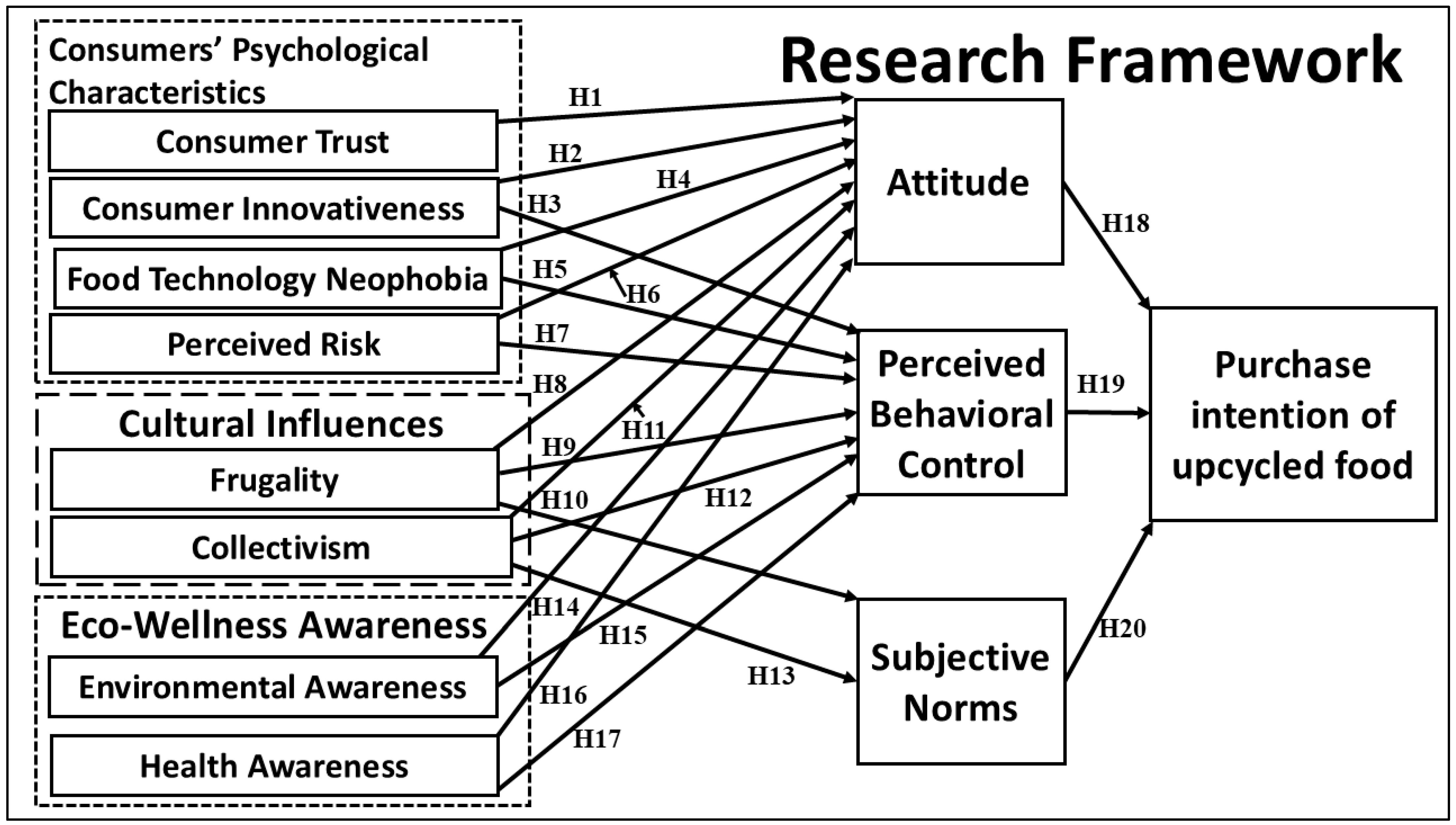
Based on these contributions, the following hypothesis was defined:
H1. 
Consumer trust positively influences attitude towards upcycled foods.

2.4. Consumer Innovativeness, Attitude, and Perceived Behavioural Control

Consumer innovativeness is a characteristic that drives individuals to rapidly adopt new products and lifestyles, impacting market acceptance and the success of innovative products [55]. Innovativeness influences not only the adoption of new technologies but also new forms of products, such as upcycled foods, which are designed by repurposing waste into valuable resources [55,56]. Research has shown that innovativeness enhances consumer attitudes towards environmentally friendly products, as innovative consumers are typically early adopters of products that promote environmental sustainability [57]. Furthermore, design innovation in upcycled foods has been linked to increased purchase intentions, indicating that innovativeness not only supports but also promotes environmental product choices [58].
Based on these contributions, the following hypothesis was defined:
H2. 
Consumer innovativeness positively influences attitude towards upcycled foods.
Perceived Behavioural Control (PBC), as defined in Ajzen’s Theory of Planned Behaviour, reflects an individual’s perception of their ability to perform a behaviour, which includes factors like control and confidence [59]. Innovativeness encourages individuals to explore and adopt sustainable products, thereby increasing their confidence in managing environmental impacts effectively [60]. Moreover, innovativeness is linked to a heightened awareness of environmental benefits and personal norms, which are crucial for fostering pro-environmental behaviours [61]. Studies suggest that individuals with higher innovativeness are more likely to perceive and act upon the environmental benefits of products due to stronger personal norms [62,63].
Based on these contributions, the following hypothesis was defined:
H3. 
Consumer innovativeness positively influences perceived behavioural control towards upcycled foods.

2.5. Food Technology Neophobia, Attitude and Perceived Behavioural Control

Food technology neophobia, defined as the fear of new food technologies, has a pronounced effect on consumer behaviour toward innovative products, including upcycled foods [27]. This apprehension arises from concerns about safety, health implications, and the perceived alteration of food’s naturalness due to technological interventions. These factors collectively hinder consumer acceptance of innovative food solutions [64,65].
Neophobia directly influences consumer attitudes by engendering scepticism or resistance towards foods developed with novel technologies [66]. This resistance is often rooted in negative perceptions regarding the taste and overall quality of these foods, leading to adverse attitudes among consumers [67].
Furthermore, food technology neophobia affects perceived behavioural control, a measure of a consumer’s assessment of the ease or difficulty associated with adopting upcycled foods [68]. Neophobic consumers may feel they lack the competence to make informed decisions due to uncertainty or distrust in the technologies applied, thereby diminishing their confidence to engage with these products [69].
Addressing food technology neophobia is essential for enhancing both attitudes towards and perceived behavioural control of upcycled foods, ultimately fostering greater consumer acceptance of these environmentally sustainable options.
Based on these contributions, the following hypothesis was defined:
H4. 
Food technology neophobia negatively influences attitude towards upcycled foods.
H5. 
Food technology neophobia negatively influences perceived behavioural control towards upcycled foods.

2.6. Perceived Risk, Attitude and Perceived Behavioural Control

Perceived risk, encompassing psychological, financial, physical, social, and performance dimensions, significantly influences consumer behaviour, particularly in the context of upcycled foods [70,71]. When consumers face high perceived risks, such as uncertainty about product quality, potential social disapproval, or economic loss, their attitude towards these products tends to be negative, and their sense of control over making successful purchasing decisions is diminished [72].
Perceived risks associated with upcycled foods include concerns about the products’ quality and the potential for social stigma. For example, consumers might worry that upcycled products are of lower quality or that using such products might not be socially accepted [73,74]. These concerns can lead to negative attitudes towards upcycled foods because consumers fear adverse outcomes such as dissatisfaction with the product or social disapproval.
Furthermore, within the TPB framework, perceived behavioural control reflects individuals’ confidence in their ability to perform a behaviour. According to Ajzen [59] perceived behavioural control reflects individuals’ perceived ease or difficulty in performing a behaviour, which is closely related to self-efficacy. When consumers perceive high levels of risk, they may experience uncertainty and a lack of control over the outcomes of their decisions, thereby weakening their perceived behavioural control [75,76].
This is particularly relevant in the context of upcycled foods, where consumers often lack sufficient knowledge to evaluate product safety, quality, and performance. High perceived risk also increases cognitive burden and decision complexity, making consumers feel less capable of making optimal choices, thereby further weakening their perceived behavioural control. As a result, higher perceived risk reduces consumers’ decision-making confidence and creates a sense of inability to manage potential negative outcomes. Prior studies have also suggested that risk perceptions can undermine individuals’ sense of control and self-efficacy in performing behaviours [38,77].
Based on these insights, perceived risk plays a critical role in shaping both consumer attitudes and perceived behavioural control, particularly in contexts involving novel or less understood products such as upcycled foods.
Based on these contributions, the following hypothesis was defined:
H6. 
Perceived risk negatively influences attitude towards upcycled foods.
H7. 
Perceived risk negatively influences perceived behavioural control over purchasing upcycled food.

2.7. Frugality, Attitude, Subjective Norms, and Perceived Behavioural Control

Frugality, characterized by careful spending and maximizing the utility of money, impacts consumer behaviour significantly, especially in the context of upcycled food. Rooted in both internal and external motivations, frugality affects not only spending habits but also attitudes toward consumption and lifestyle choices. Chinese society, for instance, emphasizes a culture of frugality that shapes consumers’ everyday behaviours and choices [35,78].
Frugal consumers tend to prefer lower-priced options, spend less on non-essential goods, and seek products that offer greater value [79]. This sensitivity to price and value influences their attitudes towards various products, including upcycled foods, which are often positioned as both economical and environmentally friendly. The economic factor is pivotal in determining the attractiveness of these products, as consumers assess the costs and benefits associated with their purchasing decisions [47,80].
The influence of frugality extends to subjective norms and perceived behavioural control. In social contexts, frugal behaviours are often viewed positively, aligning with broader social and environmental values. This alignment can reinforce subjective norms, where frugal behaviour becomes a socially endorsed practice, especially in communities prioritizing sustainability [81,82]. Moreover, frugality enhances perceived behavioural control by equipping consumers with strategies to manage their resources effectively, making sustainable choices like purchasing upcycled foods feel more accessible and manageable.
Given this analysis, frugality not only fosters a positive attitude towards upcycled foods due to the perceived value and cost savings but also strengthens subjective norms and enhances perceived behavioural control by aligning personal spending habits with broader social expectations and personal capabilities.
Based on these contributions, the following hypothesis was defined:
H8. 
Frugality positively influences attitude towards upcycled food.
H9. 
Frugality positively influences perceived behavioural control towards upcycled food.
H10. 
Frugality positively influences subjective norms towards upcycled food.

2.8. Collectivism, Attitude, Subjective Norms, and Perceived Behavioural Control

Collectivism plays a significant role in shaping attitudes toward upcycled food, particularly in cultures that prioritize community welfare and collective interests over individual goals. In these communities, the collective mindset promotes environmental conservation and waste reduction, which positively impacts attitudes towards sustainable practices like upcycled food consumption. This influence is well-documented in studies such as Maaravi et al. [83], highlighting how communal values foster positive attitudes towards environmentally friendly behaviours.
H11. 
Collectivism positively influences attitude towards upcycled food.
Collectivism strengthens community norms that favour sustainability, making individuals more likely to adopt and endorse these norms. This phenomenon enhances the subjective norms within the community, especially noticeable in environments where community leaders actively promote sustainable consumption. This reinforcement of community values contributes to a stronger endorsement of sustainability practices among community members, as noted by Lu et al. [84] and Triandis [21].
H12. 
Collectivism positively influences subjective norms towards upcycled food.
In collectivist settings, the support and cooperation among community members are pivotal, enhancing individuals perceived behavioural control. This communal support system provides necessary resources and encouragement, reducing barriers to participating in environmentally friendly practices like purchasing upcycled food. Studies by Roseira et al. [37], along with findings from Xue and Li [85], Liu and Lapinski [86], support this notion, indicating that the collective valuation of green consumption significantly influences individual behaviours, aligning them with group norms to maintain social harmony and approval. Moreover, the group’s approval and support in collectivist societies provide individuals with the confidence and capability to engage in sustainable behaviours, as further supported by Prakash et al. [87] and Qu [88].
H13. 
Collectivism positively influences perceived behavioural control towards upcycled food.

2.9. Environmental Awareness, Attitude, and Perceived Behaviour Control

Environmental awareness enhances an individual’s attitude towards upcycled food. Increased awareness leads to a greater understanding of the benefits of upcycling foods, fostering positive attitudes towards such practices [89]. Individuals who are more knowledgeable about environmental issues are more likely to support sustainable practices, including the consumption of upcycled food products [90,91].
Based on these contributions, the following hypothesis was defined:
H14. 
Environmental awareness positively influences attitude towards upcycled food.
Environmental awareness also positively affects perceived behavioural control (PBC) towards upcycled food. When individuals are aware of the environmental impacts of their food choices, they feel more empowered and capable of adopting sustainable behaviours, including the use of upcycled food [77]. This increased PBC stems from a heightened sense of responsibility and self-efficacy in making environmentally friendly choices [92].
Based on these contributions, the following hypothesis was defined:
H15. 
Environmental awareness positively influences perceived behavioural control towards upcycled food.

2.10. Health Awareness, Attitude, and Perceived Behavioural Control

In the Asian market, particularly in China, there is a long-established preference for functional foods—those enhanced with health and nutritional benefits, a concept introduced by Japan’s Ministry of Health and Welfare in 1984 [93]. This preference is reflected in the popularity of upcycled foods in China, which are valued for their nutritional properties and contribution to a sustainable diet [94].
Chinese consumers frequently assess the health benefits of upcycled foods, which significantly influences their attitudes towards these products and enhances their perceived control over making sustainable choices. The knowledge of health benefits encourages consumers to overcome obstacles like availability and convenience, increasing the likelihood of choosing upcycled foods [12,95].
Furthermore, promoting the health advantages of upcycled foods, rather than solely their environmental benefits, has shown to significantly boost consumer acceptance [12,96]. The heightened health awareness not only instils a moral responsibility but also motivates consumers to prioritize health over convenience, fostering a shift towards choosing upcycled foods more readily.
Based on these contributions, the following hypothesis was defined:
H16. 
Health awareness positively influences attitude towards upcycled food.
H17. 
Health awareness positively influences perceived behavioural control towards upcycled food.

2.11. Attitude, Perceived Behavioural Control, Subjective Norms and Purchase Intention

Attitude encompasses an individual’s positive or negative evaluation of engaging in a particular behaviour. Previous research indicates that a positive attitude towards an environmentally friendly practice, such as consuming upcycled food, enhances the likelihood of adopting this behaviour [45,97]. Therefore, if individuals hold positive attitudes towards upcycled food, recognizing its benefits to sustainability and health, their intention to purchase such food is likely to increase.
Perceived Behavioural Control reflects an individual’s perception of the ease or difficulty of performing a behaviour, which includes access to resources and opportunities [98,99]. In the context of upcycled food, if consumers perceive that they have the means, ability, and opportunity to purchase and consume upcycled products, their likelihood of doing so increases. This perception can be enhanced through widespread availability and affirmative marketing.
Subjective Norms involve perceived social pressure to engage or not engage in a behaviour and the desire to comply with the expectations of significant others [100,101]. In the case of upcycled food, if individuals perceive that their social circle values sustainability and supports the consumption of upcycled products, they are more likely to conform to these norms. This reflects a societal shift towards more sustainable consumption practices.
Based on these contributions, the following hypothesis was defined:
H18. 
Attitude positively influences the Purchase Intention of upcycled food.
H19. 
Perceived behavioural control positively influences the purchase intention of upcycled food.
H20. 
Subjective Norms positively influence the purchase intention of upcycled food.
As shown in Figure 1, the proposed research model illustrates the relationships among the key constructs.

3. Methodology

3.1. Ensuring Research Ethics in Survey Practices

This section describes the procedures employed to ensure data privacy and respondent anonymity, which are essential for conducting ethically responsible research. The study was conducted through an online questionnaire aimed at exploring consumer purchase intentions for upcycled foods. The primary aim of this study is to gain deeper insight into consumer attitudes and purchasing behaviours related to upcycled foods.

3.1.1. Ethical Considerations and Participant Rights

This study was conducted in accordance with established ethical standards for research involving human participants. Ethical approval was obtained from the Human Research Ethics Committee of Universiti Sains Malaysia (JEPeM-USM).

3.1.2. Data Use and Dissemination

The data gathered from the questionnaire are intended exclusively for academic research purposes. The analysis focuses on evaluating consumer acceptance of upcycled foods. It is anticipated that the results of this study may be published in academic journals or presented at conferences. However, in line with our ethical commitment, no personal information or data that could lead to the identification of the participants will be disclosed in any publications or presentations.

3.1.3. Survey Instructions and Consent

Clear instructions were provided to participants regarding how to complete the survey. They were encouraged to select answers that best reflected their views, based on their actual situation, emphasizing that there were no right or wrong answers—only their honest opinions were sought. Before starting the questionnaire, participants were required to confirm their consent electronically by ticking a box that indicated they had read, understood, and agreed to the terms of participation voluntarily.

3.1.4. Withdrawal Mechanism

A straightforward mechanism for withdrawing from the study was outlined at the beginning of the survey. Participants could withdraw at any point simply by closing the webpage or by contacting the research team directly using the provided contact information.
These methodologies and ethical considerations were carefully designed and implemented to ensure the integrity of the research process and safeguard the rights and privacy of all participants. This approach underscores the commitment of the research team to conduct scientifically rigorous and ethically responsible research.

3.2. Questionnaire Design and Pre-Testing Study

The research commenced by collecting demographic data through a survey before exploring the primary variables of interest. We assessed all latent variables using previously validated scales. Participants provided in-depth insights into their viewpoints by rating various statements on a five-point Likert scale, where 1 denotes ‘strongly disagree’ and 5 ‘strongly agree’ [102]. The five-point Likert scale is especially beneficial as it has demonstrated higher reliability. Additionally, its use tends to enhance response rates, making it an effective tool for data collection [103].
Before data collection, we conducted pre-tests to confirm the questionnaire’s validity and reliability. This process included a thorough review of the content—assessing clarity, language, sequence, format, and the complexity of both questions and instructions. We made revisions, restructured, or removed certain elements based on expert evaluations and detailed analyses to ensure accuracy. Additionally, to cater to the primary language of participants, the questionnaire was translated into Mandarin through a forward and backward translation process [104,105].
Participant feedback in this phase was instrumental. Based on the pre-test results, all measurement items demonstrated satisfactory clarity and reliability, and were therefore retained for further analysis. Due to space constraints, the full list of measurement items is presented in Appendix A.

3.3. Sample Size Calculation and Study Sample

The confidence interval technique is the most employed method for estimating sample size. It considers accuracy (margin of sampling error), variability, and the confidence interval to determine the suitable sample size. This technique is favoured by many marketing researchers and national consulting firms for establishing sample sizes [106]. Consequently, the minimum number of respondents for this research was determined using Cochran’s sample size formula [107].
In marketing research, determining an appropriate sample size is essential to ensure the reliability of findings. The confidence interval method is widely used to balance precision and practicality [108]. Cochran’s formula provides a robust approach for estimating the required sample size based on the desired confidence level and margin of error [109].
Using Cochran’s sample size formula with a confidence level of 95% and a margin of error of 5%, the minimum number of respondents required for this study is 385. Cochran’s formula is typically used to determine an appropriate sample size for a survey given a desired level of precision, confidence level, and variability.
Standard sample size formula:
n = z 2   ( p q ) e 2
where:
n = the sample size
z = the standard normal variate corresponding to the selected confidence level (typically 1.96 for 95% confidence)
p = the estimated proportion of the population
q = 1 − p
e = the acceptable margin of error
For a confidence level of 95%, the Z-value is 1.96. With a margin of error of 5% (0.05), and assuming the maximum variability (p = 0.5), the formula becomes:
n 0 Z ( c . l . ) 2 · p · q e 2
n 0 1.96 2 ( 0.5 ) ( 0.5 ) 0.05 2
n 0 384.16 Respondents rounded to 385 respondents
In this study, however, a sample size of 612 respondents was utilized. Using a larger sample size enhances the precision of the study’s results and ensures a more accurate and reliable representation of the population.

3.4. Sampling and Data Collection

This study adopts a cross-sectional research design, as data were collected at a single point in time. This design is appropriate for examining the relationships among key constructs such as consumer attitudes, trust, and purchase intention. Given the exploratory and predictive nature of this research, the cross-sectional approach enables efficient data collection from a large sample and supports the application of PLS-SEM for theory testing. Moreover, this design is widely used in consumer behaviour research, particularly when investigating perceptual and psychological constructs that are relatively stable over a short period.
Our study conducted a survey between February and April 2024, using the well-known online platform Tencent Questionnaire to distribute the survey. This method is highly cost-effective and time-efficient, providing extensive reach, which is ideal for social science research [110,111]. Tencent Questionnaire, a leading tool in China for market research, educational assessments, and customer satisfaction surveys, boasts over ninety million users. This diverse user base includes individuals of various ages, genders, professions, and educational levels, offering a statistically significant sample for our research.
This study employed purposive sampling to select participants who were likely to provide valuable insights relevant to our research objectives. We targeted individuals over 18 years old to comply with ethical standards, ensuring that all participants were of legal age. The survey was distributed randomly among registered users who satisfied this age requirement.
To enhance the validity and applicability of the responses, the survey was specifically designed for participants with existing knowledge of recycled food products. Within this segment, we meticulously defined the concept of upgraded recycled food products to ensure clarity and uniform understanding among all respondents.
An integral part of our methodology included a screening phase designed to verify that participants met the necessary criteria. This phase was crucial for maintaining the integrity of the data collection process. Any respondent or sample failing to meet these predefined standards was systematically removed from the dataset before the commencement of data analysis. This approach was taken to ensure that the analysis would be based solely on data from appropriately qualified participants.
Table 1 presents the demographic details of our respondents. The data shows a nearly balanced gender split with 46.7% male (286 respondents) and 53.3% female (326 respondents). The most represented age group is 26–35 years, accounting for 28.6% of respondents (175 individuals), with fewer participants in both older and younger age groups. Most respondents earn less than 3000 units of currency monthly, primarily within the 0–3000 income bracket (48.7%). Higher income brackets are less common.
Regarding education, a significant number of respondents completed junior high school (35%, 214 respondents) or senior high school (31.9%, 195 respondents), with fewer possessing a college diploma or a bachelor’s degree. In terms of occupation, office workers (17.3%, 106 respondents), factory workers (16.7%, 102 respondents), and freelancers (15.2%, 93 respondents) are prominently represented, along with other civil servants and retirees.

3.5. Statistical Analysis

For our statistical analysis and structural equation modelling, we opted to use Smart PLS 4.1 (SmartPLS GmbH, Boenningstedt, Germany) software, preferring partial least squares structural equation modelling (PLS-SEM) over covariance-based SEM (CB-SEM) for several reasons:
Focus on Theory Development and Prediction: PLS-SEM is particularly effective for exploratory research and theory development, unlike CB-SEM, which primarily focuses on theory confirmation and model fitting [112]. Our study aims to expand theoretical frameworks and enhance predictive analyses, particularly in understanding consumer behaviour towards sustainable products.
Statistical Power and Model Complexity: PLS-SEM is robust, accommodating smaller sample sizes and managing complex models with multiple constructs and paths effectively [113,114]. This capability proved essential for our study, which features numerous interrelated constructs within an intricate model. Furthermore, PLS-SEM’s flexibility with distributional assumptions was advantageous given the nature of our data.
Prevalence in Related Studies: Partial Least Squares Structural Equation Modelling (PLS-SEM) is widely employed in sustainable consumption research, particularly in studies focusing on sustainable food consumption [115,116]. Edeh et al. [117] and Sarstedt et al. [118] have highlighted its applicability, underscored its suitability and reinforced our choice of methodology.
Through these detailed justifications, we aim to elucidate our methodological selection and affirm the alignment of PLS-SEM with the objectives and data structure of our study.

4. Results

4.1. Measurement Model

This research evaluated the reflective measurement model in terms of reliability, convergent validity, and discriminant validity as outlined by Hair Jr et al. [119] and Memon et al. [120]. The findings from the confirmatory factor analysis are detailed in Table 2. Here, factor loadings ranged from 0.858 to 0.922, surpassing the 0.60 threshold. Moreover, the average variance extracted (AVE) for each construct exceeded the 0.50 mark, and the composite reliability scores varied from 0.782 to 0.841, exceeding the recommended threshold of 0.70.
Henseler et al. [121] proposed that the heterotrait–monotrait (HTMT) ratio serves as a robust indicator for identifying shortcomings in discriminant validity and is comparable in effectiveness to the Fornell-Larker criteria. They described it as providing “the optimal balance between high detection rate and low risk of arbitrary violations”. In light of this, our study employed the HTMT ratio to assess discriminant validity. As shown in Table 3, all HTMT values were below the more liberal threshold of 0.90, as recommended by [122].
However, it is noted that several HTMT values are relatively high and approach the threshold, suggesting potential conceptual proximity between certain constructs. This is theoretically justifiable given that some constructs in the model (e.g., attitude, perceived behavioural control, and subjective norms within the TPB framework) are conceptually related yet distinct dimensions. Following prior research, such moderate correlations are expected in models involving closely related psychological constructs and do not necessarily indicate a lack of discriminant validity.
The results of the structural model, including path coefficients, t-values, and hypothesis testing outcomes, are presented in Table 4.

4.2. Structural Model

The validity of the structural model was confirmed using a range of indices. The model exhibited R2 values of 0.892 for Purchase Intention (PI), 0.734 for Subjective Norms (SN), 0.868 for Perceived Behavioural Control (PBC), and 0.803 for Attitude (ATT). Each of these values surpasses the threshold of 0.5 recommended by Falk and Miller [123]. Additionally, predictive relevance was evaluated with Q2 values for the exogenous variables: PI demonstrated a Q2 of 0.362, SN a Q2 of 0.289, PBC a Q2 of 0.435, and ATT a Q2 of 0.251. All these values exceed zero, aligning with Geisser’s criteria [124]. These findings underscore the model’s robust explanatory and predictive capabilities, confirming its structural validity.

4.3. Hypothesis Testing

The study’s hypotheses were tested using a bootstrapping method with 5000 subsamples, maintaining a 95% confidence level as recommended by Memon et al. and Witte & Witte [120,125].
When the path coefficient is significantly non-zero, A T statistic surpassing the critical value of 1.69 signifies statistical significance, as does a p-value falling below the commonly accepted threshold of 0.05. It points to a substantial relationship between the variables. The confidence interval provides a range suggesting where the true effect size likely falls, enhancing our grasp of the estimate’s reliability and accuracy [126]. Moreover, a confidence interval excluding zero reaffirms this relationship’s significance [127,128]. Together, these statistical metrics facilitate a thorough verification of hypotheses, offering a detailed evaluation of the dynamics between the studied variables.

4.3.1. Consumer Trust and Innovativeness

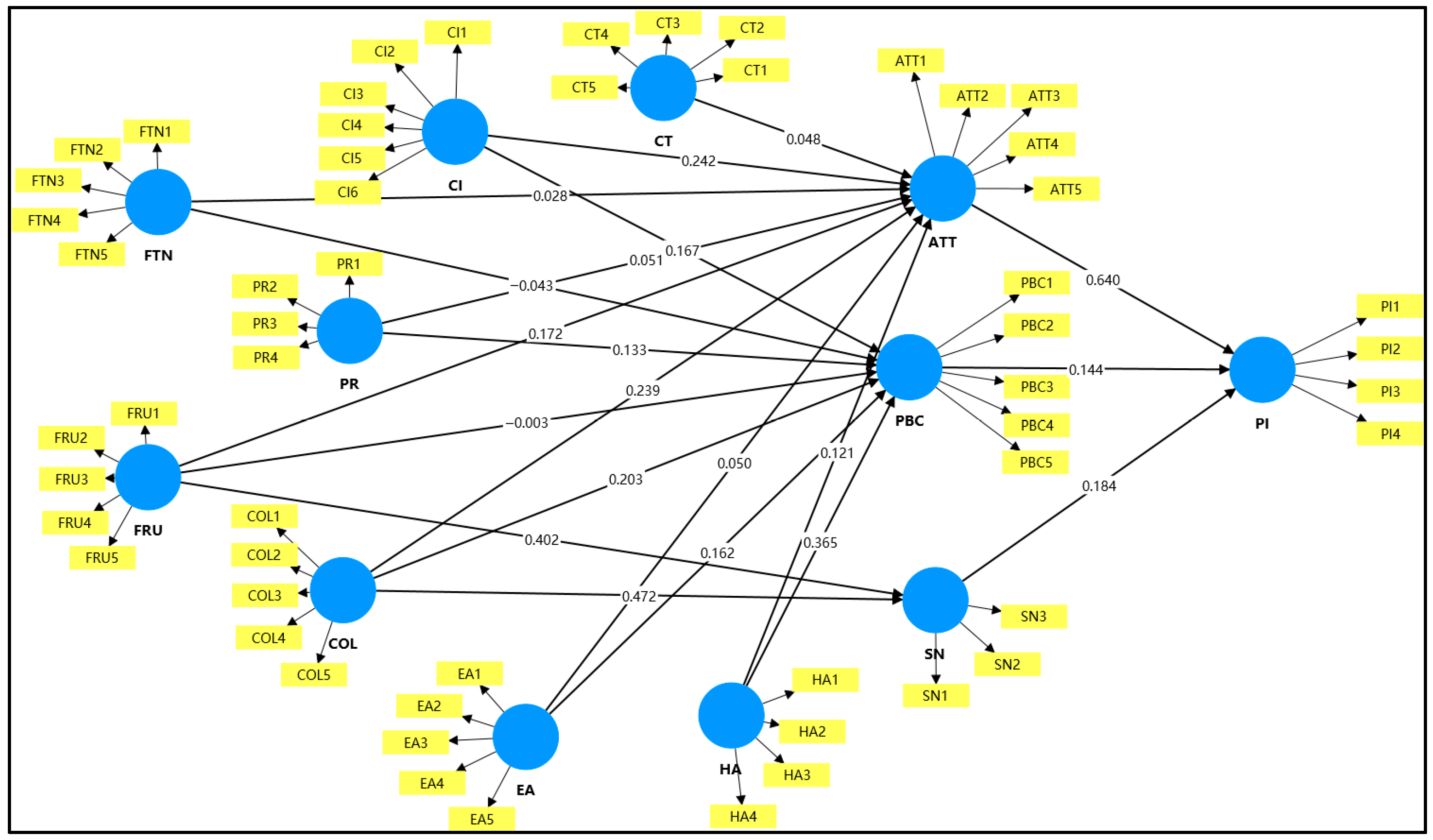
The statistical analysis presented in Table 4 examines the diverse impacts of psychological and behavioural constructs. The analysis reveals that Consumer Trust (CT) does not significantly influence Attitude (ATT), as indicated by a t-value below 1.69 (H1: CT → ATT, β = 0.056, t = 0.81, p = 0.209). In contrast, Consumer Innovativeness (CI) significantly affects ATT (H2: CI → ATT, β = 0.242, t = 2.949, p = 0.002) and enhances Perceived Behavioural Control (PBC), suggesting that innovative tendencies positively influence behavioural control (H3: CI → PBC, β = 0.167, t = 3.09, p = 0.001).

4.3.2. Food Technology Neophobia and Perceived Risk

The analysis also explored the impact of Food Technology Neophobia (FTN) and Perceived Risk (PR) on attitudes and behavioural control. Neither FTN’s influence on ATT nor on PBC was significant, highlighting its limited effect within this context (H4: FTN → ATT, β = 0.028, t = 0.29, p = 0.386; H5: FTN → PBC, β = −0.043, t = 0.601, p = 0.274). However, PR positively influenced PBC, indicating a significant effect (H7: PR → PBC, β = 0.133, t = 1.779, p = 0.037), although it did not significantly affect ATT (H6: PR → ATT, β = 0.051, t = 0.534, p = 0.297).

4.3.3. Frugality and Collectivism

Further, the roles of Frugality (FRU) and Collectivism (COL) in shaping attitudes and norms were examined. FRU positively influenced attitudes and subjective norms (H8: FRU → ATT, β = 0.248, t = 3.008, p = 0.001; H10: FRU → SN, β = 0.276, t = 2.695, p = 0.004), yet had no significant impact on PBC (H9: FRU → PBC, β = 0.031, t = 0.425, p = 0.335). COL, conversely, significantly impacted all tested constructs, enhancing attitudes, PBC, and subjective norms (H11: COL → ATT, β = 0.239, t = 3.256, p = 0.001; H12: COL → PBC, β = 0.249, t = 3.973, p < 0.001; H13: COL → SN, β = 0.302, t = 4.362, p < 0.001).

4.3.4. Health and Environmental Awareness

The study also addressed the effects of Health Awareness (HA) and Environmental Awareness (EA) on ATT and PBC. EA’s influence on ATT was not significant (H14: EA → ATT, β = 0.125, t = 1.529, p = 0.063), though it significantly enhanced PBC (H15: EA → PBC, β = 0.31, t = 2.928, p = 0.002). Conversely, HA strongly influenced both ATT and PBC, indicating its profound effect on these constructs (H16: HA → ATT, β = 0.121, t = 1.75, p = 0.04; H17: HA → PBC, β = 0.365, t = 5.208, p < 0.001).

4.3.5. Attitude, Perceived Behavioural Control, and Subjective Norms

Finally, the study examined how Attitude (ATT), Perceived Behavioural Control (PBC), and Subjective Norms (SN) affect Purchase Intention (PI), finding significant results for all three constructs. ATT showed a strong positive influence (H18: ATT → PI, β = 0.64, t = 8.041, p < 0.001). Although PBC’s impact was less pronounced, it remained significant (H19: PBC → PI, β = 0.144, t = 2.303, p = 0.011). Similarly, SN’s positive relationship with PI was confirmed (H20: SN → PI, β = 0.184, t = 2.533, p = 0.006). These findings underscore the critical roles of attitudes, behavioural control, and societal norms in shaping purchase intentions.

4.4. Structural Model Evaluation

4.4.1. Collinearity Assessment

Collinearity was assessed using the variance inflation factor (VIF). As shown in Appendix B, all VIF values ranged between 2.675 and 3.296, which are below the recommended threshold of 3.3 [129], indicating that collinearity is not a concern in this study.

4.4.2. Model Fit Assessment

Model fit was assessed using the standardized root mean square residual (SRMR). The SRMR value for the saturated model was 0.027, while the estimated model yielded an SRMR of 0.037. Both values are below the recommended threshold of 0.08, as suggested by Hair et al. [119], indicating a good model fit, with values below 0.05 further supporting model adequacy.

4.4.3. Final Structural Model

As illustrated in Figure 2, the final structural model displays the standardized path coefficients among the constructs.

5. Discussion and Conclusions

The aim of this study was to investigate the factors influencing consumers’ purchase intentions towards upcycled foods in China. The results revealed several key findings.
Firstly, the three dimensions of the Theory of Planned Behaviour (TPB), namely Attitude (ATT), Subjective Norms (SN), and Perceived Behavioural Control (PBC), significantly and positively influenced online purchase intentions for upcycled foods. The findings confirm that TPB effectively predicts consumer behaviour in this context, consistent with prior research [130,131,132]. Among the dimensions, ATT exerted the strongest influence on purchase intentions, indicating that personal attitudes towards upcycled foods, driven by perceptions of their benefits, sustainability, and environmental impact, are paramount. This reflects a growing consumer recognition and valuation of these attributes, substantially boosting their purchase intentions.
SN also significantly influenced purchase intentions, highlighting the role of peer opinions and broader social norms in shaping behavioural intentions. The influence of subjective norms can be particularly strong in collectivist cultures, where social approval and conformity play critical roles in shaping behaviours [133]. Furthermore, societal trends towards sustainability and the increasing visibility of upcycled foods in media and public discourse enhance the impact of subjective norms [134].
PBC was also a crucial factor. The rapid expansion of the upcycled food market in China has increased consumer awareness, supported by extensive marketing and a growing number of retail outlets offering these products. Additionally, the affordability of upcycled foods enhances consumers’ perceived ease of purchase, making them feel more empowered to buy these products due to their accessibility and low cost. This combination of increased availability and affordability strengthens purchase intentions. This highlights the importance of PBC in influencing consumer decisions in the upcycled food sector. Previous studies have shown that perceived behavioural control, including ease of access to upcycled foods and consumer confidence in identifying and purchasing them, plays a significant role in shaping purchase intentions [135,136].
While perceived behavioural control (PBC) is a significant predictor of behavioural intention, its effect may depend on external contextual factors, particularly spatial accessibility. In particular, even when consumers possess strong intentions and perceive themselves as capable of engaging in sustainable consumption, limited physical access to upcycled food outlets may constrain actual purchasing behaviour. Consistent with this perspective, prior research suggests that uneven geographic distribution of resources can significantly affect individual behavioural outcomes [137].
Therefore, perceived behavioural control should not only be understood at the individual level but also as being partially shaped by external spatial and infrastructural conditions. This perspective helps explain why high consumer intention does not always result in actual adoption of upcycled food products.
Secondly, beyond the core TPB dimensions, this study shows that consumer innovativeness, coupled with positive attitudes towards upcycled foods, significantly enhances the likelihood of purchasing such items. Consumers perceive these choices as beneficial, practical, and socially responsible. This finding aligns with the research conducted by Altintzoglou et al. [90], which identified various psychological characteristics that influence consumer acceptance of upcycled foods. These characteristics include innovativeness (defined as the willingness to try new products within a specific category). The interaction of these psychological factors plays a crucial role in shaping consumer behaviour towards sustainable food options.
Beyond individual-level traits, consumer innovativeness in the Chinese context may also be shaped by the country’s evolving position within global innovation networks. Recent research indicates that China has become increasingly integrated into global innovation systems, with its role shifting from a peripheral participant to a more central and influential node in international collaboration networks [138].
This broader context may facilitate more intensive knowledge exchange, technological diffusion, and cross-border innovation cooperation, thereby accelerating the dissemination of new ideas and sustainability-oriented consumption practices. In particular, the increasing interconnectedness of global innovation networks enables Chinese consumers to be more frequently exposed to emerging concepts such as circular economy, resource efficiency, and upcycled products.
As a result, consumer innovativeness observed in this study may not solely reflect individual-level traits but may also be interpreted within broader structural dynamics of global knowledge flows and innovation diffusion. This perspective provides a deeper contextual explanation for the positive role of innovativeness in shaping attitudes and behavioural intentions toward upcycled foods.
Thirdly, the analysis of perceived risk (PR) in this study provides important insights into its influence on perceived behavioural control (PBC). Hypothesis testing indicates that perceived risk positively impacts PBC, corroborating the theory that heightened risk awareness enhances consumers’ perceived control over their actions. This positive correlation between PR and PBC aligns with research by Dou and Chen [139], which similarly identified a significant influence of PR on PBC. Such findings suggest that increased awareness of risk can strengthen consumers’ confidence in their ability to manage and mitigate uncertainty. This is a critical component of decision-making related to safety and risk management.
In addition to the significant findings, the non-significant effect of perceived risk on attitude suggests that risk may not play a dominant role in shaping consumers’ evaluations of upcycled foods. This may be due to effective communication strategies and increased awareness of sustainability, which reduce the salience of perceived risk and shift consumers’ focus toward perceived benefits.
More importantly, the positive effect of perceived risk on perceived behavioural control appears to diverge from conventional theoretical expectations. This can be interpreted from a risk-management perspective, where heightened risk awareness encourages more active information processing, thereby enhancing consumers’ perceived ability to manage uncertainty. In this context, perceived risk may function not only as a barrier but also as a motivator that strengthens perceived control.
By contrast, the hypothesis that perceived risk would influence attitude (ATT) was not supported. This outcome diverges from findings by Kim et al. [140], who observed that the perceived risk associated with upcycled products significantly impacts consumers’ attitudes. This discrepancy suggests that while perceived risk can enhance perceived control, its effect on altering consumers’ attitudes toward risky situations or decisions is not as pronounced. This distinction contributes to our broader understanding of how risk perception influences various facets of consumer behaviour, highlighting the complex interplay between perceived risk, control, and attitudes. These nuances are pivotal for developing more effective strategies for consumer engagement and risk communication.
These findings are also consistent with prior research showing that perceived risk operates differently across consumer contexts. For example, Jangir et al. [141] found that perceived risk moderated users’ continuance intention in the realm of FinTech services, though its effect was minimal on the dynamics between perceived usefulness and satisfaction. Additionally, Wang et al. [142] documented a significant influence of perceived risk on travel intentions during the COVID-19 pandemic, highlighting the roles of perceived behavioural control and subjective norms.
In the context of upcycled foods, the non-significant effect of perceived risk on attitude may reflect effective communication and framing strategies that enhance consumer acceptance. Aschemann-Witzel et al. [36] suggest that effective communication that foregrounds the environmental benefits and safety of upcycled foods can diminish perceived risks and cultivate positive attitudes. Furthermore, consumer studies across various regions, including the US and China, have indicated differences in acceptance levels and attitudes toward upcycled foods, pointing to the influential roles of cultural factors and targeted marketing [12].
These insights collectively indicate that while perceived risk is an integral element of consumer decision-making, its impact on attitudes towards upcycled foods is overshadowed by more potent factors such as perceived benefits, effective communication, and cultural acceptance. This understanding is essential for tailoring strategies that address consumer perceptions and foster sustainable consumption practices. Accordingly, brands may adopt transparent sourcing and traceability labelling strategies (e.g., clearly communicating raw material origins and processing methods) to reduce the “waste” stigma associated with upcycled foods and mitigate perceived risk.
In addition to perceived risk, this study also explores the influence of frugality (FRU) on consumer behaviour toward upcycled foods, focusing on consumers’ attitudes (ATT) and social norms (SN). Hypothesis testing reveals that frugality significantly impacts behavioural attitudes, as a stronger inclination towards frugality correlates with more favourable attitudes towards these products. Additionally, frugality also significantly influences social norms, suggesting that frugal consumers perceive social approval for purchasing upcycled foods. These findings align with research by Aschemann-Witzel et al. [36], who found that a pronounced frugality orientation led to favourable attitudes towards upcycled food products. However, the expected impact of frugality on perceived behavioural control (PBC) was not supported, highlighting the complex interaction between frugality and various dimensions of consumer behaviour. This complexity underscores the need for nuanced strategies to promote sustainable consumer practices, especially in the context of upcycled food consumption.
This study examines the effect of collectivism (COL) on attitude, perceived behavioural control (PBC), and social norms (SN) related to upcycled foods. Hypothesis testing indicates that collectivism substantially influences attitude, perceived behavioural control and social norms, with stronger collectivistic tendencies correlating with enhanced perceived control and more favourable social norms regarding upcycled food purchase behaviours. These findings are consistent with observations by Roseira et al. [37], who highlighted that collectivist orientations lead to positive attitudes and enhance the subjective norms surrounding the consumption of sustainable foods. Importantly, in the Chinese context, subjective norms may stem from both familial influences (e.g., family expectations regarding food safety and health) and broader societal pressures (e.g., sustainability trends and public discourse), which may influence purchase intentions through different psychological mechanisms.
Turning to awareness-related factors, our analysis revealed that environmental awareness significantly and positively influences perceived behavioural control, indicating that individuals with higher environmental consciousness feel more capable of engaging in sustainable consumption behaviours such as purchasing upcycled foods. This finding highlights the empowering role of environmental values in consumer behaviour, demonstrating that environmental consciousness enhances individuals’ perceived ability and control over eco-friendly purchasing decisions. However, the impact of environmental awareness on personal attitudes towards upcycled foods was not statistically significant, suggesting that while environmental consciousness may enhance perceived capability, it does not necessarily translate into more favourable personal attitudes towards these products. This contrast can be juxtaposed with the findings of Aschemann-Witzel et al. [36], who reported that consumers with stronger environmental concerns exhibited more positive attitudes towards upcycled bakery, dairy, and snack products. This discrepancy suggests that general environmental awareness may not directly enhance personal attitudes towards upcycled foods. However, certain segments of environmentally conscious consumers may still develop positive perceptions, potentially influenced by product category or communication strategies.
In contrast, health awareness exhibited a significant influence on both attitude and perceived behavioural control. Our data confirm a strong positive relationship between health awareness and attitude, demonstrating that individuals who recognize the health benefits of upcycled foods tend to value these products highly and perceive them positively. Furthermore, health awareness substantially enhances perceived behavioural control, empowering consumers to make health-oriented purchasing decisions. This effect reflects the critical role of health consciousness in motivating consumers to actively select upcycled foods, driven by both the perceived health benefits and the increased availability of these products. Grasso et al. [12] support this view, emphasizing that Chinese consumers prioritize the health impacts (nutrition) of foods, particularly upcycled foods, over environmental considerations. This preference for health-related attributes over environmental factors further corroborates the significant role of health consciousness in influencing consumer behaviour towards upcycled foods.
Together, these findings suggest that while environmental and health consciousness both play roles in shaping consumer preferences and behaviours, the pathways and impacts of these influences vary. Environmental awareness predominantly enhances perceived behavioural control, whereas health awareness directly enhances personal attitudes and decision-making capabilities, especially regarding the consumption of upcycled foods. In addition, time allocation may also influence consumers’ adoption of upcycled foods, as busy urban lifestyles tend to increase the importance of convenience in food choices [143].
Beyond individual-level health and environmental motivations, environmental awareness and health awareness can be also conceptually framed within a broader eco-wellness perspective. In this study, these two constructs are modelled as conceptually related but empirically distinct dimensions, rather than as a higher-order construct.
From this broader perspective, recent research highlights that enhancing food security resilience requires improving the efficiency of resource utilization and reducing food loss across the supply chain [144]. In this context, upcycled foods represent a practical mechanism for transforming underutilized food resources into valuable nutritional outputs, thereby strengthening system-level sustainability.
From this perspective, consumers with higher levels of environmental and health awareness may not only perceive personal benefits but may also recognise the broader contribution of upcycled foods to sustainability and food system resilience. This distinction allows for a more nuanced understanding of how different forms of awareness influence consumer behaviour through potentially different psychological mechanisms.
Therefore, the combined effects of environmental awareness and health awareness observed in this study may extend beyond individual cognition, reflecting a deeper alignment with resilient and sustainable food system development.
Furthermore, although this study collected data across multiple provinces in China, regional disparities may still influence consumer responses toward upcycled foods. Differences in urbanization levels and the development of waste management infrastructure can shape consumers’ exposure to sustainability practices and circular economy concepts. In addition, from a longitudinal perspective, rapid urbanization in China has reshaped lifestyles and consumption patterns over time, contributing to the growing demand for convenient and sustainable food solutions such as upcycled foods [145].
Recent studies suggest that recycling-related industries and waste management systems in China exhibit clear spatial patterns, with more developed regions demonstrating higher levels of infrastructure and institutional support [146]. In such regions, consumers are more likely to be familiar with resource recovery processes and may therefore show greater acceptance of upcycled food products. In contrast, in less developed areas, limited exposure to recycling systems and sustainability initiatives may lead to higher uncertainty and lower perceived legitimacy of such products.
Therefore, variations in consumer attitudes and behavioural responses observed in this study may partially reflect these underlying spatial dynamics. Future research is encouraged to incorporate regional-level indicators, such as urbanization rates or waste management development, to further examine geographical heterogeneity in upcycled food adoption.
With regard to non-significant findings, this research also suggests that trust may not be a significant determinant of consumer attitudes towards upcycled food products. Grasso et al. [12] revealed while consumers generally recognize and accept upcycled food, their purchasing decisions are primarily influenced by ethical concerns and sensory appeal rather than trust. This finding suggests that factors other than trust play a more critical role in shaping consumer attitudes towards upcycled food.
Beyond firm-level marketing strategies, the promotion of upcycled foods may also be shaped by broader institutional pressures. In the Chinese context, non-governmental organizations (NGOs) and environmental governance mechanisms play an increasingly important role in influencing corporate behaviour toward sustainability.
Recent studies indicate that environmental NGOs can exert both direct and indirect pressures on firms by enhancing environmental accountability and promoting sustainable practices [147]. In addition, the economic relocation effect—where firms adjust their geographic distribution in response to environmental regulations and institutional conditions—further shapes corporate engagement in “waste-to-wealth” initiatives.
These institutional dynamics suggest that firms’ participation in upcycled food production may not be driven solely by market opportunities but is also embedded within a broader system of regulatory pressures and sustainability governance. Therefore, the development of the upcycled food sector in China can be better understood as a result of the interaction between market mechanisms and institutional forces.
Further, the research by Hellali and Koraï [31] supports the notion that the level of innovation and the emotional responses elicited by upcycled food products significantly impact consumer acceptance. These studies indicate that consumers are more likely to try innovative products that evoke positive emotions, which serve as a stronger influence on their attitudes than trust alone. This body of evidence underscores the importance of focusing on the innovative aspects and emotional engagement of upcycled food products to better understand consumer behaviour in this emerging market.
Our research suggests that food technology neophobia does not substantially influence either consumer attitudes or perceived behavioural control. This finding contrasts with the results of the studies by both Vidigal et al. [66] and Hellali and Koraï [31], which identified a significant impact of food technology neophobia on consumer acceptance of innovative food technologies. Specifically, they noted that consumers with high neophobia levels tend to perceive upcycled food as unsafe or unnatural, leading to negative attitudes that eclipse the potential benefits of these products, such as sustainability and ethical considerations. Similarly, Szlachciuk and Żakowska-Biemans [148] and Subramaniam and Muthusamy [149] emphasized the pivotal role of neophobia in both the rejection and acceptance of new food types, highlighting the necessity of overcoming initial neophobic responses to enhance consumer receptivity to innovative food technologies.
To further interpret these non-significant findings, it is important to consider the cultural and contextual characteristics of the Chinese market.
First, the non-significant relationship between consumer trust and attitude suggests that trust may not be a primary determinant of evaluative judgments in the context of upcycled foods. Instead, Chinese consumers may rely more heavily on tangible product attributes, perceived benefits, and sensory expectations when forming attitudes, rather than abstract trust perceptions. This may reflect a pragmatic consumption orientation in emerging sustainable markets.
Second, the non-significant effect of food technology neophobia on attitude indicates that resistance to food innovation may be less pronounced in China. Given the rapid technological advancement, strong governmental support for innovation, and frequent exposure to new food technologies, Chinese consumers may exhibit higher adaptability and openness to novel food concepts. As such, neophobia may no longer serve as a major barrier in shaping attitudes towards upcycled foods in this context.
Overall, these findings suggest that, in contrast to prior studies conducted in Western contexts, cultural factors such as collectivism, innovation exposure, and institutional trust in technology development may weaken the role of psychological barriers (e.g., trust concerns and neophobia) in shaping consumer attitudes. This highlights the importance of contextualising consumer behaviour models within specific socio-cultural environments.
In China, rapid modernization and frequent exposure to new technologies may contribute to a lower baseline of neophobia among consumers, potentially making them more receptive to food innovations. This cultural adaptability could explain the diminished perceived impact of neophobia observed in our study. Additionally, the role of media and public discourse in shaping perceptions of food technology cannot be overlooked. In regions like China, where there are positive media coverage and governmental support for food innovations, these factors might counteract neophobic tendencies, fostering a more accepting attitude towards new technologies. This interplay of cultural, media, and governmental influences is crucial in understanding the varied responses to food technology neophobia across different contexts.
The influence of food technology neophobia on consumer attitudes can vary significantly depending on the specific technology in question. For instance, a study published in Nature highlights that food neophobia has a mixed impact on attitudes toward new food technologies, showing no association with certain technologies (e.g., genetically modified foods) but some impact on others (e.g., 3D-printed food) [150].
Furthermore, research by Baker et al. [151] found that food neophobia slightly moderates the relationship between consumers’ trust in food systems and their purchase attitudes. However, this moderation effect is minimal and suggests that other factors are more significant in shaping consumer behaviour.
Finally, it is also important to consider the representativeness of the sample when interpreting these findings. The data in this study were collected through a widely used online survey platform with a large and diverse user base in China. This platform enables access to respondents from different demographic backgrounds, thereby providing a certain degree of coverage across age, income, and occupational groups. As shown in Table 1, the sample exhibits variability in key demographic characteristics, which supports a reasonable level of representativeness for exploratory consumer research.
However, it should be noted that participation in the survey was voluntary, and respondents self-selected into the study. As a result, individuals who are more interested in sustainability or upcycled food products may have been more likely to participate. This may introduce a degree of self-selection bias, which should be considered when interpreting the findings.

6. Implications

6.1. Theoretical Implications

This study contributes to the existing literature by integrating environmental and health awareness into the consumer decision-making process for upcycled foods within an extended TPB framework. The research framework presented meticulously outlines the interactions between various psychological characteristics, cultural influences, and eco-wellness awareness, providing a comprehensive model that captures the complexity of consumer behaviours towards sustainable products.
Firstly, by systematically mapping out the influence of consumer trust, innovativeness, and perceived risks along with cultural factors like frugality and collectivism, the model offers a sophisticated analysis of how these variables interact with environmental and health awareness to shape attitudes, perceived behavioural control, and subjective norms. This approach allows for a detailed examination of the pathways through which these awareness types exert their influence on the purchase intentions of upcycled foods, highlighting the multifaceted nature of consumer decision-making.
Secondly, the integration of TPB with eco-wellness awareness (comprising both environmental and health dimensions) into this model addresses a critical gap in the literature, where previous studies may have separately considered these factors without recognizing their potential interdependencies and combined impact on consumer behaviour. By doing so, the study not only extends the theoretical application of TPB in the context of sustainable consumption but also enriches our understanding of how specific types of awareness contribute to shaping consumer behaviours in more nuanced ways than previously recognized.
Lastly, this enhanced model underscores the importance of tailoring marketing and educational strategies to the specific values and awareness levels of different consumer segments. The divergent paths identified through the research framework suggest that targeted interventions focusing on enhancing either environmental or health awareness can be designed to effectively influence specific elements of the TPB, such as attitudes or perceived behavioural control, thereby potentially increasing the purchase intentions for upcycled foods.
Overall, the model presented and the findings of this study provide valuable insights into the complex interplay of psychological, cultural, and awareness factors in shaping sustainable consumption patterns. These insights not only fill a theoretical gap but also offer practical guidance for stakeholders aiming to promote sustainable consumer practices more effectively.

6.2. Managerial Implications

This research provides strategic insights for marketers and policymakers to enhance consumer acceptance of upcycled foods in China. The findings suggest that consumer decision-making is shaped more strongly by perceived benefits, product attributes, and accessibility, while the roles of trust and food technology neophobia are less pronounced in this context.
Firstly, marketing communication plays a critical role in reducing perceived risk and strengthening perceived behavioural control. Given that consumers rely more on tangible product attributes, marketers should emphasise concrete benefits such as product quality, safety, health value, and environmental impact. Clear and consistent messaging can enhance consumer confidence and facilitate decision-making.
Secondly, transparent and standardised labelling strategies are essential to reduce information asymmetry and improve consumer understanding. Providing clear information on product origin, processing methods, and sustainability impact—through certification labels, traceability systems, and simplified visual cues—can help mitigate perceived risk and support informed purchasing decisions.
Thirdly, public awareness campaigns are crucial for normalising upcycled food consumption. Policymakers and industry stakeholders should promote sustainability narratives through mass media, digital platforms, and educational initiatives. In particular, campaigns leveraging social norms can enhance perceived social acceptance, which is especially relevant in the Chinese context.
In addition, collaborations with influencers and community leaders can amplify communication effectiveness by leveraging social trust and network effects. These strategies can accelerate the diffusion of sustainable consumption practices.
From a policy perspective, adaptive policy frameworks—such as region-specific subsidies, tax incentives, and regulatory support—can further facilitate market development [152]. These measures can enhance product accessibility and affordability, thereby strengthening consumers’ perceived behavioural control.
Finally, firms should integrate transparency, fair pricing, and emotional engagement strategies (e.g., storytelling and community-based initiatives) to reinforce consumer connection with sustainability. A coordinated approach combining communication, labelling, and policy support is essential to promote long-term adoption of upcycled foods.
These findings highlight that, in the Chinese context, reducing perceived risk and enhancing perceived behavioural control are more effective levers for increasing consumer acceptance than solely focusing on trust-building strategies.

7. Limitation and Future Directions

This study offers significant insights into consumer behaviour regarding upcycled foods in China; however, it also has several limitations that warrant attention.
Primarily, the research was confined to China, limiting the generalizability of the findings to other cultural contexts. In addition, as the data were collected through an online survey platform with voluntary participation, the study may be subject to self-selection bias. To address this, future research could expand the geographical scope to include diverse consumer markets, which would help validate and extend the findings across different cultural and economic backgrounds.
Furthermore, this study employed a cross-sectional design, which captures data at a single point in time. As a result, causal inferences cannot be firmly established, and the observed relationships should be interpreted as associations rather than definitive causal effects.
In addition, although demographic information was collected, this study did not examine potential differences across subgroups (e.g., age, gender, or income). Measurement invariance and multi-group analysis were not conducted, as the primary objective of this study was to examine the structural relationships at the overall sample level rather than to compare group differences. Future research is encouraged to investigate subgroup variations using more balanced and sufficiently large samples to further validate the generalisability of the findings.
Additionally, the focus of this study was primarily on upcycled foods, a rapidly growing segment within the spectrum of sustainable products. Further investigations could explore additional categories of sustainable consumer goods to determine if the observed patterns are consistent across different sectors, thereby providing a more comprehensive understanding of sustainable consumer behaviour.
A significant limitation of the current study lies in the limited exploration of potential moderating effects. While variables such as consumer trust and food technology neophobia were examined, the study did not investigate how contextual or individual factors (e.g., consumer awareness, socio-economic status, or regulatory environments) may influence these relationships. Future research could explore such moderating mechanisms to provide deeper insights into the complexity of consumer decision-making processes.
Finally, the growing influence of digital media and online social networks presents an important avenue for future research. Given the increasing role of digital platforms in shaping consumer perceptions and behaviours, future studies should examine how online engagement and digital communication strategies influence attitudes and purchase intentions toward sustainable products.
Together, these limitations highlight the need for further research across diverse contexts into sustainable consumer behaviour. Additionally, this study did not explicitly account for regional differences such as urbanization levels or waste management infrastructure, which may also influence consumer perceptions and adoption of upcycled foods. Future research may incorporate such contextual factors to enhance the robustness of findings.

Author Contributions

Conceptualization, K.F.; Methodology, K.F. and X.J.; Software, K.F.; Validation, K.F. and X.J.; Formal analysis, K.F.; Investigation, K.F. and X.J.; Data curation, K.F. and X.J.; Visualization, K.F. and X.J.; Writing—original draft, K.F.; Writing—review and editing, X.J. and A.O.; Supervision, A.O.; Project administration, A.O.; Resources, A.O. All authors have read and agreed to the published version of the manuscript.

Funding

This research received no external funding.

Institutional Review Board Statement

This study was approved by the Human Research Ethics Committee of Universiti Sains Malaysia (JEPeM-USM) (approval code USM/JEPeM/PP/2509076721 November 2025).

Informed Consent Statement

Informed consent was obtained from all subjects involved in the study.

Data Availability Statement

The datasets used and/or analysed during the current study are available from the corresponding author upon reasonable request.

Conflicts of Interest

The authors declare no conflicts of interest.

Appendix A

Table A1. The measurement scale and resource.
Variable
Name
Title
Number
Evaluation ContentSource
Consumer TrustCT1I trust that upcycled foods are high quality.Lassoued et al. [153]
CT2I trust that upcycled foods are safe.Ariyawardana et al. [154]
CT3Upcycled foods are accurately labelled.Benson et al. [155]
CT4Upcycled foods have integrity.
CT5Upcycled foods are trustworthy.
Consumer InnovativenessCI1Do you tend to try the latest products on the market, even before they become mainstream?Heidenreich et al. [156] Roehrich [157]
CI2I would like to be the first to own new products.
CI3I wish I am an early adopter of new products.
CI4It is important for me to become the first person to buy new products.
CI5Do you tend to avoid trying unknown or unproven products, even though they may have potential benefits?
CI6It makes me uncomfortable to buy unfamiliar products like upcycled foods just for something different.
Food Technology NeophobiaFTN1New products like upcycled foods are not healthier than traditional foods.Cox and Evans [158]; Wendt and Weinrich [159]
FTN2The benefits of new foods like upcycled foods technologies are often grossly overstated.
FTN3New food like upcycled foods technologies decrease the natural quality of food.
FTN4It can be risky to switch to new food technologies like upcycled food technologies too quickly.
FTN5New food technologies like upcycled food technologies may have long term negative environmental effects.
Perceived riskPR1Upcycled food is made from unqualified materials.Zhang et al. [160]
PR2There are illegal or excessive additives in upcycled food.
PR3I am concerned about the health risk associated with upcycled food.
PR4Upcycled food with quality problems will damage my health.
FrugalityFRU1I believe in being careful how I spend my money.Lastovicka et al. [161]; Evers et al. [162]
FRU2I discipline myself to get the most from my money.
FRU3There are things I resist buying today so I can save for tomorrow.
FRU4If you can reuse an item, you already have, there’s no sense in buying something new.
FRU5There are many things that are normally thrown away that are still quite useful.
CollectivismCOL1I work hard for the goals of a group, even if it does not result in personal recognition.McCarty and Shrum [163]; Zhang et al. [20]
COL2I am a cooperative participant in group activities.
COL3I readily help others in need of help.
COL4I do what is good for most of the people in the group, even if it means that I will receive less.
COL5I often share items and moments with others.
Environmental AwarenessEA1I am worried about the state of the global environment and its impact on my future and even on the next generation.Chin et al. [164]; Jain and Kaur [165]
EA2I would be willing to change my lifestyle if that could bring reduction to pollution.
EA3I am willing to pay a bit more for products that do not harm the environment.Gonçalves-Dias et al. [166]; De Toni et al. [167]
EA4I stop purchasing products from a company that disrespects the environment.
EA5I have already convinced other people not to buy products that harm the environment.
Health AwarenessHA1I reflect about my health a lot.Gould [168]; Parasharet et al. [169]
HA2I am very self-conscious about my health.
HA3I am generally attentive to my inner feelings about my health.
HA4I regularly check my health and remain attentive to any changes in my condition.
Perceived behaviour controlPBC1If I wanted to, I would not have problems purchasing upcycled foods.Rex [170]; Yadav and Pathak [171]
PBC2I have full control over whether I purchase upcycled foods.
PBC3I have the time to purchase upcycled foods.
PBC4I have the opportunities to purchase upcycled foods.
PBC5I have the resources to purchase upcycled foods.
Subjective normsSN1People who are important to me think that I should use environmentally friendly products like upcycled foods.Alzubaidi et al. [61]
SN2People who influence my behaviour think that I should use environmentally friendly products like upcycled foods.
SN3People whose opinions that I value prefer that I use environmentally friendly products like upcycled foods.
AttitudesATT1It makes perfect sense to reuse wasted foods for human consumption.Davis [172]; Hellali and Korai [27]
ATT2Considering the potential environmental and health benefits of upcycled foods, can you imagine yourself incorporating such products into your daily diet?
ATT3My attitude toward purchasing upcycled foods is very positive.
ATT4I think purchasing upcycled foods is very favourable for me.Preuit and Yan [173]
ATT5I think purchasing upcycled foods is a pleasant choice.
Purchase IntentionPI1I will consider buying upcycled foods.Preuit and Yan [173]; Lobo and Greenland [174]
PI2In the future, I will tell my friends about the upcycled foods.
PI3I am willing to buy upcycled foods instead of conventional foods while shopping.
PI4I intend to purchase upcycled foods.

Appendix B

Table A2. Indicator-Level Collinearity Assessment.
VIF
ATT13.191
ATT23.296
ATT33.083
ATT43.116
ATT53.022
CI13.195
CI23.276
CI33.173
CI43.248
CI53.267
CI62.73
COL13.168
COL22.92
COL33.139
COL42.798
COL53.238
CT13.228
CT23.096
CT33.134
CT43.104
CT53.275
EA12.789
EA23.13
EA33.037
EA43.197
EA53.239
FRU13.029
FRU22.894
FRU33.25
FRU43.123
FRU53.276
FTN13.039
FTN23.117
FTN33.193
FTN43.247
FTN53.259
HA13.216
HA23.067
HA33.027
HA43.13
PBC12.956
PBC23.161
PBC33.221
PBC43.099
PBC53.142
PI13.247
PI23.295
PI33.077
PI43.138
PR13.13
PR23.229
PR33.057
PR43.184
SN13.09
SN22.675
SN33.121

References

  1. Carnaval, L.d.S.C.; Jaiswal, A.K.; Jaiswal, S. Agro-Food Waste Valorization for Sustainable Bio-Based Packaging. J. Compos. Sci. 2024, 8, 41. [Google Scholar] [CrossRef]
  2. Phiri, R.; Rangappa, S.M.; Siengchin, S. Agro-waste for renewable and sustainable green production: A review. J. Clean. Prod. 2023, 434, 139989. [Google Scholar] [CrossRef]
  3. Palansooriya, K.N.; Dissanayake, P.D.; Igalavithana, A.D.; Tang, R.; Cai, Y.; Chang, S.X. Converting food waste into soil amendments for improving soil sustainability and crop productivity: A review. Sci. Total Environ. 2023, 881, 163311. [Google Scholar] [CrossRef]
  4. United Nations Environment Programme. Food Waste Index Report 2021; United Nations Environment Programme: Nairobi, Kenya, 2021. [Google Scholar]
  5. Vaško, Ž.; Jalić, N. Food Loss and Waste Reduction—A New Challenge for All Stakeholders in Food Supply Chain; Ostojić, A., Vaško, Ž., Pržulj, N., Eds.; Academy of Sciences and Arts of the Republic of Srpska: Banja Luka, Bosnia and Herzegovina, 2024; Volume 10. [Google Scholar] [CrossRef]
  6. UN General Assembly. Transforming Our World: The 2030 Agenda for Sustainable Development; Seventieth Session; United Nations: New York, NY, USA, 2015; Volume 25, pp. 86–97. [Google Scholar]
  7. Luo, N.; Olsen, T.; Liu, Y.; Zhang, A. Reducing food loss and waste in supply chain operations. Transp. Res. Part E Logist. Transp. Rev. 2022, 162, 102730. [Google Scholar] [CrossRef]
  8. Moshtaghian, H.; Bolton, K.; Rousta, K. Upcycled food choice motives and their association with hesitancy towards consumption of this type of food: A Swedish study. Br. Food J. 2024, 126, 48–63. [Google Scholar] [CrossRef]
  9. Aschemann-Witzel, J.; Asioli, D.; Banovic, M.; Perito, M.A.; Peschel, A.O.; Stancu, V. Defining upcycled food: The dual role of upcycling in reducing food loss and waste. Trends Food Sci. Technol. 2023, 132, 132–137. [Google Scholar] [CrossRef]
  10. Dou, Z.; Dierenfeld, E.S.; Wang, X.; Chen, X.; Shurson, G.C. A critical analysis of challenges and opportunities for upcycling food waste to animal feed to reduce climate and resource burdens. Resour. Conserv. Recycl. 2024, 203, 107418. [Google Scholar] [CrossRef]
  11. Moshtaghian, H.; Bolton, K.; Rousta, K. Challenges for Upcycled Foods: Definition, Inclusion in the Food Waste Management Hierarchy and Public Acceptability. Foods 2021, 10, 2874. [Google Scholar] [CrossRef]
  12. Grasso, S.; Fu, R.; Goodman-Smith, F.; Lalor, F.; Crofton, E. Consumer attitudes to upcycled foods in US and China. J. Clean. Prod. 2023, 388, 135919. [Google Scholar] [CrossRef]
  13. Yang, X.; Huang, Y.; Cai, X.; Song, Y.; Jiang, H.; Chen, Q.; Chen, Q. Using imagination to overcome fear: How mental simulation nudges consumers’ purchase intentions for upcycled food. Sustainability 2021, 13, 1130. [Google Scholar] [CrossRef]
  14. Hidayat, T.; Sumargo, A.; Zahrudy, F.; Putra, D. The influence of green attitudes on sustainable consumption in the fashion industry. Manaj. Bisnis 2026, 25, 296. [Google Scholar] [CrossRef]
  15. Lu, D.; Ran, T. Navigating social and material challenges of sustainable consumption among the Chinese urban middle class: Environmentalism, simplicity, and frugality. Chin. J. Sociol. 2026, 12, 45–69. [Google Scholar] [CrossRef]
  16. Zuo, W.; Schwartz, M.S.; Wu, Y. Institutional forces affecting corporate social responsibility behavior of the Chinese food industry. Bus. Soc. 2017, 56, 705–737. [Google Scholar] [CrossRef]
  17. Sheng, G.; Xie, F.; Gong, S.; Pan, H. The role of cultural values in green purchasing intention: Empirical evidence from Chinese consumers. Int. J. Consum. Stud. 2019, 43, 315–326. [Google Scholar] [CrossRef]
  18. Nguyen, K.H.; Tran, M.D. How Minimalism Drives Green Purchase Intention in Collectivist Cultures. Sustainability 2025, 17, 332. [Google Scholar] [CrossRef]
  19. Moshtaghian, H.; Bolton, K.; Rousta, K. Public preferences for nutritional, environmental and food safety characteristics of upcycled foods in Sweden. Int. J. Food Sci. Technol. 2023, 58, 5616–5625. [Google Scholar] [CrossRef]
  20. Zhang, W.; Mas’od, A.; Sulaiman, Z. Moderating Effect of Collectivism on Chinese Consumers’ Intention to Adopt Electric Vehicles—An Adoption of VBN Framework. Sustainability 2022, 14, 12398. [Google Scholar] [CrossRef]
  21. Triandis, H.C. Individualism and Collectivism; Routledge: Oxfordshire, UK, 2018. [Google Scholar]
  22. Liu, P.; Ma, L. Food scandals, media exposure, and citizens’ safety concerns: A multilevel analysis across Chinese cities. Food Policy 2016, 63, 102–111. [Google Scholar] [CrossRef]
  23. Yilmaz, E.; Kahveci, D. Consumers’ purchase intention for upcycled foods: Insights from Turkey. Future Foods 2022, 6, 100172. [Google Scholar] [CrossRef]
  24. Wang, K.; Cong, L.; Mirosa, M.; Hou, Y.; Bremer, P. Food Technology Neophobia Scales in cross-national context: Consumers’ acceptance of food technologies between Chinese and New Zealand. J. Food Sci. 2023, 88, 3551–3561. [Google Scholar] [CrossRef]
  25. Romagnoli, S.; Tarabu’, C.; Maleki Vishkaei, B.; De Giovanni, P. The Impact of Digital Technologies and Sustainable Practices on Circular Supply Chain Management. Logistics 2023, 7, 1. [Google Scholar] [CrossRef]
  26. Cheng, C.; Ahmad, S.F.; Irshad, M.; Alsanie, G.; Khan, Y.; Ahmad Ayassrah, A.Y.A.B.; Aleemi, A.R. Impact of Green Process Innovation and Productivity on Sustainability: The Moderating Role of Environmental Awareness. Sustainability 2023, 15, 12945. [Google Scholar] [CrossRef]
  27. Hellali, W.; Korai, B. Understanding consumer’s acceptability of the technology behind upcycled foods: An application of the technology acceptance model. Food Qual. Prefer. 2023, 110, 104943. [Google Scholar] [CrossRef]
  28. Liu, J.; Liu, M.; Chai, Z.; Li, C.; Wang, Y.; Shen, M.; Zhuang, G.; Zhang, L. Projected rapid growth in diabetes disease burden and economic burden in China: A spatio-temporal study from 2020 to 2030. Lancet Reg. Health–West. Pac. 2023, 33, 100700. [Google Scholar] [CrossRef]
  29. The Writing Committee of the Report on Cardiovascular Health and Diseases in China. Report on cardiovascular health and diseases in China 2021: An updated summary. J. Geriatr. Cardiol. JGC 2023, 20, 399–430. [CrossRef]
  30. Nazzaro, C.; Lerro, M.; Stanco, M.; Marotta, G. Do consumers like food product innovation? An analysis of willingness to pay for innovative food attributes. Br. Food J. 2019, 121, 1413–1427. [Google Scholar] [CrossRef]
  31. Hellali, W.; Koraï, B. The impact of innovation level and emotional response on upcycled food acceptance. Food Qual. Prefer. 2023, 107, 104849. [Google Scholar] [CrossRef]
  32. Lu, P.; Parrella, J.A.; Xu, Z.; Kogut, A. A scoping review of the literature examining consumer acceptance of upcycled foods. Food Qual. Prefer. 2024, 114, 105098. [Google Scholar] [CrossRef]
  33. Parrella, J.A.; Leggette, H.R.; Lu, P.; Wingenbach, G.; Baker, M.; Murano, E. Evaluating Factors Explaining US Consumers’ Behavioral Intentions toward Irradiated Ground Beef. Foods 2023, 12, 3146. [Google Scholar] [CrossRef] [PubMed]
  34. Campos, A.C.; De Oliveira Santini, F.; Perin, M.G.; Ladeira, W.J. Effects of abnormally shaped fruits and vegetables on consumer’s willingness to buy: A meta-analytic study. J. Soc. Mark. 2022, 12, 556–586. [Google Scholar] [CrossRef]
  35. Wang, H.; Bai, R.; Zhao, H.; Hu, Z.; Li, Y. Why does frugality influence the recycling intention of waste materials? Front. Psychol. 2023, 13, 952010. [Google Scholar] [CrossRef] [PubMed]
  36. Aschemann-Witzel, J.; Asioli, D.; Banovic, M.; Perito, M.A.; Peschel, A.O. Communicating upcycled foods: Frugality framing supports acceptance of sustainable product innovations. Food Qual. Prefer. 2022, 100, 104596. [Google Scholar] [CrossRef]
  37. Roseira, C.; Teixeira, S.; Barbosa, B.; Macedo, R. How Collectivism Affects Organic Food Purchase Intention and Behavior: A Study with Norwegian and Portuguese Young Consumers. Sustainability 2022, 14, 7361. [Google Scholar] [CrossRef]
  38. Yoo, F.; Jung, H.J.; Oh, K.W. Motivators and Barriers for Buying Intention of Upcycled Fashion Products in China. Sustainability 2021, 13, 2584. [Google Scholar] [CrossRef]
  39. Ajzen, I. The theory of planned behaviour: Reactions and reflections. Psychol. Health 2011, 26, 1113–1127. [Google Scholar] [CrossRef]
  40. Ajzen, I. The theory of planned behavior: Frequently asked questions. Hum. Behav. Emerg. Technol. 2020, 2, 314–324. [Google Scholar] [CrossRef]
  41. Qi, X.; Ploeger, A. Explaining Chinese consumers’ green food purchase intentions during the COVID-19 pandemic: An extended Theory of Planned Behaviour. Foods 2021, 10, 1200. [Google Scholar] [CrossRef]
  42. Wongsaichia, S.; Naruetharadhol, P.; Schrank, J.; Phoomsom, P.; Sirisoonthonkul, K.; Paiyasen, V.; Srichaingwang, S.; Ketkaew, C. Influences of Green Eating Behaviors Underlying the Extended Theory of Planned Behavior: A Study of Market Segmentation and Purchase Intention. Sustainability 2022, 14, 8050. [Google Scholar] [CrossRef]
  43. Si, H.; Shi, J.G.; Tang, D.; Wen, S.; Miao, W.; Duan, K. Application of the Theory of Planned Behavior in Environmental Science: A Comprehensive Bibliometric Analysis. Int. J. Environ. Res. Public Health 2019, 16, 2788. [Google Scholar] [CrossRef] [PubMed]
  44. Moon, S.-J. Investigating beliefs, attitudes, and intentions regarding green restaurant patronage: An application of the extended theory of planned behavior with moderating effects of gender and age. Int. J. Hosp. Manag. 2021, 92, 102727. [Google Scholar] [CrossRef]
  45. Graham-Rowe, E.; Jessop, D.C.; Sparks, P. Predicting household food waste reduction using an extended theory of planned behaviour. Resour. Conserv. Recycl. 2015, 101, 194–202. [Google Scholar] [CrossRef]
  46. Ye, H. Emerging Trends in Sustainable Marketing: A Review of Upcycled Food Research and Opportunities for Growth. J. Sustain. Mark. 2023, 4, 63–79. [Google Scholar] [CrossRef]
  47. Dangelico, R.; Ceccarelli, G.; Fraccascia, L. Consumer behavioral intention toward sustainable biscuits: An extension of the theory of planned behavior with product familiarity and perceived value. Bus. Strategy Environ. 2024, 33, 5681–5702. [Google Scholar] [CrossRef]
  48. Zhang, R.; Jun, M.; Palacios, S. M-shopping service quality dimensions and their effects on customer trust and loyalty: An empirical study. Int. J. Qual. Reliab. Manag. 2023, 40, 169–191. [Google Scholar] [CrossRef]
  49. Kushwah, S.; Dhir, A.; Sagar, M. Understanding consumer resistance to the consumption of organic food. A study of ethical consumption, purchasing, and choice behaviour. Food Qual. Prefer. 2019, 77, 1–14. [Google Scholar] [CrossRef]
  50. Tseng, H.-T. Shaping path of trust: The role of information credibility, social support, information sharing and perceived privacy risk in social commerce. Inf. Technol. People 2023, 36, 683–700. [Google Scholar] [CrossRef]
  51. Sun, X.; Pelet, J.-É.; Dai, S.; Ma, Y. The Effects of Trust, Perceived Risk, Innovativeness, and Deal Proneness on Consumers’ Purchasing Behavior in the Livestreaming Social Commerce Context. Sustainability 2023, 15, 16320. [Google Scholar] [CrossRef]
  52. Begho, T.; Odeniyi, K.; Fadare, O. Toward acceptance of future foods: The role of trust and perception in consumption intentions of plant-based meat alternatives. Br. Food J. 2023, 125, 2392–2406. [Google Scholar] [CrossRef]
  53. Karunasingha, A.; Abeysekera, N. The mediating effect of trust on consumer behavior in social media marketing environments. South Asian J. Mark. 2022, 3, 135–149. [Google Scholar] [CrossRef]
  54. Huang, L.; Bai, L.; Gong, S. The effects of carrier, benefit, and perceived trust in information channel on functional food purchase intention among Chinese consumers. Food Qual. Prefer. 2020, 81, 103854. [Google Scholar] [CrossRef]
  55. Li, L.; Wang, Z.; Li, Y.; Liao, A. Impacts of consumer innovativeness on the intention to purchase sustainable products. Sustain. Prod. Consum. 2021, 27, 774–786. [Google Scholar] [CrossRef]
  56. Seyed Esfahani, M.; Reynolds, N. Impact of consumer innovativeness on really new product adoption. Mark. Intell. Plan. 2021, 39, 589–612. [Google Scholar] [CrossRef]
  57. Majid, A.; Farooq, M.S. Enhancing Corporate Sustainability: An Examination Of Green Marketing Strategies And Their Impact On Environmental Commitment And Innovation Performance. Educ. Adm. Theory Pract. 2024, 30, 11939–11951. [Google Scholar] [CrossRef]
  58. Taufik, D.; Rood, R.; Dagevos, H.; Bouwman, E.P.; Reinders, M.J. Effects of abstract and concrete communication on moral signalling and purchase intention of upcycled food products. Clean. Responsible Consum. 2023, 8, 100110. [Google Scholar] [CrossRef]
  59. Ajzen, I. The theory of planned behavior. Organ. Behav. Hum. Decis. Process. 1991, 50, 179–211. [Google Scholar] [CrossRef]
  60. Chen, S.; Qiu, H.; Xiao, H.; He, W.; Mou, J.; Siponen, M. Consumption behavior of eco-friendly products and applications of ICT innovation. J. Clean. Prod. 2021, 287, 125436. [Google Scholar] [CrossRef]
  61. Alzubaidi, H.; Slade, E.L.; Dwivedi, Y.K. Examining antecedents of consumers’ pro-environmental behaviours: TPB extended with materialism and innovativeness. J. Bus. Res. 2021, 122, 685–699. [Google Scholar] [CrossRef]
  62. Jansson, J.; Marell, A.; Nordlund, A. Green consumer behavior: Determinants of curtailment and eco-innovation adoption. J. Consum. Mark. 2010, 27, 358–370. [Google Scholar] [CrossRef]
  63. Lee, S.S.; Kim, Y.; Roh, T. Pro-environmental behavior on electric vehicle use intention: Integrating value-belief-norm theory and theory of planned behavior. J. Clean. Prod. 2023, 418, 138211. [Google Scholar] [CrossRef]
  64. Verbeke, W.; Sans, P.; Van Loo, E.J. Challenges and prospects for consumer acceptance of cultured meat. J. Integr. Agric. 2015, 14, 285–294. [Google Scholar] [CrossRef]
  65. Siddiqui, S.A.; Zannou, O.; Karim, I.; Kasmiati; Awad, N.M.H.; Gołaszewski, J.; Heinz, V.; Smetana, S. Avoiding Food Neophobia and Increasing Consumer Acceptance of New Food Trends—A Decade of Research. Sustainability 2022, 14, 10391. [Google Scholar] [CrossRef]
  66. Vidigal, M.C.T.R.; Minim, V.P.R.; Simiqueli, A.A.; Souza, P.H.P.; Balbino, D.F.; Minim, L.A. Food technology neophobia and consumer attitudes toward foods produced by new and conventional technologies: A case study in Brazil. LWT—Food Sci. Technol. 2015, 60, 832–840. [Google Scholar] [CrossRef]
  67. Kuang, L.; Burgess, B.; Cuite, C.L.; Tepper, B.J.; Hallman, W.K. Sensory acceptability and willingness to buy foods presented as having benefits achieved through the use of nanotechnology. Food Qual. Prefer. 2020, 83, 103922. [Google Scholar] [CrossRef]
  68. Mehta, A.; Serventi, L.; Kumar, L.; Torrico, D.D. The Scoop on SCOBY (Symbiotic Culture of Bacteria and Yeast): Exploring Consumer Behaviours towards a Novel Ice Cream. Foods 2023, 12, 3152. [Google Scholar] [CrossRef]
  69. Faccio, E.; Guiotto Nai Fovino, L. Food Neophobia or Distrust of Novelties? Exploring Consumers’ Attitudes toward GMOs, Insects and Cultured Meat. Appl. Sci. 2019, 9, 4440. [Google Scholar] [CrossRef]
  70. Kang, J.; Kim, S.H. What Are Consumers Afraid of? Understanding Perceived Risk toward the Consumption of Environmentally Sustainable Apparel. Fam. Consum. Sci. Res. J. 2013, 41, 267–283. [Google Scholar] [CrossRef]
  71. Geetha, C.; Chin, K.S.; binti Bachok, F.I.; Kong, W.L.; Liew, H.X.; Lim, M.F. The Perceived Risks That Influence the Intention of Consumers to Do Online Purchases in East Malaysia. Malays. J. Bus. Econ. (MJBE) 2021, 8, 75–94. [Google Scholar] [CrossRef]
  72. Wang, T.; Tian, M. Exploring consumer perceived risk and purchase intention of water-saving appliances: A moderated dual-mediation model. Front. Psychol. 2022, 13, 1099897. [Google Scholar] [CrossRef] [PubMed]
  73. Voznyuk, K.; Lyon, E.L.; Tahvili, M.; Francisco, M.; Mahadani, S. Unwanted, Not Unlovable: Information Provision’s Impact on Upcycled Food Preference; University of British Columbia: Vancouver, BC, Canada, 2023. [Google Scholar]
  74. Rakesh, B.; Mahendran, R. Upcycling of food waste and food loss–A sustainable approach in the food sector. Trends Food Sci. Technol. 2023, 143, 104274. [Google Scholar] [CrossRef]
  75. Guo, M.; Tan, C.L.; Wu, L.; Peng, J.; Ren, R.; Chiu, C.-H. Determinants of intention to purchase bottled water based on business online strategy in china: The role of perceived risk in the theory of planned behavior. Int. J. Environ. Res. Public Health 2021, 18, 10729. [Google Scholar] [CrossRef]
  76. Si, H.; Duan, X.; Zhang, W.; Su, Y.; Wu, G. Are you a water saver? Discovering people’s water-saving intention by extending the theory of planned behavior. J. Environ. Manag. 2022, 311, 114848. [Google Scholar] [CrossRef]
  77. Yu, S.; Lee, J. The Effects of Consumers’ Perceived Values on Intention to Purchase Upcycled Products. Sustainability 2019, 11, 1034. [Google Scholar] [CrossRef]
  78. Song, C.S.; Lee, J.Y.; Mutha, R.; Kim, M. Frugal or Sustainable? The Interplay of Consumers’ Personality Traits and Self-Regulated Minds in Recycling Behavior. Sustainability 2023, 15, 16821. [Google Scholar] [CrossRef]
  79. Natal, T.M.S.; Bentulan, K.K.T.; Del Rosario, R.J.L.; Olazo, C.B.; Mangarin, J.A. Understanding Financial Behavior: An Analysis of Personal Financial Management Among Working Professionals Amidst the Global Inflation Surge. Get Int. Res. J. 2024, 2, 183–208. [Google Scholar]
  80. Bhatt, S.; Deutsch, J.; Suri, R. Differentiating Price Sensitivity from Willingness to Pay: Role of Pricing in Consumer Acceptance of Upcycled Foods. J. Food Prod. Mark. 2021, 27, 331–339. [Google Scholar] [CrossRef]
  81. Rishi, P.; Bk, P.; Gupta, S.; Sinha, S. Mindfulness and Diversity Acceptance as Indicators of Frugality-linked Sustainability Behaviour During COVID-19: Mediating Role of Happiness. J. Hum. Values 2023, 29, 137–152. [Google Scholar] [CrossRef]
  82. Holmes, M.R.; Dodds, R.; Frochot, I. At Home or Abroad, Does Our Behavior Change? Examining How Everyday Behavior Influences Sustainable Travel Behavior and Tourist Clusters. J. Travel Res. 2019, 60, 102–116. [Google Scholar] [CrossRef]
  83. Maaravi, Y.; Levy, A.; Gur, T.; Confino, D.; Segal, S. “The tragedy of the commons”: How individualism and collectivism affected the spread of the COVID-19 pandemic. Front. Public Health 2021, 9, 627559. [Google Scholar] [CrossRef]
  84. Lu, J.G.; Jin, P.; English, A.S. Collectivism predicts mask use during COVID-19. Proc. Natl. Acad. Sci. USA 2021, 118, e2021793118. [Google Scholar] [CrossRef] [PubMed]
  85. Xue, X.; Li, L. Fashion Consumption of Naturally Dyed Products: A Cross-Cultural Study of the Consumption of Blue-Dyed Apparel Between China and Japan. Fibres Text. East. Eur. 2023, 31, 52–65. [Google Scholar] [CrossRef]
  86. Liu, R.W.; Lapinski, M.K. Cultural influences on the effects of social norm appeals. Philos. Trans. R. Soc. B 2024, 379, 20230036. [Google Scholar] [CrossRef]
  87. Prakash, G.; Sharma, S.; Kumar, A.; Luthra, S. Does the purchase intention of green consumers align with their zero-waste buying behaviour? An empirical study on a proactive approach towards embracing waste-free consumption. Heliyon 2024, 10, e25022. [Google Scholar] [CrossRef]
  88. Qu, D. Collectivism culture and green transition: An empirical investigation for the rice theory. Front. Environ. Sci. 2023, 11, 1129170. [Google Scholar] [CrossRef]
  89. Kim, N.; Lee, K. Environmental Consciousness, Purchase Intention, and Actual Purchase Behavior of Eco-Friendly Products: The Moderating Impact of Situational Context. Int. J. Environ. Res. Public Health 2023, 20, 5312. [Google Scholar] [CrossRef] [PubMed]
  90. Altintzoglou, T.; Honkanen, P.; Whitaker, R.D. Influence of the involvement in food waste reduction on attitudes towards sustainable products containing seafood by-products. J. Clean. Prod. 2021, 285, 125487. [Google Scholar] [CrossRef]
  91. Gadenne, D.; Sharma, B.; Kerr, D.; Smith, T. The influence of consumers’ environmental beliefs and attitudes on energy saving behaviours. Energy Policy 2011, 39, 7684–7694. [Google Scholar] [CrossRef]
  92. Zheng, M.; Zheng, Q.; Chen, J.; Tang, D. Are non-competitors greener? The effect of consumer awareness differences on green food consumption. Front. Psychol. 2023, 14, 1276261. [Google Scholar] [CrossRef] [PubMed]
  93. Valls, J.; Pasamontes, N.; Pantaleón, A.; Vinaixa, S.; Vaqué, M.; Soler, A.; Millán, S.; Gómez, X. Prospects of functional foods/nutraceuticals and markets. In Natural Products; Ramawat, K., Mérillon, J.M., Eds.; Springer: Berlin/Heidelberg, Germany, 2013; pp. 2491–2525. [Google Scholar]
  94. Thorsen, M.; Nyhof, F.; Goodman-Smith, F.; Deutsch, J.; Mirosa, M. Accessing supermarket shelves: Retail category managers advice to upcycled food manufacturers. J. Food Prod. Mark. 2022, 28, 179–192. [Google Scholar] [CrossRef]
  95. Asioli, D.; Grasso, S. Do Consumers Value Food Products Containing Upcycled Ingredients? The Effect of Nutritional and Environmental Information. Food Qual. Prefer. 2021, 91, 104194. [Google Scholar] [CrossRef]
  96. Coderoni, S.; Perito, M.A. Approaches for reducing wastes in the agricultural sector. An analysis of Millennials’ willingness to buy food with upcycled ingredients. Waste Manag. 2021, 126, 283–290. [Google Scholar] [CrossRef]
  97. Rahimah, A.; Yuliaji, E.S. Predicting Consumers’ Attitudes and Behaviors Toward Green Practices and Perceived Ecological Image of a Green Restaurant. KnE Soc. Sci. 2024, 2024, 115–140. [Google Scholar] [CrossRef]
  98. Ajzen, I. Perceived behavioral control, self-efficacy, locus of control, and the theory of planned behavior. J. Appl. Soc. Psychol. 2002, 32, 665–683. [Google Scholar] [CrossRef]
  99. Savari, M.; Sheheytavi, A.; Amghani, M.S. Promotion of adopting preventive behavioral intention toward biodiversity degradation among Iranian farmers. Glob. Ecol. Conserv. 2023, 43, e02450. [Google Scholar] [CrossRef]
  100. Kumar, A.; Pandey, M. Social media and impact of altruistic motivation, egoistic motivation, subjective norms, and ewom toward green consumption behavior: An empirical investigation. Sustainability 2023, 15, 4222. [Google Scholar] [CrossRef]
  101. Ham, M.; Jeger, M.; Frajman Ivković, A. The role of subjective norms in forming the intention to purchase green food. Econ. Res.-Ekon. Istraž. 2015, 28, 738–748. [Google Scholar] [CrossRef]
  102. Likert, R. A technique for the measurement of attitude scales. Arch. Psychol. 1932, 22, 55. [Google Scholar]
  103. Russo, G.M.; Tomei, P.A.; Serra, B.; Mello, S. Differences in the use of 5-or 7-point likert scale: An application in food safety culture. Organ. Cult. 2021, 21, 1. [Google Scholar] [CrossRef]
  104. Choi, J.; Kushner, K.E.; Mill, J.; Lai, D.W.L. Understanding the language, the culture, and the experience: Translation in cross-cultural research. Int. J. Qual. Methods 2012, 11, 652–665. [Google Scholar] [CrossRef]
  105. Brislin, R.W. Back-translation for cross-cultural research. J. Cross-Cult. Psychol. 1970, 1, 185–216. [Google Scholar] [CrossRef]
  106. Schorr, R.A.; Ellison, L.E.; Lukacs, P.M. Estimating Sample Size for Landscape-Scale Mark-Recapture Studies of North American Migratory Tree Bats. Acta Chiropterologica 2014, 16, 231–239. [Google Scholar] [CrossRef]
  107. Ahmad, H.; Halim, H. Determining Sample Size for Research Activities. Selangor Bus. Rev. 2017, 2, 20–34. [Google Scholar]
  108. Bell, E.; Bryman, A.; Harley, B. Business Research Methods; Oxford University Press: Oxford, UK, 2022. [Google Scholar]
  109. Mohapatra, S.C.; Chamola, S.K. Sampling in research series 1: Basic concepts in estimating sample size. J. Adv. Res. Med. Sci. Technol. 2020, 7, 17–21. [Google Scholar] [CrossRef]
  110. Cunha, D.; Kastenholz, E.; Lane, B. Challenges for collecting questionnaire-based onsite survey data in a niche tourism market context: The case of wine tourism in rural areas. Sustainability 2021, 13, 12251. [Google Scholar] [CrossRef]
  111. Krause, R.M.; Fatemi, S.M.; Nguyen Long, L.A.; Arnold, G.; Hofmeyer, S.L. What is the future of survey-based data collection for local government research? Trends, strategies, and recommendations. Urban Aff. Rev. 2024, 60, 1094–1115. [Google Scholar] [CrossRef]
  112. Usakli, A.; Rasoolimanesh, S.M. Which SEM to use and what to report? A comparison of CB-SEM and PLS-SEM. In Cutting Edge Research Methods in Hospitality and Tourism; Emerald Publishing Limited: Leeds, UK, 2023; pp. 5–28. [Google Scholar]
  113. Hair, J.F., Jr.; Sarstedt, M.; Hopkins, L.; Kuppelwieser, V.G. Partial least squares structural equation modeling (PLS-SEM): An emerging tool in business research. Eur. Bus. Rev. 2014, 26, 106–121. [Google Scholar] [CrossRef]
  114. Evermann, J.; Rönkkö, M. Recent developments in PLS. Commun. Assoc. Inf. Syst. 2023, 52, 663–667. [Google Scholar] [CrossRef]
  115. Erfanian, S.; Qin, S.; Waseem, L.A.; Dayo, M.A. Cultivating a greener plate: Understanding consumer choices in the plant-based meat revolution for sustainable diets. Front. Sustain. Food Syst. 2024, 7, 1315448. [Google Scholar] [CrossRef]
  116. Thanki, H.; Shah, S.; Oza, A.; Vizureanu, P.; Burduhos-Nergis, D.D. Sustainable Consumption: Will They Buy It Again? Factors Influencing the Intention to Repurchase Organic Food Grain. Foods 2022, 11, 3046. [Google Scholar] [CrossRef] [PubMed]
  117. Edeh, E.; Lo, W.-J.; Khojasteh, J. Review of Partial Least Squares Structural Equation Modeling (PLS-SEM) Using R: A Workbook: By Joseph F. Hair Jr., G. Tomas M. Hult, Christian M. Ringle, Marko Sarstedt, Nicholas P. Danks, Soumya Ray. Cham, Switzerland: Springer, (2021). 197 pp. $0, Open Access; $59.99, Hardcover Book. Struct. Equ. Model. Multidiscip. J. 2023, 30, 165–167. [Google Scholar]
  118. Sarstedt, M.; Hair, J.F.; Pick, M.; Liengaard, B.D.; Radomir, L.; Ringle, C.M. Progress in partial least squares structural equation modeling use in marketing research in the last decade. Psychol. Mark. 2022, 39, 1035–1064. [Google Scholar] [CrossRef]
  119. Hair, J.F.; Hult, G.T.M.; Ringle, C.M.; Sarstedt, M.; Danks, N.P.; Ray, S. Partial Least Squares Structural Equation Modeling (PLS-SEM) Using R: A Workbook; Springer: Cham, Switzerland, 2021. [Google Scholar]
  120. Memon, M.A.; Ramayah, T.; Cheah, J.-H.; Ting, H.; Chuah, F.; Cham, T.H. PLS-SEM statistical programs: A review. J. Appl. Struct. Equ. Model. 2021, 5, 1–14. [Google Scholar] [CrossRef]
  121. Henseler, J.; Ringle, C.M.; Sarstedt, M. A new criterion for assessing discriminant validity in variance-based structural equation modeling. J. Acad. Mark. Sci. 2015, 43, 115–135. [Google Scholar] [CrossRef]
  122. Franke, G.; Sarstedt, M. Heuristics versus statistics in discriminant validity testing: A comparison of four procedures. Internet Res. 2019, 29, 430–447. [Google Scholar] [CrossRef]
  123. Falk, R.F.; Miller, N.B. A Primer for Soft Modeling; University of Akron Press: Akron, OH, USA, 1992. [Google Scholar]
  124. Geisser, S. A predictive approach to the random effect model. Biometrika 1974, 61, 101–107. [Google Scholar] [CrossRef]
  125. Purwanto, A.; Sudargini, Y. Partial least squares structural squation modeling (PLS-SEM) analysis for social and management research: A literature review. J. Ind. Eng. Manag. Res. 2021, 2, 114–123. [Google Scholar]
  126. Witte, R.S.; Witte, J.S. Statistics; John Wiley & Sons: Hoboken, NJ, USA, 2017. [Google Scholar]
  127. Johnson, R.A.; Wichern, D.W. Applied Multivariate Statistical Analysis; Prentice Hall: Upper Saddle River, NJ, USA, 2002. [Google Scholar]
  128. Latan, H.; Noonan, R. Partial Least Squares Path Modeling: Basic Concepts, Methodological Issues and Applications; Springer: Cham, Switzerland, 2017. [Google Scholar] [CrossRef]
  129. Kock, N. Common method bias in PLS-SEM: A full collinearity assessment approach. Int. J. e-Collab. (IJeC) 2015, 11, 1–10. [Google Scholar] [CrossRef]
  130. Gansser, O.A.; Reich, C.S. Influence of the new ecological paradigm (NEP) and environmental concerns on pro-environmental behavioral intention based on the theory of planned behavior (TPB). J. Clean. Prod. 2023, 382, 134629. [Google Scholar] [CrossRef]
  131. Nguyen, H.V.; Nguyen, N.; Nguyen, B.K.; Greenland, S. Sustainable food consumption: Investigating organic meat purchase intention by Vietnamese consumers. Sustainability 2021, 13, 953. [Google Scholar] [CrossRef]
  132. Mason, M.C.; Pauluzzo, R.; Umar, R.M. Recycling habits and environmental responses to fast-fashion consumption: Enhancing the theory of planned behavior to predict Generation Y consumers’ purchase decisions. Waste Manag. 2022, 139, 146–157. [Google Scholar] [CrossRef]
  133. Cao, D.; Zheng, Y.-q.; Li, G. Understanding food pleasure in organic consumption: The moderating effects of trust within the theory of planned behavior. Br. Food J. 2023, 126, 898–919. [Google Scholar] [CrossRef]
  134. Toklu, İ.T.; Ustaahmetoğlu, E. What Affects Purchase Intention of Organic Foods among Young Adults? The Role of the Extended Model of the Theory of Planned Behavior. Artvin Çoruh Üniversitesi Uluslararası Sos. Bilim. Derg. 2022, 8, 107–120. [Google Scholar] [CrossRef]
  135. D’Souza, C.; Taghian, M.; Apaolaza, V.; Hartmann, P.; Brouwer, A.R.; Chowdhury, B. Consumer Self-Confidence in Green Foods: An Investigation of the Role of Ecolabels Using the Theory of Planned Behavior and Market Segmentation. J. Int. Food Agribus. Mark. 2021, 34, 457–487. [Google Scholar] [CrossRef]
  136. Mohammadnia Motlagh, K.; Shamsi, M.; Roozbahani, N.; Karimy, M.; Moradzadeh, R. Factors affecting consumption of healthy foods among prediabetic women in Arak city in 2019: The application of the Planned Behavior Theory. J. Arak Univ. Med. Sci. 2021, 24, 760–771. [Google Scholar] [CrossRef]
  137. Wang, X.; Yang, H.; Duan, Z.; Pan, J. Spatial accessibility of primary health care in China: A case study in Sichuan Province. Soc. Sci. Med. 2018, 209, 14–24. [Google Scholar] [CrossRef]
  138. Hu, F.; Qiu, L.; Wei, S.; Zhou, H.; Bathuure, I.A.; Hu, H. The spatiotemporal evolution of global innovation networks and the changing position of China: A social network analysis based on cooperative patents. RD Manag. 2024, 54, 574–589. [Google Scholar] [CrossRef]
  139. Dou, Y.; Chen, J. Factors of Sustainable Consumption Behavior Based on Health Risk Perception: The Example of Electronic Vehicles in Kunming, Yunnan Province, China. Preprint 2023. [Google Scholar] [CrossRef]
  140. Kim, I.; Jung, H.J.; Lee, Y. Consumers’ Value and Risk Perceptions of Circular Fashion: Comparison between Secondhand, Upcycled, and Recycled Clothing. Sustainability 2021, 13, 1208. [Google Scholar] [CrossRef]
  141. Jangir, K.; Sharma, V.; Taneja, S.; Rupeika-Apoga, R. The Moderating Effect of Perceived Risk on Users’ Continuance Intention for FinTech Services. J. Risk Financ. Manag. 2022, 16, 21. [Google Scholar] [CrossRef]
  142. Wang, L.; Yeh, S.S.; Chen, K.-Y.; Huan, T.-C.T. Tourists’ travel intention: Revisiting the TPB model with age and perceived risk as moderator and attitude as mediator. Tour. Rev. 2022, 77, 877–896. [Google Scholar] [CrossRef]
  143. Hong, Q.; Jiao, X.; Qiu, X.; Xu, A. Investigating the impact of time allocation on family well-being in China. J. Bus. Econ. Manag. 2024, 25, 981–1005. [Google Scholar] [CrossRef]
  144. Xie, X.; Hu, Y.; Li, X.; Li, S.; Li, X.; Li, Y. Measuring and Enhancing Food Security Resilience in China Under Climate Change. Systems 2025, 13, 1054. [Google Scholar] [CrossRef]
  145. Xu, H. Disaggregating the longitudinal association between urbanization and body weight in Chinese adults over 1991–2015. Int. J. Popul. Stud. 2022, 8, 75–87. [Google Scholar] [CrossRef]
  146. Hu, F.; Yang, H.; Zhou, X.; Zhao, S.; Qiu, L.; Wei, S.; Hu, J.; Chen, Y.; Hu, H.; Zhou, H. Spatial dynamics of lithium battery recycling enterprises in China: Implications for smart waste management and public health. Front. Public Health 2026, 13, 1729413. [Google Scholar] [CrossRef]
  147. Li, G.; Luo, J.; Liu, S. Performance Evaluation of Economic Relocation Effect for Environmental Non-Governmental Organizations: Evidence from China. Economics 2024, 18, 20220080. [Google Scholar] [CrossRef]
  148. Szlachciuk, J.; Żakowska-Biemans, S. Breaking the Taboo: Understanding the Relationship between Perception, Beliefs, Willingness to Eat Insects, and Food Neophobia among Polish Adults. Foods 2024, 13, 944. [Google Scholar] [CrossRef] [PubMed]
  149. Subramaniam, A.; Muthusamy, G. Food Neophobia: Explored and Unexplored Terrains. Int. J. Econ. Manag. Account. 2024, 32, 129–147. [Google Scholar] [CrossRef]
  150. Siegrist, M.; Hartmann, C. Consumer acceptance of novel food technologies. Nat. Food 2020, 1, 343–350. [Google Scholar] [CrossRef]
  151. Baker, M.T.; Lu, P.; Parrella, J.A.; Leggette, H.R. Consumer acceptance toward functional foods: A scoping review. Int. J. Environ. Res. Public Health 2022, 19, 1217. [Google Scholar] [CrossRef] [PubMed]
  152. Jiang, C.; Wang, Y.; Yang, Z.; Zhao, Y. Do adaptive policy adjustments deliver ecosystem-agriculture-economy co-benefits in land degradation neutrality efforts? Evidence from southeast coast of China. Environ. Monit. Assess. 2023, 195, 1215. [Google Scholar] [CrossRef]
  153. Lassoued, R.; Hobbs, J.E.; Micheels, E.T.; Zhang, D.D. Consumer trust in chicken brands: A structural equation model. Can. J. Agric. Econ./Rev. Can. D’agroeconomie 2015, 63, 621–647. [Google Scholar] [CrossRef]
  154. Ariyawardana, A.; Ganegodage, K.; Mortlock, M.Y. Consumers’ trust in vegetable supply chain members and their behavioural responses: A study based in Queensland, Australia. Food Control 2017, 73, 193–201. [Google Scholar] [CrossRef]
  155. Benson, T.; Lavelle, F.; Spence, M.; Elliott, C.T.; Dean, M. The development and validation of a toolkit to measure consumer trust in food. Food Control 2020, 110, 106988. [Google Scholar] [CrossRef]
  156. Heidenreich, S.; Spieth, P.; Petschnig, M. Ready, steady, green: Examining the effectiveness of external policies to enhance the adoption of eco-friendly innovations. J. Prod. Innov. Manag. 2017, 34, 343–359. [Google Scholar] [CrossRef]
  157. Roehrich, G. Consumer innovativeness: Concepts and measurements. J. Bus. Res. 2004, 57, 671–677. [Google Scholar] [CrossRef]
  158. Cox, D.N.; Evans, G. Construction and validation of a psychometric scale to measure consumers’ fears of novel food technologies: The food technology neophobia scale. Food Qual. Prefer. 2008, 19, 704–710. [Google Scholar] [CrossRef]
  159. Wendt, M.-C.; Weinrich, R. A systematic review of consumer studies applying the Food Technology Neophobia Scale: Lessons and applications. Food Qual. Prefer. 2023, 106, 104811. [Google Scholar] [CrossRef]
  160. Zhang, W.; Zheng, J.; Li, Y. Explaining Chinese Consumers’ Continuous Consumption Intention toward Prepared Dishes: The Role of Perceived Risk and Trust. Foods 2023, 13, 88. [Google Scholar] [CrossRef] [PubMed]
  161. Lastovicka, J.L.; Bettencourt, L.A.; Hughner, R.S.; Kuntze, R.J. Lifestyle of the tight and frugal: Theory and measurement. J. Consum. Res. 1999, 26, 85–98. [Google Scholar] [CrossRef]
  162. Evers, U.; Gruner, R.L.; Sneddon, J.; Lee, J.A. Exploring materialism and frugality in determining product end-use consumption behaviors. Psychol. Mark. 2018, 35, 948–956. [Google Scholar] [CrossRef]
  163. McCarty, J.A.; Shrum, L.J. The influence of individualism, collectivism, and locus of control on environmental beliefs and behavior. J. Public Policy Mark. 2001, 20, 93–104. [Google Scholar] [CrossRef]
  164. Chin, Y.S.J.; De Pretto, L.; Thuppil, V.; Ashfold, M.J. Public awareness and support for environmental protection—A focus on air pollution in peninsular Malaysia. PLoS ONE 2019, 14, e0212206. [Google Scholar] [CrossRef] [PubMed]
  165. Jain, S.K.; Kaur, G. Role of socio-demographics in segmenting and profiling green consumers: An exploratory study of consumers in India. J. Int. Consum. Mark. 2006, 18, 107–146. [Google Scholar] [CrossRef]
  166. Gonçalves-Dias, S.L.F.; Teodósio, A.d.S.d.S.; Carvalho, S.; Silva, H.M.R.d. Consciência ambiental: Um estudo exploratório sobre suas implicações para o ensino de administração. RAE Eletrônica 2009, 8, 1–22. [Google Scholar] [CrossRef]
  167. De Toni, D.; Eberle, L.; Larentis, F.; Milan, G.S. Antecedents of perceived value and repurchase intention of organic food. J. Food Prod. Mark. 2018, 24, 456–475. [Google Scholar] [CrossRef]
  168. Gould, S.J. Consumer attitudes toward health and health care: A differential perspective. J. Consum. Aff. 1988, 22, 96–118. [Google Scholar] [CrossRef]
  169. Parashar, S.; Singh, S.; Sood, G. Examining the role of health consciousness, environmental awareness and intention on purchase of organic food: A moderated model of attitude. J. Clean. Prod. 2023, 386, 135553. [Google Scholar] [CrossRef]
  170. Rex, J.; Lobo, A.; Leckie, C. Evaluating the drivers of sustainable behavioral intentions: An application and extension of the theory of planned behavior. J. Nonprofit Public Sect. Mark. 2015, 27, 263–284. [Google Scholar] [CrossRef]
  171. Yadav, R.; Pathak, G.S. Determinants of consumers’ green purchase behavior in a developing nation: Applying and extending the theory of planned behavior. Ecol. Econ. 2017, 134, 114–122. [Google Scholar] [CrossRef]
  172. Davis, F.D. A Technology Acceptance Model for Empirically Testing New End-User Information Systems: Theory and Results. Ph.D. Thesis, Massachusetts Institute of Technology, Cambridge, MA, USA, 1985. [Google Scholar]
  173. Preuit, R.; Yan, R.-N.T. Fashion and sustainability: Increasing knowledge about slow fashion through an educational module. In International Textile and Apparel Association Annual Conference Proceedings; Iowa State University Digital Press: Ames, IA, USA, 2016. [Google Scholar]
  174. Lobo, A.; Greenland, S. The influence of cultural values on green purchase behaviour. Mark. Intell. Plan. 2017, 35, 377–396. [Google Scholar] [CrossRef]
Figure 1. Proposed research model.
Sustainability 18 04195 g001
Figure 2. Final structural model with standardized path coefficients.
Sustainability 18 04195 g002
Table 1. Demographic Information of Respondents.
CharacteristicCategoriesN%
GenderMale28646.7
Female32653.3
Age18–259816.0
26–3511919.4
36–4517528.6
46–5512019.6
56–6510016.3
>6530.4
Income0–300029848.7
3001–500017428.4
5001–800010417
8001–10,000274.4
10,001 and above91.5
Education
Level
Junior High School 21435
Senior High School19531.9
College diploma13321.7
Bachelor’s degree609.8
Master’s degree101.6
OccupationCurrent Students528.5
Civil Servants569.2
Business Managers477.7
Office Workers10617.3
Professionals172.8
Factory Workers10216.7
Service Workers111.8
Sole Proprietor172.8
Freelancer9315.2
Agricultural Workers233.8
Retire548.8
No Occupation yet345.6
Table 2. Reliability and Validity of the study.
ConstructItemsFactor LoadingsCronbach’s AlphaCRAVE
CTCT10.8970.9410.9550.808
CT20.904
CT30.896
CT40.898
CT50.9
CICI10.8970.9450.9560.784
CI20.887
CI30.896
CI40.89
CI50.884
CI60.858
FTNFTN10.8870.9360.9510.795
FTN20.888
FTN30.899
FTN40.892
FTN50.892
PRPR10.90.9270.9480.819
PR20.916
PR30.902
PR40.903
FRUFRU10.8950.9350.950.793
FRU20.877
FRU30.894
FRU40.888
FRU50.897
COLCOL10.90.930.9470.782
COL20.879
COL30.878
COL40.872
COL50.893
EAEA10.870.9380.9530.802
EA20.908
EA30.911
EA40.889
EA50.897
HAHA10.9110.9290.950.825
HA20.915
HA30.895
HA40.912
ATTATT10.8980.9460.9580.822
ATT20.913
ATT30.914
ATT40.893
ATT50.914
PBCPBC10.880.9360.9510.795
PBC20.892
PBC30.903
PBC40.886
PBC50.896
SNSN10.9220.9050.9410.841
SN20.908
SN30.922
PIPI10.9180.9340.9530.835
PI20.906
PI30.922
PI40.908
Table 3. HTMT result.
ATTCICOLCTEAFRUFTNHAPBCPIPRSN
ATT
CI0.887
COL0.8240.86
CT0.8490.840.87
EA0.8950.870.8840.842
FRU0.8790.890.8860.8630.874
FTN0.8810.850.8290.8690.8160.836
HA0.8960.880.8640.8620.8910.8590.848
PBC0.8650.890.8570.8710.8560.8310.8980.877
PI0.8970.890.8890.8510.8680.8720.8660.870.855
PR0.8540.870.8180.8020.8010.8280.8750.8730.8920.827
SN0.8780.890.8170.8540.8120.8090.8880.8250.8850.8670.862
Table 4. Hypotheses test.
Hypothesis
Number
PathPath CoefficientT-Statisticp-ValueLLCI (5.00%)ULCI (95.00%)Supported
H1CT → ATT0.0560.810.209−0.0490.18NO
H2CI → ATT0.2422.9490.0020.1070.374YES
H3CI → PBC0.1673.090.0010.0790.257YES
H4FTN → ATT0.0280.290.386−0.1370.177NO
H5FTN → PBC−0.0430.6010.274−0.1670.07NO
H6PR → ATT0.0510.5340.297−0.090.222NO
H7PR → PBC0.1331.7790.0370.0150.288YES
H8FRU → ATT0.2483.0080.0010.10.373YES
H9FRU → PBC0.0310.4250.335−0.0940.149NO
H10FRU → SN0.2762.6950.0040.1060.441YES
H11COL → ATT0.2393.2560.0010.120.36YES
H12COL → PBC0.2493.97300.1460.351YES
H13COL → SN0.3024.36200.1920.419YES
H14EA → ATT0.1251.5290.063−0.0030.265NO
H15EA → PBC0.312.9280.0020.1340.485YES
H16HA → ATT0.1211.750.040.0090.253YES
H17HA → PBC0.3655.20800.2480.478YES
H18ATT → PI0.648.04100.4950.759YES
H19PBC → PI0.1442.3030.0110.0590.266YES
H20SN → PI0.1842.5330.0060.0650.301YES
Disclaimer/Publisher’s Note: The statements, opinions and data contained in all publications are solely those of the individual author(s) and contributor(s) and not of MDPI and/or the editor(s). MDPI and/or the editor(s) disclaim responsibility for any injury to people or property resulting from any ideas, methods, instructions or products referred to in the content.