Deconstructing Perceived Risk to Predict Suboptimal Food Purchase: A Strategy for Mitigating Food Waste
Abstract
1. Introduction
2. Materials and Methods
2.1. Questionnaire Design and Measure
2.1.1. Perceived Risk
2.1.2. Purchase Intention
2.1.3. Socio-Demographic Questionnaire
2.2. Data Collection
2.2.1. Respondent Selection
2.2.2. Experimental Procedure
2.3. Data Analyses
3. Results
3.1. Descriptive Statistical Analysis
3.2. Reliability and Validity
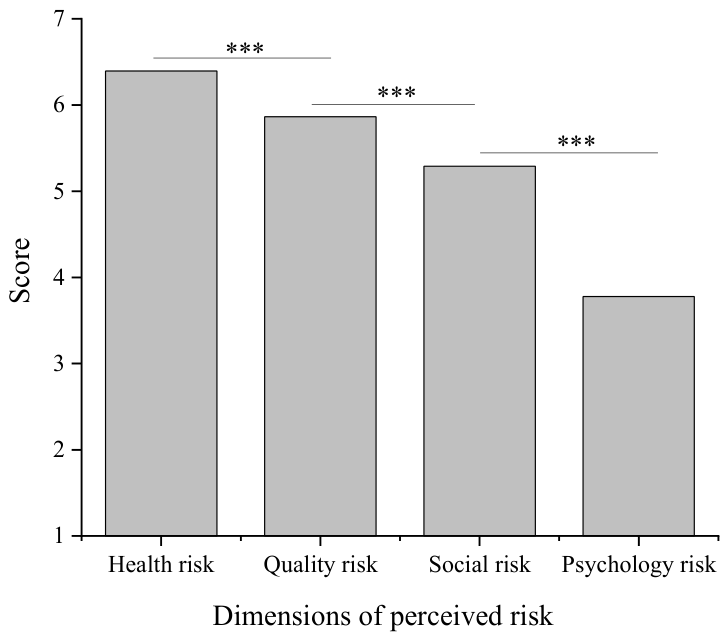
3.3. Results for Perceived Risk Dimensions
3.4. Influence of Demographic Variables on Perceived Risk Dimensions
3.5. Effects of Perceived Risk Dimensions on Purchase Intention
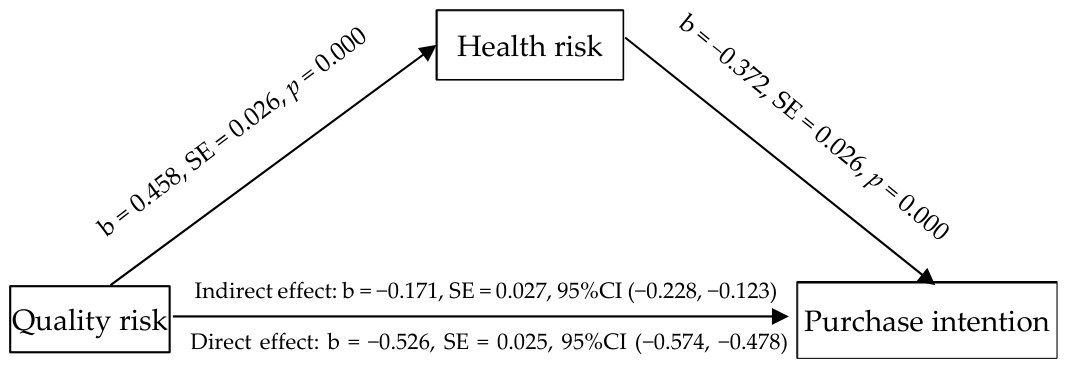
3.6. Mediating Role of Perceived Health Risk
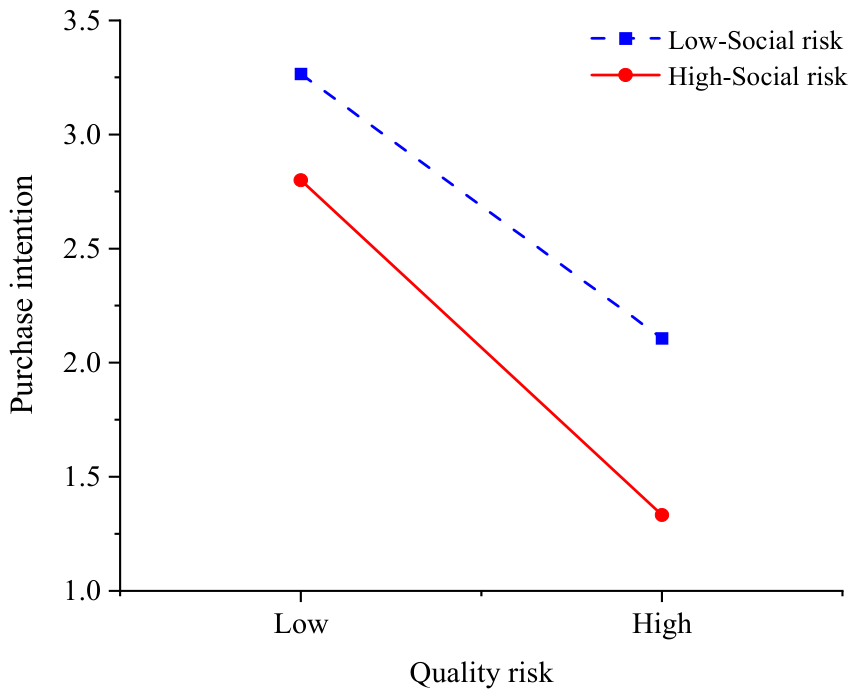
3.7. Moderating Role of Perceived Social Risk
4. Discussion
4.1. General Discussion
4.1.1. Perceived Quality and Health Risk
4.1.2. The Dual Role of Perceived Social Risk
4.1.3. The Non-Significant Role of Perceived Psychological Risk
4.2. Theoretical Contributions
4.3. Practical Implications
4.4. Limitations and Future Research
5. Conclusions
Author Contributions
Funding
Institutional Review Board Statement
Informed Consent Statement
Data Availability Statement
Conflicts of Interest
References
- UNEP. UNEP Food Waste Index Report 2024; United Nations Environment Programme: Nairobi, Kenya, 2024; Available online: https://www.unep.org/resources/publication/food-waste-index-report-2024 (accessed on 27 March 2024).
- Wang, Y.; Ying, H.; Stefanovski, D.; Shurson, G.C.; Chen, T.; Wang, Z.; Yin, Y.; Zheng, H.; Nakaishi, T.; Li, J.; et al. Food waste used as a resource can reduce climate and resource burdens in agrifood systems. Nat. Food 2025, 6, 478–490. [Google Scholar] [CrossRef] [PubMed]
- Williams, H.; Wikström, F. Environmental impact of packaging and food in a life cycle perspective: A comparative analysis of five food items. J. Clean. Prod. 2011, 19, 43–48. [Google Scholar] [CrossRef]
- Aschemann-Witzel, J.; de Hooge, I.E.; Almli, V.L. My style, my food, my waste: Understanding food waste-related lifestyle segments. J. Retail. Consum. Serv. 2021, 59, 102353. [Google Scholar] [CrossRef]
- Bech-Larsen, T.; Aschemann-Witzel, J.; Kulikovskaja, V. Re-distribution and promotion practices for suboptimal foods: Commercial and social initiatives for the reduction of food waste. Soc. Bus. Rev. 2019, 14, 186–199. [Google Scholar] [CrossRef]
- Aschemann-Witzel, J. Consumer perception and preference for suboptimal food under the emerging practice of expiration date based pricing in supermarkets. Food Qual. Prefer. 2018, 63, 119–128. [Google Scholar] [CrossRef]
- Aschemann-Witzel, J.; de Hooge, I.E.; Amani, P.; Bech-Larsen, T.; Oostindjer, M. Consumer-related food waste: Causes and potential for action. Sustainability 2015, 7, 6457–6477. [Google Scholar] [CrossRef]
- de Hooge, I.E.; Oostindjer, M.; Aschemann-Witzel, J.; Normann, A.; Loose, S.M.; Almli, V.L. This apple is too ugly for me! Consumer preferences for suboptimal food products in the supermarket and at home. Food Qual. Prefer. 2017, 56, 80–92. [Google Scholar] [CrossRef]
- Devin, B.; Richards, C. Food waste, power, and corporate social responsibility in the Australian food supply chain. J. Bus. Ethics 2018, 150, 199–210. [Google Scholar] [CrossRef]
- Giménez, A.; Alcaire, F.; Vidal, L.; Antúnez, L.; Lado, J.; Dini, M.; Ares, G. From visual bias to sensory redemption: Consumer perception of suboptimal fruits through the lens of expectation-disconfirmation theory. Food Qual. Prefer. 2026, 136, 105755. [Google Scholar] [CrossRef]
- Parizeau, K.; von Massow, M.; Martin, R. Household-level dynamics of food waste production and related beliefs, attitudes, and behaviours in Guelph, Ontario. Waste Manag. 2015, 35, 207–217. [Google Scholar] [CrossRef]
- Szymkowiak, A.; Antoniak, M.A.; Maślana, N. Changing consumer attitudes towards suboptimal foods: The effect of zero waste labeling. Food Qual. Prefer. 2024, 114, 105095. [Google Scholar] [CrossRef]
- Chen, C.C.; Hanum, F.; Bui, T.D.; Lim, M.K.; Tseng, M.L. Suboptimal food products in Indonesia: A sustainable consumption behavior choice experiment and unveiling the attributes with a causality approach. Ann. Oper. Res. 2024, 35, 1175–1221. [Google Scholar] [CrossRef]
- Lim, S.M.; Law, H.; Lee, S.S. Consumers’ quality perception and acceptance of suboptimal food: An online survey in Selangor and Kuala Lumpur, Malaysia. Foods 2023, 12, 2824. [Google Scholar] [CrossRef] [PubMed]
- Loebnitz, N.; Grunert, K.G. The effect of food shape abnormality on purchase intentions in China. Food Qual. Prefer. 2015, 40, 24–30. [Google Scholar] [CrossRef]
- Adel, A.M.; Dai, X.; Roshdy, R.S. Investigating consumers’ behavioral intentions toward suboptimal produce: An extended theory of planned behavior—A cross-cultural study. Br. Food J. 2021, 124, 99–139. [Google Scholar] [CrossRef]
- Wong, S.L.; Hsu, C.C.; Chen, H.S. To buy or not to buy? Consumer attitudes and purchase intentions for suboptimal food. Int. J. Environ. Res. Public Health 2018, 15, 1431. [Google Scholar] [CrossRef]
- Huang, W.S.; Kuo, H.Y.; Tung, S.Y.; Chen, H.S. Assessing consumer preferences for suboptimal food: Application of a choice experiment in citrus fruit retail. Foods 2021, 10, 15. [Google Scholar] [CrossRef]
- Chang, H.H. Effectiveness of environmental claims in preventing food waste: Exploring consumer perspectives toward suboptimal food. Asia Pac. J. Mark. Logist. 2022, 35, 2093–2109. [Google Scholar] [CrossRef]
- Yang, C.; Chen, X.Q. Factors affecting consumers’ purchasing of suboptimal foods during the COVID-19 pandemic. Agriculture 2022, 12, 99. [Google Scholar] [CrossRef]
- Chang, H.H.; Lu, L.C.; Kuo, T.C. Are discounts useful in promoting suboptimal foods for sustainable consumption and production? The interaction effects of original prices, discount presentation modes, and product types. J. Retail. Consum. Serv. 2024, 79, 103881. [Google Scholar] [CrossRef]
- Jacoby, J. Consumer psychology: An octennium. Annu. Rev. Psychol. 1976, 27, 331–358. [Google Scholar] [CrossRef]
- Bauer, R.A. Consumer behavior as risk taking. In Dynamic Marketing for a Changing World: Proceedings of the 43rd Conference of the American Marketing Association; Hancock, R.S., Ed.; American Marketing Association: Chicago, IL, USA, 1960; pp. 389–398. [Google Scholar]
- Zhong, Y. Impact of the perceived value and perceived risk on consumers’ purchase behavior of suboptimal food. Br. Food J. 2025, 127, 539–553. [Google Scholar] [CrossRef]
- Xiao, J.; Wang, Q.; Dai, J.; Yang, B.; Li, L. Urban Residents’ Green Agro-Food Consumption: Perceived Risk, Decision Behaviors, and Policy Implications in China. Sustainability 2023, 15, 10505. [Google Scholar] [CrossRef]
- Mookerjee, S.; Cornil, Y.; Hoegg, J. From waste to taste: How “ugly” labels can increase purchase of unattractive produce. J. Mark. 2021, 85, 62–77. [Google Scholar] [CrossRef]
- Orquin, J.L.; Loose, S.M. Attention and choice: A review on eye movements in decision making. Acta Psychol. 2013, 144, 190–206. [Google Scholar] [CrossRef]
- de Jonge, J.; van Trijp, H.; Jan Renes, R.; Frewer, L. Understanding consumer confidence in the safety of foods: Its two-dimensional structure and determinants. Risk Anal. 2007, 27, 729–740. [Google Scholar] [CrossRef]
- Rozin, P. The integration of biological, social, cultural and psychological influences on food choice. In The Psychology of Food Choice; Shepherd, R., Raats, M., Eds.; CABI Publishing: Wallingford, UK, 2006; pp. 19–39. [Google Scholar]
- White, K.; Lin, L.; Dahl, D.W.; Ritchie, R.J.B. When do consumers avoid imperfections? Superficial packaging damage as a contamination cue. J. Mark. Res. 2016, 53, 110–123. [Google Scholar] [CrossRef]
- Zhang, W.; Zheng, J.; Li, Y. Explaining Chinese Consumers’ Continuous Consumption Intention toward Prepared Dishes: The Role of Perceived Risk and Trust. Foods 2024, 13, 88. [Google Scholar] [CrossRef]
- Mitchell, V.-W. Consumer perceived risk: Conceptualisations and models. Eur. J. Mark. 1999, 33, 163–195. [Google Scholar] [CrossRef]
- Pentz, C.D.; Du Preez, R.; Swiegers, L. To bu(Y) or not to bu(Y): Perceived risk barriers to online shopping among South African generation Y consumers. Cogent Bus. Manag. 2020, 7, 1827813. [Google Scholar] [CrossRef]
- Grewal, D.; Gotlieb, J.; Marmorstein, H. The moderating effects of message framing and source credibility on the price-perceived risk relationship. J. Consum. Res. 1994, 21, 145–153. [Google Scholar] [CrossRef] [PubMed]
- Cao, S.Y.; Gong, S.L.; Bai, L. Situational variables that affect consumers’ suboptimal food purchasing behavior in China. Br. Food J. 2023, 125, 145–166. [Google Scholar] [CrossRef]
- White, K.; Habib, R.; Hardisty, D.J. How to SHIFT consumer behaviors to be more sustainable: A literature review and guiding framework. J. Mark. 2019, 83, 22–49. [Google Scholar] [CrossRef]
- Schanes, K.; Dobernig, K.; Gözet, B. Food waste matters—A systematic review of household food waste practices and their policy implications. J. Clean. Prod. 2018, 182, 978–991. [Google Scholar] [CrossRef]
- Stancu, V.; Haugaard, P.; Lähteenmäki, L. Determinants of consumer food waste behaviour: Two routes to food waste. Appetite 2016, 96, 7–17. [Google Scholar] [CrossRef]
- Vermeir, I.; Verbeke, W. Sustainable food consumption: Exploring the consumer “attitude–behavioral intention” gap. J. Agric. Environ. Ethics 2006, 19, 169–194. [Google Scholar] [CrossRef]
- Poulis, A.; Theodoridis, P.; Chatzopoulou, E. Sustainable brand resilience: Mitigating panic buying through brand value and food waste attitudes amid social media misinformation. Sustainability 2024, 16, 6658. [Google Scholar] [CrossRef]
- Bai, L.; Cao, S.; Gong, S.; Huang, L. Motivations and obstructions of minimizing suboptimal food waste in Chinese households. J. Clean. Prod. 2022, 342, 130951. [Google Scholar] [CrossRef]
- Dodds, W.B.; Monroe, K.B.; Grewal, D. Effects of price, brand, and store information on buyers’ product evaluations. J. Mark. Res. 1991, 28, 307–319. [Google Scholar]
- Gao, P.; Zhu, Z.-Y. Does Xenophobia Among Local Residents Affect Sustainable Tourism Development in China? A Study Based on Attribution Theory and Social Identity Theory. Sustainability 2025, 17, 11201. [Google Scholar] [CrossRef]
- Aiken, L.S.; West, S.G. Multiple Regression: Testing and Interpreting Interactions; Sage Publications: Newbury Park, CA, USA, 1991. [Google Scholar]
- Zhang, X.; Gao, M.; He, B.; Chen, C.H.; Hu, L. From Pen to Plate: How Handwritten Typeface and Narrative Perspective Shape Consumer Perceptions in Organic Food Consumption. Sustainability 2025, 17, 3961. [Google Scholar] [CrossRef]
- Chang, H.H.; Su, J.W. Sustainable consumption in Taiwan retailing: The impact of product features and price promotion on purchase behaviors toward expiring products. Food Qual. Prefer. 2022, 96, 104452. [Google Scholar] [CrossRef]
- Hartmann, T.; Jahnke, B.; Hamm, U. Making ugly food beautiful: Consumer barriers to purchase and marketing options for Suboptimal Food at retail level—A systematic review. Food Qual. Prefer. 2021, 90, 104179. [Google Scholar] [CrossRef]
- Grunert, K.G.; Søndergaard, H.A.; Scholderer, J. How can we know what we like when we don’t understand it? Consumer attitude formation towards complex technical issues. Presented at the International Conference on Research in Advertising, Oslo, Norway, 6–8 June 2004. [Google Scholar]
- Elimelech, E.; Ert, E.; Parag, Y.; Hochman, G. Exploring the Impact of Visual Perception and Taste Experience on Consumers’ Acceptance of Suboptimal Fresh Produce. Sustainability 2024, 16, 2698. [Google Scholar] [CrossRef]
- Li, Y.; Wang, L.; Liu, G.; Cheng, S. Rural household food waste characteristics and driving factors in China. Resour. Conserv. Recycl. 2021, 164, 105209. [Google Scholar] [CrossRef]
- Wilson, N.L.W.; Rickard, B.J.; Saputo, R.; Ho, S. Food waste: The role of date labels, package size, and product category. Food Qual. Prefer. 2017, 55, 35–44. [Google Scholar] [CrossRef]
- Acebrón, L.B.; Dopico, D.C. The importance of intrinsic and extrinsic cues to expected and experienced quality: An empirical application for beef. Food Qual. Prefer. 2000, 11, 229–238. [Google Scholar] [CrossRef]
- Wei, S.; Ou, L.; Luo, M.R.; Hutchings, J.B. Optimisation of food expectations using product colour and appearance. Food Qual. Prefer. 2012, 23, 49–62. [Google Scholar] [CrossRef]
- Van Boxstael, S.; Devlieghere, F.; Berkvens, D.; Vermeulen, A.; Uyttendaele, M. Understanding and attitude regarding the shelf life labels and dates on pre-packed food products by Belgian consumers. Food Control 2014, 37, 85–92. [Google Scholar] [CrossRef]
- Siegrist, M.; Hartmann, C. Consumer acceptance of novel food technologies. Nat. Food 2020, 1, 343–350. [Google Scholar] [CrossRef]
- Qian, Z.; Li, J.; Zhang, Y.; Liu, Y.; Wang, Q. Understanding gender differences in online protective products purchases through an impression management perspective: Evidence from a natural experiment. Inf. Process. Manag. 2025, 62, 104181. [Google Scholar] [CrossRef]
- Inglehart, R.; Baker, W.E. Modernization, cultural change, and the persistence of traditional values: Looking forward, looking back: Continuity and change at the turn of the millennium. Am. Sociol. Rev. 2000, 65, 19–51. [Google Scholar] [CrossRef]
- Zhou, L.; Zhang, S.-J. How face as a system of value-constructs operates through the interplay of mianzi and lian in Chinese: A corpus-based study. Lang. Sci. 2017, 64, 152–166. [Google Scholar] [CrossRef]
- Ren, Z.; Howe, C.Q.; Zhang, W. Maintaining “mianzi” and “lizi”: Understanding the reasons for formality marriages between gay men and lesbians in China. Transcult. Psychiatry 2019, 56, 213–232. [Google Scholar] [CrossRef]
- Jiang, L.; Cui, A.P.; Shan, J. The risk of embarrassment in buying luxury counterfeits: Do face-conscious consumers care? Eur. J. Mark. 2023, 57, 1996–2020. [Google Scholar] [CrossRef]
- Tufail, H.S.; Yaqub, R.M.S.; Alsuhaibani, A.M.; Ramzan, S.; Shahid, A.U.; Refat, M.S. Consumers’ purchase intention of suboptimal food using behavioral reasoning theory: A food waste reduction strategy. Sustainability 2022, 14, 8905. [Google Scholar] [CrossRef]



| Variable | Category | Frequency | Percentage |
|---|---|---|---|
| Gender | Male | 509 | 49.8% |
| Female | 513 | 50.2% | |
| Location | Countryside | 429 | 42.0% |
| City | 593 | 58.0% | |
| Age | 18–29 years | 214 | 20.9% |
| 30–39 years | 337 | 33.0% | |
| 40–49 years | 282 | 27.6% | |
| 50 years and older | 189 | 18.5% | |
| Education | Secondary schools and below | 289 | 28.3% |
| Senior school | 315 | 30.8% | |
| College degree | 240 | 23.5% | |
| Graduate or above | 178 | 17.4% | |
| Income | 3000 or less | 394 | 38.6% |
| 3001–5000 | 289 | 28.3% | |
| 5001–10,000 | 245 | 24.0% | |
| More than 10,000 | 94 | 9.2% | |
| Household size | 1 person or 2 persons | 192 | 18.8% |
| 3 persons | 364 | 35.6% | |
| More than 3 people | 466 | 45.6% |
| Latent Variable | Item | Cronbach’s α | KMO | CR | AVE |
|---|---|---|---|---|---|
| Psychology risk | I feel psychological pressure to purchase suboptimal food. | 0.877 | 0.737 | 0.878 | 0.708 |
| I would not feel wise to purchase suboptimal food. | |||||
| I worry about purchasing suboptimal food. | |||||
| Quality risk | Suboptimal food is of poor quality compared to normal food. | 0.835 | 0.500 | 0.835 | 0.717 |
| Suboptimal food is less nutritious or functional than normal food. | |||||
| Health risk | Purchasing suboptimal food is associated with a higher risk of illness. | 0.905 | 0.727 | 0.908 | 0.769 |
| Purchasing suboptimal food will damage your health. | |||||
| It is not harmful to eat suboptimal food. | |||||
| Social risk | Purchasing suboptimal food would be laughed at by those around me. | 0.886 | 0.745 | 0.886 | 0.722 |
| Purchasing suboptimal food is considered unwise by those around me. | |||||
| Purchasing suboptimal food will affect my image in the eyes of those around me. | |||||
| Purchase intention | I am highly likely to purchase the suboptimal food mentioned above. | 0.936 | 0.864 | 0.936 | 0.786 |
| I think the suboptimal food described above are worth purchasing. | |||||
| I would recommend to my friends to purchase the suboptimal food described above. |
| Latent Variable | Psychology Risk | Quality Risk | Health Risk | Social Risk | Purchase Intention |
|---|---|---|---|---|---|
| Psychology risk | (0.841) | ||||
| Quality risk | 0.021 | (0.847) | |||
| Health risk | −0.029 | 0.491 ** | (0.877) | ||
| Social risk | 0.050 | 0.468 ** | 0.158 ** | (0.850) | |
| Purchase intention | 0.002 | −0.682 ** | −0.592 ** | −0.529 ** | (0.887) |
| Latent Variable | F | t | Sig. | Difference in Mean | |
|---|---|---|---|---|---|
| Gender | Health risk | 9.252 | −2.450 | 0.014 | −0.155 |
| Quality risk | 2.813 | −2.488 | 0.013 | −0.167 | |
| Latent Variable | Test Method | (I) | (J) | Mean Value (I–J) | Significance | |
|---|---|---|---|---|---|---|
| Age | Social risk | LSD | 18~29 years old | 30~39 years old | −0.322 * | 0.006 |
| 30~39 years old | ≥50 years old | 0.331 * | 0.005 | |||
| Education | Social risk | Tamhane | Middle school and below | Undergraduate or junior college | −0.383 * | 0.002 |
| High school or technical secondary school | Undergraduate or junior college | −0.328 * | 0.011 | |||
| Household size | Social risk | LSD | 1 or 2 persons | 3 persons | −0.243 * | 0.036 |
| ≥4 persons | −0.381 * | 0.001 | ||||
| Variables | Model 1 | Model 2 | ||||
|---|---|---|---|---|---|---|
| B | Standard Error | p | B | Standard Error | p | |
| Constant | 8.395 | 0.165 | 0.000 | 8.692 | 0.221 | 0.000 |
| Health risk | −0.402 | 0.024 | 0.000 | −0.402 | 0.024 | 0.000 |
| Quality risk | −0.369 | 0.025 | 0.000 | −0.366 | 0.026 | 0.000 |
| Social risk | −0.258 | 0.019 | 0.000 | −0.257 | 0.019 | 0.000 |
| Psychology risk | 0.011 | 0.016 | 0.475 | 0.013 | 0.016 | 0.394 |
| Gender | −0.060 | 0.043 | 0.164 | |||
| Location | −0.045 | 0.048 | 0.350 | |||
| Age | −0.022 | 0.021 | 0.301 | |||
| Education | −0.034 | 0.022 | 0.115 | |||
| Income | −0.029 | 0.022 | 0.198 | |||
| Household size | 0.011 | 0.029 | 0.716 | |||
| Adjusted R2 | 0.622 | 0.623 | ||||
| F | 420.622 | 169.412 | ||||
| p | 0.000 | 0.000 | ||||
| Durbin-Watson | 1.638 | |||||
| Mean purchase intention (SD) | 2.34 (1.11) | |||||
| Dependent variable: suboptimal food purchase intention | ||||||
| Variables | B | Standard Error | t | p |
|---|---|---|---|---|
| Constant | 2.716 | 0.179 | 15.177 | 0.000 |
| Gender | −0.081 | 0.048 | −1.698 | 0.090 |
| Location | −0.030 | 0.054 | −0.562 | 0.574 |
| Age | −0.014 | 0.024 | −0.608 | 0.544 |
| Education | −0.027 | 0.024 | −1.128 | 0.259 |
| Income | −0.029 | 0.025 | −1.155 | 0.248 |
| Household size | −0.006 | 0.033 | −0.184 | 0.854 |
| Quality risk | −0.608 *** | 0.027 | −22.663 | 0.000 |
| Social risk | −0.238 *** | 0.021 | −11.263 | 0.000 |
| Quality risk × Social risk | −0.055 *** | 0.012 | −4.473 | 0.000 |
| Adjusted R2 | 0.529 |
Disclaimer/Publisher’s Note: The statements, opinions and data contained in all publications are solely those of the individual author(s) and contributor(s) and not of MDPI and/or the editor(s). MDPI and/or the editor(s) disclaim responsibility for any injury to people or property resulting from any ideas, methods, instructions or products referred to in the content. |
© 2026 by the authors. Licensee MDPI, Basel, Switzerland. This article is an open access article distributed under the terms and conditions of the Creative Commons Attribution (CC BY) license.
Share and Cite
Cao, S.; Tang, Y. Deconstructing Perceived Risk to Predict Suboptimal Food Purchase: A Strategy for Mitigating Food Waste. Sustainability 2026, 18, 4192. https://doi.org/10.3390/su18094192
Cao S, Tang Y. Deconstructing Perceived Risk to Predict Suboptimal Food Purchase: A Strategy for Mitigating Food Waste. Sustainability. 2026; 18(9):4192. https://doi.org/10.3390/su18094192
Chicago/Turabian StyleCao, Shiyang, and Yifan Tang. 2026. "Deconstructing Perceived Risk to Predict Suboptimal Food Purchase: A Strategy for Mitigating Food Waste" Sustainability 18, no. 9: 4192. https://doi.org/10.3390/su18094192
APA StyleCao, S., & Tang, Y. (2026). Deconstructing Perceived Risk to Predict Suboptimal Food Purchase: A Strategy for Mitigating Food Waste. Sustainability, 18(9), 4192. https://doi.org/10.3390/su18094192