1. Introduction
Citrus production depends on climate. Temperature and water availability shape flowering, fruit set, and fruit development. Small shifts in these conditions can affect yield stability and fruit quality. Citrus trees are particularly sensitive to temperature extremes during flowering and early fruit formation [
1,
2,
3,
4].
Fruit crops are exposed to climatic variability. Heat stress reduces fruit set and increases physiological disorders. High temperatures also affect fruit size and quality. Empirical studies show that productivity declines once critical temperature thresholds are exceeded [
5,
6,
7,
8]. In citrus systems, temperature sensitivity is particularly pronounced during flowering and early fruit set stages, where heat stress can disrupt pollination, reduce fruit set, and increase fruit drop. These stage-specific responses make citrus production especially vulnerable to short-term temperature extremes.
Climate change adds pressure to these systems. Temperature trends are shifting. Rainfall patterns are becoming less predictable. Variability is increasing. These changes affect agricultural production in many regions. Mediterranean systems are especially exposed. Production often takes place under semi-arid conditions and depends on irrigation [
9,
10,
11,
12,
13].
Citrus is a major global fruit group. Total production exceeded 169 million tons in 2023. Mandarin alone accounted for more than 52 million tons [
14]. Demand continues to grow. Trade has expanded in parallel [
15,
16,
17]. Against this global background, Türkiye provides a particularly relevant case study due to its position as one of the leading producers and exporters of mandarins, combined with its exposure to Mediterranean climatic conditions that are highly sensitive to temperature changes.
Türkiye is a key producer. It ranked third in global mandarin production and second in exports in 2023 [
14]. Production is concentrated in coastal provinces. These areas offer suitable conditions for citrus cultivation. Mild winters and long growing seasons support orchard productivity [
18,
19,
20,
21]. This concentration makes Türkiye an ideal setting to examine how climatic variability translates into production outcomes at the regional level.
Recent evidence points to clear climatic shifts in Türkiye. Temperatures have increased. Precipitation patterns have changed. Drought risk has intensified in several regions [
22,
23,
24,
25]. These trends may affect citrus systems that rely on stable thermal conditions during sensitive growth stages.
Evidence at the crop level remains limited. Most studies focus on aggregate agricultural production or other crops. Mandarin-specific analyses are scarce, especially at the regional scale. This gap matters. Citrus production responds to local climate and orchard conditions. Understanding these responses is essential for assessing resilience in Mediterranean production systems. This study contributes to the literature by jointly analysing climatic and economic determinants of mandarin production within a provincial panel data framework. Unlike studies that focus solely on climatic variables, this approach captures both environmental constraints and production conditions, including adaptation-related factors such as energy use.
This study examines the link between climate change and mandarin production in Türkiye. It also captures adaptation through production-related conditions. A provincial panel dataset covering 2004–2023 is used. The analysis focuses on ten provinces that account for almost all national output. Climate variables include mean temperature and total precipitation. Economic variables include population, agricultural energy use, and lagged producer prices. The panel framework allows regional heterogeneity to be controlled. The results provide new evidence on how climate and adaptation shape mandarin production in a major producing country.
2. Materials and Methods
2.1. Study Area
Mandarin production in Türkiye is concentrated in a limited number of provinces located mainly along the Mediterranean and Aegean coasts. These regions provide suitable climatic conditions for citrus cultivation, including mild winters, long growing seasons, and favorable temperature regimes. Such conditions make these coastal areas the primary citrus-growing zones of the country.
This study focuses on ten provinces where mandarin production is most intensive: Adana, Antalya, Aydın, Balıkesir, Hatay, Kahramanmaraş, Mersin, Muğla, Osmaniye, and İzmir. Together, these provinces account for almost the entire mandarin production of Türkiye. According to official statistics, approximately 99% of national mandarin output originates from these provinces [
16].
Table 1 presents mandarin production levels in Türkiye and in the major producing provinces for selected years. In 2023, total mandarin production in Türkiye reached 2,952,775 tons. Of this amount, 2,947,111 tons were produced in the ten provinces included in the analysis. This corresponds to 99.81% of national production.
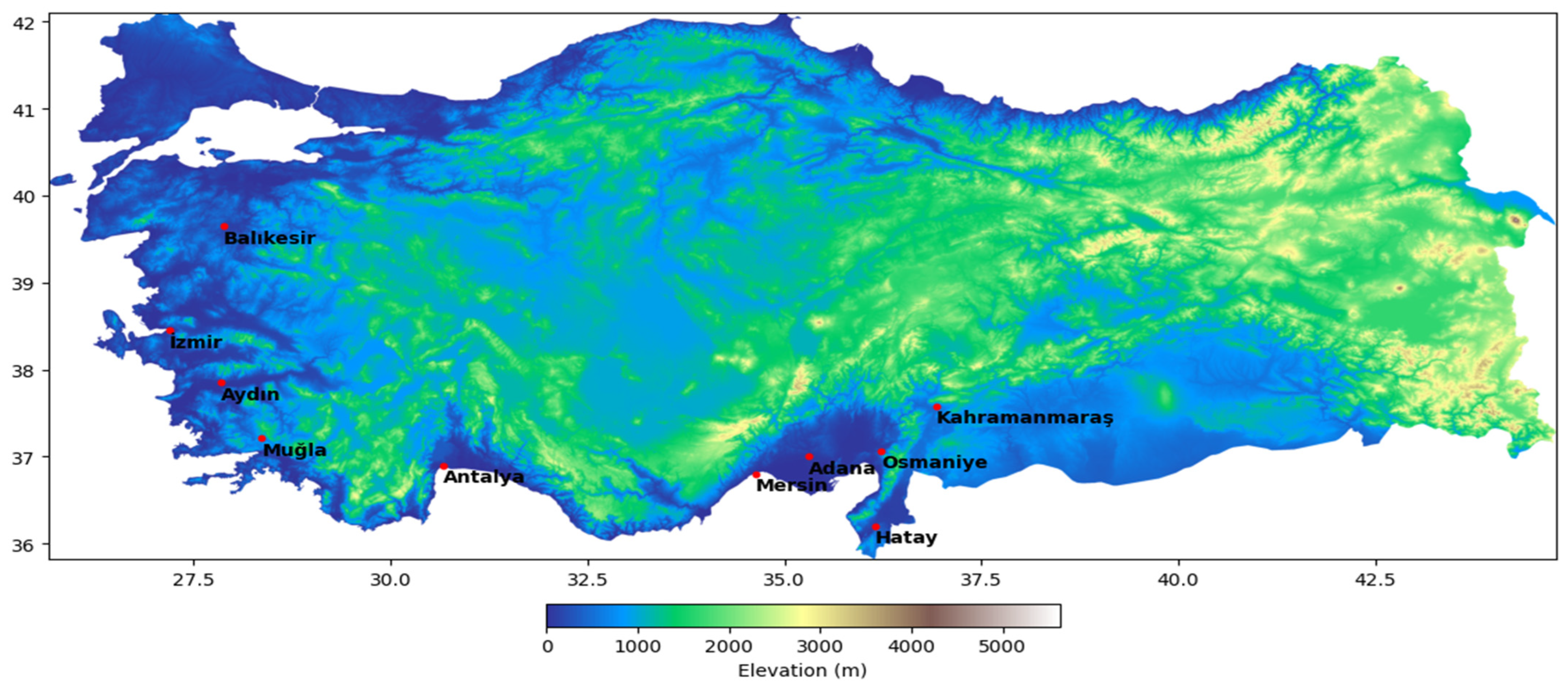
The spatial distribution of the study area is shown in
Figure 1. Most of the provinces are located in Mediterranean citrus production zones, while a smaller share of production occurs in Aegean coastal regions. The concentration of production in these provinces makes them suitable for analyzing the relationship between climatic conditions and mandarin production in Türkiye.
2.2. Datasets
This study uses a provincial panel dataset covering the period 2004–2023. The dataset includes ten provinces where mandarin production is concentrated in Türkiye. These provinces represent almost the entire national production.
The dependent variable is annual mandarin production (tons). Data on mandarin production were obtained from the Turkish Statistical Institute crop production statistics database [
16].
Several climatic and socio-economic variables were included in the analysis. Climatic variables consist of mean annual temperature (°C) and total annual precipitation (mm). These data were obtained from the World Bank Climate Change Knowledge Portal, which provides standardized historical climate data for many countries [
24].
Economic variables were also included in the model. Producer prices for mandarins (TRY/kg) were collected from the Turkish Statistical Institute agricultural price statistics [
25]. Because mandarin is a perennial crop, production decisions respond slowly to price signals. For this reason, producer prices were introduced into the model with a one-year lag.
Agricultural energy consumption (MWh) was used as an indicator of production intensity and mechanization. Agricultural energy use can also be interpreted as a proxy for adaptation capacity, as it reflects irrigation intensity and farmers’ ability to mitigate climatic stress. These data were obtained from national energy statistics published by the Turkish Statistical Institute [
26]. Population data (persons) were also included to reflect regional economic activity and market size. Population statistics were obtained from the Address-Based Population Registration System of the Turkish Statistical Institute [
27].
All monetary variables were converted to real terms using the Consumer Price Index (CPI, 2003 = 100) to remove the effects of inflation [
28]. The final dataset consists of 200 province–year observations. Descriptive statistics for all variables are presented in
Table 2.
Provincial yield statistics are not consistently available for the full study period. Therefore, production data are used as the most reliable long-term indicator of regional output. It should be noted that production reflects both yield and harvested area. However, in perennial crops such as mandarin, changes in harvested area typically occur gradually due to the long-term nature of orchard investment. As a result, short-term variation in production is largely driven by yield responses and management conditions rather than abrupt changes in cultivated area.
The model is intentionally parsimonious because several potentially relevant variables—such as fertilizer use, irrigation infrastructure, export demand, trade shocks, technological change, and extreme weather indicators—are not consistently available at the provincial level for the full study period.
All variables were compiled from official statistical sources and checked for consistency across provinces and years. The dataset is balanced, with no missing observations over the study period. Therefore, no interpolation or imputation procedures were required.
2.3. Methodology
2.3.1. Baseline Model
The relationship between climate variability and mandarin production was analysed using a panel data framework. The dataset includes observations for ten provinces covering the period 2004–2023. Panel models allow regional differences and time variation to be analysed jointly. This structure makes it possible to control for unobserved characteristics that remain constant across provinces.
The econometric model is specified as follows:
where y
dt denotes mandarin production in province d during year t. Temp
dt represents mean annual temperature and Rain
dt represents total annual precipitation. Pop
dt denotes population and Energy
dt represents agricultural energy consumption. Price
d,t−1 denotes the producer price of mandarins with a one-year lag.
All variables are specified in level form. This allows the estimated coefficients to be interpreted directly in terms of changes in production associated with changes in the explanatory variables.
Producer prices were introduced with a lag because mandarin is a perennial crop. Orchard production responds slowly to economic signals. Farmers typically adjust production decisions after observing price developments in the previous season.
The term δd represents province fixed effects. These effects capture time-invariant regional characteristics such as soil conditions, orchard age structure, and long-term production capacity. The term τt represents year fixed effects and controls for common shocks affecting all provinces in a given year. The error term is denoted by εdt.
2.3.2. Fixed-Effects and Random-Effects Estimation
Two panel estimators were considered: fixed effects and random effects. The fixed effects estimator controls for unobserved, time-invariant provincial characteristics that may be correlated with the explanatory variables. These may include factors such as soil quality, orchard structure, and long-term infrastructure conditions. By removing these time-invariant effects, the fixed-effects model provides consistent estimates when such correlations are present [
29].
In contrast, the random-effects estimator assumes that province-specific effects are uncorrelated with the explanatory variables. Under this assumption, the random-effects model can be more efficient. However, if this assumption is violated, the estimates become inconsistent. Estimating both models allows this assumption to be tested empirically through the Hausman specification test.
2.3.3. Hausman Test
The Hausman specification test was used to determine the appropriate estimator. The null hypothesis assumes that the random-effects estimator is efficient and consistent. Rejection of the null hypothesis indicates that the fixed-effects estimator provides more reliable results.
The Hausman test is commonly applied in panel data analysis to guide model selection when both estimators are available [
30].
2.3.4. Robustness and Diagnostic Tests
Several diagnostic procedures were conducted to assess the reliability of the panel estimations. Panel data models may be affected by heteroskedasticity and serial correlation, which can lead to biased standard errors. To address these potential issues, all regressions were estimated using robust standard errors clustered at the provincial level.
Multicollinearity among explanatory variables was examined using variance inflation factors (VIF). This diagnostic helps identify whether strong correlations among regressors may distort coefficient estimates. The calculated VIF values remained well below commonly accepted threshold levels, indicating that multicollinearity is not a major concern in the estimated models.
Robustness checks were also conducted by estimating alternative model specifications. In particular, additional regressions including lagged climate variables were estimated to examine whether climatic conditions may influence mandarin production with a temporal delay. This approach is relevant for perennial crops such as citrus, where production responses to climatic conditions may extend over more than one production cycle.
Climatic variables were introduced in annual form because long-term regional production statistics are reported on a yearly basis and consistent higher-frequency climate data are not available for all provinces over the study period. Annual indicators capture the overall climatic conditions experienced during the production cycle. However, they may not fully reflect short-term climatic variability during critical phenological stages such as flowering and fruit set. As a result, the estimated coefficients should be interpreted as representing average climatic effects over the production cycle rather than stage-specific responses.
The variables were estimated in level form because the objective of the analysis is to examine the association between climatic conditions and observed production levels across provinces. Using level variables allows the estimated coefficients to be interpreted directly in terms of changes in production.
Overall, the robustness analyses indicate that the main empirical results remain stable across alternative specifications.
3. Results
Mandarin production has expanded substantially over the last two decades. According to FAO statistics, global production reached 52,556,927 tons in 2023. Production is highly concentrated in a limited number of countries.
China is the largest producer, with approximately 26.9 million tons. India ranks second with about 6.18 million tons. Türkiye ranks third with 2.95 million tons. Other major producers include Pakistan, Spain, Egypt, Brazil, the United States, Italy, and Morocco.
These ten countries account for a large share of global mandarin production. Production levels for the major producing countries are presented in
Table 3.
Mandarin trade is also concentrated in a limited number of exporting countries. Spain is the leading exporter, with exports exceeding 1.05 million tons in 2023. Türkiye ranks second with exports of about 969,849 tons. China ranks third.
Other important exporters include South Africa, Morocco, Pakistan, Egypt, Chile, Peru, and the Netherlands. Export volumes for the main exporting countries are presented in
Table 4.
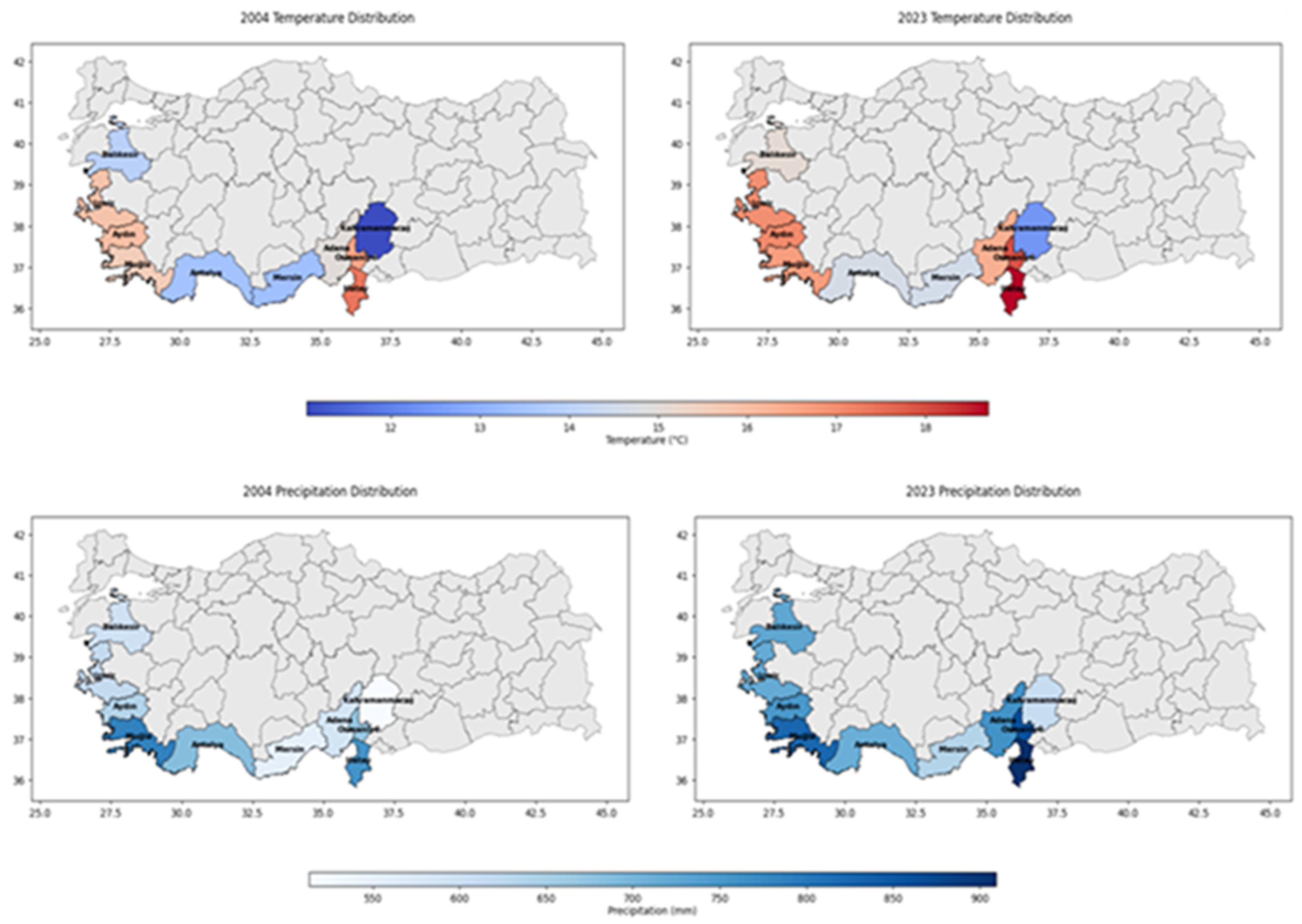
Temperature and precipitation patterns changed during the study period. Mean temperatures in the major mandarin-producing provinces show a gradual upward trend between 2004 and 2023. Precipitation patterns show higher variability across years.
Figure 2 illustrates the evolution of temperature and precipitation in the provinces included in the dataset. Temperature increases are visible across most provinces, although the magnitude differs by region.
The estimated regression results are presented in
Table 5. Two model specifications were estimated to examine the relationship between climatic variables and mandarin production. The regression results show a consistent pattern across model specifications. The negative relationship between temperature and mandarin production is observed in pooled OLS (Ordinary least squares), random-effects, and fixed-effects models, although the magnitude of the coefficient declines when moving from OLS to fixed effects. This suggests that part of the variation captured in simpler models reflects unobserved provincial heterogeneity. In contrast, the fixed-effects estimates provide a more conservative and reliable measure of the temperature effect. Precipitation does not show a statistically significant relationship with mandarin production in either specification. This result may reflect the widespread use of irrigation in citrus production areas. Population shows a positive and significant association with production. Provinces with larger populations tend to have higher production levels. Lagged producer prices have a positive and statistically significant effect on mandarin production. The magnitude of the coefficient indicates that increases in previous-year prices are associated with higher production levels, reflecting the gradual adjustment of production decisions in perennial crop systems.
Agricultural energy consumption also shows a positive association with mandarin production. Although the coefficient appears large in absolute terms, this reflects the scale of the variable, which is measured in MWh. The positive relationship indicates that higher energy use—linked to irrigation, mechanization, and input intensity—is associated with increased production capacity.
Before interpreting the regression coefficients, several diagnostic tests were conducted to assess the reliability of the estimated models.
First, the Hausman specification test was applied to determine the appropriate panel estimator. The test rejected the null hypothesis that the random-effects estimator is consistent. This result indicates that the fixed-effects model provides more reliable estimates for the dataset. Therefore, the main interpretation of the regression results is based on the fixed-effects specification. The results are shown in
Table 6.
Second, multicollinearity among explanatory variables was evaluated using variance inflation factors (VIF). The calculated VIF values were below the commonly accepted threshold levels. This result suggests that multicollinearity is not a major concern in the estimated models and that the explanatory variables provide independent information. The results are shown in
Table 7.
Third, additional robustness checks were conducted by estimating alternative model specifications. These specifications included lagged climate variables to examine whether delayed climate effects influence mandarin production. The results remained broadly consistent across alternative specifications. In particular, the negative relationship between temperature and mandarin production remained statistically significant. The results are shown in
Table 8.
The diagnostic tests confirm the reliability of the estimated models. The Hausman test indicates that the fixed-effects specification is preferred. Multicollinearity is not detected, and the robustness checks show consistent results across alternative specifications.
Among the climatic variables, temperature shows a negative and statistically significant association with mandarin production. Provinces experiencing higher temperatures tend to report lower production levels. The fixed-effects estimates indicate that a one-degree increase in mean annual temperature is associated with a reduction of approximately 483 tons in mandarin production at the provincial level. Although this marginal effect may appear limited in a single year, it becomes economically meaningful when considered across major producing regions and over time. Persistent increases in temperature may therefore lead to cumulative production losses, particularly in Mediterranean environments where baseline temperatures are already high.
Precipitation does not show a statistically significant relationship with mandarin production. Annual rainfall variability does not appear to explain differences in production levels across provinces in the estimated models.
Economic variables are positively associated with mandarin production across all model specifications. Lagged producer prices show a positive effect, indicating that higher prices in the previous year encourage increased production through gradual adjustments in perennial crop systems. Agricultural energy use also exhibits a positive and statistically significant coefficient. Given the scale of the variable, the magnitude reflects the role of energy-intensive inputs such as irrigation and mechanization in sustaining production. Population shows a positive association, capturing regional-scale effects, including infrastructure, labor availability, and market access.
Agricultural energy consumption also shows a positive association with mandarin production. Provinces with higher energy use tend to report higher production levels.
Overall, the results indicate that both climatic and economic variables are associated with differences in mandarin production across provinces. Among the climatic variables considered, temperature emerges as the most consistent factor associated with production variation.
4. Discussion
The results point to a clear pattern. Temperature is negatively associated with mandarin production. This relationship is stable across specifications. The finding is consistent with citrus physiology. Reproductive stages are sensitive to heat. High temperatures reduce pollination success and increase fruit drop. Tree performance weakens under thermal stress [
1,
2,
3,
4,
5,
6]. This pattern aligns with earlier evidence. Warming reduces crop productivity once critical thresholds are exceeded [
7,
8,
9,
10,
11,
12]. Most studies focus on annual crops. Similar responses are observed in perennial systems under prolonged heat exposure. Citrus trees operate within narrow thermal ranges during flowering. Excess heat during this period lowers fruit set and limits output. These findings are consistent with evidence from Mediterranean agricultural systems, where rising temperatures have been shown to reduce crop productivity once thermal thresholds are exceeded [
9,
10,
11,
12]. Similar patterns have also been reported in citrus production, where heat stress during reproductive stages limits fruit set and reduces yield potential [
1,
2,
3,
4]. This alignment suggests that the observed temperature effects are not specific to Türkiye but reflect broader responses of citrus systems under warming conditions.
The regional context supports this interpretation. Production is concentrated in Mediterranean and Aegean provinces. These areas already experience warm conditions. Observed warming trends increase exposure to heat stress during critical growth stages [
17,
18,
22,
23,
24]. Even small temperature shifts can have measurable effects in such environments.
Precipitation is not statistically significant. This does not imply that water is irrelevant. Citrus requires a stable water supply for fruit development [
2,
4]. However, annual rainfall does not fully capture water availability in irrigated systems. Managed irrigation reduces direct dependence on rainfall, and water supply is partly controlled in major producing provinces. This result therefore reflects the structure of citrus production in Türkiye, where irrigation buffers rainfall variability. Similar findings are reported for irrigated agricultural systems [
9,
13].
At the same time, the use of annual climate variables introduces aggregation bias. Short-term climatic variability during critical phenological stages such as flowering and fruit set is averaged out in annual indicators. Citrus production is particularly sensitive to intra-seasonal temperature extremes, which cannot be fully captured by annual data [
33,
34,
35]. Therefore, the estimated coefficients should be interpreted as average effects over the production cycle rather than precise stage-specific responses. Future research could benefit from higher-frequency climate data and refined indicators such as growing degree days or heat stress measures.
Economic variables provide additional insight. The positive effect of lagged prices reflects delayed adjustment. Orchard systems respond slowly to market signals. Farmers adjust inputs and management over time. The estimated lag structure is consistent with perennial crop behaviour [
36]. Agricultural energy use shows a positive association with production. This variable reflects production intensity. It is closely linked to irrigation, mechanization, and post-harvest operations [
37]. It can also be read as a proxy for adaptation capacity. Higher energy use often implies greater control over water and microclimate conditions. Population is also positive. This variable captures regional scale and infrastructure. Larger provinces tend to have stronger logistics and market access [
38]. These conditions support higher production levels.
The use of production instead of yield requires careful interpretation. Production reflects both harvested area and productivity. Due to data limitations, consistent provincial yield statistics are not available for the full study period. In perennial systems such as citrus, however, changes in harvested area typically occur gradually, as orchard establishment and removal involve long-term investment decisions. As a result, short-term variation in production is largely driven by yield responses and management conditions rather than abrupt changes in cultivated area [
39]. This allows production to serve as a reasonable proxy for underlying productivity dynamics in the absence of consistent yield data. Nevertheless, part of the variation may still reflect structural changes in production area, which should be considered when interpreting the results. Model selection results support the empirical strategy. The Hausman test favours the fixed-effects estimator, indicating that unobserved provincial characteristics are correlated with the explanatory variables. This suggests that regional differences in soils, orchard structure, and infrastructure play an important role in shaping production outcomes.
Overall, mandarin production reflects both climate and economic conditions. Temperature stands out as the main climatic constraint. This has direct implications for sustainability. Continued warming increases exposure to heat stress in citrus systems.
Adaptation becomes central under these conditions. Irrigation management, energy use, and orchard practices already play a buffering role. These mechanisms reduce sensitivity to rainfall and partially offset heat stress. Further gains depend on targeted strategies. Improved irrigation efficiency, canopy management, and heat-tolerant cultivars can strengthen resilience [
1,
2,
3,
4].
Several relevant variables are not directly included in the empirical specification. These include fertilizer use, irrigation infrastructure, export demand, trade shocks, technological change, and extreme weather events such as frost and heatwaves. The exclusion of these variables is primarily due to the lack of consistent provincial-level data over the full study period. This reflects a common constraint in long-term panel analyses. These limitations highlight that the empirical results should be interpreted within a partial equilibrium framework, where estimated relationships reflect conditional associations rather than fully identified causal effects.
Within this context, agricultural energy consumption is used as an indirect proxy for production intensity and adaptation capacity. In practice, energy use in agriculture is closely associated with irrigation systems, groundwater pumping, mechanization, and controlled production practices. Higher energy use often indicates greater capacity to mitigate climatic stress, particularly in semi-arid production environments. Nevertheless, this proxy does not fully capture all dimensions of infrastructure, technology, or input use, and should be interpreted with caution.
Another limitation relates to potential endogeneity between production and certain explanatory variables, particularly prices and energy use. While the fixed-effects framework helps control for time-invariant unobserved heterogeneity, it does not fully eliminate endogeneity concerns. Future research could address this issue by employing instrumental variable approaches to strengthen causal identification. However, identifying valid instruments at the provincial level remains a challenge in this context.
The study adds crop-specific evidence to the climate–agriculture literature. Evidence for fruit crops remains limited compared to staple crops [
7,
8,
9,
10,
11,
12]. The results highlight the need to move beyond annual aggregates and incorporate seasonal dynamics in future work. Future research could benefit from incorporating consistent yield and harvested area data to further disentangle productivity and scale effects.
5. Conclusions
This study examined the relationship between climate variability and mandarin production in Türkiye using a provincial panel dataset covering the period 2004–2023. The analysis focused on ten provinces that account for almost all national production.
The results provide clear and consistent evidence. Temperature emerges as the main climatic constraint on mandarin production. The fixed-effects estimates indicate that a 1 °C increase in mean annual temperature is associated with a reduction of approximately 483 tons in provincial production. While this marginal effect may appear limited in a single year, it becomes economically meaningful when considered across major producing regions and under sustained warming trends.
Precipitation does not show a statistically significant effect. This reflects the widespread use of irrigation systems, which reduce direct dependence on rainfall. Economic variables also play an important role. Lagged producer prices and agricultural energy use are positively associated with production, indicating the relevance of market incentives and production intensity.
These findings have direct implications for policy and farm-level adaptation. Rising temperatures increase production risks in Mediterranean citrus systems, particularly in already warm coastal regions. Strengthening adaptation capacity is therefore essential. This includes the adoption of heat-tolerant cultivars, improved irrigation efficiency, better water management, and orchard-level practices that reduce heat stress. Investments in irrigation infrastructure and energy-efficient technologies may further enhance resilience.
Overall, the results highlight the importance of integrating climatic and economic factors when evaluating the sustainability of fruit production systems. Future research should incorporate seasonal climate indicators and yield-based measures to better capture short-term climatic effects and productivity dynamics.