Article

Unlocking Sustainable Supply Chains Through Blockchain Traceability: The Strategic Roles of Transparency, Collaboration, and Environmental Orientation


by
Alhassian Abobassier
*,
Amir Khadem
,
Hasan Yousef Aljuhmani
and
Ahmad Bassam Alzubi
Department of Business Administration, Institute of Graduate Research and Studies, University of Mediterranean Karpasia, Mersin 33010, Turkey
*
Author to whom correspondence should be addressed.
Sustainability 2026, 18(8), 4138; https://doi.org/10.3390/su18084138
Submission received: 5 March 2026 / Revised: 1 April 2026 / Accepted: 11 April 2026 / Published: 21 April 2026

Abstract

This study investigates the influence of blockchain-enabled supply chain traceability (BESCT) on sustainable supply chain practices (SSCP) in the context of small and medium-sized enterprises (SMEs) in the Turkish manufacturing sector. Grounded in the Resource-Based View (RBV), the research further examines the mediating roles of perceived information transparency (PIT) and supply chain collaboration (SCC) and the moderating effect of environmental orientation (EO). The study employs a quantitative research design using data collected from 652 managers representing various manufacturing SMEs. Structural equation modeling via SmartPLS 4.0 is applied to test a moderated mediation model and assess the relationships among the constructs. The results indicate that BESCT is positively associated with SSCP both directly and through PIT and SCC as mediating mechanisms. PIT is linked to improved visibility and information integrity, while SCC is associated with joint sustainability efforts across supply chain partners. Moreover, EO strengthens the positive associations between BESCT and PIT with SSCP, while its effect on collaboration is more nuanced. Given the cross-sectional design, these findings should be interpreted as associative rather than causal. In addition, the use of a non-probability convenience sampling approach may limit generalizability, and the results should be interpreted with caution. This study contributes to the RBV literature by conceptualizing blockchain as a traceability-enabled dynamic capability that supports sustainability-oriented practices in SMEs.

1. Introduction

In an increasingly globalized and fragmented market landscape, supply chains are becoming more complex, decentralized, and susceptible to disruptions, thereby intensifying the demand for traceability, transparency, and accountability [1]. Supply chain traceability—defined as the ability to track the provenance, movement, and attributes of goods—has emerged as a strategic imperative driven by regulatory compliance, quality assurance, and growing consumer awareness [2]. Yet, conventional supply chain systems remain constrained by information asymmetry, fragmented databases, and limited stakeholder trust, particularly in emerging economies and resource-constrained environments such as small and medium-sized enterprises (SMEs) [3].
Blockchain technology, characterized by decentralization, immutability, and distributed verification, has been widely recognized as a transformative solution for enhancing supply chain traceability and transparency [4,5]. Prior studies have highlighted its potential to foster trust, reduce transaction costs, and improve operational visibility [6,7]. However, much of the existing literature remains predominantly descriptive, emphasizing technological features while offering limited insight into the underlying organizational mechanisms through which blockchain-enabled traceability contributes to sustainable supply chain practices (SSCP). Moreover, insufficient attention has been paid to how firm-level orientations shape the effectiveness of such digital initiatives [8,9].
To address this gap, this study adopts the Resource-Based View (RBV) [10] as its theoretical foundation and conceptualizes blockchain-enabled supply chain traceability (BESCT) as a firm-level traceability capability enabled by blockchain technology that ensures immutable, transparent, and real-time tracking of supply chain transactions across organizational boundaries [11,12,13]. Unlike conventional information systems (e.g., ERP), which rely on centralized control and are susceptible to data manipulation, BESCT operates through decentralized consensus mechanisms, cryptographic validation, and shared ledgers, making it inherently more transparent, verifiable, and difficult to imitate [14,15,16]. From an RBV perspective, these attributes position BESCT as a strategic and inimitable capability that enables firms to reconfigure supply chain processes, reduce information asymmetry, and embed sustainability considerations into operational decision-making, rather than merely improving efficiency.
Importantly, BESCT contributes to sustainability not only through operational optimization but also by enabling environmental monitoring (e.g., emissions and waste tracking), ethical sourcing verification, and compliance transparency across supply chain networks [17,18,19]. These features support the development of SSCP by enhancing accountability and facilitating more responsible resource utilization. To unpack these mechanisms, this study introduces perceived information transparency (PIT) and supply chain collaboration (SCC) as key mediating processes through which BESCT translates into sustainability outcomes. Furthermore, environmental orientation (EO) is incorporated as a boundary condition to examine when and under what organizational contexts the benefits of BESCT are amplified.
This research focuses on the Turkish manufacturing sector, where SMEs constitute approximately 99.5% of all enterprises [20,21]. Despite their economic significance, these firms often face constraints in digital infrastructure and sustainability implementation. Accordingly, this study contributes by (1) advancing the RBV framework through a clearer conceptualization of blockchain-enabled traceability as a distinct strategic capability, and (2) providing empirical evidence on the mechanisms linking digital traceability to sustainability outcomes in an emerging economy SME context. These contributions are particularly relevant given increasing institutional and market pressures for sustainable supply chain transformation. Accordingly, the study is guided by the following research questions:
  • RQ1: How does blockchain-enabled supply chain traceability influence sustainable supply chain practices in Turkish manufacturing SMEs?
  • RQ2: To what extent do perceived information transparency and supply chain collaboration mediate the relationship between BESCT and SSCP?
  • RQ3: How does environmental orientation moderate the effects of BESCT, PIT, and SCC on sustainable supply chain practices?
By addressing these questions, the study provides a more nuanced understanding of how digital technologies enable sustainability-oriented transformation in supply chains. The remainder of this paper is organized as follows: Section 2 reviews the relevant literature and hypotheses; Section 3 outlines the research methodology; Section 4 presents the results; and Section 5 discusses key findings and implications with limitations and directions for future research.

2. Theoretical Framework and Hypotheses Development

2.1. Resource-Based View (RBV)

The RBV posits that sustained competitive advantage arises from the possession and effective deployment of valuable, rare, inimitable, and non-substitutable (VRIN) resources [10,22]. These resources extend beyond tangible assets to include intangible capabilities such as organizational knowledge, technological competencies, and interorganizational coordination routines [23]. In supply chain contexts, RBV suggests that firms achieve superior performance by developing capabilities that are difficult for competitors to replicate, particularly when such capabilities are embedded within digitally enabled and sustainability-oriented processes [24].
Building on this perspective, this study conceptualizes BESCT as a firm-level traceability capability enabled by blockchain technology that ensures immutable, transparent, and real-time tracking of supply chain transactions across organizational boundaries [25]. This definition moves beyond treating blockchain as a generic technological resource or adoption decision and instead positions BESCT as an embedded organizational capability integrated within supply chain routines [5].
Unlike conventional information systems (e.g., ERP or centralized databases), which rely on single-point control and are susceptible to data manipulation, BESCT operates through decentralized consensus mechanisms, cryptographic validation, and distributed ledgers [26]. These characteristics enable tamper-resistant records, multi-party verification, and synchronized data visibility, which collectively enhance trust and accountability across supply chain actors. From an RBV perspective, these attributes make BESCT inherently more difficult to imitate, as its value is co-created across network participants and embedded within interorganizational processes rather than confined to firm-level infrastructure [27].
RBV further emphasizes that the value of such capabilities depends on their alignment with complementary organizational mechanisms [28]. In this study, PIT and SCC are conceptualized as process-based mechanisms through which BESCT translates into SSCP, thereby justifying their roles as mediating variables. In contrast, EO is treated as a boundary condition that shapes the extent to which firms leverage BESCT-driven capabilities, thereby justifying its role as a moderating variable. This distinction aligns with RBV and contingency logic, where internal capabilities generate value through mechanisms, while contextual orientations influence the strength of these relationships [29,30].
Importantly, BESCT contributes to sustainability not merely through operational efficiency but by enabling environmental monitoring (e.g., emissions and resource tracking), ethical sourcing verification, and compliance transparency across supply chain networks [31,32]. These capabilities allow firms to align operational processes with environmental and social objectives, reinforcing the role of digital traceability as a driver of sustainability-oriented transformation [33,34].
Moreover, RBV highlights that firms differ in their ability to leverage such capabilities due to heterogeneity in resource endowments and strategic orientations [35]. Firms with stronger EO are more likely to utilize BESCT to convert traceability into sustainability outcomes, as they integrate traceability insights into strategic and operational decision-making [36,37].
In sum, RBV provides a robust foundation for understanding BESCT as a distinct, inimitable, and sustainability-enabling capability, rather than a generic technological resource. By positioning BESCT as an embedded capability that operates through transparency and collaboration mechanisms and is conditioned by EO, this study offers a more precise and theoretically grounded explanation of how digital traceability supports SSCP.

2.2. BESCT and SSCP

BESCT, conceptualized in this study as a firm-level traceability capability, enables firms to embed verifiable and synchronized information flows into supply chain routines, thereby improving the integrity and usability of sustainability-related data across organizational boundaries [38,39]. Rather than reiterating its technological features, the focus here is on how this capability translates into sustainability-oriented supply chain outcomes.
SSCP refer to the integration of environmental, social, and operational objectives into supply chain activities, including sourcing, production, logistics, and distribution [40]. Achieving SSCP requires high levels of coordination, information visibility, and alignment among supply chain partners [41,42]. In this context, BESCT contributes to sustainability by enabling environmental monitoring (e.g., carbon emissions and resource usage tracking), ethical sourcing verification, and regulatory compliance transparency [31,32,43]. These capabilities allow firms to move beyond reactive compliance toward proactive sustainability management across the product lifecycle.
From an RBV perspective, the value of BESCT lies in its ability to embed traceability within organizational and interorganizational routines, thereby supporting the development of sustainability-oriented capabilities [44]. This capability allows firms to systematically align operational processes with sustainability objectives by transforming fragmented data into verifiable and actionable insights. Because BESCT operates across multiple actors and relies on shared data infrastructures, its benefits are co-created and difficult for competitors to imitate, distinguishing it from traditional IT-enabled traceability solutions [25].
Empirical evidence suggests that blockchain-enabled traceability improves supply chain visibility, responsiveness, and accountability [1,8]. These improvements facilitate more efficient resource utilization, reduce waste, and enhance compliance with environmental and social standards, thereby directly supporting SSCP. Particularly in complex and globally dispersed supply networks, BESCT enables real-time insights into supply chain operations, allowing firms to identify inefficiencies, monitor supplier behavior, and ensure adherence to sustainability criteria across all tiers.
Accordingly, by strengthening the reliability and strategic use of sustainability-related information, BESCT provides a critical digital foundation for implementing SSCP.
H1. 
BESCT is positively associated with SSCP.

2.3. BESCT and PIT

In complex and digitally interconnected supply chains, PIT plays a critical role in fostering trust, coordination, and effective decision-making among stakeholders. PIT refers to the extent to which relevant, timely, and accurate information is accessible and shared across supply chain partners [45]. However, many firms continue to face challenges in achieving transparency due to fragmented systems, information silos, and limited willingness to disclose sensitive data, leading to inconsistent visibility and reduced coordination efficiency [46].
As a traceability capability, BESCT enhances PIT by structurally embedding data reliability and accessibility into supply chain processes rather than relying on discretionary information sharing. Through decentralized data validation and distributed record-keeping, BESCT ensures that transaction data are securely recorded, consistently updated, and accessible to authorized participants. This reduces information asymmetry, minimizes data manipulation risks, and enhances the credibility of shared information across the supply chain [47].
Unlike traditional transparency mechanisms that depend on post hoc reporting, BESCT enables real-time verification of supply chain events, allowing firms to access consistent and verifiable records of product origin, movement, and transformation [48]. This improves visibility and supports more informed decision-making across supply chain activities.
Prior research highlights that blockchain-enabled traceability improves data integrity, enhances process visibility, and facilitates reliable information exchange among supply chain partners [49]. These features collectively strengthen PIT by ensuring that supply chain data are accurate, timely, and trustworthy. As a result, firms can better coordinate activities, monitor supplier performance, and respond to operational and sustainability-related requirements, particularly under conditions of uncertainty and regulatory pressure [50].
From a process perspective, PIT operates as a key mechanism through which BESCT translates into improved supply chain outcomes. Specifically, it represents the informational pathway through which traceability capability is converted into shared visibility and accountability, enabling firms to build trust and support sustainability-oriented decision-making [51].
Taken together, these arguments suggest that BESCT directly enhances PIT by improving the reliability, accessibility, and strategic value of supply chain information.
H2. 
BESCT is positively associated with PIT.

2.4. BESCT and SCC

SCC refers to the strategic alignment and cooperative engagement of supply chain partners to achieve shared objectives related to efficiency, innovation, and sustainability [6]. In increasingly complex and dynamic supply networks, collaboration enables firms to coordinate activities, share resources, and respond effectively to market and environmental uncertainties. However, achieving effective collaboration remains challenging due to information asymmetry, lack of trust, and limited visibility across supply chain actors [16].
BESCT facilitates SCC by creating a shared and verifiable information environment that reduces uncertainty and enables coordinated action among supply chain partners [11]. Through decentralized data validation and shared ledgers, supply chain actors can access consistent and trustworthy information without reliance on intermediaries. This enhances trust, reduces opportunistic behavior, and enables more synchronized decision-making.
By establishing a common data infrastructure, BESCT shifts collaboration from relational dependence to system-enabled coordination, where partners rely on verified data rather than assumptions or bilateral agreements [52]. This shared visibility reduces coordination costs, minimizes demand uncertainty, and improves alignment of supply chain activities.
Prior research indicates that enhanced transparency and data reliability are critical drivers of SCC [53,54]. By ensuring that information is accurate, timely, and accessible, BESCT supports the development of trust-based relationships and facilitates resource sharing and joint problem-solving among supply chain partners [55]. These capabilities are particularly valuable for SMEs, which often face constraints in managing interorganizational relationships and coordinating complex supply chain activities.
From a process perspective, SCC represents a key mechanism through which BESCT translates into improved supply chain outcomes. While PIT captures the informational dimension of traceability, SCC reflects the relational and coordination dimension through which firms jointly implement sustainability practices, making it a complementary pathway in the transformation of traceability into SSCP [56].
Empirical evidence further supports this relationship. For instance, Pham et al. [57] demonstrate that blockchain-enabled traceability strengthens stakeholder trust and fosters collaborative behaviors across supply chain networks. Similarly, Cao et al. [58] show that blockchain adoption enhances coordination and integration among supply chain partners, enabling more effective collaboration and long-term value creation.
Taken together, these arguments suggest that BESCT directly enhances SCC by strengthening trust, coordination, and collective action across supply chain actors.
H3. 
BESCT is positively associated with SCC.

2.5. PIT and SSCP

PIT refers to the extent to which accurate, timely, and relevant information is accessible and shared among supply chain partners, enabling informed decision-making and effective coordination [59]. In supply chain contexts, PIT encompasses the visibility of operational data related to sourcing, production, logistics, and product provenance, including information on environmental and ethical practices [50]. Such transparency enhances supply chain visibility and reduces information asymmetry, which are critical for aligning sustainability objectives across multiple actors.
SSCP involve the integration of environmental, social, and operational considerations into supply chain activities, including resource utilization, emissions management, ethical sourcing, and process optimization [40]. Achieving SSCP requires not only technical capabilities but also reliable and transparent information flows that enable firms to monitor performance, identify inefficiencies, and ensure compliance with sustainability standards [60,61].
From a process perspective, PIT serves as a critical mechanism through which enhanced information visibility translates into improved sustainability outcomes. Rather than reflecting mere data availability, PIT captures the extent to which supply chain information is interpretable, trusted, and actionable for sustainability-related decision-making. By providing accurate and verifiable information, PIT enables firms to monitor environmental impacts, ensure supplier compliance, and make data-driven decisions that support sustainability objectives [62].
Prior research highlights that transparency plays a central role in enabling sustainable supply chain performance. Yadav and Singh [63] identify transparency-related factors such as data accessibility, governance, and standardization as key drivers of sustainability in digitally enabled supply chains. Similarly, Sunmola and Burgess [50] emphasize that transparency enhances accountability, system reliability, and data integrity, all of which are essential for achieving sustainable outcomes.
Importantly, PIT complements BESCT by translating traceability capability into actionable and interpretable information across supply chain processes. While traceability ensures that data exist and are verifiable, PIT determines whether such data are effectively utilized to support sustainability implementation. Thus, PIT functions as an intermediate mechanism that links traceability capability with sustainability performance.
Taken together, these arguments suggest that higher levels of PIT enable firms to implement more effective and consistent SSCP.
H4. 
PIT is positively associated with SSCP.

2.6. SCC and SSCP

SCC refers to the extent to which supply chain partners engage in joint decision-making, resource sharing, and coordinated activities to achieve common operational and strategic objectives [64]. In contemporary supply chains, collaboration extends beyond transactional exchanges to include long-term partnerships aimed at improving efficiency, innovation, and sustainability outcomes.
SSCP involve the coordinated implementation of environmental, social, and operational initiatives across supply chain actors, including responsible sourcing, emissions reduction, waste management, and process optimization [40,65]. Achieving such practices requires not only access to reliable information but also active cooperation and alignment among supply chain partners, particularly when sustainability goals span multiple organizational boundaries [42,66].
From a process perspective, SCC functions as a relational mechanism that enables the joint execution of sustainability initiatives across the supply chain. While information transparency (PIT) facilitates visibility and data accessibility, SCC enables collective action, shared responsibility, and coordinated implementation of sustainability practices [67,68]. This highlights that sustainability outcomes depend not only on what firms know (information), but also on how effectively they act together (collaboration).
Through collaborative arrangements, firms can share knowledge, align sustainability standards, and co-develop environmentally and socially responsible solutions [69]. For instance, collaboration enables partners to jointly optimize logistics operations, reduce resource consumption, and ensure compliance with sustainability regulations across supply chain tiers [64].
Empirical studies support the importance of collaboration in achieving sustainability outcomes. Dania et al. [70] show that collaborative alignment among supply chain actors enhances value creation and improves sustainability performance. Similarly, Zaridis et al. [71] highlight that SMEs benefit from collaboration by accessing complementary resources and capabilities that support sustainable innovation and operational improvements.
Importantly, SCC complements BESCT by enabling firms to act upon shared and verified information across the supply chain. While traceability provides the informational foundation, SCC determines the extent to which this information is translated into coordinated sustainability actions. Thus, SCC operates as a key relational mechanism linking traceability capability with sustainability performance.
Taken together, these arguments suggest that higher levels of SCC enhance the implementation and effectiveness of SSCP.
H5. 
SCC is positively associated with SSCP.

2.7. The Mediating Mechanism of Perceived Information Transparency

PIT functions as a key mechanism through which BESCT influences SSCP. In this context, mediation reflects the transformation of traceability-enabled information into actionable transparency that supports sustainability practices [5,11]. While traceability ensures that supply chain data are recorded and verifiable, PIT reflects how such data are perceived, accessed, and utilized by supply chain partners [50].
Enhanced transparency enables firms to monitor environmental impacts, ensure compliance with sustainability standards, and improve accountability across supply chain operations. For example, transparent information regarding product origin, production processes, and logistics activities supports ethical sourcing, emissions tracking, and waste reduction initiatives [51]. Thus, the influence of traceability on sustainability is realized through the quality and usability of information rather than the mere existence of data.
From a mediation perspective, PIT represents the informational pathway that connects traceability capability with sustainability outcomes. It captures how verified data are translated into shared understanding and informed decision-making across supply chain actors. This positioning clarifies its role as a mediator rather than a direct strategic resource.
Empirical studies support this mechanism, indicating that enhanced transparency improves supply chain responsiveness, regulatory compliance, and sustainability performance [52,72,73]. Accordingly, higher levels of perceived transparency are expected to strengthen the positive association between BESCT and SSCP.
H6. 
PIT mediates the relationship between BESCT and SSCP.

2.8. The Mediating Mechanism of Supply Chain Collaboration

SCC functions as a key relational mechanism through which BESCT influences SSCP. In this mediation context, collaboration reflects how supply chain actors collectively act upon shared and verified information to implement sustainability initiatives [64]. While traceability enhances data reliability, its impact on sustainability depends on the extent to which firms engage in coordinated actions [56,74].
Collaboration enables synchronized planning, joint problem-solving, and coordinated decision-making across supply chain partners. These processes are essential for aligning sustainability goals, sharing responsibilities, and implementing environmentally and socially responsible practices across multiple supply chain tiers [16,54,55].
From a mediation perspective, SCC represents the relational pathway linking traceability capability with sustainability outcomes. It captures the transition from information availability to collective execution, ensuring that sustainability practices are embedded within interorganizational processes rather than isolated firm-level actions.
Importantly, SCC is conceptually distinct from PIT. Whereas PIT reflects the visibility and usability of information, SCC captures the extent of joint action and coordinated implementation among supply chain partners [75]. This distinction reinforces the complementary nature of informational (PIT) and relational (SCC) mechanisms within the model.
Through collaborative mechanisms, firms can co-develop sustainable solutions such as green logistics optimization, waste reduction strategies, and ethical sourcing initiatives. Collaboration also enables the pooling of complementary resources and capabilities, which is particularly beneficial for SMEs [71].
Empirical evidence supports this mechanism, indicating that higher levels of collaboration are associated with improved supply chain performance, enhanced trust, and stronger sustainability outcomes [6,76]. Accordingly, stronger SCC is expected to enhance the positive association between BESCT and SSCP.
H7. 
SCC mediates the relationship between BESCT and SSCP.

2.9. The Moderating Role of Environmental Orientation

EO represents a firm’s strategic commitment to integrating environmental concerns into its decision-making processes, organizational routines, and supply chain activities [77]. Unlike operational sustainability practices, EO reflects a higher-level strategic posture that shapes how firms prioritize and respond to environmental issues [78]. This positioning distinguishes EO as a strategic orientation that guides decision-making rather than an operational capability or process mechanism.
In this study, EO is conceptualized as a moderating variable that influences the strength of the relationships between BESCT, PIT, SCC, and SSCP. While BESCT, PIT, and SCC represent capability- and process-based mechanisms that directly enable sustainability outcomes, EO determines the extent to which firms are willing and able to leverage these mechanisms for sustainability purposes [79]. Specifically, PIT and SCC function as mediating mechanisms that explain how sustainability outcomes are generated, whereas EO operates as a contextual condition that shapes when and to what extent these mechanisms become effective.
The effectiveness of traceability and its associated mechanisms is therefore contingent upon firms’ strategic orientation toward environmental priorities rather than the mere presence of technological or process capabilities. Firms with high EO are more likely to interpret traceability-enabled information through a sustainability lens, using it to monitor environmental impacts, ensure compliance with ecological standards, and implement green practices such as waste reduction, emissions tracking, and responsible sourcing [80,81,82]. In contrast, firms with low EO may utilize the same capabilities primarily for efficiency or cost reduction, thereby limiting their contribution to sustainability outcomes.
From a theoretical perspective, EO functions as a boundary condition that shapes how internal capabilities and interorganizational processes translate into performance outcomes. Unlike mediating variables such as PIT and SCC, which explain the mechanisms through which capabilities influence SSCP, EO does not transmit effects but instead amplifies or attenuates existing relationships [83]. This distinction reinforces the complementary roles of mechanisms (PIT, SCC) and context (EO) within the proposed framework.
Furthermore, EO enhances the effectiveness of PIT and SCC in driving SSCP. Firms with strong EO are more likely to act upon transparent information and engage in meaningful collaboration to achieve sustainability goals. For instance, transparent data regarding environmental performance is more likely to be utilized for sustainability improvements when firms are environmentally oriented. Similarly, collaborative efforts are more likely to result in green innovation and responsible practices when partners share a strong environmental commitment [84].
Importantly, EO is conceptually distinct from SSCP. While SSCP reflects the implementation of sustainability practices at the operational level, EO captures the strategic intent and organizational mindset that guide such practices [78]. This distinction ensures conceptual clarity and avoids overlap between predictor and outcome constructs.
Empirical studies support the moderating role of EO, indicating that environmentally oriented firms derive greater value from digital capabilities and collaborative practices in achieving sustainability outcomes [85,86,87]. Accordingly, EO is expected to strengthen the positive effects of BESCT, PIT, and SCC on SSCP.
H8. 
EO positively moderates the relationship between BESCT and SSCP, such that the relationship is stronger when EO is high.
H9. 
EO positively moderates the relationship between PIT and SSCP, such that the relationship is stronger when EO is high.
H10. 
EO positively moderates the relationship between SCC and SSCP, such that the relationship is stronger when EO is high.

2.10. Conceptual Framework

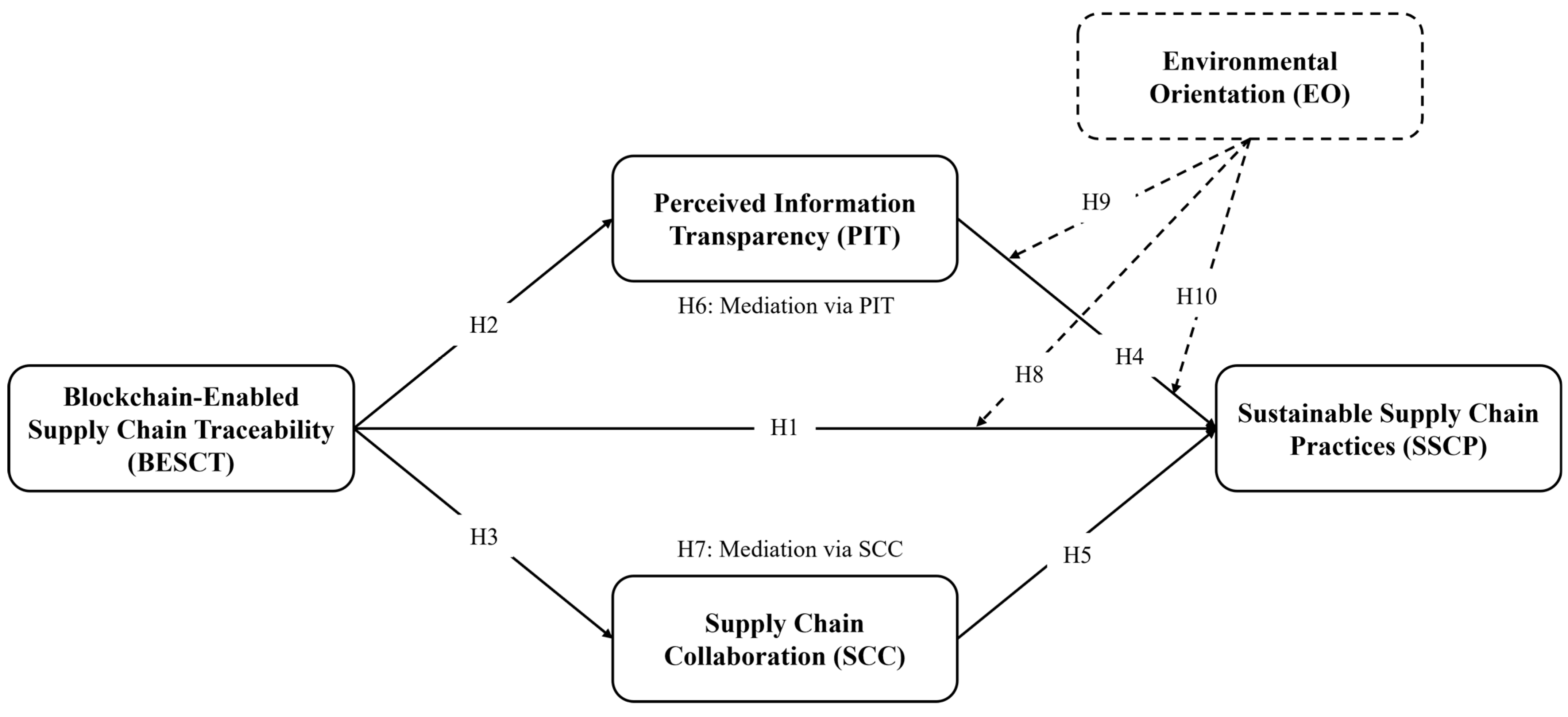
Guided by the RBV, this study develops an integrated conceptual framework that explains how BESCT drives SSCP through distinct capability and process mechanisms. Within this framework, BESCT is positioned as a core organizational capability that provides the foundation for sustainability-oriented supply chain transformation. As illustrated in Figure 1, the framework positions PIT and SCC as parallel mediating mechanisms through which BESCT translates into improved sustainability outcomes. Specifically, PIT represents an information-based mechanism that enhances visibility, data integrity, and accountability, while SCC reflects a relational mechanism that enables coordinated decision-making, knowledge sharing, and joint sustainability initiatives across supply chain partners.
Furthermore, EO is conceptualized as a boundary condition that moderates the strength of these relationships rather than serving as a transmission mechanism. While PIT and SCC explain how BESCT influences SSCP, EO determines when and to what extent these effects are amplified, depending on the firm’s strategic commitment to environmental sustainability. This distinction clarifies that sustainability outcomes are not driven solely by capability deployment, but also by the strategic context in which such capabilities are leveraged. Firms with stronger EO are more likely to utilize transparency and collaboration mechanisms for sustainability goals, whereas firms with weaker EO may direct these mechanisms toward efficiency-oriented outcomes. By explicitly differentiating capability (BESCT), mechanisms (PIT and SCC), and boundary condition (EO), the framework provides a coherent explanation of how and under what conditions sustainability outcomes emerge within supply chain systems.

3. Methods and Design

3.1. Sampling and Data Collection

This study employed a structured questionnaire-based survey to examine the relationship between BESCT and SSCP among SMEs in the Turkish manufacturing sector. SMEs were selected due to their critical role in national economic development and their increasing participation in global supply chains [87,88]. The manufacturing sector remains a key contributor to economic growth, with an average growth rate of 4.82% between 1999 and 2022, highlighting its relevance for sustainability-oriented transformation [89,90]. Furthermore, Türkiye provides a relevant empirical context, as SMEs in emerging economies often face significant challenges in balancing competitiveness, resource constraints, and environmental compliance [91,92,93].
This study employed a non-probability convenience sampling approach due to limited accessibility to SMEs actively engaged in blockchain-related practices and the practical constraints associated with reaching managerial respondents. Managers of SMEs registered with the Small and Medium Enterprises Development Organization (SMEDO) were targeted as key informants. Prior to data collection, SMEDO representatives were contacted and informed about the study objectives to facilitate access. Subsequently, email invitations were distributed to 1200 SME managers across various manufacturing sub-sectors. The invitation outlined the study purpose, emphasized voluntary participation, and assured confidentiality and anonymity [94,95,96].
Data were collected between February and May 2025, resulting in 652 valid responses (response rate = 54.3%), which is consistent with prior survey-based research involving managerial samples [97,98]. However, given the use of convenience sampling, the findings should be interpreted with caution, as the sample may not fully represent the broader population of Turkish manufacturing SMEs. Accordingly, claims of external validity and generalizability are limited, and the results should be viewed as context-specific insights rather than universally generalizable conclusions. Despite these limitations, the sample provides meaningful empirical evidence from a relevant and difficult-to-access population, particularly in the context of emerging digital technologies such as blockchain. The structured survey design ensured consistency in responses and supported the reliability and validity of the empirical analysis.

3.2. Measurement

This study employed a structured survey instrument to collect data, ensuring methodological rigor and alignment with sustainability and supply chain management research standards [99]. To adapt the instrument to the Turkish context, the backward translation method was applied to ensure linguistic and conceptual equivalence [100]. Independent bilingual translators conducted translation and back-translation procedures, and discrepancies were resolved through discussion. A pilot test with five SME managers was conducted to enhance clarity and contextual relevance.
The final questionnaire consisted of demographic questions and multi-item scales measured on a 7-point Likert scale (1 = strongly disagree, 7 = strongly agree). The model includes BESCT, PIT, SCC, EO, and SSCP. For transparency and replicability, the full list of measurement items is provided in Appendix A (Table A1).

3.2.1. Dependent Variable

The dependent construct, SSCP, is conceptualized as a second-order reflective–reflective construct composed of five first-order dimensions: Environmental Management Practices (EMP), Operations Practices (OP), Supply Chain Integration (SCI), Socially Inclusive Practices for Employees (SPE), and Socially Inclusive Practices for Communities (SPC), adapted from Das [101]. This hierarchical modeling approach captures the multidimensional nature of sustainability practices across environmental, operational, and social domains. Importantly, SSCP reflects operational sustainability implementation, whereas EO represents a strategic orientation, ensuring no conceptual overlap between the constructs.

3.2.2. Independent Variable

The independent variable, BESCT, is operationalized using a three-item scale adapted from Wamba et al. [102], capturing the extent to which firms implement blockchain-enabled traceability capabilities within supply chain processes. Consistent with the theoretical framework, BESCT is treated as a firm-level traceability capability rather than mere technology adoption.

3.2.3. Mediating Variables

Two mediators are included to explain the underlying mechanisms linking BESCT and SSCP. PIT was measured using a five-item scale developed by Zhou et al. [59] and validated by Duong et al. [51], capturing perceived visibility and accuracy of shared information. SCC was measured using a validated scale from Cao and Zhang [103] and Li et al. [104], reflecting the extent of interorganizational coordination and joint decision-making.

3.2.4. Moderating Variable

EO was measured using a four-item scale developed by Chan et al. [77] and validated by Murtaza et al. [105]. EO reflects a firm’s strategic commitment to environmental sustainability and serves as a boundary condition influencing the strength of relationships between BESCT, PIT, SCC, and SSCP.

4. Data Analysis and Results

4.1. Respondents’ Demographic Profile

The respondents’ demographic profile provides key insights into the characteristics of Turkish manufacturing SMEs engaged in this study, outlined in Table 1. Male executives constituted the majority, at 76.1% (n = 496), indicative of gender representation in leadership roles within the industry. Educationally, over half (54.8%, n = 357) held a bachelor’s degree, while 24.7% (n = 161) had associate qualifications, ensuring a well-educated sample capable of informed perspectives on SSCP. All respondents occupied executive positions, including directors (10.1%), senior managers (16.6%), managers (30.8%), and section heads (42.5%), highlighting strategic decision-makers’ engagement. Most firms were relatively young, with 57.8% (n = 377) established within the past decade, 27.8% (n = 181) between 11 and 20 years, and 14.4% (n = 94) exceeding 21 years, reflecting a dynamic mix of growth stages. Managerial respondents primarily fell within the 41–50 years age group (41.0%, n = 267), followed by 30–40 years (39.0%, n = 254), signaling experienced individuals positioned to influence organizational sustainability. Additionally, the SMEs were predominantly small-sized businesses with fewer than 50 employees (58.1%, n = 379), complemented by medium-sized enterprises (41.9%, n = 273), providing a balanced representation crucial for addressing sustainability challenges across diverse organizational scales.

4.2. Statistical Analysis Technique

To examine the research model, this study employed partial least squares structural equation modeling (PLS-SEM) using the SmartPLS 4.0 software package [106]. PLS-SEM was selected due to its capacity to handle complex models with mediated moderation effects, which aligns with the study’s objective of exploring intricate interactions in SSCP [107,108]. This technique is particularly advantageous for analyzing latent constructs in scenarios involving non-normal data and medium sample sizes, ensuring robustness in the statistical analysis [109]. The analytical process was conducted in two stages [110]: first, assessing the measurement model to confirm the reliability and validity of the constructs; and second, evaluating the structural model to test the hypothesized relationships [111,112].

4.3. Common Method Bias

To mitigate concerns regarding common method bias (CMB) arising from the single-source, cross-sectional nature of the data, this study adopted comprehensive procedural and statistical remedies as recommended by Podsakoff et al. [113]. Procedurally, respondent anonymity was assured, and the survey cover letter emphasized that there were no right or wrong answers, encouraging honest participation [114]. The study’s purpose was clearly explained to reduce ambiguity, and a pilot test was conducted to refine question clarity and minimize the potential effects of priming through strategic item arrangements [99]. Statistically, the Harman single-factor test revealed that the first factor explained only 26.75% of the total variance, significantly below the 50% threshold, indicating no dominant factor [113]. Additionally, a full collinearity test was conducted, with all variance inflation factor (VIF) values ranging from 1.068 to 2.865, below the accepted threshold of 3.3, confirming the absence of multicollinearity issues [109,115]. These measures validate the robustness of the findings and ensure that CMB does not compromise the study’s contributions to sustainable practices.

4.4. Measurement Model Evaluation

To ensure the reliability and validity of the constructs, a rigorous evaluation of the measurement model was conducted, focusing on convergent and discriminant validity. Convergent validity, which assesses whether items effectively measure the intended construct, was evaluated through factor loadings, average variance extracted (AVE), and composite reliability (CR), following the guidelines of Hair et al. [116]. Table 2 reveals that the majority of factor loadings exceeded the acceptable threshold of 0.70, with none falling below 0.60. This complies with the assertion by Hair et al. [117] that loadings between 0.50 and 0.70 are permissible when AVE and CR meet the required thresholds. As presented in Table 2, AVE values for all constructs were greater than 0.50 [118], and CR values surpassed 0.70, confirming the constructs’ convergent validity [109].
To establish discriminant validity, which ensures that constructs are distinct from one another, two criteria were employed: Fornell and Larcker’s [118] criterion and the heterotrait–monotrait (HTMT) ratio of correlations [119]. Table 3 demonstrates that the square roots of AVE, displayed along the diagonal and bold, were greater than their respective inter-construct correlations, satisfying the Fornell and Larcker criterion. Furthermore, Table 4 reports that none of the HTMT values exceeded the threshold of 0.85 [109,120]. Compliance with these two criteria confirms the absence of discriminant validity concerns.

4.5. Second-Order Evaluation

SSCP was modeled as a second-order reflective–reflective construct composed of five first-order dimensions: EMP, OP, SCI, SPE, and SPC. Following Sarstedt et al. [121], a two-stage approach in SmartPLS was employed, where latent variable scores of the first-order constructs were obtained in the first stage and subsequently used as indicators of the higher-order construct (SSCP) in the second stage. The results indicate that the second-order construct demonstrates strong reliability and convergent validity (Table 2), with Cronbach’s α = 0.911, composite reliability (CR) = 0.941, and average variance extracted (AVE) = 0.548. All outer loadings were statistically significant (p = 0.001), while all VIF values were 1.000, indicating the absence of multicollinearity concerns.

4.6. Structural Model Assessment

Following the validation of the measurement model, key metrics such as the coefficient of determination (R2), predictive relevance (Q2), and effect sizes (f2) were used to gauge the structural model’s explanatory and predictive capabilities. The coefficient of determination (R2) values was examined to assess the model’s explanatory power, with results showing R2 values of 0.122 for PIT, 0.436 for SCC, and 0.534 for SSCP, all surpassing the recommended threshold of 0.10 [122], as presented in Table 5. Predictive relevance (Q2), determined through the blindfolding procedure, yielded values of 0.366, 0.420, and 0.435 for the same constructs, affirming the model’s predictive validity [123]. Additionally, effect sizes (f2), also reported in Table 5, provide insights into the magnitude of relationships. Consistent with Henseler et al. [124], small (0.02), medium (0.15), and large (0.35) effects were observed across the tested paths, indicating small to large effects [109,125]. Model fit indices also confirmed the adequacy of the structural model; the standardized root mean square residual (SRMR) was 0.068, below the threshold of 0.08, and the normed fit index (NFI) was 0.853, exceeding the acceptable benchmark of 0.80 [126]. These findings collectively demonstrate the structural model’s robustness and relevance.

4.7. Hypotheses Testing

The structural model was evaluated to test the proposed hypotheses and examine the relationships among the study constructs, employing a bootstrapping approach with 5000 resamples to calculate path coefficients (β) and significance levels [116]. Given the cross-sectional design of this study, these relationships should be interpreted as associations rather than causal effects. The results, summarized in Table 6, revealed strong support for the hypotheses. Specifically, BESCT was positively associated with SSCP (β = 0.347, p < 0.001), confirming H1. Similarly, BESCT was positively associated with PIT (β = 0.290, p < 0.001) and SCC (β = 0.486, p < 0.001), validating H2 and H3. Furthermore, PIT was positively associated with SSCP (β = 0.259, p < 0.001), supporting H4. Additionally, SCC was positively associated with SSCP (β = 0.145, p < 0.05), confirming H5.
Beyond direct effects, this study also examined mediation effects using Henseler et al. [124] guidelines and the bias-corrected bootstrap confidence interval method [127]. As shown in Table 6, PIT mediated the relationship between BESCT and SSCP, yielding a significant indirect effect (indirect effect = 0.075, p < 0.001, 95% CI [0.043; 0.117]), thereby validating H6. Similarly, SCC emerged as a complementary mediator in the same relationship, with a significant indirect effect (indirect effect = 0.071, p < 0.05, 95% CI [0.015; 0.132]), confirming H7. These findings underline the critical intermediary roles played by transparency and collaboration in translating traceability improvements into sustainable practices.

4.8. Moderation Effects

The moderating role of EO on the relationships between BESCT, PIT, SCC, and SSCP was analyzed using PLS-SEM. Following the recommendations of Hair et al. [109], the interaction terms were computed to examine moderation effects [128,129], with the results presented in Table 7.
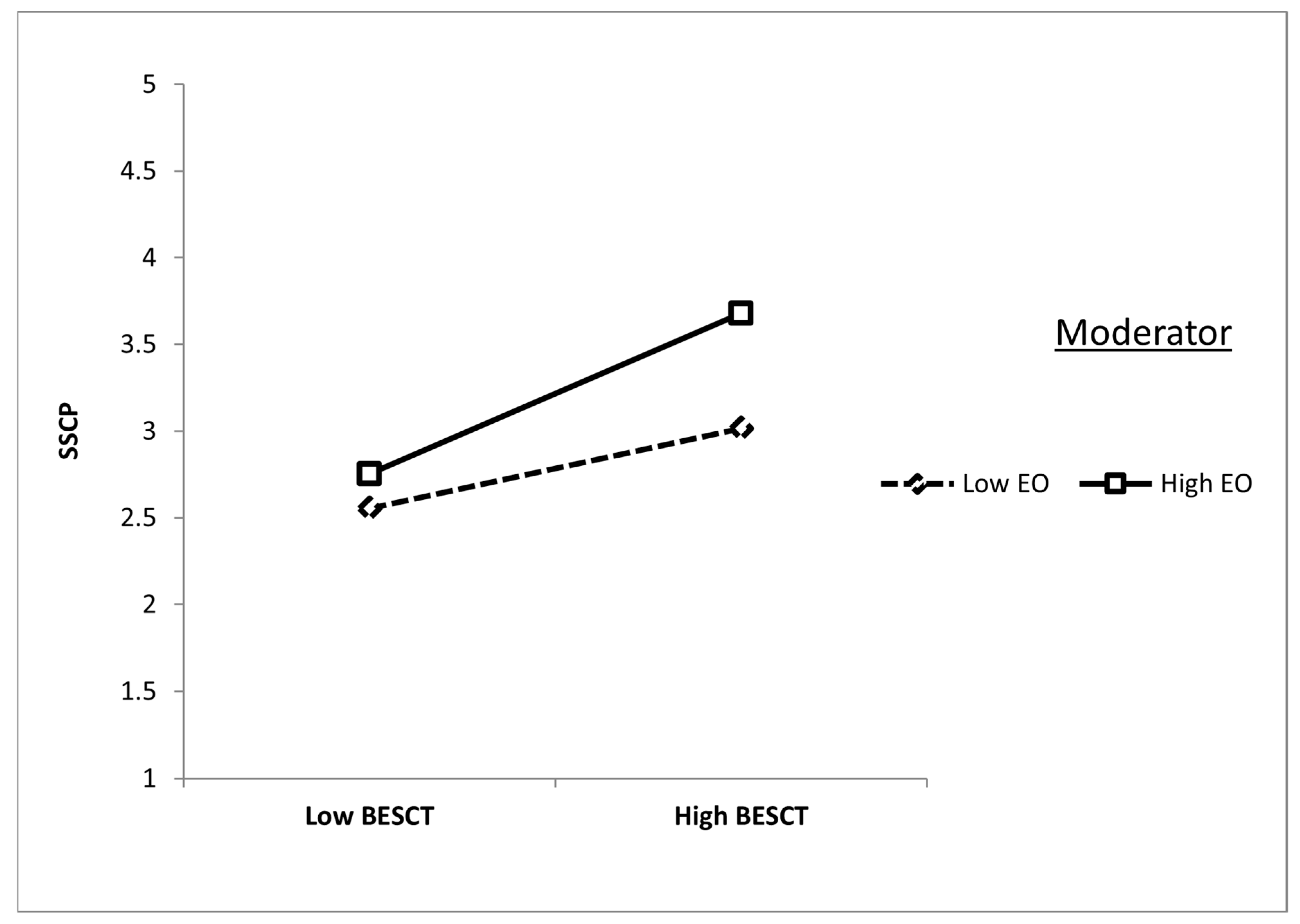
H8 proposed that EO positively moderates the relationship between BESCT and SSCP, amplifying the effectiveness of BESCT in its association with SSCP under conditions of high EO. The analysis supported this hypothesis, revealing a significant positive interaction effect (β = 0.116, p < 0.05), as shown in Table 7. Figure 2 provides a visual representation of this moderation effect, demonstrating that the slope of the BESCT-SSCP relationship becomes steeper with higher levels of EO, consistent with Dawson’s [130] guidelines for interpreting interaction effects. This finding underscores the critical role of aligning blockchain technologies with environmentally oriented strategies to maximize their impact on sustainability goals.
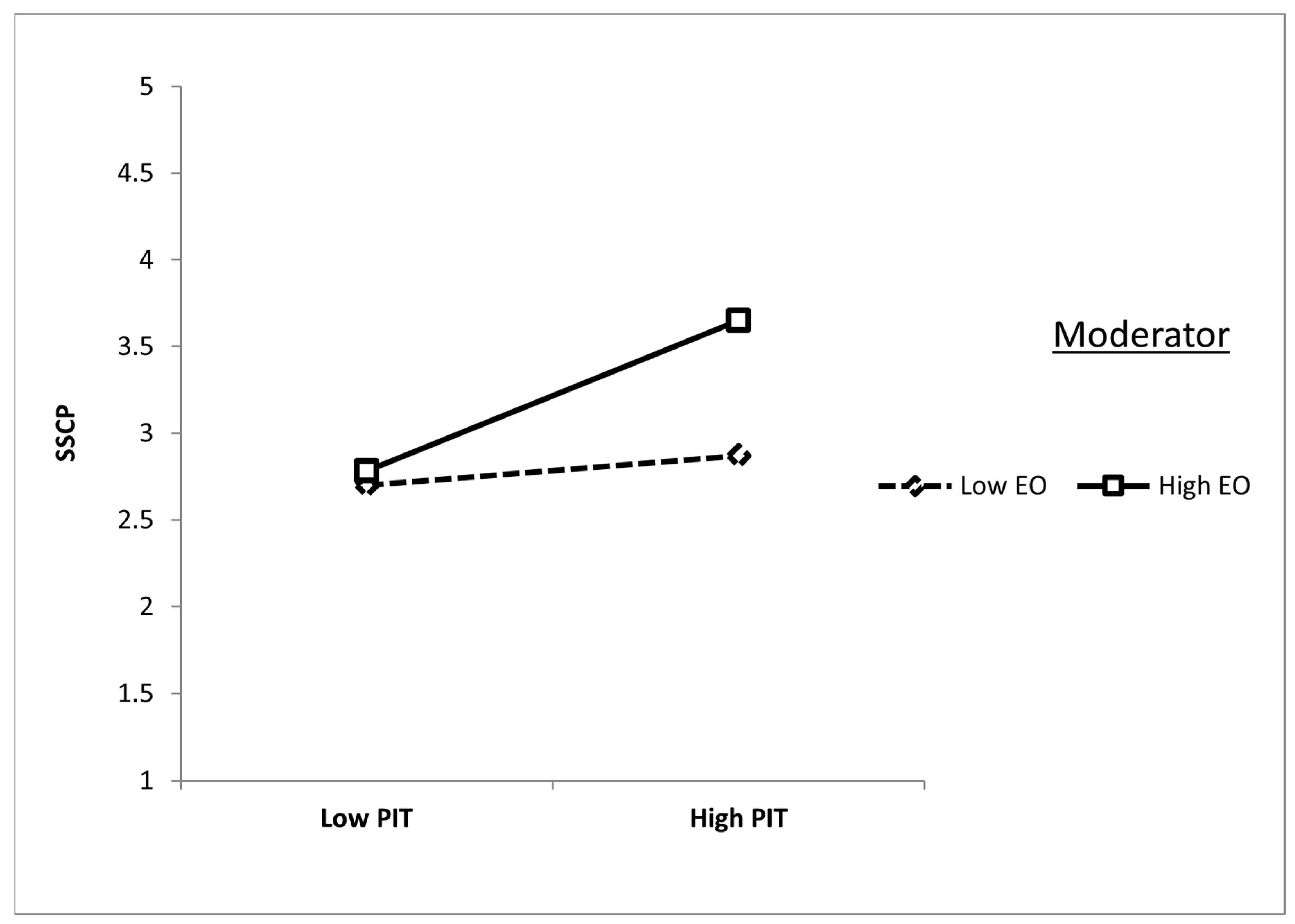
Similarly, H9 suggested that EO moderates the relationship between PIT and SSCP, strengthening the positive association between PIT and SSCP. This hypothesis was strongly supported, with a significant positive interaction effect (β = 0.174, p < 0.001). Table 7 reports these results, while Figure 3 highlights the interaction effect, indicating that organizations with higher EO derive greater sustainability benefits from their transparency initiatives.
Contrastingly, H10, which posited that EO moderates the relationship between SCC and SSCP, was not supported (β = −0.037, p = 0.402). This result suggests that collaboration in the supply chain, while crucial, does not exhibit significant enhancement from EO in driving sustainable outcomes. This aligns with the notion that collaboration efforts require integration within broader environmental frameworks to effectively translate into sustainability benefits.

5. Conclusions and Implications

5.1. Discussion of Findings

This study aimed to explore how BESCT is positively associated with SSCP in the context of Turkish SMEs, while also investigating the mediating roles of PIT and SCC, as well as the moderating effect of EO. Given the cross-sectional design, these relationships should be interpreted as associative rather than causal.
First, the findings confirm that BESCT is positively associated with SSCP (H1), reinforcing the RBV perspective that blockchain should be understood as a firm-level traceability capability enabled by blockchain technology that ensures immutable, transparent, and real-time tracking of supply chain transactions, rather than merely a technological tool. This capability perspective highlights how blockchain supports sustainability through enhanced traceability, accountability, and transparency across supply chains [2,102].
Support for H2 and H3 indicates that BESCT is positively associated with PIT and SCC. These findings align with prior research suggesting that BESCT reduces information asymmetry and strengthens interorganizational coordination [6,50]. From an RBV lens, PIT represents an information-processing capability that enhances visibility, while SCC reflects a relational capability that facilitates resource integration and joint problem-solving [58,71].
The findings related to H4 and H5 further suggest that both PIT and SCC are positively associated with SSCP, indicating that transparency and collaboration function as critical mechanisms through which sustainability practices are realized. These results are consistent with prior studies emphasizing that transparency supports responsible decision-making, while collaboration enables the co-development of sustainable solutions across supply chain partners [66,131].
Moreover, the support for H6 and H7 highlights the mediating roles of PIT and SCC, suggesting that BESCT is linked to SSCP through these organizational and interorganizational capabilities. This aligns with the dynamic capability perspective, where firms transform digital capabilities into sustainability outcomes through effective integration and deployment mechanisms [11].
Regarding the moderating effects, the findings indicate that EO strengthens the relationships between BESCT and SSCP (H8) and between PIT and SSCP (H9). This suggests that firms with strong EO are better positioned to leverage traceability and transparency capabilities to support sustainability objectives, consistent with prior research emphasizing the role of strategic orientation in amplifying the value of digital capabilities [56,78].
However, contrary to expectations, H10 is not supported, indicating that EO does not significantly moderate the relationship between SCC and SSCP. This finding can be theoretically explained in several ways. First, the benefits of SCC may be universally realized across firms, regardless of their level of EO, as collaboration inherently facilitates coordination and efficiency [103]. Second, the influence of EO may be more strongly captured through transparency mechanisms, suggesting that PIT serves as the primary pathway through which environmental values are translated into sustainability practices [50]. Third, sustainability-oriented collaboration often depends on alignment among multiple supply chain actors, limiting the extent to which a focal firm’s EO alone can shape collaborative outcomes [67].
In sum, this study extends prior work by demonstrating that BESCT is associated with sustainable supply chain transformation through transparency and collaboration mechanisms, under the boundary condition of environmental orientation.

5.2. Theoretical Implications

This study makes several noteworthy theoretical contributions by advancing the application of the RBV within the context of BESCT and SSCP. First, the findings demonstrate how blockchain technology should be conceptualized as a firm-level traceability capability enabled by blockchain technology that ensures immutable, transparent, and real-time tracking of supply chain transactions, rather than merely a technological tool or generic resource. This distinction clarifies the positioning of BESCT as a dynamic capability that is valuable, rare, and difficult to imitate due to its decentralization, immutability, and multi-party verification features [10,11].
Second, this study strengthens RBV by demonstrating how this traceability capability (BESCT) optimizes internal firm resources and improves coordination efficiency among supply chain partners. By providing secure, real-time data synchronization, BESCT is linked to reduced information asymmetry and improved coordination across supply chain actors [51,132]. This optimization of internal capabilities aligns with RBV’s emphasis on leveraging firm-specific assets to build sustained competitive advantage. Furthermore, the findings highlight that BESCT, as a capability, supports the development of relational capabilities such as transparency and collaboration, which are critical for sustainable supply chain systems.
Third, this research extends RBV to include boundary-spanning capabilities by showing how BESCT enables firms to access and integrate external sustainability-related information. The mediating role of PIT illustrates that BESCT functions as an information-processing capability that strengthens trust and shared understanding among stakeholders [71]. This broadens RBV by highlighting how digital capabilities not only reinforce internal strengths but also facilitate effective interaction with external partners.
Moreover, the empirical validation of SCC as a mediator provides theoretical grounding for the social-relational dimension of RBV. Collaboration is not merely a processual outcome but a capability that emerges from the effective deployment of BESCT, enabling inter-firm routines, shared goals, and synchronized operations. These findings demonstrate how traceability capability-driven collaboration supports the implementation of SSCP [133].
Finally, this study contributes to the RBV literature by incorporating EO as a contingent factor shaping the effectiveness of digital capabilities. The moderating effects suggest that EO strengthens the impact of BESCT and transparency-related capabilities on SSCP, while its influence on collaboration is more nuanced. This indicates that the effectiveness of relational capabilities such as SCC may depend on broader multi-firm alignment rather than the focal firm’s orientation alone, thereby refining the boundary conditions of RBV in sustainability contexts [78].
In summary, this study not only operationalizes RBV in a digitally mediated and sustainability-focused supply chain context but also deepens its theoretical reach by highlighting the role of traceability as a dynamic capability, alongside transparency, collaboration, and environmental orientation.

5.3. Managerial Implications

The findings of this study provide several practical implications for supply chain managers, SME leaders, and policymakers aiming to enhance sustainability through blockchain-enabled traceability systems. First, the study underscores the strategic importance of BESCT as a mechanism to improve transparency, reduce uncertainty, and build trust among supply chain stakeholders. Managers in manufacturing SMEs should prioritize the implementation of blockchain technologies to enable end-to-end visibility across the supply chain. However, given resource constraints, SMEs are advised to adopt a phased approach by initially focusing on traceability implementation in high-risk or high-impact supply chain nodes (e.g., raw material sourcing or compliance-sensitive processes), where immediate sustainability benefits can be realized. This can enhance real-time decision-making and ensure regulatory compliance while supporting environmental and social sustainability [5,134].
Second, the results highlight the importance of PIT in strengthening collaborative relationships and driving sustainable practices. Managers should invest in technologies and communication practices that ensure open and accurate sharing of sustainability-related information. For SMEs with limited digital maturity, prioritizing transparency-related investments can yield faster returns, particularly in environmental compliance and certification processes, where traceable data directly supports regulatory and customer requirements. By reducing information asymmetry, firms can better align their sustainability efforts with stakeholder expectations [47,50].
Third, SCC emerged as a critical enabler of SSCP. Managers should proactively foster inter-organizational collaboration through shared digital platforms, trust-building initiatives, and data-sharing protocols. To overcome financial and technological barriers, SMEs can leverage consortium-based blockchain models or blockchain-as-a-service (BaaS) solutions, which allow resource pooling and reduce individual investment costs. Enhanced collaboration can help SMEs co-develop eco-innovations and respond to environmental challenges [57,71].
Fourth, the moderating role of EO suggests that firms with stronger sustainability values derive greater benefits from blockchain-enabled traceability. Managers should embed EO into their strategic planning and corporate culture. From a prioritization perspective, SMEs are encouraged to first target environmental sustainability initiatives (e.g., carbon tracking, waste reduction, and compliance monitoring), as these areas often provide the most immediate and measurable returns from blockchain adoption, before expanding into broader social and operational sustainability practices [61,135,136].
Finally, the study offers guidance for policymakers and industry associations. Facilitating SME access to blockchain solutions—through training programs, subsidies, and standardized frameworks—can enhance sector-wide adoption. Policymakers should also support the development of scalable, low-cost blockchain infrastructures tailored to SMEs, enabling gradual adoption from basic traceability to more advanced sustainability analytics. Furthermore, developing certification mechanisms that validate traceability and sustainability performance using blockchain records can strengthen accountability and consumer trust [9,38,137].

5.4. Limitations and Future Studies

Although this study offers valuable insights into the role of BESCT in advancing SSCP, several limitations should be acknowledged. First, the research adopts a cross-sectional design focused on manufacturing SMEs in Turkey, which may limit the generalizability of findings across different industries and geographical contexts. Importantly, due to the cross-sectional nature of the data, causal relationships cannot be inferred, and the findings should be interpreted as associations rather than cause-and-effect relationships. Future studies should consider longitudinal or multi-country designs to capture temporal dynamics and institutional differences influencing blockchain adoption.
Second, this study relies on a non-probability convenience sampling approach, which may limit the representativeness of the sample and the external validity of the findings. While this approach was appropriate given the difficulty of accessing SME managers engaged in blockchain-related practices and industry access constraints, the results should be interpreted with caution when generalizing beyond the study context. Third, while the RBV underpins the conceptual framework, its application remains largely descriptive. Future research could enrich the theoretical rigor by integrating RBV with complementary theories such as dynamic capabilities or stakeholder theory to better explain the mechanisms through which blockchain facilitates sustainability outcomes. Finally, future research could explore firm-level contingencies such as digital maturity and regulatory support, as well as sector-specific applications of blockchain, to identify critical success factors and boundary conditions influencing SSCP.

Author Contributions

Conceptualization, A.A.; supervision, A.K.; formal analysis, H.Y.A.; project administration, A.B.A.; Validation, A.B.A. and A.K.; Writing—original draft, A.A.; Writing—review and editing, H.Y.A. and A.A. All authors have read and agreed to the published version of the manuscript.

Funding

This research received no external funding.

Institutional Review Board Statement

This study was conducted in accordance with the Declaration of Helsinki and approved by the Ethics Committee of University of Mediterranean Karpasia’s Institutional Review Board (AKUN-ETK-31/26) on [24 January 2025].

Informed Consent Statement

All participants in this study provided their informed consent.

Data Availability Statement

The data from this study can be requested from the corresponding author, Alhassian Abobassier.

Conflicts of Interest

The authors report no conflicts of interest.

Appendix A

Table A1. Measurement Items and Sources.
ConstructCodeMeasurement ItemsSources
Blockchain-Enabled Supply Chain Traceability (BESCT)BESCT1My company invests resources in blockchain-enabled supply chain applications.Wamba et al. [102]
BESCT2Business activities in our company require the use of blockchain technologies.
BESCT3Functional areas in my company require the use of blockchain technologies.
Perceived Information Transparency (PIT)PIT1After using the blockchain-enabled system, I can fully understand the product.Zhou et al. [59]; Duong et al. [51]
PIT2After using the blockchain-enabled system, I have a clearer understanding of the product.
PIT3I had a clear understanding of the product after navigating the blockchain-enabled system.
PIT4After browsing the blockchain-enabled system, I was able to learn about the product very well.
PIT5Overall, the product was transparent to me after I browsed the blockchain-enabled system.
Environmental Orientation (EO)EO1Our firm makes concerted efforts to ensure employees understand environmental preservation.Chan et al. [77]; Murtaza et al. [105]
EO2Our firm has clear policy statements promoting environmental awareness in all operations.
EO3Environmental preservation is highly valued by members of our firm.
EO4Environmental preservation is a central corporate value of our firm.
Supply Chain Collaboration (SCC)SCC1We share our knowledge with our suppliers.Cao and Zhang [103]; Li et al. [104]
SCC2We provide technical support to our suppliers.
SCC3We form cross-functional teams with suppliers to work collaboratively.
SCC4We colocate employees with suppliers to facilitate integration.
SCC5Our collaboration aims to solve problems effectively and innovatively.
Sustainable Supply Chain Practices (SSCP) Das [101]
Environmental Management Practices (EMP)EMP1Environmental management systems (e.g., ISO 14001) are implemented in our organization.
EMP2We provide suppliers with environmental compliance specifications.
EMP3We assist suppliers in implementing environmental management systems.
EMP4We address environmental concerns through eco-friendly product design and distribution.
EMP5We adopt cleaner production practices to address environmental concerns.
EMP6Our products are designed to reduce material and energy consumption.
Operations Practices (OP)OP1We support suppliers in implementing quality management practices (e.g., TQM, Six Sigma).
OP2We assist suppliers in value engineering to reduce costs.
OP3We use inventory control techniques (e.g., JIT) to manage inventory efficiently.
OP4We implement lean production practices to minimize waste.
OP5We pursue economies of scale in transportation.
Supply Chain Integration (SCI)SCI1We update production plans based on customer needs and share them with suppliers.
SCI2We respond quickly to customer needs by maintaining adequate inventory.
SCI3We forecast customer needs based on realistic assessments.
SCI4We communicate customer needs promptly to suppliers.
Socially Inclusive Practices for Employees (SPE)SPE1Our organization implements advanced safety measures to reduce workplace risks.
SPE2We provide a healthy and positive working environment for employees.
SPE3Child labor and forced labor are strictly prohibited.
SPE4Employee wages and benefits are sufficient to meet basic needs.
SPE5Employees receive benefits such as leave, healthcare, and social security.
Socially Inclusive Practices for Communities (SPC)SPC1We provide employment or business opportunities to local communities.
SPC2We support healthcare initiatives for local communities.
SPC3We contribute to primary education in surrounding communities.

References

  1. Moretto, A.; Macchion, L. Drivers, Barriers and Supply Chain Variables Influencing the Adoption of the Blockchain to Support Traceability along Fashion Supply Chains. Oper. Manag. Res. 2022, 15, 1470–1489. [Google Scholar] [CrossRef]
  2. Hastig, G.M.; Sodhi, M.S. Blockchain for Supply Chain Traceability: Business Requirements and Critical Success Factors. Prod. Oper. Manag. 2020, 29, 935–954. [Google Scholar] [CrossRef]
  3. Durman, S.; Iyiola, K.; Alzubi, A.B.; Aljuhmani, H.Y. Dynamic Capabilities in Action: Digital Capability, Business Model Innovation and Absorptive Capacity. Manag. Decis. 2025, 1–36. [Google Scholar] [CrossRef]
  4. Agrawal, T.K.; Kumar, V.; Pal, R.; Wang, L.; Chen, Y. Blockchain-Based Framework for Supply Chain Traceability: A Case Example of Textile and Clothing Industry. Comput. Ind. Eng. 2021, 154, 107130. [Google Scholar] [CrossRef]
  5. Ahmed, W.A.H.; MacCarthy, B.L. Blockchain-Enabled Supply Chain Traceability—How Wide? How Deep? Int. J. Prod. Econ. 2023, 263, 108963. [Google Scholar] [CrossRef]
  6. Rejeb, A.; Keogh, J.G.; Simske, S.J.; Stafford, T.; Treiblmaier, H. Potentials of Blockchain Technologies for Supply Chain Collaboration: A Conceptual Framework. Int. J. Logist. Manag. 2021, 32, 973–994. [Google Scholar] [CrossRef]
  7. Balcıoğlu, Y.S.; Çelik, A.A.; Altındağ, E. Integrating Blockchain Technology in Supply Chain Management: A Bibliometric Analysis of Theme Extraction via Text Mining. Sustainability 2024, 16, 10032. [Google Scholar] [CrossRef]
  8. Sharma, M.; AlNuaimi, B.K.; Khan, M.; Alghafes, R.; Pandey, R. Blockchain-Enabled Dynamic Capabilities for Supply Chain Ambidexterity: Empirical Evidence from Manufacturing Firms for Enhanced Competence and Flexibility. Technol. Forecast. Soc. Change 2026, 226, 124467. [Google Scholar] [CrossRef]
  9. Wamba, S.F.; Queiroz, M.M. Blockchain in the Operations and Supply Chain Management: Benefits, Challenges and Future Research Opportunities. Int. J. Inf. Manag. 2020, 52, 102064. [Google Scholar] [CrossRef]
  10. Barney, J. Firm Resources and Sustained Competitive Advantage. J. Manag. 1991, 17, 99–120. [Google Scholar] [CrossRef]
  11. Nandi, M.L.; Nandi, S.; Moya, H.; Kaynak, H. Blockchain Technology-Enabled Supply Chain Systems and Supply Chain Performance: A Resource-Based View. Supply Chain Manag. Int. J. 2020, 25, 841–862. [Google Scholar] [CrossRef]
  12. Sharma, B.K.; Jain, P. Blockchain Technology Adoption to Improve Supply Chain Efficiency: A Resource-Based View. Benchmarking Int. J. 2025, 1–23. [Google Scholar] [CrossRef]
  13. Lima, B.; Ganga, G.M.D.; Godinho Filho, M.; De Santa-Eulalia, L.A.; Thürer, M.; Queiroz, M.M.; Moraes, K.K. Timing and Interdependencies in Blockchain Capabilities Development for Supply Chain Management: A Resource-Based View Perspective. Ind. Manag. Data Syst. 2025, 125, 1645–1685. [Google Scholar] [CrossRef]
  14. Chen, S. Blockchain-Enabled Traceability Framework to Improve Transparency in Supply Chain Management. Inf. Resour. Manag. J. (IRMJ) 2025, 38, 1–29. [Google Scholar] [CrossRef]
  15. Paliwal, V.; Chandra, S.; Sharma, S. Blockchain Technology for Sustainable Supply Chain Management: A Systematic Literature Review and a Classification Framework. Sustainability 2020, 12, 7638. [Google Scholar] [CrossRef]
  16. Zhao, X.; Su, Q.; Li, Q. Realising Supply Chain Performance through Blockchain-Enabled Collaboration: Through the Lens of Dynamic Capability View. Int. J. Logist. Res. Appl. 2025, 1–32. [Google Scholar] [CrossRef]
  17. Park, A.; Li, H. The Effect of Blockchain Technology on Supply Chain Sustainability Performances. Sustainability 2021, 13, 1726. [Google Scholar] [CrossRef]
  18. Sahoo, S.; Kumar, S.; Sivarajah, U.; Lim, W.M.; Westland, J.C.; Kumar, A. Blockchain for Sustainable Supply Chain Management: Trends and Ways Forward. Electron. Commer. Res. 2022, 24, 1563–1618. [Google Scholar] [CrossRef]
  19. Chowdhury, W.A. Blockchain for Sustainable Supply Chain Management: Reducing Waste Through Transparent Resource Tracking. J. Procure. Supply Chain Manag. 2025, 4, 28–34. [Google Scholar] [CrossRef]
  20. Ramadhan, A.; Iyiola, K.; Alzubi, A.B. Linking Absorptive Capacity to Project Success via Mediating Role of Customer Knowledge Management Capability: The Role of Environmental Complexity. Bus. Process Manag. J. 2024, 30, 939–962. [Google Scholar] [CrossRef]
  21. Farnana, K.; Alzubi, A.B.; Aljuhmani, H.Y.; Khadem, A. Fostering a Green Workplace: How Responsible Leadership Inspires Voluntary Green Behavior through Perceived Insider Status and Green Work Climate. Kybernetes 2026, 1–31. [Google Scholar] [CrossRef]
  22. Alsafadi, Y.; Aljuhmani, H.Y. The Influence of Entrepreneurial Innovations in Building Competitive Advantage: The Mediating Role of Entrepreneurial Thinking. Kybernetes 2023, 53, 4051–4073. [Google Scholar] [CrossRef]
  23. Albannai, N.; Alzubi, A.B.; Aljuhmani, H.Y. How Environmental Management Systems Enable Sustainability Transition: The Roles of Green Transition and Policy Support in Driving Circular Product Innovation. Sustainability 2026, 18, 2060. [Google Scholar] [CrossRef]
  24. Peng, Y.; Xiao, Z.; Li, Y. The Impact of Digital Transformation on Sustainable Supply Chain Performance: The Mediating Effect of Service Innovation. Data Sci. Manag. 2026. [Google Scholar] [CrossRef]
  25. Sahoo, S. Blockchain-Enabled Traceability Systems for Supply Chain Quality Management: Empirical Insights from Pharmaceutical Manufacturers. Int. J. Qual. Reliab. Manag. 2024, 42, 1381–1410. [Google Scholar] [CrossRef]
  26. Böhmecke-Schwafert, M. The Role of Blockchain for Trade in Global Value Chains: A Systematic Literature Review and Guidance for Future Research. Telecommun. Policy 2024, 48, 102835. [Google Scholar] [CrossRef]
  27. Jyoti, C.; Efpraxia, Z. Understanding and Exploring the Value Co-Creation of Cloud Computing Innovation Using Resource Based Value Theory: An Interpretive Case Study. J. Bus. Res. 2023, 164, 113970. [Google Scholar] [CrossRef]
  28. Chen, M.-J.; Michel, J.G.; Lin, W. Worlds Apart? Connecting Competitive Dynamics and the Resource-Based View of the Firm. J. Manag. 2021, 47, 1820–1840. [Google Scholar] [CrossRef]
  29. Rockwell, S. A Resource-Based Framework for Strategically Managing Identity. J. Organ. Change Manag. 2019, 32, 80–102. [Google Scholar] [CrossRef]
  30. Gavronski, I.; Klassen, R.D.; Vachon, S.; Nascimento, L.F.M.d. A Resource-Based View of Green Supply Management. Transp. Res. Part E Logist. Transp. Rev. 2011, 47, 872–885. [Google Scholar] [CrossRef]
  31. Hariyani, D.; Hariyani, P.; Mishra, S.; Sharma, M.K. A Literature Review on Transformative Impacts of Blockchain Technology on Manufacturing Management and Industrial Engineering Practices. Green Technol. Sustain. 2025, 3, 100169. [Google Scholar] [CrossRef]
  32. Saha, A.; Raut, R.D.; Kumar, M.; Paul, S.K.; Shi, Y.; Shah, B.; Ghoshal, S. Achieving Sustainable Carbon-Neutral Supply Chain: A Perspective of Integrating Blockchain Technology. Technol. Forecast. Soc. Change 2025, 219, 124262. [Google Scholar] [CrossRef]
  33. Khan, M.I.; Yasmeen, T.; Khan, M.; Hadi, N.U.; Asif, M.; Farooq, M.; Al-Ghamdi, S.G. Integrating Industry 4.0 for Enhanced Sustainability: Pathways and Prospects. Sustain. Prod. Consum. 2025, 54, 149–189. [Google Scholar] [CrossRef]
  34. Mohsin, A.; Rashed, M.; Gerschberger, M.; Ahmed, S.F.; Plasch, M.; Rahman, A.; Noor, M.A. Can Supply Chains Decarbonize? Exploring the Potential of Scope 3 Emission Reduction for Sustainable Transformation. Sustain. Futures 2025, 10, 101512. [Google Scholar] [CrossRef]
  35. Lockett, A.; Thompson, S.; Morgenstern, U. The Development of the Resource-Based View of the Firm: A Critical Appraisal. Int. J. Manag. Rev. 2009, 11, 9–28. [Google Scholar] [CrossRef]
  36. Odamtten, M.; Hanson, O.-Y.; Agboyi, M.; Antwi, B.O. Green Supply Chain Management and Environmental Performance: Does Environmental Commitment Matter? Bus. Soc. Rev. 2025, 130, 525–547. [Google Scholar] [CrossRef]
  37. Mubarik, M.; Raja Mohd Rasi, R.Z.; Mubarak, M.F.; Ashraf, R. Impact of Blockchain Technology on Green Supply Chain Practices: Evidence from Emerging Economy. Manag. Environ. Qual. Int. J. 2021, 32, 1023–1039. [Google Scholar] [CrossRef]
  38. Fosso Wamba, S.; Guthrie, C. The Impact of Blockchain Adoption on Competitive Performance: The Mediating Role of Process and Relational Innovation. Logistique Manag. 2020, 28, 88–96. [Google Scholar] [CrossRef]
  39. Khan, S.A.R.; Godil, D.I.; Jabbour, C.J.C.; Shujaat, S.; Razzaq, A.; Yu, Z. Green Data Analytics, Blockchain Technology for Sustainable Development, and Sustainable Supply Chain Practices: Evidence from Small and Medium Enterprises. Ann. Oper. Res. 2021, 350, 603–627. [Google Scholar] [CrossRef]
  40. Das, D. The Impact of Sustainable Supply Chain Management Practices on Firm Performance: Lessons from Indian Organizations. J. Clean. Prod. 2018, 203, 179–196. [Google Scholar] [CrossRef]
  41. Sirisawat, P.; Hasachoo, N.; Rodbundith, T.S. Sustainable Supply Chain Management Challenges Analysis in Local Plastic Recycling Business. Clean. Logist. Supply Chain 2024, 13, 100188. [Google Scholar] [CrossRef]
  42. Mugoni, E.; Kanyepe, J.; Tukuta, M. Sustainable Supply Chain Management Practices (SSCMPS) and Environmental Performance: A Systematic Review. Sustain. Technol. Entrep. 2024, 3, 100050. [Google Scholar] [CrossRef]
  43. Moawad, K.; Musamih, A.; Chadly, A.; Mayyas, A.; Salah, K.; Jayaraman, R.; Omar, M.; Yaqoob, I. Blockchain-Enabled Sustainability of Li-Ion Batteries Supply Chain: Tracking and Sourcing Eco-Friendly Materials. Int. J. Prod. Res. 2025, 63, 9529–9570. [Google Scholar] [CrossRef]
  44. Garcia-Torres, S.; Rey-Garcia, M.; Sáenz, J. Enhancing Sustainable Supply Chains through Traceability, Transparency and Stakeholder Collaboration: A Quantitative Analysis. Bus. Strategy Environ. 2024, 33, 7607–7629. [Google Scholar] [CrossRef]
  45. Chai, L.; Lai, K.; Zong, L. How Digital Transformation Enhances Supply Chain Transparency? Based on the Perspective of Information Improvement and Resource Optimization. Transp. Res. Part E Logist. Transp. Rev. 2025, 201, 104256. [Google Scholar] [CrossRef]
  46. Ada, E.; Sagnak, M.; Kazancoglu, Y.; Luthra, S.; Kumar, A. A Framework for Evaluating Information Transparency in Supply Chains. J. Glob. Inf. Manag. 2021, 29, 1–22. [Google Scholar] [CrossRef]
  47. Sunny, J.; Undralla, N.; Madhusudanan Pillai, V. Supply Chain Transparency through Blockchain-Based Traceability: An Overview with Demonstration. Comput. Ind. Eng. 2020, 150, 106895. [Google Scholar] [CrossRef]
  48. Karaduman, Ö.; Gülhas, G. Blockchain-Enabled Supply Chain Management: A Review of Security, Traceability, and Data Integrity Amid the Evolving Systemic Demand. Appl. Sci. 2025, 15, 5168. [Google Scholar] [CrossRef]
  49. Feng, H.; Wang, X.; Duan, Y.; Zhang, J.; Zhang, X. Applying Blockchain Technology to Improve Agri-Food Traceability: A Review of Development Methods, Benefits and Challenges. J. Clean. Prod. 2020, 260, 121031. [Google Scholar] [CrossRef]
  50. Sunmola, F.; Burgess, P. Transparency by Design for Blockchain-Based Supply Chains. Procedia Comput. Sci. 2023, 217, 1256–1265. [Google Scholar] [CrossRef]
  51. Duong, C.D.; Nguyen, T.H.; Ngo, T.V.N.; Thanh, T.D.; Tran, N.M. Blockchain Technology and Consumers’ Organic Food Consumption: A Moderated Mediation Model of Blockchain-Based Trust and Perceived Blockchain-Related Information Transparency. J. Asia Bus. Stud. 2024. epub ahead of printing. [Google Scholar] [CrossRef]
  52. Pattanayak, S.; Ramkumar, M.; Goswami, M.; Chan, F.T.S.; Rana, N.P. Blockchain and Supply Chain Performance: Leveraging Digital Transformation-Enabled Operational and Strategic Dynamic Capabilities. J. Enterp. Inf. Manag. 2025, 39, 696–735. [Google Scholar] [CrossRef]
  53. Aslam, J.; Saleem, A.; Khan, N.T.; Kim, Y.B. Factors Influencing Blockchain Adoption in Supply Chain Management Practices: A Study Based on the Oil Industry. J. Innov. Knowl. 2021, 6, 124–134. [Google Scholar] [CrossRef]
  54. Liu, W.; Liu, X.; Shi, X.; Hou, J.; Shi, V.; Dong, J. Collaborative Adoption of Blockchain Technology: A Supply Chain Contract Perspective. Front. Eng. Manag. 2023, 10, 121–142. [Google Scholar] [CrossRef]
  55. Agrawal, T.K.; Angelis, J.; Khilji, W.A.; Kalaiarasan, R.; Wiktorsson, M. Demonstration of a Blockchain-Based Framework Using Smart Contracts for Supply Chain Collaboration. Int. J. Prod. Res. 2023, 61, 1497–1516. [Google Scholar] [CrossRef]
  56. Jimenez-Jimenez, D.; Martínez-Costa, M.; Sanchez Rodriguez, C. The Mediating Role of Supply Chain Collaboration on the Relationship between Information Technology and Innovation. J. Knowl. Manag. 2018, 23, 548–567. [Google Scholar] [CrossRef]
  57. Pham, C.; Nguyen, T.-T.; Adamopoulos, A.; Tait, E. Blockchain-Enabled Traceability in Sustainable Food Supply Chains: A Case Study of the Pork Industry in Vietnam. In Information Systems Research in Vietnam: A Shared Vision and New Frontiers; Hoang Thuan, N., Dang-Pham, D., Le, H.-S., Phan, T.Q., Eds.; Springer Nature: Singapore, 2023; pp. 65–81. [Google Scholar]
  58. Cao, S.; Xu, H.; Bryceson, K.P. Blockchain Traceability for Sustainability Communication in Food Supply Chains: An Architectural Framework, Design Pathway and Considerations. Sustainability 2023, 15, 13486. [Google Scholar] [CrossRef]
  59. Zhou, L.; Wang, W.; Xu, J.D.; Liu, T.; Gu, J. Perceived Information Transparency in B2C E-Commerce: An Empirical Investigation. Inf. Manag. 2018, 55, 912–927. [Google Scholar] [CrossRef]
  60. Dai, J.; Xie, L.; Chu, Z. Developing Sustainable Supply Chain Management: The Interplay of Institutional Pressures and Sustainability Capabilities. Sustain. Prod. Consum. 2021, 28, 254–268. [Google Scholar] [CrossRef]
  61. Mwenda, B.; Israel, B.; Mahuwi, L. The Influence of Sustainable Supply Chain Management Practices on Financial Sustainability of Food Processing SMEs. LBS J. Manag. Res. 2023, 21, 218–235. [Google Scholar] [CrossRef]
  62. Hina, M.; Islam, N.; Luo, X.R. Towards Sustainable Consumption Decision-Making: Examining the Interplay of Blockchain Transparency and Information-Seeking in Reducing Product Uncertainty. Decis. Support Syst. 2025, 189, 114370. [Google Scholar] [CrossRef]
  63. Yadav, S.; Singh, S.P. Blockchain Critical Success Factors for Sustainable Supply Chain. Resour. Conserv. Recycl. 2020, 152, 104505. [Google Scholar] [CrossRef]
  64. Chauhan, C.; Kaur, P.; Arrawatia, R.; Ractham, P.; Dhir, A. Supply Chain Collaboration and Sustainable Development Goals (SDGs). Teamwork Makes Achieving SDGs Dream Work. J. Bus. Res. 2022, 147, 290–307. [Google Scholar] [CrossRef]
  65. Nyamah, E.Y.; Nyamah, E.Y.; Opoku, R.K.; Attatsi, P.B. Sustainable Supply Chain Practices and Sustainable Performance in a Developing Economy: Do Governance Quality and Performance Metrics Matter? J. Manuf. Technol. Manag. 2026, 1–30. [Google Scholar] [CrossRef]
  66. Acquah, I.S.K.; Agyabeng-Mensah, Y.; Afum, E. Examining the Link among Green Human Resource Management Practices, Green Supply Chain Management Practices and Performance. Benchmarking Int. J. 2020, 28, 267–290. [Google Scholar] [CrossRef]
  67. Buranasiri, B.; Lai, P.-L.; Woo, S.; Piboonrungroj, P. Impact of Sustainable Development Goal Orientation on Supply Chain Collaboration and Sustained Competitive Advantage: Evidence from the Tea and Coffee Industry. Asian J. Shipp. Logist. 2024, 40, 83–88. [Google Scholar] [CrossRef]
  68. Dias, G.P.; Silva, M.E.; Viana, F.L.E. Contributions of Social Capital to Supply Chain Sustainability Practices: Conceptual Framework and Propositions. Clean. Logist. Supply Chain 2024, 11, 100151. [Google Scholar] [CrossRef]
  69. Kriym, A.; Aljuhmani, H.Y. Knowledge Management in Environmental Sustainability: The Roles of Financial and Social Integration. Sustainability 2026, 18, 735. [Google Scholar] [CrossRef]
  70. Dania, W.A.P.; Xing, K.; Amer, Y. Collaboration Behavioural Factors for Sustainable Agri-Food Supply Chains: A Systematic Review. J. Clean. Prod. 2018, 186, 851–864. [Google Scholar] [CrossRef]
  71. Zaridis, A.; Vlachos, I.; Bourlakis, M. SMEs Strategy and Scale Constraints Impact on Agri-Food Supply Chain Collaboration and Firm Performance. Prod. Plan. Control 2021, 32, 1165–1178. [Google Scholar] [CrossRef]
  72. Hua, X.; Hu, L.; Eltantawy, R.; Zhang, L.; Wang, B.; Tian, Y.; Zhang, J.Z. Blockchain Technology Adoption and Sustainable Performance in Chinese Manufacturing: Insights on Learning and Organizational Inertia. Ind. Manag. Data Syst. 2025, 125, 604–626. [Google Scholar] [CrossRef]
  73. Saberi, S.; Kouhizadeh, M.; Sarkis, J.; Shen, L. Blockchain Technology and Its Relationships to Sustainable Supply Chain Management. Int. J. Prod. Res. 2019, 57, 2117–2135. [Google Scholar] [CrossRef]
  74. Usman, M.; Moazzam, M.; Ghafoor, U.; Hakim, A.; Khalid, M.K. Driving Sustainability in Agri-Food Supply Chains: How Coordination, Analytic Capability, Data Driven Decision-Making, Agility and Innovation Shape the Future? J. Enterp. Inf. Manag. 2025, 1–31. [Google Scholar] [CrossRef]
  75. Brun, A.; Karaosman, H.; Barresi, T. Supply Chain Collaboration for Transparency. Sustainability 2020, 12, 4429. [Google Scholar] [CrossRef]
  76. Oriekhoe, O.I.; Oyeyemi, O.P.; Bello, B.G.; Omotoye, G.B.; Daraojimba, A.I.; Adefemi, A. Blockchain in Supply Chain Management: A Review of Efficiency, Transparency, and Innovation. Int. J. Sci. Res. Arch. 2024, 11, 173–181. [Google Scholar] [CrossRef]
  77. Chan, R.Y.K.; He, H.; Chan, H.K.; Wang, W.Y.C. Environmental Orientation and Corporate Performance: The Mediation Mechanism of Green Supply Chain Management and Moderating Effect of Competitive Intensity. Ind. Mark. Manag. 2012, 41, 621–630. [Google Scholar] [CrossRef]
  78. Agyapong, A.; Aidoo, S.O.; Acquaah, M.; Akomea, S. Environmental Orientation and Sustainability Performance; the Mediated Moderation Effects of Green Supply Chain Management Practices and Institutional Pressure. J. Clean. Prod. 2023, 430, 139592. [Google Scholar] [CrossRef]
  79. Chen, J.; Rojniruttikul, N. Influence of a Green Environmental Orientation on Corporate Sustainable Performance in the Manufacturing Sector. Sustainability 2025, 17, 2430. [Google Scholar] [CrossRef]
  80. Sun, Y.; Shahzad, M.; Razzaq, A. Sustainable Organizational Performance through Blockchain Technology Adoption and Knowledge Management in China. J. Innov. Knowl. 2022, 7, 100247. [Google Scholar] [CrossRef]
  81. Baralla, G.; Pinna, A.; Tonelli, R.; Marchesi, M. Waste Management: A Comprehensive State of the Art about the Rise of Blockchain Technology. Comput. Ind. 2023, 145, 103812. [Google Scholar] [CrossRef]
  82. Bhatt, G.D.; Emdad, A. Blockchain’s Role in Environmental Sustainability: Bibliometric Insights from Scopus. Green Technol. Sustain. 2025, 3, 100236. [Google Scholar] [CrossRef]
  83. Aladaileh, M.J.; Aladayleh, K.J.; Lahuerta-Otero, E.; Cordero-Gutiérrez, R. Leveraging Lean and Green Supply Chain Practices for Sustainable Supply Chain Performance: The Moderating Role of Environmental Orientation. Eng. Manag. Prod. Serv. 2024, 16, 75–97. [Google Scholar] [CrossRef]
  84. Shah, N.; Soomro, B.A. Internal Green Integration and Environmental Performance: The Predictive Power of Proactive Environmental Strategy, Greening the Supplier, and Environmental Collaboration with the Supplier. Bus. Strategy Environ. 2021, 30, 1333–1344. [Google Scholar] [CrossRef]
  85. Bu, X.; Dang, W.V.T.; Wang, J.; Liu, Q. Environmental Orientation, Green Supply Chain Management, and Firm Performance: Empirical Evidence from Chinese Small and Medium-Sized Enterprises. Int. J. Environ. Res. Public Health 2020, 17, 1199. [Google Scholar] [CrossRef] [PubMed]
  86. Khan, S.A.R.; Tabish, M.; Zhang, Y. Embracement of Industry 4.0 and Sustainable Supply Chain Practices under the Shadow of Practice-Based View Theory: Ensuring Environmental Sustainability in Corporate Sector. J. Clean. Prod. 2023, 398, 136609. [Google Scholar] [CrossRef]
  87. Abuzawida, S.S.; Alzubi, A.B.; Iyiola, K. Sustainable Supply Chain Practices: An Empirical Investigation from the Manufacturing Industry. Sustainability 2023, 15, 14395. [Google Scholar] [CrossRef]
  88. Enbaia, E.; Alzubi, A.; Iyiola, K.; Aljuhmani, H.Y. The Interplay Between Environmental Ethics and Sustainable Performance: Does Organizational Green Culture and Green Innovation Really Matter? Sustainability 2024, 16, 10230. [Google Scholar] [CrossRef]
  89. Özgüner, Z.; Özgüner, M.; Durmaz, Y. The Evaluation of the Effects of the COVID-19 Pandemic on the Turkish Manufacturing Sector Using AHP-TOPSIS Methods. J. Bus. Ind. Mark. 2022, 38, 1562–1573. [Google Scholar] [CrossRef]
  90. Uzkurt, C.; Ekmekcioglu, E.B.; Ceyhan, S. Business Ties, Adaptive Capability and Technological Turbulence: Implications for SMEs’ Performance in Turkey. J. Bus. Ind. Mark. 2023, 39, 568–580. [Google Scholar] [CrossRef]
  91. Rihal, J.; Alzubi, A.; Aljuhmani, H.Y.; Berberoğlu, A. From Ethics to Ecology: How Ethical Leadership Drives Environmental Performance through Green Organizational Identity and Culture. PLoS ONE 2025, 20, e0336608. [Google Scholar] [CrossRef]
  92. Kahveci, E.; Avunduk, Z.B.; Daim, T.; Zaim, S. The Role of Flexibility, Digitalization, and Crisis Response Strategy for SMEs: Case of COVID-19. J. Small Bus. Manag. 2024, 63, 1198–1235. [Google Scholar] [CrossRef]
  93. Tera, A.A.; Alzubi, A.; Iyiola, K. Supply Chain Digitalization and Performance: A Moderated Mediation of Supply Chain Visibility and Supply Chain Survivability. Heliyon 2024, 10, e25584. [Google Scholar] [CrossRef] [PubMed]
  94. Neiroukh, S.; Emeagwali, O.L.; Aljuhmani, H.Y. Artificial Intelligence Capability and Organizational Performance: Unraveling the Mediating Mechanisms of Decision-Making Processes. Manag. Decis. 2025, 63, 3501–3532. [Google Scholar] [CrossRef]
  95. Aljuhmani, H.Y.; Emeagwali, O.L.; Ababneh, B. The Relationships between CEOs’ Psychological Attributes, Top Management Team Behavioral Integration and Firm Performance. Int. J. Organ. Theory Behav. 2021, 24, 126–145. [Google Scholar] [CrossRef]
  96. Salamah, E.; Alzubi, A.; Yinal, A. Unveiling the Impact of Digitalization on Supply Chain Performance in the Post-COVID-19 Era: The Mediating Role of Supply Chain Integration and Efficiency. Sustainability 2024, 16, 304. [Google Scholar] [CrossRef]
  97. Kotrlik, J.; Higgins, C. Organizational Research: Determining Appropriate Sample Size in Survey Research. Inf. Technol. Learn. Perform. J. 2001, 19, 43. [Google Scholar]
  98. Rong, B.; Wilkinson, I.F. What Do Managers’ Survey Responses Mean and What Affects Them? The Case of Market Orientation and Firm Performance. Australas. Mark. J. 2011, 19, 137–147. [Google Scholar] [CrossRef]
  99. Flynn, B.; Pagell, M.; Fugate, B. Editorial: Survey Research Design in Supply Chain Management: The Need for Evolution in Our Expectations. J. Supply Chain Manag. 2018, 54, 1–15. [Google Scholar] [CrossRef]
  100. Brislin, R.W. The Wording and Translation of Research Instruments. In Field Methods in Cross-Cultural Research; Cross-cultural research and methodology series; Sage Publications, Inc.: Thousand Oaks, CA, USA, 1986; Volume 8, pp. 137–164. ISBN 978-0-8039-2549-6. [Google Scholar]
  101. Das, D. Development and Validation of a Scale for Measuring Sustainable Supply Chain Management Practices and Performance. J. Clean. Prod. 2017, 164, 1344–1362. [Google Scholar] [CrossRef]
  102. Fosso Wamba, S.; Queiroz, M.M.; Trinchera, L. Dynamics between Blockchain Adoption Determinants and Supply Chain Performance: An Empirical Investigation. Int. J. Prod. Econ. 2020, 229, 107791. [Google Scholar] [CrossRef]
  103. Cao, M.; Zhang, Q. Supply Chain Collaboration: Impact on Collaborative Advantage and Firm Performance. J. Oper. Manag. 2011, 29, 163–180. [Google Scholar] [CrossRef]
  104. Li, S.; Xu, T.; Park, K.C.; Kang, M. The Effect of Supply Chain Collaboration on Firms’ Risk Management under Technology Turbulence. Prod. Plan. Control 2024, 35, 1991–2006. [Google Scholar] [CrossRef]
  105. Murtaza, S.H.; Khan, A.; Mustafa, S.M. Eco-Centric Success: Stakeholder Approaches to Sustainable Performance via Green Improvisation Behavior and Environmental Orientation in the Hotel Industry. Bus. Strategy Environ. 2024, 33, 7273–7286. [Google Scholar] [CrossRef]
  106. Ringle, C.M.; Wende, S.; Becker, J.-M. “SmartPLS 4.” Oststeinbek: SmartPLS GmbH. 2022. Available online: https://www.smartpls.com (accessed on 26 June 2025).
  107. Akter, S.; Fosso Wamba, S.; Dewan, S. Why PLS-SEM Is Suitable for Complex Modelling? An Empirical Illustration in Big Data Analytics Quality. Prod. Plan. Control 2017, 28, 1011–1021. [Google Scholar] [CrossRef]
  108. Wang, S.; Cheah, J.-H.; Wong, C.Y.; Ramayah, T. Progress in Partial Least Squares Structural Equation Modeling Use in Logistics and Supply Chain Management in the Last Decade: A Structured Literature Review. Int. J. Phys. Distrib. Logist. Manag. 2023, 54, 673–704. [Google Scholar] [CrossRef]
  109. Hair, J.F.; Risher, J.J.; Sarstedt, M.; Ringle, C.M. When to Use and How to Report the Results of PLS-SEM. Eur. Bus. Rev. 2019, 31, 2–24. [Google Scholar] [CrossRef]
  110. Anderson, J.C.; Gerbing, D.W. Structural Equation Modeling in Practice: A Review and Recommended Two-Step Approach. Psychol. Bull. 1988, 103, 411–423. [Google Scholar] [CrossRef]
  111. AlAjlouni, A.O.; Aljuhmani, H.Y. Leveraging Business Intelligence for Enhanced Financial Performance: The Mediating Effect of Supply Chain Integration. In Achieving Sustainable Business Through AI, Technology Education and Computer Science: Volume 3: Business Sustainability and Artificial Intelligence Applications; Hamdan, A., Ed.; Springer Nature: Cham, Switzerland, 2024; pp. 79–89. ISBN 978-3-031-73632-2. [Google Scholar]
  112. Hazen, B.T.; Overstreet, R.E.; Boone, C.A. Suggested Reporting Guidelines for Structural Equation Modeling in Supply Chain Management Research. Int. J. Logist. Manag. 2015, 26, 627–641. [Google Scholar] [CrossRef]
  113. Podsakoff, P.M.; MacKenzie, S.B.; Lee, J.-Y.; Podsakoff, N.P. Common Method Biases in Behavioral Research: A Critical Review of the Literature and Recommended Remedies. J. Appl. Psychol. 2003, 88, 879–903. [Google Scholar] [CrossRef]
  114. Aljuhmani, H.Y.; Awwad, R.I.; Albuhisi, B.; Hamdan, S. The Impact of Digital Transformation Leadership Competencies on Firm Performance Through the Lens of Organizational Creativity and Digital Strategy. In Innovative and Intelligent Digital Technologies; Towards an Increased Efficiency: Volume 1; Al Mubarak, M., Hamdan, A., Eds.; Springer Nature: Cham, Switzerland, 2024; pp. 283–293. ISBN 978-3-031-70399-7. [Google Scholar]
  115. Kock, N. Common Method Bias in PLS-SEM: A Full Collinearity Assessment Approach. Int. J. e-Collab. 2015, 11, 1–10. [Google Scholar] [CrossRef]
  116. Hair, J.; Hult, G.T.M.; Ringle, C.M.; Sarstedt, M. A Primer on Partial Least Squares Structural Equation Modeling, 3rd ed.; SAGE Publications, Inc.: Los Angeles, CA, USA, 2021; ISBN 978-1-5443-9640-8. [Google Scholar]
  117. Hair, J.F.; Sarstedt, M.; Ringle, C.M.; Gudergan, S.P. Advanced Issues in Partial Least Squares Structural Equation Modeling, 2nd ed.; SAGE Publications, Inc.: Thousand Oaks, CA, USA, 2024; ISBN 978-1-0718-6250-6. [Google Scholar]
  118. Fornell, C.; Larcker, D.F. Evaluating Structural Equation Models with Unobservable Variables and Measurement Error. J. Mark. Res. 1981, 18, 39–50. [Google Scholar] [CrossRef]
  119. Henseler, J.; Ringle, C.M.; Sarstedt, M. A New Criterion for Assessing Discriminant Validity in Variance-Based Structural Equation Modeling. J. Acad. Mark. Sci. 2015, 43, 115–135. [Google Scholar] [CrossRef]
  120. Franke, G.; Sarstedt, M. Heuristics versus Statistics in Discriminant Validity Testing: A Comparison of Four Procedures. Internet Res. 2019, 29, 430–447. [Google Scholar] [CrossRef]
  121. Sarstedt, M.; Hair, J.F.; Cheah, J.-H.; Becker, J.-M.; Ringle, C.M. How to Specify, Estimate, and Validate Higher-Order Constructs in PLS-SEM. Australas. Mark. J. 2019, 27, 197–211. [Google Scholar] [CrossRef]
  122. Falk, R.F.; Miller, N.B. A Primer for Soft Modeling, 1st ed.; University of Akron Press: Akron, OH, USA, 1992; ISBN 978-0-9622628-4-5. [Google Scholar]
  123. Shmueli, G.; Ray, S.; Velasquez Estrada, J.M.; Chatla, S.B. The Elephant in the Room: Predictive Performance of PLS Models. J. Bus. Res. 2016, 69, 4552–4564. [Google Scholar] [CrossRef]
  124. Henseler, J.; Hubona, G.; Ray, P.A. Using PLS Path Modeling in New Technology Research: Updated Guidelines. Ind. Manag. Data Syst. 2016, 116, 2–20. [Google Scholar] [CrossRef]
  125. Cohen, J. Statistical Power Analysis for the Behavioral Sciences, 2nd ed.; Routledge: Hillsdale, NJ, USA, 1988; ISBN 978-0-8058-0283-2. [Google Scholar]
  126. Alfaqiyah, E.; Alzubi, A.; Aljuhmani, H.Y.; Öz, T. How Industry 4.0 Technologies Enhance Supply Chain Resilience: The Interplay of Agility, Adaptability, and Customer Integration in Manufacturing Firms. Sustainability 2025, 17, 7922. [Google Scholar] [CrossRef]
  127. Hayes, A.F. Beyond Baron and Kenny: Statistical Mediation Analysis in the New Millennium. Commun. Monogr. 2009, 76, 408–420. [Google Scholar] [CrossRef]
  128. Chin, W.W.; Marcolin, B.L.; Newsted, P.R. A Partial Least Squares Latent Variable Modeling Approach for Measuring Interaction Effects: Results from a Monte Carlo Simulation Study and an Electronic-Mail Emotion/Adoption Study. Inf. Syst. Res. 2003, 14, 189–217. [Google Scholar] [CrossRef]
  129. Henseler, J.; Fassott, G. Testing Moderating Effects in PLS Path Models: An Illustration of Available Procedures. In Handbook of Partial Least Squares: Concepts, Methods and Applications; Esposito Vinzi, V., Chin, W.W., Henseler, J., Wang, H., Eds.; Springer: Berlin, Heidelberg, 2010; pp. 713–735. ISBN 978-3-540-32827-8. [Google Scholar]
  130. Dawson, J.F. Moderation in Management Research: What, Why, When, and How. J. Bus. Psychol. 2014, 29, 1–19. [Google Scholar] [CrossRef]
  131. Mollenkopf, D.A.; Peinkofer, S.T.; Chu, Y.J. Supply Chain Transparency: Consumer Reactions to Incongruent Signals. J. Oper. Manag. 2022, 68, 306–327. [Google Scholar] [CrossRef]
  132. Yin, W.; Ran, W. Theoretical Exploration of Supply Chain Viability Utilizing Blockchain Technology. Sustainability 2021, 13, 8231. [Google Scholar] [CrossRef]
  133. Yu, W.; Chavez, R.; Jacobs, M.A.; Feng, M. Data-Driven Supply Chain Capabilities and Performance: A Resource-Based View. Transp. Res. Part E Logist. Transp. Rev. 2018, 114, 371–385. [Google Scholar] [CrossRef]
  134. Dasaklis, T.K.; Voutsinas, T.G.; Tsoulfas, G.T.; Casino, F. A Systematic Literature Review of Blockchain-Enabled Supply Chain Traceability Implementations. Sustainability 2022, 14, 2439. [Google Scholar] [CrossRef]
  135. Alnogaidan, M. Block-Chain for Sustainability: Tracing Environmental Impacts in Supply Chains. Green Environ. Technol. 2024, 1, 12–22. [Google Scholar]
  136. Younes, S.; Adedokun, M.W.; Alzubi, A.B.; Aljuhmani, H.Y. Impact of Supply Chain Management on Energy Transition and Environmental Sustainability: The Role of Knowledge Management and Green Innovations. Sustainability 2025, 17, 9249. [Google Scholar] [CrossRef]
  137. Lim, M.K.; Li, Y.; Wang, C.; Tseng, M.-L. A Literature Review of Blockchain Technology Applications in Supply Chains: A Comprehensive Analysis of Themes, Methodologies and Industries. Comput. Ind. Eng. 2021, 154, 107133. [Google Scholar] [CrossRef]
Figure 1. Research Model. Solid arrows represent direct effects, while dotted arrows represent moderating effects.
Sustainability 18 04138 g001
Figure 2. Moderation Effect of Environmental Orientation (EO) on the Relationship Between Blockchain-Enabled Supply Chain Traceability (BESCT) and Sustainable Supply Chain Practices (SSCP). The underlined term “Moderator” indicates that EO is modeled as a moderating variable, with lines representing high and low levels of EO.
Sustainability 18 04138 g002
Figure 3. Moderation Effect of Environmental Orientation (EO) on the Relationship Between Perceived Information Transparency (PIT) and Sustainable Supply Chain Practices (SSCP). The underlined term “Moderator” indicates that EO is modeled as a moderating variable, with lines representing high and low levels of EO.
Sustainability 18 04138 g003
Table 1. Summary of the respondent’s profile.
CategoryFrequency Percentage (%)
GenderMale49676.1
Female15623.9
Educational levelHigh school degree426.4
Associate’s degree16124.7
Bachelor’s degree35754.8
Postgraduate’s degree9214.1
AgeLess than 30 years old213.2
30–4025439.0
41–5026741.0
51–606810.4
More than 60 years old426.4
Job Position Director6610.1
Senior manager10816.6
Manager20130.8
Section head27742.5
SMEs Firm age0–10 years37757.8
11–20 years18127.8
21 years and above9414.4
SMEs Firm sizeSmall sized 37958.1
Medium sized27341.9
Total652100%
Table 2. Measurement model.
First-Order ConstructSecond-Order ConstructItemsFactor LoadingsVIFCronbach’s αCRAVE
Blockchain-Enabled Supply Chain Traceability (BESCT) 0.7980.8670.707
BESCT10.8601.718
BESCT20.8511.771
BESCT30.8111.574
Perceived Information Transparency (PIT) 0.7820.8100.528
PIT10.8251.068
PIT20.7951.714
PIT30.8081.845
PIT40.7981.446
PIT50.7641.269
Supply Chain Collaboration (SCC) 0.8080.8460.565
SCC10.7661.595
SCC20.6821.452
SCC30.8031.738
SCC40.7061.410
SCC50.7941.711
Environmental Orientation (EO) 0.8320.8730.656
EO10.7851.889
EO20.7481.472
EO30.8602.665
EO40.8642.219
Environmental Management Practices (EMP) 0.8960.9220.676
EMP10.6041.501
EMP20.8911.365
EMP30.8622.354
EMP40.8232.490
EMP50.8652.865
EMP60.8152.281
Operations Practices (OP) 0.7430.8170.578
OP10.7001.319
OP20.7991.858
OP30.7831.843
OP40.6041.135
OP50.6281.227
Supply Chain Integration (SCI) 0.8810.9180.737
SCI10.8732.422
SCI20.8272.129
SCI30.8522.120
SCI40.8802.393
Socially Inclusive Practices for Employees (SPE) 0.7950.8290.619
SPE10.8551.852
SPE20.7231.551
SPE30.7451.394
SPE40.7771.670
SPE50.7901.492
Socially Inclusive Practices for Community (SPC) 0.7830.8460.649
SPC10.8091.307
SPC20.8771.883
SPC30.7231.662
Sustainable Supply Chain Practices (SSCP)0.9110.9410.548
EMP0.814
OP0.725
SCI0.784
SPE0.632
SPC0.563
Note(s): Variance inflation factor (VIF), Composite reliability (CR), Average variance extracted (AVE).
Table 3. Discriminant validity (Fornell and Larcker).
ConstructsBESCTEMPEOOPPITSCCSCISPCSPE
BESCT0.841
EMP0.5410.815
EO0.3900.4610.816
OP0.5290.4880.3330.691
PIT0.3060.3940.1380.3990.726
SCC0.5830.5050.4740.4530.3380.752
SCI0.3360.7420.3200.3330.3090.2690.858
SPC0.2630.2330.1180.4890.4330.1860.1870.808
SPE0.4770.3720.3990.4660.1620.3350.1620.2390.786
Note(s): Blockchain-Enabled Supply Chain Traceability (BESCT), Environmental Management Practices (EMP), Environmental Orientation (EO), Operations Practices (OP), Perceived Information Transparency (PIT), Supply Chain Collaboration (SCC), Supply Chain Integration (SCI), Socially Inclusive Practices for Communities (SPC), Socially Inclusive Practices for Employees (SPE). The diagonal values in bold represent the square root of the Average Variance Extracted (AVE).
Table 4. Discriminant validity (HTMT).
VariablesBESCTEMPEOOPPITSCCSCISPCSPE
BESCT0
EMP0.6410
EO0.4670.5340
OP0.6930.5970.4100
PIT0.4070.4750.2050.5310
SCC0.7170.5890.5660.5680.4580
SCI0.3940.8280.3610.4020.3920.3060
SPC0.3300.2640.1130.6390.6210.2140.2130
SPE0.6320.4670.5110.6250.2310.4260.2130.3410
Note(s): Blockchain-Enabled Supply Chain Traceability (BESCT), Environmental Management Practices (EMP), Environmental Orientation (EO), Operations Practices (OP), Perceived Information Transparency (PIT), Supply Chain Collaboration (SCC), Supply Chain Integration (SCI), Socially Inclusive Practices for Communities (SPC), Socially Inclusive Practices for Employees (SPE).
Table 5. Explanatory power results.
FactorsR2R2 AdjustedQ2f2
PIT0.1220.1150.3660.082
SCC0.4360.4310.4200.357
SSCP0.5340.5280.4350.360
Table 6. Hypotheses testing results.
RelationshipsβT-Statisticsp-ValuesCIsDecision
2.5%97.5%
H1: BESCT → SSCP0.3476.6730.0000.2400.444Supported
H2: BESCT → PIT0.2905.5680.0000.1900.398Supported
H3: BESCT → SCC0.48611.1020.0000.4000.570Supported
H4: PIT → SSCP0.2595.9710.0000.1740.345Supported
H5: SCC → SSCP0.1452.5150.0120.0320.259Supported
H6: BESCT → PIT → SSCP0.0753.9570.0000.0430.117Supported
H7: BESCT → SCC → SSCP0.0712.3840.0170.0150.132Supported
Note(s): Blockchain-Enabled Supply Chain Traceability (BESCT), Sustainable Supply Chain Practices (SSCP), Perceived Information Transparency (PIT), Supply Chain Collaboration (SCC), Confidence Intervals (CIs).
Table 7. Moderating analysis results.
Interaction Effect PathsEstimatesT-Statisticsp-ValuesCIsResults
2.5%97.5%
H8: BESCT × EO → SSCP0.1162.3640.0180.0190.210Supported
H9: PIT × EO → SSCP0.1744.1500.0000.0870.251Supported
H10: SCC × EO → SSCP−0.0370.8370.402−0.1210.054Not Supported
Note(s): Blockchain-Enabled Supply Chain Traceability (BESCT), Environmental Orientation (EO), Sustainable Supply Chain Practices (SSCP), Perceived Information Transparency (PIT), Supply Chain Collaboration (SCC), Confidence Intervals (CIs).
Disclaimer/Publisher’s Note: The statements, opinions and data contained in all publications are solely those of the individual author(s) and contributor(s) and not of MDPI and/or the editor(s). MDPI and/or the editor(s) disclaim responsibility for any injury to people or property resulting from any ideas, methods, instructions or products referred to in the content.