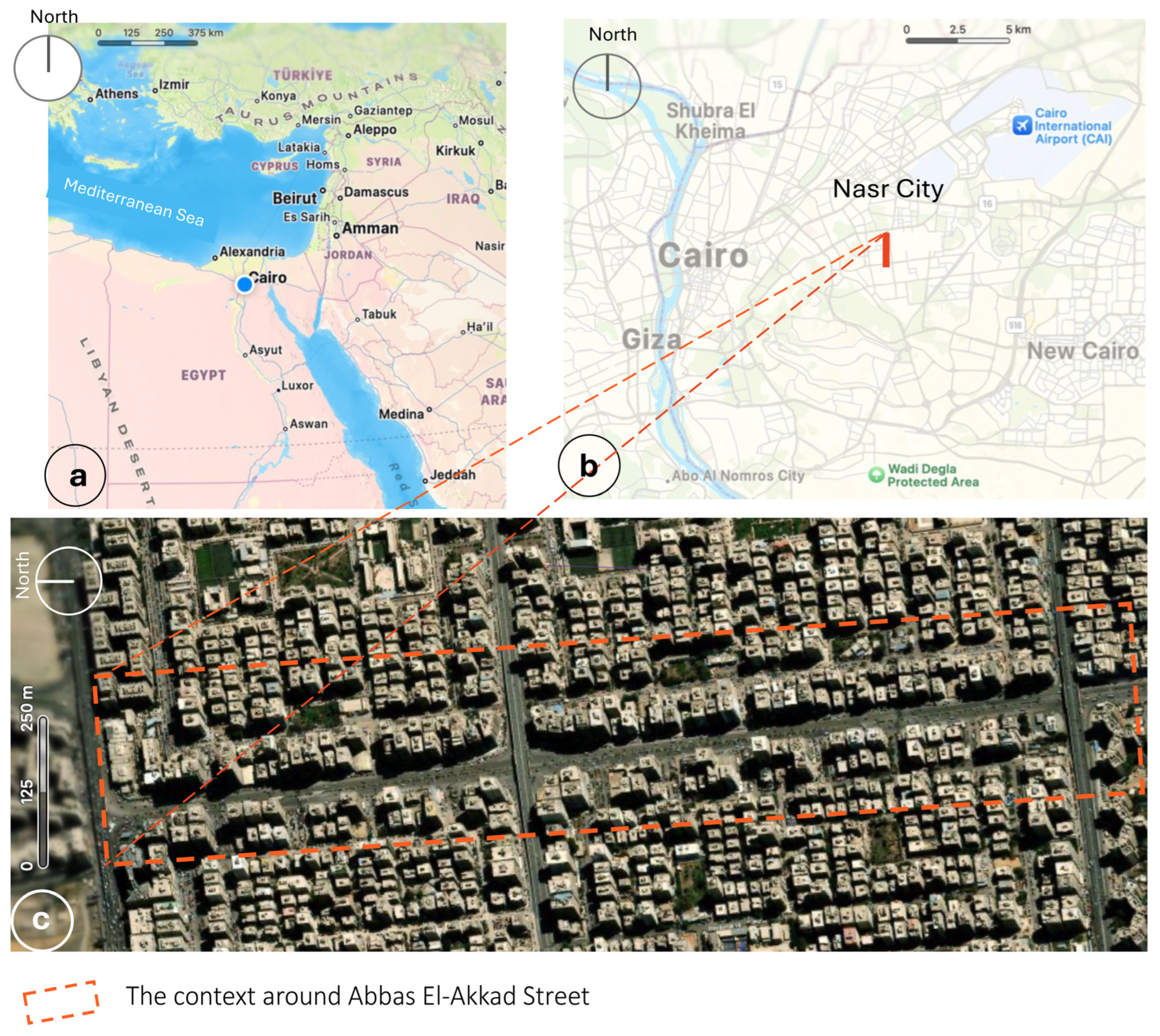
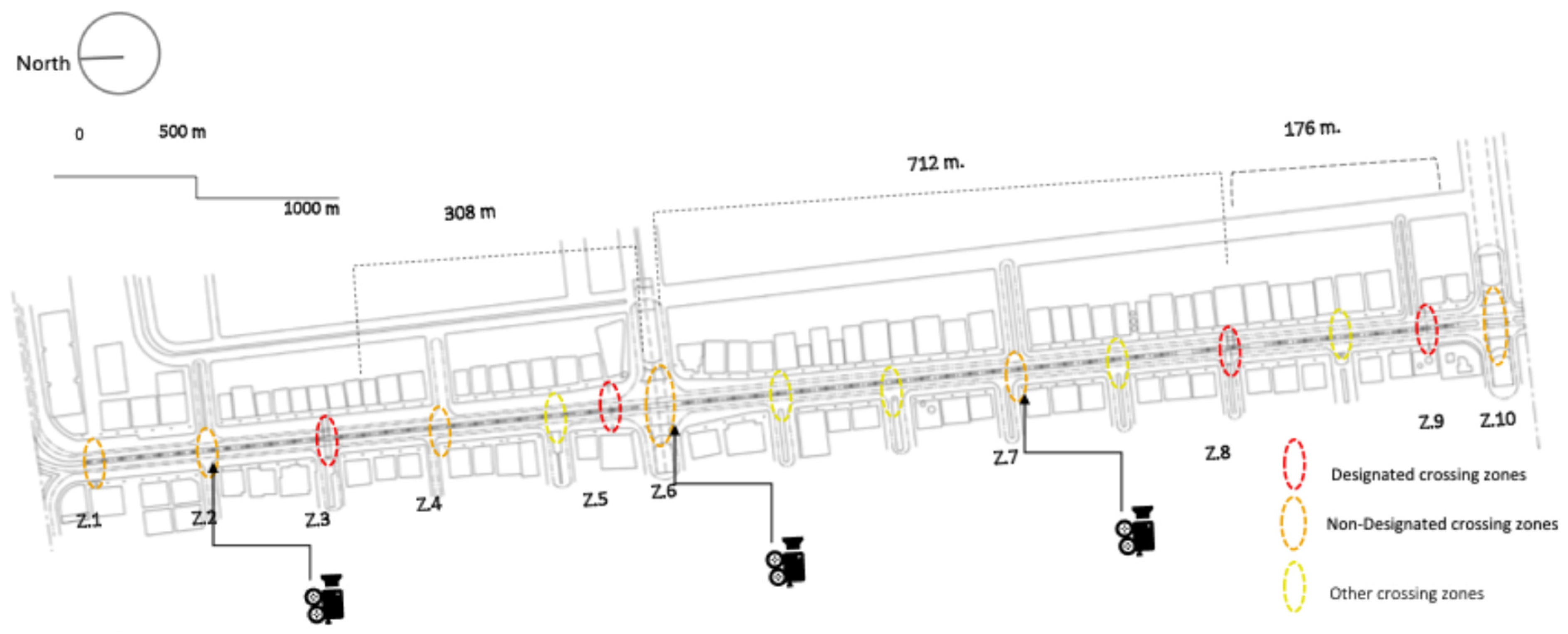
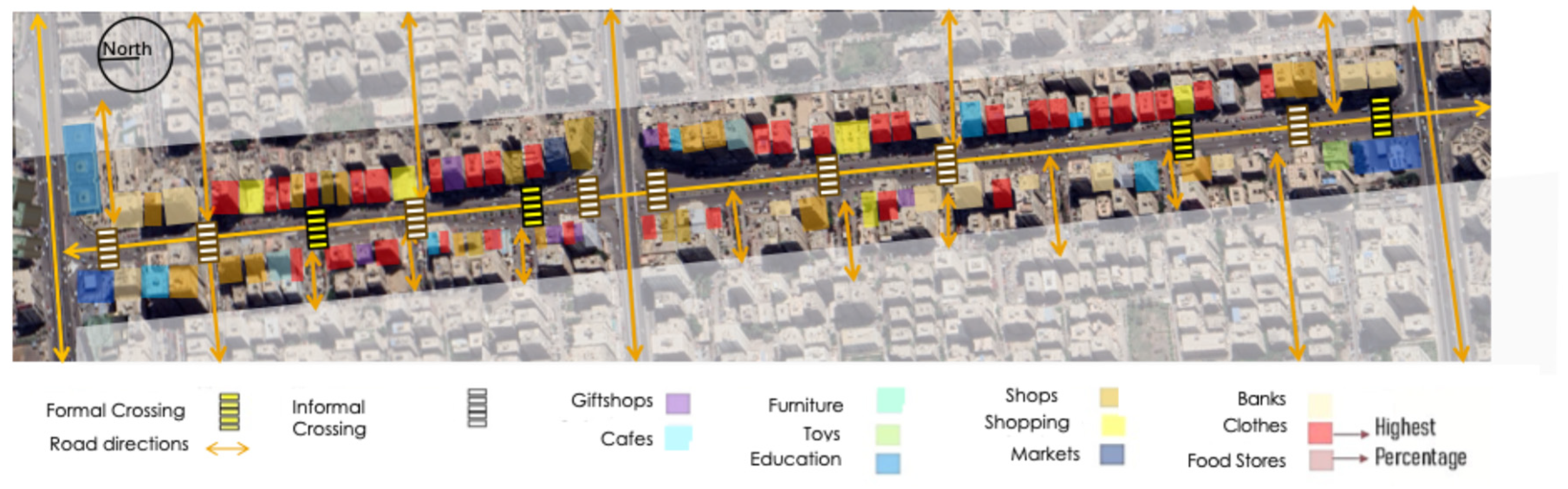
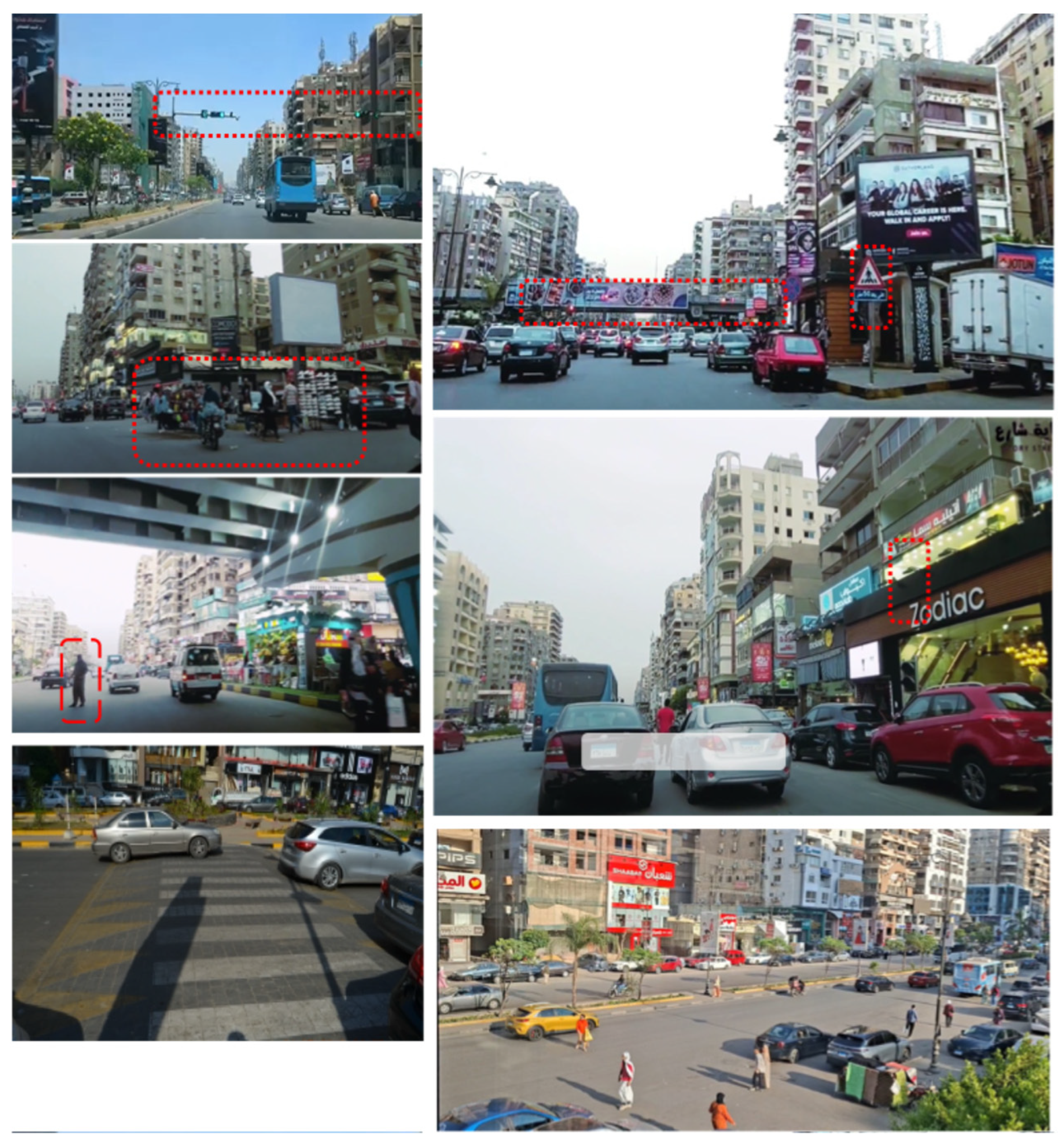
Agent-Based Modeling of Pedestrian Crossing Behavior in Commercial Streets: Seven Actionable Strategies for Safe and Sustainable Urban Mobility


Abstract
1. Introduction
2. Materials and Methods
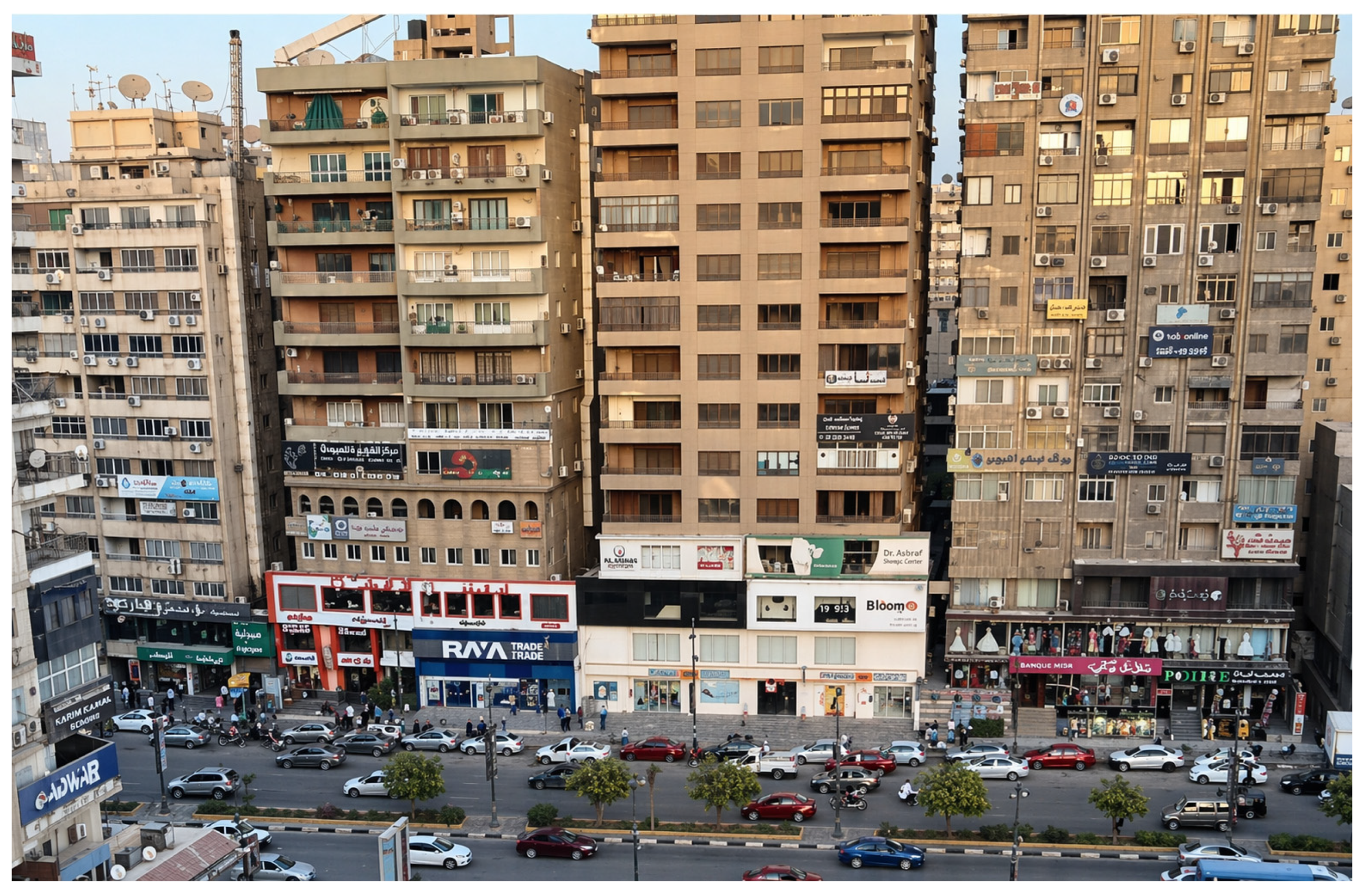
2.1. The Case Study
2.2. Data and Analysis
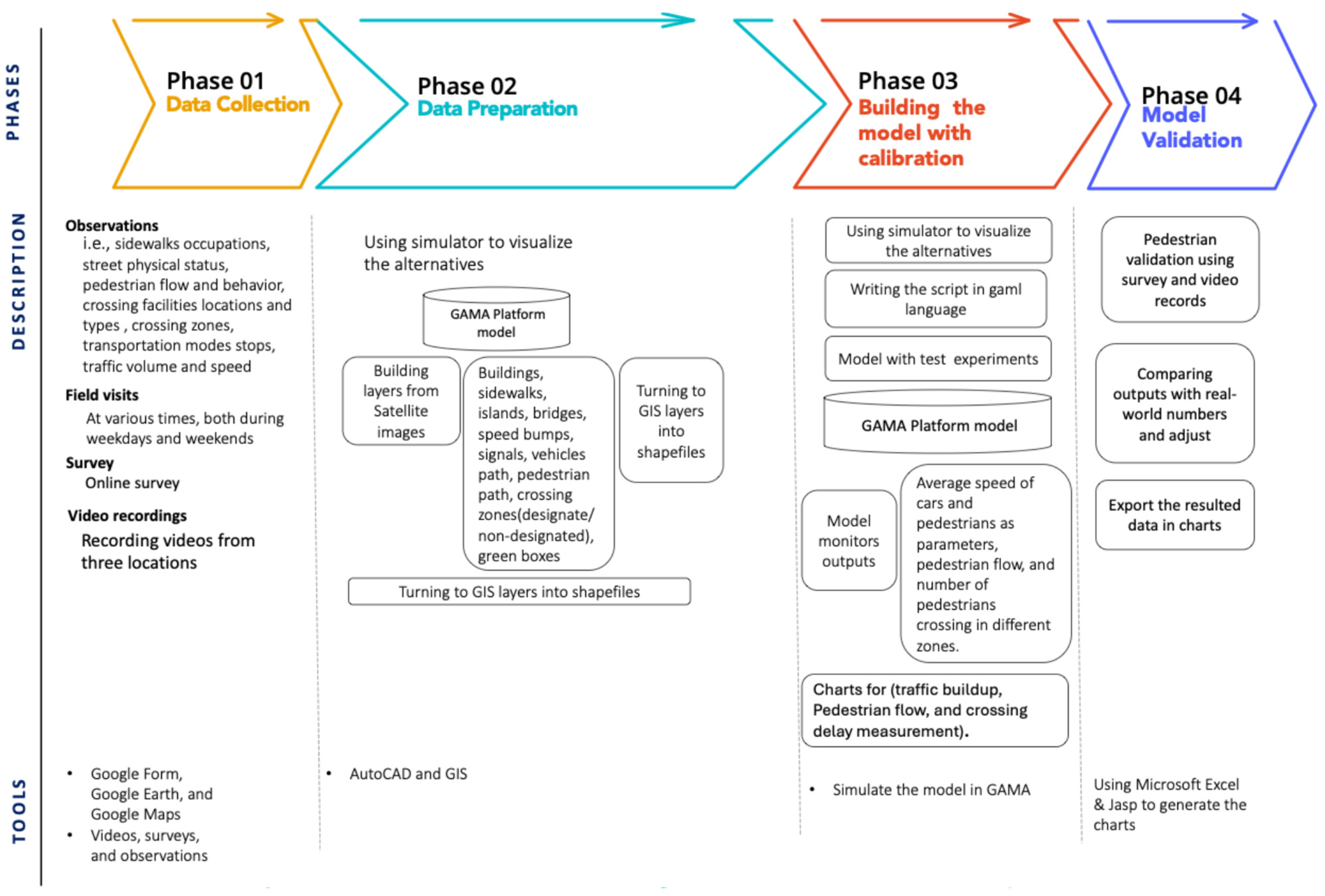
2.2.1. Data Collection—The First Phase
- -
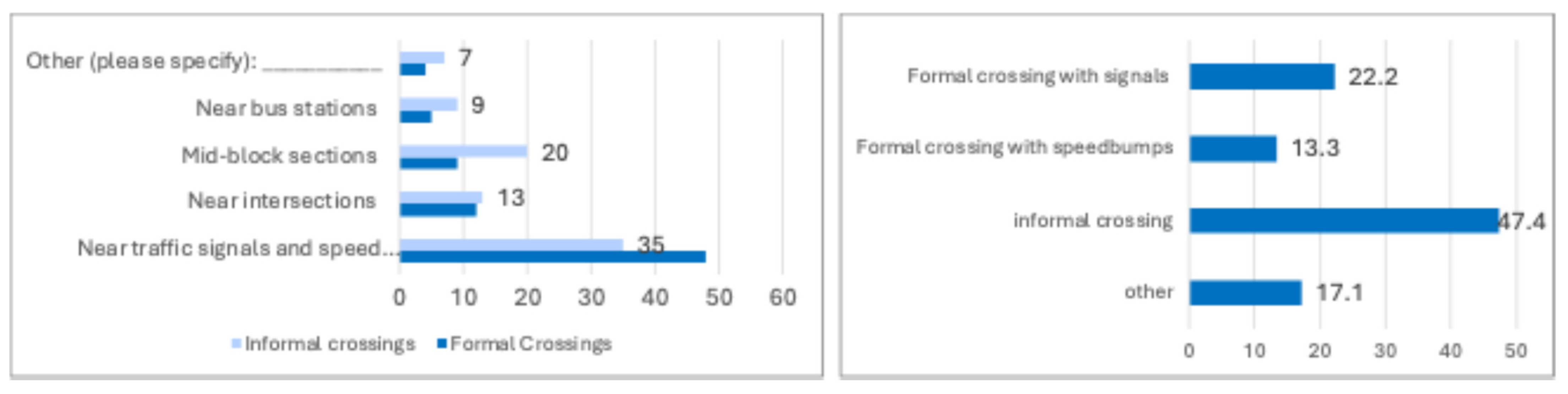
- Which locations do you most frequently cross from?
- -
- How do you usually cross this street?
2.2.2. Data Preparation—The Second Phase
2.2.3. Building the Model with Calibration—The Third Phase
- Initial field framing and model preparation: the prepared street layout, including roads, sidewalks, elevated crosswalks/speed bumps, islands, and informal crossing zones, was manually drawn as shapefiles in GIS and exported to GAMA. A scale-correction step was later introduced to better match real-world dimensions, with a 0.05% downscaling.
- Building the simulation environment in GAMA: The physical environment was built using the GAMA platform, chosen for its integration of GIS data and agent-based behavior scripting. Shapefiles were imported to define the physical environment, and species were created for:
- -
- Buildings, sidewalks, islands, speed bumps, car paths, greenery, pedestrian areas, crossing zones, and traffic signals.
- -
- Dynamic agents: people and cars (car drivers) as shown in Table 1.Table 1. Model agents and assigned skill/behaviors implemented. Source: The authors.
Agent Type Skill\Behaviors Implemented People Random waypoint walking, network-based movement, speed variation, street crossing using facilities in crossing zones, and locations of non-designated crossing zones, avoiding obstacles such as flower boxes Cars Route following, response to signals, speed bump slowing, lane spacing, and avoiding pedestrian Signal Light toggles between red and green based on cycle timer Greenery Works as obstacles to be avoided by pedestrian Speed bump Works as a designated crossing facility for pedestrians and as a tool to slow vehicle traffic All agents GIS-based spatial logic, movement inside designated areas (sidewalks, islands,)
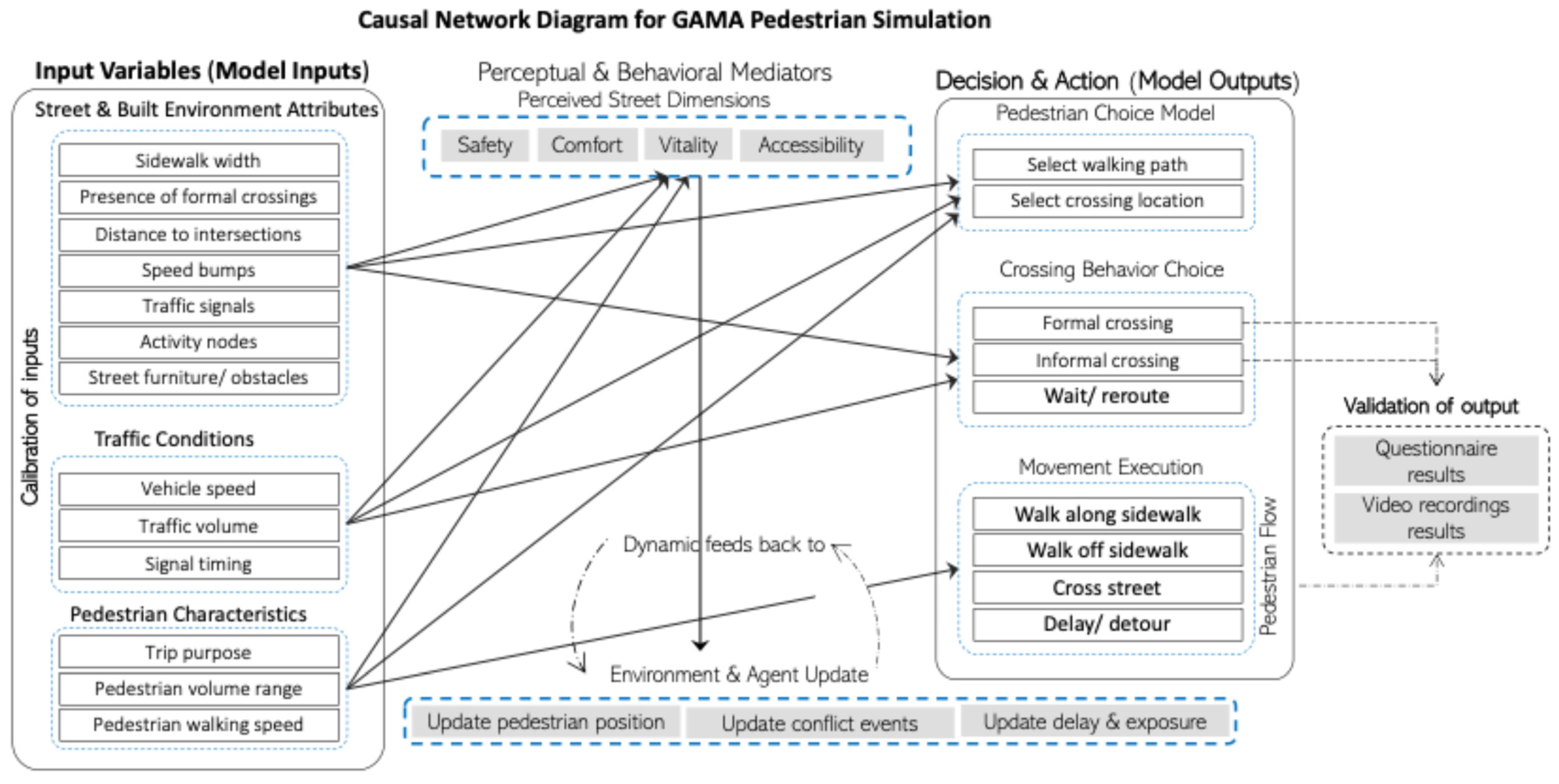
- Defining pedestrian agent behavior: To build pedestrian and vehicular networks, a pedestrian network and a car network was generated using GAMA’s as_edge_graph () function, connecting sidewalk nodes, medians, and speed bumps, and then using pedestrian paths to move. Pedestrians were assigned basic mobility skills with randomized speeds from 0.2 to 1.0 m/s, based on the literature review. Their movement was governed by a reflex that allowed them to navigate to randomly selected points on the pedestrian network. The model settings in pedestrian agents should be capable of (walking within sidewalks, medians, and bump zones, responding to spatial constraints, and redirecting to new destinations upon reaching current targets, crossing along the street on both sides). As such, the physical settings were conducted, such as:
- -
- Ensuring movement inside sidewalks, not along the edges. This was resolved by generating 300 intermediate nodes (nodes_in_sidewalk) within sidewalk geometries and including them in the network, along with creating a pedestrian path to avoid obstacles, such as greenery boxes.
- -
- Achieving visible pedestrian flow. Speeds were reduced and animation intervals adjusted to improve traceability.
- Modeling vehicle agents and traffic signal interactions: The number of pedestrians was randomly sampled from 500 to 3000, varying over time and increasing during peak hours. Pedestrians were distributed along the street, on the sidewalks around the buildings, and crossing from different zones to the other sidewalk. Vehicles were implemented with behaviors that accounted for:
- -
- Speed variation in response to road infrastructure (20–60 km/h) based on the traffic agency, following Egyptian guidelines, particularly slowing near speed bumps and intersections [83].
- -
- Dynamic response to traffic signals, halting when red and resuming when green.

2.2.4. Model Validation–Fourth Phase
3. Results
3.1. Results from Observations and Field Visits
3.2. Survey Results
3.3. Video Recordings Results
3.4. Results from the Model
4. Discussion
4.1. Deductive Argument
4.2. Actionable Strategies for Implementing a Safer, Sustainable Urban Form
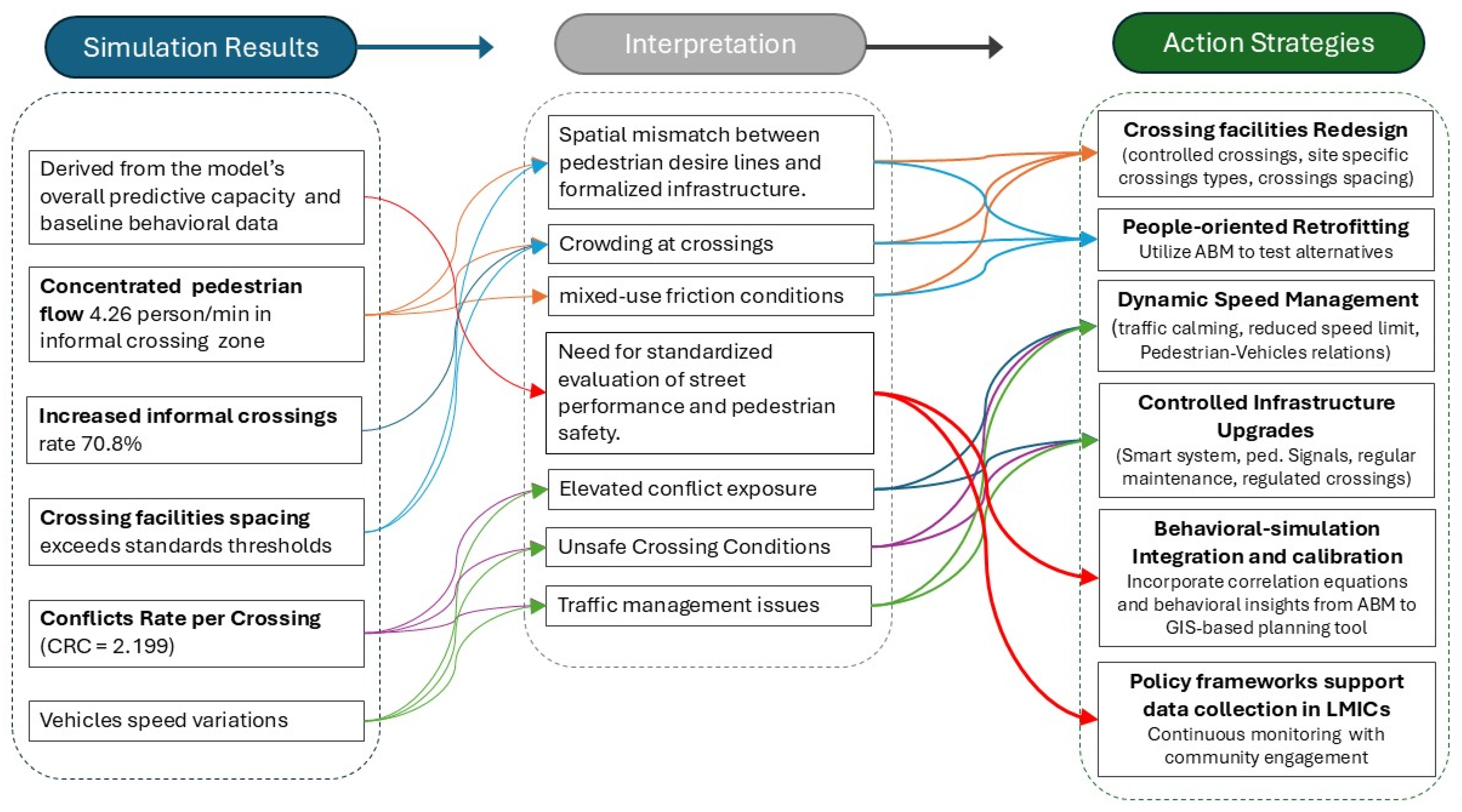
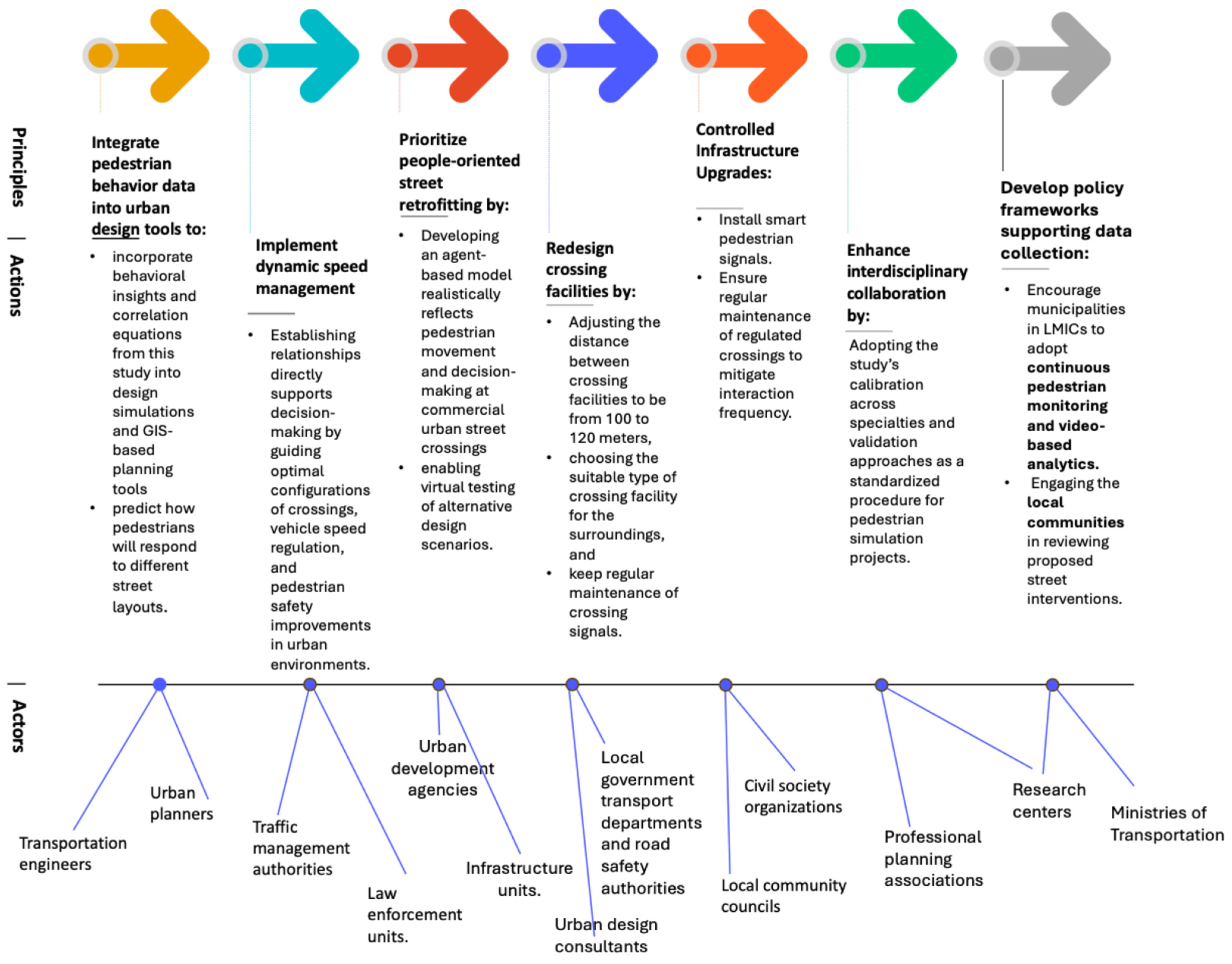
- The first principle is integrating pedestrian behavior data into urban design tools. The action involves incorporating behavioral insights and correlation models into simulation platforms and GIS-based planning tools to better predict pedestrian responses to different street configurations. The main actors responsible for this are urban planners and transportation engineers, who operationalize data into design and planning decisions.
- The second principle is implementing dynamic speed management. The action focuses on establishing clear relationships among pedestrian activity, crossing design, and vehicle speed regulation to guide safer, more efficient traffic conditions. This is primarily led by traffic management authorities, with strong support from law enforcement units to ensure enforcement and compliance.
- The third principle is prioritizing people-oriented street retrofitting. The action involves developing and applying agent-based models that realistically simulate pedestrian movement and decision-making, enabling virtual testing of alternative design scenarios. Urban development agencies and infrastructure units are key actors, integrating these models into redevelopment strategies and street upgrades.
- The fourth principle is redesigning crossing facilities. The action includes adjusting the spacing between crossings, selecting appropriate crossing types for specific contexts, and maintaining crossing infrastructure to ensure safety and usability. Local government transport departments and road safety authorities are the main actors, often collaborating with urban design consultants.
- The fifth principle is controlled infrastructure upgrades. The action focuses on installing smart pedestrian signals and ensuring the regular maintenance of regulated crossings to better manage pedestrian–vehicle interactions. Civil society organizations and local community councils are important actors, contributing through advocacy, feedback, and ensuring that interventions respond to community needs.
- The sixth principle is enhancing interdisciplinary collaboration. The action involves adopting standardized, validated approaches across the disciplines involved in pedestrian simulation and urban design, ensuring consistency and integration in practice. Professional planning associations and research centers are the primary actors, facilitating collaboration, validation, and knowledge sharing.
- The seventh principle is to develop policy frameworks that support data collection. The action includes encouraging municipalities to adopt continuous pedestrian monitoring systems and video-based analytics and engaging local communities in evaluating proposed interventions. Ministries of transport, alongside research centers and local communities, are the central actors responsible for shaping, implementing, and sustaining these policy frameworks.
4.3. Prior Studies and Research Limitations
5. Conclusions
Author Contributions
Funding
Institutional Review Board Statement
Informed Consent Statement
Data Availability Statement
Acknowledgments
Conflicts of Interest
Abbreviations
| ABM | Agent-Based Modeling |
| BDI | Belief–Desire–Intention |
| CCTV | Closed-Circuit Television |
| CRC | Conflicts Rate per Crossing |
| GAMA | GIS Agent-Based Modeling Architecture |
| GIS | Geographic Information System |
| LMICs | Low- Middle-Income Countries |
| MAT Sim | Multi-agent transport simulation |
| SUMO | Simulation of urban mobility |
| SDGs | Sustainable Development Goals |
Appendix A
Appendix B
| Tool | Modeling Approach | Main Application | Strengths | Limitations | Suitability for This Research |
|---|---|---|---|---|---|
| GAMA Platform | Agent-Based Modeling (ABM) with GIS integration | Urban systems, pedestrian–vehicle interaction, environmental simulations | Strong GIS integration, supports complex agent behaviors, handles large datasets, open-source, customizable modeling environment | Requires programming knowledge; moderate learning curve | Highly suitable. Enables modeling of pedestrian–vehicle interactions, integration of spatial data, and simulation of behavioral dynamics relevant to people-oriented street analysis. |
| VISSIM | Microscopic traffic simulation | Traffic flow, vehicle operations, signal control analysis | High accuracy for vehicle traffic simulation, widely used in transportation engineering, strong visualization tools | Limited behavioral modeling of pedestrians; less flexible for custom agent behaviors | Suitable mainly for vehicle traffic analysis, but less appropriate for integrated pedestrian behavior modeling. |
| Depth Map | Space syntax analysis | Spatial configuration analysis, pedestrian movement prediction | Strong spatial analysis capabilities, useful for accessibility and movement patterns | Not an ABM platform; cannot simulate dynamic interactions between pedestrians and vehicles | Useful for spatial configuration analysis, but unsuitable for behavioral simulation. |
| Net Logo | Agent-Based Modeling | Social systems, educational simulations, behavioral models | Easy to learn, good for conceptual models, extensive community support | Limited GIS capabilities, less efficient for large-scale spatial models | Suitable for simple ABM experiments, but less effective for complex urban spatial modeling. |
| MAT Sim | Multi-agent transport simulation | Large-scale transportation systems and travel demand modeling | Efficient for large transportation networks, strong for policy and mobility scenarios | Focuses mainly on travel demand and network flows rather than detailed pedestrian interactions | Suitable for regional mobility modeling, but less appropriate for micro-scale pedestrian behavior analysis. |
| Any Logic | Multi-method simulation (ABM, system dynamics, discrete event) | Logistics, transportation systems, business simulations | Powerful modeling environment with multiple simulation approaches | Commercial software, limited accessibility for academic research without license | Useful for complex simulations, but less accessible and less specialized for urban pedestrian analysis. |
References
- Baeza, J.L.; Carpio-Pinedo, J.; Sievert, J.; Landwehr, A.; Preuner, P.; Borgmann, K.; Avakumović, M.; Weissbach, A.; Bruns-Berentelg, J.; Noennig, J.R. Modeling pedestrian flows: Agent-based simulations of pedestrian activity for land use distributions in urban developments. Sustainability 2021, 13, 9268. [Google Scholar] [CrossRef] [Scilit]
- Abusaada, H.; Elshater, A. Revisiting urban street planning and design factors to promote walking as a physical activity for middle-class individuals with metabolic syndrome in Cairo, Egypt. Int. J. Environ. Res. Public Health 2024, 21, 402. [Google Scholar] [CrossRef] [Scilit] [PubMed]
- Zhang, J.; Li, Y.; Fukuda, T.; Wang, B. Urban safety perception assessments via integrating multimodal large language models with street view images. Cities 2025, 165, 106122. [Google Scholar] [CrossRef] [Scilit]
- Abusaada, H.; Elshater, A. Decoding near synonyms in pedestrianization research: A numerical analysis and summative approach. Urban Sci. 2024, 8, 45. [Google Scholar] [CrossRef] [Scilit]
- Tzouras, P.G.; Batista, M.; Kepaptsoglou, K.L.; Vlahogianni, E.I.; Friedrich, B. Can we all coexist? An empirical analysis of drivers’ and pedestrians’ behavior in four different shared space road environments. Cities 2023, 141, 104477. [Google Scholar] [CrossRef] [Scilit]
- World Health Organization (WHO). Global Status Report on Road Safety; World Health Organization: Geneva, Switzerland, 2018. [Google Scholar]
- Hagos, K.G.; Adnan, M.; Yasar, A.U.H. Effect of sidewalk vendors on pedestrian movement characteristics: A microscopic simulation study of Addis Ababa, Ethiopia. Cities 2020, 103, 102769. [Google Scholar] [CrossRef] [Scilit]
- Anciaes, P.R.; Jones, P. The mismatch between street design and pedestrian preferences: Insights for equitable transport planning. J. Urban Des. 2021, 26, 1025–1044. [Google Scholar]
- Ayoush, P.; Dorina, P. Barriers to the pedestrianization of city centres: Perspectives from the Global North and the Global South. J. Urban Des. 2018, 23, 142–160. [Google Scholar]
- Zhu, Y. Assessment of the stopping for right-turning large vehicles policy in Nanjing: Effectiveness and determinants. PLoS ONE 2025, 20, e0319115. [Google Scholar] [CrossRef] [Scilit]
- Poon, J.; Wong, Y.D. Attitudes and behaviour of elderly in cognisance of transport safety when navigating pedestrian facilities. Accid. Anal. Prev. 2025, 209, 107807. [Google Scholar] [CrossRef] [Scilit]
- Ahmed, N.; Elshater, A.; Afifi, S. The Community Participation in the Design Process of Livable Streets. In Proceedings of the Innovations and Interdisciplinary Solutions for Underserved Areas, Cairo, Egypt, 14–15 February 2019. [Google Scholar]
- Yadav, A.; Kumari, R. Gender safety perspective in urban planning: The case of pedestrian mobility in Kanpur city. Cities 2024, 147, 104845. [Google Scholar] [CrossRef] [Scilit]
- Qi, Z.; Li, J.; Yang, X.; He, Z. How streetscape shapes affect visitor emotions: An experimental analysis based on large-scale street view images in Xi’an, China. Cities 2026, 168, 106424. [Google Scholar] [CrossRef] [Scilit]
- Rui, J.; Othengrafen, F. Examining the Role of Innovative Streets in enhancing urban mobility and livability for sustainable urban transition: A review. Sustainability 2023, 15, 5709. [Google Scholar] [CrossRef] [Scilit]
- Naseri, H.; Ciari, F.; Cloutier, M.-S.; Patwary, A.U.Z. Barriers to car-free streets: Identifying opponents of pedestrianization in Montreal. Cities 2025, 165, 106178. [Google Scholar] [CrossRef] [Scilit]
- Wang, Y.; Srinivasan, A.R.; Jokinen, J.P.; Oulasvirta, A.; Markkula, G.M. Pedestrian crossing decisions can be explained by bounded optimal decision-making under noisy visual perception. Transp. Res. Part C Emerg. Technol. 2025, 171, 104963. [Google Scholar] [CrossRef] [Scilit]
- Szagala, P.; Brzezinski, A.; Kiec, M.; Budzynski, M.; Wachnicka, J.; Pazdan, S. Pedestrian safety at midblock crossings on dual carriageway roads in Polish cities. Sustainability 2022, 14, 5703. [Google Scholar] [CrossRef] [Scilit]
- Saleh, W.; Grigorova, M.; Elattar, S. Pedestrian road crossing at uncontrolled mid-block locations: Does the refuge island Increase risk? Sustainability 2020, 12, 4891. [Google Scholar] [CrossRef] [Scilit]
- El-Bardisy, N.; Elshater, A.; Afifi, S.; Alfiky, A. Predicting traffic sound levels in Cairo before, during, and after the COVID-19 lockdown using Predictor-LimA software. Ain Shams Eng. J. 2024, 14, 102088. [Google Scholar] [CrossRef] [Scilit]
- Wael, S.; Elshater, A.; Afifi, S. Mapping user experiences around transit stops using computer vision technology: Action priorities from Cairo. Sustainability 2022, 14, 11008. [Google Scholar] [CrossRef] [Scilit]
- Perel, P.; Ker, K.; Ivers, R.; Blackhall, K. Road safety in low- and middle-income countries: A neglected research area. Inj. Prev. 2007, 13, 227–233. [Google Scholar] [CrossRef] [Scilit]
- Elsayed, M.; Elshater, A.; Shehayeb, D.F.M.; Afifi, S. Exploring the restorative environments in Bratislava using EEG and VR: A neuro-urbanism approach. Archnet-IJAR Int. J. Archit. Res. 2025, 19, 666–688. [Google Scholar] [CrossRef] [Scilit]
- Godthelp, H.; Wesemann, P.; Stipdonk, H.L.; King, M. Capacity building for road safety in LMICs: The need for a sustainable local knowledge and research infrastructure. Traffic Saf. Res. 2024, 8, e000063. [Google Scholar] [CrossRef] [Scilit]
- Staton, C.; Vissoci, J.; Gong, E.; Toomey, N.; Abdelgadir, R.; Zahou, J.; Liu, C.; Pei, F.; Zick, B. Road traffic injury prevention Initiatives: A systematic review and meta summary of effectiveness in low and middle income countries. PLoS ONE 2016, 11, e0150150. [Google Scholar] [CrossRef] [Scilit] [PubMed]
- Flannigan, S.; Khayesi, M. Content analysis of reported activities of the United Nations Road Safety Collaboration Members during the decade of action for road safety 2011–2020. BMJ Open 2021, 5, e042409. [Google Scholar] [CrossRef] [Scilit]
- Panahi, N.; Tavakoli, N.; Sarvestani, K.K. Women’s walking behavior: Investigating contributing factors in urban contexts. Cities 2026, 168, 106467. [Google Scholar] [CrossRef] [Scilit]
- Muley, D.; Kharbeche, M.; Downey, L.; Saleh, W.; Al-Salem, M. Road users’ behavior at marked crosswalks on channelized right-turn lanes at intersections in the State of Qatar. Sustainability 2019, 11, 5699. [Google Scholar] [CrossRef] [Scilit]
- Ahmed, N.; Elshater, A.; Afifi, S.; El-Bardisiy, W.M. Scoping review for people-oriented development reaching planning and design factors in urban streets. Al-Qadisiyah J. Eng. Sci. 2026, 19, 1–13. [Google Scholar]
- Yao, S.; Wang, N.; Wu, J. How does the built environment affect pedestrian perception of road safety on sidewalks? Evidence from eye-tracking experiments. Transp. Res. Part F Traffic Psychol. Behav. 2025, 110, 57–73. [Google Scholar] [CrossRef] [Scilit]
- Yang, Y.; Wang, Y.; Easa, S.M.; Zheng, X. Analyzing pedestrian behavior at unsignalized crosswalks from the drivers’ perspective: A qualitative study. Appl. Sci. 2022, 12, 4017. [Google Scholar] [CrossRef] [Scilit]
- Gerike, R.; Koszowski, C.; Schröter, B.; Buehler, R.; Schepers, P.; Weber, J.; Wittwer, R.; Jones, P. Built environment determinants of pedestrian activities and their consideration in urban street design. Sustainability 2021, 13, 9362. [Google Scholar] [CrossRef] [Scilit]
- Angulo, A.V.; Robartes, E.; Guo, X.; Chen, T.D.; Heydarian, A.; Smith, B.L. Evaluating current and future pedestrian mid-block crossing safety treatments using virtual reality simulation. Accid. Anal. Prev. 2024, 206, 107715. [Google Scholar] [CrossRef] [Scilit]
- Abusaada, H.; Elshater, A. Improving visitor satisfaction in Egypt’s Heliopolis historical district. J. Eng. Appl. Sci. 2021, 68, 19. [Google Scholar] [CrossRef] [Scilit]
- Yassin, H.H. Livable city: An approach to pedestrianization through tactical urbanism. Alex. Eng. J. 2019, 58, 251–259. [Google Scholar] [CrossRef] [Scilit]
- Raida, A.; Hosseini, A.; Cárdenas, C.D.; Heydarian, A.; Chen, T.D. What affects pedestrian street crossing decisions in day and night scenarios? A case study in Charlottesville, Virginia. Transp. Res. Part F Traffic Psychol. Behav. 2025, 115, 103362. [Google Scholar] [CrossRef] [Scilit]
- Rashed, R. From concept to action: Active mobility cards for collective spaces in block-system urban neighborhoods. Ain Shams Eng. J. 2025, 16, 103771. [Google Scholar] [CrossRef] [Scilit]
- Yendra, D.; Watson-Brown, N.; Haworth, N. A comparison of factors influencing the safety of pedestrians accessing bus stops in countries of differing income levels. Accid. Anal. Prev. 2024, 207, 107725. [Google Scholar] [CrossRef] [Scilit]
- United Nations. Transforming Our World: The 2030 Agenda for Sustainable Development (Resolution A/RES/70/1); United Nations: New York, NY, USA, 2015. [Google Scholar]
- Pechteep, P.; Luathep, P.; Jaensirisak, S.; Kronprasert, N. Analysis of factors influencing driver yielding behavior at midblock crosswalks on urban arterial roads in Thailand. Sustainability 2024, 16, 4118. [Google Scholar] [CrossRef] [Scilit]
- Sabi Boun, S.; Janvier, R.; Jean Marc, R.E.; Paul, P.; Senat, R.; Demes, J.A.E.; Burigusa, G.; Chaput, S.; Maurice, P.; Druetz, T. Environmental measures to improve pedestrian safety in low- and middle-income countries: A scoping review. Glob Health Promot 2024, 31, 44–55. [Google Scholar] [CrossRef] [Scilit]
- Altwaijri, S.; Alotaibi, S.; Alosaimi, F.; Almutairi, A.; Alauany, A. A multi-model machine learning framework for predicting and ranking high-risk urban intersections in Riyadh. Sustainability 2026, 18, 3651. [Google Scholar] [CrossRef] [Scilit]
- Mukherjee, D.; Mitra, S. What affects pedestrian crossing difficulty at urban intersections in a developing country? IATSS Res. 2022, 46, 586–601. [Google Scholar] [CrossRef] [Scilit]
- Loo, B. Walking towards a happy city. J. Transp. Geogr. 2021, 93, 103078. [Google Scholar] [CrossRef] [Scilit]
- Gitelman, V.; Sharon, A. An Examination of pedestrian crossing behaviors at signalized intersections with bus priority routes. Sustainability 2025, 17, 457. [Google Scholar] [CrossRef] [Scilit]
- McIlroy, R.C.; Nam, V.H.; Bunyasi, B.W.; Jikyong, U.; Kokwaro, G.O.; Wu, J.; Hoque, M.S.; Plant, K.L.; Preston, J.M.; Neville, A. Stanton, Exploring the relationships between pedestrian behaviours and traffic safety attitudes in six countries. Transp. Res. Part F Traffic Psychol. Behav. 2020, 68, 257–271. [Google Scholar] [CrossRef] [Scilit]
- Densu, S.N.; Brijs, K.; Polders, E.; Janssens, D.; Brijs, T.; Pirdavani, A. Bus stop environment and pedestrian crash risk in Kumasi, Ghana: Implications for safe and sustainable urban mobility. Sustainability 2026, 18, 3437. [Google Scholar] [CrossRef] [Scilit]
- Song, L.; Wang, W.; Liu, Q.; Bi, R.; Xu, X. Towards sustainable urban mobility: An experimental study on vibration and noise of elevated rail Transit at different train speeds. Sustainability 2026, 18, 3296. [Google Scholar] [CrossRef] [Scilit]
- Abusaada, H.; Elshater, A. Cairenes’ storytelling: Pedestrian scenarios as a normative factor when enforcing street changes in residential areas. Soc. Sci. 2023, 12, 278. [Google Scholar] [CrossRef] [Scilit]
- El-Sherbiny, Y.M. Design of urban traffic areas. J. Eng. Appl. Sci. 2011, 6, 1–7. [Google Scholar]
- Maarouf, N.M.; El-Alfy, A.H. An approach towards solving pedestrian problems in modern Cairo. J. Appl. Sci. Res. 2012, 8, 144–156. [Google Scholar]
- Hamad, S.; El Din, H. Towards Sustainable Cities and Communities: Right of Use of Sidewalks in Cairo. In Design for Resilient Communities: UIA 2023; Sustainable Development Goals Series; Springer: Cham, Switzerland, 2023; pp. 3–14. [Google Scholar]
- El-Razik, M.A.; Hafez, Y.; Hendy, A.; Fawzy, M. Methodology for microclimatic urban canyon design case study surrounding MUST university campus in Cairo. HBRC J. 2024, 20, 589–603. [Google Scholar] [CrossRef] [Scilit]
- Abdullah, M.; Shafik, Z.; El-Kerdany, D. General theory of walkability as criteria for regenerating Maadi as a walkable neighborhood. J. Eng. Res. 2019, 162, 60–75. [Google Scholar] [CrossRef] [Scilit]
- Banerjee, A.; Maurya, A.K.; Lämmel, G. A review of pedestrian flow characteristics and level of service over different pedestrian facilities. Collect. Dyn. 2018, 3, 1–52. [Google Scholar]
- Ezzati Amini, R.; Katrakazas, C.; Antoniou, C. Negotiation and decision-making for a pedestrian roadway crossing: A literature review. Sustainability 2019, 11, 6713. [Google Scholar] [CrossRef] [Scilit]
- Abusaada, H.; Elshater, A. Effects of urban atmospheres on changing attitudes of crowded public places: An action plan. Int. J. Community Well-Being 2020, 3, 109–159. [Google Scholar] [CrossRef] [Scilit]
- Crooks, A.; Castle, C.E.; Batty, M. Key challenges in agent-based modelling for geo-spatial simulation. Comput. Environ. Urban Syst. 2008, 32, 417–430. [Google Scholar] [CrossRef] [Scilit]
- Sadeek, S.N.; Rahman, M.H.; Rifaat, S.M. Understanding pedestrian bridge usage considering perception and socio-demographic characteristics of the road users in Dhaka city. Transp. Res. Interdiscip. Perspect. 2025, 31, 101384. [Google Scholar] [CrossRef] [Scilit]
- Sheng, Q.; Jiao, J.; Pang, T. Understanding the impact of street patterns on pedestrian distribution: A case study in Tianjin, China. Urban Rail Transit 2021, 7, 209–225. [Google Scholar] [CrossRef] [Scilit]
- Cochran, W.G. Sampling Techniques; John Wiley & Sons: New York, NY, USA, 1977. [Google Scholar]
- Megahed, G.; Elshater, A.; Afifi, S.M. Competencies urban planning students need to succeed in professional practices: Lessons learned from Egypt. Archnet-IJAR 2018, 14, 267–287. [Google Scholar] [CrossRef] [Scilit]
- Elshater, A.; Abusaada, H.; Tarek, M.; Afifi, S. Designing the socio-spatial context urban infill, liveability, and conviviality. Built Environ. 2022, 48, 341–363. [Google Scholar] [CrossRef] [Scilit]
- Bonabeau, E. Agent-based modeling: Methods and techniques for simulating human systems. Proc. Natl. Acad. Sci. USA 2002, 99, 7280–7287. [Google Scholar] [CrossRef] [Scilit]
- Lakmali, R.G.N.; Genovese, P.V.; Abewardhana, A.A.B.D.P. Evaluating the efficacy of agent-based modeling in analyzing pedestrian dynamics within the built environment: A comprehensive systematic literature review. Buildings 2024, 14, 1945. [Google Scholar] [CrossRef] [Scilit]
- Wu, H.; Liu, L.; Yu, Y.; Peng, Z.; Jiao, H.; Niu, Q. An Agent-based Model Simulation of Human Mobility Based on Mobile Phone Data: How Commuting Relates to Congestion. ISPRS Int. J. Geo-Inf. 2019, 8, 313. [Google Scholar] [CrossRef] [Scilit]
- Yang, S.; Dane, G.Z.; Arentze, T.A. An agent-based model to simulate pedestrians’ affective experiences and activities for evaluating urban public space design. Cities 2025, 166, 106292. [Google Scholar] [CrossRef] [Scilit]
- Crooks, A.T.; Heppenstall, A.J. Introduction to agent-based modeling. In Agent-Based Models of Geographical Systems; Springer: Dordrecht, The Netherlands, 2012; pp. 85–105. [Google Scholar]
- Chauhan, S.; Dave, S.; Shah, J.; Kedia, A. Assessing Traffic Characteristics for Safe Pedestrian Crossings: Developing Warrants for Sustainable Urban Safety. Sustainability 2024, 16, 4182. [Google Scholar] [CrossRef] [Scilit]
- Serena, L.; Marzolla, M.; D’Angelo, G.; Ferretti, S. A review of multilevel modeling and simulation for human mobility and behavior. Simul. Model. Pract. Theory 2023, 127, 102780. [Google Scholar] [CrossRef] [Scilit]
- Ma, L.; Brandt, S.A.; Seipel, S.; Ma, D. Simple agents–complex emergent path systems: Agent-based modelling of pedestrian movement. Environ. Plan. B Urban Anal. City Sci. 2023, 51, 479–495. [Google Scholar] [CrossRef] [Scilit]
- Yannis, G.; Golias, J.; Papadimitriou, E. Modeling crossing behavior and accident risk of pedestrians. J. Transp. Eng. 2007, 133, 634–644. [Google Scholar] [CrossRef] [Scilit]
- Viale, R. Behavioral city. Front. Built Environ. 2025, 10, 1501853. [Google Scholar] [CrossRef] [Scilit]
- Uthpala, N.; Hansika, N.; Dissanayaka, S.; Tennakoon, K.; Dharmarathne, S.; Vidanarachchi, R.; Alawatugoda, J.; Herath, D. Analyzing transportation mode interactions using agent-based models. SN Appl. Sci. 2023, 5, 357. [Google Scholar] [CrossRef] [Scilit]
- Krajzewicz, D.; Erdmann, J.; Behrisch, M.; Bieker, L. Recent development and applications of SUMO–Simulation of Urban Mobility. Int. J. Adv. Syst. Meas. 2012, 5, 128–138. [Google Scholar]
- Burdzik, R.; Simiński, D.; Kruszewski, M.; Niedzicka, A.; Gąsiorek, K.; Zabieva, A.; Mamala, J.; Dębicka, E. Designing and Planning of Studies of Driver Behavior at Pedestrian Crossings Using Whole-Vehicle Simulators. Appl. Sci. 2024, 14, 4217. [Google Scholar] [CrossRef] [Scilit]
- Taillandier, P.; Vo, D.A.; Amouroux, E.; Drogoul, A. GAMA: A simulation platform that integrates GIS, agent-based modeling and multi-scale control. In Complex Systems Modeling and Simulation in Infrastructure and Environmental Engineering; Springer: Berlin/Heidelberg, Germany, 2019. [Google Scholar]
- Saval, A.; Minh, D.P.; Chapuis, K.; Tranouez, P.; Caron, C.; Daudé, É. Dealing with mixed and non-normative traffic. An agent-based simulation with the GAMA platform. PLoS ONE 2023, 18, e0281658. [Google Scholar] [CrossRef] [Scilit]
- Gilbert, N.; Troitzsch, K. Simulation for the Social Scientist; Open University Press: London, UK, 2005. [Google Scholar]
- Taillandier, P.; Gaudou, B.; Grignard, A.; Huynh, Q.-N.; Marilleau, N.; Caillou, P.P.; Philippon, D.; Drogoul, A. Building, composing and experimenting complex spatial models with the GAMA platform. Geoinformatica 2019, 23, 299–322. [Google Scholar] [CrossRef] [Scilit]
- Caillou, P.; Gaudou, B.; Grignard, A.; Truong, C.Q.; Taillandier, P. A Simple-to-Use BDI Architecture for Agent-Based Modeling and Simulation. In Advances in Social Simulation 2015; Springer: Berlin/Heidelberg, Germany, 2017. [Google Scholar]
- Sparnaaij, M.; Duives, D.C. Chapter Nine-Calibration, validation & verification. Adv. Transp. Policy Plan. 2025, 15, 297–348. [Google Scholar]
- Bank, W. Cairo Traffic Congestion Study; World Bank: Cairo, Egypt, 2011. [Google Scholar]
- Tian, K.; Tzigieras, A.; Wei, C.; Lee, Y.M.; Holmes, C.; Leonetti, M.; Merat, N.; Romano, R.; Markkula, G. Deceleration parameters as implicit communication signals for pedestrians’ crossing decisions and estimations of automated vehicle behaviour. Accid. Anal. Prev. 2023, 190, 107173. [Google Scholar] [CrossRef] [Scilit] [PubMed]
- Helbing, D.; Molnár, P. Social force model for pedestrian dynamics. Phys. Rev. E 1995, 51, 4282–4286. [Google Scholar] [CrossRef] [Scilit] [PubMed]
- Yannis, G.; Papadimitriou, E.; Theofilatos, A. Pedestrian gap acceptance for mid-block street crossing. Transp. Plan. Technol. 2013, 36, 450–462. [Google Scholar] [CrossRef] [Scilit]
- Hussein, M.; Sayed, T. Validation of an agent-based microscopic pedestrian simulation model in a crowded pedestrian walking environment. Transp. Plan. Technol. 2018, 42, 1–22. [Google Scholar] [CrossRef] [Scilit]
- Khogali, M.M.E.; Ali, E.A.M.; Ramdani, A. Integrating behavioral science into urban planning: A framework for human-centered spatial design. Front. Psychol. 2025, 16, 1632523. [Google Scholar] [CrossRef] [Scilit]
- Kim, Y.; Choi, B.; Choi, M.; Ahn, S.; Hwang, S. Enhancing pedestrian perceived safety through walking environment modification considering traffic and walking infrastructure. Front Public Health 2024, 11, 1326468. [Google Scholar] [CrossRef] [Scilit]
- Silva, C.; Xue, S. Situating spatial determinism in urban design and planning for sustainable walkability: A simulation of street morphology and pedestrian behaviour. Discov. Sustain. 2024, 5, 212. [Google Scholar] [CrossRef] [Scilit]
- Hamidi, S.; Moazzeni, S. Examining the relationship between urban design qualities and walking behavior: Empirical evidence from Dallas, TX. Sustainability 2019, 11, 2720. [Google Scholar] [CrossRef] [Scilit]
- Mu, X.; Mu, L.; Zhang, J. The impact of street elements on pedestrian stopping behavior in commercial pedestrian streets from the perspective of commercial vitality. Sustainability 2024, 16, 7727. [Google Scholar] [CrossRef] [Scilit]
- Lawrence, P.J.; Pellacini, V.; Blackshields, D. The Development of Pedestrian Gap Acceptance and Midblock Pedestrian Road Crossing Behavior Utilizing SUMO. In Proceedings of the SUMO User Conference 2021, Online, 13–15 September 2021. [Google Scholar]
- Soares, F.; Pereira, F.; Faria, S.; Sousa, E.; Almeida, R.; Freitas, E. Pedestrian behavior in static and dynamic virtual road crossing experiments. Appl. Syst. Innov. 2024, 7, 94. [Google Scholar] [CrossRef] [Scilit]








Disclaimer/Publisher’s Note: The statements, opinions and data contained in all publications are solely those of the individual author(s) and contributor(s) and not of MDPI and/or the editor(s). MDPI and/or the editor(s) disclaim responsibility for any injury to people or property resulting from any ideas, methods, instructions or products referred to in the content. |
© 2026 by the authors. Licensee MDPI, Basel, Switzerland. This article is an open access article distributed under the terms and conditions of the Creative Commons Attribution (CC BY) license.
Share and Cite
Ahmed, N.; Elshater, A.; Afifi, S.; Elbardisy, W.M. Agent-Based Modeling of Pedestrian Crossing Behavior in Commercial Streets: Seven Actionable Strategies for Safe and Sustainable Urban Mobility. Sustainability 2026, 18, 4122. https://doi.org/10.3390/su18084122
Ahmed N, Elshater A, Afifi S, Elbardisy WM. Agent-Based Modeling of Pedestrian Crossing Behavior in Commercial Streets: Seven Actionable Strategies for Safe and Sustainable Urban Mobility. Sustainability. 2026; 18(8):4122. https://doi.org/10.3390/su18084122
Chicago/Turabian StyleAhmed, Nourhan, Abeer Elshater, Samy Afifi, and Wesam M. Elbardisy. 2026. "Agent-Based Modeling of Pedestrian Crossing Behavior in Commercial Streets: Seven Actionable Strategies for Safe and Sustainable Urban Mobility" Sustainability 18, no. 8: 4122. https://doi.org/10.3390/su18084122
APA StyleAhmed, N., Elshater, A., Afifi, S., & Elbardisy, W. M. (2026). Agent-Based Modeling of Pedestrian Crossing Behavior in Commercial Streets: Seven Actionable Strategies for Safe and Sustainable Urban Mobility. Sustainability, 18(8), 4122. https://doi.org/10.3390/su18084122