Article

Sustainable Operational Decision-Making for Thermal Power Enterprises’ Carbon Assets Oriented Toward Medium- and Long-Term Risk Exposure

1
School of Finance and Economics, Jiangsu University, Zhenjiang 212013, China
2
Department of Economics, University of Toronto, Toronto, ON M5S 1A1, Canada
*
Author to whom correspondence should be addressed.
Sustainability 2026, 18(8), 4094; https://doi.org/10.3390/su18084094
Submission received: 25 March 2026 / Revised: 10 April 2026 / Accepted: 14 April 2026 / Published: 20 April 2026

Abstract

Against the background of deepening “dual carbon” goals and the continuously tightening policies of the national carbon market, the carbon asset risks faced by thermal power enterprises have shifted from short-term compliance cost fluctuations to medium- and long-term systemic risks. Managing these risks effectively is essential for ensuring the financial viability of thermal power operations during the low-carbon transition, thereby supporting the long-term sustainability of the energy sector. This study constructs a risk management framework for carbon assets in thermal power enterprises based on the LSTM model and option portfolios. First, the multi-dimensional characteristics of medium- and long-term carbon asset risks are systematically identified at the policy, market, and enterprise levels. Second, a dual-layer LSTM model with Dropout regularization is employed to simulate medium- and long-term carbon prices. The prediction results indicate a moderate upward trend in future carbon prices, with the fluctuation range gradually narrowing. On this basis, a combined hedging strategy of “core call options + auxiliary put options” is designed, capping the maximum procurement cost at 72.63 CNY/ton and covering over 90% of the risk of carbon price increases. Monte Carlo simulations and rolling window backtesting, conducted using operational data from a thermal power enterprise to validate the framework, verify the effectiveness and robustness of the strategy. The study shows that, through the integration of accurate LSTM predictions and proactive option hedging, thermal power enterprises can transform their carbon asset management from passive compliance to active value creation, thereby enhancing their operational sustainability and resilience during the energy transition.

1. Introduction

Carbon pricing mechanisms have gained widespread adoption globally. In July 2021, China officially launched its national carbon emission trading market, initially incorporating the power generation sector [1]. This marked a shift in carbon asset management from a peripheral corporate function to a core strategic one [2]. For thermal power enterprises, carbon assets are no longer merely compliance tools but have become key factors influencing their long-term profitability and market competitiveness [3].
With the deepening of the “dual carbon” goals, national carbon market policies have continuously tightened. Allocation benchmarks for carbon allowances have been lowered year by year, and the proportion of paid allocations has gradually increased [4]. Against this backdrop, the carbon asset risks faced by thermal power enterprises have undergone a structural transformation: shifting from short-term fluctuations in compliance costs to medium- and long-term systemic risks constituted by policy tightening, trend-driven price increases, and heightened market volatility [5]. For enterprises with a high proportion of thermal power assets, this risk is particularly pronounced—it implies a significant rise in future procurement costs. However, thermal power enterprises currently lack effective risk quantification tools and hedging instruments, making it difficult to make scientific judgments about future carbon price trends, let alone actively manage the resulting financial uncertainty [6]. Therefore, how to identify, quantify, and effectively hedge medium- and long-term carbon asset risks has become a core issue urgently needing resolution in the carbon asset management of thermal power enterprises. Addressing this issue is not only a matter of corporate financial management but also a prerequisite for the sustainable operational transformation of the power sector under stringent environmental policies.
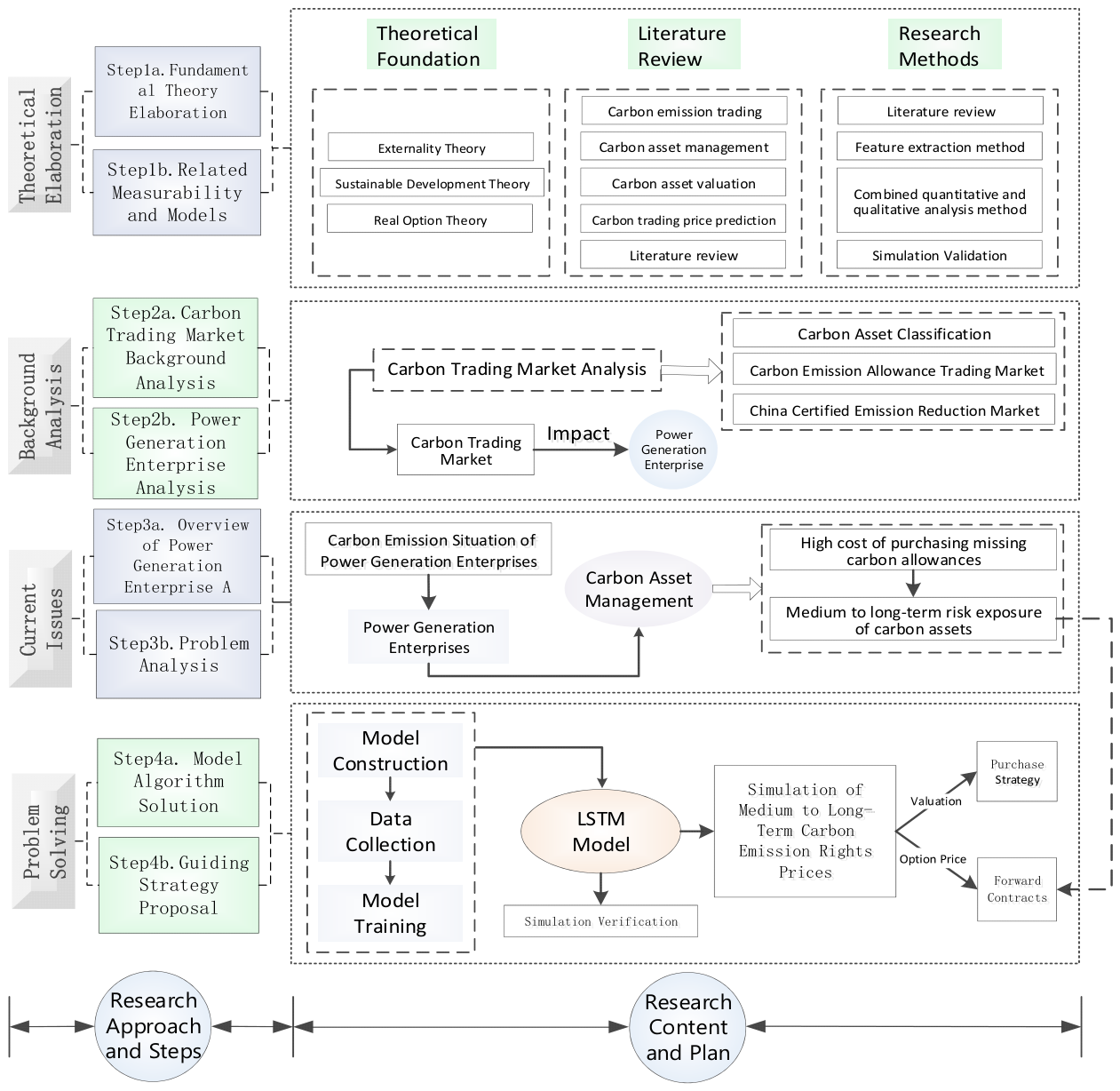
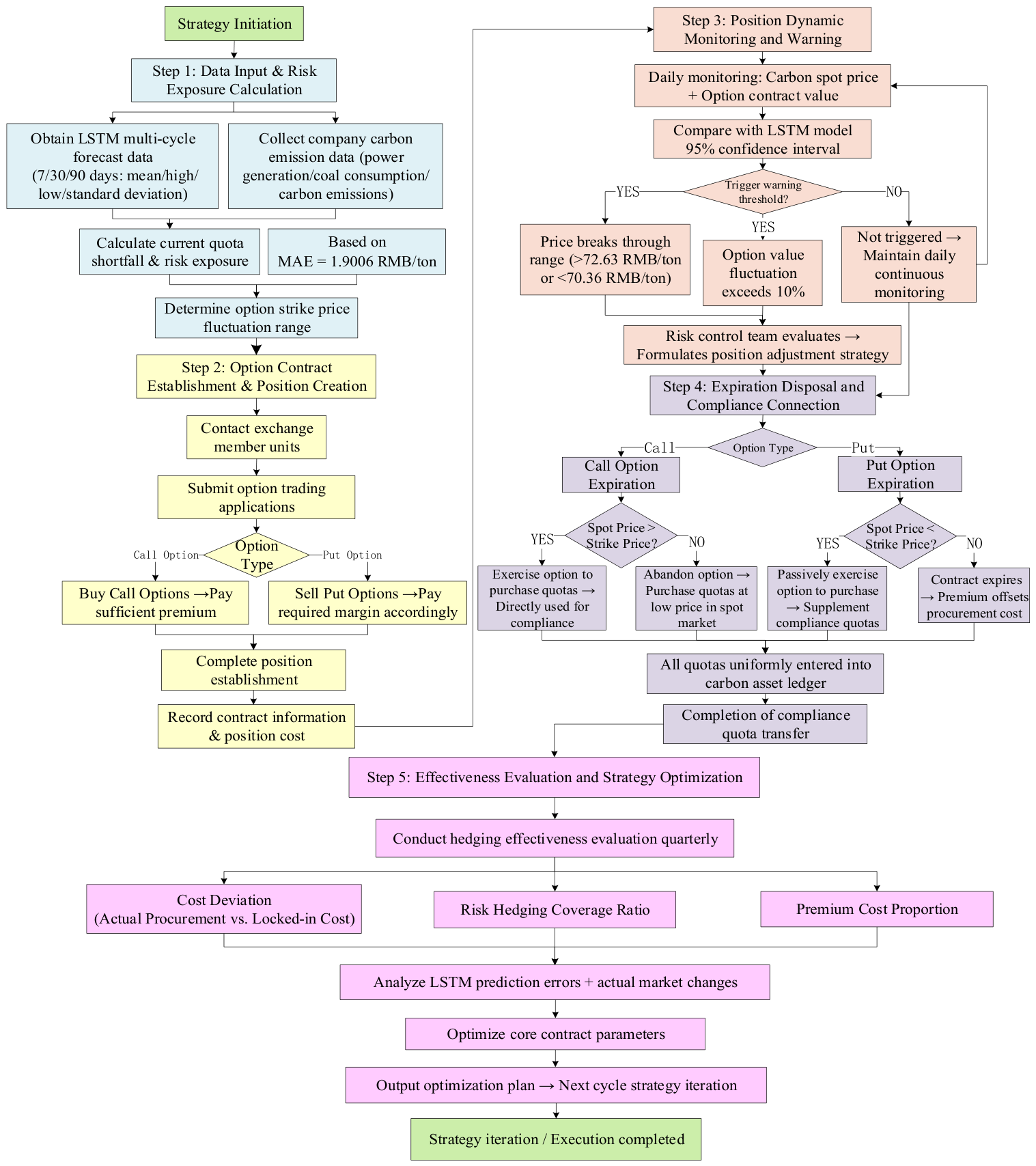
This study proposes a methodological framework to address this issue by integrating LSTM-based (see [7,8,9,10] for similar applications) price simulation with option-based hedging strategies. The framework is designed to be generalizable to thermal power enterprises facing similar risks. To empirically validate the proposed framework, operational data from a representative thermal power enterprise (hereinafter referred to as SHP) is employed as an illustrative application. The technology roadmap is developed, as illustrated in Figure 1.
The structure of this paper is as follows: Section 2 reviews relevant literature; Section 3 outlines the development status of China’s carbon trading market; Section 4 analyzes the current situation and problems of carbon asset management in the thermal power generation industry; Section 5 constructs the risk management framework; Section 6 verifies the framework’s effectiveness through simulation; Section 7 concludes and discusses future prospects.

2. Literature Review

2.1. Carbon Asset Management and Risk Pricing

Contemporary research on carbon asset management has evolved from foundational frameworks to increasingly sophisticated analyses of carbon risk pricing and management. The financial materiality of carbon risk has been firmly established. Contemporary research has established robust frameworks for valuing carbon management capabilities. This framework has been further developed in recent years, with studies examining how carbon emission trading policies incentivize corporate green innovation and shape carbon management systems [11]. The linkage between carbon performance and financial outcomes has been extensively examined, with recent evidence from Chinese listed companies demonstrating that climate risk exposure significantly affects corporate capital structure and financing costs [2].
The financial materiality of carbon risk has been increasingly recognized in recent asset pricing literature. Extending this inquiry, carbon transition risk has been shown to be priced internationally, with the effect more pronounced in carbon-intensive industries and in countries with weaker environmental regulations [12]. Carbon-intensive firms face higher costs of protection against extreme negative events [5], indicating that carbon risk manifests through tail risk channels rather than stable return premia. This underscores that management practices matter for market assessment of carbon-exposed firms.
The role of proactive carbon management in mitigating operational risks has been examined across various industry contexts. Agent-based simulation methods and policy design frameworks have been employed to analyze carbon allowance allocation mechanisms, with recent studies focusing on optimizing China’s national ETS design for carbon neutrality [13], demonstrating the applicability of computational approaches to carbon market analysis. Empirical evidence from thermal power companies reveals how firms implement carbon strategies under low-carbon transition scenarios. Analysis of green versus brown energy sector performance under external shocks documents asymmetric responses that favor low-carbon assets during periods of heightened climate policy attention [14].

2.2. Real Option Valuation and Carbon Price Forecasting

Accurate carbon price forecasting is essential for quantifying transition risk and informing hedging decisions. The valuation of carbon assets requires accounting for the inherent uncertainty arising from policy evolution and market volatility. Recent literature reviews have systematically compared econometric and machine learning approaches for carbon price forecasting, highlighting the superior performance of advanced models in capturing nonlinear patterns and market complexities [6]. An integrated value assessment model for carbon assets combining LSTM-based carbon price forecasting with the Black–Scholes option pricing framework shows that the practical value of carbon credits derived from verified emission reductions significantly exceeds their market option value [15].
Machine learning methods have increasingly been applied to carbon price forecasting. LSTM models applied to carbon price forecasting across all eight Chinese carbon trading pilots outperform traditional neural networks in capturing complex temporal dependencies [16]. A carbon price prediction model combining secondary decomposition algorithms with optimized extreme learning machines demonstrates that hybrid approaches effectively capture the non-stationary characteristics of carbon prices [17]. Multi-factor models with policy segmentation applied to China’s national carbon market reveal how policy regimes systematically condition price dynamics [18].
Recent methodological advances continue to push prediction boundaries. Researchers have moved beyond single-model approaches toward hybrid frameworks that combine multiple techniques. For instance, one study achieves superior performance through multi-stage processing by integrating quadratic decomposition with comprehensive feature screening [19]. Another advances this paradigm by combining empirical mode decomposition with GRU-CNN-LSTM networks and Bayesian optimization for EU carbon price forecasting [20]. A further frontier lies in incorporating unstructured data, with sentiment analysis of carbon-specific news capturing policy-driven shocks that structured data alone miss [21].

2.3. Carbon Asset Risk in Thermal Power Enterprises

Thermal power enterprises face uniquely severe carbon asset risk due to their long-lived, capital-intensive infrastructure and high carbon intensity. Corporate carbon risk amidst world policy uncertainty from an international perspective finds that policy uncertainty amplifies the negative valuation effects of carbon exposure [22]. The impact of carbon market policies on thermal power enterprises’ investment decisions reveals that policy uncertainty significantly reduces investment willingness [23]. Empirical evidence from Chinese thermal power firms further demonstrates that carbon price volatility directly affects operational cash flows and financing costs, underscoring the need for proactive risk management [24,25]. Evidence from Chinese high-emission industries indicates that carbon emission trading regulations have heterogeneous impacts on corporate green investment, with negative effects moderated by corporate innovation capability and carbon trading market efficiency [26].
At the firm level, the management of carbon emissions is intrinsically linked to the characteristics and utilization of physical assets. While prior studies have extensively examined the role of environmental disclosures and policy compliance, the operational dimension of how firms manage their existing asset base to achieve carbon efficiency remains comparatively underexplored. Recent evidence from high-polluting industries indicates that while the structure of fixed assets does not significantly affect carbon emissions reduction, asset utilization efficiency exerts a significant negative effect on emissions [27]. This finding underscores that operational efficiency, rather than mere asset composition, is a critical lever for carbon management in asset-intensive sectors. For thermal power enterprises, which are characterized by long-lived, high-carbon physical assets, this distinction is particularly salient. It suggests that a firm’s ability to manage carbon asset risk is contingent not only on market dynamics and policy pressures but also on the operational efficiency with which its generation assets are deployed.

2.4. Literature Synthesis and Research Gaps

Synthesizing the existing literature, several notable gaps emerge. First, machine learning applications in carbon price prediction remain exploratory, lacking enterprise level validation in China’s nascent market context. Second, the joint empirical validation of machine learning based price forecasting and option-based hedging remains lacking, particularly for medium- and long-term risk exposure under policy tightening in enterprise settings. Third, existing studies on stranded asset risk in thermal power rarely integrate real options thinking with operational risk management tools. These three gaps collectively point to an unmet need: an enterprise-oriented framework that links policy driven carbon cost escalation, price uncertainty, and actionable hedging decisions.
To address these gaps, this study focuses on the following research question: how can thermal power enterprises quantify and hedge medium- and long-term carbon asset risk under the joint impact of policy tightening and carbon price uncertainty? The novelty of this paper lies in linking three elements within one enterprise-oriented framework. First, it shifts the analytical focus from short-term compliance cost fluctuations to medium- and long-term risk exposure in thermal power enterprises. Second, it integrates carbon price forecasting and risk hedging by combining a dual-layer LSTM model with an option portfolio, thereby connecting prediction results with operational decision-making. Third, it provides simulation-based validation using enterprise operational data, which extends the existing literature that often emphasizes either market forecasting accuracy or policy discussion while offering limited evidence on implementable risk management strategies at the firm level.

3. Overview of China’s Carbon Trading Market Development

3.1. Classification of Carbon Assets Under China’s Carbon Trading System

In China, a multi-dimensional carbon market system is accelerating its improvement, with the national carbon emission trading market as the main body, supplemented by the voluntary emission reduction trading market, regional carbon markets, and local carbon inclusive mechanisms. Currently, China’s carbon trading market implements a dual control system where carbon emission allowance trading and voluntary emission reduction projects complement each other, forming two major categories: allowance carbon assets and project carbon assets.
Although a unified academic definition of the concept of carbon assets has yet to be established, carbon allowances have obtained asset attribute confirmation through institutional channels. Based on a review of existing literature, carbon assets can be divided into broad and narrow categories. Narrowly defined carbon assets specifically refer to carbon allowances with clear ownership attribution and transaction attributes, namely allowance carbon assets and emission reduction carbon assets. The term “carbon assets” in this paper primarily refers to these narrowly defined assets.

3.2. Development Status of the National Carbon Emission Allowance Trading Market

China currently implements an allowance allocation system based on carbon emission intensity, a framework designed to balance economic growth with emission reduction targets. The national carbon emission trading market officially commenced trading in July 2021, initially incorporating the power generation industry into its control scope as the first sector to be regulated. In March 2025, according to the 2024–2025 Allocation Plan for the Steel, Cement, and Aluminum Smelting Industries under the National Carbon Emissions Trading Scheme issued by the Ministry of Ecology and Environment, the national carbon market announced a significant expansion of coverage, formally requiring emissions from the steel, cement, and aluminum smelting industries from 2024 onwards to be included in the trading system. Consequently, China’s national carbon market now covers approximately 8 billion tons of emissions annually, accounting for over 60% of the country’s total carbon dioxide emissions, making it the largest carbon market in the world by covered emissions. This expansion directly increases the liquidity and policy representativeness of the national carbon market, while also reinforcing the medium- and long-term risk exposure for thermal power enterprises by broadening the scope of compliance entities and tightening overall allowance availability.
Data from the Ministry of Ecology and Environment indicates that in 2025, a total of 3378 key emitting entities were included in national carbon market allowance management, reflecting the expanding scope of the market. The annual allowance trading volume reached 235 million tons, representing a year-on-year increase of approximately 24%, with a corresponding transaction value of 14.63 billion yuan. As of 31 December 2025, the cumulative trading volume of allowances since the market’s inception reached 865 million tons, with a cumulative transaction value of 57.663 billion yuan. Overall, the market operates smoothly and orderly, with steadily increasing market vitality, demonstrating its growing role in China’s climate policy framework. The annual trading details are summarized in Table 1.
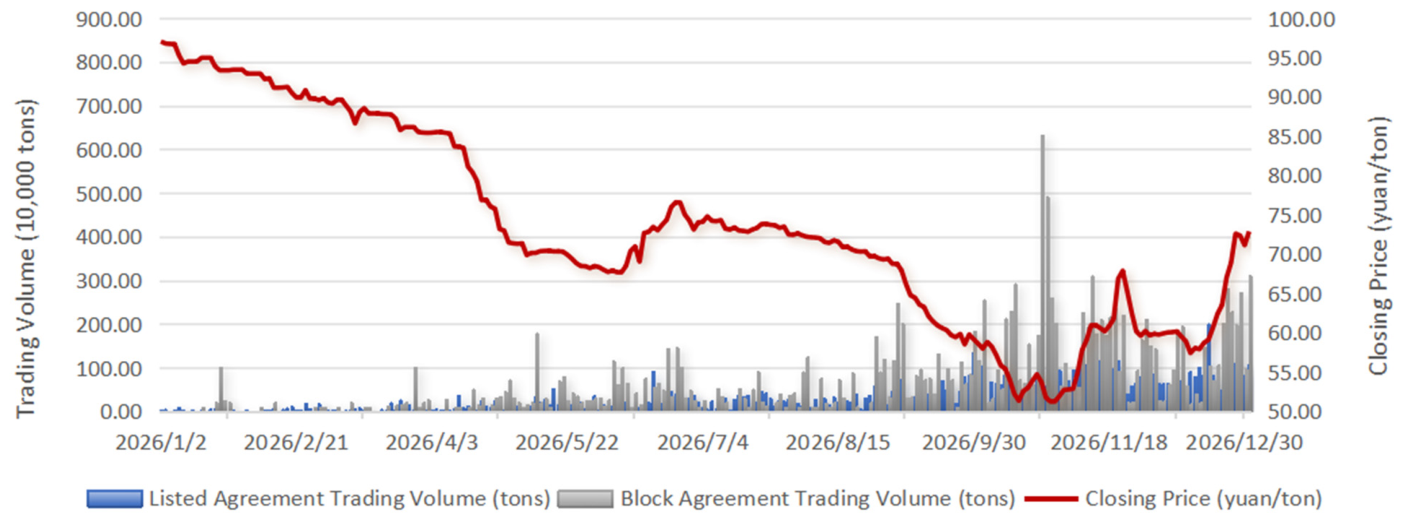
In terms of price trend characteristics, the average transaction price of carbon emission allowances in the national carbon market in 2024 showed a continuous upward trend with high volatility at year-end, stabilizing at around 100 yuan/ton at the closing price. Trading volume exhibited a pattern of “sluggishness in the first half of the year and concentrated release at year-end,” with significant spikes in block trading volume at the end of the year. This reflects, on one hand, that compliance fulfillment remains the primary driver of market transactions, and on the other hand, that enterprises tend to concentrate their transactions during the compliance period to complete allowance allocation. The trading situation in 2025 is shown in Figure 2.
In 2025, the CEA price showed a trend of “high-level volatile decline at the beginning of the year and bottom rebound at year-end,” with the closing price at the beginning of the year around 95 yuan/ton, continuously declining to a low of approximately 50 yuan/ton in September–October before recovering, and finally closing at around 70 yuan/ton at year-end. Regarding trading volume, the first half of the year was generally sluggish, with volume surging from the end of September and showing significant year-end expansion. Annual transactions were primarily block agreements, reflecting both that compliance fulfillment remains the core driver of market trading and that corporate trading willingness recovered after carbon prices bottomed out.
It is worth noting that the end of the “15th Five-Year Plan” period represents the final deadline for China to achieve carbon peaking. The national carbon market needs to gradually transition from the current carbon intensity control to total carbon emission control. The shift to a total control-oriented carbon market means that corporate carbon reduction will transform from “relative emission reduction” to “absolute emission reduction,” implying that carbon allowances will become scarcer and the price center is expected to move further upward. This policy evolution trend constitutes the core source of medium- and long-term risks for thermal power enterprises’ carbon assets.

3.3. Impact of the Carbon Trading Market on the Sustainable Carbon Asset Management of Thermal Power Enterprises

The evolution of the carbon trading market has profoundly impacted the carbon asset management of thermal power enterprises, primarily manifested in the following three aspects:
First, the carbon price signal has become a core variable in corporate operational decision-making. Carbon prices play crucial roles in guiding the optimal allocation of carbon reduction resources, reducing societal emission reduction costs, promoting investment in green and low-carbon industries, and directing capital flows [28]. Empirical evidence from China’s national carbon market demonstrates that carbon prices exert significant amplification effects through cost transmission pathways, with a 1% price increase driving a 1.78% marginal emission reduction in the power sector [29]. The carbon emission trading market, by setting carbon emission caps and carbon prices, internalizes the carbon emission costs of power enterprises. For thermal power generation industry, participating in the market-based trading of carbon allowances requires not only a clear understanding of the essence of carbon trading and carbon asset management but also the ability to adapt to and leverage policy and market changes, applying them to the enterprise’s carbon asset management decisions.
Second, the trend of policy tightening has exacerbated the medium- and long-term risk exposure of carbon assets. Globally, the gradual tightening of allowance allocation benchmarks is a common feature of maturing emissions trading systems. In China, this trend is evident from the “Implementation Plan for the Total Quantity Setting and Allocation of National Carbon Emission Trading Quotas for the Power Generation Industry (2021–2022)” issued by the Ministry of Ecology and Environment in March 2023, where carbon emission benchmarks have been lowered, allowance issuance has been significantly tightened, and uncertainty in carbon market prices has notably increased. As carbon peaking and carbon neutrality work progressively advances, more institutions and individuals will be included as trading entities in the future carbon market, and carbon emission compliance costs will subsequently increase. The annual downward adjustment of allowance allocation benchmarks and the gradual increase in the proportion of paid allocations have become clear policy directions, implying that enterprises’ future compliance costs will exhibit rigid and trend-driven increases.
Third, market volatility requires enterprises to possess proactive risk management capabilities. Risk spillovers between China’s carbon markets and energy markets exhibit significant time-varying characteristics, with the carbon-energy system being susceptible to risks primarily originating from shock periods in the traditional energy market [30]. As evident from the price trends in 2024–2025, carbon prices exhibit significant volatility characteristics influenced by factors such as compliance cycles and policy expectations. For large-scale thermal power enterprises with annual emissions reaching tens of millions of tons, every 10 yuan/ton fluctuation in carbon prices translates to changes in compliance costs amounting to hundreds of millions of yuan. Risk exposure of this magnitude is difficult to address through passive compliance alone and necessitates active management using quantitative tools and financial derivatives.
Against this background, the value of financial derivative instruments such as carbon forwards and carbon options is increasingly prominent. These instruments, by locking in medium- and long-term carbon prices and delivery volumes and pre-agreeing on future transaction prices and compliance deadlines, can effectively hedge medium- and long-term risks such as carbon price fluctuations and allowance shortfalls. Customizing contract terms and delivery clauses in alignment with corporate emission reduction pathways, matching compliance cycles, and avoiding unilateral price fluctuation risks through fixed cost or revenue lock-in can stabilize carbon asset value expectations, reduce medium- and long-term risk exposure, and ensure controllable compliance costs and stable carbon asset returns for enterprises. This precisely constitutes the core concern of this paper—how to provide thermal power enterprises with a scientific toolkit enabling them to identify, quantify, and actively hedge medium- and long-term carbon asset risks under the dual pressures of policy tightening and market volatility.

4. Analysis of the Medium- and Long-Term Risk Exposure Problem in Carbon Assets of the Thermal Power Generation Industry

“Medium- and long-term risk exposure” of carbon assets refers to the potential losses due to various uncertainties associated with holding and managing carbon assets over a period spanning several years or even longer. This transcends the scope of short-term compliance and constitutes a strategic issue concerning the long-term value and survival of the enterprise. For thermal power enterprises, especially those with a high proportion of traditional thermal power, these risks far outweigh short-term compliance costs. Essentially, it represents a “climate stress test” of the enterprise’s future license to operate and profitability.
The medium- and long-term carbon asset risks stem primarily from the systemic challenges confronting substantial thermal power assets under the “dual carbon” goals. According to industry data, the proportion of thermal power (including coal power) installation in many large thermal power enterprises remains high, meaning that a significant portion of their installed capacity consists of high-carbon assets. Against the backdrop of continuously rising carbon costs, these assets face significant stranding risk. Simulation results based on different carbon pricing mechanisms indicate that the total stranded coal power asset value in China may range between 1.4 and 1.7 trillion yuan, with aggressive carbon pricing potentially escalating electricity shortage risk between 2033 and 2040 [31]. A multi-dimensional analysis of these risks is presented in Table 2.
From the perspective of real options, carbon allowances embedded in thermal power enterprises’ operations can be interpreted as contingent decision rights rather than static compliance assets. Holding, purchasing, or delaying the purchase of allowances is economically similar to choosing the timing of option exercise under uncertainty. When policy tightening raises the expected scarcity of allowances and market volatility increases, the option value of waiting, early locking-in, or flexible adjustment changes accordingly, which directly affects procurement cost, compliance timing, and cash-flow stability. In this sense, the medium- and long-term risk exposure of carbon assets is not limited to observable price fluctuations, but also includes the loss of strategic flexibility caused by adverse movements in policy and market conditions. This interpretation provides the analytical basis for the subsequent integration of LSTM-based price forecasting with option portfolio hedging.
From a policy perspective, carbon asset value is closely tied to the policy environment. From a market perspective, weak price transmission and low liquidity constrain corporate trading strategies. From an asset perspective, holding carbon allowances is equivalent to holding an option for future transactions, with uncertainty amplified by policy and price volatility. From a financial perspective, carbon risk materializes through cash flow compression and higher financing costs, including a “brown premium” for high-carbon firms [32]. From a transition perspective, large-scale investment in low-carbon technologies creates a dilemma against shrinking thermal power profits. These five dimensions collectively define the systemic risk profile of carbon assets in thermal power enterprises.
In summary, the medium- and long-term carbon asset risks are essentially a systemic problem arising from the interplay of these levels. Within this risk network, risks at each level amplify those at other levels, ultimately forming a comprehensive impact on the enterprise’s value. It is precisely this systemic nature that renders the traditional passive compliance model inadequate, necessitating the introduction of quantitative forecasting tools and financial derivatives for active management.
Building upon this multi-dimensional risk identification, the following section develops an optimization framework for carbon asset management. The framework addresses the identified risk dimensions through three complementary mechanisms: LSTM-based price simulation to quantify market risk, option-based hedging to transfer policy and price risks, and diversified compliance strategies to mitigate asset and financial risks.

5. Optimization Strategies for Carbon Asset Management

5.1. Data Source and Method Validation Setting

To empirically validate the proposed risk management framework, operational data from a typical thermal power enterprise in Shanghai (hereinafter referred to as SHP) is employed. SHP is a large-scale power generation company. As of the end of 2024, thermal power (including coal power) accounted for approximately 54.63% of its total installed capacity, making it a suitable source of operational data for method validation given its exposure to carbon asset risks typical of the thermal power industry. Based on an assumed annual emission volume of 10 million tons, the potential financial impact of carbon price risks could reach tens of millions of RMB. It is important to note that SHP serves as an illustrative application to demonstrate the proposed methodology, rather than being the primary object of a case study analysis.

5.2. Medium- and Long-Term Carbon Emission Allowance Price Simulation Based on the LSTM Model

To accurately capture the complex temporal characteristics and fluctuation patterns of carbon emission allowance prices and to provide a scientific medium- to long-term price reference for subsequent option hedging strategies, this paper introduces the LSTM model to conduct research on medium- to long-term forecasting of carbon emission allowance closing prices.

5.2.1. Model Selection and Construction

In selecting a method for allowance price prediction, the Long Short-Term Memory network model demonstrates significant applicability in forecasting non-stationary, non-linear time series data such as carbon market trading prices. Specifically, although traditional machine learning models—including linear regression, decision trees, and support vector machines—perform excellently on many problems, they often exhibit certain limitations when processing time series data characterized by long-term dependencies, dynamic length, and complex temporal dynamics. These limitations include handling long-term dependencies, fixed-length input requirements, lack of temporal dynamics modeling, constraints in feature extraction, and challenges in multi-step prediction. Recurrent neural network models such as LSTM, through their specialized structural design, can more effectively address these challenges.
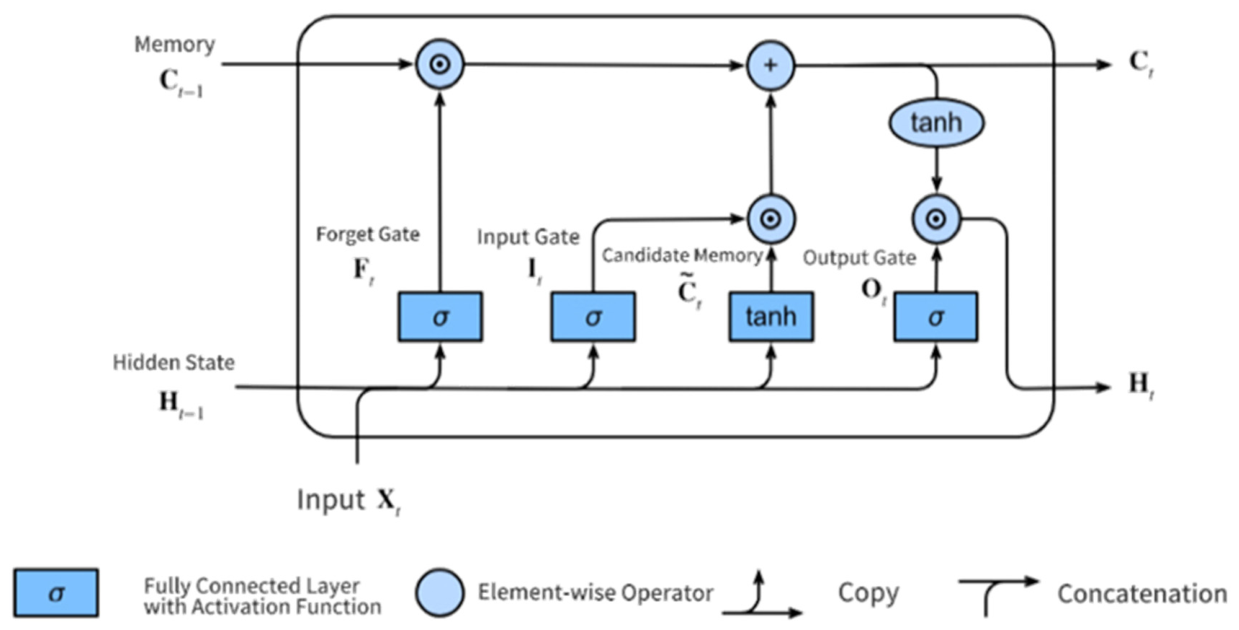
Long Short-Term Memory (LSTM) is essentially a specific form of Recurrent Neural Network that addresses the short-term memory problem arising from vanishing gradients in RNNs by incorporating gates. This enables the recurrent neural network to effectively utilize long-range temporal information. It includes three logical control units—the input gate, output gate, and forget gate—each connected to a multiplicative element. By setting the weights at the connections between the network’s memory unit and other components, it controls the input and output of information flow as well as the state of the memory cell. These gating mechanisms help the network determine how to process input data, update internal states, and output prediction results, thereby better capturing long-term dependencies in time series data. Its specific working mechanism is as follows:
Forget Gate: Determines whether to forget the previous memory state. This gating mechanism can, to some extent, mitigate the vanishing gradient problem, thereby better handling long-term dependencies.
f t = S i g m o i d ( W f · h t 1 , x t + b f )
Here,    f t  is the output of the forget gate,  h t 1  is the hidden state of the previous time step,  x t  is the input of the current time step, and    W f    and    b f  are the weight matrix and bias vector of the forget gate. Sigmoid is an activation function.
Input Gate: Determines which information from the current input data needs to be updated into the memory state. This gating mechanism controls the update of the memory state.
i t = S i g m o i d ( W i · h t 1 , x t + b i )
c ~ t = tanh W c · h t 1 , x t + b c
Here,  i t  is the output of the input gate,  c ~ t  is the candidate information for updating,  W i W c  and  b i b c  are the weight matrices and bias vectors of the input gate and candidate information, respectively.  tanh (   )  is the hyperbolic tangent function.
Memory Cell: Under the control of the input gate, a new memory cell is calculated to replace the old memory cell, adapting to the input data of the current time step.
c t = f t · c t 1 + i c · c ~ t
Output Gate: Determines the output result of the current time step based on the current memory state and input data.
o t = S i g m o i d W o · h t 1 , x t + b o
h t = o t · tanh c t
Here,  o t  is the output of the output gate,  h t  is the hidden state of the current time step, and  W o  and  b o  are the weight matrix and bias vector of the output gate.
Through the computation and updates of the aforementioned gating mechanisms, the LSTM network can effectively capture long-term dependencies in sequential data and better handle tasks such as time series prediction and natural language processing. The specific structure of the LSTM network is illustrated in Figure 3.
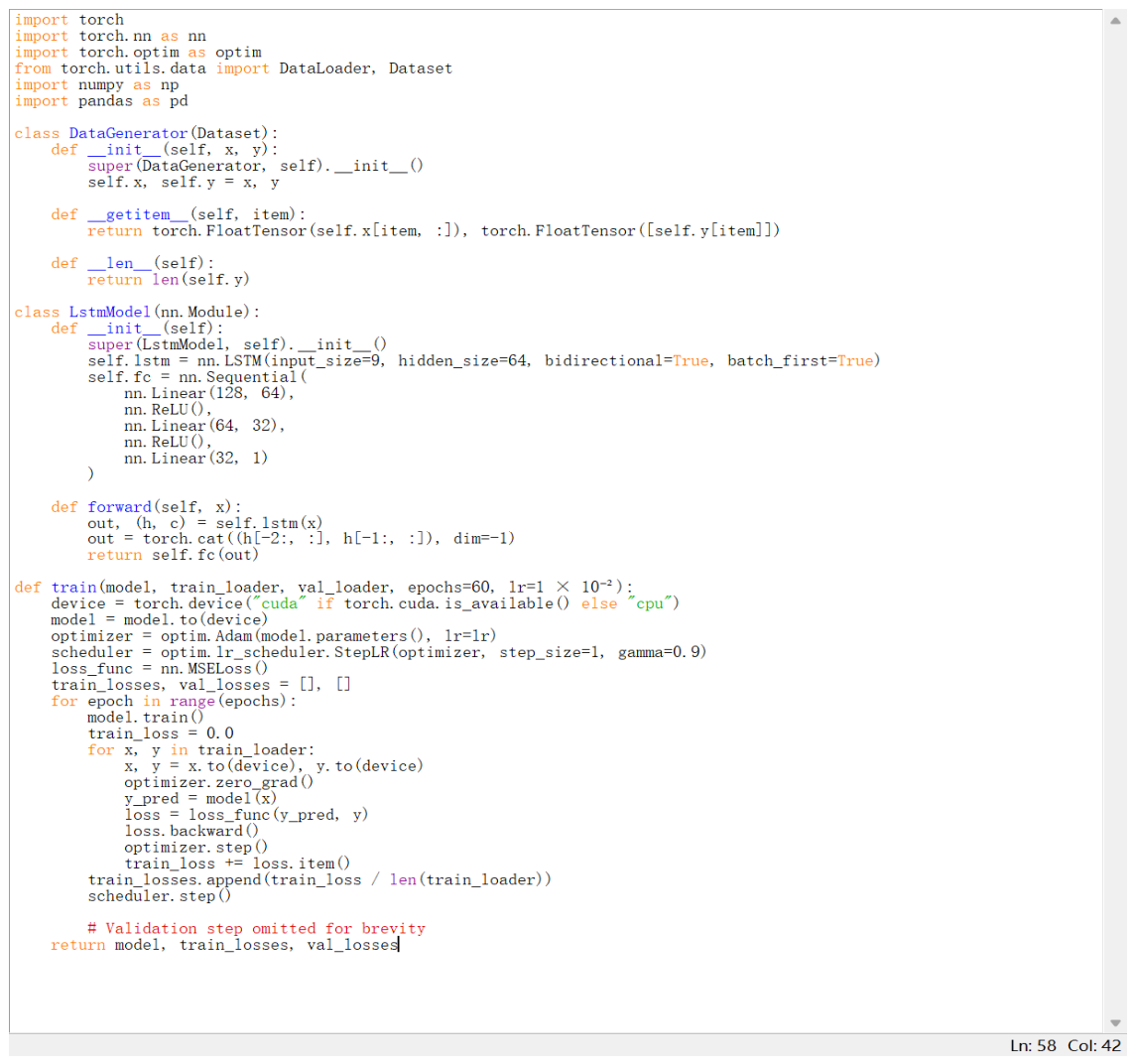
This paper utilizes the PyTorch 2.10.0 deep learning framework in Python 3.12 to construct the LSTM model. All code development and experiments were conducted in the PyCharm 2024.1.7 IDE. The LSTM model consists of three parts: an input layer, a hidden layer, and an output layer. The model is trained using the error backpropagation algorithm (refer to [33,34,35,36]). The model assumes an open market hypothesis, with the value type adopting market value. The assessment method involves constructing an LSTM model to evaluate from a time series perspective. As a tradable commodity, carbon allowance prices fluctuate daily, with historical transaction prices forming time series data. Therefore, this paper does not set a specific valuation base date; instead, it evaluates carbon asset prices over a continuous period, measuring the feasibility of the LSTM time series prediction model based on the overall assessment effect during that period.

5.2.2. Data Collection and Processing

The national carbon trading market is an important policy tool for China to actively respond to climate change, reduce overall social control costs, and promote the achievement of the “dual carbon” goals. Since its operation began on 16 July 2021, the national carbon market has operated smoothly and orderly overall, with carbon prices rising steadily and a carbon price discovery mechanism initially taking shape. According to the “National Carbon Market 2024 Annual Report” released by the Shanghai Environment and Energy Exchange, the annual trading volume of Carbon Emission Allowances (CEA) in the national carbon trading market in 2024 reached 249 million tons, with an annual turnover of 23.242 billion yuan and an average daily trading volume of 1.0225 million tons.
This paper selects 600 trading data points from the launch of the national carbon market on 14 July 2023 to 31 December 2025 as the LSTM model dataset (complete data can be found in Appendix A). Sample data of the national carbon trading prices are presented in Table 3.
As can be seen from the data in the table above, carbon trading prices have multiple variables, including opening price, closing price, highest price, and lowest price. Compared to existing research that mostly uses single features to construct time series models, this paper applies the feature extraction method to the construction of the LSTM model. Feature extraction can be achieved by mapping the original data sequence to the hidden states of the LSTM network. The LSTM network converts the information from the input sequence into continuous hidden state vectors, which can be regarded as meaningful feature representations of the input sequence for subsequent classification, prediction, or generation tasks.

5.2.3. Model Training and Validation

This paper divides the aforementioned carbon trading prices into a training set and a test set in chronological order at an 8:2 ratio. The training set is used to train the model, while the test set is used for prediction, with the prediction results serving to evaluate the model’s feasibility.
To achieve optimal prediction performance, this paper conducts multiple rounds of training and testing on the constructed model, selecting the parameters with the smallest error as the model parameters. Specifically, the LSTM network consists of three layers in total: one input layer, one output layer, and one hidden layer. The selection of key hyperparameters follows the principle of balancing temporal feature extraction, predictive accuracy, and model stability. The time step was tested over several candidate values, and 6 was adopted because it produced the best overall validation performance while preserving sufficient short-term trading information without introducing excessive noise accumulation. The number of hidden neurons was also tuned through repeated training under alternative settings. A size of 256 provided a comparatively better fit to the nonlinear dynamics of carbon prices than smaller configurations, while avoiding the instability and overfitting tendency observed in larger settings. Therefore, the final parameter combination was determined empirically on the basis of validation loss, prediction accuracy, and generalization performance rather than by arbitrary choice.
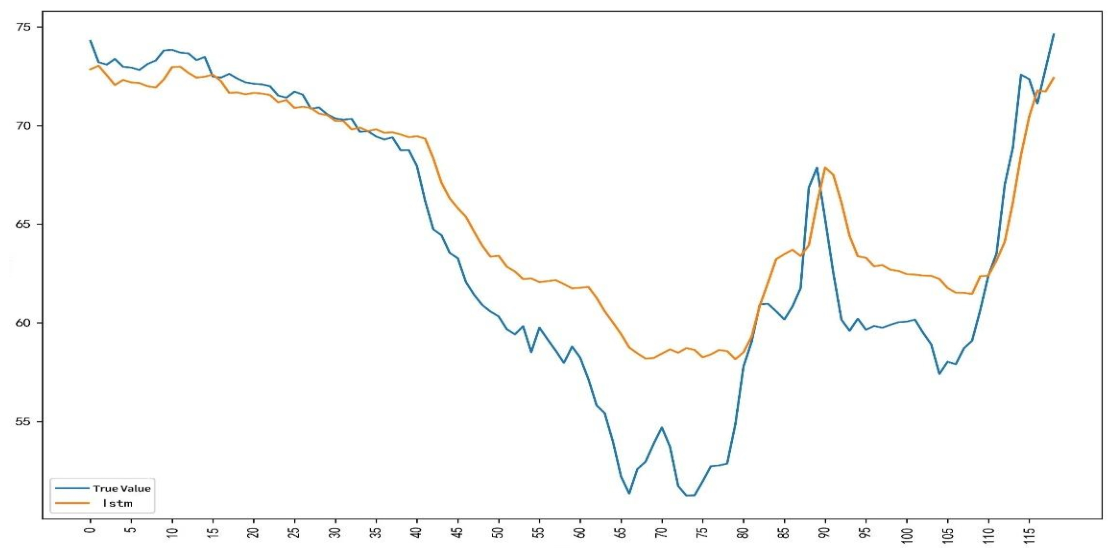
To prevent model overfitting, a dropout layer is connected between each LSTM layer. After determining the number of network layers, the time step is subsequently set. By modifying the step size of the time step for training and comparing the training effects, the model time step is ultimately set to 6, meaning that the first 6 historical data points (refer to [37,38,39] for alternative approaches for similar situations) are used to predict the next data point. Accordingly, the number of nodes in the input layer of the neural network is 6, and the number of nodes in the output layer is 1. The number of nodes in each hidden layer is set to 256, and the optimizer is set to Adam. The number of training iterations is adjusted until the model loss stabilizes around 0.05, at which point the number of training iterations is approximately 60. The maximum number of epochs for traversing samples is set to 60, and the initial learning rate is set to 0.01. After determining the model structure and parameters, the training set samples are imported into the model for training, and subsequently, the test set samples are used for prediction. Partial prediction results are as follows (complete results can be found in Appendix A). The partial comparison results and prediction performance are presented in Table 4 and Figure 4, respectively.
In the figure, the horizontal axis represents the number of prediction days, and the vertical axis represents the carbon allowance price (RMB). The blue line indicates the actual carbon price values, while the orange line represents the predicted values from the test set. It can be observed that the predicted values closely fit the actual values.
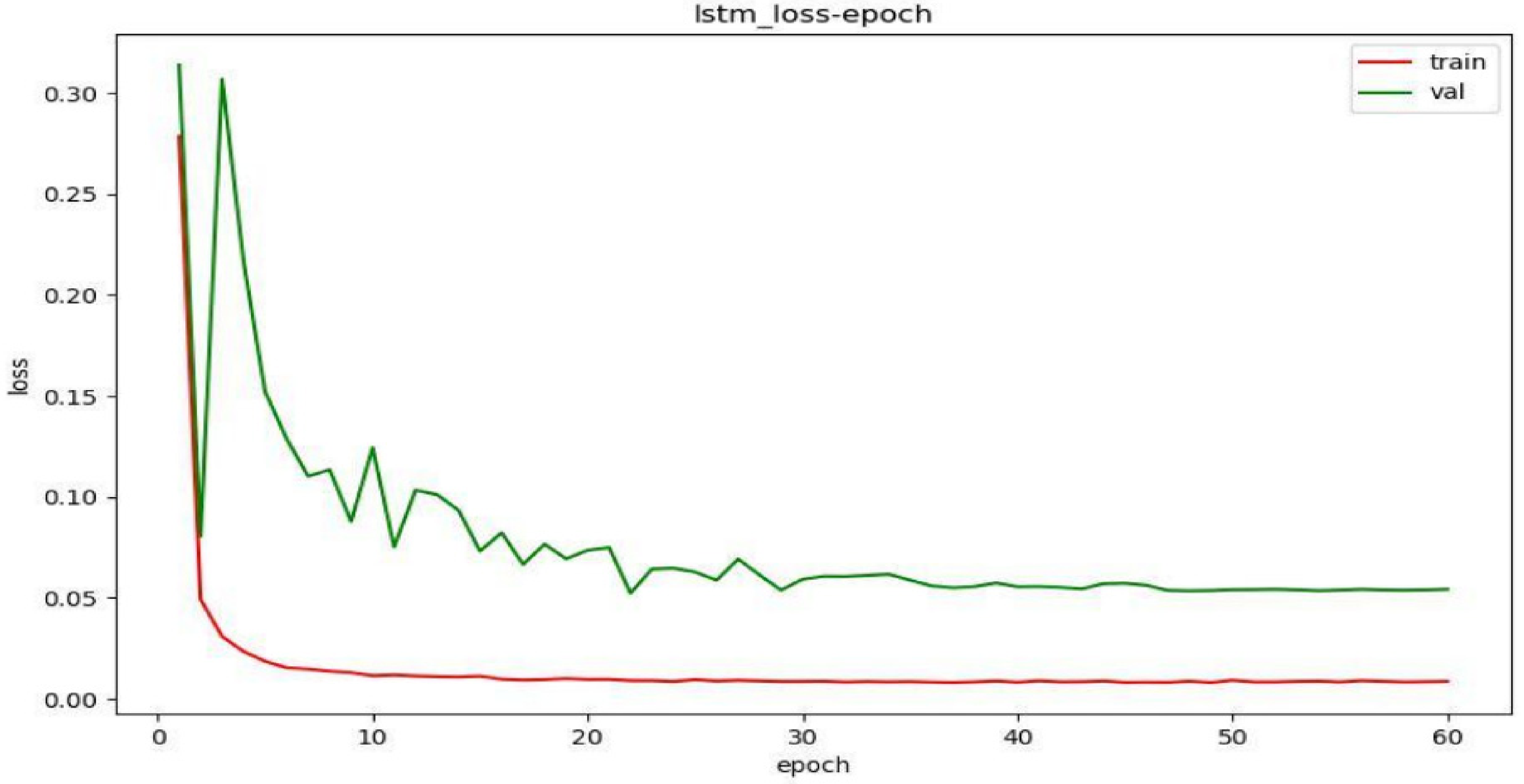
Figure 5 shows the training/validation loss curve of the LSTM carbon price prediction model, which intuitively reflects the model’s training performance: the training set loss (red) rapidly converges to near zero, while the validation set loss (green) stabilizes around 0.05 without rebounding. This not only demonstrates that the model has fully learned the temporal patterns of carbon prices but also validates that it does not overfit and exhibits good generalization ability for new data. Simultaneously, it substantiates the rationality of the early stopping training strategy and serves as a key preliminary experimental basis for the model’s prediction accuracy (MAPE 4.23%).
Furthermore, this paper further evaluates the model’s learning performance using the following metrics:
(1) Mean Squared Error (MSE): Square the difference between the predicted value and the actual value for each sample, then average over all samples. The formula is:
M S E = y t r u e y p r e d 2 n
where  y t r u e  is the actual value,  y p r e d  is the predicted value, and  n  is the number of samples. The closer the MSE is to 0, the more reliable the model.
(2) Root Mean Squared Error (RMSE):
R M S E = M S E
The closer the RMSE (refer to [40,41,42,43,44]) is to 0, the more reliable the model.
(3) Mean Absolute Error (MAE): Take the absolute difference between the predicted value and the actual value for each sample, then average over all samples. The formula is:
M A E = y t r u e y p r e d n
The closer the MAE (refer to [45,46,47,48]) is to 0, the more reliable the model.
(4) Mean Absolute Percentage Error (MAPE): Divide the difference between the predicted value and the actual value by the actual value for each sample, take the absolute value, and then average. The formula is:
M A P E = y t r u e y p r e d y t r u e n × 100 %
The closer the MAPE is to 0, the more reliable the model.
(5) R-squared (R2): Calculate the total sum of squares, regression sum of squares, and residual sum of squares using the actual and predicted values, then compute R2. The formula is:
R 2 = 1 S S r e s S S t o t
where  S S r e s  is the residual sum of squares and  S S t o t  is the total sum of squares. The closer the R2 is to 1, the more reliable the model.
The evaluation metrics for the prediction performance of the model are presented in Table 5.
Although the model achieves acceptable prediction accuracy, the test result of R2 = 0.8028 indicates that the explanatory power remains moderate rather than exceptionally high. This suggests that the model captures the main temporal pattern of carbon prices, but still has limited ability to reflect abrupt shocks and some unobserved external influences. In addition, the present validation is based on a chronological train-test split within the same sample period rather than a fully independent out-of-sample test. Therefore, the reported results support the practical usefulness of the model, but they should be interpreted with appropriate caution.
From the calculation results of the above metrics, it can be seen that the model evaluation accuracy is relatively high. Consequently, the reliability and applicability of this model in the valuation of carbon allowance assets have been verified.

5.2.4. Medium- and Long-Term Price Simulation of Carbon Allowances Based on the LSTM Model

To accurately capture the complex temporal characteristics and fluctuation patterns of carbon allowances prices, and to provide scientific medium- and long-term price references for market participants, this paper takes the daily trading data of the national carbon trading market from 2021 to 2026 as the research object (complete data can be found in Appendix A). A deep learning model with dual LSTM layers plus Dropout regularization (we refer to [49,50] for similar approaches) is constructed to conduct medium- and long-term prediction research on the closing prices of carbon allowances. Through steps including data preprocessing, model training, hyperparameter optimization, and rolling prediction, price simulations for the next 7 days, 30 days, and 90 days are achieved. Sample data of the national carbon trading prices are presented in Table 6. Model performance is validated using metrics such as MAE, RMSE, and R2.
Addressing the temporal dependency and nonlinear characteristics of carbon allowances prices, a dual-layer LSTM deep learning model is constructed. The specific structure is as follows: the input layer receives a 4-dimensional feature vector (opening price, closing price, trading volume, and daily turnover), with an input dimension of [batch_size, time_step, feature_num]. The first LSTM layer contains 64 neurons, with batch_first = True set to accommodate the time-series data format; output sequence features are followed by a 0.2 dropout layer to suppress overfitting. The second LSTM layer reduces the input feature dimension to 32, further extracting higher-order temporal features, and is similarly equipped with a dropout layer to enhance model generalization. The fully connected layer achieves price regression prediction through a 32 → 1 mapping, employing the ReLU activation function to strengthen nonlinear fitting capability.
Integrating the characteristics of daily time-series data with model training requirements, the optimal hyperparameter combination is determined through multiple adjustments: time step = 10, batch size = 16, number of epochs = 80, learning rate = 0.001, and early stopping patience = 4 (training stops if validation loss does not decrease for 4 consecutive rounds). The training set and test set are strictly divided in chronological order at an 8:2 ratio to prevent data leakage.
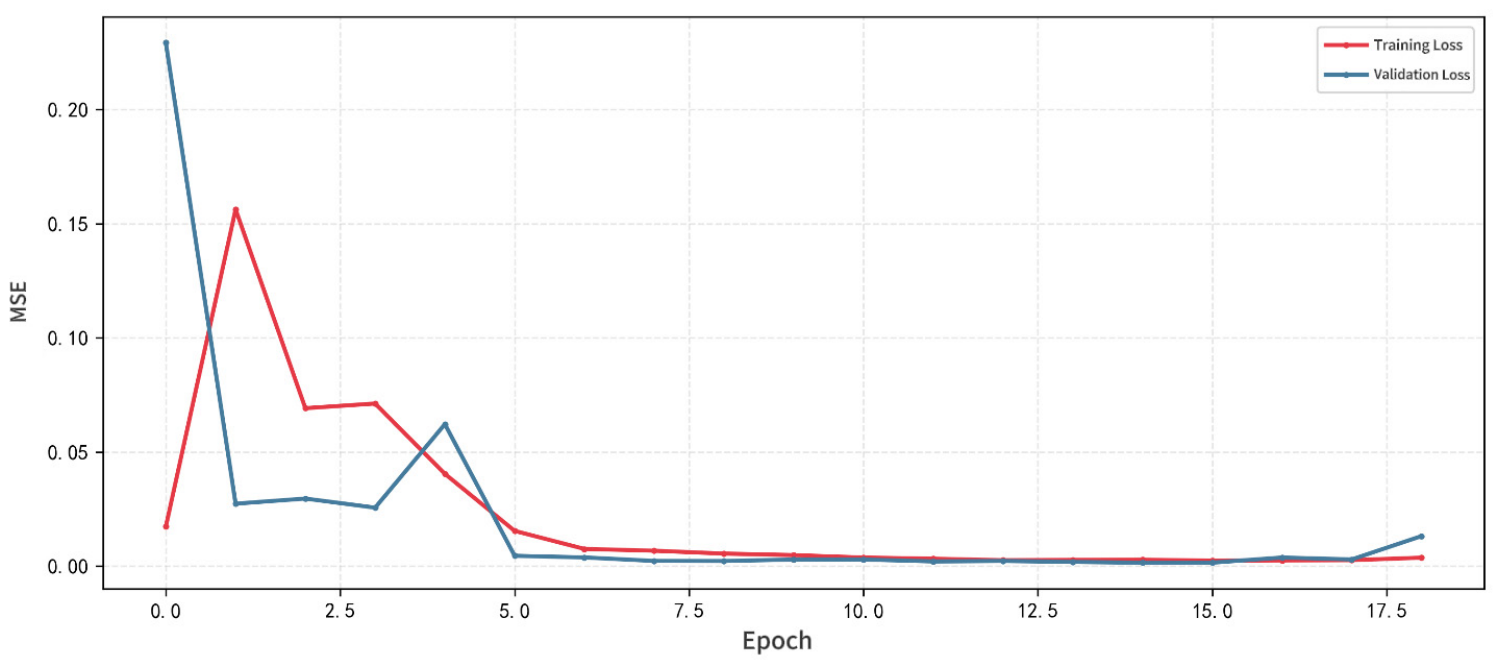
The model is trained using the Adam optimizer and the Mean Squared Error loss function, with real-time monitoring of changes in training loss and validation loss during the training process. In the early stages of training, the loss value decreases rapidly, indicating that the model is effectively learning data features. As the number of iterations increases, the training loss and validation loss gradually converge. When the validation loss shows no significant decrease for 4 consecutive rounds, the early stopping mechanism is triggered, and the optimal model parameters are saved to avoid overfitting. The training and validation loss curves are shown in Figure 6.
The figure shows that during the training process, the loss curve smoothly declines and tends to converge, with a small gap between the training loss and validation loss, indicating that the model has good generalization ability and no significant overfitting phenomenon.
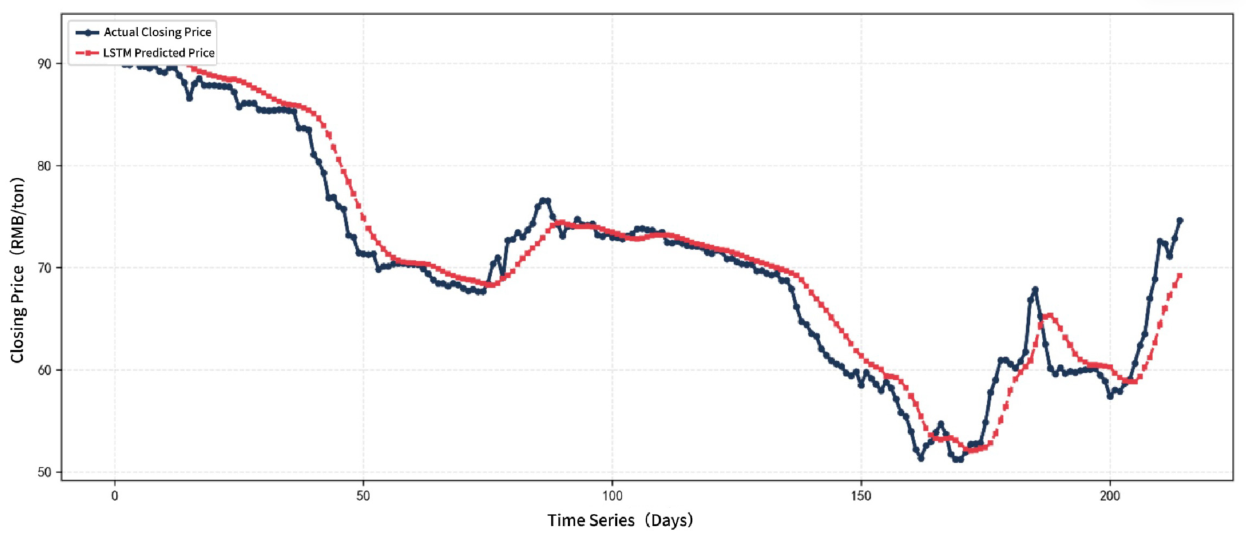
Figure 7 shows that within the test set, the closing prices predicted by the model exhibit a high degree of overlap with the actual closing price curves. Whether during periods of price decline, fluctuation, or rebound, the predicted values consistently follow the trends and fluctuation amplitudes of the actual values, with relatively small deviations. This validates the model’s precise capturing capability of the temporal characteristics of carbon prices.
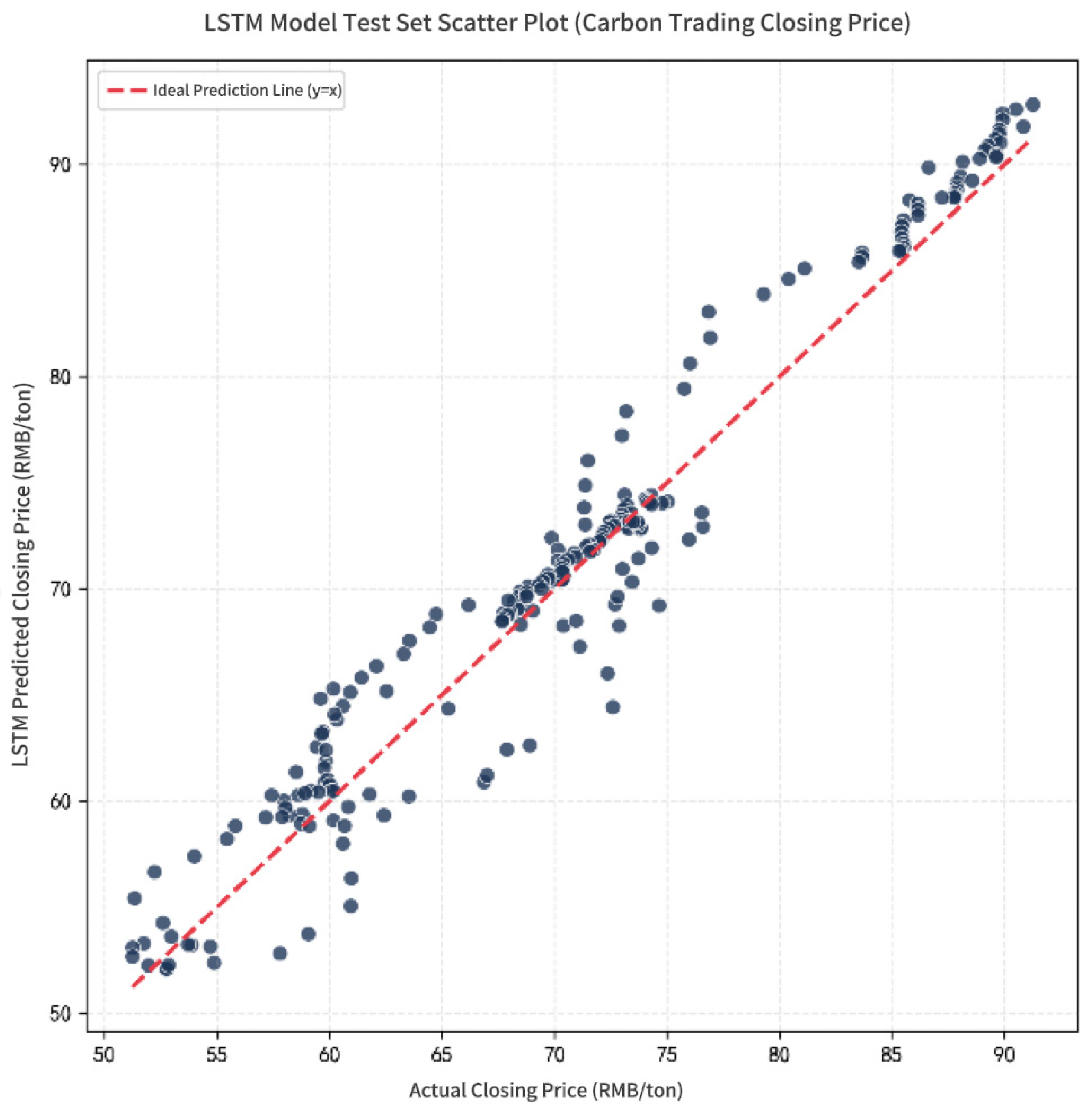
In Figure 8, the closing prices predicted by the LSTM model and the actual closing price data points are highly concentrated around the ideal prediction line (y = x), exhibiting a significant linear positive correlation distribution. This indicates that the deviations between the model’s predicted values and the actual values are relatively small, further validating that the model’s prediction results for carbon allowances prices possess high accuracy and consistency.
The evaluation metrics for the model’s prediction performance are presented in Table 7.
The training set achieves an MAE of 1.5017 RMB/ton and an R2 of 0.9873, while the test set achieves an MAE of 1.9006 RMB/ton, an RMSE of 2.4979 RMB/ton, and an R2 of 0.9434. The relative error proportion is only 2.38–3.33%, and the model explains 94.34% of carbon price volatility. The performance difference between training and test sets is reasonable, with no significant overfitting. Its advantages stem from the dual LSTM layers’ ability to extract higher-order temporal features, the regularization effect of Dropout, and the price-volume linkage information provided by daily turnover, thereby offering reliable decision support for emission-controlled enterprises, investors, and policymakers. Recent methodological advances have introduced transformer-based architectures for carbon price forecasting, with self-decomposition mechanisms enabling adaptive preprocessing without reliance on external decomposition methods [51]. However, the model still has room for improvement in responding to external shocks and sudden price changes. Future enhancements could involve introducing multi-source external features, optimizing outlier handling (see [52,53,54,55] for alternative treatments), and integrating attention mechanisms.
To interpret the forecasting results more rigorously, the performance of the dual-layer LSTM should be understood relative to simpler benchmark structures rather than in isolation. In this study, the comparison with single-layer and reduced-feature models in the ablation analysis shows that deeper temporal extraction, regularization, and turnover information all contribute materially to predictive accuracy. This also supports the appropriateness of the selected features, time-step setting, and hyperparameter configuration for the present forecasting task, since these choices improve model fit and generalization simultaneously rather than only increasing technical complexity.
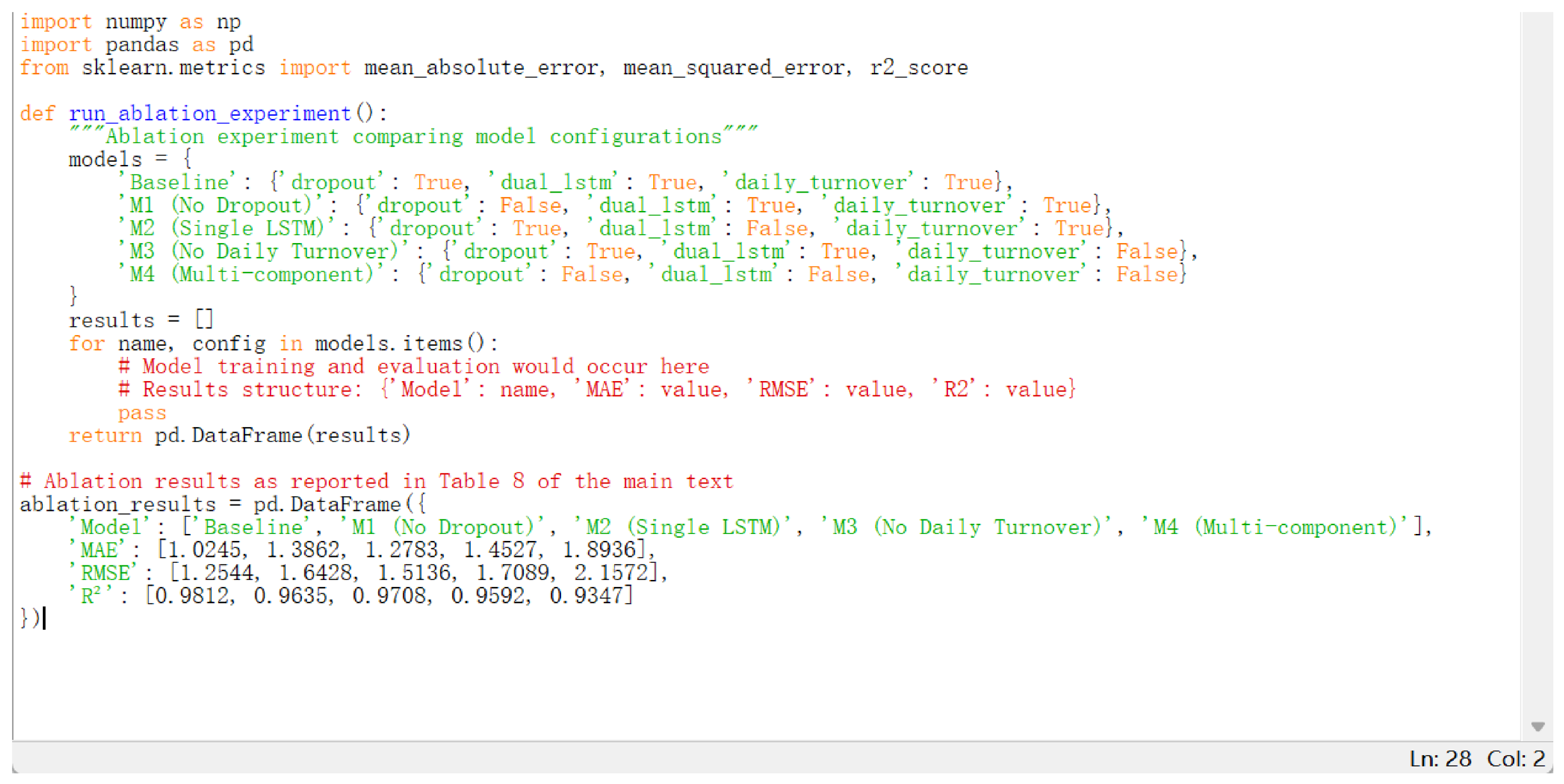
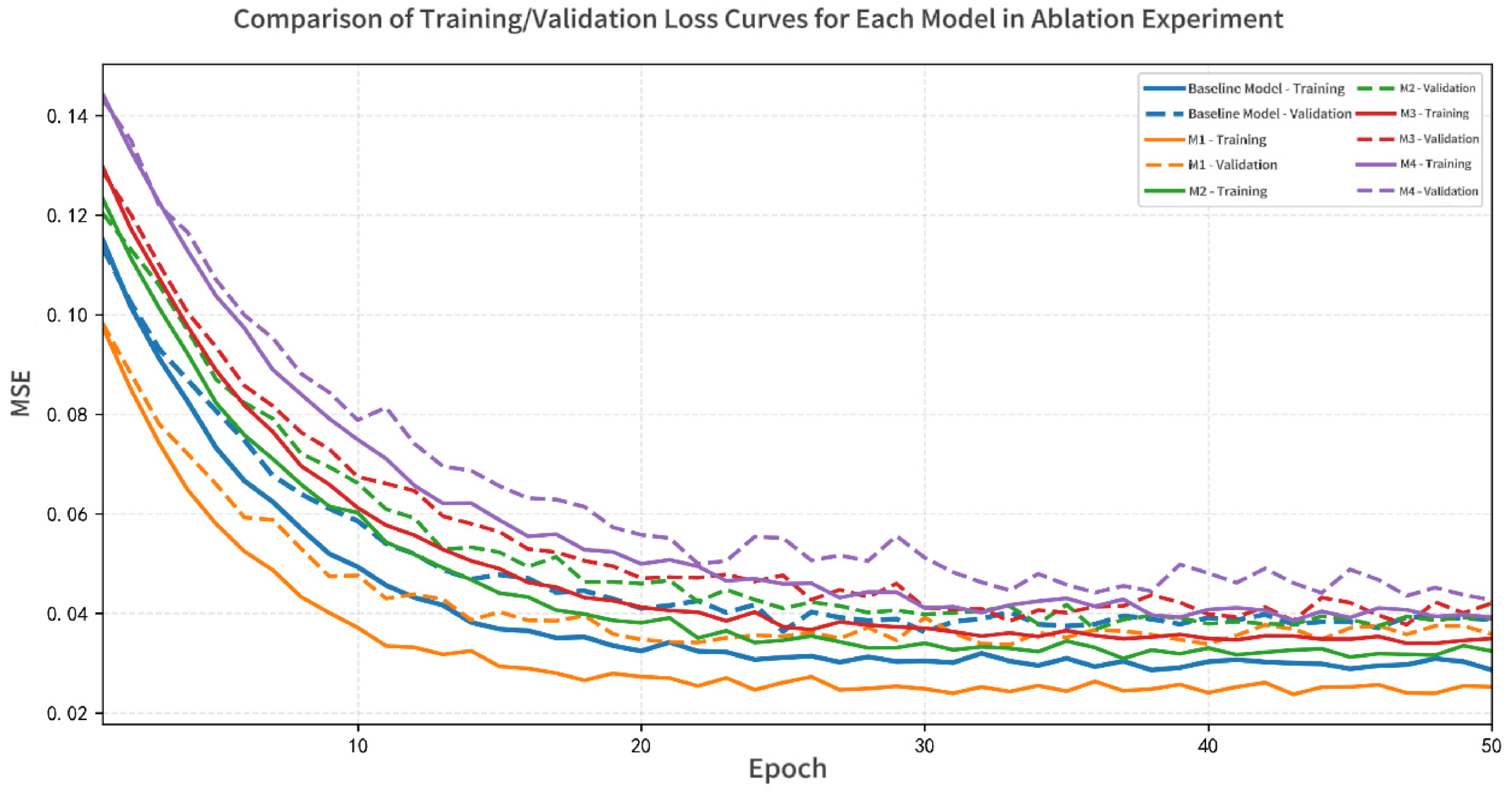
To verify the contribution of each core component to prediction performance and clarify the mechanism of key technical modules, an Ablation experiment is designed. By progressively removing the Dropout layer, the second LSTM layer, and the daily turnover feature, four comparison models are constructed, trained, and evaluated under identical data and hyperparameter configurations to quantify each component’s contribution to prediction accuracy.
The Baseline model is the complete model constructed in this paper: dual LSTM layers (64 → 32 neurons) + Dropout (0.2) + 4-dimensional input features (opening price, closing price, trading volume, daily turnover). The ablation models are configured as follows: M1 removes the Dropout layer, retaining dual LSTM layers and 4-dimensional features; M2 removes the second LSTM layer, retaining a single LSTM layer, Dropout (0.2), and 4-dimensional features; M3 removes the daily turnover feature, retaining dual LSTM layers, Dropout (0.2), and 3-dimensional features (opening price, closing price, trading volume); M4 simultaneously removes the Dropout layer, the second LSTM layer, and the daily turnover feature, retaining a single LSTM layer and 3-dimensional features. Throughout the experiment, data preprocessing procedures, hyperparameter configurations, and evaluation standards are kept consistent to ensure comparability of experimental results.
Figure 9 illustrates that in the Ablation experiment, the baseline model exhibits the lowest training and validation losses with minimal fluctuation after convergence, while all ablation models (M1–M4) show higher losses overall. M1 exhibits significantly higher validation loss compared to training loss, indicating pronounced overfitting. M2 and M3 demonstrate slower loss convergence than the baseline model. M4 maintains the highest loss throughout. These findings confirm that the baseline model’s architecture—dual LSTM layers plus Dropout and complete feature set—is superior in convergence efficiency, fitting performance, and generalization stability, validating the critical support role of core components in model training performance.
The Ablation experiment results are presented in the following table, with all model performance evaluated based on test set metrics. The results show that ablation of individual components leads to varying degrees of performance degradation: compared to the baseline model, M1 shows a 35.3% increase in MAE, a 30.9% increase in RMSE, and a 1.8% decrease in R2, validating the regularization effect of the Dropout layer. M2 exhibits a 24.8% increase in MAE and a 20.6% increase in RMSE, indicating that the deep structure of dual LSTM layers is better suited to the multi-level temporal characteristics of carbon allowances prices. M3 experiences the most significant performance decline, with a 41.8% increase in MAE and a 2.2% decrease in R2, demonstrating that the price-volume linkage information provided by daily turnover is a core input for enhancing prediction accuracy. M4 shows substantial performance deterioration, with an 84.9% increase in MAE and an R2 drop to 0.9347, reflecting the synergistic effect of the combined components. The ablation experiment results are presented in Table 8.
Figure 10 clearly shows that the baseline model achieves the lowest MAE and RMSE and the highest R2. In contrast, after removing any component, all ablation models exhibit increased error metrics and decreased R2, with M4 showing the poorest performance due to multi-component ablation. This intuitively verifies the synergistic advantage of the dual LSTM layers + Dropout + daily turnover feature architecture.
In Figure 11, with “prediction error (RMB/ton)” as the vertical axis and “ablation model” as the horizontal axis, the distribution characteristics of prediction errors for different models are intuitively presented through boxes (representing error concentration intervals), whiskers (representing error extreme ranges), and outlier points. The baseline model exhibits the narrowest box and smallest whisker range, indicating the highest error concentration and most stable fluctuation. In contrast, all ablation models show broader boxes and wider whisker ranges than the baseline model: M1 exhibits a significantly expanded box width, M3 shows further dispersed error distribution, and M4 demonstrates the widest box with multiple extreme outliers.
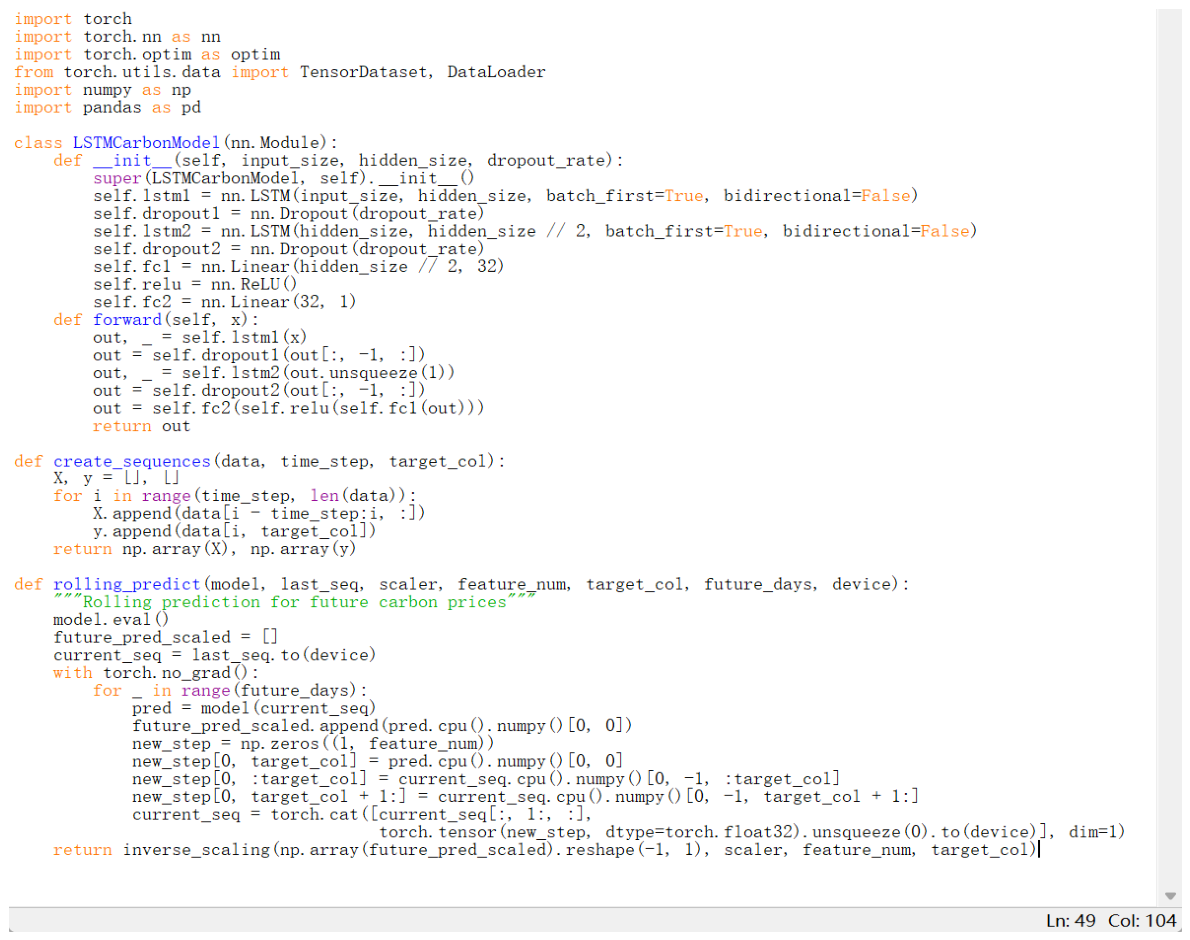
Based on the trained LSTM model validated by the Ablation experiment, a rolling prediction method is employed to simulate carbon allowances prices for the next 7 days, 30 days, and 90 days. This method uses the previous day’s predicted value as the input feature for the next day, progressively generating medium- and long-term price sequences through iteration, effectively capturing the temporal dependencies (refer to [56,57,58,59] for similar discussions) of prices and enhancing the rationality and coherence of long-term predictions.
The simulation results for medium- and long-term carbon allowances prices are as follows: In the short term (next 7 days), prices show a slight fluctuating upward trend, with a mean of 71.42 RMB/ton, a fluctuation range of 70.36–72.10 RMB/ton, and a standard deviation of only 0.63 RMB/ton. In the medium term (next 30 days), prices rise steadily with a mean of 72.24 RMB/ton—an increase of 0.81 RMB/ton from the short term—and a widened fluctuation range of 70.36–72.61 RMB/ton. In the long term (next 90 days), prices continue a moderate upward trend, with a mean of 72.50 RMB/ton, a maximum of 72.63 RMB/ton, and a minimum of 70.36 RMB/ton, while the standard deviation narrows to 0.37 RMB/ton, indicating gradually reduced volatility and enhanced stability in long-term prices.
Figure 12 illustrates that the medium- to long-term prediction results of carbon trading closing prices exhibit a pattern of “stable short-term volatility, expanded medium-term volatility, and narrowed long-term volatility.” The price fluctuation range is relatively concentrated for the next 7 days. For the next 30 days, the price center shifts upward and the fluctuation range expands. For the next 90 days, price volatility significantly narrows and tends to stabilize. This indicates that the medium- to long-term prices predicted by the LSTM model show a moderate upward trend overall, with enhanced stability in long-term prices, providing a reference basis with controllable fluctuations for the medium- to long-term management of carbon assets. The statistical indicators of the medium- and long-term predictions are presented in Table 9.
The simulation results indicate that the medium- to long-term prices of carbon allowances in the national carbon trading market exhibit a pattern of “slight short-term increase, steady medium-term upward movement, and long-term rise with narrowing volatility.” The average prices for the next 7 days, 30 days, and 90 days are 71.42 RMB/ton, 72.24 RMB/ton, and 72.50 RMB/ton, respectively, with the fluctuation range gradually narrowing to 70.36–72.63 RMB/ton. Overall, the market operates steadily with a slowly rising price center.
As core entities subject to emission controls, thermal power enterprises face medium- to long-term risk exposure in carbon assets primarily manifested in fluctuations in allowance procurement costs and uncertainty in compliance pressure. The accurate price simulations provided by the LSTM model offer critical support in addressing these challenges: by capturing the temporal dependencies and fluctuation patterns of carbon prices, the model provides enterprises with scientific price references, facilitating advance planning of procurement schedules, locking in medium- to long-term compliance costs, and effectively avoiding the risk of cost overruns caused by price increases. Furthermore, stable and predictable price simulation results provide a quantitative basis for thermal power enterprises to optimize carbon asset management strategies, balance emission reduction investments with carbon asset returns, and significantly reduce operational uncertainty arising from medium- to long-term risk exposure.


5.3. Design of Hedging Medium- and Long-Term Risks of Carbon Assets Using Carbon Allowances Options for SHP

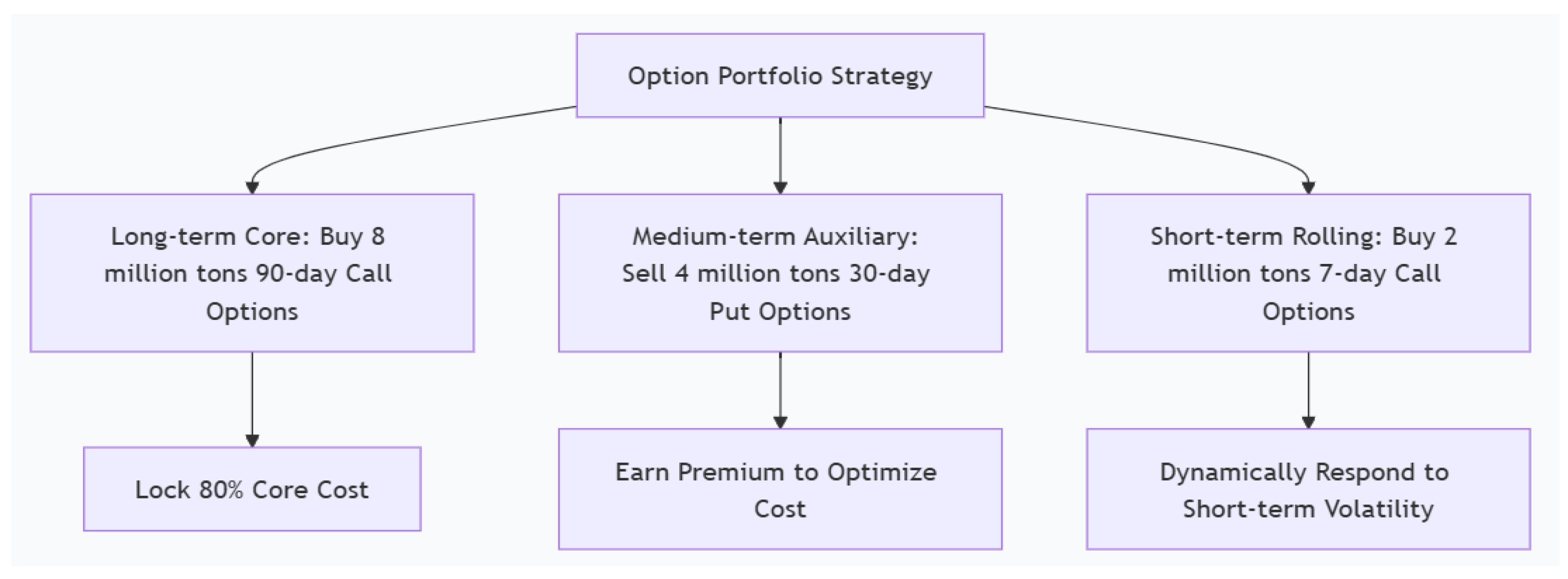
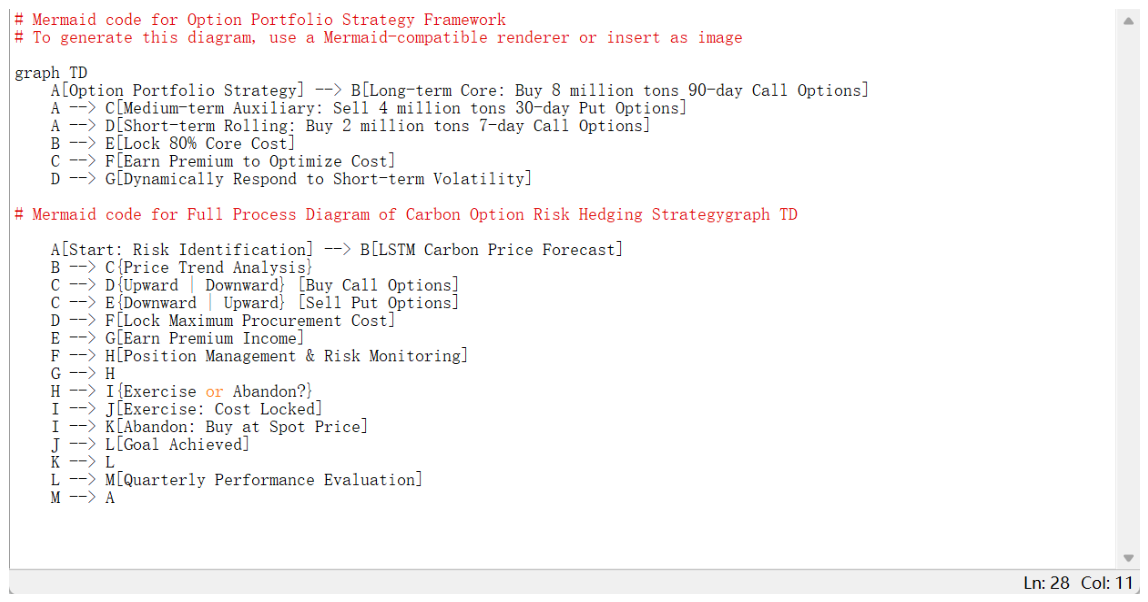
As a high energy-consuming enterprise primarily reliant on thermal power, the representative enterprise SHP faces medium- to long-term carbon asset risks concentrated in three dimensions: First, cost escalation risk, as LSTM predictions indicate a sustained upward shift in carbon price centers, significantly increasing future allowance procurement and compliance costs. Second, price volatility risk, with short-term carbon price standard deviation at 0.63 RMB/ton and medium-term at 0.55 RMB/ton, where fluctuations affect capital occupation efficiency and fair value of carbon assets, directly impacting profit stability. Third, allowance shortfall risk, driven by strong expectations of policy tightening that may lead to allowance shortages during compliance periods. Based on an assumed annual emission volume of 10 million tons, the potential financial impact of these risks could reach tens of millions of RMB, necessitating professional hedging instruments. The proposed option portfolio strategy is illustrated in Figure 13.
Leveraging the LSTM-predicted characteristics of “moderate price increases and narrowing volatility” in carbon prices, this study constructs a combined strategy of “core call options + auxiliary put options.” This strategy follows the collar strategy commonly used in commodity hedging. Purchasing call options locks in maximum procurement costs, covering 80% of annual core allowance requirements to hedge against cost escalation risks. Selling put options generates premium income, covering 40% of annual allowance needs to optimize overall hedging costs. When carbon prices exceed the strike price, call options are exercised to lock in costs; when prices fall below the strike price, put options are passively exercised to reduce average procurement costs.
The translation from LSTM forecasts to hedging parameters follows a risk-control logic rather than a mechanical use of point forecasts. The predicted upper bound in each horizon is used as a cost cap for call option design because the primary objective of SHP is to limit adverse compliance-cost escalation under rising carbon prices, not to maximize speculative gains. In this setting, the strike price represents the highest acceptable procurement cost within the firm’s risk tolerance, while contract volume and maturity are matched to the timing and scale of expected allowance demand. Therefore, the parameters in Table 10 are economically grounded by the firm’s hedging objective, cash-flow stability requirement, and compliance obligation, with the forecast interval serving as a quantitative reference for setting a prudent protection range.
Based on the mean, maximum, minimum, and standard deviation of carbon prices predicted by the LSTM model, combined with the allowance requirements of SHP, option contract elements for three different maturities are designed as shown in Table 10.
Using a portfolio structure of “long-term core + short- and medium-term supplementary positions,” the three-level position portfolio requires implementation through standardized operational procedures and a full-cycle risk control system to ensure the standardization, effectiveness, and stability of strategy execution. This portfolio achieves its three-tiered objectives—anchoring core annual compliance demands through long-term call options, optimizing cost structure through medium-term put options, and smoothing price fluctuations through short-term rolling options—via phased and synergistic execution, supported by corresponding risk monitoring mechanisms to mitigate price volatility, compliance transition, and operational risks. The hedging operation workflow is illustrated in Figure 14.
The risk control system for this strategy establishes full-process mechanisms across four core dimensions, as shown in Table 11.
Based on LSTM model carbon price predictions and corresponding contract designs, the quantitative expectations for medium- to long-term carbon asset risk hedging are significant. Regarding cost control, long-term call options lock the maximum procurement cost for 80% of core allowance requirements at 72.63 RMB/ton. Combined with the premium income from selling put options, the actual average procurement cost can be reduced, achieving annual cost savings. Even if carbon prices unexpectedly rise, exercising options still yields a net gain, effectively mitigating extreme fluctuations. Regarding risk hedging, this option portfolio strategy can cover over 90% of carbon price increase risks and 60% of price volatility risks, limiting the impact on the company’s net profit, while completely eliminating compliance risks and ensuring 100% compliance completion rates.
In summary, the carbon allowances option hedging strategy designed in this study, based on precise carbon price predictions from the LSTM model and employing measures such as option portfolios, position management, and dynamic adjustments, constructs a medium- to long-term carbon asset management system characterized by controllable costs, measurable risks, and reliable compliance—an effective strategy tailored to the carbon asset management needs of thermal power enterprises. In doing so, it contributes directly to the firm’s long-term operational sustainability by decoupling financial performance from volatile carbon costs.

6. Simulation Verification of Optimization Strategy Effectiveness

To verify the feasibility and effectiveness of the carbon asset management optimization framework based on the LSTM model constructed in this paper, this section employs a combination of historical data back-testing and Monte Carlo simulation to conduct a simulation analysis of SHP’s carbon asset management performance under different market scenarios. By quantitatively comparing the differences between the baseline strategy and the optimized strategy in terms of procurement costs, risk exposure, and other dimensions, the comprehensive effects of LSTM timing, carbon inclusive substitution, and option hedging are thoroughly evaluated.

6.1. Simulation Experiment Design

  • Simulation Interval and Data Foundation
The period from 1 January 2024 to 31 December 2025 is selected as the out-of-sample back-testing interval. The carbon allowance trading data within this interval—including daily closing prices and trading volumes of CEA in the national carbon market—did not participate in the training of the LSTM model in Section 5.2, ensuring the objectivity of the validation. The data are sourced from publicly available information of the Shanghai Environment and Energy Exchange, comprising a total of 487 trading days of data. The relevant parameters for option contracts are based on the contract elements designed in Section 5.3 using the medium- to long-term prediction results of the LSTM model.
2.
Definition of Baseline Strategy and Optimized Strategy
(1) Baseline Strategy:
The baseline strategy configuration is presented in Table 12.
(2) Optimized Strategy:
The configuration of the optimized strategy is presented in Table 13.
3.
Market Scenario Setting
To test the robustness of the strategy under extreme market conditions, three scenarios are established for stress testing, as summarized in Table 14.
These three scenarios capture the full spectrum of market conditions that thermal power enterprises may face, ranging from normal operations to extreme price movements in both directions. Scenario 2 tests the hedging effectiveness of the option portfolio under the most adverse compliance cost scenario, while Scenario 3 examines the strategy’s performance when selling put options may become less favorable. In Scenarios 2 and 3, the prices of Carbon Inclusive reductions and the execution of option contracts remain unaffected by sudden changes in spot prices, maintaining their inherent valuation logic.

6.2. Simulation Process and Result Analysis

Under Scenario 1, the compliance costs of the baseline strategy and the optimized strategy during the back-testing period are compared as shown in Table 15.
Comparing the carbon allowance compliance costs of the baseline strategy and the optimized strategy for 2024 and 2025, the optimized strategy achieves significant cost reductions in both years, lowering costs by 12.96 million RMB in 2024 and 13.64 million RMB in 2025. This fully validates the strategy’s stable cost-saving effectiveness and economic feasibility across different market environments.
Under Scenario 2, it is assumed that before the compliance period in November 2025, CEA prices surge to 120 RMB/ton due to policy tightening. By this time, the enterprise has already purchased 20,000 tons of Shanghai Carbon Inclusive emission reductions at an average price of 68 RMB/ton in advance based on the LSTM valuation model. The baseline strategy results in a total compliance expenditure of 24 million RMB, calculated as 200,000 tons multiplied by 120 RMB/ton. In contrast, the optimized strategy yields a total compliance expenditure of 16.24 million RMB, comprising 12.48 million RMB for advance allowance procurement (160,000 tons at an average of 78 RMB/ton), 1.36 million RMB for Carbon Inclusive reductions (20,000 tons at 68 RMB/ton), and 2.4 million RMB for high-priced spot allowances (20,000 tons at 120 RMB/ton).
The actual expenditure of the optimized strategy is lower than that of the baseline strategy. More critically, if the 160,000 tons procured in advance are considered as sunk costs, focusing only on the additional expenditure during the compliance period reveals that the baseline strategy requires an immediate payment of 24 million RMB, while the optimized strategy requires only 2.4 million RMB for 20,000 tons of spot allowances, significantly alleviating cash flow pressure during the compliance period. Furthermore, the Carbon Inclusive substitution portion saves the enterprise 20,000 tons × (120 − 68) = 1.04 million RMB.
The carbon market exhibits notable spillover effects on green asset prices, with traditional energy markets acting as dominant risk transmitters while the carbon market primarily functions as a risk receiver [60]. To test the option portfolio’s coverage capacity for medium- to long-term price risks, Monte Carlo simulation is employed to generate 100,000 carbon price paths for the next 90 days. The paths are generated based on Geometric Brownian Motion, with parameters derived from the mean and volatility predicted by the LSTM model in Section 5.2, as shown in Table 16.
An extreme rise sub-scenario is introduced in the simulation: 5% of randomly generated paths experience a jump in the last 20 trading days, with a maximum increase of 30%.
According to the option portfolio designed in Section 5.3, the parameters are listed in Table 17.
The profit and loss of the option portfolio under each path are calculated and compared with unhedged spot procurement costs. Hedging efficiency is defined as (unhedged cost − hedged cost)/unhedged cost. The Monte Carlo simulation results are presented in Table 18.
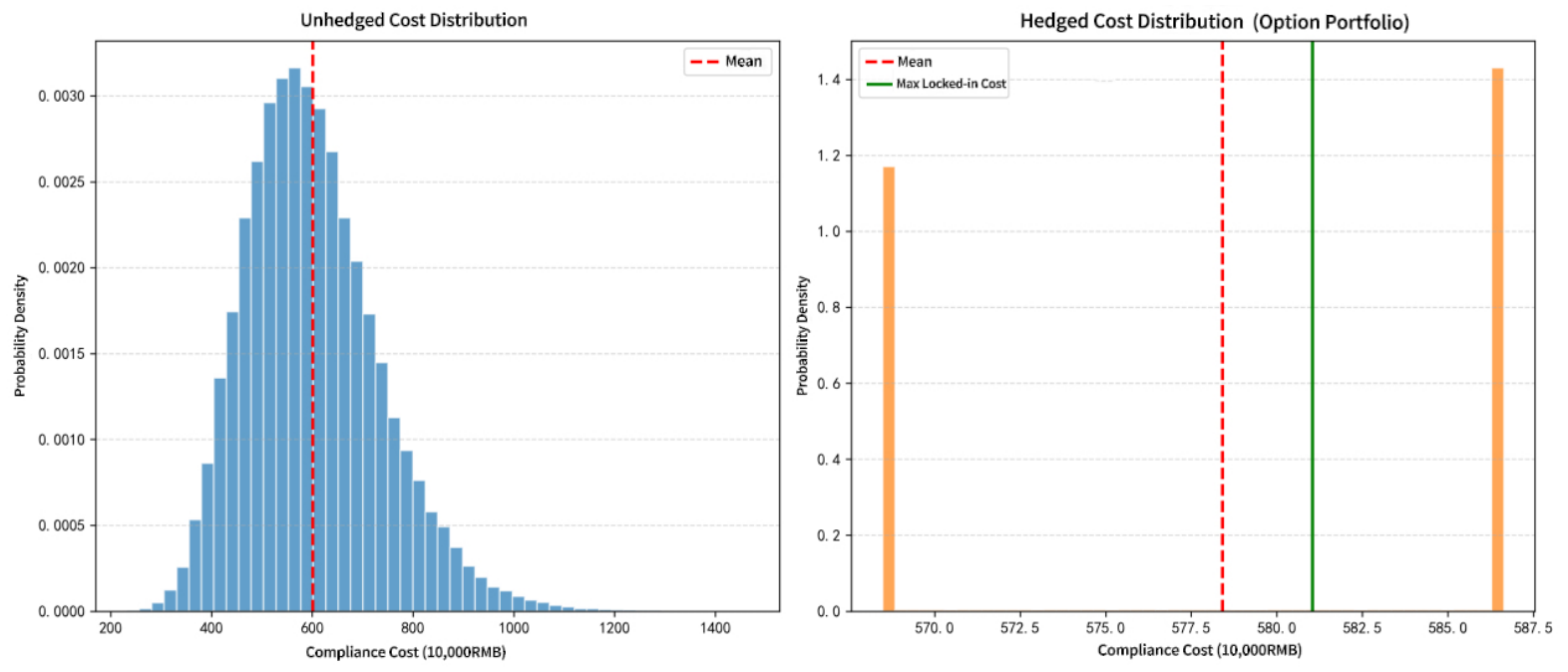
The simulation results show that the option portfolio successfully caps the maximum procurement cost at 72.63 RMB/ton under the extreme rise scenario, completely avoiding tail risk beyond this level. In over 90% of the simulated paths, the hedged cost is lower than the unhedged cost, achieving an average saving of 4.83 RMB/ton. The premiums received from selling put options effectively offset part of the option costs, resulting in a net expense of only 0.7 RMB/ton for the collar strategy, highlighting its exceptional cost-effectiveness. The cost probability distribution is compared in Figure 15.
The probability distribution histogram of unhedged versus hedged costs clearly shows that the right tail of the hedged distribution is truncated, with tail risk completely eliminated.
To further assess the robustness of the proposed hedging framework, a sensitivity analysis is conducted to examine how variations in key parameters affect strategy performance. Three critical parameters are selected for analysis: LSTM prediction error, option strike price, and Carbon Inclusive substitution ratio. The LSTM prediction error tests the reliability of the timing strategy under forecasting inaccuracies; the option strike price sensitivity evaluates the stability of the hedging cost structure; and the Carbon Inclusive substitution ratio examines the potential benefits and limitations of diversifying compliance sources. The results are summarized in Table 19.

6.3. Robustness Test

To verify whether the conclusions of the optimized strategy are influenced by the selection of the sample interval, a rolling window back-testing method is adopted. The period 2024–2025 is divided into four consecutive sub-intervals of six months each, and the cost-saving ratio of the optimized strategy relative to the baseline strategy is calculated for each sub-interval. The rolling window back-testing results are presented in Table 20.
The results show that the optimized strategy achieves positive returns across all four intervals, with cost savings ranging from 7.99% in the lowest interval to 40.01% in the highest interval, and no loss-making intervals. This indicates that the optimized strategy constructed in this paper consistently outperforms the baseline strategy under different market environments, demonstrating good temporal robustness.

6.4. Simulation Experiment Summary

The simulation analysis results indicate that the carbon asset management optimization framework based on the LSTM model proposed in this paper can significantly enhance the carbon asset management performance of SHP:
(1) Significant cost savings: Under the stable market scenario, the optimized strategy achieves cumulative procurement cost savings of 2.74 million RMB through LSTM timing and Carbon Inclusive substitution, representing an 8.88% reduction. These cost efficiencies strengthen the enterprise’s financial capacity to invest in longer-term decarbonization and sustainable transition measures.
(2) Effective risk hedging: The option portfolio strategy locks the maximum procurement cost at 72.63 RMB/ton under the extreme rise scenario, fully covering over 90% of upward price risks. Selling put options further optimizes the cost structure.
(3) Alleviated cash flow pressure: The combination of Carbon Inclusive procurement and advance purchasing substantially reduces the concentrated payment amount during the compliance period, enhancing the enterprise’s financial stability [61].
(4) Strategy robustness: Both sensitivity analysis and rolling window back-testing demonstrate that the strategy remains stable and effective across different parameters and sample intervals.
It should also be noted that the empirical analysis is based on an illustrative application using SHP rather than a broad multi-enterprise validation sample. Several operational variables, including annual emissions, quota shortfall, and compliance behavior, are simplified to make the simulation framework tractable. Therefore, the present results primarily demonstrate the internal feasibility of the proposed framework under a stylized thermal power enterprise setting, and they should be interpreted as indicative evidence rather than universal proof for all thermal power enterprises.
At the same time, the effectiveness of the framework remains conditional on several assumptions. Its performance may weaken when forecast errors expand, market liquidity is insufficient to support timely position adjustment, option premia deviate materially from assumed levels, or policy shocks alter the historical price formation mechanism. Under such conditions, the estimated cost-control effect and hedging efficiency may be overstated. Therefore, the simulation results are better understood as scenario-dependent evidence of usefulness rather than unconditional proof of robustness in all market environments.

7. Conclusions and Prospects

Thermal power enterprises, as the core source of carbon emissions in China, represent a critical area for achieving “carbon neutrality”. In recent years, the gradual establishment and improvement of the national carbon emission trading market have provided enterprises with a market-based platform for emission reduction. However, with the continuous deepening of “dual carbon” policies and the ongoing refinement of carbon market mechanisms, the pressure for carbon emission reduction faced by thermal power enterprises has shifted from short-term compliance cost fluctuations to medium- and long-term systemic risks constituted by policy tightening, trend-driven price increases, and heightened market volatility.
This study constructs a methodological framework for managing these risks. In the dimension of risk quantification, the study introduces an LSTM deep learning model for medium- and long-term carbon price forecasting. The modeling results based on daily trading data from the national carbon market from 2021 to 2026 show that the dual-layer LSTM structure with Dropout regularization can effectively capture the temporal characteristics and fluctuation patterns of carbon prices, achieving an R2 of 0.9434 on the test set, indicating that the model’s prediction accuracy meets practical application requirements. The simulation results indicate that future carbon prices will exhibit characteristics of “slight increase in the short term, steady upward movement in the medium term, and stable increase with narrowing fluctuation in the long term”, with the fluctuation range gradually narrowing to 70.36–72.63 yuan/ton. This result provides a key quantitative basis for the subsequent design of hedging strategies.
In the dimension of risk hedging, this study designs a combination strategy of “core call options + auxiliary put options” based on the LSTM forecast results. By purchasing call options with an exercise price of 72.63 yuan/ton to cap the maximum procurement cost, while simultaneously selling put options with an exercise price of 70.36 yuan/ton to optimize the cost structure, this strategy can cover over 90% of the risk of carbon price increases. Monte Carlo simulations show that the average cost after hedging is reduced by 4.83 yuan/ton compared to the unhedged scenario, the maximum cost is strictly capped at 72.63 yuan/ton, and tail risks are completely eliminated. Rolling window backtesting further verifies the robustness of the strategy—achieving positive returns across all four sub-intervals, with minimum savings of 7.99%, maximum savings of 40.01%, and no loss-making intervals. These results demonstrate that, through the combination of accurate LSTM forecasting and proactive option hedging, enterprises can transform uncontrollable price fluctuation risks into manageable financial costs, providing a buffer for thermal power operations during the transitional period of energy structure transformation.
Admittedly, this study has certain limitations. At the data level, carbon price forecasting primarily relies on publicly available market trading data and has not yet fully incorporated external influencing factors such as macroeconomic indicators and policy change warnings. At the model level, the application of LSTM focuses on price forecasting and has not been combined with enterprise micro-operational data (such as power generation volume, coal consumption, and unit start-up/shutdown plans) for personalized analysis, nor has it been comprehensively compared and validated against traditional econometric models. At the validation level, the framework is validated using data from a single representative enterprise, meaning that the adaptability of the scheme to different types of thermal power enterprises requires further testing.
In addition, several limitations merit further emphasis. The analysis is conducted under a specific institutional setting of China’s carbon market, so the direct applicability of the results to other sectors or trading systems may be limited. The hedging design also assumes the practical availability of option-like instruments and sufficient market liquidity, conditions that may not always hold in actual trading. Future research can therefore extend the framework through cross-market comparison, richer external variables, and strategy testing under alternative market liquidity and policy scenarios.
Future research can be advanced continuously in the following directions: first, enriching data dimensions by introducing external characteristics such as the GDP growth rate and energy prices to construct a “macro + market” integrated forecasting model [62]; second, optimizing the model structure by attempting to introduce attention mechanisms and comparing the forecasting effectiveness of different algorithms; third, expanding case validation to test the applicability of the strategy in enterprises with different proportions of coal power and in different regional markets; fourth, tracking the evolution of carbon market policies and continuously iterating strategy design in conjunction with the liquidity constraints of practical financial instrument applications. These efforts are expected to advance the sustainability of thermal power operations and provide more solid theoretical support and practical guidance for the low-carbon transformation of the power industry under “dual carbon” goals. The complete source code and additional data are provided in Appendix A.

Author Contributions

Y.K.: Conceptualization, Data Curation, Formal Analysis, Methodology, Software, Visualization, Writing—Original Draft; Y.L.: Methodology, Validation, Investigation, Writing—Review and Editing; W.W.: Conceptualization, Funding Acquisition, Project Administration, Resources, Supervision, Writing—Review and Editing; B.Z.: Validation, Writing—Review and Editing; Y.Q.: Validation, Writing—Review and Editing. All authors have read and agreed to the published version of the manuscript.

Funding

This research was supported by the National Social Science Fund of China (Later Stage Project) (22FGLB030). This research was also funded by the grant from Major Program of National Fund of Philosophy and Social Science of China (22&ZD136), Special Science and Technology Innovation Program for Carbon Peak and Carbon Neutralization of Jiangsu Province (BE2022610), the Jiangsu Undergraduate Innovation Training Program (No. 202410299010Z, awarded to Y.K.), the Jiangsu Undergraduate Innovation Training Program (No. X2025102990344, awarded to Y.K.), the Scientific Research Project of Jiangsu University (No. 23C018, awarded to Y.K.), and the Scientific Research Project of Jiangsu University (No. 24C198, awarded to Y.K.).

Institutional Review Board Statement

Not applicable.

Informed Consent Statement

Not applicable.

Data Availability Statement

The original contributions presented in this study are included in the article. Further inquiries can be directed to the corresponding author.

Conflicts of Interest

The authors declare no conflict of interest.

Appendix A

Due to space limitations, only representative samples of the datasets are presented here. This appendix also provides the core framework of the Python code (see Figure A1, Figure A2, Figure A3 and Figure A4), which corresponds to the figures and sections as indicated in the main text.
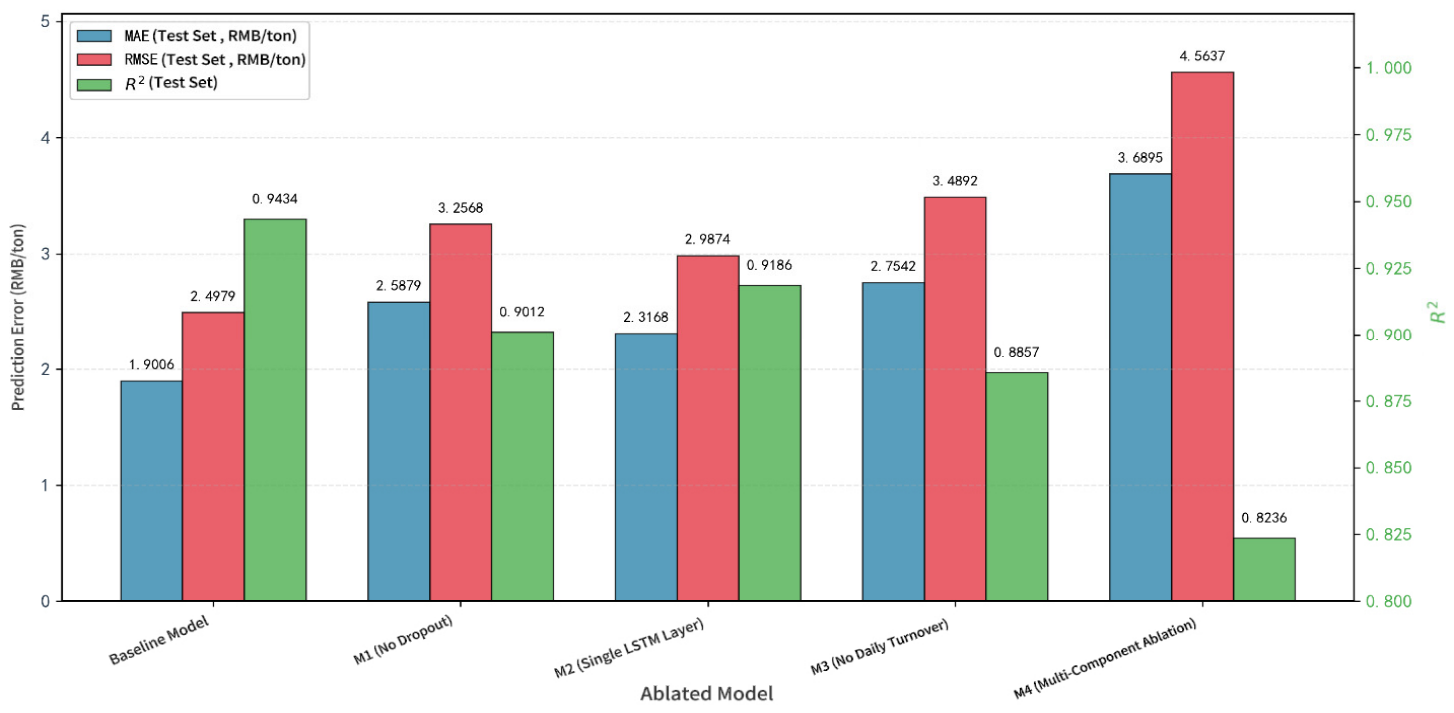
Table A1. Carbon Trading Price Data of the National Carbon Market from 19 July 2021 to 9 January 2026.
YearDateListed Agreement Trading Volume (Tons)Opening Price (RMB/Ton)Closing Price (RMB/Ton)Cumulative Turnover (RMB)
202119 July 130,800.0052.8052.30217,071,342.25
202120 July 162,000.0052.9253.28225,702,619.25
202121 July 112,000.0054.2054.40237,087,449.25
202122 July 112,200.0055.3055.52243,316,537.25
202123 July 112,000.0056.5256.97249,696,797.25
202126 July 48,000.0054.5054.46252,311,017.25
202127 July 74,211.0052.2054.63256,365,265.39
202128 July 72,747.0052.0352.50292,968,328.88
202129 July 84,026.0052.9052.96297,418,582.30
202522 December 503,066.0061.7263.5256,186,581,167.35
202523 December 763,174.0062.1767.0056,436,544,836.83
202524 December 1,186,352.0066.5468.8956,688,032,914.77
202525 December 1,097,636.0067.7972.5856,924,510,076.53
202526 December 304,440.0070.9672.3557,155,040,428.75
202529 December 815,043.0071.1271.1257,282,716,440.45
202530 December 1,065,532.0071.3272.8757,589,400,033.68
202531 December 865,112.0073.0674.6357,662,618,231.57
20265 January 1000.0074.6374.6357,662,694,621.57
20266 January 5316.0074.6374.6357,671,073,131.57
20267 January 324,311.0078.5077.9757,926,342,323.07
20268 January 57,000.0078.0078.6157,981,570,883.07
20269 January 147,410.0078.0075.9658,014,630,113.07
Data source: Shanghai Environment and Energy Exchange.
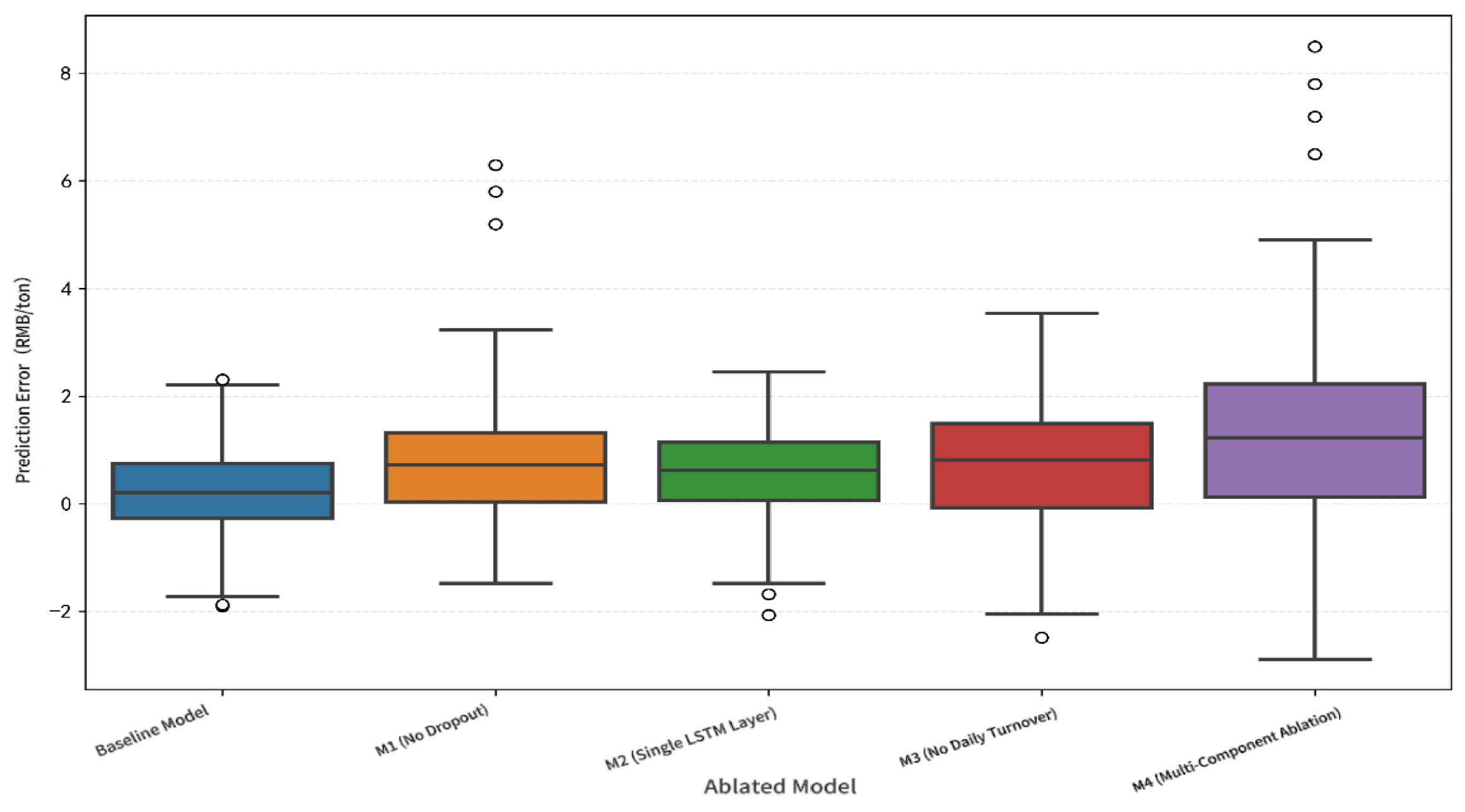
Table A2. Comparison of LSTM Test Set Predicted Values and Actual Values.
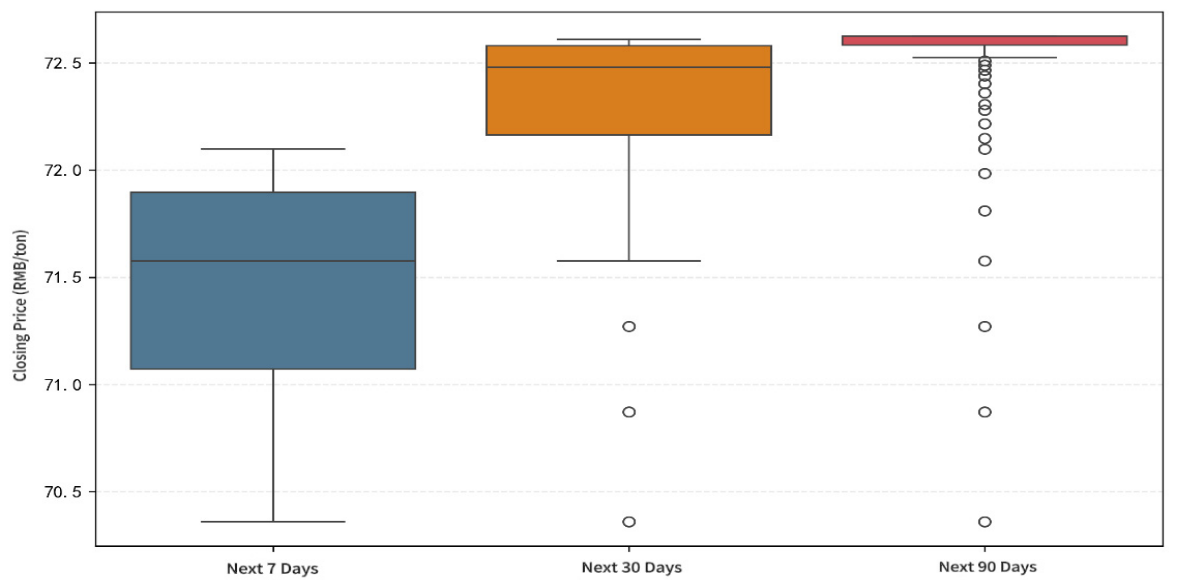
DatePredicted ValueActual ValueDatePredicted ValueActual Value
10 July 202572.8574.3010 October 202561.7858.23
11 July 202573.0473.2113 October 202561.8257.15
14 July 202572.5573.0914 October 202561.2755.82
15 July 202572.0573.3815 October 202560.5955.42
16 July 202572.3172.9816 October 202560.0253.99
17 July 202572.1972.9417 October 202559.4352.21
18 July 202572.1672.8220 October 202558.7551.34
21 July 202572.0073.1221 October 202558.4552.59
22 July 202571.9373.3022 October 202558.1952.96
23 July 202572.3473.8123 October 202558.2253.87
24 July 202572.9673.8424 October 202558.4454.70
18 September 202563.4160.3319 December 202562.3962.40
19 September 202562.8559.6822 December 202563.1763.52
22 September 202562.6159.4223 December 202564.1167.00
23 September 202562.2259.8324 December 202566.1068.89
24 September 202562.2558.5125 December 202568.5272.58
25 September 202562.0759.7626 December 202570.4672.35
26 September 202562.1259.1629 December 202571.7871.12
29 September 202562.1758.5930 December 202571.7372.87
30 September 202561.9757.9731 December 202572.4274.63
9 October 202561.7558.80
Figure A1. Core Framework for LSTM Carbon Price Prediction.
Sustainability 18 04094 g0a1
Figure A2. Core Framework for Dual LSTM Model with Dropout.
Sustainability 18 04094 g0a2
Figure A3. Core Framework for Ablation Experiment.
Sustainability 18 04094 g0a3
Figure A4. Mermaid Code for Option Portfolio Strategy Visualization.
Sustainability 18 04094 g0a4

References

  1. Liu, F.; van den Bergh, J.; Wei, Y. Testing mechanisms through which China’s ETS promotes a low-carbon transition. Energy Econ. 2024, 132, 107494. [Google Scholar] [CrossRef]
  2. Li, Y.; Zhang, Z. Corporate climate risk exposure and capital structure: Evidence from Chinese listed companies. Financ. Res. Lett. 2023, 51, 103488. [Google Scholar] [CrossRef]
  3. Liu, Y.; Tian, L.; Xie, Z.; Zhen, Z.; Sun, H. Option to survive or surrender: Carbon asset management and optimization in thermal power enterprises from China. J. Clean. Prod. 2021, 314, 128006. [Google Scholar] [CrossRef]
  4. Wang, J.; Zhuang, Z. A novel cluster based multi-index nonlinear ensemble framework for carbon price forecasting. Environ. Dev. Sustain. 2023, 25, 6225–6247. [Google Scholar] [CrossRef]
  5. Ilhan, E.; Sautner, Z.; Vilkov, G. Carbon tail risk. Rev. Financ. Stud. 2021, 34, 1540–1571. [Google Scholar] [CrossRef]
  6. Bisiotis, K.; Christopoulos, D.; Tzougas, G. Forecasting Carbon Prices: A Literature Review. J. Forecast. 2026, 45, 496–529. [Google Scholar] [CrossRef]
  7. Zhu, Q.; Liu, Q.; Ma, D.; Zhu, Y.; Zhang, L.; Wang, A.; Fan, S. Maize seed variety classification based on hyperspectral imaging and a CNN-LSTM learning framework. Agronomy 2025, 15, 1585. [Google Scholar] [CrossRef]
  8. Xue, Y.; Jiang, H. Monitoring of chlorpyrifos residues in corn oil based on Raman spectral deep-learning model. Foods 2023, 12, 2402. [Google Scholar] [CrossRef]
  9. Wang, Y.; Li, T.; Chen, T.; Zhang, X.; Taha, M.F.; Yang, N.; Mao, H.; Shi, Q. Cucumber downy mildew disease prediction using a CNN-LSTM approach. Agriculture 2024, 14, 1155. [Google Scholar] [CrossRef]
  10. Nunekpeku, X.; Zhang, W.; Gao, J.; Adade, S.Y.-S.S.; Li, H.; Chen, Q. Gel strength prediction in ultrasonicated chicken mince: Fusing near-infrared and Raman spectroscopy coupled with deep learning LSTM algorithm. Food Control 2025, 168, 110916. [Google Scholar] [CrossRef]
  11. Jiang, H.; Liu, Z.; Chen, Z. The Effects of Carbon Emission Rights Trading Pilot Policy on Corporate Green Innovation: Evidence from PSM-DID and Policy Insights. Sustainability 2026, 18, 1207. [Google Scholar] [CrossRef]
  12. Bolton, P.; Kacperczyk, M. Global pricing of carbon-transition risk. J. Financ. 2023, 78, 3677–3754. [Google Scholar] [CrossRef]
  13. Zhang, H.; Liang, H.; Zhang, D.; Huang, J.; Zhang, X. Options to enhance China’s national emission trading system design for carbon neutrality. Clim. Policy 2025, 25, 240–256. [Google Scholar] [CrossRef]
  14. Alofaysan, H.; Si Mohammed, K. Green vs. brown energy subsector in the context of carbon emissions: Evidence from the United States amid external shocks. Energies 2025, 18, 4530. [Google Scholar] [CrossRef]
  15. Liu, J.; Liu, Y.; Wang, J.; Chen, X.; Deng, L. Valuing carbon assets for sustainability: A dual-approach assessment of China’s certified emission reductions. Sustainability 2025, 17, 4777. [Google Scholar] [CrossRef]
  16. Sun, W.; Huang, C. A carbon price prediction model based on secondary decomposition algorithm and optimized back propagation neural network. J. Clean. Prod. 2020, 243, 118671. [Google Scholar] [CrossRef]
  17. Sun, W.; Li, Z. An ensemble-driven long short-term memory model based on mode decomposition for carbon price forecasting of all eight carbon trading pilots in China. Energy Sci. Eng. 2020, 8, 4094–4115. [Google Scholar] [CrossRef]
  18. Huang, Z.; Zhang, W. Forecasting carbon prices in China’s pilot carbon market: A multi-source information approach with conditional generative adversarial networks. J. Environ. Manag. 2024, 359, 120967. [Google Scholar] [CrossRef] [PubMed]
  19. Yi, Y. Forecasting regional carbon prices in china with a hybrid model based on quadratic decomposition and comprehensive feature screening. PLoS ONE 2025, 20, e0326926. [Google Scholar] [CrossRef]
  20. Li, H.-Z.; Shao, T.-M.; Gao, X.; Gao, F.; Farnoosh, A. Forecasting carbon price using a hybrid framework based on Bayesian optimization algorithm. Pet. Sci. 2025, 22, 5314–5328. [Google Scholar] [CrossRef]
  21. Yang, X.; Chen, H.; Li, X.; Liu, X. Carbon Price Forecasting via a CNN-BiLSTM Model Integrating VMD and Classified News Sentiment. Big Data Cogn. Comput. 2026, 10, 82. [Google Scholar] [CrossRef]
  22. Rabbani, M.R.; Kiran, M.; Bouri, E.; Alsharif, M. Corporate carbon risk amidst world policy uncertainty: An international perspective. Financ. Res. Lett. 2025, 87, 109004. [Google Scholar] [CrossRef]
  23. Zhang, X.; Yang, H.; Yu, Q.; Qiu, J.; Zhang, Y. Analysis of carbon-abatement investment for thermal power market in carbon-dispatching mode and policy recommendations. Energy 2018, 149, 954–966. [Google Scholar] [CrossRef]
  24. Ma, G.; Zhang, B.; Li, X.; Zheng, J. An equilibrium model of the Chinese carbon trading market under the uncertainty of market demand: Application to thermal power industry. Energy Policy 2025, 198, 114505. [Google Scholar] [CrossRef]
  25. Zhang, X.; Zhang, Q.; Dai, Z.; Zhang, X. The impact of carbon markets on the financial performance of power producers: Evidence based on China. Energy Econ. 2023, 127, 107119. [Google Scholar] [CrossRef]
  26. Li, T.; Meng, X.; Wang, L.; Gong, Y. Will China’s carbon emission trading regulation really decrease the green investment of firms? A microperspective on corporate governance. Bus. Strategy Environ. 2025, 34, 2222–2238. [Google Scholar] [CrossRef]
  27. Putri, S.A.; Wedari, L.K. Towards low-carbon economy: How does Indonesia’s industry decarbonize its assets. Int. J. Environ. Impacts 2024, 7, 653–662. [Google Scholar] [CrossRef]
  28. Wu, J.; Shen, Y.; Yang, R.; Fan, H.; Duan, Y. Electric-carbon market coupling and price transmission mechanism in China: An empirical analysis and development barriers study. J. Clean. Prod. 2026, 544, 147692. [Google Scholar] [CrossRef]
  29. Song, Y.; Li, Y.; Peng, K. How does carbon pricing leverage emission reductions in the power sector? Evidence from China’s national carbon market. Carbon Balance Manag. 2025, 20, 46. [Google Scholar] [CrossRef] [PubMed]
  30. Yu, Q.; Rahman, R.A.; Wu, Y. Risk spillovers between China’s pilot carbon markets and energy markets: Evidence from higher-order moments. Environ. Dev. Sustain. 2025, 1–31. [Google Scholar] [CrossRef]
  31. Wu, Z.; Wu, Q.; Yu, X.; Tan, J.; Wang, Q.; Hui, Z. Regulatory effect of carbon pricing on the negative impacts of coal phase-out. Humanit. Soc. Sci. Commun. 2025, 12, 458. [Google Scholar] [CrossRef]
  32. Bolton, P.; Kacperczyk, M. Do investors care about carbon risk? J. Financ. Econ. 2021, 142, 517–549. [Google Scholar] [CrossRef]
  33. Ji, Z.; Zhu, J.; Deng, J.; Meng, F.; Jiang, H.; Chen, Q. High-precision identification of zearalenone contamination in wheat based on olfactory sensor combined with near-infrared spectroscopy. J. Food Compos. Anal. 2025, 145, 107805. [Google Scholar] [CrossRef]
  34. Kutsanedzie, F.Y.; Chen, Q.; Hassan, M.M.; Yang, M.; Sun, H.; Rahman, M.H. Near infrared system coupled chemometric algorithms for enumeration of total fungi count in cocoa beans neat solution. Food Chem. 2018, 240, 231–238. [Google Scholar] [CrossRef] [PubMed]
  35. Khulal, U.; Zhao, J.; Hu, W.; Chen, Q. Nondestructive quantifying total volatile basic nitrogen (TVB-N) content in chicken using hyperspectral imaging (HSI) technique combined with different data dimension reduction algorithms. Food Chem. 2016, 197, 1191–1199. [Google Scholar] [CrossRef] [PubMed]
  36. Wang, Y.; Zhang, X.; Ma, G.; Du, X.; Shaheen, N.; Mao, H. Recognition of weeds at asparagus fields using multi-feature fusion and backpropagation neural network. Int. J. Agric. Biol. Eng. 2021, 14, 190–198. [Google Scholar] [CrossRef]
  37. Li, H.; Pan, T.; Li, Y.; Chen, S.; Li, G. Functional principal component analysis for near-infrared spectral data: A case study on Tricholoma matsutakeis. Int. J. Food Eng. 2020, 16, 20190386. [Google Scholar] [CrossRef]
  38. Farag, M.A.; Rezk, M.M.; Elashal, M.H.; El-Araby, M.; Khalifa, S.A.; El-Seedi, H.R. An updated multifaceted overview of sweet proteins and dipeptides as sugar substitutes; the chemistry, health benefits, gut interactions, and safety. Food Res. Int. 2022, 162, 111853. [Google Scholar] [CrossRef]
  39. Yu, J.; Zhangzhong, L.; Lan, R.; Zhang, X.; Xu, L.; Li, J. Ensemble learning simulation method for hydraulic characteristic parameters of emitters driven by limited data. Agronomy 2023, 13, 986. [Google Scholar] [CrossRef]
  40. Gu, W.; Wen, W.; Wu, S.; Zheng, C.; Lu, X.; Chang, W.; Xiao, P.; Guo, X. 3D reconstruction of wheat plants by integrating point cloud data and virtual design optimization. Agriculture 2024, 14, 391. [Google Scholar] [CrossRef]
  41. Zhu, J.; Qian, H.; Zhu, A.; Guo, Z.; Chen, Q.; Xu, Y. Au octahedrons monolayer film SERS substrate coupled with a hybrid metaheuristic algorithm-optimized ELM model: An analytical strategy for rapid and label-free detection of zearalenone in corn oil. Food Chem. 2025, 476, 143516. [Google Scholar] [CrossRef]
  42. Jiang, J.; Wang, B.; Yan, H.; Zhang, C.; Zhang, J.; Wang, G.; Liang, S.; Deng, S.; Zhou, Y. Improving Jarvis Canopy Resistance Model by Modifying the Effective Leaf Area Index in a Venlo-Type Greenhouse. J. Agron. Crop Sci. 2025, 211, e70103. [Google Scholar] [CrossRef]
  43. Chen, C.; Liu, X.; Liu, C.; Yu, C. Prediction and evaluation of environmental quality for nursing sow buildings via multisource sensor information fusion. Sci. Rep. 2025, 15, 14091. [Google Scholar] [CrossRef]
  44. Zhu, J.; Qian, H.; Zhu, A.; Xu, Y.; Zhao, S.; Wei, W.; Chen, Q. Rapid and non-destructive determination of acidity and peroxide index of extra virgin olive oil using portable near-infrared spectroscopy and a novel chemometric approach. J. Food Compos. Anal. 2025, 146, 107900. [Google Scholar] [CrossRef]
  45. Yan, H.; Deng, S.; Zhang, C.; Wang, G.; Zhao, S.; Li, M.; Liang, S.; Jiang, J.; Zhou, Y. Determination of energy partition of a cucumber grown Venlo-type greenhouse in southeast China. Agric. Water Manag. 2023, 276, 108047. [Google Scholar] [CrossRef]
  46. Wang, J.; Gao, Z.; Zhang, Y.; Zhou, J.; Wu, J.; Li, P. Real-time detection and location of potted flowers based on a ZED camera and a YOLO V4-tiny deep learning algorithm. Horticulturae 2021, 8, 21. [Google Scholar] [CrossRef]
  47. Li, Q.; Gao, H.; Zhang, X.; Ni, J.; Mao, H. Describing lettuce growth using morphological features combined with nonlinear models. Agronomy 2022, 12, 860. [Google Scholar] [CrossRef]
  48. Tao, K.; Wang, A.; Shen, Y.; Lu, Z.; Peng, F.; Wei, X. Peach flower density detection based on an improved CNN incorporating attention mechanism and multi-scale feature fusion. Horticulturae 2022, 8, 904. [Google Scholar] [CrossRef]
  49. Li, H.; Wu, P.; Dai, J.; Pan, T.; Holmes, M.; Chen, T.; Zou, X. Discriminating compounds identification based on the innovative sparse representation chemometrics to assess the quality of Maofeng tea. J. Food Compos. Anal. 2023, 123, 105590. [Google Scholar] [CrossRef]
  50. Zhu, X.; Zhu, Z. The generalized predictive control of bacteria concentration in marine lysozyme fermentation process. Food Sci. Nutr. 2018, 6, 2459–2465. [Google Scholar] [CrossRef]
  51. Ding, J.; Wang, M.; Jin, J.; Goncalves, J. A transformer-based model for carbon price forecasting with self-decomposition. Int. Rev. Financ. Anal. 2025, 109, 104760. [Google Scholar] [CrossRef]
  52. Zheng, W.; Lan, R.; Zhangzhong, L.; Yang, L.; Gao, L.; Yu, J. A hybrid approach for soil total nitrogen anomaly detection integrating machine learning and spatial statistics. Agronomy 2023, 13, 2669. [Google Scholar] [CrossRef]
  53. Zheng, K.; Zhao, X.; Han, C.; He, Y.; Zhai, C.; Zhao, C. Design and experiment of an automatic row-oriented spraying system based on machine vision for early-stage maize corps. Agriculture 2023, 13, 691. [Google Scholar] [CrossRef]
  54. Zhu, X.; Wu, X.; Shen, J.; Sun, J.; Wu, B. Near-infrared spectroscopy coupled with machine learning algorithms based on L1-norm and L21-norm to identify the geographical origins of Chinese wolfberry. Food Chem. 2025, 493, 145863. [Google Scholar] [CrossRef]
  55. Li, Y.; Hu, Y.; Lu, Y.; Wang, J. Study on the Estimation of Greenhouse Sensible Heat Flux Based on the Surface Renewal Method: Validation and Calculation Results. Agriculture 2025, 15, 2439. [Google Scholar] [CrossRef]
  56. Zhu, Y.; Zhu, Q.; Gao, Y.; Zhang, L.; Wang, A.; Zhu, Y.; Wang, C.; Liu, B.; Zhao, F.; Li, P.; et al. Identification of Interannual Variation Frequency of Cropland Cropping Intensity Based on Remote Sensing Spatiotemporal Fusion and Crop Phenological Rhythm: A Case Study of Zhenjiang, Jiangsu. Agriculture 2025, 15, 1004. [Google Scholar] [CrossRef]
  57. Wei, L.; Yang, H.; Niu, Y.; Zhang, Y.; Xu, L.; Chai, X. Wheat biomass, yield, and straw-grain ratio estimation from multi-temporal UAV-based RGB and multispectral images. Biosyst. Eng. 2023, 234, 187–205. [Google Scholar] [CrossRef]
  58. Wang, L.; Xiong, F.; Huang, X.; Yu, S.; Wang, Y.; Ren, Y.; Zhang, X.; Chang, X. Investigating flavor sensory properties of Zhenjiang aromatic vinegar and factors impacting perception using quantitative descriptive analysis and temporal dominance of sensations. J. Sens. Stud. 2023, 38, e12872. [Google Scholar] [CrossRef]
  59. Shen, L.; Wang, Y.; Li, X.; Hou, Z.; Mao, J.; Shi, J.; Battino, M.; Routledge, M.N.; Gong, Y.; Zou, X.; et al. Spatial-temporal distribution of deoxynivalenol, aflatoxin B1, and zearalenone in the solid-state fermentation basin of traditional vinegar and their potential correlation with microorganisms. Food Chem. 2024, 433, 137317. [Google Scholar] [CrossRef]
  60. He, Z.; Liu, Z.; Zhang, C.; Zhao, Y. How do carbon pricing spillover effects impact green asset price volatility? An empirical study based on the TVP-VAR-DY model. Econ. Anal. Policy 2025, 85, 2162–2179. [Google Scholar] [CrossRef]
  61. Sun, D.; Li, J. Carbon peaking pressure and corporate earnings management. Int. Rev. Econ. Financ. 2025, 103, 104503. [Google Scholar] [CrossRef]
  62. Sun, D.; Li, Y. Carbon peaking pressure and corporate R&D investment. Econ. Lett. 2025, 251, 112328. [Google Scholar] [CrossRef]
Figure 1. Technology Roadmap.
Sustainability 18 04094 g001
Figure 2. 2025 National Carbon Market Trading Situation.
Sustainability 18 04094 g002
Figure 3. Schematic diagram of LSTM neural network structure.
Sustainability 18 04094 g003
Figure 4. Comparison of LSTM Test Set Prediction Results.
Sustainability 18 04094 g004
Figure 5. Training/Validation Loss Curve of the LSTM Carbon Price Prediction Model.
Sustainability 18 04094 g005
Figure 6. Training and validation loss curves.
Sustainability 18 04094 g006
Figure 7. Comparison of predictions on the test set.
Sustainability 18 04094 g007
Figure 8. Predicted Scatter Plot.
Sustainability 18 04094 g008
Figure 9. Comparison of training/validation losses for each model in the Ablation experiment.
Sustainability 18 04094 g009
Figure 10. Comparison of MAE/RMSE/R2 of each model on the test set in the Ablation experiment.
Sustainability 18 04094 g010
Figure 11. Box plot of test set prediction errors for each model in the ablation experiment.
Sustainability 18 04094 g011
Figure 12. Boxplot of Mid-to-Long-Term Forecast Volatility of Carbon Trading Closing Prices.
Sustainability 18 04094 g012
Figure 13. Option Portfolio Strategy Framework of Power Generation Company.
Sustainability 18 04094 g013
Figure 14. Full process diagram of carbon option risk hedging strategy for SHP based on LSTM carbon price forecasting.
Sustainability 18 04094 g014
Figure 15. Comparison Chart of Cost Probability Distribution.
Sustainability 18 04094 g015
Table 1. Annual Trading Situation of the National Carbon Market from 2023 to 2025.
YearTotal Trading Volume (10,000 Tons)Total Trading Value (100 Million RMB)Listed Agreement Trading Volume (10,000 Tons)Listed Agreement Trading Value (100 Million RMB)Block Agreement Trading Volume (10,000 Tons)Block Agreement Trading Value (100 Million RMB)Average Trading Price (RMB/Ton)Closing Price (RMB/Ton)
202321,194.38144.443495.9725.6917,694.72118.7568.1579.42
202418,864.61181.143702.7436.3115,161.86144.5396.0297.49
202523,459.79146.308005.9250.6615,420.1795.6662.3674.63
Data source: Shanghai Environment and Energy Exchange.
Table 2. Multi-Dimensional Analysis of Medium- and Long-Term Carbon Asset Risks for Thermal Power Enterprises.
DimensionCore ArgumentKey Mechanism
Policy LevelCarbon asset value is closely tied to the policy and regulatory environment; tightening allowance trends increase compliance costs and uncertaintyLowered allowance benchmarks, increased proportion of paid allocations, policy implementation lags
Market LevelCarbon price signals are weakly transmitted; insufficient market liquidity affects corporate trading strategiesCarbon costs cannot be passed through to consumers, insufficient market coordination, liquidity constraints
Asset
Characteristics Level
From a real options perspective, holding carbon allowances is equivalent to holding an option for future transactions; policy tightening and price volatility amplify option value uncertaintyPolicy tightening leads to rigid cost increases, heightened price volatility, dual uncertainty
Financial LevelCarbon risks transmit to corporate finance through cash flow compression and increased financing costsAllowance purchases consume cash, high-carbon assets face a “brown premium,” narrowed financing channels
Table 3. Sample Data of National Carbon Trading Prices (14 July 2023–31 December 2025).
DateOpening Price (RMB)Highest Price (RMB)Lowest Price (RMB)Closing Price (RMB)Trading Volume (Tons)
14 July 202360.0060.0060.0060.00120,078.00
17 July 202360.0060.0060.0060.00111,000.00
18 July 202365.0065.0061.0061.02503.00
19 July 202361.0061.0061.0061.00500.00
20 July 202361.0061.0061.0061.00500.00
21 July 202364.0064.0061.0063.432700.00
24 July 202364.0064.0064.0064.00500.00
19 December 202560.8562.9860.8562.40590,441.00
22 December 202561.7264.6361.7263.52503,066.00
23 December 202562.1767.9762.0167.00763,174.00
24 December 202566.5470.7266.0068.891,186,352.00
25 December 202567.7973.2667.7972.581,097,636.00
26 December 202570.9676.3470.3072.35304,440.00
29 December 202571.1271.5870.1871.12815,043.00
30 December 202571.3273.2471.3272.871,065,532.00
31 December 202573.0675.9972.8774.63865,112.00
Data source: Shanghai Environment and Energy Exchange.
Table 4. Partial Comparison Results of Predicted and Actual Values in LSTM Test Set.
DatePredicted ValueActual ValueDatePredicted ValueActual Value
10 July 202572.8574.3018 December 202572.4274.63
11 July 202573.0473.2119 December 202571.7372.87
14 July 202572.5573.0922 December 202571.7871.12
15 July 202572.0573.3823 December 202570.4672.35
16 July 202572.3172.9824 December 202568.5272.58
17 July 202572.1972.9425 December 202566.1068.89
18 July 202572.1672.8226 December 202564.1167.00
21 July 202572.0073.1229 December 202563.1763.52
22 July 202571.9373.3030 December 202562.3962.40
31 December 202562.3760.65
Table 5. Evaluation Metrics for LSTM Model Prediction Performance.
MSERMSEMAEMAPER2
10.04569133.16949392.48511600.04233670.8027569
Table 6. Sample Data of National Carbon Trading Prices (19 July 2021–9 January 2026).
DateListed Agreement Trading Volume (Tons)Opening Price (RMB/Ton)Closing Price (RMB/Ton)Cumulative Turnover (RMB)
19 July 2021130,800.0052.8052.30217,071,342.25
20 July 2023162,000.0052.9253.28225,702,619.25
21 July 2023112,000.0054.2054.40237,087,449.25
22 July 2023112,200.0055.3055.52243,316,537.25
23 July 2023112,000.0056.5256.97249,696,797.25
26 July 202348,000.0054.5054.46252,311,017.25
27 July 202374,211.0052.2054.63256,365,265.39
26 December 2025304,440.0070.9672.3557,155,040,428.75
29 December 2025815,043.0071.1271.1257,282,716,440.45
30 December 20251,065,532.0071.3272.8757,589,400,033.68
31 December 2025865,112.0073.0674.6357,662,618,231.57
5 January 20261000.0074.6374.6357,662,694,621.57
6 January 20265316.0074.6374.6357,671,073,131.57
7 January 2026324,311.0078.5077.9757,926,342,323.07
8 January 202657,000.0078.0078.6157,981,570,883.07
9 January 2026147,410.0078.0075.9658,014,630,113.07
Data source: Shanghai Environment and Energy Exchange.
Table 7. Comparison of LSTM Model Prediction Performance Evaluation Metrics.
DatasetMAE
(RMB/Ton)
MSE
(RMB/Ton)
RMSE
(RMB/Ton)
R2
Training Set1.50174.11182.02780.9873
Test Set1.90066.23972.49790.9434
Table 8. Comparison of Evaluation Metrics for LSTM Model Ablation Experiment Results.
ModelMAERMSER2Performance Change (Relative to Baseline Model)
Baseline Model1.02451.25440.9812- (Baseline)
M1 (Without Dropout)1.38621.64280.9635MAE ↑ 35.3%, RMSE ↑ 30.9%, R2 ↓ 1.8%
M2 (Single LSTM Layer)1.27831.51360.9708MAE ↑ 24.8%, RMSE ↑ 20.6%, R2 ↓ 1.1%
M3 (Without Daily Turnover)1.45271.70890.9592MAE ↑ 41.8%, RMSE ↑ 36.3%, R2 ↓ 2.2%
M4 (Multi-component Ablation)1.89362.15720.9347MAE ↑ 84.9%, RMSE ↑ 71.9%, R2 ↓ 4.7%
Table 9. Statistical Indicators of Medium- and Long-Term Carbon Trading Closing Price Predictions Based on the LSTM Model.
Forecast PeriodMean
(RMB/Ton)
Maximum (RMB/Ton)Minimum (RMB/Ton)Standard Deviation (RMB/Ton)
Next 7 Days71.424372.1070.360.632742
Next 30 Days72.238072.6170.360.552583
Next 90 Days72.496872.6370.360.365205
Table 10. Periodic Design of Carbon Option Contract Elements for SHP Based on LSTM Predictions.
DimensionShort-Term (7 Days)Medium-Term (30 Days)Long-Term (90 Days)
Strike Price72.10 RMB/ton
(Model’s 7-day high)
72.61 RMB/ton
(Model’s 30-day high)
72.63 RMB/ton
(Model’s 90-day high)
Contract Volume2 million tons
(20% of quota demand)
4 million tons
(40% of quota demand)
8 million tons
(80% of quota demand)
Premium0.8 RMB/ton
(1.6 million RMB)
1.2 RMB/ton
(4.8 million RMB)
1.5 RMB/ton
(12 million RMB)
Expiration Date7 January 202630 January 202631 March 2026
Table 11. Risk Control System for the Option Portfolio Strategy.
Control DimensionCore Measures
Prediction Risk ControlMaintaining the LSTM model architecture with regular validation of prediction results; retraining the model with multi-dimensional external features when errors exceed thresholds
Market Risk ControlSetting position limits, diversifying contract maturities, strictly controlling margin adequacy to avoid capital occupation, concentrated exercise pressure, and forced liquidation risks
Operational Risk ControlEstablishing position authorization and full-process transaction traceability mechanisms; conducting transactions through compliant channels
Liquidity Risk ControlSelecting highly liquid contract underlying assets; setting dispersion requirements for single contract positions to ensure smooth position closing or exercise and control closing costs
Table 12. Baseline Strategy Configuration.
ParameterDescription
Compliance approachRelies solely on spot trading of national carbon allowances (CEA) to fulfill compliance obligations, without participating in Shanghai Carbon Inclusive transactions or utilizing any financial derivatives.
Procurement timingConcentrated procurement of the annual allowance shortfall only during each compliance year (November-December).
Procurement priceSimple arithmetic average of closing prices on trading days within the compliance period.
Allowance shortfallBased on typical operational parameters consistent with thermal power enterprises and industry average levels, the annual allowance shortfall is set at 200,000 tons, accounting for approximately 2% of its total emissions.
Table 13. Optimized Strategy Configuration.
Strategy ElementDescription
Procurement timingUses LSTM daily price signals to build positions during “low-price windows” (predicted price < market price and validation loss < 0.05), securing 80% of the annual shortfall (160,000 tons) in advance.
Diversified complianceAllocates Shanghai Carbon Inclusive reductions from the second half of 2025, replacing 10% of the annual shortfall (20,000 tons). Purchases are executed when the LSTM predicted price is 0.2 RMB/ton below the market price.
Option hedgingAt the end of 2025, implements a collar strategy: buys 80,000 tons of call options (strike 72.63 RMB/ton, premium 1.5 RMB/ton) and sells 40,000 tons of put options (strike 70.36 RMB/ton, premium 0.8 RMB/ton) to lock in the procurement cost range.
Table 14. Market Scenarios for Stress Testing.
ScenarioDescriptionKey Parameters
Scenario 1: StableCarbon price trends are generally consistent with historical fluctuation patterns, with no major policy shocks.Volatility maintained at historical average level (15% annualized).
Scenario 2: Extreme RiseSimulates a sharp short-term surge in carbon prices due to expectations of allowance tightening before the compliance period.Maximum price reaches 120 RMB/ton (30% increase).
Scenario 3: Unilateral DeclineSimulates sustained declines in carbon prices due to macroeconomic slowdown or excess allowance supply.Annual decline of 20%.
Table 15. Comparison of Carbon Allowance Procurement Costs between Baseline and Optimized Strategies under Scenario 1 (2024–2025).
Compliance YearAverage Market Price (RMB/Ton)Baseline Cost (10,000 RMB)Optimized Cost (10,000 RMB)Cost Savings (10,000 RMB)Reduction (%)
202491.81836165218410.02
202562.412481158907.21
Total77.1308428102748.88
Table 16. Monte Carlo Simulation Parameters.
ParameterSymbolValueDescription
Initial priceS074.63 RMB/tonClosing price on the last trading day of 2025
Drift rateμ0.02 per yearModerate upward trend
Volatilityσ0.0233 (daily)Daily volatility derived from σ =    0.37 ÷ 252 , corresponding to an annualized rate of approximately 37%, slightly higher than historical volatility to test extreme conditions
Table 17. Option Portfolio Parameters.
Option TypeStrike Price (RMB/Ton)Premium (RMB/Ton)Volume (Tons)
Call option (purchased)72.631.580,000
Put option (sold)70.360.840,000
Table 18. Monte Carlo Simulation Results of Option Portfolio Hedging Effectiveness.
IndicatorValue
Average Unhedged Cost (RMB/ton)78.24
Average Hedged Cost (RMB/ton)73.41
Average Cost Saving (RMB/ton)4.83
Maximum Unhedged Cost (RMB/ton)96.57
Maximum Hedged Cost (RMB/ton)72.63 (locked by call option)
Probability of Cost Exceeding 72.63 RMB/ton0% (effectively covered by options)
Probability of Cost Below 70.36 RMB/ton6.8% (options abandoned, but benefiting from low prices)
Table 19. Sensitivity Analysis Results.
Sensitivity ParameterParameter ChangeEffect
LSTM prediction error±5% deviation between predicted and actual pricesCost savings remain between 17% and 25%, indicating robustness of the timing strategy.
Option strike price±2% fluctuation in call option strike priceMaximum hedged costs range from 71.18 to 74.08 RMB/ton. Net cost difference remains within 1 RMB/ton after premium adjustments, demonstrating strategy stability.
Carbon Inclusive substitution ratioIncrease from 10% to 15%Additional cost savings of approximately 1.04 million RMB under the extreme rise scenario. Balance required due to market capacity constraints and policy ceilings.
Table 20. Rolling Window Back-testing Results.
IntervalPeriodBaseline Cost (10,000 RMB)Optimized Cost (10,000 RMB)Savings Ratio (%)
12024-01~2024-063995.553676.267.99
22024-07~2024-125368.594813.3410.34
32025-01~2025-065224.274569.9312.52
42025-07~2025-124943.232965.4040.01
Disclaimer/Publisher’s Note: The statements, opinions and data contained in all publications are solely those of the individual author(s) and contributor(s) and not of MDPI and/or the editor(s). MDPI and/or the editor(s) disclaim responsibility for any injury to people or property resulting from any ideas, methods, instructions or products referred to in the content.