1. Introduction
Climate change is intensifying flood risks in coastal cities worldwide, exposing urban areas to increasingly complex and interconnected hazards, including sea-level rise, extreme precipitation, and ecosystem degradation [
1]. Coastal regions are particularly vulnerable due to dense populations, sealed surfaces, and ageing infrastructure, making flooding a persistent and systemic challenge for urban governance [
1,
2]. While significant advances have been made in engineering-based flood protection, there is growing recognition that technical solutions alone are insufficient to address the social, institutional, and behavioural dimensions of urban flood risk [
3].
Among the various flood typologies affecting coastal cities, pluvial flooding—caused by intense rainfall overwhelming urban drainage systems—has emerged as a critical and often under-addressed threat. Unlike coastal or fluvial flooding, pluvial events are highly localised, difficult to predict, and closely linked to land-use practices and everyday urban behaviours [
4,
5]. Addressing pluvial flooding therefore requires not only infrastructural adaptation but also coordinated behavioural and organisational change within municipal systems and local communities [
6,
7].
In response to these challenges, Nature-based Solutions (NbSs), such as green roofs, retention parks, and rainwater gardens, have gained prominence as integrative approaches to urban flood adaptation. NbSs offer the potential to simultaneously reduce flood risk, enhance biodiversity, and improve urban liveability. While their technical and ecological benefits are well established, qualitative research increasingly highlights persistent implementation gaps related to governance complexity, stakeholder engagement, and long-term maintenance. These challenges point to the need for participatory learning, reflexivity, and shared problem framing in adaptation processes [
8,
9].
This study contributes to this emerging field by examining behavioural change processes within the Gdańsk Coastal City Living Lab (CCLL), a participatory platform developed under the Horizon 2020 SCORE project and further expanded through the Horizon PRO-CLIMATE project. Whereas many urban adaptation initiatives prioritise technical innovation, PRO-CLIMATE explicitly addresses the behavioural, relational, and institutional factors that shape engagement with NbS. The Living Lab framework provides a setting in which municipalities, researchers, and community actors collaboratively explore how adaptation measures can be socially anchored in flood-prone urban contexts.
Situated within broader debates on participatory governance, transformative adaptation, and behavioural change, this research builds on established theories of organisational change and experiential learning to examine how institutional and behavioural transformation can co-evolve in municipal settings [
6,
8,
9,
10]. By focusing on relational, intrinsic, and instrumental value orientations toward nature, the study advances existing qualitative research by explicitly linking value-based perspectives with behavioural change frameworks in urban climate adaptation practice.
The paper addresses three research questions:
How do stakeholders’ diverse value orientations toward nature influence their engagement with NbS?
What mechanisms within the Living Lab process enable or constrain behavioural change?
How can locally driven, trust-based engagement be scaled or institutionalised within urban governance structures?
By analysing stakeholder experiences, engagement practices, and challenges emerging from the Gdańsk CCLL, this study advances current understanding of how behavioural change frameworks can support adaptive governance in coastal cities. The findings offer transferable insights for integrating technical and social approaches to pluvial flood adaptation, contributing to the transition of NbS from isolated interventions toward systemic urban resilience strategies.
2. Materials and Methods
The Gdańsk Coastal City Living Lab (CCLL) was established at the Faculty of Oceanography at the University of Gdańsk on 26 July 2021 as part of the SCORE Project, which aimed to reduce the impacts of sea level rise and extreme weather events due to climate change on European coastal cities by co-designing, co-developing, deploying, testing and demonstrating innovative Ecosystem-based Adaptations (EBAs), smart technologies and Nature-based Solutions (NbSs). To realise this, SCORE established a network of 10 CCLLs across seven European countries and Turkey. Gdańsk CCLL focuses on reducing the impacts of pluvial flooding caused by extreme events through collaborative action among stakeholders. By combining data-driven research, stakeholder engagement, and practical, low-cost actions for the public and citizen science, the CCLL seeks to enhance Gdańsk’s climate resilience and foster behavioural change for a more sustainable future. One of the main goals of the Gdansk CCLL is to be an open information hub, network connector and a friendly information facilitator among institutions that possess data on various climate-related hazards, risks and impacts in Poland.
Gdańsk is the leading city in northern Poland with a population of 488,000—making it the sixth largest city in Poland, as of 2024. Gdańsk lies at the mouth of the Motława River, along the Gdańsk Bay near the cities of Sopot and Gdynia, which form Tricity (Tricity metropolitan area), with a population of approximately 1.7 million according to GUS in 2023 [
11], Gdańsk prides itself on its thousand-year history, Hanseatic heritage, Solidarity movement and dynamic economic development, as well as its economic and cultural potential. In 2024, Gdańsk received 4.5 million tourists [
11].
The city has moderately cold and overcast winters and mild summers with frequent rains and thunderstorms. The Gdańsk area is strongly influenced by its proximity to the sea [
12]. The city is located at an altitude ranging from −1.6 m below sea level up to 180 m above sea level [
13]. Gdańsk is situated in an area with high spatial diversity, characterised by varied natural environmental conditions. The city’s topography, hydrographic layout, and climatic parameters are influenced by its coastal location, specifically the impact of the sea on the terrestrial environment.
Urban flash floods in Gdańsk demonstrate a growing trend in frequency. Since the beginning of the 21st century, there have been 4 rainfall events with a duration of more than 8 h, which should be classified as 100-year rain [
14]. The two most intense torrential rain events occurred at an interval of 15 years (July 2001 and July 2016). The evidence indicates the importance of taking climate change into account when estimating the magnitude of current and future urban activities [
15].
Since the 2001 flood, Gdańsk has significantly transformed its approach to protecting the municipal infrastructure and residents [
16]. As a consequence of the increases in maximum daily precipitation in the years 2001 and 2016–2017, Gdańsk Water Company (Gdańsk, Poland) adapted its rainwater management approach [
12]. In 2019, 44 Polish cities, including Gdańsk, participated in a Ministry of the Environment-initiated project to prepare for climate change [
17]. The Municipality of Gdańsk adopted the Urban Climate Change Adaptation Plan for Gdańsk up to 2030. Moreover, local authorities engaged citizens in Civic Panels and Gdańsk Climate Change Forum to participate in decision-making processes to spread awareness and gather insights on suggested adjustment strategies [
12].
While the identification of these NbSs is a result of the SCORE analysis, the strategy for their community uptake is driven by PRO-CLIMATE. Recognising that technical feasibility does not guarantee social acceptance, the Gdansk CCLL leveraged PRO-CLIMATE’s resources to shift focus from “what’’ needs to be built, to “who’’ needs to be engaged and ‘’how’’ behaviours must adapt to support these interventions.
Gdańsk’s population has increased more than 1.5 times since the end of World War II. The causes of flash floods in Gdańsk are a combination of two factors: the heaviest rainfall occurring during the summer period and the prevention of natural water infiltration and rapid surface water runoff due to dense urban development located in the upper terraces of the city. Gdańsk is the most flood-vulnerable city in Poland [
18]. It is distinguished by the largest proportion of low elevation coastal zones occupying almost half of the territory—46.7% (SCORE, D1.3, p. 36). The commercial and industry sectors are also exposed to potentially negative effects of urban flash floods. During torrential rain on 14 July 2016, Gdańsk experienced the highest rainfall recorded outside of mountainous regions in Poland on 14 July 2016, where recorded precipitation was double that of average rainfall for the month of July [
19].
The Gdańsk CCLL explores NbS to mitigate inland flooding caused by severe rainfall with the objective of assessing the effectiveness of interventions before and after the establishment of the Living Lab. The European Network of Living Labs (Brussels, Belgium) asserts that a necessary element to the activities of living laboratories is to ‘foster co-creation and open innovation among the main actors of the Quadruple Helix Model, namely: Citizens, Government, Industry, Academia [
20]’.
Gdańsk CCLL collaborates with a group of over 20 stakeholders, all of whom belong to the quadruple helix group [
21]. Within CCLL, a core group of individuals/institutions has been established, representing key players in the city’s change process. These include representatives of the Polish Water Regional Water Management in Gdansk (Polskie Wody RZGW), the Institute of Meteorology and Water Management National Research Institute (IMGW-PIB), Regional Directorates for Environmental Protection in Gdańsk (RDOŚ), the Regional Atmosphere Monitoring Agency Gdańsk-Gdynia-Sopot (ARMAAG, Gdańsk, Poland), Water Gdańsk (Gdańsk, Poland), and the University of Gdańsk. The selection of stakeholders was subjective, taking into account important institutions in Gdańsk dealing with water, climate, and resilience issues. The same stakeholders were invited to participate in the PRO-CLIMATE project as those involved in the SCORE project, as the PRO-CLIMATE project is a continuation of that project. All stakeholders were invited to the workshops; attendance depended solely on availability.
The findings from this research were further utilised in the PRO-CLIMATE project to initiate the change process in Gdańsk CCLL. The first workshops were organised on 10 April 2025. Invitations were sent to nine key stakeholders, and seven participated. One representative of Polish Waters was unable to participate in the meeting for personal reasons, and one researcher was unable to participate due to other official duties. Seven stakeholders attended the meeting: three government representatives, two business representatives, one academic representative, and one city resident. The following entities took part in the workshop: Water Gdańsk (Gdańsk, Poland), Gdańsk Municipality, ARMAAG (Gdańsk, Poland), RDOŚ, University of Gdańsk and IMGW-PIB. The invited participants have extensive experience in water management and adaptation to climate change in Gdańsk and have been collaborating with the Gdańsk CCLL for several years. Five stakeholders hold managerial/director positions in their respective institutions/companies. All participants (present and absent) are involved in the PRO-CLIMATE project and its activities. Attendance is recorded in the project Key Performance Indicator’s register, which has been maintained since April 2025.
The theme of the meeting was ‘Implementation of NBSs for Gdańsk’. Adaptation to climate change by minimising the effects of torrential rain. The main aim was to propose the most feasible and impactful NbSs for further implementation/investigation/recommendations in the Gdańsk LL activities in the context of the behavioural change process in Gdańsk city. Among the evaluated options, water parks and retention ponds were considered the most effective in enhancing climate resilience. However, several obstacles (such as high costs, limited space, high urbanisation, long planning processes or insufficient investment financing) hindered the implementation, and so one key and one complementary NbS were selected for further investigation. The key NbS was the introduction and/or renovation of open green spaces, and the complementary one was rainwater gardens.
2.1. The DeepChange Model
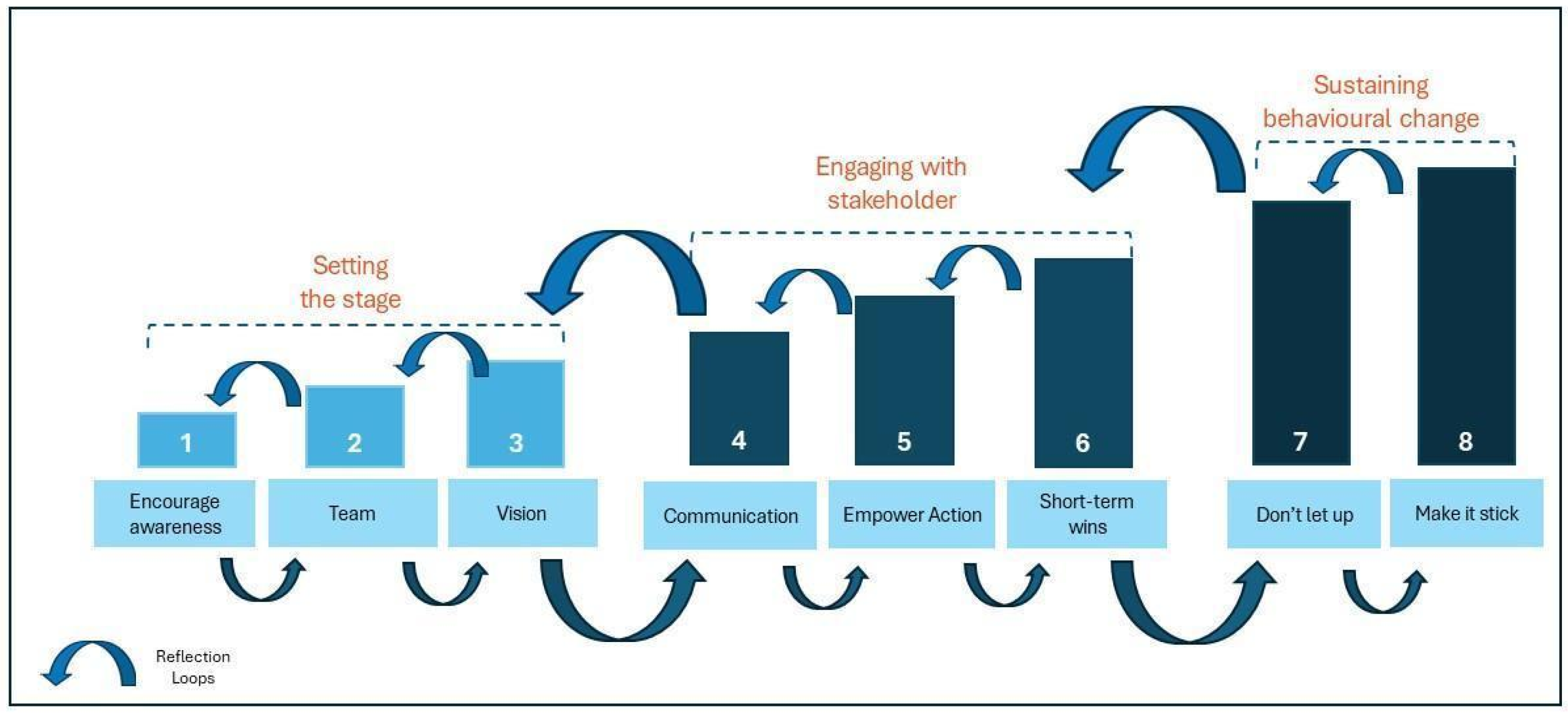
To operationalise the DeepChange Model within the specific context of PRO-CLIMATE, which aims to facilitate embedded and participatory transformation towards municipal climate resilience, the model draws primarily on Kotter’s Eight-Step Process for Leading Change [
6], while conceptually engaging with selected principles from Theory U [
8]. Kotter’s model provides a sequenced and time-oriented scaffold for organisational change, offering clear phases from problem recognition and coalition-building to institutionalisation. Theory U complements this structure by introducing a reflective and emergent learning dimension, emphasising deep listening, co-sensing, and collective meaning-making. While Kotter establishes
when and
how change progresses, Theory U enriches
how stakeholders learn and adapt within each phase of that progression.
In the Gdańsk Coastal City Living Lab (CCLL), the methodological application was grounded primarily in Kotter’s structured process and participatory governance practices inspired by the Bristol Approach and Extreme Citizen Science (ExCiteS) [
6]. Although Theory U methods were not explicitly implemented during this phase, the conceptual alignment between Kotter’s and Scharmer’s frameworks, particularly their shared systemic orientation and emphasis on co-creation, highlights clear potential for future methodological integration. Specifically, Kotter’s sequential steps can be understood as a temporal backbone within which Theory U’s reflective learning cycles could be embedded.
The DeepChange Model is therefore not presented as a fixed or fully operationalised methodology, but as an evolving meta-theoretical framework that aligns three mutually reinforcing dimensions: the structural logic of organisational change [
6], the participatory ethos of inclusive governance [
10], and the transformative learning dynamics of systems change [
9]. These dimensions interact dynamically: participatory trust-building enables reflective learning; reflective learning informs adaptive decision-making; and structured change processes support the translation of shared insights into sustained institutional and behavioural transformation (see
Figure 1).
The model is further informed by insights from the SUITS project [
7,
10], which demonstrated how Kotter’s change framework can be adapted to local government contexts through iterative reflection and learning cycles. In the Gdańsk application, Change Agents embedded within local communities operate as connectors between municipal governance, behavioural science, and civil society, supporting both structured progression and relational engagement.
Finally, the DeepChange Model is grounded in principles aligned with Extreme Citizen Science and the Bristol Approach [
9], both of which advocate democratised knowledge production, participatory governance, and stakeholder empowerment as core elements of system change. By positioning local actors as legitimate drivers of transformation, the methodology challenges top-down knowledge hierarchies and fosters mutual learning, peer exchange, and context-sensitive interventions. The Bristol Approach further reinforces the model’s emphasis on trust-building, distributed leadership, and “stake-in” rather than mere stake-holding, underscoring the foundational role of relational dynamics in enabling enduring institutional and behavioural change.
2.2. The Three-Fold Engagement Strategy
To operationalise the DeepChange model, we implemented a Three-Fold Engagement Strategy, consisting of:
Change Agents (CAs) are carefully selected community leaders who serve as trusted facilitators and catalysts for behavioural change. Their roles include:
Coordinating local stakeholder involvement.
Leading workshops and knowledge exchange.
Facilitating ongoing engagement.
Collecting behavioural and governance evidence.
Acting as conduits between municipal and community spheres.
Selection criteria emphasise community trust, domain knowledge (e.g., behavioural science), and network access. This cascading model positions CAs as multipliers—scaling influence through layered engagement and peer-to-peer networks.
- 2.
Bi-Monthly Bilateral Meetings (Structured Governance and Adaptation)
These structured, iterative sessions create a space for adaptive governance and sustained reflection. Functions include:
Clarifying CA roles and project commitments.
Defining Focal Action Situations.
Monitoring Key Performance Indicators (KPIs) and timelines.
Documenting emerging issues and required support.
Templates are used for consistency and institutional memory. Over time, the meetings shift from transactional updates to strategic co-reflection, enabling resilience through adaptive learning cycles.
- 3.
Co-Creative Workshops (Peer Learning and Innovation)
Workshops serve as collaborative learning spaces across Living Labs, enabling:
Capacity-building for CAs on behavioural and governance methodologies.
Peer learning and exchange of local challenges and solutions.
Strengthening cross-city networks and shared purpose.
Contextual adaptation of tools and concepts over time.
Challenges such as language barriers are mitigated through bilingual facilitation and direct support, ensuring inclusivity and reinforcing CA confidence. These workshops exemplify learning-by-doing, aligned with the Living Lab and Extreme Citizen Science ethos.
The Three-Fold Engagement Strategy—Change Agents, Bilateral Meetings, and Co-Creative Workshops—embeds the DeepChange model within a practical, scalable framework. It integrates structured change management [
6], reflection on change management activities, and grassroots-led learning [
9]. The result is a cascading model of influence that grows from community trust outward, fostering self-sustaining systems of adaptation, learning, and resilience. This methodology is replicable and scalable, offering a roadmap for other Living Labs aiming to translate community participation into institutional transformation.
Qualitative Data Analysis and Thematic Coding
The qualitative analysis drew on a comprehensive corpus of empirical material generated through the Three-Fold Engagement Strategy, including transcripts from stakeholder workshops, Change Agents’ reflective logbooks, bi-monthly bilateral meeting notes, expert support documentation, and facilitation templates. In total, the dataset comprised over 120 pages of transcribed and written qualitative material, collected longitudinally throughout the PRO-CLIMATE intervention in the Gdańsk Coastal City Living Lab (CCLL).
Data Collection
Qualitative data were collected through multiple engagement formats within the Gdańsk Coastal City Living Lab (CCLL), including stakeholder workshops, Change Agents’ reflective logbooks, bi-monthly bilateral governance meetings, and expert support mechanisms conducted as part of the PRO-CLIMATE intervention. Participants comprised municipal officials, community stakeholders, civil society representatives, technical experts, and locally embedded Change Agents.
Data collection focused on capturing stakeholder perceptions of nature, governance interactions, and behavioural dynamics related to the planning and implementation of Nature-based Solutions. All workshops and meetings were documented using standardised templates and subsequently transcribed and anonymised. The data collection strategy was explicitly designed to address the three research questions by generating empirical material on (i) stakeholders’ value orientations toward nature, (ii) mechanisms enabling or constraining behavioural change, and (iii) pathways for scaling and institutionalising trust-based engagement.
Analytical approach
The analysis followed a reflexive thematic analysis informed by qualitative content analysis principles, drawing in particular on Krippendorff’s methodological framework for systematic and transparent coding of meaning in qualitative data [
22]. This approach supports analytical reliability while allowing for interpretive depth, making it well suited to participatory and process-oriented research contexts. The coding combined
deductive and inductive logics, balancing theoretical guidance with empirical openness.
Coding process
The analysis proceeded in four stages:
All materials were read repeatedly by the research team to gain an in-depth understanding of the dataset. Analytical memos were used to document emerging insights, reflexive considerations, and preliminary category boundaries, in line with Krippendorff’s emphasis on researcher transparency.
- (2)
Initial coding
Data were coded systematically using descriptive, process-oriented, and value-based codes. Coding focused on stakeholder perceptions of nature, expressions of trust and relational dynamics, co-creation practices, behavioural shifts, governance interactions, and barriers to engagement. Coding across multiple data sources enabled internal triangulation and category stabilisation.
- (3)
Theme development and refinement
Codes were clustered into higher-order themes through iterative comparison and abstraction, consistent with Krippendorff’s notion of analytical convergence. Candidate themes were tested against the full dataset to ensure internal consistency and analytical distinction. This process resulted in the core themes structuring
Section 3, including:
Relational, intrinsic, and instrumental values toward nature.
Enablers of behavioural change (trust, co-creation, shared vision).
Barriers and negotiation mechanisms.
Systemic gaps and institutional challenges.
- (4)
Analytical rigour and validation
Rigour was ensured through multiple strategies aligned with the criteria of reliability, validity, and replicability [
22]:
Triangulation across workshops, Change Agent reflections, and governance meetings.
Reflexive peer debriefing within the research team.
Iterative sense-checking with Change Agents and project partners.
Thick description and verbatim quotations to anchor interpretations in empirical material.
The proposed codes were concepts relevant to changing behaviors toward climate change and building social resilience. The following concepts were selected: water, climate, resilience, behaviors, values, flooding, Nature-based Solutions, process, etc. During the workshops, stakeholders were tasked with addressing these concepts and proposing actions that would enable a change in social behavior toward climate change, considering the social, economic, technical, legal, and spatial dimensions. Then, as part of a SWOT analysis, stakeholders identified the strengths, weaknesses, opportunities, and threats in implementing social change mechanisms that were most significant, operationally feasible, and scalable, i.e., transferable to other areas, cities, and countries, to develop recommendations for the European Commission in the PRO-CLIMATE project.
3. Results
The application of the DeepChange model created the conditions necessary for meaningful behavioural transformation. These activities represent the practical application of PRO-CLIMATE’s objectives to empower local communities through systematic engagement. Combined with the Three-Fold Engagement Strategy—Change Agents, Bi-Monthly Bilateral Governance, and Co-Creative Workshops—this methodology provided both the structure and the flexibility needed to navigate the complex landscape of climate adaptation. Critically, the methodology was not applied as a static framework but adapted iteratively to local needs. Change Agents served as the keystone, supported by the structures provided by the PRO-CLIMATE consortium, translating system-level goals into community-relevant actions, while workshops and bilateral meetings offered real-time feedback loops for learning and adjustment. The methodological tools (templates, KPI frameworks, logbooks) enabled structured data collection, but it was the relational and participatory ethos—rooted in DeepChange—that ensured these tools were used meaningfully and with stakeholder buy-in.
Therefore, the Gdańsk Coastal City Living Lab (CCLL) offers a compelling case of how community-driven behavioural change can be cultivated when underpinned by trust, participatory governance, and sustained engagement. Drawing on the activities of Change Agents (CAs), co-creative learning environments, and bi-monthly adaptive planning, the findings from Gdańsk illuminate both the potential and the complexity of embedding climate resilience through Living Labs.
3.1. Stakeholders’ Perceptions of Nature: Relational, Intrinsic, Instrumental
Stakeholders in Gdańsk articulated diverse perspectives on the meaning and value of nature—an important starting point for behaviourally anchored climate action. Key themes of relational values and intrinsic values emerged.
Relational values were particularly salient. Community members often described nature as part of their identity and social routines. As one participant shared: “My grandparents and parents devoted a lot of time to developing our neighbourhood, so that everyone felt good here and enjoyed spending their free time. They always cared about the greenery and safety of this place, and they wanted us to live here with our children.” These perceptions highlight the importance of emotional and social ties to the locality, reinforcing the idea that climate action must also be culturally embedded.
Intrinsic values were voiced by those who believed that nature deserves protection regardless of human benefit. For example, a local stakeholder stated, “Often, short-term financial benefits outweigh long-term environmental benefits. However, it’s important to remember that in the long run, environmental benefits will contribute not only to prosperity but also to the broader development of society as a whole.” This viewpoint aligns with broader environmental justice narratives and supports more holistic climate action framing.
Instrumental values were evident among participants involved in infrastructure and planning, who emphasised the ecosystem services provided by nature—such as the ability to manage excess rainfall with appropriate collection—pose no threat and can even be repurposed for recreational or agricultural purposes. In this context, climate adaptation was framed in terms of technical functionality and risk reduction.
The coexistence of these three value orientations suggests that any successful engagement strategy must accommodate multiple worldviews. The use of storytelling, visualisation, and local knowledge helped bridge these perspectives in co-creative settings.
3.2. Enablers of Change: Trust, Co-Creation, and Shared Vision
Three dominant enablers of change were identified: trust, co-creation, and the development of a shared vision.
Trust was identified as the single most critical precondition for stakeholder engagement. The positioning of Change Agents as locally embedded and respected figures was essential. Their ability to communicate in everyday language, navigate informal power dynamics, and demonstrate cultural sensitivity enabled the building of confidence across diverse stakeholder groups. In this regard, it proved crucial to position the Change Agent so that other participants in the transformation process would not perceive their superiority in terms of knowledge, attitudes, or opinions. Therefore, a Change Agent should be “their own person,” enabling an unhindered exchange of ideas between stakeholders.
The process of co-creation was both procedural and symbolic. In the words of one CA: “When people see their ideas in the plan, they believe in the plan”, demonstrating the value placed in shaping the ideas and solutions. Rather than delivering pre-formed solutions, the Living Lab invited community members into the design process, reinforcing a sense of ownership, thereby reducing resistance to behavioural change. Crucial in this respect was the approach assuming that every proposal is good, none should be excluded a priori, and their usefulness depends on the broader context, the place of implementation of the solutions, costs or available material and human resources.
Developing a shared vision was a key milestone. This vision developed organically, co-developed over time through workshops, bilateral meetings, and informal consultations, and revised and reworked continually, reflecting the iterative nature of participatory governance. Clear articulation of roles and responsibilities within this vision enhanced stakeholder accountability.
These enablers were cultivated over time, through repeated engagement, responsiveness to feedback, and visible attention to community input.
3.3. Barriers and Negotiation Mechanisms
In the context of the research presented in this article, the institutional theory method was identified to explain the functioning of the identified mechanisms and the results of observations made during the Gdańsk workshop. Institutional theory addresses the deeper and more resilient aspects of social structure. It considers the processes by which structures, including schemas, rules, norms, and routines, become authoritative guidelines for social behavior [
23]. Within this theory, one can distinguish barriers that hinder the implementation of new solutions. These stem from cultural logic and cognitive frameworks that favor existing models and mechanisms of action over innovative ones. Similarly, within neo-institutional theory, institutions are composed of rules, norms, cognitive frameworks, and others [
24].
Therefore, four categories of barriers can be distinguished that hinder the implementation of new solutions within various urban policies: legal and institutional barriers; financial barriers; political and cultural barriers; and practical and technological barriers [
25]. According to the authors, legal and institutional barriers include existing national regulations, legislative and administrative processes, and administrative costs. These barriers include a lack of authority or unclear roles and responsibilities of key actors, leading to complex coordination problems. Financial barriers include budget constraints. Political and cultural barriers can include acceptability issues, strong pressure groups resisting change, and other cultural characteristics that influence the attitudes and actions of those involved in a given policy. Practical and technological barriers, in turn, concern the availability of land for infrastructure projects, administrative solutions, information or available technologies.
While the overall process was constructive, several barriers emerged that necessitated active negotiation.
A primary barrier was language. The bilingual nature of the project (Polish and English) complicated facilitation, particularly in emotionally or technically subtle discussions. As reported by one CA: “Sometimes, you lose the nuance when translating, and the meaning shifts.” This was bilingual facilitation, with appropriate and real-time translation support, proving crucial in maintaining dialogue integrity.
Ambiguity in roles and time commitments presented early challenges, particularly for newly appointed CAs. Initial uncertainty about expectations led to disengagement by some stakeholders. This was mitigated through structured onboarding materials, templates for reflection and action, and clarification of focal action situations. The following
Table 1 shows, for example, the “activity template” that supported CAs to keep track of all their engagement with the different stakeholders in the Living Lab.
Capacity and funding limitations also emerged as barriers. Stakeholders without institutional affiliation or time flexibility struggled to participate consistently. Moreover, the Change Agents’ voluntary roles added burdens, especially as their responsibilities increased. While some CAs viewed their work as a form of civic duty, others expressed concern over burnout and sustainability.
Negotiation mechanisms included transparent planning, shared decision-making during bilateral meetings, and flexible agenda-setting that allowed stakeholders to voice and address concerns dynamically.
3.4. Gaps and Systemic Challenges: Recommendations for Future Practice
The findings from Gdańsk also highlighted systemic gaps in Living Lab planning and execution. These include issues that extend beyond local control, requiring structural change at the programme or policy level.
Short timeframes symptomatic of EU-funded projects do not align with the long-term, trust-based work required for behavioural transformation. Stakeholders and Change Agents alike noted that meaningful change “takes time to take root.” Therefore, a two-phase project model is recommended: one focused on Living Lab creation, stakeholder engagement, and trust-building, and a second devoted to implementation and evaluation of behavioural interventions (Phase 1: SCORE—Phase 2: PRO-CLIMATE).
Financial sustainability remains a core concern. While tools such as Memoranda of Understanding, certificates, and thank-you letters offered motivation and a sense of legitimacy, they could not replace compensation for time and labour. Future initiatives should explore models of micro-grants or participatory budgets to support community leadership and sustained engagement.
The need for institutional learning mechanisms to ensure knowledge gained is retained beyond the project lifecycle is required. Without formal structures to integrate workshop insights, behavioural data, and Change Agent learnings into city governance systems, the risk of knowledge loss is high.
There are potential benefits of institutionalising project tasks in legal regulations that oblige stakeholders to participate in projects. The need to seek the opinions of individual institutions or participate in the processes of preparing social transformations for climate change within European research programs would support the idea of active participation in line with the quadruple helix concept.
In summary, the Gdańsk CCLL illustrates the complex interplay between values, trust, structure, and agency in driving behavioural change for climate resilience. While progress was evident—through clearer governance processes, active stakeholder engagement, and deepened community dialogue—barriers remain that underscore the necessity of longer-term, well-supported, and context-sensitive approaches. The findings argue for embedding behavioural methodologies within broader climate governance frameworks, ensuring that citizen engagement is not episodic but systemic.
4. Discussion
There follows a discussion of the findings from the Gdańsk Coastal City Living Lab (CCLL) contributing to understanding the relational, behavioural, and institutional dimensions of transformation. The discussion centres on the three guiding research questions:
- (1)
How do stakeholders’ diverse value orientations toward nature influence their engagement with Nature-based Solutions (NbSs)?
- (2)
What mechanisms within the Living Lab process enable or constrain behavioural change?
- (3)
How can locally driven, trust-based engagement be scaled or institutionalised within urban governance structures?
4.1. RQ1: Stakeholders’ Value Orientations and Engagement with NbS
Stakeholders’ engagement with NbS is profoundly shaped by diverse value orientations: relational, intrinsic, and instrumental. These orientations influence not only how actors perceive nature, but also how they define legitimate forms of climate action.
Relational values, grounded in emotional attachment, heritage, and social identity, motivated community members to engage because NbS initiatives resonated with their sense of belonging and care for their locality. These values fostered stewardship and collective ownership, aligning with recent research that highlights relational values as powerful drivers of pro-environmental behaviour [
26].
Intrinsic values, which frame nature as deserving of protection regardless of human benefit, created a moral rationale for participation. Participants who emphasised these values tended to champion longer-term environmental outcomes over short-term gains, supporting earlier findings that intrinsic ethics underpin sustainable policy support [
27].
Instrumental values, focused on functionality, risk management, and ecosystem services, were dominant among planners and engineers, aligning NbS engagement with measurable outputs and infrastructure performance.
The coexistence of these orientations sometimes created tension between moral, emotional, and utilitarian motivations, but the Living Lab’s participatory design (storytelling, co-creative workshops, and visual tools) acted as a value mediation mechanism. These methods enabled participants to surface and reconcile differing worldviews, fostering shared understanding of NbS as both ecological infrastructure and social process. Thus, the Gdańsk case illustrates that NbS engagement succeeds when plural values are recognised and deliberately bridged, not when one orientation dominates.
4.2. RQ2: Mechanisms That Enable or Constrain Behavioural Change
Behavioural transformation in the Gdańsk CCLL was not spontaneous; it emerged through the interaction of enabling mechanisms and the negotiation of systemic constraints.
The most critical enabler was trust, identified by stakeholders as the foundation for meaningful participation. Trust served dual roles: as a
precondition for engagement and as an
outcome of repeated, transparent collaboration. It reduced perceived risk, encouraged open dialogue, and legitimised the behavioural expectations embedded in NbS implementation. This finding aligns with studies in participatory governance and environmental psychology that identify trust as a mediator between intention and action [
7,
28].
Co-creation acted as a procedural mechanism for behavioural learning. Through iterative workshops and bi-monthly bilateral meetings, participants collectively designed, tested, and adapted interventions. This participatory cycle facilitated learning-by-doing, enabling behavioural feedback loops where reflection led to adjusted practices.
A third enabler was the development of a shared vision, co-evolved across engagement cycles. The continuous refinement of this vision built collective efficiency, and stakeholders began to perceive change as achievable and self-driven rather than externally imposed.
However, several constraints limited behavioural consolidation. Language barriers in bilingual facilitation occasionally undermined emotional nuance; ambiguity in roles and expectations weakened initial participation; and resource limitations, especially the unpaid workload of Change Agents, strained long-term engagement. These barriers mirror structural constraints seen in many EU-funded initiatives, where project logic (short timelines, rigid deliverables) clashes with the organic temporality of social learning [
29].
Overall, behavioural change was sustained when formal mechanisms (templates, logbooks, KPI frameworks) interacted positively with relational mechanisms (trust, inclusion, responsiveness). The synergy between structure and empathy proved decisive for moving from participation to transformation.
4.3. RQ3: Scaling and Institutionalising Trust-Based Engagement
The Gdańsk experience demonstrates that locally driven, trust-based engagement can generate deep behavioural shifts, with emphasis on institutional embedding. Scaling such engagement requires moving beyond episodic projects to create reflexive governance infrastructures that can sustain participatory momentum.
Three strategies emerged:
Co-creative tools such as Change Agent roles, bilateral governance meetings, and activity templates should be integrated into municipal departments rather than remaining project-bound. This converts temporary participatory experiments into standing mechanisms for citizen involvement in NbS planning.
- 2.
Building enabling policies and resources:
Trust and participation cannot thrive without supportive structures. Dedicated funding for community facilitators, micro-grants for civic groups, and participatory budgeting can translate relational capital into institutional capacity.
- 3.
Scaling through learning networks:
Knowledge exchange between Living Labs, municipalities, and regional authorities enables replication of trust-based engagement principles without imposing uniform templates. This aligns with the concept of “institutional scaffolding” for social innovation [
30].
The Gdansk CCLL serves as a primary pilot within the PRO-CLIMATE network, demonstrating to other partner cities how technical legacy projects can be revitalised through behavioural science interventions. In essence, scaling trust does not mean standardising engagement; it means embedding flexibility, reciprocity, and reflection into the machinery of governance. Such institutionalisation transforms Living Labs from experimental projects into enduring ecosystems of collective learning.
4.4. Implications for Research: Refining the DeepChange Meta-Framework
The Gdańsk experience illustrates that future research requires investigation into how Theory U can be systematically incorporated into the DeepChange Model to enhance its capacity for reflexive learning and adaptive governance. The goal would involve moving from a dual-track framework—anchored in structured behavioural change and participatory engagement—to a fully triadic model integrating:
- -
Kotter’s structured process as the strategic and temporal scaffold;
- -
The Bristol Approach as the relational and equity-based foundation;
- -
Theory U as the transformative learning engine that connects reflection, visioning, and co-creation.
In this configuration, each framework contributes a distinct leverage point:
- -
Kotter’s Eight-Step Process contributes the institutional dimension of change, a disciplined sequence for moving from urgency and coalition building to institutionalisation. It provides temporal order and accountability mechanisms.
- -
The Bristol Approach contributes the relational leverage point—a commitment to inclusion, “stake-in” participation, and democratised knowledge production. It ensures that processes of change are legitimate and socially grounded.
- -
Theory U, still to be operationalised, offers the cognitive-transformative leverage point—a process for collective awareness and innovation through its stages of co-initiating, co-sensing, presencing, co-creating, and co-evolving. This perspective allows systems to redesign themselves from a shared future intention rather than from past constraints.
Future empirical work could test these interconnections by examining how the five stages of the U-process—co-initiating, co-sensing, presencing, co-creating, and co-evolving—can be embedded as learning loops within Kotter’s stepwise structure.
Empirical research should examine how the DeepChange meta-framework can be implemented across diverse Living Lab and municipal contexts. Specific avenues include:
- -
Designing pilot interventions that map Kotter’s steps onto the five movements of Theory U to test their compatibility with facilitating behavioural and institutional change.
- -
Investigating how the Bristol Approach’s trust-building and distributed leadership can function as preconditions for the early “co-initiating” and “co-sensing” stages.
- -
Exploring feedback and learning cycles that enable the system to “co-evolve”, embedding resilience into municipal governance structures.
Comparative studies across Living Labs could further explore how inclusive governance practices (Bristol) and reflective learning processes (Theory U) reinforce one another in achieving long-term resilience.
Ultimately, integrating Theory U into the DeepChange framework represents a logical next step in its evolution—from an applied change management tool to a scientifically grounded meta-framework capable of guiding deep, participatory, and self-sustaining transformations in urban and regional systems.
4.5. Implications for Practice
Build Trust as a Foundation for Change
Trust emerged as the single most important precondition for behavioural transformation. Practitioners should treat it as an intentional design goal rather than an assumed outcome. Early investment in locally embedded intermediaries such as Change Agents (CAs) helps translate institutional objectives into community language and action. Consistency, transparency, and responsiveness to feedback build credibility over time and enable stakeholders to take ownership of the process. Trust requires cultivation and maintenance through repeated engagement with monitoring as a key performance indicator in participatory projects.
Integrate Diverse Value Perspectives toward Nature
Stakeholders engage with Nature-based Solutions (NbSs) through different value lenses: relational, intrinsic, and instrumental. Effective engagement requires recognising and integrating these plural worldviews. Storytelling, participatory mapping, and visualisation techniques can bridge differing perceptions and create emotional and ethical connections to local environments. Acknowledging that NbSs are not only ecological or technical interventions, but also cultural and moral projects, increases legitimacy and long-term commitment among diverse actors.
Institutionalise Co-Creation and Reflexive Learning
The iterative Living Lab process in Gdańsk, combining workshops, bilateral governance meetings, and adaptive reflection, proved essential for learning and behavioural reinforcement. To make such engagement durable, co-creation should be embedded into municipal and organisational governance structures rather than remaining a one-off project activity. Establishing regular reflection cycles, participatory monitoring, and adaptive planning routines institutionalises collective learning and ensures that participatory energy translates into long-term governance innovation.
Align Resources and Timeframes with Behavioural Depth
Behavioural change occurs over longer timeframes than most funding cycles allow. Short-term projects often end before trust and collective ownership are fully established. Multi-phase project models starting with relationship-building and stakeholder mapping before implementation allow social processes to mature. Equally, sustained participation depends on recognising civic labour through modest compensation, micro-grants, or participatory budgets. Providing these resources ensures equity, prevents burnout, and supports continuity of engagement.
Embed Flexibility, Inclusion, and Equity in Governance
Transformative engagement must remain adaptive to changing community needs and inclusive of diverse voices. Flexibility in meeting formats, language accessibility, and attention to gender and socio-economic diversity enhance both legitimacy and effectiveness. Equitable participation not only strengthens social justice outcomes but also increases the robustness of climate adaptation decisions. Embedding such inclusive and flexible principles within formal governance systems ensures that trust-based engagement becomes systemic rather than episodic.
5. Conclusions
This study demonstrates that behavioural transformation for climate resilience in coastal cities depends as much on social and relational dynamics as on technical design. The Gdańsk Coastal City Living Lab shows that when trust, co-creation, and value pluralism are deliberately embedded in participatory processes, Nature-based Solutions (NbSs) function not merely as technical interventions but as catalysts for collective learning and local ownership. The application of the DeepChange methodology highlights how behavioural change frameworks can provide sufficient structure for adaptive governance while remaining responsive to local context.
The evolution of the Gdańsk CCLL further underscores the importance of inter-project integration. While SCORE delivered the technical foundations of flood resilience, PRO-CLIMATE effectively addressed the behavioural and social dimensions required to sustain these interventions. Together, they illustrate that urban resilience cannot be achieved through isolated or short-term initiatives. Instead, it emerges through sustained relationships, iterative reflection, and institutional learning. Embedding these principles into urban governance can support the transition of NbS from experimental solutions to systemic practice, fostering forms of resilience that are ecological, social, and cultural in nature.
The example of Gdańsk offers a good model for transferring to other cities in terms of informal collaboration between stakeholders from various institutions. In particular, middle-aged and younger people, seeking unconventional and innovative European and global solutions, are eager to collaborate outside of formal government structures. Awareness of climate change, its consequences, threats, and institutional barriers makes it relatively easy to implement less costly solutions that require less organizational effort and legislative changes. Small-scale solutions, applied on a mass scale, constitute the strength of this approach, which transcends the rigid rules and institutional norms established by central governments. Such methods are particularly suitable for implementation in post-socialist countries, where the legacy of top-down governance and low levels of social capital still constitute obstacles to implementing innovation and changing social behaviors, which are crucial for building resilience, including adaptability and social transformation.




 ,
,