Article

Responsible AI Integration in STEM Higher Education: Advancing Sustainable Development Goals

by
Adel R. Althubyani
Department of Curriculum & Educational Technology, College of Education, Taif University, Taif 21944, Saudi Arabia
Sustainability 2026, 18(8), 4005; https://doi.org/10.3390/su18084005
Submission received: 15 February 2026 / Revised: 11 April 2026 / Accepted: 13 April 2026 / Published: 17 April 2026

Abstract

Artificial intelligence has been considered as a transformative element capable of reshaping STEM education into equitable, resource-efficient, and scalable learning environments. However, realizing this potential requires striking a careful balance between technological innovation, pedagogical considerations, and ethical concerns. This study sought to examine the implementation of artificial intelligence (AI) tools by STEM university faculty members in Saudi Arabia to promote Sustainable Development Goal 4 (quality education). While doing so, the study attempted to explore how Saudi STEM university faculty members integrated AI tools in their instructional practices and analyze their perceptions towards these tools. To achieve these goals, the study employed an explanatory sequential mixed-methods design. In the first phase of data collection, a close-ended questionnaire was applied to a random sample of (324) STEM university faculty members. The second phase involved gathering qualitative data using a semi-structured interview administered to 12 purposively selected experts. Key quantitative findings revealed an overall AI integration at a medium level with a mean of (2.71) and standard deviation of (0.36) across three instructional practices, namely planning, implementation, and assessment. The highest integration level was in assessment (M = 2.93, medium) while the lowest was in planning (M = 2.61, medium). The results also revealed that the participants’ perceptions towards integrating AI tools were highly positive (M = 4.00, high), albeit with some concerns regarding the effect of excessive and unguided use of AI tools on students’ higher-order thinking skills, particularly the risk of AI functioning merely as an information delivery mechanism rather than serving its more pedagogically valuable role as a brainstorming scaffold. Furthermore, the study unveiled a number of barriers to integrating AI tools, including the weakness of digital infrastructure, lack of professional development, the limited credibility of AI-generated content, and ethical concerns related to academic integrity and copyrights. The research suggests the establishment of a sustainable digital environment by improving the infrastructure, providing specific training in accordance with the principles of sustainability, and implementing policies that promote equitable, transparent, and responsible integration of AI. These strategies can coordinate the growth of technology with the larger needs of the quality of education, inclusion, and sustainability of STEM education in the long term.

1. Introduction

In most fields of education, namely supporting the goals of global sustainability, artificial intelligence has been one of the central pillars of qualitative revolution. It affects administrative skills [1] and teaching and assessment practices [2], specifically in the higher education setting [3,4]. Introduced into the curricula, AI technologies can meet the requirements of the 21st century [5] and, simultaneously, can assist in meeting Sustainable Development Goal 4 that presupposes the necessity to offer inclusive and equitable quality education and lifelong learning opportunities to all people [6].
Under the framework of the United Nations Sustainable Development Goals, sustainable education is generally defined as learning that is based on equity, inclusivity, and high quality, designed to equip individuals with the competencies necessary to address environmental, social, and economic challenges [7,8]. This concept is manifested through SDG 4 (quality education), which outlines seven targets focused on key areas such as inclusive schooling (4.1); early childhood development (4.2); technical and vocational training (4.3); skills for employment and sustainable development (4.4); gender equality (4.5); universal literacy (4.6); and global citizenship (4.7). It also includes supporting targets for educational infrastructure (4.a), scholarships (4.b), and teacher training (4.c). This study focuses specifically on targets 4.1, 4.4, 4.5, and 4.c, being the most closely related to how faculty members integrate artificial intelligence into STEM instruction.
In this study, “responsible AI” refers to the intentional integration of AI in educational contexts, an approach characterized by transparency, equity, and ethical foundations, with long-term sustainability at its core. Such an approach transcends the mere use of existing technologies; it entails careful evaluation of whether an AI tool genuinely supports learner autonomy, expands rather than restricts access, mitigates rather than perpetuates algorithmic bias, and aligns with the ethical standards established by institutions and national policies [4,9]. In this sense, responsible AI stands in contrast to uncritical AI adoption, which may yield short-term efficiencies but can inadvertently undermine the equity, critical thinking, and lifelong learning objectives which are at the center of SDG 4.
In STEM education specifically, AI applications provide opportunities to increase the quality of instruction as well as support sustainable learning processes by implementing resource efficiency, scalability, and improved access [2,4,10,11]. Artificial intelligence helps create more sustainable educational systems. These systems can meet growing demands without greatly increasing resource use or harming the environment. They achieve this by creating interactive learning environments and offering new options that help students learn and develop skills [5,10].
The presence of the COVID-19 pandemic highlighted the significance and the possibilities of digital technologies in the development of resilient and sustainable educational systems. The difficulties inherent in the pandemic have resulted in the need to quickly embrace technology-based educational designs to ensure the continuity of the learning process, which shows how AI can become an element of educational sustainability via crisis resilience [12,13,14]. Advanced learning tools and resources, such as adaptive learning, intelligent real-time assessment, translation tools, and digital simulations, which are based on the needs of individual learners and reduce reliance on physical resources, were created through artificial intelligence [2,4,10]. This change in digitally mediated learning is a more sustainable approach since it means a decrease in the amount of materials used, energy spent on the physical infrastructure, and the geographical limitations in access [5].
In this study, a central distinction is established between the mere use of AI tools and the responsible integration of such tools. In routine use, AI tools are added to existing practices without critical consideration for their implications for equity, pedagogical soundness, or resource allocation. However, responsible integration involves more profound questions: Do these tools facilitate access or limit it? Do they foster critical thinking or replace it? Are they cost efficient? Such questions align AI integration with the goals of sustainable education under SDG 4, and they inform how the findings of this study are interpreted.

1.1. AI and Sustainable Educational Transformation

Sustainable education involves environmental, social, economic, and institutional sectors, and when combined, guarantees sustainable educational sustenance over time. The introduction of AI to STEM education serves every aspect of sustainability through the improvement of efficiency, equity, and flexibility.

1.1.1. Environmental Sustainability

Several innovations can help educational institutions make AI integration environmentally friendly and resource-efficient. AI virtual labs, simulations, and online assessments can reduce the use of physical materials, chemicals, and energy, while remote and hybrid learning models have the potential to lower carbon emissions and cut paper consumption [5].

1.1.2. Social Sustainability and Equity

By removing geographical and time constraints, AI tools can make quality STEM education equitably available to everyone. Intelligent tutoring systems (ITS), for instance, deliver one-on-one instruction to learners in underserved areas [15,16]. Adaptive platforms have the capacity to address diverse learning needs and promote inclusivity, aligning with the equity goal of SDG 4 (Target 4.5). Additionally, translation tools and multimodal formats can enhance linguistic and cultural accessibility.

1.1.3. Economic Sustainability

Although AI infrastructure may entail significant upfront costs, over time it can help reduce per-student expenditure, decrease reliance on physical resources, and optimize faculty time through automation [5]. Such efficiencies enable institutions to expand educational opportunities sustainably, without requiring a proportional increase in resources.

1.1.4. Pedagogical Sustainability and Lifelong Learning

By enabling access to adaptive learning tools, feedback mechanisms, and learning opportunities beyond the classroom, AI supports self-directed and lifelong learning which are key aspects of SDG Target 4.4 [4,17,18]. Therefore, it encourages sustained educational engagement and facilitates the continuous development of competencies over time.

1.1.5. Institutional Resilience

Institutional flexibility is enhanced through AI’s scalable and adaptable systems that support quality learning across diverse contexts. This kind of resilience ensures that education can remain effective even amid disruptions or shifting societal demands.

1.2. Faculty Role in Sustainable AI Integration

The successful implementation of AI technologies to help transform sustainable education is highly dependent on the availability of quality professors who will have the capability of teaching the use of technology via the technologies, supervising the devices of application, and controlling the interplay between students and AI technologies [19]. It is university staff that are the most important in designing the process of AI use in learning institutions, and may either support or obstruct the sustainability objectives.
It will require the training of the educational staff with a profound understanding of AI characteristics and limitations [20], and the ability to apply such technology in a way that would enable the development of an “AI literacy” in educational establishments [4,17,18]. This training should go beyond technical to include critical views on equity implications, resource efficiency, environmental sustainability, and sustainability in broader aims.
In the manner that will facimlitate sustainable development goals, such programs should not only focus on techniques and teaching methods, they should also take into consideration moral issues and fairness [9,20]. Artificial intelligence can be used as a tool to improve the instructional practices of teachers, not to replace them. It can also increase faculty productivity and support sustainable learning [21].

1.3. AI in STEM Education and Sustainable Transformation

Among the most revolutionary scientific innovations of the recent decades, artificial intelligence (AI) is aimed at emulating human cognitive functions by means of smart software that can think creatively and, at the same time, conduct analytical reasoning [22]. Using AI in STEM education, one can leverage it to achieve sustainability through the simulation of human thought, problem-solving, and decision-making [23]. AI systems examine the actions of learners to determine the best content and activity and generate custom learning that enhances the results and saves time, materials, and instructional effort [10,24]. Interactive AI systems are very personalized and scalable. They provide instant feedback mechanisms and personalized instructional content [2,25], thereby increasing engagement and academic performance while causing minimal harm to the environment. In addition to teaching, AI facilitates sustainability in educational processes, like curriculum development and assessment and monitoring of performance, enhancing quality and minimizing wastage [26,27]. It also overcomes the issue of overcrowded classes and lowers costs [5,15,16]. Repetitive teaching tasks can be automated [28]. This enables educators to concentrate on meaningful and impactful learning. These benefits cannot be maintained unless there is AI literacy and institutional support. Stakeholders promote the notion of holistic AI training, ethics practice, and equitable access to see if the adaptation of AI in STEM education improves the quality and sustainability of the education process [9,18,19,29,30,31].

1.4. Current Landscape, Challenges, and Research Significance

Artificial intelligence can help improve sustainable higher education, but it is not widely used and is unevenly distributed [4,18]. Most institutions are experimenting with AI but have not seen clear results in sustainability. Ethical and legal issues, data privacy, and algorithmic bias, as well as the lack of high-quality AI tools suitable for STEM settings, are among the barriers. Other barriers include hardware and infrastructural constraints, curriculum mismatch, and disparity in access to technology. Regarding sustainability, factors like the price of proprietary tools, environmental impact of digital infrastructure, and digital disparities can even sabotage future objectives.
Stakeholders need to be involved in the digital transformation in higher education institutions. However, faculty attitudes and willingness are still central: low confidence, experience, or training in AI integration can be major factors of resistance and apprehension [32]. These human and institutional issues must be addressed to ensure that AI implementation will add value to sustainability goals.
The research on AI in STEM education is far from unified, and it is important to differentiate between what evidence reliably demonstrates and what is simply asserted. Several studies have confirmed that AI tools, especially adaptive learning systems and automated feedback, can enhance student engagement and reduce administrative burdens, but only with sufficient infrastructure [10,11,19]. More contested are claims that integration of AI tools can enhance equity; most supporting evidence stems from small-scale pilots or theoretical models that have yet to be validated across large-scale, diverse higher education contexts [33]. Broader ethical concerns such as the environmental footprint of large AI infrastructure, the impact of AI tools on students’ independent thinking, and the fairness of using AI grading in high-stake STEM assessments remain largely unresolved. This study engages with all three of these domains: it investigates the Saudi STEM faculty’s integration of AI; it analyzes how this integration relates to sustainability outcomes aligned with SDG 4; and it employs a mixed-methods approach to address the ethical and equity concerns that the literature has yet to fully resolve.
Although the use of AI in higher education is a growing field of investigation [34], the majority of studies focus on students or administrative systems [35]. Not much has been done to explore the faculty competencies, attitudes, and practices in integrating AI to support sustainable STEM education [4,19,21,33]. This study therefore examines the use and perception of AI tools by the STEM faculty and the sustainability implications of their use, in order to maximize the use of AI to improve the quality of education, equity, efficiency, and environmental responsibility.

1.5. Study Objectives and Questions

This study has two main objectives: first to examine how Saudi STEM faculties integrate AI tools into their instructional practices, and second, to explore their perceptions towards these tools, specifically with regard to how current practices align with sustainable development goals. To achieve these objectives, the following are set as the research questions:
  • RQ1: To what extent do STEM faculties integrate AI tools in ways that support sustainable education (SDG 4)?
  • RQ2: What are faculty members’ perceptions of AI’s role in advancing sustainable STEM education?
  • RQ3: How do faculties integrate AI in practice to promote sustainability, and what challenges do they face?
The answers to these questions should have evidence-based implications for policymakers, education leaders, and institutions through this research. The aim is to educate the creation of policies, infrastructure upgrades, and professional development programs to facilitate equitable, accountable, and sustainable implementation of AI in STEM higher education, which will eventually help to fulfill SDG 4 and sustainability goals on the whole.
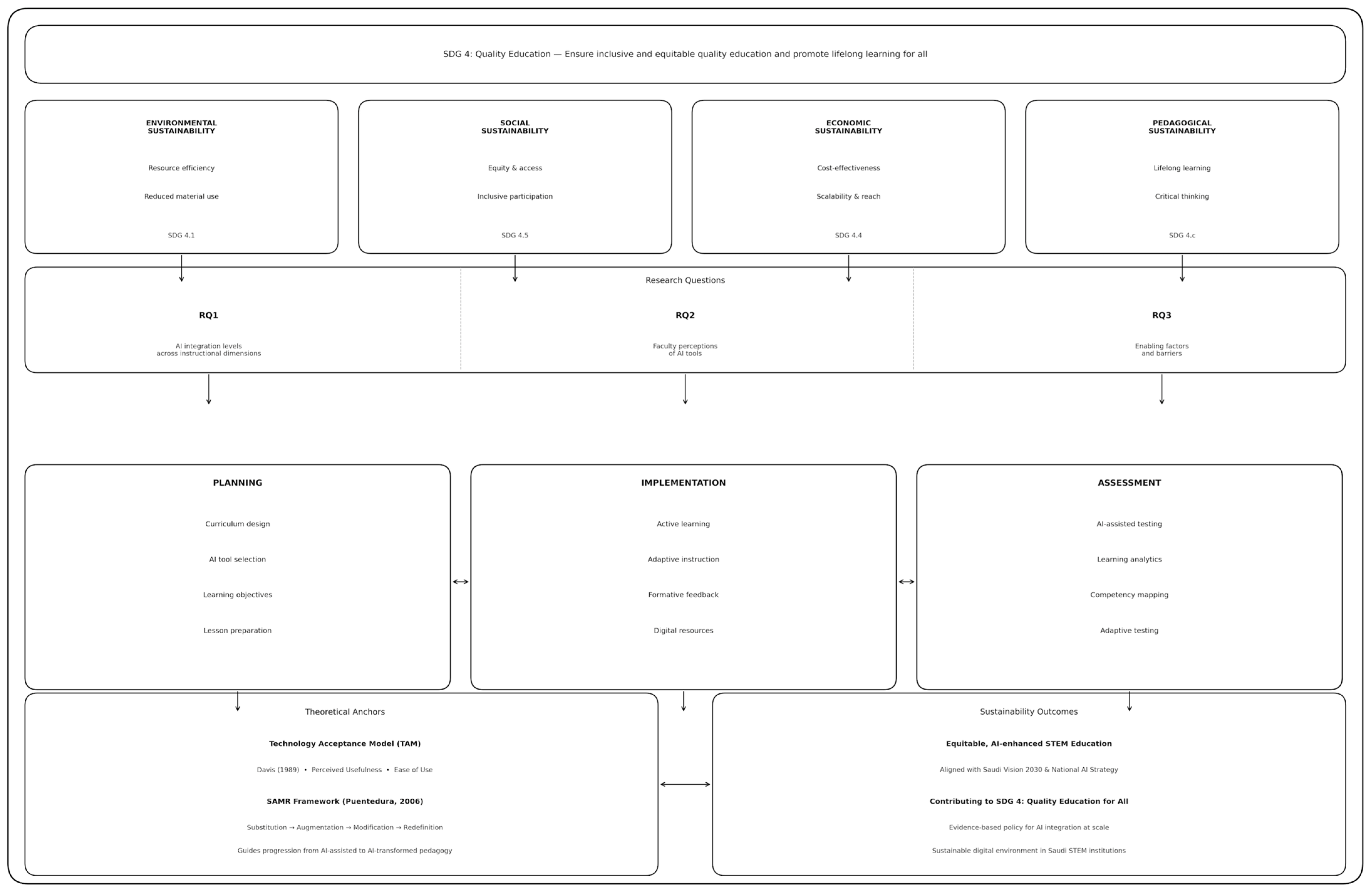
Figure 1 illustrates the conceptual framework of the sustainable AI integration in this study. Four sustainability dimensions are outlined, i.e., environmental, social, economic, and pedagogical, with specific indicators assigned to each dimension. Environmental sustainability includes resource efficiency and reduced material consumption while social sustainability encompasses equity, accessibility, and inclusive access. Economic sustainability covers cost-effectiveness and scalability while pedagogical sustainability addresses lifelong learning, critical thinking, and faculty development. Each dimension is linked to particular SDG 4 targets—4.1 (quality), 4.4 (skills), 4.5 (equity), and 4.c (teachers)—as well as to the three instructional practices examined in this study: planning, implementation, and assessment. Each research question aligns with one or more sustainability dimensions: RQ1 addresses environmental and economic sustainability through a quantitative assessment of AI integration levels; RQ2 addresses pedagogical and social sustainability through analysis of faculty perceptions; and RQ3 engages all four dimensions through a qualitative exploration of barriers that hinder the integration of AI tools.

2. Methodology

2.1. Study Methodology

A mixed-methods explanatory sequential design combining quantitative and qualitative data was used in this research to comprehend the relationship between AI implementation in STEM education and sustainable educational development. The strategy appreciated the fact that sustainability in education can be considered both in the context of quantifiable practices as well as contextual processes, which need to be explored qualitatively.
The quantitative data were gathered in the initial phase with the help of a structured questionnaire that reviewed the proportion of STEM faculty members who have already integrated the AI tool and their attitude towards the importance of AI in sustainability. The items addressed resource efficiency, accessibility, scalability, and equity, which are the primary elements of sustainable education. The general trends of the integration were defined with the help of statistical analysis and gave impetus to the qualitative stage.
The second step was semi-structured interviews which sought to obtain further information about the quantitative findings. These reviewed the application of AI tools and how they could facilitate or hinder sustainable educational goals like resource efficiency, resource access, equity, environmental effects, and SDG 4 congruency. Importantly, the quantitative findings helped shape the interview design. Areas with the lowest scores, such as instructional planning (M = 2.61), were designated as priority topics for further exploration in the interviews. This approach ensured that the qualitative phase served to explain and contextualize the patterns uncovered in Phase 1, which fits well within an explanatory sequential mixed-methods design [36].
The third step was a synthesis of the findings of two datasets to identify the convergence and deviation between the measured practices and lived experiences, to present a summary of AI integration depending on sustainability.
This design is grounded on the principles of sustainability research because it acknowledges the transformative educational change of the process, which entails not only quantitative changes in the process but also qualitative input (as such). A combination of both numerical data and narrative evidence provided a highly effective, multidimensional conceptual lens for understanding how the use of AI in STEM higher education can facilitate sustainable practices in teaching, learning, and institutional development.

2.2. The Study Sample

2.2.1. Quantitative Sample

A total of 324 STEM faculty members represented the quantitative sample. This number was established through a priori power analysis conducted in G*Power 3.1 for one-sample mean estimation, assuming a medium effect size (d = 0.50), 0.80 power, and α = 0.05. These values indicated a minimum of 33 participants were required. The final sample far exceeded this baseline, offering a strong foundation for the descriptive analyses (means and standard deviations) carried out across the three instructional dimensions and the faculty perception scale. For the qualitative phase, 12 individuals participated, a figure supported by research indicating that thematic saturation in semi-structured interview studies generally occurs within 12 interviews [37] and that qualitative sample sizes are guided by data richness rather than predetermined numbers [36]. Participants were randomly selected from Saudi universities during the second semester of the 2024–2025 academic year. The participants were organized using stratified random sampling in which they were divided into strata based on institution (six universities), discipline (Mathematics, Science, Technology, Engineering), and gender. Faculty members were then selected randomly from departmental staff lists within each stratum, which helped make the sample representative of a broad range of institutional contexts. This sampling design aligned well with the study’s aim of investigating AI integration across various educational settings.
The study sample was compiled based on a number of procedures. First, departmental contact lists were obtained from institutional research offices across six Saudi universities, and faculty members were recruited from these universities to reflect varied geographic locations and resource contexts. Then, an electronic questionnaire was sent to 520 faculty members, of whom 338 responded, with 324 responses deemed complete, placing an initial response rate of 65.0% and a usable response rate of 62.5%. Although no formal non-response analysis was undertaken, a comparison between respondents and non-respondents was performed using the sole demographic variable available (discipline), revealing no notable distributional discrepancies. Even so, the potential for non-response bias remains a recognized limitation, as faculties with a stronger inclination toward AI may have been more inclined to participate.
The Research Ethics Committee at Taif University gave ethical approval to the research, and all the research procedures were conducted in accordance with ethical guidelines governing human research topics. The questionnaire was sent via an electronic platform, and there was a statement of purpose of the research to investigate the integration of AI through the prism of educational sustainability and adherence to SDG 4. The participants were told about the importance of the research to encourage sustainable, equitable, and effective STEM education and guaranteed confidentiality, voluntary involvement, and the sole academic application of the data. Response was recorded through informed consent, which was obtained electronically.
Table 1 shows the demographic variables of the participants by their gender, discipline, and years of teaching experience. These variables allowed examining possible variations in the patterns of AI integration and sustainability perceptions across faculty subgroups.
The sample is quite varied in terms of gender (40.4% of men, 59.6% of women), disciplines (28.7% of Science, 27.1% of Technology, 25.3 of Engineering, 18.8% of Mathematics), and experience (31.2% of early career, 40.7% of mid-career, 28.1% experienced). This has increased the research capabilities of the study to identify trends in sustainability that may not be comparable in other faculty contexts or at varying expertise levels.

2.2.2. Qualitative Sample

For the qualitative part, a purposive sample of 12 faculty members was recruited. To address volunteering bias, a concern in interview recruitment, a two-stage selection process was implemented. In the first stage, all 324 questionnaire respondents were invited to take part in a follow-up interview, of whom, 41 were willing to participate. In the second stage, 12 participants were purposively chosen from the 41 volunteers using maximum variation criteria, including gender, discipline, and years of experience, guaranteeing a broad spectrum of perspectives. In doing so, the selection process reflected the fact that participation in the interview was completely optional while the purposive selection among volunteers ensured analytical diversity [38]. Maximum variation sampling in this context allowed the researcher to intentionally include participants with various AI integration levels, from very low to very high, thereby maximizing the range of perspectives involved in the interview. The selection criteria specifically took into account:
(a)
Diversity in teaching experience, recognizing sustainability perspectives and digital competencies;
(b)
Variation in academic disciplines within STEM;
(c)
Representation of both genders.
This sampling method is consistent with the qualitative research principles of focusing on the cases that are rich in information and can be used to shed light on the phenomenon under study. Maximum variation sampling in this context was a viable choice because it allows investigation into a variety of pathways, barriers, and opportunities of sustainable AI integration in different contexts of the faculty. The characteristics of interview participants are displayed in Table 2, which proves that the desired diversity in the qualitative sample was attained.
The qualitative sample consists of an equal representation of males and females (6 of each gender), represents the entire range of big STEM fields, and includes the experience level of 4 to 16 years. This research facilitated an intensive study of how different members of the faculty perceive and implement AI sustainability in the context of individual situations.

2.3. Study Instruments

2.3.1. Questionnaire

The measurement of quantitative data was done by a closed-ended questionnaire formulated to research the integration of AI tools in STEM teaching on the sustainability aspect. The tool had two goals: (a) measuring the level of faculty AI integration in terms of planning, implementation, and assessment, and (b) measuring perceptions of AI implications of sustainability, such as equity, accessibility, resource efficiency, and lifelong learning alignment.
The questionnaire was created due to the processing of previous frameworks and systematic review [5,16,29,33]. The items were extended in order to include SDG 4 dimensions and to measure technical practices and sustainability impact awareness.
The questionnaire consisted of three major parts:
  • Section One: Demographic information gathered information on gender, academic discipline, and teaching experience. The selection of these variables was made to define the differences in AI integration patterns and sustainability perceptions among the groups of faculty members.
  • Section Two: Practices of AI integration (43 items, three dimensions) included the use of AI in instructional processes by faculty members:
    Dimension 1: The instructional planning section contained 15 items that covered the application of AI in the context of content development and planning activities, and covered topics related to maintaining sustainability, including resource efficiency, equitable access, and integration of lifelong learning.
    Dimension 2: Instructional implementation (18 items) looked at AI in terms of delivery, adaptive instruction, simulations, and collaboration support.
    Dimension 3: Student assessment (10 items) evaluated the use of AI in formative and summative assessment, feedback, and monitoring in terms of efficiency, inclusivity, and continuous learning.
  • Section Three: Perceptions of AI (19 items) measured the faculty perceptions of how AI contributes to educational quality, inclusivity, and sustainability. Questions related to items in the perceived benefit category, ethical and equity considerations, resource efficiency, and possible harm to autonomy or critical thinking were asked.
The questionnaire employs a five-point Likert response format (1 = very low, 2 = low, 3 = medium, 4 = high, 5 = very high).
Face and content validity were ensured by having six experts in STEM education, educational technology, and sustainable education review the questionnaire. The panel tested the congruency of the instrument with the principles of sustainability, comprehensiveness, clarity, and correlation of items and dimensions. Experts who are conversant with SDG 4 indicators made sure that the equity, accessibility, and lifelong learning dimensions had been adequately covered. This feedback was used to improve several items by adding improvements to make the reference to sustainability clearer, enhancing the wording of the items touching on equity and accessibility, and adjusting the benefits with a possible impact on sustainability.
To verify construct validity, the full sample (N = 324) underwent exploratory factor analysis (EFA) using principal axis factoring (PAF) with Promax oblique rotation. Prior to extraction, data suitability was confirmed through the Kaiser–Meyer–Olkin measure of sampling adequacy (KMO = 0.946), classified as marvelous [39], and Bartlett’s test of sphericity (χ2(1891) = 13,003.37, p < 0.001), both indicating that the correlation matrix was appropriate for factor analysis [40]. Factor retention was determined by parallel analysis [41] using 1000 randomly generated datasets at the 95th-percentile criterion [42], supplemented by inspection of the eigenvalue structure [39,43]. Both criteria converged on a four-factor solution, with eigenvalues of 16.48, 7.98, 6.24, and 4.28, collectively accounting for 56.29% of the total variance, a proportion considered adequate in educational measurement research [44].
All 62 items loaded strongly and exclusively on their theoretically designated factor, with primary loadings ranging from 0.640 to 0.854, well exceeding the 0.40 threshold recommended for educational research instruments [45]. No item produced a cross-loading above 0.12, indicating a clean simple structure with no ambiguous items. Communalities ranged from 0.414 to 0.730, reflecting adequate to strong shared variance. The moderate inter-factor correlations (0.222–0.443) confirmed that the four dimensions are conceptually related yet empirically distinct, retrospectively validating the use of oblique rotation [46]. The four factors corresponded precisely to the instrument’s theoretical dimensions: instructional planning (15 items), instructional implementation (18 items), students’ assessment (10 items), and perceptions of AI integration (19 items), providing strong evidence for the construct validity of the questionnaire.
Reliability was also measured through Cronbach’s α. The total reliability coefficient was α = 0.95, and this indicates high internal consistency. The dimension-specific values were planning (α = 0.94), implementation (α = 0.93), assessment (α = 0.93), and perceptions (α = 0.95), all exceeding the 0.70 threshold recommended for social science research [47].

2.3.2. The Semi-Structured Interview

To gain a better understanding of the quantitative results and investigate the possibilities of sustainable AI-based integration in STEM teaching, semi-structured interviews were conducted with 12 university faculty members. The protocol was intended to investigate several dimensions of sustainability and to allow participants to bring forth unexpected themes. The interviews were structured around four areas with probes based on the quantitative results:
  • Domain 1: AI Tools and Integration Practices
    The participants described the AI tools they were using and their application in teaching. The resource efficiency, accessibility, scalability, and implications of equity, including reduction in material usage, were investigated in the probes.
  • Domain 2: Perceived Benefits
    Inquired questions were based on the subject of how AI assists in equity, diverse learners, and lifelong learning, and the contribution of AI to achieving educational efficiency and sustainability goals.
  • Domain 3: Facilitating Factors
    The domain examined institutional facilitators, including the presence of an adequate infrastructure, the faculty development process, and the collaboration of the faculty, as well as correspondence between policies and the sustainability principles.
  • Domain 4: Challenges and Barriers
    Respondents discussed barriers which were infrastructural and financial support, ethical cases and pedagogical conflicts between AI implementation and long-term learning objectives.
Follow-up questions were used by the researcher to ensure that they pay consistent attention to sustainability dimensions despite their omission. As an example, interviewers tried to dig deeper to find out the implications of virtual labs when the participants were describing them, and the implications were resource efficiency, remote accessibility, and comparative effectiveness. This is a flexible but organized method to cover all possible perspectives of sustainability, offering abundant qualitative information to support and contextualize the quantitative data.

2.4. Data Analysis Procedures

The data from the quantitative questionnaires were analyzed by descriptive statistics.
Given that this study’s primary objective is to characterize the level and distribution of AI integration and faculty perceptions rather than to test hypotheses about group differences or predictive relationships, means and standard deviations are the analytically appropriate choice. Descriptive statistics are well-suited to this descriptive–exploratory purpose, as they enable systematic comparison of means and standard deviations across dimensions and items without requiring inferential assumptions [36]. Accordingly, no inferential claims are made beyond the observed patterns in this sample; the appropriateness of inferential analyses for future research is acknowledged in the Limitations Section 5.3.
A five-level classification was adopted to interpret the means of participants’ responses with equal intervals across the five levels: very low (1.00–1.80), low (1.81–2.60), medium (2.61–3.40), high (3.41–4.20), and very high (4.21–5.00). This classification scheme ensured consistency in comparing item- and dimension-level means across the instructional planning, instructional implementation, and students’ assessment dimensions [48,49].
Reflexive thematic analysis [50] was used to conduct the qualitative data analysis. Employing MAXQDA 23 software, the analysis proceeded in six stages: familiarization with data; generating initial codes; searching for themes; reviewing themes; defining and naming themes; and producing the report. A random 20% sub-sample of transcripts was coded independently by two researchers, and the intercoder reliability was satisfactory at (κ = 0.81). Interview 9 achieved thematic saturation, with interviews 10–12 producing no new codes. The interview questions were meant to investigate low-scoring quantitative dimensions (particularly planning, M = 2.61), ensuring methodological integration between phases.
The credibility and trustworthiness of the interview were verified through triangulation which was established through the variety of the data, researchers, and data sources as well as data saturation. The interview questions were also subjected to rounds of revision and modification to ensure their face and content validity before applying them to the study’s sample. Furthermore, to maintain accuracy and credibility, permission was obtained from participants to record their responses. The responses were then transcribed, summarized, and shared with the participants to verify the accuracy of the data. Finally, every participant was assigned a specific code to ensure confidentiality.
During interpretation, special consideration was given to sustainability-related concepts (e.g., the ones dealing with equity, accessibility, resource efficiency, and lifelong learning support). Thematic analysis was used to analyze qualitative interview data; transcripts of interviews were coded systematically to come up with concrete practices, perceived benefits, enabling factors, and problems expressed by the respondents.
The noted themes were considered in the context of the sustainability framework of the study: the environmental, social, economic, and pedagogical aspects. Lastly, quantitative and qualitative data were combined by comparing and contrasting the results.
Qualitative data assisted in interpreting quantitative trends and provided additional context to the information, shedding light on how AI implementation affects or does not progress sustainable practices in education. Such mixed-methods analysis allowed making stronger conclusions on the ways to meet the goals of sustainable development in the alignment of AI use in STEM education.

2.5. Ethical Considerations

This research was conducted in accordance with established ethical standards of National Bioethics Committee in Saudi Arabia and the Declaration of Helsinki for research. The study was approved by the Scientific Research Ethics Committee of Taif University (with code number 46-234) before any data collection process occurred.
The objectives and scope of the research were thoroughly explained to the participants, and the research involved the investigation of AI integration from the perspective of educational sustainability and SDG 4 contribution. Informed consent was obtained from all participants, indicating that they were participating voluntarily and had the right to withdraw at any time they wished.
The research process was carried out with relative confidentiality and anonymity: all the information in questionnaires and transcripts of interviews was not identified, the data were kept in a safe place without any access to unauthorized researchers, and the participants were informed that the data were only to be used in the context of scientific research. The purpose of this research was to enhance STEM higher education in terms of sustainability.

3. Research Results

The section presents the findings on each of the research questions and combines questionnaire data and insights gained during interviews on a sustainability basis. First, the levels of quantitative integration are introduced at the levels of instruction (planning, implementation, assessment), faculty perceptions, and, finally, the qualitative themes by interview about the use of AI, its benefits, and challenges.

3.1. Findings Related to Research Question One

RQ1: To what extent do STEM faculties integrate AI tools in ways that support sustainable education (SDG 4)?
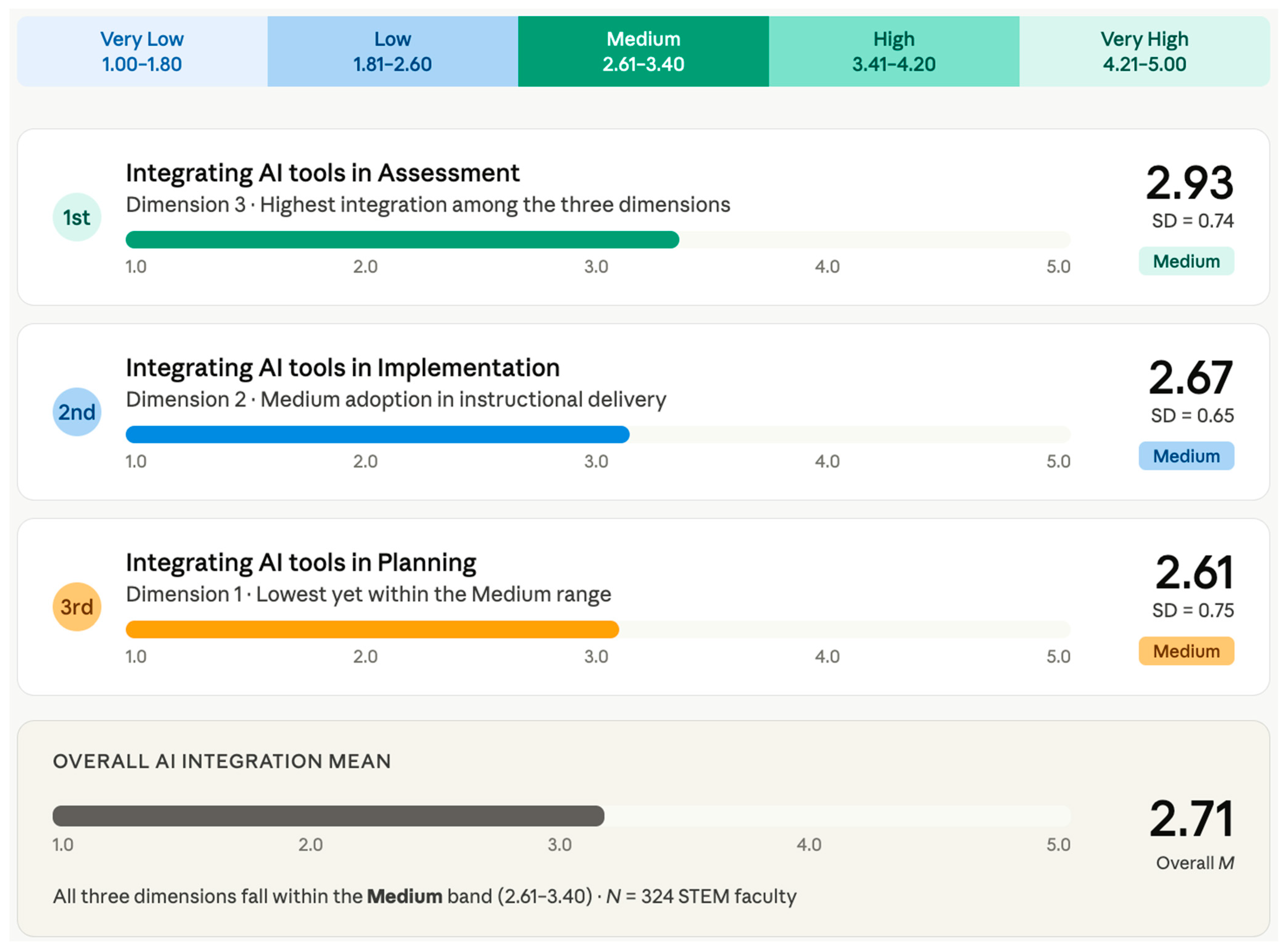
To answer this question, the questionnaire was administered to the STEM faculty members. The means and standard deviations of their responses to the items of the three dimensions of the second section, which targeted this question, were calculated as Figure 2 shows.
Figure 2 indicates that the integration of AI tools in instructional practices was at a medium level across the three dimensions. The third dimension, on the integration of AI in students’ assessment, ranked highest with a mean of 2.93, reflecting a medium level of integration. It was followed by the second dimension, the use of AI tools in instructional implementation, with a mean score of 2.67, also indicating a medium level. Ranking last, the first dimension, related to AI integration in instructional planning, achieved a mean score of 2.61, still within the same medium range.
To further understand AI tool integration in instructional practices, the means and standard deviations for each dimension and its items were calculated as the following:

3.1.1. Integration in Instructional Planning

According to Table 3, the item with the highest score was the one on making lessons which contained higher-order thinking skills to integrate AI with a mean of (2.91), reflecting a medium level of integration. This showed that most faculty members perceived critical thinking as the essential aspect of teaching and as one of the competencies of long-term sustainability in problem-solving. Also with a medium level of integration, the item on employing AI tools in formulating educational objectives and learning outcomes that contribute to developing self-learning skills achieved a mean of (2.83). On the other hand, other items reflected low integration levels, such as transforming classrooms into AI-based interactive environments, with a mean of (2.35) and designing simple scientific content that stimulates student motivation, with a mean of (2.33). These results reflected the obstacles that may have been related to either a lack of resources or limited specialized training.
These findings indicate that the background in AI-informed planning is medium, and distinct possibilities to make curricular innovations and equity more central.

3.1.2. Integration in Instructional Implementation

Table 4 shows instructional implementation results. The items that achieved the highest rate included using AI-powered remote platforms during instruction (M = 3.49), reflecting widespread adoption of online tools to extend accessibility and reduce the need for physical labs (thus supporting both equity and environmental goals). Similarly, the item “I communicate with students through electronic chat to answer their inquiries and provide guidance and counseling” had a medium level with a mean of (3.17).
On the other hand, the results revealed a weakness in faculty members’ ability to use AI tools to help students visualize abstract scientific concepts, with a mean of (2.35). Similarly, the item for utilizing AI tools such as robots in classroom discussions was among the least implemented items, with a mean of (2.23).

3.1.3. Integration in Students’ Assessment

According to Table 5, students’ assessment achieved the highest level of integration with a mean of (2.93) at medium. The item designing digital tests with AI to ensure academic integrity had the highest mean of (3.38), followed by the item on using AI to prepare and grade assignments with a mean of (3.34). These high scores indicated that faculty members frequently utilized AI for efficient assessment. The items with the lowest means involved using AI for predictive student analytics and diverse assessment formats both with a mean of (2.69), indicating advanced uses were still emerging.
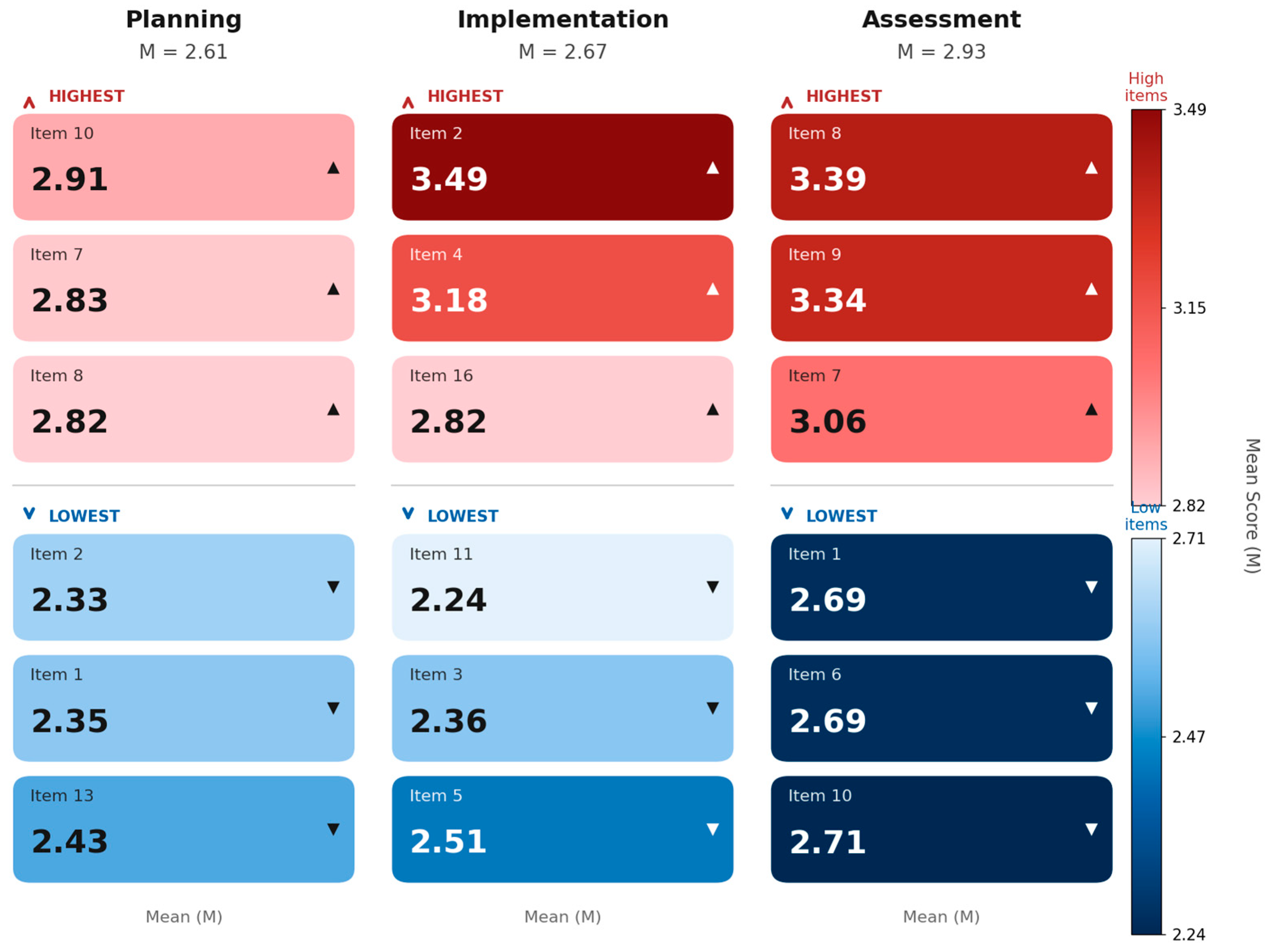
To conclude, the heatmap in Figure 3 reveals a consistent medium level of AI integration across all three instructional dimensions (planning M = 2.61, implementation M = 2.67, assessment M = 2.93).
Among the three practices, students’ assessment ranked highest, with the highest scores for items on designing AI-based digital integrity tests (M = 3.39) and AI-assisted assignment preparation (M = 3.34). Instructional implementation came in second place and had the widest range of integration levels, whereby remote electronic platforms scored notably high (M = 3.49) while AI-enabled robot discussions remained the least integrated practice across the entire questionnaire (M = 2.24). Instructional planning had the overall weakest integration level. The item which scored the highest was including higher-order thinking skills while planning lessons (M = 2.91) and lowest was designing simple scientific content that stimulates student motivation (M = 2.33).

3.2. Findings Related to Research Question Two

RQ2: What are faculty members’ perceptions of AI’s role in advancing sustainable STEM education?
The faculty surveyed had a very favorable view of AI in the teaching profession. Table 6 represents all perception items with the highest scores (means of 3.95–4.20 on a five-point scale), with a total mean of 4.00 (high). As an illustration, the most highly rated statements were that AI is associated with the latest trends in STEM (M = 4.20) and that it provides students with the necessary digital skills (M = 4.19). Its lowest-rated item (AI to enhance writing skills) was at 3.95. This is a sign that the faculty are passionately hopeful that AI will help improve the quality of education and readiness of the workforce.
Meanwhile, some of the issues received high scores: specifically, most of them thought that using AI could harm students by reducing their critical and innovative thinking (M = 4.13). To put it differently, educators acknowledge the opportunity of AI at the same time and understand that it is crucial to retain pedagogical processes (SDG 4.1/4.5) together with the improvement of instruction and equity.
The underlying subtext of these two approaches, which amount to large praise and considerable apprehension, is that faculties are mindful of adopting AI to maximize gain (enhancing learning, engagement, and access) and reduce harm to student agency and essential skills.

Sustainability Themes in Faculty Perceptions

The unrestricted analysis yielded a number of themes associated with sustainability. First, there was the quality of education (SDG 4.1): The faculty pointed out that AI can assist in satisfying the standards of instruction, understanding, and performance. An example is that participants mentioned the capability of AI to explain terms and give individual practice, thus contributing to increased educational results.
Second, equity and access appeared (SDG 4.5): The participants talked about language support, accessibility tools, and differentiated content as equity advantages of AI, but they talked less about equity explicitly, which may indicate that it is not a priority.
Third, lifelong learning and ability building were determined: participants acknowledged the ability of AI to facilitate the development of self-directed learning and digital (SDG 4.4) competence, equipping the students with the skills to maintain lifelong learning.
Fourth, there was teachers’ professional sustainability (SDG 4.c): The participants believed that AI could help to improve their own abilities, decrease the number of work hours, and promote lifelong learning.
Lastly, one of the themes was the sustainability of cognitive development: Many participants noted that the use of AI should not impair the ability of students to think critically. Although one of the items of perception was observed (faculty interviews echoed this), over-dependence on AI might result in the decline of the thinking skills of students.
In general, AI is widely regarded by the faculty as an effective facilitator of sustainable STEM learning, improving quality, inclusivity, and lifelong learning, but emphasis must be placed on integration to ensure that student autonomy and deep learning are preserved.

3.3. Findings Related to Research Question Three

RQ3: How do faculties integrate AI in practice to promote sustainability, and what challenges do they face?
Interview data were organized into three domains: actual integration approaches (Domain One), perceived benefits (Domain Two), and challenges (Domain Three).

3.3.1. Domain One: Integration Approaches in Instruction

The faculty mentioned three primary ways to implement AI in STEM teaching, including planning and content design, in-class interaction, assessment, and feedback, which support more individualized and sustainable learning.
In instruction, AI tools enabled the faculty to plan and design course materials. A biology professor (FP8) explained that she utilized an AI tool (Gemini) by inputting lesson objectives to obtain diverse activity suggestions that accounted for individual differences among students in a “Molecular Genetics” course. This reflects the efficiency and equity benefits of AI-assisted planning. This application improves equity and efficiency in time, which provides a chance of personalized teaching that addresses the needs of different learners.
The faculty members applied AI to enhance learning during in-class interaction as a means of simulation, visualization, and interactive questioning. Participant (MP6) pointed out he utilized ChatGPT to explain the concept of “global warming,” by directing the application to gather precise, detailed information about the phenomenon’s causes and effects in a simplified manner appropriate to students’ comprehension levels. Furthermore, participant (MP3), an associate professor of architecture, pointed out using multiple AI tools to design and prepare interactive learning activities for architectural design courses. Students were asked to create prototypes of their design concepts, then to refine and compare them with various architectural structures using 2D/3D simulation technologies like Spacemaker AI, TestFit.io, and intelligent tutoring systems (ITS). Furthermore, participant (MP2), a physics professor, reported using AI tools to design a lesson on “vertically projected projectiles,” with practical examples demonstrating gravity’s effect on object motion. The professor also used Algodoo, an AI-powered tool, to design virtual simulation activities which presented interactive models of physical phenomena. This approach offered simulated learning experiences through realistic yet simplified interactions, enhancing students’ grasp of abstract physics concepts through hands-on interaction.
Similarly, participants (FP9), (FP10), and (FP11) discussed using AI tools to develop various learning activities. This included utilizing digital tools like GeoGebra to present mathematical and geometric concepts in innovative, interactive ways; employing MindMeister to create interactive mind maps that helped organize ideas and concepts; and presenting practical problems to deepen understanding. The participants stressed that such tools improved student engagement with the content and provided visual representations that reinforced conceptual comprehension, which enriched the learning experience.
Artificial intelligence was applied in assessment and feedback to perform analysis and evaluation of work by the students. Participants (MP4, MP5, and FP11), faculty members in Engineering and Computer Science, reported using ChatGPT to analyze students’ programming codes. When students encountered programming errors, they inputted the code into the tool which then analyzed the errors, explained their causes, and suggested detailed steps for correction. This was confirmed by participant (FM9), a Computer Science professor, who stated, “when a student writes code, the tool enables them to precisely identify errors, whether syntactic or logical, and suggests modifications to improve them within seconds.”
The use of AI tools allowed programming professors to identify the presence of coding errors, provide reasons, and propose solutions, which facilitated quick and repetitive learning. Individualized feedback in scale and the automated grading systems also supported both efficiency and quality of learning.
When combined, these strategies reveal that the faculty is using AI throughout the entire teaching process; that is, design through feedback to build integrated, adaptive, and sustainable learning spaces that enhance quality, equity, and ongoing improvement in STEM education.

3.3.2. Domain Two: Benefits of AI for Sustainable Education

The faculty showed a number of benefits of AI integration that are related to sustainability, the first of them being time and resource efficiency. Participants (MP2, FP9, and FP12) noted that AI helps to save enormous amounts of time and energy by automating such usual tasks as grading and answering frequently asked questions. “What it would take me hours to do by hand”, as one participant (MP2) noted... [AI] “accomplishes in minutes.” Such efficiency allows the universities to reach a larger number of students with the same resources (in line with SDG 4.3) and allows professors to concentrate on enriching the teaching process and professional development.
Another advantage was the improvement of assessment quality. AI-generated analytics and adaptive tests are instant and provide customized feedback. These features make assessment a formative learning process (SDG 4.1). Artificial intelligence also facilitates equity as it helps to identify the difficulty of questions and the type of feedback that needs to be given to students of various needs and levels.
Lifelong learning opportunities were another sustainability benefit that faculty members identified. Adaptive learning platforms and AI tutoring support self-directed and lifelong learning by providing round-the-clock accessibility (SDG 4.4). Students have the opportunity to revise complicated areas; study whenever and however they want; and engage in extra-curricular learning, which is especially useful with distance and working learners. Participants (MP3, MP2, and FP12) confirmed the effectiveness of these tools in helping students become independent learners.
Improving student achievement was another benefit of using AI tools. Participant (MP3) expressed that his use of AI was motivated by his belief that these tools would enhance his efficiency in delivering scientific content, which as a result would improve his students’ achievement. Participant (FP8) also echoed this idea by stating, “I noticed an improvement in student achievement and grades when I used AI tools in teaching, which encouraged me to continue using them.”
In addition, AI’s alignment with modern education was identified as an advantage. Participants (MP2, MP3, and MP5) indicated that a major motivation for using AI tools was their conviction that such tools fit well with modern educational trends and contemporary professional standards. Similarly, participant (FP7) stated, “during my academic fellowship in education, I noticed that the focus on using modern technologies, including AI, strongly aligns with current teaching trends.”
Lastly, the faculty members noticed that there was improved student performance and involvement. Visualizations, simulations and adaptive practice in AI were shown to enhance understanding, confidence and exam performance. According to the words of one Engineering professor, learners can master concepts deeper and they are able to perform better when they are assisted by AI tools.
In general, the faculty believed that AI integration would result in improved scalability, personalization, and quality of feedback, resulting in a more inclusive, efficient, and high-quality STEM education, fulfilling the objectives of SDG 4 of equitable, lifelong learning opportunities to all.

3.3.3. Domain Three: Challenges and Barriers

The faculty members pointed out a range of barriers that hindered sustainable AI integration in STEM education. Challenges related to attitudes and skills were the most prominent. Other faculty members expressed trepidation towards AI as it may threaten their job security. Participant (MP5) stated, “I believe AI may eliminate my traditional role in the future and take my place, which could lead to unemployment among university graduates.”
Faculty members also indicated that many students lacked sufficient digital literacy to use AI tools effectively. This meant that additional training was required to bridge this gap which consumed class time and risked widening existing inequalities, as students with earlier exposure to AI tools progressed more smoothly while those with less exposure fell behind.
Participants (MP1, MP5, and MP6) noted that some students lacked the necessary skills to utilize AI tools in learning which meant faculty members had to provide detailed explanations and guidance on how to use them. Similarly, participant (FP12) confirmed that some educational stakeholders still viewed AI tools as a supplementary rather than an essential or central component of the educational process.
AI infrastructure limitations were another significant challenge included. The faculty members identified a number of issues such as unreliable internet, old hardware, and overloaded networks, slowing down the use of AI. Participants (MP4 and FP7) pointed out that the campus networks became so sluggish when a large number of students utilized the AI tools that some were compelled to use expensive mobile data. According to participants (MP1, MP2, MP5, FP8, and FP9), they often had to rely on mobile data from their personal phones due to weak campus networks, resulting in additional financial burdens. These gaps increase the digital divide, which compromises the SDG 4.5 objective of equitable access and deters the sustainable use of AI.
The issue of financial sustainability also emerged as a concern in AI integration. Complete AI applications are usually paid for, and free versions are not very helpful. Most universities cannot afford to sustain full versions on a regular basis, which leads to reliance on commercial vendors. According to participant (FP11), “free AI applications do not provide all the features and services we need to fully implement digital activities of engineering.” Participant (MP2) confirmed this challenge, noting that, “the cost of using some AI tools with all their features, such as ChatGPT and electronic grading applications, is considered high.”
Without institutional funding or access to open-source options, the long-term viability and fairness of AI-driven learning become precarious. Such reliance on external vendors presents a structural risk to sustainability: programs built around proprietary platforms are vulnerable to disruption should licensing fees increase or providers cease operations.
Several participants expressed concerns about academic dishonesty and information credibility. Participant (MP5) noted observing students including references and studies in their scientific reports that, upon verification, turned out to be non-existent. When questioned, the students revealed that ChatGPT had generated these references and studies hypothetically without any real sources. Participant (MP2) further emphasized this challenge, explaining that some students’ dependence on AI tools led them to cite non-academic sources, such as unverified websites or social media forums, compromising the quality of acquired knowledge and deviating from proper scientific research and analysis methodologies. The participants emphasized the necessity to educate students to evaluate AI output critically and make sure sources are verified to maintain confidence in academic standards.
In terms of academic integrity and copyrights, participants (MP1, FP9, and FP12) expressed clear concerns about students potentially misusing AI tools in ways that violated academic values and principles of integrity. They noted that some students might rely on these tools to prepare reports or complete assignments without genuine personal effort, then submit the work as their own. Participant (FP9) shared a specific incident, stating, “I noticed that one student’s writing style was unusually advanced and inconsistent with his usual level. The ideas in his course project also exceeded his capabilities. This became evident during my discussion with him about what he had submitted.”
Another challenge was that excessive or total dependence on AI tools may reduce critical thinking skills. Participants (FP10 and FP11) indicated that students’ heavy reliance on AI tools might hinder authentic learning experiences, especially hands-on activities, negatively affecting the development of critical and creative thinking skills when they try to initiate new thoughts and ideas. Participant (MP6) added, “despite improved grades and report quality in projects and lab work, I think that total dependence on these tools may have long-term drawbacks, weakening creative thinking and academic writing abilities over time if students use it as an information provider rather than a brainstorming scaffold.”
To sum up, the qualitative findings corroborate the quantitative findings and provide context to them, reflecting heavy assessment integration, relatively low planning adoption, generally positive perceptions by faculty members, and overarching challenges to AI integration.

4. Discussion

4.1. The Current State of AI Integration: Interpreting the Moderate but Uneven Development

In light of the existing literature and the sustainability framework outlined earlier in Figure 1, the quantitative findings showed a medium level of overall AI integration in STEM teaching, and the extent of use in assessment applications (e.g., automatic grading) was much higher than that in planning and implementation. This trend is an improvement—the faculty use AI to support personalized learning, simulations, distance learning, and real-time feedback—but also reflects the lopsided development. The faculty stated that they used AI to promote equity and tailored learning, decrease environmental and economic expenditures by substituting physical laboratories, and facilitate lifelong learning with immediate feedback, which is adequate to meet SDG 4 goals of quality and lifelong learning.
Nonetheless, the use of AI as a means of assessment is the primary constraint on transformational impact. Although grading automation will enhance efficiency and scalability, excessive application will reduce learning outcomes to skills that are easily measurable and overlook creativity, ethics, and collaboration competencies that are core to sustainability. Curriculum planning reflected the weakest integration, pointing to a significant missed opportunity. The planning stage offers the greatest opportunity to merge equity and sustainability principles directly into course design. The limited integration of AI at this phase signals untapped potential for fostering inclusive, adaptive, and resource-conscious approaches to course development.
While faculty members have demonstrated some innovation, such as the development of novel materials and virtual lab options that align with sustainability goals, these practices tended to be exceptional rather than mainstream. As the literature repeatedly underscores, meaningful AI integration hinges on deliberate curriculum transformation rather than the mere technical adoption of AI [4,33].
To conclude, present AI applications in STEM learning are a transitional phase, as they indicate progress but need further application beyond testing. The institutional training programs and legislations should support AI use in planning and instructional practices that can bring change in higher education [19].
Two theoretical approaches offer insight into these findings: the Technology Acceptance Model (TAM); [51] and the SAMR framework [52]. TAM helps clarify why faculty members who view AI as both useful and straightforward tend to embrace it more readily. SAMR, on the other hand, outlines where faculty members fall along the integration continuum, from substitution, where AI merely replaces an existing task, through augmentation and modification, and finally reaching redefinition, where AI enables entirely new forms of learning. This study indicated that most Saudi STEM faculty members remained situated at the substitution and augmentation stages, a pattern most evident in the widespread use of automated grading and feedback tools, which correspond to the higher scores observed in the assessment dimension. However, achieving the modification and redefinition levels, where integration most closely aligns with sustainable and equity-oriented education, depends on sustained professional development and meaningful institutional infrastructure investment. Still, developments which have been documented in other higher education systems, such as those in Finland and China [10], offer some reason for optimism regarding the trajectory of change within Saudi universities.

4.2. Faculty Perceptions and Integration Mechanisms: Positive Attitudes with Emerging Sustainable Practices

The highly positive perceptions (M = 4.00) revealed that STEM faculty members in Saudi Arabia held high positive views towards AI. They regarded AI as a key driver for modernizing STEM instruction and furthering sustainability objectives, aligning closely with SDG 4 priorities such as lifelong learning (4.4) and the development of teachers’ capacity (4.c). This favorable outlook was reinforced by the qualitative findings, with participants citing concrete advantages including time efficiency, enhanced access to resources, and expanded opportunities for continuous professional growth. When contrasted with results from other regional settings, this enthusiasm for AI integration may stem from Saudi Arabia’s national push for digital transformation under the Saudi Vision 2030, coupled with the rapid reliance on technology imposed by the COVID-19 pandemic. Consequently, the strong motivational orientation among faculty offers a solid basis for pursuing AI integration that is both equity-centered and sustainable.
In addition to the perceptions, the quantitative findings also revealed some serious concerns. Comparable to the most strongly held positive perceptions (M = 4.20, 4.19), the faculty members indicated that extensive AI use may diminish students’ critical and creative thinking (item 13, M = 4.16) and weaken their practical skills and autonomy (item 19, M = 4.13). The fact that the participants simultaneously supported AI integration while expressing concerns about its consequences might seem contradictory. However, if anything, this reflects the faculty members’ informed position. They were able to discern the advantages of AI integration while at the same time, they were aware of its potential negative effects, such as reducing problem-solving and hands-on inquiry that STEM education is designed to cultivate [53].
In the qualitative findings, the participants echoed the concern captured in the quantitative data, cautioning that increasing student reliance on AI may compromise authentic learning. At the same time, however, several participants viewed AI interactions as a potential catalyst for thinking and brainstorming. According to the participants, when suitably used, AI tools could support rather than replace critical reasoning. Taken together, the mixed-methods data agree that the success of AI integration in STEM instruction depends not on the technology itself but on how and why it is embedded in instruction.
The implications of such perceptions are the apparent policy and training implications. This should be developed in the spirit of professionalism and exploit passion and, at the same time, concern dependency and integrity issues. The training should be tailored to the manner in which AI enhances productivity and inclusion, and include plans such as scaffolding AI use, a genuine assessment plan, and metacognition reflection. Institutional policies should make AI programs explicitly related to the principles of sustainability, i.e., equity, quality, and lifelong learning, and offer technical principles of responsible use.
The qualitative part revealed that the faculty members utilized AI to promote sustainability objectives. The qualitative data suggested that AI enabled the diversification of content during planning as well as the simplification of complex STEM concepts. The faculty members also pointed out the affordability and eco-friendliness of virtual laboratories compared with physical ones. AI-powered platforms can expand educational access in geographically isolated areas, contributing to both equity gains and lower carbon emissions. While adaptive systems facilitate individualized learning and feedback, persistent infrastructural disparities continue to constrain equitable participation.
It has to be noted that the nature of the associations presented in this discussion is a limitation that needs to be taken into consideration. Given the cross-sectional, self-report design, it remains unclear whether AI integration drives progress toward sustainability-related outcomes, or whether faculties who are already more innovative and better equipped are simply more inclined to adopt AI and to report favorable sustainability impacts. Establishing the causes and effects would necessitate experimental or longitudinal designs. This limitation was similarly recognized in a recent mixed-methods study conducted in a similar context [54].
The most developed area of AI implementation is in assessment, with automated grading, analytics, and plagiarism detection making the assessment process more efficient and ensuring academic integrity, which resonates with SDG 4.4 on the idea of lifelong learning. The faculty, however, warned against over automation as this could reduce the curricula and reduce creativity and collaboration, which are essential in sustainable education.
Altogether, the faculty are ready, reflective, and responsible in their use of AI to make it sustainable. Their expanding practices are already more inclusive, efficient, and optimized for resources, but institutional investment, fair digital access, and ongoing pedagogical progress are needed to have systemic impact. The strong commitment of the faculty, with explicit ethical and policy support, provides a strong platform to enable the sustainable transformation of STEM education with the help of AI.

4.3. Challenges to Sustainable Integration: Systemic Barriers Requiring Comprehensive Response

Although positive changes were encouraged, the faculty members revealed that there were major obstacles that jeopardized the sustainability of AI integration unless they are dealt with in an organized manner. Infrastructure and resource deficiencies emerged as the most significant barriers, aligning with the qualitative findings. Many institutions lack reliable internet connectivity, up-to-date hardware, and the financial means to acquire expensive AI applications. Consequently, faculty members and students frequently rely on personal data plans and devices to access the internet. This shifts the cost burden onto learners and exacerbates the digital divide. The qualitative data further explain why educators struggle to transform their classrooms into active scientific environments through AI integration during the planning and design phase (M = 2.35, SD = 0.97), as well as to utilize AI tools for conducting real-world STEM experiments (M = 2.47, SD = 1.02).
This injustice negatively impacts SDG 4.5 (equity and inclusion) because under-resourced students are deprived of full engagement, and professors who cover the cost themselves are undermined professionally, which in turn threatens SDG 4.c (teachers’ development). The threat of financial inequalities also strengthening institutional inequalities is posed by financial inequality where more endowed universities can purchase more expensive AI ecosystems.
To close these gaps, AI infrastructure should be an educational public good. Organizations can invest in high-speed networks, frequent updates of equipment and open-source or inexpensive AI tools. Regional and national funds might be used to fund collaborative AI education platforms, similar to government funding of research infrastructure. This would enhance social equity and economic sustainability through wide and affordable access.
Faculty capacity and pedagogical training are another significant impediment. A lot of participants have no systematic information on how to implement AI. The majority of learners learn by trial and error, and they only pay attention to the operation of the tools but not how to apply them strategically or ethically. This narrows down the opportunities of AI in promoting quality (SDG 4.1) and equity (SDG 4.5) and raises the workload pressure (SDG 4.c). Since the faculty are conscious of the cognitive risks of AI, they are prepared to learn more professionally. Training should go beyond the technical to encompass critical pedagogical judgment, e.g., scaffolding the use of AI to retain student autonomy, or intertwining AI support with human instruction to promote reflection and creativity.
Another issue is digital and information integrity. The faculty indicated the misinformation and fake references generated by AI, as well as untrustworthy content. It is necessary to build the skills of students to critically approach, cross-check, and utilize AI outputs ethically to preserve academic integrity and enable students to continue learning throughout their lives (SDG 4.4). There should be a task of teaching AI literacy as a mandatory part of the curriculum, enabling students to understand how to act in an AI-infused world in a responsible way.
Lastly, participants were worried about the long-term cognitive impacts of AI. Dependence may eliminate problem thinking and problem-solving, which are important skills in sustainable development. This finding was reflected in the qualitative part which highlighted the concern that overreliance on AI tools could undermine students’ critical and creative thinking, potentially reducing their cognitive capacities over time (M = 4.16, SD = 0.86) as well as the idea that students’ over-dependence on AI tools in completing their assignments and tasks may lead to weak self-efficacy and practical skills in the long term. Sustainable AI adoption should therefore have productive learning difficulty where learning tasks are designed in such a way that they are not overly reliant on AI support and reflective thought. The coordinated intervention, such as upgrading infrastructure, increasing training, and AI literacy, is crucial to turn short-term advantages of AI into sustainable, long-term benefits to education.
The systemic nature of sustainable AI integration, on the other hand, requires a systemic approach of infrastructure, pedagogy, policy, and professional capacity. The most important priorities are the increase in fair access to technology, lifelong faculty development, the redesign of the curriculum according to sustainability, and the policies at the institution that guarantee responsible and ethical use of AI.
The use of a sustainability paradigm provides a sense of consistency in dimensions:
  • Environmental: AI-based virtual laboratories and online materials minimize waste and emissions.
  • Economic: It allows cost-effective scaling of education due to the gains of efficiency.
  • Social: On the one hand, personalized learning entails inclusion and quality in the event of equal access.
  • Pedagogical: Retention of critical and creative abilities are the guaranty of value in long-term learning.
  • Professional: Workload/growth of professors—strong, innovative workforce.
Institutions can make AI adoption a strategic force of educational sustainability by integrating sustainability into all such decisions that involve AI, such as the preference of open access tools, universally designed tools, the consequences of learning, and so forth. Faculty preparedness and awareness are already aligned with this vision; what is needed now is a coordinated and systemic working out that will not only proceed with AI implementation but also SDG 4 goals.

5. Conclusions and Recommendations

The research has defined three integrative areas of AI, including instructional planning, instructional implementation, and students’ assessment, and concluded that the faculty indicated the most common AI applications in assessment. The faculty had very strong opinions about the potential of AI to help support sustainable STEM education. They demonstrated positivity in respect to access, resource efficiency, and lifelong learning support (in accordance with SDG 4 objectives of inclusive quality education).
Significant issues were equity and pedagogy. Participants reported a lack of digital infrastructure and the prohibitive price of proprietary AI software, and cautioned that excessive use of AI may hinder the acquisition of critical thinking skills, skills that are needed to address future environmental problems of sustainability.
The major barriers to the use of AI in a sustainable way were outlined as insufficient infrastructure, insufficient training of the faculty, the lack of trust in the credibility of AI information, and the ethical concerns connected with academic integrity. The barriers can be an impediment to equal, quality education unless they are addressed.
This study offers several distinctive contributions to the existing body of research. To the best of the author’s knowledge, it ranks among the first to assess AI integration practices among a STEM faculty in Saudi Arabia in light of SDG 4 sustainability indicators, employing a purpose-built, validated multidimensional instrument rather than relying on adapted general-purpose scales. Furthermore, it also treats “responsible AI” as a construct in its own right, analytically distinct from general adoption, which allows for more precise policy and pedagogical conclusions than studies that simply measure whether or not faculties use AI. In addition, through an explanatory sequential design combining a quantitative questionnaire with qualitative follow-up interviews, the research moves beyond documenting statistical patterns to uncover the reasons behind those patterns and their practical implications, marking a methodological advance over the predominantly single-method studies that currently characterize the field [4].

5.1. Recommendations

The study offers five recommendations, presented below according to the urgency within which they require action. The first two address the most critical obstacles identified by the data: deficiencies in infrastructure and insufficient faculty development. The following two are policy-related while the fifth advocates for embedding AI literacy into curricula as a foundational component of STEM programs. Each recommendation is tied to specific SDG 4 targets, ensuring the policy rationale remains transparent. Investment in infrastructure (Recommendation 1) aligns directly with SDG 4.a, which calls for inclusive learning environments and adequate digital infrastructure. Faculty development initiatives (Recommendation 2) support SDG 4.c, focused on teachers preparation and capacity strengthening. Establishing governance frameworks for responsible AI (Recommendation 3) advances both SDG 4.1 on educational quality and SDG 4.5 on gender equity and inclusion. Fostering cross-sector partnerships (Recommendation 4) corresponds to SDG 4.b and 4.7, which emphasize collaboration and education for sustainable development. Cultivating student AI literacy (Recommendation 5) directly addresses SDG 4.4, concerning the digital and technical competencies necessary for employment and sustainable futures.
  • Recommendation 1: Investment in Infrastructure (SDG 4.a: Learning facilities and digital infrastructure)
Dedicated funding for AI infrastructure should be established by governments and institutions, taking inspiration from initiatives such as the UAE National AI Strategy 2031 and Finland’s AuroraAI program. In practical terms, this entails deploying high-bandwidth campus networks, implementing device equity schemes, and securing national-level agreements for open-source AI platform measures designed to lower costs across institutions and reduce reliance on commercial vendors.
  • Recommendation 2: Faculty Development (SDG 4.c: Teacher development and AI pedagogy)
It is recommended to develop competency-leveled, AI professional development initiatives modeled on Singapore’s TPACK-AI framework and the UK’s Jisc AI in Education program. Training should range from foundational AI literacy for all faculties to advanced sustainability-focused design for lead users, with explicit attention to equity, responsible use, and SDG-4-aligned instruction.
  • Recommendation 3: Establishing Responsible AI Governance Frameworks (SDG 4.1 and 4.5: Quality and equitable education)
The study recommends formalizing and circulating institutional policies and ethical guidelines to govern the use of AI applications. Policy frameworks should promote the adoption of AI, especially in its responsible and balanced form, while safeguarding equity and remaining consistent with the aims of SDG 4 (inclusive and equitable quality education).
  • Recommendation 4: Cross-Sector Collaboration (SDG 4.b and 4.7: Partnerships for sustainable education)
Partnerships among educators, technology developers, and policymakers to co-develop AI curricula and tools should be encouraged. Through such collaborative efforts, AI applications can be leveraged to advance sustainable and inclusive STEM learning.
  • Recommendation 5: Developing Student AI Literacy and Critical Thinking (SDG 4.4: Skills for employment and sustainable futures)
AI literacy and critical thinking education should be introduced as part of STEM. The most important skill that should be taught to students when using AI is to be responsible and analytical.
The assessment of these recommendations should involve several measurable indicators of success. In terms of infrastructure, the target is for at least 80% of STEM faculties to have institutional access to AI tools, alongside average campus internet bandwidth reaching a minimum of 100 Mbps. For faculty training, the goals include a minimum of 70% of the STEM faculty completing foundational AI literacy certification. Regarding policy, an institutional framework for responsible AI should be formally adopted and made publicly accessible. On collaboration, at least one co-designed AI curriculum unit, developed jointly by educators, technology developers, and policymakers, should be piloted. Finally, for student proficiency, AI literacy assessment outcomes ought to be integrated into annual program evaluation reports.

5.2. Future Research Directions

Several areas for future research can be identified. The most urgent need lies in experimental studies: cluster-randomized trials that compare AI-supported instruction with conventional teaching in STEM settings, employing validated rubrics rather than self-reported measures, would help move the field beyond the correlational constraints inherent in questionnaire-based designs. Complementing such work, longitudinal studies tracking faculty AI adoption over a minimum of two years, combining periodic surveys with in-depth interviews, would shed light on how integration practices develop and what factors sustain them beyond initial training.
Questions concerning cost and environmental impact remain largely unexplored. Comparative analyses of open-source versus proprietary AI deployment, measuring learning gains alongside per-student expenditure and energy consumption, would offer valuable guidance for institutions navigating procurement decisions. Cross-national comparisons across GCC, Asian, and European STEM higher education contexts would also help distinguish which findings are unique to the Saudi setting from those reflecting broader patterns of AI integration.
Basic empirical research is needed to quantify the effects of AI on learning outcomes, including academic performance, higher-order thinking, and competencies related to sustainability. Equity and access concerns likewise demand further investigation, particularly how AI-enhanced education may benefit certain groups of learners while disadvantaging others based on socioeconomic, geographic, or demographic factors.
Pedagogical innovation requires additional study to establish sustainable instructional models; for instance, AI scaffolding that supports rather than supersedes student agency while enhancing learning quality. Faculty development also merits closer attention; the literature will need to examine which training approaches most effectively strengthen educators’ AI literacy and the sustainability of their teaching practices.
Ethical and policy dimensions, encompassing academic integrity, data privacy, and algorithmic bias, must be explored to guide responsible AI use. Finally, cross contextual comparative studies can offer insight into how cultural, infrastructural, and policy factors shape the effectiveness and fairness of AI implementation across different global settings.

5.3. Limitations

The results of this study are to be viewed against a number of limitations. The questionnaire and interviews were conducted with faculties in Saudi universities exclusively in 2024-2025, which is reflected by Saudi Vision 2030 and particular initiatives surrounding digital transformation.
It is worth emphasizing that the pilot study (n = 49) functioned as a feasibility assessment, focused on evaluating item clarity, questionnaire flow, and completion time. The Cronbach α values reported in this study were derived from the full sample of 324 participants, adhering to standard psychometric conventions. Future investigations employing independent samples of at least 200 participants should conduct confirmatory factor analysis to determine whether the four-factor structure remains consistent across diverse settings. Although the 62.5% response rate is disclosed transparently, a comprehensive non-response bias analysis could not be undertaken due to the unavailability of population-level demographic benchmarks for the sampling frame, a limitation that warrants acknowledgment and should be addressed in subsequent research.
Two potential sources of bias should be taken into consideration given that the data come from faculty self-reports. Social desirability may have prompted participants to overstate their level of AI integration relative to actual practice, especially in light of the institutional emphasis on digital innovation within Saudi universities. Recall constraints may also have compromised accuracy, particularly for questionnaire items requiring faculties to reflect on practices spanning an entire semester. Strengthening the validity of future findings would require triangulating self-reported data with direct classroom observations, learning analytics, and student outcome measures, an approach recommended for subsequent studies. The self-selected nature of the sample likely resulted in the participation of faculties who already possessed a preexisting interest in technology, while the cross-sectional, single-semester design captures only a momentary view of a rapidly evolving field. Additionally, this study did not capture student experiences, actual learning outcomes, or quantitative sustainability indicators such as environmental or resource impacts. These considerations underscore the need for inferential analyses, including ANOVA and regression, to assess genuine learning outcomes, as well as caution when extending the findings to other contexts or drawing conclusions about long-term implications.

Funding

The author would like to acknowledge the Deanship of Graduate Studies and Scientific Research, Taif University, for funding this work.

Institutional Review Board Statement

The study was conducted in accordance with the Declaration of Helsinki and approved by the Scientific Research Ethics Committee of Taif University, Saudi Arabia, with code number 46-234.

Informed Consent Statement

Informed consent was obtained from all subjects involved in the study.

Data Availability Statement

The data presented in this study are available on request from the corresponding author.

Acknowledgments

Claude (Anthropic) was used solely for the purpose of proofreading, data visualization, and graphical presentation. All data, findings, interpretations, analysis, and academic content contained within the visualizations (Figure 2 and Figure 3), including means, standard deviations, item scores, thematic categories, and all narrative descriptions, were produced exclusively by the author through original empirical research.

Conflicts of Interest

The author declares no conflict of interest.

References

  1. Chassignol, M.; Khoroshavin, A.; Klimova, A.; Bilyatdinova, A. Artificial intelligence trends in education: A narrative overview. Procedia Comput. Sci. 2018, 136, 16–24. [Google Scholar] [CrossRef]
  2. Chen, L.; Chen, P.; Lin, Z. Artificial intelligence in education: A review. IEEE Access 2020, 8, 75264–75278. [Google Scholar] [CrossRef]
  3. Popenici, S.A.D.; Kerr, S. Exploring the impact of artificial intelligence on teaching and learning in higher education. Res. Pract. Technol. Enhanc. Learn. 2017, 12, 22. [Google Scholar] [CrossRef]
  4. Zawacki-Richter, O.; Marín, V.I.; Bond, M.; Gouverneur, F. Systematic review of research on artificial intelligence applications in higher education—Where are the educators? Int. J. Educ. Technol. High. Educ. 2019, 16, 39. [Google Scholar] [CrossRef]
  5. Ahmad, S.; Rahmat, M.; Mubarik, M.; Alam, M.; Hyder, S. Artificial intelligence and its role in education. Sustainability 2021, 13, 12902. [Google Scholar] [CrossRef]
  6. United Nations. Transforming Our World: The 2030 Agenda for Sustainable Development; (Resolution A/RES/70/1); United Nations: New York, NY, USA, 2015. Available online: https://sdgs.un.org/2030agenda (accessed on 1 November 2025).
  7. UNESCO. Education for Sustainable Development: A Roadmap; UNESCO: Paris, France, 2020. [CrossRef]
  8. Vare, P.; Scott, W. Learning for a change: Exploring the relationship between education and sustainable development. J. Educ. Sustain. Dev. 2007, 1, 191–198. [Google Scholar] [CrossRef]
  9. Akgun, S.; Greenhow, C. Artificial intelligence in education: Addressing ethical challenges in K-12 settings. AI Ethics 2021, 2, 431–440. [Google Scholar] [CrossRef]
  10. Xu, W.; Ouyang, F. The application of AI technologies in STEM education: A systematic review from 2011 to 2021. Int. J. STEM Educ. 2022, 9, 59. [Google Scholar] [CrossRef]
  11. Chan, C.K.Y.; Hu, W. Students’ voices on generative AI: Perceptions, benefits, and challenges in higher education. Int. J. Educ. Technol. High. Educ. 2023, 20, 43. [Google Scholar] [CrossRef]
  12. Hodges, C.; Moore, S.; Lockee, B.; Trust, T.; Bond, M.A. The Difference Between Emergency Remote Teaching and Online Learning. Educ. Rev. 2020, 27, 1–9. Available online: https://er.educause.edu/articles/2020/3/the-difference-between-emergency-remote-teaching-and-online-learning (accessed on 1 November 2025).
  13. Bozkurt, A.; Sharma, R.C. Emergency remote teaching in a time of global crisis due to coronavirus pandemic. Asian J. Distance Educ. 2020, 15, i–vi. [Google Scholar] [CrossRef]
  14. Basilaia, G.; Kvavadze, D. Transition to online education in schools during a SARS-CoV-2 coronavirus (COVID-19) pandemic in Georgia. Pedagog. Res. 2020, 5, em0060. [Google Scholar] [CrossRef] [PubMed]
  15. Karsenti, T. Artificial intelligence in education: The urgent need to prepare teachers for tomorrow’s schools. Form. Et Prof. 2019, 27, 105–111. [Google Scholar] [CrossRef]
  16. Saputro, A.; Rohaeti, E.; Prodjosantoso, A.K. Using inquiry-based laboratory instruction to improve critical thinking and scientific process skills among preservice elementary teachers. Eurasian J. Educ. Res. 2019, 19, 151–170. [Google Scholar] [CrossRef]
  17. Triplett, W. Impact of Technology Integration in STEM Education. Cybersecur. Innov. Technol. J. 2023, 1, 16–23. [Google Scholar] [CrossRef]
  18. Laupichler, M.C.; Aster, A.; Schirch, J.; Raupach, T. Artificial intelligence literacy in higher and adult education: A scoping literature review. Comput. Educ. Artif. Intell. 2022, 3, 100101. [Google Scholar] [CrossRef]
  19. Park, J.; Teo, T.; Teo, A.; Chang, J.; Koo, S. Integrating artificial intelligence into science lessons: Teachers’ experiences and views. Int. J. STEM Educ. 2023, 10, 61. [Google Scholar] [CrossRef]
  20. Celik, I. Towards Intelligent-TPACK: An empirical study on teachers’ professional knowledge to ethically integrate artificial intelligence (AI)-based tools into education. Comput. Hum. Behav. 2023, 138, 107468. [Google Scholar] [CrossRef]
  21. Mah, D.-K.; Groß, N. Artificial intelligence in higher education: Exploring faculty use, self-efficacy, distinct profiles, and professional development needs. Int. J. Educ. Technol. High. Educ. 2024, 21, 58. [Google Scholar] [CrossRef]
  22. Shamsuddinova, S.; Heryani, P.; Naval, M. Evolution to revolution: Critical exploration of educators’ perceptions of the impact of Artificial Intelligence (AI) on the teaching and learning process in the GCC region. Int. J. Educ. Res. 2024, 125, 102326. [Google Scholar] [CrossRef]
  23. Baker, T.; Smith, L. Educ-AI-tion Rebooted? Exploring the Future of Artificial Intelligence in Schools and Colleges. NESTA Report. 2019. Available online: https://media.nesta.org.uk/documents/Future_of_AI_and_education_v5_WEB.pdf (accessed on 1 January 2026).
  24. Florea, A.; Radu, S. Artificial intelligence and education. In Proceedings of the 22nd International Conference on Control Systems and Computer Science (CSCS); IEEE: Piscataway, NJ, USA, 2019; pp. 381–382. [Google Scholar] [CrossRef]
  25. Pisica, A.I.; Edu, T.; Zaharia, R.M.; Zaharia, R. Implementing Artificial Intelligence in Higher Education: Pros and Cons from the Perspectives of Academics. Societies 2023, 13, 118. [Google Scholar] [CrossRef]
  26. Zhao, Y.; Liu, G. How Do Teachers Face Educational Changes in Artificial Intelligence Era. In Proceedings of the International Workshop on Education Reform and Social Sciences (ERSS 2018); Atlantis Press: Dordrecht, The Netherlands, 2019. [Google Scholar] [CrossRef]
  27. Darling-Hammond, L.; Hyler, M.E.; Gardner, M. Effective Teacher Professional Development; Learning Policy Institute: Palo Alto, CA, USA, 2017. [Google Scholar] [CrossRef]
  28. Huang, J.; Saleh, S.; Liu, Y. A Review on Artificial Intelligence in Education. Acad. J. Interdiscip. Stud. 2021, 10, 206–2017. [Google Scholar] [CrossRef]
  29. Naidoo, G.M.; Madida, M.; Rugbeer, H. Conceptual framework for ICT integration in rural secondary schools in South Africa. J. Gend. Inf. Dev. Afr. (JGIDA) 2019, 8, 187–212. [Google Scholar] [CrossRef]
  30. Kong, S.; Ogata, H.; Shih, J.-L. The role of Artificial Intelligence in STEM education. In Proceedings of the International Conference on Computers in Education; Asia-Pacific Society for Computers in Education: Taoyuan City, Taiwan, 2021; pp. 774–776. Available online: https://library.apsce.net/index.php/ICCE/article/view/4336 (accessed on 1 November 2025).
  31. Asia Pacific Foundation of Canada; Korea AI Ethics Association; Chung-Ang University. Talent for the Future: AI Education for K-12 in Canada and South Korea; Asia Pacific Foundation of Canada: Vancouver, BC, Canada, 2021. [Google Scholar]
  32. Chounta, I.A.; Bardone, E.; Raudsep, A.; Pedaste, M. Exploring Teachers’ Perceptions of Artificial Intelligence as a Tool to Support their Practice in Estonian K-12 Education. Int. J. Artif. Intell. Educ. 2022, 32, 725–755. [Google Scholar] [CrossRef]
  33. Crompton, H.; Jones, M.; Burke, D. Affordances and challenges of artificial intelligence in K-12 education: A systematic review. J. Res. Technol. Educ. 2024, 56, 248–268. [Google Scholar] [CrossRef]
  34. Salas-Pilco, S.Z.; Yang, Y. Artificial intelligence applications in Latin American higher education: A systematic review. Int. J. Educ. Technol. High. Educ. 2022, 19, 21. [Google Scholar] [CrossRef]
  35. Liang, J.; Stephens, J.M.; Brown, G.T.L. A systematic review of the early impact of artificial intelligence on higher education curriculum, instruction, and assessment. Front. Educ. 2025, 10, 1522841. [Google Scholar] [CrossRef]
  36. Creswell, J.W.; Poth, C.N. Qualitative Inquiry and Research Design: Choosing Among Five Approaches, 4th ed.; SAGE: Thousand Oaks, CA, USA, 2018. [Google Scholar]
  37. Guest, G.; Bunce, A.; Johnson, L. How many interviews are enough? An experiment with data saturation and variability. Field Methods 2006, 18, 59–82. [Google Scholar] [CrossRef]
  38. Patton, M.Q. Qualitative Research and Evaluation Methods, 4th ed.; SAGE: Thousand Oaks, CA, USA, 2015. [Google Scholar]
  39. Kaiser, H.F. An index of factorial simplicity. Psychometrika 1974, 39, 31–36. [Google Scholar] [CrossRef]
  40. Field, A. Discovering Statistics Using IBM SPSS Statistics, 5th ed.; SAGE Publications: Thousand Oaks, CA, USA, 2018. [Google Scholar]
  41. Horn, J.L. A rationale and test for the number of factors in factor analysis. Psychometrika 1965, 30, 179–185. [Google Scholar] [CrossRef] [PubMed]
  42. Hayton, J.C.; Allen, D.G.; Scarpello, V. Factor retention decisions in exploratory factor analysis: A tutorial on parallel analysis. Organ. Res. Methods 2004, 7, 191–205. [Google Scholar] [CrossRef]
  43. Kaiser, H.F. The application of electronic computers to factor analysis. Educ. Psychol. Meas. 1960, 20, 141–151. [Google Scholar] [CrossRef]
  44. Hair, J.F.; Black, W.C.; Babin, B.J.; Anderson, R.E. Multivariate Data Analysis, 8th ed.; Cengage Learning: South Melbourne, VIC, Australia, 2019. [Google Scholar]
  45. Stevens, J.P. Applied Multivariate Statistics for the Social Sciences, 5th ed.; Routledge: Oxfordshire, UK, 2009. [Google Scholar]
  46. Tabachnick, B.G.; Fidell, L.S. Using Multivariate Statistics, 7th ed.; Pearson: Richmond, VIC, Australia, 2019. [Google Scholar]
  47. Nunnally, J.C. Psychometric Theory, 2nd ed.; McGraw-Hill: North Ryde, NSW, Australia, 1978. [Google Scholar]
  48. Joshi, A.; Kale, S.; Chandel, S.; Pal, D. Likert scale: Explored and explained. Br. J. Appl. Sci. Technol. 2015, 7, 396–403. [Google Scholar] [CrossRef]
  49. Norman, G. Likert scales, levels of measurement and the “laws” of statistics. Adv. Health Sci. Educ. 2010, 15, 625–632. [Google Scholar] [CrossRef] [PubMed]
  50. Braun, V.; Clarke, V. Using thematic analysis in psychology. Qual. Res. Psychol. 2006, 3, 77–101. [Google Scholar] [CrossRef]
  51. Davis, F.D. Perceived usefulness, perceived ease of use, and user acceptance of information technology. MIS Q. 1989, 13, 319–340. [Google Scholar] [CrossRef]
  52. Puentedura, R.R. Transformation, Technology, and Education. [Presentation]. 2006. Available online: http://hippasus.com/resources/tte/ (accessed on 1 December 2025).
  53. Gerlich, M. AI tools in society: Impacts on cognitive offloading and the future of critical thinking. Societies 2025, 15, 6. [Google Scholar] [CrossRef]
  54. Lyu, W.; Zhang, S.; Chuang, T.; Sun, Y.; Zhang, Y. Understanding the Practices, Perceptions, and (Dis) Trust of Generative AI among Instructors: A Mixed-methods Study in the US Higher Education. Comput. Educ. Artif. Intell. 2025, 8, 100383. [Google Scholar] [CrossRef]
Figure 1. Conceptual framework for sustainable AI integration in STEM higher education, linking AI instructional dimensions to sustainability outcomes and SDG 4 targets.
Sustainability 18 04005 g001
Figure 2. Means and standard deviations of participants’ responses to the three questionnaire dimensions.
Sustainability 18 04005 g002
Figure 3. Heatmap of AI integration means of highest and lowest three items per dimension (n = 324).
Sustainability 18 04005 g003
Table 1. The distribution of participants according to the demographic variables: gender, years of experience, and academic discipline (n = 324).
VariableCategoryn%
GenderMale13140.4
Female19359.6
DisciplineScience9328.7
Technology8827.1
Engineering8225.3
Mathematics6118.8
Years of ExperienceLess than 5 Years10131.2
5–10 Years13240.7
More than 10 Years9128.1
Table 2. Characteristics of the interview participants (n = 12).
NGenderDisciplineYears of Experience
1MaleScience7
2MaleScience11
3MaleEngineering6
4MaleIT/Computer Science5
5MaleEngineering13
6MaleScience12
7FemaleMathematics9
8FemaleScience11
9FemaleIT/Computer Science16
10FemaleEngineering4
11FemaleEngineering6
12FemaleMathematics10
Table 3. The means and standard deviations of the participants’ responses to the items of the instructional planning dimension.
NItemMSDLevel
1I plan to transform the classroom into an active scientific lab through the integration of AI tools.2.350.97Low
2I design scientific content for the selected AI tool in a way that is easy to use and motivating.2.330.92Low
3I use AI tools to analyze students’ characteristics and their learning capabilities.2.490.97Low
4I plan utilizing AI tools in conducting STEM experiments which are difficult to perform in the real world.2.471.02Low
5I identify AI-compatible learning resources and tools (such as games, applications, software, videos, audio materials, models, etc.) which can be used to teach STEM topics.2.640.98Medium
6I design a teaching plan for STEM topics that is organized and aligned with AI tools such as robotics, chatbots, etc.2.701.00Medium
7I use AI tools in formulating learning objectives and outcomes which contribute to developing self-learning skills.2.831.00Medium
8The learning activities and experiences I select or design are relevant to students’ lives and STEM disciplines, and can be implemented using AI tools.2.810.91Medium
9I design and prepare a classroom environment suitable for implementing AI tools.2.810.88Medium
10I ensure that STEM lessons include higher-order thinking skills required to integrate AI tools.2.910.99Medium
11I use AI tools that are suitable for university level and are aligned with students’ abilities, potential, and individual differences in using AI tools.2.500.96Low
12I use AI tools that meet student needs.2.490.96Low
13I design an AI-based e-learning platform which allows students to actively interact with academic content.2.421.04Low
14I use pedagogical strategies implementable through AI tools and aligned with scientific content, learning situation, and learning outcomes.2.640.97Medium
15I analyze the learning content to identify lesson objectives using the available AI tools.2.701.02Medium
Integrating AI Tools in Planning2.610.99Medium
Table 4. The means and standard deviations of the participants’ responses to the items of the implementation dimension.
NItemMSDLevel
1I employ an AI tool in preparing students before starting instruction.2.680.82Medium
2I use electronic platforms as an AI tool in implementing STEM lessons remotely.3.491.20High
3I use an AI tool to help students visualize abstract scientific concepts.2.350.87Low
4I communicate with students through electronic chat to answer their inquiries and provide guidance and counseling.3.170.92Medium
5I encourage students to use an AI tool to identify and correct their misconceptions.2.500.93Low
6I use AI tools suitable for smartphones (such as Siri, Google Assistant, etc.) in implementing STEM lessons.2.480.77Low
7I encourage students during STEM lessons to interact and engage with images and 3D simulations prepared by AI tools. 2.661.08Medium
8I direct students to follow the feedback provided by AI tools.2.821.11Medium
9I use AI tools to present and implement real-life examples related to students’ daily life situations in STEM lessons.2.580.82Low
10I use AI tools in implementing STEM lessons to increase students’ motivation for learning and capture their attention.2.660.81Medium
11I make sure to utilize an AI tool, such as a robot, to enable students to engage in discussions with it about STEM topics and lessons.2.230.67Low
12I use intelligent learning systems and AI-based adaptive learning platforms to reshape students’ interaction with the learning process.2.490.77Low
13I provide equal opportunities to all learners to use AI tools while implementing curricular and extra-curricular activities.2.681.07Medium
14I motivate students to use AI tools as teaching assistants to support them in research and investigation; task implementation; writing composition; and reaching conclusions, while verifying these tools’ accuracy and reliability.2.480.77Low
15I use text, image, and voice search engines powered by AI.2.631.08Medium
16I provide learners with guidance and support while using AI tools.2.821.12Medium
17I utilize AI tools (such as Kahoot, EdSights, Synthesia, Google Meet) to enhance effective communication among students, motivate them to interact positively, exchange ideas in innovative ways, and foster values of cooperation and mutual respect in an interactive learning environment.2.560.81Low
18I implement diverse instructional strategies (such as: discussion and dialogue; inquiry; cooperative learning; gaming; modeling; problem-solving; and project-based learning) that are compatible with AI tools.2.630.80Medium
The Integration of AI Tools in the Implementation of STEM Instruction2.660.96Medium
Table 5. The means and standard deviations of the participants’ responses to the items of the assessment dimension.
NItemMSDLevel
1I make sure to integrate assessment activities and situations suitable for AI tools.2.690.83Medium
2I make sure to use AI tools to create comprehensive and detailed reports on topics that are difficult to understand.2.780.86Medium
3I utilize AI-powered assessment tools (such as Quizizz, AI Scoring in Microsoft Forms, Cognii) to enhance the accuracy and speed of assessment while providing immediate feedback.2.930.91Medium
4I formulate clear, progressively difficult questions using AI tools.2.960.94Medium
5I make sure to provide electronic performance reports for each student after every educational stage using AI tools.2.720.90Medium
6I utilize AI tools to predict the progression of students’ performance. 2.690.88Medium
I use AI to measure students’ responses and attitudes towards scientific activities and STEM disciplines.3.060.96Medium
7I design digital tests that ensure academic integrity using AI tools.3.381.05Medium
8I utilize AI tools to prepare and assess assignments.3.340.94Medium
9I utilize AI tools to identify common student mistakes and suggest ways to address them. 2.710.88Medium
The Integration of AI Tools in Assessment2.930.95Medium
Table 6. The means and standard deviations of participants’ responses to the perceptions section.
NItemsMSDLevel
1AI tools enhance my teaching performance in terms of planning, implementation, and assessment. 3.480.69High
2Using AI tools helps students understand and comprehend STEM disciplines. 3.530.69High
3Using AI tools develops students’ interest and motivation towards STEM disciplines.3.940.86High
4AI tools improve students’ performance, reflecting positively on their academic achievement and grades.4.010.89High
5AI tools are easy to use in STEM instruction.4.140.93High
6I have the knowledge and skills that enable me to utilize AI tools in STEM instruction.4.180.91High
7Using AI tools aligns with the modern trends in STEM instruction.4.200.81High
8Using AI tools achieves active learning and effectiveness.4.130.87High
9Using AI tools is not in violation of the educational regulations of either the Ministry of Education or the university. 3.640.98High
10Using AI tools meets the needs of faculty members’ professional needs.4.100.85High
11Using AI tools in STEM instruction achieves the scientific standards of university instruction and of technology integration.4.170.87High
12Using AI tools facilitates the communication between a faculty member and their students.3.830.94High
13Excessive use of AI tools may affect students’ critical and creative thinking, diminishing their thinking capabilities in the future. 4.160.86High
14Using AI tools in STEM instruction promotes connecting scientific concepts with life skills.4.120.95High
15Using AI tools in STEM instruction equips students with digital skills to thrive in a better society that is globally competitive.4.190.81High
16Using AI tools in STEM instruction enables students to apply appropriate scientific concepts and practices.4.030.91High
17AI tools help students develop their academic writing skills, enhancing the quality of their work and learning outcomes.3.950.83High
18AI tools enhance students’ efficiency in developing language skills, thereby improving their ability to express themselves more effectively.4.150.86High
19Students’ over-dependence on AI tools in completing their assignments and tasks may lead to weak self-efficacy and practical skills in the long term.4.130.86High
Faculty Members’ Perceptions towards AI Tools 4.000.21High
Disclaimer/Publisher’s Note: The statements, opinions and data contained in all publications are solely those of the individual author(s) and contributor(s) and not of MDPI and/or the editor(s). MDPI and/or the editor(s) disclaim responsibility for any injury to people or property resulting from any ideas, methods, instructions or products referred to in the content.