Responsible AI Integration in STEM Higher Education: Advancing Sustainable Development Goals


Abstract
1. Introduction
1.1. AI and Sustainable Educational Transformation
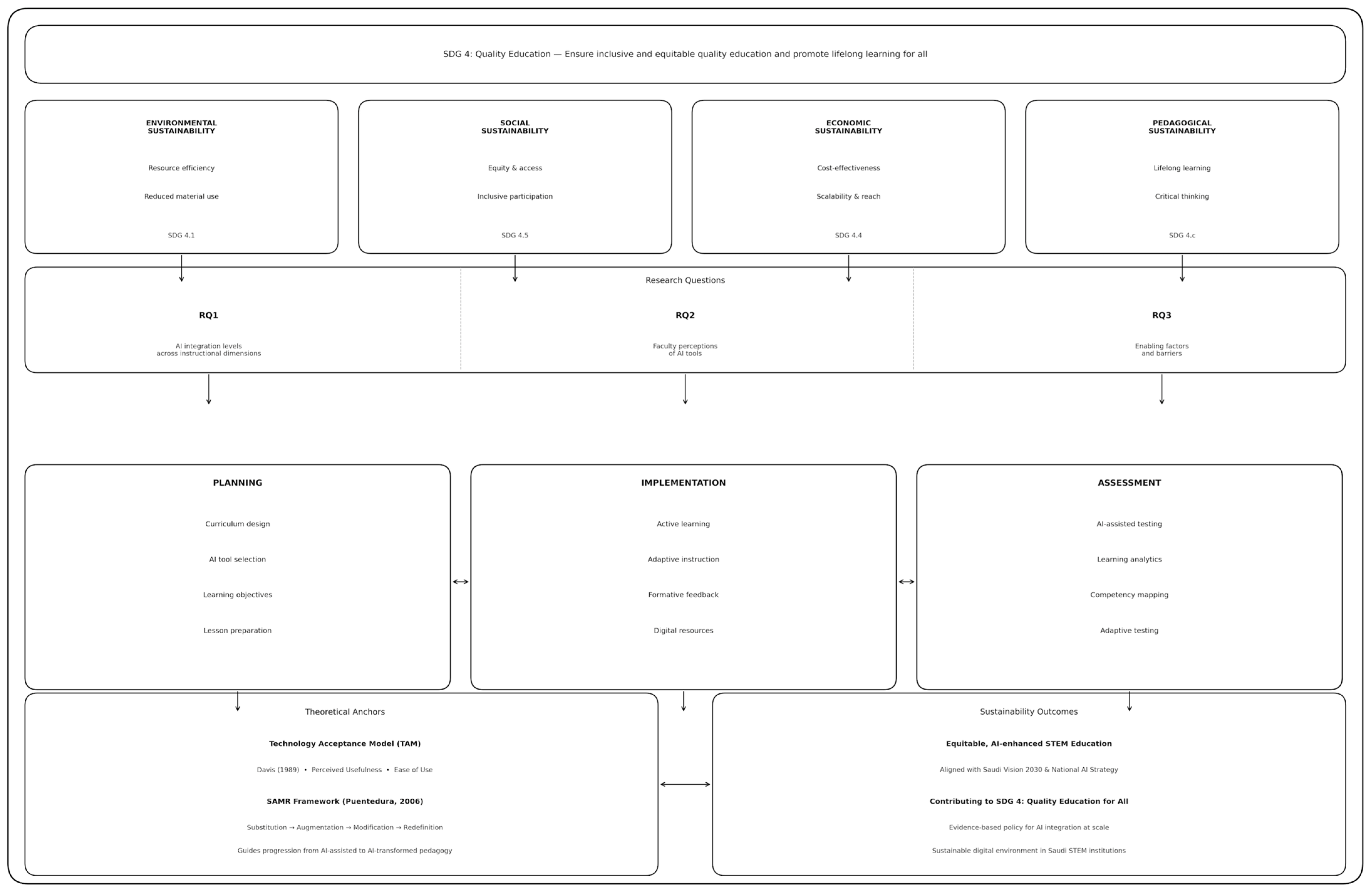
1.1.1. Environmental Sustainability
1.1.2. Social Sustainability and Equity
1.1.3. Economic Sustainability
1.1.4. Pedagogical Sustainability and Lifelong Learning
1.1.5. Institutional Resilience
1.2. Faculty Role in Sustainable AI Integration
1.3. AI in STEM Education and Sustainable Transformation
1.4. Current Landscape, Challenges, and Research Significance
1.5. Study Objectives and Questions
- RQ1: To what extent do STEM faculties integrate AI tools in ways that support sustainable education (SDG 4)?
- RQ2: What are faculty members’ perceptions of AI’s role in advancing sustainable STEM education?
- RQ3: How do faculties integrate AI in practice to promote sustainability, and what challenges do they face?
2. Methodology
2.1. Study Methodology
2.2. The Study Sample
2.2.1. Quantitative Sample
2.2.2. Qualitative Sample
- (a)
- Diversity in teaching experience, recognizing sustainability perspectives and digital competencies;
- (b)
- Variation in academic disciplines within STEM;
- (c)
- Representation of both genders.
2.3. Study Instruments
2.3.1. Questionnaire
- Section One: Demographic information gathered information on gender, academic discipline, and teaching experience. The selection of these variables was made to define the differences in AI integration patterns and sustainability perceptions among the groups of faculty members.
- Section Two: Practices of AI integration (43 items, three dimensions) included the use of AI in instructional processes by faculty members:
- ○
- Dimension 1: The instructional planning section contained 15 items that covered the application of AI in the context of content development and planning activities, and covered topics related to maintaining sustainability, including resource efficiency, equitable access, and integration of lifelong learning.
- ○
- Dimension 2: Instructional implementation (18 items) looked at AI in terms of delivery, adaptive instruction, simulations, and collaboration support.
- ○
- Dimension 3: Student assessment (10 items) evaluated the use of AI in formative and summative assessment, feedback, and monitoring in terms of efficiency, inclusivity, and continuous learning.
- Section Three: Perceptions of AI (19 items) measured the faculty perceptions of how AI contributes to educational quality, inclusivity, and sustainability. Questions related to items in the perceived benefit category, ethical and equity considerations, resource efficiency, and possible harm to autonomy or critical thinking were asked.
2.3.2. The Semi-Structured Interview
- Domain 1: AI Tools and Integration Practices
- ○
- The participants described the AI tools they were using and their application in teaching. The resource efficiency, accessibility, scalability, and implications of equity, including reduction in material usage, were investigated in the probes.
- Domain 2: Perceived Benefits
- ○
- Inquired questions were based on the subject of how AI assists in equity, diverse learners, and lifelong learning, and the contribution of AI to achieving educational efficiency and sustainability goals.
- Domain 3: Facilitating Factors
- ○
- The domain examined institutional facilitators, including the presence of an adequate infrastructure, the faculty development process, and the collaboration of the faculty, as well as correspondence between policies and the sustainability principles.
- Domain 4: Challenges and Barriers
- ○
- Respondents discussed barriers which were infrastructural and financial support, ethical cases and pedagogical conflicts between AI implementation and long-term learning objectives.
2.4. Data Analysis Procedures
2.5. Ethical Considerations
3. Research Results
3.1. Findings Related to Research Question One
3.1.1. Integration in Instructional Planning
3.1.2. Integration in Instructional Implementation
3.1.3. Integration in Students’ Assessment
3.2. Findings Related to Research Question Two
Sustainability Themes in Faculty Perceptions
3.3. Findings Related to Research Question Three
3.3.1. Domain One: Integration Approaches in Instruction
3.3.2. Domain Two: Benefits of AI for Sustainable Education
3.3.3. Domain Three: Challenges and Barriers
4. Discussion
4.1. The Current State of AI Integration: Interpreting the Moderate but Uneven Development
4.2. Faculty Perceptions and Integration Mechanisms: Positive Attitudes with Emerging Sustainable Practices
4.3. Challenges to Sustainable Integration: Systemic Barriers Requiring Comprehensive Response
- Environmental: AI-based virtual laboratories and online materials minimize waste and emissions.
- Economic: It allows cost-effective scaling of education due to the gains of efficiency.
- Social: On the one hand, personalized learning entails inclusion and quality in the event of equal access.
- Pedagogical: Retention of critical and creative abilities are the guaranty of value in long-term learning.
- Professional: Workload/growth of professors—strong, innovative workforce.
5. Conclusions and Recommendations
5.1. Recommendations
- Recommendation 1: Investment in Infrastructure (SDG 4.a: Learning facilities and digital infrastructure)
- Recommendation 2: Faculty Development (SDG 4.c: Teacher development and AI pedagogy)
- Recommendation 3: Establishing Responsible AI Governance Frameworks (SDG 4.1 and 4.5: Quality and equitable education)
- Recommendation 4: Cross-Sector Collaboration (SDG 4.b and 4.7: Partnerships for sustainable education)
- Recommendation 5: Developing Student AI Literacy and Critical Thinking (SDG 4.4: Skills for employment and sustainable futures)
5.2. Future Research Directions
5.3. Limitations
Funding
Institutional Review Board Statement
Informed Consent Statement
Data Availability Statement
Acknowledgments
Conflicts of Interest
References
- Chassignol, M.; Khoroshavin, A.; Klimova, A.; Bilyatdinova, A. Artificial intelligence trends in education: A narrative overview. Procedia Comput. Sci. 2018, 136, 16–24. [Google Scholar] [CrossRef]
- Chen, L.; Chen, P.; Lin, Z. Artificial intelligence in education: A review. IEEE Access 2020, 8, 75264–75278. [Google Scholar] [CrossRef]
- Popenici, S.A.D.; Kerr, S. Exploring the impact of artificial intelligence on teaching and learning in higher education. Res. Pract. Technol. Enhanc. Learn. 2017, 12, 22. [Google Scholar] [CrossRef]
- Zawacki-Richter, O.; Marín, V.I.; Bond, M.; Gouverneur, F. Systematic review of research on artificial intelligence applications in higher education—Where are the educators? Int. J. Educ. Technol. High. Educ. 2019, 16, 39. [Google Scholar] [CrossRef]
- Ahmad, S.; Rahmat, M.; Mubarik, M.; Alam, M.; Hyder, S. Artificial intelligence and its role in education. Sustainability 2021, 13, 12902. [Google Scholar] [CrossRef]
- United Nations. Transforming Our World: The 2030 Agenda for Sustainable Development; (Resolution A/RES/70/1); United Nations: New York, NY, USA, 2015. Available online: https://sdgs.un.org/2030agenda (accessed on 1 November 2025).
- UNESCO. Education for Sustainable Development: A Roadmap; UNESCO: Paris, France, 2020. [CrossRef]
- Vare, P.; Scott, W. Learning for a change: Exploring the relationship between education and sustainable development. J. Educ. Sustain. Dev. 2007, 1, 191–198. [Google Scholar] [CrossRef]
- Akgun, S.; Greenhow, C. Artificial intelligence in education: Addressing ethical challenges in K-12 settings. AI Ethics 2021, 2, 431–440. [Google Scholar] [CrossRef]
- Xu, W.; Ouyang, F. The application of AI technologies in STEM education: A systematic review from 2011 to 2021. Int. J. STEM Educ. 2022, 9, 59. [Google Scholar] [CrossRef]
- Chan, C.K.Y.; Hu, W. Students’ voices on generative AI: Perceptions, benefits, and challenges in higher education. Int. J. Educ. Technol. High. Educ. 2023, 20, 43. [Google Scholar] [CrossRef]
- Hodges, C.; Moore, S.; Lockee, B.; Trust, T.; Bond, M.A. The Difference Between Emergency Remote Teaching and Online Learning. Educ. Rev. 2020, 27, 1–9. Available online: https://er.educause.edu/articles/2020/3/the-difference-between-emergency-remote-teaching-and-online-learning (accessed on 1 November 2025).
- Bozkurt, A.; Sharma, R.C. Emergency remote teaching in a time of global crisis due to coronavirus pandemic. Asian J. Distance Educ. 2020, 15, i–vi. [Google Scholar] [CrossRef]
- Basilaia, G.; Kvavadze, D. Transition to online education in schools during a SARS-CoV-2 coronavirus (COVID-19) pandemic in Georgia. Pedagog. Res. 2020, 5, em0060. [Google Scholar] [CrossRef] [PubMed]
- Karsenti, T. Artificial intelligence in education: The urgent need to prepare teachers for tomorrow’s schools. Form. Et Prof. 2019, 27, 105–111. [Google Scholar] [CrossRef]
- Saputro, A.; Rohaeti, E.; Prodjosantoso, A.K. Using inquiry-based laboratory instruction to improve critical thinking and scientific process skills among preservice elementary teachers. Eurasian J. Educ. Res. 2019, 19, 151–170. [Google Scholar] [CrossRef]
- Triplett, W. Impact of Technology Integration in STEM Education. Cybersecur. Innov. Technol. J. 2023, 1, 16–23. [Google Scholar] [CrossRef]
- Laupichler, M.C.; Aster, A.; Schirch, J.; Raupach, T. Artificial intelligence literacy in higher and adult education: A scoping literature review. Comput. Educ. Artif. Intell. 2022, 3, 100101. [Google Scholar] [CrossRef]
- Park, J.; Teo, T.; Teo, A.; Chang, J.; Koo, S. Integrating artificial intelligence into science lessons: Teachers’ experiences and views. Int. J. STEM Educ. 2023, 10, 61. [Google Scholar] [CrossRef]
- Celik, I. Towards Intelligent-TPACK: An empirical study on teachers’ professional knowledge to ethically integrate artificial intelligence (AI)-based tools into education. Comput. Hum. Behav. 2023, 138, 107468. [Google Scholar] [CrossRef]
- Mah, D.-K.; Groß, N. Artificial intelligence in higher education: Exploring faculty use, self-efficacy, distinct profiles, and professional development needs. Int. J. Educ. Technol. High. Educ. 2024, 21, 58. [Google Scholar] [CrossRef]
- Shamsuddinova, S.; Heryani, P.; Naval, M. Evolution to revolution: Critical exploration of educators’ perceptions of the impact of Artificial Intelligence (AI) on the teaching and learning process in the GCC region. Int. J. Educ. Res. 2024, 125, 102326. [Google Scholar] [CrossRef]
- Baker, T.; Smith, L. Educ-AI-tion Rebooted? Exploring the Future of Artificial Intelligence in Schools and Colleges. NESTA Report. 2019. Available online: https://media.nesta.org.uk/documents/Future_of_AI_and_education_v5_WEB.pdf (accessed on 1 January 2026).
- Florea, A.; Radu, S. Artificial intelligence and education. In Proceedings of the 22nd International Conference on Control Systems and Computer Science (CSCS); IEEE: Piscataway, NJ, USA, 2019; pp. 381–382. [Google Scholar] [CrossRef]
- Pisica, A.I.; Edu, T.; Zaharia, R.M.; Zaharia, R. Implementing Artificial Intelligence in Higher Education: Pros and Cons from the Perspectives of Academics. Societies 2023, 13, 118. [Google Scholar] [CrossRef]
- Zhao, Y.; Liu, G. How Do Teachers Face Educational Changes in Artificial Intelligence Era. In Proceedings of the International Workshop on Education Reform and Social Sciences (ERSS 2018); Atlantis Press: Dordrecht, The Netherlands, 2019. [Google Scholar] [CrossRef]
- Darling-Hammond, L.; Hyler, M.E.; Gardner, M. Effective Teacher Professional Development; Learning Policy Institute: Palo Alto, CA, USA, 2017. [Google Scholar] [CrossRef]
- Huang, J.; Saleh, S.; Liu, Y. A Review on Artificial Intelligence in Education. Acad. J. Interdiscip. Stud. 2021, 10, 206–2017. [Google Scholar] [CrossRef]
- Naidoo, G.M.; Madida, M.; Rugbeer, H. Conceptual framework for ICT integration in rural secondary schools in South Africa. J. Gend. Inf. Dev. Afr. (JGIDA) 2019, 8, 187–212. [Google Scholar] [CrossRef]
- Kong, S.; Ogata, H.; Shih, J.-L. The role of Artificial Intelligence in STEM education. In Proceedings of the International Conference on Computers in Education; Asia-Pacific Society for Computers in Education: Taoyuan City, Taiwan, 2021; pp. 774–776. Available online: https://library.apsce.net/index.php/ICCE/article/view/4336 (accessed on 1 November 2025).
- Asia Pacific Foundation of Canada; Korea AI Ethics Association; Chung-Ang University. Talent for the Future: AI Education for K-12 in Canada and South Korea; Asia Pacific Foundation of Canada: Vancouver, BC, Canada, 2021. [Google Scholar]
- Chounta, I.A.; Bardone, E.; Raudsep, A.; Pedaste, M. Exploring Teachers’ Perceptions of Artificial Intelligence as a Tool to Support their Practice in Estonian K-12 Education. Int. J. Artif. Intell. Educ. 2022, 32, 725–755. [Google Scholar] [CrossRef]
- Crompton, H.; Jones, M.; Burke, D. Affordances and challenges of artificial intelligence in K-12 education: A systematic review. J. Res. Technol. Educ. 2024, 56, 248–268. [Google Scholar] [CrossRef]
- Salas-Pilco, S.Z.; Yang, Y. Artificial intelligence applications in Latin American higher education: A systematic review. Int. J. Educ. Technol. High. Educ. 2022, 19, 21. [Google Scholar] [CrossRef]
- Liang, J.; Stephens, J.M.; Brown, G.T.L. A systematic review of the early impact of artificial intelligence on higher education curriculum, instruction, and assessment. Front. Educ. 2025, 10, 1522841. [Google Scholar] [CrossRef]
- Creswell, J.W.; Poth, C.N. Qualitative Inquiry and Research Design: Choosing Among Five Approaches, 4th ed.; SAGE: Thousand Oaks, CA, USA, 2018. [Google Scholar]
- Guest, G.; Bunce, A.; Johnson, L. How many interviews are enough? An experiment with data saturation and variability. Field Methods 2006, 18, 59–82. [Google Scholar] [CrossRef]
- Patton, M.Q. Qualitative Research and Evaluation Methods, 4th ed.; SAGE: Thousand Oaks, CA, USA, 2015. [Google Scholar]
- Kaiser, H.F. An index of factorial simplicity. Psychometrika 1974, 39, 31–36. [Google Scholar] [CrossRef]
- Field, A. Discovering Statistics Using IBM SPSS Statistics, 5th ed.; SAGE Publications: Thousand Oaks, CA, USA, 2018. [Google Scholar]
- Horn, J.L. A rationale and test for the number of factors in factor analysis. Psychometrika 1965, 30, 179–185. [Google Scholar] [CrossRef] [PubMed]
- Hayton, J.C.; Allen, D.G.; Scarpello, V. Factor retention decisions in exploratory factor analysis: A tutorial on parallel analysis. Organ. Res. Methods 2004, 7, 191–205. [Google Scholar] [CrossRef]
- Kaiser, H.F. The application of electronic computers to factor analysis. Educ. Psychol. Meas. 1960, 20, 141–151. [Google Scholar] [CrossRef]
- Hair, J.F.; Black, W.C.; Babin, B.J.; Anderson, R.E. Multivariate Data Analysis, 8th ed.; Cengage Learning: South Melbourne, VIC, Australia, 2019. [Google Scholar]
- Stevens, J.P. Applied Multivariate Statistics for the Social Sciences, 5th ed.; Routledge: Oxfordshire, UK, 2009. [Google Scholar]
- Tabachnick, B.G.; Fidell, L.S. Using Multivariate Statistics, 7th ed.; Pearson: Richmond, VIC, Australia, 2019. [Google Scholar]
- Nunnally, J.C. Psychometric Theory, 2nd ed.; McGraw-Hill: North Ryde, NSW, Australia, 1978. [Google Scholar]
- Joshi, A.; Kale, S.; Chandel, S.; Pal, D. Likert scale: Explored and explained. Br. J. Appl. Sci. Technol. 2015, 7, 396–403. [Google Scholar] [CrossRef]
- Norman, G. Likert scales, levels of measurement and the “laws” of statistics. Adv. Health Sci. Educ. 2010, 15, 625–632. [Google Scholar] [CrossRef] [PubMed]
- Braun, V.; Clarke, V. Using thematic analysis in psychology. Qual. Res. Psychol. 2006, 3, 77–101. [Google Scholar] [CrossRef]
- Davis, F.D. Perceived usefulness, perceived ease of use, and user acceptance of information technology. MIS Q. 1989, 13, 319–340. [Google Scholar] [CrossRef]
- Puentedura, R.R. Transformation, Technology, and Education. [Presentation]. 2006. Available online: http://hippasus.com/resources/tte/ (accessed on 1 December 2025).
- Gerlich, M. AI tools in society: Impacts on cognitive offloading and the future of critical thinking. Societies 2025, 15, 6. [Google Scholar] [CrossRef]
- Lyu, W.; Zhang, S.; Chuang, T.; Sun, Y.; Zhang, Y. Understanding the Practices, Perceptions, and (Dis) Trust of Generative AI among Instructors: A Mixed-methods Study in the US Higher Education. Comput. Educ. Artif. Intell. 2025, 8, 100383. [Google Scholar] [CrossRef]



| Variable | Category | n | % |
|---|---|---|---|
| Gender | Male | 131 | 40.4 |
| Female | 193 | 59.6 | |
| Discipline | Science | 93 | 28.7 |
| Technology | 88 | 27.1 | |
| Engineering | 82 | 25.3 | |
| Mathematics | 61 | 18.8 | |
| Years of Experience | Less than 5 Years | 101 | 31.2 |
| 5–10 Years | 132 | 40.7 | |
| More than 10 Years | 91 | 28.1 |
| N | Gender | Discipline | Years of Experience |
|---|---|---|---|
| 1 | Male | Science | 7 |
| 2 | Male | Science | 11 |
| 3 | Male | Engineering | 6 |
| 4 | Male | IT/Computer Science | 5 |
| 5 | Male | Engineering | 13 |
| 6 | Male | Science | 12 |
| 7 | Female | Mathematics | 9 |
| 8 | Female | Science | 11 |
| 9 | Female | IT/Computer Science | 16 |
| 10 | Female | Engineering | 4 |
| 11 | Female | Engineering | 6 |
| 12 | Female | Mathematics | 10 |
| N | Item | M | SD | Level |
|---|---|---|---|---|
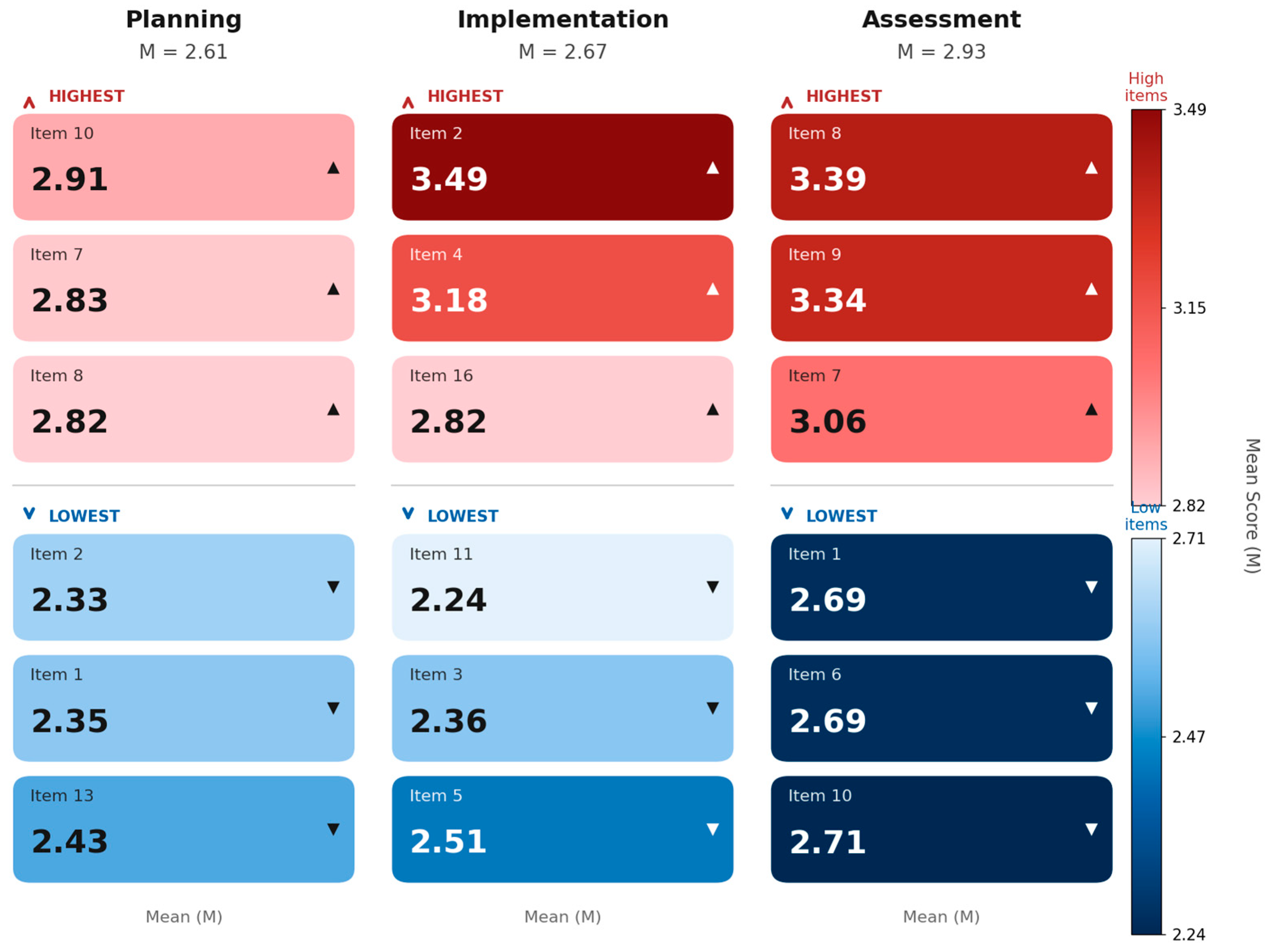
| 1 | I plan to transform the classroom into an active scientific lab through the integration of AI tools. | 2.35 | 0.97 | Low |
| 2 | I design scientific content for the selected AI tool in a way that is easy to use and motivating. | 2.33 | 0.92 | Low |
| 3 | I use AI tools to analyze students’ characteristics and their learning capabilities. | 2.49 | 0.97 | Low |
| 4 | I plan utilizing AI tools in conducting STEM experiments which are difficult to perform in the real world. | 2.47 | 1.02 | Low |
| 5 | I identify AI-compatible learning resources and tools (such as games, applications, software, videos, audio materials, models, etc.) which can be used to teach STEM topics. | 2.64 | 0.98 | Medium |
| 6 | I design a teaching plan for STEM topics that is organized and aligned with AI tools such as robotics, chatbots, etc. | 2.70 | 1.00 | Medium |
| 7 | I use AI tools in formulating learning objectives and outcomes which contribute to developing self-learning skills. | 2.83 | 1.00 | Medium |
| 8 | The learning activities and experiences I select or design are relevant to students’ lives and STEM disciplines, and can be implemented using AI tools. | 2.81 | 0.91 | Medium |
| 9 | I design and prepare a classroom environment suitable for implementing AI tools. | 2.81 | 0.88 | Medium |
| 10 | I ensure that STEM lessons include higher-order thinking skills required to integrate AI tools. | 2.91 | 0.99 | Medium |
| 11 | I use AI tools that are suitable for university level and are aligned with students’ abilities, potential, and individual differences in using AI tools. | 2.50 | 0.96 | Low |
| 12 | I use AI tools that meet student needs. | 2.49 | 0.96 | Low |
| 13 | I design an AI-based e-learning platform which allows students to actively interact with academic content. | 2.42 | 1.04 | Low |
| 14 | I use pedagogical strategies implementable through AI tools and aligned with scientific content, learning situation, and learning outcomes. | 2.64 | 0.97 | Medium |
| 15 | I analyze the learning content to identify lesson objectives using the available AI tools. | 2.70 | 1.02 | Medium |
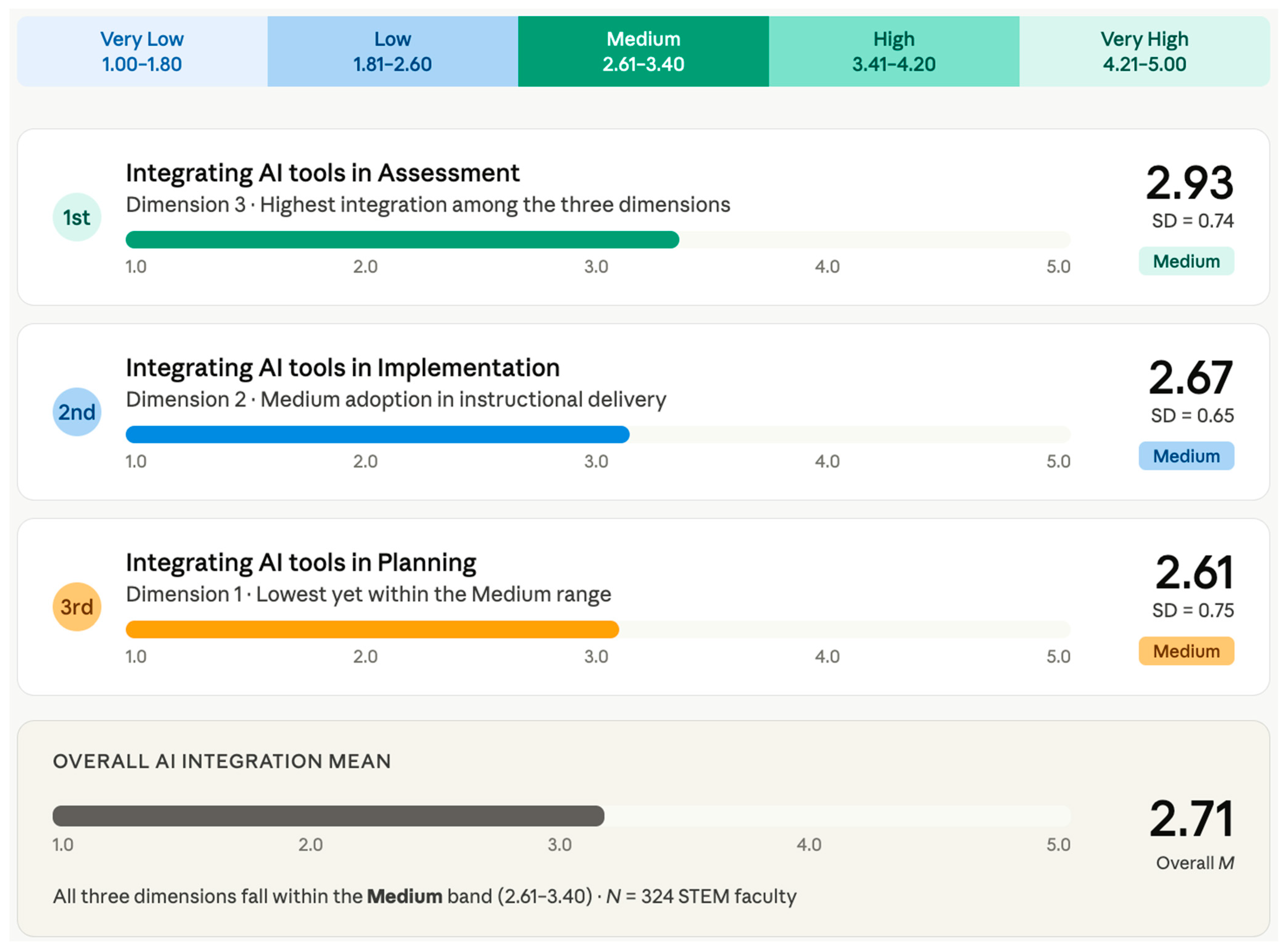
| Integrating AI Tools in Planning | 2.61 | 0.99 | Medium | |
| N | Item | M | SD | Level |
|---|---|---|---|---|
| 1 | I employ an AI tool in preparing students before starting instruction. | 2.68 | 0.82 | Medium |
| 2 | I use electronic platforms as an AI tool in implementing STEM lessons remotely. | 3.49 | 1.20 | High |
| 3 | I use an AI tool to help students visualize abstract scientific concepts. | 2.35 | 0.87 | Low |
| 4 | I communicate with students through electronic chat to answer their inquiries and provide guidance and counseling. | 3.17 | 0.92 | Medium |
| 5 | I encourage students to use an AI tool to identify and correct their misconceptions. | 2.50 | 0.93 | Low |
| 6 | I use AI tools suitable for smartphones (such as Siri, Google Assistant, etc.) in implementing STEM lessons. | 2.48 | 0.77 | Low |
| 7 | I encourage students during STEM lessons to interact and engage with images and 3D simulations prepared by AI tools. | 2.66 | 1.08 | Medium |
| 8 | I direct students to follow the feedback provided by AI tools. | 2.82 | 1.11 | Medium |
| 9 | I use AI tools to present and implement real-life examples related to students’ daily life situations in STEM lessons. | 2.58 | 0.82 | Low |
| 10 | I use AI tools in implementing STEM lessons to increase students’ motivation for learning and capture their attention. | 2.66 | 0.81 | Medium |
| 11 | I make sure to utilize an AI tool, such as a robot, to enable students to engage in discussions with it about STEM topics and lessons. | 2.23 | 0.67 | Low |
| 12 | I use intelligent learning systems and AI-based adaptive learning platforms to reshape students’ interaction with the learning process. | 2.49 | 0.77 | Low |
| 13 | I provide equal opportunities to all learners to use AI tools while implementing curricular and extra-curricular activities. | 2.68 | 1.07 | Medium |
| 14 | I motivate students to use AI tools as teaching assistants to support them in research and investigation; task implementation; writing composition; and reaching conclusions, while verifying these tools’ accuracy and reliability. | 2.48 | 0.77 | Low |
| 15 | I use text, image, and voice search engines powered by AI. | 2.63 | 1.08 | Medium |
| 16 | I provide learners with guidance and support while using AI tools. | 2.82 | 1.12 | Medium |
| 17 | I utilize AI tools (such as Kahoot, EdSights, Synthesia, Google Meet) to enhance effective communication among students, motivate them to interact positively, exchange ideas in innovative ways, and foster values of cooperation and mutual respect in an interactive learning environment. | 2.56 | 0.81 | Low |
| 18 | I implement diverse instructional strategies (such as: discussion and dialogue; inquiry; cooperative learning; gaming; modeling; problem-solving; and project-based learning) that are compatible with AI tools. | 2.63 | 0.80 | Medium |
| The Integration of AI Tools in the Implementation of STEM Instruction | 2.66 | 0.96 | Medium | |
| N | Item | M | SD | Level |
|---|---|---|---|---|
| 1 | I make sure to integrate assessment activities and situations suitable for AI tools. | 2.69 | 0.83 | Medium |
| 2 | I make sure to use AI tools to create comprehensive and detailed reports on topics that are difficult to understand. | 2.78 | 0.86 | Medium |
| 3 | I utilize AI-powered assessment tools (such as Quizizz, AI Scoring in Microsoft Forms, Cognii) to enhance the accuracy and speed of assessment while providing immediate feedback. | 2.93 | 0.91 | Medium |
| 4 | I formulate clear, progressively difficult questions using AI tools. | 2.96 | 0.94 | Medium |
| 5 | I make sure to provide electronic performance reports for each student after every educational stage using AI tools. | 2.72 | 0.90 | Medium |
| 6 | I utilize AI tools to predict the progression of students’ performance. | 2.69 | 0.88 | Medium |
| I use AI to measure students’ responses and attitudes towards scientific activities and STEM disciplines. | 3.06 | 0.96 | Medium | |
| 7 | I design digital tests that ensure academic integrity using AI tools. | 3.38 | 1.05 | Medium |
| 8 | I utilize AI tools to prepare and assess assignments. | 3.34 | 0.94 | Medium |
| 9 | I utilize AI tools to identify common student mistakes and suggest ways to address them. | 2.71 | 0.88 | Medium |
| The Integration of AI Tools in Assessment | 2.93 | 0.95 | Medium | |
| N | Items | M | SD | Level |
|---|---|---|---|---|
| 1 | AI tools enhance my teaching performance in terms of planning, implementation, and assessment. | 3.48 | 0.69 | High |
| 2 | Using AI tools helps students understand and comprehend STEM disciplines. | 3.53 | 0.69 | High |
| 3 | Using AI tools develops students’ interest and motivation towards STEM disciplines. | 3.94 | 0.86 | High |
| 4 | AI tools improve students’ performance, reflecting positively on their academic achievement and grades. | 4.01 | 0.89 | High |
| 5 | AI tools are easy to use in STEM instruction. | 4.14 | 0.93 | High |
| 6 | I have the knowledge and skills that enable me to utilize AI tools in STEM instruction. | 4.18 | 0.91 | High |
| 7 | Using AI tools aligns with the modern trends in STEM instruction. | 4.20 | 0.81 | High |
| 8 | Using AI tools achieves active learning and effectiveness. | 4.13 | 0.87 | High |
| 9 | Using AI tools is not in violation of the educational regulations of either the Ministry of Education or the university. | 3.64 | 0.98 | High |
| 10 | Using AI tools meets the needs of faculty members’ professional needs. | 4.10 | 0.85 | High |
| 11 | Using AI tools in STEM instruction achieves the scientific standards of university instruction and of technology integration. | 4.17 | 0.87 | High |
| 12 | Using AI tools facilitates the communication between a faculty member and their students. | 3.83 | 0.94 | High |
| 13 | Excessive use of AI tools may affect students’ critical and creative thinking, diminishing their thinking capabilities in the future. | 4.16 | 0.86 | High |
| 14 | Using AI tools in STEM instruction promotes connecting scientific concepts with life skills. | 4.12 | 0.95 | High |
| 15 | Using AI tools in STEM instruction equips students with digital skills to thrive in a better society that is globally competitive. | 4.19 | 0.81 | High |
| 16 | Using AI tools in STEM instruction enables students to apply appropriate scientific concepts and practices. | 4.03 | 0.91 | High |
| 17 | AI tools help students develop their academic writing skills, enhancing the quality of their work and learning outcomes. | 3.95 | 0.83 | High |
| 18 | AI tools enhance students’ efficiency in developing language skills, thereby improving their ability to express themselves more effectively. | 4.15 | 0.86 | High |
| 19 | Students’ over-dependence on AI tools in completing their assignments and tasks may lead to weak self-efficacy and practical skills in the long term. | 4.13 | 0.86 | High |
| Faculty Members’ Perceptions towards AI Tools | 4.00 | 0.21 | High | |
Disclaimer/Publisher’s Note: The statements, opinions and data contained in all publications are solely those of the individual author(s) and contributor(s) and not of MDPI and/or the editor(s). MDPI and/or the editor(s) disclaim responsibility for any injury to people or property resulting from any ideas, methods, instructions or products referred to in the content. |
© 2026 by the author. Licensee MDPI, Basel, Switzerland. This article is an open access article distributed under the terms and conditions of the Creative Commons Attribution (CC BY) license.
Share and Cite
Althubyani, A.R. Responsible AI Integration in STEM Higher Education: Advancing Sustainable Development Goals. Sustainability 2026, 18, 4005. https://doi.org/10.3390/su18084005
Althubyani AR. Responsible AI Integration in STEM Higher Education: Advancing Sustainable Development Goals. Sustainability. 2026; 18(8):4005. https://doi.org/10.3390/su18084005
Chicago/Turabian StyleAlthubyani, Adel R. 2026. "Responsible AI Integration in STEM Higher Education: Advancing Sustainable Development Goals" Sustainability 18, no. 8: 4005. https://doi.org/10.3390/su18084005
APA StyleAlthubyani, A. R. (2026). Responsible AI Integration in STEM Higher Education: Advancing Sustainable Development Goals. Sustainability, 18(8), 4005. https://doi.org/10.3390/su18084005