Development of a Multi-Dimensional Framework for Interpreting the Sustainability of Textile Materials

Abstract
1. Introduction
2. Methods
2.1. Research Overview
2.2. Material Selection and Categorization
- materials that are currently commercially available, are expected to reach near-term commercialization, or have demonstrated technical feasibility;
- materials for which sustainability-related information on textile materials is accessible; and
- materials representing a broad range of material origin categories.
2.3. Framework Development Procedure
2.4. Assessment Procedure
- Each material was assessed independently for renewability, process sustainability, EoL options, and material source; and
- Qualitative content analysis was conducted based on multiple data sources, including LCA studies, industrial reports, corporate disclosures, patents, and technical datasheets, drawing on established life-cycle-based assessment frameworks [14,30], thereby enabling consistent and reproducible interpretation under defined analytical criteria.
3. Results
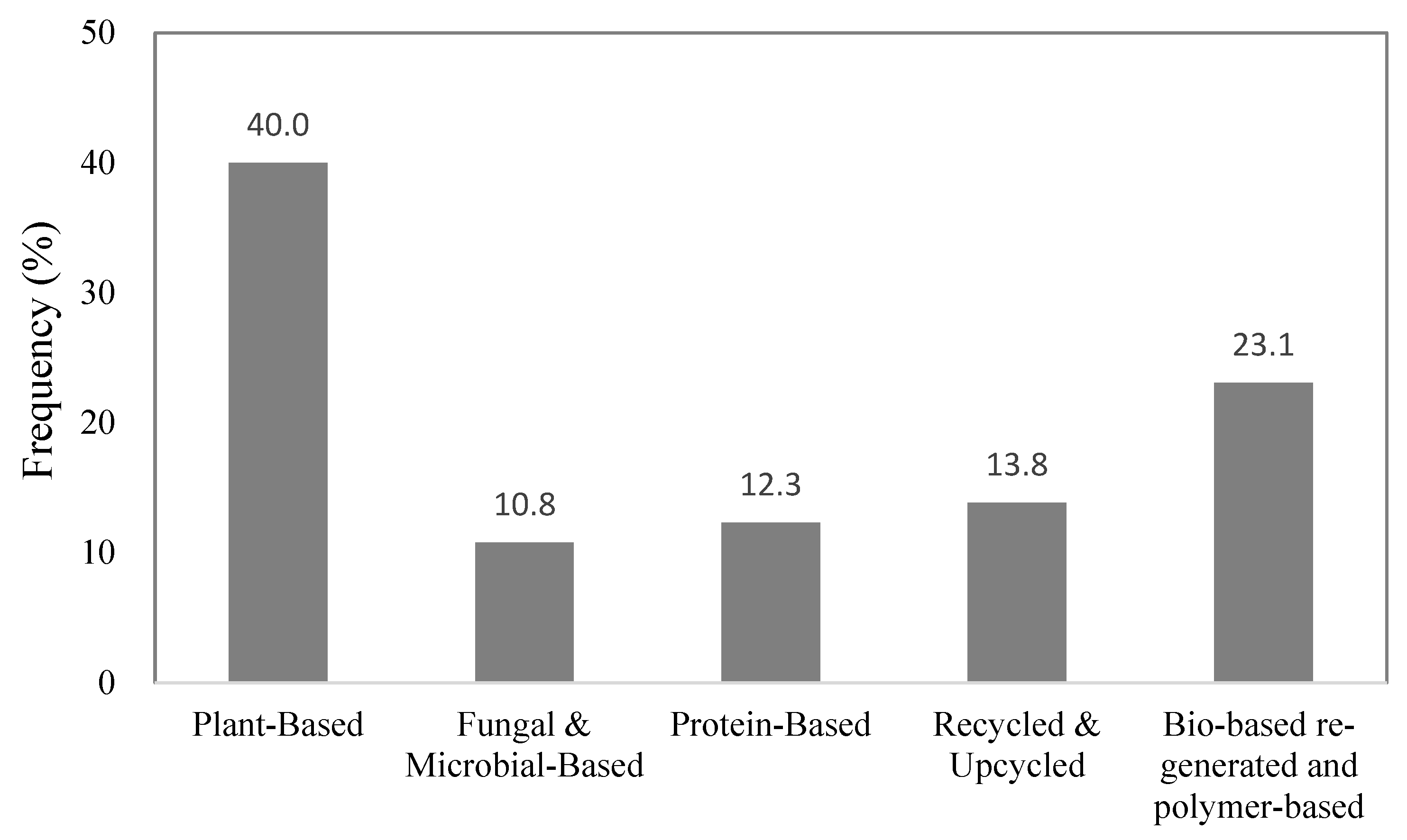
3.1. Origin-Centered Classification of Textile Materials and Trend Analysis
3.2. Comparative Case Study and Limitations
3.3. Development of a Multi-Dimensional Sustainability Assessment Framework
3.3.1. Renewability
3.3.2. Process Sustainability
3.3.3. End-of-Life Options
3.3.4. Material Source
4. Conclusions
Funding
Institutional Review Board Statement
Informed Consent Statement
Data Availability Statement
Acknowledgments
Conflicts of Interest
Appendix A
Classification Criteria
- Material Structure: Materials were classified according to commonly recognized textile forms, including woven, knitted, nonwoven, composite, and layered structures. In cases of emerging or hybrid materials, structural classification reflects typical or re-ported configurations.
- Intended Application: Intended application was defined based on the primary end-use context of each material, including apparel, technical textiles (e.g., automotive, filtration, medical), leather alternatives or coated materials, and packaging or disposable applications.

| Category | Sub-Category | No. | Material | Structure | Intended Application |
|---|---|---|---|---|---|
| Plant-Based | Agricultural & Natural | 1 | agave | fiber/woven | apparel/technical |
| 2 | bamboo linen | fiber/woven | apparel | ||
| 3 | banana fiber (abacá) | fiber/woven | apparel/technical | ||
| 4 | coconut coir | fiber/nonwoven | technical | ||
| 5 | jute | fiber/woven | technical | ||
| 6 | kapok | fiber | filling/textile | ||
| 7 | lotus fiber | fiber/woven | apparel | ||
| 8 | organic cotton | fiber/woven/knitted | apparel | ||
| 9 | organic hemp | fiber/woven | apparel/technical | ||
| 10 | organic linen | fiber/woven | apparel | ||
| 11 | palm leather | composite | leather alternative | ||
| 12 | soy fabric | fiber/knitted | apparel | ||
| 13 | barley | composite | experimental | ||
| 14 | bagasse | nonwoven | packaging/technical | ||
| Agricultural Residue | 15 | corn husk | nonwoven | packaging | |
| 16 | grain | composite | experimental | ||
| 17 | wheat straw | nonwoven | packaging | ||
| 18 | rice straw | nonwoven | packaging | ||
| Food Waste-Derived | 19 | Piñatex | nonwoven/composite | leather alternative | |
| 20 | AppleSkin™ | composite | leather alternative | ||
| 21 | GrapeSkin | composite | leather alternative | ||
| 22 | mango leather | composite | leather alternative | ||
| 23 | orange fiber | fiber/woven | apparel | ||
| 24 | tomato peel | composite | experimental | ||
| 25 | Vegea | composite | leather alternative | ||
| Marine- & Algae-Based | 26 | Kelsun™ | fiber | textile/technical | |
| Fungal & Microbial | Bacterial Cellulose | 27 | kombucha leather (SCOBY) | nonwoven | experimental/textile |
| 28 | Modern Synthesis | composite | textile | ||
| Mycelium-Derived | 29 | Ecovative materials | composite | packaging/textile | |
| 30 | Mogu | composite | interior/textile | ||
| 31 | MycoTEX® | composite | apparel | ||
| 32 | Mylo™ | composite | leather alternative | ||
| 33 | Reishi™ | composite | leather alternative | ||
| Protein-Based | Natural Protein Fibers | 34 | ahimsa silk | fiber/woven | apparel |
| 35 | organic leather | composite | leather | ||
| 36 | organic silk | fiber/woven | apparel | ||
| 37 | organic wool | fiber/knitted/woven | apparel | ||
| Bioengineered Protein Fibers | 38 | Microsilk | fiber | technical/textile | |
| 39 | Qmonos | fiber | technical | ||
| 40 | spider silk | fiber | technical | ||
| 41 | Werewool material | fiber | textile | ||
| Recycled & Upcycled | Recycled Synthetic Fibers | 42 | Ocean Born polyester | fiber/woven/knitted | apparel |
| 43 | ECONYL® | fiber/knitted | apparel | ||
| 44 | rPET | fiber/woven/knitted | apparel | ||
| 45 | deadstock fabric | woven | apparel | ||
| 46 | reclaimed cashmere | knitted | apparel | ||
| 47 | reclaimed cotton | fiber/woven/knitted | apparel | ||
| 48 | reclaimed wool | knitted | apparel | ||
| Hybrid Recycled Fibers | 49 | Algoblend® | composite | apparel | |
| 50 | recycled plastic | composite | technical | ||
| Bio-based regenerated | Regenerated Cellulosic Fibers | 51 | bamboo lyocell | fiber/woven/knitted | apparel |
| 52 | Ecovero | fiber/woven | apparel | ||
| 53 | modal | fiber/knitted | apparel | ||
| 54 | Tencel™ | fiber/woven/knitted | apparel | ||
| 55 | SeaCell™ | fiber/woven/knitted | apparel/technical | ||
| Bio-based polymer | Bio-based Synthetic Polymers (bioplastics) | 56 | algae-based foam | composite | packaging |
| 57 | BioPTMG | polymer | textile | ||
| 58 | PBS (Kintra) | fiber | textile | ||
| 59 | PAF | polymer | technical | ||
| 60 | PLA | fiber | textile | ||
| Bio-based polymer composite | Bio-based Polymer Composites / Hybrids | 61 | ALT TEX™ | fiber/composite | apparel |
| 62 | corn & castor PU | coated textile | leather alternative | ||
| 63 | BioVERA | coated textile | leather alternative | ||
| 64 | MIRUM® | layered | leather alternative | ||
| 65 | Susterra® propanediol | polymer intermediate | textile |
References
- Karthik, T.; Gopalakrishnan, D. Sustainable Fibres and Textiles: Design and Manufacture; Woodhead Publishing: Cambridge, UK, 2014. [Google Scholar]
- World Economic Forum. These Facts Show How Unsustainable the Fashion Industry Is. 2020. Available online: https://www.weforum.org/stories/2020/01/fashion-industry-carbon-unsustainable-environment-pollution/ (accessed on 28 May 2025).
- Gonzalez, V.; Lou, X.; Chi, T. Evaluating Environmental Impact of Natural and Synthetic Fibers: A Life Cycle Assessment Approach. Sustainability 2023, 15, 7670. [Google Scholar] [CrossRef]
- Mehmeti, A.; Abdelhafez, A.A.M.; Ellssel, P.; Todorovic, M.; Calabrese, G. Performance and Sustainability of Organic and Conventional Cotton Farming Systems in Egypt: An Environmental and Energy Assessment. Sustainability 2024, 16, 6637. [Google Scholar] [CrossRef]
- Moazzem, S.; Crossin, E.; Daver, F.; Wang, L. Assessing Environmental Impact Reduction Opportunities through Life Cycle Assessment of Apparel Products. Sustain. Prod. Consum. 2021, 28, 663–674. [Google Scholar] [CrossRef]
- Juanga-Labayen, J.P.; Labayen, I.V.; Yuan, Q. A Review on Textile Recycling Practices and Challenges. Textiles 2022, 2, 174–188. [Google Scholar] [CrossRef]
- Niinimäki, K.; Peters, G.; Dahlbo, H.; Perry, P.; Rissanen, T.; Gwilt, A. The Environmental Price of Fast Fashion. Nat. Rev. Earth Environ. 2020, 1, 189–200. [Google Scholar] [CrossRef]
- Damayanti, D.; Wulandari, L.A.; Bagaskoro, A.; Rianjanu, A.; Wu, H.-S. Possible Routes for Textile Recycling Technology. Polymers 2021, 13, 3834. [Google Scholar] [CrossRef]
- Farhana, K.; Kadirgama, K.; Mahamude, A.S.F.; Mica, M.T. Energy Consumption, Environmental Impact, and Implementation of Renewable Energy Resources in Global Textile Industries: An Overview towards Circularity and Sustainability. Mater. Circ. Econ. 2022, 4, 15. [Google Scholar] [CrossRef]
- Navarro, D.; Wu, J.; Lin, W.; Fullana-I-Palmer, P.; Puig, R. Life Cycle Assessment and Leather Production. J. Leather Sci. Eng. 2020, 2, 26. [Google Scholar] [CrossRef]
- European Commission. The European Green Deal and EU Taxonomy for Sustainable Activities; European Commission: Brussels, Belgium, 2019.
- European Commission. Commission Recommendation on the Use of the Environmental Footprint Methods; European Commission: Brussels, Belgium, 2021.
- European Parliament. Directive (EU) 2022/2464 on Corporate Sustainability Reporting (CSRD). Off. J. Eur. Union 2022, L322, 15–80. [Google Scholar]
- ISO 14040/44; Environmental Management—Life Cycle Assessment—Principles and Framework. International Organization for Standardization: Geneva, Switzerland, 2006.
- Sandin, G.; Peters, G.M. Environmental Impact of Textile Reuse and Recycling: A Review. J. Clean. Prod. 2018, 184, 353–365. [Google Scholar] [CrossRef]
- Fadara, T.G.; Wong, K.Y.; Zarei, H. A Comprehensive Framework for Sustainability Indicators in the Textile Industry of Developing Countries. Bus. Strategy Dev. 2024, 7, e332. [Google Scholar] [CrossRef]
- Roh, E.K. A Systematic Framework for Evaluating Sustainability in the Textile and Apparel Industry. Sustainability 2026, 18, 131. [Google Scholar] [CrossRef]
- Ribul, M.; Lanot, A.; Pisapia, C.T.; Purnell, P.; McQueen-Mason, S.J.; Baurley, S. Mechanical, Chemical, Biological: Moving towards Closed-Loop Bio-Based Recycling in a Circular Economy of Sustainable Textiles. J. Clean. Prod. 2021, 326, 129325. [Google Scholar] [CrossRef]
- European Commission. Commission Decision (EU) 2014/350 on the EU Ecolabel Criteria for Textile Products; European Commission: Brussels, Belgium, 2014.
- OEKO-TEX®. Standard 100 by OEKO-TEX®; OEKO-TEX® Association: Zurich, Switzerland, 2023. [Google Scholar]
- OEKO-TEX®. STeP by OEKO-TEX®: Sustainable Textile and Leather Production; OEKO-TEX® Association: Zurich, Switzerland, 2023. [Google Scholar]
- United Nations Environment Programme. Sustainability and Circularity in the Textile Value Chain: A Global Roadmap; UNEP: Nairobi, Kenya, 2023. [Google Scholar]
- Van der Velden, N.M.; Patel, M.K.; Vogtländer, J.G. LCA Benchmarking Study on Textiles Made of Cotton, Polyester, Nylon, Acryl, or Elastane. Int. J. Life Cycle Assess. 2014, 19, 331–356. [Google Scholar] [CrossRef]
- Baloyi, R.B.; Gbadeyan, O.J.; Sithole, B.; Chunilall, V. Recent Advances in Recycling Technologies for Waste Textile Fabrics: A Review. Text. Res. J. 2024, 94, 508–529. [Google Scholar] [CrossRef]
- Abagnato, S.; Rigamonti, L.; Grosso, M. Life Cycle Assessment Applications to Reuse, Recycling and Circular Practices for Textiles: A Review. Waste Manag. 2024, 182, 74–90. [Google Scholar] [CrossRef] [PubMed]
- Eppinger, E. Recycling Technologies for Enabling Sustainability Transitions of the Fashion Industry: Status Quo and Avenues for Increasing Post-Consumer Waste Recycling. Sustain. Sci. Pract. Policy 2022, 18, 114–128. [Google Scholar] [CrossRef]
- Harmsen, P.; Scheffer, M.; Bos, H. Textiles for Circular Fashion: The Logic Behind Recycling Options. Sustainability 2021, 13, 9714. [Google Scholar] [CrossRef]
- Lenzing AG. Sustainability Report and TENCEL™ Fiber Overview. 2024. Available online: https://reports.lenzing.com (accessed on 29 May 2025).
- Ribul, M.; Goldsworthy, K.; Collet, C. Material-Driven Textile Design (MDTD): A Methodology for Designing Circular Material-Driven Fabrication and Finishing Processes in the Materials Science Laboratory. Sustainability 2021, 13, 1268. [Google Scholar] [CrossRef]
- Muthu, S.S. Handbook of Life Cycle Assessment (LCA) of Textiles and Clothing; Woodhead Publishing: Cambridge, UK, 2015. [Google Scholar]
- Nath, D.; Misra, M.; Al-Daoud, F.; Mohanty, A.K. Studies on Poly(butylene succinate) and Poly(butylene succinate-co-adipate)-Based Biodegradable Plastics for Sustainable Flexible Packaging and Agricultural Applications. RSC Sustain. 2025, 3, 1267–1302. [Google Scholar] [CrossRef]
- Maragkaki, A.; Malliaros, N.G.; Sampathianakis, I.; Lolos, T.; Tsompanidis, C.; Manios, T. Evaluation of Biodegradability of Polylactic Acid and Compostable Bags from Food Waste under Industrial Composting. Sustainability 2023, 15, 15963. [Google Scholar] [CrossRef]
- Ellen MacArthur Foundation. Completing the Picture: How the Circular Economy Tackles Climate Change. 2019. Available online: https://ellenmacarthurfoundation.org (accessed on 28 May 2025).
- Amobonye, A.; Lalung, J.; Awasthi, M.K.; Pillai, S. Fungal Mycelium as Leather Alternative: A Sustainable Biogenic Material for the Fashion Industry. Sustain. Mater. Technol. 2023, 38, e00724. [Google Scholar] [CrossRef]
- Hopewell, J.; Dvorak, R.; Kosior, E. Plastics Recycling: Challenges and Opportunities. Philos. Trans. R. Soc. B 2009, 364, 2115–2126. [Google Scholar] [CrossRef]
- Ragaert, K.; Delva, L.; Van Geem, K. Mechanical and Chemical Recycling of Solid Plastic Waste. Waste Manag. 2017, 69, 24–58. [Google Scholar] [CrossRef] [PubMed]
- Singh, N.; Hui, D.; Singh, R.; Ahuja, I.P.S.; Feo, L.; Fraternali, F. Recycling of Plastic Solid Waste: A State of Art Review and Future Applications. Compos. Part B Eng. 2017, 115, 409–422. [Google Scholar] [CrossRef]
- Jehanno, C.; Pérez-Madrigal, M.M.; Demarteau, J.; Sardon, H.; Dove, A.P. Organocatalysis for Depolymerisation. Polym. Chem. 2019, 10, 172–186. [Google Scholar] [CrossRef]
- Tournier, V.; Topham, C.M.; Gilles, A.; David, B.; Folgoas, C.; Moya-Leclair, E.; Kamionka, E.; Desrousseaux, M.-L.; Texier, H.; Gavalda, S.; et al. An Engineered PET Depolymerase to Break Down and Recycle Plastic Bottles. Nature 2020, 580, 216–219. [Google Scholar] [CrossRef]
- Pringle, T.; Barwood, M.; Rahimifard, S. The Challenges in Achieving a Circular Economy within Leather Recycling. Procedia CIRP 2016, 48, 544–549. [Google Scholar] [CrossRef]
- Tonsi, G.; Maesani, C.; Ortenzi, M.A.; Alini, S.; Pirola, C. The Selective Dissolution–Precipitation Recycling: A Review on This Alternative Approach for the Recovery of Nylon-Based Waste Materials. Waste Manag. 2025, 204, 114937. [Google Scholar] [CrossRef] [PubMed]
- Maga, D.; Hiebel, M.; Thonemann, N. Life Cycle Assessment of Recycling Options for Polylactic Acid. Resour. Conserv. Recycl. 2019, 149, 86–96. [Google Scholar] [CrossRef]
- Haslinger, S.; Hummel, M.; Anghelescu-Hakala, A.; Määttänen, M.; Sixta, H. Upcycling of Cotton Polyester Blended Textile Waste to New Man-Made Cellulose Fibers. Waste Manag. 2019, 97, 88–96. [Google Scholar] [CrossRef] [PubMed]
- Perin, D.; Rigotti, D.; Fredi, G.; Papageorgiou, G.Z.; Bikiaris, D.N.; Dorigato, A. Innovative Bio-Based Poly(lactic acid)/Poly(alkylene furanoate)s Fiber Blends for Sustainable Textile Applications. J. Polym. Environ. 2021, 29, 3948–3963. [Google Scholar] [CrossRef]
- Shen, L.; Worrell, E.; Patel, M.K. Environmental Impact Assessment of Man-Made Cellulose Fibres. Resour. Conserv. Recycl. 2010, 55, 260–274. [Google Scholar] [CrossRef]
- Zhang, S.; Chen, C.; Duan, C.; Hu, H.; Li, H.; Li, J.; Liu, Y.; Ma, X.; Stavik, J.; Ni, Y. Regenerated Cellulose by the Lyocell Process: A Brief Review of the Process and Properties. BioResources 2018, 13, 4577–4592. [Google Scholar] [CrossRef]
- Vegea Company. Sustainability. 2025. Available online: https://www.vegeacompany.com/sustainability/ (accessed on 1 June 2025).
- MoEa. GrapeSkin—Material Specifications. 2024. Available online: https://moea.io/pages/grapeskin (accessed on 1 June 2025).
- Immaculate Vegan. What Is Vegea? The Plant-Based Leather Made from Grapes. 2024. Available online: https://immaculatevegan.com/blogs/magazine/raise-a-glass-to-this-vegan-leather-made-from-grapes (accessed on 1 June 2025).
- Reset.org. Vegea: Eco-Friendly Vegan Leather from Wine Industry Leftovers. 2018. Available online: https://en.reset.org/vegea-making-bags-and-shoes-wine-leftovers-05082018 (accessed on 1 June 2025).
- Reddy, M.M.; Vivekanandhan, S.; Misra, M.; Bhatia, S.K.; Mohanty, A.K. Biobased Plastics and Bionanocomposites: Current Status and Future Opportunities. Prog. Polym. Sci. 2013, 38, 1653–1689. [Google Scholar] [CrossRef]
- Volk, R.; Schröter, M.; Saeidi, N.; Steffl, S.; Javadian, A.; Hebel, D.E.; Schultmann, F. Life Cycle Assessment of Mycelium-Based Composite Materials. Resour. Conserv. Recycl. 2024, 205, 107579. [Google Scholar] [CrossRef]
- Klug, V.; Schöggl, J.P.; Dallinger, D.; Hiebler, K.; Stueckler, C.; Steiner, A.; Arzt, A.; Kappe, C.O.; Baumgartner, R.J. Comparative Life Cycle Assessment of Different Production Processes for Waterborne Polyurethane Dispersions. ACS Sustain. Chem. Eng. 2021, 9, 8980–8989. [Google Scholar] [CrossRef]
- Immaculate Vegan. COG Laika Women’s Grape Leather Vegan Ankle Boots (Product Specification). 2024. Available online: https://immaculatevegan.com/products/cog-laika-women-s-grape-leather-vegan-ankle-boots-black (accessed on 1 June 2025).
- Oliveira, M.S.; Luz, F.S.D.; Teixeira Souza, A.; Demosthenes, L.C.d.C.; Pereira, A.C.; Filho, F.d.C.G.; Braga, F.d.O.; Figueiredo, A.B.-H.d.S.; Monteiro, S.N. Tucum Fiber from Amazon Astrocaryum vulgare Palm Tree: Novel Reinforcement for Polymer Composites. Polymers 2020, 12, 2259. [Google Scholar] [CrossRef]
- Shen, L.; Haufe, J.; Patel, M.K. Product Overview and Market Projection of Emerging Bio-Based Plastics (PRO-BIP 2009); European Polysaccharide Network of Excellence & European Bioplastics: Utrecht, The Netherlands, 2009. [Google Scholar]
- Vink, E.T.H.; Rábago, K.R.; Glassner, D.A.; Gruber, P.R. Applications of Life Cycle Assessment to NatureWorks™ Polylactide (PLA) Production. Polym. Degrad. Stab. 2003, 80, 403–419. [Google Scholar] [CrossRef]
- Wang, S.; Salmon, S. Progress toward Circularity of Polyester and Cotton Textiles. Sustain. Chem. 2022, 3, 376–403. [Google Scholar] [CrossRef]
- Niinimäki, K.; Karell, E. Closing the Loop: Intentional Fashion Design Defined by Recycling Technologies. In Technology-Driven Sustainability; Springer: Cham, Switzerland, 2020; pp. 7–25. [Google Scholar] [CrossRef]
- Fonseca, A.; Ramalho, E.; Gouveia, A.; Figueiredo, F.; Nunes, J. Life Cycle Assessment of PLA Products: A Systematic Literature Review. Sustainability 2023, 15, 12470. [Google Scholar] [CrossRef]
- Poulopoulou, N.; Kasmi, N.; Siampani, M.; Terzopoulou, Z.N.; Bikiaris, D.N.; Achilias, D.S.; Papageorgiou, D.G.; Papageorgiou, G.Z. Exploring Next-Generation Engineering Bioplastics: Poly(alkylene furanoate)/Poly(alkylene terephthalate) Blends. Polymers 2019, 11, 556. [Google Scholar] [CrossRef] [PubMed]
- Mogany, T.; Bhola, V.; Bux, F. Algal-Based Bioplastics: Global Trends in Applied Research, Technologies, and Commercialization. Environ. Sci. Pollut. Res. 2024, 31, 38022–38044. [Google Scholar] [CrossRef] [PubMed]
- Aquafil S.p.A. Environmental Product Declaration for ECONYL® NTF Texturized Yarns on Cones. 2024. Available online: https://www.aquafil.com (accessed on 31 May 2025).
- Singh, A.; Rorrer, N.A.; Nicholson, S.R.; Erickson, E.; DesVeaux, J.S.; Avelino, A.F.T.; Lamers, P.; Bhatt, A.; Zhang, Y.; Avery, G.; et al. Techno-Economic, Life-Cycle, and Socioeconomic Impact Analysis of Enzymatic Recycling of Poly(ethylene terephthalate). Joule 2021, 5, 2479–2503. [Google Scholar] [CrossRef]
- Cubas, A.L.V.; Provin, A.P.; Dutra, A.R.A.; Mouro, C.; Gouveia, I.C. Advances in the Production of Biomaterials through Kombucha Using Food Waste: Concepts, Challenges, and Potential. Polymers 2023, 15, 1701. [Google Scholar] [CrossRef]
- Klemm, D.; Heublein, B.; Fink, H.-P.; Bohn, A. Cellulose: Fascinating Biopolymer and Sustainable Raw Material. Angew. Chem. Int. Ed. 2005, 44, 3358–3393. [Google Scholar] [CrossRef]
- Alaux, N.; Vašatko, H.; Maierhofer, D.; Saade, M.R.M.; Stavric, M.; Passer, A. Environmental Potential of Fungal Insulation: A Prospective Life Cycle Assessment of Mycelium-Based Composites. Int. J. Life Cycle Assess. 2024, 29, 255–272. [Google Scholar] [CrossRef]
- Amjad, A.I. Bamboo Fibre: A Sustainable Solution for Textile Manufacturing. Adv. Bamboo Sci. 2024, 7, 100088. [Google Scholar] [CrossRef]
- Nayak, L.; Mishra, S.P. Prospect of Bamboo as a Renewable Textile Fiber: Historical Overview, Labeling, Controversies and Regulation. Fash. Text. 2016, 3, 2. [Google Scholar] [CrossRef]
- Waite, M. Sustainable Textiles: The Role of Bamboo and a Comparison of Bamboo Textile Properties (Part II). J. Text. Apparel Technol. Manag. 2010, 6, 1–15. [Google Scholar]

| Stage | Description | Key Activities |
|---|---|---|
| Stage 1: Concept Derivation | Review of existing literature and policy documents | Extraction of key sustainability concepts and assessment indicators (e.g., European Commission [11] and Ellen MacArthur Foundation [33]) |
| Stage 2: Criterion Formulation | Structuring of assessment items | Definition of four core criteria—Renewability, Process Sustainability, EoL Options, and Material Source |
| Stage 3: Framework Structuring | Design of qualitative rating system | Establishment of assessment rules for the sustainability of textile materials based on a three-tier qualitative scale (Favorable/Conditional/Unfavorable) |
| Category | Sub-Category | Materials |
|---|---|---|
| Plant-Based | Agricultural & Natural | agave, bamboo linen, banana fiber (abacá), coconut coir, jute, kapok, lotus fiber, organic cotton, organic hemp, organic linen, palm leather, soy fabric, barley, and bagasse |
| Agricultural Residue-Derived | corn husk, grain, Piñatex, rice straw, and wheat straw | |
| Food Waste-Derived | AppleSkin™, GrapeSkin, mango leather, orange fiber, tomato peel, and Vegea | |
| Marine- & Algae-Based | Kelsun™ | |
| Fungal- & Microbial-Based | Bacterial Cellulose-Based | kombucha leather (SCOBY), Modern Synthesis (biofabricated bacterial cellulose composite) |
| Mycelium-Derived | ecovative mushroom materials, Mogu, MycoTEX® (NEFFA), Mylo™ (Bolt Threads), and Reishi™ | |
| Protein-Based | Natural Protein Fibers | ahimsa silk (peace silk), organic leather, organic silk, and organic wool |
| Bioengineered Protein Fibers | Microsilk, Qmonos (bioengineered spider silk fiber), spider silk, and Werewool’s material | |
| Recycled & Upcycled | Recycled Synthetic Fibers | Ocean Born Lifestyle (marine plastic-derived polyester), ECONYL® (recycled nylon), and rPET (recycled polyester) |
| Reclaimed Natural Fibers | deadstock fabric, reclaimed cashmere, reclaimed cotton, and reclaimed wool | |
| Hybrid Recycled Materials | Algoblend® and recycled plastic | |
| Bio-based regenerated and polymer-based materials | Regenerated Cellulosic Fibers | bamboo lyocell, Ecovero, modal, Tencel™, and SeaCell™ |
| Bio-based Synthetic Polymers (bioplastics) | algae-based foam (bio-based polymer composite), BioPTMG (bio-based polytetramethylene glycol), polybutylene succinate (PBS; Kintra Labs), poly (alkylene furanoate) (PAF), and polylactic acid (PLA) | |
| Bio-based Polymer Composites/Hybrids | ALT TEX™ bioplastic fiber, corn- & castor-based polyurethanes (PU), BioVERA (Modern Meadow), MIRUM® (Natural Fiber Welding), and Susterra® propanediol |
| Ref | Material/System | Polymer Degradation | Contamination/Additives | Separation Difficulty | Evidence Basis |
|---|---|---|---|---|---|
| [18] Ribul et al., 2021 | Textile recycling systems | ✔ | ✔ | ✔ | Closed-loop recycling limitations driven by material complexity and system constraints |
| [35] Hopewell et al., 2009 | Plastics recycling | – | ✔ | ✔ | Sorting difficulty and contamination explicitly discussed at the system level |
| [36] Ragaert et al., 2017 | Plastic recycling | ✔ | ✔ | ✔ | Mechanical recycling leading to polymer degradation; mixed waste contamination and sorting limitations |
| [37] Singh et al., 2017 | Plastic waste recycling | ✔ | ✔ | ✔ | Combined effects of degradation, mixed waste contamination, and recycling inefficiency |
| [38] Jehanno et al., 2019 | PET depolymerisation | ✔ | ✔ | ✔ | Impurities and depolymerisation limitations affecting recycling efficiency |
| [39] Tournier et al., 2020 | PET enzymatic recycling | ✔ | ✔ | ✔ | Depolymerisation dependent on high-purity feedstock; contamination affects process efficiency |
| [40] Pringle et al., 2016 | Leather recycling | – | ✔ | ✔ | Composite structure (tanned leather) and separation barriers in recycling processes |
| [41] Tonsi et al., 2025 | Polyamide recycling | – | ✔ | ✔ | Selective dissolution constrained by impurities and separation challenges |
| [42] Maga et al., 2019 | PLA recycling | ✔ | ✔ | ✔ | Recycling limitations including degradation, sorting constraints, and contamination |
| [43] Haslinger et al., 2019 | Recycled cotton (blended textiles) | ✔ | ✔ | ✔ | Fiber degradation and challenges in separating blended materials (e.g., cotton/polyester) |
| Category | Supplier/Brand | Main Composition | Backing Fabric | Binder Type | Technical Features |
|---|---|---|---|---|---|
| VEGEA [47] | Vegea Company (Milan, Italy) | Grape pomace (skins, seeds, stems) + vegetal oils + bio-based polymers | Cotton or polyester | Water-based PU | Reduced toxicity vs. leather; PU limits biodegradability |
| GrapeSkin® (MoEa specification) [48] | MoEa (Paris, France) | 55% grape-derived content + 45% water-based PU | 100% rPET | Water-based PU | High renewable content; limited recyclability |
| GrapeSkin® (general retail specification) [49] | Retail product (Immaculate Vegan) | 26% grape pomace + 54% recycled polyester + 20% water-based PU | Backing integrated in coating layer (rPET-based microfiber structure) | Water-based PU | Variable structure; uncertain EoL performance |
| Evaluation Criterion | Main Assessment Focus | Representative Indicators | Qualitative Rating/Classification | Reference Basis |
|---|---|---|---|---|
| Renewability | Whether the material is biogenic or waste-derived | Biogenic origin of feedstock, competition with food resources | Favorable/Conditional/Unfavorable | [11] European Commission (2019); [14] ISO (2006); [51] Reddy et al. (2013); [55] Oliveira et al. (2020); [56] Shen et al. (2009); [57] Vink et al. (2003) |
| Process Sustainability | Energy, chemical, and emission intensity during production and recycling | Energy demand, chemical use, solvent recovery rate | Favorable/Conditional/Unfavorable | [3] Gonzalez et al. (2023); [5] Moazzem et al. (2021); [14] ISO (2006); [23] Van der Velden et al. (2014); [24] Baloyi et al. (2024); [27] Harmsen et al. (2021); [30] Muthu (2015) |
| EoL Options | Potential for biodegradation, recycling, or energy recovery | Biodegradation conditions, recycling infrastructure, disassembly feasibility | Favorable/Conditional/Unfavorable | [11] European Commission (2019); [22] UNEP (2023); [33] Ellen MacArthur Foundation (2019) |
| Material Source | Type and circularity of the origin | Natural/Bio-based/Recycled/Mixed | Categorical classification (contextual) | [27] Harmsen et al. (2021); [58] Wang & Salmon (2022); [59] Niinimäki & Karell (2020) |
Disclaimer/Publisher’s Note: The statements, opinions and data contained in all publications are solely those of the individual author(s) and contributor(s) and not of MDPI and/or the editor(s). MDPI and/or the editor(s) disclaim responsibility for any injury to people or property resulting from any ideas, methods, instructions or products referred to in the content. |
© 2026 by the author. Licensee MDPI, Basel, Switzerland. This article is an open access article distributed under the terms and conditions of the Creative Commons Attribution (CC BY) license.
Share and Cite
Roh, E.K. Development of a Multi-Dimensional Framework for Interpreting the Sustainability of Textile Materials. Sustainability 2026, 18, 3982. https://doi.org/10.3390/su18083982
Roh EK. Development of a Multi-Dimensional Framework for Interpreting the Sustainability of Textile Materials. Sustainability. 2026; 18(8):3982. https://doi.org/10.3390/su18083982
Chicago/Turabian StyleRoh, Eui Kyung. 2026. "Development of a Multi-Dimensional Framework for Interpreting the Sustainability of Textile Materials" Sustainability 18, no. 8: 3982. https://doi.org/10.3390/su18083982
APA StyleRoh, E. K. (2026). Development of a Multi-Dimensional Framework for Interpreting the Sustainability of Textile Materials. Sustainability, 18(8), 3982. https://doi.org/10.3390/su18083982