1. Introduction
Climate change has significantly increased the frequency of extreme weather events, making urban areas more vulnerable to prolonged droughts and water shortages [
1,
2]. Urban drought, driven by climatic factors such as temperature fluctuations, precipitation deficits, reduced soil moisture, and air conditions, presents a growing threat to environmental sustainability, public health, and economic stability [
3,
4]. In rapidly developing urban areas, rising resource demand and infrastructure pressure exacerbate water stress, underscoring the need for climate adaptation strategies in sustainable smart city planning. Effectively managing these challenges requires systematic monitoring and prediction of the climatic factors influencing urban drought dynamics, thereby enabling proactive water resource management and long-term urban resilience [
5,
6].
Accurate drought forecasting is essential for sustainable urban design and adaptive water management. Classical time series modeling approaches, particularly ARIMA and its seasonal extension SARIMA, are based on the Box-Jenkins methodology [
7] and remain fundamental tools for analyzing and forecasting meteorological data. Their theoretical framework and practical implementation are well established in the literature [
8], providing a structured approach to modeling linear temporal dependencies and seasonal patterns. Several studies have applied ARIMA-based models for drought-related forecasting. For example, ref. [
9] used ARIMA models for daily meteorological time series and demonstrated satisfactory short-term predictive accuracy. However, their approach was limited by the assumption of linearity and reduced performance under highly variable precipitation patterns. Similarly, ref. [
10] applied ARIMA for drought forecasting using the Standardized Precipitation Index (SPI), showing good seasonal forecasting capability, but the model struggled to capture non-linear climatic interactions.
To address these limitations, recent studies have explored hybrid approaches. For example, ref. [
11] combined decomposition techniques with machine learning models and achieved improved accuracy in complex drought scenarios but at the cost of reduced interpretability. In [
12], the authors applied deep learning models (Informer), demonstrating superior performance for long-term forecasting. The limitations were that these models generally require large datasets and high computational resources. Additionally, the systematic review by [
13] highlighted that hybrid forecasting methods often improve prediction accuracy by combining the complementary strengths of statistical and machine learning models. However, their methodological complexity, lower transparency, and more demanding implementation can reduce their suitability for operational and easily reproducible applications.
The development of sustainable smart cities [
14,
15] extends conventional sustainable urban planning by integrating digital technologies, real-time data acquisition, and data-driven decision-making into urban management processes. While sustainable city planning focuses on resource efficiency, environmental protection, and long-term resilience, sustainable smart city planning also incorporates digital monitoring systems [
16,
17] that enable continuous environmental data collection through interconnected sensors and meteorological stations. These systems improve data accessibility and support evidence-based, adaptive urban decision-making. Advanced predictive methods, including machine learning and fuzzy logic techniques, have been explored in recent studies; however, this study focuses on classical statistical time series approaches. Analyzing meteorological time series is also essential for identifying long-term patterns and supporting climate adaptation planning [
18].
Exponential smoothing methods [
19], among classical forecasting approaches, are highly relevant due to their ability to model level, trend, and seasonality through adaptive updating processes. Holt–Winters exponential smoothing models are widely used for their interpretability, computational efficiency, and robustness across various application areas. The use of (S)ARIMA and Holt–Winters models [
20] in urban meteorology highlights the importance of systematic evaluation using information criteria and forecast accuracy metrics [
21,
22]. However, despite the widespread application of statistical and hybrid forecasting models in drought-related studies, several limitations persist. Current research mostly focuses on single meteorological variables or aggregated drought indices, without systematically examining the interrelated behavior of essential climatic factors affecting urban drought dynamics. In addition, there is a lack of consistent and systematic forecasting approaches that directly connect time series predictions to drought evaluation and decision-support mechanisms within the context of sustainable smart city planning.
This study addresses these gaps by developing and systematically assessing a time series forecasting methodology specifically designed for the climatic drivers of urban drought. The proposed methodology offers a reproducible and transferable analytical approach for urban climate studies by incorporating structured data preprocessing, univariate modeling procedures, and standardized performance evaluation. Air temperature, precipitation, soil moisture, and wind speed are analyzed as interrelated climatic variables that influence urban drought dynamics.
The study links prediction results to drought index calculation [
23,
24] and severity categorization [
25], thereby converting statistical findings into practical decision-support tools. This research contributes to methodology by employing a structured, application-oriented forecasting procedure. It also offers practical benefits by enhancing early warning capabilities and informing sustainable water resource management, climate adaptation strategies, and long-term smart city planning under increasing climate uncertainty [
26].
2. Materials and Methods
2.1. Study Area and Data Collection
The empirical analysis used meteorological data from the weather monitoring station “WH3” near Novi Sad, Serbia. The station is located on a high river terrace with stable terrain suitable for urban development. This setting allows for the observation of climatic dynamics relevant to urban drought evaluation [
5].
The dataset covers January 2014 to December 2020 and consists of hourly measurements recorded by integrated environmental sensors. The station is equipped with various sensors that measure air and soil parameters. This study identifies four key meteorological variables as the main determinants of urban drought dynamics: air temperature (°C), precipitation (mm), soil moisture (% volumetric content), and wind speed (m/s). These variables represent atmospheric influences and surface moisture conditions that affect evapotranspiration and water balance processes in urban environments [
27].
2.2. Data Structure and Preparation
The raw hourly observations were exported in tabular format and analyzed using statistical methods implemented in the R programming environment. The original dataset contained four primary attributes describing measurement metadata and recorded values (
Table 1).
Table 2 presents a segment of the aggregated dataset used for time series modeling to illustrate the structure of the processed data.
Data preparation involved filtering, aggregation, chronological sequencing, and conversion into structured time series objects [
28].
To ensure consistency in drought monitoring and reduce high-frequency variability, daily measurements were consolidated to a monthly temporal resolution before modeling. Monthly averages were calculated for air temperature, soil moisture, and wind speed, while monthly totals were calculated for precipitation. Monthly aggregation reduces short-term fluctuations, improves seasonal signal identification, and aligns the forecasting methodology with conventional drought index calculation protocols [
29].
Prior to modeling, preliminary analyses and visual inspection were performed to assess seasonality, variability, and trend characteristics. Due to the lack of strong cross-variable correlations and to maintain methodological transparency, univariate time series modeling was applied to each climate variable.
2.3. Time Series Forecasting Methodology
A systematic time series forecasting approach was developed to predict selected climate variables. Two traditional statistical techniques were used: Seasonal Autoregressive Integrated Moving Average (SARIMA) and Holt–Winters exponential smoothing. All models were implemented in the R environment using the forecast package, with automated parameter selection and standard forecasting functions.
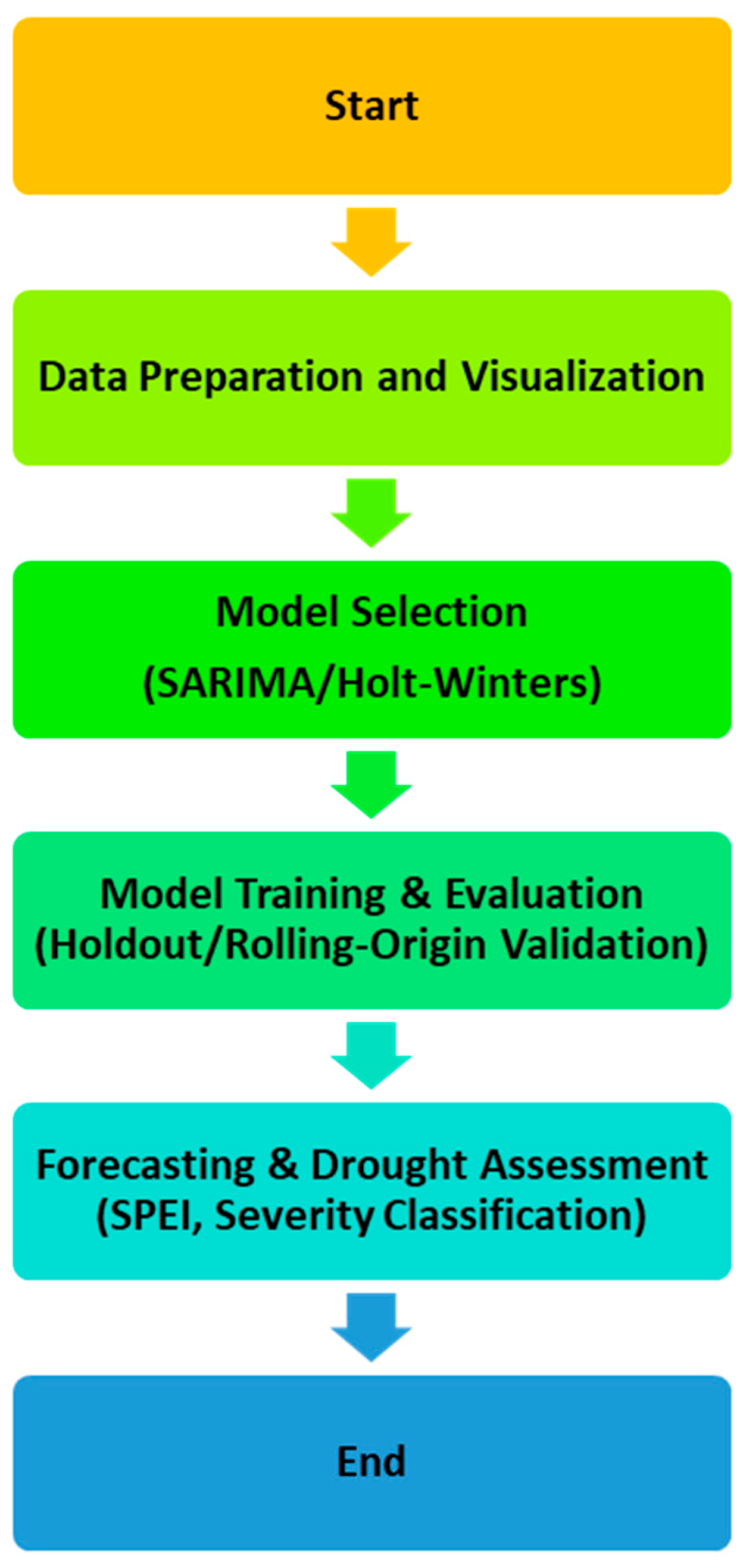
To provide a clear overview of the proposed forecasting methodology, the overall workflow is shown in
Figure 1.
2.3.1. (S)ARIMA Modeling
The (S)ARIMA framework improves the ARIMA model by incorporating seasonal components to address periodic variations commonly found in meteorological time series [
9,
10]. The SARIMA model is denoted as SARIMA(
p,
d,
q)(
P,
D,
Q)s where
p,
d, and
q indicate the non-seasonal autoregressive, differencing, and moving average orders, while
P,
D, and
Q represent the corresponding seasonal components with seasonal period
s [
7,
8]. Model identification and parameter estimation were performed using automated selection methods based on information criteria (AIC, AICc, BIC) [
8]. This approach ensures objectivity and consistency, removing the need for subjective manual adjustments.
2.3.2. Holt–Winters Exponential Smoothing
The Holt–Winters method analyzes time series by recursively updating the level, trend, and seasonal components [
19]. The additive formulation was used when seasonal variance remained stable over time. This method assigns exponentially decreasing weights to historical observations, allowing the model to adapt to gradual structural changes while maintaining interpretability [
20]. Its suitability for meteorological applications is due to its ability to capture persistent seasonal cycles and emerging patterns [
22].
2.4. Validation Strategy and Model Evaluation
An initial fixed holdout method was employed to evaluate prediction performance [
21]. The dataset was divided chronologically, with the first 80% of observations used for model estimation and the remaining 20% for out-of-sample forecast evaluation. This approach represents a time series validation technique and should not be interpreted as a machine learning procedure.
The accuracy of the forecast was assessed using the following performance metrics [
30]:
Mean Absolute Error (MAE),
Root Mean Square Error (RMSE),
and Mean Absolute Percentage Error (MAPE) [
8].
These metrics measure average deviation, penalize significant forecast errors, and assess relative prediction accuracy, respectively.
2.5. Time Series Cross-Validation
To enhance methodological robustness and reduce reliance on a single train-test split, a rolling-origin time series cross-validation approach was implemented [
31]. Unlike traditional k-fold cross-validation, which randomly partitions observations and disrupts temporal sequencing, time series cross-validation preserves the historical integrity of the data, ensuring a realistic assessment of forecasting accuracy.
The rolling-origin method incrementally enlarges the training window while sequentially updating the validation interval. The initial model was trained on the earliest section of the dataset and evaluated on the subsequent temporal block. The training window was then iteratively expanded to include additional data, and forecasts were generated for the next chronological interval. This process was repeated until the end of the available data range (2014–2020), resulting in several validation folds.
This strategy offers several methodological advantages. First, it evaluates model stability across multiple temporal contexts rather than relying on a single partition. Second, it reduces the risk of overfitting to a specific validation period. Third, it more accurately reflects practical forecasting scenarios in urban climate monitoring systems, where models are continually updated as new observations are collected.
By incorporating rolling-origin cross-validation, the proposed forecasting methodology improves generalizability and enhances the reliability of evaluating the climatic drivers of urban drought within sustainable smart city planning contexts.
2.6. Integration with Drought Assessment
Forecasted climatic variables were used as inputs for calculating drought indices and severity classification procedures based on the Standardized Precipitation Evapotranspiration Index (SPEI) [
23]. The projected values of air temperature, precipitation, soil moisture, and wind speed were incorporated into a drought assessment framework using established threshold criteria, enabling the identification of different levels of drought intensity [
24,
25].
The methodology combines statistical forecasting outputs with drought classification systems, converting predictive time series results into organized decision-support information relevant to urban water management. This connection enables proactive early-warning systems and supports evidence-based climate adaptation strategies within sustainable smart city planning [
32]. The integration ensures that forecasting outputs go beyond statistical evaluation and contribute directly to operational drought monitoring systems.
3. Results
3.1. Descriptive Analysis of Climatic Drivers
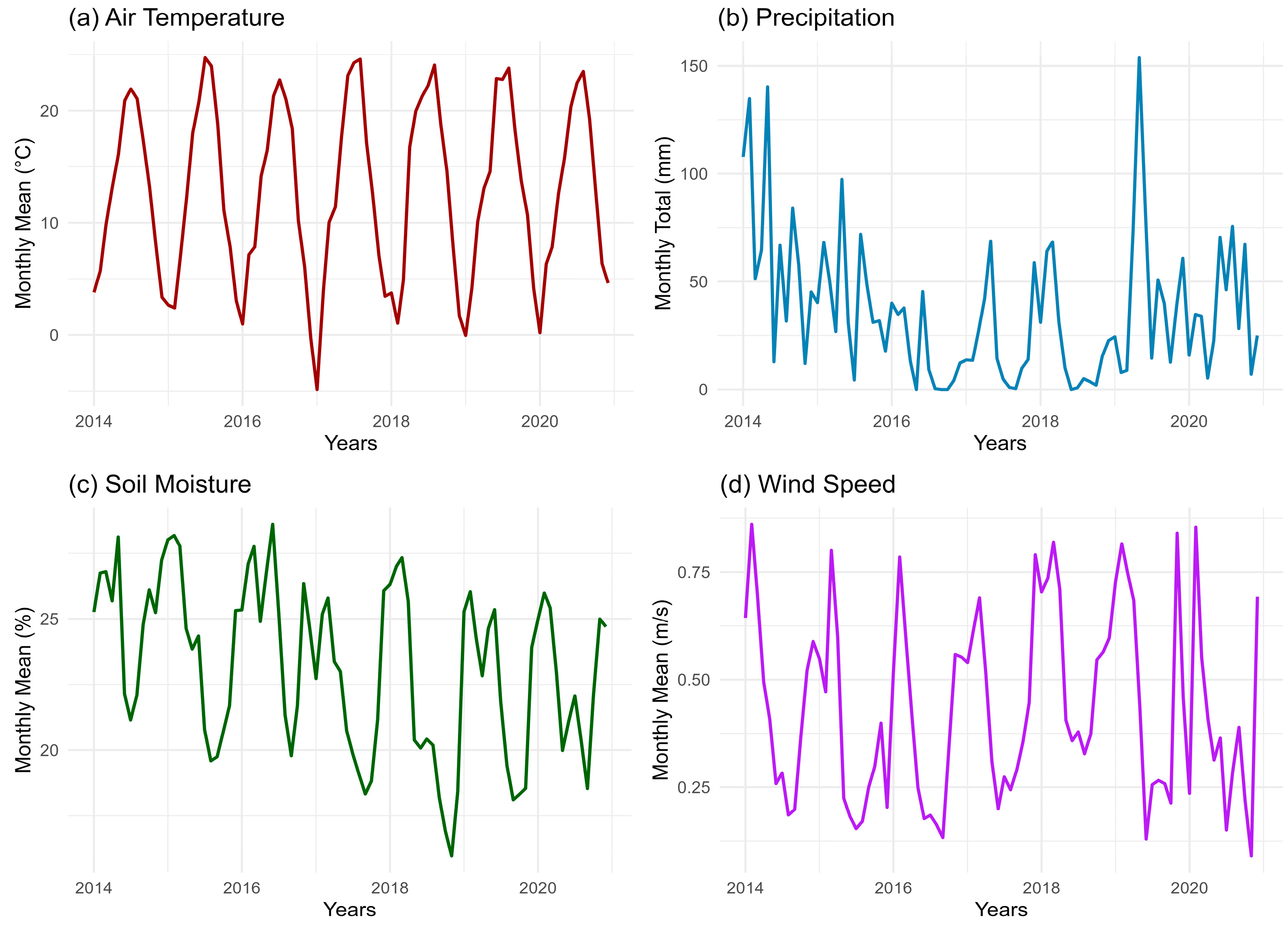
The monthly aggregated time series of air temperature, precipitation, soil moisture, and wind speed from 2014 to 2020 show clear seasonal and interannual trends relevant to urban drought dynamics (
Figure 2). The continuous temporal representation highlights both annual cycles and interannual variability, providing essential context for future forecasting research.
Air temperature shows significant annual variation, with stable summer peaks and winter troughs. Interannual variability is low, as peak summer temperatures fluctuate only slightly between years while maintaining a consistent seasonal pattern. This stable yearly trend demonstrates pronounced seasonality, supporting the use of seasonal time series modeling techniques.
Precipitation fluctuates more than other climate factors. Monthly totals display uneven distribution, with episodic peaks and dry intervals that vary greatly between years. Some summer seasons have reduced precipitation, indicating potential drought-prone periods within the observation period. The irregularity and inconsistent timing of rainfall highlight the unpredictable nature of precipitation and the associated forecasting challenges.
Soil moisture shows a seasonal oscillation pattern closely correlated with temperature and precipitation cycles. Higher moisture levels are typically observed during cooler, wetter months, while summer periods show reduced values. In addition to the seasonal pattern, minor interannual variations are evident, possibly indicating cumulative drying effects during years with less precipitation. The relatively stable progression of soil moisture in relation to precipitation suggests that adaptive smoothing-based forecasting methods are appropriate.
Wind speed exhibits minor seasonal fluctuations without a significant long-term trend. Despite observable short-term variations, the overall pattern remains relatively steady over the seven-year period.
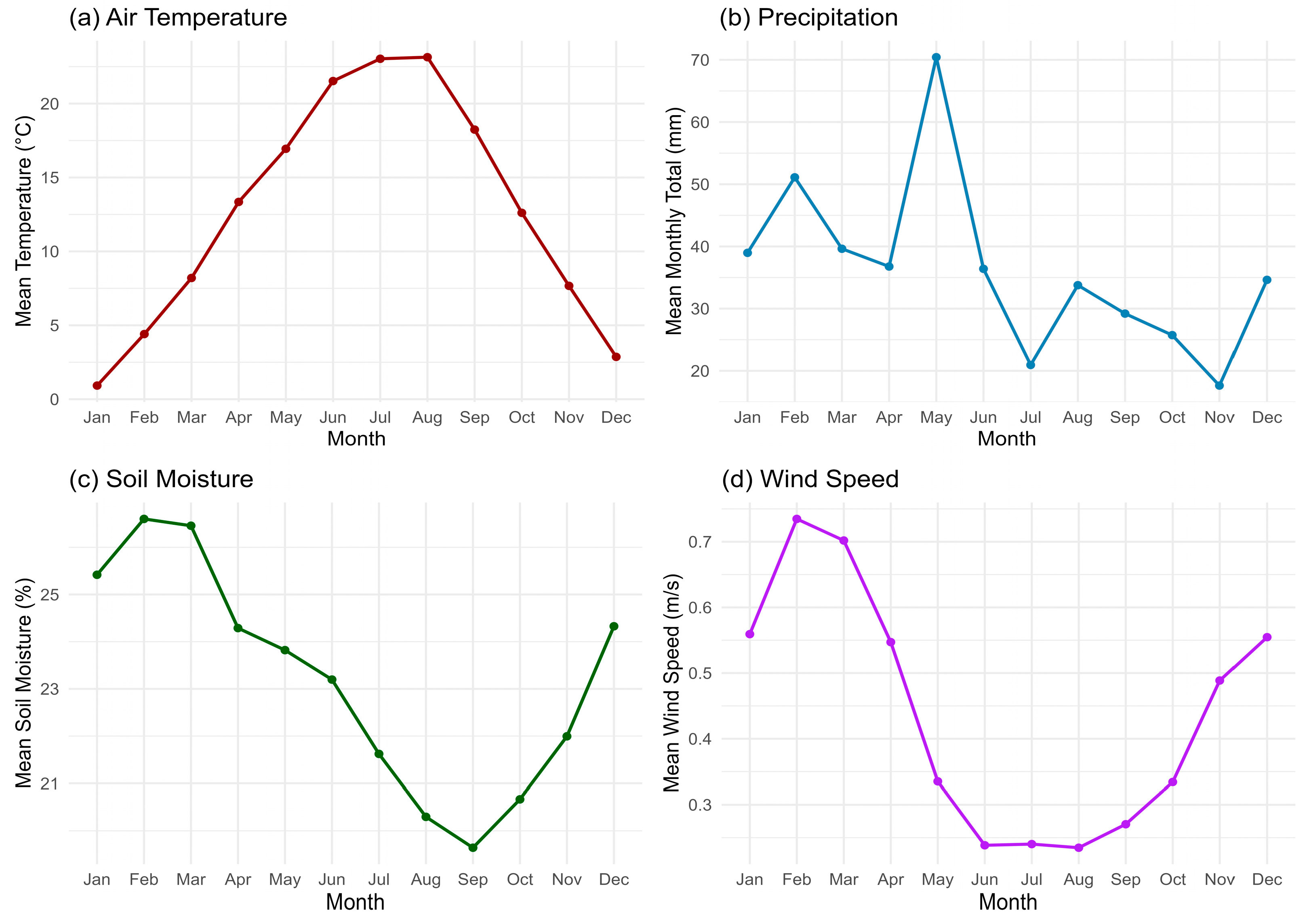
The climatological monthly averages (
Figure 3) highlight the consistent annual patterns of temperature and soil moisture, confirming regular seasonality. In contrast, precipitation climatology shows an irregular monthly distribution, with higher averages observed in late spring and autumn. These seasonal patterns clearly justify the use of seasonal time series models such as (S)ARIMA and Holt–Winters in the proposed forecasting methodology.
Overall, although all climatic drivers exhibit seasonal behavior, their statistical properties differ in variability, intermittency, and persistence. Temperature and soil moisture show consistent seasonal patterns, whereas precipitation displays irregular and episodic variations. These structural differences suggest that forecasting performance depends primarily on the intrinsic dynamics of each variable, justifying the use of variable-specific modeling strategies within the methodological framework of this study.
3.2. Forecasting Performance Under Holdout Validation
Based on the established seasonal and interannual characteristics of climatic factors, forecasting performance was evaluated using a structured holdout validation methodology to assess the suitability of (S)ARIMA and Holt–Winters models for each variable. An 80/20 fixed holdout split was used, with 80% of the monthly observations allocated for model training and the remaining 20% reserved for out-of-sample testing. This approach preserves temporal structure and enables an objective assessment of prediction accuracy for climatic drivers.
The quantitative performance metrics for the (S)ARIMA model are presented in
Table 3, while the corresponding results for the Holt–Winters specification are summarized in
Table 4. Model accuracy was assessed using RMSE, MAE, and MAPE, providing complementary measures of absolute and relative forecast deviation.
The holdout validation results show notable differences between the two modeling approaches (
Table 3 and
Table 4).
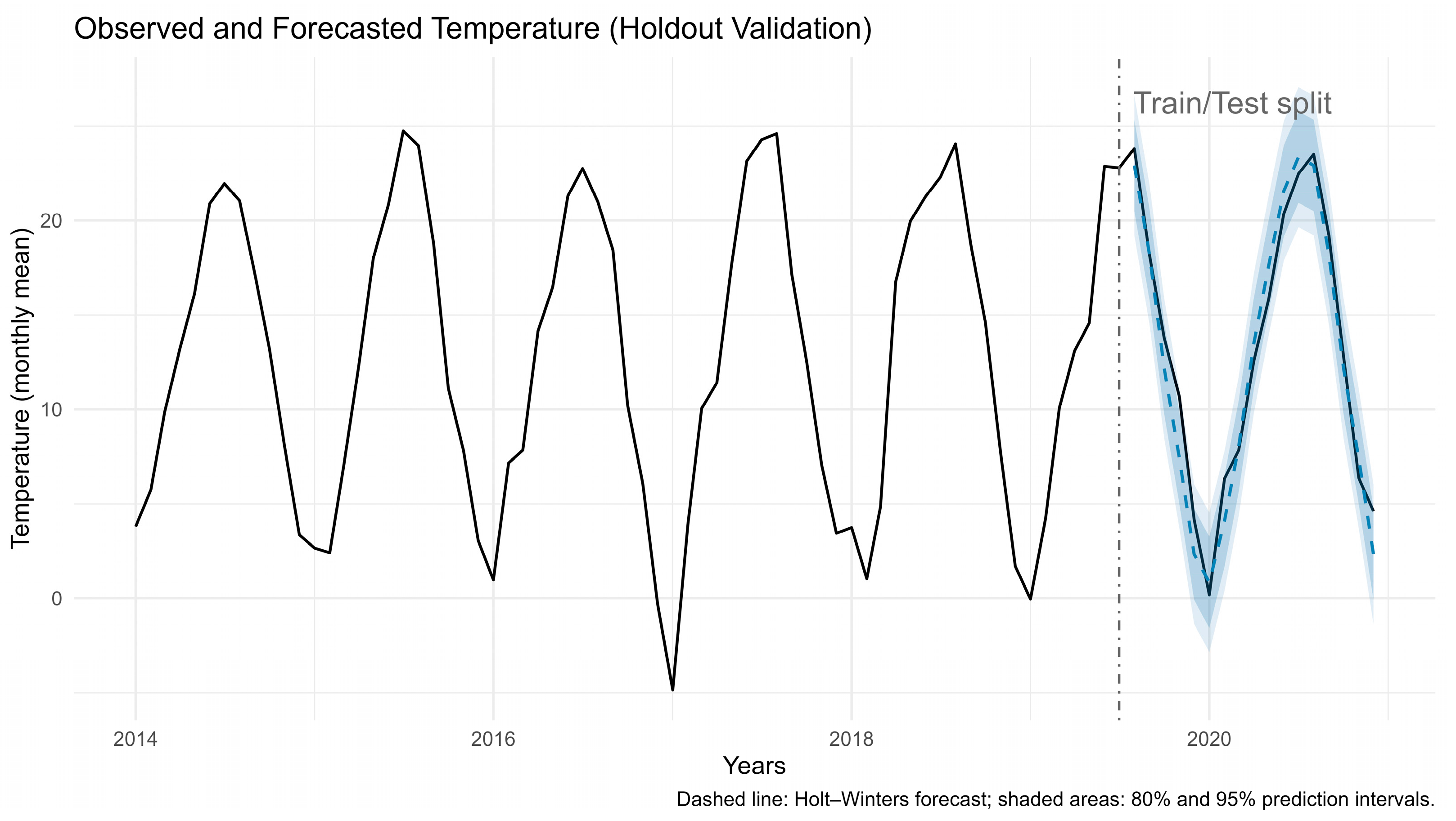
For air temperature, the Holt–Winters model consistently produced lower error values (RMSE = 1.48; MAE = 1.24; MAPE = 34.52%) than the (S)ARIMA model, indicating improved forecast accuracy. The substantial reduction in relative error suggests that adaptive exponential smoothing effectively captures the pronounced seasonal structure and gradual interannual variability of temperature.
Figure 3 illustrates the forecasting behavior of air temperature using the Holt–Winters model, showing accurate reconstruction of seasonal patterns and stable prediction intervals during the validation period. The vertical dashed line in
Figure 4 marks the training–testing split, while the shaded regions represent the 80% and 95% prediction intervals of the Holt–Winters model.
Precipitation forecasts showed the highest error magnitudes under both models, reflecting the unpredictable and highly variable nature of rainfall processes. However, the Holt–Winters model improved relative performance compared to (S)ARIMA, reducing MAPE from 153.33% to 76.25%. Although elevated percentage errors persisted due to low or zero monthly totals, the smoothing-based approach demonstrated greater robustness in modeling rainfall variability.
In contrast, the (S)ARIMA model performed better for soil moisture prediction, yielding lower error metrics (MAPE = 8.50%) than the Holt–Winters model (MAPE = 11.21%). This result indicates that autoregressive seasonal structures more accurately capture soil moisture dynamics. The comparatively low percentage errors in both models validate the more stable and less volatile temporal behavior of this variable.
Wind speed predictions showed moderate absolute errors across both modeling approaches. The Holt–Winters model demonstrated marginally better performance across all criteria; however, elevated MAPE values indicate sensitivity to minor denominator effects rather than significant absolute deviations.
Overall, the holdout validation results suggest that the Holt–Winters model offers broader applicability across most climatic drivers, while (S)ARIMA provides greater accuracy for soil moisture. These results underscore the importance of aligning forecasting methodologies with the statistical properties of individual variables rather than assuming universal model superiority.
3.3. Rolling-Origin Cross-Validation Results
To assess the temporal stability and generalization ability of the forecasting models, rolling-origin cross-validation was implemented using an expanding training window approach. In simple terms, this approach repeatedly trains the model on historical data and evaluates it on subsequent time periods, gradually increasing the available training data. This simulates real-world forecasting, where models are continually updated as new data becomes available. Given the total of 84 monthly data points (2014–2020), an initial training window of 36 months (three years) was chosen to ensure sufficient seasonal representation. One-step-ahead forecasts were then generated sequentially for each subsequent month, resulting in 48 validation folds (84 − 36 = 48). This technique preserves chronological order while providing repeated out-of-sample evaluation across evolving temporal segments, allowing for a more comprehensive assessment of both average predictive accuracy and performance variability.
The aggregated cross-validation results for both (S)ARIMA and Holt–Winters models are presented in
Table 5, including the mean and standard deviation of RMSE, MAE, and MAPE across all validation folds. Including standard deviation values enables evaluation of performance variability alongside mean accuracy.
Precipitation was the most difficult variable to predict, with high errors in both models because of the irregular and sporadic nature of rainfall. The Holt–Winters model showed lower average error values (RMSE = 23.6 ± 23.5) compared to (S)ARIMA (RMSE = 27.1 ± 24.0), indicating relatively improved robustness across validation folds. However, extremely high and variable MAPE values– especially for (S)ARIMA (436% ± 1207%)—show that percentage-based metrics are highly sensitive to months with low or zero precipitation.
Soil moisture was predicted more accurately than other variables, with (S)ARIMA producing slightly better and more consistent results than Holt–Winters. The relatively small size and variability of errors confirm the more stable temporal dynamics and enhanced autoregressive structure of soil moisture.
Both models performed equally well for temperature forecasting. While the Holt–Winters method achieved a marginally lower mean RMSE (1.72 ± 1.35) compared to (S)ARIMA (1.83 ± 1.53), variability across folds suggests moderate temporal sensitivity. Percentage-based errors showed significant variability, especially under the Holt–Winters specification (85.6% ± 340%), highlighting the limitations of MAPE for variables with seasonal amplitude fluctuations.
Wind speed forecasts showed relatively consistent errors in both models. The Holt–Winters method provided a slightly lower mean RMSE (0.105 ± 0.102) compared to (S)ARIMA (0.117 ± 0.109), although MAPE variability remained high due to the influence of small denominators.
Overall, the rolling-origin cross-validation results support the holdout findings and reinforce the conclusion that model suitability depends on the inherent statistical properties of specific climatic drivers. Holt–Winters demonstrates greater robustness for precipitation and wind speed, whereas (S)ARIMA is more beneficial for soil moisture, supporting a variable-specific forecasting approach.
3.4. Implications for Urban Drought Monitoring
The forecasting results obtained through holdout validation and rolling-origin cross-validation offer several practical implications for urban drought monitoring systems. The variation in model performance across different climatic drivers underscores the importance of adopting variable-specific forecasting strategies within smart city water management systems.
First, the relatively stable and accurate prediction of air temperature using the Holt–Winters model indicates that seasonal temperature dynamics can be effectively incorporated into short-term urban climate monitoring systems. Given the strong correlation among rising temperatures, evapotranspiration rates, and urban water demand, reliable temperature forecasts can support proactive resource allocation and demand-side management strategies.
Second, although precipitation forecasts exhibit greater variability and higher percentage-based errors, the smoothing-based method demonstrates comparatively improved robustness. Operationally, even moderately accurate rainfall predictions can enhance early-warning systems when combined with additional hydrological indicators. However, the observed volatility in MAPE values suggests that absolute error metrics (RMSE and MAE) may serve as more reliable evaluation criteria for precipitation forecasting in urban drought scenarios.
Third, soil moisture forecasting results show relatively stable and low error magnitudes, particularly with the (S)ARIMA model. Soil moisture is crucial for assessing drought severity, serving as a comprehensive indicator of cumulative precipitation deficits and the effects of evapotranspiration. The observed predictive stability suggests that soil moisture forecasts could provide a reliable input for drought index calculation and severity classification within urban resilience systems.
Wind speed forecasts exhibit moderate predictive accuracy and limited practical sensitivity when considered in isolation; however, wind conditions influence evapotranspiration processes and urban microclimate dynamics. Therefore, incorporating wind speed forecasts as a complementary variable may enhance multi-parameter drought monitoring systems rather than serving as a standalone indicator.
Overall, the results highlight that urban drought monitoring systems should not depend on a single climate predictor. Instead, integrating forecasts of multiple climatic drivers within a systematic analytical framework enhances the accuracy of drought risk identification. The findings support the development of adaptive smart city systems capable of continuously updating forecasts as new meteorological data become available, thereby strengthening proactive water resource management and climate adaptation strategies amid increasing climatic uncertainty.
4. Discussion
The results show that forecasting performance depends more on the characteristics of individual climatic variables than on the choice of a single model. In particular, no single model consistently outperforms the others across all variables, indicating the need to select forecasting methods according to the specific temporal behavior of each variable.
The Holt–Winters model showed strong performance for temperature during holdout validation, along with relatively stable rolling-origin RMSE values. This indicates that exponential smoothing effectively captures major seasonal components. However, variability in percentage-based errors demonstrates sensitivity to fluctuating seasonal amplitudes, emphasizing the importance of evaluating multiple performance indicators.
Precipitation forecasting remained the most challenging task for both modeling methodologies. The significant variability in RMSE and high dispersion in MAPE across validation folds reflect the irregular and intermittent nature of rainfall processes. The findings confirm that precipitation time series often violate assumptions of linear continuity and constant variance, limiting the interpretability of relative error measures. Therefore, RMSE and MAE are more reliable indicators of precipitation forecast performance in drought-related contexts.
In contrast, soil moisture exhibited relatively low and stable prediction errors across both validation frameworks, with (S)ARIMA showing marginally better performance. The autoregressive seasonal structure of (S)ARIMA appears particularly well-suited for modeling persistence and lagged hydrometeorological responses. This structural compatibility likely explains the reduced relative error and cross-fold variability observed for soil moisture.
Wind speed forecasts produced low absolute errors but significant percentage variability, highlighting the methodological limitation of MAPE when applied to variables with small magnitude fluctuations. These findings highlight the importance of selecting appropriate evaluation metrics based on the characteristics of each variable.
Overall, the results show that classical time series models remain effective tools for urban climate forecasting when applied within a systematic validation framework. Their interpretability, computational efficiency, and stable performance make them suitable for practical urban monitoring systems.
The results are consistent with previous studies on time series forecasting of climatic variables. Similar findings were reported by [
9], who demonstrated that ARIMA-based models perform well for structured meteorological series with stable seasonal components. Other researchers, such as [
8,
20], highlighted the effectiveness of exponential smoothing techniques in capturing seasonality and short-term dynamics, especially for temperature-related variables. In the context of drought forecasting, ref. [
10] found that ARIMA models can provide reliable predictions for drought-related variables, supporting the observed performance of (S)ARIMA for soil moisture in this study. The significant unpredictability observed in precipitation forecasting is also consistent with other studies, which highlight the stochastic and intermittent nature of rainfall processes and the associated limitations of traditional statistical models. These comparisons confirm that the performance patterns identified in this study are in line with existing literature.
Despite these consistencies, several limitations must be acknowledged. The study is based on a seven-year observation period, which may restrict its ability to detect long-term climatic changes or multi-decadal variability. The exclusive reliance on univariate modeling does not adequately account for interactions between variables, such as temperature–soil moisture feedback mechanisms. The instability of MAPE for precipitation further highlights the need for careful metric selection in drought forecasting research. Future studies may explore multivariate or hybrid modeling techniques, longer datasets, and additional evaluation metrics such as sMAPE or normalized RMSE to enhance robustness.
In summary, the study demonstrates that variable-specific classical time series modeling, validated through both holdout and rolling-origin procedures, can provide reliable short-term forecasts of key meteorological drivers relevant to urban drought monitoring. The proposed approach supports the computation of structured drought indices and severity classification, thereby advancing the development of adaptive, data-driven smart city systems that strengthen climate resilience and sustainable water resource management amid increasing climatic uncertainty.
5. Conclusions
This study evaluated the performance of traditional time series forecasting models—(S)ARIMA and Holt–Winters exponential smoothing—in forecasting key meteorological factors influencing urban drought, including air temperature, precipitation, soil moisture, and wind speed. The research integrates fixed holdout validation and rolling-origin cross-validation to comprehensively assess prediction accuracy and temporal stability across various climatic variables.
The results indicate that predictive performance is variable-specific rather than model-universal. The Holt–Winters method showed greater applicability for temperature, precipitation, and wind speed, while (S)ARIMA demonstrated slight advantages in modeling soil moisture dynamics. Rolling-origin validation confirmed these tendencies and further emphasized the importance of evaluating both average performance and variability across expanding training windows. The findings also highlight the limitations of percentage-based metrics, especially for precipitation, underscoring the need for careful selection of evaluation criteria in climate forecasting applications.
Quantitative results further support these conclusions. Holt–Winters achieved higher accuracy for temperature (RMSE ≈ 1.48; MAPE ≈ 34.5%) and precipitation (MAPE decreased from 153.3% to 76.3%), while (S)ARIMA provided more accurate predictions for soil moisture (MAPE ≈ 8.5%). In contrast, precipitation showed high variability across folds, reflecting its stochastic behavior.
The study underscores the continued relevance of classical time series approaches when integrated into structured validation frameworks. While various advanced approaches have been explored in the literature, (S)ARIMA and Holt–Winters models offer interpretability, computational efficiency, and reliable short-term forecasting capabilities suitable for practical urban monitoring systems.
From a practical perspective, the integration of variable-specific forecasts supports structured drought index calculation and severity categorization, enhancing adaptive water resource management and climate resilience strategies. This research advances the development of sustainable smart city monitoring systems by establishing the feasibility of a reproducible forecasting methodology for urban climatic drivers amid increasing climate uncertainty.
Future research may extend temporal coverage, incorporate multivariate or hybrid modeling techniques, and explore alternative evaluation criteria to further strengthen the robustness of urban drought forecasting systems.




 ,
,