1. Introduction and Background
As natural hazards intensify, the performance of reinforced-concrete (RC) infrastructure must be evaluated not only in terms of ultimate safety but also in terms of risk, damage, and recovery. Within hazard risk assessment frameworks, fragility concepts are commonly used to relate hazard intensity to the probability of reaching defined damage states, while resilience extends this view by incorporating the consequences of damage, repairability, and the ability to restore functionality over time [
1].
For RC systems, this shift in perspective highlights the importance of damage mechanisms that control repair demand, which often governs service disruption and intervention requirements even when collapse prevention criteria are satisfied [
2,
3]. Recent work has consequently expanded hazard performance assessment for RC buildings from “life-safety” verification toward risk-informed objectives that explicitly consider damage consequences and recovery. In this context, fragility-based descriptions of damage states are increasingly complemented by metrics tied to repair effort and time-to-functionality so that resilience can be expressed in terms of expected recovery trajectories rather than strength alone. This shift is particularly relevant for RC systems because post-event disruption is often governed by the extent of repairable damage—including cracking-driven interventions and localized component repairs—well before global instability becomes critical. Accordingly, current research trends emphasize damage control and functional recovery targeting as practical ways to reduce repair intensity and improve post-hazard performance, consistent with resilience-oriented design and assessment goals [
4].
At the same time, aligning hazard mitigation with sustainability goals requires that material and design choices intended to improve robustness and repairability are assessed alongside their environmental burdens and circularity benefits, supporting risk-informed strategies for sustainable disaster-risk reduction [
5,
6]. In this context, fibre reinforcement has therefore been widely explored as a damage-control strategy for cementitious materials, since fibres can bridge microcracks, delay crack localization, and increase post-cracking toughness and residual load capacity—mechanisms that are directly relevant to repair demand and performance retention under hazard actions. Recent syntheses of fibre-reinforced cementitious composites emphasise that these benefits are most evident after cracking initiates, when fibres transfer across crack faces and reduce crack growth, thereby improving ductility and energy absorption [
7].
In parallel, there is growing interest in natural and waste-derived fibres as reinforcement because they can provide crack-control benefits while also supporting circular-economy objectives. Recent systematic reviews on natural-fibre-reinforced mortars and concretes also highlight their potential to reduce agricultural waste and environmental burdens, while noting the importance of durability, fibre treatment, and dosage control for reliable performance [
8]. In the specific case of sheep wool fibres, a recent comprehensive review highlights emerging evidence based on workability, compressive-strength trends, flexural response, post-cracking behaviour, and durability considerations while noting that further building-scale quantification is still needed [
9]. This dual motivation—enhancing cracking-related mechanical performance and valorising an underused agricultural by-product—supports the rationale for studying unprocessed waste wool fibres as a reinforcement strategy with potential environmental co-benefits.
Despite the growing interest in wool fibres as reinforcement, research on sheep-wool-fibre cementitious materials remains concentrated at the specimen scale, and their waste-management implications are often treated only qualitatively or through laboratory dosages [
10]. From a circularity standpoint, the key question is not only whether unprocessed waste wool can be incorporated into structural concrete but also whether such incorporation can be represented consistently in digital modelling workflows that quantify material substitution, waste diversion, and related environmental indicators at the building scale. In practice, this requires explicit links between laboratory-reported fibre dosages, digital material definitions, and model-derived quantities within interoperable BIM/IFC environments.
Accordingly, this study is framed as a methodological BIM-based evaluation framework that translates experimentally reported material properties from the literature into building-scale assessment through a digital-twin workflow. The current research gap is not limited to the scarcity of building-scale studies: There is also a lack of digital modelling approaches capable of embedding RC-WOOL material definitions into interoperable digital twins and translating experimental evidence into traceable quantity take-off, environmental accounting, and performance-oriented building assessment [
11,
12]. Although prior experimental studies reported improvements in cracking behaviour and post-cracking response for unprocessed waste sheep wool fibres, these findings have rarely been operationalised in BIM-based or digital-twin workflows. To address this limitation, this paper proposes a BIM/IFC digital-twin methodology that compares a conventional RC design (RC-CONV) with an equivalent wool-fibre RC design (RC-WOOL), combining automated quantity take-off with embodied CO
2/energy indicators, waste-diversion accounting, and a cracking-driven repairability proxy derived from laboratory evidence and relevant to hazard performance.
To guide the analysis, this study addresses the following research questions:
RQ1: How can literature-derived physical and mechanical properties of wool-fibre cementitious materials be consistently integrated into a BIM-based digital-twin workflow?
RQ2: What are the building-scale implications of incorporating waste sheep wool fibres in reinforced-concrete structures in terms of material quantities, environmental impacts, and circularity indicators?
RQ3: Can cracking-related and durability-related performance indicators reported in the literature be translated into meaningful repairability-oriented proxies within a BIM-based building-scale assessment?
The novelty of this study lies in providing a reproducible OpenBIM-based framework that bridges literature-derived evidence on wool-fibre cementitious materials with building-scale quantity take-off, environmental assessment, circularity accounting, and repairability-oriented evaluation based on material-level performance indicators.
2. Materials and Methods
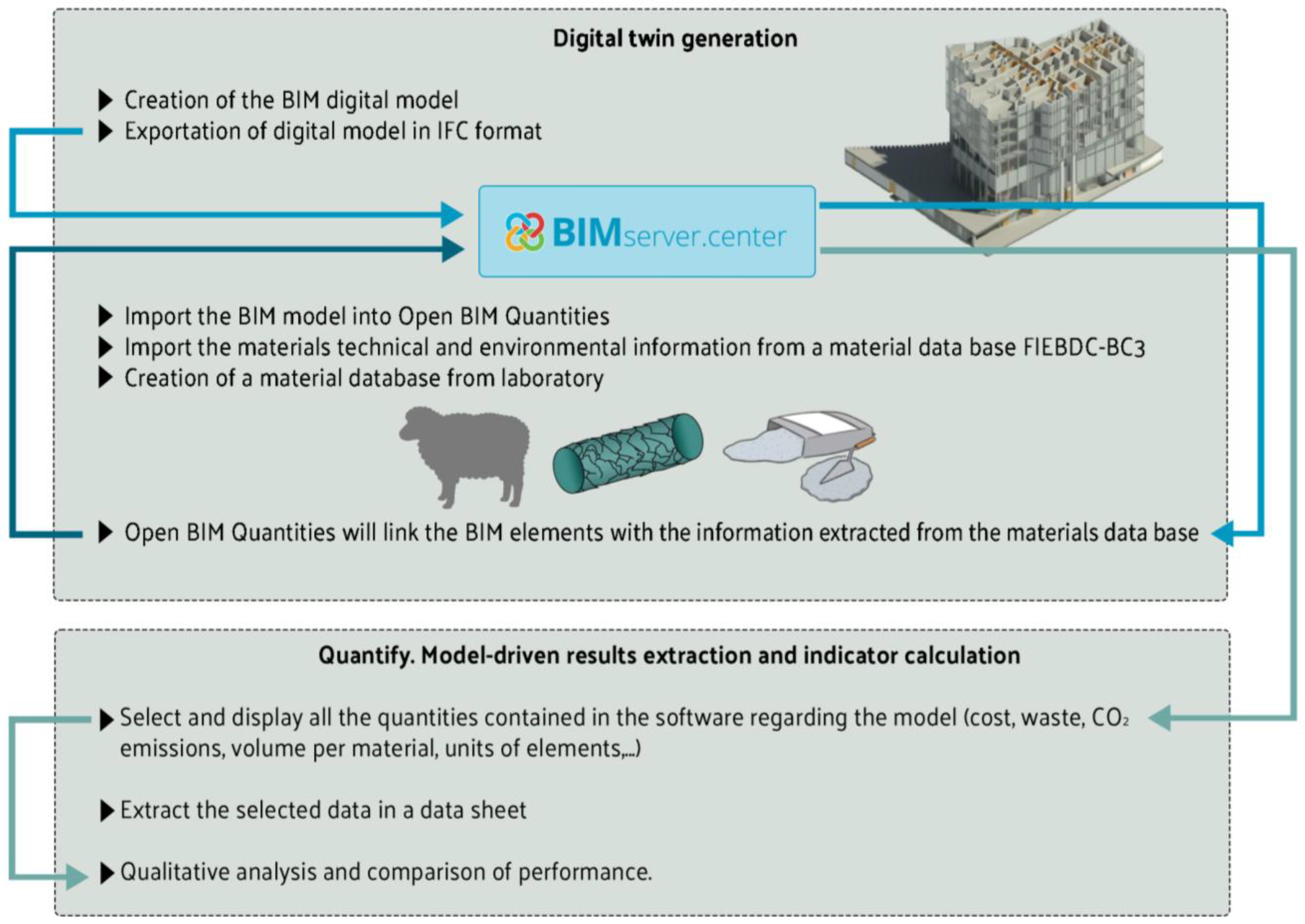
This section develops a methodology to translate laboratory evidence on wool-fibre-reinforced concrete into building-scale decision metrics. The proposed workflow couples an interoperable IFC digital twin with automated quantity take-off and a transparent material/property database, enabling a like-for-like comparison between a conventional reinforced concrete design (RC-CONV) and an equivalent design using wool-fibre cementitious materials (RC-WOOL); see
Figure 1.
2.1. BIM-Based Digital Twin and Quantity Extraction
By anchoring both alternatives to the same model-derived material inventory, the methodology simultaneously evaluates sustainability outcomes and a repairability-oriented proxy linked to cracking-related damage states, and it is used to inform a qualitative interpretation of repairability-related implications, providing an auditable basis to assess whether the wool-fibre intervention improves mechanical performance and circularity while also informing an interpretation based on repairability-related proxies.
2.1.1. Digital Twin Generation
The structural model is developed in a BIM platform capable of exporting to open standards and is subsequently exported as an IFC file to ensure interoperability.
To enable automated measurement downstream, model objects are organised using a consistent classification and naming strategy. The model focuses on elements that drive the structural inventory and repairability-relevant impacts, such as RC members (slabs, beams, columns, and walls), reinforcing steel, and formwork-related surfaces. Because this study targets early-stage decision-making, the digital twin prioritises geometric and parametric information required for measurement rather than construction sequencing or fabrication-level detailing. After IFC export, the model is stored in a shared project space to maintain version control, traceability of changes, and consistent access to the digital twin used by all analysis steps.
The BIM digital twin corresponds to the same 39-storey reinforced-concrete hotel case study located in Andalusia (Spain) previously analysed by Serrano-Baena et al. [
11]. The model-derived bill of quantities used in this study is therefore based on a real building-scale dataset, ensuring consistency with prior BIM-based sustainability analyses.
2.1.2. Quantity Take-Off Extraction and Linking Rules
The IFC model is imported into an OpenBIM quantity take-off environment to extract a harmonised bill of quantities for both alternatives. The minimum inventory required for this study is concrete volume (m3) and reinforcing steel mass (kg). A rule-based mapping is used to connect IFC entities to measurement definitions and to prevent double-counting.
The linking is implemented through selection filters and measurement rules that reference stable element attributes. Each mapping rule specifies which model objects are included, which quantity is measured, which unit is enforced (m3, kg), and how the value is aggregated (per category and total). Consistency of units is treated as a control step: The quantity extracted from the IFC model must match the unit basis of the database entry used later for environmental and circularity calculations. Any mismatches are corrected through explicit conversion factors documented in the assumptions.
2.2. Material Database and Scenario Definition
A project-specific database is created to attach environmental and circularity attributes to the quantities extracted from the model. For each material/process, the database stores the parameters needed for cradle-to-gate sustainability accounting, such as embodied energy intensity (MJ per unit), embodied carbon intensity (kg CO2-eq per unit), and waste-related parameters relevant to the circularity metric (where applicable).
The database can be assembled from publicly available construction datasets or institutional LCA sources. The wool-fibre cementitious mix does not typically exist as a standard entry in generic construction databases. Therefore, the wool-fibre-reinforced cementitious material is introduced as an additional material definition created specifically for this study. Its mechanical and performance-related parameters are assigned based on the existing experimental literature and prior research.
Based on the bill of quantities obtained through the OpenBIM workflow, the work items were screened to identify candidates for substitution with sheep-wool-fibre-reinforced cementitious materials while keeping the BIM geometry and measurement rules unchanged and ensuring a traceable substitution grounded in experimental evidence. According to
Table 1, a work item was considered eligible when (i) it performed a structural function and (ii) its main material consisted of a cementitious matrix (structural concrete or cement-based mortar/layer) that could be redefined as a fibre-reinforced material without altering the building-scale construction system. Otherwise (non-cementitious systems, purely metallic elements, or elements without a cementitious matrix suitable for fibre reinforcement), it was classified as non-eligible. This filtering process generates a subset of structural cementitious elements (e.g., slabs, walls, columns, and stair components) that are subsequently linked to wool-based formulations identified in the literature, with
Table 1 establishing the connection between the BIM inventory and the material-assignment stage.
2.3. Literature-Based Selection of Wool-Fibre Cementitious Formulations
2.3.1. Search Strategy and Eligibility Criteria
In order to assign to each eligible work item a wool-based formulation supported by experimental evidence, a systematic review was conducted to identify studies testing sheep-wool-fibre-reinforced cementitious materials (concrete and/or mortars). The search was carried out in Scopus and Web of Science using query strings based on terms related to sheep/ovine wool, fiber/fibre, and concrete/mortar/cement-based materials, incorporating filters to exclude non-relevant “wools” and review papers.
To ensure comparability and quality, restrictions were applied regarding publication period (2016–2026), language (English), and document type. A staged screening procedure was then performed using explicit exclusion criteria. The final set of articles constitutes the evidence base used to identify studies reporting the performance factors required for each structural element and to select the candidate wool-fibre formulations.
2.3.2. Definition of Key and Secondary Performance Factors
To ensure that the selected wool-based formulations are consistent with the dominant functional demand of each structural element, two performance factors were defined for each work item: a key factor and a secondary factor. The key factor represents the governing property of the structural or service behaviour, whereas the secondary factor acts as a complementary condition that should not deteriorate, typically associated with cracking resistance, durability, or transport-related phenomena. This approach ensures that the selection is not only limited to conventional strength-based properties but also captures cracking-related behaviour, durability, and transport mechanisms that are critical for damage control and repairability.
Table 2 summarises, for each element code, the element–factor relationship and the articles that test both factors simultaneously (a necessary condition to support the formulation selection). Since the available evidence is not homogeneous and the literature includes cementitious matrices in both concrete and mortar, the use of mortar-based studies was accepted as a proxy when the test reflects the same relevant physical mechanism (e.g., cracking, toughness, or ingress/absorption processes) and allows traceable comparisons against a fibre-free control specimen.
2.3.3. Selection of Wool-Fibre Cementitious Formulations
Once the studies simultaneously testing the key and secondary factors for each element had been identified, wool-based formulations were selected from this subset of evidence and assigned to each eligible structural work item in the BIM inventory. The selection was performed at the mix level and always relative to the control specimen reported in the same study (same matrix and testing conditions, without fibres), ensuring that the decision relied on traceable relative changes with respect to the experimental reference.
The selected mixture had to satisfy the condition that the key factor improved relative to the control specimen while the secondary factor did not deteriorate.
Initially, two complementary decision rules were considered: a performance-oriented rule and a waste-valorisation rule. However, in the cases analysed in this study, both rules converged to the same mixture. Therefore, a single formulation was retained for each element and implemented in the RC-WOOL scenario.
When direct evidence in concrete was limited, mortar-based evidence was accepted as a proxy provided that the tested property captured the same governing mechanism. In all cases, the results were used only as relative changes (Δ%) with respect to this study’s control, and no absolute equivalence between mortar and concrete values was assumed; the results are not interpreted as direct predictors of structural behaviour. The use of mortar-based evidence does not imply direct extrapolation to structural concrete members but rather a mechanistic approximation based on relative trends in cracking-related behaviour.
Table 3 summarises, for each structural element, the selected formulation (including wool processing or treatment when applicable), the wool dosage as reported in the source article, and the corresponding reference. These formulations are subsequently assigned to the BIM work items while preserving the original units and quantities so that the comparison between the conventional scenario and the wool-based scenario does not alter the geometry or quantity take-off but only the specification of the cementitious material.
The selected formulations were implemented as the material definitions for the RC-WOOL scenario and compared against the conventional RC-CONV baseline, as described in the following section.
2.4. Relative Performance Evaluation of Selected Mixes
To compare the effect of wool reinforcement consistently across structural elements and experimental studies, the performance of each formulation is expressed as a relative change with respect to the control specimen reported in the same experimental work. For each factor (key and secondary), the percentage change is calculated as
where X
wool is the value measured in the wool-reinforced mixture, and X
control is the value measured in the control mixture without fibres under the same testing programme.
For strength-related properties, Δ > 0 indicates improvement. For transport or ingress indicators (e.g., capillary absorption/sorptivity, open porosity, or chloride penetration), a reduction is typically favourable; therefore, Δ < 0 is interpreted as an improvement.
When a transport-related indicator is reported through graphical curves without numerical tables, Δ (%) is estimated from the representative value indicated in the figure, and this condition is explicitly stated in the corresponding notes.
2.5. Environmental Coefficients and Open BIM Quantities Implementation
To translate the incorporation of waste sheep wool fibres into the BIM-based environmental indicators reported by Open BIM Quantities, this study adopts unit environmental coefficients for sheep wool from a verified third-party Environmental Product Declaration (EPD) representative of sheep wool used as a low-value by-product with minimal processing (washing and standard industrial conditioning) [
18].
In this study, the environmental assessment is limited to cradle-to-gate stages (A1–A3), consistent with the scope of the selected EPD and with the objective of comparing material-level impacts within the BIM-based workflow.
2.5.1. Mapping to Open BIM Quantities Indicators
The EPD indicators are mapped onto the four “BIM Quantity” environmental outputs as follows: The EPD primary energy indicator is mapped to the Open BIM Quantities “energy cost” indicator (Coste energético); global warming potential (GWP) is mapped to the “CO2 emissions” indicator (Emisión de CO2); the mass of waste disposed reported in the EPD is used to derive the “total waste mass” indicator (masa total de residuo). Because EPDs typically report waste outputs primarily as mass (kg) rather than volume (m3), volumen total de residuo is only used if an explicit volumetric waste output is available; otherwise, it is reported as not evaluated.
To ensure compatibility with the fibre dosages extracted from the literature (expressed as g/m
3, kg/m
3, or as volume fraction Vf), EPD results are converted to per kg coefficients when necessary (e.g., when the EPD declares results per m
3 of product). The adopted coefficients and their mapping to the Open BIM Quantities indicators are summarised in
Table 4.
2.5.2. Scenario Modelling and Wool-Dosage Implementation
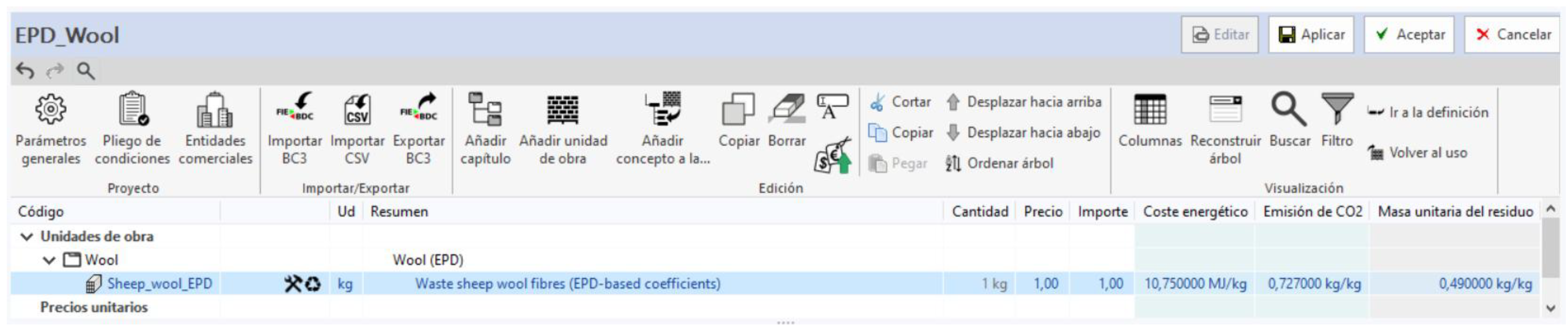
A dedicated work item was created in Open BIM Quantities version 2026 to represent sheep wool fibres as an additional material input using EPD-based unit coefficients. The concept “Sheep wool (ISOLENA EPD 2025)” was defined with unit kg, and its environmental fields were populated with the adopted coefficients (energy cost = 10.75 MJ/kg, CO
2 emissions = 0.727 kgCO
2/kg, and waste mass = 0.490 kg/kg).
Figure 2 illustrates how these unit factors are embedded in the cost database so that the software can compute the incremental impacts of wool addition by multiplying them by the total wool mass assigned in the budget measurement for each scenario.
When wool content is reported in the literature as a volumetric fraction (Vf), it is converted to an equivalent mass-based dosage (kg/m3) using the fibre density reported in the source study or derived from the experimental mix data. In this study, wool fibres are introduced as an incremental material input without modifying the base concrete mix proportions (e.g., cement content, aggregates, or admixtures) in order to isolate the effect of fibre incorporation within a consistent BIM-based quantity framework.
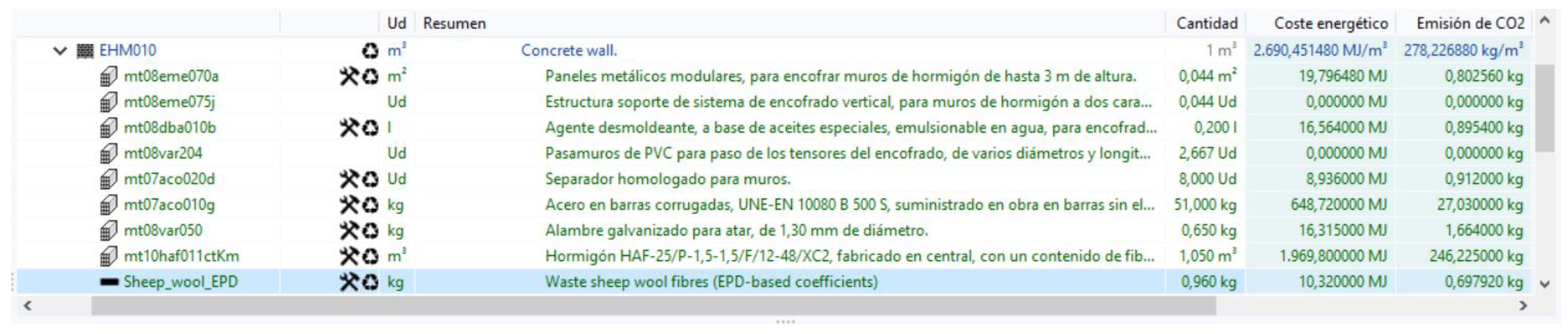
Figure 3 illustrates the implementation of sheep-wool fibres within the decomposition of a structural work item in Open BIM Quantities. The fibres are introduced as an additional material input expressed as a mass-based dosage (kg per m
3 of structural element), allowing the software to automatically compute the associated environmental indicators based on the EPD coefficients assigned to the material.
The scenario-specific quantities and coefficients defined in this stage are then used to compute the environmental and circularity indicators reported in
Section 2.6.
2.6. Impact Calculation and Reporting
After the digital twin was prepared and linked, the workflow was executed for each design alternative of RC-CONV and RC-WOOL to produce study outputs in a consistent and traceable manner. In this stage, the software compiles the project results directly from the linked model and reports them in a structured format suitable for comparison at the element-category level and at the whole-structure level.
The tool first compiles a consolidated bill of quantities from the linked model, reporting at a minimum concrete volume (m3) and reinforcing steel mass (kg), aggregated by element group and for the whole structure. These quantities are then converted into cradle-to-gate embodied energy (MJ) and embodied carbon (kg CO2-eq) at the same aggregation levels. The CO2 emissions are calculated by multiplying the BIM-derived material quantities by the corresponding unit global warming potential (GWP) coefficients obtained from the EPD (kg CO2-eq per unit of material), ensuring full traceability between material quantities, environmental factors, and resulting emissions. For RC-WOOL, the outputs also include a circularity result expressed as the total mass of waste wool diverted, reported per m3 of concrete and for the whole structure. Finally, the same categorised outputs enable a repairability-oriented comparison based on literature-derived changes in cracking and post-cracking response for wool-fibre mixes relative to RC-CONV. In this study, the RC-WOOL scenario is represented as an additive input rather than as a full mix redesign in order to preserve consistency with the BIM-based quantity take-off.
The proposed workflow should be interpreted under the following conditions:
The comparison is scenario-based and does not involve changes to the building geometry or structural layout.
Only a subset of structural cementitious elements is included within the scope of the wool-fibre implementation.
Material selection relies on literature evidence and relative within-study trends rather than on absolute structural equivalence.
Proxy evidence is accepted only for comparable mechanisms, which limits direct extrapolation to full structural behaviour.
The environmental evaluation is restricted to product-stage impacts, and fibre incorporation is represented as an added input rather than as a full mix redesign.
The results should therefore be interpreted as a methodological demonstration of comparative performance and not as a complete structural or life-cycle prediction.
This stage therefore outputs, for each alternative, a model-consistent dataset supporting a transparent comparison of trade-offs between structural feasibility constraints, repairability-oriented performance, and sustainability outcomes.
3. Results
3.1. Structural Quantities and Wool Fibre Incorporation
The OpenBIM quantity take-off provided the structural inventory used as the basis for the environmental and circularity assessment. The quantities were extracted from the IFC digital twin for the structural cementitious elements identified as eligible for substitution with sheep-wool fibre cementitious formulations.
Because the same BIM model is used for both scenarios, the structural quantities remain identical in the conventional reinforced concrete scenario (RC-CONV) and in the wool-fibre reinforced alternative (RC-WOOL). The difference between the scenarios, therefore, lies exclusively in the incorporation of wool fibres within the cementitious matrix.
Table 5 summarises the BIM-derived structural quantities together with the wool dosage per element and the resulting mass of wool incorporated in the RC-WOOL scenario.
Although the fibre dosage per cubic metre of cementitious material is relatively low, the cumulative effect at the building scale results in a non-negligible quantity of waste wool incorporated into the structural system. In total, approximately 9.58 t of waste wool is incorporated into the building structure in the RC-WOOL scenario.
3.2. Environmental Indicators from Open BIM Quantities
Using the environmental coefficients assigned to the materials in the Open BIM Quantities database, the workflow automatically calculated the environmental indicators associated with each structural scenario based on the BIM-derived material quantities.
Table 6 compares the environmental results obtained for the conventional reinforced concrete scenario (RC-CONV) and the wool-fibre reinforced alternative (RC-WOOL).
The incorporation of wool fibres produces only a minor increase in the environmental indicators due to the additional material input associated with the fibres, indicating that the environmental penalty associated with fibre incorporation is marginal when compared with the total structural material inventory of the building.
To improve the readability of the results presented in
Table 6,
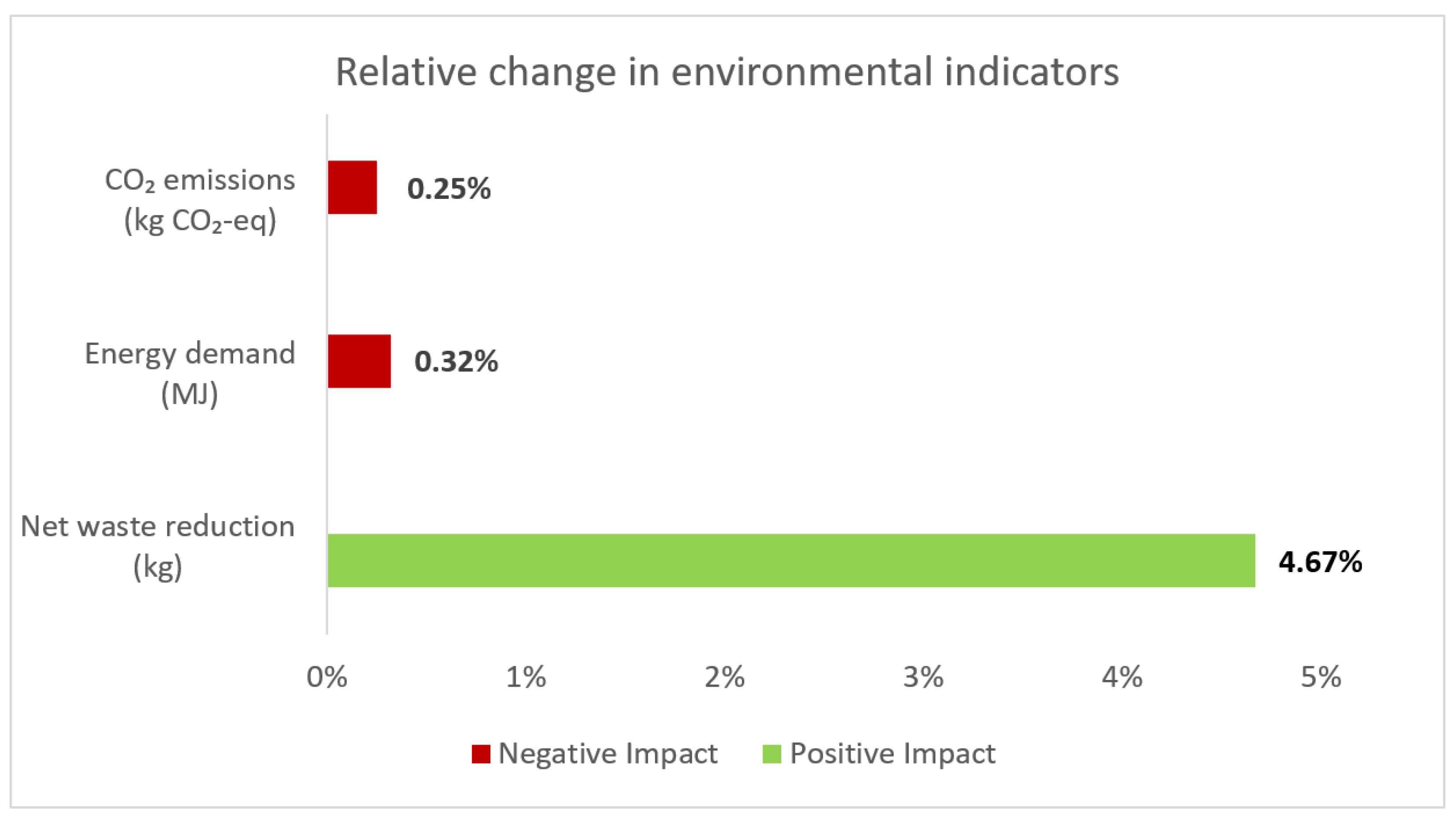
Figure 4 provides a graphical comparison of the relative changes in key environmental and circularity indicators between the RC-CONV and RC-WOOL scenarios. In this representation, increases in environmental burden (energy demand and CO
2 emissions) are shown in red, while beneficial effects (net waste reduction) are shown in green. In addition to energy demand and CO
2 emissions, a net waste reduction indicator is included, accounting for the difference between the waste generated in the RC-WOOL scenario and the amount of waste wool incorporated into the structure. This representation highlights the contrast between the marginal environmental increases associated with fibre incorporation and the potential benefits in terms of waste valorisation.
3.3. Relative Performance of the Selected Wool-Fibre Formulations
The wool-fibre formulations implemented in the RC-WOOL scenario were selected from experimental studies that simultaneously evaluated the key and secondary performance factors defined for each structural element (
Table 2). These factors represent the dominant structural requirement of each element and a complementary serviceability-related condition that should not deteriorate with the introduction of fibres.
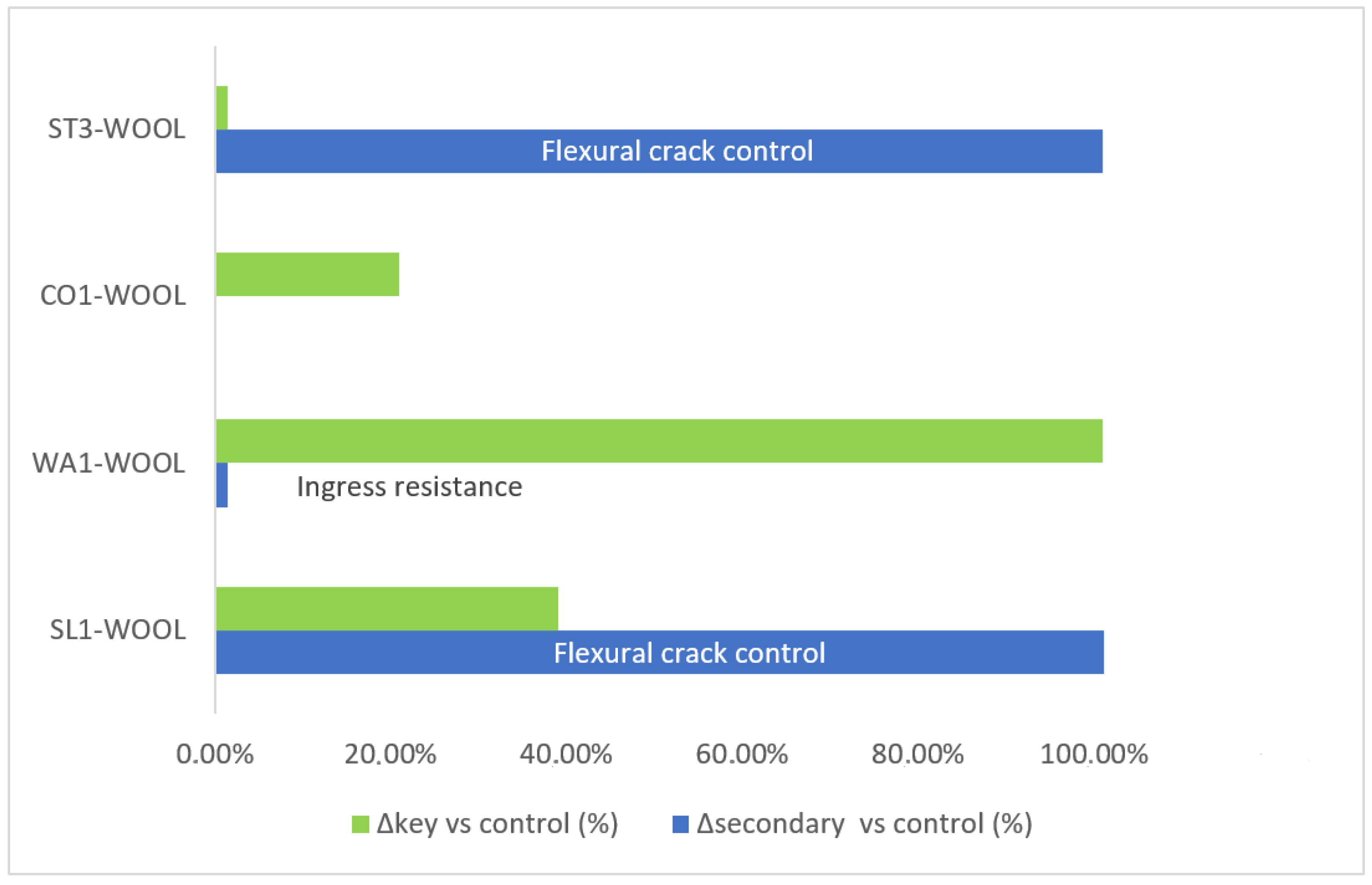
Figure 5 summarises the relative change (Δ%) in these factors for the selected wool-fibre mixtures compared with the corresponding control specimens reported in the source studies.
For the reticular slab (SL1), the selected formulation shows a marked increase in flexural strength together with a substantial improvement in crack control through enhanced toughness, indicating improved post-cracking behaviour relative to the control mixture. For the concrete wall (WA1), the wool-reinforced mortar exhibits a pronounced increase in toughness-related crack control, while the associated transport-related indicator of ingress resistance remains close to the values observed in the control mixture.
For the circular concrete columns (CO1), the incorporation of wool fibres leads to a moderate increase in compressive strength, while the splitting tensile strength associated with crack resistance remains comparable to the control specimens. Finally, for the exposed concrete staircase (ST3), the formulation exhibits a strong improvement in ingress resistance, with only minor variation in the secondary parameter related to crack control via toughness.
Taken together, the results indicate that, within the scope and assumptions of the present BIM-based framework, incorporating waste sheep wool fibres in cementitious materials provides a technically consistent approach for combining crack-control strategies with circular-economy objectives at the material level. However, these findings are limited to material-level performance indicators and building-scale quantification under simplified assumptions, and they should be interpreted as a methodological demonstration rather than a direct prediction of structural or life-cycle performance.
4. Discussion
4.1. Building-Scale Implications and Circularity Potential of Wool-Fibre Incorporation
The results obtained from the BIM-based workflow show that, although the fibre dosage per unit volume of concrete is relatively small, its cumulative effect at the building scale becomes significant. As reported in
Section 3.1, the incorporation of wool fibres in the RC-WOOL scenario results in approximately 9.6 t of waste wool embedded in the structural system of the case-study building.
At the same time, the environmental indicators calculated through the Open BIM Quantities workflow indicate that this material substitution introduces only minor changes in the overall environmental profile of the structure, with increases below 0.5% in both embodied energy and CO
2 emissions relative to the conventional RC scenario (
Section 3.2). This result suggests that the environmental burden associated with fibre incorporation is negligible when compared with the total material inventory of a reinforced-concrete building. This interpretation is consistent with recent systematic LCA evidence on fibre-reinforced concrete, which shows that the environmental balance of FRC depends strongly on fibre type, processing route, and functional-performance gains but can be favourable when sustainable fibres are used under well-defined assessment boundaries [
19].
When these results are expressed in terms of the average fibre dosage derived from the building model (≈1 kg of wool per m
3 of concrete), they can also be interpreted in relation to regional material flows. As shown in
Table 7, applying a similar dosage to the annual production of ready-mix concrete in Europe (≈140.3 million m
3/year) would correspond to a potential demand of roughly 140 kt of wool fibres per year [
20]. This magnitude becomes particularly relevant when compared with the estimated annual production of sheep wool in Europe, which is on the order of 200 kt/year according to recent sectoral documentation [
21].
Under these assumptions, the use of wool fibres in cementitious materials could theoretically absorb around 70% of the available wool stream, highlighting the potential of the construction sector to act as a large-scale sink for under-utilised agricultural by-products.
Although this extrapolation is simplified and does not account for logistical constraints, competing uses of wool, or processing requirements, it illustrates the value of linking building-scale BIM inventories with regional material-flow indicators. Such integration enables laboratory-derived material innovations to be evaluated not only in terms of structural feasibility but also in terms of their potential contribution to circular-economy strategies within the built environment.
4.2. Structural Performance and Repairability Implications
The experimental evidence associated with the selected wool-fibre formulations indicates improvements in crack-control and toughness-related behaviour while maintaining compressive or tensile strength at levels comparable to the corresponding control mixtures. These trends are consistent with the crack-bridging mechanisms typically reported for fibre-reinforced cementitious composites, in which fibres transfer stresses across crack faces and delay crack localisation after matrix cracking [
22,
23].
From a structural-performance perspective, such mechanisms are particularly relevant because many damage states in reinforced-concrete structures subjected to extreme loading are governed by crack propagation rather than by immediate loss of load-bearing capacity. Improvements in crack control and post-cracking behaviour can therefore be interpreted as potentially contributing to limiting crack widths and reducing the extent of damage requiring repair interventions [
24].
In addition, the use of waste sheep wool as fibre reinforcement introduces a material for which its utilisation simultaneously supports circularity objectives by valorising an agricultural by-product that would otherwise remain underused. The combination of improved cracking-related behaviour and the use of a residual natural fibre therefore aligns material-level performance improvements with broader sustainability goals in cementitious composites.
Beyond the direct environmental credit associated with waste utilisation, such performance improvements may also enable additional environmental optimisation through reduced repair demand or longer service life of structural elements.
It should be noted that these observations are based on material-level performance indicators and their conceptual linkage to damage mechanisms, and they do not constitute a direct quantification of structural vulnerability, recovery time, or resilience metrics at the building scale.
4.3. Potential Environmental Optimisation Through Material Performance
Beyond the direct environmental credit associated with waste utilisation, improvements in cracking resistance and post-cracking behaviour reported for wool-fibre cementitious materials may open additional pathways for environmental optimisation. Enhanced toughness and crack-control mechanisms can be interpreted as contributing to improved durability and potentially reduced repair demand, which may indirectly lower life-cycle environmental burdens associated with maintenance interventions [
22,
25].
In addition, improved mechanical performance may create opportunities for structural optimisation in future design scenarios. Fibre-reinforced cementitious composites have been shown to enable alternative design approaches in which improved tensile behaviour and crack control allow more efficient structural detailing or reductions in conventional reinforcement or material volumes [
24,
26]. In this context, the incorporation of waste wool fibres could potentially support structural element re-dimensioning strategies that reduce the total volume of concrete required, thereby decreasing the embodied environmental impacts associated with cementitious materials.
Although such optimisation was not implemented in the present study—where the geometric configuration of the BIM model was intentionally kept unchanged—the combination of improved cracking-related performance and material circularity highlights the potential for future workflows that couple material innovation with structural optimisation and life-cycle environmental assessment.
From a comparative perspective, the behaviour of sheep-wool fibres can be positioned relative to other fibre-reinforced cementitious systems. Synthetic fibres (e.g., polypropylene or steel) typically provide more consistent mechanical performance and higher strength and ductility gains under controlled conditions, but they are associated with higher embodied impacts and more limited circularity potential. In contrast, natural fibres generally offer lower environmental burdens and renewable sourcing, although they often present higher variability and durability-related challenges, including fibre degradation, moisture sensitivity, and fibre–matrix compatibility issues [
27,
28].
Within this spectrum, sheep wool fibres present a distinct profile: Their mechanical contribution is generally moderate and more variable due to natural heterogeneity, but they offer the advantage of being a largely underutilised agricultural by-product with relevant circularity potential and requiring minimal processing [
10,
29]. These characteristics make them particularly suitable for applications where crack-control mechanisms and environmental performance are prioritised over maximum strength enhancement.
Therefore, wool fibres should not be interpreted as a direct substitute for high-performance synthetic fibres but rather as a complementary solution within sustainable material-selection strategies, where moderate performance improvements can be combined with waste valorisation and reduced environmental burden.
4.4. Limitations
4.4.1. Scale Transition: Laboratory Specimens vs. Structural Elements
A first limitation of the proposed workflow concerns the scale transition between laboratory testing and building-scale modelling. The wool-fibre formulations assigned to the RC-WOOL scenario are derived from experimental studies conducted on small mortar or concrete specimens under controlled conditions, specifically the works of Pederneiras et al. [
15] and Yousif and Salih [
17].
Differences in specimen size, fibre distribution, curing conditions, and stress states may influence the mechanical response of fibre-reinforced cementitious materials when applied to full structural elements. Similar limitations have been noted in previous research on fibre-reinforced concrete, where improvements observed at the specimen level cannot always be directly extrapolated to member-level structural behaviour without further validation through structural testing or numerical modelling [
24,
25].
In this study, laboratory results are therefore used only as relative performance indicators with respect to the control mixture of each experimental campaign rather than as direct predictors of structural capacity. The proposed workflow should be interpreted as an approximation framework that mediates between laboratory-scale evidence and building-scale assessment rather than a direct predictive model of structural behaviour.
4.4.2. Dosage Conversion and Literature Heterogeneity
Another limitation relates to the heterogeneity of dosage reporting in the experimental literature on sheep-wool fibre cementitious materials. As reflected in the master dataset compiled for this study, fibre content is reported using different conventions, including volumetric fractions (Vf), mass ratios relative to cement content, or absolute fibre mass per cubic metre of mixture. This lack of consistent reporting complicates the integration of laboratory results into BIM-based modelling environments, where material quantities must be defined in mass-based units compatible with quantity take-off and environmental databases.
To enable implementation within Open BIM Quantities, the selected formulations were converted to equivalent mass-based dosages (kg of wool per m3 of cementitious material). While this step allows experimental evidence to be operationalised within the BIM workflow, it introduces uncertainty because the conversion depends on assumptions regarding fibre density and mixture composition.
The literature also reports fibre dosages using heterogeneous metrics and partial property characterisation, which complicates cross-study comparison and benchmarking of wool-fibre formulations. Similar limitations have been reported for natural fibre-reinforced cementitious composites more broadly [
30,
31,
32].
A further limitation is that wool fibres are modelled as an incremental addition without redefining the full concrete mix. Defining replacement scenarios would introduce additional uncertainty, as the substituted constituents and their proportions are not uniquely determined. Moreover, given the low fibre dosages considered (≈1 kg/m3), any potential reduction in conventional materials would be minor. Future work may explore mix redesign or sensitivity analyses.
4.4.3. Trade-Offs in Wool-Fibre Cementitious Materials
Although the formulations implemented in the BIM model showed improvements in the key indicators considered in this study, the experimental literature indicates that sheep-wool fibre incorporation may also lead to trade-offs in other material properties.
In the rendering mortar formulations investigated by Pederneiras et al. [
15], the incorporation of sheep-wool fibres improved crack control and toughness-related behaviour, but they also produced reductions in compressive strength compared with the reference mortar, particularly at higher fibre contents.
Similarly, the concrete formulations analysed by Yousif and Salih [
17] show that the mechanical response depends strongly on fibre characteristics. While compressive strength increased when fibres from younger sheep were used, certain configurations produced reductions in compressive and splitting tensile strength, particularly when fibres obtained from older animals were incorporated.
These observations are consistent with the broader literature on natural-fibre-reinforced cementitious composites, where improvements in crack resistance or ductility may be accompanied by reductions in workability or compressive strength due to fibre dispersion issues and increased water absorption [
30,
31,
32].
Although a formal sensitivity analysis is beyond the scope of this study, the use of relative performance indicators (Δ%) and consistent selection criteria across all elements contributes to reducing uncertainty and improving the robustness of the comparative assessment.
5. Conclusions
This study presents a BIM-based digital-twin methodology to translate laboratory evidence on sheep-wool-fibre cementitious materials into building-scale performance, sustainability, and performance-informed indicators for reinforced-concrete (RC) infrastructure.
The BIM-based quantity take-off shows that the incorporation of wool fibres results in approximately 9.6 t of waste sheep wool embedded in the structure, demonstrating that low fibre dosages at the material level translate into significant waste valorisation at the building scale.
From an environmental perspective, the RC-WOOL scenario exhibits only marginal variations compared with the conventional RC-CONV solution, with embodied energy and CO2 emissions increasing by less than 0.5%. This result indicates that the environmental penalty associated with fibre incorporation is negligible relative to the total structural material inventory.
From a mechanical performance standpoint, the selected wool-fibre formulations satisfy the dual performance criterion defined in the methodology: the governing structural property improves relative to the control specimens, while the secondary performance factor remains stable or improves. These trends are consistent with enhanced crack control and post-cracking behaviour, suggesting a potential contribution to damage limitation and repairability.
At a broader scale, using an average dosage of approximately 1 kg of wool per m3 of concrete, the European ready-mix concrete sector could theoretically incorporate around 140 kt of wool fibres annually, representing approximately 70% of the estimated wool production in Europe.
Overall, the proposed OpenBIM workflow provides a reproducible framework for integrating material innovation, digital modelling, and building-scale assessment, supporting more sustainable and performance-informed decision-making in reinforced concrete construction.





 ,
,