Multi-Source Environmental Data Sharing in Green Innovation Networks: A Network Evolutionary Game Approach

Abstract
1. Introduction
2. Methods
2.1. Problem Description and Basic Assumptions
2.2. Payoff Matrix and Game Setting
- (1)
- Mutual cooperation : Both agents share.
- (2)
- Unilateral cooperation . Agent shares while agent withholds.
- (3)
- Free-riding : Agent withholds while agent shares.
- (4)
- Mutual non-cooperation : Both agents withhold.
2.3. Interaction Network Construction
2.4. Numerical Simulations Design
3. Results
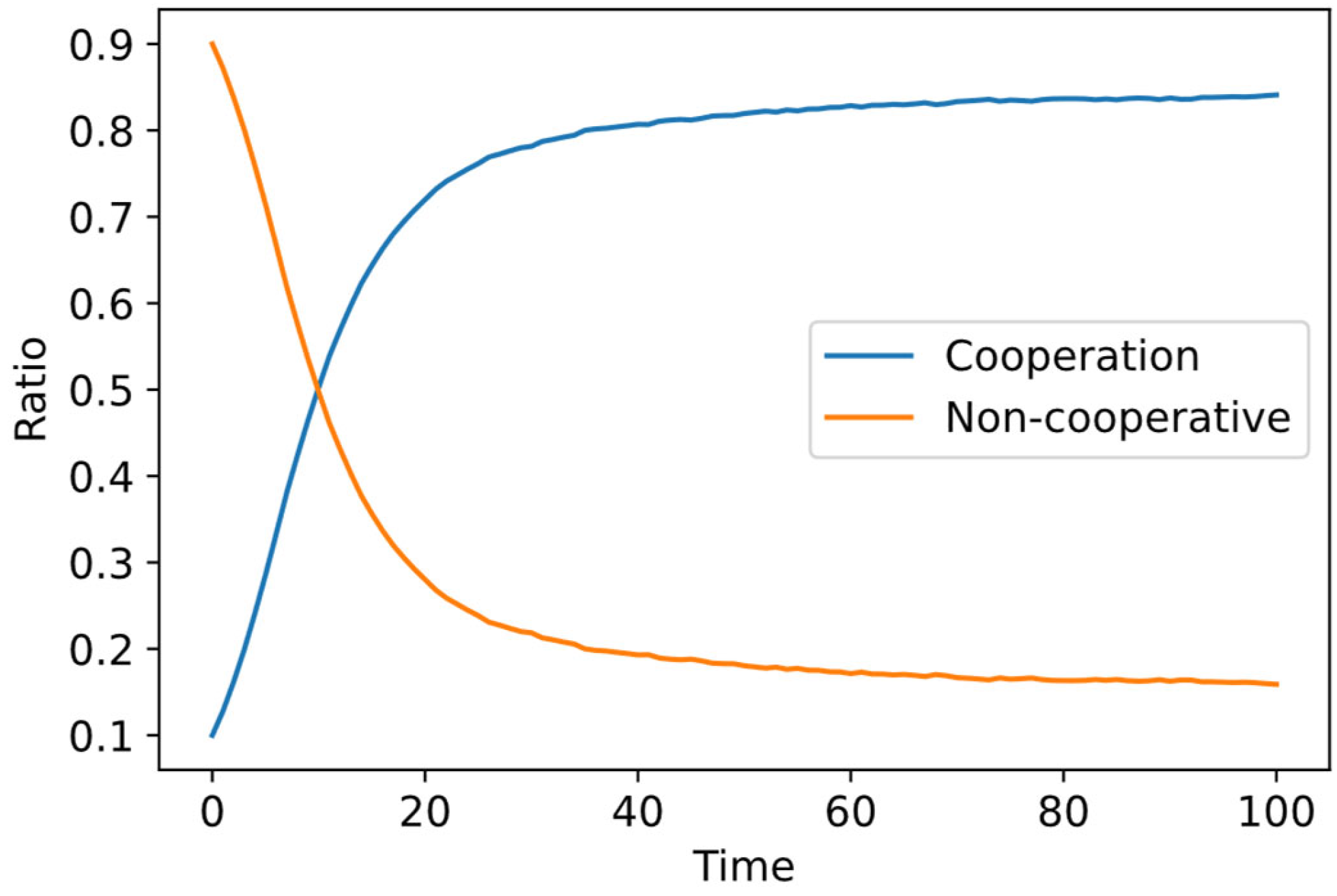
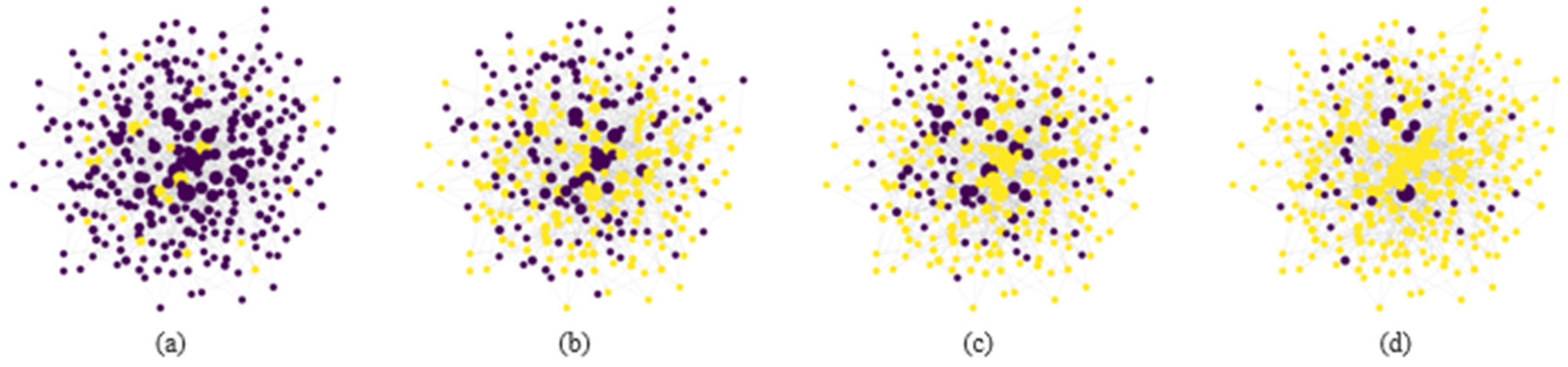
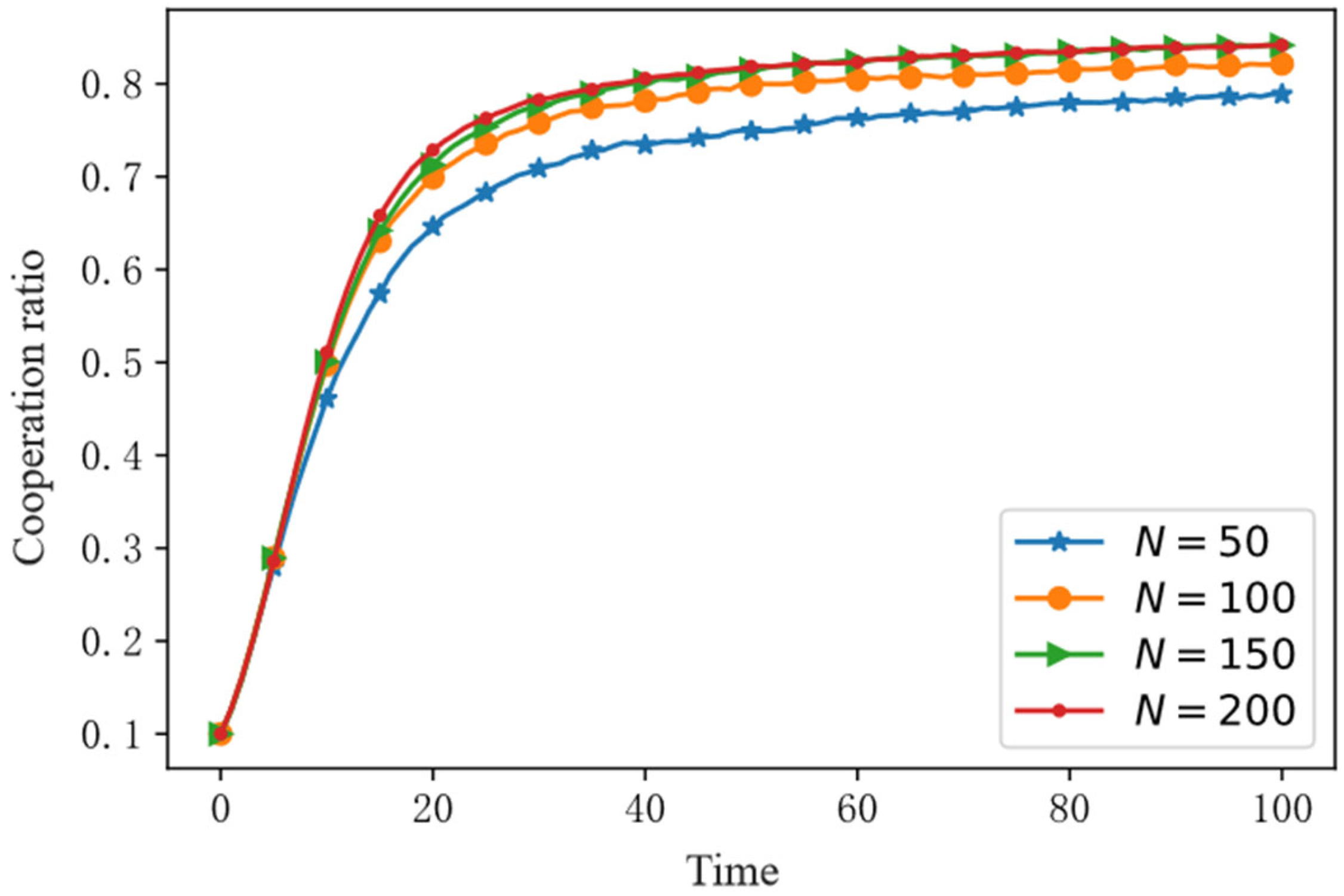
3.1. Baseline Evolution of Cooperation
3.2. Sensitivity Analysis
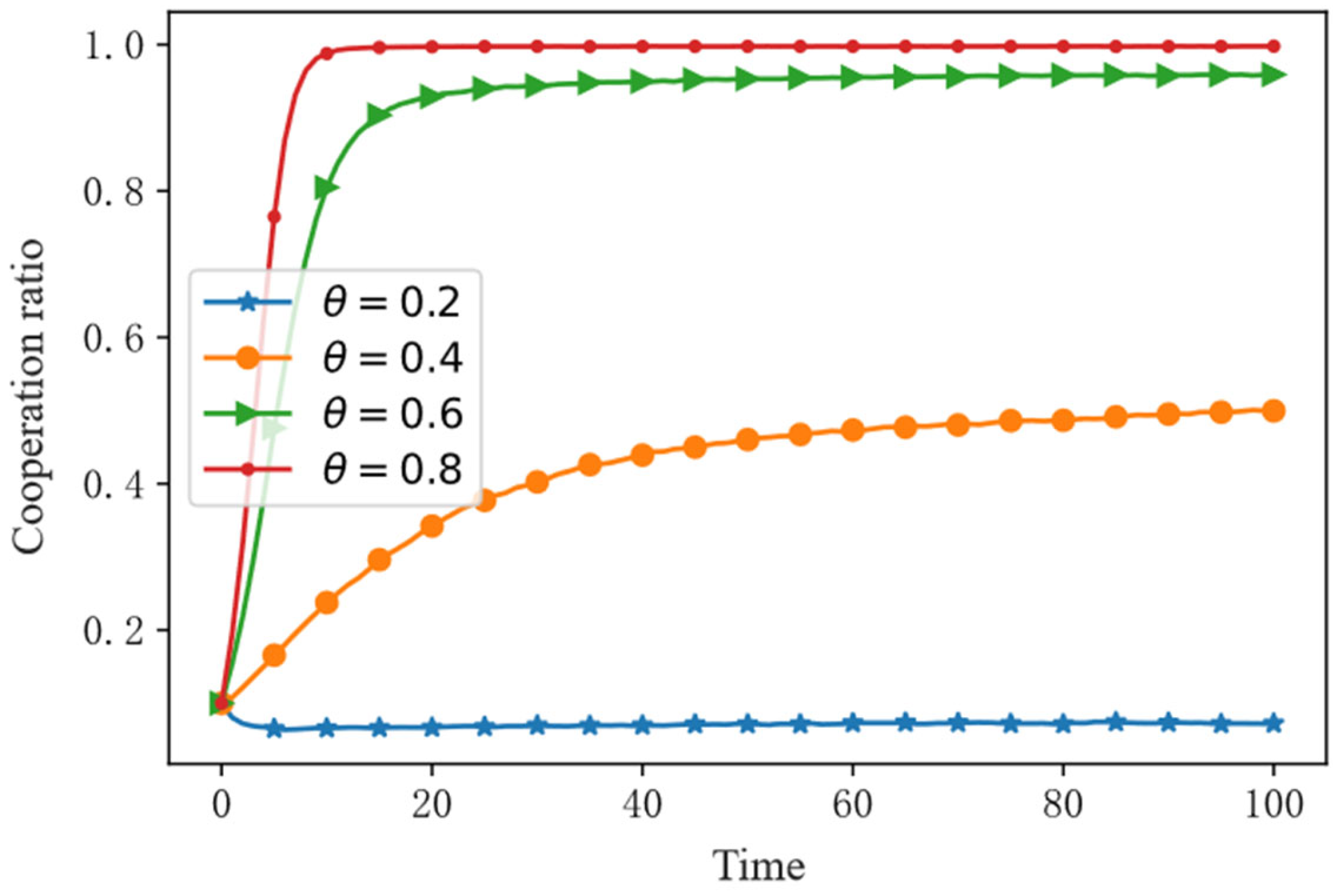
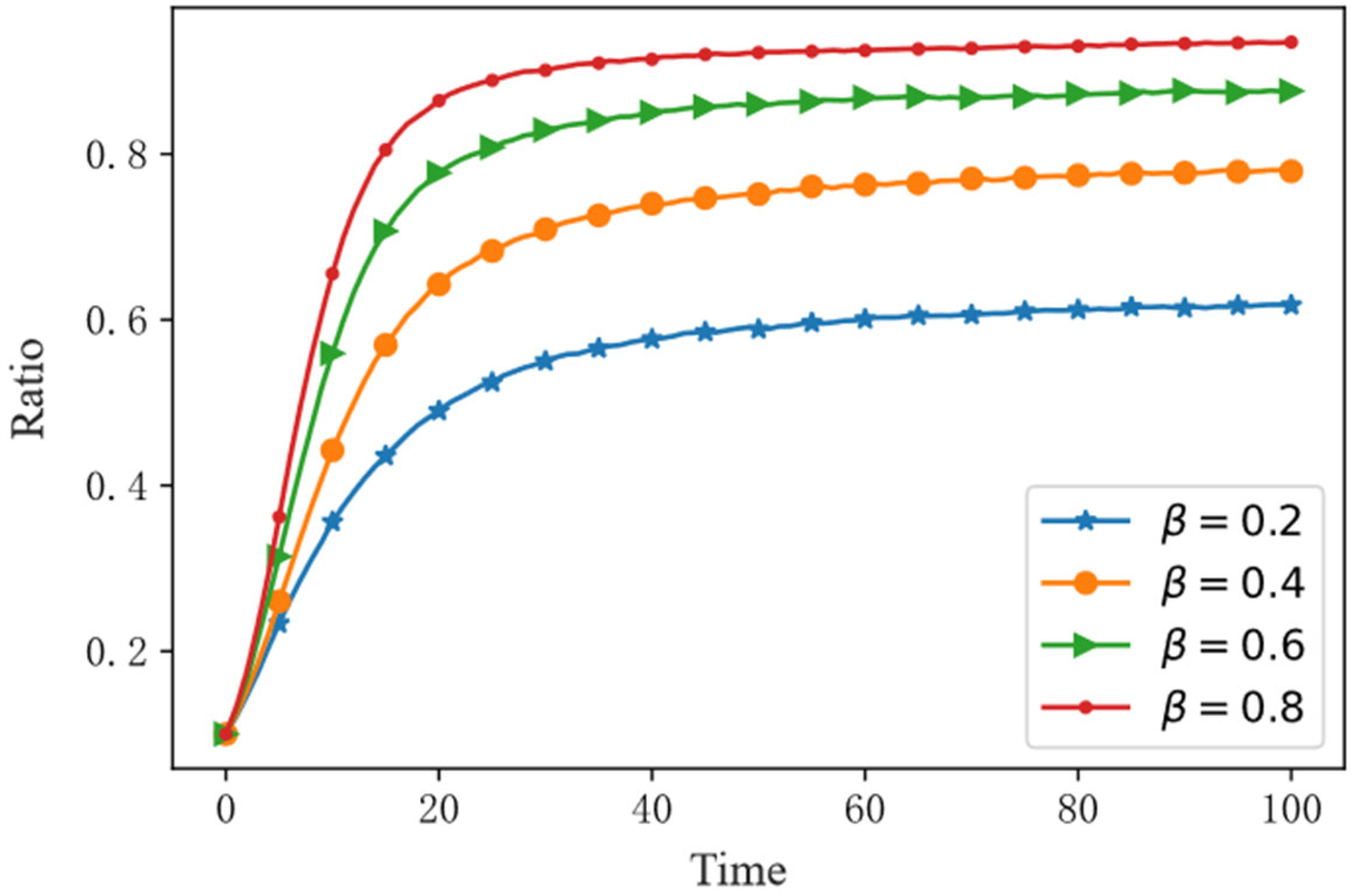
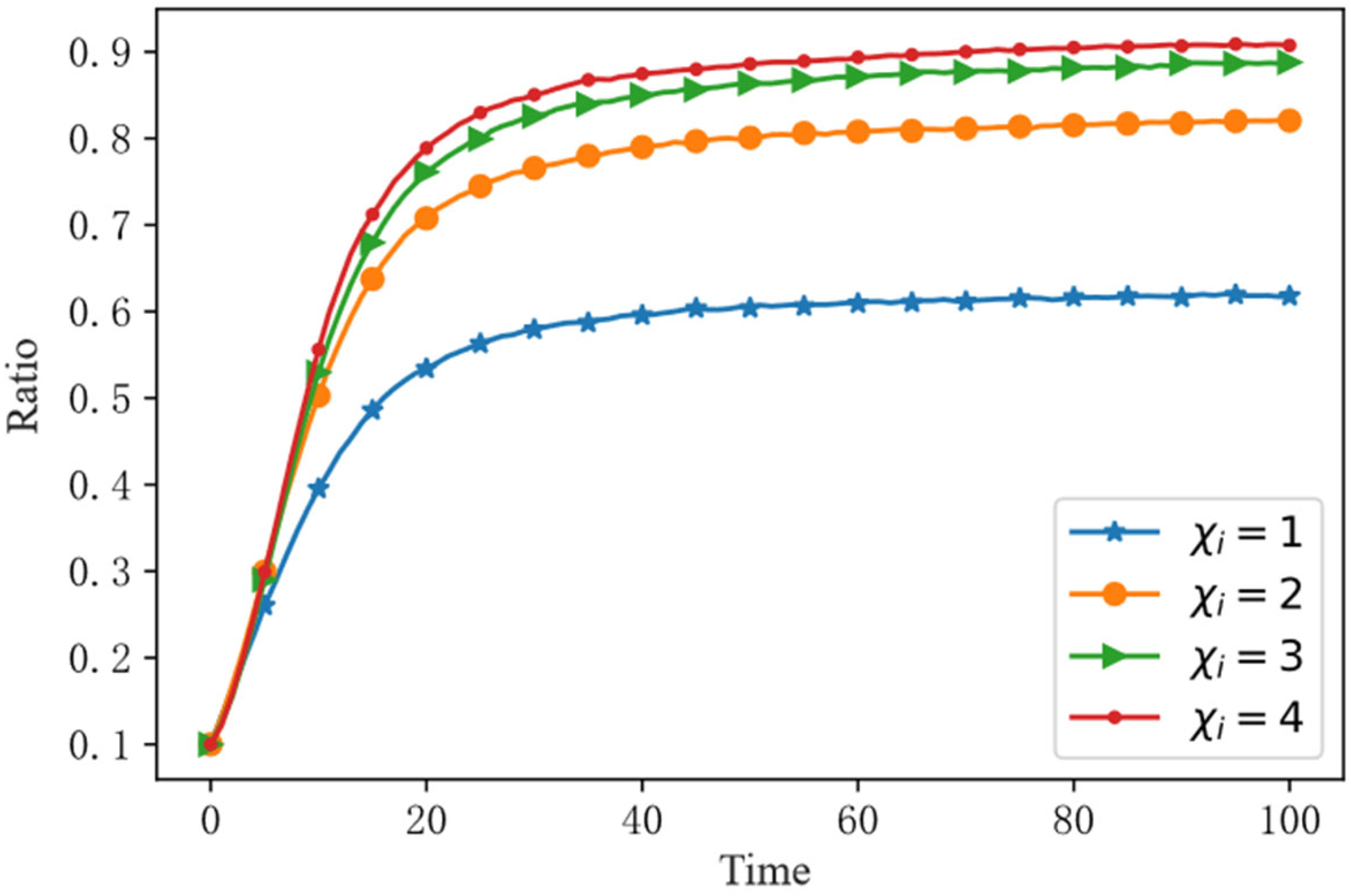
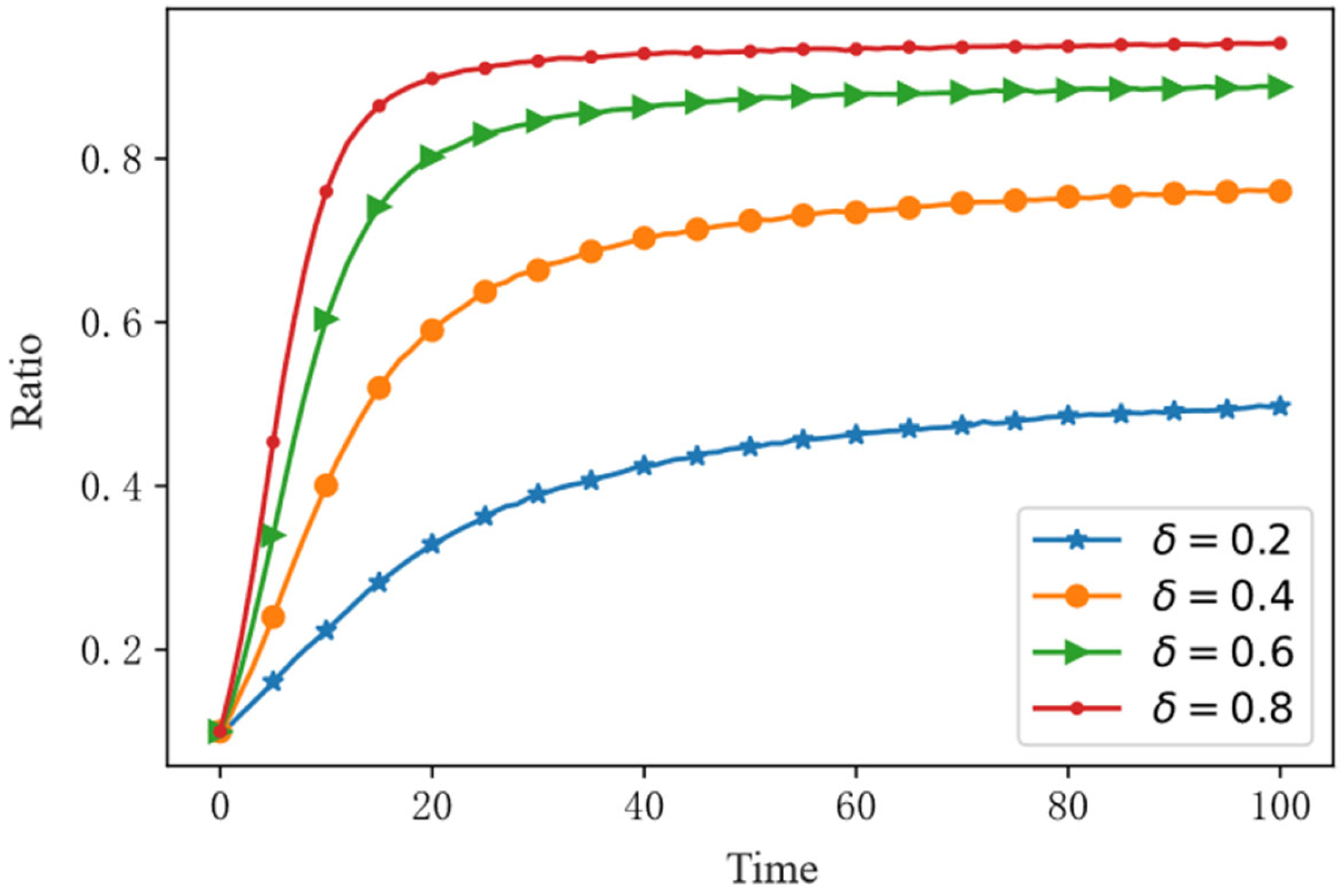
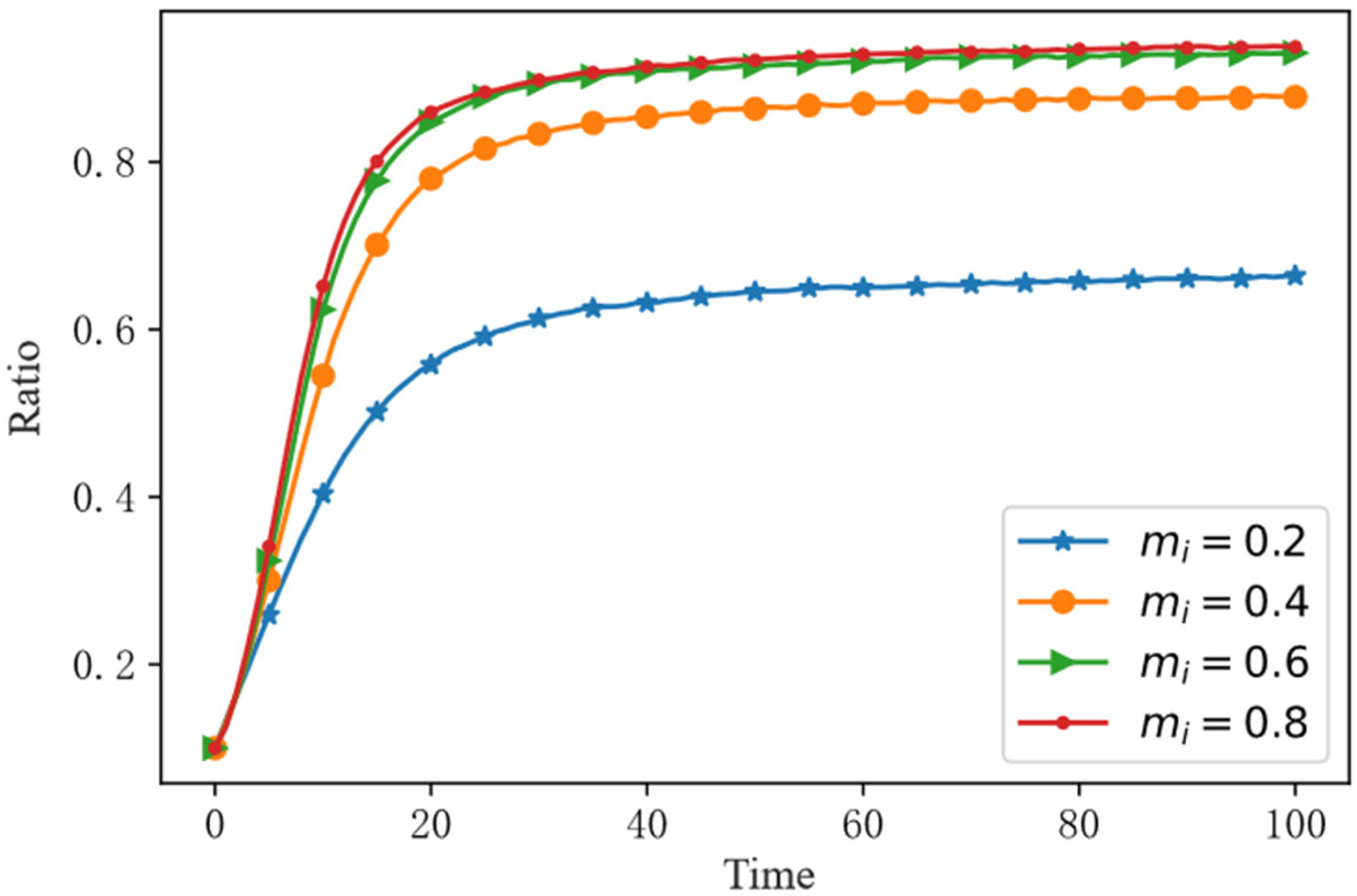
3.2.1. Parameters Related to Benefits and Incentives
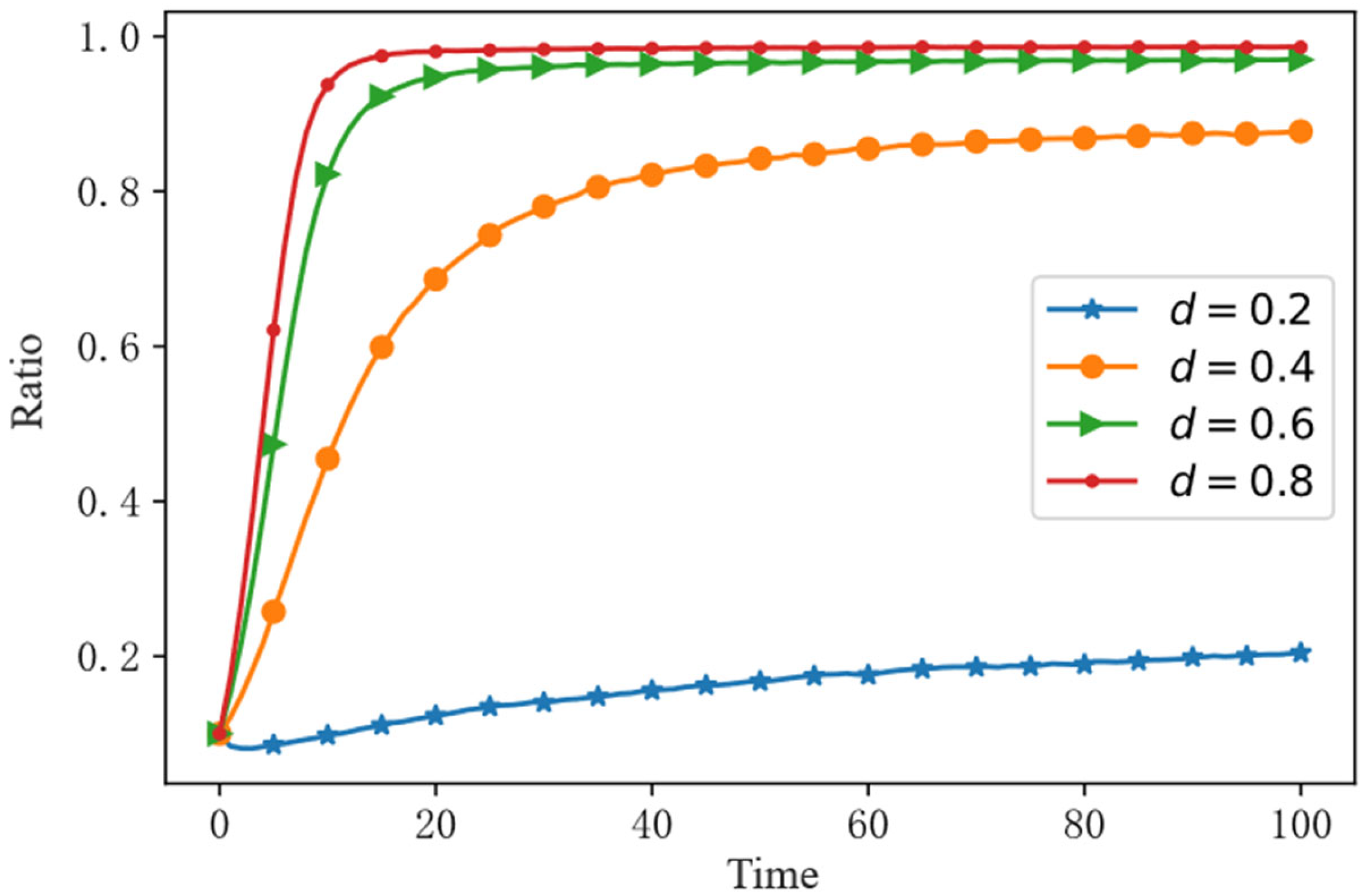
3.2.2. Cost, Risk, and Environmental Noise Parameters
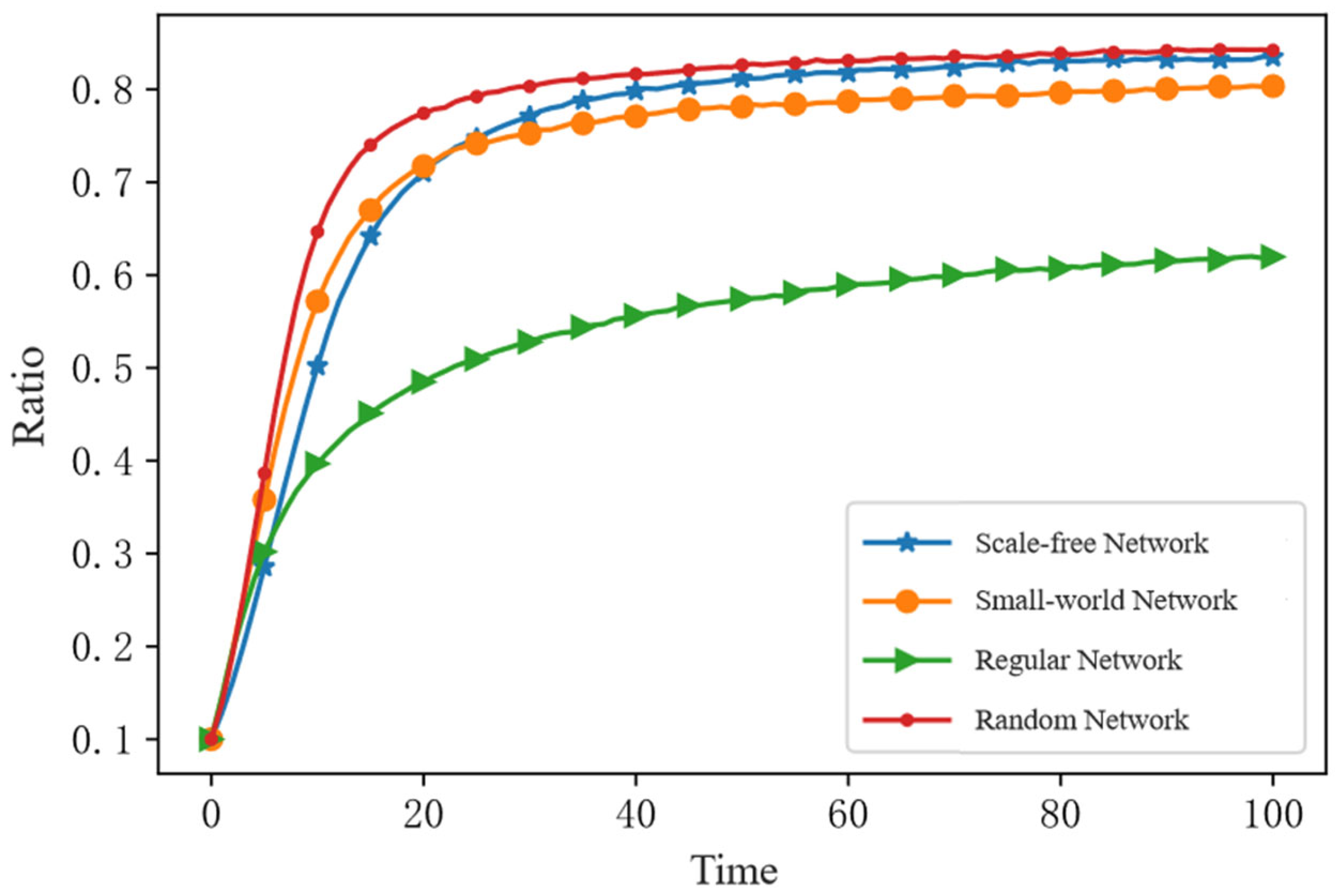
3.2.3. The Influence of Data Endowment and Network Structure
3.2.4. Summary of Sensitivity Results
4. Discussion
4.1. Diffusion Mechanisms and Network Structure
4.2. Key Parameter Effects and Multi-Source Synergy Gains
4.3. Network Sustainability and Governance Implications
5. Conclusions
5.1. Main Findings
5.2. Implications
5.3. Limitations and Future Research
Supplementary Materials
Author Contributions
Funding
Institutional Review Board Statement
Informed Consent Statement
Data Availability Statement
Conflicts of Interest
References
- IPCC. Climate Change 2022: Mitigation of Climate Change: Working Group III Contribution to the Sixth Assessment Report; Cambridge University Press: Cambridge, UK, 2022. [Google Scholar]
- Global e-Sustainability Initiative (GeSI). SMARTer2030: ICT Solutions for 21st Century Challenges; GeSI: Brussels, Belgium, 2015. [Google Scholar]
- European Parliament and Council of the European Union. Regulation (EU) 2024/1735 Establishing a Framework of Measures for Strengthening Europe’s Net-Zero Technology Manufacturing Ecosystem; European Union: Brussels, Belgium, 2024. [Google Scholar]
- Yin, Z.; Yue, Z.; Yin, Z. Carbon Mitigation Benefits Brought by Green Manufacturing: Evidence from China’s “Green Factory” Program. J. Clean. Prod. 2026, 544, 147690. [Google Scholar] [CrossRef]
- Yin, Z.; Wang, H. The Impact of Green Transformation in Data Centers on Corporate Carbon Emission Reduction: Empirical Evidence from China. Environ. Dev. Sustain. 2026, 28, 9483–9505. [Google Scholar] [CrossRef]
- Melander, L.; Arvidsson, A. Green Innovation Networks: A Research Agenda. J. Clean. Prod. 2022, 357, 131926. [Google Scholar] [CrossRef]
- Pattinson, S.; Damij, N.; El Maalouf, N.; Bazi, S.; Elsahn, Z.; Hilliard, R.; Cunningham, J.A. Building Green Innovation Networks for People, Planet, and Profit: A Multi-Level, Multi-Value Approach. Ind. Mark. Manag. 2023, 115, 408–420. [Google Scholar] [CrossRef]
- World Resources Institute and World Business Council for Sustainable Development. Corporate Value Chain (Scope 3) Accounting and Reporting Standard; Greenhouse Gas Protocol: Washington, DC, USA, 2011. [Google Scholar]
- Wang, J.; Gao, F.; Zhou, Y.; Guo, Q.; Tan, C.-W.; Song, J.; Wang, Y. Data Sharing in Energy Systems. Adv. Appl. Energy 2023, 10, 100132. [Google Scholar] [CrossRef]
- World Bank. State and Trends of Carbon Pricing 2024; World Bank: Washington, DC, USA, 2024. [Google Scholar]
- European Union Agency for Cybersecurity (ENISA). Data Protection Engineering; ENISA: Athens, Greece, 2022. [Google Scholar]
- Tang, X.; Lan, T.; Zhong, H.; Li, D.; Miao, Q. An Evolutionary Game Model for Indirect Data Sharing in Manufacturing Big Data Consortium. Expert Syst. Appl. 2024, 255, 124807. [Google Scholar] [CrossRef]
- Li, D.; Mei, X. Evolutionary Game Analysis of Data Sharing among Large and Medium-Sized Enterprises from the Perspective of Platform Empowerment. Sci. Rep. 2024, 14, 11447. [Google Scholar] [CrossRef]
- Cui, B.; Shui, Z.; Yang, S.; Lei, T. Evolutionary Game Analysis of Green Technology Innovation under the Carbon Emission Trading Mechanism. Front. Environ. Sci. 2022, 10, 997724. [Google Scholar] [CrossRef]
- Samuelson, P.A. The Pure Theory of Public Expenditure. Rev. Econ. Stat. 1954, 36, 387–389. [Google Scholar] [CrossRef]
- Ostrom, E. Governing the Commons: The Evolution of Institutions for Collective Action; Cambridge University Press: Cambridge, UK, 1990. [Google Scholar]
- Nowak, M.A. Five Rules for the Evolution of Cooperation. Science 2006, 314, 1560–1563. [Google Scholar] [CrossRef]
- Ohtsuki, H.; Hauert, C.; Lieberman, E.; Nowak, M.A. A Simple Rule for the Evolution of Cooperation on Graphs and Social Networks. Nature 2006, 441, 502–505. [Google Scholar] [CrossRef]
- Szabó, G.; Hauert, C. Evolutionary Prisoner’s Dilemma Games with Voluntary Participation. Phys. Rev. E 2002, 66, 062903. [Google Scholar] [CrossRef] [PubMed]
- Körner, M.F.; Leinauer, C.; Ströher, T.; Strüker, J. Digital Measuring, Reporting, and Verification (dMRV) for Decarbonization. Bus. Inf. Syst. Eng. 2025, 67, 753–765. [Google Scholar] [CrossRef]
- Barabási, A.-L.; Albert, R. Emergence of Scaling in Random Networks. Science 1999, 286, 509–512. [Google Scholar] [CrossRef] [PubMed]
- Szabó, G.T.; Hoke, C. Evolutionary Prisoner’s Dilemma Game on a Square Lattice. Phys. Rev. E 1998, 58, 69–73. [Google Scholar] [CrossRef]
- Szabó, G.; Fáth, G. Evolutionary Games on Graphs. Phys. Rep. 2007, 446, 97–216. [Google Scholar] [CrossRef]
- ISO/IEC 25012:2008; Data Quality Model. International Organization for Standardization: Geneva, Switzerland, 2008.
- Lippert, I. Failing the Market, Failing Deliberative Democracy: How Scaling up Corporate Carbon Reporting Proliferates Information Asymmetries. Big Data Soc. 2016, 3, 1–13. [Google Scholar] [CrossRef]
- The European Green Deal: How Open Data Supports a Green Transition; Publications Office of the European Union: Luxembourg, 2024; Available online: https://data.europa.eu (accessed on 23 March 2026).
- Mao, X.; Mao, Y.; Wang, Y. Unlocking Collaborative Low-Carbon Innovation in Clusters Using BA Scale-Free Networks and Evolutionary Game. Sustainability 2025, 17, 10566. [Google Scholar] [CrossRef]
- Eghbali, M.A.; Rasti-Barzoki, M.; Altmann, J. An Evolutionary Game-theoretic Approach to Analysis the Green Innovation Chain Dynamics under Government Policies. Technol. Soc. 2024, 77, 102568. [Google Scholar] [CrossRef]
- Tang, S.Y.; Kouvelis, P. Pay-Back-Revenue-Sharing Contract in Coordinating Supply Chains with Random Yield. Prod. Oper. Manag. 2014, 23, 2089–2102. [Google Scholar] [CrossRef]
- van den Broek, T.; van Veenstra, A.F. Governance of Big Data Collaborations: How to Balance Regulatory Compliance and Disruptive Innovation. Technol. Forecast. Soc. Change 2018, 129, 330–338. [Google Scholar] [CrossRef]
- Chen, X.; Yang, W.; Zhang, R. Research on the Diffusion of Green Innovation Behavior Using a Complex Network Evolutionary Game Model. Manag. Decis. Econ. 2024, 45, 1215–1229. [Google Scholar] [CrossRef]
- Newman, M.E. The Structure and Function of Complex Networks. SIAM Rev. 2003, 45, 167–256. [Google Scholar] [CrossRef]
- China Academy of Information and Communications Technology. Analysis Report on Data Sharing Practices; China Academy of Information and Communications Technology: Beijing, China, 2025. [Google Scholar]
- Santos, F.C.; Pacheco, J.M. Scale-Free Networks Provide a Unifying Framework for the Emergence of Cooperation. Phys. Rev. Lett. 2005, 95, 098104. [Google Scholar] [CrossRef] [PubMed]
- Watts, D.J. A Simple Model of Global Cascades on Random Networks. Proc. Natl. Acad. Sci. USA 2002, 99, 5766–5771. [Google Scholar] [CrossRef]
- Bollobás, B. On the Evolution of Random Graphs. Trans. Am. Math. Soc. 1984, 286, 257–274. [Google Scholar] [CrossRef]
- Watts, D.J.; Strogatz, S.H. Collective Dynamics of ‘Small-World’Networks. Nature 1998, 393, 440–442. [Google Scholar] [CrossRef]
- Hutterer, A.; Krumay, B. Scopes of Governance in Data Spaces. In Proceedings of the Australasian Conference on Information Systems (ACIS) 2024, Canberra, Australia, 4–6 December 2024. [Google Scholar]
- Delacroix, S.; Lawrence, N.D. Bottom-up Data Trusts: Disturbing the ‘One Size Fits All’ Approach to Data Governance. Int. Data Priv. Law 2019, 9, 236–252. [Google Scholar] [CrossRef]
- Artyushina, A. Is Civic Data Governance the Key to Democratic Smart cities? The Role of the Urban Data Trust in Sidewalk Toronto. Telemat. Inform. 2020, 55, 101456. [Google Scholar] [CrossRef]
- Otto, B. Organizing Data Governance: Findings from the Telecommunications Industry and Consequences for Large Service Providers. Commun. Assoc. Inf. Syst. 2011, 29, 45–66. [Google Scholar] [CrossRef]
- Nowak, M.A. Evolutionary Dynamics: Exploring the Equations of Life; Harvard University Press: Cambridge, MA, USA, 2006. [Google Scholar]
- Fehr, E.; Schmidt, K.M. A Theory of Fairness, Competition, and Cooperation. Q. J. Econ. 1999, 114, 817–868. [Google Scholar] [CrossRef]
- Otto, B.; Steinbuß, S.; Teuscher, A.; Lohmann, S.; Auer, S.; Bader, S.; Bastiaansen, H.; Bauer, H.; Birnstil, P.; Böhmer, M.; et al. International Data Spaces: Reference Architecture Model Version 3. International Data Spaces Association–IDSA. Available online: https://internationaldataspaces.org/wp-content/uploads/IDS-Reference-Architecture-Model-3.0-2019.pdf (accessed on 23 March 2026).
- Fan, R.; Wang, Y.; Chen, F.; Du, K.; Wang, Y. How do Government Policies Affect the Diffusion of Green Innovation among Peer Enterprises?—An Evolutionary-Game Model in Complex Networks. J. Clean. Prod. 2022, 364, 132711. [Google Scholar] [CrossRef]
- Greenberg, P.S.; Greenberg, R.H.; Lederer Antonucci, Y. The Role of Trust in the Governance of Business Process Outsourcing Relationships: A Transaction Cost Economics Approach. Bus. Process Manag. J. 2008, 14, 593–608. [Google Scholar] [CrossRef]
- Jussen, I.; Möller, F.; Schweihoff, J.; Gieß, A.; Giussani, G.; Otto, B. Issues in Inter-Organizational Data Sharing: Findings from Practice and Research Challenges. Data Knowl. Eng. 2024, 150, 102280. [Google Scholar] [CrossRef]
- OECD. Enhancing Access to and Sharing of Data: Reconciling Risks and Benefits for Data Re-Use Across Societies; OECD Publishing: Paris, France, 2019. [Google Scholar]
- Adner, R. Ecosystem as Structure: An Actionable Construct for Strategy. J. Manag. 2017, 43, 39–58. [Google Scholar] [CrossRef]
- Gawer, A. Digital Platforms and Ecosystems: Remarks on the Dominant Organizational Forms of the Digital Age. Innovation 2022, 24, 110–124. [Google Scholar] [CrossRef]
- Mazzola, E.; Piazza, M.; Acur, N.; Perrone, G. Treating the Crowd Fairly: Increasing the Solvers’ Self-Selection in Idea Innovation Contests. Ind. Mark. Manag. 2020, 91, 16–29. [Google Scholar] [CrossRef]



| Agent i\Agent j | Green Innovation Agent j | ||
|---|---|---|---|
| Share S | Not Share N | ||
| Green Innovation Agent | Share | ||
| Not Share | |||
| Category | Symbol | Description | Baseline Setting | Value Range/Distribution | Notes |
|---|---|---|---|---|---|
| Network | N | Number of agents (nodes) | 300 | 100 to 1000 | BA network size |
| Network | Initial seed size | 5 | 3 to 10 | Fully connected seed | |
| Network | Edges added per new node | 3 | 1 to 5 | Controls average degree | |
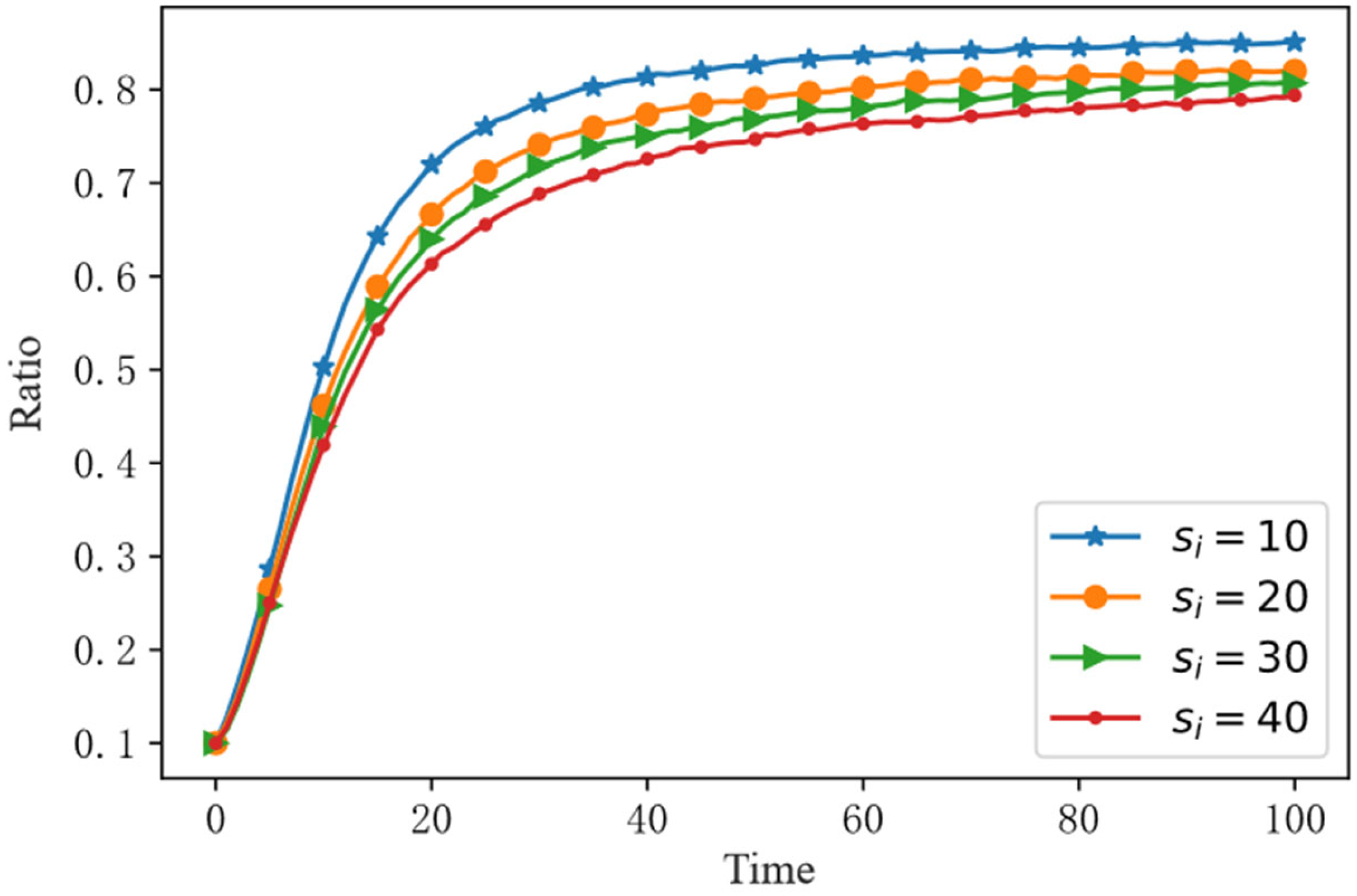
| Endowment | Multi-source data stock of agent () | U (0, 1] | scenario based (e.g.,10, 20, 30, 40) | Baseline uses bounded heterogeneity | |
| Behavior | Data contribution ratio under sharing | U (0, 1] | 0.2, 0.4, 0.6, 0.8 | 0 < ≤ 1 | |
| Incentive | Incentive intensity for agent () | U (0, 1] | 1, 2, 3, 4 | Sensitivity uses homogeneous | |
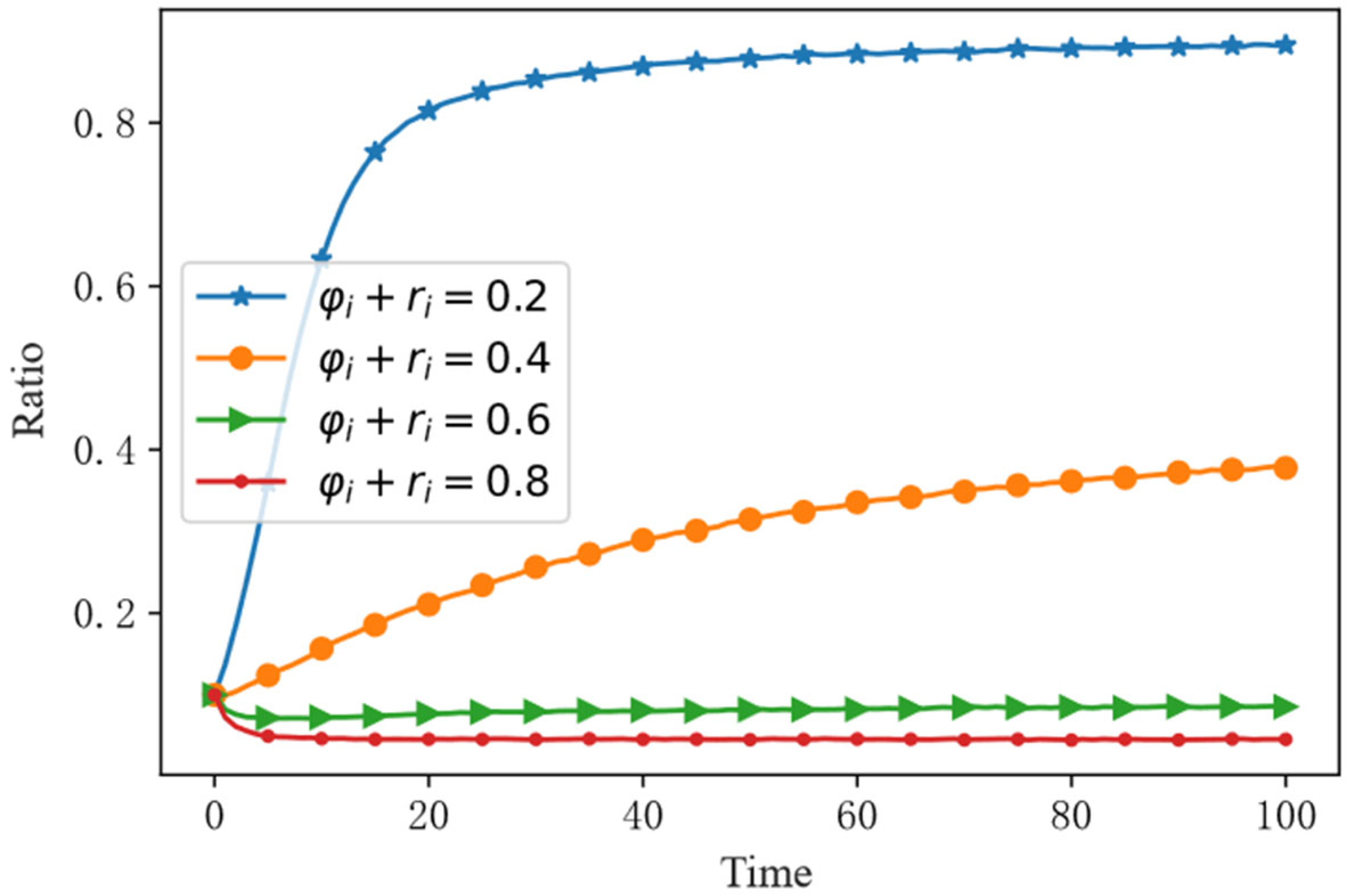
| Cost | Variable sharing cost coefficient | U (0, 0.10] | 0.2, 0.4, 0.6, 0.8 (via ( + )) | Non negative | |
| Risk | Leakage and governance risk | U (0, 0.08] | 0.2, 0.4, 0.6, 0.8 (via ( + )) | Non negative | |
| Opportunity loss | Opportunity loss under non sharing | U (0.2, 0.5] | 0.2, 0.4, 0.6, 0.8 | Penalizes non cooperation | |
| Benefit | Profit conversion coefficient of own data | 0.8 | 0.2, 0.4, 0.6, 0.8 | δ > 0 | |
| Benefit | Synergy coefficient from partner data | 0.3 | 0.2, 0.4, 0.6, 0.8 | Β ≥ 0 | |
| Allocation | Allocation shares to focal agent | 0.6 | 0.2, 0.4, 0.6, 0.8 | 0 ≤ θ ≤ 1 | |
| Fixed cost | Fixed infrastructure and governance cost | 0.2 | 0.1 to 1.0 | (C > 0) | |
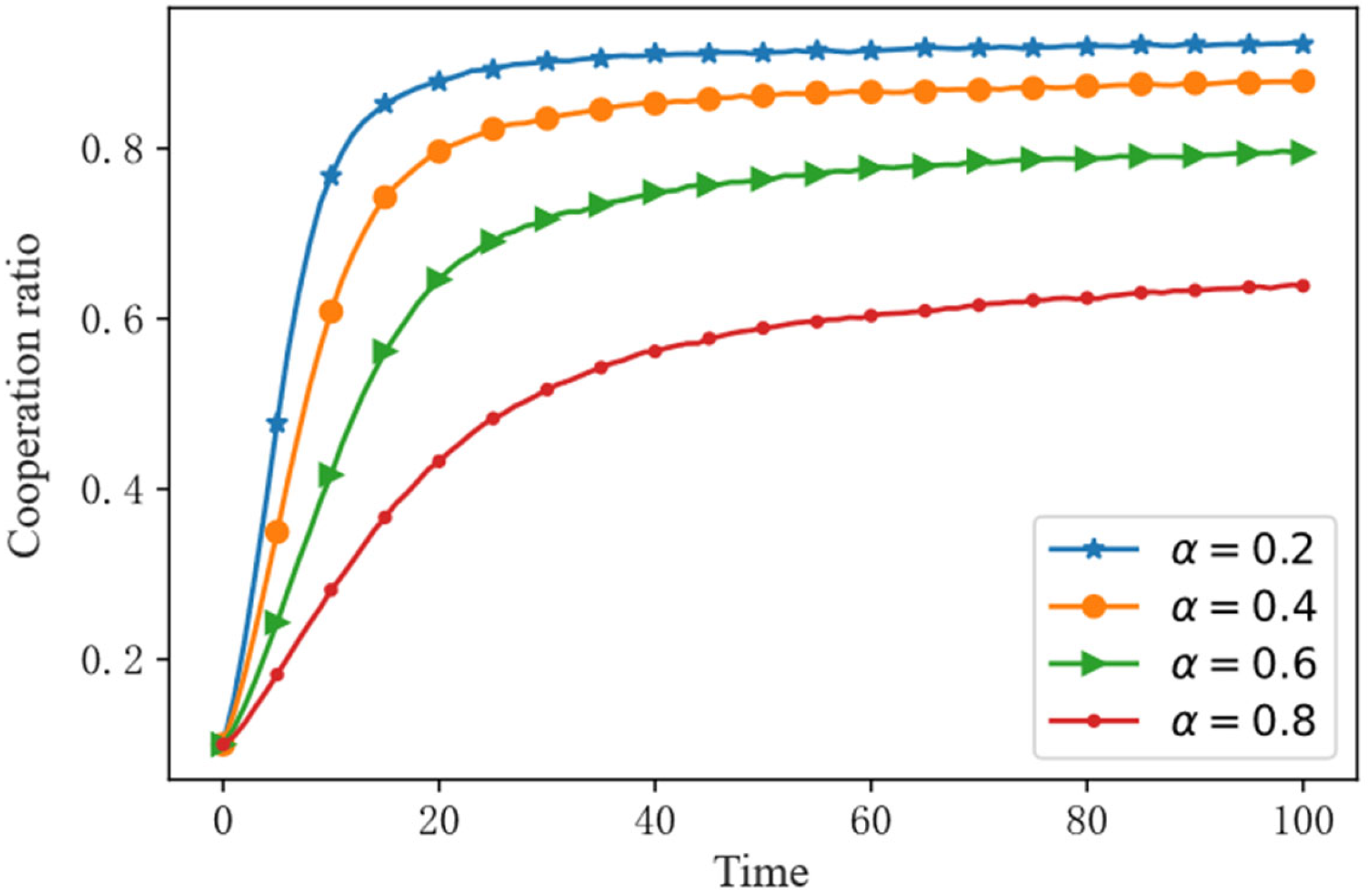
| Fixed cost | Effective fixed cost share under cooperation | 0.5 | 0.2, 0.4, 0.6, 0.8 | 0 < α ≤ 1 | |
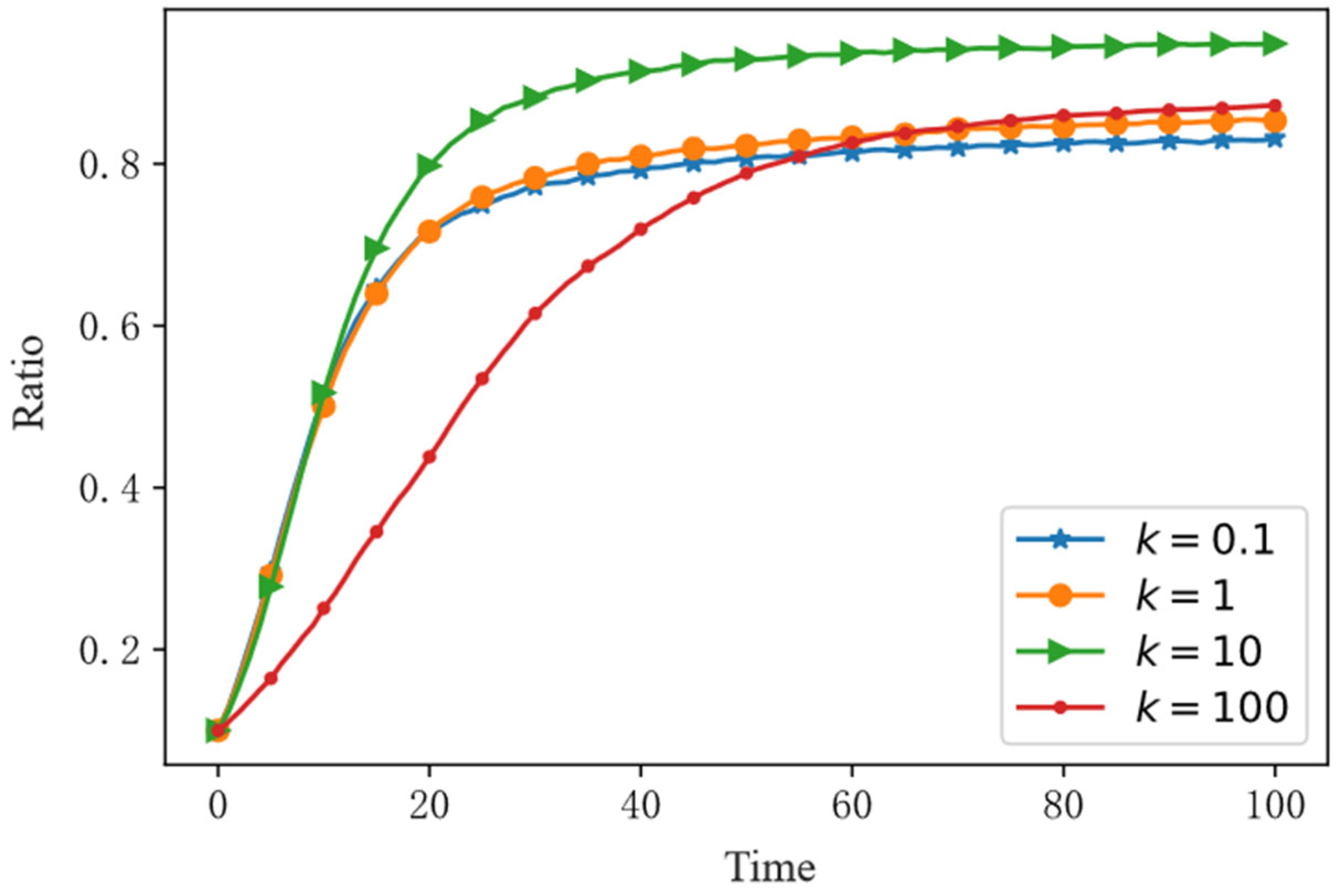
| Dynamics | Noise parameter in Fermi rule | 0.1 | 0.1, 1, 10, 100 | Controls decision uncertainty | |
| Simulation | Initial cooperation rate | 0.1 | 0.05 to 0.50 | Random initialization | |
| Simulation | Number of rounds | 3000 | fixed | Ensure convergence | |
| Simulation | Repetitions per setting | 100 | fixed | Average trajectories |
Disclaimer/Publisher’s Note: The statements, opinions and data contained in all publications are solely those of the individual author(s) and contributor(s) and not of MDPI and/or the editor(s). MDPI and/or the editor(s) disclaim responsibility for any injury to people or property resulting from any ideas, methods, instructions or products referred to in the content. |
© 2026 by the authors. Licensee MDPI, Basel, Switzerland. This article is an open access article distributed under the terms and conditions of the Creative Commons Attribution (CC BY) license.
Share and Cite
Yang, L.; Du, K.; Hu, B.; Yin, Z. Multi-Source Environmental Data Sharing in Green Innovation Networks: A Network Evolutionary Game Approach. Sustainability 2026, 18, 3886. https://doi.org/10.3390/su18083886
Yang L, Du K, Hu B, Yin Z. Multi-Source Environmental Data Sharing in Green Innovation Networks: A Network Evolutionary Game Approach. Sustainability. 2026; 18(8):3886. https://doi.org/10.3390/su18083886
Chicago/Turabian StyleYang, Liu, Kang Du, Biyu Hu, and Zhixiang Yin. 2026. "Multi-Source Environmental Data Sharing in Green Innovation Networks: A Network Evolutionary Game Approach" Sustainability 18, no. 8: 3886. https://doi.org/10.3390/su18083886
APA StyleYang, L., Du, K., Hu, B., & Yin, Z. (2026). Multi-Source Environmental Data Sharing in Green Innovation Networks: A Network Evolutionary Game Approach. Sustainability, 18(8), 3886. https://doi.org/10.3390/su18083886