1. Introduction
Urbanization has become one of the most transformative global trends of the twenty-first century. Rapid urban expansion has reshaped economic structures, labor markets, and environmental conditions across cities worldwide [
1,
2]. As urban populations continue to grow, cities are increasingly recognized as central engines of economic productivity, innovation, and human capital accumulation [
3,
4]. However, the rapid pace of urban development often creates significant environmental pressures, including declining air quality, reduced ecological resilience, and the loss of urban green spaces [
5,
6,
7]. These challenges raise important concerns regarding the sustainability of urban economic growth and the well-being of urban workers, particularly in rapidly urbanizing developing countries.
In response to these challenges, urban green spaces have gained increasing attention in both academic and policy discussions. Urban green spaces—such as public parks, urban forests, and other vegetated areas—are widely acknowledged for their ecological and social functions [
8,
9]. From an environmental perspective, green spaces improve urban microclimates, mitigate heat island effects, and enhance air quality [
10]. From a social perspective, they contribute to recreational opportunities, mental health, and overall quality of life for urban residents [
11,
12]. While these benefits are well established, much of the literature has traditionally emphasized environmental sustainability and urban livability, often treating green spaces primarily as ecological or amenity-based assets.
More recent studies, however, suggest that the role of urban green spaces extends beyond environmental and social dimensions to include economic implications. In particular, a growing body of literature highlights the potential link between environmental quality and labor productivity. Green environments can improve physical and mental health, reduce stress levels, and enhance cognitive functioning, all of which are closely associated with worker performance [
13,
14,
15]. Healthier and less stressed workers are more likely to exhibit higher levels of concentration, creativity, and efficiency in the workplace [
16,
17]. Evidence from environmental psychology and public health further indicates that exposure to natural environments can reduce mental fatigue and improve attention restoration, thereby supporting higher productivity levels [
18,
19].
In addition to these micro-level mechanisms, broader empirical studies demonstrate that environmental conditions significantly influence economic performance. Factors such as air quality, temperature, and urban climate have been shown to affect worker efficiency, absenteeism, and output levels Several studies have explored the broader relationship between environmental quality and economic productivity. Environmental conditions such as air quality, temperature, and urban climate have been found to significantly influence worker performance and output levels [
20,
21,
22]. For example, extreme heat and pollution can reduce labor productivity and increase health risks productivity [
23,
24,
25], while improvements in environmental quality can enhance working conditions and economic outcomes [
26,
27,
28]. Within this framework, urban green spaces can be viewed as part of urban environmental infrastructure that supports productive labor markets.
The case of Indonesia provides a particularly relevant context for examining this relationship. Indonesia has experienced rapid urban growth over the past two decades, with an increasing concentration of economic activity in urban areas [
29]. Cities across the country have become important centers of employment, industrial production, and service sector expansion [
30,
31]. At the same time, urban expansion has often been accompanied by environmental degradation and the reduction in urban green areas [
32,
33,
34]. Although national and local governments have introduced policies promoting the development of urban green spaces, their economic implications remain insufficiently understood.
Urban green spaces may also contribute to economic productivity through their influence on urban attractiveness and human capital mobility [
8,
35,
36]. Cities with higher environmental quality and well-maintained green spaces tend to be more attractive to skilled workers and highly educated professionals [
37,
38]. Such environmental amenities can influence residential location choices, encourage talent retention, and increase the competitiveness of cities in attracting investment and innovation [
39,
40]. In this context, urban green spaces can indirectly contribute to economic growth by strengthening local labor markets and supporting knowledge-based economic activities.
Understanding the role of urban green spaces in shaping labor productivity is particularly important for Indonesia’s urban development agenda. As cities continue to compete for investment, talent, and economic growth, improving the productivity of the urban workforce has become a key policy priority. Urban environmental quality, including the provision of green spaces, may serve as an important factor influencing worker performance and overall economic efficiency. However, empirical evidence on this relationship in the Indonesian context remains limited, especially at the city level.
Given these conditions, a deeper examination of the link between urban green spaces and labor productivity is essential for informing sustainable urban policy. Investigating this relationship can provide insights into whether environmental investments, such as the expansion of urban green areas can generate not only ecological benefits but also measurable economic gains. Such evidence is particularly relevant for policymakers seeking to balance economic growth with environmental sustainability in rapidly urbanizing economies.
This study contributes to the existing literature in several important ways. It directly examines the relationship between urban green spaces and labor productivity, an area that has received relatively limited empirical attention compared to other outcomes such as health or property values. The study focuses on cities in Indonesia, a rapidly urbanizing developing country where environmental pressures and labor productivity challenges coexist. By utilizing city-level data across Indonesia, the study provides new empirical evidence on how urban environmental amenities may influence economic performance in emerging urban systems. These contributions help expand the literature linking environmental sustainability and urban economic productivity.
Based on these considerations, the main objective of this study is to analyze the impact of urban green spaces on labor productivity in Indonesian cities. Specifically, the study seeks to investigate whether the availability of urban green spaces contributes to higher levels of labor productivity across cities in Indonesia. By examining this relationship, the study aims to provide empirical evidence that can inform policies promoting sustainable urban development while simultaneously enhancing economic performance.
Despite these potential benefits, much of the existing literature on urban green spaces has focused on outcomes such as property values, urban livability, and environmental quality. Numerous studies have documented the positive effects of green spaces on housing prices, demonstrating that proximity to parks and green areas often increases property values. Similarly, research in urban planning has highlighted the role of green spaces in enhancing the overall quality of life in cities. While these findings provide valuable insights, they primarily emphasize the social and environmental dimensions of urban green infrastructure rather than its economic implications.
Empirical research examining the relationship between green spaces and labor productivity remains relatively limited. Although some studies suggest that greener working environments can improve employee performance and workplace satisfaction, most of this evidence is derived from micro-level studies focusing on office environments, workplace design, or individual-level productivity measures. Such studies provide important insights into behavioral mechanisms but may not fully capture broader economic effects at the city or regional level.
Furthermore, the majority of existing empirical studies have been conducted in developed countries, particularly in North America and Europe. Urban contexts in developing economies often differ substantially in terms of urban density, environmental management, institutional capacity, and labor market structures. Rapid urban expansion in developing countries frequently leads to the conversion of green areas into built environments, potentially reducing the availability of urban green spaces. At the same time, these countries face significant challenges in improving labor productivity as part of their broader economic development strategies.
Indonesia provides a particularly relevant case for examining these issues. As one of the largest emerging economies in Southeast Asia, Indonesia has experienced rapid urbanization and significant structural transformation over the past two decades. Urban areas have become key centers of economic activity, employment generation, and industrial development. However, this rapid urban growth has also placed increasing pressure on urban environmental resources, including the availability of green spaces. Although urban green space policies have been introduced in several cities, the extent to which such environmental investments contribute to economic performance remains largely unexplored.
Based on the existing literature, several important gaps remain in understanding the relationship between urban green spaces and economic productivity. While numerous studies have examined the environmental and social benefits of urban green spaces, relatively limited research has directly investigated their impact on labor productivity at the macro or city level. Most existing studies focus on health outcomes, property markets, or urban livability, leaving the economic productivity dimension underexplored.
The majority of empirical evidence on urban green spaces originates from developed countries, where urban planning systems, environmental governance, and labor market conditions differ substantially from those in developing economies. Consequently, the applicability of these findings to rapidly urbanizing countries such as Indonesia remains uncertain. Cities in developing countries often face unique challenges related to environmental degradation, infrastructure constraints, and uneven economic development.
Empirical studies that simultaneously examine urban environmental amenities and labor productivity at the city level remain scarce. Understanding whether urban green spaces can contribute to improving labor productivity is crucial for policymakers seeking to design integrated urban development strategies that combine environmental sustainability with economic efficiency. Addressing these gaps is therefore essential for expanding the literature on sustainable urban development and for providing new evidence on the economic value of urban green infrastructure in emerging economies.
2. Methodology
2.1. Study Area
This study focuses on 92 cities across Indonesia, a large archipelagic country characterized by substantial geographical fragmentation and regional heterogeneity. The selected cities are distributed across major island groups, including Java, Sumatra, Kalimantan, Sulawesi, and Eastern Indonesia, reflecting diverse urban, economic, and environmental conditions.
Given Indonesia’s spatial structure as an archipelago, the cities included in this study are geographically dispersed and vary considerably in size, density, and level of development. Some cities are located within highly urbanized regions such as Java, while others are situated in relatively less developed or remote areas. This wide spatial distribution provides a rich empirical setting to examine inter-regional differences as well as potential spatial interactions among cities.
The selection of 92 cities ensures adequate representation of Indonesia’s urban system while maintaining data consistency over the observation period from 2014 to 2024. Importantly, this study adopts a city-level analytical framework, where each city is treated as a spatial unit of analysis embedded within a broader regional system. This allows the model to capture not only intra-city characteristics but also inter-city spillover effects, which are particularly relevant in a geographically fragmented country like Indonesia.
Overall, the study area captures significant variation in environmental quality, urban green space availability, human capital, and economic performance, making it well-suited for analyzing the relationship between urban environmental factors and labor productivity within a spatial econometric framework.
2.2. Data and Variables
This study employs an applied quantitative research design aimed at examining the relationship between urban environmental factors and economic productivity in Indonesian cities. The dataset covers 92 cities across Indonesia over the period 2014–2024, forming a balanced panel dataset that captures both cross-sectional and temporal variations Data related to economic indicators, employment, education, and health are obtained from Statistics Indonesia and its regional statistical publications. Urban green space is measured using the Normalized Difference Vegetation Index (NDVI) derived from remote sensing using Google Earth Engine (GEE), while environmental quality is proxied by Aerosol Optical Depth (AOD), also obtained from remote sensing.
In this study, labor productivity serves as the dependent variable and represents the efficiency of economic output generated by the workforce. It is calculated as the ratio between total regional economic output and the number of employed workers. The main explanatory variable is urban green space, which reflects the availability and intensity of vegetation within urban areas. NDVI is widely used in environmental and urban studies to measure vegetation density based on satellite imagery.
To ensure a more comprehensive analysis, several control variables are included to account for other socio-economic and environmental factors that may influence labor productivity. Life expectancy is used as a proxy for public health, Aerosol Optical Depth (AOD) captures environmental quality, average years of schooling reflects human capital, and GRDP per capita controls for differences in economic development. The operational definitions and measurements of these variables are presented in
Table 1.
All data processing and empirical analyses in this study were conducted using the R 4.2.1 software environment. The use of R enables efficient data management, implementation of spatial econometric models, and ensures the reproducibility of the analysis.
2.3. Empirical Model
To capture potential spatial spillover effects among cities, this study adopts an empirical framework based on a spatial autoregressive panel model. Spatial econometric approaches are particularly suitable for regional studies because economic outcomes in one location may be influenced by conditions in neighboring regions [
41,
42]. In the context of this study, labor productivity in a city may be affected not only by its own socio-economic and environmental characteristics but also by productivity dynamics in surrounding cities. Following the approach proposed by [
43], the empirical specification incorporates spatial dependence and dynamic adjustment within a panel data framework. The baseline empirical model is specified as follows:
where
represents labor productivity in city
i at time
t. The term
denotes the lagged value of labor productivity, capturing dynamic persistence in productivity performance over time. In this study, a spatial weighting matrix
constructed to represent spatial relationships among cities. The element
of the matrix captures the spatial interaction between city
i and city
j in period
t. The diagonal elements of the matrix are set to zero, indicating that a city does not exert spatial influence on itself, and the matrix is row-normalized to ensure comparability across observations.
Equation (1) also includes a full set of city-specific dummy variables, denoted by , which capture unobserved heterogeneity across cities that remains constant over time. In addition, time-specific dummy variables are included to control for common shocks that may simultaneously affect all cities. The error term captures unobserved factors not explicitly included in the model and is assumed to satisfy the condition for all cities and time periods.
Previous studies have highlighted the importance of incorporating spatial dynamics into empirical models. Reference [
44] demonstrates that regression estimates may suffer from significant bias when relevant spatial time-lag effects are omitted, whereas including additional spatial lags does not necessarily reduce estimation efficiency. Based on this argument, the present study further estimates a Spatial Dynamic Panel Data (SDPD) model that incorporates spatial time-lag effects as a robustness specification. The extended dynamic spatial model is specified as follows:
In this specification, the additional spatial time-lag term captures the influence of past productivity conditions in neighboring cities on current productivity outcomes. By incorporating both spatial and temporal dynamics, the model allows for a more comprehensive analysis of how labor productivity evolves across cities and how environmental and socio-economic factors interact within an interconnected urban system.
3. Results
Table 2 presents the summary statistics of the variables used in this study, providing an overview of the distribution and variation in the key indicators across Indonesian cities during the observation period. The statistics indicate that labor productivity exhibits noticeable variation across cities, reflecting differences in economic efficiency and workforce performance in urban areas. Similarly, the urban green space variable, measured using NDVI, shows a relatively moderate dispersion, suggesting that the availability and intensity of vegetation vary considerably among cities. Such variation is important for empirical analysis because it indicates the presence of sufficient cross-sectional heterogeneity to examine the relationship between urban green environments and labor productivity.
The descriptive statistics also show variation in the control variables related to health, environmental quality, education, and economic development. Life expectancy demonstrates relatively stable distribution across cities, indicating broadly comparable health conditions, although some differences remain among urban areas. Environmental quality, represented by aerosol optical depth (AOD), displays a wider dispersion, reflecting differences in air pollution levels across cities. Meanwhile, the average years of schooling show moderate variability, suggesting that human capital conditions differ across Indonesian urban areas. In addition, GDP per capita exhibits substantial variation, highlighting disparities in economic development and income levels among cities.
The distributional characteristics of the variables indicate that the dataset captures considerable heterogeneity across Indonesian cities in terms of environmental conditions, socio-economic factors, and economic performance. This variability is essential for empirical modeling because it provides the necessary variation to identify potential relationships between urban green spaces and labor productivity while controlling for other relevant socio-economic and environmental factors.
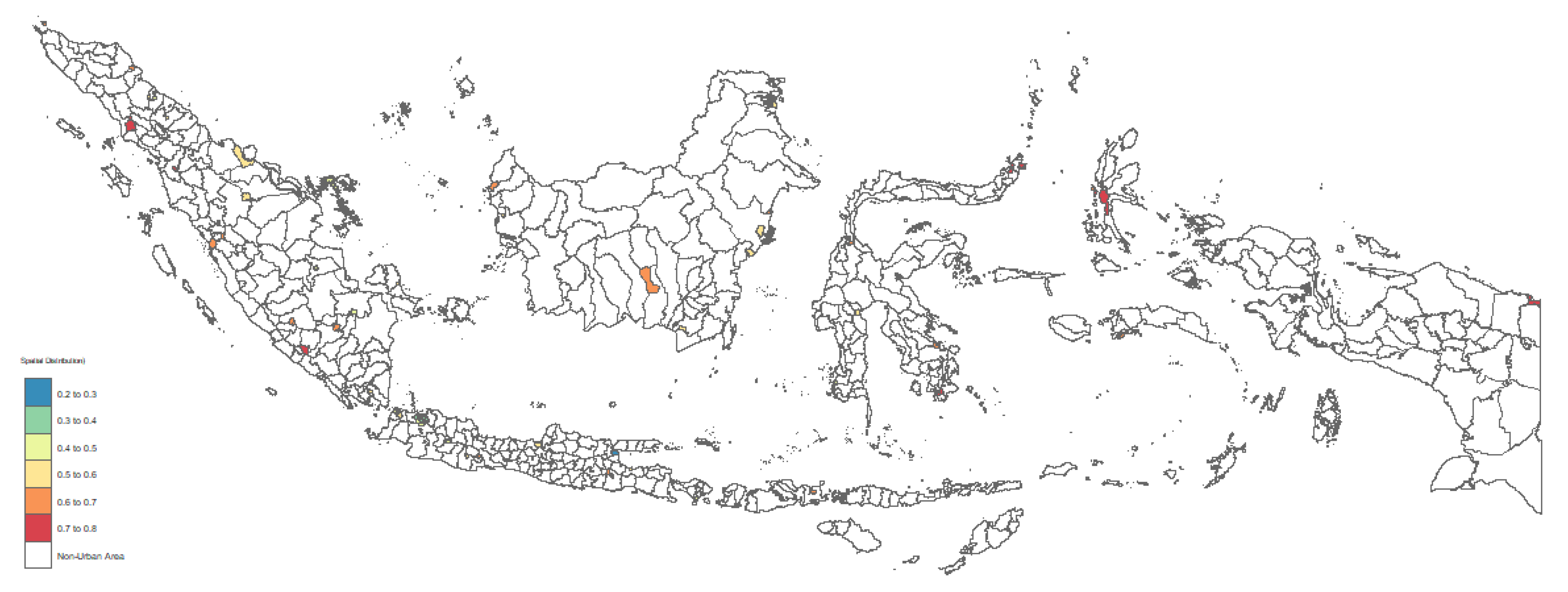
The spatial distribution of urban green space across Indonesian cities, as proxied by NDVI values, reveals substantial geographic heterogeneity. As shown in
Figure 1, higher NDVI levels are predominantly observed in cities located outside the main metropolitan cores, particularly in parts of Kalimantan, Sulawesi, and eastern Indonesia. In contrast, several cities in more densely urbanized regions, especially on the island of Java and parts of Sumatra, tend to exhibit relatively lower NDVI values. This pattern suggests that rapid urban expansion and higher population density are associated with reduced availability of urban green spaces, reflecting increasing pressure on land use in economically active regions.
Moreover, the spatial variation illustrated in the map indicates that urban green space is not evenly distributed across cities, highlighting the potential for spatial disparities in environmental quality and, consequently, labor productivity. The clustering of lower NDVI values in highly urbanized corridors may imply that cities with intense economic activities face trade-offs between development and environmental sustainability. Conversely, cities with higher NDVI levels may benefit from better environmental conditions that support worker well-being and productivity. These spatial patterns reinforce the importance of incorporating geographic context when analyzing the relationship between urban green spaces and economic performance.
Table 3 presents the correlation matrix among the variables used in the analysis. The matrix provides a preliminary overview of the pairwise relationships between labor productivity, urban green space, and the control variables included in the study. In general, the correlations indicate varying degrees of association among the variables, suggesting that urban environmental conditions, human capital, health indicators, and economic development are interconnected across Indonesian cities. Labor productivity appears to be associated with several socio-economic indicators, particularly those related to economic development and human capital, reflecting the multidimensional factors that shape workforce performance in urban areas.
The correlation results also show that urban green space exhibits associations with several control variables, including environmental quality and economic development indicators. These relationships suggest that cities with different levels of vegetation coverage may also differ in broader socio-economic and environmental conditions. Importantly, the magnitude of the correlations among the explanatory variables does not indicate excessively strong relationships, suggesting that potential multicollinearity issues are unlikely to pose serious concerns in the subsequent econometric estimation. The correlation matrix provides an initial indication of the relationships among the variables while supporting the feasibility of including them simultaneously in the empirical model.
Table 4 reports the estimation results of the spatial dynamic panel models used to examine the relationship between urban green spaces and labor productivity across Indonesian cities. Three spatial specifications are estimated, namely the Spatial Autoregressive (SAR), Spatial Durbin Model (SDM), and Spatial Autoregressive with Autoregressive Disturbances (SARAR). The inclusion of the lagged dependent variable in all specifications indicates that labor productivity exhibits dynamic persistence over time, meaning that current productivity levels are influenced by productivity performance in the previous period. This finding suggests that productivity dynamics in urban economies evolve gradually and are influenced by past economic conditions. Across all model specifications, the coefficient of urban green space (UGS) is positive and statistically significant, indicating a consistent association between vegetation coverage in urban areas and labor productivity. This result implies that cities with greater availability of green spaces tend to exhibit higher levels of labor productivity. The consistency of this relationship across the SAR model, SDM, and SARAR model suggests that the estimated effect is robust to alternative spatial model specifications.
The control variables also demonstrate statistically significant relationships with labor productivity across the models. Life expectancy shows a positive association with productivity, suggesting that better health conditions are linked to improved workforce performance. Environmental quality, represented by aerosol optical depth (AOD), exhibits a negative relationship with labor productivity, indicating that poorer environmental conditions are associated with lower productivity levels. In addition, education, measured by average years of schooling, is positively related to labor productivity, highlighting the importance of human capital in enhancing economic performance at the city level. Similarly, GDP per capita demonstrates a positive association with labor productivity, reflecting the role of economic development in supporting more productive urban labor markets.
The spatial dependence parameters further confirm the presence of spatial interactions among cities. The spatial autoregressive coefficient (ρ) is positive and statistically significant in all specifications, indicating that labor productivity in one city is influenced by productivity levels in neighboring cities. This result suggests the existence of spatial spillover effects, where economic performance in one urban area may transmit to surrounding cities through regional economic linkages, labor mobility, or shared infrastructure networks. In the SARAR specification, the spatial error coefficient (λ) is also statistically significant, implying that spatial dependence may additionally arise through unobserved regional shocks or omitted spatially correlated factors.
Model diagnostic indicators are also reported to assess the overall validity and performance of the estimated models. The Wald statistics in all specifications are statistically significant, confirming the joint significance of the explanatory variables included in the models. The inclusion of both city fixed effects and year fixed effects allows the model to control for unobserved heterogeneity across cities as well as common time-specific shocks that may affect labor productivity simultaneously across all regions.
To determine the most appropriate model specification, the Akaike Information Criterion (AIC) is used as the primary model selection criterion. Among the three estimated models, the SARAR specification produces the lowest AIC value, indicating that it provides the best fit to the data compared with the SAR model and SDM. This result suggests that accounting for both spatial lag dependence and spatial error correlation improves the explanatory power of the model.
Based on these model selection results, the SARAR model is considered the preferred specification for interpreting the empirical relationship between urban green spaces and labor productivity. The results from this model provide the most reliable estimates because they simultaneously capture dynamic persistence, spatial interactions among cities, and spatially correlated disturbances. Consequently, the SARAR specification serves as the main reference model for the subsequent interpretation and discussion of the empirical findings.
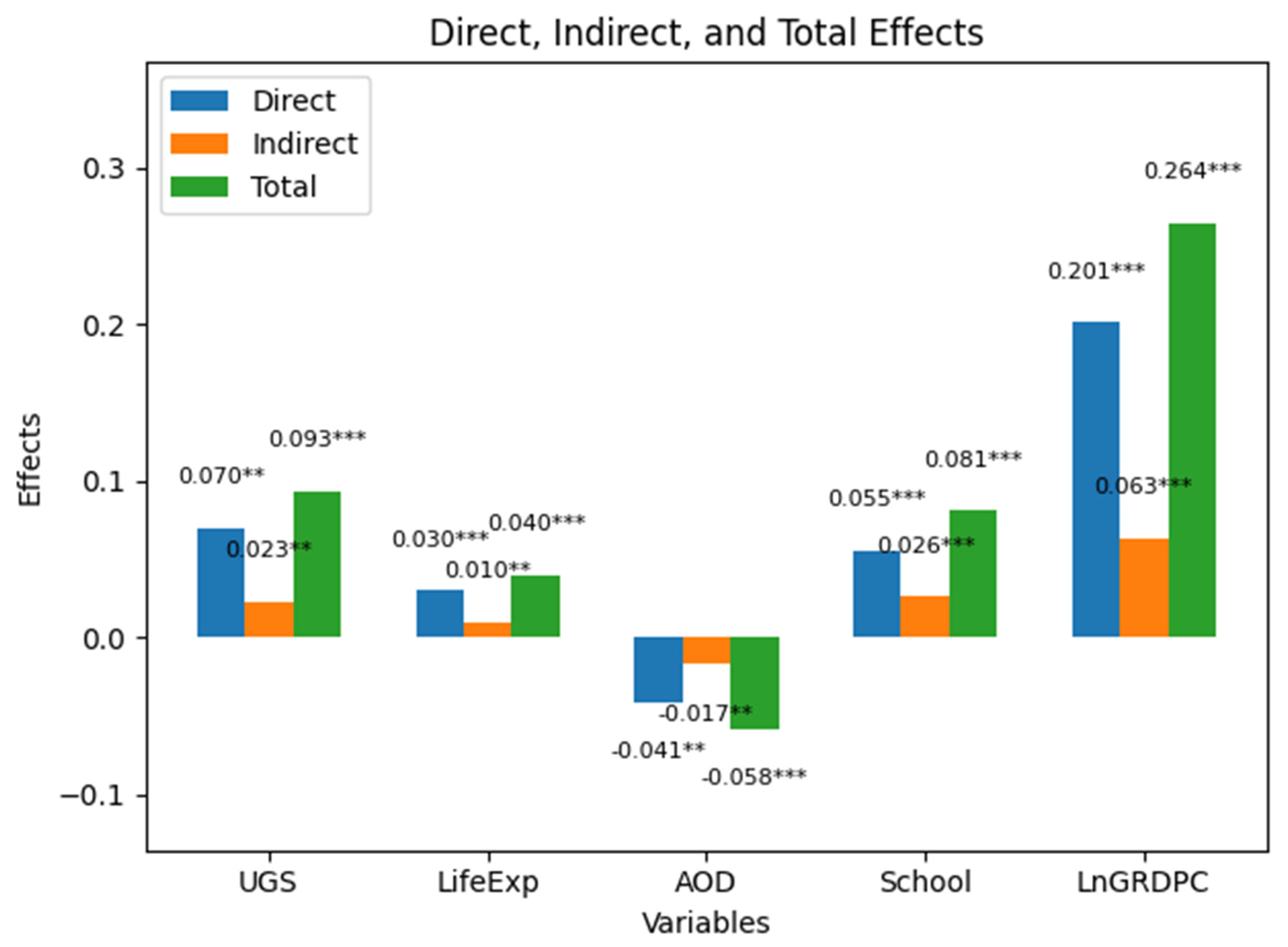
Figure 2 shows the decomposition of the estimated impacts from the spatial dynamic panel model into direct, indirect, and total effects. This decomposition allows a more comprehensive interpretation of the spatial relationships captured by the model. The direct effects reflect the influence of explanatory variables on labor productivity within the same city, while the indirect effects capture spatial spillover impacts transmitted to neighboring cities through spatial interactions. The total effects represent the combined influence of both local and spatial spillover effects across the urban system.
The results indicate that urban green space exhibits statistically significant direct and indirect effects on labor productivity. The positive direct effect suggests that increases in vegetation coverage within a city are associated with improvements in local labor productivity. At the same time, the positive indirect effect indicates that the presence of urban green spaces in one city can also generate productivity gains in surrounding cities. This pattern suggests that the benefits of urban environmental improvements are not confined to local boundaries but may extend across neighboring urban areas through regional interactions.
Health conditions, represented by life expectancy, also demonstrate positive direct and indirect effects on labor productivity. The direct effect implies that improvements in population health contribute to higher productivity within cities, reflecting the importance of healthy labor forces for economic performance. Meanwhile, the positive spillover effect suggests that better health conditions in one city may indirectly influence productivity in nearby cities, potentially through labor mobility, regional labor markets, or shared socio-economic environments.
Environmental quality, proxied by aerosol optical depth (AOD), shows negative direct and indirect effects on labor productivity. The negative direct effect indicates that higher levels of air pollution are associated with lower productivity in the affected cities. In addition, the negative spillover effect suggests that environmental degradation in one city may also adversely affect productivity in neighboring areas. This result highlights the spatial dimension of environmental externalities, where poor environmental conditions can generate broader regional impacts beyond the local level.
Human capital, measured by average years of schooling, displays positive and statistically significant direct and indirect effects. The direct effect indicates that higher educational attainment contributes to improved labor productivity within cities by enhancing workforce skills and capabilities. The presence of positive spillover effects further suggests that improvements in educational attainment in one city may generate broader regional benefits, possibly through knowledge diffusion, labor mobility, or inter-city economic linkages.
Finally, economic development, represented by GDP per capita, demonstrates strong positive direct and indirect effects on labor productivity. The direct effect reflects the role of higher income levels and economic capacity in supporting more productive labor markets. Meanwhile, the indirect effect indicates that economic development in one city can generate productivity spillovers to neighboring cities. Taken together, these results highlight the importance of both local socio-economic conditions and spatial interactions in shaping labor productivity across Indonesian cities.
4. Discussion
The findings of this study provide important insights into the relationship between urban green spaces and labor productivity within the context of rapidly urbanizing cities in Indonesia. Rather than merely confirming existing expectations, the results highlight how environmental amenities operate as economically relevant factors at the city level, particularly when spatial interdependencies are taken into account. This evidence supports the growing argument that environmental sustainability and economic productivity are not mutually exclusive objectives but rather mutually reinforcing components of sustainable urban development.
The positive association between urban green spaces and labor productivity highlights the broader economic value of green infrastructure in urban environments. This finding aligns with theoretical arguments suggesting that green environments improve working conditions and support human well-being, which ultimately contributes to higher levels of productivity. Previous studies have emphasized that access to natural environments can reduce stress, improve mental health, and promote physical activity among urban populations [
45,
46]. These improvements in health and well-being are closely linked to higher cognitive performance, greater workplace engagement, and increased efficiency in economic activities [
18,
47]. Compared to earlier studies that primarily rely on micro-level or individual-based evidence, this study provides city-level empirical support, suggesting that these mechanisms also operate at a broader spatial scale.
Furthermore, the results are consistent with studies emphasizing the broader relationship between environmental conditions and economic outcomes. Environmental factors such as air quality, temperature, and urban climate have been shown to influence worker performance and productivity in various economic sectors [
20,
21,
22]. Poor environmental conditions, including high levels of pollution and excessive heat, may reduce worker efficiency and increase health risks [
23,
24]. Conversely, improvements in urban environmental quality may enhance working conditions and support more productive economic activities [
26,
27]. However, this study extends the literature by explicitly identifying urban green spaces as a measurable and policy-relevant component of environmental quality that contributes to productivity through both direct and spatial spillover effects.
An interesting aspect of the findings relates to the discrepancy between the initial correlation patterns and the regression results. The raw correlation matrix indicates a negative association between urban green spaces and labor productivity, which may appear counterintuitive. However, this pattern likely reflects underlying structural differences across cities. Cities with higher productivity levels—particularly large metropolitan areas—often experience greater land-use pressure, leading to reduced availability of green spaces. In contrast, smaller or less densely developed cities may exhibit higher levels of green coverage but lower economic productivity. Once these structural and spatial factors are controlled for in the econometric model, the relationship becomes positive, suggesting that the initial negative correlation is driven by omitted variable bias and urban scale effects rather than a true negative impact of green spaces. This finding highlights the importance of using spatial econometric approaches when analyzing urban environmental variables.
Another important implication relates to the role of urban green spaces in strengthening the attractiveness and competitiveness of cities. Previous research suggests that cities with better environmental quality and well-maintained green spaces tend to attract highly skilled workers and knowledge-based industries [
35,
36]. Environmental amenities may influence residential preferences and encourage the retention of human capital within urban areas [
37]. By improving the overall livability of cities, green spaces can indirectly contribute to economic development through their impact on labor mobility and human capital accumulation [
8,
39]. The results of this study provide empirical support for these arguments by demonstrating that such advantages are reflected not only in urban attractiveness but also in measurable productivity outcomes.
The findings also highlight the importance of socio-economic factors such as health, education, and economic development in shaping labor productivity across cities. Improved health conditions contribute to higher productivity levels by enabling workers to maintain better physical and cognitive performance. Similarly, education remains a critical determinant of human capital formation and labor market efficiency. Cities with higher educational attainment tend to exhibit stronger workforce capabilities, which translate into higher productivity and economic competitiveness. These results are consistent with previous studies emphasizing the importance of human capital and public health as key drivers of economic performance in urban economies [
48,
49]. Importantly, the coexistence of these factors with environmental variables suggests that urban productivity is shaped by an integrated system of socio-economic and environmental conditions rather than by isolated determinants.
Environmental quality also emerges as an important factor influencing productivity dynamics in urban areas. Poor environmental conditions, particularly those associated with air pollution, may negatively affect worker health and reduce productivity levels. This finding is in line with previous research demonstrating that environmental degradation can generate substantial economic costs by reducing workforce performance and increasing health-related risks [
25]. The negative effect of AOD in this study reinforces the argument that environmental degradation and productivity losses are closely linked, providing further evidence that improving environmental quality is not only an ecological concern but also an economic necessity.
From a policy perspective, these findings carry important implications for urban planning and economic development strategies. The positive and significant impact of urban green spaces on labor productivity suggests that investments in green infrastructure should not be viewed solely as environmental or esthetic initiatives, but also as economically productive interventions. Urban planners and policymakers should therefore consider integrating green space development into broader urban economic policies, particularly in rapidly growing cities where land-use pressures are high.
Moreover, the presence of spatial spillover effects implies that urban policies cannot be designed in isolation. Environmental improvements in one city may generate positive externalities for neighboring areas, highlighting the need for coordinated regional planning approaches. In this context, inter-city collaboration and integrated spatial planning become essential to maximize the economic and environmental benefits of green infrastructure.
In addition, the significant role of health, education, and environmental quality suggests that policy interventions should adopt a more holistic approach. Enhancing labor productivity requires not only investments in physical infrastructure but also improvements in human capital and environmental conditions. Policies aimed at expanding urban green spaces should therefore be aligned with public health initiatives, education development, and environmental management strategies.
Importantly, this study contributes to the existing literature by providing empirical evidence from a developing country context. Much of the previous research on urban green spaces has focused on developed countries, where urban planning systems and environmental governance frameworks are often more established. However, rapidly urbanizing economies such as Indonesia face distinct challenges related to urban expansion, environmental degradation, and uneven economic development. By examining a large sample of Indonesian cities, this study provides new insights into how urban environmental amenities interact with socio-economic factors to influence productivity outcomes in emerging urban systems. This contextual contribution is particularly important, as the effects of green spaces may differ significantly between developed and developing urban environments.
The findings of this study help bridge an important gap in the literature by linking urban environmental sustainability with economic productivity at the city level. While previous studies have largely focused on the environmental and social benefits of green spaces, this research highlights their potential economic implications for labor productivity. More importantly, it demonstrates that these effects operate not only locally but also through spatial spillovers, reinforcing the relevance of spatial perspectives in urban economic analysis. In doing so, the study provides empirical support for the argument that urban green infrastructure should be viewed not merely as an environmental investment but also as a strategic component of sustainable economic development in rapidly growing cities.
5. Conclusions
This study examines the relationship between urban green spaces and labor productivity across Indonesian cities using a spatial dynamic panel framework. The findings provide consistent evidence that urban green spaces have a positive and statistically significant effect on labor productivity, both directly and through spatial spillovers. This indicates that environmental amenities contribute not only to local economic performance but also to productivity dynamics across neighboring cities.
In addition, the results show that labor productivity is shaped by an integrated set of environmental and socio-economic factors, including health, education, air quality, and economic development. The negative effect of air pollution and the positive contributions of human capital variables reinforce the importance of considering both environmental and socio-economic conditions in explaining urban productivity differences. The spatial dimension of the model further reveals that these effects are not isolated, but interconnected across cities, highlighting the importance of regional interactions in shaping economic outcomes.
These findings contribute to the literature by providing city-level empirical evidence from a developing country context, where the interaction between rapid urbanization and environmental change is particularly pronounced. Unlike much of the existing literature, which focuses on micro-level evidence or developed economies, this study demonstrates that the productivity effects of urban green spaces are observable at an aggregate level and within emerging urban systems.
While the results have policy relevance, their primary implication is that urban environmental quality should be considered an integral component of economic performance rather than a separate policy domain. Investments in urban green spaces and environmental management may therefore generate not only ecological and social benefits but also measurable economic gains.
Despite these contributions, several limitations should be acknowledged. The measurement of urban green space relies on NDVI indicators, which capture vegetation density but do not fully reflect accessibility, quality, or functional use of green spaces. In addition, although the spatial dynamic panel approach accounts for inter-city interactions, other potentially relevant factors—such as institutional quality, governance, and infrastructure—are not explicitly included in the model. These limitations suggest that the estimated relationships should be interpreted with caution.
Future research could extend this analysis by incorporating more detailed measures of urban green space, including accessibility and distribution, as well as by exploring additional transmission mechanisms such as health outcomes, urban heat mitigation, and innovation processes. Comparative studies across countries or regions would also be valuable in assessing the generalizability of these findings and in understanding how different urban and policy contexts shape the relationship between environmental quality and labor productivity.