1. Introduction
Plastic production has increased dramatically in recent decades, rising from approximately 2 million tonnes in 1950 to around 460 million tonnes in 2019, while more recent OECD scenario updates indicate that global plastics production and use amounted to about 435 million tonnes in 2020 and may rise to 736 million tonnes by 2040 under current policy trajectories [
1]. Despite the widespread use and functional benefits of plastics across numerous sectors, the downstream management of plastic waste remains highly uneven. Globally, only about 9% of plastic waste is recycled, while the remainder is primarily landfilled, incinerated, or mismanaged in terrestrial and marine environments [
2]. Consequently, improving recycling performance has become a critical objective in efforts to mitigate climate change and reduce environmental burdens [
3].
Life Cycle Assessment (LCA) has emerged as one of the most widely applied frameworks for evaluating environmental impacts associated with alternative waste management strategies. Numerous studies show that different end-of-life pathways such as mechanical recycling, energy recovery, or disposal can significantly influence cumulative energy demand (CED) and greenhouse gas (GHG) emissions [
4]. In many cases, impact indicators such as global warming potential (GWP) and CED are driven primarily by electricity and thermal energy inputs rather than by material flows themselves, highlighting the importance of accurate energy modeling in environmental assessments [
5]. Comparative analyses conducted under European energy-mix conditions often indicate that recycling pathways outperform energy recovery options in terms of environmental performance, reinforcing the central role of recycling within circular economy strategies [
6].
Plastic recycling is not a single technological route, but rather a group of distinct pathways with different material, energy, and environmental implications. At the broadest level, post-consumer plastics may be managed through mechanical recycling, chemical recycling, solvent-based purification routes, energy recovery, or final disposal. Each pathway differs in terms of feedstock tolerance, product quality outcomes, process complexity, and dependence on energy or chemical inputs [
7]. As a result, the environmental performance of recycling cannot be interpreted independently of the technological route under consideration.
The recent review literature also shows that LCA research on plastics has expanded significantly in both scope and methodological complexity, covering not only waste-management routes, but also recycling-system design, circularity assumptions, allocation choices, and emerging impact categories. Comprehensive review studies have highlighted that the environmental performance of plastic recycling is highly sensitive to system-boundary definition, substitution assumptions, foreground data quality, and the treatment of end-of-life credits. At the same time, methodological recommendation papers have emphasized that robust comparison of plastic recycling systems requires particular care regarding fossil-carbon accounting, avoided virgin production assumptions, and transparent reporting of recycling-specific modeling choices [
8].
Among existing waste treatment options, mechanical recycling remains the most widely implemented and industrially mature technology for post-consumer thermoplastics. Because it does not require extensive chemical transformation and largely preserves polymer chain integrity, it is generally less energy-intensive than chemical recycling alternatives under current industrial conditions [
9]. However, its performance is not uniform and depends strongly on operational realities such as feedstock composition, contamination levels, moisture content, process control quality, and technological capability. Review studies consistently report that although mechanical recycling is technologically mature and cost-effective, it remains operationally sensitive and exhibits considerable variability in environmental performance [
10].
In current industrial practice, mechanical recycling remains the most established route for relatively clean and sortable thermoplastic waste streams, whereas chemical and solvent-assisted processes are often discussed as alternatives for more contaminated, mixed, or compositionally complex plastics. However, these alternatives typically involve higher process complexity and may introduce additional environmental burdens related to thermal demand, chemical consumption, solvent recovery, or downstream purification. For this reason, the comparative sustainability of recycling technologies depends not only on the recovery principle itself, but also on system design, feedstock characteristics, and life cycle modeling assumptions.
In parallel, the literature on chemical and solvent-assisted recycling has also grown rapidly, especially in relation to pyrolysis, depolymerization, dissolution-based purification, and mixed-plastic valorization pathways. Critical and comparative review studies show that these routes may offer advantages for contaminated or hard-to-recycle streams, but their environmental performance is highly case-dependent and often strongly influenced by electricity demand, chemical consumption, solvent recovery, process scale, and product substitution assumptions. Importantly, several recent reviews conclude that no universally superior recycling pathway can be declared across all plastic fractions and impact categories; rather, environmental ranking depends on polymer type, feedstock heterogeneity, process design, and modeling choices [
11]. To situate the present study within the broader LCA literature on plastic recycling, key published findings relevant to its scope are summarised here. For mechanical recycling, published gate-to-gate or cradle-to-gate LCA studies consistently identify extrusion and washing as the dominant energy-consuming stages, while reported GWP values vary depending on the national electricity grid, polymer type, and process configuration [
9]. For chemical recycling via pyrolysis, published LCA studies report considerably higher process energy demands and GWP values, with results strongly sensitive to product yield, energy source, and the assumed credit for avoided virgin production [
11,
12]. Solvent-based dissolution routes show variable environmental profiles depending on solvent selection, recovery efficiency, and downstream processing requirements; Saleem et al. found that process conditions substantially influence total life cycle impacts and that no single solvent route dominates across all impact categories [
13]. Comparative studies that evaluate multiple recycling pathways side-by-side generally confirm that mechanical recycling offers lower energy demand and GWP per kilogram of recycled output for clean, sortable thermoplastic streams, while chemical routes may be more appropriate for heterogeneous or heavily contaminated fractions [
6,
11,
12]. The present study contributes to this body of evidence by providing real industrial data for mechanical recycling under emerging-economy conditions, which remain underrepresented in the peer-reviewed LCA literature.
At the same time, the environmental attractiveness of mechanical recycling does not automatically guarantee full restoration of virgin-grade material properties, since the quality of recycled output may remain application-dependent and sensitive to feedstock contamination and process history.
Recent LCA studies have also shown that solvent-based dissolution routes can exhibit markedly different environmental profiles due to the influence of solvent selection, recovery requirements, and dissolution-stage energy demand. For example, Saleem et al. evaluated several solvent-dissolution pathways for mixed plastic waste and reported that both dissolution and downstream processing conditions substantially affect total impacts [
13]. However, these findings are associated with solvent-assisted recycling systems and are therefore not directly transferable to conventional mechanical recycling lines that operate without solvent input.
It should also be noted that this study focuses specifically on conventional mechanical recycling operations and therefore does not include solvent-based dissolution or purification routes. Such processes belong to a different technological category, typically involving additional chemical inputs, solvent recovery stages, and distinct emission profiles. While these routes may be environmentally relevant for mixed or difficult-to-recycle plastic streams, they are not part of the actual process configuration of the facility assessed in this study.
These sensitivities are particularly evident in emerging economies such as Türkiye, where recycling facilities often operate under conditions of limited automation, variable feedstock quality, and relatively old equipment. Similar structural constraints have been documented in other developing regions and can significantly influence both process stability and environmental outputs [
14]. In practice, such conditions may lead to higher specific energy consumption (SEC), greater process volatility, and increased emissions. For this reason, plant-level studies based on real industrial measurements rather than theoretical assumptions are essential for producing more reliable and context-sensitive conclusions.
The existing literature shows that energy consumption in mechanical recycling lines is typically concentrated in washing and extrusion stages [
15,
16]. Nevertheless, their relative contribution varies depending on polymer type, moisture load, and process configuration. Boundary definitions and allocation choices can further influence calculated environmental intensities, making methodological transparency crucial for meaningful comparison [
17]. This broader literature base makes it clear that the main unresolved issue is no longer whether plastic recycling should be assessed by LCA, but how such assessments should be parameterized, bounded, and interpreted under heterogeneous industrial conditions. Although LCA research on plastic waste management has increased substantially in recent years including broader reviews of mechanical, chemical, and hybrid recycling routes process-level assessments that capture operational dynamics, long-term variability, and multi-polymer industrial conditions remain comparatively limited, especially outside the European context.
A major limitation of many existing assessments is the reliance on deterministic modeling assumptions. In such models, parameters such as raw material composition, production rate, and process conditions are often represented as fixed mean values, whereas real industrial operations are inherently dynamic. Seasonal throughput variation, maintenance interruptions, and short-term process deviations can all affect energy demand and emissions. Monte Carlo simulation provides a robust methodological alternative by representing key variables as probability distributions rather than constants. This approach does not necessarily reduce calculated impact values but improves interpretation by quantifying uncertainty ranges and confidence intervals [
7,
8,
9,
10,
11,
12,
13,
14,
15,
16,
17,
18].
Despite the availability of probabilistic tools, relatively few studies have combined long-term, meter-based industrial energy measurements with Monte Carlo uncertainty analysis to evaluate stage-level performance across multiple polymer streams within a single facility. Addressing this gap is essential for developing operationally grounded and statistically robust assessments of recycling systems.
Although mechanical recycling has been widely studied in the LCA literature, many published assessments still rely on simplified inventories, single-polymer assumptions, short observation periods, or deterministic modeling frameworks. As a result, the combined effects of operational variability, polymer-specific differences, and process-level energy hotspots remain insufficiently characterized under real industrial conditions. In this respect, the present study does not propose a completely new LCA methodology; rather, its novelty and contribution rest on four interconnected elements that have not been previously combined in a single study of this type. First, the study is grounded in twelve months of continuous, meter-based energy measurements from a full-scale industrial facility—a level of temporal resolution and operational realism that is rare in the existing LCA literature on plastic recycling. Second, environmental performance is assessed simultaneously across four commercially important polymer streams (PET, HDPE, LDPE, PP) under a single consistent system boundary, enabling direct polymer-to-polymer comparison within the same operational context. Third, three technology-improvement scenarios are evaluated not only deterministically but also through Monte Carlo uncertainty analysis, providing a statistically robust basis for scenario ranking that goes beyond the point-estimate approach common in the literature. Fourth, the study is conducted in an emerging-economy context (Türkiye) where operational conditions, energy mix, and infrastructure constraints differ substantially from those in European benchmarking studies, filling a documented gap in the geographically diverse characterization of mechanical recycling performance.
The main contributions of this study can be summarized as follows: (1) it presents a 12 month meter-based industrial dataset from a full-scale mechanical plastic recycling facility in Türkiye; (2) it evaluates environmental performance at the process level across four major post-consumer polymer streams (PET, HDPE, LDPE, and PP) under a consistent functional unit and system boundary; (3) it compares baseline and technology improvement scenarios involving sensor-based sorting, high-efficiency extrusion, and their combined application; and (4) it complements deterministic LCA results with Monte Carlo-based uncertainty analysis in order to capture operational variability and strengthen the robustness of scenario-level conclusions.
Although plastic recycling has been widely examined in the LCA literature, the available evidence is still dispersed across product-level comparisons, route-based evaluations, broad review studies, and technology-specific case analyses. As a consequence, relatively few studies combine long-term industrial measurements, process-level assessment, uncertainty analysis, and multi-polymer operational data within a single mechanical recycling facility. This gap is particularly important in emerging-economy contexts, where plant conditions, feedstock quality, and process stability may differ substantially from those assumed in more standardized European case studies.
In this context, the main objective of the study is to quantitatively assess the energy use and environmental performance of a mechanical plastic recycling plant operating in Gaziantep, Türkiye, by integrating 12 months of real industrial measurements with process-level LCA and Monte Carlo-based uncertainty analysis. The assessment covers four commonly recycled polymers—polyethylene terephthalate (PET), high-density polyethylene (HDPE), low-density polyethylene (LDPE), and polypropylene (PP)—and examines performance changes associated with the implementation of sensor-based sorting and high-efficiency extrusion systems. Through structured comparative scenario analysis conducted under consistent system boundaries, the study aims to provide plant-level evidence that is both operationally realistic and statistically supported, thereby contributing to the interpretation of mechanical recycling performance in emerging-economy industrial settings [
19,
20].
2. Materials and Methods
2.1. Study Area and Recycling Facility Description
The case study was carried out at an industrial-scale mechanical plastic recycling plant in Türkiye’s Gaziantep Organized Industrial Zone, a key center for plastic manufacturing and recycling systems. The area is home to a dense cluster of polymer-processing industries and offers a representative setting for emerging-economy recycling operations. Plants in this context typically run at high throughput, handle mixed waste streams, and deal with considerable variability in feedstock quality.
The facility processes post-consumer plastic waste and operates year-round on a continuous basis. The assessment draws on twelve consecutive months of operational records, which makes it possible to capture seasonal shifts in production volume, feedstock composition, and energy demand. The plant handles four major polymer types commonly found in municipal and commercial waste streams: PET, HDPE, LDPE, and PP.
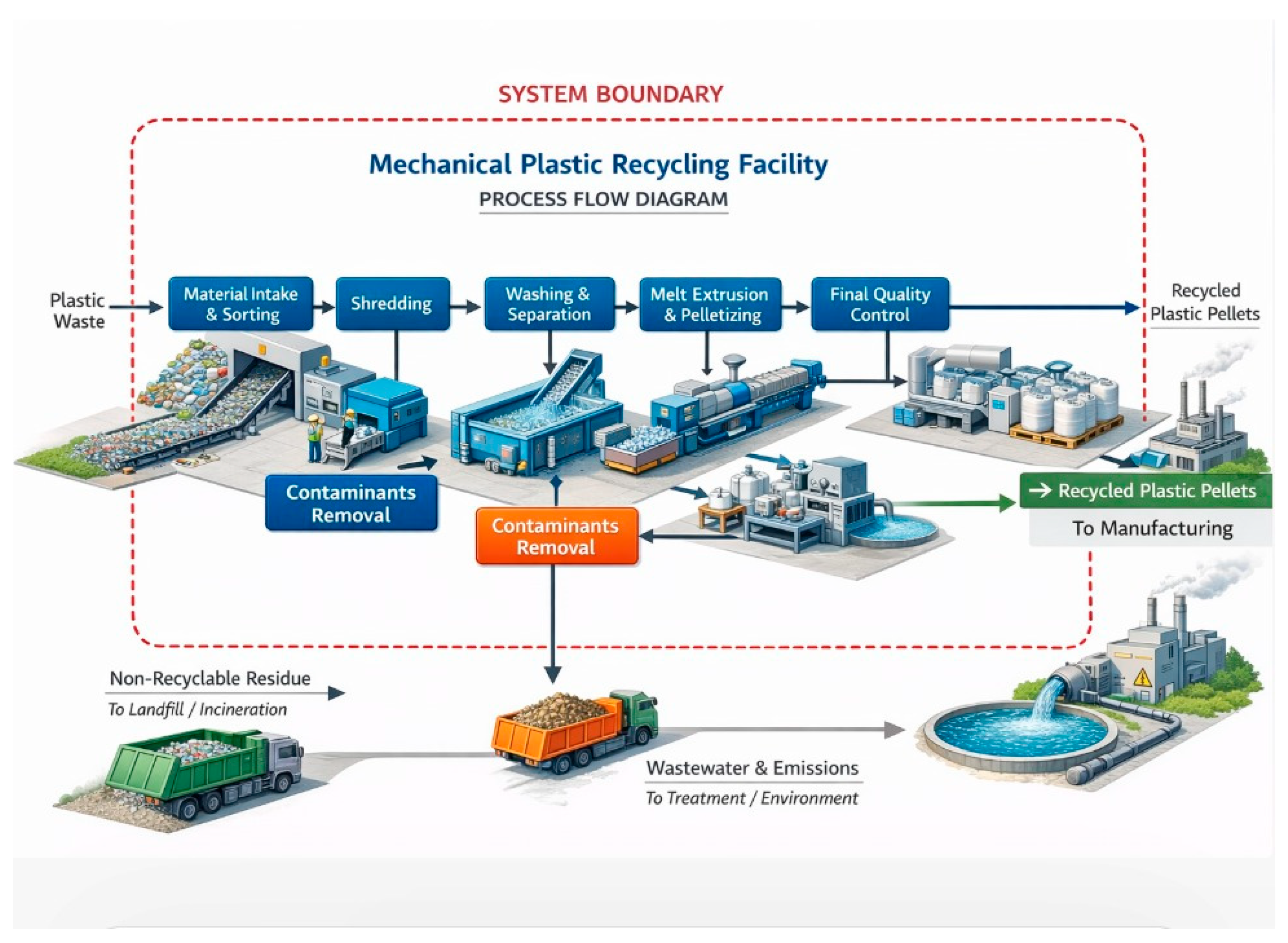
The plant operates two parallel mechanical recycling lines (PES-1 and PES-2), both set up to handle mixed polymer inputs. In practice, the two lines run the same sequence of steps: manual pre-sorting, shredding, hot-water washing, centrifugal drying, single-screw extrusion, melt filtration, and pelletizing. Incoming waste is first checked and manually sorted to remove large contaminants, then shredded and washed in natural gas-heated units. The washed material is dried in high-speed centrifuges and sent to extrusion, where it is melted, pressurized, filtered, and converted into pellets before packaging.
The plant draws most of its electricity for shredding, drying, extrusion, and the supporting auxiliary systems, while natural gas is used largely to heat the washing process.
Figure 1 shows the facility layout and key process units, and highlights the stages that dominate energy consumption and have the greatest influence on overall operating performance.
2.2. Data Collection and Energy Monitoring
Energy use was monitored directly through meter readings collected continuously over a full year of plant operation. Calibrated digital meters installed on the main distribution panels of each line made it possible to break electricity demand down by process stage sorting, shredding, washing, drying, extrusion, and pelletizing.
Natural gas use for hot-water washing and thermal drying was tracked with on-site gas flow meters connected to the central boiler system. Monthly gas totals were then allocated to individual process stages using a proportional weighting procedure based on three factors: (i) measured operating duration of each thermal stage per month (hours), (ii) nominal heat demand of the installed equipment (kW thermal rating from manufacturer specifications), and (iii) stage-specific material throughput share relative to total monthly processed volume. The allocation weight for each stage
i was computed as
where
h is operating hours,
Q is nominal thermal demand, and m is throughput share. In the investigated facility, the washing stage consistently received the largest share of total natural gas consumption (approximately 62–68% across months), owing to its continuous hot-water heating requirement at 70–85 °C. The drying stage received the remaining 32–38%, reflecting the centrifugal dryer’s supplementary heating demand. Shredding, extrusion, and pelletizing stages were not assigned any natural gas share because they do not require direct thermal input from the boiler system. The sum of all stage allocations was constrained to equal the total measured monthly natural gas consumption at the plant-level meter.
Daily production data covering both the amount of material processed and the final pellet output were taken from the facility’s internal logs and checked against shipment and inventory records. These data were used to calculate SEC, reported as kWh·ton−1 for electricity and m3·ton−1 for natural gas, and normalized to a functional unit of 1 ton of recycled plastic pellets.
To keep the dataset as reliable as possible, the energy measurements were carefully reviewed for outliers and atypical operating periods, such as unplanned shutdowns or maintenance disruptions. Data from these non-representative intervals were removed so that the analysis reflects normal industrial operation. As a result, the final dataset preserves real-world variability while still providing a consistent and robust basis for the life cycle and uncertainty analyses.
This data-screening step was essential to ensure that the LCA model was built on representative foreground inputs rather than irregular operational anomalies, thereby improving both the robustness and reproducibility of the methodological framework.
2.3. Life Cycle Assessment Framework
The life cycle assessment (LCA) in this study was carried out in line with the principles and requirements of ISO 14040 and ISO 14044 [
21,
22]. It was designed to quantify process-level energy use and overall environmental performance for an industrial mechanical plastic recycling facility operating under real conditions in Türkiye, with a specific focus on pinpointing energy hotspots and assessing potential technological optimization scenarios. Such integration of life cycle assessment with process-level optimization has been increasingly recognized as an effective approach to enhance industrial sustainability performance [
23].
The methodological design of the study was structured around four core elements: definition of the system boundary, justification of the functional unit, construction of a foreground inventory based on site-specific measurements, and impact calculation using transparent background emission factors and conversion coefficients. This structure was adopted to ensure that the assessment remains reproducible, internally consistent, and clearly interpretable at the process level.
Accordingly, the study focuses on process-level environmental performance and operational optimization, rather than on the comparative technical quality of recycled and virgin polymers. Material property retention, contamination-related quality loss, and application-specific suitability were therefore treated as issues outside the direct scope of the present assessment.
A gate-to-gate boundary was chosen to keep the focus on what happens inside the plant. In practical terms, the analysis tracks the on-site process from receiving pre-sorted post-consumer plastic waste to producing recycled plastic granules ready to leave the facility. Activities outside the facility such as collection, transport, and centralized sorting were not included, nor were downstream stages like distribution, use, and end-of-life. Keeping the boundary this way makes it easier to evaluate the plant’s own recycling performance directly, and it aligns with common practice in process-level environmental assessments of industrial facilities.
This boundary choice was considered appropriate because the main objective of the study is to evaluate the environmental performance of the recycling operation itself, rather than to compare entire end-of-life chains or downstream product systems. By limiting the analysis to processes physically occurring within the facility, the study isolates plant-level energy use and emissions in a way that is methodologically consistent with the intended process-focused interpretation. It is important to note that the gate-to-gate scope deliberately excludes upstream stages such as plastic waste collection, transportation to the recycling facility, and pre-sorting infrastructure, as well as downstream stages including the application of recycled pellets as secondary raw material and the end-of-life of products containing recycled content. Consequently, the present study does not provide a full cradle-to-grave comparison with alternative waste management pathways such as landfilling or incineration. Such a comparison would require additional inventory data for the competing disposal routes and explicit substitution assumptions regarding the credit for avoided virgin polymer production. Extending the system boundary in this direction is technically feasible using the gate-to-gate inventory constructed here as the foreground module and is recommended as a priority for future research.
In this study, the functional unit (FU) was defined as 1 ton of recycled plastic pellets obtained at the plant’s output. Thus, all energy and environmental indicators such as SEC, CED, and GWP were calculated according to this common reference; the results of different process steps and scenarios were made comparable on the same scale.
The functional unit was selected on a mass-output basis because the study aims to compare alternative operational scenarios within the same industrial recycling system. Defining the FU as 1 ton of recycled pellet output enables direct normalization of electricity use, natural gas use, CED, and GWP across process stages and scenarios, while remaining closely aligned with the plant’s actual production logic and reporting practice.
It should be emphasized that this functional unit is defined on a mass-output basis and does not imply full equivalence between recycled pellets and virgin polymers in terms of material properties, purity, or end-use suitability. The purpose of the functional unit is to provide a consistent reference for comparing process-level energy and environmental performance within the investigated recycling system, rather than to assume identical technical performance across all downstream applications.
The life cycle inventory (LCI) developed for this assessment is primarily based on meter-based industrial measurements recorded over a 12-month period at the facility; specifically, electricity and natural gas consumption were obtained from this data. In addition to site-specific operational data, background life cycle inventory datasets were cross-checked using the ecoinvent database to ensure methodological consistency with internationally recognized LCA data sources [
24].
Monthly natural gas consumption was measured at plant level and then allocated to heat-related process stages using a proportional weighting procedure. The allocation weights were defined according to the relative thermal demand of each relevant stage, considering equipment operating duration, expected heating intensity, and stage-specific material throughput. In practical terms, stages requiring direct thermal input-primarily washing and drying-received a proportion of the total monthly gas demand according to their calculated heat-demand share. The sum of all stage-level allocations was constrained to equal the total measured monthly natural gas consumption recorded at the facility.
This procedure was adopted to preserve consistency with plant-level measurements while enabling process-level interpretation of thermal-energy use.
Because utility consumption was recorded primarily at plant and line level rather than separately for each polymer stream, polymer-specific results were derived through a disaggregation procedure. Annual plant throughput was distributed across PET, HDPE, LDPE, and PP according to the mixed-feed profile observed in facility records, and process-specific adjustment factors were introduced to reflect relative differences in washing, drying, and extrusion demand among polymer types. This procedure enabled polymer-level comparison while maintaining consistency with the measured plant-scale totals.
Although the calculations were implemented in a transparent analytical framework tailored to the plant-level dataset, the assessment was not constructed independently of established LCA practice. On the contrary, internationally recognized background datasets and characterization references-including ecoinvent, IPCC, and IEA-based factors-were used to anchor the inventory and impact calculations within a standard LCA-compatible methodological structure.
The inventory is also supported by production efficiency information and operational records shared by the facility. Electricity consumption is reported in kWh, and natural gas consumption in m
3; where necessary, natural gas values are converted to energy units using standard lower calorific values. Electricity-related emission factors applied in this study were derived from internationally recognized datasets, including the latest emission statistics published by the International Energy Agency ensuring methodological consistency with global energy accounting practice [
18].
More specifically, the foreground inventory consisted of on-site electricity meter readings, natural gas flow measurements, monthly production records, and stage-level operational logs collected directly from the plant over a 12-month period. The background parameters used for impact calculation consisted of national or internationally recognized emission factors, primary-energy conversion coefficients, and database-supported consistency checks. This distinction between measured foreground data and standardized background parameters was maintained throughout the assessment in order to improve methodological transparency and reproducibility.
The environmental assessment in this study focuses on the two key dimensions of mechanical recycling: energy use and climate impact. Total energy demand is quantified using CED, while climate impacts are assessed through the 100-year GWP, reported in kg CO
2-equivalent. Characterization of greenhouse gas emissions followed the methodological framework provided by the IPCC Guidelines for National Greenhouse Gas Inventories which define standardized global warming potential factors for climate impact assessment [
25].
These indicators were selected because they align closely with industrial decarbonization priorities and circular economy objectives.
These two impact categories were selected deliberately because the investigated system is dominated by electricity and natural gas consumption, and the main purpose of the study is to identify process-level energy hotspots and climate-relevant improvement potential under real plant conditions. In this context, CED and GWP were considered the most decision-relevant indicators for evaluating operational modernization scenarios within the defined industrial boundary.
Other impact categories such as acidification, eutrophication, human toxicity, and ecotoxicity were not included in the present assessment. This does not imply that such categories are unimportant; rather, it reflects a deliberate scope limitation adopted to maintain methodological focus on energy- and climate-driven burdens, which are the dominant concerns in the investigated process configuration and the most directly actionable parameters for plant-level optimization.
A reliable assessment of average performance and variability under actual operating conditions is made possible by the interpretation step, which combines probabilistic outputs from Monte Carlo simulation with deterministic LCA results.
Life Cycle Impact Assessment Methodology
The aim of the Life Cycle Impact (LCIA) phase is to transform the inputs we collect in the inventory, such as electricity and natural gas, into measurable indicators that answer the question, “How much environmental impact does it create?” In this study, since we focused specifically on the energy consumption and climate impact of the mechanical plastic recycling line, we highlighted two intermediate impact categories: CED, representing the total energy requirement and GWP expressing the greenhouse gas effect over a 100-year horizon. In this way, the energy load and carbon footprint of each scenario can be directly and clearly compared using the same reference unit.
In the GWP calculation, the characterization factors published in the IPCC’s Sixth Assessment Report (AR6), based on a 100-year time horizon, were used. By combining greenhouse gas emissions from electricity consumption and natural gas combustion, the results were reported in kg CO
2 equivalent per functional unit (kg CO
2-eq·ton
−1). To realistically reflect the conditions in Turkey, national grid emission factors were used; in addition, consistency checks were performed by comparing the results with ecoinvent v3.8 background datasets to strengthen compliance with international LCA practices [
25].
It should be clarified that no separate GWP contribution was assigned to process-water consumption in the present model. Within the defined gate-to-gate system boundary, climate impacts were calculated only from electricity use and natural gas combustion. Although water is used during the washing stage, its associated climate burden was not modeled as an independent inventory flow because water treatment and water-supply processes were excluded from the assessed system. Accordingly, the GWP results reported here should be interpreted as energy-related climate impacts of the recycling operation rather than as a full water-inclusive carbon profile.
For transparency, electricity-related GWP calculations were based on the national grid emission factor adopted for Türkiye, while natural gas-related emissions were calculated using standard combustion-based carbon coefficients consistent with IPCC guidance. The origin and role of each factor were treated explicitly as background parameters within the LCIA model, rather than as plant-specific measured values.
To determine the total primary energy requirement, we expressed the energy consumed within our defined system limits using the CED indicator and reported the results in GJ (GJ·ton−1) per ton of processed plastic waste. To convert electricity consumption to primary energy equivalent, we used a conversion of 1 kWh = 3.6 MJ, taking into account the average conversion efficiency. Natural gas consumption was converted to primary energy using its lower heating value (LHV = 35.8 MJ·m−3). To ensure a fair and direct comparison between scenarios, we applied these conversion coefficients consistently across all scenarios.
These conversion factors ensure that the energy calculations performed are both transparent and repeatable. LCIA calculations were carried out in MATLAB using process inputs measured at the facility as foreground data and standardized emission coefficients and energy conversion factors as background parameters. This hybrid approach strengthens methodological consistency by combining the accuracy of site-specific operational data with internationally accepted environmental characterization models.
In this study, only process energy inputs directly measured within the facility were included in the LCIA. In line with the selected gate to gate system boundary, infrastructure and buildings, capital equipment manufacturing, maintenance activities, chemical additives, water treatment processes, and the final product’s use phase were excluded from the evaluation. Furthermore, since the system produces a single output stream (recycled plastic granules/pellets) per defined functional unit, a multiple product situation did not arise, and therefore no allocation procedure was required.
For the same reason, no separate emission factor for water consumption was applied in the GWP calculation. Any climate burden associated with water supply, recirculation infrastructure, or wastewater management would require additional inventory modeling and background datasets, which were intentionally kept outside the scope of the present assessment.
In other words, all measured energy inputs were assigned directly to the single recycled-pellet output represented by the functional unit. Since no co-products, by-products, or parallel marketable outputs were generated within the defined system boundary, the use of mass-, energy-, or economic-allocation procedures was not necessary.
In addition, solvent-based dissolution, solvent purification, and solvent recovery operations were excluded from the system boundary because they are not used in the investigated facility. Accordingly, solvent-related emissions were not modeled in the inventory, and the findings should be interpreted as representative of a conventional mechanical recycling configuration rather than solvent-assisted recycling pathways.
The emission factors employed in LCIA were modelled using a uniform distribution of ±5% to allow uncertainty propagation. This was in line with the uncertainty approach utilized in the Monte Carlo study. This guarantees methodological consistency between the diversity of impact assessments and inventories.
2.4. Scenario Definition and Energy Modelling
In this section, scenarios are developed and analyzed to examine how technological improvements in mechanical plastic recycling influence energy consumption and environmental performance. The scenarios are grounded in the facility’s current industrial configuration and include both incremental upgrade options suitable for recycling plants operating in emerging economies such as Türkiye and an integrated optimization case that combines these measures.
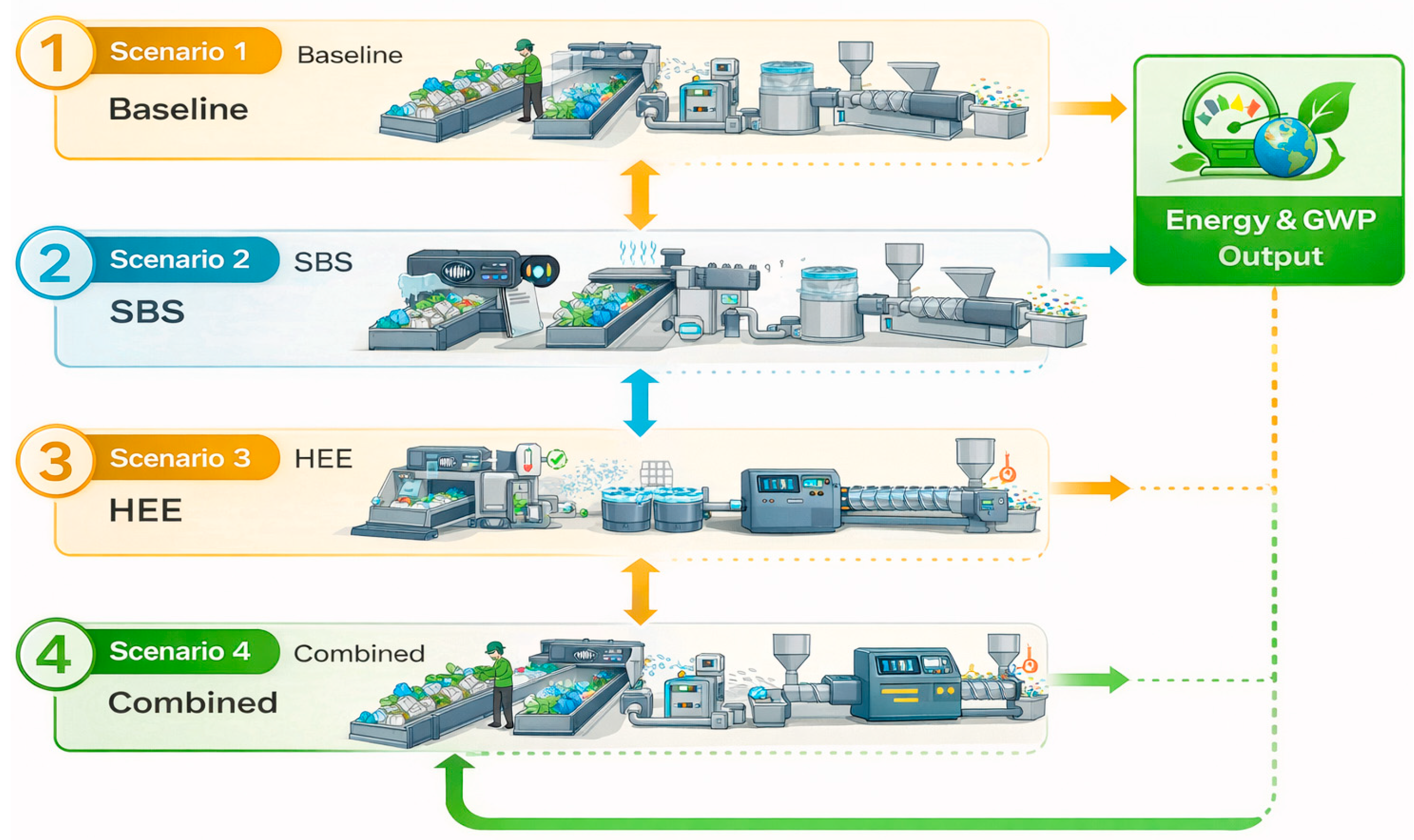
Figure 2 summarizes the scenario structure and shows how each scenario relates to the energy and climate related indicators.
The baseline scenario (Scenario 1) represents how the plant currently operates, following a conventional mechanical recycling line that includes manual sorting, crushing, washing, drying, single-screw extrusion, and pelletizing sections. This scenario is used as the reference point for all comparisons.
The sensor-based separation scenario (Scenario 2—SBS) builds on the baseline by introducing sensor-based sorting at the front end of the line. The aim is to improve feedstock purity and limit polymer cross-contamination, which helps stabilize downstream operations and in turn reduces energy use and greenhouse gas emissions.
The high-efficiency extrusion scenario (Scenario 3—HEE) aims to improve the extrusion stage, which is identified as the point with the highest energy consumption in the line. In this scenario, only the extrusion system is updated; the existing conventional extruder is replaced with a high-efficiency extruder that has better thermal control and load regulation capabilities, while all other process steps remain the same.
The combined scenario (Scenario 4—SBS + HEE) aims to improve raw material quality upstream and process efficiency downstream by implementing both improvements simultaneously. Therefore, the scenario represents a coordinated optimization approach that goes beyond the individual implementation of SBS and HEE steps. This integrated implementation is expected to lead to more significant reductions in CED and GWP.
All scenarios were assessed using the same system boundaries, functional unit, and LCIA approach to keep the results fully comparable. For each case, energy use and environmental performance indicators were calculated and then ran through Monte Carlo simulation to capture operational variability and uncertainty. The scenarios provide an overview and summarize their key technological features.
2.4.1. Baseline Scenario
The plant operates year-round with two continuous lines (PES-1 and PES-2) that process mixed post-consumer polyolefin and polyester waste. Each line follows the same five core steps: manual sorting, mechanical shredding, hot-water washing, centrifugal drying, and extrusion pelletizing. The plant generally operates in a semi-steady operating regime under conditions where the feed composition is kept relatively stable and operating temperatures are controlled.
The plant initially uses manual sorting to remove coarse contaminants such as metal, glass, textiles, and paper. The sorted material is then shredded in mechanical granulators to reduce its size and washed at temperatures between 70 and 85 °C using process water heated by natural gas and containing detergent. The washing water is recirculated within the system; the discharge amount is limited to less than 10% of the total process volume. Following washing, the material is dried in high-speed centrifugal dryers to reduce its moisture content to below 2%. The dried flakes are fed into a single-screw extrusion line where they are melted, filtered, pressurized, and converted into pellet form. The total nominal production capacity of the plant is approximately 15 t-day−1.
In the present study, the environmental burden of this stage was represented through the measured natural gas demand required for water heating, whereas the upstream and downstream burdens of water supply and wastewater handling were not modeled separately.
Electricity consumption mainly comes from separation conveyors, shredding units, centrifugal dryers, and extrusion-pelletizing equipment. Natural gas is used only to provide the necessary thermal energy during the washing stage. The plant does not have a heat recovery system; process automation is limited to basic temperature and efficiency control.
To quantify process performance, monthly energy consumption data were normalized using SEC indicators, defined as
where
(kWh) represents monthly electricity consumption,
(m
3) denotes monthly natural gas consumption, and
(ton) corresponds to the processed polymer mass.
CED and GWP were calculated according to
The conversion factors used in this section are based on the standard lower calorific value for natural gas and internationally accepted coefficients expressing the energy equivalence of electricity [
23,
24]. As emission factors, EF
(grid) = 0.46 kg CO
2-equivalent kWh
−1 and EF
(gas) = 2.00 kg CO
2-equivalent m
−3 were used for the national electricity grid and natural gas, respectively. These values were selected based on national energy statistics and commonly used LCA databases (e.g., Ecoinvent v3.8) [
24]. This basic configuration constitutes the reference system limit of the study and is used as the benchmark (base case) for all optimization scenarios considered thereafter.
2.4.2. Sensor-Based Sorting (SBS) Scenario
In the sensor-based separation (SBS) scenario, the existing recycling line preprocessing section has been improved by adding a near-infrared (NIR) optical separation unit. This unit is positioned before mechanical crushing to more accurately identify polymers and obtain cleaner fractions, and is designed to operate at the beginning of the line, also supporting manual separation.
The NIR-based system uses hyperspectral infrared sensing technology in conjunction with pneumatic air jets to identify and separate polymers based on their unique spectral signatures. Processing mixed post-consumer plastic streams under continuous operation, this system is designed to remove off-target polymers and residual contaminants before the material progresses to the next stages.
Electricity and natural gas consumption under the SBS configuration were calculated as
where
and
denote the baseline monthly electricity (kWh) and natural gas (m
3) consumption, respectively. The parameter
represents the fractional improvement in feedstock purity and is defined as
. The coefficients
and
are reduction factors that translate improved material homogeneity into lower electricity and natural gas demand, respectively.
The parameter values used in Equations (6) and (7) were selected to represent conservative, industrially plausible improvements rather than ideal laboratory performance. The feedstock-purity improvement parameter ρ = 0.12 ± 0.02 represents a 12% improvement in feedstock homogeneity attributable to the installation of a near-infrared (NIR) optical sorting unit prior to shredding. This value is consistent with published performance data for NIR sorting systems applied to mixed post-consumer thermoplastic streams, where purity improvements in the range of 8–18% relative to manually sorted feedstock have been reported under industrial conditions [
26,
27]. The adopted value reflects a conservative mid-range estimate appropriate for a retrofit upgrade in an existing facility. The electricity-reduction coefficient β = 0.5 and natural gas-reduction coefficient α = 0.8 translate the feedstock purity improvement into reductions in downstream energy demand. The asymmetry between β and α reflects the different sensitivities of the relevant process stages: electricity demand (primarily in extrusion and shredding) is less sensitive to feedstock homogeneity than natural gas demand (primarily in washing water heating and drying), where contamination-driven reprocessing cycles have a more direct effect on thermal energy use. These coefficient values were calibrated against process-level energy modeling assumptions in comparable studies on feedstock-quality effects in mechanical recycling lines and were intentionally set conservatively to avoid overstating environmental benefits [
26].
A fixed 5% increase in electricity usage was added to account for the operation of optical sensors, control units, and compressed air systems. Before normalization, this extra load was directly reflected in the modified electricity inventory.
The functional unit, emission factors, system boundaries, and other process characteristics all stay the same as they were in the baseline scenario. To separate the impact of feedstock quality improvement on process level energy consumption and environmental variables, the SBS configuration is assessed separately.
2.4.3. High-Efficiency Extrusion Scenario
In the high-efficiency extrusion (HEE) scenario, the baseline mechanical recycling line is modified by upgrading only the extrusion unit to an energy-optimized system, while all other process stages remain unchanged. The HEE configuration is intended to reduce electricity demand associated with barrel heating and the mechanical drive system.
The extrusion unit operates under continuous conditions and is equipped with enhanced thermal insulation, segmented barrel heating zones, and closed-loop temperature control. Temperature regulation is achieved using proportional integral–derivative (PID) controllers coupled with variable-frequency drives (VFDs) to adjust motor torque and screw rotation speed in response to real-time melt-temperature feedback.
The thermal management system maintains a stable melt temperature within the 180–200 °C range, reducing unnecessary heat input and limiting heat losses along the screw-barrel line. This extrusion improvement was implemented solely to observe the effect of increased thermal efficiency; no changes were made to polymer yield, screw geometry, or filtration configuration.
A thermal efficiency adjustment factor was applied to the baseline electricity usage of the extrusion stage to represent the impact of extrusion optimization.
Under the HEE arrangement, the monthly electricity demand was computed as follows:
where
designate the baseline monthly electricity consumption (kWh). The parameter
represents the fractional improvement in extrusion-stage energy performance and was set to 0.15. The factor
is the system level thermal-efficiency coefficient, defined as
, accounting for insulation quality and temperature control precision.
The parameter values adopted in Equation (8) require explicit justification. The fractional extrusion efficiency improvement γ = 0.15 reflects the electricity savings achievable through barrel insulation upgrade, segmented heating zone control, and VFD-assisted motor regulation in an existing single-screw extruder. Published industrial retrofit case studies and equipment performance data for polymer processing extruders consistently report electricity reductions of 10–20% when thermal management systems are upgraded from conventional on/off control to PID-regulated closed-loop systems [
28,
29]. The value of 0.15 was therefore selected as a conservative mid-range estimate appropriate for a targeted equipment upgrade in an existing plant, rather than the maximum efficiency achievable with a newly installed state-of-the-art system. The thermal efficiency coefficient η = 0.85 ± 0.03 represents the effective heat utilization ratio of the upgraded extrusion barrel, accounting for residual thermal losses after insulation improvement. Its uncertainty range (±0.03) was assigned based on variability in published insulation performance data and is propagated through the Monte Carlo simulation. The model therefore reflects a moderate efficiency gain attributable to improved barrel insulation, more stable thermal control, and reduced load fluctuation under closed-loop operation, not the maximum efficiency of a completely redesigned extrusion line.
In the HEE scenario, only the electricity consumption for the extrusion stage has been updated. The electricity demand for the separation, crushing, washing, drying, and pelletizing steps, as well as the amount of natural gas used for process water heating, has been kept constant at the levels of the base scenario; no additional auxiliary energy input has been added to the system.
All other methodological assumptions, system limits, emission factors, and normalization procedures are fully consistent with the base scenario. Therefore, the HEE configuration has been evaluated as a separate scenario solely to quantify the isolated effect of energy optimization in the extrusion stage within the defined gate-to-gate system limit.
2.4.4. Combined Scenario
The combined scenario (SBS + HEE) reflects the most extensive operational upgrade examined in this study. It couples sensor-based sorting with a high-efficiency extruder within the same gate-to-gate boundary. The idea is straightforward: cleaner feedstock upstream and a more efficient extrusion step downstream should work together to cut both material-related losses and process energy demand.
Operationally, a near-infrared (NIR) sorting unit is added before mechanical shredding, and the extrusion stage is upgraded with better insulation, segmented heating zones, and closed-loop temperature control. All other steps shredding, washing, drying, and pelletizing are kept exactly as in the baseline so the results remain directly comparable, and the combined benefit of the two upgrades can be seen more clearly.
With both measures in place, changes are expected in electricity and natural gas use. Higher feedstock purity typically means less intensive washing and more stable extrusion operation, while the upgraded extruder reduces electricity demand linked to barrel heating and mechanical load. To avoid overstating the savings, the overall effect was modeled conservatively by applying multiplicative reduction factors to the baseline energy inventory, which helps account for interactions between the two improvements. Monthly electricity and natural gas consumption under the combined scenario were calculated as
where
and
denote baseline monthly electricity (kWh) and natural gas (m
3) consumption, respectively. The parameter
represents the fractional improvement in feedstock purity (0.12 ± 0.02), while
and
correspond to electricity and natural gas reduction coefficients associated with improved material homogeneity. The parameter
reflects the fractional improvement in extrusion-stage energy performance, and
denotes the system-level thermal efficiency factor of the upgraded extrusion unit.
This formulation makes sure that improvements in feedstock purity do not artificially boost the benefits assigned to extrusion optimization, and vice versa. Handling these interaction effects in a conservative way follows common best practice in industrial LCA and process-systems modeling, particularly when combined technology scenarios are assessed under uncertainty [
10,
26,
27].
The extra electricity required to run the optical sorting system was represented as a fixed 5% increase over baseline electricity consumption, applied before normalizing results to the functional unit of 1 ton of recycled pellets.
All other elements of the assessment methodological assumptions, emission factors, functional unit definition, and system boundaries were kept exactly the same as in the baseline, SBS, and HEE scenarios.
The combined scenario is intended to capture potential synergies, such as fewer reprocessing needs, more stable melt behavior, and reduced thermal losses during extrusion. By bringing upstream and downstream improvements together, it outlines a realistic and scalable modernization pathway that is also relevant from both a technological and policy perspective for industrial mechanical recycling plants in emerging economies.
Finally, energy and environmental indicators for the combined scenario were evaluated using Monte Carlo simulation, ensuring consistent uncertainty propagation and enabling statistically comparable results across all operational configurations.
2.5. Uncertainty Analysis and Monte Carlo Simulation
To reflect real-world operational variability and uncertainty in key parameters, a Monte Carlo-based uncertainty analysis was carried out for the industrial mechanical recycling process. This approach propagates uncertainty from the input data through to the energy and environmental performance indicators under actual operating conditions, providing a statistically robust complement to the deterministic scenario results.
Uncertainty was introduced into the life cycle inventory by assigning probability distributions to the key inputs that drive electricity use, natural gas demand, and emission factors. These inputs were chosen to mirror the kinds of fluctuations typically seen in real facilities such as shifts in feedstock quality, day-to-day differences in operational stability, variations in thermal control performance, and measurement related variability.
In this context, the following parameters were considered as stochastic variables within the Monte Carlo framework:
Electricity intensity (kWh·ton−1);
Natural gas intensity (m3·ton−1);
Grid electricity emission factor (kg CO2-eq·kWh−1);
Natural gas emission factor (kg CO2-eq·m−3);
Process-efficiency coefficients applied in the SBS and HEE scenarios.
Electricity intensity was modeled using a normal distribution with a standard deviation equal to 10% of the mean value, reflecting load variability and operational fluctuations across monthly production periods:
Natural gas intensity was represented using a normal distribution with a standard deviation equal to 5% of the mean, capturing seasonal effects as well as process-related fluctuations in hot water heating demand:
Emission factors for grid electricity and natural gas were represented with uniform distributions spanning ±5% around the nominal values. This range reflects typical uncertainty reported in national inventories and aligns with guidance from widely used LCA databases (e.g., Ecoinvent):
Monte Carlo simulations were carried out in MATLAB R2023b, using 10,000 runs for each scenario (baseline, SBS, HEE, and the combined SBS + HEE case). This number of iterations was chosen to obtain well-converged output distributions and stable percentile estimates (P5–P95), in line with typical best-practice recommendations for uncertainty analysis in industrial LCA. In each iteration, the model sampled random values from the assigned input distributions and used them to calculate CED and GWP based on the equations in
Section 2.4.1.
For each scenario, we reported the median (P50) together with the 5th and 95th percentiles (P5–P95) to describe both the typical outcome and the uncertainty range of the simulated results. This setup also allows probability density functions to be generated for CED and GWP at the functional-unit level, giving a clearer picture of how results vary across runs. All outputs were normalized to 1 ton of recycled plastic pellets produced at the factory gate.
Within the Monte Carlo framework, a correlation analysis was performed to link input parameters with the output indicators and pinpoint which inputs contribute most to result variability. Importantly, the uncertainty analysis did not change any scenario-specific assumptions: system boundaries, inventory definitions, functional unit, and emission factors were kept identical across all simulations to ensure results remain directly comparable between scenarios.
3. Results
3.1. Energy Performance Results
The simulation results highlight clear and consistent contrasts in both energy use and environmental performance across the operational setups.
Table 1 brings these outcomes together by reporting annual electricity intensity, natural gas intensity, CED, and GWP for the baseline, SBS, HEE, and combined SBS + HEE scenarios, all expressed per 1 ton of recycled plastic pellets (functional unit).
Under the baseline configuration, electricity intensity was 1131.7 kWh·ton−1 and natural gas intensity was 515.3 m3·ton−1. Together, these translate to a cumulative energy demand of 67.7 GJ·ton−1 and a global warming potential of 370 kg CO2e·ton−1, reflecting the plant’s current operating practice without any dedicated energy-optimization measures.
The implementation of sensor-based sorting (SBS) resulted in a substantial reduction in both electricity and natural gas demand. Electricity intensity decreased to 962 kWh·ton−1, while natural gas intensity declined to 382 m3·ton−1. Consequently, cumulative energy demand was reduced to 58.5 GJ·ton−1 and GWP to 326 kg CO2e·ton−1, highlighting the effectiveness of improved feedstock purity in stabilizing washing and extrusion operations.
In the high-efficiency extrusion (HEE) scenario, electricity intensity decreased to 1005 kWh·ton−1, while natural gas intensity remained quite close to the baseline scenario at 449.6 m3·ton−1. This change corresponds to a calculated CED of 61.8 GJ·ton−1 and GWP of 332 kg CO2e·ton−1. The results clearly show that the effect of optimization for extrusion is mainly seen in electricity consumption; however, it has a more limited effect on thermal energy (natural gas) consumption.
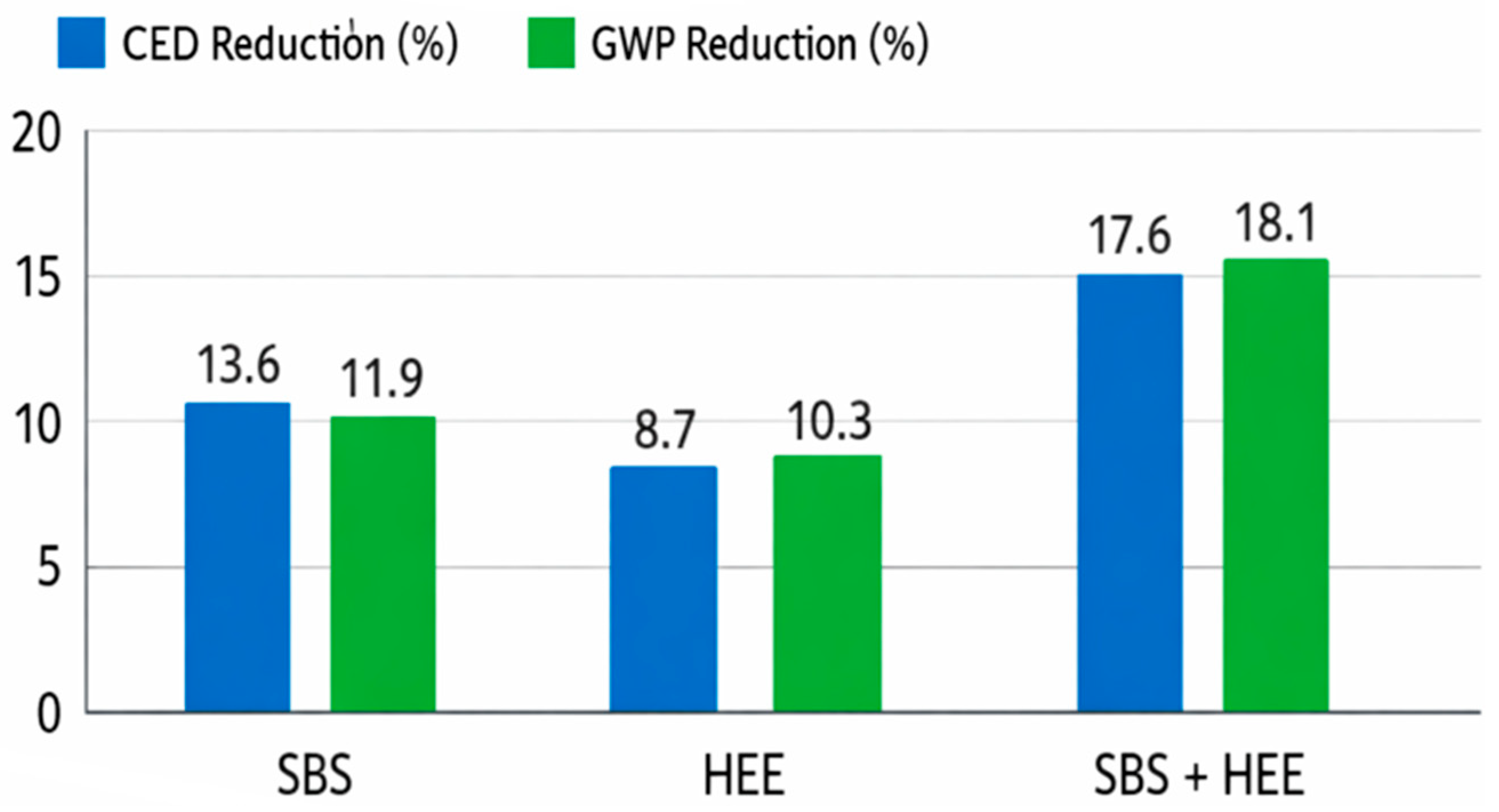
The combined SBS + HEE configuration achieved the most pronounced performance improvements across all indicators. Electricity intensity declined to 883 kWh·ton−1 and natural gas intensity to 373 m3·ton−1, resulting in the lowest cumulative energy demand (55.8 GJ·ton−1) and global warming potential (303 kg CO2e·ton−1) among all scenarios. Relative to the baseline, this corresponds to net reductions of 17.6% in total energy demand and 18.1% in GWP.
Across all configurations, electricity remained the dominant contributor to cumulative energy demand, reflecting the energy-intensive nature of shredding, drying, and extrusion stages in mechanical recycling systems. All percentage changes reported in
Table 1 are calculated relative to the baseline configuration.
In summary, the data presented in
Table 1 demonstrate that the implementation of gradual and integrated technological improvements correlates with a consistent decrease in both energy consumption and greenhouse gas emissions. While single interventions (SBS or HEE) provide notable improvements relative to the baseline, the combined SBS + HEE configuration consistently delivers the highest reductions across all evaluated indicators, confirming the cumulative benefit of coordinated upstream and downstream optimization.
To further clarify the multi-polymer structure of the plant, the scenario results were also disaggregated for the four main polymer streams processed in the facility, namely PET, HDPE, LDPE, and PP, as presented in
Table 2.
Table 2 presents a polymer-specific disaggregation of the scenario results for PET, HDPE, LDPE, and PP in order to support the multi-polymer scope of the study. Since direct utility metering was not available separately for each polymer stream across all process units, the results were estimated using annual throughput shares together with process-based adjustment factors reflecting differences in washing, drying, and extrusion demand. Although the absolute SEC, natural gas intensity, CED, and GWP values vary across polymer types, the scenario ranking remains unchanged. In all four polymer streams, the baseline case produced the highest burdens, the individual SBS and HEE cases provided intermediate improvements, and the combined SBS + HEE case yielded the lowest overall environmental impact.
3.2. Comparative Reduction in Energy and Emission Indicators
Percentage reductions in cumulative energy demand (CED) and global warming potential (GWP) were calculated relative to the baseline configuration using Equation (10). This normalization enables direct comparison of process-level improvements across scenarios independent of production throughput:
where
represents either CED (GJ·ton
−1) or GWP (kg CO
2e·ton
−1).
This normalization keeps the comparison consistent across scenarios by removing the effect of changes in production throughput and isolating improvements in process efficiency.
Figure 3 shows the percentage reductions in CED and GWP for each scenario and highlights the stronger performance achieved under the integrated optimization pathway.
The combined configuration strongly demonstrates the synergistic effect of integrated process optimization, delivering the most significant reduction in both energy demand and greenhouse gas emissions. These findings indicate that there is considerable room for low-carbon improvements, particularly in mechanical recycling plants in developing economies where raw material heterogeneity is high and process constraints are prevalent. Furthermore, the combined optimization pathway is directionally consistent with the improvement levels reported in selected recycling studies, although direct one-to-one comparison remains limited by differences in system boundaries, polymer composition, and electricity mixes.
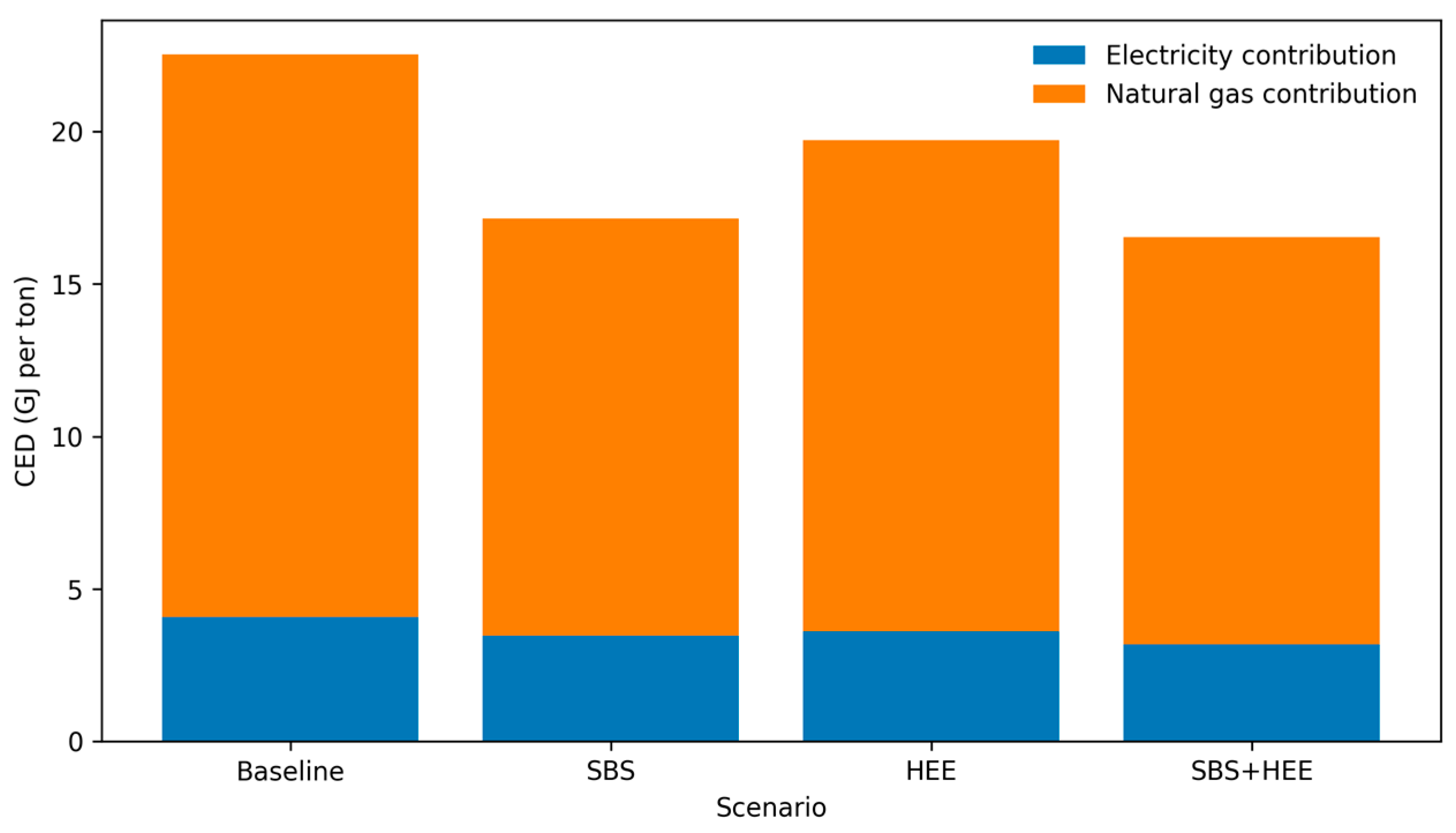
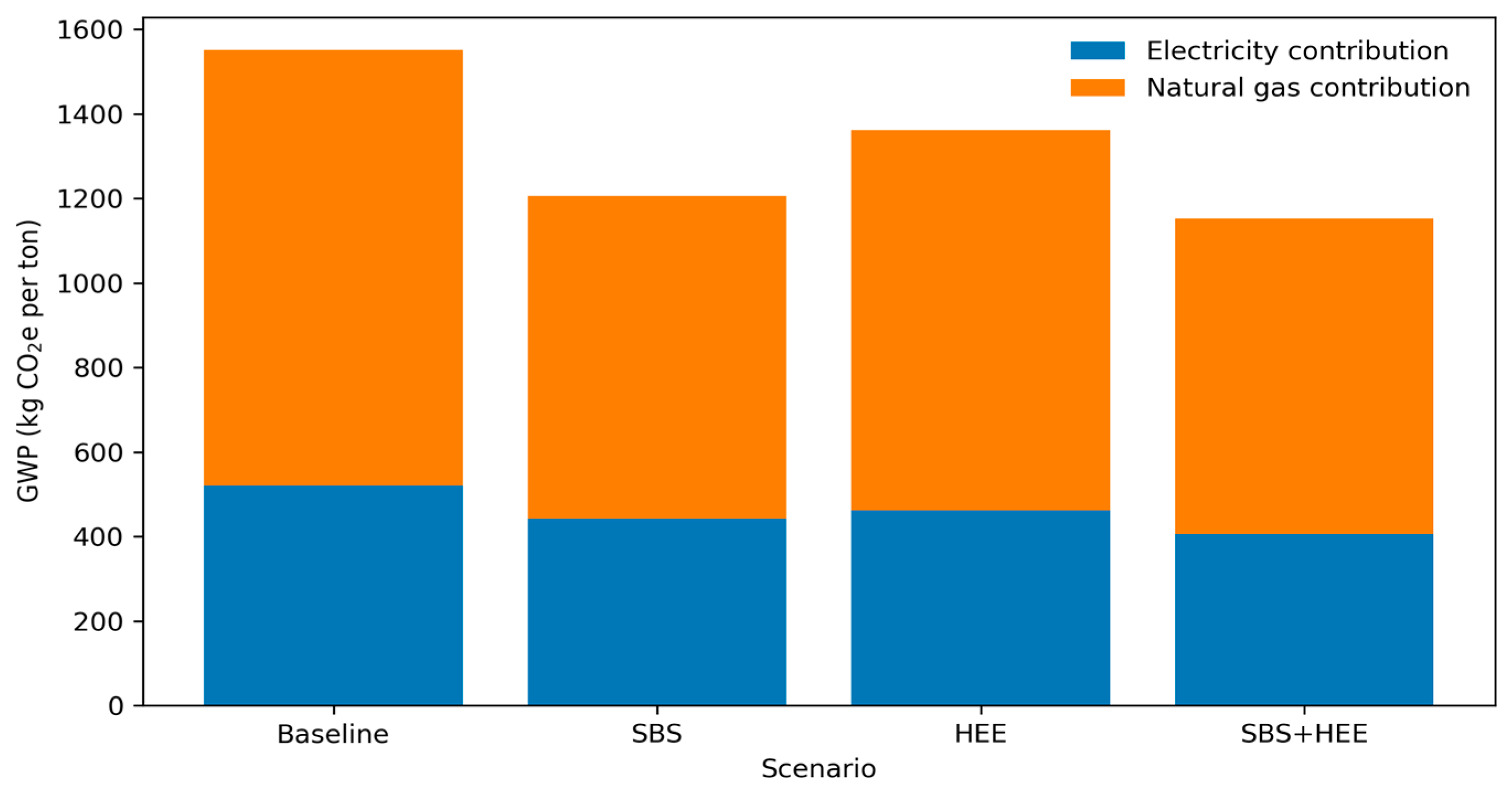
To better interpret the underlying drivers of the observed reductions in CED and GWP, the relative contributions of electricity and natural gas consumption were analyzed for each scenario.
Figure 4 and
Figure 5 illustrate how changes in energy source use influence total energy demand and emission intensity across the evaluated configurations.
Figure 4 decomposes cumulative energy demand into electricity- and natural gas-related contributions, allowing for the main sources of savings to be identified more clearly. Electricity remains the dominant contributor to total CED across all scenarios. However, the SBS and combined configurations also achieve noticeable reductions in thermal-energy demand, largely because improved feedstock quality reduces washing intensity and associated natural gas use.
Figure 5 shows a similar pattern for GWP. In the SBS scenario, emission reductions are driven mainly by lower natural gas consumption, whereas in the HEE scenario the main contribution comes from improved electricity-related process efficiency. The combined SBS + HEE configuration achieves the lowest overall GWP because it reduces the burdens associated with both energy carriers simultaneously.
Electricity-related emissions dominate in all scenarios; in the SBS scenario, natural gas-related GWP declines more sharply (−25.8%) than electricity-related GWP (−15.0%), reflecting the strong sensitivity of washing and drying stages to feedstock purity improvement.
3.3. Uncertainty and Monte Carlo Results
Monte Carlo simulation results evaluate energy consumption and climate implications in a probabilistic framework for each scenario, allowing us to understand how durable the deterministic LCA conclusions remain under genuine operational uncertainty.
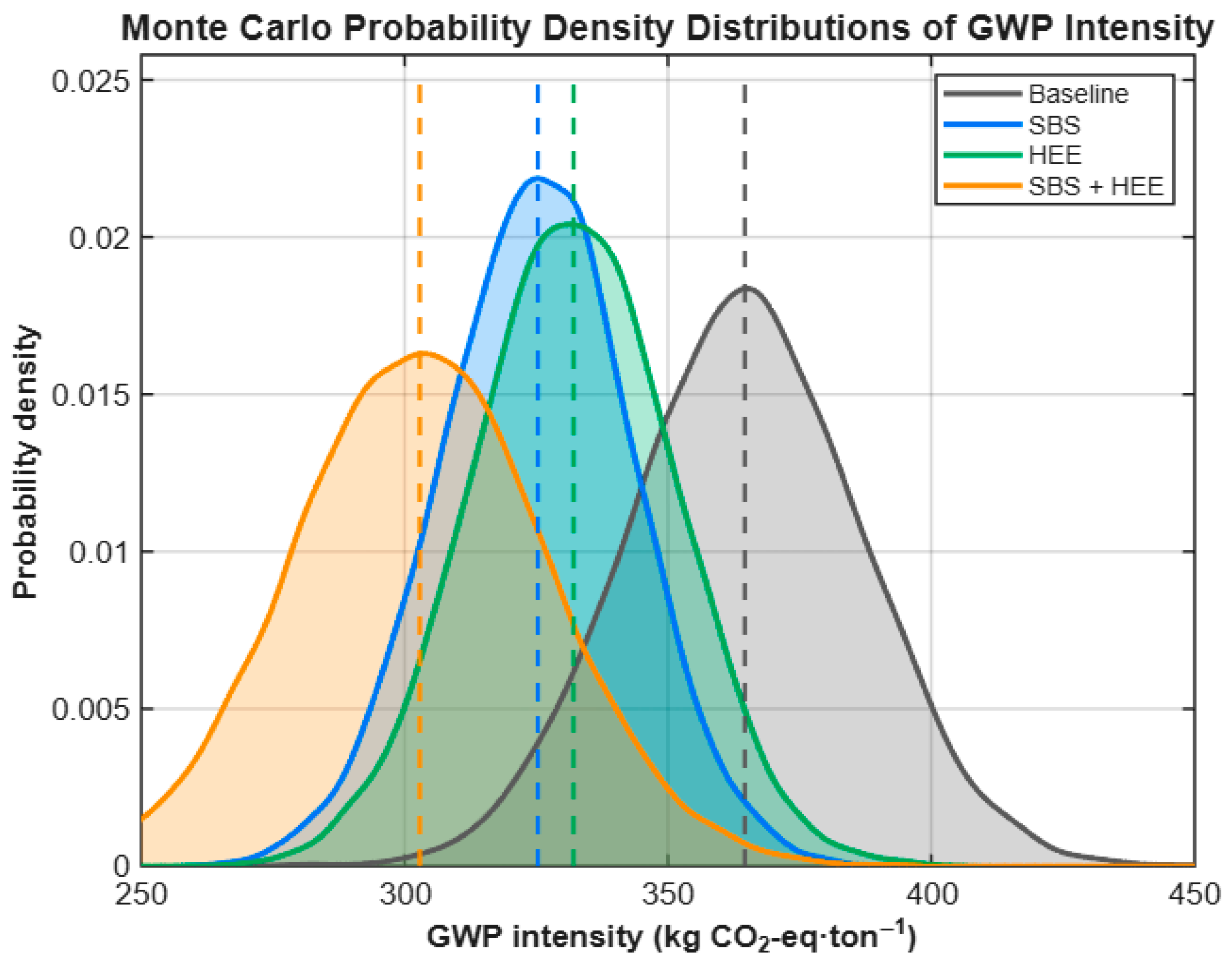
The GWP intensity probability density functions (PDF) derived from 10,000 iterations for the base case, SBS, HEE, and combination SBS + HEE configurations are shown in
Figure 6.
The baseline configuration shows the widest probability distribution, indicating that GWP results are strongly influenced by fluctuations in electricity use, natural gas demand, and emission-related parameters. The broad P5–P95 range is consistent with limited process control and variable feedstock quality, pointing to substantial variability in environmental performance under non-optimized operating conditions.
Both single-optimization scenarios (SBS and HEE) display noticeably narrower distributions compared to the baseline configuration. In the SBS scenario, reduced dispersion is primarily associated with improved feedstock purity, which stabilizes washing and extrusion energy demand. In the HEE scenario, variance reduction is driven by enhanced thermal regulation and load stability during extrusion. In both cases, the contraction of the probability distributions indicates improved operational consistency in addition to reduced mean impact values.
The combined SBS + HEE configuration demonstrates the lowest median GWP intensity and the narrowest uncertainty range among all evaluated scenarios. As summarized in
Table 3, the Monte Carlo median values remain closely aligned with the deterministic scenario results presented in
Table 1, while the P5–P95 ranges confirm that the scenario ranking remains stable under plausible operational variability. Notably, the P5–P95 interval of the combined configuration does not overlap with that of the baseline scenario, confirming that the observed reduction in GWP is statistically significant and not attributable to random variability. The pronounced shift in the distribution peak toward lower impact values further indicates systematic performance improvement rather than isolated efficiency gains.
Across all Monte Carlo iterations, scenario ranking remains stable, with the combined configuration yielding the lowest cumulative energy demand and GWP in more than 95% of simulations. Correlation analysis confirms that electricity intensity and extrusion-related efficiency parameters are the dominant contributors to output variability, reinforcing the critical role of extrusion-stage optimization in reducing both environmental impact and operational uncertainty.
3.3.1. Stage-Resolved and Polymer-Resolved Energy Results
To support the claim that extrusion accounts for 72–79% of cumulative energy demand,
Table 4 presents the baseline electricity consumption disaggregated by process stage and averaged across the four polymer streams. The stage shares were derived from the meter-based data using the allocation procedure described in
Section 2.2. Extrusion consistently represents the largest stage share in all polymer streams, confirming its role as the primary energy hotspot. The washing stage is the second largest contributor owing to the high thermal demand of the hot-water system, while shredding, drying, and pelletizing collectively account for the remaining share.
Table 4 presents the baseline distribution of electricity consumption across the main process stages, providing a clear reference for identifying energy-intensive operations and potential efficiency improvement areas.
3.3.2. Sensitivity Analysis of Scenario Parameters
To assess the robustness of the scenario results to the assumed model coefficients, a one-at-a-time (OAT) sensitivity analysis was performed for the three key parameters: feedstock purity improvement ρ, electricity-reduction coefficient β, and extrusion efficiency improvement γ. Each parameter was varied by ±25% relative to its baseline value, while all other parameters were held constant.
Table 5 reports the resulting change in combined-scenario CED and GWP relative to the central estimates, confirming that the reported reductions are robust to moderate variation in the assumed coefficients.
Table 5 summarizes the results of the one-at-a-time sensitivity analysis for key scenario parameters in the combined SBS+HEE configuration, with changes reported as percentage deviations from the central cumulative energy demand (CED) and global warming potential (GWP) estimates.
The sensitivity results confirm that a ±25% change in any single parameter shifts the combined-scenario CED and GWP by no more than ±3.4%, indicating that the reported reductions are not artefacts of specific parameter choices but are robust across a plausible range of input values.
3.3.3. Correlation Analysis Results
Table 6 presents the Pearson correlation coefficients between Monte Carlo input parameters and the output indicators (CED and GWP) for the baseline scenario. Electricity intensity and the extrusion-stage energy parameter show the strongest positive correlation with both outputs, confirming the dominance of extrusion-related variability in driving uncertainty in the results. The national grid emission factor is the primary driver of GWP variability, while its influence on CED is comparatively minor.
3.3.4. Comparison with European Benchmark Studies
Table 7 presents a structured harmonized comparison of the present study’s baseline results against selected published LCA benchmarks for mechanical plastic recycling. Because published studies differ in system boundaries, functional units, electricity mix, and included process stages, direct numerical comparison is inherently limited.
Table 7 therefore explicitly lists these methodological parameters alongside the reported CED and GWP values to enable transparent contextualisation rather than direct equivalence claims. The Gaziantep baseline GWP (370 kg CO
2e·ton
−1) is higher than European benchmarks reporting values in the 120–250 kg CO
2e·ton
−1 range, primarily reflecting Türkiye’s more carbon-intensive national electricity grid (0.46 kg CO
2e·kWh
−1 versus EU average of approximately 0.23–0.30 kg CO
2e·kWh
−1). The optimized SBS+HEE scenario (303 kg CO
2e·ton
−1) substantially narrows this gap, suggesting that technology upgrading under an unchanged grid mix can bring performance considerably closer to European levels.
Table 7 provides a harmonized comparison between the results of the present study and selected literature benchmarks on mechanical recycling LCA, enabling a consistent evaluation of cumulative energy demand (CED) and global warming potential (GWP) across different studies and system boundaries.
3.4. Comparison with Virgin Polymer Production: GWP Context
To contextualise the environmental significance of the present results, the GWP intensities of the assessed recycling scenarios are compared here against published life cycle GWP values for virgin polymer production. It must be emphasised that this comparison is indicative rather than strictly equivalent because the present study uses a gate-to-gate system boundary that covers only the recycling operation itself, whereas virgin polymer production values from the literature typically reflect a cradle-to-gate scope including monomer synthesis, polymerisation, and pelletisation. The comparison is therefore intended to illustrate the order-of-magnitude climate benefit of mechanical recycling relative to primary production, not to constitute a formal substitution equivalence or a full comparative LCA.
Table 8 presents the GWP results from the present study alongside the literature-based virgin production values for PET, HDPE, LDPE, and PP. Virgin polymer GWP reference values were drawn from the ecoinvent v3 database and corroborated by published LCA literature, which consistently reports values in the range of 1.8–3.4 kg CO
2e per kg for these four commodity thermoplastics [
3,
24]. The comparison shows that the gate-to-gate GWP of mechanical recycling in the baseline scenario (0.370–0.389 kg CO
2e·kg
−1 across polymer types) is approximately 80–90% lower than the cradle-to-gate GWP of the corresponding virgin polymers. Under the combined SBS + HEE scenario, this differential increases further, with recycling GWP values falling to 0.288–0.315 kg CO
2e·kg
−1. These figures confirm that, even without accounting for avoided virgin production credits, the within-plant carbon intensity of mechanical recycling is substantially lower than that of primary polymer manufacture under current Turkish grid conditions.
Recycling GWP values are gate-to-gate; virgin production GWP values are cradle-to-gate from the published LCA literature and ecoinvent v3 [
3,
24].
Overall, the Monte Carlo results show that combining sensor-based sorting with high-efficiency extrusion does more than just lower average energy use and carbon impacts; it also makes performance more stable and statistically robust, indicating a mechanical recycling system that remains more reliable and resilient under real-world variability in industrial operating conditions.
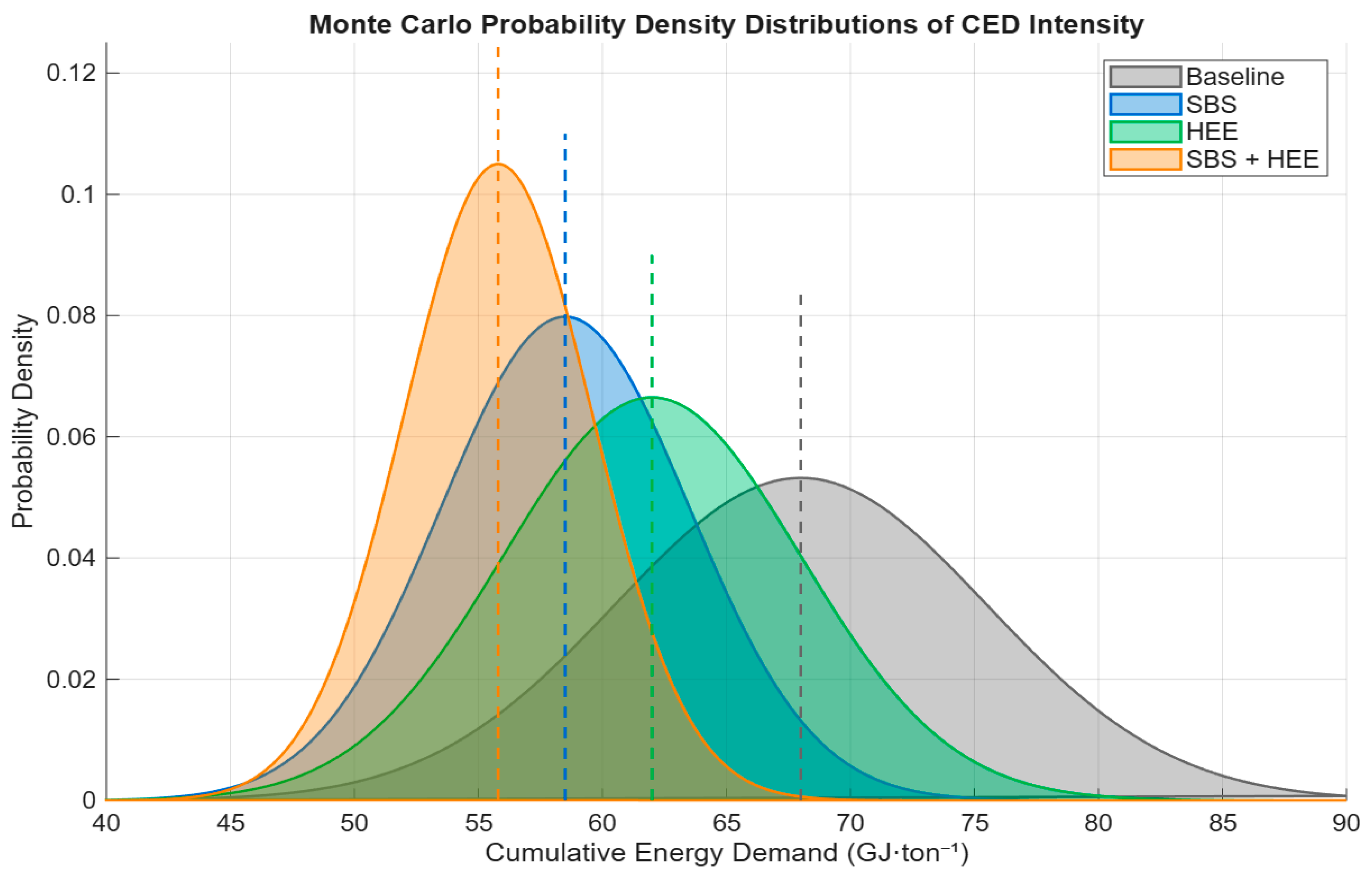
Figure 7 presents the probability density distributions of cumulative energy demand (CED) intensity obtained from Monte Carlo simulations. The fact that the distributions show a similar trend to the GWP results reveals that the relationship between energy use and climate impact remains consistent across the scenarios, and the findings are mutually supportive.
The basic scenario again exhibits the widest distribution, demonstrating how sensitive total energy demand is to fluctuations in electrical density and thermal energy use. In contrast, the distribution narrows significantly in the SBS and HEE scenarios; this can be attributed to more stable processes due to more homogeneous raw materials in the SBS scenario, and to improved energy efficiency and control during the extrusion phase in the HEE scenario.
The combined SBS + HEE configuration produces the “tightest” (most compact) distribution in terms of CED, yielding both the lowest median energy demand and the narrowest uncertainty range. As seen in the GWP results, the non-overlapping P5–P95 ranges of the combined and base scenarios demonstrate that the decrease in energy demand is not a random fluctuation; it represents a statistically significant improvement. The simultaneous reduction in uncertainty in CED and GWP reveals that optimization not only improves the average but also makes the system more stable and predictable.
The order of the scenarios remained unchanged in all Monte Carlo iterations; the combined configuration produced the lowest CED and GWP values in over 95% of the simulations. Correlation analysis also confirms that the most significant factors determining output variability are electricity density and extrusion-related efficiency parameters. This more clearly demonstrates that improvements in the extrusion phase play a key role in both reducing environmental impacts and lowering operational uncertainty.
In conclusion, the Monte Carlo analysis conducted in this study demonstrates that integrated optimization, combining sensor-based separation and high-efficiency extrusion, not only improves average energy and carbon performance but also significantly enhances the reliability and robustness of mechanical recycling systems under variable industrial conditions.
4. Discussion
The findings of this study shed light on where mechanical plastic recycling plants in emerging economies lose efficiency and where the largest optimization gains can realistically be achieved under real industrial conditions. The high SEC observed in the baseline case appears to be driven not only by technological limitations but also by broader structural constraints, including weak process integration, limited energy monitoring, and substantial variation in feedstock quality. Similar gaps between technologically mature and developing recycling systems have also been documented in international assessments, which identify differences in automation, sorting performance, and process control as key drivers of energy outcomes [
14,
30]. Together, these issues tend to make plant operation less stable, increase thermal fluctuations, and ultimately raise cumulative energy demand.
The strong gains observed with sensor-based sorting (SBS) underline how central feedstock homogeneity is to the energy and environmental performance of mechanical recycling. By sharply reducing polymer cross-contamination, SBS lowers the thermal load during washing, helps extrusion operate more steadily, and reduces melt fluctuations that often lead to energy-intensive reprocessing. This aligns with earlier work showing that better sorting can cut downstream energy demand by limiting contamination-driven process instability [
24]. More importantly, the results position upstream sorting as one of the most powerful leverage points for reducing both energy use and emissions, especially in the highly mixed and heterogeneous waste streams that are typical of emerging industrial settings.
The gains achieved when the HEE scenario is implemented alone may not appear as large as those of SBS. However, because extrusion accounts for a very high share of total electricity consumption, this improvement remains strategically important. Previous studies have consistently identified extrusion as the most energy-intensive step in mechanical recycling lines because it combines both thermal and mechanical requirements [
10,
15]. The improvements in thermal stability and load control observed under the HEE configuration demonstrate that targeted optimizations focused on a critical process unit can significantly reduce energy intensity even without full automation across the plant. This suggests that step-by-step modernization approaches can be both feasible and effective, particularly for small and medium-sized recycling plants that must proceed under investment constraints.
The combined SBS + HEE configuration produces synergistic effects that go beyond the linear sum of the individual interventions. The simultaneous improvement of material purity and thermal process control results in lower cumulative energy demand, reduced emission intensity, and improved operational stability across all analyzed polymer streams. Notably, the narrowing of uncertainty intervals observed in the Monte Carlo analysis indicates enhanced system resilience and reduced sensitivity to operational variability. This probabilistic behavior suggests that technological integration improves not only average performance but also the reliability and predictability of system operation, thereby strengthening confidence in the long-term viability of the optimized configuration.
Recent product-level life cycle assessment studies conducted in Türkiye have shown that increasing recycled content and optimizing electricity supply sources can substantially reduce CED and GWP [
31]. While such studies mainly address material and packaging design, the present work extends the sustainability discussion upstream to the recycling process itself. In this sense, the results reinforce the importance of process-level optimization as a critical, yet often underrepresented, component of low-carbon plastic value chains.
At the same time, several limitations should be considered when interpreting the present findings. First, this study is based on a single industrial case from Gaziantep, Türkiye. Although this case provides valuable insight into the operational realities of mechanical plastic recycling in an emerging-economy context, the findings are inevitably influenced by site-specific factors such as plant layout, feedstock composition, equipment condition, operating practices, and regional energy characteristics. Therefore, the results should not be interpreted as universally representative of all recycling facilities in Türkiye or other developing economies. To partially address this limitation, the present results are compared here with published LCA evidence from comparable contexts. Available evidence from Serbia [
14] indicates that the process-stage energy distribution observed in Gaziantep—with extrusion as the dominant energy hotspot—is broadly consistent with patterns reported for mechanical recycling operations in other EU-accession and emerging-economy settings, although absolute CED values differ substantially due to variations in national electricity grid emission factors, equipment age, and feedstock polymer composition. This convergence of process-level findings across independent studies strengthens confidence in the general pattern identified here, even in the absence of a direct multi-facility comparison. The direct application of the present methodology to other Turkish regions or neighboring countries such as Serbia or Egypt would require updating the national electricity grid emission factor, facility-level specific energy consumption values per process stage, and local feedstock quality parameters. The methodological framework developed in this study-combining long-term operational monitoring, scenario-based process modeling, and Monte Carlo uncertainty analysis-is designed to be modular and transferable, and is offered as a replicable template for future multi-facility and cross-national comparative research.
Second, the environmental assessment was intentionally restricted to cumulative energy demand and global warming potential. While these indicators are highly relevant for electricity- and fuel-intensive recycling systems, they do not capture other potentially important environmental dimensions such as acidification, eutrophication, human toxicity, or ecotoxicity. Accordingly, the results should be interpreted as a focused evaluation of energy and climate performance rather than as a fully comprehensive multi-impact LCA of the recycling system. Future studies could extend the framework by incorporating additional midpoint and endpoint impact categories through full LCA software environments and expanded background inventories.
Third, this study does not quantify a separate GWP contribution associated with process-water consumption. Although water is used in the washing stage, the present assessment captures only the energy-related climate burden of that operation through natural gas use for water heating. Since water supply, wastewater treatment, and related background processes were excluded from the system boundary, no independent water-related emission factor was applied. Therefore, the reported GWP values should not be interpreted as including the full upstream and downstream carbon implications of industrial water management. Future work could extend the current gate-to-gate model by explicitly incorporating water supply and wastewater-treatment inventories so that the climate implications of process-water use can be assessed alongside energy-related emissions.
An additional limitation is that this study evaluates the environmental performance of recycled pellet production without directly assessing the final material quality of the recycled output relative to virgin polymers. In practice, the technical suitability of recycled plastics may vary depending on contamination level, polymer degradation, additive content, and the requirements of the intended end use. Therefore, the functional-unit-based comparison adopted here should not be interpreted as evidence of full one-to-one substitutability between recycled and virgin plastics across all applications. Rather, the results should be understood as representing the energy and climate performance of producing recycled pellets under the investigated mechanical recycling configuration.
The present findings are also specific to conventional mechanical recycling and do not account for solvent-related emissions or solvent recovery burdens because the analyzed facility operates entirely through mechanical process steps. As a result, the reported CED and GWP values should not be interpreted as representative of solvent-assisted recycling technologies or hybrid purification systems. In addition, the assessment is restricted to a gate-to-gate boundary and therefore does not quantify the full life cycle benefits of mechanical recycling relative to alternative end-of-life options such as landfilling or incineration. The findings should therefore be interpreted as plant-level evidence on process performance and optimization potential rather than as a complete comparative evaluation of all waste-management pathways. For transparency,
Table 9 consolidates all exclusions from the system boundary in a single location, together with the rationale for each exclusion and the direction of expected bias on the reported results.
Overall, the results indicate that effective modernization of mechanical recycling systems may benefit from an integrated strategy combining feedstock quality improvement with process-level efficiency enhancement. Such coordinated interventions appear to offer a technically feasible and environmentally meaningful pathway for improving the performance of recycling infrastructure, particularly in emerging-economy contexts. In addition, the probabilistic support provided by the Monte Carlo analysis increases confidence in the stability of the scenario ranking under operational variability. However, the broader practical relevance of these findings should be interpreted together with the methodological scope of the study and the absence of a techno-economic assessment. Future research should therefore extend this framework in three directions: first, by integrating techno-economic analysis to evaluate not only what performs best environmentally but also what is most viable in practice; second, by expanding the system boundary to a cradle-to-grave scope to enable full life cycle comparison with alternative end-of-life pathways including landfilling and incineration; and third, by replicating the measurement-based LCA methodology at additional facilities in other Turkish regions and neighboring emerging economies such as Serbia or Egypt, in order to validate the generalizability of the present findings and develop context-sensitive benchmarks for mechanical recycling performance.
5. Conclusions
Mechanical recycling is becoming an increasingly important component of circular economy strategies as countries seek to reduce plastic waste and transition industrial systems toward lower-carbon production. In line with the EU Circular Economy Action Plan, Türkiye’s transition to low-carbon manufacturing also requires improvements in recycling efficiency, energy performance, and material recovery effectiveness. In this context, the present study examined a mechanical plastic recycling plant operating under real industrial conditions and provided an early-stage environmental assessment based on field-derived process data.
The baseline results indicate that the facility retains substantial room for efficiency improvement. Extrusion was identified as the dominant energy hotspot, and overall SEC remained relatively high under current operating conditions. This suggests that process configurations commonly found in developing industrial contexts may still fall short of expected circular-economy performance levels, and that targeted technical upgrading is necessary to reduce both energy use and emissions intensity.
The scenario analysis further showed that focused technological interventions, particularly sensor-based sorting and high-efficiency extrusion, can generate meaningful environmental gains. Relative to the baseline, cumulative energy demand decreased by up to 17.6%, while global warming potential decreased by 18.1%. Importantly, the combined SBS + HEE configuration did not behave as a simple sum of two isolated interventions, but instead produced a clear synergistic effect. This finding indicates that integrated process-optimization strategies may be more effective than implementing individual upgrades separately.
The Monte Carlo analysis further strengthened the robustness of these conclusions. The optimized configurations not only reduced average environmental burdens, but also narrowed the spread of outcomes, indicating lower variability and more stable operation under heterogeneous feedstock conditions and fluctuating plant performance. In this respect, the probabilistic analysis extends beyond a purely deterministic assessment by testing whether the scenario ranking remains stable under real-world uncertainty.
At the same time, the findings should be interpreted within the scope of the present study. The reported GWP values reflect electricity- and natural gas-related emissions within the defined plant boundary and do not include separately modeled contributions from water supply or wastewater management. More broadly, the conclusions are limited to energy- and climate-related indicators and should not be interpreted as a complete multi-category environmental profile of the investigated recycling system. Likewise, the results should be understood as process-level environmental findings for recycled pellet production rather than as evidence of universal functional equivalence between recycled and virgin plastics in all downstream applications.
Overall, the results show that targeted upgrading of critical process stages can provide a practical and environmentally meaningful pathway for improving the performance of mechanical plastic recycling in emerging-economy contexts such as Türkiye. The findings provide process-level evidence that may support future industrial upgrading and more informed evaluation of low-carbon recycling strategies. These conclusions apply specifically to conventional mechanical recycling facilities and should not be directly generalized to solvent-based or chemically assisted recycling pathways, which involve different inventories, process stages, and emission profiles.
Beyond reporting scenario-based reductions in CED and GWP, this study contributes to the literature by combining long-term industrial monitoring, multi-polymer process-level assessment, and uncertainty-aware scenario evaluation within a single emerging-economy case. Its main contribution is therefore not the introduction of a completely new LCA framework, but the provision of a more operationally realistic and statistically supported basis for interpreting the environmental performance of mechanical plastic recycling systems. Building on this environmental assessment, future research should extend the framework through detailed techno-economic analysis in order to evaluate not only what performs best environmentally, but also what is most viable in practice for the deployment and scaling of sustainable plastic recycling technologies.