1. Introduction
As an integral part of daily transportation, the number of two-wheeled electric vehicles in circulation has surpassed 350 million, with an annual production volume exceeding 30 million units [
1]. Driven by both the “dual-carbon” goals and rising consumer expectations, two-wheeled electric vehicles are undergoing a profound transformation from basic means of transportation to vehicles that embody personalized lifestyles; product design has become a key factor influencing consumer purchasing decisions [
2,
3]. However, the industry currently faces prominent challenges such as accelerating design iterations, ambiguous user demands, and a disconnect between design decisions and actual market feedback. These issues have led to severe product homogenization, shortened product lifecycles, and significant waste of design resources—all of which run counter to sustainable development strategies [
4,
5]. From an industrial design perspective, the core dilemma in two-wheeled electric vehicle design lies in the “implicit” nature of users’ esthetic perceptions [
6]. Consumers typically struggle to articulate their visual preferences using professional design terminology and can often only make intuitive judgments of “like” or “dislike” when presented with finished products. This cognitive expression barrier prevents effective demand information from being accurately captured at the design stage, forcing designers to rely on personal experience or intuitive judgments on trends when making styling decisions [
7,
8]. The consequences are twofold: on the one hand, the stylistic characteristics of best-selling models are difficult to systematically summarize and carry forward; on the other hand, companies’ predictions regarding future style trends are often inaccurate, leading to high sunk costs in design investments. Consequently, inventory backlogs and resource wastage caused by outdated styles are commonplace [
9].
The concept of sustainable design emphasizes reducing environmental impact from the very beginning of a product’s lifecycle, and the longevity of a design style—that is, a product’s ability to maintain esthetic appeal to users over an extended period—is a critical dimension that cannot be overlooked [
10]. Classic models often achieve exceptionally long market lifespans due to their restrained, balanced design language and timeless appeal, whereas designs that excessively chase fleeting trends accelerate product obsolescence [
11]. Therefore, understanding users’ deep semantic perceptions of design styles through scientific methods and revealing the stylistic commonalities inherent in best-selling models and their potential links to sustainable value, and thereby establishing a predictive framework for style trend analysis, have become urgent research priorities in the field of industrial design. This study focuses on this interdisciplinary area and, through the adoption of established methods for quantifying visual imagery, provides a reproducible and verifiable paradigm for style trend analysis in the field of two-wheeled electric vehicle design. The core contribution of this study lies in treating users’ semantic cognition as a mediating variable linking design features to sustainable value. Through a data-driven approach, it reveals the stylistic commonalities of best-selling models and, for the first time, establishes the “simplicity–cognitive consensus” correlation as a quantitative proxy for visual durability, thereby providing a methodological reference for the transition of design decision-making from an experience-orientated to a science-orientated approach.
2. Literature Review
Product styling is a core research area in the field of industrial design; at its core, it is the process through which a design symbol system conveys esthetic information and cultural significance through visual form [
12,
13]. The theory of product semantics emphasizes the expansion of product design beyond mere functional satisfaction to the level of meaning construction, conveying a product’s identity and value through elements such as form, color, and materials [
14]. Product form not only serves operational guidance functions but also fulfills symbolic functions in expressing social identity, emotional affiliation, and cultural identity [
15,
16]. Form semantics is directly linked to users’ perceptions and judgments of a product’s character. Scholars have explored quantitative research on form style and semantic perception through various approaches. Orsborn et al. conducted systematic research on the decomposition of styling features in the fields of construction machinery and automotive design. Relying on parametric shape grammar technology, they explored vehicle styling concepts by reducing complex morphological variations to a finite set of feature parameters [
17]. Liu et al. introduced the shape grammar method into the study of automotive front-end styling, identifying new design opportunities and stylistic trends by analyzing the mapping relationship between front-end styling parameters and users’ esthetic perceptions [
18]. McCormack et al. analyzed the relationship between the geometric structure of automotive hood panels and designers’ intended styling objectives, thereby guiding inner panel styling design within a shape grammar framework [
19]. Research by Lin et al. indicates that studies on users’ perceptual experiences of smart vehicle design primarily focus on the integration of eye-tracking and semantic differentiation methods, which can effectively quantify users’ perceptual experiences of smart vehicle design [
20]. Li et al. employed semantic differential methods to measure the imagery of automotive front-end styling, confirming the existence of a stable mapping structure between product styling and semantic cognition [
21]. Demirbilek et al. examined the interplay between product design, semantics, and emotional responses, employing semantic analysis methods to explore the relationship between product design and users’ emotional responses, thereby guiding the semantic design of products [
22]. It is worth noting that existing research on design semantics has largely concentrated on the automotive sector; specialized studies on two-wheeled electric vehicles remain limited. A few studies have conducted preliminary explorations of the design imagery of electric bicycles, but these have featured small sample sizes and limited model coverage and have not yet established a systematic cognitive framework for the design semantics of two-wheeled electric vehicles. In particular, there is a lack of focused analysis on best-selling models on the market, making it difficult to uncover the underlying logic of current mainstream consumer esthetic preferences.
The concept of sustainable design has undergone a paradigm shift from green design and ecological design to product–service system design [
23]. In the field of industrial design, Jetti et al. argue that sustainable design should not be limited to the environmental performance of materials and processes but should extend to the durability of a product’s meaning—that is, its ability to be cherished over the long term on a cultural and psychological level [
24]. Haines-Gadd et al. introduced the emotional durability analysis method into sustainable design and proposed a nine-element tool for emotional durability design to identify new design opportunities that transcend the limitations of environmental performance and integrate both cultural value and sustainability [
25]. Ackermann and others introduced the concept of “emotional durability”, arguing that product design should extend the duration of users’ esthetic identification with a product through moderate esthetic expression and a restrained stylistic language [
26]. Lokman [
27] believes that by systematically linking users’ emotional imagery with product design elements through the methods of affective engineering, one can demonstrate a close and quantifiable relationship between user emotions, esthetic experiences, and product design. Veryzer et al. [
28], through a longitudinal study of consumer electronics, found that products with “minimalist” and “neutral” visual characteristics tended to have longer market lifespans, with users exhibiting delayed visual fatigue. Carbon and Shieh et al. termed this phenomenon “visual endurance” and proposed quantitative metrics such as form complexity, color saturation, and ornament density as technical parameters for evaluating visual endurance [
29,
30]. In the automotive sector, some scholars have examined electric vehicles to analyze how “family-style front-end” design strategies promote brand recognition continuity, noting that a consistent design language helps reduce the cognitive effort required for users to adapt to new products while strengthening emotional brand loyalty [
16,
31]. Existing research on the continuity of design styles has largely focused on the product usage phase, with insufficient attention paid to the pre-purchase stage—specifically, how style selection influences purchasing decisions and future perceptions. Arguments regarding the relationship between these factors are mostly based on post hoc attribution, lacking a systematic predictive analytical framework. Furthermore, research in the field of two-wheeled electric vehicles is virtually nonexistent, even though their fast-moving consumer goods (FMCG) nature and short product iteration cycles lead to particularly high demands regarding visual durability.
The semantic differential method is a classic approach for quantifying visual imagery [
32,
33]. Its core principle involves using multiple pairs of semantically opposite adjectives to measure participants’ subjective evaluations of concepts or objects. Since its introduction into design research in the 1990s, this method has become the mainstream paradigm for studying product image perception [
34]. Scholars such as Nagamachi systematically developed the theory of product image modeling, combining the semantic differential method with morphological analysis and multivariate statistical methods to establish a research framework for “Kansei engineering” [
35,
36]. Yan et al. and others introduced fuzzy goal-orientated decision analysis into Kansei evaluation, proposing a priority-based multi-attribute fuzzy decision model [
37]. At the application level, this method has been successfully extended to multiple fields, including automotive styling, home appliances, and furniture design, demonstrating its applicability across product categories. Factor analysis is a common statistical technique for dimensionality reduction in semantic differential data; its purpose is to condense multiple observed variables into a few latent factors, thereby revealing the underlying structure of user cognition [
38,
39]. In industrial design research, factor analysis is widely used to extract the dominant dimensions of product style imagery.
A review of existing research reveals that while the field of industrial design has accumulated extensive experience in methods for quantifying visual imagery, there is still a lack of studies applying these methods to the analysis of the stylistic evolution of two-wheeled electric vehicles from a sustainable design perspective. This study focuses precisely on this interdisciplinary area. By adopting a well-established methodological chain—comprising semantic difference analysis, factor analysis, and fuzzy number operations—and focusing on best-selling models from 2025, we aim to construct a transferable and reproducible academic framework for deducing style trends.
3. Materials and Methods
3.1. A Quantitative Paradigm for Visual Imagery from a Design Perspective
Quantitative research on visual imagery falls within the interdisciplinary field of affective engineering and design cognition. Its philosophical foundation lies in the recognition that, although users’ esthetic judgments regarding product form are subjective and ambiguous, they are not entirely disordered [
40,
41]. Through the statistical synthesis of a large volume of individual evaluation data, research on the quantification of visual imagery can reveal stable cognitive structures at the group level [
42,
43]. Its value lies in the following points: firstly, the research subjects are all product types with a strong visual dominance, where design style directly influences user choice; secondly, researchers aim to address the disconnect between design and consumption caused by the ambiguous expression of user needs; and thirdly, the research process begins with the collection of imagery adjectives and concludes with the output of quantitative evaluation data, forming a complete methodological loop [
44,
45].
This study focuses on three-dimensional designs of two-wheeled electric vehicles. The coding of design features must be tailored to the product’s inherent characteristics, and the database of descriptive adjectives must be semantically filtered and constructed within the context of transportation. The incorporation of a sustainability perspective requires that the research goes beyond merely describing the product’s design style; it must also establish logical connections with concepts such as emotional durability and visual adaptability in the interpretation of results.
3.2. Research Pathway Design
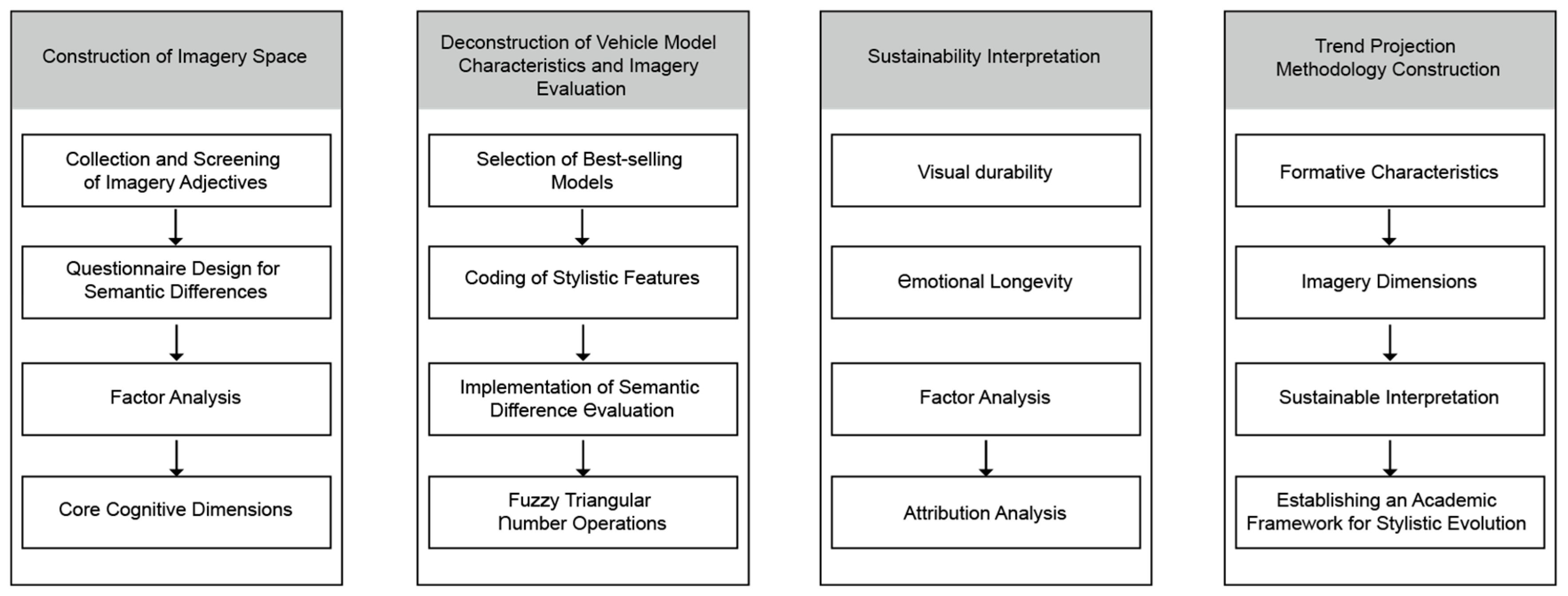
In this study, we developed an academic method for deriving design style trends for two-wheeled electric vehicles orientated toward sustainability. With product semantic cognition as its theoretical core, the method employs a process comprising “collection of imagery vocabulary–extraction of semantic dimensions–coding of design features–quantification of stylistic imagery–interpretation of sustainability” to achieve the structured expression of users’ vague visual preferences and the derivation of design trends (
Figure 1). The research process is divided into four phases and nine steps: Phase I involves the construction of the image space, comprising three steps—collection and screening of image adjectives, design of a semantic difference questionnaire, and factor analysis—with the aim of extracting core cognitive dimensions of users’ perceptions regarding design styles [
46]. The second stage involves the deconstruction of vehicle model features and image evaluation, comprising four steps: the selection of best-selling models, coding of design features, administration of semantic difference evaluations, and fuzzy triangular number operations [
47]. This stage is designed to quantify the performance intensity of each model across image dimensions and establish correlation mapping between design features and image dimensions. The third stage involves a sustainability-based interpretation, introducing theoretical perspectives such as visual durability and emotional longevity to conduct an attribution analysis of the stylistic commonalities among best-selling models [
48]; the fourth stage focuses on constructing a trend extrapolation methodology, proposing an academic framework for extrapolating stylistic evolution trends based on the analytical chain of “design features–imagery dimensions–sustainability-based interpretation”. The core logic of this approach is as follows: the user’s cognitive structure serves as the mediating variable linking design features and stylistic value. By quantifying the distribution of imagery dimensions, one can infer the perceptual activation patterns of design features; by focusing on best-selling models, one can identify stylistic configurations with high current market acceptance; and through a sustainability lens, one can discern stylistic directions with longer-term esthetic vitality. Trend extrapolation is thus a directional inference built upon this three-tiered analytical foundation.
3.3. Methods for Constructing a Collection of Imagery Adjectives
The completeness and representativeness of the collection of imagery adjectives directly affect the quality of subsequent factor analysis. Following the standard screening process for common lexicons, in this study, we adopted a three-stage procedure: “extensive collection–expert screening–pre-testing optimization” [
49]. During the extensive collection phase, keywords such as “two-wheeled electric vehicles”, “electric bicycles”, “motorcycles”, “styling”, and “design imagery” were used to systematically search three categories of sources: firstly, product styling adjectives already used in the academic literature, covering categories such as transportation, consumer electronics, and home appliances; secondly, high-frequency terms from user comments on product detail pages for two-wheeled electric vehicles on e-commerce platforms (Tmall, JD.com), where cumulative comments from 10 models of mainstream brands over the past year were collected and sentiment-orientated adjectives were extracted through word frequency analysis; and thirdly, descriptive vocabulary used by professional design teams or companies to describe electric vehicle styling. We initially identified 120 adjectives covering dimensions such as form, color, texture, and overall impression. For the expert screening phase, a panel of 10 experts was formed, comprising industrial design professionals and university researchers with backgrounds in transportation design. The selection criteria were as follows: at least 5 years of professional or teaching experience, and participation in the design of at least two mass-produced vehicle models. The screening principles for adjectives included (1) clear semantic meaning without ambiguity; (2) strong relevance to the styling of two-wheeled electric vehicles; (3) non-technical terminology that general consumers can understand; (4) no obvious positive or negative connotations. Through a two-round Delphi method discussion, 40 image adjectives were ultimately identified, forming 20 pairs of semantic difference scales. In the pre-testing phase, 30 general consumers were selected for a small-sample test to verify the consistency of understanding regarding the adjective pairs. Based on the feedback, three formulations were fine-tuned to create the semantic difference scales for the formal questionnaire [
50].
3.4. Design of a Semantic Difference Questionnaire
The semantic differential method is a technique that measures a subject’s subjective evaluation of an object by using multiple pairs of oppositely charged adjectives and an intermediate scale [
51]. In this study, we employed a 7-point semantic differential scale, in which each pair of adjectives was divided into seven levels, corresponding to scores of −3, −2, −1, 0, 1, 2, and 3. Negative scores indicate a preference for the left adjective, positive scores indicate a preference for the right adjective, and 0 represents neutrality. The scale design adhered to the following principles: the order of adjective pairs was randomized to prevent subjects from developing a habitual response pattern; no fixed superiority or inferiority was assigned to the left or right adjectives to offset order effects; and each page presented a complete evaluation task for a single vehicle model, with the order of models rotating randomly.
The questionnaire consists of three sections. The introductory section explains the purpose of the study and how to complete the questionnaire and states that the data will be used solely for academic research; the first section covers demographic variables, including gender, age, occupation, experience with electric vehicles, and involvement in purchasing decisions, which are used to describe the sample structure and facilitate subsequent group comparisons; the second section focuses on the evaluation of semantic differences among vehicle models, with participants asked to rate each model on a 7-point scale across 20 pairs of adjectives; and the third section consists of open-ended feedback, allowing participants to add any perceptual dimensions not covered in the questionnaire.
The sample size was determined based on the requirements of factor analysis [
52]. According to general statistical guidelines, the sample size for factor analysis should be at least 5 to 10 times the number of variables. Since there are 20 research variables (pairs of adjectives), the target valid sample size should be no less than 200. Taking into account the rate of invalid questionnaires, we plan to distribute no fewer than 300 questionnaires. The sampling method employed was stratified quota sampling, with quotas controlled by age (18–30, 31–45, 46–60), gender, and occupational level. During the actual data collection, a total of 352 questionnaires were distributed. After rigorous logical validation and screening based on response duration (excluding questionnaires with response times under 300 s, repetitive answers, and those failing reverse-item validation), 309 valid questionnaires were ultimately kept, resulting in a valid response rate of 87.8%. This sample size far exceeds the minimum requirement for factor analysis (5–10 times the number of variables), and the response rate falls within the acceptable range for social surveys. The reasonable distribution of the user profile sample across dimensions such as age, gender, and occupation indicates that the sample is highly representative, providing a sufficient and reliable data foundation for subsequent factor analysis, fuzzy evaluation, and subgroup stability testing.
To test the reliability and validity of the scale, we conducted multidimensional validation of 20 pairs of adjectives during the pilot testing phase. Firstly, exploratory factor analysis was used to test the scale’s structural validity; the results revealed a clear four-factor structure, accounting for 73.6% of the total variance. Secondly, to address potential conceptual redundancy, we calculated Pearson correlation coefficients between each pair of adjectives. The results showed that the correlation coefficients for adjective pairs within the same dimension (e.g., “simple–complex” and “holistic–fragmented”) ranged from 0.42 to 0.58, indicating moderate correlation among items within a dimension. This suggests that the items are neither completely redundant nor entirely independent but rather collectively reflect the core construct. In contrast, the correlation coefficients between adjective pairs across different dimensions were generally below 0.30, preliminarily indicating that each dimension possessed good discriminant validity. Furthermore, moderate redundancy in the number of items within a single dimension (e.g., the “simplicity” dimension includes five pairs of adjectives) helps enhance intra-factor consistency; however, the study controlled for excessive redundancy through factor loading screening (retaining items with loadings >0.6).
3.5. Factor Analysis
Factor analysis is designed to reduce the image rating variables to a small number of latent dimensions, thereby revealing the fundamental categories of users’ perceptions regarding electric vehicle styling [
53]. In this study, we employed exploratory factor analysis, with the specific procedures outlined below. Firstly, sample suitability tests were conducted. The Kaiser–Meyer–Olkin (KMO) statistic and Bartlett’s sphericity test were used to determine whether the data were suitable for factor analysis [
54]. A KMO value > 0.7 and a
p-value < 0.05 for Bartlett’s test were considered acceptable. Principal component analysis was used to extract initial factors, retaining those with eigenvalues greater than 1. Factor rotation was performed using the varimax method to simplify the factor loading structure and enhance interpretability. Factors were named by abstractly generalizing the adjectives with higher loadings; for example, if the three pairs of adjectives “simple–complex”, “holistic–fragmented”, and “restrained–exaggerated” all had loadings greater than 0.6 on the same factor, that factor was named the “simplicity” dimension. The results of the factor analysis not only output the structure of the image perception dimensions but also provide a basis for dimension weights in subsequent fuzzy evaluations. The variance contribution rate of each factor will serve as a coefficient of importance for that dimension in the overall style evaluation, used to calculate the weighted comprehensive image score of the vehicle model.
The mathematical formula and calculation steps for factor analysis are as follows:
The KMO inspection is as follows:
represents the simple correlation coefficient, and represents the partial correlation coefficient. The KMO value ranges from 0 to 1; the closer the value is to 1, the more common factors there are among the variables and the more suitable the data is for factor analysis.
Bartlett’s spherical inspection is as follows:
The sample size is n (304), the number of variables is p (20), and R is the correlation matrix.
- 2.
Factor Extraction
Using principal component analysis, the original variables are linearly combined to form principal components. Let the matrix of original variables be X and its covariance matrix be Σ. Solving the eigenvalue equation |Σ − λI| = 0 yields eigenvalues λ1 ≥ λ2 ≥ ⋯ ≥ λp ≥ 0. Factors with eigenvalues greater than 1 are extracted, comprising a total of four principal components, with cumulative variance explained as follows:
- 3.
Factor rotation
Perform an orthogonal rotation using the method of maximum variance to simplify the structure of the factor loading matrix A, thereby maximizing the sum of the squared variances of the factor loadings:
The rotated factor loadings are denoted by , and the commonality of variables is denoted by .
- 4.
Factor Naming and Load Screening
Select pairs of adjectives whose absolute values of rotated factor loadings are greater than 0.6 to serve as the variables constituting the dimensions. The factor loading
represents the correlation coefficient between the i-th variable and the j-th common factor and is calculated as follows:
is the j-th common factor.
- 5.
Reliability Test
The internal consistency for each dimension was assessed using Cronbach’s alpha:
k denotes the number of variables in the dimension,
denotes the variance of the
i-th variable, and denotes the variance of the total score for the dimension.
3.6. Methods for Coding and Deconstructing Stylistic Features
To establish a correlation between design features and imagery dimensions, a systematic deconstruction of the design features of ten best-selling electric scooters is required. This study employs morphological analysis and, based on the structural composition of two-wheeled electric scooters, deconstructs design features into four levels: overall posture, primary visual surfaces, component parts, and decorative details.
At the overall stance level, the coding variables include the wheelbase-to-length ratio (the ratio of front-to-rear wheelbase to overall vehicle length), the main frame rake angle, the difference in height between the seat and handlebars, and the visual perception of footboard ground clearance. At the primary visual surface level, the coding variables include the front fascia contour shape (trapezoidal/shield-shaped/streamlined/geometric), the proportion of side fairing area, and the rear taper design. At the component level, coding variables include headlight shape (round/rectangular/irregular/full-width), taillight strip design, instrument panel shape and integration, and rearview mirror styling features. At the decorative detail level, coding variables include the proportion of graphic decals, number of colors, material contrast, and proportion of exposed structural components.
Through independent coding, each feature variable for every vehicle model is classified typologically or measured as a continuous variable. For categorical variables, the inter-coder reliability coefficient is calculated; for continuous variables, the average of the three coders’ scores is taken. The results of the feature coding serve as the morphological basis for subsequent fuzzy evaluation analysis and sustainable interpretation.
3.7. Triangular Fuzzy Number Evaluation Method
The raw data obtained from the semantic difference questionnaire consist of discrete ratings given by users for each vehicle model across 20 pairs of descriptive adjectives. The traditional approach involves calculating the arithmetic mean of all participants’ ratings to represent the model’s score for a given attribute. However, design evaluation is inherently ambiguous, and calculating the mean leads to loss of information about the distribution of the ratings. Triangular fuzzy numbers characterize a set of evaluation results using a triplet consisting of a minimum value, a most likely value, and a maximum value, thereby more fully preserving the fuzzy characteristics of the data. The specific calculation steps for triangular fuzzy numbers are as follows:
Based on the results of the factor analysis, the 20 pairs of adjectives were grouped into four core imagery dimensions (“simplicity”, “technological feel”, “approachability”, and “lightness”). Each dimension comprises several pairs of adjectives.
- 2.
Calculation of the Overall Dimension Score
To calculate the overall score for a particular vehicle model in a given dimension, take the arithmetic mean of the triangular fuzzy numbers for all adjective pairs within that dimension. Suppose the dimension contains k adjective pairs with triangular fuzzy numbers (l1, m1, u1), (l2, m2, u2), …, (lk, mk, uk); then, the overall fuzzy score for the dimension is D = (L, M, U):
- 3.
Calculation of the Overall Style Ambiguity Score
The fuzzy numbers for each dimension are weighted and averaged according to their weights, which are obtained by normalizing the variance contribution rates of each dimension from the factor analysis. Let the dimension weights be
wj (
j = 1, …,
i); then, the overall style fuzzy number
S = (
Ls,
Ms,
Us) is given by
- 4.
De-blurring
The mean method is used to convert fuzzy numbers into clear scores. This calculation provides a quantitative representation for each vehicle model across every stylistic dimension and at the overall style level, capturing both central tendency and dispersion. More importantly, the distribution range of the fuzzy scores intuitively reflects the degree of consensus among users regarding the vehicle’s style: a narrower range indicates stronger consensus, while a wider range indicates greater divergence in perceptions. This information has particular value for interpretability.
Triangular fuzzy number operations use a triplet consisting of the minimum (l), median (m), and maximum (u) to characterize the distribution of user evaluations; the validity of this approach requires further verification. Compared to the mean, the median exhibits greater robustness against outliers and can more accurately reflect the central tendency of the evaluations. The selection of the minimum and maximum values is designed to preserve the dispersion range of the evaluations but is susceptible to the influence of extreme outliers. To address this, we performed outlier diagnostics on the raw data prior to calculation, using box plots to identify scores exceeding 1.5 times the interquartile range. The results show that the proportion of extreme values was less than 3%, indicating a limited impact on the overall distribution. To further validate the findings, we conducted a sensitivity analysis by substituting the minimum and maximum values with the 10th and 90th percentiles. The results show that the correlation coefficient (Spearman’s ρ) for the vehicle model rankings obtained using the percentile boundaries and the original extreme value method reached 0.94. This indicates that the extreme value method adopted in this study did not result in significant deviations in the ranking outcomes due to individual outliers and that this approach achieved a reasonable balance between preserving the original distribution characteristics of the data and mitigating the influence of outliers.
3.8. Framework for Interpreting Sustainability
In this study, we consider a sustainability perspective throughout the interpretation of results, with our specific operational approach being to establish a hypothesis linking “imagery dimensions” and “visual durability”. Based on a literature review, the following three testable interpretive leads are proposed:
Clue 1: The “simplicity” dimension is positively correlated with visual durability. That is, users generally believe that “simple”, “cohesive”, and “restrained” design styles are less likely to cause esthetic fatigue. This judgment is supported by the literature and will be further validated by examining the score distribution of best-selling models in this dimension within the research data.
Clue 2: The “approachability” dimension is associated with emotional durability. Emotional durability refers to the long-term value of a product derived from its ability to evoke positive emotions. “Affinity” in design language is often associated with rounded forms, warm colors, and low aggressiveness, which may extend the user’s psychological retention period.
Clue 3: There is a correlation between cognitive consensus and stylistic stability. If a vehicle model exhibits a narrow range of ambiguity scores in image evaluations, this indicates a high degree of consensus among users regarding its stylistic characteristics. This may suggest that the style shows strong distinctiveness and viral potential, thereby supporting sustained market activity over a longer period.
The above clues are not subject to rigorous causal verification through hypothesis testing; rather, they serve as interpretive lenses for deducing the implications of sustainability in the stylistic configurations of best-selling models. This is precisely the fundamental distinction between this research and commercial forecasting models: it provides a framework for understanding, not a set of decision-making directives.
To provide a more empirical foundation for the interpretation of sustainability, this study offers operational definitions for three core concepts. Visual durability refers to a product’s ability to sustain users’ esthetic appreciation over an extended period without causing visual fatigue. In this study, scores on the “minimalism” dimension and the degree of user consensus (i.e., the width of the fuzzy number interval) serve as quantitative proxy indicators. Specifically, the “simplicity” dimension (load ≥ 0.68) directly corresponds to visual characteristics such as “minimalist” and “cohesive”, while the degree of cognitive consensus reflects the consistency of users’ style judgments. The combination of these two factors indirectly represents the design’s universal acceptance and potential longevity. Emotional durability refers to a product’s ability to be cherished over the long term due to the establishment of positive emotional connections with users. In this study, we use the score for the “approachability” dimension (load ≥ 0.61) as its quantitative proxy indicator. This dimension is composed of adjectives such as “warm”, “rounded”, and “approachable”, which align closely with the formal language that promotes positive emotional connections in emotional design theory. Sustainability potential is a composite indicator that comprehensively reflects a product’s performance across the two dimensions of visual durability and emotional durability. At the operational level, in this study, we conduct a comprehensive evaluation by integrating “simplicity” scores, cognitive consensus, and “affinity” scores to identify vehicle models that excel in both esthetic durability and emotional connection capabilities, thereby defining them as models with high sustainability potential.
4. Results
4.1. The Process of Collecting and Selecting Imagery Adjectives
The collection of descriptive adjectives for this study was conducted by systematically searching academic journals for papers on product design imagery research, from which 127 descriptive adjectives were extracted; after deduplication, 85 were retained. Regarding user reviews, we collected user evaluation data for models sold in the flagship stores of 10 major brands—including Yadea, Aima, Tai Ling, Ninebot, and NIU—on the Tmall platform. After obtaining the review texts, we performed word segmentation and part-of-speech tagging to extract a list of high-frequency adjectives, ultimately selecting 65 terms directly related to design style. From professional media sources, 41 adjectives were extracted by reviewing 22 targeted design commentary articles on two-wheeled electric vehicles. After merging and deduplicating the three sources, an initial vocabulary of 120 terms was obtained (
Table 1).
To enhance the rigor and reproducibility of the adjective screening process, we quantified the screening criteria. During the word frequency analysis phase, after tokenizing user reviews from e-commerce platforms, only adjectives that appeared at least five times and were directly related to styling were retained to form a candidate word list. In the first round of expert screening, a binary “retain/delete” decision was made, with the retention criterion set at ≥7 votes in favor (out of 10 experts). A total of 55 low-frequency or semantically ambiguous terms were eliminated, such as “flashy” (too broad in meaning), “stylish” (informal expression), and “futuristic” (semantic overlap with “futuristic feel”). In the second round of expert discussion, the retained terms were clustered based on semantic similarity. For example, “minimalist”, “simplistic”, and “concise” were merged into “minimalist”, while “high-tech”, “smart”, and “digital” were merged into “technological”. This ultimately resulted in 40 image-related adjectives forming 20 pairs of semantic difference scales. Kendall’s coefficient of concordance for the two rounds of expert screening was 0.82 and 0.79, respectively, indicating a high degree of consistency in expert evaluations.
The expert screening panel consisted of 10 members, including three associate professors and two lecturers from industrial design departments at universities, as well as five senior designers from leading electric vehicle manufacturers. The screening process involved two rounds of online voting via a questionnaire. In the first round, experts independently evaluated 120 terms using a binary “retain/delete” decision; terms were retained if they received at least seven votes in favor, resulting in 65 retained terms. In the second round, the retained terms were consolidated based on semantic similarity and paired with antonyms. Following discussion, 40 adjectives were finalized to form 20 pairs of semantic contrast scales (
Table 2), for example, “technological vs. traditional”, “minimalist vs. ornate”, “angular vs. rounded”, “light vs. heavy”, “holistic vs. fragmented”, “fluid vs. abrupt”, and “refined vs. rugged”. After recruiting 30 college students to complete questionnaires and participate in interviews, a small-scale pilot test confirmed that all adjective pairs were clearly defined and unambiguous, and the scale was formally finalized.
4.2. Selecting Vehicle Models
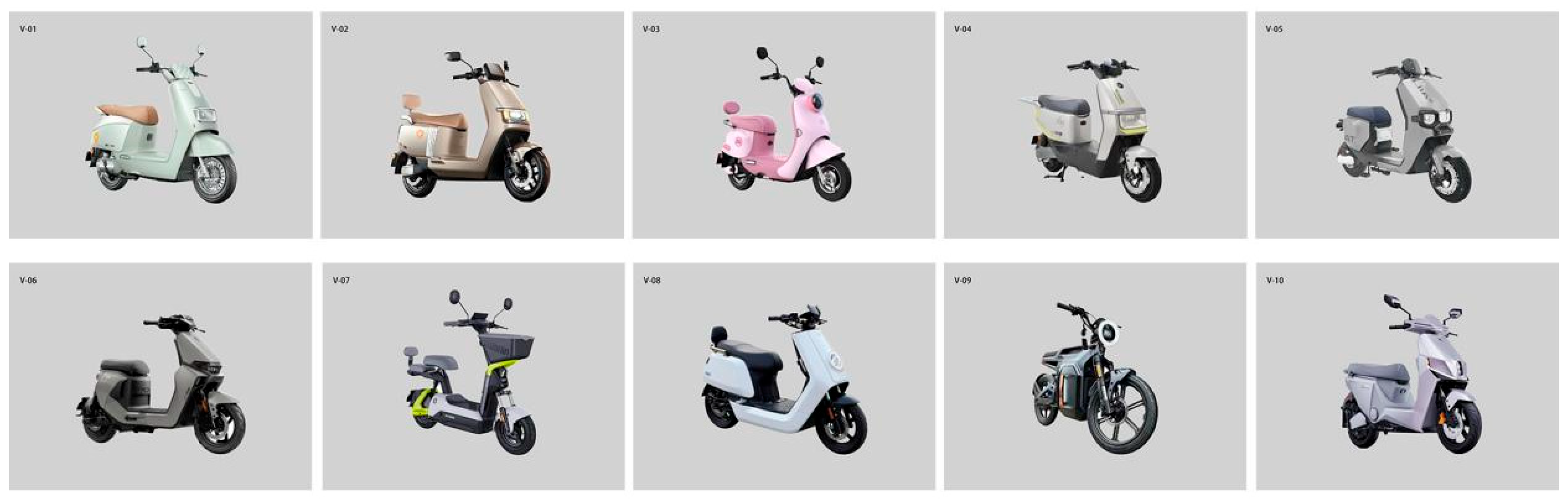
By comparing sales data from online platforms such as JD.com and Tmall, the top ten models by annual retail sales volume in 2025 were selected as the subjects of this study. The selected models span four major categories: luxury electric motorcycles, urban electric scooters, retro scooters, and functional crossover models. Brands included Yadea (V01-Guanneng Q9, V02-Shexiang E10), Aima (V03-Luna W290, V04-Commander Pro), Taisheng (V05-Chaoneng S Cangqiong), Ninebot (V06-Mz MIX, V07-V30C), NIU (V08-NQi 2025, V09-SQi 2025), and GreenSource (V10-S90), totaling 10 models.
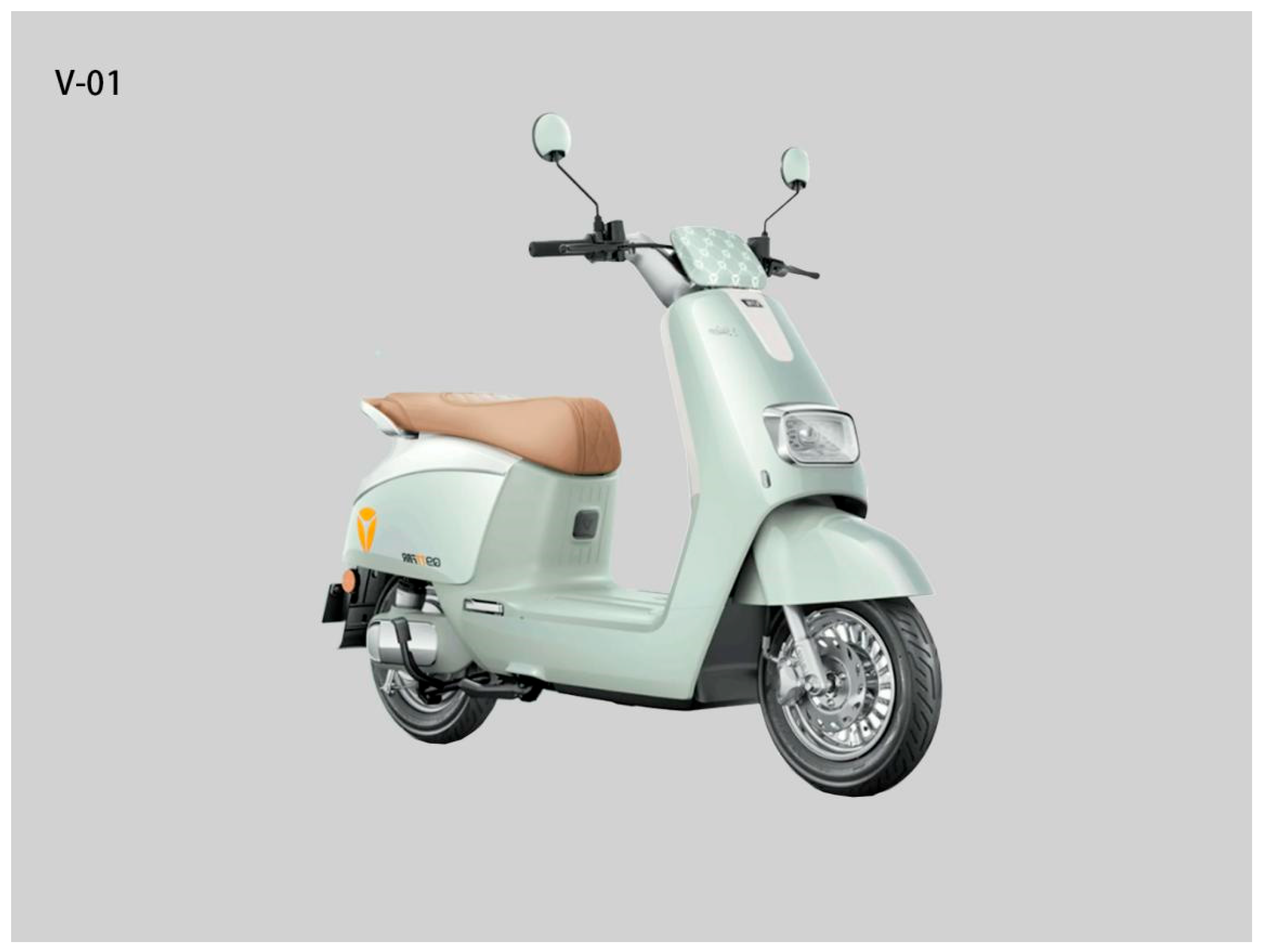
To ensure the standardization of evaluation materials, the research team processed each model as follows: official renderings and multi-angle real-life photos were uniformly collected, with the 45° front right view selected as the primary perspective (
Figure 2). This angle fully captures key design features such as the front panel, side panels, handlebars, and lighting fixtures. Image backgrounds were uniformly processed to a neutral gray to eliminate environmental distractions; resolution was standardized to 1920 × 1080 pixels; and all brand logos were retained without being obscured to replicate the visual perception experienced in real-world purchasing scenarios. The images of the 10 vehicle models were sequentially numbered V01–V10 and entered into the survey system (
Figure 3).
The rationale for selecting the top ten best-selling models of 2025 as the subjects of this study is as follows: firstly, sales data serve as a direct quantitative indicator of collective consumer esthetic preferences, representing the highest level of market acceptance for design styles and providing an empirical foundation for identifying mainstream styling configurations. Secondly, these models span a wide range of market segments—from mainstream brands to emerging players and from basic commuter vehicles to high-end tech-driven models—reflecting the diverse demand landscape of the mainstream consumer market. Furthermore, from a sustainable design perspective, best-selling models typically have longer lifecycles than non-best-selling models. Their design styles have withstood long-term esthetic scrutiny from a broader user base, making them more likely to embody sustainable value characteristics such as visual and emotional durability. Based on this, using best-selling models as research subjects enhances the market relevance of our conclusions while providing reliable data anchors for subsequent sustainability analyses.
4.3. Survey Administration and Data Collection
The survey was conducted through a hybrid online and offline approach, featuring targeted online distribution supplemented by in-person interviews (at electric vehicle dealerships, on university campuses, and in supermarket entrances). A total of 352 questionnaires were collected. After logical validation and screening based on response duration, 43 questionnaires were excluded due to response times under 300 s, repetitive answering patterns (e.g., selecting the same score for all questions), or failed reverse-checking on reverse-scored questions. This resulted in 309 valid questionnaires, yielding a valid response rate of 87.8%. The composition of the valid sample was as follows: 152 males (49.0%) and 157 females (51.0%); 98 respondents aged 18–30 (31.7%), 114 aged 31–45 (36.9%), and 97 aged 46–60 (31.4%); and 91 university students (29.4%), 110 company employees (35.6%), and 108 community residents (35.0%). Additionally, 70.5% of the sample had experience in purchasing electric vehicles, indicating a strong experiential relevance between the participants and the research subjects.
4.4. Factor Analysis and Extraction of Imagery Dimensions
A factor analysis was conducted on the rating data for 20 pairs of imagery adjectives from 309 valid questionnaires. First, an appropriateness test was performed: the KMO value was 0.872, and Bartlett’s sphericity test yielded χ
2 = 3845.67, df = 190,
p < 0.001, indicating that the data were highly suitable for factor analysis. Principal component analysis was used to extract the initial factors, with an extraction criterion set at an eigenvalue greater than 1. A total of four common factors were extracted, accounting for 73.6% of the cumulative variance. Factor rotation was performed using the maximum variance method; after rotation, the variance contributions of the four factors were 28.3%, 21.7%, 13.5%, and 10.1%, respectively. Referring to the factor loading matrix (
Table 3), pairs of imagery adjectives with factor loadings greater than 0.6 were selected to name the dimensions.
Adjective pairs with high loadings for Factor 1 include “simple–complex” (0.82), “holistic–fragmented” (0.79), “restrained–exaggerated” (0.75), and “fluid–jerky” (0.68), which are grouped under the “simplicity” dimension. Adjective pairs with high loadings for Factor 2 include “technological–traditional” (0.85), “futuristic–present” (0.81), “rugged–smooth” (−0.72, indicating a technological feel after reverse scoring), and “sharp–mild” (−0.69), which are grouped into the “technological feel” dimension. Adjective pairs with high loadings for Factor 3 include “approachable–distant” (0.78), “warm–cool” (0.74), and “rounded–rugged” (0.65), which are grouped into the “approachability” dimension. The adjective pairs with high loadings for Factor 4 include “light–heavy” (0.80), “agile–clumsy” (0.76), and “dynamic–steady” (0.71), which are grouped into the “lightness” dimension.
Cronbach’s α coefficients for the four dimensions were 0.87, 0.83, 0.79, and 0.81, respectively, all of which were above 0.7, indicating that the scale offers good internal consistency and reliability (
Table 4). The results of the factor analysis clearly revealed four core dimensions of users’ perceptions of the design styles of two-wheeled electric vehicles, forming the basic framework for subsequent analysis.
To test the stability of the factor structure across different subgroups, we grouped the sample by age (18–30, 31–45, 46–60), gender (male, female), and purchasing experience (with purchasing experience, without purchasing experience) and conducted confirmatory factor analysis for each group. The results showed that the factor structure across all subgroups was highly consistent with that of the overall sample. The four factors—simplicity, technological sophistication, approachability, and lightness—were consistently extracted, and there were no significant differences in factor loadings across groups (p > 0.05). The results of the multi-group measurement invariance tests suggested both morphological invariance and weak measurement invariance (CFI differences < 0.01), indicating that the factor structure remained essentially unchanged across key demographic segments. This suggests that the four-dimensional image cognitive structure extracted in this study exhibits good generalizability across populations and is not significantly influenced by age, gender, or purchasing experience.
4.5. Calculation of Vehicle Image Scores
Following the steps for fuzzy triangular arithmetic, we first calculate the distribution of user ratings for each vehicle model across each pair of descriptive adjectives, compute the minimum value l, median m, and maximum value u, and construct a 304 × 20 × 10 three-dimensional fuzzy evaluation dataset. Next, based on the results of factor analysis, we group the 20 pairs of adjectives into four core image dimensions and calculate the fuzzy scores for each vehicle model across each dimension.
For each vehicle model, the distribution of user ratings for each pair of descriptive adjectives (20 pairs in total) is calculated. The minimum (l), median (m), and maximum (u) of the ratings are computed for each pair, forming the triangular fuzzy number A = (l, m, u) for that vehicle model and that adjective pair. This generates a three-dimensional fuzzy evaluation dataset with the following dimensions: number of user samples (304) × number of adjective pairs (20) × number of vehicle models (10).
We will use V01 (Yadea Guanneng Q9) in the “simplicity” dimension as an example (
Table 5). This dimension comprises four pairs of adjectives. The triangular fuzzy values for this model across these four variables are (0, 1, 3), (0, 2, 2), (1, 2, 2), and (0, 1, 3). Thus, the composite score for the dimension, Ã_simplicity, is calculated as ((0 + 0 + 1 + 0)/4, (1 + 2 + 2 + 1)/4, (3 + 2 + 2 + 3)/4) = (0.25, 1.25, 2.50). By extension, we obtain the fuzziness scores for the 10 vehicle models across the four image dimensions, as well as the overall style fuzziness score calculated by weighting these scores with the dimension weights. The weights for each dimension are derived by normalizing the variance contribution rates from factor analysis: simplicity, 0.384; technological feel, 0.295; approachability, 0.183; and lightness, 0.138.
After defuzzing, the overall style and dimension clarity scores for each model were determined (
Table 6 and
Table 7). The data show that V09 (Niubility SQi 2025) scored highest on the “technological feel” dimension (2.25), V05 (Ninebot MzMIX) scored highest on the “minimalism” dimension (2.17), V03 (Aima Luna W290) scored highest on the “approachability” dimension (2.08), and V10 (Lvyuan S90) scored highest on the “lightness” dimension (2.00). The models exhibit distinct distributions across different dimensions, reflecting their differentiated style positioning.
4.6. Dimensions and Results of Morphological Feature Encoding
Three coders independently coded the features of 10 vehicle models (
Table 8). The mean Fleiss’ Kappa coefficient for categorical variables was 0.79, and the mean intraclass correlation coefficient for continuous variables was 0.86, indicating good coding reliability. The feature coding results reveal several common trends in the styling characteristics of best-selling models for 2025: front fascia contours are predominantly trapezoidal or shield-shaped (8 out of 10), with purely circular contours having completely disappeared; headlights generally feature continuous light strips or irregular matrix designs (7 out of 10); side panels provide extensive coverage, with reduced exposure of mechanical components; color schemes are primarily monochromatic or two-tone, with three-color or more decals appearing only on one retro-style model; and the overall stance exhibits a tendency toward a low center of gravity and a strong sense of volume.
A cross-analysis of feature codes and image dimension scores revealed preliminary patterns of feature–image associations: models with high “simplicity” scores generally feature clean front fascia contours, minimalist decorative lines, a limited color palette, and small decal areas; models with high “high-tech” scores typically feature uniquely shaped headlights, digital instrument clusters, and metallic-finish trim; and models with high “affability” scores often feature rounded main frame transitions, warm color schemes, and biomimetic lighting designs. Models with high “agility” scores, on the other hand, exhibit a small height difference between the seat and handlebars, strongly tapered side panels, and a forward-leaning visual center of gravity.
4.7. Analysis of Clues for Interpreting Sustainability
Based on the above quantitative results, we conducted a corresponding analysis along the three established interpretive dimensions. Firstly, the correlation coefficient between the scores of the 10 vehicle models for the “simplicity” dimension and the degree of user consensus (fuzzy number interval width) was calculated, yielding r = −0.67. This indicates that the higher a model’s simplicity score, the greater the consensus among users regarding its style. Secondly, by comparing the design features of the top three and bottom three models in the “approachability” dimension, it was found that high-scoring models all featured rounded main beams, warm color schemes, and integrated seat cushions—characteristics that align closely with the “affinity forms” suggested in emotional design theory. Thirdly, an analysis of the three models with the narrowest overall style fuzziness intervals (V05, V09, and V01) revealed that they were all flagship or core volume models for their respective brands, with long market lifecycles and consistently high sales volumes. This preliminarily confirms the positive correlation between cognitive consensus and style stability, as well as market longevity.
5. Discussion
Through the systematic application of visual imagery evaluation methods, in this study, we examined ten best-selling two-wheeled electric vehicles from 2025, completing a comprehensive research process ranging from the collection of imagery vocabulary, evaluation of semantic differences, factor analysis, and fuzzy triangular operations to the correlation of design features and the interpretation of sustainability. The results revealed that users’ semantic perceptions of two-wheeled electric vehicle design styles exhibit a four-dimensional structure, comprising simplicity, technological sophistication, approachability, and lightness, collectively explaining 73.6% of the total variance. Among these, “lightness” is a category-specific dimension, distinguishing this research from studies on the imagery of products such as automobiles. Best-selling models exhibit differentiated distributions across the four dimensions. Models with higher scores in technological sophistication and simplicity demonstrate greater cognitive consensus than those with high scores in approachability and lightness, indicating that the design language corresponding to the former two dimensions is more distinctive. Generalizable mapping is possible between design features and image dimensions: high simplicity corresponds to clean contours and restrained ornamentation; high technological sophistication is associated with unconventional lighting and material contrasts; high approachability relies on rounded forms and warm color tones; and high lightness is manifested through a low stance and a forward-shifted visual center of gravity. Analysis of sustainability reveals a positive correlation between simplicity scores and user consensus. Models with high approachability often employ an emotional design language, and those with high consensus typically have longer product lifecycles, providing empirical evidence for incorporating design style into sustainable design strategies.
This study engaged in dialog with existing research on three levels. In the field of affective engineering, it confirmed the applicability of the product image evolution design framework to the two-wheeled electric vehicle category and incorporated factor analysis weightings into fuzzy comprehensive evaluation, thereby enriching the methodological toolkit. In the field of sustainable design, this study provided empirical evidence for the propositions of emotional durability and visual durability based on large-scale market data and revealed that the correlation between “simplicity and cognitive consensus” can serve as a proxy indicator for predicting visual lifecycles. In the field of two-wheeled electric vehicle design, we conducted the first-ever cross-comparison of the top ten models by annual sales volume, mapped the cognitive landscape of mainstream styling trends, and revealed a competitive landscape where leading companies coexist with both differentiated positioning and follow-the-leader strategies.
The final output of this study is a framework for trend projection that serves as a reference. Its core operational logic can be summarized as “three-tiered mapping”. The first tier maps a set of stylistic features to the user’s semantic cognitive dimension, establishing a quantitative relationship between design elements and perception, thereby laying the epistemological foundation for style trend analysis. The second mapping transitions from the user’s semantic cognitive dimension to market acceptance, identifying mainstream esthetic configurations and fringe areas through the distribution of image scores for best-selling models, thereby forming the basis for assessing the current landscape. The third mapping transitions from market acceptance to the assessment of sustainable potential, introducing theoretical lenses such as visual durability and emotional longevity to evaluate the esthetic vitality of mainstream styles, thus constituting the starting point for future projections. Subsequent researchers can adapt this framework independently based on product types, market indicators, and sustainability theories. The value of this methodological framework lies not in providing “black-box” predictive conclusions but in offering a set of reproducible, assessable, and repeatable logical tools to deconstruct stylistic cognitive structures, anchor value characteristics, and extrapolate evolutionary directions.
This study has several limitations that should be addressed in future research. For example, in terms of research methods, we could consider drawing on experimental techniques such as eye-tracking and infrared venography to map the evolution of a product’s visual semantics and develop multimodal semantic data models for further research [
55,
56]. Regarding the sample, although quota sampling was employed, users in the online sample pool tend to be younger and more highly educated overall, resulting in insufficient representation of older users and those in lower-tier markets. Future research could incorporate on-site surveys in rural villages and towns to expand the sample coverage. Regarding vehicle models, the analysis focused solely on the top ten best-selling models of 2025. While this approach highlights mainstream trends, it overlooks niche styles and emerging brands. Some models with forward-looking designs but yet-to-be-realized sales were excluded from the analysis, which may have resulted in an insufficient capture of “leading indicators” for trend projections. Future studies could introduce a supplementary sample group of “design innovation demonstration models” for comparative analysis. Regarding the imagery dimensions, the four-dimensional structure extracted through factor analysis achieved an explanatory power of 73.6%, leaving nearly 30% of the variance unexplained, indicating the existence of cognitive dimensions not covered by the current adjective database. Future research could include in-depth interviews to uncover more potential imagery vocabulary and continuously optimize the scale. Regarding sustainability correlations, we established associations through theoretical interpretation, lacking direct validation from actual product lifespan data. Future longitudinal tracking studies could be conducted to repeat imagery evaluations of the same cohort of models across years, testing the empirical relationship between the stability of imagery scores and the length of the market sales cycle, thereby providing stronger evidence for the theory of sustainable design.
6. Conclusions
Through an evaluation of the visual imagery of ten best-selling two-wheeled electric vehicles in 2025, we reached the following conclusions. Firstly, users’ perceptions of design exhibit a stable four-dimensional semantic structure comprising simplicity, technological sophistication, approachability, and lightness. These dimensions collectively explain 73.6% of the total variance, with Cronbach’s α coefficients of 0.87, 0.83, 0.79, and 0.81, respectively, indicating that the scale has good internal consistency. Secondly, best-selling models exhibit a differentiated positioning pattern within the four-dimensional space. The NIU SQi, Ninebot Mz MIX, and Aima Luna W290 lead in the “technological feel” (2.25), “simplicity” (2.17), and “approachability” (2.08) dimensions, respectively, reflecting a coexistence of diverse mainstream esthetic preferences. Thirdly, fuzzy triangular number calculations based on 309 valid questionnaires show that V05 (Ninebot Mz MIX) achieved the highest clarity score (2.17) on the “simplicity” dimension, with the narrowest user consensus range (fuzzy number interval width), preliminarily confirming a positive correlation between a minimalist style and visual durability. Fourthly, a mapping relationship was established between design features and imagery dimensions: simplicity corresponds to clean contours and low decorative density; tech-inspired design corresponds to unconventional lighting and material contrast; warmth corresponds to rounded forms and warm color tones; and lightness corresponds to a low center of gravity and tapered side panels, thereby grounding trend analysis at the level of specific design implementation. Next, incorporating a sustainability perspective revealed that simplicity scores are positively correlated with user cognitive consensus. Models with an approachable esthetic generally employ emotional design language, and those with high cognitive consensus exhibit longer lifecycles, providing a value anchor for style trends. Finally, we have established a reproducible deductive methodology linking “design features, semantic cognition, market performance, and sustainability interpretation”. Unlike commercial forecasting models, its value lies in providing a logical framework for understanding the structure of stylistic cognition.
Against the backdrop of increasingly diverse consumer tastes, accelerating product iterations, and rising demands for sustainability, designers of two-wheeled electric vehicles face unprecedented opportunities and challenges. In this study, we employed the ontological language of design as our research tool, user semantic cognition as our subject, and sustainable value as our guiding principle. We fully adopted the methodological approach used in evaluating the visual imagery of stone flooring. Based on empirical data from best-selling models in 2025, we constructed a trend-based academic deduction method focused on the correlation between style and semantics. In this study, we neither intended nor were able to provide standardized answers in style prediction; rather, this work was dedicated to presenting an academic pathway that involved posing, analyzing, and resolving problems. Just as the accumulation of knowledge in all mature disciplines is built upon research paradigms that are open to criticism, reproducible, and iterative, our deepening understanding of the laws governing the evolution of design styles within the field of industrial design similarly requires methodological self-awareness. We hope that this study will serve as a stepping stone in this academic process, providing a reference for subsequent explorations that are deeper, more systematic, and more empirically grounded.