Article

Impact of Transport Infrastructure on Regional Economic Synergy: Evidence from Chinese Cities

1
School of Economics and Management, University of Chinese Academy of Sciences, Beijing 100190, China
2
Gansu Provincial Highway Aviation Tourism Investment Group Co., Ltd., Lanzhou 730030, China
3
Department of Econmics, Party School of the Central Committee of CPC (National Academy of Governance), Beijing 100089, China
4
Business School, Beijing Information Science & Technology University, Beijing 100192, China
*
Author to whom correspondence should be addressed.
Sustainability 2026, 18(8), 3855; https://doi.org/10.3390/su18083855
Submission received: 20 January 2026 / Revised: 24 February 2026 / Accepted: 10 March 2026 / Published: 14 April 2026

Abstract

Transport infrastructure serves as a critical physical carrier for constructing a unified national market and promoting coordinated regional economic development. Addressing the practical contradiction between rapid transport network expansion and persistent regional development imbalances, this paper constructs a comprehensive transport infrastructure service efficiency index using panel data from 297 prefecture-level cities in China from 2010 to 2023. We systematically investigate the nonlinear impact and underlying mechanisms of transport infrastructure on inter-city economic disparities. The findings reveal a significant inverted U-shaped relationship between transport infrastructure construction and regional economic disparity. Specifically, in the early stages of transport development, the dominance of the agglomeration effect leads to widening regional gaps; once a specific threshold is crossed (an index value of approximately 0.274), the diffusion effect emerges, facilitating convergence. This nonlinear relationship exhibits significant regional heterogeneity: the eastern region has largely crossed the inflection point into the convergence phase, while the western region remains in the “climbing” period dominated by polarization effects. Mechanism testing indicates that labor factor allocation is the core driver of this inverted U-shaped evolution. This study not only clarifies the dynamic boundaries of transport infrastructure’s impact on regional economic patterns but also provides empirical evidence for formulating differentiated transport and regional coordination policies for regions at different developmental stages.

1. Introduction

Realizing the United Nations Sustainable Development Goals (SDGs)—specifically Goal 10 (Reduced Inequalities) and Goal 9 (Resilient Infrastructure)—constitutes a shared imperative for economies worldwide. As the largest developing nation, China is transitioning into the new development phase of its 15th Five-Year Plan (2026–2030). This period represents a decisive juncture for attaining high-quality development and serves as a crucial window for exploring pathways to sustain inclusive regional growth amidst rapid infrastructural expansion. Against this backdrop, China’s implementation of the “Coordinated Regional Development Strategy” and the acceleration of a “Unified National Market” are, in essence, strategic efforts to resolve the global conundrum of spatial development disparities by mitigating both institutional and physical transaction costs. Consequently, utilizing China as a case study to rigorously examine how transport infrastructure reconfigures the regional economic landscape is vital. This inquiry not only informs the practical execution of China’s domestic strategies but also offers robust empirical evidence for the broader developing world seeking to balance “efficiency and equity” while pursuing sustainable regional development throughout the process of rapid urbanization.
Indeed, since the era of Reform and Opening-up, China’s transport infrastructure has experienced transformative growth. The rapid emergence and continuous upgrading of high-speed rail and expressway networks (anchored by the “eight vertical and eight horizontal” corridors) have drastically compressed “spatio-temporal distances” between cities, thereby facilitating cross-regional factor allocation. Yet, a palpable contradiction persists: physical “high-speed connectivity” has not spontaneously translated into economic “synergistic development.” Regional disparities remain stark and, in certain areas, have even intensified. The “polarization effect” induced by transport improvements has elicited widespread concern within both academic and policy spheres. Rather than narrowing the disparity between core and peripheral regions, enhanced infrastructure often accelerates the agglomeration of premium production factors—such as talent and capital—into central cities [1], thereby perpetuating a “Matthew Effect” where the strong become stronger and the weak weaker. This paradox—wherein infrastructure upgrades may inadvertently exacerbate short-term spatial inequality—is pervasive across many emerging market economies and stands in stark tension with the objective of “inclusive growth” emphasized in sustainable development agendas.
This empirical contradiction reflects a deep-seated theoretical divergence. At its core, the impact of transport infrastructure on economic geography is rooted in the reduction in generalized transaction costs [2,3]. Neoclassical growth theory posits that lower transaction costs prompt production factors to migrate toward regions with higher marginal returns (often underdeveloped areas), thereby fostering long-term regional economic “convergence” [4]. This perspective is reinforced by recent empirical evidence; for instance, Donaldson [5] demonstrated that the colonial-era Indian railway network significantly mitigated regional price dispersions and bolstered real incomes by enhancing market access. Similarly, Li et al. [6] argued that transport networks narrow regional gaps by alleviating information asymmetry and migration costs, thus catalyzing regional trade and industrial maturation.
Conversely, the New Economic Geography (NEG) paradigm, epitomized by Krugman [7]’s “core-periphery” model, suggests a different outcome. Under the interplay of economies of scale, market linkages, and transport costs, a reduction in transport costs beyond a certain “critical threshold” may trigger a “circular and cumulative causation” mechanism. Firms and labor spontaneously gravitate toward “core” regions with existing scale advantages to minimize market-linkage costs, potentially locking “peripheral” areas into low-end industrial trajectories and exacerbating spatial polarization. Faber [8]’s analysis of China’s national trunk highway system supports this, finding that expressway connectivity led to decreased industrial output and GDP growth in non-target peripheral counties. Subsequent studies [9,10] and recent findings by Lyu et al. [11] further suggest that high-speed rail connections may reinforce regional inequalities driven by disparities in innovation capacity.
Historically, Williamson [3] proposed an inverted U-shaped hypothesis for regional development, suggesting that polarization dominates early stages, whereas diffusion effects only emerge once economic development reaches a threshold where congestion and rising factor costs force industrial spillover. Transport infrastructure acts as a vital conduit in this process, initially intensifying polarization but eventually facilitating diffusion as the network matures and transport costs fall further. While Tang & Sun [12] confirmed this nonlinear inverted U-shaped relationship, several critical gaps remain in the literature. First, conventional research often relies on “highway mileage” or “railway density” as proxies, which fail to capture the actual service efficiency of infrastructure. Second, while the role of factor flows is acknowledged, the phased characteristics of labor mobility remain under-explored. Third, there is a scarcity of empirical evidence regarding the precise “inflection point” of this relationship, particularly in the context of China’s heterogeneous development stages. Consequently, this study addresses several key questions: How can we more accurately measure the impact of transport infrastructure on inter-city economic gaps? Is this impact a nonlinear process that evolves dynamically with network density? What are the underlying mechanisms and where exactly is the inflection point? Utilizing panel data from Chinese prefecture-level cities, this paper constructs a comprehensive “Transport Infrastructure Service Efficiency Index” to systematically examine the nonlinear effects and transmission mechanisms of transport infrastructure on regional disparities.
The potential marginal contributions of this paper are threefold. First, we construct a “Service Efficiency Index” encompassing transport capacity, investment, and employment. This index transcends the limitation of focusing solely on physical attributes, thereby providing a more accurate measurement of the sustainable service capacity of infrastructure. Second, our mechanism analysis elucidates the logic through which transport infrastructure affects inter-city economic disparities; the core mechanism lies in facilitating labor factor mobility to improve factor allocation efficiency. Third, we confirm the existence of a transformation threshold and precisely measure the “inflection point” at which China’s transport infrastructure begins to drive regional synergy. This study not only provides a quantitative basis for China to formulate differentiated regional policies during the 15th Five-Year Plan period but also offers a reference model for other developing countries currently undergoing large-scale infrastructure construction on how to balance “growth and equity.”

2. Literature Review

The research theme of this paper is closely intertwined with three primary theoretical strands. The first strand explores how transport infrastructure influences factor allocation and regional convergence by mitigating transaction costs. As a fundamental instrument for overcoming geographical barriers, the core economic value of infrastructure lies in its capacity to reduce transport and information costs [13,14]. By lowering these costs, infrastructure makes inter-regional trade feasible, enabling regions to leverage their comparative advantages through broader market specialization, thereby accruing “gains from trade” [15,16]. Such reductions in transaction costs facilitate the free flow of production factors, particularly capital and labor. Crucially, the recent literature underscores the transformative role of transport infrastructure in reshaping “factor mobility.” By enhancing commuting efficiency and reducing migration costs, modern transport networks significantly bolster inter-regional labor mobility [17] and facilitate the optimal allocation of human capital within urban agglomerations [18]. Furthermore, these networks accelerate the cross-regional flow and restructuring of capital. Notably, Sun et al. [19] demonstrate that the opening of High-Speed Rail (HSR) profoundly impacts regional income disparities by fostering the complementary flow of capital and labor. Finally, improved connectivity expedites knowledge and technology spillovers [20]. This optimized allocation of factors is regarded as the central driver for underdeveloped regions to achieve economic catch-up and promote inter-regional “convergence” [4,19]. While this strand provides the groundwork for analyzing “factor allocation mechanisms,” its linear convergence perspective struggles to account for the pervasive and intensifying “polarization effects” observed in reality.
The second strand, rooted in New Economic Geography (NEG), provides a rigorous theoretical framework for understanding the phenomenon of spatial polarization. Departing from neoclassical assumptions, NEG emphasizes the endogeneity of spatial agglomeration. Krugman [7]’s “core-periphery” model demonstrates that under the interplay of economies of scale, forward and backward industrial linkages, and transport costs, a reduction in transport costs does not always promote spatial equilibrium. When transport costs descend from high levels and cross a specific critical threshold, firms seeking proximity to larger markets and economies of scale trigger a “circular and cumulative causation” mechanism. This causes production factors to spontaneously concentrate in “core” regions with initial advantages, while “peripheral” regions may undergo “deindustrialization” as their market scale shrinks, eventually resulting in a stable polarized spatial configuration. Within this framework, infrastructure improvement can ironically act as a catalyst for regional inequality. This is supported by Chen & Haynes [10], who found that the construction of China’s national highway network significantly inhibited industrial output growth in peripheral counties, confirming the reinforcement of agglomeration in core areas. Thus, NEG theory provides the core theoretical support for the factor mobility mechanism explored in this paper, suggesting that market integration can, at certain stages, strengthen core-periphery structures and widen regional gaps [21,22].
The third strand of literature attempts to reconcile the conflicts between the aforementioned theories by investigating the nonlinear characteristics of transport infrastructure’s impact. While the previous two strands offer diametrically opposed linear outcomes, the actual evolution of economic spatial patterns is far more complex [23]. Recent studies have begun to focus on the phased characteristics of transport impact, suggesting that “polarization” and “diffusion” may dominate sequentially across different stages of development [9]. Williamson [24] initially posited an “inverted U-shaped curve” relationship between regional inequality and national economic development. Subsequent research has confirmed that a similar relationship likely exists between transport infrastructure and regional disparity [24,25,26]. Specifically, during the early stages of transport network development, the polarization effects described by NEG dominate, as central cities leverage efficiency advantages to rapidly aggregate resources, thereby widening regional gaps. However, as transport networks mature and cross a certain critical threshold, diffusion forces (such as congestion effects in core cities) emerge. Concurrently, fundamental improvements in the factor allocation efficiency of peripheral regions allow the “diffusion effect” to become prominent, leading to regional disparities toward convergence. For instance, Yan et al. [27] demonstrated that the impact of transport infrastructure on peripheral areas is contingent upon the availability of region-specific factors, suggesting that governments should align transport spatial layouts with the distribution of local resource endowments.
In summary, the existing literature exhibits profound theoretical divergences and empirical contradictions regarding the net effect of transport infrastructure on regional economic disparity. Although the “inverted U-shaped” hypothesis offers a promising framework to reconcile these conflicts, several deficiencies remain. First, most studies rely on simplistic proxies such as “highway mileage” or “railway density,” which fail to reflect actual service efficiency. Second, while factor mobility is widely recognized as a channel for transport’s impact, the phased characteristics of labor mobility are rarely deconstructed in depth. Finally, existing research is predominantly static, lacking precise empirical measurement of the inflection point for the “inverted U” phenomenon and the critical values for factor agglomeration and return in varied contexts. This study seeks to bridge these gaps by providing a more comprehensive and dynamic analytical framework for understanding how transport infrastructure facilitates or inhibits regional economic synergistic development.

3. Theoretical Mechanism and Research Hypotheses

3.1. Theoretical Mechanism

Drawing on the seminal theoretical frameworks of Puga [25] and Helpman [28], this paper constructs a simplified spatial equilibrium model that incorporates transport infrastructure service efficiency and residential congestion effects.
Assume an economy composed of two regions, i∈{1,2}. Labor tends to migrate toward regions offering higher real wages; thus, migration occurs based on the disparity in real wages (ωi). The real wage ωi in a region is determined by two components:
Nominal Wage (wi): Representing the monetary income earned by workers in the local market.
Cost-of-Living Index (Pi): Primarily driven by industrial goods prices and housing congestion costs.
The labor migration equation can be expressed as:
L ˙ i = θ ( ω i ω )
where Li denotes the labor inflow to region i, ωi represents the real welfare (real wage) in region i, and θ is the sensitivity of migration.
The logarithmic form of the real wage ω_i can be decomposed into a positive “income effect” and a negative “cost effect”:
l n   ω i = l n w i Nominal   Income μ l n G i Commodity   Prices ( 1 μ ) l n H i Housing / Congestion   Costs
In this equation, G i is the price index of manufactured goods in region i, and H i is the price index of non-tradable goods such as housing and local services, reflecting urban congestion costs. μ represents the proportion of consumer expenditure on industrial goods, while (1 − μ ) denotes the share spent on housing. This parameter determines labor’s sensitivity to high housing prices. In the early stages, when transport infrastructure is inadequate, firms tend to cluster to exploit economies of scale and reduce trade costs, leading to increased labor demand in central cities and driving up nominal wages wi. Assuming housing supply is inelastic, an increase in population Li leads to higher rents (Hi∝Li), thereby escalating congestion effects.
Let “transport infrastructure service efficiency” be denoted by E . Inter-regional trade costs (iceberg costs), τ , are assumed to be a decreasing function of E :
τ ( E ) = τ 0 E δ ,    δ > 0
As E increases (indicating higher levels of infrastructure development and service capacity) transportation becomes more convenient, and τ decreases accordingly.
To observe changes in regional disparity, we examine the response of the real wage gap between the core region (1) and the peripheral region (2), Δ Ω = ln ω 1 ln ω 2 , to changes in transport efficiency E . By differentiating Ω with respect to E and substituting the equilibrium conditions, we derive the core mechanism equation:
Ω E = ( Nominal   Wage   Gap ) τ τ E Polarization   Effect   ( > 0 ) + ( Cost-of-Living   Gap ) τ τ E Diffusion   Effect   ( < 0 )
The sign of this derivative depends on the developmental stage of E . To elucidate this non-linear evolution, we incorporate the perspective of heterogeneous labor mobility across different skill levels [17,29]:
Early Stage: When transportation is inconvenient (low E ), the primary benefit of infrastructure improvement is expanding the market reach of goods. To save on freight costs, firms tend to cluster in central markets. This phase is dominated by the “sorting and agglomeration” of high-skilled labor. During this period, high-skilled workers prioritize the efficiency of skill matching and knowledge externalities found in core cities [30]. In this stage, the growth of nominal wages ( w 1 ) dominates the negative impact of rising housing prices. Consequently, ( Δ Ω ) E > 0 , high-skilled talent tends to concentrate in the core, inducing a concurrent inflow of low-skilled labor in supporting service sectors, thereby exacerbating regional disparities. Advanced Stage: As transport infrastructure matures and E exceeds a critical threshold E^*, trade costs τ become sufficiently low that firms in peripheral regions can easily serve other markets, diminishing location-based advantages. Meanwhile, congestion costs ( H 1 ) in central regions become prohibitively high, eroding nominal wage advantages and causing real wages in the center to fall below those in the periphery. Low-skilled labor, being highly sensitive to living costs, begins to flow back to the lower-cost periphery, driven by rising congestion costs in central cities and the relocation of manufacturing industries to the outskirts [31]. For high-skilled labor, the ultra-high efficiency of transport services (e.g., the “commuterization” of High-Speed Rail) generates a “time-space compression” effect. This enables high-skilled talent to adopt a “work in the core, live in the periphery” model via inter-city commuting, effectively bypassing the congestion costs of central cities [32]. Thus, ( Δ Ω ) E < 0 , labor begins to flow back to peripheral areas, and regional disparities narrow.
By setting ( Δ Ω ) E = 0 , we can solve for the theoretical inflection point E = ( 1 μ ) ( σ 1 ) μ ( 2 σ 1 ) 1 τ 0 1 δ . This demonstrates the objective existence of an inverted U-shaped inflection point, which is contingent upon labor’s sensitivity to congestion.

3.2. Dual Impact Mechanisms of Transport Infrastructure on Regional Disparity

The “core-periphery” theory in New Economic Geography posits that under the influence of economies of scale and industrial agglomeration, economic resources tend to concentrate in developed regions, forming a spatial configuration where the core dominates and the periphery is subordinate. Transport infrastructure, such as highways and railways, significantly enhances the cross-regional mobility of factors, thereby reinforcing this polarization effect. Production factors like capital and talent accelerate toward economically developed areas, continuously increasing agglomeration in the core and widening regional economic gaps. Conversely, transport infrastructure also offers new development opportunities for relatively backward regions, exerting a convergent effect. On one hand, direct investment in infrastructure stimulates growth in underdeveloped areas along the routes through the investment multiplier effect. On the other hand, improved connectivity expands the market boundaries of remote regions, facilitating their integration into broader economic circles. According to Smith’s Theorem, market expansion deepens the division of labor and enhances specialization and productivity, thereby driving growth in backward regions and promoting coordinated development.
According to the inverted U-shaped hypothesis, the impact of transport infrastructure is primarily characterized by the polarization effect in its early stages. Infrastructure significantly improves the accessibility of core areas, accelerating the concentration of high-end production factors like talent, capital, and technology in central cities. Meanwhile, peripheral regions—handicapped by locational disadvantages and weak industrial bases—struggle to absorb spillover effects in the short term and may even face resource outflows. During this phase, the economic gap between the core and periphery is likely to widen. As transport networks mature and regional synergy policies take effect, the impact gradually shifts toward a diffusion-dominated phase. Developed areas, facing rising land and labor costs, begin to transfer industries and technologies to surrounding areas with lower costs and improved transport. Simultaneously, backward regions, now connected to national high-speed networks, can expand their market scale, absorb industrial transfers, develop specialized sectors, and attract talent back. Knowledge, technology, and information spill over through convenient personnel flows, enhancing productivity in late-mover regions.
Based on the above analysis, we propose:
Hypothesis 1:
The impact of transport infrastructure construction on China’s regional economic disparity follows an inverted U-shaped relationship, characterized by distinct developmental stages.

3.3. Transmission Paths of Transport Infrastructure on Regional Disparity

Factor allocation efficiency is a core variable determining regional productivity differences. Transport infrastructure significantly enhances inter-regional accessibility, facilitating the optimal allocation of factors such as capital and labor. According to neoclassical growth theory, the cross-regional flow of factors eventually leads to the convergence of marginal returns, bringing about long-term economic convergence. For example, high-speed rail reduces commuting and migration costs, accelerating the shift in labor from low-efficiency to high-efficiency sectors. This not only increases worker income and expands market search radii but also incentivizes labor-exporting regions to improve local environments to attract talent back, thereby enhancing overall resource allocation efficiency [33]. According to studies by Lin [29] and Heuermann & Schmieder [17], this impact is significantly skill-biased: initially, high-skilled labor tends to cluster in central cities with high wages and innovation-rich environments to seek better skill matching and knowledge spillovers. When transport networks are sufficiently developed, high-skilled talent can choose to “live in the periphery and work in the center” or “live in the center and start businesses in the periphery,” breaking the one-way siphon. Furthermore, the profit-seeking nature of capital drives it toward capital-scarce peripheral regions with higher marginal output, fostering industrial transfer and creating more manufacturing and service jobs that absorb local and returning low-skilled labor.
Simultaneously, transport infrastructure facilitates spatial industrial restructuring and synergy. Although economic agglomeration concentrates resources in advantageous areas, it also drives development in surrounding regions through technology spillover and industrial transfer. The evolution of transport networks strengthens economic links between cities and promotes the diffusion of knowledge and innovation, allowing peripheral areas to receive industrial transfers from central cities and benefit from economies of scale, thereby enhancing overall regional development [34].
Accordingly, we propose:
Hypothesis 2:
Transport infrastructure can reduce regional economic disparity after crossing a specific stage by optimizing the cross-regional allocation of production factors.

4. Research Design

4.1. Econometric Model Specification

This study empirically tests whether an inverted U-shaped relationship exists between transport infrastructure construction and the synergistic development of inter-city economies. Based on a fixed-effects model, the baseline regression equation is constructed from a “city-year” dimension as follows:
L o g g a p i t = α 0 + α 1 I n f r a i t + α 2 I n f r a i t 2 + α 3 C V i t + σ i + δ t + ϵ i t
where L o g g a p i t represents the economic income disparity, I n f r a i t denotes the level of transport infrastructure, C V i t is the set of control variables, σ i and δ t represent city and year fixed effects, respectively, and ϵ i t is the random disturbance term.

4.2. Variable Description

  • Dependent Variable: Regional Economic Disparity
Following the methodologies of Ni et al. [35] and Ren et al. [36], we use the log deviation of per capita GDP of prefecture-level cities to represent regional economic disparity. Deviation is the absolute difference between a sample point and the sample mean, and the deviation method is a critical tool for measuring internal system gaps. The specific calculation for the dependent variable ( Log g a p i t ) is: given that Pgdp_it is the per capita GDP of city i in year t, then Log g a p i t = ln ( P g d p i t / P g d p ¯ t ) . Data are sourced from the National Bureau of Statistics of China.
2.
Independent Variable: Transport Infrastructure Service Efficiency
Departing from existing research that predominantly uses highway mileage or network density, this study constructs a “Transport Infrastructure Service Efficiency Index” (Infra). This index comprehensively accounts for the fact that infrastructure construction and maintenance require personnel and capital inputs while minimizing endogeneity issues with economic data. Referencing the index construction methods of Li et al. [37], Pan [38], Zan et al. [39], we select 10 sub-indicators across three dimensions: infrastructure employment, infrastructure capacity, and infrastructure investment. The index in Table 1 is synthesized using the Entropy Weight TOPSIS method, which objectively determines weights and evaluates the relative performance of cities. Data are sourced from the China City Construction Statistical Yearbook.
3.
Control Variables
The model includes a set of city-year level control variables ( C V i t ):
Technology Level (Tech): Measured by the ratio of local fiscal expenditure on science and technology to regional GDP.
Human Capital (Puniver): Represented by the proportion of local college students in the total population.
Openness (Open): Measured by the ratio of actual utilized foreign direct investment (converted to RMB) to GDP.
Fiscal Intervention (Fisc): Measured by the ratio of local fiscal expenditure to GDP.
Industrial Structure (Industry): Represented by the proportion of value-added from secondary and tertiary industries to GDP.
Financial Development (Finance): Measured by the ratio of total deposits and loans of financial institutions to GDP.
Data are sourced from the China City Statistical Yearbook and the CSMAR database.

4.3. Descriptive Statistics

Recognizing 2010 as the concluding year of the national “11th Five-Year” transport plan—which first proposed building a “smooth, efficient, safe, and green” transport system—and considering data availability, we select panel data from 297 prefecture-level cities in China from 2010 to 2023 as the research sample. Considering that there are 333 prefecture-level administrative divisions in China, the sample coverage rate is sufficiently high, the sample is representative, and there is no systematic omission. To ensure completeness, we retain regions (especially in the West) that only began reporting certain control variables after 2017. Linear interpolation was used to fill isolated missing values, resulting in an unbalanced panel. Descriptive statistics are provided in Table 2.

5. Results and Discussion

5.1. Baseline Regression Results

This study employs a city-year two-way fixed-effects model, utilizing cluster-robust standard errors for parameter estimation. Deviating from the traditional perspective that transport infrastructure simply promotes inter-city economic convergence [40,41], the baseline regression results reveal a significant inverted U-shaped relationship between transport infrastructure and regional economic disparity. This finding aligns with the conclusions of Ren et al. [36] regarding the impact of high-speed rail on regional inequality.
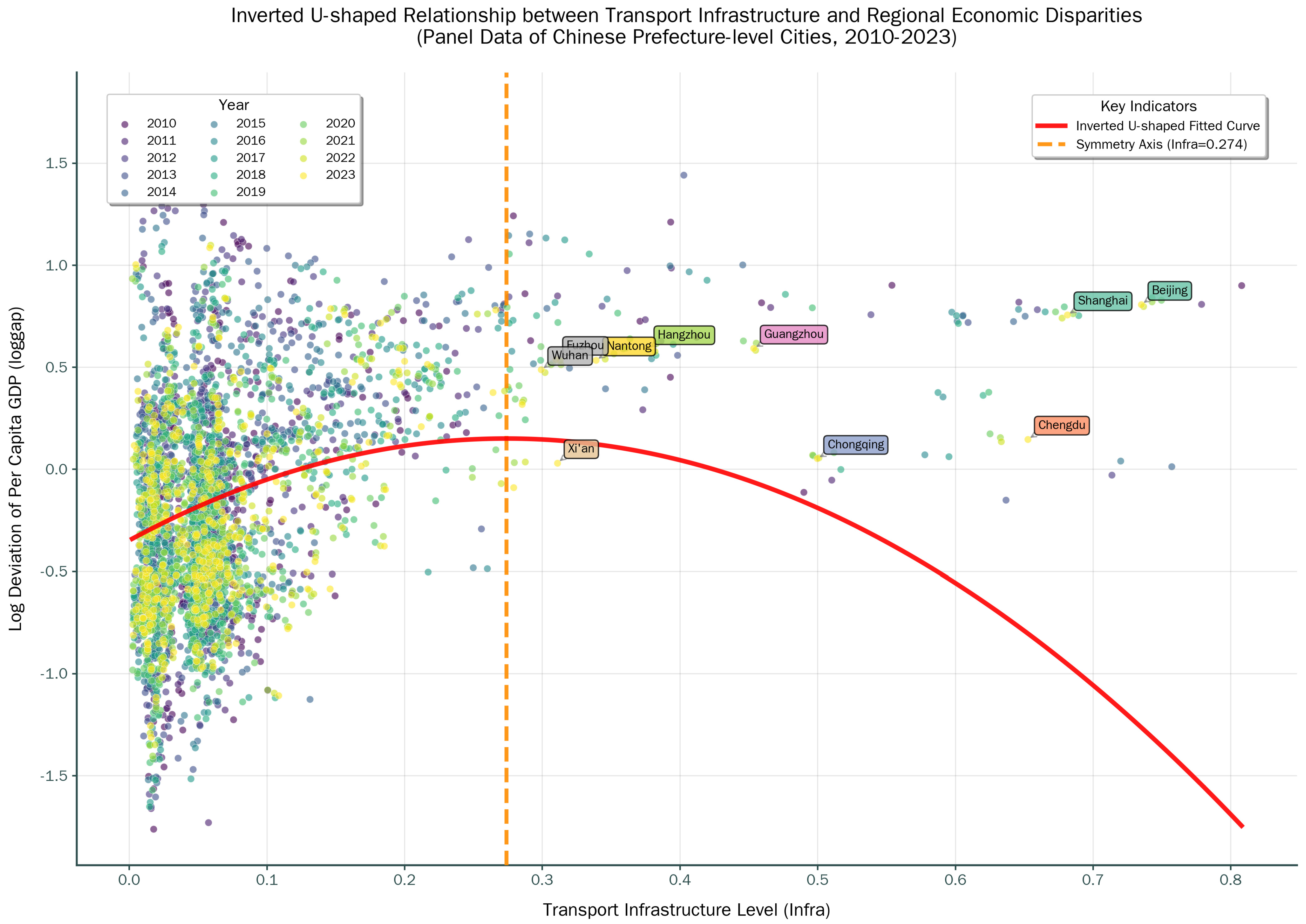
To ensure the reliability of these findings, the Utest method was applied to verify the inverted U-shaped nexus. The results in Column (4) of Table 3 identify an extreme point at 0.274, which falls well within the range of the transport infrastructure index [0.002, 0.808], thereby passing the Utest. Specifically, the primary term of transport infrastructure (Infra) is significantly positive, while its quadratic term (Rec) is significantly negative. This suggests that in the early stages of development (where the infrastructure level remains below 0.274) improvements in transport conditions primarily trigger a “polarization effect,” accelerating the concentration of factors in developed regions and thus widening economic gaps. However, once transport networks cross this specific threshold, the “diffusion effect” begins to predominate. High-quality factors such as industry, technology, and knowledge spill over to peripheral areas through efficient transport corridors, catalyzing growth in underdeveloped regions and steering regional disparities toward convergence. This dynamic process underscores the phased characteristics of transport infrastructure’s influence. Furthermore, control variables such as industrialization, technological innovation, and openness significantly exacerbate disparities, whereas financial development and fiscal regulation exhibit a clear convergent effect, validating the robustness of the model specification.
To further explore the nuances of this inverted U-shaped relationship, the sample was split based on the symmetry axis of Infra = 0.274. In Table 4, regressions conducted on either side of this threshold reveal that for cities with lower infrastructure levels, polarization effects dominate due to underdeveloped regional positioning, significantly increasing the inter-city income gap. Conversely, for cities with higher infrastructure levels, diffusion effects take over, substantially narrowing regional disparities. It is noteworthy that only 15 regional centers (e.g., Beijing, Shanghai, Guangzhou) currently fall to the right of the 0.274 threshold (as shown in Figure 1). This emphasizes the national imperative to further strengthen transport infrastructure and cultivate more growth poles within city clusters to facilitate high-quality regional coordination.

5.2. Endogeneity Tests

Potential reverse causality between transport infrastructure and inter-city economic synergy could bias the accuracy of causal identification. To mitigate this endogeneity bias, an Instrumental Variable (IV) approach is employed. We select the Geographical Relief (Slope) of each prefecture-level city as our instrument. The rationale is twofold: First, slope reflects topographical variation, which directly correlates with infrastructure construction costs—building railways or highways on plains is significantly cheaper than in mountainous areas. Given that China’s transport networks are predominantly concentrated in plain regions, topography is a critical determinant of infrastructure investment, satisfying the relevance requirement. Second, geographical relief is a natural endowment formed over long-term history; it is objectively determined and only influences regional gaps through its effect on the site selection and construction of transport infrastructure, satisfying the exogeneity requirement.
Following Ji & Yang [42], a 2SLS (two-stage least squares) regression was conducted. In Table 5, The first-stage results show a significant negative correlation between relief and infrastructure levels, confirming the instrument’s validity. The second-stage results demonstrate a robust inverted U-shaped relationship between transport infrastructure and regional economic disparity, consistent with the baseline findings. Furthermore, the F-statistic for the weak instrument test exceeds 10, and the Hansen J-statistic for the over-identification test is insignificant, verifying the efficacy of the selected instrumental variables.

5.3. Robustness Checks

To ensure the stability of the baseline results, several robustness tests were conducted:
1. Interactive Fixed Effects: Following Bai [43], interactive effects between individual and time differences were introduced to capture the varying impacts of common factors across individuals. This addresses endogeneity stemming from omitted variables that fluctuate over time and across cities, thereby enhancing the model’s goodness of fit. The results remain robust and significant.
2. Winsorization: To eliminate the influence of extreme values, all variables were winsorized at the 1% level. The estimated coefficients for the primary and secondary terms of infrastructure remain significant at the 1% level, confirming that the baseline findings are not driven by outliers.
3. Excluding Municipalities: Considering that administrative hierarchy might influence results, we excluded the four municipalities (Beijing, Shanghai, Tianjin, and Chongqing). The inverted U-shaped relationship remains significantly present.
4. Lagged Dependent Variable: To address potential reverse causality and account for the lagged impact of transport infrastructure, we used the one-period lagged dependent variable (L. loggap). The results in Table 6 align with the baseline model, indicating that endogeneity is well-controlled.

5.4. Heterogeneity Analysis

To explore regional divergence, the sample was divided into Eastern (102 cities), Central (100 cities), and Western (95 cities) groups based on geographical location. The results indicate that the economic effects of transport infrastructure are not uniform but exhibit significant spatial differentiation.
Table 7 shows that in the Western region, both terms are statistically significant, forming a clear inverted U-shaped relationship. This suggests that the West is experiencing the full cycle from polarization to eventual diffusion, though currently it remains in the early stage where connectivity intensifies resource concentration in centers. In the Eastern region, the quadratic term is significantly negative while the linear term is insignificant. This is likely because the East possesses superior infrastructure that has already crossed the inflection point, placing it in a stage dominated by diffusion effects. Conversely, coefficients for the Central region are statistically insignificant, reflecting a more complex mechanism. As a transitional zone, the Central region experiences a “tug-of-war” between siphoning forces from the East and its own emerging role as a recipient of industrial transfer. This phase, where centripetal and centrifugal forces offset each other, validates the “plateau characteristic” near the peak of the inverted U-shaped curve.
Considering that city size and administrative level are both important dimensions influencing the heterogeneous effects of transportation infrastructure, and that municipalities directly under the Central Government and sub-provincial cities are characterized by large scales and high GDP levels, this paper classifies such cities as a separate group and the remaining ordinary prefecture-level cities as another group to conduct a grouped heterogeneity analysis.
The results of Table 8 show that the impact of transportation infrastructure on regional economic disparities presents significant heterogeneous characteristics between the two groups of samples: the inverted U-shaped relationship between transportation infrastructure and regional economic disparities is highly significant in the sample of ordinary prefecture-level cities, while this nonlinear relationship fails the significance test in the sample of municipalities directly under the Central Government and sub-provincial cities. The core reason for this difference lies in the essential distinctions between the two types of cities in terms of development stage, infrastructure endowment and functional orientation. As national-level core economic growth poles, municipalities directly under the Central Government and sub-provincial cities launched transportation infrastructure construction at an early stage, with a high-density and well-improved infrastructure network. During the sample period, they have long crossed the inflection point of the inverted U-shaped curve and entered a stage dominated by the diffusion effect. At this stage, the marginal improvement of transportation infrastructure is more reflected in optimizing resource allocation and promoting the flow of production factors to surrounding cities and regions, rather than strengthening the agglomeration effect of the core cities themselves, making it difficult to identify a significant nonlinear relationship in statistical terms. In contrast, ordinary prefecture-level cities were in a stage of accelerated industrialization and urbanization during the sample period, and their transportation infrastructure construction experienced a rapid leap from a low level to a medium-high level. This process exactly fully covers the complete stage of the inverted U-shaped curve from the dominance of the polarization effect to that of the diffusion effect. Meanwhile, their urban functions are still focused on agglomeration and expansion, making the impact law of transportation infrastructure on economic disparities more pure and significant, thus the regression results are more prominent.

5.5. Mechanism Testing: Factor Allocation

To avoid bias from multicollinearity in traditional three-step mediation tests, we follow the two-stage method proposed by Jiang [44] to conduct mechanism analysis:
l o g g a p i t = α 0 + α 1 I n f r a i t + α 2 I n f r a i t 2 + α 3 C V i t + σ i + δ t + ϵ i t
M e c i t = β 0 + β 1 I n f r a i t + β 2 C V i t + + σ i + δ t + ϵ i t
where Equation (6) represents the baseline regression and Mec_it in Equation (7) denotes the mechanism variable—specifically the factor allocation mechanism analyzed below. The U-shaped impact of labor mobility on regional economic disparity has been extensively discussed in existing literature [45,46]. On one hand, rational labor mobility facilitates the optimal allocation of production factors between regions. The transfer of surplus labor from underdeveloped areas to developed regions can alleviate local employment pressure, increase migrant worker income, and bring back funds and technology. It also provides an ample labor supply for industrial development in developed regions, thereby enhancing economic efficiency. On the other hand, if labor mobility is excessive and predominantly one-way, underdeveloped regions may fall into a “brain drain” trap. Continuous outflows of high-quality labor can cause a sharp decline in local human capital stocks, weakening the endogenous drive for industrial upgrading and growth, thus widening the developmental gap with developed regions. Conversely, developed regions might face resource strain and public service pressure due to over-concentration, which in turn constrains high-quality economic development.
This theoretical foundation supports our mechanism analysis. Transport infrastructure construction influences regional gaps by optimizing factor allocation, with labor mobility being the most critical form of allocation that must utilize transport facilities. When considering the agglomeration effects and technology spillovers of high-skilled workers, labor mobility does not necessarily promote regional convergence; instead, its impact on regional disparity exhibits an inverted U-shaped relationship [45]. In this study, we select the Population Flow Rate (Popuflow)—defined as the ratio of highway passenger volume to the year-end permanent population—as the mediating variable. Data were obtained from the National Bureau of Statistics, resulting in a processed sample of 4032 observations.
The results in Column (2) of Table 9 indicate that transport infrastructure has a significant positive impact on local population mobility, thereby altering inter-regional factor allocation. Moderate mobility of labor and capital drives factors from “low-efficiency regions” to “high-efficiency regions.” For instance, labor from peripheral areas entering high-income sectors in central cities can return entrepreneurial skills after their income improves, stimulating growth in peripheral areas. Simultaneously, capital from central cities shifts to peripheral industries along transport routes, optimizing regional factor allocation and eventually narrowing the economic gap. However, it must be noted that the “appropriateness” of factor mobility is paramount; if mobility is excessively concentrated (e.g., all young labor flowing to central cities), it may exacerbate the “hollowing out” of peripheral regions, potentially widening the gap.

5.6. International Applicability and Generalizability

First, the “Inverted U-shaped” mechanism validated in this paper has theoretical universality. The core logic that transport improvement initially triggers polarization (due to agglomeration effects) and subsequently fosters diffusion (due to dispersion forces) aligns with the classical New Economic Geography models applicable globally. Similar patterns have been observed in other contexts. For instance, Donaldson [5] found that railroad expansion in colonial India significantly altered regional trade costs and welfare, though the distributional effects varied. Berger & Enflo [47] also identified transformative impacts of rail networks on local growth patterns in Sweden. This suggests that the “polarization-to-diffusion” transition driven by infrastructure is a general economic law, not a unique Chinese phenomenon.
Second, the identified threshold (0.274) offers a reference for other developing economies. China’s experience provides a valuable lesson for emerging markets currently undergoing rapid infrastructure expansion. Our findings suggest that in the early stages of development, infrastructure investment may inevitably widen regional gaps. Policy makers in these countries should anticipate this “pain period” of polarization and prepare compensatory policies, rather than expecting immediate balanced growth. The threshold concept emphasizes that sustained investment is necessary to cross the tipping point and achieve regional synergy. However, specific factors in China may influence the extent of these effects. Therefore, while the direction of the effects is general, the specific inflection point (0.274) may vary depending on factors such as population density in different countries.

6. Conclusions and Policy Recommendations

6.1. Research Conclusions

Based on panel data of Chinese prefecture-level cities and using fixed-effects models, robust tests, regional heterogeneity analysis, and mechanism testing, this study systematically explores the impact of transport infrastructure on inter-city regional economic synergistic development. The core conclusions are as follows:
First, an inverted U-shaped relationship exists between transport infrastructure and regional economic disparity, characterized by distinct stages. In the early stages of infrastructure construction, “polarization effects” dominate. Convenient transport conditions facilitate the rapid concentration of capital, talent, and other production factors in central cities. Peripheral regions, due to factor outflows and weak industrial bases, experience widening economic gaps with central cities. Once transport network development crosses a critical threshold, “diffusion effects” gradually become dominant. Rising costs in central cities drive industrial shifts to surrounding areas, while knowledge and technology spill over. Peripheral regions leverage their transport advantages to absorb transfers and develop featured industries, leading to a convergence of regional economic gaps.
Second, the impact of transport infrastructure on regional economic disparity exhibits significant spatial heterogeneity. Most cities in the eastern region have already crossed the inverted U-shaped peak, entering a stage of synergistic development dominated by “diffusion effects.” While the western region also exhibits an inverted U-shaped relationship, it remains in the early stages of development dominated by “polarization effects,” with factors still concentrating in regional core cities. The central region shows an inverted U-shaped trend, but it is not statistically significant, as the impact of transport on regional gaps remains unclear due to overlapping factors such as labor outflow, industrial transfer, and the cultivation of core cities.
Third, transport infrastructure influences regional economic disparity through factor allocation mechanisms. Transport improvements enhance the efficiency of inter-regional factor mobility. Moderate factor mobility pushes resources toward high-efficiency regions while narrowing gaps through labor return and capital downshifting. However, over-concentration can exacerbate the “hollowing out” of peripheral areas.
Fourth, although the empirical results of this paper are based on data from Chinese prefecture-level cities, the underlying theoretical logic and methodology possess universal reference value for other economies. In terms of methodology and core mechanisms, the “inverted U-shaped” evolutionary pattern validated in this paper aligns with a broad international consensus. Across both developed and developing economies, improvements in transport infrastructure typically undergo a dynamic transition from a “Siphon Effect” to a “Spillover Effect”—a general law of economic geographic evolution. However, the unique Chinese context dictates the specificity of the “inflection point coordinates.” That is, while the general pattern holds, the specific threshold measured in this study (0.274) may be moderated by factors specific to China, such as high population density. Consequently, when generalizing these conclusions to other nations, the “inflection point value” requires calibration based on respective institutional friction coefficients and population densities.

6.2. Policy Recommendations

Based on the empirical findings regarding the inverted U-shaped relationship between transport infrastructure service efficiency and regional economic disparities, as well as the underlying mechanisms—and particularly the identified critical inflection point (Infra = 0.274)—it is necessary to construct a systematic and differentiated policy framework. This framework must account for the developmental differences between Eastern, Central, and Western regions and the radiation patterns of urban agglomerations. Policy should take urban agglomerations as the core vehicle for strengthening regional coordination, focusing on factor mobility—especially the orderly and efficient allocation of labor. Furthermore, fiscal and financial policies should be leveraged to create synergy for coordinated regional economic development, with clear delineation of responsible entities for each stage of construction.
In optimizing the layout of transport infrastructure, precise planning should be implemented according to the different developmental stages of the East, Central, and West regions, utilizing city cluster construction as a leverage for differentiated transport network layouts. For the Western region, which remains in the agglomeration phase (i.e., where the transport service efficiency index falls below 0.274), the central government should assume the primary responsibility for investment. The priority should be to densify the backbone transport networks within intra-provincial urban agglomerations and to construct complementary industrial transfer parks and regional logistics nodes. Through the coordinated layout of transport and industry, the goal is to ensure the rational agglomeration of factors to form regional growth poles while preventing the excessive outflow of core factors—particularly labor—thereby cultivating local labor “stickiness.” For the Eastern region, which has entered the dispersion phase (i.e., where the index has surpassed the inflection point of 0.274), greater emphasis should be placed on cross-jurisdictional coordination by local governments and the role of market entities. Taking major urban agglomerations such as Beijing-Tianjin-Hebei, the Yangtze River Delta, and the Guangdong-Hong Kong-Macao Greater Bay Area as the primary units, the focus should be on: densifying commuter-oriented transport networks between core cities and peripheral counties; constructing cross-agglomeration logistics hub systems; and reducing the costs of industrial transfer and factor mobility. Transport infrastructure should guide the gradient transfer of high-end industrial segments from core cities to surrounding areas, fostering a coordinated pattern of “core leadership + concentric linkage.” For the Central region, which is in a transitional phase (i.e., approaching the threshold of 0.274), the strategy should accelerate the development of composite transport hubs that bridge the core agglomerations of the East and West. This involves strengthening transport connectivity with Eastern agglomerations (sources of industrial relocation) and Western agglomerations (consumption markets). Relying on urban agglomerations to cultivate regional growth poles, the transport network should connect peripheral small and medium-sized cities, thereby gradually amplifying spillover effects and narrowing intra-regional disparities.
At the factor allocation coordination level, a cross-regional factor mobility regulation system should be built with the orderly and efficient flow of labor as the core. A national unified labor market service platform should be established to bridge information sharing and facilitate social security transfers between city clusters. To address labor skill shortages in the Western region, investment in vocational training should be increased, cultivating specialized talent aligned with local industrial needs to enhance local employment capacity. For Eastern city clusters, optimizing the supply of public services and refining the housing security system will attract reasonable labor concentration while guiding a portion of the labor force toward surrounding small and medium cities, thereby alleviating resource pressure in core cities. The Central region should leverage its transport hub advantages to build dual-flow platforms for labor, absorbing labor-intensive industries from the East while supplying professional skilled talent to Eastern clusters, achieving optimized labor resource allocation across city clusters. Simultaneously, a cross-regional factor flow compensation mechanism should be established, where core cities benefiting from factor agglomeration provide development dividends back to outflow areas through fiscal transfers and industrial cooperation profit-sharing, specifically for enhancing human capital and infrastructure in those regions, thus forming a virtuous cycle of factor mobility and regional coordination.
To further strengthen transport construction and promote factor mobility, market integration should be advanced using city clusters as units, constructing a unified national market. This involves promoting the harmonization of product quality standards, testing procedures, and logistics service norms across city clusters to dismantle local protectionist barriers. Utilizing the market advantages of the Eastern clusters, cross-regional production-marketing docking platforms should be established to guide featured agriculture and manufacturing from the Central and West into Eastern supply chains, enhancing the market competitiveness of peripheral industries. Cross-cluster industrial alliances should be cultivated, encouraging leading enterprises in core cities to collaborate on industrial chain synergy with SMEs in surrounding cities, ensuring smooth logistics through transport networks to avoid the widening of regional gaps during the integration process.
Furthermore, fiscal and financial policies should be continuously promoted to work in synergy, forming a policy force to promote regional economic convergence. In terms of fiscal policy, the intensity of transfer payments to peripheral areas along transport routes should be increased, focusing on regions with weak infrastructure and poor industrial bases. A “Regional Synergistic Development Special Fund” should be established to support cross-regional transport networking and industrial cooperation projects. Subsidies or tax incentives should be provided to industrial projects transferring from central cities to peripheral areas to incentivize orderly industrial outward migration. In terms of financial policy, financial institutions should be encouraged to set up branches in peripheral areas along transport routes, innovating “Transport + Industry” credit products to provide low-interest loans for firms accepting industrial transfers and credit loans for specialized local farmers. The construction of regional equity markets should be promoted to provide financing services for SMEs in peripheral areas, further solidifying the economic foundation of regional synergy through fiscal and financial empowerment.
Finally, to ensure the effective implementation of policies, a governance system featuring “cross-regional coordination and dynamic monitoring” must be constructed. A regional transport and economic synergistic development leadership group, led by provincial governments, should be established to coordinate cross-city transport planning, industrial transfer, and factor mobility, breaking administrative barriers to form policy synergy. A monitoring and evaluation system for transport and economic synergy should be established, setting core indicators such as factor mobility equilibrium, market integration levels, and regional gap changes. Regular monitoring of transport infrastructure’s impact on regional synergy should be conducted to adjust policy directions timely. The construction of cross-regional information-sharing platforms should be promoted, integrating data on transport operations, factor mobility, and industrial development to provide data support for policy formulation. Simultaneously, relevant information should be opened to enterprises and the public to enhance policy transparency and market expectation stability, ultimately forming a closed-loop governance of “planning-implementation-monitoring-optimization” to fully leverage transport infrastructure as the core support for high-quality regional economic synergistic development between cities.

6.3. Limitations and Future Prospects

Although this paper makes marginal contributions in constructing the service efficiency index for transport infrastructure and identifying its inverted U-shaped characteristics, subject to data availability and space constraints, the following limitations remain, which also point to directions for future research:
First, data granularity warrants further refinement. This paper relies primarily on macro-statistical data at the prefecture-level city level. While this approach captures general inter-regional trends, it struggles to reveal the heterogeneous responses of micro-agents (e.g., firms and households) to transport improvements. Future research could integrate firm-level micro-data or high-frequency population migration data based on Location-Based Services (LBS) to more precisely identify the micro-level causal effects of transport infrastructure on the location choices of different types of firms and the mobility of labor with varying skills.
Second, the dimensions of the index need to be expanded. The “Service Efficiency Index” constructed in this paper focuses on traditional physical attributes. In the digital economy era, transport infrastructure is undergoing a digital transformation. Future research should focus on the integration of “New Infrastructure” (digital infrastructure) with traditional transport facilities, exploring how digitized transport infrastructure further reshapes the regional economic geographic landscape by reducing information asymmetry.
Third, the consideration of environmental externalities is insufficient. This paper focuses on the convergence of economic disparities without fully discussing the potential environmental costs associated with transport construction. Future studies could incorporate Green Total Factor Productivity (GTFP) or carbon emission indicators into the analytical framework. This would allow for an exploration of how transport infrastructure can achieve environmental sustainability while promoting regional economic synergy, thereby providing more comprehensive theoretical support for high-quality development.


Author Contributions

Conceptualization, R.J.; methodology, D.W.; validation, X.M.; formal analysis, X.M.; data curation, R.J.; writing—original draft preparation, D.W.; writing—review and editing, D.W.; supervision, R.J.; project administration, X.M. All authors have read and agreed to the published version of the manuscript.

Funding

This research was funded by R&D Program of Beijing Municipal Education Commission grant number SM202111232002.

Institutional Review Board Statement

Not applicable.

Informed Consent Statement

Not applicable.

Data Availability Statement

The raw data supporting the conclusions of this article will be made available by the authors on request.

Conflicts of Interest

Author Ruibo Jia was employed by the Gansu Provincial Highway Aviation Tourism Investment Group Co., Ltd. The remaining authors declare that the research was conducted in the absence of any commercial or financial relationships that could be construed as a potential conflict of interest.

References

  1. Ma, G.; Cheng, X.; Yang, E. How transportation infrastructure promotes capital flows—Research based on high-speed rail opening and remote investment of listed companies. China Ind. Econ. 2020, 6, 5–23. (In Chinese) [Google Scholar] [CrossRef]
  2. Coase, R.H. The nature of the firm. Economica 1937, 4, 386–405. [Google Scholar] [CrossRef]
  3. Williamson, O.E. Transaction-cost economics: The governance of contractual relations. J. Law Econ. 1979, 22, 233–261. [Google Scholar] [CrossRef]
  4. Barro, R.; Sala-i-Martin, X. Convergence. J. Polit. Econ. 1992, 100, 223–251. [Google Scholar] [CrossRef]
  5. Donaldson, D. Railroads of the Raj: Estimating the impact of transportation infrastructure. Am. Econ. Rev. 2018, 108, 899–934. [Google Scholar] [CrossRef]
  6. Li, H.; Hu, T.; Ma, X.; Cheng, B. The impact of transportation infrastructure on the regional economic integration in China: A CGE analysis. Int. Rev. Econ. Finance 2025, 99, 104045. [Google Scholar] [CrossRef]
  7. Krugman, P. Increasing returns and economic geography. J. Polit. Econ. 1991, 99, 483–499. [Google Scholar] [CrossRef]
  8. Faber, B. Trade integration, market size, and industrialization: Evidence from China’s National Trunk Highway System. Rev. Econ. Stud. 2014, 81, 1046–1070. [Google Scholar] [CrossRef]
  9. Baum-Snow, N.; Brandt, L.; Henderson, J.V.; Turner, M.; Zhang, Q. Roads, railroads, and decentralization of Chinese cities. Rev. Econ. Stat. 2017, 99, 435–448. [Google Scholar] [CrossRef]
  10. Chen, Z.; Haynes, K.E. Impact of high-speed rail on regional economic disparity in China. J. Transp. Geogr. 2017, 65, 80–91. [Google Scholar] [CrossRef]
  11. Lyu, S.; Sun, T.; Sun, X. The effect of high-speed railway connections on economic development in China’s peripheral cities: A perspective of innovation capacity. Transp. Policy 2025, 171, 1–17. [Google Scholar] [CrossRef]
  12. Tang, R.; Sun, Y. Breaking the inverted U relationship between transportation infrastructure and tourism development provides new evidence for sustainability. Discov. Sustain. 2025, 7, 23. [Google Scholar] [CrossRef]
  13. Limão, N.; Venables, A.J. Infrastructure, geographical disadvantage, transport costs, and trade. World Bank Econ. Rev. 2001, 15, 451–479. [Google Scholar] [CrossRef]
  14. Zhang, X. Has transportation infrastructure promoted regional economic growth? With a discussion on the spatial spillover effect of transportation infrastructure. Soc. Sci. China 2012, 33, 60–77. (In Chinese) [Google Scholar]
  15. Donaldson, D.; Hornbeck, R. Railroads and American economic growth: A “market access” approach. Q. J. Econ. 2016, 131, 799–858. [Google Scholar] [CrossRef]
  16. Zhang, T.; Chen, L.; Dong, Z. Highway construction, firm evolution and regional economic efficiency. China Ind. Econ. 2018, 1, 79–99. (In Chinese) [Google Scholar] [CrossRef]
  17. Heuermann, D.; Schmieder, J. The effect of infrastructure on worker mobility: Evidence from high-speed rail expansion in Germany. J. Econ. Geogr. 2019, 19, 335–372. [Google Scholar] [CrossRef]
  18. Xu, Y.; Ou, G. Does high-speed railway promote the level of human capital? An empirical analysis based on three urban agglomerations in China. Sustainability 2022, 14, 12631. [Google Scholar] [CrossRef]
  19. Sun, D.; Zhao, X.; Zhang, G.; Chen, P. Impact of the introduction of high-speed rail on the income gap between urban and rural residents. PLoS ONE 2023, 18, e0292105. [Google Scholar] [CrossRef]
  20. Cui, W. Shadow and spillover: The influence of neighboring innovative cities on regional innovation growth. China Econ. Rev. 2025, 90, 102355. [Google Scholar] [CrossRef]
  21. Glaeser, E.L.; Kohlhase, J. Cities, regions and the decline of transport costs. Pap. Reg. Sci. 2004, 83, 197–228. [Google Scholar] [CrossRef]
  22. Xu, M.; Feng, Y. Large-scale transport infrastructure construction and county-level firm productivity heterogeneity: Empirical evidence from the “Five Vertical and Seven Horizontal” national trunk highways. China Econ. Q. 2021, 21, 1969–1992. (In Chinese) [Google Scholar] [CrossRef]
  23. Qu, J.; Yang, T.; Nam, K.-M.; Kim, E.; Chen, Y.; Liu, X. Transport network changes and varying socioeconomic effects across China’s Yangtze River Delta. J. Transp. Geogr. 2024, 121, 104051. [Google Scholar] [CrossRef]
  24. Williamson, J.G. Regional inequality and the process of national development: A description of the patterns. In Economic Development and Cultural Change; The University of Chicago Press: Chicago, IL, USA, 1965; Volume 13, pp. 1–84. [Google Scholar] [CrossRef]
  25. Puga, D. The rise and fall of regional inequalities. Eur. Econ. Rev. 1999, 43, 303–334. [Google Scholar] [CrossRef]
  26. Luo, N.; Sun, L. The impact of transportation development on regional economic disparity. Urban Probl. 2019, 8, 51–60. (In Chinese) [Google Scholar] [CrossRef]
  27. Yan, Y.; Ni, P.; Liu, X. High-speed rail opening, region-specific factors and the development of peripheral regions. China Ind. Econ. 2020, 8, 118–136. (In Chinese) [Google Scholar] [CrossRef]
  28. Helpman, E. The Size of Regions; Working Paper No. 14–95; The Foerder Institute for Economic Research, Tel Aviv University: Tel Aviv, Israel, 1995; Available online: https://EconPapers.repec.org/RePEc:fth:teavfo:14-95 (accessed on 15 December 2025).
  29. Lin, Y. Travel costs and urban specialization patterns: Evidence from China’s high speed railway system. J. Urban Econ. 2017, 98, 98–123. [Google Scholar] [CrossRef]
  30. Feng, Q.; Chen, Z.; Cheng, C.; Chang, H. Impact of high-speed rail on high-skilled labor mobility in China. Transp. Policy 2023, 133, 64–74. [Google Scholar] [CrossRef]
  31. Chi, F.; Han, H. The impact of high-speed rail on economic development: A county-level analysis. Land 2023, 12, 874. [Google Scholar] [CrossRef]
  32. Yu, Y.; Pan, Y. Did the opening of high-speed rail narrow the urban-rural income gap? An explanation based on the perspective of heterogeneous labor transfer. Chin. Rural Econ. 2019, 1, 79–95. (In Chinese) [Google Scholar] [CrossRef]
  33. Liu, K. Transport infrastructure construction, urban total factor productivity growth and its convergence. Econ. Manag. 2024, 38, 27–34. (In Chinese) [Google Scholar]
  34. Shen, K.; Yan, J. High-speed rail opening and enterprise digital transformation: A dual perspective based on information learning effect and resource agglomeration effect. J. Financ. Res. 2024, 1, 150–168. (In Chinese) [Google Scholar]
  35. Ni, P.; Liu, W.; Huang, S. Securities market, spatial allocation of capital and coordinated development of regional economy: A perspective based on spatial economics. Econ. Res. J. 2014, 49, 121–132. (In Chinese) [Google Scholar]
  36. Ren, B.; Jing, W.; Hu, Z. Transportation infrastructure and regional economic disparity: Based on the perspective of market differentiated allocation of high-speed rail opening. Inq. Into Econ. Issues 2025, 9, 111–119. (In Chinese) [Google Scholar] [CrossRef]
  37. Li, G.; Wang, L.; Yang, X.; Li, Y.; Liu, Y. Comparative study on the development level of China’s transportation infrastructure. J. Highw. Transp. Res. Dev. 2021, 38, 97–105. (In Chinese) [Google Scholar] [CrossRef]
  38. Pan, Y. Infrastructure investment structure and high-quality economic development: Efficiency and mechanism. Shandong Soc. Sci. 2023, 9, 135–143. (In Chinese) [Google Scholar] [CrossRef]
  39. Zan, X.; Ou, G.; Lv, W. How does transportation infrastructure excavate the market potential of Chinese cities? From the perspective of production factor flow. Inq. Into Econ. Issues 2023, 5, 76–102. (In Chinese) [Google Scholar]
  40. Liu, S.; Hu, A. Transportation infrastructure and economic growth: The perspective of regional disparity in China. China Ind. Econ. 2010, 4, 14–23. (In Chinese) [Google Scholar] [CrossRef]
  41. Xue, J.; Zhou, S. Transport and communication infrastructure: Development, regional disparity and economic effects. Manag. Rev. 2023, 35, 3–14. (In Chinese) [Google Scholar] [CrossRef]
  42. Ji, Y.; Yang, Q. Can the opening of high-speed rail promote enterprise innovation: Research based on quasi-natural experiment. J. World Econ. 2020, 43, 147–166. (In Chinese) [Google Scholar] [CrossRef]
  43. Bai, J. Panel data models with interactive fixed effects. Econometrica 2009, 77, 1229–1279. [Google Scholar] [CrossRef]
  44. Jiang, T. The mediation analysis and moderation analysis in causal inference empirical research. China Ind. Econ. 2022, 5, 100–120. (In Chinese) [Google Scholar] [CrossRef]
  45. Liu, C.; Chen, C. Labor mobility, skill matching and regional economic disparity. Econ. Res. J. 2022, 57, 45–63. (In Chinese) [Google Scholar]
  46. Zhu, J.; Li, Z. Household registration reform, population migration and regional disparity: An analysis based on heterogeneous population intertemporal migration model. China Econ. Q. 2016, 15, 797–816. (In Chinese) [Google Scholar] [CrossRef]
  47. Berger, T.; Enflo, K. Locomotives of local growth: The short- and long-term impact of railroads in Sweden. J. Urban Econ. 2017, 98, 124–138. [Google Scholar] [CrossRef]
Figure 1. Fitted Plot of the Non-linear Relationship between Transport Infrastructure and Regional Economic Disparities (Including Control Variables).
Sustainability 18 03855 g001
Table 1. Construction of the Transport Infrastructure Service Efficiency Index.
Primary IndicatorSecondary IndicatorWeighting Coefficient
Infrastructure EmploymentNumber of employees in the construction industry (10,000 persons)0.091
Number of employees in transport, storage, and postal services (10,000 persons)0.124
Number of employees in water conservancy, environment, and public facility management (10,000 persons)0.088
Infrastructure CapacityRailway freight volume (10,000 tons)0.002
Highway freight volume (10,000 tons)0.041
Total internal highway mileage (km)0.027
Infrastructure InvestmentTotal fixed asset investment/GDP0.050
Fixed asset investment in municipal public facilities/GDP0.152
Investment in urban rail transit and public transport/GDP0.291
Urban road and bridge investment/GDP0.135
Table 2. Descriptive Statistics of Variables.
VarNameObsMeanSDMinMax
Loggap4041−0.1730.531−1.7621.768
Infra40410.0730.0890.0020.808
Industry40410.8770.0800.5011.059
Tech40410.0030.0030.0000.063
Finance40412.6101.2980.58821.301
Puniver40410.0200.0250.0000.187
Open40410.0020.0030.0000.020
Fisc40410.2080.1250.0441.554
Table 3. Baseline Regression Results.
(1)(2)(3)(4)
VARIABLESLoggapLoggapLoggapLoggap
City Fixed EffectsYesYesYesYes
Year Fixed EffectsNoYesNoYes
Control VariablesNoNoYesYes
Infra2.090 ***2.347 ***0.728 ***0.602 ***
(5.21)(6.29)(3.30)(2.81)
Rec−2.602 ***−2.604 ***−1.179 ***−1.100 ***
(−4.09)(−4.70)(−2.98)(−3.26)
Pgdp 0.000 ***0.000 ***
(6.65)(10.97)
Industry 1.774 ***2.156 ***
(9.06)(8.50)
Tech −2.647−1.525
(−1.46)(−1.02)
Finance −0.083 ***−0.037 ***
(−4.06)(−3.00)
Puniver −3.253 ***−1.785 **
(−3.43)(−2.10)
Open 20.176 ***15.244 ***
(6.42)(5.81)
Fisc −1.153 ***−0.846 ***
(−6.49)(−6.14)
Constant−0.290 ***−0.308 ***−1.416 ***−2.159 ***
(−12.99)(−14.66)(−8.28)(−9.27)
Observations4041404140414041
Note: Robust t-statistics in parentheses. *** p < 0.01, ** p < 0.05, * p < 0.1.
Table 4. Regression Results for Sub-samples based on the Inflection Point.
(Infra < 0.274)(Infra >= 0.274)
VARIABLESLoggapLoggap
Infra0.323 *−0.183 **
(1.86)(−2.61)
pgdp0.000 ***0.000 ***
(10.66)(16.67)
industry2.098 ***5.813 ***
(8.29)(4.52)
Tech−0.9010.754
(−0.60)(0.40)
Finance−0.034 ***−0.058 **
(−2.94)(−2.48)
puniver−1.928 **−0.353
(−2.17)(−0.14)
open15.239 ***−4.658
(5.49)(−0.93)
fisc−0.857 ***−1.356
(−6.26)(−1.67)
Constant−2.142 ***−5.130 ***
(−9.33)(−4.61)
Observations3909132
R-squared0.9660.981
Note: Robust t-statistics in parentheses. *** p < 0.01, ** p < 0.05, * p < 0.1.
Table 5. Endogeneity Tests (2SLS).
(2SLS-Stage1)(2SLS-Stage2)
VARIABLESInfraLoggap
Infra 3.375 ***
(0.947)
rec −4.728 ***
(−1.638)
Relief−0.007 ***
(0.002)
Pgdp0.000 ***0.000 ***
(0.000)(0.000)
Industry−0.0080.922 ***
(0.018)(0.090)
Tech3.974 ***10.372 **
(0.984)(4.832)
Finance0.022 ***0.067 ***
(0.003)(0.021)
Puniver0.413 ***2.092 ***
(0.124)(0.578)
Open2.112 ***18.765 ***
(0.769)(4.106)
Fisc−0.058 ***−1.113 ***
(0.017)(0.127)
Constant0.016−1.152 ***
(0.015)(0.084)
Observations40084008
R-squared0.3540.708
Note: Robust standard errors in parentheses. *** p < 0.01, ** p < 0.05, * p < 0.1.
Table 6. Robustness Checks.
(1)(2)(3)(4)
VARIABLESLoggapLoggapLoggapL.Loggap
Infra0.201 ***0.687 ***0.735 ***0.993 ***
(2.84)(2.93)(3.15)(4.14)
rec−0.282 **−1.630 ***−1.559 ***−1.483 ***
(−2.52)(−3.56)(−3.80)(−5.02)
pgdp0.000 ***0.000 ***0.000 ***0.000 ***
(76.08)(10.51)(11.04)(7.65)
industry0.768 ***2.125 ***2.121 ***1.941 ***
(12.04)(9.04)(8.38)(7.69)
Tech0.748−0.861−1.7840.679
(1.47)(−0.31)(−1.17)(0.41)
Finance−0.013 ***−0.075 ***−0.036 ***−0.028 **
(−7.36)(−5.51)(−2.98)(−2.16)
puniver−0.149−1.193−1.896 **−1.466 *
(−0.70)(−1.51)(−2.17)(−1.73)
open2.637 ***15.824 ***15.030 ***13.606 ***
(3.08)(5.70)(5.41)(5.52)
fisc−0.587 ***−0.732 ***−0.842 ***−1.089 ***
(−18.10)(−4.84)(−6.13)(−6.88)
Constant−1.301 ***−2.057 ***−2.152 ***−1.886 ***
(−22.70)(−9.27)(−9.31)(−7.95)
Observations4041404139853705
R-squared0.9730.9700.9670.960
Note: Robust t-statistics in parentheses. *** p < 0.01, ** p < 0.05, * p < 0.1.
Table 7. Heterogeneity Analysis.
(1)(2)(3)
VARIABLESLoggapLoggapLoggap
Infra0.136−0.0820.990 **
(0.65)(−0.20)(2.41)
Rec−0.237 *0.009−1.477 *
(−1.78)(0.01)(−1.75)
Pgdp0.000 ***0.000 ***0.000 ***
(10.80)(9.99)(6.31)
Industry2.572 ***2.629 ***1.589 ***
(5.44)(5.61)(4.50)
Tech−4.865 **−2.683−0.315
(−2.16)(−0.75)(−0.20)
Finance−0.061 ***−0.011 ***−0.042
(−3.12)(−2.83)(−1.29)
Puniver−0.006−3.622 ***−4.461 ***
(−0.01)(−2.71)(−3.54)
Open6.315 **0.76415.044 *
(2.45)(0.18)(1.76)
Fisc0.353−0.286−0.941 ***
(1.18)(−1.44)(−3.84)
Constant−2.613 ***−2.843 ***−1.677 ***
(−5.88)(−6.88)(−5.00)
Observations140513811255
R-Squared0.9790.9690.969
Note: Robust t-statistics in parentheses. *** p < 0.01, ** p < 0.05, * p < 0.1.
Table 8. Heterogeneity Analysis for city level.
(1)(2)
VARIABLESLoggapLoggap
Infra0.2911.108 ***
(1.20)(2.67)
rec−0.414−3.345 **
(−1.68)(−2.29)
pgdp0.000 ***0.000 ***
(14.93)(10.81)
industry0.9662.022 ***
(1.55)(8.08)
Tech−0.851−0.327
(−0.32)(−0.22)
Finance−0.049 **−0.030 ***
(−2.52)(−2.88)
puniver0.172−2.959 ***
(0.25)(−3.42)
open6.767 **13.847 ***
(2.83)(4.15)
fisc−1.172−0.861 ***
(−1.27)(−6.39)
Constant−0.701−2.123 ***
(−1.25)(−9.51)
Observations2633776
R-squared0.9820.965
Note: Robust t-statistics in parentheses. *** p < 0.01, ** p < 0.05, * p < 0.1.
Table 9. Mechanism Testing.
(1)(2)
VARIABLESLoggapPopuflow 3
Infra0.603 ***177.269 *
(2.81)(1.68)
rec−1.101 ***
(−3.26)
pgdp0.000 ***−0.000
(10.95)(−1.16)
industry2.153 ***16.898
(8.47)(0.95)
Tech−1.542−544.978 *
(−1.03)(−1.84)
Finance−0.037 ***−0.636
(−3.00)(−0.90)
puniver−1.788 **−172.611
(−2.10)(−1.11)
open15.265 ***840.543 ***
(5.81)(2.79)
fisc−0.847 ***1.009
(−6.14)(0.10)
Constant−2.156 ***−1.877
(−9.24)(−0.11)
Observations40324032
R-squared0.9670.332
Note: Robust t-statistics in parentheses. *** p < 0.01, ** p < 0.05, * p < 0.1.
Disclaimer/Publisher’s Note: The statements, opinions and data contained in all publications are solely those of the individual author(s) and contributor(s) and not of MDPI and/or the editor(s). MDPI and/or the editor(s) disclaim responsibility for any injury to people or property resulting from any ideas, methods, instructions or products referred to in the content.