Article

Soil Carbon Dynamics and Greenhouse Gas Reduction Potential of Arundo donax-Based Sustainable Aviation Fuel in China’s Bohai Rim Region

1
College of Aeronautical Engineering, Civil Aviation University of China, Tianjin 300300, China
2
Transportation Science and Engineering, Civil Aviation University of China, Tianjin 300300, China
3
Institute for Environment and Development, Civil Aviation University of China, Tianjin 300300, China
*
Author to whom correspondence should be addressed.
Sustainability 2026, 18(8), 3848; https://doi.org/10.3390/su18083848
Submission received: 14 March 2026 / Revised: 6 April 2026 / Accepted: 10 April 2026 / Published: 13 April 2026

Abstract

The development of bioenergy crops on saline–alkaline land has been recognized as a potential pathway for both land restoration and combating global warming. However, the role of soil organic carbon (SOC) dynamics under such conditions remains insufficiently quantified in long-term assessments. In this study, an exploratory assessment was conducted to evaluate the long-term soil carbon sequestration (SCS) potential and life-cycle greenhouse gas (GHG) emissions of sustainable aviation fuel (SAF) produced from Arundo donax in the Bohai Rim region of China. The CENTURY model was integrated with Long Short-Term Memory (LSTM) time series forecasting to simulate SOC dynamics under future climate scenarios (2024–2035). Compared with the original CENTURY simulation, the LSTM model yielded a substantially more conservative estimate of SOC accumulation, with an Ensemble Mean SCS rate of 0.032 t C/ha/a and a 95% confidence interval ranging from −0.079 to 0.143 t C/ha/a. This result indicates a positive regional average tendency toward soil carbon sequestration, while also suggesting that some locations may behave as carbon sources under less favorable climatic conditions. The total SCS potential across the study area was estimated at 0.615 Tg C. When these soil carbon benefits were incorporated into the life-cycle assessment of Fischer–Tropsch (F-T) SAF, the pathway could become potentially net-negative under the adopted assumptions, reaching −32.1 g CO2e/MJ, which corresponds to a potential reduction of 136.1% relative to fossil aviation fuel. These results should be interpreted as exploratory and scenario-based, given that large-scale cultivation of Arundo donax has not yet been established in the Bohai Rim region and the assessment therefore relies on assumptions. Beyond GHG mitigation, the cultivation of Arundo donax on degraded saline–alkaline soils may also have potential relevance to broader sustainability objectives, including SDG 13 (Climate Action) and SDG 15 (Life on Land). These findings highlight the possible synergies among energy crop cultivation, soil restoration, and climate neutrality goals, and provide preliminary insights for integrating marginal land utilization into sustainable land management and low-carbon aviation strategies.

1. Introduction

Global greenhouse gas (GHG) emissions from air transport account for more than 2% of total anthropogenic GHG emissions [1]. While the ground transportation sector is actively advancing deep decarbonization through electrification and the deployment of fuel cell vehicles (FCVs) [2,3], the aviation industry faces unique technological bottlenecks. Due to strict weight and energy density requirements, direct electrification or hydrogen fuel cell applications remain highly challenging for commercial aviation at the present stage. Because the carbon dioxide emitted by aircraft in the high air will remain in the atmosphere for more than 100 years, the adverse impact on the environment is greater, which has aroused wide attention from scholars in various countries, and people are studying the corresponding emission reduction measures. Among them, using biomass fuel to replace traditional fossil fuels has been recognized and supported by the International Civil Aviation Organization (ICAO) [4]. And in 2016, ICAO adopted the world’s first Carbon Offsetting and Reduction Scheme for International Aviation (CORSIA) targeting GHG emissions from a single sector [5]. Sustainable aviation fuel (SAF) derived from energy plants can absorb and fix CO2 from the atmosphere through the “carbon capture” of plants during the growth stage, and at the same time, it will be accompanied by changes in soil carbon dynamics. Some energy plants can also be planted on non-arable areas like saline–alkali land and degraded soil [6]. Therefore, SAF has been recognized as having great potential to mitigate climate change in terms of achieving low carbon emission reduction and enhancing soil carbon sequestration [7,8]. This dual benefit aligns closely with multiple Sustainable Development Goals (SDGs), especially Climate Action (SDG 13) and Life on Land (SDG 15) [9,10]. However, soil composition and properties vary greatly across regions, and monitoring soil carbon changes over large areas still requires significant manpower and resources [11,12,13]. As a result, the mechanisms driving soil carbon dynamics are not fully understood [14]. Consequently, the effect of the life-cycle of SAF production on soil carbon based on biomass and cellulose remains unclear and needs further investigation.
Life-cycle assessment (LCA) is extensively applied to evaluate GHG emissions from SAF [15,16,17]. In the biomass raw material acquisition stage of SAF, the planting of energy plants will lead to dynamic changes in soil utilization types and the soil organic carbon pool [18]. In the process of calculating the LCA of SAF, induced land-use change (ILUC) has been added to the CORSIA. ILUC emission is the shift in soil organic carbon due to energy plant changes driven by global market regulations [19,20]. ILUC emissions are less important for assessing long-term soil carbon dynamics in SAF. However, it has been suggested that the production of SAF feedstock on marginal land could potentially enhance soil or plant carbon sequestration [21]; therefore, in this study, the marginal salt–alkaline land in the Bohai Rim Region of China was used as the research area to plant Arundo donax biomass raw materials that can be produced from SAF using the Fischer–Tropsch (F-T) process and to simulate the regional soil carbon dynamics in the future years, so as to supplement the LCA GHG emissions of Arundo donax SAF (F-T). At present, many researchers recognize soil carbon’s role in reducing emissions and mitigating climate change, employing various methods to model its dynamics. Some researchers integrated carbon response functions within a biophysical process-based model to effectively simulate and depict the dynamics of soil organic carbon [22]. Other relevant researchers used machine learning methods to analyze the multi-year soil carbon dynamics of different soil layers in China, using factorial simulation to pinpoint the effects of major variables [23]. Colorado State University developed the CENTURY model to simulate soil carbon dynamics across various ecosystems [24]. Scholars such as Pablo Baldassini and Paruelo [25] used the CENTURY model to successfully simulate soil organic carbon changes in the next 20 years under different land management measures in Chaco, a semi-arid region in Argentina. Some other scholars [26,27] also used the calibrated and validated CENTURY model to simulate the dynamics of soil organic carbon in their study area for many years. While CENTURY can model the future soil carbon dynamics, it faces large regional uncertainty and challenges in high-complexity data due to irregularity, randomness, and nonlinearity, making precise predictions difficult with a single simulation model. By refining training through multiple iterations, a nonlinear model can be developed from historical data, enhancing prediction accuracy [28]. In view of this, the Long Short-Term Time (LSTM) Series Prediction was adopted to optimize and revise the CENTURY model. LSTM time series prediction was based on an autoregressive series. It is a transformation of the nodal structure of the Recurrent Neural Network (RNN). Abderrachid Hamrani et al. [29] successfully predicted GHG emissions from agricultural soils by taking eight factors, including air temperature, soil temperature, precipitation and humidity, as input variables of LSTM time series. In this study, five input variables including annual accumulated temperature (>10 °C), relative humidity, normalized vegetation index (NDVI), net radiation intensity, and CENTURY simulation results were used as input variables to predict future soil carbon dynamics.
In this context, the present study integrates LSTM-based time series prediction with the CENTURY model to improve the simulation accuracy of soil organic carbon dynamics. Using the Bohai Rim saline–alkaline region as a case study, the future soil organic carbon (SOC) dynamics under Arundo donax cultivation are simulated and incorporated into the LCA of F-T SAF. The aim is to comprehensively evaluate the life-cycle GHG emissions of SAF by accounting for soil carbon dynamics and to explore the potential role of marginal land utilization in linking land restoration, carbon sequestration, and aviation decarbonization.

2. Materials and Methods

2.1. Study Area and Energy Plant

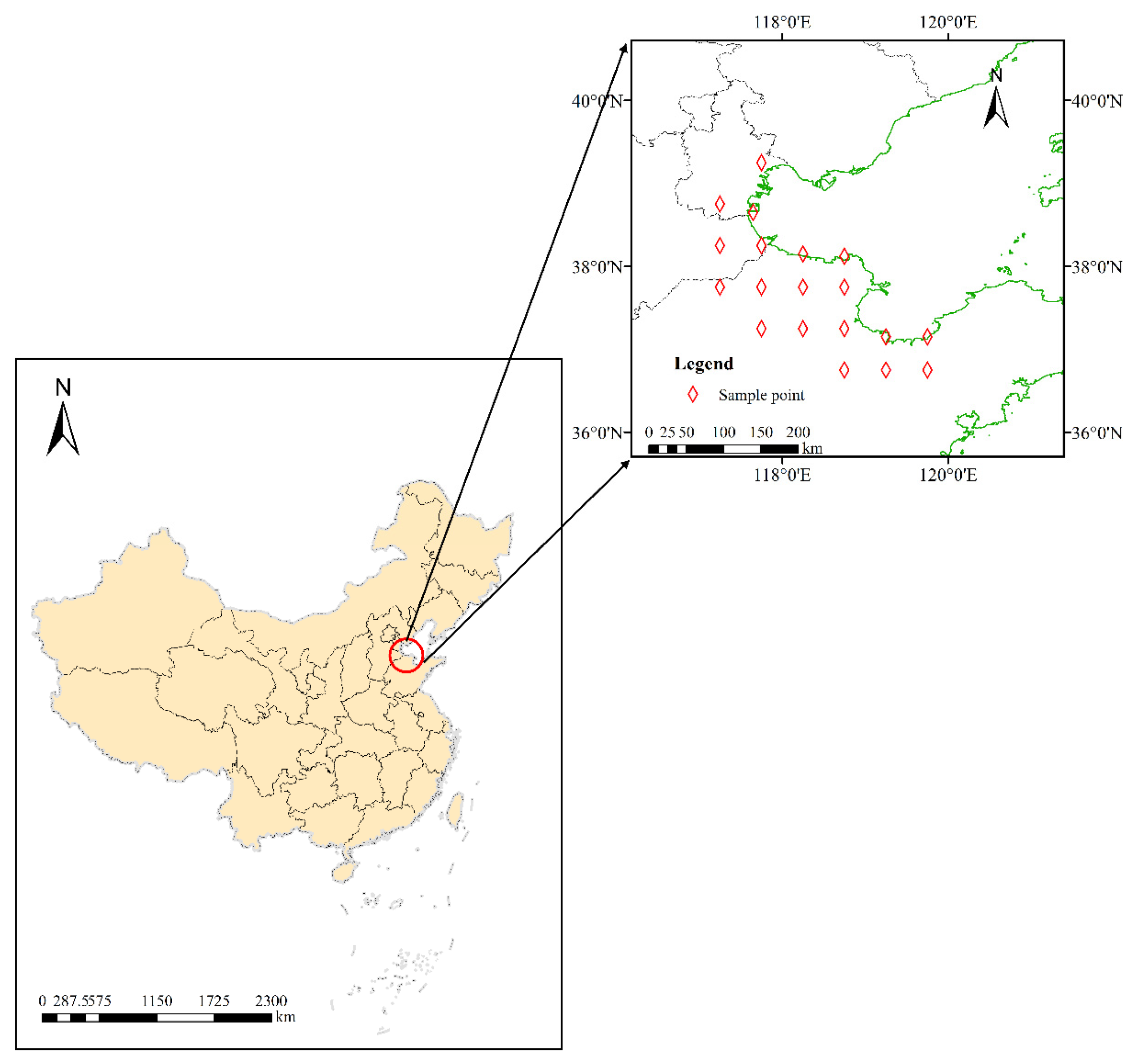
The Bohai Rim Region (36.25° N to 39.75° N, 116.75° E to 120.25° E, Figure 1) in China was taken as the research object in this study, with a total area of 17,582 km2. The region exhibits a warm climate, averaging 12.6 °C annually with 543.2 mm of yearly precipitation [30]. The area is primarily flat with severe soil salinization, limiting traditional agricultural production. In order to solve the problem of exploiting marginal land resources in the Bohai Rim Region, drought-tolerant and saline-resistant energy plants can be planted from the perspective of biomass energy.
The new variety of Arundo donax cultivated by modern biotechnology has strong ecological adaptability and can grow in marginal land such as beach land and saline–alkali land. With high cellulose content and calorific value, it is now internationally recognized as an energy plant with low input and high yield and an environmental remediation plant [31]. In the whole research area of saline–alkali land around the Bohai Sea, the Civil Aviation University of China has a corresponding experimental plot of Arundo donax planting. Therefore, Arundo donax was selected as the potential energy crop for the simulation model.

2.2. Methodology

2.2.1. Life-Cycle Assessment

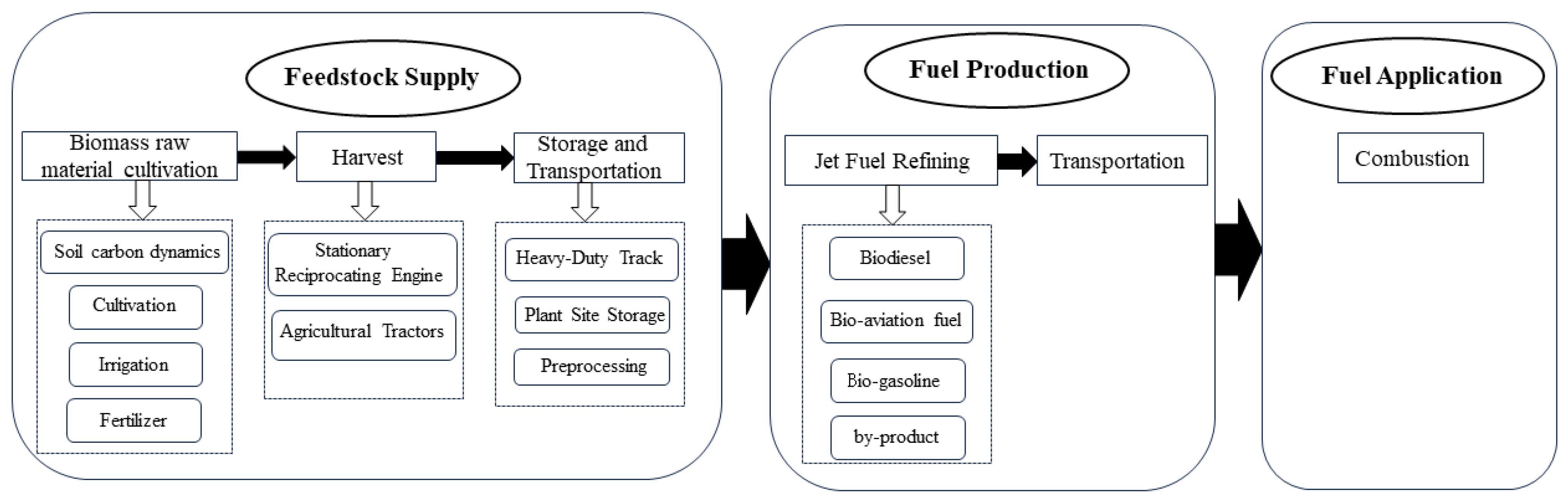
In this study, the F-T process was used to produce sustainable aviation fuel from the biomaterial of Arundo donax, the F-T process being a chemical reaction used to convert carbon-containing feedstocks into liquid hydrocarbons. The life-cycle stage includes the planting stage of raw material, the fuel stage of SAF production, and the application stage of fuel combustion. In consideration of soil carbon dynamics, the GHG emissions of sustainable aviation fuel in the LCA of Arundo donax were calculated. The LCA system boundary is shown in Figure 2. The mean transport mileage is 80 km. The primary functional unit is established as GHG emissions per MJ of SAF produced.

2.2.2. CENTURY Model

In this study, the CENTURY4.0 model was used to simulate the carbon dynamics of the topsoil (0–20 cm) in the Bohai Rim Region. S1 (see Section S1 in Supplementary Information) shows the CENTURY model calibration and validation process for Arundo donax, where the production temperature range of Arundo donax refers to literature values [32]. In this study, 2000 years of spin-ups are conducted to achieve equilibrium in the SOC pool. The organic carbon change in the topsoil (0–20 cm) in this study area was simulated. The land-use change (Arundo donax planting land) was assumed to occur in 2021, and the simulation ended in 2035. During the period, Arundo donax was continuously planted and harvested once a year. As one of the input variables of the LSTM model, the annual soil organic carbon content simulated by the CENTURY model in the study area will continue to be iteratively optimized in the LSTM model.

2.2.3. Long Short-Term Memory

Long Short-Term Memory (LSTM) network [33] is an improvement on the problem that the error gradient of traditional RNN disappears with time, achieving long-term memory that RNNs cannot perform. At time t, LSTM adds a new variable ( c t ) based on the original RNN state ( h t 1 ), which is used to store the long-term state of the neural network. This new state variable is called cell state; that is, at time t, LSTM has three input variables: present time network input:  x t ; prior time LSTM output:  h t 1 ; and prior time cell state:  c t 1 .
LSTM has door control structure, including forget the door ( f t ), enter the door ( i t ), and the output gate ( o t ).  f t  is employed to modulate the degree of historical state retention of LSTM neural network memory cells;  i t  controls the extent to which input information (i.e., short-term memory,  c ~ t ) enters the cell unit;  o t  is used to control the output information of the cell unit. Through the three-gate control, the LSTM can remember the information that needs to be remembered, and at the same time, it can also forget the information that is not needed. Among them, sigmoid function is the key operator to realize the gating effect of the LSTM. The operator outputs a vector between 0 and 1 and performs vector dot multiplication with cell state. Zero represents all forgetting and 1 represents all memory, and the filtering effects of gating structure can be realized. The algorithm consists of the following running steps:
Step#1: Define the memory gate weight matrix  W  and memory gate bias matrix  b :
W = W f , W i , W c ~ , W o , W d
b = b f , b i , b c ~ , b o , b d
Step#2: Compute the forgetting gate function  f t  at time  t :
By calculating the input variable  x t  and the last time output variable  h t 1 , the long vector  h t 1 , x t  information output 0~1 sigmoid function vector value can be found, which is used to calculate the historical memory preservation degree of LSTM network memory cells.
f t = s   i   g m o i d W f h t 1 , x t + b f
Step#3: Calculate the information memory amount  c t  at time  t :
The input gate function  i t  is calculated to determine the extent to which the current LSTM network cells have added information to memory.
i t = s   i   g m o i d W i h t 1 , x t + b i
The vector  h t 1 , x t  is passed through the tanh layer to obtain the short-term memory of the current moment  c ~ t , some of which is updated into the long-term memory of the memory cell.
c ~ t = tan h W c ~ h t 1 , x t + b c ~
Information in the cell state at the current time:
c t = f t c t 1 + i t c ~ t
Step#4: Calculate the output gate function  o t  at time  t :
o t  determines the amount of information output in  c t  to the LSTM’s current hidden layer state variable  h t .
o t = s   i   g m o i d W o h t 1 , x t + b o
h t = o t tan h c t
Step#5: Predicted value  y t  at time  t :
y t = W d h t + b d
Step#6: The iteration stops. If it is necessary to continue to calculate the predicted value at time  t + 1  , repeat Step#2 to Step#6; otherwise, stop the process.
The LSTM time series prediction network established in this study was based on the training data obtained from the experimental monitoring of Arundo donax planting soil conducted by M. Fagnano et al. [34] in the Naples University Federico II, Italy. The training data is also used in the correction process of the CENTURY model. The validation data of the two models were used together with the simulation results of Enrico Martani et al. [35] on the multi-year cultivation of Arundo donax in the Gariga di Podenzano experimental site in northwestern Italy. In the absence of long-term observational data for Arundo donax cultivation and associated SOC dynamics in the Bohai Rim Region, Italian experimental datasets were used to support the construction and preliminary evaluation of the hybrid modeling framework. However, such cross-regional transfer may introduce uncertainty, since the Italian experimental sites may differ from the Bohai Rim Region in climate, salinity conditions, management practices, soil texture, hydrology, and biomass productivity. Accordingly, the model outputs in this study should be interpreted as exploratory estimates under the adopted assumptions rather than as directly validated regional predictions.
LSTM neural network has 5 feature input variables in the input layer, 15 in the hidden layer, and 1 in the output layer. The initial learning rate was 0.1. After 125 training sessions, the learning rate decreased with a factor of 0.2. The maximum number of iterations is 500; the minimum batch number is 3; and the adaptive moment estimation (ADAM) algorithm is used to optimize the model.

2.3. Data

Table 1 summarizes the characteristics, spatial resolution, temporal coverage, and sources of all input data used in this study. Soil data, such as soil mechanical composition and pH, from sample sites in 19 study areas were obtained from Harmonized World Soil Database (HWSD) [36]. The climate variables input to CENTURY model include monthly precipitation (pr), monthly mean maximum temperature (tmax), and monthly mean minimum temperature (tmin). Historical Climate variables (1901 to 2020) from CRU Climate Datasets (https://geomodeling.njnu.edu.cn/dataItem/5cd1865f6af45606404f971e, accessed on 21 October 2025) were downloaded, future climate prediction variables (2021–2035) from the Coupled Model Intercomparison Project Phase 6 (CMIP6) (https://esgf-node.llnl.gov/projects/cmip6/, accessed on 21 October 2025) were downloaded, and through the Delta method downscaling (see Section S5 in Supplementary Information), the 0.5° × 0.5° resolution was re-adopted.
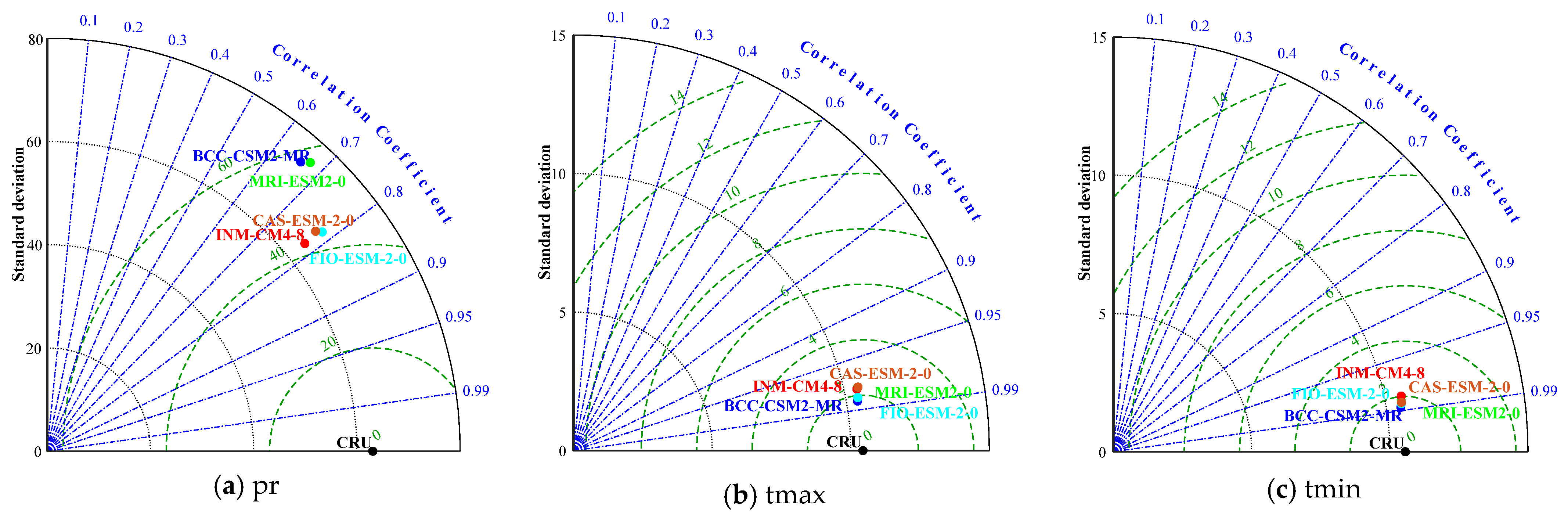
The downloaded future climate variables were all simulated by global climate models (GCMs), which included BCC-CSM2-MR, MRI-ESM-2-0, CAS-ESM-2-0, INM-CM4-8, and FIO-ESM-2-0, and were evaluated using Taylor’s Figure [37], as shown in Figure 3. All GCM climate models are widely used in global or regional climate simulations [38]. Experimental data from future scenarios [39] composed of combinations of different shared socio-economic paths (SSPs) and canonical concentration paths (RCPs) are used for the future climate types projected in this study. The scenarios ranging from low emission to high emission are SSP1-2.6, SSP2-4.5, SSP3-7.0, and SSP5-8.5.
Input variables for LSTM time series prediction include annual accumulated temperature (AD > 10 °C), annual relative humidity (%), surface net solar radiation intensity (W/m2), normalized difference vegetation index (NDVI), and CENTURY model simulation values. Among them, the observed annual accumulated temperature, annual relative humidity, and surface net solar radiation intensity were downloaded from the China Meteorological Data Service Centre (CMDC), the future predicted values of these three input variables were downloaded from CMIP6, and the data accuracy was reclassified to be consistent with the observation accuracy by referring to the Delta method. Observational NDVI average numerical data capture from AVHRR data (USGS: https://www.usgs.gov/centers/eros/science/usgs-eros-archive-avhrr-normalized-difference-vegetation-index-ndvi-composites, accessed on 3 November 2025), the future of NDVI value, was obtained using the LSTM single time series prediction method to get forecasts from 2021 to 2035.

3. Results and Discussion

3.1. LSTM Time Series Prediction Optimization Results of CENTURY Model

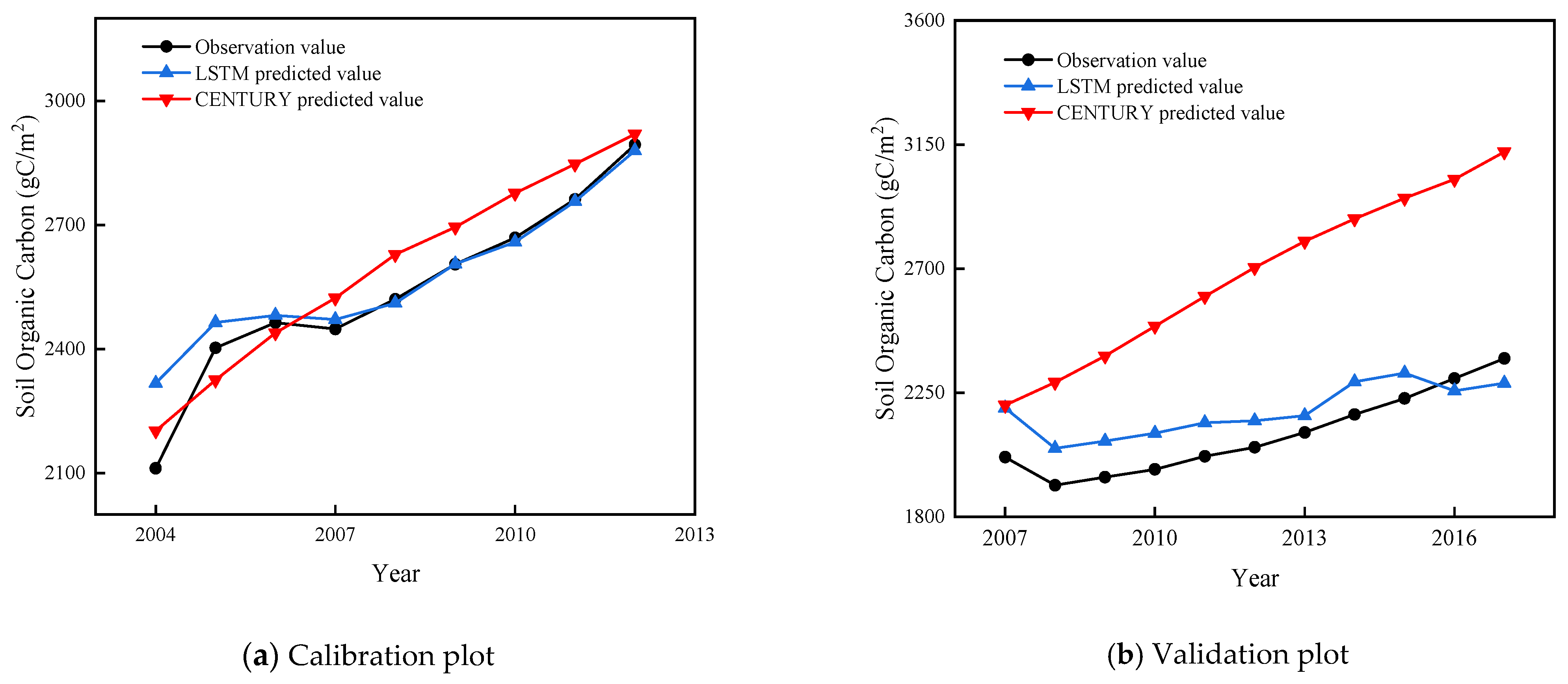
When only the CENTURY model was used to simulate the change in the soil organic carbon content in a region, the actual environmental factors of the soil in the sampled land were rarely considered, and testing the simulation results was limited to testing the correlation coefficient, which led to a large degree of error in the actual numerical simulation of SOC content. The uncertainty of regional simulation in the CENTURY model is further amplified. When the sample plots were verified, it could be seen from the verification results in Figure 4 that the simulation results of the CENTURY model are only correlated with the actual observation values in the growth trend, but there is a large gap in the numerical value.
There are many factors that can affect soil organic carbon content [36]. Although there are obvious interactions between the annual accumulated temperature (AD > 10 °C), annual relative humidity (%), surface net solar radiation intensity (W/m2), normalized difference vegetation index (NDVI), and soil organic carbon content, according to the current literature, the influence degree and mechanism between these variables are insufficient, which makes it impossible to effectively evaluate the soil organic carbon content. Therefore, there is an urgent need for a nonlinear and strong generalization ability soil carbon dynamic prediction model to simulate soil organic carbon. LSTM time series prediction, as a deep learning model, can better find the patterns between input variables and output variables, integrate multiple natural factors that affect soil carbon dynamics, and achieve the prediction of soil carbon dynamic changes in the Bohai Rim Region planted with Arundo donax.
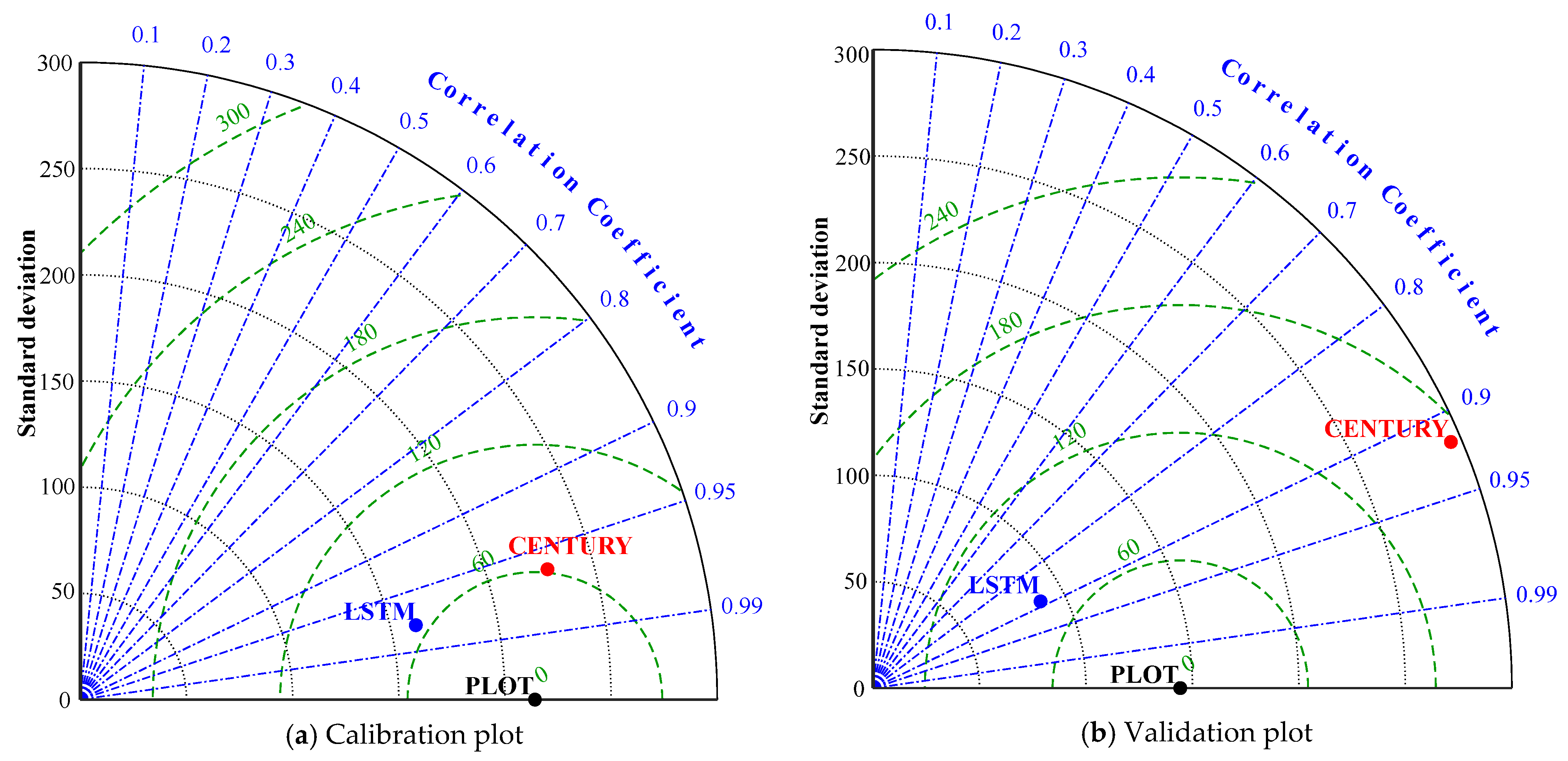
In order to better reflect the effect of LSTM time series prediction on the optimization and correction of the CENTURY model in soil organic carbon simulation, this study took into account the advantages of the Taylor chart in the evaluation of several GCMs, which can combine the errors, center root mean square errors, and correlations of several results at the same time and make the comprehensive evaluation results more intuitive and effective. In this study, the Taylor diagram was innovatively adopted to evaluate the optimization effect of LSTM on the CENTURY model. The Taylor diagram for the simulation and prediction of soil organic carbon at the top layer (0–20 cm) of two plots is shown in Figure 5, while Table 2 provides performance metrics. The LSTM time series and CENTURY model have similar coefficients of determination (R2). In the validation plot, compared with the CENTURY model, LSTM has a lower standard deviation (SD) and root mean square error (RMSE).

3.2. Simulation and Prediction of Soil Carbon Dynamics

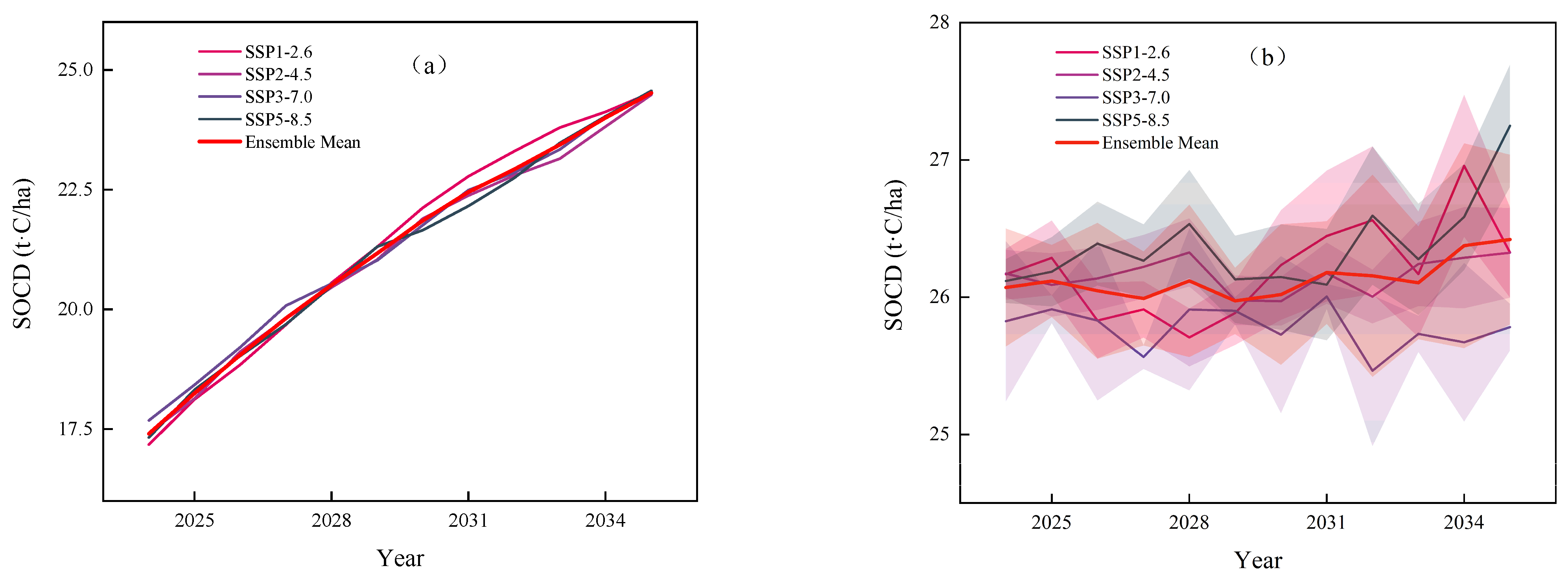
Marginal saline–alkali land in the Bohai Rim Region is the main area assumed to be planted with Arundo donax in this study. To study the optimization impact of the proposed LSTM time series prediction on the CENTURY model in soil organic carbon pool simulation in more detail, Figure 6 compares the soil carbon dynamics prediction results of two prediction models. These values represent the average annual change in the annual change in SOC content in the accuracy range of 0.5° × 0.5° at 19 sample points. The simulation results of the CENTURY model shows that soil organic carbon density (SOCD) in the study area presents a linear trend of increasing year by year (Figure 6a), while after the optimization of LSTM time series prediction, SOCD presents a trend of fluctuation and the SOCD increases slowly (Figure 6b). In addition, Figure 6b presents the spatial uncertainty ranges of SOCD (±SD across the 19 sample points) under different SSP scenarios and the Ensemble Mean. To quantify these uncertainties, the annual soil carbon sequestration (SCS) rate, standard deviation, and 95% confidence interval were calculated for each scenario, and the results are summarized in Table 3. As shown in Table 3, the Ensemble Mean SCS rate is 0.032 t C/ha/a, while the corresponding 95% confidence interval ranges from −0.079 to 0.143 t C/ha/a. This indicates that under some climatic conditions, soils at certain sampling sites may function as net carbon sources rather than carbon sinks. This possibility is particularly evident under the SSP3-7.0 scenario, where the mean SCS rate is slightly negative (−0.004 t C/ha/a). Therefore, soil carbon dynamics in the study region should be understood as a spatially heterogeneous process, and Arundo donax cultivation does not necessarily lead to soil carbon sequestration at all points. A review on the effects of perennial crop establishment on SCS also suggests that short-term SOC responses after perennialization may be weak or even negative, whereas more pronounced benefits generally emerge over longer time scales [40].
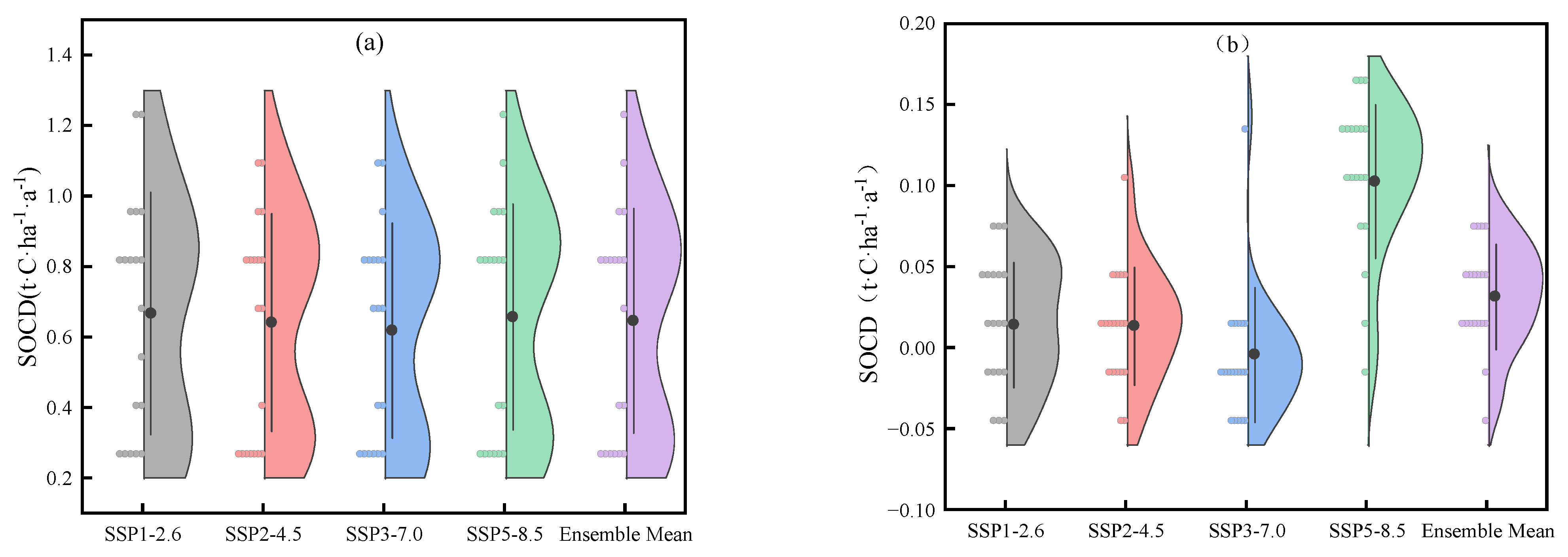
Through CENTURY simulation, the average annual increase in future topsoil (0–20 cm) organic carbon density across all sampling sites over 12 years is 0.647 t C/ha/a, ranging from 0.214 to 1.271 t C/ha/a (Figure 7a). By contrast, the LSTM time series prediction shows an average carbon sequestration rate of 0.032 t C/ha/a, with a range of −0.05 to 0.158 t C/ha/a (Figure 7b). This contrast indicates that the LSTM-based correction provides a more conservative estimate of SOC accumulation than the original CENTURY simulation. To evaluate the reasonableness of these projections, the discussion here focuses on whether the values obtained from the model are within a credible order of magnitude compared to the SOC sequestration rate in the relevant literature. A recent assessment of Chinese croplands reported an average SCS rate of 0.113 t C/ha/a for the 0–20 cm soil layer [41]. Although the present study focuses on marginal saline–alkali land rather than cropland, this value still provides a useful point of comparison. Notably, it falls within the 95% confidence interval of the present study and is close to its upper bound. Meanwhile, the Ensemble Mean SCS rate is lower than the global average reported for perennial energy crops (0.21 t C/ha/a) [42], indicating that the present result should be interpreted as conservative. In addition, a 16-year field experiment on Arundo donax [43] reported an average SCS rate of approximately 1.0 t C/ha/a, which is substantially higher than the value estimated in the present study. This difference might be due to the stricter conditions of this study, including the cultivation of saline–alkali marginal land and different emission intensities in future scenarios. Overall, the available evidence suggests that the Ensemble Mean SCS rate estimated in this study is lower than the reported global average for perennial energy crops, while its uncertainty range overlaps with some SOC sequestration rates reported for comparable land-use systems. Therefore, the modeled results appear reasonable in magnitude, but they should still be regarded as exploratory estimates that require further validation using field observations of Arundo donax cultivation in the Bohai Rim Region.
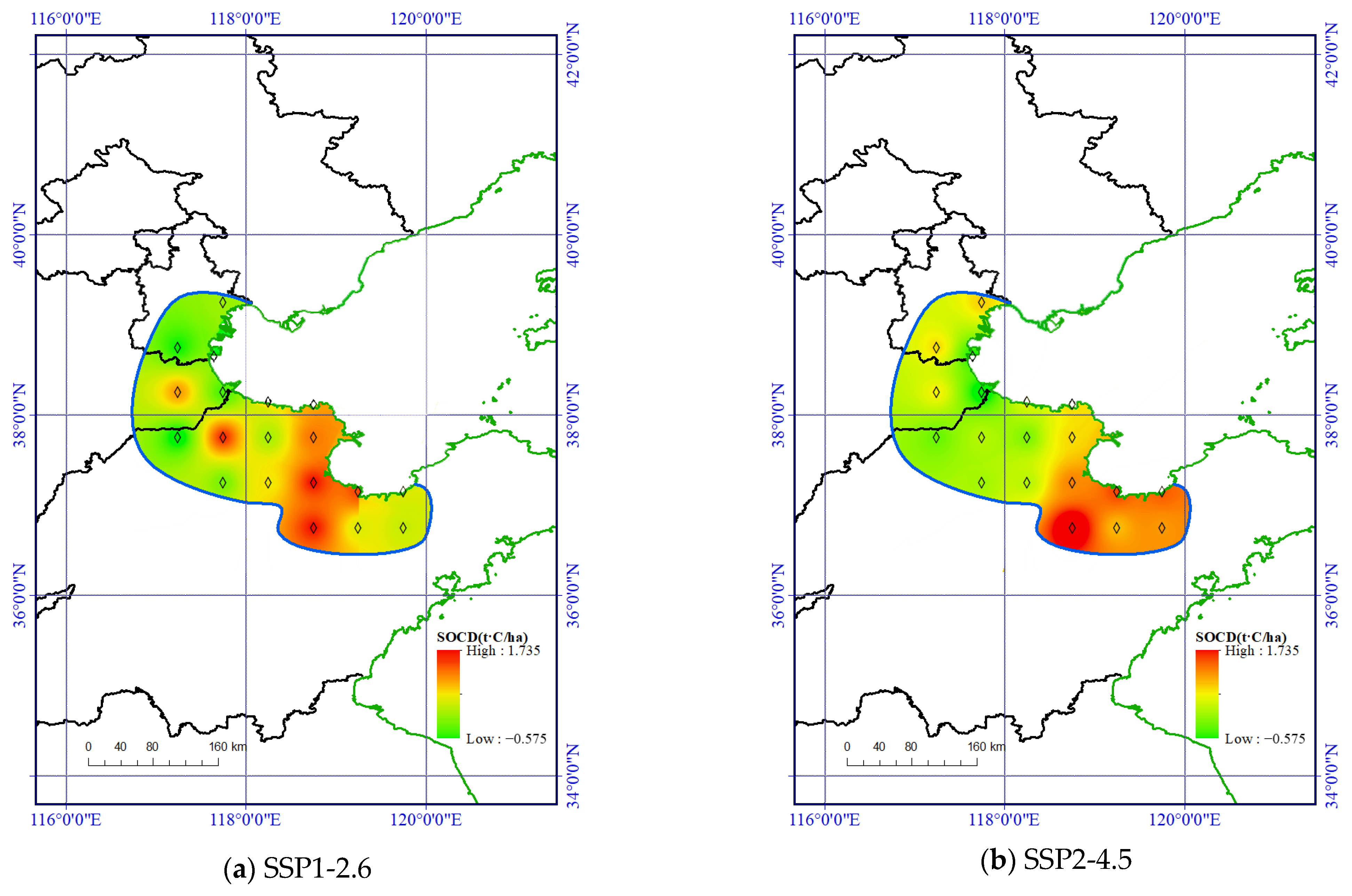
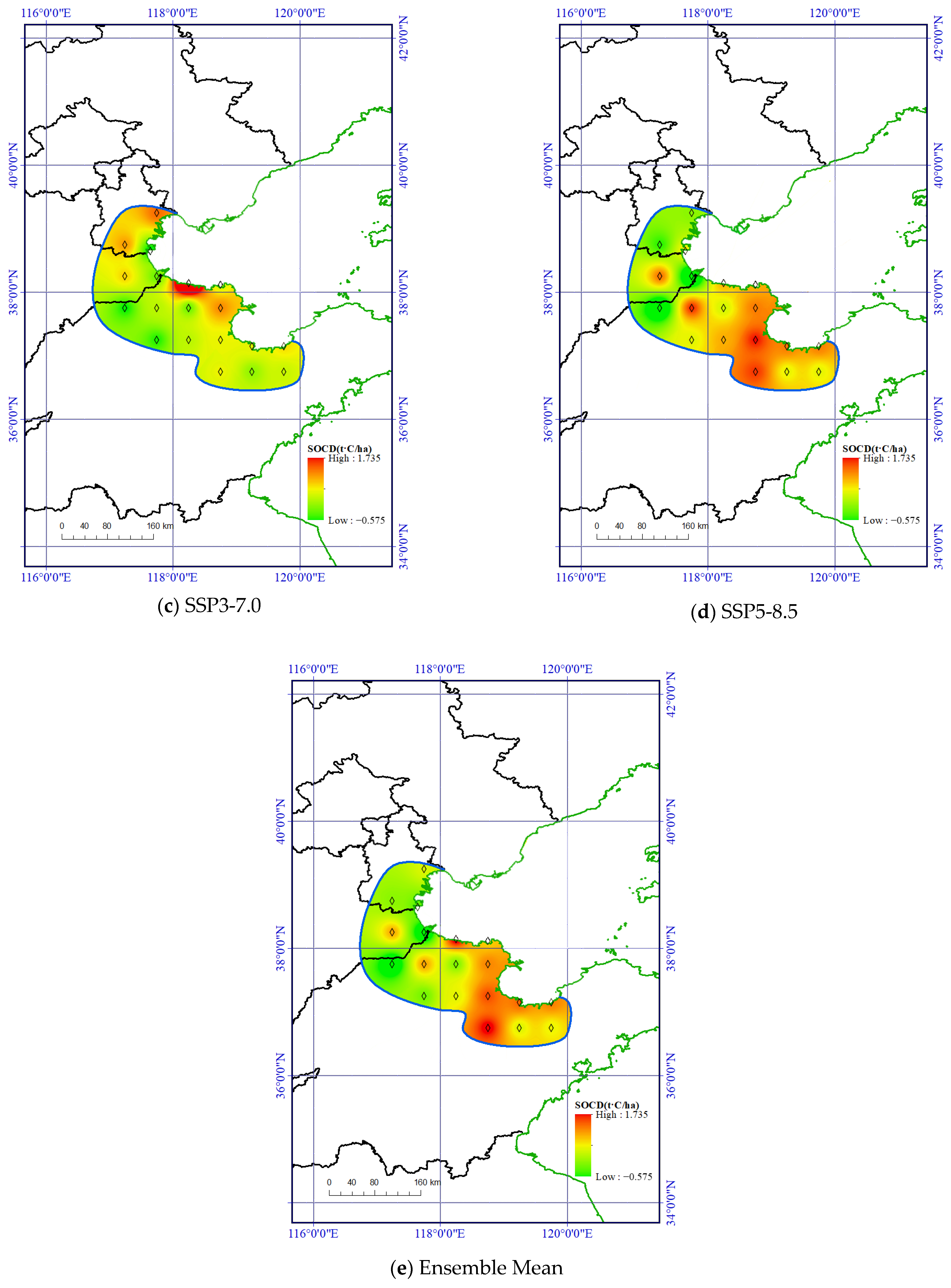
In this study, inverse distance weighted interpolation (IDW), a commonly used interval interpolation method, is used to map SOCD changes at 19 sample points under different future climate scenarios (Figure 8) [44]. The estimated cumulative changes in SOCD were 0.159 t C/ha for SSP1-2.6, 0.151 t C/ha for SSP2-4.5, −0.043 t C/ha for SSP3-7.0, and 1.131 t C/ha for SSP5-8.5. The Ensemble Mean is 0.350 t C/ha, the carbon sequestration potential of soil in the study area during the simulation period is 0.615 Tg C, and the average annual carbon sequestration potential is 0.056 Tg C/a. It should be noted, however, that this regional estimate is derived from interpolation based on the limited 19 sample points in the present study and should therefore be interpreted with appropriate caution. Given the likely heterogeneity of soil properties and climatic conditions across the Bohai Rim Region, the present sampling density is more suitable for illustrating broad regional tendencies than for supporting high-resolution spatial inference. In addition, the uncertainty statistics reported in Table 3 indicate substantial variability among sampling points and scenarios, suggesting that some locations may still behave as carbon sources under less favorable climatic conditions. Accordingly, the IDW maps in Figure 8 are intended to provide an indicative representation of the spatial pattern of modeled SOCD change under different scenarios rather than a precise geospatial prediction.

3.3. Consider the Impact of Soil Carbon Dynamics in the Study Area on the LCA of Arundo donax-Based SAF

The purpose of this section is to explore the marginal land total carbon sequestration potential in the Bohai Rim Region by simulating the cultivation of Arundo donax, which can be used for bio-aviation fuel, while treating and restoring saline–alkali land. Including C fixed by the biomass harvested by Arundo donax for the production of bio-aviation fuel and soil carbon dynamics, according to the simulation of this study, the average annual carbon sequestration potential in the saline–alkali land restoration process is 0.032 t C/ha/a, according to the data related to the new variety of Arundo donax produced by Wuhan Landor Biotechnology Co., Ltd., Wuhan, China (Arundo donax SAF produced using the F-T process). The dry matter harvest mass of Arundo donax is 75 t/ha, 33.3 tons of dry matter are required for each ton of SAF, and 0.44 ha of land is required for Arundo donax planting for each ton of SAF produced. Assuming that Arundo donax has been continuously planted for 25 years in the study area, 1 t of SAF corresponds to 0.352 Mg C soil carbon sequestration (i.e., 1MJ SAF emission −29.9 gCO2).
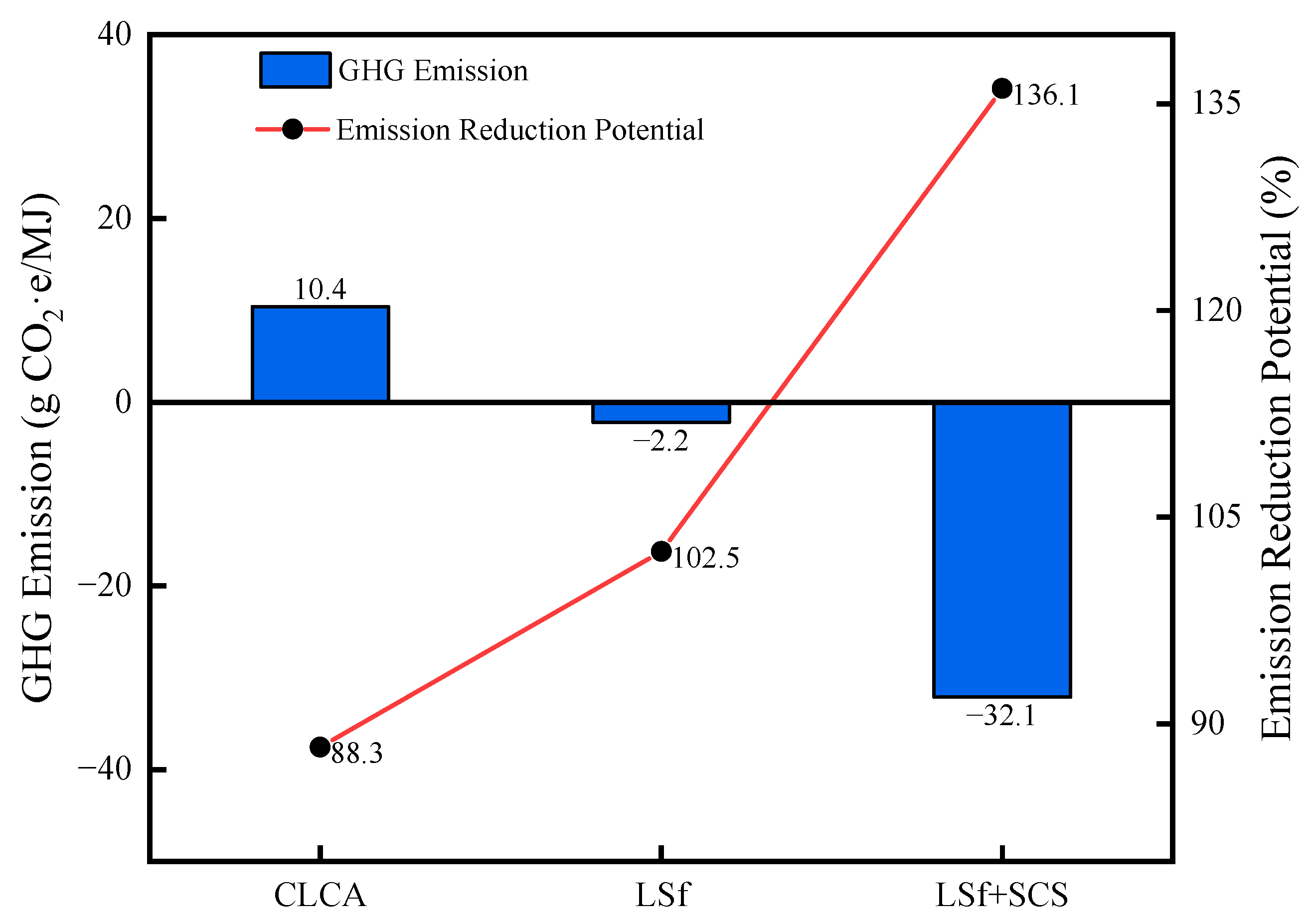
Given the lack of research on the life-cycle GHG emissions from Arundo donax-based SAF, according to the literature [45,46], Arundo donax and miscanthus obtained cellulose and glucose from biomass with very similar values per unit mass and similar biomass yield per hectare. Therefore, in place of Arundo donax, the study used life-cycle GHG emission data from miscanthus; the effects of SCS in the study area on the life-cycle GHG emissions of the F-T Fuel Conversion path for SAF production were analyzed and compared, and the GHG emission reduction potential relative to fossil fuels was calculated, as shown in Figure 9. cLCA (core LCA) and LSf (life-cycle emissions factor for a CORSIA-eligible fuel in gCO2e/MJ for the value of ILUC + cLCA) refer to CORSIA [47].
Long-term large-scale planting of biomass fuel Arundo donax in the study area will affect the fluctuations of global biomass fuel prices, lead to changes in land use in other regions, and then affect the GHG emissions of the whole life-cycle of Arundo donax SAF. In view of this, this study refers to the CORSIA method for calculating carbon emissions and sets the allocation period to 25 years [19]. In this study, after considering the dynamic changes in soil carbon in the study area, the life-cycle GHG emissions of Arundo donax SAF produced via the Fischer–Tropsch process are as follows: the emission reduction potential of −32.1 g CO2e/MJ relative to fossil aviation fuel can reach 136.1%, which is 1.3 times the emission reduction potential of LSf GHG and 1.5 times cLCA GHG without considering SCS in the simulation period. These results suggest that soil carbon dynamics may materially affect the life-cycle evaluation of SAF pathways on marginal land, although the magnitude of this effect remains dependent on the adopted assumptions and the persistence of the modeled soil carbon benefit.

3.4. Sensitivity Analysis

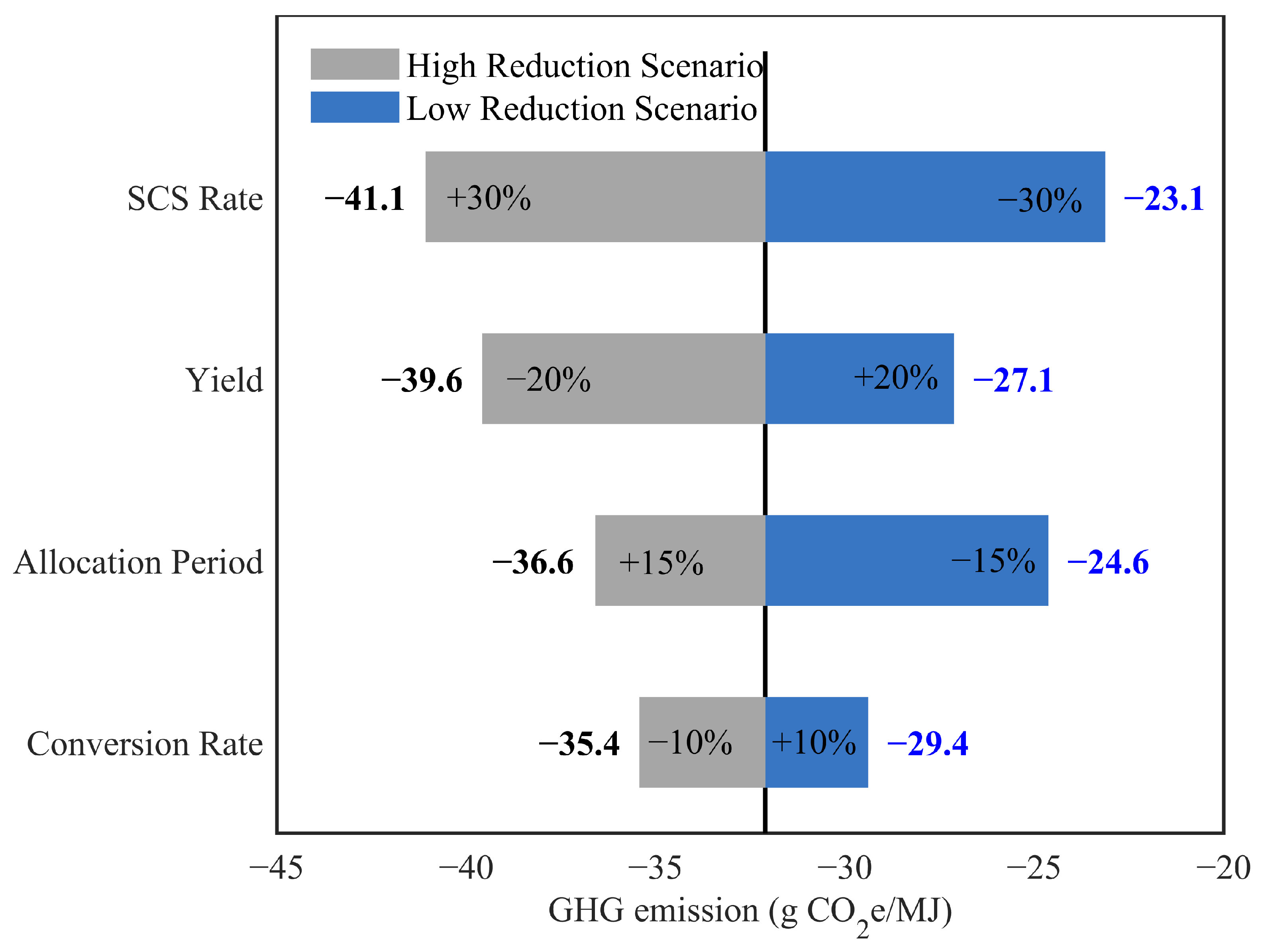
To assess the robustness of the LCA results for Arundo donax-based SAF, a sensitivity analysis was conducted on four key parameters, namely Arundo donax yield, the allocation period, the conversion efficiency of Arundo donax in the F-T process, and the SCS rate predicted in this study. Given the differing characteristics of these parameters, different variation ranges were assigned to each: ±30% for the highly climate-sensitive SCS rate, ±20% for the agronomically variable biomass yield, ±15% for the policy-dependent allocation period, and ±10% for the industrially stable conversion rate. Figure 10 presents the results of the sensitivity analysis. It can be seen that, within the variation ranges of all four parameters, Arundo donax-based SAF still achieves net-negative carbon emissions. In addition, the SCS rate and allocation period are positively correlated with GHG emissions, whereas the other two parameters are negatively correlated. It is worth noting that a reduction in Arundo donax yield would lead to an increase in the land area required for cultivation, thereby resulting in greater soil carbon sequestration. This phenomenon has positive implications for marginal land, as it can not only improve soil quality and increase SOC content but also provide additional carbon offsets. Such an effect may further incentivize the cultivation of energy crops on marginal land. At present, the Renewable Energy Directive of the European Union has already stated that additional soil organic carbon achieved through cultivation activities on such land may be recognized as “carbon removal” [48].
In addition, an extreme boundary test was performed using the 95% confidence interval of the predicted SCS rate (−0.079 to 0.143 t C/ha/a). Under the worst-case condition, where the SCS rate was −0.079 t C/ha/a, the soil became a carbon source, and the life-cycle GHG emissions of SAF increased to 71.6 g CO2e/MJ. However, this value still remained below the fossil aviation fuel baseline of 89 g CO2e/MJ and still satisfied the CORSIA minimum requirement of a 10% GHG reduction for eligible SAF, mainly due to the negative ILUC value. In contrast, under the optimistic condition, where the SCS rate reached 0.143 t C/ha/a, Arundo donax-based SAF exhibited the highest emission reduction potential, reaching −135.8 g CO2e/MJ. Therefore, even in cases where Arundo donax-based SAF may not achieve net-negative carbon emissions, its capacity to deliver substantial GHG reductions relative to fossil aviation fuel remains robust.

3.5. Implications for Sustainable Land Management and Aviation Decarbonization

For the Bohai Rim region, this study suggests that Arundo donax cultivation may increase the SOC on average, although the magnitude and direction of this effect depend on climate scenarios and spatial heterogeneity. As SOC is crucial for soil stability, nutrient retention, and ecosystem resilience, this increase represents not only an additional carbon sink but also a potential ecological restoration of saline–alkali land [49,50]. This aligns with SDG 15, which focuses on conserving, restoring, and sustainably managing terrestrial ecosystems [51]. Unlike conventional bioenergy strategies that prioritize maximizing biomass yield, cultivating perennial crops on marginal saline–alkali land offers a restorative land-use approach, improving both biomass production and degraded land functions. Therefore, marginal saline–alkali land should be seen as a valuable spatial asset that links land restoration with aviation decarbonization rather than as a passive reserve. Additionally, utilizing marginal land for biomass cultivation can reduce competition with food production, making it more feasible amid growing land resource constraints [52]. However, not all marginal lands are suitable for large-scale bioenergy cultivation. Such efforts should be based on land suitability assessments, ecological sensitivity analyses, and regional resource capacity to avoid unintended environmental impacts [53].
From a climate mitigation perspective, the emission reduction potential of Arundo donax-based SAF stems not only from replacing fossil aviation fuels but also from soil carbon sequestration during cultivation. Failing to incorporate soil carbon dynamics into SAF evaluations could lead to underestimating their true mitigation potential for aviation decarbonization. This is especially important for the aviation sector, where deep decarbonization is challenging and alternative mitigation options are limited. Systems that combine fuel substitution with soil carbon accumulation may offer significant long-term climate benefits. In this context, the pathway explored in this study should be seen not just as a feedstock choice but as a system-level solution involving land use, carbon sink management, and low-carbon fuel supply, aligning with SDG 13 (Climate Action) [54].
From a policy and implementation perspective, this study provides quantitative evidence supporting the inclusion of Arundo donax-based bioenergy within the regional framework of low-carbon development and land governance. ICAO’s sustainability framework for CORSIA-eligible fuels emphasizes that SAF evaluation should extend beyond life-cycle GHG emissions to include broader sustainability factors, such as land use, water resources, and socio-economic impacts [55]. The large-scale implementation of this pathway will depend on alignment with land-use planning, sustainability certification, life-cycle standards, and regional policies, alongside considerations of supply chain organization, economic feasibility, and socio-economic implications.

4. Limitations and Future Directions

This study provides a quantitative analysis of soil carbon dynamics and GHG reduction potential of Arundo donax-based SAF, but several limitations remain. First, due to the lack of observational data on Arundo donax cultivation and SOC in the Bohai Rim region, the study used LSTM to optimize the CENTURY model. The training data for the LSTM model came from Arundo donax planting experiments in Italy, not from local data. Although the modeled SCS results were compared with values from other saline–alkali soils or similar environments in the literature, these comparisons offer contextual plausibility support rather than direct validation, given the differences in soil types, climate, salinity, and management practices between the regions. Future research should incorporate actual soil data from the Bohai Rim region for further model calibration and validation.
Second, while this study considered variables such as climate, vegetation, soil properties, and radiation intensity, factors like soil microbial activity and plant root–soil interactions were not fully integrated. Future studies should include these factors to enhance the model’s ability to predict soil carbon dynamics under varying conditions.
Third, this study focused on the environmental aspects of soil carbon sequestration and GHG emissions. While Arundo donax has potential for ecological restoration on saline–alkali land, this study only examined its soil carbon sequestration effect. It did not assess other restoration indicators, such as salinity reduction, microbial diversity, or soil structure improvement. These additional benefits should be integrated in future research, along with techno-economic and social impact analyses, to provide a more comprehensive sustainability assessment of SAF pathways.
Finally, the spatial extrapolation of SOCD was limited by the limited number of sampling points and IDW. Although these results offer a general trend, the regional estimate of 0.615 Tg C should be interpreted with caution. The limited sample size may not fully represent the area’s heterogeneity, and future studies should increase sampling density and improve spatial uncertainty analysis to better capture soil carbon sequestration variability.

5. Conclusions

This study developed an exploratory framework integrating an LSTM time series prediction model with the CENTURY model to investigate topsoil carbon dynamics under Arundo donax cultivation in the Bohai Rim Region and incorporate these effects into the life-cycle assessment of SAF. The results indicate that the conventional CENTURY model may overestimate SOC accumulation, whereas the LSTM-corrected model provides a more conservative estimate of SOC dynamics. The CENTURY simulation showed an average increase in topsoil SOC density of 0.647 t C/ha/a (range: 0.214–1.271 t C/ha/a). After LSTM optimization, the average SCS rate was adjusted to 0.032 t C/ha/a, with a range of −0.05 to 0.158 t C/ha/a and a 95% confidence interval of −0.079 to 0.143 t C/ha/a. This suggests an overall positive trend but with spatial and scenario uncertainties, implying that some locations may act as carbon sources under unfavorable climatic conditions. Therefore, the modeled soil carbon response should be interpreted as conditional and spatially heterogeneous rather than as a uniform regional carbon sink. The total SCS potential in the study area obtained by limited sample points interpolation during the simulation period was estimated at 0.615 Tg C, corresponding to an average annual sequestration potential of 0.056 Tg C/a.
In the life-cycle assessment, under assumptions regarding Arundo donax yield, conversion rate, and the use of miscanthus data for life-cycle GHG emissions, the life-cycle GHG emissions of SAF produced via the Fischer–Tropsch pathway were −32.1 g CO2e/MJ, representing a reduction of 136.1% relative to fossil aviation fuel. This suggests that including soil carbon sequestration could make the pathway net-negative in emissions. However, sensitivity analysis shows that this outcome is not guaranteed. Under the lower bound of the predicted SCS rate, the pathway could lose its net-negative characteristic but still maintain significant GHG reduction compared to fossil aviation fuel.
These results highlight that incorporating soil carbon dynamics into SAF life-cycle accounting provides a more comprehensive understanding of the environmental impacts of biomass pathways on marginal land. Cultivating Arundo donax on saline–alkali marginal land may offer a pathway linking biomass production, soil carbon sequestration, and aviation decarbonization. Furthermore, given that large-scale cultivation of Arundo donax in the Bohai Rim Region remains hypothetical and constrained by the limitations of this study, the results are exploratory and scenario-based and should not yet be regarded as fully confirmed empirical evidence.
Overall, this study provides preliminary evidence that incorporating soil carbon dynamics into SAF life-cycle accounting may improve the assessment of biomass pathways on saline–alkali marginal land and help clarify the potential linkages among land restoration, carbon sequestration, and aviation decarbonization. Future research should integrate local field observations, additional ecological restoration indicators, economic feasibility, social impacts, sustainable land governance, and policy implementation to support a more comprehensive assessment of SAF mitigation pathways.

Supplementary Materials

The following supporting information can be downloaded at: https://www.mdpi.com/article/10.3390/su18083848/s1, Figure S1: CENTURY model calibration and validation; Table S1: Key parameters in CENTURY were used in this study; Table S2: Longitude and latitude coordinates of the center of the sample plot and soil information; Table S3: SSP prediction of LSTM with annual increment of SOCD.

Author Contributions

Conceptualization, W.L.; Methodology, W.L. and J.L.; Software, W.L.; Formal analysis, W.L.; Investigation, J.L.; Data curation, W.L., J.L., X.W. and Z.Z.; Writing—original draft, W.L. and J.L.; Writing—review and editing, W.L. and J.L. All authors have read and agreed to the published version of the manuscript.

Funding

The financial support by the Fundamental Research Funds for the Central Universities (Civil Aviation University of China, 3122026052).

Institutional Review Board Statement

Not applicable.

Informed Consent Statement

Not applicable.

Data Availability Statement

The original contributions presented in this study are included in the article/Supplementary Material. Further inquiries can be directed to the corresponding author.

Acknowledgments

The financial support by the Fundamental Research Funds for the Central Universities (Civil Aviation University of China, 3122026052) are gratefully acknowledged.

Conflicts of Interest

The authors declare no conflict of interest.

References

  1. Prussi, M.; Lee, U.; Wang, M.; Malina, R.; Valin, H.; Taheripour, F.; Velarde, C.; Staples, M.D.; Lonza, L.; Hileman, J.I. CORSIA: The first internationally adopted approach to calculate life-cycle GHG emissions for aviation fuels. Renew. Sustain. Energy Rev. 2021, 150, 111398. [Google Scholar] [CrossRef]
  2. Jiao, Z.P.; Li, K.Q.; Meng, H.D.; Guo, Y.; Zhou, J.M.; Zhang, C.Z.; Huang, Z.J. A methodology for lithium-ion battery state of health estimation using random constraints of state of charge. J. Energy Storage 2026, 154, 121349. [Google Scholar] [CrossRef]
  3. Jia, C.C.; Liu, W.; Chau, K.T.; He, H.W.; Zhou, J.M.; Niu, S.Y. Passenger-aware reinforcement learning for efficient and robust energy management of fuel cell buses. Etransportation 2026, 27, 100537. [Google Scholar] [CrossRef]
  4. ICAO. Resolutions Adopted at the 39th Session of the Assembly; International Civil Aviation Organization: Montreal, QC, Canada, 2016. [Google Scholar]
  5. ICAO. Carbon Offsetting and Reduction Scheme for International Aviation; International Civil Aviation Organization: Montreal, QC, Canada, 2020. [Google Scholar]
  6. Naess, J.S.; Hu, X.P.; Gvein, M.H.; Iordan, C.M.; Cavalett, O.; Dorber, M.; Giroux, B.; Cherubini, F. Climate change mitigation potentials of biofuels produced from perennial crops and natural regrowth on abandoned and degraded cropland in Nordic countries. J. Environ. Manag. 2023, 325, 116474. [Google Scholar] [CrossRef]
  7. Liu, W.; Yu, Z.; Zhu, Q.; Zhou, X.; Peng, C. Assessment of biomass utilization potential of Caragana korshinskii and its effect on carbon sequestration on the Northern Shaanxi Loess Plateau, China. Land Degrad. Dev. 2020, 31, 53–64. [Google Scholar] [CrossRef]
  8. Rebello, S.; Anoopkumar, A.N.; Aneesh, E.M.; Sindhu, R.; Binod, P.; Pandey, A. Sustainability and life cycle assessments of lignocellulosic and algal pretreatments. Bioresour. Technol. 2020, 301, 122678. [Google Scholar] [CrossRef]
  9. Lee, B.X.; Kjaerulf, F.; Turner, S.; Cohen, L.; Donnelly, P.D.; Muggah, R.; Davis, R.; Realini, A.; Kieselbach, B.; MacGregor, L.S.; et al. Transforming Our World: Implementing the 2030 Agenda Through Sustainable Development Goal Indicators. J. Public Health Policy 2016, 37, S13–S31. [Google Scholar] [CrossRef]
  10. Nerini, F.F.; Sovacool, B.; Hughes, N.; Cozzi, L.; Cosgrave, E.; Howells, M.; Tavoni, M.; Tomei, J.; Zerriffi, H.; Milligan, B. Connecting climate action with other Sustainable Development Goals. Nat. Sustain. 2019, 2, 674–680. [Google Scholar] [CrossRef]
  11. Cui, H.; Mo, C.Y.; Chen, P.F.; Lan, R.; He, C.; Lin, J.D.; Jiang, Z.H.; Yang, J.P. Impact of rhizosphere priming on soil organic carbon dynamics: Insights from the perspective of carbon fractions. Appl. Soil Ecol. 2023, 189, 104982. [Google Scholar] [CrossRef]
  12. Borah, P.; Gogoi, N.; Mahanta, S.P. Seasonal Variation in Carbon Mineralization Kinetics, Microbial Biomass Carbon and Enzyme Activities in the Soils of Three Natural Ecosystems of Kaziranga National Park, Assam, North East India. J. Soil Sci. Plant Nutr. 2023, 23, 5300–5311. [Google Scholar] [CrossRef]
  13. Teixeira, C.D.; Castillo, B.T.; Bernhardt, L.; Warren, N.D.; Petry, C.; Ernakovich, J.G.; Smith, R.G.; Frey, S.D. Frequent defoliation of perennial legume-grass bicultures alters soil carbon dynamics. Plant Soil 2023, 490, 423–434. [Google Scholar] [CrossRef]
  14. Luo, Z.K.; Feng, W.T.; Luo, Y.Q.; Baldock, J.; Wang, E.L. Soil organic carbon dynamics jointly controlled by climate, carbon inputs, soil properties and soil carbon fractions. Glob. Change Biol. 2017, 23, 4430–4439. [Google Scholar] [CrossRef] [PubMed]
  15. Guo, L.; Wang, X.; Yang, W.; Lv, J. Life Cycle Assessment of Aviation Fuel Production from Steel-Industry Off-Gas. Processes 2024, 12, 579. [Google Scholar] [CrossRef]
  16. Klimczyk, W.; Jasiński, R.; Niklas, J.; Siedlecki, M.; Ziółkowski, A. Sustainable Aviation Fuels: A Comprehensive Review of Production Pathways, Environmental Impacts, Lifecycle Assessment, and Certification Frameworks. Energies 2025, 18, 3705. [Google Scholar] [CrossRef]
  17. Puschnigg, S.; Fazeni-Fraisl, K.; Lindorfer, J.; Kienberger, T. Biorefinery development for the conversion of softwood residues into sustainable aviation fuel: Implications from life cycle assessment and energetic-exergetic analyses. J. Clean. Prod. 2023, 386, 135815. [Google Scholar] [CrossRef]
  18. Carriquiry, M.; Elobeid, A.; Dumortier, J.; Goodrich, R. Incorporating Sub-National Brazilian Agricultural Production and Land-Use into US Biofuel Policy Evaluation. Appl. Econ. Perspect. Policy 2020, 42, 497–523. [Google Scholar] [CrossRef]
  19. Zhao, X.; Taheripour, F.; Malina, R.; Staples, M.D.; Tyner, W.E. Estimating induced land use change emissions for sustainable aviation biofuel pathways. Sci. Total Environ. 2021, 779, 146238. [Google Scholar] [CrossRef]
  20. Chen, R.; Qin, Z.C.; Han, J.; Wang, M.; Taheripour, F.; Tyner, W.; O’Connor, D.; Duffield, J. Life cycle energy and greenhouse gas emission effects of biodiesel in the United States with induced land use change impacts. Bioresour. Technol. 2018, 251, 249–258. [Google Scholar] [CrossRef]
  21. Xu, Y.; Zhou, J.; Feng, W.H.; Jia, R.; Liu, C.Y.; Fu, T.C.; Xue, S.; Yi, Z.L.; Guillaume, T.; Yang, Y.D.; et al. Marginal land conversion to perennial energy crops with biomass removal enhances soil carbon sequestration. Glob. Change Biol. Bioenergy 2022, 14, 1117–1127. [Google Scholar] [CrossRef]
  22. Frank, S.; Schmid, E.; Havlik, P.; Schneider, U.A.; Bottcher, H.; Balkovic, J.; Obersteiner, M. The dynamic soil organic carbon mitigation potential of European cropland. Glob. Environ. Change 2015, 35, 269–278. [Google Scholar] [CrossRef]
  23. Li, H.; Wu, Y.; Liu, S.; Xiao, J.; Zhao, W.; Chen, J.; Alexandrov, G.; Cao, Y. Decipher soil organic carbon dynamics and driving forces across China using machine learning. Glob. Change Biol. 2022, 28, 3394–3410. [Google Scholar] [CrossRef]
  24. Parton, W.J. The Century Model; Springer: Berlin/Heidelberg, Germany, 1996; pp. 283–291. [Google Scholar]
  25. Baldassini, P.; Paruelo, J.M. Deforestation and current management practices reduce soil organic carbon in the semi-arid Chaco, Argentina. Agric. Syst. 2020, 178, 102749. [Google Scholar] [CrossRef]
  26. Sakrabani, R.; Hollis, J. Evaluating changes in soil organic matter with climate using CENTURY in England and Wales. J. Environ. Qual. 2018, 47, 695–703. [Google Scholar] [CrossRef]
  27. Iravani, M.; White, S.R.; Farr, D.R.; Habib, T.J.; Kariyeva, J.; Faramarzi, M. Assessing the provision of carbon-related ecosystem services across a range of temperate grassland systems in western Canada. Sci. Total Environ. 2019, 680, 151–168. [Google Scholar] [CrossRef] [PubMed]
  28. Li, Y.; Zhu, Z.F.; Kong, D.Q.; Han, H.; Zhao, Y. EA-LSTM: Evolutionary attention-based LSTM for time series prediction. Knowl.-Based Syst. 2019, 181, 104785. [Google Scholar] [CrossRef]
  29. Hamrani, A.; Akbarzadeh, A.; Madramootoo, C.A. Machine learning for predicting greenhouse gas emissions from agricultural soils. Sci. Total Environ. 2020, 741, 140338. [Google Scholar] [CrossRef]
  30. Yang, H.; Xia, J.; Cui, Q.; Liu, J.; Wei, S.; Feng, L.; Dong, K. Effects of different Tamarix chinensis-grass patterns on the soil quality of coastal saline soil in the Yellow River Delta, China. Sci. Total Environ. 2021, 772, 145501. [Google Scholar] [CrossRef] [PubMed]
  31. Faralli, M.; Williams, K.; Corke, F.; Li, M.; Doonan, J.H.; Varotto, C. Interspecific and intraspecific phenotypic diversity for drought adaptation in bioenergy Arundo species. GCB Bioenergy 2021, 13, 753–769. [Google Scholar] [CrossRef]
  32. Jampeetong, A.; Guo, W.Y.; Brix, H. Growth and photosynthetic acclimation to temperature in hybrid Napier grass (Pennisetum purpureum × P. americanum cv. Pakchong 1) and giant reed (Arundo donax). Aquat. Bot. 2020, 164, 103232. [Google Scholar] [CrossRef]
  33. Gers, F.A.; Schraudolph, N.N.; Schmidhuber, J. Learning precise timing with LSTM recurrent networks. J. Mach. Learn. Res. 2002, 3, 115–143. [Google Scholar] [CrossRef][Green Version]
  34. Fagnano, M.; Impagliazzo, A.; Mori, M.; Fiorentino, N. Agronomic and environmental impacts of giant reed (Arundo donax L.): Results from a long-term field experiment in hilly areas subject to soil erosion. Bioenergy Res. 2015, 8, 415–422. [Google Scholar] [CrossRef]
  35. Martani, E.; Ferrarini, A.; Hastings, A.; Amaducci, S. Soil organic carbon significantly increases when perennial biomass plantations are reverted back to annual arable crops. Agronomy 2023, 13, 447. [Google Scholar] [CrossRef]
  36. Li, Q.-Q.; Yue, T.-X.; Wang, C.-Q.; Zhang, W.-J.; Yu, Y.; Li, B.; Yang, J.; Bai, G.-C. Spatially distributed modeling of soil organic matter across China: An application of artificial neural network approach. Catena 2013, 104, 210–218. [Google Scholar] [CrossRef]
  37. Taylor, K.E. Summarizing multiple aspects of model performance in a single diagram. J. Geophys. Res. Atmos. 2001, 106, 7183–7192. [Google Scholar] [CrossRef]
  38. Moradian, S.; Akbari, M.; Iglesias, G. Optimized hybrid ensemble technique for CMIP6 wind data projections under different climate-change scenarios. Case study: United Kingdom. Sci. Total Environ. 2022, 826, 154124. [Google Scholar] [CrossRef]
  39. Field, J.L.; Richard, T.L.; Smithwick, E.A.; Cai, H.; Laser, M.S.; LeBauer, D.S.; Long, S.P.; Paustian, K.; Qin, Z.; Sheehan, J.J. Robust paths to net greenhouse gas mitigation and negative emissions via advanced biofuels. Proc. Natl. Acad. Sci. USA 2020, 117, 21968–21977. [Google Scholar] [CrossRef]
  40. Siddique, I.A.; Grados, D.; Chen, J.; Laerke, P.E.; Jorgensen, U. Soil organic carbon stock change following perennialization: A meta-analysis. Agron. Sustain. Dev. 2023, 43, 58. [Google Scholar] [CrossRef]
  41. Zuo, W.A.; Gu, B.X.; Zou, X.W.; Peng, K.; Shan, Y.L.; Yi, S.Q.; Shan, Y.H.; Gu, C.H.; Bai, Y.C. Soil organic carbon sequestration in croplands can make remarkable contributions to China’s carbon neutrality. J. Clean. Prod. 2023, 382, 382. [Google Scholar] [CrossRef]
  42. Wu, Y.N.; Huang, H.R.; Chen, F.; Tan, T.S.; Xu, Y. Soil organic carbon sequestration rate and spatiotemporal dynamics under perennial energy crops cultivation: A global meta-analysis. Soil Tillage Res. 2024, 240, 106064. [Google Scholar] [CrossRef]
  43. Monti, A.; Zegada-Lizarazu, W. Sixteen-Year Biomass Yield and Soil Carbon Storage of Giant Reed (Arundo donax L.) Grown Under Variable Nitrogen Fertilization Rates. Bioenergy Res. 2016, 9, 248–256. [Google Scholar] [CrossRef]
  44. Kingsley, J.; Afu, S.M.; Isong, I.A.; Chapman, P.A.; Kebonye, N.M.; Ayito, E.O. Estimation of Soil Organic Carbon Distribution by Geostatistical and Deterministic Interpolation Methods: A Case Study of the Southeastern Soils of Nigeria. Environ. Eng. Manag. J. 2021, 20, 1077–1085. [Google Scholar] [CrossRef]
  45. Ge, X.; Burner, D.M.; Xu, J.; Phillips, G.C.; Sivakumar, G. Bioethanol production from dedicated energy crops and residues in Arkansas, USA. Biotechnol. J. 2011, 6, 66–73. [Google Scholar] [CrossRef]
  46. Yao, G.; Staples, M.D.; Malina, R.; Tyner, W.E. Stochastic techno-economic analysis of alcohol-to-jet fuel production. Biotechnol. Biofuels 2017, 10, 18. [Google Scholar] [CrossRef]
  47. ICAO. Document06 CORSIA Default Life Cycle Emissions Values forCORSIA Eliqible Fuels; International Civil Aviation Organization: Montreal, QC, Canada, 2022. [Google Scholar]
  48. Buffi, M.; Bergonzoli, S.; Medina-Martos, E.; Hurtig, O.; Chiaramonti, D.; Tozzi, F.; Monti, A.; Sessa, M.G.; Thiel, C.; Schillaci, C. Camelina oil for sustainable aviation fuel production: A scenario assessment for recovering European degraded soils. Energy Policy 2026, 210, 115043. [Google Scholar] [CrossRef]
  49. Jha, A.; Bonetti, S.; Smith, A.P.; Souza, R.; Calabrese, S. Linking Soil Structure, Hydraulic Properties, and Organic Carbon Dynamics: A Holistic Framework to Study the Impact of Climate Change and Land Management. J. Geophys. Res. Biogeosci. 2023, 128, e2023JG007389. [Google Scholar] [CrossRef]
  50. Yadav, M.; Mittal, R.; Kumari, A.; Bhatia, A.; Khatri, A.; Bhateria, R. Soil carbon fractions and their role in climate-resilient agriculture: A review. Sustain. Chem. Clim. Action 2025, 7, 100127. [Google Scholar] [CrossRef]
  51. United Nations. Goal 15: Life on Land; United Nations: New York, NY, USA, 2025. [Google Scholar]
  52. Yu, Z.Y.; Zhang, F.; Gao, C.Z.; Mangi, E.; Ali, C. The potential for bioenergy generated on marginal land to offset agricultural greenhouse gas emissions in China. Renew. Sust. Energ. Rev. 2024, 189, 113924. [Google Scholar] [CrossRef]
  53. Csikós, N.; Tóth, G. Concepts of agricultural marginal lands and their utilisation: A review. Agric. Syst. 2023, 204, 103560. [Google Scholar] [CrossRef]
  54. United Nations. Goal 13: Climate Action; United Nations: New York, NY, USA, 2025. [Google Scholar]
  55. ICAO. CORSIA Sustainability Criteria for CORSIA Eligible Fuels; International Civil Aviation Organization: Montreal, QC, Canada, 2025. [Google Scholar]
Figure 1. Spatial distribution of the sampling points.
Sustainability 18 03848 g001
Figure 2. LCA system boundary.
Sustainability 18 03848 g002
Figure 3. The downscaling results of different GCMs were evaluated using Taylor diagrams.
Sustainability 18 03848 g003
Figure 4. LSTM calibrated the CENTURY model and verified the optimization results of the sample plots.
Sustainability 18 03848 g004
Figure 5. Taylor diagram was used to evaluate the optimization effect of LSTM on CENTURY model.
Sustainability 18 03848 g005
Figure 6. Map of soil organic carbon density (SOCD) changes in the study area. (a) The simulation result of CENTURY model; (b) the simulation result of LSTM time series prediction. SSP1-2.6, SSP2-4.5, SSP3-7.0, and SSP5-8.5 are different future emission scenarios. Ensemble Mean is the ensemble average of predicted soil carbon dynamics results for four future climate types.
Sustainability 18 03848 g006
Figure 7. Violin charts of the annual incremental distribution of SOCD in 19 study plots under different future climate scenarios. (a) The simulation result of CENTURY model; (b) the simulation result of LSTM time series prediction.
Sustainability 18 03848 g007
Figure 8. IDW-interpolated spatial distribution of cumulative SOCD change (2024–2035) based on 19 sample points. The dots in the figure represent the selected sampling points.
Sustainability 18 03848 g008aSustainability 18 03848 g008b
Figure 9. Arundo donax SAF (F-T)’s LCA and changes in emission reduction potential relative to fossil aviation fuels. cLCA: core life-cycle assessment; LSf: CORSIA-compliant life-cycle emission factor for eligible SAF; LSf + SCS: emission factor with SCS included. The life-cycle emission factor of fossil aviation fuel is 89 g CO2e/MJ.
Sustainability 18 03848 g009
Figure 10. Sensitivity analysis of life-cycle GHG emission of Arundo donax-based SAF.
Sustainability 18 03848 g010
Table 1. The data information.
Data CategoryVariablesTemporal CoverageSpatial ResolutionSource
soil propertiespH, sand/silt/clay content, bulk densitystatic 1 km × 1 kmHWSD
climate datapr, tmax, tminhistorical (1901–2020)0.5° × 0.5°CRU
future (2021–2035)Downscaled to 0.5° × 0.5°CMIP6
LSTM input variablesannual accumulated temperature (>10 °C), annual relative humidity, surface net solar radiation intensityhistoricalStation CMDC
futureDownscaled to 0.5° × 0.5°CMIP6
NDVIhistorical1 km × 1 kmUSGS
future-predicted via LSTM single time series forecasting
CENTURY simulated SOChistorical and future-simulated by CENTURY model in this study
Arundo donax observation dataSOC dynamics of Arundo donaxmulti-yearSite-specificexperimental data from Naples and Podenzano, Italy [34,35]
Table 2. Performance metrics of SOC simulation for the calibration and validation plot.
SiteSourceSDRMSER2
Calibration plotObservation214.110.001.00
LSTM161.8566.170.97
CENTURY228.4261.650.96
Validation plotObservation144.290.001.00
LSTM88.5577.290.89
CENTURY295171.840.91
Table 3. Projected soil carbon sequestration rate and their uncertainties under different SSPs.
ScenarioMeanStandard Deviation95% Confidence IntervalUnits
SSP1-2.60.0140.030−0.044 to 0.073t C/ha/a
SSP2-4.50.0140.030−0.045 to 0.072
SSP3-7.0−0.0040.015−0.034 to 0.026
SSP5-8.50.1030.0410.023 to 0.182
Ensemble Mean0.0320.057−0.079 to 0.143
Disclaimer/Publisher’s Note: The statements, opinions and data contained in all publications are solely those of the individual author(s) and contributor(s) and not of MDPI and/or the editor(s). MDPI and/or the editor(s) disclaim responsibility for any injury to people or property resulting from any ideas, methods, instructions or products referred to in the content.