Residential Consumers’ Willingness to Pay for Sustainable Grid Resilience Against Climate-Induced Large-Scale Outages of Long-Duration: Evidence from South Korea



Abstract
1. Introduction
2. Short Literature Review
2.1. A Review of the Related Literature
- Firstly, only a limited number of studies have estimated WTP to avoid LSLD, and none have focused on residential consumers in South Korea. This study, therefore, provides novel insights and policy relevance by estimating their WTP for avoiding a 24 h nationwide outage.
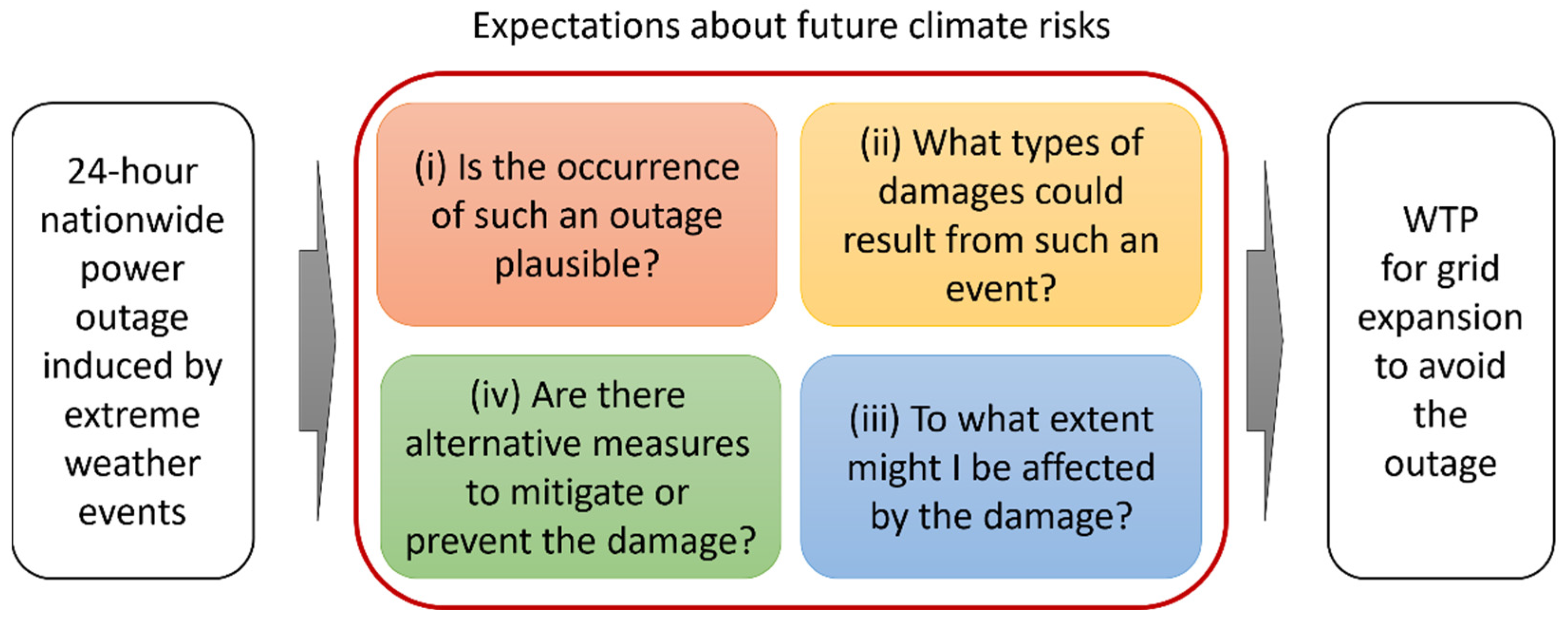
- Secondly, the rarity of LSLD creates considerable uncertainty regarding potential damages from such events, making perceptions of these impacts a critical determinant of WTP. Building on this reasoning, this paper further tests the hypothesis that expectations about the occurrence of such outages induced by extreme weather events, together with perceptions of the direct personal damages they would entail, significantly influence WTP. In particular, socioeconomic characteristics such as generation, presence of children, and educational level are expected to be closely associated with these expectations and/or perceptions and to exert significant effects on WTPs, whereas gender, political ideology, and experience of past outages are not. As far as the authors are aware, this study constitutes the first such attempt reported in the literature.
- Thirdly, although distributed energy resources (DERs) may provide a limited electricity supply during LSLD, they can satisfy consumers’ bare necessities, highlighting their critical value. This suggests a potential trade-off between consumers’ WTP for DERs and for the grid. Accordingly, this paper investigates whether the adoption status of home solar—either already installed or intended for future installation—exerts a significant effect on WTP for grid investment, with particular attention to the direction of this relationship.
- Finally, prior research shows that residential consumers exhibit a WTP not only for household-level but also for community-level services, and that the provision of information on the potential damage produced by an outage reduces the uncertainty in the WTP responses. Building on this evidence, this study ensures that the respondents receive sufficient information on both the household- and community-level impacts.
2.2. Further Literature Review on Resilience Under Multiple Hazards
3. Methodology
3.1. Method: CV
3.2. Procedure for Applying CV
3.2.1. Defining the Good, Scenario, and Payment Vehicle
3.2.2. Designing the Format of the Questionnaire
3.2.3. Implementing the Field Survey
3.2.4. Adopting the WTP Model
3.2.5. Analyzing the WTP Data
4. Results and Discussion
4.1. Data
4.2. Results
4.3. Discussion of the Results
4.3.1. Acceptance of Residential Tariff Increases
4.3.2. Socioeconomic Determinants of Tariff Acceptance
4.3.3. Further Investigation of the Zero WTP Observations
4.3.4. Caveats on Policy Extrapolation
4.3.5. Temporal Validity and Framework Evolution
5. Conclusions
Author Contributions
Funding
Institutional Review Board Statement
Informed Consent Statement
Data Availability Statement
Conflicts of Interest
Abbreviations
| cdf | Cumulative distribution function |
| CE | Choice experiment |
| CI | Confidence interval |
| CV | Contingent valuation |
| DB | Double-bound |
| DC | Dichotomous choice |
| DER | Distributed energy resource |
| HP | High-priority |
| KEPCO | Korea Electric Power Corporation |
| LP | Low-priority |
| LSLD | Large-scale outages of long duration |
| MLE | Maximum likelihood estimation |
| MMWTP | Mean marginal willingness to pay |
| MWTP | Mean willingness to pay |
| OB | One-and-one-half-bound |
| RCP | Representative Concentration Pathway |
| SB | Single-bound |
| SP | Stated preference |
| WTA | Willingness to accept |
| WTP | Willingness to pay |
References
- Do, V.; Wilner, L.B.; Flores, N.M.; McBrien, H.; Northrop, A.J.; Casey, J.A. Spatiotemporal patterns of individual and multiple simultaneous severe weather events co-occurring with power outages in the United States, 2018–2020. PLoS Clim. 2025, 4, e0000523. [Google Scholar] [CrossRef]
- Guddanti, K.P.; Bharati, A.K.; Nekkalapu, S.; Mcwherter, J.; Morris, S.L. A comprehensive review: Impacts of extreme temperatures due to climate change on power grid infrastructure and operation. IEEE Access 2025, 13, 49375–49415. [Google Scholar] [CrossRef]
- Hawker, G.; Bell, K.; Bialek, J.; Maciver, C. Management of extreme weather impacts on electricity grids: An international review. Prog. Energy 2024, 6, 032005. [Google Scholar] [CrossRef]
- International Energy Agency. Electricity Grids and Secure Energy Transitions; IEA: Paris, France, 2023; Available online: https://www.iea.org/reports/electricity-grids-and-secure-energy-transitions (accessed on 25 August 2025).
- Panteli, M.; Mancarella, P. The grid: Stronger, bigger, smarter? Presenting a conceptual framework of power system resilience. IEEE Power Energy Mag. 2015, 13, 58–66. [Google Scholar] [CrossRef]
- Lambert, D.M.; Ripberger, J.T.; Jenkins-Smith, H.; Silva, C.L.; Bowman, W.; Long, M.A.; Gupta, K.; Fox, A. Consumer willingness-to-pay for a resilient electrical grid. Energy Econ. 2024, 131, 107345. [Google Scholar] [CrossRef]
- Gorman, W. The quest to quantify the value of lost load: A critical review of the economics of power outages. Electr. J. 2022, 35, 107187. [Google Scholar] [CrossRef]
- de Nooij, M.; Koopmans, C.; Bijvoet, C. The value of supply security: The costs of power interruptions: Economic input for damage reduction and investment in networks. Energy Econ. 2007, 29, 277–295. [Google Scholar] [CrossRef]
- Shivakumar, A.; Welsch, M.; Taliots, C.; Jakšić, D.; Baričević, T.; Howells, M.; Gupta, S.; Rogner, H. Valuing blackouts and lost leisure: Estimating electricity interruption costs for households across the European Union. Energy Res. Soc. Sci. 2017, 34, 39–48. [Google Scholar] [CrossRef]
- Baik, S.; Davis, A.L.; Morgan, M.G. Assessing the cost of large-scale power outages to residential customers. Risk Anal. 2018, 38, 283–296. [Google Scholar] [CrossRef]
- Baik, S.; Davis, A.L.; Park, J.W.; Sirinterlikci, S.; Morgan, M.G. Estimating what US residential customers are willing to pay for resilience to large electricity outages of long duration. Nat. Energy 2020, 5, 250–258. [Google Scholar] [CrossRef]
- Vennemo, H.; Rosnes, O.; Skulstad, A. The cost to households of a large electricity outage. Energy Econ. 2022, 116, 106394. [Google Scholar] [CrossRef]
- Cohen, J.; Moeltner, K.; Reichl, J.; Schmidthaler, M. Effect of global warming on willingness to pay for uninterrupted electricity supply in European nations. Nat. Energy 2018, 3, 37–45. [Google Scholar] [CrossRef]
- Morrissey, K.; Plater, A.; Dean, M. The cost of electric power outages in the residential sector: A willingness to pay approach. Appl. Energy 2018, 212, 141–150. [Google Scholar] [CrossRef]
- Kim, J.; Lim, K.; Yoo, S. Evaluating residential consumers’ willingness to pay to avoid power outages in South Korea. Sustainability 2019, 11, 1258. [Google Scholar] [CrossRef]
- Carlsson, F.; Kataria, M.; Lampi, E.; Martinsson, P. Past and present outage costs—A follow-up study of households’ willingness to pay to avoid power outages. Resour. Energy Econ. 2021, 64, 101216. [Google Scholar] [CrossRef]
- Matsubara, M.; Mae, M.; Matsuhashi, R. Investigation of residential value of lost load and the importance of electric loads during outages in Japan. Energies 2025, 18, 2060. [Google Scholar] [CrossRef]
- Wei, Y.; Cheng, Y.; Liao, H. Optimal resilience-based restoration of a system subject to recurrent dependent hazards. Reliab. Eng. Syst. Saf. 2024, 247, 110137. [Google Scholar] [CrossRef]
- Wei, Y.; Cheng, Y.; Liao, H.; Elsayed, E.A. Resilience modeling for an engineered network with multimodal performance under multiple recurrent hazards. Reliab. Eng. Syst. Saf. 2026, 266, 111640. [Google Scholar] [CrossRef]
- Kong, J.; Zhang, C.; Simonovic, S.P. Optimizing the resilience of interdependent infrastructures to regional natural hazards with combined improvement measures. Reliab. Eng. Syst. Saf. 2021, 210, 107538. [Google Scholar] [CrossRef]
- Panteli, M.; Pickering, C.; Wilkinson, S.; Dawson, R.; Mancarella, P. Power system resilience to extreme weather: Fragility modeling, probabilistic impact assessment, and adaptation measures. IEEE Trans. Power Syst. 2016, 32, 3747–3757. [Google Scholar] [CrossRef]
- Freeman, A.M., III; Herriges, J.A.; Kling, C.L. The Measurement of Environmental and Resource Values: The Theory and Methods, 3rd ed.; Routledge: London, UK, 2014. [Google Scholar] [CrossRef]
- Venkatachalam, L. The contingent valuation method: A review. Environ. Impact Assess. Rev. 2004, 24, 89–124. [Google Scholar] [CrossRef]
- Arrow, K.; Solow, R.; Portney, P.R.; Leamer, E.E.; Radner, R.; Schuman, H. Report of the NOAA panel on contingent valuation. Fed. Regist. 1993, 58, 4601–4614. [Google Scholar]
- Bateman, I.J.; Turner, R.K. Valuation of environment, methods and techniques: The contingent valuation method. In Sustainable Environmental Economics and Management: Principles and Practice; Turer, R.K., Ed.; Belhaven Press: London, UK, 1993; pp. 120–191. [Google Scholar]
- Cummings, R.G.; Brookshire, D.S.; Schulze, W.D. (Eds.) Valuing Environmental Goods: A State of the Arts Assessment of the Contingent Valuation Method; Roweman and Allanheld: Totawa, NJ, USA, 1986. [Google Scholar]
- Kim, S.; Shin, J.; Lee, G.; Park, J.; Sung, K. Future changes in precipitation extreme over South Korea based on observations and CMIP6 SSP scenarios. Water 2025, 17, 1702. [Google Scholar] [CrossRef]
- Korea Electric Power Corporation. 11th Long-Term Transmission and Substation Facilities Plan; Korea Electric Power Corporation: Daejeon, Republic of Korea, 2025; Available online: https://www.kepco.co.kr/home/media/newsroom/pr/boardView.do (accessed on 25 August 2025). (In Korean)
- Bergstrom, J.C.; Stoll, J.R.; Randall, A. The impact of information on environmental commodity valuation decisions. Am. J. Agric. Econ. 1990, 72, 614–621. [Google Scholar] [CrossRef]
- Hammitt, J.K.; Graham, J.D. Willingness to pay for health protection: Inadequate sensitivity to probability? J. Risk Uncertain. 1999, 18, 33–62. [Google Scholar] [CrossRef]
- Sajise, A.J.; Samson, J.N.; Quiao, L.; Sibal, J.; Raitzer, D.A.; Harder, D. Contingent Valuation of Nonmarket Benefits in Project Economic Analysis: A Guide to Good Practice; Asia Development Bank: Manila, Philippines, 2021. [Google Scholar] [CrossRef]
- Brookshire, D.S.; Coursey, D.L. Measuring the value of a public good: An empirical comparison of elicitation procedures. Am. Econ. Rev. 1987, 77, 554–566. [Google Scholar]
- Diamond, P.A.; Hausman, J.A.; Leonard, G.K.; Denning, M.A. Does contingent valuation measure preference? Experimental evidence. In Contingent Valuation: A Critical Assessment; Hausman, J.A., Ed.; North Holland: Amsterdam, The Netherlands, 1993; pp. 41–85. [Google Scholar] [CrossRef]
- Hanemann, M.W. Willingness to pay and willingness to accept: How much can they differ? Am. Econ. Rev. 1991, 81, 635–647. [Google Scholar] [CrossRef]
- Cameron, T.A.; James, M.D. Efficient estimation methods for “closed-ended” contingent valuation surveys. Rev. Econ. Stat. 1987, 69, 269–276. [Google Scholar] [CrossRef]
- Carson, R.T.; Flores, N.E.; Meade, N.F. Contingent valuation: Controversies and evidence. Environ. Resour. Econ. 2001, 19, 173–210. [Google Scholar] [CrossRef]
- Cooper, J.C.; Hanemann, M.; Signorello, G. One-and-one-half-bound dichotomous choice contingent valuation. Rev. Econ. Stat. 2002, 84, 742–750. [Google Scholar] [CrossRef]
- Korea Ministry of Data and Statistics. Results of the 2024 Population and Housing Census; Korea Ministry of Data and Statistics: Daejeon, Republic of Korea, 2025. Available online: https://kostat.go.kr/board.es?mid=a10301020200&bid=203&act=view&list_no=437767 (accessed on 25 August 2025). (In Korean)
- Whittington, D. Improving the performance of contingent valuation studies in developing countries. Environ. Resour. Econ. 2002, 22, 323–367. [Google Scholar] [CrossRef]
- Hanemann, M.W. Welfare evaluations in contingent valuation experiments with discrete responses. Am. J. Agric. Econ. 1984, 66, 332–341. [Google Scholar] [CrossRef]
- McFadden, D. Econometric models for probabilistic choice among products. J. Bus. 1980, 53, S13–S29. [Google Scholar] [CrossRef]
- McConnell, K.E. Models for referendum data: The structure of discrete choice models for contingent valuation. J. Environ. Econ. Manag. 1990, 18, 19–34. [Google Scholar] [CrossRef]
- Haab, T.C.; McConnell, K.E. Referendum models and negative willingness to pay: Alternative solutions. J. Environ. Econ. Manag. 1997, 32, 251–270. [Google Scholar] [CrossRef]
- Haab, T.C.; McConnell, K.E. Referendum models and economic values: Theoretical, intuitive and practical bounds on willingness to pay. Land Econ. 1998, 74, 216–229. [Google Scholar] [CrossRef]
- Strazzera, E.; Scarpa, R.; Calia, P.; Garrod, G.D.; Willis, K.G. Modelling zero values and protest responses in contingent valuation surveys. Appl. Econ. 2003, 35, 133–138. [Google Scholar] [CrossRef]
- Halstead, J.M.; Luloff, A.E.; Stevens, T.H. Protest bidders in contingent valuation. Northeast. J. Agric. Resour. Econ. 1992, 21, 160–169. [Google Scholar] [CrossRef]
- Kriström, B. Spike models in contingent valuation. Am. J. Agric. Econ. 1997, 79, 1013–1023. [Google Scholar] [CrossRef]
- Haab, T.C.; McConnell, K.E. (Eds.) Valuing Environmental and Natural Resources: The Economics of Non-Market Valuation; Edward Elgar: Cheltenham, UK, 2002. [Google Scholar] [CrossRef]
- Carlsson, F.; Martinsson, P. Willingness to pay among Swedish households to avoid power outages: A random parameter Tobit model approach. Energy J. 2007, 28, 75–90. [Google Scholar] [CrossRef]
- Krinsky, I.; Robb, A.L. On approximating the statistical properties of elasticities. Rev. Econ. Stat. 1986, 68, 715–719. [Google Scholar] [CrossRef]
- Bateman, I.J.; Day, B.H.; Dupont, D.P.; Georgiou, S. Procedural invariance testing of the one-and-one-half-bound dichotomous choice elicitation method. Rev. Econ. Stat. 2009, 91, 806–820. [Google Scholar] [CrossRef]
- Grant, L.; Vanderkelen, I.; Gudmundsson, L.; Fisher, E.; Seneviratne, S.I.; Thiery, W. Global emergence of unprecedented lifetime exposure to climate extremes. Nature 2025, 641, 374–379. [Google Scholar] [CrossRef]
- Kim, M. Bottlenecks to Renewable Energy Integration in South Korea; The Institute for Energy Economics and Financial Analysis: Valley City, OH, USA, 2025; Available online: https://ieefa.org/resources/bottlenecks-renewable-energy-integration-south-korea (accessed on 25 August 2025).
- Moore, P.; Alimi, O.A.; Abu-Siada, A. A review of system strength and inertia in renewable-energy-dominated grids: Challenges, sustainability, and solutions. Challenges 2025, 16, 12. [Google Scholar] [CrossRef]
- Red Eléctrica de España. Black in Spanish Peninsular Electrical System the 28th of April 2025; Red Eléctrica de España: Alcobendas, Spain, 2025; Available online: https://www.ree.es/en/press-office/news/press-release/2025/06/red-electrica-presents-report-incident-28-april-and-proposes-recommendations (accessed on 25 August 2025).
- Bajo Buenestado, R. The Iberian Peninsula Blackout: Causes, Consequences, and Challenges Ahead; Baker Institute for Public Policy: Houston, TX, USA, 2025; Available online: https://www.bakerinstitute.org/research/iberian-peninsula-blackout-causes-consequences-and-challenges-ahead (accessed on 25 August 2025).
- Korea Electric Power Corporation. Electricity Tariff Cost Information; Korea Electric Power Corporation: Daejeon, Republic of Korea, 2025; Available online: https://home.kepco.co.kr/kepco_alio/front/FN/P/A/FNPA001List.jsp# (accessed on 25 August 2025). (In Korean)
- International Energy Agency. Climate Resilience for Energy Security; IEA: Paris, France, 2022; Available online: https://www.iea.org/reports/climate-resilience-for-energy-security (accessed on 25 August 2025).
- Kim, Y.; Lee, M.; Min, S.; Park, D.; Cha, D.; Byun, Y.; Heo, J. Global warming-induced warmer surface water over the East China Sea can intensify typhoons like Hinnamnor. Bull. Am. Meteorol. Soc. 2004, 105, E1416–E1421. [Google Scholar] [CrossRef]
- ICF International. Cost of Climate Change to an American Born in 2024. Available online: https://advocacy.consumerreports.org/research/icf-report-2024 (accessed on 25 August 2025).
- Sun, T.; Feng, Y.; Zanocco, C.; Flora, J.; Majumdar, A.; Rajagopal, R. Solar and battery can reduce energy costs and provide affordable outage backup for US households. Nat. Energy 2025, 10, 1025–1040. [Google Scholar] [CrossRef]
- Gorman, W.; Barbose, G.; Carvallo, J.P.; Baik, S.; Miller, C.A.; White, P.; Praprost, M. County-level assessment of behind-the-meter solar and storage to mitigate long duration power interruptions for residential customers. Appl. Energy 2023, 342, 121166. [Google Scholar] [CrossRef]



| Sources | Methods a | Countries | Outage Durations b | Mean WTPs |
|---|---|---|---|---|
| Cohen et al. [13] | CE | 19 EU nations | 1 h | EUR 0.32 to 1.86 |
| Baik et al. [10] | CV | United States | 24 h | USD 0.35 to 1.2 per kWh |
| Morrissey et al. [14] | CE | England | 20 m, 1 h, 4 h, and 8 h | GBP 5.29 to 31.37 |
| Kim et al. [15] | CV | South Korea | 1 h | KRW 1522 per month |
| Baik et al. [11] | CV | United States | 10 d | USD 43 to 60 per day and USD 19 to 29 per day |
| Carlsson et al. [16] | CV | Sweden | 3 m, 1 h, 4 h, and 12 h | SEK 7.1 to 234.3 |
| Vennemo et al. [12] | CV | Norway | 24 h | NOK 678 to 979 |
| Matsubara et al. [17] | CV | Japan | 2 h | JPY 501.1 to 559.9 per kWh |
| Variables | Units | Mean | Standard Deviations | Minimum | Maximum | Anticipated Significance | Expected Sign |
|---|---|---|---|---|---|---|---|
| Generation | Likert | 1.42 | 0.67 | 0.00 | 2.00 | Significant | (−) |
| Children | (=1) | 0.84 | 0.37 | 0.00 | 1.00 | Significant | (+) |
| Solar_installed | (=1) | 0.02 | 0.13 | 0.00 | 1.00 | Significant | — |
| Solar_intended | (=1) | 0.21 | 0.41 | 0.00 | 1.00 | Significant | — |
| Education | Years | 14.60 | 2.1 | 6.00 | 20.00 | Significant | (+) |
| Outage | Numbers | 0.12 | 0.42 | 0.00 | 4.00 | Not significant | — |
| Political ideology | Likert | 3.08 | 1.22 | 0.00 | 6.00 | Not significant | — |
| Female | (=1) | 0.50 | 0.50 | 0.00 | 1.00 | Not significant | — |
| Salience | Likert | 2.62 | 0.91 | 0.00 | 4.00 | Significant | (+) |
| Household income | Million Korean won | 6.04 | 4.12 | 0.80 | 100.00 | Significant | (+) |
| Family size | Persons | 2.97 | 1.12 | 1.00 | 7.00 | Significant | (−) |
| Variables | Model Without Covariates | Model with Covariates a |
|---|---|---|
| Constant | −0.1070 (0.084) * | −1.8526 (0.002) *** |
| Bid amount b | −0.2880 (0.000) *** | −0.3025 (0.000) *** |
| Generation | −0.2232 (0.045) ** | |
| Children | 0.4545 (0.052) * | |
| Solar_installed | 0.5808 (0.210) | |
| Solar_intended | 0.7817 (0.000) *** | |
| Education | 0.0665 (0.049) ** | |
| Outage | 0.0968 (0.492) | |
| Political ideology | −0.0605 (0.231) | |
| Female | −0.1710 (0.171) | |
| Salience | 0.2860 (0.000) *** | |
| Household income | 0.0765 (0.002) *** | |
| Family size | −0.1392 (0.059) * | |
| Monthly household average willingness to pay | KRW 2226 (USD 1.54) | KRW 2128 (USD 1.48) |
| p-values | 0.000 *** | 0.000 *** |
| 95% confidence intervals c | KRW 1990 to 2490 (USD 1.38 to 1.73) | KRW 1910 to 2379 (USD 1.32 to 1.65) |
| Spike | 0.5267 (0.000) *** | 0.5252 (0.000) *** |
| Wald statistics (p-values) | 501.04 (0.000) *** | 534.44 (0.000) *** |
| McFadden’s pseudo-R2 | 0.033 | |
| Log-likelihood | −1193.12 | −1153.79 |
| Number of observations | 1000 | 1000 |
| Variables | Model Without Covariates | Model with Covariates |
|---|---|---|
| Monthly household average willingness to pay | KRW 2557 (USD 1.77) | KRW 2430 (USD 1.69) |
| p-values | 0.000 # | 0.000 # |
| 95% confidence intervals a | KRW 2273 to 2907 (USD 1.58 to 2.02) | KRW 2164 to 2761 (USD 1.50 to 1.91) |
| Variables | Mean Marginal WTP a | p-Values |
|---|---|---|
| Generation | KRW −738 (USD −0.51) | 0.045 ** |
| Children | KRW 1502 (USD 1.04) | 0.053 * |
| Solar_installed | KRW 1920 (USD 1.33) | 0.210 |
| Solar_intended | KRW 2584 (USD 1.79) | 0.000 # |
| Education | KRW 220 (USD 0.15) | 0.049 ** |
| Outage | KRW 320 (USD 0.22) | 0.492 |
| Political ideology | KRW −200 (USD −0.14) | 0.231 |
| Female | KRW −565 (USD −0.39) | 0.171 |
| Salience | KRW 945 (USD 0.66) | 0.000 # |
| Household income | KRW 253 (USD 0.18) | 0.002 # |
| Family size | KRW −460 (USD −0.32) | 0.059 * |
| Reasons | Number of Observations |
|---|---|
| 87 (16.9%) |
| 11 (2.1%) |
| 28 (5.4%) |
| 34 (6.6%) |
| 233 (45.2%) |
| 66 (12.8%) |
| 15 (2.9%) |
| 19 (3.7%) |
| 22 (4.3%) |
| Totals | 515 (100.0%) |
| Variables | Baseline | Narrow View | Broad View |
|---|---|---|---|
| Sample size | 1000 | 538 | 577 |
| True zeros | 515 | 53 | 92 |
| Protest bids excluded | 0 | 462 | 423 |
| Mean WTP per household per year | KRW 2226 (USD 1.54) | KRW 4021 (USD 2.78) | KRW 3769 (USD 2.61) |
| t-values | 22.84 # | 23.54 # | 22.36 # |
| 95% confidence interval a | KRW 2050–2402 | KRW 3691–4379 | KRW 3455–4116 |
| National WTP per year | KRW 0.60 trillion | KRW 1.08 trillion | KRW 1.02 trillion |
Disclaimer/Publisher’s Note: The statements, opinions and data contained in all publications are solely those of the individual author(s) and contributor(s) and not of MDPI and/or the editor(s). MDPI and/or the editor(s) disclaim responsibility for any injury to people or property resulting from any ideas, methods, instructions or products referred to in the content. |
© 2026 by the authors. Licensee MDPI, Basel, Switzerland. This article is an open access article distributed under the terms and conditions of the Creative Commons Attribution (CC BY) license.
Share and Cite
Kim, D.; Hyun, M.-K.; Yoo, S.-H. Residential Consumers’ Willingness to Pay for Sustainable Grid Resilience Against Climate-Induced Large-Scale Outages of Long-Duration: Evidence from South Korea. Sustainability 2026, 18, 3845. https://doi.org/10.3390/su18083845
Kim D, Hyun M-K, Yoo S-H. Residential Consumers’ Willingness to Pay for Sustainable Grid Resilience Against Climate-Induced Large-Scale Outages of Long-Duration: Evidence from South Korea. Sustainability. 2026; 18(8):3845. https://doi.org/10.3390/su18083845
Chicago/Turabian StyleKim, Doyob, Min-Ki Hyun, and Seung-Hoon Yoo. 2026. "Residential Consumers’ Willingness to Pay for Sustainable Grid Resilience Against Climate-Induced Large-Scale Outages of Long-Duration: Evidence from South Korea" Sustainability 18, no. 8: 3845. https://doi.org/10.3390/su18083845
APA StyleKim, D., Hyun, M.-K., & Yoo, S.-H. (2026). Residential Consumers’ Willingness to Pay for Sustainable Grid Resilience Against Climate-Induced Large-Scale Outages of Long-Duration: Evidence from South Korea. Sustainability, 18(8), 3845. https://doi.org/10.3390/su18083845