1. Introduction
Urban areas are increasingly confronted with two interrelated pressures: elevated urban temperatures and intensified rainfall runoff associated with extensive impervious surfaces [
1]. Spatial analyses indicate that heat stress and stormwater burdens frequently coincide at the neighborhood scale [
2]. In Berlin, an assessment of more than 14,000 building and street sections identified 2270 sections simultaneously experiencing high urban-heat-island (UHI) conditions and elevated stormwater pollution loads. Approximately 93% of high-UHI areas overlapped with zones of increased runoff-related pollution, while about 38% of high-pollution areas were located within high-UHI zones [
2]. These findings underscore that the UHI effect represents not only a concern for urban comfort and public health, but also a measurable energy burden. Evidence from Athens, as cited in this review, demonstrates substantial increases in cooling demand, peak electricity consumption, and overall urban energy use under intensified heat-island conditions [
3]. Collectively, these interacting pressures reinforce the need for mitigation strategies capable of addressing heat accumulation and runoff generation through integrated urban infrastructure approaches [
1,
3,
4].
Pavements represent a critical intervention point because they occupy a substantial proportion of urban land and directly influence both thermal exchange processes and stormwater dynamics [
4,
5]. From a climate-resilience perspective, rising air temperatures and increasing precipitation intensity necessitate pavement strategies that integrate materials selection, structural design, maintenance practices, and performance monitoring, rather than treating thermal and hydrological functions as independent objectives [
6]. Surface structure plays a key role in near-surface thermal behavior. For example, open-graded asphalt has been shown to cool more rapidly during nighttime conditions under wind exposure compared with dense-graded asphalt, primarily because its interconnected pore structure enhances convective heat exchange [
5]. Within this context, porous and evaporative asphalt pavement systems have gained increasing attention as multifunctional infrastructure solutions capable of combining stormwater infiltration capacity with surface cooling potential when moisture is available near the pavement surface [
4,
7].
Importantly, thermal benefits are not guaranteed by permeability alone, because cooling persistence ultimately depends on near-surface water availability rather than permeability alone [
7,
8]. Existing asphalt-focused syntheses indicate that evaporation-driven cooling is most effective when moisture remains within the upper surface zone, whereas rapid drainage can shorten the duration of cooling even in highly permeable systems. Nevertheless, meaningful temperature reductions have still been reported under very hot climatic conditions, highlighting the context-dependent nature of thermal performance [
7,
8]. More broadly, stormwater-oriented interventions such as green roofs and integrated urban water management portfolios that include permeable pavements demonstrate that improved water management can simultaneously deliver thermal benefits and broader societal co-benefits [
9,
10].
1.1. Objective and Scope
Despite the extensive body of research conducted separately on permeable pavements and cool pavement technologies, no unified synthesis has yet quantitatively linked pore-network structure, hydraulic storage dynamics, and evaporative cooling persistence within a single performance-based framework. Accordingly, this review conceptualizes porous asphalt (PA) as a coupled hydro-thermal system and synthesizes how design variables, water storage and transport processes, evaluation methods, and climatic or operational conditions collectively govern both runoff mitigation and cooling performance.
To address this gap, the present review is guided by the following objectives:
Develop an integrated hydro-thermal framework that conceptualizes runoff control and heat mitigation as coupled system outcomes governed by water availability, storage behavior, and transport processes.
Synthesize quantitative relationships that connect pore-network structure, including architecture and connectivity, with hydraulic storage and retention dynamics, as well as with the magnitude and persistence of evaporation-driven cooling.
Compare laboratory experimentation, field monitoring, and numerical modeling approaches, with particular attention to the performance metrics required for cross-study comparability and to the limitations associated with interpretations based solely on permeability indicators.
Identify design-relevant thresholds and performance trade-offs among infiltration capacity, near-surface moisture availability, drainage pathways, and structural requirements, thereby supporting the optimization of PA systems under defined climatic and operational boundary conditions.
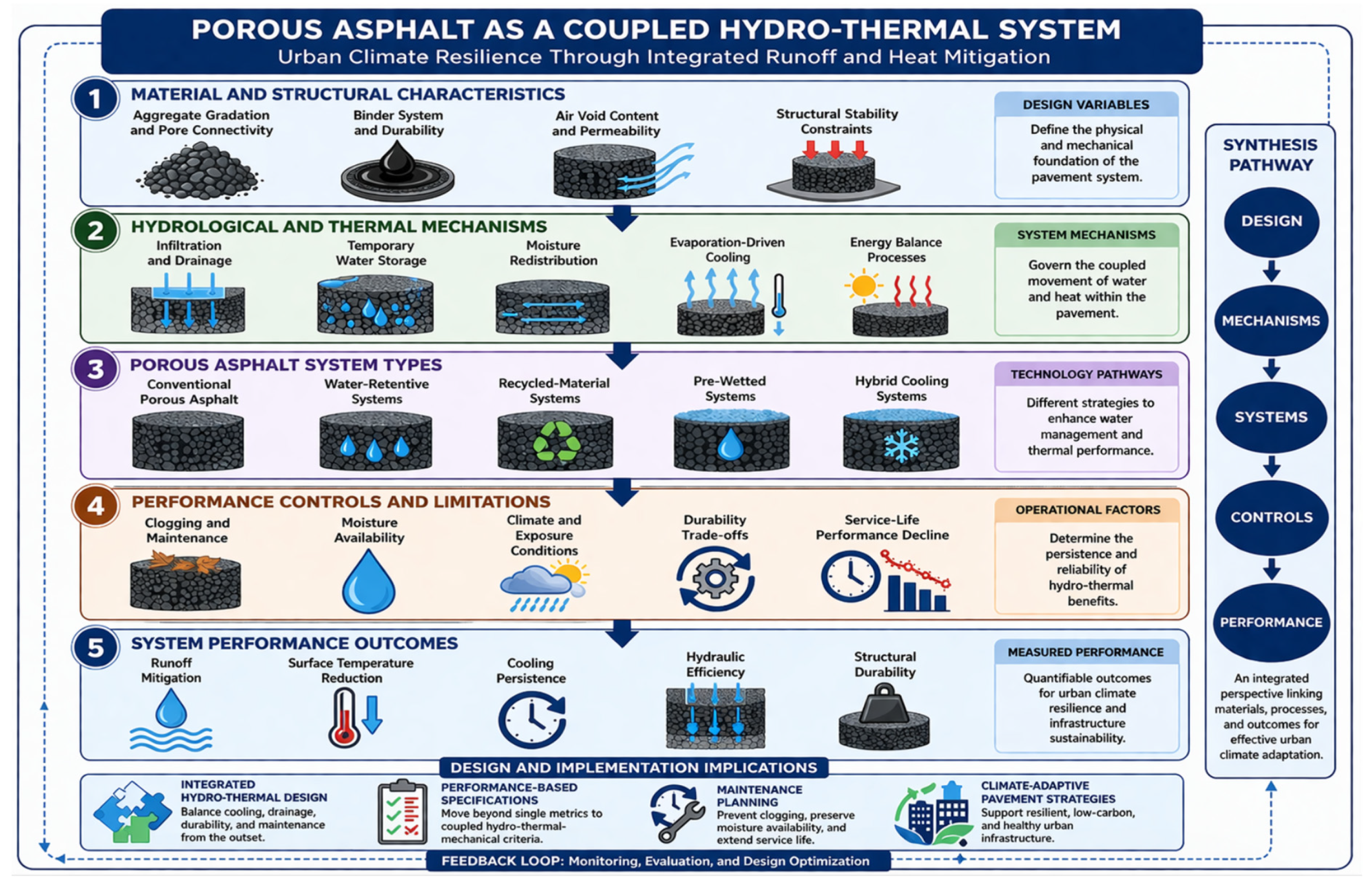
Figure 1 presents the integrated conceptual synthesis framework adopted in this review, illustrating the relationships among the material and structural characteristics, governing hydrological and thermal mechanisms, PA system configurations, operational constraints, and resulting performance outcomes. The framework organizes the reviewed literature into interconnected components and explicitly emphasizes the coupled nature of hydro-thermal processes within porous pavement systems. By linking design variables to system behavior and measurable performance indicators, the figure provides a structured representation of the interactions and dependencies that define system functionality and long-term effectiveness under varying environmental and operational conditions.
1.2. Literature Search Strategy and Review Scope
This review was developed as a narrative state-of-the-art synthesis rather than a formal systematic review. The reference base was compiled primarily from major scientific databases, including ScienceDirect and Google Scholar, using combinations of keywords related to PA pavement, evaporative cooling, UHI mitigation, stormwater management, hydro-thermal performance, and urban climate resilience. The literature coverage spans the period from 2001 to 2026, with greater emphasis placed on studies published after 2012 in order to reflect recent advancements in porous pavement technology, system design, and performance evaluation methods. Sources were selected based on their direct relevance to PA materials and structural characteristics, hydrological behavior, cooling mechanisms, evaluation approaches, climatic influences, and long-term performance trade-offs. The review relied predominantly on peer-reviewed journal publications, while also incorporating selected review articles and a limited number of additional sources, including thesis-level and conference-based publications, when they provided relevant and topic-specific evidence. This selection strategy enabled a focused synthesis of the most pertinent research while maintaining alignment with the stated objectives and scope of the review.
Several methodological limitations associated with the adopted narrative review approach should be acknowledged. Because the literature search was conducted using a defined set of databases and keyword combinations, some relevant studies indexed in alternative databases or reported in less accessible sources may not have been captured. In addition, no formal risk-of-bias assessment or quantitative meta-analysis was performed, as the purpose of this study was to provide an integrated qualitative synthesis of current knowledge rather than a statistically pooled evaluation of results. Moreover, the available evidence base in this field remains relatively specialized and context-dependent, particularly with respect to climatic conditions, pavement configurations, and operational practices. These contextual dependencies may limit the availability of directly comparable studies across regions, climates, and application scenarios. Accordingly, the findings presented in this review should be interpreted within the defined scope of this narrative synthesis, rather than as an exhaustive or systematically pooled assessment of all published research on the topic. For consistency and clarity, this review adopts standardized terminology throughout the manuscript. The term porosity is used for general discussion of pore structure, VV is used to denote air-void content, permeability refers to the intrinsic hydraulic property of the material, infiltration denotes measured water-entry behavior at the surface, and cooling performance is described using metrics that reflect the governing mechanism, magnitude, and persistence of temperature reduction.
6. Influence of Environmental and Climatic Conditions
Environmental forcing governs whether stored moisture can be converted into useful evaporative cooling and how long that effect can be sustained [
75,
76]. In addition to field and laboratory evidence, simulation research has become important for interpreting this dependence because it can isolate the coupled effects of radiation, air temperature, relative humidity, wind, wetting schedule, and pavement moisture transport under controlled boundary conditions [
6,
75]. Numerical studies therefore complement measurements by extending evaluation from observed events to scenario-based assessment of cooling duration, water demand, and climatic sensitivity [
61,
75].
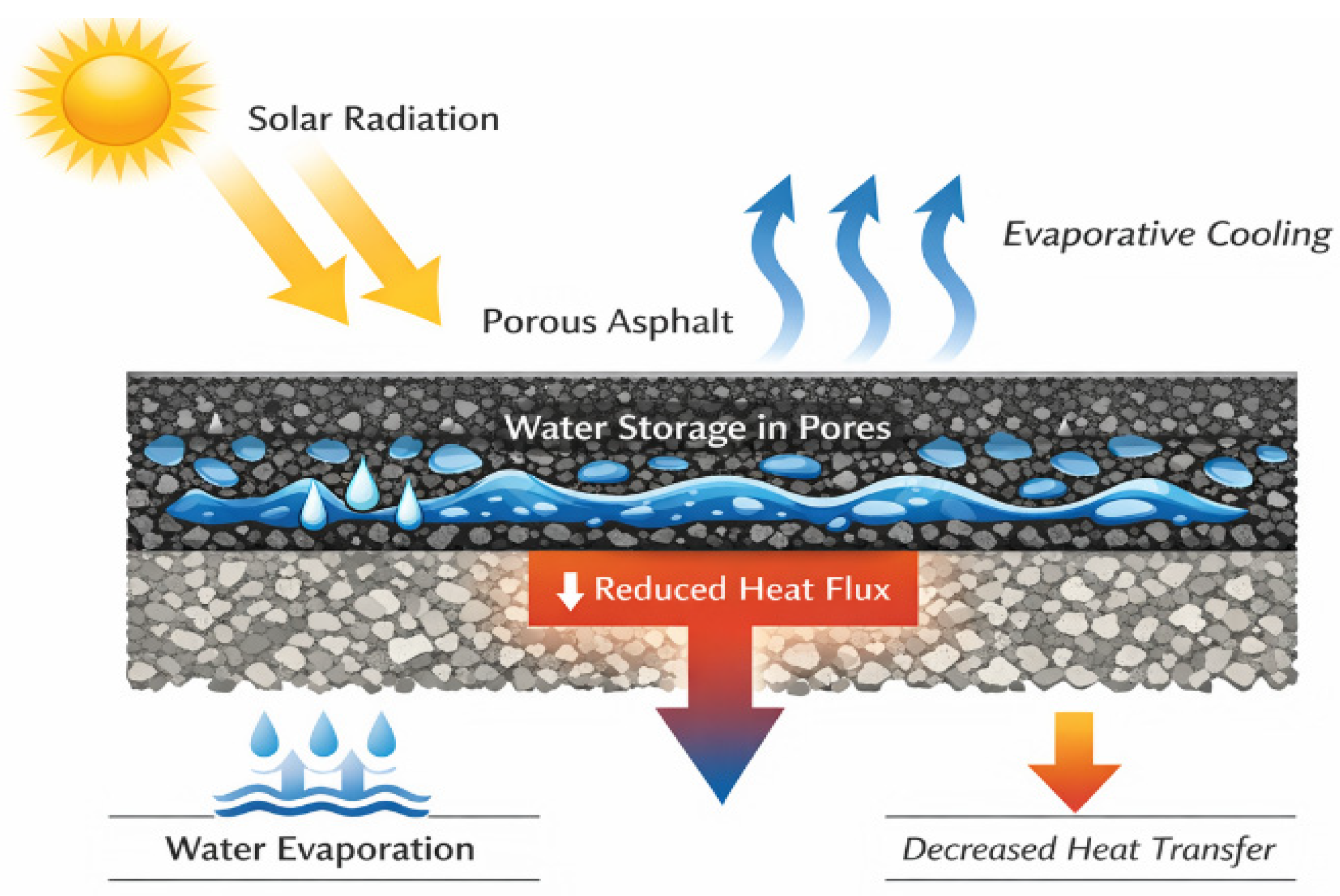
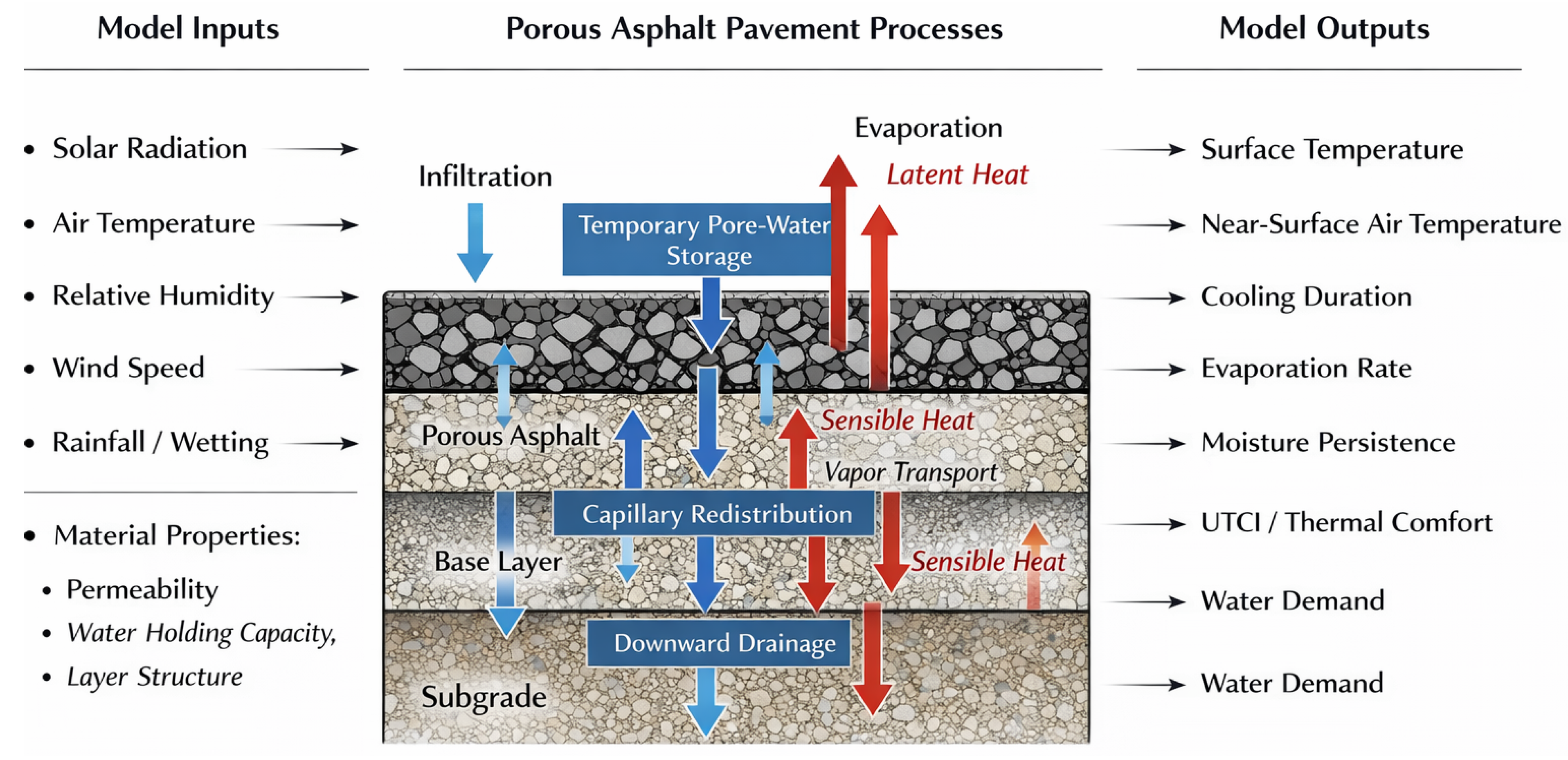
Figure 5 summarizes the simulation-based framework used to assess PA pavement under environmental and climatic conditions, showing how atmospheric forcing and pavement properties control coupled thermo-hydrological processes and the resulting performance indicators.
Watering-based cooling depends on boundary conditions and on how forcing and measurements are defined [
75,
76]. Under insolation, optimized watering cycles reduced water use by more than 80% while reducing cooling magnitude by less than 13% [
76]. Under the same conditions, measured evaporation rates were 0.31–0.41 mm/h [
76]. Smart-wetting modeling treated temperature, relative humidity, and wind as direct control variables, with tested ranges of 22–35 °C, 30–80% relative humidity, and 10 m wind speeds increasing from 0.6–2.8 m/s to more than 4 m/s [
75]. The same framework identified about 6 mm/day applied over 10 min in the morning between 08:00 and 10:00 as an effective scenario for balancing cooling and water use under the modeled conditions, rather than as a generally recommended operating rule [
75]. These results show that simulation can identify operating windows for wetting strategies that are difficult to define from field observations alone [
75].
Microclimate responses are concentrated close to the pavement surface, so sensor height and near-surface exchange conditions should be reported as part of performance evidence [
60,
76]. Field monitoring across permeable pavements with different hydraulic properties showed that irrigation primarily cooled and humidified air within 30 cm above the surface [
60]. The same evidence indicated that cooling persistence depends more on retained water availability than on permeability alone, because higher permeability accelerates drainage and shortens the wet-state duration [
60]. Under irrigated conditions, the average UTCI difference between a permeable brick and an impermeable reference decreased by 0.4 °C [
60]. In the same comparison, PA and pervious concrete systems emphasizing permeability did not show a notable thermal improvement in the surrounding environment [
60]. Additional field evidence reported that sprinkling reduced sensible-to-net-shortwave ratios and improved pedestrian-level heat-stress indicators, including black globe temperature and wet-bulb globe temperature [
77]. Street-canyon experiments further showed that local geometry modifies thermal response, which supports the use of simulation tools for examining morphology-dependent cooling under controlled urban configurations [
61].
At seasonal scale, subsurface thermal behavior contributes to persistence and depth of thermal influence [
66]. Thermal performance should be reported using explicit forcing descriptors, including radiation exposure, air temperature, relative humidity, wind or ventilation, and wetting timing [
6,
78]. This interpretation is consistent with climate-resilience reviews showing that pavement assessment under changing climate conditions increasingly relies on predictive and scenario-based approaches [
6,
73]. Rutting-resilience assessments similarly indicate that future performance cannot be separated from projected climatic loading [
78]. At the urban-network scale, pavement interventions also interact with street forms and other mitigation measures under similar meteorological backgrounds [
79]. Street-canyon evidence supports this dependence at local scale in hot and humid climates [
61]. Hydrologic boundary conditions determine when evaporative cooling is feasible, because rainfall, infiltration variability, and cold-climate stormwater functioning control rewetting frequency and moisture persistence [
29,
71]. Meteorology-dependent strategies such as watering should therefore be scaled using operating rules consistent with local water availability, maintenance capacity, and decision priorities [
75,
76,
80].
Environmental forcing does not merely modify PA performance; it determines when hydro-thermal benefit is feasible at all. The same pavement can show different cooling and runoff behavior under different radiation, humidity, wind, rainfall, and rewetting conditions, so results should not be transferred across climates without explicit forcing descriptors [
60,
75,
76]. Climate-responsive operation is therefore part of performance design, not an external adjustment made after material selection [
6,
78,
80].
7. Practical Implementation Challenges and Long-Term Performance Risks
Section 5.3 established the coupled optimization logic of PA systems, but practical deployment depends on whether that balance can be maintained under real service conditions [
24]. After construction, the pore network that supports infiltration and evaporative cooling is exposed to clogging, repeated wetting and drying, and progressive mechanical deterioration [
74]. Implementation should therefore be guided by the intended service objective. Systems aimed mainly at runoff control may prioritize rapid intake and discharge, whereas systems intended to support heat mitigation must also preserve sufficient near-surface moisture to sustain evaporation during operation [
24,
34,
60].
Cooling performance must be judged by both cooling magnitude and cooling persistence, not by peak temperature reduction alone [
75,
76]. Pre-wetted and water-charged systems can produce clear short-term cooling, but the persistence of that effect depends on retained water, atmospheric demand, and wetting timing [
60,
75,
76]. This helps explain why drainage-oriented PA, retention-enhanced PA, and hybrid systems do not show the same thermal response even when all remain hydraulically functional [
34,
60]. In practice, the design objective must therefore be defined clearly. Systems intended for heat mitigation must also preserve moisture close enough to the surface to sustain evaporation over the required cooling period [
24,
34,
60].
Another key trade-off concerns thermal benefit versus durability and structural reliability. Hydro-thermal function depends on water availability, yet repeated wetting and drying can alter binder-scale and mixture-scale behavior and accelerate damage progression [
70,
81]. Cooling-oriented operation should therefore not be assessed separately from structural performance under repeated moisture exposure and traffic loading [
70,
71]. Functional additives and retention-enhancing concepts may improve one target, but they can also introduce mechanical, compatibility, or durability limits if they are not evaluated under coupled moisture–temperature conditions [
71,
82]. The most reliable systems are therefore those that balance drainage, moisture retention, and structural resistance within one design framework [
34,
60].
Maintenance realism is equally important because many PA systems show strong initial hydraulic and thermal performance, then lose efficiency when inspection and cleaning are delayed [
24,
83]. In PAC, sediment deposition alters internal flow paths and gradually reduces effective permeability, even when the original mixture design is appropriate [
74,
83]. This decline is not only hydraulic. Partial blockage can also reduce rewetting efficiency and moisture redistribution, which weakens evaporative cooling before infiltration capacity is fully lost [
24,
60,
74]. Maintenance should therefore be treated as part of the design strategy, not only as a post-construction requirement [
24]. Surface structure should be selected with the expected sediment type, loading rate, and cleaning feasibility of the target site in mind [
74].
These constraints also explain why results differ across studies. Some studies assess systems designed for rapid hydraulic conveyance, while others evaluate retention-based or wetted systems intended to prolong evaporation [
34,
60,
75]. Thermal response also depends strongly on radiation, air temperature, humidity, wind, and wetting schedule [
60,
75,
76]. Field performance is therefore shaped not only by mixture design, but also by climate, exposure history, and maintenance conditions. A robust implementation framework should accordingly combine hydro-thermal performance indicators, clogging susceptibility, structural acceptability, and maintenance planning so that runoff control and thermal mitigation can be sustained together over time [
24,
25,
74].
Long-term PA performance depends on whether hydraulic access, moisture availability, and structural acceptability can be sustained together under real service conditions [
24,
25,
74]. This is why implementation outcomes differ across studies: the controlling variable is not mixture design alone, but the interaction among climate, sediment loading, wetting history, and maintenance realism [
34,
60,
75]. Practical deployment should therefore be based on service-life balance rather than on strong initial performance alone [
24,
74,
83].



 ,
,