Research on Efficient Dewatering Mechanism of Water-Rich Shield Tunnel Muck Toward Sustainable Disposal


Abstract
1. Introduction
2. Materials and Methods
2.1. Materials
2.2. Preparation of Shield Tunnel Muck and Test Procedures
3. Results and Discussion
3.1. Effect of Dehydrating Agent Ratio on the Moisture Content
3.2. pH
3.3. TOC
3.4. Dehydration Mechanism of Shield Tunnel Muck
3.4.1. Role of Lime on Dewatering of Shield Tunnel Muck
3.4.2. Role of Cement on Dewatering of Shield Tunnel Muck
3.4.3. Role of Phosphogypsum on Dewatering of Shield Tunnel Muck
3.4.4. Role of GGBFS on Dewatering of Shield Tunnel Muck
3.4.5. Role of NS on Dewatering of Shield Tunnel Muck
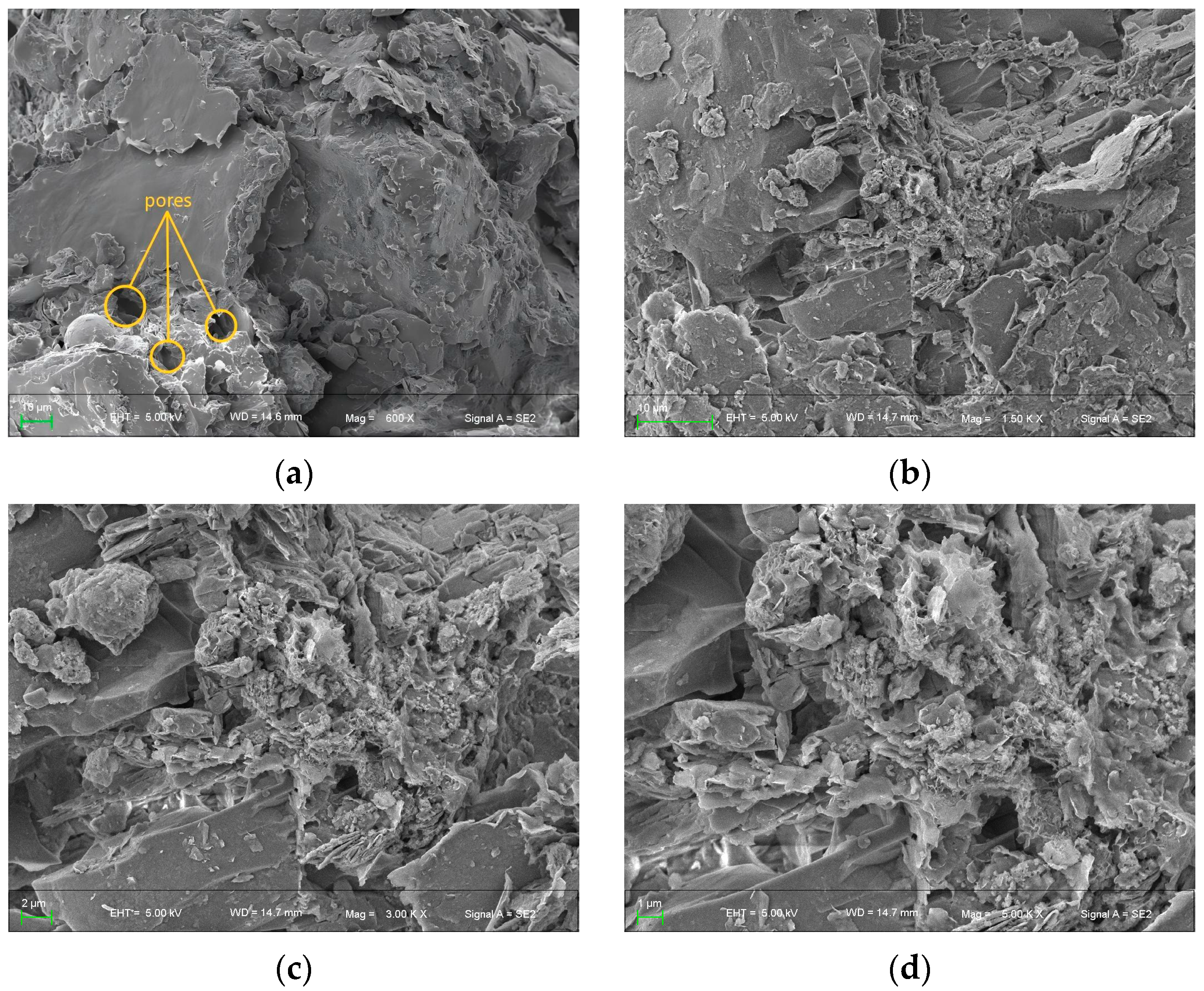
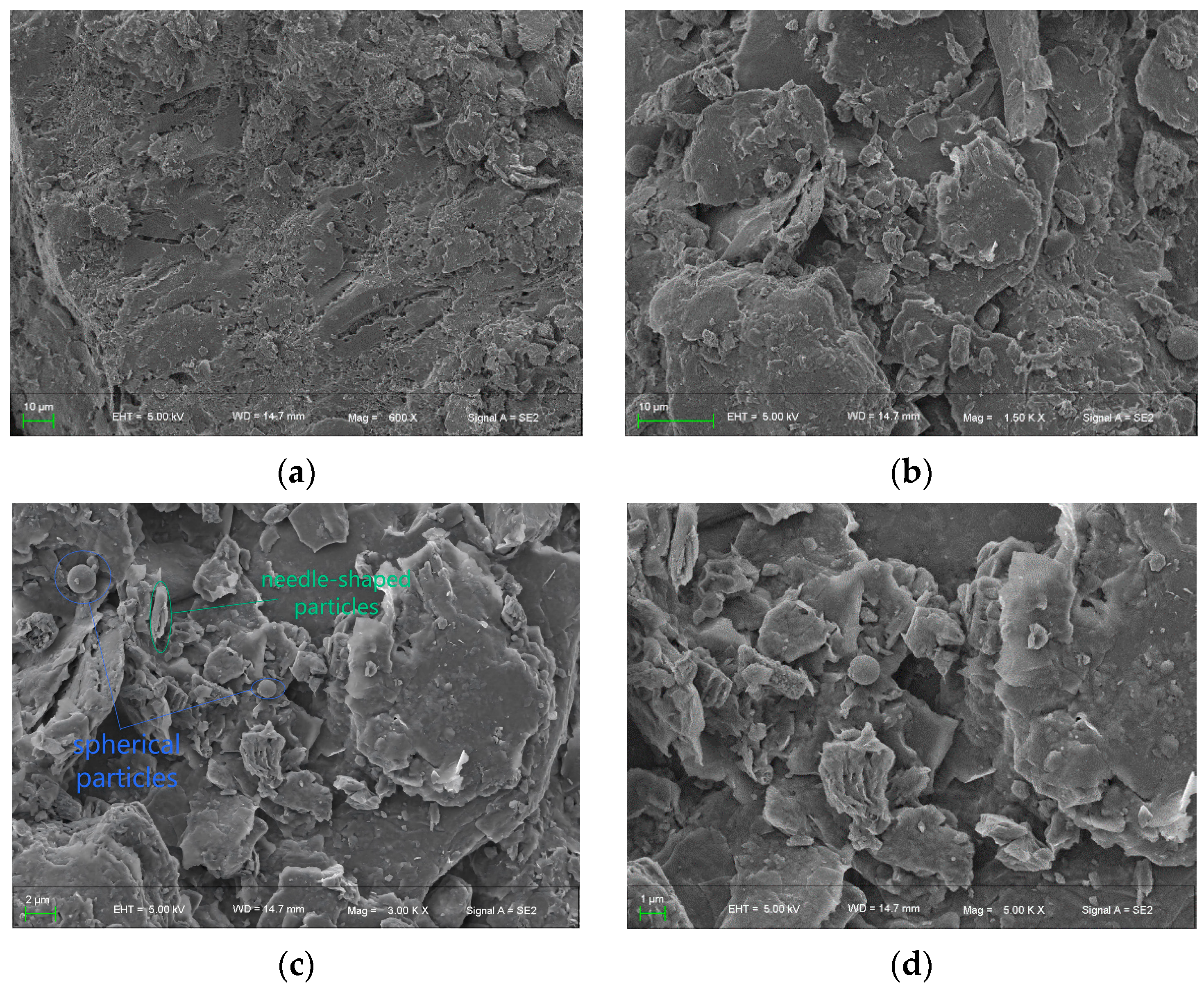
3.5. SEM Analysis
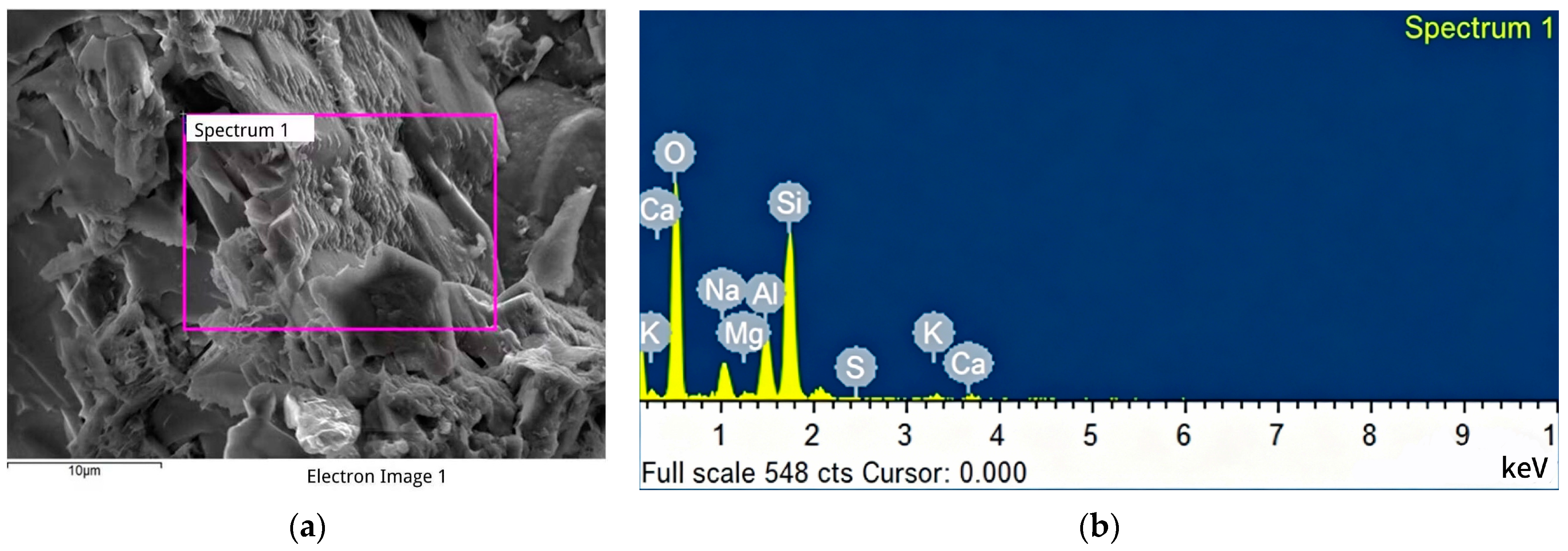
3.6. EDS Analysis
4. Conclusions
- (1)
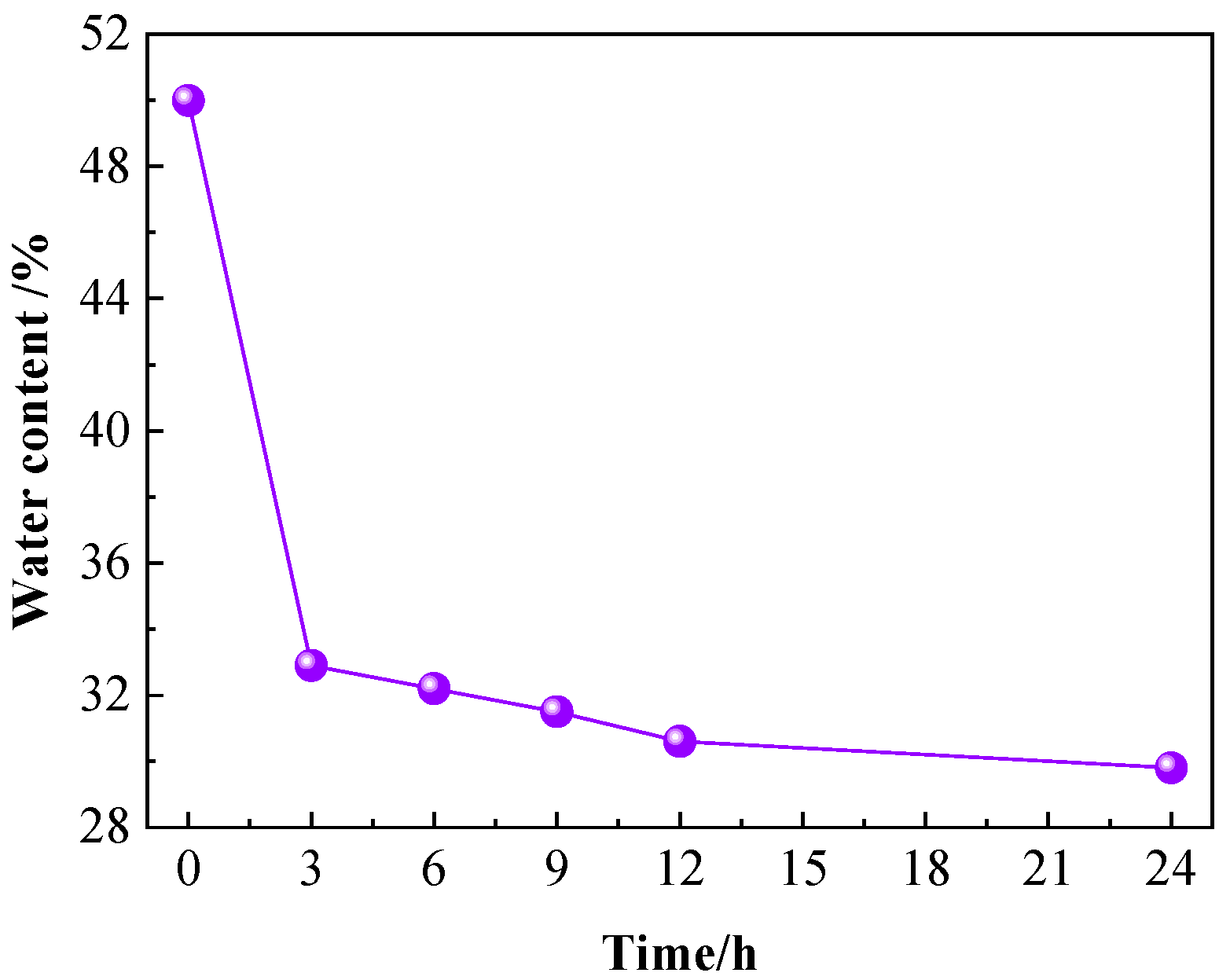
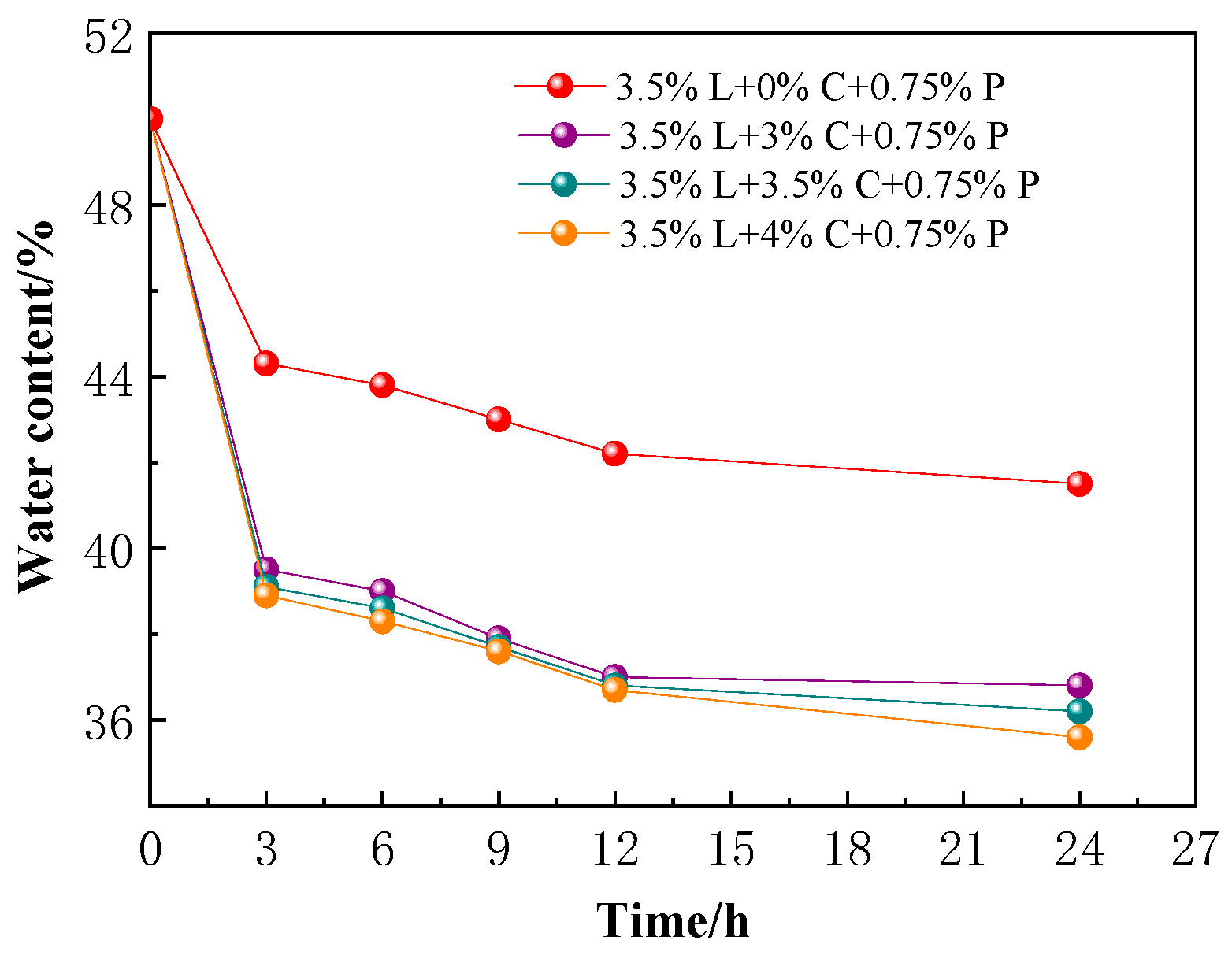
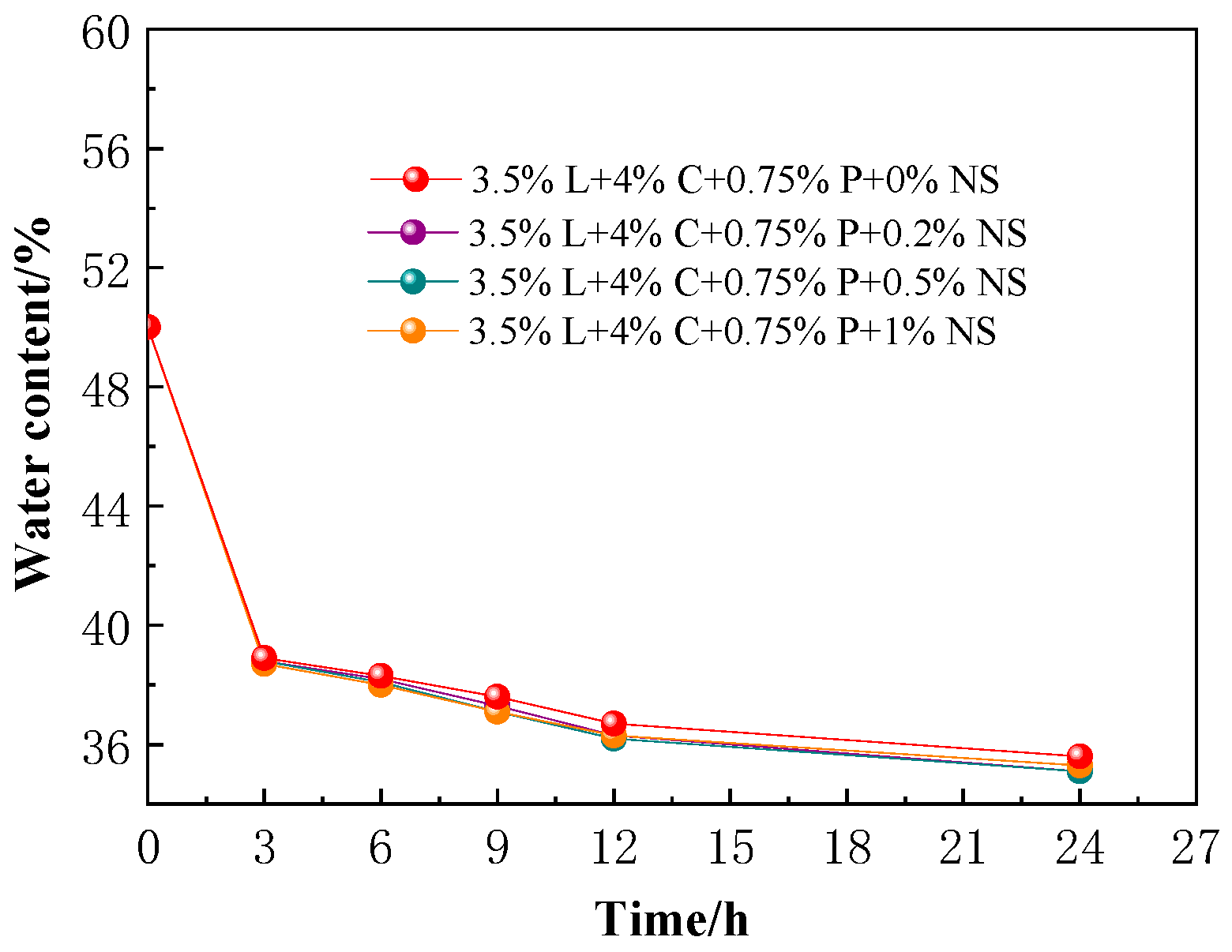
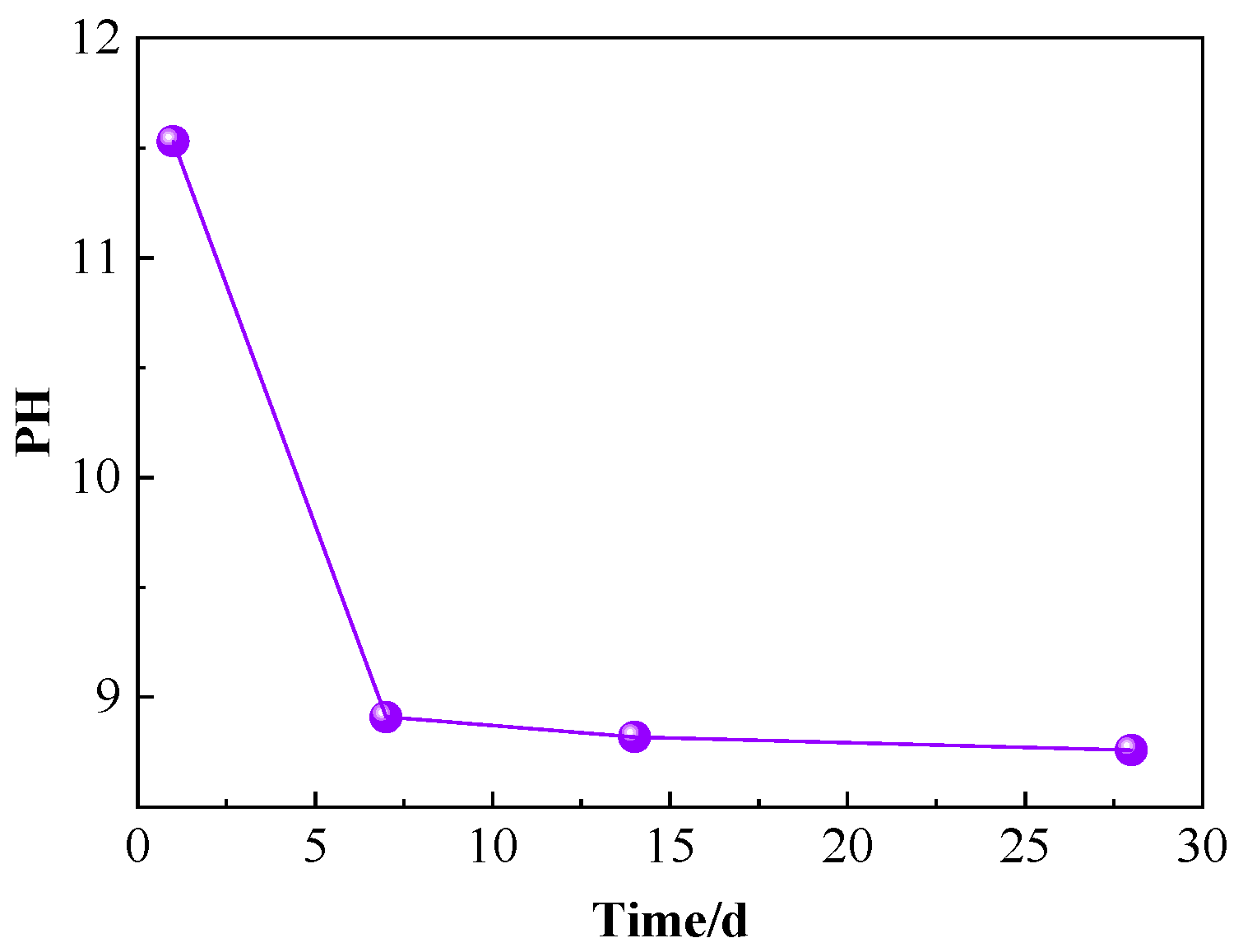
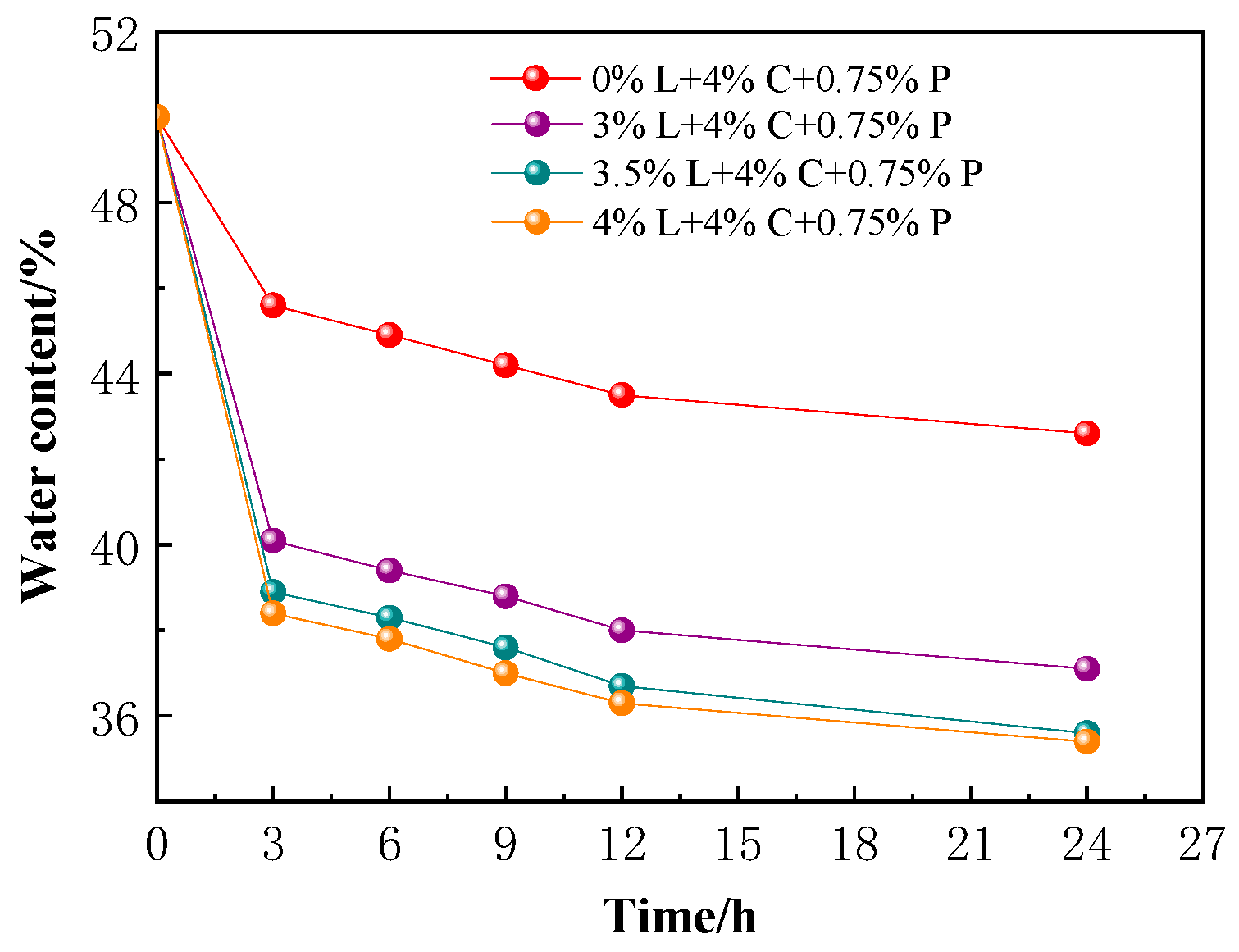
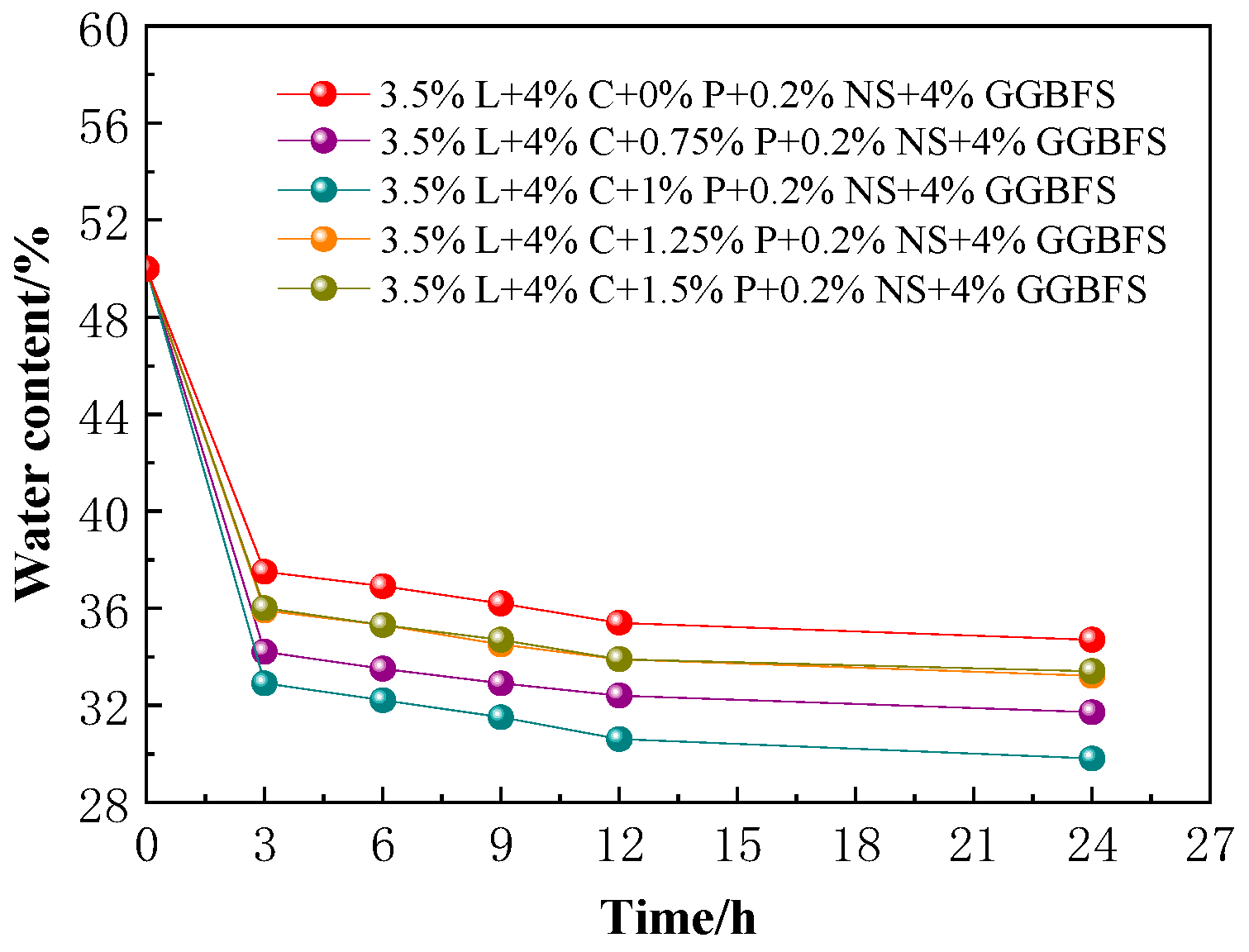
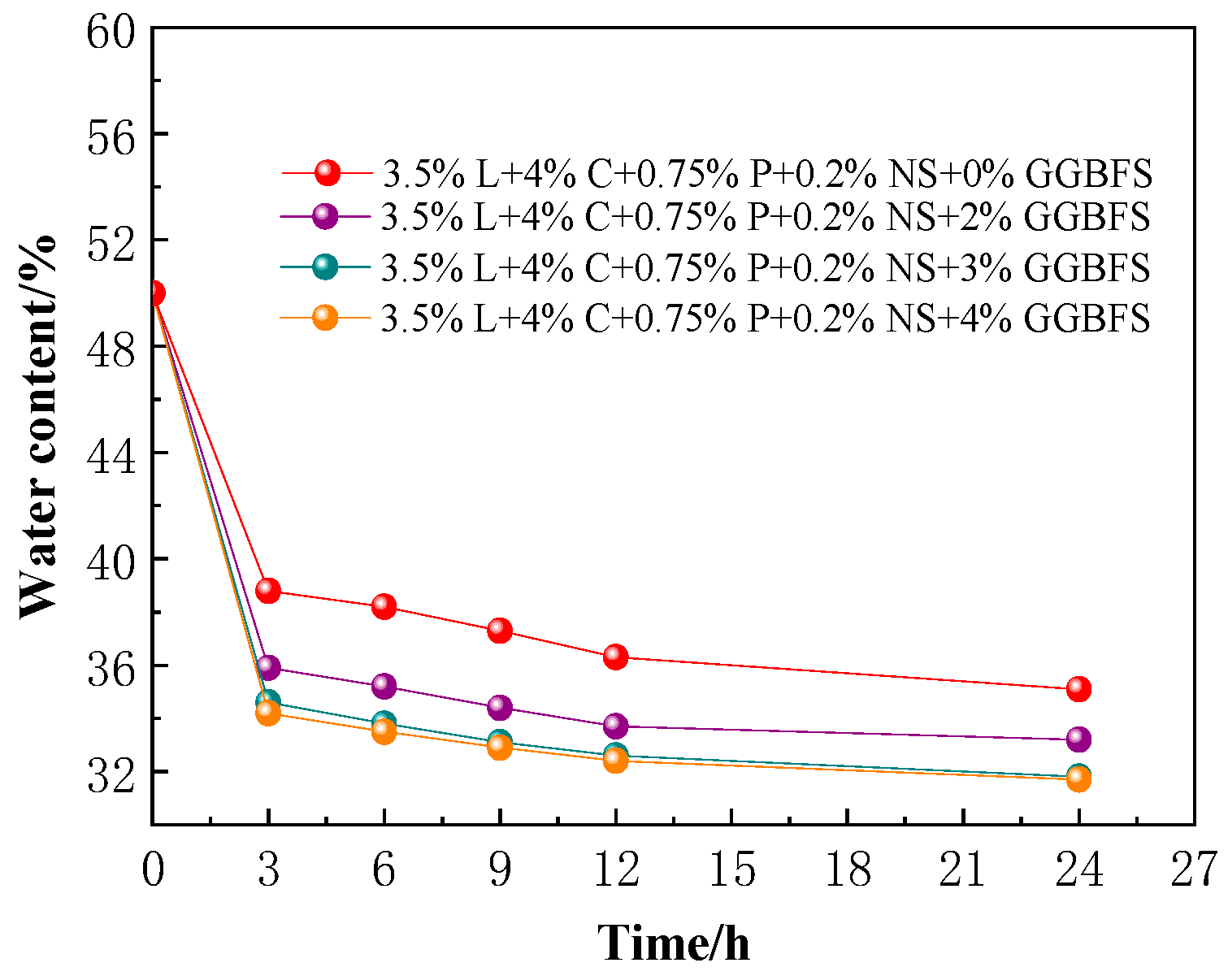
- Under the condition of an initial moisture content of 50%, the ideal content of the dewatering agent is 3.5 percent lime, 4 percent cement, 1 percent phosphogypsum, 0.2 percent nano-SiO2, and 4 percent ground granulated blast furnace slag. The water content of the water loaded shield tunnel muck quickly changed from 50 percent to 32.9 percent after 3 h of dewatering. Meanwhile, the pH value of shield tunnel muck decreased from 11.53 to 8.91 after 7 d of dewatering, and the organic carbon content of the muck after 15 d of dewatering was below the detection limit of 1 g/kg. It should be noted that the change in TOC content only reflects the total amount of foaming agent remaining in the slag and cannot directly prove that it is permanently fixed. Its leaching risk under long-term service or different environmental conditions still needs further verification. In addition, this mix ratio is based on an initial moisture content of 50%. For shield tunnel slag with other initial moisture contents or different mineral compositions, further verification is required in actual engineering applications.
- (2)
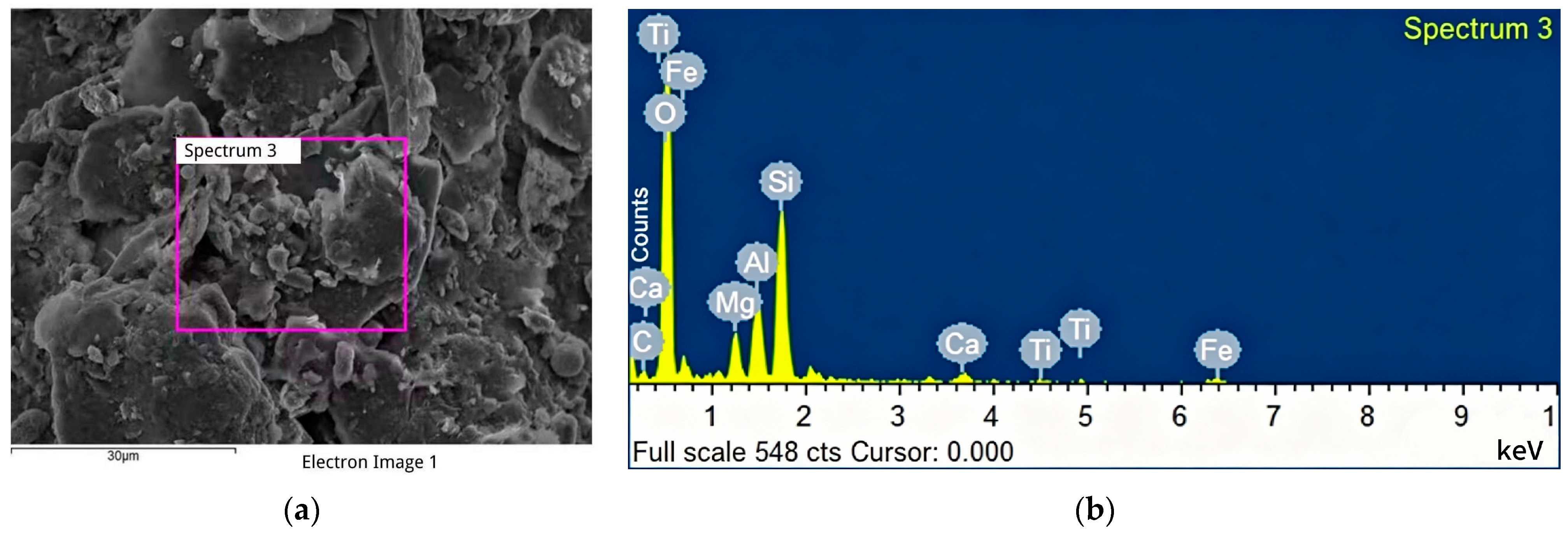
- The dewatering effect of water-rich shield tunnel slag with the addition of a dewatering agent is significant, mainly attributed to the synergistic effect of multiple components. Among the hydration products generated by the hydration of lime, cement, and blast furnace slag, C-A-S-H (calcium aluminosilicate hydrate) and C-A-H (hydrated calcium aluminate) gels are dominant, which can effectively bind the slag particles. At the same time, AFt crystals generated by the reaction of phosphogypsum and calcium aluminate in cement fill the gaps between soil particles. Together, they expel free water and some weakly bound water between slag particles, thereby effectively reducing the moisture content of the shield tunnel slag. Although the content of traditional C-S-H gel in this micro-region is relatively low, C-A-S-H gel itself has good cementing properties and a dense three-dimensional network structure, which can ensure the long-term structural stability of the solidified body.
- (3)
- Although the nano-SiO2 content has a limited influence on the water content of the muck, nano-SiO2 acts as a pozzolanic catalyst that accelerates the hydration reactions of lime and cement. Moreover, nano-SiO2 can interact with water molecules and rapidly adsorb the water expelled from the interparticle pores, leading to a rapid reduction in the fluidity of the shield tunnel muck.
- (4)
- The composite dewatering agent fully exerts the synergistic effects of its components, constructing a multi-mechanism dewatering system of “hydration gel + AFt filling + nano-catalysis.” While significantly reducing the moisture content, the system effectively mitigates environmental risks during muck disposal by lowering pH values and stabilizing organic matter (fixing foaming agents). This provides robust support for the subsequent disposal and resource utilization of shield tunnel muck.
Author Contributions
Funding
Institutional Review Board Statement
Informed Consent Statement
Data Availability Statement
Acknowledgments
Conflicts of Interest
Abbreviations
| TBM | Tunnel boring machine |
| EPB | Earth pressure balance |
| CP | Cationic polyacrylamide |
| GS | Grafted starch |
| DME | Liquid dimethyl ether |
| NS | Nano-SiO2 |
| GGBFS | Ground granulated blast furnace slag |
| TOC | Total organic carbon |
| SEM | Scanning electron microscopy |
| EDS | Energy-dispersive X-ray spectroscopy |
References
- Jiao, N.; Wan, X.; Ding, J.; Zhang, X.; Xue, C. Mechanical properties and microstructure of lime-treated shield tunnel muck improved with carbide slag and soda residue. Constr. Build. Mater. 2024, 428, 136419. [Google Scholar] [CrossRef]
- Zhang, J.; Li, H.; Yang, H.; Wang, H.; Han, S. An overview on the “reuse potential” for managing shield tunnel spoils as resources. J. China Foreign Highw. 2022, 42, 1–11. [Google Scholar] [CrossRef]
- Jiang, D.; Luo, Z.; Kang, C.; Sun, Y.; Yang, H. Research progress on dewatering treatment and resource utilization of shield tunneling slurry. Environ. Chem. 2025, 44, 2617–2638. [Google Scholar]
- Oggeri, C.; Fenoglio, T.M.; Vinai, R. Tunnelling muck classification: Definition and application. In Proceedings of the ITA-AITES World Tunnel Congress 2017, Bergen, Norway, 9–15 June 2017. [Google Scholar]
- Riviera, P.P.; Bellopede, R.; Marini, P.; Bassani, M. Performance-based re-use of tunnel muck as granular material for subgrade and sub-base formation in road construction. Tunn. Undergr. Space Technol. 2014, 40, 160–173. [Google Scholar] [CrossRef]
- Cui, W.; Liu, D.; Song, H.-F.; Pu, G.-J. Development and experimental study on environmental slurry for slurry shield tunneling. Constr. Build. Mater. 2019, 216, 416–423. [Google Scholar] [CrossRef]
- Kalumba, D.; Glendinning, S.; Rogers, C.D.F.; Tyrer, M.; Boardman, D.I. Dewatering of tunneling slurry waste using electrokinetic geosynthetics. J. Environ. Eng. 2009, 135, 1227–1236. [Google Scholar] [CrossRef]
- Khazaie, A.; Mazarji, M.; Samali, B.; Osborne, D.; Minkina, T.; Sushkova, S.; Mandzhieva, S.; Soldatov, A. A review on coagulation/flocculation in dewatering of coal slurry. Water 2022, 14, 918. [Google Scholar] [CrossRef]
- Wang, S.Y.; Guan, S.X.; Ni, Z.L.; Yang, Z.B. Review on dehydration technology of shield tunnel spoil. Tunn. Constr. 2024, 44, 35–52. [Google Scholar]
- Li, S.; Huang, C.; Zheng, H.; Gan, H.; Li, S.; Jiang, Y.; Yang, Z. Study on the intensive-efficient separation method and recycling utilization technology of waste shield slurry. Arab. J. Sci. Eng. 2025, 50, 16917–16932. [Google Scholar] [CrossRef]
- Tauer, A.; Posch, H.; Kager, M.; Schubel, D. Recycling or landfill-experience based on the example of Koralm Tunnel, Contract Kat2 from design to construction. Geomech. Tunn. 2017, 10, 700–710. [Google Scholar] [CrossRef]
- Yamana, M.; Tomizawa, Y.; Fujiwara, T.; Mizuta, K.; Mizuno, K.; Inui, T.; Katsumi, T.; Kamon, M. Management of the soils discharged from shield tunnel excavation. In Proceedings of the 8th International Congress on Environmental Geotechnics, Singapore, 28 October–1 November 2018; Springer: Singapore, 2019; Volume 1, pp. 374–381. [Google Scholar] [CrossRef]
- Zhang, F.; Kong, C.; Sun, S.; Li, X.; Liu, J.; Chen, Q. Study on preparation and properties of novel ternary flocculant for rapid separation of underground continuous wall waste mud. Pigment. Resin Technol. 2020, 49, 421–429. [Google Scholar] [CrossRef]
- Zhou, X.; Sun, X.; Li, Y.; Liu, H.; Liang, S. Research on high-efficiency dewatering and reduction treatment of shield waste residue based on DME phase transition. Mod. Tunn. Technol. 2021, 58, 46–50. [Google Scholar] [CrossRef]
- Shi, Z.; Wu, Q.; Zhao, X.; Yang, X.; Zhang, Y.; Huang, X. Flocculation-pressure filtration and dewatering performance of waste shield mud based on orthogonal experiment. J. China Three Gorges Univ. (Nat. Sci.) 2022, 44, 21–26. [Google Scholar] [CrossRef]
- Zhang, S.; Yang, D.; Li, S.S.; Hou, Y.K.; Li, H. Effects of chemical water absorption and flocculation on rheological properties of shield muck. Constr. Technol. 2022, 51, 110–113. [Google Scholar] [CrossRef]
- Zhang, Q.; Zhao, Y.; Zhang, D.; Chen, J.; Lu, J.; Zhang, Y. Research on green and efficient dewatering of shield tunneling slag using liquid DME-TTFP. Tunn. Constr. 2023, 43, 178–185. [Google Scholar]
- Huang, X.; Xie, X.; Liu, Z.; Huang, A.; Wang, Z.; Wang, R.; Zhao, X. Fabrication and analysis of an effective composite desiccant for the rapid dehydration of shield waste slurry. KSCE J. Civ. Eng. 2023, 27, 3230–3239. [Google Scholar] [CrossRef]
- Sun, X.; Chen, Z.; Guo, K.; Fei, J.; Dong, Z.; Xiong, H. Geopolymeric flocculation-solidification of tail slurry of shield tunneling spoil after sand separation. Constr. Build. Mater. 2023, 374, 130954. [Google Scholar] [CrossRef]
- Wang, D.; Min, F.; Lyu, H.; Chen, J.; Wang, B.; Zhang, J. Recycling waste sand from slurry shield tunneling: A sustainable filter aid for waste slurry dehydration. J. Clean. Prod. 2023, 383, 135387. [Google Scholar] [CrossRef]
- Fang, Y.; Yao, Y.; Wang, J.; Li, B.; Dou, L.; Wei, L.; Zhuo, B.; Zhang, W.; Hu, X. Effective dewatering and resourceful utilization of high-viscosity waste slurry through magnetic flocculation. Constr. Build. Mater. 2024, 425, 136014. [Google Scholar] [CrossRef]
- JTG 3430-2020; Test Methods of Soils for Highway Engineering. People’s Communications Press: Beijing, China, 2020.
- He, W.; Liu, P. The Undersea Tunnel on Qingdao Metro Line 8. Engineering 2018, 4, 167–169. [Google Scholar] [CrossRef]
- HJ 695-2014; Soil Determination of Organic Carbon Combustion Oxidation Nondispersive Infrared Absorption Method. China Standards Press: Beijing, China, 2014.
- Zhang, Y.; Zhang, J.; Yuan, Y.; Sun, W. Experimental study of coastal petroleum-contaminated soil using nano-SiO2 and lime as additives. Rock Soil Mech. 2023, 44, 259–267. [Google Scholar] [CrossRef]
- JTG D30-2015; Specifications for Design of Highway Subgrade. People’s Communications Press: Beijing, China, 2015.
- Dong, Z.; Lv, G.; Sun, S.; Chen, Z.; Liu, G. Environmental impact and green treatment technology of chemical additives in shield muck. J. Munic. Technol. 2023, 41, 1–7. [Google Scholar] [CrossRef]
- Wang, Q.; Cui, J. Study on strength characteristics of solidified contaminated soil under freeze-thaw cycle conditions. Adv. Civ. Eng. 2018, 2018, 8654368. [Google Scholar] [CrossRef]
- Sun, X.; Chen, Z.; Sun, Z.; Wu, S.; Guo, K.; Dong, Z.; Peng, Y. High-efficiency utilization of waste shield slurry: A geopolymeric flocculation-filtration-solidification method. Constr. Build. Mater. 2023, 387, 131569. [Google Scholar] [CrossRef]
- Sun, X.; Zhang, H.; Han, Z.; Huang, S.; Wu, S.; Tian, Z.; Chen, X.; Wang, C.; Dong, Z. Mechanism of geopolymeric solidification in shield-tunnelling slurry from diverse sources: The role of bentonite adsorption in influencing the reaction process. Constr. Build. Mater. 2024, 431, 136627. [Google Scholar] [CrossRef]
- Zhang, S. Study on Performance and Microstructure of Shield Muck Solidified by Alkali-Activated Blast Furnace Slag. Master’s Thesis, Xiangtan University, Xiangtan, China, 2020. [Google Scholar] [CrossRef]
- Lv, Z.; Li, Y.; Yang, J.; Cao, X.; Zhang, J.; Liu, H.; Wang, G. Preparation of solid waste-based porous materials by physical foaming to capture and store CO2. Environ. Eng. 2023, 41, 38–46. [Google Scholar] [CrossRef]






| Relative Density of Soil Particles | Soil Particle Content/% | Liquid Limit /% | Plastic Limit /% | Plasticity Index | MDD 1 /(g·cm−3) | OMC 1 /% | Moisture Content /% | ||
|---|---|---|---|---|---|---|---|---|---|
| Sand (2–0.075 mm) | Silt (0.075–0.002 mm) | Clay (<0.002 mm) | |||||||
| 2.71 | 66.8 | 28.4 | 4.8 | 36.5 | 17.2 | 19.3 | 1.84 | 8.17 | 50 |
| Chemical Composition | GGBFS/% | Cement/% | Lime/% | Phosphogypsum/% |
|---|---|---|---|---|
| SiO2 | 34.5 | 24.99 | 1.8 | 19.68 |
| Al2O3 | 17.7 | 8.26 | 1.3 | 6.44 |
| CaO | 34.0 | 51.42 | 88.0 | 37.71 |
| MgO | 6.01 | 3.71 | 2.35 | - |
| SO3 | 1.64 | 2.51 | - | 28.93 |
| Fe2O3 | 1.03 | 4.03 | - | - |
| TiO2 | 1.9 | - | - | - |
| Other | 3.22 | 5.08 | 6.55 | 7.24 |
| Experimental Group Number | GGBFS Content /% | Cement Content /% | Lime Content /% | Phosphogypsum Content /% | NS Content /% |
|---|---|---|---|---|---|
| T1 | 0 | 4 | 3 | 0.75 | 0 |
| T2 | 0 | 4 | 3.5 | 0.75 | 0 |
| T3 | 0 | 4 | 4 | 0.75 | 0 |
| T4 | 0 | 3.5 | 3.5 | 0.75 | 0 |
| T5 | 0 | 4 | 3.5 | 0.75 | 1 |
| T6 | 0 | 4 | 3.5 | 0.75 | 0.5 |
| T7 | 0 | 4 | 3.5 | 0.75 | 0.2 |
| T8 | 2 | 4 | 3.5 | 0.75 | 0.2 |
| T9 | 3 | 4 | 3.5 | 0.75 | 0.2 |
| T10 | 4 | 4 | 3.5 | 0.75 | 0.2 |
| T11 | 4 | 4 | 3.5 | 1 | 0.2 |
| T12 | 4 | 4 | 3.5 | 1.25 | 0.2 |
| T13 | 4 | 4 | 3.5 | 1.5 | 0.2 |
| T14 | 4 | 4 | 3.5 | 1 | 0.1 |
| Experimental Group Number | Water Content/% | ||||
|---|---|---|---|---|---|
| 3 h | 6 h | 9 h | 12 h | 24 h | |
| T1 | 40.1 | 39.4 | 38.8 | 38.0 | 37.1 |
| T2 | 38.9 | 38.3 | 37.6 | 36.7 | 35.6 |
| T3 | 38.4 | 37.8 | 37.0 | 36.3 | 35.4 |
| T4 | 39.1 | 38.6 | 37.7 | 36.8 | 36.2 |
| T5 | 38.7 | 38.0 | 37.1 | 36.3 | 35.3 |
| T6 | 38.8 | 38.1 | 37.1 | 36.2 | 35.1 |
| T7 | 38.8 | 38.2 | 37.3 | 36.3 | 35.1 |
| T8 | 35.9 | 35.2 | 34.4 | 33.7 | 33.2 |
| T9 | 34.6 | 33.8 | 33.1 | 32.6 | 31.8 |
| T10 | 34.2 | 33.5 | 32.9 | 32.4 | 31.7 |
| T11 | 32.9 | 32.2 | 31.5 | 30.6 | 29.8 |
| T12 | 35.9 | 35.3 | 34.5 | 33.9 | 33.2 |
| T13 | 36.0 | 35.3 | 34.7 | 33.9 | 33.4 |
| T14 | 33.4 | 32.9 | 32.1 | 31.3 | 30.6 |
| Sample Name | TOC Content/(g/kg) | |||
|---|---|---|---|---|
| 1 d | 3 d | 7 d | 15 d | |
| Dehydrated Shield Muck | 5.75 | 1.56 | 1.1 | ≤1.0 (Limit of detection) |
| Additives | Regression Equation | R2 | F-Value | p-Value | Significance Level |
|---|---|---|---|---|---|
| L | 0.986 | 224.6 | <0.001 | Significant (*) | |
| C | 0.994 | 503.3 | <0.001 | Significant (*) | |
| P | 0.092 | 0.32 | <0.001 | Significant (*) | |
| GGBS | 0.931 | 41.65 | 0.002 | Moderate (ns) | |
| NS | −0.349 | 0.224 | 0.38 | Insignificant (ns) |
Disclaimer/Publisher’s Note: The statements, opinions and data contained in all publications are solely those of the individual author(s) and contributor(s) and not of MDPI and/or the editor(s). MDPI and/or the editor(s) disclaim responsibility for any injury to people or property resulting from any ideas, methods, instructions or products referred to in the content. |
© 2026 by the authors. Licensee MDPI, Basel, Switzerland. This article is an open access article distributed under the terms and conditions of the Creative Commons Attribution (CC BY) license.
Share and Cite
Zhang, Y.; Xu, Y.; Tao, Y.; Yi, Q.; Wu, F. Research on Efficient Dewatering Mechanism of Water-Rich Shield Tunnel Muck Toward Sustainable Disposal. Sustainability 2026, 18, 3829. https://doi.org/10.3390/su18083829
Zhang Y, Xu Y, Tao Y, Yi Q, Wu F. Research on Efficient Dewatering Mechanism of Water-Rich Shield Tunnel Muck Toward Sustainable Disposal. Sustainability. 2026; 18(8):3829. https://doi.org/10.3390/su18083829
Chicago/Turabian StyleZhang, Yanmei, Yujie Xu, Yingying Tao, Qingzhe Yi, and Fuxin Wu. 2026. "Research on Efficient Dewatering Mechanism of Water-Rich Shield Tunnel Muck Toward Sustainable Disposal" Sustainability 18, no. 8: 3829. https://doi.org/10.3390/su18083829
APA StyleZhang, Y., Xu, Y., Tao, Y., Yi, Q., & Wu, F. (2026). Research on Efficient Dewatering Mechanism of Water-Rich Shield Tunnel Muck Toward Sustainable Disposal. Sustainability, 18(8), 3829. https://doi.org/10.3390/su18083829