Article

Twenty Years of Wetland Monitoring: Aquatic Vegetation as an Indicator of Ecological Value in Andalusia (Southern Spain)


by
Gema García-Rodríguez
1,†,
Juan Diego Gilbert
1,2,†,
Fernando Ortega
1,
Víctor Cid-Gaitán
3,
Manuel Rendón-Martos
1 and
Francisco Guerrero
1,2,*
1
Departamento de Biología Animal, Biología Vegetal y Ecología, Universidad de Jaén, Campus de Las Lagunillas, s/n, 23071 Jaén, Spain
2
Centro de Estudios Avanzados en Ciencias de la Tierra, Energía y Medio Ambiente, Universidad de Jaén, Campus de Las Lagunillas, s/n, 23071 Jaén, Spain
3
Sociedad Ibérica para el Estudio y Conservación de los Ecosistemas (SIECE), Polígono Industrial Los Jarales, C/Mina Alcolea, s/n, 23700 Jaén, Spain
*
Author to whom correspondence should be addressed.
These authors contributed equally to this work.
Sustainability 2026, 18(8), 3807; https://doi.org/10.3390/su18083807
Submission received: 5 March 2026 / Revised: 7 April 2026 / Accepted: 9 April 2026 / Published: 11 April 2026

Abstract

Aquatic macrophytes constitute essential bioindicators of the ecological status of Mediterranean wetlands. We evaluated 136 Andalusian wetlands across four biogeographical regions (Sierra Morena, Betic Ranges, Guadalquivir Valley, and Coastal Zone) by contrasting two methodological approaches. We compared a standard biological valuation index, based on hydrophyte valuation and total species richness, with a biogeographical assessment focused strictly on the originality, singularity, and integrity of hydrophyte assemblages. Results revealed a critical nonlinear decoupling between both metrics. Traditional valuation prioritized the Coastal and Guadalquivir zones, inflating the value of communities saturated by widespread taxa and masking their lower structural integrity. Conversely, the biogeographical analysis identified Sierra Morena as the reservoir of highest structural stability despite its natural species poverty. Furthermore, residual analysis exposed highly original hidden jewels systematically undervalued by standard protocols. Since richness-dependent metrics risk neglecting unique hydrophyte components, we propose a dual conservation strategy integrating irreplaceability and structural integrity. Ultimately, this framework provides actionable insights for the sustainable management of Mediterranean aquatic biodiversity, aligning conservation practices with global ecological sustainability goals. We caution that management decisions based solely on richness thresholds may inadvertently prioritize common habitats over functionally unique but species-poor refugia.

1. Introduction

Wetlands are ecosystems of high ecological value that provide essential ecosystem services and refuge for threatened species, serving as key elements for biodiversity conservation [1,2]. Beyond their biological importance, they hold significant economic, historical, and cultural value [3,4,5]. Despite all the benefits they provide, comprehensive long-term knowledge about the structural and functional dynamics of these ecosystems remains incomplete globally, and continuous monitoring is particularly scarce in Mediterranean regions [6].
In the context of the Iberian Peninsula, Andalusia represents a typical Mediterranean region. It contains approximately 17% of Spain’s water bodies, representing 56% of the national wetland surface area [7], most of which are shallow systems. These sites exhibit high ecological diversity, and some are considered unique ecosystems within the scope of the European Union [8]. In these shallow environments, macrophytes play a fundamental functional and structural role, acting as sources of organic carbon, food, and habitat for various groups of organisms [9,10,11,12,13]. Apart from their intrinsic floral value, macrophytes are recognized as effective bioindicators [14,15]. While the application of biological indicators is required by the European Water Framework Directive 2000/60/EC; the long-term assessments of shallow Mediterranean wetlands using specific conservation and rarity indices remains infrequent in Spain [16].
Mediterranean wetlands are highly dependent on water availability, encompassing a gradient ranging from ephemeral to permanent systems [6]. Naturally, many Andalusian wetlands are characterized by alternating flooding and desiccation phases with marked interannual variability [6]. Although these ecosystems possess a high adaptative capacity to these cyclical fluctuations, this delicate hydrological dependence makes them particularly vulnerable to directional climate change. Driven by projected increases in precipitation irregularity and higher evapotranspiration rates in the region [17,18], these prolonged stressors threaten to push these systems beyond their natural resilience thresholds. This fluctuation strongly conditions the life cycles of aquatic macrophytes, resulting in distinct periods of presence or absence linked to inundation levels and water physico-chemistry [19].
In addition to these natural rhythms, anthropogenic pressures such as eutrophication and siltation also drive changes in vegetation composition. Crucially, these pressures often trigger biotic homogenization, a process where range-restricted specialists are replaced by widespread generalists [20]. Consequently, traditional metrics based solely on species richness may fail to capture the loss of regional distinctiveness, necessitating weight-based indices that account for species rarity and community originality [21]. The importance of macrophytes–due to their rarity or representativeness–combined with these environmental pressures, necessitates rigorous evaluation using long-term data series rather than sporadic sampling [22].
Therefore, this study analyzes the composition of macrophytic flora in Andalusian wetlands over a 20-year period. Due to their sensitivity to hydrogeochemical shifts and long-term environmental variability, macrophytes are widely recognized as robust biological indicators capable of reflecting the overall ecological status of shallow aquatic ecosystems. Specifically, the research addresses two main objectives: (i) to determine the ecological status and conservation value of these wetlands using the standardized botanical index proposed by Cirujano and collaborators [14]; and (ii) to evaluate the structural integrity of these communities by analyzing their floristic originality and modeling potential biodiversity loss under different extinction scenarios. This combined approach allows the assessment of network structural resilience and provides a robust floristic conservation baseline for the sustainable management of hydrophytic diversity in Mediterranean wetlands. By refining valuation metrics to explicitly account for species rarity, this study contributes directly to the broader objectives of ecological sustainability, ensuring the long-term preservation of aquatic biodiversity in the face of anthropogenic pressures. Consequently, we hypothesized that aquatic plant richness and floristic originality are spatially decoupled, and that species-poor wetlands, often overlooked by traditional richness-based metrics, serve as irreplaceable refugia for highly original, rare assemblages.

2. Materials and Methods

2.1. Study Area

Andalusia, located in the south of the Iberian Peninsula, is characterized by a Mediterranean climate featuring marked summer aridity and high interannual precipitation variability. Consequently, the region frequently experiences cycles of prolonged drought alternating with occasional years of intense rainfall [6].
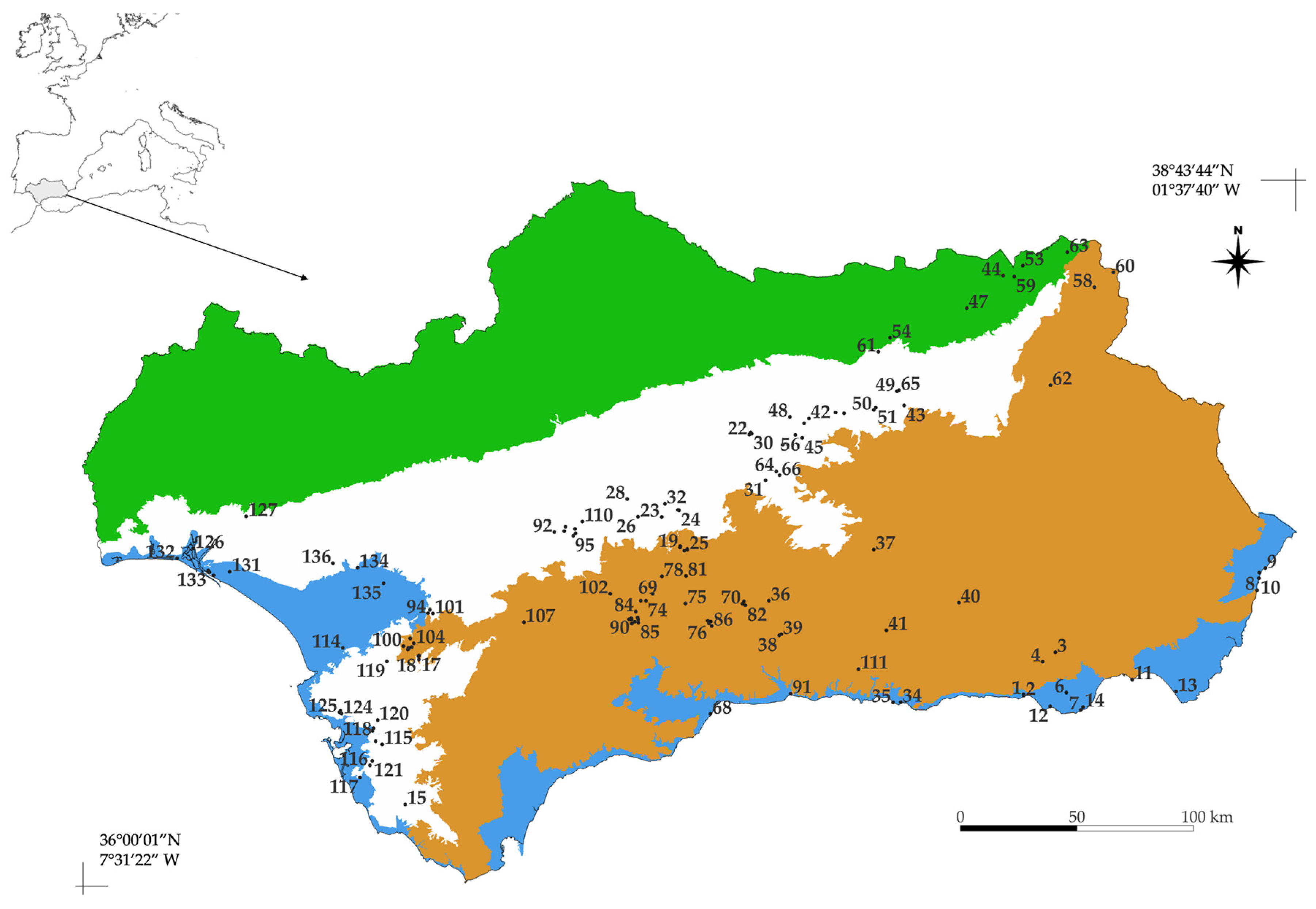
The ecological diversity of the region is reflected in the official inventory, which lists 229 wetlands, although the total number of aquatic ecosystems likely exceeds current official registries [23]. For this study, 136 wetlands were sampled (Figure 1), spanning a broad altitudinal gradient from sea level to 2940 m a.s.l. While most of these systems are temporary [18], semi-permanent and permanent water bodies were also surveyed. According to the Andalusian Wetland Plan classification [8], the sampled sites—whose locations by zone are detailed in Table S1—are primarily situated in the Guadalquivir Valley (38.2%) and the Betic Ranges (37.5%), with the remainder located in Mediterranean or Atlantic Coastal Zones (19.9%), and Sierra Morena (4.4%). The selection of these 136 sites was strictly based on the availability of robust, continuous botanical monitoring data spanning 20 years. Furthermore, as formally documented in the regional inventory [8], this uneven spatial distribution is not an artifact of sampling effort. Specifically, the low density of wetlands in Sierra Morena ecoregion is a natural consequence of its ancient siliceous lithology and steep erosive relief, which intrinsically limit wetland formation compared to the sedimentary, endorheic, and karstic environments that dominate the Guadalquivir and Betic domains.

2.2. Vegetation Sampling

Data collection spanned a 20-year period (1998–2018). To accurately capture the total species richness and mitigate the effect of temporary absences due to the high interannual variability of Mediterranean wetlands, all subsequent analyses and Supplementary Materials are based on the cumulative species records obtained over the entire two-decade timeframe. Within this framework, a continuous monitoring strategy, consisting of at least four seasonal surveys per year, was implemented between 2003 and 2012 for 106 sites included in the Andalusian Wetland Inventory (https://www.juntadeandalucia.es/medioambiente/portal/areas-tematicas/espacios-protegidos/humedales/inventario-humedales-andalucia (accessed on 10 February 2026)), as part of a wetland management program by the Regional Government of Andalusia. This intensive phase was designed to capture the complete annual succession of macrophyte assemblages and maximize species detection across the full hydrological cycle. For the remaining 30 wetlands or during years outside this intensive monitoring phase, sampling was non-continuous, though ensuring a minimum of one comprehensive survey per site during the entire study period.
Macrophytes were surveyed along linear transects, perpendicular to the shoreline and extending towards the center of the water body to ensure the inclusion of all vegetation belts. The number and length of these transects were adapted to the size and morphology of each wetland to ensure representative coverage of all available microhabitats. Sampling was conducted by wading or by boat, depending on water depth. Samples were collected manually or, where necessary, using a bottom sampler. Taxonomic identification was subsequently performed in the laboratory using stereomicroscopes and specialized taxonomic keys [24,25,26,27,28,29,30,31,32].
Once the floristic inventory was completed, and to accurately evaluate the biogeographical value and structural integrity of the sites, we mitigated the effect of temporary absences due to the high interannual variability of Mediterranean wetlands by basing all subsequent analyses and index calculations on the cumulative species records obtained over the entire study period for each site.

2.3. Wetland Conservation Assessment

The conservation value of the studied wetlands was assessed using the botanical criteria proposed by Cirujano and collaborators [14], employing macrophytes as indicators of ecological importance. This entire evaluation framework is standardized on a scoring system ranging from 2 to 10, where higher scores consistently denote greater ecological value, whether through rarity, conservation priority or species richness. Specifically, the Individual Plant Valuation Index (IT; Table 1) was calculated as the arithmetic mean of three distinct sub-indicators: first, the species’ frequency within Andalusia (IA), second its relevance to European flora (IE), and third its specific conservation status (IC). Based on these data, two site-specific metrics were derived using the same 2 to 10 scale; the Floristic Index (IF), obtained by averaging the IT values of all species present, and the Diversity Index (ID), which reflects the species richness of both hydrophytes and hygrophytes in each wetland. Finally, the overall Wetland Valuation Index (IH) was computed as the arithmetic mean of the two preceding indices (IF and ID). According to this methodology, IH scores between 5.5 and 6.5 designate wetlands of national importance, whereas scores exceeding 6.5 denote ecosystems of European relevance.
While this approach focuses on the botanical component, it is widely accepted that macrophytes act as foundational indicators of overall wetland integrity. To further robustize this assessment, the conservation value is complemented in the following section by an analysis of floristic originality, providing a broader biogeographical perspective.

2.4. Species Originality and Floristic Originality Index

To assess the conservation value of the studied wetlands based on species rarity, we calculated what we have termed the Floristic Originality Index (FOI), an adaptation of the Index of Faunal Originality (IFO) proposed by Puchalski [33]. Although originally developed for faunal assemblages, the mathematical architecture of this metric is fundamentally taxonomic-agnostic. First, the originality of each species (Oi) was determined as the inverse of its frequency of occurrence across the entire dataset:
O i =   1 M i
where Mi represents the total number of sites where the species occurs. Consequently, species found in a single location obtain the maximum value of 1, while widespread taxa yield lower scores. This mathematical weighting ensures that the index is sensitive to specialist taxa with narrow environmental requirements, effectively mitigating the influence of generalist macrophytes with broad ecological niches.
Based on these individual values, a site-specific index (FOIsite) was calculated for each wetland [34]. This metric represents the mean originality of the aquatic plant assemblage in a site and is calculated as:
F O I s i t e =   i = 1 S 1 M i S
where S is the species richness of the wetland. By dividing by species richness, this metric normalizes the assessment, making it independent of the total number of species and allowing for a reliable comparison of originality among wetlands.
Finally, to compare biodiversity value across large geographic areas, a Regional FOI was calculated for each of the four study zones (i) Sierra Morena; (ii) Betic Ranges; (iii) Guadalquivir Valley; and (iv) Coastal Zones. This regional value is defined as the mean originality (Oi) of the species pool recorded within each specific region.

2.5. Simulation of Extinction Scenarios and Structural Vulnerability

To evaluate the structural vulnerability of the macrophyte assemblages, a simulation analysis of biodiversity erosion based on species range sizes was performed. This analysis was conducted on the entire dataset and subsequently repeated for each of the four specific study zones. This simulation does not aim to measure functional ecosystem resilience, but rather the structural vulnerability and the decay of biogeographical integrity. Initial data consisted of binary presence-absence matrices, and a Rarity Index (RI) was calculated for each species to establish the extinction sequences:
R I = F i F m a x
where Fi is the frequency of occurrence of species i, and Fmax is the maximum frequency observed in the dataset. This index ranges from its minimum possible value 1/Fmax (highly range-restricted species) to 1 (widespread or cosmopolitan species).
To monitor the simulation, we employed the Biogeographical Integrity (I) metric. While mathematically equivalent to the FOIsite as described above, we explicitly distinguish their spatial scales of application by calculating the FOI at the site level to assess local floristic distinctness, whereas this metric (I) was calculated based on the aggregated species pool for the entire study area and for each zone, rather than as a mean of individual sites. At each simulation step, the index was calculated as:
I = 1 S i = 1 S 1 M i
where S is the total species richness remaining in the assemblage at that specific step, and Mi is the initial global frequency of species “i” in the original dataset. This approach allows for the quantification of the overall regional assemblage at each simulation step and is analogous to the Corrected Weighted Endemism (CWE) index proposed by Crisp and collaborators [35]. This score serves as the response variable, where higher values indicate a community dominated by rare, high-value taxa.
The loss of integrity was modeled under three distinct scenarios, removing species in 10% increments from the initial pool. In the “rare-first” deterministic scenario, species were extirpated in ascending order of their RI to simulate threats disproportionately affecting specialized taxa, whereas the “common-first” scenario removed widespread species first. While the “rare-first” trajectory mimics the most probable ecological reality of habitat degradation, the “common-first” approach acts primarily as a counterfactual baseline. In real world ecosystems, ubiquitous species are typically generalists with high tolerance to environmental fluctuations, making them the least likely to face immediate regional extinction. However, simulating their preliminary removal is mathematically essential to isolate the structural importance of rarity, demonstrating whether the collapse of biogeographical integrity is driven merely by the sheer volume of species lost, or specifically by the targeted loss of rare, functionally unique taxa. These were compared against a stochastic “null model” where species were removed randomly. This process was iterated 1000 times to calculate the mean trajectory and 95% confidence intervals. Finally, the resulting decay curves were compared using a non-parametric Friedman test to determine if the loss of integrity in deterministic scenarios differed significantly from random expectations.
Finally, to evaluate the relationship between the traditional biological valuation index (IH) and floristic originality (FOI), we first performed a Spearman rank correlation. While this test provides a general measure of correlation between both metrics, it does not capture complex nonlinear patterns across the richness gradient. Therefore, to establish a continuous baseline of expected originality for any given valuation score, we modeled this interaction using a Locally Estimated Scatterplot Smoothing (LOESS) regression. This approach specifically accounts for the ecological tendency of originality to stabilize at higher richness levels due to the accumulation of widespread species. Subsequently, a residual analysis was conducted based on this LOESS model to identify discordant wetlands. Following standard criteria for biological datasets [36], sites with FOI values exceeding the expected prediction by more than 1.5 standard deviations (SD) were classified as positive outliers. This procedure objectively isolates ecosystems that act as critical refuges for rare flora despite lacking high overall species richness. All statistical analyses and visualizations for both, the extinction simulations and the index comparisons were conducted in the R statistical environment version 4.0.0 (R Foundation for Statistical Computing, Vienna, Austria), utilizing custom scripts for matrix manipulation alongside the ggplot2 and ggrepel packages.

3. Results

3.1. Floristic Diversity of Aquatic Macrophytes and Wetland’s Valuation

The floristic inventory conducted across the 136 sampled wetlands yielded a total of 125 taxa. Regarding growth forms, the assemblage was composed of 71 hygrophytes and 54 hydrophytes; the latter group included 30 angiosperms, 20 charophytes, 3 bryophytes, and a single pteridophyte (see Table S2 for the complete list of hydrophytic and hygrophytic taxa identified across all sampling sites).
Regarding the hygrophytic fringe, the vegetation was structurally dominated by a core group of four ubiquitous species (Bolboschoenus maritimus, Scirpoides holoschoenus, Phragmites australis and Tamarix gallica). These four taxa exhibited a remarkably high frequency, being recorded ≥70% of the surveyed wetlands. Despite this dominance of generalists, the assemblage includes relevant taxa of high conservation value. Notably, species recorded in three or fewer locations represented 34% of the total helophyte assemblage. This fraction of restricted taxa includes temporary pond specialists such as Coronopus navasii and Isoetes velata, as well as specific halophytes like Limonium quesadense. Spatially, the richness of helophytes followed a clear gradient. The Guadalquivir Valley harbored the highest diversity with 53 taxa, followed by the Betic Ranges (47 species) and the Coastal Zone (41 species), whereas Sierra Morena showed a remarkably poorer assemblage composed of only 9 species. Regarding community structure, the Guadalquivir Valley and Coastal Zones shared a marked dominance by the four ubiquitous species, which consistently exceeded 70% frequency in these areas. In the Betic Ranges, this group also defined the landscape structure, although with slightly lower frequencies (65–70%). A markedly different pattern was observed in Sierra Morena, where this generalist group was replaced by Eleocharis palustris, occurring in 100% of the surveyed sites. In this zone, B. maritimus and Glyceria declinata achieved significant secondary frequencies (50%), while the remaining helophytes were merely occasional.
Focusing on the aquatic community (hydrophytes), this group exhibited a typical pattern of dominance by a few generalist taxa. The most widespread species, recorded in more than 40 sites, included Chara aspera, Chara connivens, Stuckenia pectinata, Ranunculus peltatus var. peltatus, and Zannichellia obtusifolia. Conversely, a high proportion of the flora showed a restricted distribution: 46.29% of the identified taxa appeared in fewer than three wetlands. Specifically, 11 species were identified as singletons (recorded in only one site). This group of rare taxa is of particular conservation relevance, as it includes species listed as Critically Endangered (CR) or Endangered (EN) in regional Red Lists, such as the glacial relict Sparganium angustifolium and the aquatic liverwort Ricciocarpos natans, as well as highly specialized charophytes like Tolypella salina (see Table 1 for the complete list).
The assessment of conservation value, detailed in Table 2, underscores the high ecological relevance of the studied ecosystems, with mean IF and IH values of 3.537 and 5.346 across all sites, respectively. Furthermore, the ID revealed a solid community structure, with the majority of wetlands scoring above 6, and 60.3% of sites achieving a score ≥ 8 (indicating a richness of 11 or more species of hydrophytes and hygrophytes). In contrast, only 8.1% of sites recorded low diversity values (ID = 4—corresponding to 3–5 species). These metrics translate into a significant proportion of wetlands classified within high ecological value categories. Eleven ecosystems were identified as being of European importance, while 52 were classified as being of National Interest. Among the sites of European relevance, three wetlands stood out for their exceptional scores. Laguna de las Madres achieved the highest valuation (>8), followed by Laguna de Alcalá and Charca de Suárez, which both recorded valuations between 7.35 and 7.50. In addition to these priority categories, four specific sites (Laguna de Las Lomas, Pantaneta de Funes, Laguna de Siles and Laguna de Juntillas) were identified as Singular Andalusian Wetlands. Although these ecosystems did not exceed the valuation threshold of 5.5, they host singleton taxa, representing the exclusive refuge for these species within the Andalusian context.

3.2. Hydrophytic Community Composition and Floral Originality by Region

The analysis of hydrophytic species composition and floristic originality across the entire study area (n = 136) revealed a high cumulative richness (S = 54), yielding a global FOI of 0.376. This value provides a quantitative baseline for comparing the four study zones, distinguishing areas characterized by taxonomic originality from those dominated by widespread taxa. At this global scale, the community structure is defined by the dominance of the generalist species previously identified (see Section 3.1), which form the primary structural matrix of the regional wetland network. In contrast, the originality is maintained by the core of specialized taxa (Oi = 1) documented in the preceding inventory. The distribution of these common and rare assemblages is heterogeneous across the study area, resulting in distinct regional patterns.
The wetlands of Sierra Morena (n = 6) reached a total richness of 10 species with a regional FOI of 0.515. Despite its lower total richness compared to other regions, this sector functions as a high-originality enclave where 60% of its flora consist of locally restricted specialists. At this scale, the high originality is driven by the presence of six taxa exclusive to single sites within this zone (Oi = 1.0), most notably Isoetes setaceum and Ranunculus tripartitus. These taxa are characterized by high regional scarcity, yet they coexist with a more common hydrophytic base—primarily Callitriche brutia and Ranunculus peltatus var. peltatus (Oi = 0.25)—which structures the community matrix. At the site level, Laguna del Castillo represents the wetland with the highest originality, recording an individual FOIsite of 0.750, followed by Laguna Los Perales (0.646) and Laguna El Ardal (0.583). Collectively, these results indicate that the biological value of Sierra Morena is concentrated in small, high-quality refugia that are essential for maintaining regional biodiversity.
The Coastal Zone (n = 27) recorded a richness of 30 species and a regional FOI of 0.523, a value that reflects a high concentration of taxonomic originality despite the environmental pressures typical of littoral systems. The community structure is primarily organized around a halotolerant matrix, where Ruppia maritima var. maritima (Oi = 0.077) and Stuckenia pectinata (Oi = 0.083) function as the dominant structural taxa. However, the high originality of this sector is underpinned by 10 localized specialists (Oi = 1), including Lemna gibba, Nymphaea alba, and Nuphar lutea, which are notable for being singletons not only within this zone but across the entire study area. The biogeographical value of the coast is further enhanced by the presence of rare taxa with very restricted distributions in Andalusia, such as the liverwort Riella cossoniana and Persicaria amphibia (each with only two regional records), alongside Zannichellia peltata. At the site level, Laguna de las Madres stood out with a maximum individual FOIsite of 1, representing a critical biodiversity hotspot, followed by Laguna de los Caballos (0.625) and Laguna del Portil (0.457).
The Betic Ranges (n = 51) reached a total richness of 38 species, and a regional FOI of 0.451. Despite its broad geographical extent, the community structure is strongly influenced by a pervasive matrix of common taxa, notably Chara connivens (Oi = 0.03) and Zannichellia obtusifolia (Oi = 0.038), which are widely distributed across these mountain systems. Nevertheless, the region maintains its biological distinctiveness through 10 localized specialist species (Oi = 1), including several taxa of high conservation priority that represent exclusive occurrences within the entire Andalusian territory. Notable among these are the charophytes Chara braunii and Chara imperfecta; the vascular plants Potamogeton berchtoldii, Isolepis fluitans, and the glacial relict Sparganium angustifolium, as well as the rare aquatic liverwort Ricciocarpos natans. At the site level, the exceptional nature of certain high-altitude or isolated systems is evidenced by three wetlands (Laguna de los Arenales, Laguna del Rico, and Laguna de Juntillas), all of which recorded a maximum FOIsite of 1. Other ecosystems, such as Laguna de Las Lomas (0.488) and Laguna de Valdeazores (0.481), also contribute significantly to the pool of originality within this zone.
Finally, the Guadalquivir Valley (n = 52), which contains the highest number of wetlands in the study, recorded a total richness of 35 species and the lowest regional FOI for any zone at 0.407. The community is dominated by a ubiquitous matrix of generalist taxa, primarily Chara connivens (Oi = 0.027), Chara aspera (Oi = 0.043), and Zannichellia obtusifolia (Oi = 0.048). The high degree of overlap with the Betic Ranges suggests a process of biotic homogenization across the lowland-mountain gradient. Despite this trend, the zone maintains critical conservation points through seven localized specialists (Oi = 1), including Callitriche lusitanica and the rare charophyte Tolypella salina, both of which are exclusive to this sector and represent singletons within the entire Andalusian territory. Furthermore, the presence of Potamogeton gramineus and Ranunculus tripartitus—each with only two records in the study area—highlights the role of certain valley wetlands as specialized habitats for rare flora. At the site level, Laguna de Alcalá (0.650) and Laguna de San Lázaro (0.625) recorded the highest FOIsite values, representing systems of high ecological originality within this predominantly homogenized landscape.

3.3. Congruence Between Traditional Valuation and Floristic Originality

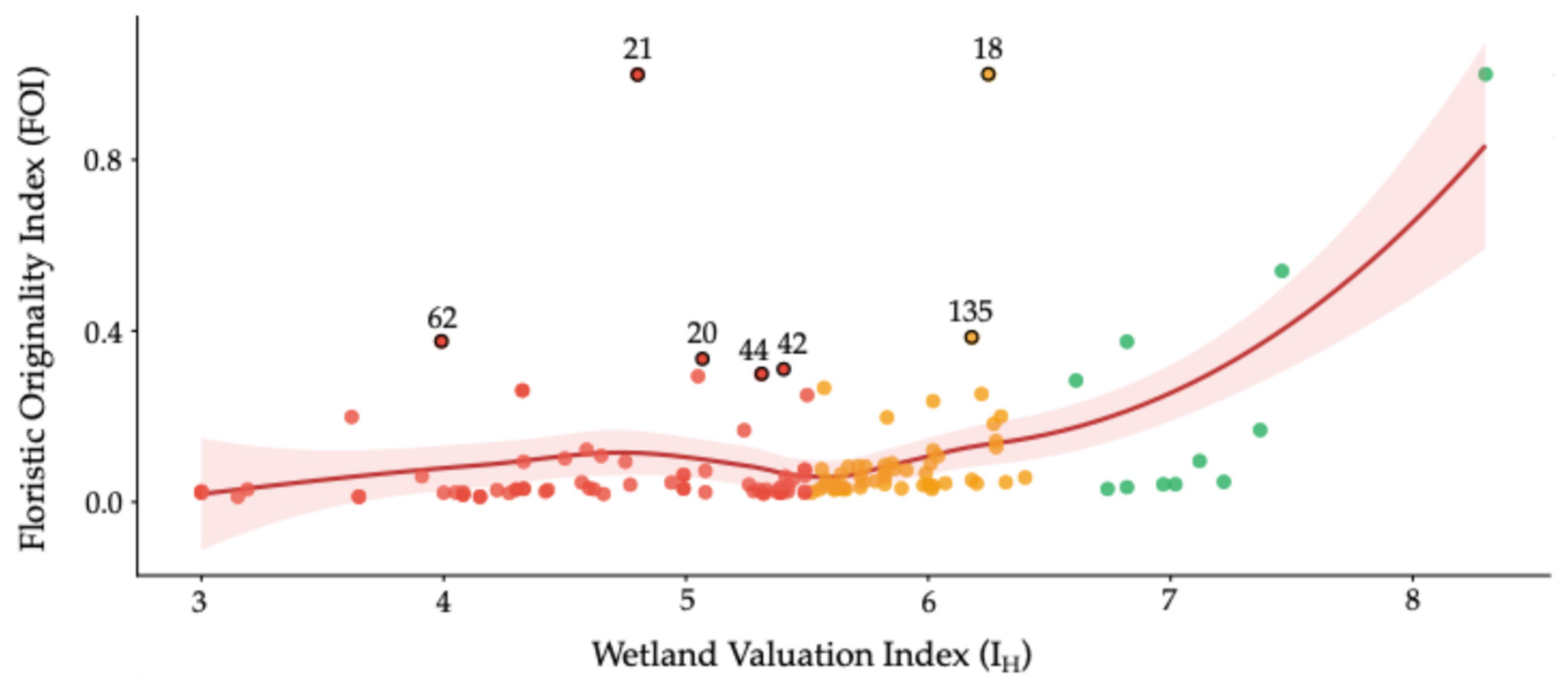
When comparing the traditional valuation metrics with our structural and biogeographical framework, the Spearman correlation revealed a positive and statistically significant relationship between the Biological Valuation Index (IH) and the Floristic Originality Index (FOI) across the studied network (ρ = 0.446, p < 0.001; Figure 2). However, the moderate value of the correlation coefficient indicates a substantial decoupling between both metrics. As illustrated by the LOESS regression in the scatter plot, the relationship follows a clear nonlinear trajectory where originality largely plateaus across most of the richness spectrum. The deviation of each wetland from this expected curve confirmed this decoupling, identifying several clear positive outliers above the 1.5 standard deviations threshold. Notably, this highly original subset included wetlands categorized as having low conservation interest (IH < 5.5), such as Lagunas de Juntillas, Siles, Rico, Valdeazores, and Las Lomas, alongside sites recognized as having National Interest (IH > 5.5), namely, Laguna de Portil and Los Arenales (Granada). Despite their different traditional valuations, all these ecosystems exhibited exceptionally high floristic originality scores compared to model predictions. Conversely, numerous sites reaching the European Interest category (IH > 6.5) displayed near zero FOI values, confirming that their high traditional scores are primarily driven by species rich assemblages dominated by widespread generalist taxa. Ultimately, this distribution reveals a sharp terminal rise, indicating that true floristic originality only increases exponentially in a highly restricted subset of exceptionally mature wetlands.

3.4. Simulation of Extinction Scenarios and Community Vulnerability

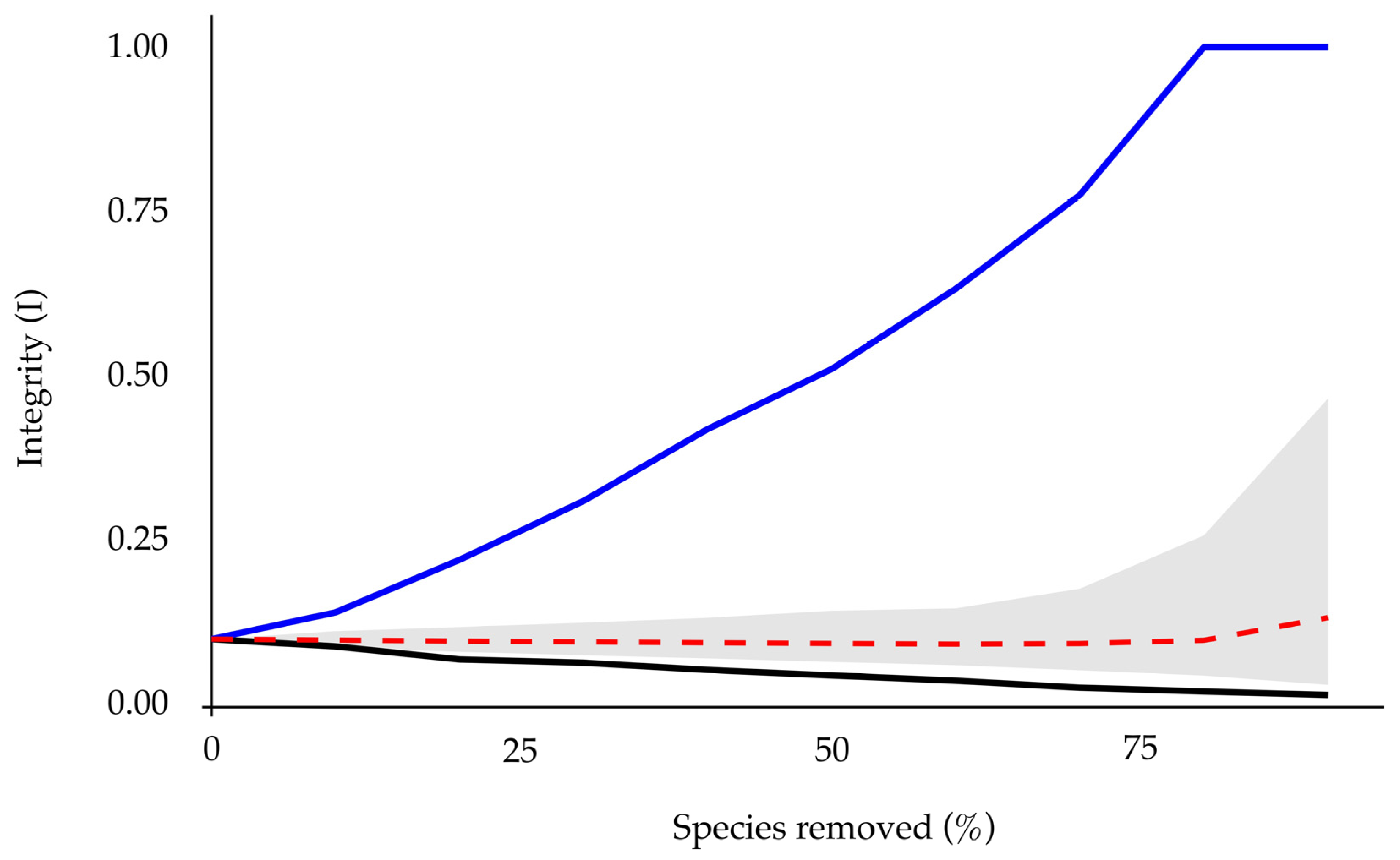
The simulation of extinction scenarios on the complete dataset revealed a community structure heavily influenced by widespread taxa (Figure 3). The initial biogeographical integrity of the regional pool, calculated on the aggregated species pool of the 136 wetlands, was relatively low (I = 0.11). This baseline value reflects the numerical dominance of ubiquitous species across the region, which tends to dilute the contribution of rare taxa. Under the Rare-First scenario, integrity exhibited a steady and deterministic decline, dropping significantly below the lower bound of the null model’s 95% confidence interval (p < 0.001; Figure 3). Conversely, the Common-First scenario resulted in a rapid increase in integrity, as the removal of widespread species increased the proportional weight of rare taxa in the remaining assemblage. However, it required the removal of approximately 80% of the total species pool to reach maximum integrity values (I = 1). The Friedman test confirmed that the trajectories of the three scenarios were statistically distinct (χ2 = 18.2, p < 0.001), rejecting the hypothesis that biodiversity loss is a random process regarding biogeographical integrity.
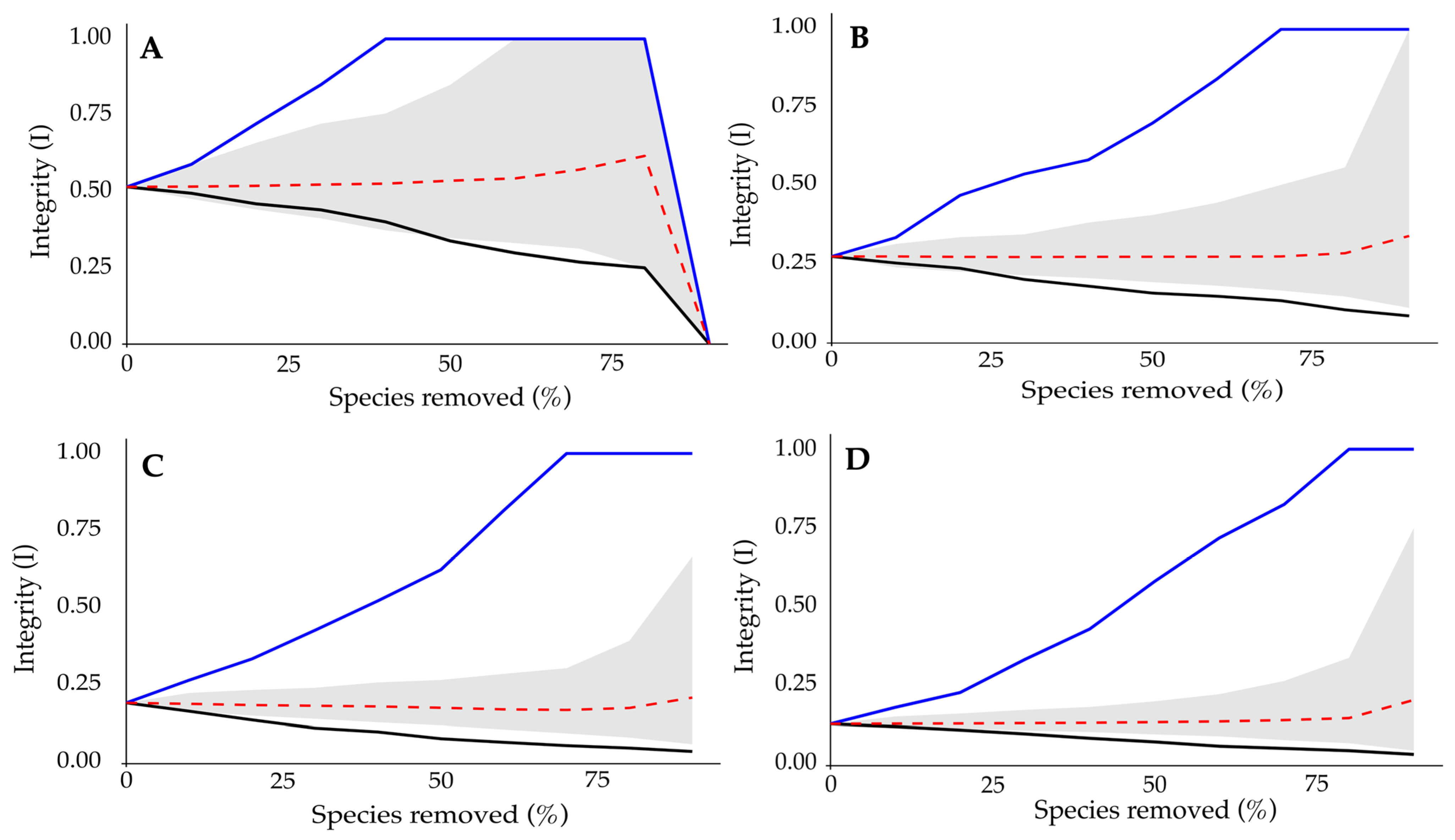
The analysis by zones highlighted a clear gradient of structural variability across the study area (Figure 4). Sierra Morena stood out as the reservoir of highest originality, with the highest initial integrity baseline (I = 0.51; Figure 4A). Unlike other zones, the removal of common species resulted in reaching maximum integrity (I = 1) more rapidly than in any other zone, specifically at 40% removal. However, a distinct feature of this zone is the sharp collapse of integrity at the very end of the simulation, contrasting with the sustained plateaus observed elsewhere. This reflects a geographically restricted species pool that is easily exhausted, confirming that the biogeographical identity of Sierra Morena depends on a small, non-redundant assemblage of specialists with no buffer against total extinction.
In contrast, the Coastal Zone (Figure 4B) and the Betic Ranges (Figure 4C) displayed intermediate profiles, with initial integrity values of 0.28 and 0.20, respectively. In both cases, the trajectories reached the maximum integrity threshold at 70% removal. These results characterize both zones as solid reservoirs where specialized flora coexists with a broader matrix of generalist taxa. On the opposite end of the spectrum, the Guadalquivir Valley recorded the lowest initial integrity value (I = 0.13; Figure 4D). This community appears saturated by cosmopolitan species, requiring the removal of 80% of its species pool to reach maximum values. Despite this dominance of generalists, the structural vulnerability is high, as the specific loss of its rare relict core drives regional integrity to near zero values significantly faster than random expectations (p < 0.001).

4. Discussion

4.1. Floristic Richness and Conservation Value of Andalusian Wetlands: The Critical Role of Long-Term Monitoring

The cumulative floristic richness documented in this study over the 20-year period, totaling 125 taxa (54 hydrophytes and 71 hygrophytes), establishes Andalusian wetlands among the most diverse in the Iberian Peninsula. This richness surpasses values reported in other Spanish regions [16,37,38], but the most striking results arise from comparing it with the national baseline study of 444 wetlands [14]. In this context, our IF value is slightly higher than the national average and other regional assessments [14,16,37]. The mean diversity reached an ID of 7.15 (averaging 6 to 20 aquatic taxa per site). This figure is notably higher than national [14], and Duero basin averages [16,37], though it remains lower than values documented for León [38].
In terms of conservation priority, the density of high-value sites in Andalusia is exceptional. Our IH index surpasses the national average [14] and most regional studies [16,37]. Specifically, we identified 52 wetlands of National Interest, 11 of European Interest, and four as Singular Andalusian Wetlands. To put this in perspective, the national evaluation identified 62 National and 17 European Interest sites across 444 sampled wetlands. Similar low proportions are found in northern clusters like León [38] and the Duero Depression [16,37]. While these comparisons require careful interpretation due to different sampling sites, the contrast is clear, as our findings are based on only one-third of the wetlands analyzed in the national baseline [14]. Andalusia possesses a greater frequency of high-value enclaves, even though certain northern systems might maintain higher-level individual maturity in their plant communities [38].
Beyond geography, we argue these superior metrics directly result from our 20-year monitoring period. Mediterranean wetlands face extreme inter-annual variability, where plant communities undergo significant temporal turnover, and rare specialists only emerge under specific hydrological windows that may occur only a few times per decade. Short-term surveys often capture a mere snapshot, leading to false negatives for many rare or ephemeral taxa. By integrating two decades of data, our study captures the true ecological potential and seed bank expression of these systems. Therefore, perceived botanical quality in Mediterranean wetlands is frequently underestimated due to insufficient sampling duration. Long-term monitoring is fundamental required to ensure an accurate assessment and effective protection of wetland biodiversity worldwide, especially in highly fluctuating Mediterranean ecosystems [39].
While our cumulative approach mitigates the effects of interannual variability, it is necessary to acknowledge the potential influence of unequal sampling effort. Species richness and richness-dependent metrics, such as the IH, are naturally sensitive to sampling intensity and might be slightly underestimated in the sporadically monitored sites. Conversely, the FOI, calculated as a mean value, is mathematically less sensitive to variations in cumulative richness. Ultimately, by aggregating data over a 20-year period, the core assemblage and the fundamental biogeographical signals are reliably captured across the entire network, minimizing the impact of disparate sampling frequencies.

4.2. The Paradox of Floral Originality: Patterns of Exclusivity and Ecological Drivers

The regional distribution of aquatic flora in Andalusia reveals a biogeographical paradox characterized by a marked decoupling between exclusivity and originality. Traditional conservation strategies prioritize richness or endemism hotspots [40], while global assessments increasingly demonstrate a spatial mismatch among different biodiversity dimensions [41,42]. Our results extend this divergence to the structural and biogeographical framework, as the Betic Ranges harbor the highest absolute exclusivity, yet exhibit a lower FOI compared to the Coastal Zone or Sierra Morena. Thus, exclusive taxa do not guarantee high community originality, widespread generalists can easily dilute the signal of rare species.
A detailed analysis identifies 11 singletons at the regional scale. The Betic Ranges emerge as the main exclusivity reservoir (six singletons), followed by the Coastal Zones with three and the Guadalquivir Valley with two. Despite this, the regional FOI exhibits a different hierarchy, where the highest value is recorded in the Coastal Zone, followed by Sierra Morena, while the Betic Ranges show a lower regional mean. Notably, when assessing Andalusia as a single unit, the regional FOI drops to 0.376, a value lower than any of the individual regions analyzed.
This decline highlights a distinction between local and regional biodiversity signals. In the Betic Ranges, six exclusive taxa are masked by a dominant matrix of common and widespread hydrophytes. This aligns with findings indicating that overall species richness patterns are driven by a few common species [21], providing limited information about rare taxa [43]. These widespread species, exhibiting a positive correlation between local and spatial distribution [44], generate a high occupancy that overshadows rare specialists in mean indices. This explains the lower Andalusia-wide FOI as the high proportion of shared species among regions increases the frequency of occurrence in the total dataset, reducing the mean originality score of the territory despite its high cumulative richness.
The high originality of the Coastal Zone is spatially and structurally linked to its fragmented landscape. As illustrated in Figure 1, this area comprises disjunct patches separated by the Betic Ranges and the Guadalquivir Valley. This configuration is critical because these wetlands act as meta-ecosystems in which aquatic macrophytes operate as a metacommunity regulated by both local environmental filtering and regional dispersal [45,46,47]. Physical isolation limits dispersal flows that typically homogenize fully connected systems [48], since high connectivity favors biotic homogenization by facilitating the expansion of dominant taxa [49]. Consequently, this lack of connectivity acts as a protective filter, maintaining high compositional distinctness between sites.
In contrast, the conservation value of Sierra Morena relies on environmental filtering driven by its siliceous lithology, distinct from the sedimentary and calcareous nature of the Betic and Guadalquivir areas [50]. This singularity creates specific hydrochemical niches acting as strict filters for community assembly. Even without regionally exclusive taxa, the restriction of specialized species (e.g., Isoetes setaceum or Ranunculus tripartitus) to single ponds indicates these wetlands offer rare micro-habitats, consistent with rare species responding to fine-grained spatial scales [51]. Consequently, these wetlands are fragile; perturbations on rare species severely affect community stability [52], implying that losing these restricted specialists would trigger a structural collapse.
Finally, the Guadalquivir Valley exhibits low regional originality driven by anthropogenic pressures and an intensive agricultural matrix. This is best explained by biotic homogenization caused by landscape simplification and eutrophication, favoring generalist taxa [53,54]. However, this uniformity is nuanced by two regionally exclusive species persisting through strict geological and trophic filters. First, Tolypella salina is restricted to saline enclaves derived from Triassic Keuper materials, demonstrating that geological heterogeneity acts as a refuge in degraded landscapes [55]. Second, Callitriche lusitanica, a taxon included in the Red List of Andalusian Vascular Flora [56], is associated with shallow mesotrophic backwaters. Its rarity reflects widespread water quality deterioration making non-eutrophic wetlands virtually absent [23]. As this species typically occurs in siliceous environments [57], its persistence here suggests rare, neutral-to-acidic, low-carbonate waters micro-habitats that mimic upstream conditions within the predominantly calcareous and eutrophic agricultural matrix.
Synthesizing these patterns, the discrepancy between the high sectoral FOI values and the lower global baseline illustrates the scale-dependence of biological indices [58]. This reflects a high species turnover between zones, confirming the Andalusian wetland network operates as a mosaic of complementary assemblages rather than a homogenized continuum. The specific environmental conditions of each sector act as barriers preventing the expansion of specialists, maintaining high local originality despite the regional statistical dilution. Therefore, the conservation value of the system relies on the independent management of these environmentally distinct sectors to preserve hydrophyte diversity.
It is important to emphasize that the high floristic originality observed across the Andalusian network is inherently driven by the diverse typologies of these wetlands, which are shaped by complex environmental interactions. In these Mediterranean ecosystems, hydroperiod does not act in isolation; rather, the combination of hydrological fluctuations, broad salinity gradients, and diverse geological substrates creates highly specific abiotic environmental conditions. While a detailed segregation of these individual drivers falls outside the macroscopic scope of this network-level study, this heterogeneity is implicitly captured in our results. These distinct, coupled abiotic conditions support specialized, non-overlapping macrophyte assemblages that maximize regional structural stability.

4.3. Analysis of Community Vulnerability and Scale-Dependent Biogeographical Integrity

The extinction scenario simulations reveal a decoupling between species richness and floristic originality. At the regional scale (Figure 3), the low initial integrity value indicates that the dominance of widespread taxa masks the singularity of rare species; a pattern also observed in crustacean assemblages [59].
Detailed inspection exposes contrasting levels of structural stability across zones. Sierra Morena (Figure 4A) stands out as the primary reservoir of local specialized flora, starting at the highest integrity baseline. However, the Common-First simulation displays a distinctive behavior, reaching maximum integrity before undergoing a sharp terminal collapse. Unlike other zones, this abrupt decline indicates a critical lack of internal redundancy, where biogeographical identity is sustained by a narrow core of rare species without compensatory mechanisms from ubiquitous flora. This pattern is consistent with high-diversity ecosystems where rare species support distinct biological features, making the system highly fragile to their specific loss [60]. The significant decline under Random and Rare-First scenarios confirms its community assembly is governed by local environmental filtering, consistent with metacommunity species-sorting [61], where narrow-range taxa are structural pillars rather than transient elements.
In contrast, the Coastal Zone (Figure 4B), Betic Ranges (Figure 4C), and particularly the Guadalquivir Valley (Figure 4D) exhibit an ecological signature mirroring the Andalusian regional pattern (Figure 3). These areas display lower initial integrity; but their Common-First trajectories rise significantly, unveiling a masked originality within the assemblage. This low initial integrity is not attributable to the absence of specialized taxa, but rather a dilution effect caused by dominant generalists [60]. Consequently, this numerical dominance conceals a latent core of specialized taxa maintained by local environmental filters, a niche-based structure obscured by the biotic homogenization [62].
Finally, the Rare-First and Random simulations reveal convergence response patterns across Andalusia and the Coastal, Betic, and Guadalquivir sectors. In all these cases, a sustained decline in integrity is observed as rare species are removed, confirming that despite landscape level homogenization, regional biogeographical identity remains critically dependent on the rare fraction [61]. Conversely, the Random scenario shows a relative maintenance of integrity, culminating in a final ascent. This resistance to stochastic loss is characteristic of communities with high internal redundancy, where widespread generalist taxa buffer the immediate erosion of the biogeographical signal [63]. The terminal rise further corroborates the masking effect [59], as stochastic extinction thins out dominant ubiquitous flora, unmasking the high-value assemblage components.

4.4. Conservation Implications: Shifting the Focus from Species Richness to Biogeographical Integrity

Mediterranean wetlands face intense anthropogenic pressures triggering pervasive biotic homogenization [62,64]. This often leads to a significant loss of regional distinctiveness not quantified by traditional metrics alone [65]. While species richness (S) is the most common biodiversity measure in management, it is increasingly criticized for its inability to capture phylogenetic diversity or biogeographical structure [42]. Consequently, conservation strategies relying solely on richness-based metrics risk prioritizing assemblages dominated by widespread taxa while overlooking ecosystem stability.
This discrepancy is evident when applying standard conservation protocols [14], to the studied network, which identifies 52 wetlands of National Interest, 11 of European Interest, and 4 as Singular Andalusian Wetlands. However, spatial breakdown reveals a skewed prioritization not strictly correlating with total biodiversity or regional exclusivity. Although the Betic Ranges host the highest total richness (S = 38), the percentage of protected wetlands (39.22%) is notably lower than in the Coastal (55.5%) and Guadalquivir (51.92%) zones. While including certain Betic ponds protects populations of regional singletons (e.g., Potamogeton berchtoldii, Chara braunii, and Isolepis fluitans), significant conservation gaps persist. Vulnerable taxa like Sphaerocarpos prolifera and Chara curta lack effective coverage despite their presence in Betic ponds. These gaps are driven by reliance on rigid scalar scoring systems introducing arbitrary exclusion through threshold artifacts [66]. A paradigmatic case is Potamogeton pusillus, recorded in two Guadalquivir wetlands with an IH of 5.49, falling merely 0.1 points below the protection cut-off. This rigid adherence to numerical boundaries leaves singular wetlands unprotected, illustrating the limitations of standard effectiveness measures [67].
This decoupling is explicitly visualized in the correlation analysis (Figure 2). The moderate relationship between IH and FOI confirms that standard metrics fail to capture the rarest dimension of biodiversity, reflecting a spatial mismatch between richness hotspots and rarity [41,68]. Notably, several wetlands classified with low traditional conservation value emerge as critical refuges for specialists. Laguna de Juntillas, Laguna de Siles, and Laguna de Las Lomas, were already recognized as Singular Wetlands due to exclusive singleton taxa. Crucially, our nonlinear residual analysis reveals that Laguna de Valdeazores and Laguna del Rico exhibit comparable structural originality and surpass the expected baseline threshold despite lacking those specific singletons. Therefore, these hidden jewels must be urgently added to the highest conservation priority networks. Conversely, European Interest sites with near zero originality demonstrates that standard protocols frequently inflate the value of communities saturated by cosmopolitan species, as local richness is often driven by widely distributed taxa [69]. Moreover, the sharp terminal rise observed in the correlation highlights a critical ecological threshold. True biogeographical originality does not gradually increase with the accumulation of widespread hydrophytes; it emerges exponentially only in highly complex systems possessing the strict environmental filters necessary to support rare specialists [21,43]. This nonlinear decoupling can be further explained through environmental filtering theory [70,71]. In highly disturbed or eutrophic systems, the relaxation of specialized abiotic filters allows for the colonization of ubiquitous, euryoecious species, which artificially inflates richness while diluting biogeographical uniqueness. Conversely, the high originality found in specific biogeographical areas like Sierra Morena suggests the presence of restrictive, idiosyncratic environmental filters dictated by their distinct geological and lithological matrices. Therefore, conservation strategies must transcend simple richness-based prioritization; effective protection of these fragile ecosystems requires a steadfast focus on maintaining their unique hydrogeochemical conditions [72], which are the ultimate drivers of their rare flora.
The most profound contradiction arises in Sierra Morena. Despite emerging in our simulations with the highest structural integrity and originality, it presents the lowest species richness (S = 10) and is severely penalized by traditional indices. Consequently, it is relegated to the lowest conservation priority, with only 33.3% of its wetlands included in the National Interest category and none achieving European recognition. This paradox underscores a fundamental flaw in current conservation paradigms, namely the conflation of species richness with ecosystem stability. Standard metrics penalize Sierra Morena for its low total species richness, a foreseeable consequence of its limited spatial representation in our network combined with its distinctive regional geology, ignoring that its highly specialized community assembly represents a unique reference condition shaped by these regional environmental baselines. Given their high structural integrity, conservation efforts should not rely on arbitrary richness thresholds to protect isolated sites. Instead, the entire network of these six wetlands must be protected as a cohesive biogeographical unit to safeguard this regional pool of specialists. By contrast, the higher scores observed in the Guadalquivir and Coastal Zones are partly inflated by the presence of euryoecious taxa, which increase species richness but do not necessarily reflect always high conservation value [73].
While the present study establishes a solid spatial and biogeographical baseline for the Floristic Originality Index (FOI), future research should focus on its empirical validation against independent ecological indicators. Specifically, integrating local hydrochemical variables and trophic status across long-term datasets will be a crucial next step to fully understand how specific physico-chemical filters drive the composition and stability of highly original aquatic assemblages.
Despite its predictive utility, it is important to acknowledge the inherent limitations of our simulation model. Our approach provides a mathematical baseline for structural vulnerability but assumes a static and independent extinction process. In real-world ecosystems, structural collapse is rarely an isolated event; it is often a coordinated phenomenon. The loss of key taxa can lead to severe habitat alteration or the disruption of ecological networks, thereby triggering co-extinctions or “domino effects” where multiple species disappear simultaneously [74,75]. Furthermore, our current approach does not account for dynamic biotic interactions, such as ecological niche competition, which can significantly shape metacommunity assembly [76]. Additionally, the static nature of our baseline prevents the incorporation of potential shifts in species distribution ranges—driven by climate change or local anthropogenic impacts—that may have occurred over the 20-year study period [77]. Future research coupling co-occurrence networks with dynamic spatio-temporal modeling will be necessary to fully capture these complex extinction trajectories, offering deeper insights into the structural integrity of Mediterranean wetlands.
Ultimately, this study advocates for the synergistic integration of valuation protocols rather than their replacement. While the standardized index [14] remains a fundamental tool for identifying floristic rarities, effective management requires a complementary multidimensional perspective [78]. Consequently, conservation strategies must incorporate criteria of irreplaceability to ensure the persistence of rare taxa, correcting protection gaps by eliminating arbitrary scoring thresholds, while simultaneously recognizing biogeographical integrity to protect high-quality reservoirs. Adopting this hybrid framework safeguards both endangered biodiversity and ecosystem stability, providing a quantitative basis to halt biotic homogenization and ensure resistance against the increasing stochasticity of Mediterranean ecosystems. The integration of these perspectives is essential to achieve true ecological sustainability and protect the most singular and irreplaceable components of our natural heritage.

Supplementary Materials

The following supporting information can be downloaded at https://www.mdpi.com/article/10.3390/su18083807/s1: Table S1: Geographic and environmental characterization of the studied wetlands. The table includes the numerical identifier corresponding to Figure 1, the assigned biogeographical zone, altitude (m a.s.l.) and geographical coordinates. Table S2: Floristic presence-absence matrix of hydrophytes and hygrophytes, and valuation scores (IT, ID and IH indexes) for the surveyed wetlands. Site identifiers and numbers are coincident with those listed in Table S1.

Author Contributions

Conceptualization, F.G., F.O. and J.D.G.; methodology, G.G.-R., J.D.G., F.O. and F.G.; software, J.D.G.; validation, G.G.-R., J.D.G., F.O., V.C.-G., M.R.-M. and F.G.; formal analysis, G.G.-R. and J.D.G.; investigation, G.G.-R., J.D.G., F.O., V.C.-G., M.R.-M. and F.G.; resources, F.G.; data curation, G.G.-R., V.C.-G. and J.D.G.; writing—original draft preparation, F.G., G.G.-R. and J.D.G.; writing—review and editing, G.G.-R., J.D.G., F.O., V.C.-G., M.R.-M. and F.G.; visualization, G.G.-R., J.D.G., F.O., V.C.-G., M.R.-M. and F.G.; supervision, F.G., J.D.G., F.O. and M.R.-M. All authors have read and agreed to the published version of the manuscript.

Funding

This research received no external funding.

Institutional Review Board Statement

Not applicable.

Informed Consent Statement

Not applicable.

Data Availability Statement

The original contributions presented in this study are included in the article/Supplementary Materials. Further inquiries can be directed to the corresponding author.

Acknowledgments

The authors would like to thank the Department of Environment of the Regional Government of Andalusia (Consejería de Medio Ambiente, Junta de Andalucía) for providing the data necessary for this study.

Conflicts of Interest

SIECE is a non-profit naturalist association (NGO). “Polígono Industrial Los Jarales” refers strictly to the physical address of the association’s headquarters, not to a commercial corporation. Author Víctor Cid-Gaitán acts as a researcher for this non-profit entity. The authors declare no conflicts of interest.

Abbreviations

The following abbreviations are used in this manuscript:
FOIFloristic Originality Index
IFOIndex of Faunal Originality
IBiogeographical Integrity
RIRarity Index
CWECorrected Weighted Endemism
CRCritically Endangered
ENEndangered

References

  1. Mitsch, W.J.; Gosselink, J.G. Wetlands, 3rd ed.; Jon Wiley and Sons: New York, NY, USA, 2000. [Google Scholar]
  2. Costanza, R.; dArge, R.; de Groot, R.; Farber, S.; Grasso, M.; Hannon, B.; Limburg, K.; Naeem, S.; Oneill, R.V.; Paruelo, J.; et al. The value of the world’s ecosystem services and natural capital. Nature 1997, 387, 253–260. [Google Scholar] [CrossRef]
  3. González Bernáldez, F. Las zonas encharcables españolas: El marco conceptual. In Bases Científicas para la Protección de los Humedales En España, 1st ed.; Real Academia de Ciencias Exactas, Físicas y Naturales: Madrid, Spain, 1987; pp. 9–30. [Google Scholar]
  4. Williams, W.D. Conservation of wetlands in drylands: A key global issue. Aquat. Conserv. Mar. Freshw. Ecosyst. 1999, 9, 517–522. [Google Scholar] [CrossRef]
  5. Mitsch, W.J.; Gosselink, J.G. The value of wetlands: Importance of scale and landscape setting. Ecol. Econ. 2000, 35, 25–33. [Google Scholar] [CrossRef]
  6. Álvarez-Cobelas, M.; Rojo, C.; Angeler, D.G. Mediterranean limnology: Currents status, gaps and the future. J. Limnol. 2005, 64, 13–29. [Google Scholar] [CrossRef]
  7. González Capitel, E. Humedales: Los primeros pasos de un plan. Medioambiente 2003, 42, 22–24. [Google Scholar]
  8. Consejería de Medio Ambiente de la Junta de Andalucía. Plan Andaluz de Humedales, 1st ed.; Junta de Andalucía: Sevilla, Spain, 2004. [Google Scholar]
  9. Dvořák, J. An example of relationships between macrophytes, macroinvertebrates and their food resources in a shallow eutrophic lake. Hydrobiologia 1996, 339, 27–36. [Google Scholar] [CrossRef]
  10. Blindow, I. Distribution of charophytes along the Swedish coast in relation to salinity and eutrophication. Int. Rev. Hydrobiol. 2000, 85, 707–717. [Google Scholar] [CrossRef]
  11. Moss, B.; Stephen, D.; Balayla, D.M.; Bécares, E.; Collings, S.E.; Fernández-Aláez, C.; Fernández-Aláez, M.; Ferriol, C.; García, P.; Gomá, J.; et al. Continental-scale patterns of nutrient and fish effects on shallow lakes: Synthesis of a pan-European mesocosm experiment. Freshw. Biol. 2004, 499, 1633–1649. [Google Scholar] [CrossRef]
  12. Beklioglu, M.; Romo, S.; Kagalou, I.; Quintana, X.; Bécares, E. State of the art in the functioning of shallow Mediterranean lakes: Workshop conclusions. Hydrobiologia 2007, 584, 317–326. [Google Scholar] [CrossRef]
  13. Jeppesen, E.; Søndergaard, M.; Søndergaard, M.; Christoffersen, K. The Structuring Role of Submerged Macrophytes in Lakes, 1st ed.; Springer: New York, NY, USA, 1998. [Google Scholar]
  14. Cirujano Bracamonte, S.; Velayos Rodríguez, M.; Castilla Lattke, F.; Gil Pinilla, M. Criterios Botánicos para la Valoración de Lagunas y Humedales Españoles, 1st ed.; Ministerio de Agricultura, Pesca y Alimentación: Madrid, Spain, 1992. [Google Scholar]
  15. Penning, W.E.; Mjelde, M.; Dudley, B.; Hellsten, S.; Hanganu, J.; Kolada, A.; van den Berg, M.; Poikane, S.; Phillips, G.; Willby, N.; et al. Classifying aquatic macrophytes as indicators of eutrophication in European lakes. Aquat. Ecol. 2008, 42, 237–251. [Google Scholar] [CrossRef]
  16. Flor-Arnau, N.; Cambra Sánchez, J.; Velasco I Batlle, E. Valoración de lagos y lagunas de la cuenca del Duero a partir de los macrófitos acuáticos. Limnetica 2013, 32, 373–390. [Google Scholar] [CrossRef]
  17. Lionello, P.; Scarascia, L. The relation between climate change in the Mediterranean region and global warming. Reg. Environ. Change 2018, 18, 1481–1493. [Google Scholar] [CrossRef]
  18. Cramer, W.; Guiot, L.; Fader, M.; Garrabou, J.; Gattuso, J.-P.; Iglesias, A.; Lange, M.A.; Lionello, P.; Llasat, M.C.; Paz, S.; et al. Climate change and interconnected risk to sustainable development in the Mediterranean. Nat. Clim. Change 2018, 8, 972–980. [Google Scholar] [CrossRef]
  19. Grillas, P.; García Murillo, P.; Geertz-Hansen, O.; Marbá, N.; Montes, C.; Duarte, C.M.; Tan Ham, L.; Crossmann, A. Submerged macrophyte seed bank in a Mediterranean temporary marsh: Abundance and relationship with stablished vegetation. Oecologia 1993, 94, 1–6. [Google Scholar] [CrossRef]
  20. Olden, J.D.; Poff, N.L.; Douglas, M.R.; Douglas, M.E.; Fausch, K.D. Ecological and evolutionary consequences of biotic homogenization. Trends. Ecol. Evol. 2004, 19, 18–24. [Google Scholar] [CrossRef] [PubMed]
  21. Lennon, J.J.; Koleff, P.; Greenwood, J.J.D.; Gaston, K.J. Contribution of rarity and commonness to pattens of species richness. Ecol. Lett. 2004, 7, 81–87. [Google Scholar] [CrossRef]
  22. Ortega, F.; Paracuellos, M.; Guerrero, F. Corología de macrófitos acuáticos en Andalucía oriental. Lazaroa 2004, 25, 179–185. [Google Scholar]
  23. Guerrero, F. Humedales continentales andaluces. In Proyecto Andalucía Naturaleza. Ecología, 1st. ed.; Niell, F.X., Ed.; Publicaciones Comunitarias: Sevilla, Spain, 2009; Volume 5, pp. 357–400. [Google Scholar]
  24. Castroviejo, S. Flora Iberica; Real Jardín Botánica, CSIC: Madrid, Spain, 1986–2012; Volume 1–8, 10–15, 17, 18, 21. [Google Scholar]
  25. Cirujano, S.; Cambra, J.; Sánchez Castillo, P.; Meco, A.; Flor Arnau, N. Flora Ibérica. Algas Continentales. Carófitos (Characeae), 1st ed.; Real Jardín Botánico de Madrid–CSIC: Madrid, Spain, 2007. [Google Scholar]
  26. Cirujano Bracamonte, S.; Meco Molina, A.; García Murillo, P.; Chirino Argenta, M. Flora Acuática Española. Hidrófitos Vasculares; Real Jardín Botánico, CSIC: Madrid, Spain, 2014. [Google Scholar]
  27. Cirujano, S.; Medina, L. Plantas Acuáticas de las Lagunas y Humedales de Castilla-la Mancha; CSIC, Real Jardín Botánico y Junta de Comunidades de Castilla-La Mancha: Madrid, Spain, 2002. [Google Scholar]
  28. Comelles, M. Clave de Identificación de las Especies de Carófitos de la Península Ibérica, 1st. ed.; Asociación Española de Limnología: Barcelona, Spain, 1985. [Google Scholar]
  29. García Murillo, P.; Talavera, S. El género Althenia Petit. Lagascalia 1986, 14, 102–114. [Google Scholar]
  30. Pizarro, J. Contribución al estudio taxonómico de Rannunculus L. subgen. Batrachium (DC.) A. Gray (Ranunculaceae). Lazaroa 1994, 15, 21–113. [Google Scholar]
  31. Talavera, S.; García Murillo, P. Sobre el género Zannichellia L. (Zannichelliaceae). Lagascalia 1986, 14, 241–271. [Google Scholar]
  32. Valdés, B.; Talavera, S.; Fernández-Galiano, E. Flora Vascular De Andalucía Occidental I, II, III; Kestrell: Barcelona, Spain, 1987. [Google Scholar]
  33. Puchalski, W. Phytoplankton Assemblages in After-Exploitation Reservoirs. Ph.D. Thesis, Institute of Ecology, Polish Academy of Sciences, Kraków, Poland, 1987. [Google Scholar]
  34. Boix, D.; Gascón, S.; Sala, J.; Badosa, A.; Brucet, S.; López-Flores, R.; Martinoy, M.; Gifre, J.; Quintana, X.D. Patterns of composition and species richness of crustaceans and aquatic insects along environmental gradients in Mediterranean water bodies. Hydrobiologia 2008, 597, 53–69. [Google Scholar] [CrossRef]
  35. Crisp, M.D.; Laffan, S.; Linder, H.P.; Monro, A. Endemism in the Australian flora. J. Biogeogr. 2001, 28, 183–198. [Google Scholar] [CrossRef]
  36. Quinn, G.P.; Keough, M.J. Experimental Design and Data Analysis for Biologists, 1st. ed.; Cambridge University Press: Cambridge, UK, 2002. [Google Scholar]
  37. Del Pozo, R.; Fernández-Aláez, M.; Fernández-Aláez, C. Composición de las comunidades de macrófitos y establecimiento del estado de conservación de charcas y lagunas de la Depresión del Duero (Noreste de España) en base a criterios botánicos. Limnetica 2012, 31, 47–58. [Google Scholar] [CrossRef]
  38. Fernández-Aláez, M.; Fernández-Aláez, C.; Rodríguez, S.; Bécares, E. Evaluation of the state of conservation of shallow lakes in the province of Leon (Northwest Spain) using botanical criteria. Limnetica 1999, 17, 107–117. [Google Scholar] [CrossRef]
  39. Stefanidis, K.; Dimitrellos, G.; Tsoukalas, D.; Papastergiadou, E. A decade of macrophyte-based ecological monitoring in rivers and streams of Greece—Assessing changes in ecological quality and temporal community shifts. Front. Environ. Sci. 2026, 14, 1770709. [Google Scholar] [CrossRef]
  40. Myers, N.; Mittermeier, R.A.; Mittermeier, C.G.; da Fonseca, G.A.B.; Kent, J. Biodiversity hotspots for conservation priorities. Nature 2000, 403, 853–858. [Google Scholar] [CrossRef]
  41. Orme, C.D.L.; Davies, R.G.; Burgess, M.; Eigenbrod, F.; Pickup, N.; Olson, V.A.; Webster, A.J.; Ding, T.-S.; Rasmussen, P.C.; Ridgely, R.S.; et al. Global hotspots of species richness are not congruent with endemism or threat. Nature 2005, 436, 1016–1019. [Google Scholar] [CrossRef] [PubMed]
  42. Devictor, V.; Mouillot, D.; Meynard, C.; Jiguet, F.; Thuiller, W.; Mouquet, N. Spatial mismatch and congruence between taxonomic, phylogenetic and functional diversity: The need for integrative conservation strategies in a changing world. Ecol. Lett. 2010, 13, 1030–1040. [Google Scholar] [CrossRef]
  43. van Schalkwyk, J.; Pryke, J.S.; Samways, M.J. Contribution of common vs. rare species to species diversity patterns in conservation corridors. Ecol. Indic. 2019, 104, 279–288. [Google Scholar] [CrossRef]
  44. Brown, J.H. On the relationship between abundance and distribution of species. Am. Nat. 1984, 124, 255–279. [Google Scholar] [CrossRef]
  45. Capers, R.S.; Selski, R.; Bugbee, G.J. The relative importance of local conditions and regional processes in structuring aquatic plant communities. Freshw. Biol. 2010, 55, 952–966. [Google Scholar] [CrossRef]
  46. Guerrero, F.; Ortega, F.; García-Rodríguez, G.; Gilbert, J.D. Diversity and metacommunity structure of aquatic macrophytes: A study in Mediterranean mountain wetlands. Sustainability 2025, 17, 6103. [Google Scholar] [CrossRef]
  47. Fois, M.; Cuena-Lombraña, A.; Artufel, M.; Attard, V.; Cambria, S.; Farrugia, K.; Marignani, M.; Minissale, P.; Pace, A.; Sciandrello, S.; et al. Plant distribution and conservation in Mediterranean islands’ lentic wetlands: There us more than aquatic species. Biodivers. Conserv. 2024, 33, 1373–1392. [Google Scholar] [CrossRef]
  48. Mouquet, N.; Loreau, M. Community patterns in source-sink meta-communities. Am. Nat. 2003, 162, 544–557. [Google Scholar] [CrossRef]
  49. Thomaz, S.M.; Bini, L.M.; Bozelli, R.L. Floods increase similarity among aquatic habitats in river-flooplain systems. Hydrobiologia 2007, 579, 1–13. [Google Scholar] [CrossRef]
  50. Vera, J.A. Geología de Andalucía. Enseñ. de las Cienc. de la Tierra 1994, 2, 306–317. [Google Scholar]
  51. Siqueira, T.; Bini, L.M.; Roque, F.O.; Marques Couceiro, S.R.; Trivinho-Strixino, S.; Cottenie, K. Common and rare species respond to similar niche processes in macroinvertebrate communities. Ecography 2012, 35, 183–192. [Google Scholar] [CrossRef]
  52. Sätenberg, T.; Jonsson, T.; Yearsley, J.; Berg, S.; Ebenman, B. A potential role for rare species in ecosystem dynamics. Sci. Rep. 2019, 9, 11107. [Google Scholar] [CrossRef]
  53. Benton, T.G.; Vickery, J.A.; Wilson, J.D. Farmland biodiversity: Is habitat heterogeneity the key? Trends Ecol. Evol. 2003, 18, 182–188. [Google Scholar] [CrossRef]
  54. McKinney, M.L. Urbanization as a major cause of biotic homogenization. Biol. Conserv. 2006, 127, 247–260. [Google Scholar] [CrossRef]
  55. Hjort, J.; Gordon, J.E.; Gray, M.; Hunter, M.L., Jr. Why geodiversity matters in valuing nature’s stage. Conserv. Biol. 2015, 29, 630–639. [Google Scholar] [CrossRef]
  56. Cabezudo, B.; Talavera, S.; Blanca, G.; Salazar, C.; Cueto, M.; Valdés, B.; Hernández Bermejo, J.E.; Herrera, C.M.; Rodríguez Hiraldo, C.; Navas, D. Lista Roja de la Flora Vascular de Andalucía, 1st ed.; Consejería de Medio Ambiente, Junta de Andalucía: Sevilla, Spain, 2005; p. 92. [Google Scholar]
  57. Melendo, M.; Salazar, C. Callitrichaceae. In Flora Vascular de Andalucía Oriental, 2nd ed.; Blanca, G., Cabezudo, B., Cueto, M., Morales Torres, C., Salazar, C., Eds.; Universidades de Almería: Granada, Spain; Universidades de Granada: Granada, Spain; Universidades de Jaén: Granada, Spain; Universidades de Málaga: Granada, Spain, 2011; pp. 1259–1260. [Google Scholar]
  58. Hartley, S.; Kunin, W.E. Scale dependency of rarity, extinction risk, and conservation priority. Conserv. Biol. 2003, 17, 1559–1570. [Google Scholar] [CrossRef]
  59. Sahuquillo, M.; Miracle, M.R. Crustacean diversity and conservation value indexes in pond assessment: Implications for rare and relict species. Limnetica 2015, 34, 333–348. [Google Scholar] [CrossRef]
  60. Mouillot, D.; Bellwood, D.R.; Baraloto, C.; Chave, J.; Galzin, R.; Harmelin-Vivien, M.; Kulbicki, M.; Lavergne, S.; Lavorel, S.; Mouquet, N.; et al. Rare species support vulnerable functions in high-diversity ecosystems. PLoS Biol. 2013, 11, e1001569. [Google Scholar] [CrossRef] [PubMed]
  61. Leibold, M.A.; Holyoak, M.; Mouquet, N.; Amarasekare, P.; Chase, J.M.; Hoopes, M.F.; Holt, R.D.; Shurin, J.B.; Law, R.; Tilman, D.; et al. The metacommunity concept: A framework for multi-scale community ecology. Ecol. Lett. 2004, 7, 601–613. [Google Scholar] [CrossRef]
  62. McKinney, M.L.; Lockwood, J.L. Biotic homogenization: A few winners replacing many losers in the next mass extinction. Trends Ecol. Evol. 1999, 14, 450–453. [Google Scholar] [CrossRef]
  63. Walker, B.H. Biodiversity and ecology redundancy. Conserv. Biol. 1992, 6, 18–23. [Google Scholar] [CrossRef]
  64. García-Murillo, P.; Díaz-Paniagua, C.; Fernández-Zamudio, R. Decline of aquatic plants in an iconic European protected natural area. J. Nat. Conserv. 2025, 84, 126814. [Google Scholar] [CrossRef]
  65. Rosset, V.; Simaika, J.P.; Arthaud, F.; Bornette, G.; Vallod, D.; Samways, M.J.; Oertli, B. Comparative assessment of scoring methods to evaluate the conservation value of pond and small lake biodiversity. Aquat. Conserv. Mar. Freshw. Ecosyst. 2013, 23, 23–36. [Google Scholar] [CrossRef]
  66. Huggett, A.J. The concept and utility of ecological thresholds in biodiversity conservation. Biol. Conserv. 2005, 124, 301–310. [Google Scholar] [CrossRef]
  67. Pressey, R.L.; Whish, G.L.; Barrett, T.W.; Watts, M.E. Effectiveness of protected areas in north-eastern New South Wales: Recent trends in six measures. Biol. Conserv. 2002, 106, 57–69. [Google Scholar] [CrossRef]
  68. Prendergast, J.R.; Quinn, R.M.; Lawton, J.H.; Eversham, B.C.; Gibbons, D.W. Rare species, the coincidence of diversity hotspots and conservation strategies. Nature 1993, 365, 335–337. [Google Scholar] [CrossRef]
  69. Santamaría, L. Why are most aquatic plants widely distributed? Dispersal, clonal growth and small-scale heterogeneity in a stressful environment. Acta Oecol. 2002, 23, 137–154. [Google Scholar] [CrossRef]
  70. Keddy, P.A. Assembly and response rules: Two goals for predictive community ecology. J. Veg. Sci. 1992, 3, 157–164. [Google Scholar] [CrossRef]
  71. Kraft, N.J.B.; Adler, P.B.; Godoy, O.; James, E.C.; Fuller, S.; Levine, J.M. Community assembly, coexistence and the environmental filtering metaphor. Funct. Ecol. 2015, 29, 592–599. [Google Scholar] [CrossRef]
  72. Biggs, J.; von Fumetti, S.; Kelly-Quinn, M. The importance of small waterbodies for biodiversity and ecosystem services: Implications for policy makers. Hydrobiologia 2017, 793, 3–39. [Google Scholar] [CrossRef]
  73. Fleishman, E.; Noss, R.F.; Noon, B.R. Utility and limitations of species richness metrics for conservation planning. Ecol. Indic. 2006, 6, 543–553. [Google Scholar] [CrossRef]
  74. Koh, L.P.; Dunn, R.R.; Sodhi, N.S.; Colwell, R.K.; Proctor, H.C.; Smith, V.S. Species coextinctions and the biodiversity crisis. Science 2004, 305, 1632–1634. [Google Scholar] [CrossRef] [PubMed]
  75. Valiente-Banuet, A.; Aizen, M.A.; Alcántara, J.M.; Arroyo, J.; Cocucci, A.; Galetti, M.; García, M.B.; García, D.; Gómez, J.M.; Jordano, P.; et al. Beyond species loss: The extinction of ecological interactions in a changing world. Funct. Ecol. 2015, 29, 299–307. [Google Scholar] [CrossRef]
  76. Wisz, M.S.; Pottier, J.; Kissling, W.D.; Pellissier, L.; Lenoir, J.; Damgaard, C.F.; Dormann, C.F.; Forchhammer, M.C.; Grytnes, J.-A.; Guisan, A.; et al. The role of biotic interactions in shaping distributions and realized assemblages of species: Implications for species distribution modelling. Biol. Rev. 2013, 88, 15–30. [Google Scholar] [CrossRef] [PubMed]
  77. Chen, I.-C.; Hill, J.K.; Ohlemüller, R.; Roy, D.B.; Thomas, C.D. Rapid range shifts of species associated with high levels of climate warming. Science 2011, 333, 1024–1026. [Google Scholar] [CrossRef] [PubMed]
  78. Cadotte, M.W.; Tucker, C.M. Difficult decisions: Strategies for conservation prioritization when taxonomic, phylogenetic and functional diversity are not spatially congruent. Biol. Conserv. 2018, 225, 128–133. [Google Scholar] [CrossRef]
Figure 1. Spatial distribution of the wetlands sampled in this study. The color coding distinguishes the four studied zones: Sierra Morena (green), Coastal Zone (blue), Betic Ranges (brown), and Guadalquivir Valley (white). Site numbers correspond with those listed in Table S1.
Sustainability 18 03807 g001
Figure 2. Relationship between traditional Wetland Valuation Index (IH) and Floristic Originality Index (FOI) across the studied wetland network. The red solid line represents the LOESS non-parametric regression, with the shaded area indicating the 95% confidence interval. Data points are color-coded according to current legal protection categories: red (IH < 5.5), orange (5.5 ≤ IH < 6.5—National Importance), and green (IH > 6.5—European Importance). Wetlands labeled with IDs and highlighted with black outlines represent ecological bright spots (positive deviants), identified as having FOI values exceeding model predictions by more than 1.5 standard deviations (SD).
Sustainability 18 03807 g002
Figure 3. Simulation of biogeographical integrity (I) loss for the aggregated species pool of the 136 Andalusian wetlands. The curves represent the trajectory of community integrity under three extinction scenarios: Common-First (blue line), where widespread species are removed first; Rare-First (black line), where range-restricted species are removed first; and a Random Null Model (red line). The shaded grey area represents the 95% confidence interval of the null model (1000 iterations).
Sustainability 18 03807 g003
Figure 4. Comparative vulnerability profiles of the four study zones under simulated extinction scenarios. Plots show the response of Biogeographical Integrity (I) to species loss in (A) Sierra Morena, (B) Coastal Zones, (C) Betic Ranges, and (D) Guadalquivir Valley. Lines correspond to Common-First (blue), Rare-First (black), and Random (red) scenarios, with shaded areas indicating the 95% confidence intervals of the null model.
Sustainability 18 03807 g004
Table 1. Valuation scores (IT index) and frequency of occurrence for the hydrophyte species (n) identified in the studied wetlands.
SpeciesITnSpeciesITn
Althenia orientalis6.615Nitella translucens72
Callitriche brutia56Nuphar luteum8.61
Callitriche lusitanica7.31Nymphaea alba7.31
Callitriche truncata var. occidentalis7.35Persicaria amphibium5.62
Ceratophyllum demersum4.65Potamogeton berchtoldii5.61
Chara aspera246Potamogeton gramineus52
Chara braunii8.51Potamogeton pusillus6.33
Chara canescens5.35Potamogeton trichoides54
Chara connivens2.380Ranunculus peltatus var. peltatus246
Chara contraria62Ranunculus trichophyllus4.39
Chara curta8.33Ranunculus tripartitus72
Chara galioides3.327Ricciocarpos natans9.31
Chara globularis230Riella cossoniana9.32
Chara hispida58Riella helicophylla6.314
Chara imperfecta8.51Ruppia cirrhosa54
Chara vulgaris235Ruppia drepanensis429
Isolepis fluitans8.61Ruppia maritina var. maritima2.634
Isoetes setaceum63Stuckenia pectinata244
Lamprothamnium papulosum5.311Sparganium angustifolium7.61
Lemna gibba3.31Sphaerochara prolifera7.32
Lemna minor22Tollypella glomerata4.68
Myriophyllum alterniflorum4.35Tolypella hispanica5.316
Myriophyllum spicatum34Tolypella salina9.31
Najas marina3.333Zannichellia contorta8.33
Nitella confervacea92Zannichellia obtusifolia4.352
Nitella flexilis7.311Zannichellia pedunculata3.69
Nitella hyalina84Zannichellia peltata5.33
Table 2. Summary of the floristic and conservation assessment indices across the four studied Andalusian ecoregions. Data are presented as mean ± standard deviation for the Floristic index (IF), Diversity index (ID), and overall wetland value (IH). Detailed site-by-site data for all 136 wetlands can be found in Table S2 (Supplementary Materials).
Biogeographical RegionnIFIDIH
Sierra Morena64.21 ± 1.545.66 ± 0.814.94 ± 1.04
Coastal areas273.66 ± 1.347.48 ± 1.315.57 ± 1.12
Betic Ranges513.55 ± 1.216.75 ± 1.695.16 ± 0.94
Guadalquivir Valley523.39 ± 1.177.50 ± 1.115.44 ± 0.87
Disclaimer/Publisher’s Note: The statements, opinions and data contained in all publications are solely those of the individual author(s) and contributor(s) and not of MDPI and/or the editor(s). MDPI and/or the editor(s) disclaim responsibility for any injury to people or property resulting from any ideas, methods, instructions or products referred to in the content.