Article

Understanding User Perceptions of Gardening Apps Supporting Sustainability

Department of Economics and Informatics, Faculty of Organization and Management, Silesian University of Technology, 2A Akademicka, 44-100 Gliwice, Poland
*
Author to whom correspondence should be addressed.
Sustainability 2026, 18(8), 3703; https://doi.org/10.3390/su18083703
Submission received: 14 February 2026 / Revised: 30 March 2026 / Accepted: 7 April 2026 / Published: 9 April 2026
(This article belongs to the Special Issue Innovation in Circular Economy and Sustainable Development)

Abstract

Research on information and communication technologies (ICTs) in sustainable agriculture has largely been technocentric, focusing on effectiveness, efficiency, and adoption, with limited consideration of end-user perceptions in practice. This study addresses this gap by examining perceptions of mobile gardening apps as accessible ICT tools that may support sustainable behaviours. Based on over 180,000 user reviews from Google Play and the Apple App Store, Contextualized Topic Modeling (CTM) was used to identify key themes and interpret them within the Theory of Consumption Value (TCV) framework. This approach allows for the analysis of functional, emotional, and epistemic dimensions of user experiences based on large-scale, real-world data. The results indicate that functional aspects, such as reliability and usability, dominate app evaluation, but emotional engagement and knowledge acquisition also play a significant role. By combining a data-driven approach with a well-established behavioural framework, this study bridges the gap between technological and user perspectives. It simultaneously extends the application of the TCV to the field of ICT solutions supporting sustainable development and provides practical guidance for designing more effective gardening apps.

1. Introduction

Sustainable agriculture is founded on the paradigm that combines environmental, economic, and societal aspects [1]. Innovative technologies substantially support the sustainable development process in agriculture through new digital technologies, redefined organizational processes, new business models, and improved farmer and worker well-being [1]. Being a major domain of agriculture, horticulture focuses on fruits, vegetables, ornamental plants, and aromatic plants. Strong links between agriculture and horticulture (including gardening) mean that technological advances in the former are integrated and adapted to horticulture and gardening practices. According to [2,3,4], just like the industry, horticulture has evolved from mechanization (Horticulture 1.0) through precise resource management (3.0) to Horticulture 4.0 today, which uses digitalization and real-time data analysis to optimize resources and processes [5]. While much research focuses on professional technologies, such as IoT, robotics, UAVs, digital twins, or DSS, consumer mobile gardening applications represent a more accessible layer of ICT. These apps do not directly affect production efficiency but can support sustainable horticulture indirectly by enhancing users’ knowledge, promoting environmentally responsible behaviours, and facilitating community-based learning and engagement.
Therefore, rather than treating consumer applications and advanced agricultural technologies as separate domains, this study adopts a complementary perspective, where mobile applications are understood as a user-facing extension of the broader ICT ecosystem in horticulture.
Digital tools are critical for sustainable development both globally and in Poland. They respond to climate challenges and growing consumer expectations regarding food production safety and transparency. Despite various support and development schemes, such as European Union funds available through the mechanisms of the Common Agricultural Policy (CAP) and Rural Development Programmes, and digital initiatives, including Digital Poland and Fast Track Agrotech by the National Centre for Research and Development, the Polish agricultural ecosystem remains slow to deploy advanced technologies. Also, the pace of information and communication technologies (ICT) diffusion in agriculture and horticulture in Poland remains unsatisfactory.
Although Polish researchers do investigate agricultural innovations, they tend to focus on product eco-innovations targeting sustainable food [6]. Analyses of ICT employment concentrate on its availability [7] or threats and opportunities linked to digitalization in agriculture [8]. Moreover, most of the global research also focuses on metrics and diagnosing innovation levels within sectors or on the macroeconomic level. On the other hand, the body of research on the constraints and effects of eco-innovations is minuscule, especially on the local and individual level [6]. What is more, research on technologies 4.0 in horticulture targets mainly the technological potential [9], profitability (such as cost analysis of robotics), and production performance [10]. Admittedly, researchers have investigated social media horticulture consumer engagement [11], but they focus on the performance of financial incentives (discounts and gifts) and social incentives (calls to interaction) for marketing purposes [1,12]. We are yet to gain a solid insight into how users perceive cognitive (epistemic), emotional, and functional values of applications dedicated directly to sustainable development. Although experts recognize the challenge of agriculture and horticulture professionals’ aversion to digitalization, we still need to identify the specific psychological and behavioural factors that could overcome the barrier by better adapting the application’s features to the actual user needs and values [6,11,13].
To the best of our knowledge, existing studies on ICT in agriculture and horticulture remain predominantly technology-oriented perspective, focusing on performance, efficiency, and macro-level indicators of innovation [2,3,4,5,6,7]. At the same time, user-centered research rarely connects behavioural theories with large-scale, real-world data sources such as app reviews [5]. As a result, there is a gap between technological innovation and its actual perception and use by end-users. To better understand this gap from a user perspective, the Theory of Consumption Values (TCV) provides a useful framework for analysing how users evaluate and engage with ICT-enabled solutions. With this approach, we can offer a better understanding of the context of innovation implementation, gardener expectations, and central challenges for developers of new tools promoting sustainable development.
Therefore, our study addresses the following research questions:
RQ1: What topics can be found in user-generated reviews of mobile gardening applications?
RQ2: What consumption values are linked to specific topics?
To answer these questions, we formulate the following hypotheses:
H1: 
We assume that the identified topics will focus on the functionality of the applications being tested.
H2: 
It is likely that each established topic can be assigned to one of the five TCVs, but the functional value will be dominant.
This goal is achieved through a combined analytical approach. We employ Contextualized Topic Modelling (CTM) to capture latent themes within user comments and map them to values proposed in the Theory of Consumption Values (TCV) to interpret users’ underlying motivations and values. Therefore, in our article, we analyse user-perceived value based on reviews, rather than an objective assessment of the app’s functionality or community engagement. We focus on applications intended for individual users, not professional IT systems used in horticulture.
This study contributes to the literature in three main ways.
First, it bridges a significant gap between technocentric and user-centric approaches to ICT research in sustainable agriculture by providing empirical evidence on how users perceive and evaluate mobile gardening applications in the context of sustainability. While previous research has primarily focused on technological performance [9], adoption rates [6,8], or macroeconomic measures of innovation [2], this study shifts the focus to users’ perceptions and motivations at the micro level.
Second, this study extends the theory of consumption value (TCV) to the field of ICT solutions supporting sustainable development. Unlike previous applications of the TCV, which have relied primarily on survey data, this study operationalizes consumption values based on large-scale, unstructured user-generated content, providing a novel approach to capturing real-world user experiences.
Third, we propose an integrated analytical framework that combines unsupervised topic modelling with grounded theoretical interpretation. Rather than treating topic modelling as a purely exploratory tool, we demonstrate how it can be systematically linked to behavioural theory, thereby increasing the interpretability and theoretical relevance of textual analysis findings in sustainability and ICT research.
This study addresses these three gaps by integrating Contextualized Topic Modelling with the TCV framework to analyse large-scale user-generated reviews, thereby providing a novel, user-centred and empirically grounded perspective on how sustainability-oriented digital tools are perceived and evaluated.

2. Literature Background

The theoretical part of our contribution aims to conceptualize central problems of digital technologies in modern horticulture environments (gardening included) and their impact on the growth of environmentally responsible practices. Consecutive sections offer a view of the role of ICT in sustainable horticulture, analyse mobile applications’ features that promote environmentally responsible behaviour, and discuss the TCV as the interpretative framework for analysing user experiences and expectations. With this approach, we can offer a better understanding of the context of innovation implementation, gardener expectations, and central challenges for developers of new tools promoting sustainable development.

2.1. Role of ICT in Sustainable Horticulture

Information and communication technologies grow increasingly important as mediators of sustainable horticulture by integrating a diverse set of tools and digital solutions [9]. Their main purpose tends to be to reduce the costs of acquiring information and coordinating activities, fuelling more precise and informed cultivation [14].
Critical ICT players for agriculture and horticulture include sensors and the Internet of Things (IoT) [4,9,15,16], mobile applications for crop management, Decision Support Systems (DSSs), advanced AI data analytics [6], knowledge sharing platforms [17], and citizen science initiatives. Similarly, Subeesh and Mehta [16] and Shahriar et al. [18] emphasized the presence of AI tools and IoT in agricultural digitalisation.
The recent trends concern such digital horticulture technologies as digital twins [19,20], robots [21], and UAVs [22].
The benefits ICT contributes to the pursuit of sustainable development goals in horticulture can be viewed through diverse lenses. The first relevant matter is asset performance. Smart irrigation systems, soil moisture sensors, weather forecasts and alerts, and water consumption calculators all reduce the input of valuable natural resources, such as water and energy, while remaining neutral or beneficial for crop yield [23,24].
Another ICT component important for horticulture is the protection of biodiversity and plant health. Tools for automated identification of species, including invasive or protected species, and systems for rapid plant disease diagnostics streamline responses to biological threats and promote less harmful and more sustainable protection methods [25].
Various innovative applications provide substantial support for local food production. Crop planning, sowing calendars, rotation, and space optimisation applications help control individual, local crops, which reduces the food dependency rate and food transport carbon footprint [26].
Another ICT component vital for sustainable development goals is education and community-building. Platforms hosting how-tos, blogs, forums, and citizen science initiatives support knowledge sharing, improve user competencies, and further the emergence of new, environmentally friendly social norms [27,28].
Despite the numerous benefits, ICT for sustainable horticulture does come with challenges and limitations. Seasonality and local environmental constraints may reduce the universality of some tools [14]. Additionally, imperfect identification and diagnosis algorithms entail a risk of misinformed recommendations [29]. Digital exclusion is another issue, as some farmers and gardeners cannot access new technologies and are thus marginalised [30]. The risks also include privacy compromise due to location and image data collection and greenwashing with ICT, as the latter has to be deployed and used reasonably and consciously [31].
Although most research on information and communication technologies (ICTs) in horticulture focuses on advanced, professional technologies such as IoT systems, digital twins, and decision-support tools, these innovations are increasingly shaping the broader digital ecosystem, including consumer-facing applications. Mobile horticultural applications can be understood as a more accessible, user-centric downstream layer of this ecosystem, transforming complex technological capabilities into simplified tools for everyday use. Although such apps do not directly implement advanced technologies at the production level, they play a complementary role by transferring knowledge, supporting decision-making, and promoting sustainable practices among users. In this sense, they act as an interface between complex technological systems and end-users, facilitating the diffusion of knowledge, practices, and sustainability-oriented behaviours beyond professional farming contexts. Therefore, analysing user perceptions of mobile gardening apps provides valuable insights into how ICT-based sustainability solutions are perceived and implemented at the micro level, complementing existing technology-focused research.
This perspective allows us to conceptually bridge the gap between advanced ICT solutions and consumer-level applications, positioning mobile apps not as isolated tools but as integral components of the wider digitalisation process in horticulture. This should not be understood as a conceptual inconsistency, but rather as a multi-level perspective in which consumer applications constitute a complementary layer of the digital agriculture ecosystem.

2.2. Mobile Applications and Environmentally Responsible Behaviour

For the purpose of this study, “sustainable gardening applications” are operationally defined as mobile applications that include functionalities explicitly supporting at least one dimension of environmentally responsible gardening behaviour, such as resource efficiency (e.g., water-saving irrigation), biodiversity support (e.g., plant identification and species awareness), a reduction in chemical inputs (e.g., disease diagnostics and recommendations), or local food production (e.g., crop planning tools). This operationalization is based on observable application features rather than declared sustainability claims and is systematically applied in the classification process (see Table A1 and Table A2). Accordingly, sustainability in this study is operationalized through functional proxies rather than direct outcome-based indicators. Therefore, the inclusion criteria are function-driven and replicable, ensuring analytical consistency across the dataset.
We define environmentally responsible behaviour in horticulture and gardening as practices that reduce the consumption of inputs (especially water) and chemical plant protection products, support biodiversity (e.g., preference for native species), boost local food production, and help monitor and report on natural environment components. In this study, mobile applications are considered ICT tools that have the potential to support such behaviours through education, context-specific personalization (weather, season, or location), and automation of repetitive activities.
Importantly, we do not assume that the analysed applications directly lead to measurable sustainability outcomes. Instead, they are treated as tools that enable or encourage behaviours associated with sustainable horticulture. To ensure transparency, we apply explicit sustainability-related criteria to classify applications, as presented in Table A1 and Table A2 (Appendix A). The “Sustainability criteria” column in Table A2 specifies the functional features through which each application may contribute to environmentally responsible practices.
This approach allows us to analyse how users perceive and evaluate applications with sustainability-related functionalities, rather than to assess their objective environmental impact. While this approach does not measure actual environmental outcomes, it provides a transparent and reproducible proxy for identifying applications with sustainability-related potential.
Based on the classification presented in Table A2, we identified six functional classes of environmentally responsible behaviour supported by mobile applications: (1) identification and education (plant recognition, encyclopaedias, how-tos), (2) care routines (reminders, notes, journals), (3) crop planning (sowing calendars, layout planning, rotation), (4) watering and resource efficiency (smart schedules, weather alerts, calculators), (5) plant health (diagnosis and recommended actions), (6) and community and citizen science (observation sharing, citizen science projects). These functional categories relate to different dimensions of sustainability. For example, water savings are the most affected by irrigation solutions (automated control, context-dependent water dosing) and weather alerts. Local food production is supported by vegetable garden planners and sowing calendars. Reduced plant protection product consumption is guided by early diagnostics and recommendations. Biodiversity grows thanks to algorithmic identification and citizen science.

2.3. Theory of Consumption Values (TCV)

The digital market today is characterized by a dynamic expansion of mobile applications that support various aspects of everyday life, including gardening. This category includes gardening planners, plant identification tools, care reminders, and knowledge-sharing platforms. In addition to specific features, they offer values that affect user perception and loyalty. According to Sheth, Newman, and Gross’s TCV, there are five critical values: functional, emotional, social, conditional, and epistemic [32].
The TCV is the interpretative framework for the present article. We believe that comprehension of the five values helps design gardening applications as both functional and consistent with an entire palette of values important to the gardeners of today. Applications that combine functional, emotional, social, conditional, and epistemic values have a better chance of satisfying users who face the challenge of the climate crisis and seek to practice gardening in line with environmentally responsible principles. Such tools can meaningfully support everyday efforts in the time of expansion of urban gardening, permaculture, and an environmentally responsible lifestyle.
The functional value concerns the usability inherent in practical characteristics of the product and its ability to address specific needs [32]. In the specific case of gardening applications, it covers sowing planning, weather monitoring, plant identification from photographs, and automated care reminders. The value increases when the user interface is intuitive, recommendation algorithms are accurate, and data is reliable and up to date.
The emotional value stems from feelings caused by using the product [32]. Gardening applications can provoke positive emotions of satisfaction and pride in one’s crops, relaxation, and a sense of harmony with nature. In this setting, the application is more than just a tool. It accompanies the gardener, nurturing their passion, which makes it captivating on an emotional level as well.
The social value concerns the product’s impact on others’ perceptions of the user [32]. Gardening applications can offer social features, such as forums, groups, rating systems, and crop picture sharing. They allow users to build their images of amateurs or experts among other gardening enthusiasts. People can express their environmentally responsible lifestyle by using gardening applications. This aspect gains significance in light of the improving environmental awareness. It addresses the need to belong to a community of values.
The epistemic value is linked to the user’s intellectual curiosity and new experiences and knowledge [32]. Gardening applications can be educational if they provide articles, how-tos, quizzes, training courses, or plant encyclopaedias. They are a source of knowledge for beginners who can develop their gardening competencies using the applications. Instructions and inspirations to experiment with new plant species or gardening techniques address cognitive needs and support experienced gardeners as well.
The conditional value emerges under specific circumstances and in some contexts [32]. For gardening applications, the variable conditions come from changing seasons. Users may feel more enticed to use them in spring or summer when gardening work is abundant. The same applies to such crises as droughts or pest invasions. Quick access to tips and recommendations may significantly improve the application’s value. Content personalization according to weather or climate zone additionally improves situational usability.
The original TCV [32] identifies five core values: functional, emotional, epistemic, social, and conditional. Yet, it does not explicitly address consumer dissatisfaction or frustration. However, mobile application user feedback often includes critical opinions concerning malfunctions, ambiguous pricing models, or perceived lack of value. To capture these recurrent themes, we propose an additional category: negative functional value. This methodological expansion is supported by prior research highlighting the significance of dissatisfaction in user experience [33,34]. Recognizing and interpreting such feedback is essential for designing inclusive, user-centred ICT tools that consider both positive and negative dimensions of perceived values.

3. Materials and Methods

3.1. Research Process

We compiled a list of mobile applications for sustainable gardening using an iterative and multi-stage identification procedure designed to reflect both academic and user-oriented perspectives. The relevance and growing use of such applications have been highlighted in the scientific literature on mobile gardening and plant identification tools [35,36,37,38,39]. In the first stage, we reviewed publicly available sources such as online articles, rankings, and comparative reviews of gardening applications to identify commonly referenced tools. This step allowed us to capture applications that are visible and relevant from a user perspective. In the second stage, this approach was complemented with exploratory searches within the Google Play and Apple App Store mobile application distributionplatforms using general gardening-related queries (e.g., plant identification, plant care, and gardening planner). This enabled us to identify additional applications available to users but not necessarily covered in external comparisons. In the third stage, the resulting list of applications was iteratively refined by removing duplicates and screening each application based on its description and functionality. This process resulted in an initial set of 25 unique applications identified for further analysis. To ensure methodological transparency and reproducibility, we applied the following inclusion criteria:
  • availability on at least one major mobile platform (Google Play or Apple App Store),
  • relevance to gardening-related activities (e.g., plant identification, plant care, garden planning),
  • availability of user-generated textual reviews.
Applications were excluded if they:
  • were unrelated to gardening (e.g., decorative catalogues or purely commercial plant shops),
  • did not provide functional support for gardening activities,
  • lacked sufficient user-generated content.
In addition to functional relevance, the selection of applications was guided by their potential contribution to environmentally responsible gardening practices. Applications were considered relevant if they supported at least one of the following sustainability-related functions: resource efficiency, biodiversity awareness and conservation, support for local and home food production, environmental education, promotion of responsible gardening practices, or community-based knowledge sharing. The classification of applications was conducted using predefined, function-based criteria to ensure consistency and to minimize subjective interpretation. These criteria are aligned with selected Sustainable Development Goals, particularly SDG 12, SDG 15, and SDG 4. The detailed characteristics of the analysed applications, including their sustainability-related features, are summarized in Appendix A (Table A1). This combined approach integrates systematic identification with real-world user discovery patterns while maintaining transparency and enabling the identification of a comparable sample under similar conditions.
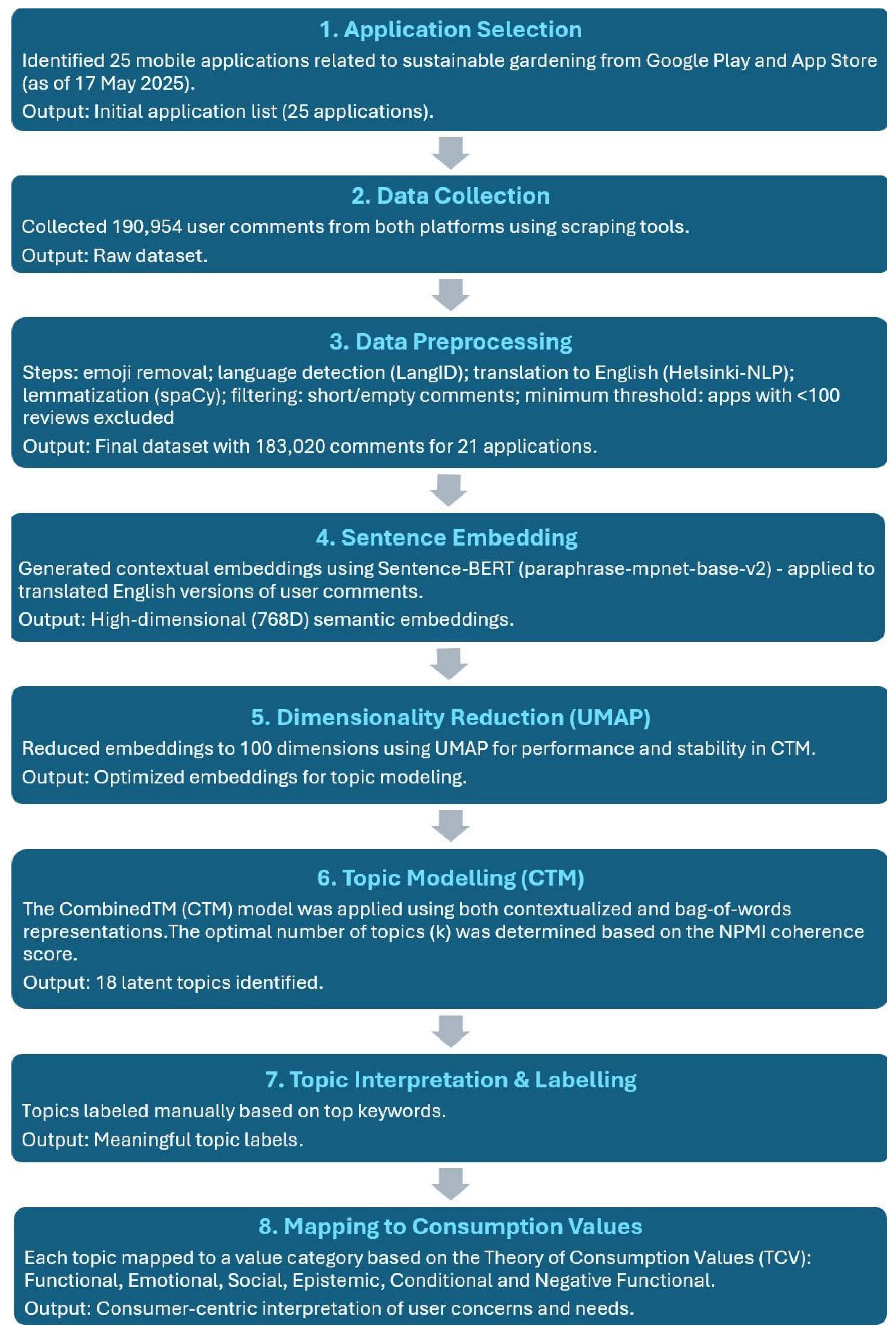
User reviews were collected from Google Play and the Apple App Store on 17 May 2025 using the google-play-scraper (version 1.2.7, developed by JoMingyu) [40] and app-store-scraper (version 0.3.5, developed by Lim, E.) [41] Python packages, resulting in a total dataset of 190,954 comments. User reviews were collected for all identified applications. After data collection, applications with fewer than 100 total reviews (aggregated across both platforms) were excluded, together with their associated comments, resulting in a final set of 21 applications. This threshold was applied to ensure that each application contributed a sufficiently large textual corpus for reliable topic modelling. Although the analysis was conducted on the aggregated corpus of user reviews, small review sets may introduce sparse and potentially unrepresentative textual data, leading to less stable and less interpretable topic structures. The data were collected at a single point in time in order to obtain a consistent snapshot of user opinions and to avoid potential fluctuations caused by the continuous updating and moderation of reviews within mobile application platforms. While this approach ensures internal consistency, it does not account for temporal dynamics in user perceptions, which is acknowledged as a limitation of the study.
While this approach ensured methodological consistency, it also involves certain trade-offs. In particular, the applied threshold may lead to the underrepresentation of less popular or newly emerging applications with smaller review bases. However, given the study’s objective of identifying dominant patterns in user perceptions, prioritizing sufficiently large and information-rich textual corpora was considered methodologically justified.
Following data collection and filtering, we started a comprehensive preprocessing pipeline:
  • Emoji Removal: All emojis were eliminated to ensure textual consistency.
  • Language Detection: The language of each comment was identified using the Langid package (version 1.1.6, developed by Lui and Baldwin) [42].
  • Translation to English: Comments detected as non-English were machine-translated into English using the Helsinki-NLP/opus-mt-mul-en model (Hugging Face Model Repository, New York, NY, USA) [43].
  • Lemmatization: Words were lemmatized to their base forms using the spaCy library (Explosion AI GmbH, Berlin, Germany).
  • Filtering: Comments containing single-letter words and empty comments were removed.
The preprocessing steps yielded a final dataset of 183,020 comments for analysis. A schematic summary of the workflow is presented in Figure 1.
Next, we generated textual embeddings of the translated user comments (i.e., the English versions obtained during preprocessing) using the paraphrase-mpnet-base-v2 model (Sentence Transformers, Hugging Face, New York, NY, USA) from the Sentence Transformer library [44]. Although Sentence Transformer models are generally applied to raw, unprocessed texts, translation was necessary to unify the dataset’s language and enable coherent semantic analysis across multilingual inputs. This approach preserved the rich contextual information in user reviews and ensured consistency in the representation of semantic content.
To facilitate subsequent analyses, we reduced the dimensionality of the embeddings using the UMAP (Uniform Manifold Approximation and Projection) algorithm implemented in the umap-learn Python library. It is a robust technique for nonlinear dimension reduction that preserves both local and global structures within the data. The embeddings were compressed to 100 dimensions, a critical step for contextualized topic models such as CombinedTM. This reduction decreases the number of model parameters, enhancing stability and computational efficiency, particularly given the vocabulary limit of approximately 2000 terms [45,46]. UMAP thus enables scalable and efficient processing of large, high-dimensional embedding datasets.
Topic modelling has become an important analytical technique for discovering latent semantic structures in large collections of unstructured textual data. Traditional probabilistic models such as Latent Dirichlet Allocation (LDA) rely primarily on bag-of-words representations, which ignore contextual semantic relationships between words and may limit topic coherence. Recent advances in natural language processing increasingly integrate contextual embeddings derived from transformer-based language models into neural topic modelling frameworks. These approaches enable richer semantic representations of documents and improved topic interpretability. Among these developments, Contextualized Topic Models (CTMs) combine contextual document embeddings with classical bag-of-words representations (constructed using the CountVectorizer implementation from the scikit-learn library (scikit-learn developers, USA)) within a neural variational architecture, resulting in improved topic coherence and semantic consistency [45,47,48,49].
In the subsequent phase, we employed Contextualized Topic Modelling (CTM) to identify latent themes within user comments. Unlike traditional topic models, CTM leverages contextualized embeddings—generated using pre-trained language models such as Sentence-BERT—in addition to the classical bag-of-words representation. This combined approach significantly enhances topic coherence and semantic richness. For implementation, we used the contextualized_topic_models Python package (developed by Bianchi et al., Italy) along with the CombinedTM model. This granted us the benefits of both contextual embeddings and bag-of-words features [45,46]. Pre-processed embeddings were loaded to CTM, which automatically inferred latent topics by jointly modelling bag-of-words representations and contextual document embeddings. This method improves the interpretability and the consistency of topic identification, outperforming traditional LDA-based models. For further details, see [50,51,52].
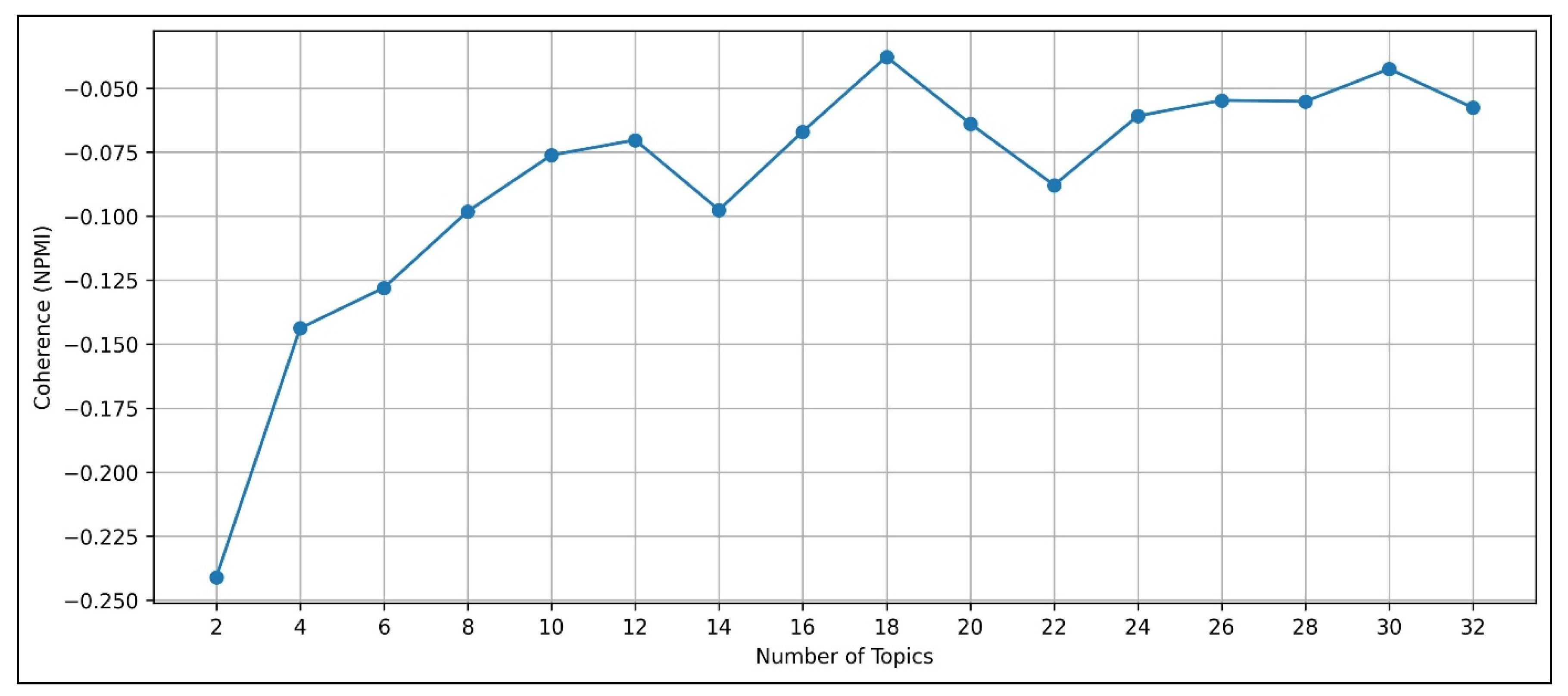
One of the key challenges in topic modelling—particularly with approaches such as LDA or CTM—is to determine the optimal number of topics (k) prior to analysis. We trained and evaluated multiple models spanning a range of topic numbers (k = 2–32) based on the topic coherence measure (NPMI), which is visually summarized in Figure 2. The coherence-based chart served as our primary guiding criterion, alongside qualitative interpretability assessments. When difficulties arose in assigning meaningful labels, we explored alternative values of k. Ultimately, we selected the 18-topic solution because it provided the best balance between topic coherence (measured using NPMI) and the interpretability of the resulting topics. The relatively large dataset analysed in this study contributes to the stability of the extracted thematic structure and reduces the likelihood that the identified topics are artefacts of small sample sizes.
In addition to coherence-based evaluation, we assessed the robustness of the topic structure through qualitative stability checks across multiple model runs with different random initializations. The core thematic patterns remained consistent, with only minor variations observed in less dominant topics. This indicates that the identified topic configuration is not an artefact of a single model specification but reflects stable semantic structures in the data. This procedure provides an approximation of stability assessment under resampling conditions, as repeated model runs enable verification of the consistency of the extracted thematic structure under varying initial conditions.
Unlike predictive decision support system (DSS) models commonly used in digital agriculture, the present study adopts an exploratory text mining approach, where robustness is evaluated in terms of semantic coherence, interpretability, and stability of the extracted topics rather than predictive accuracy or cross-site validation.
The choice of CTM was motivated by its ability to combine contextual embeddings with bag-of-words representations, which has been shown in prior research to improve topic coherence and interpretability compared to traditional topic modelling approaches.
Finally, the transferability of the identified 18-topic structure to other datasets or cultural contexts should be interpreted with caution, as topic configurations may vary depending on the composition and scale of user-generated content. This limitation reflects the context-dependent nature of topic modelling and highlights the importance of cautious interpretation when extending the findings beyond the analysed dataset.
The analytical workflow was explicitly designed to address the research questions formulated in this study. We addressed RQ1 (What topics can be found in user-generated reviews of mobile gardening applications?) by applying Contextualized Topic Modelling (CTM) to identify latent themes across 183,020 user comments. The preprocessing, embedding generation, and dimensionality reduction ensured that the extracted topics accurately reflected semantic patterns in user discourse. To address RQ2 (What consumption values are linked to specific topics?), each topic was subsequently interpreted within the framework of TCV. This two-stage analytical design ensures a coherent alignment between the study’s methodological approach and its research objectives.
From a methodological perspective, this study contributes by integrating neural topic modelling with a theory-driven interpretative framework. The use of Contextualized Topic Modelling to identify latent themes, followed by their interpretation through the Theory of Consumption Values, enables a structured linkage between data-driven text mining and established consumer behaviour theory.
Subsequently, we manually assigned a descriptive label to each topic identified by the CTM model based on its most representative keywords to capture the core theme. Each topic was then mapped to a category from the revised TCV framework, including the functional, emotional, social, conditional, epistemic, and negative functional values.
For each topic, we examined the most representative keywords and a sample of randomly selected user comments to understand the contextual meaning underlying the statistical patterns. This triangulated approach ensured that the topic labels reflected both statistical patterns in the data and the contextual nuances expressed in user feedback, thereby enhancing the robustness and validity of the thematic interpretation.
To ensure methodological transparency, we applied a structured interpretative procedure when assigning consumption values to the identified topics. Based on the triangulated analysis, each of the four authors independently assigned a consumption value category (functional, emotional, epistemic, social, conditional, or negative functional) that best reflected the dominant user concerns expressed within the topic. The initial independent coding phase allowed us to assess the consistency of interpretations across evaluators.
To further strengthen the robustness of the classification, we conducted an inter-rater agreement analysis using Fleiss’ kappa. The topic-to-value mapping was performed independently by four researchers based on the dominant semantic patterns of each topic and their alignment with the theoretical constructs of the Theory of Consumption Values (TCV). The results indicated substantial agreement among the evaluators (κ = 0.678, p < 0.001), confirming the consistency of the interpretation across coders. Minor discrepancies were primarily observed in borderline cases where topics could be theoretically associated with more than one value category. These cases were subsequently discussed and resolved through consensus.
This procedure ensured that value mapping was theory-driven, systematically applied, and empirically supported.

3.2. Research Sample

The research sample comprised 183,020 user comments for sustainable gardening applications. These comments were automatically collected using Python-based web scraping tools from both the Google Play and Apple App Store platforms. After preprocessing and filtering, reviews of 21 mobile applications were retained for further analysis.
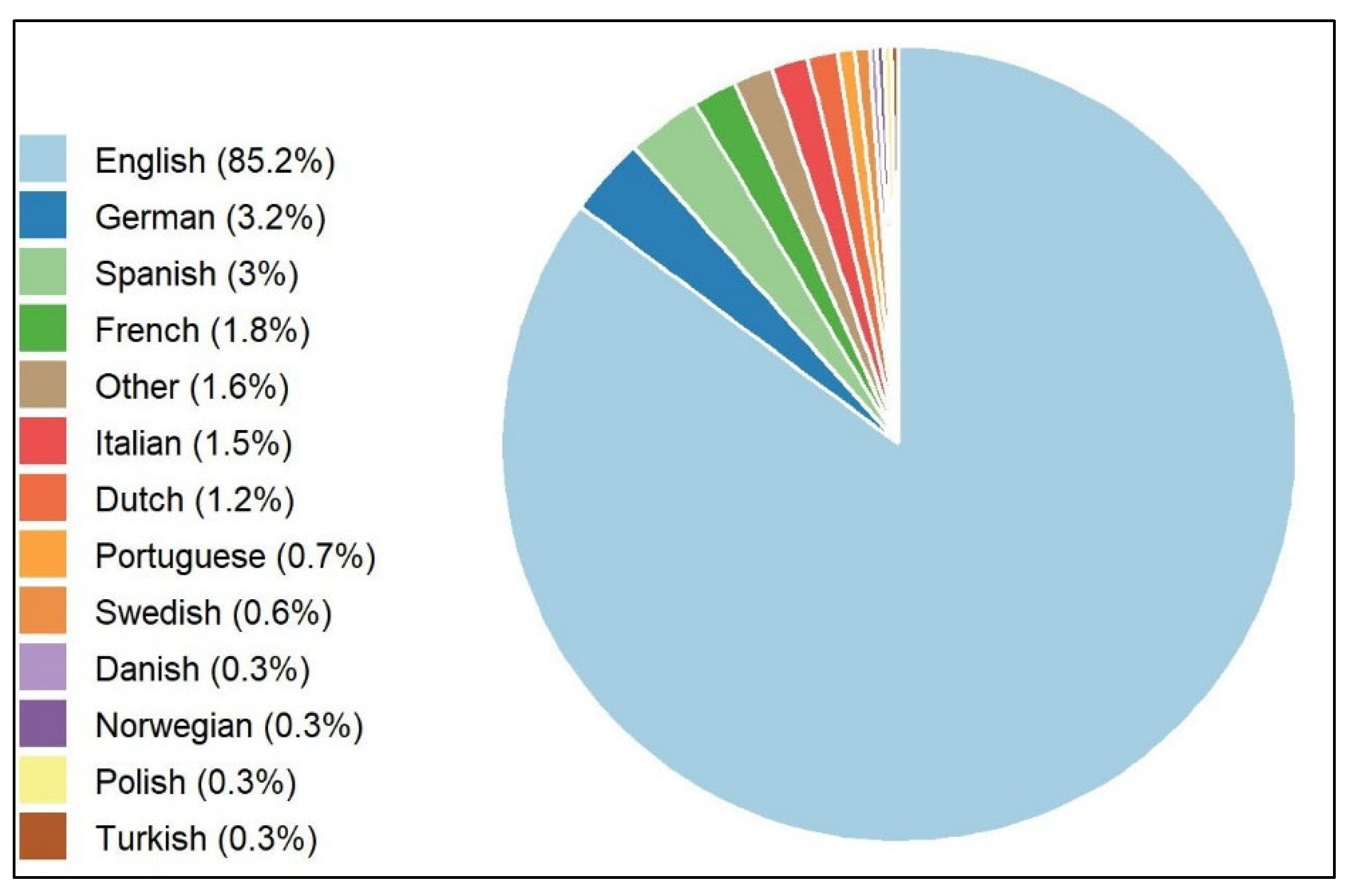
As shown in Figure 3, the vast majority of reviews were in English (85.2%), with significantly smaller proportions of German (3.2%), Spanish (3.0%), and French (1.8%). Additional languages, including Italian, Dutch, Portuguese, and Swedish, were present, each constituting less than 2% of the dataset. All remaining languages that individually represented less than 0.3% of the corpus were grouped into the ‘Other’ category (1.6%). Languages were detected using the LangID library. It is optimized for short text classification and widely employed for social media data analysis.
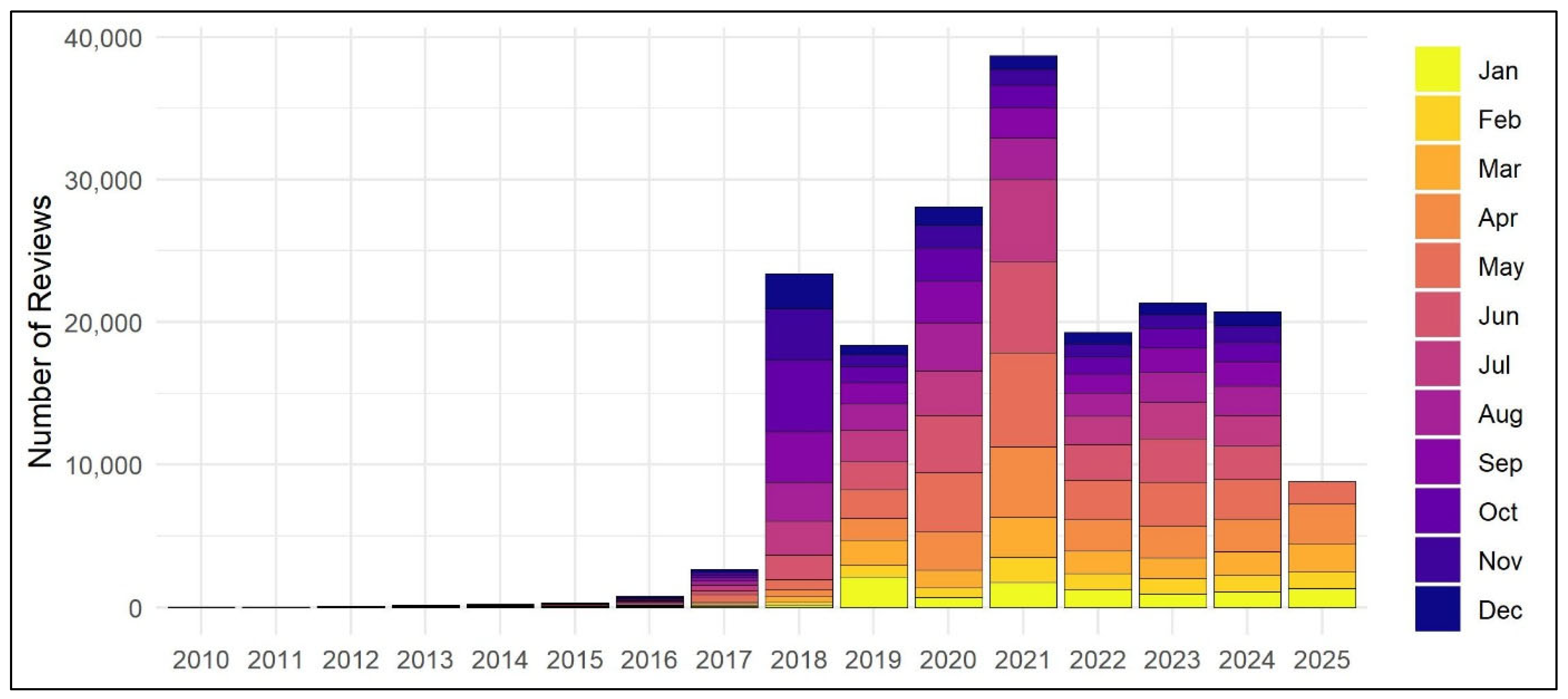
The temporal distribution of user reviews is shown in Figure 4. The number of comment postings started to increase markedly in 2017, with pronounced peaks in 2020 and 2021. This trend may reflect growing user interest in gardening-related applications, which was potentially intensified by lifestyle changes during the COVID-19 pandemic. A consistently high volume of reviews was maintained between 2020 and 2024, suggesting sustained user engagement with the selected applications.
A slight decrease in the review count is apparent in 2025; however, this likely results from data collection occurring early in the year (on 17 May 2025) and therefore does not reflect the full annual volume. Monthly breakdowns indicate year-round usage, with minor seasonal fluctuations observed across months.

4. Results

4.1. Topics Mentioned by Mobile Gardening Application Users

Table 1 presents the total number of user comments analysed for each of the 21 mobile applications from the final dataset. The most frequently reviewed application was PictureThis for plant identification, with a total of 65,270 comments collected from both the Apple App Store and Google Play. The second most reviewed application was PlantSnap, another plant identification tool, with 35,809 comments. The third position was held by PlantNet, which combines identification features with a citizen science component, accumulating 28,194 reviews. These were followed by PlantIn, an application designed to assist with plant care through personalized plans and consultations, reaching 17,451 reviews.
These results clearly indicate that applications related to plant identification dominate user review activity. Recognition features are perceived as particularly useful and appealing in the context of sustainable gardening. However, it is important to note that comprehensive applications supporting plant care routines, such as Planta (4953 reviews) and Plant Parent (4706 reviews), also maintain substantial popularity, confirming the value of tools that integrate identification with daily care support.
The analysis also revealed a substantial disparity between the number of comments collected from Google Play (146,104) and the Apple App Store (36,916), with Android user reviews nearly four times as numerous. This discrepancy can be attributed not only to a larger global user base of Android devices, particularly in lower-income regions, but also to the simpler review-posting process on Google Play, which involves fewer confirmation steps and account restrictions.
Despite this volume disparity, most applications maintain a consistent presence across both platforms, which indicates their cross-platform popularity. For example
  • PictureThis accumulated 55,751 reviews on Google Play and 9519 on the Apple App Store, securing its leadership position on both platforms.
  • PlantSnap, PlantNet, and PlantIn similarly gathered substantial numbers of reviews in each ecosystem, reflecting broad user engagement.
This platform distribution highlights the importance of considering device ecosystems when interpreting user feedback and planning feature development or prioritization across multiple platforms.
Table 2 presents the 18 latent topics identified through Combined Topic Modelling (CTM) applied to user comments from sustainable gardening mobile applications. Each topic is labelled based on representative keywords extracted from the model, accompanied by a detailed description that captures the essence of the theme. The representative keywords succinctly illustrate the dominant concepts within each topic, helping understand the thematic structure underlying user feedback.
The topics encompass a broad range of user concerns and interests, including functional application utility and suggestions, appreciation of performance and reliability, technical issues, botanical curiosity, emotional responses, as well as educational applications and community-related aspects. For example, topic 7 (Knowledge Exploration & Learning) highlights not only individuals’ curiosity but also community engagement and shared learning practices. Topic 0 (Overall Utility & User Suggestions) reflects general opinions and practical recommendations from users, while topic 5 (Plant Identification & Curiosity) captures user curiosity about botanical knowledge supported by applications’ features. In contrast, topic 16 focuses more specifically on users’ experiences with the plant identification functionality itself, including accuracy, performance, and practical usage of recognition tools.

4.2. Mapping the Topics Under the Theory of Consumption Value Framework

Table 3 maps the identified topics to the revised Theory of Consumption Value (TCV) framework. Each topic is assigned to a TCV category (functional, emotional, epistemic, conditional, social, or negative functional) based on an interpretive analysis of user concerns and values expressed in the comments. This mapping offers a consumer-centric interpretation, highlighting how distinct clusters of user feedback correspond to specific values.
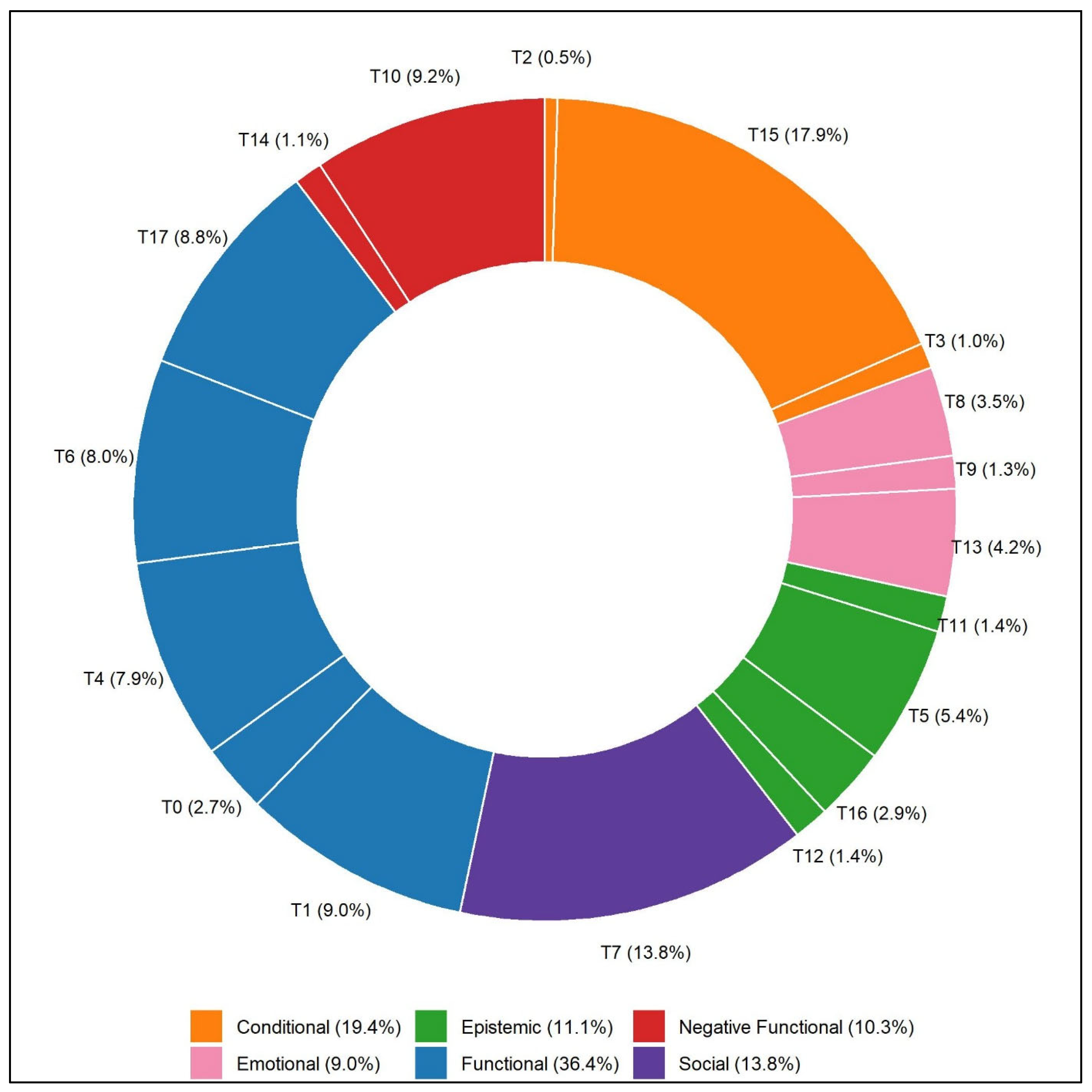
Functional topics emphasize practical utility and application performance (e.g., topics 0, 1, and 4), while emotional topics capture user feelings and satisfaction (e.g., topics 8, 9, and 13). Although some comments in topic 13 refer to application features, the dominant pattern reflects users’ emotional reactions such as satisfaction, frustration, or enjoyment associated with using the application. Epistemic topics concern knowledge acquisition and learning (e.g., topics 5 and 11), and conditional topics describe user experiences influenced by situational factors such as application availability or technical connectivity (e.g., topics 3 and 15). Topic 2 was also classified under Conditional Value because many comments refer to the usefulness of the application in specific situational contexts, such as particular gardening conditions, plant types, or seasonal activities. Social value is reflected in topics that emphasize community engagement, identity building, and shared learning (e.g., topic 7), underscoring the importance of collective knowledge creation and a sense of belonging in user communities. Negative functional topics address user frustrations related to pricing, feature access, and technical problems (e.g., topics 10 and 14). This category reflects situations in which users express dissatisfaction with the functional performance of the application, such as incorrect plant identification, technical malfunctions, or inaccurate recommendations.
This integrated thematic and value-based analysis provides nuanced insights into user priorities, experiences, and expectations, which can inform targeted improvements in sustainable gardening applications.
The mapping of topics to values proposed in the TCV reveals a strong dominance of the functional value (36.4%), confirming users’ pragmatic orientation towards reliability, speed, and utility. Concurrently, the conditional value (19.4%) highlights situational constraints such as connectivity and availability. The social value (13.8%) emerges as a distinct dimension, underscoring the importance of community engagement, shared learning, and collective identity among users. The epistemic value (11.1%) suggests that the applications also serve as tools for knowledge acquisition and discovery. Emotional feedback accounts for 9%, emphasizing the relevance of affective experiences, while negative functional aspects (10.3%) illustrate user frustrations related to pricing, access, and technical difficulties. Figure 5 presents a doughnut chart illustrating these proportions and the distribution of topics across TCV categories.
This comprehensive analysis reveals the multifaceted nature of user engagement with sustainable gardening applications, wherein functionality, knowledge acquisition, and contextual factors interact with emotions and practical concerns. These insights can guide developers in enhancing application features to better meet user expectations and to promote sustainable gardening practices.

5. Discussion

The analysis revealed a diverse array of topics reflecting users’ multifaceted engagement with sustainable gardening applications. It is important to emphasize that the findings reflect user perceptions and experiences expressed in reviews, rather than direct evidence of the applications’ actual environmental or behavioural impact. It’s also important to recognize the inherent limitations of using user-generated reviews as a primary data source. Such data can be susceptible to self-selection bias, as individuals with particularly positive or negative experiences are more likely to provide feedback, while a significant portion of users remain silent. Furthermore, reviews can vary in quality, ranging from detailed ratings to low-effort responses (e.g., simple ratings without justification), which can limit the depth and consistency of the analysis. Consequently, the dataset may not fully represent the entire user population, and the identified patterns should be interpreted as indicative of expressed user perceptions rather than comprehensive or fully representative assessments of application performance.
The predominance of the functional value (36.4%) aligns with the findings of [14], who emphasized practical utility as the primary driver of ICT adoption in agriculture. This alignment underscores the centrality of performance and accuracy in shaping user acceptance of digital horticultural and gardening solutions. The functional value dominates user feedback, highlighting the importance of reliability, accuracy, and utility in application features such as plant identification, care guidance, and scheduling. These findings are consistent with prior research emphasizing practical functionality as a key determinant of technology adoption and satisfaction [14,32,53].
The dominance of functional value may also be explained by the inherently utilitarian nature of gardening applications. Unlike many lifestyle or social media platforms, these applications are primarily used as practical tools for solving specific tasks such as plant identification, care recommendations, and garden management. As a result, users tend to evaluate them mainly in terms of reliability, accuracy, and efficiency rather than emotional engagement. This utilitarian orientation may structurally limit the prominence of emotional value in user feedback, as emotional responses often emerge only as secondary reactions to the perceived effectiveness or failure of the application’s core functionality. From a structural perspective, this dominance is also reinforced by the design logic of such applications. Most gardening apps are built around task-oriented functionalities (e.g., plant identification, care recommendations, problem diagnosis), which frame user interaction in terms of problem-solving rather than experiential engagement. As a result, user evaluations are naturally anchored in performance-related criteria, while emotional and symbolic dimensions remain secondary.
In addition, digital engagement mechanisms in consumer gardening applications differ substantially from those in professional agricultural ICT systems. Professional decision support systems (DSS) used in agriculture or horticulture are typically integrated into broader operational workflows and are evaluated primarily based on productivity, efficiency, and agronomic outcomes. In contrast, consumer-oriented gardening applications combine functional support with elements of informal learning, curiosity-driven exploration, and community interaction. This hybrid character may explain why functional and epistemic values dominate user feedback, while emotional dimensions remain comparatively less pronounced. In addition to functional utility, the social value (13.8%) emerged as a distinct dimension, reflecting users’ interest in community engagement, shared learning, and collective identity. Gardening applications are increasingly perceived not only as distinct tools but also as platforms for interaction and participation within communities of practice. These findings align with broader sustainability research that emphasizes the role of peer support and social recognition in shaping perceptions of environmentally responsible behaviour [28,31]. Features for experience sharing, contributions to citizen science, or user profile creation can thus reinforce a sense of belonging and strengthen long-term engagement. However, the results should not be directly generalized to professional ICT systems such as DSS platforms. While both categories share a functional orientation, professional tools are embedded in formal decision-making processes and evaluated against measurable agronomic outcomes. In contrast, consumer applications operate in more informal, voluntary contexts, where user perceptions and engagement play a more prominent role.
Emotional and epistemic values also play a significant role in shaping user experience [54,55]. In our dataset, the emotional value accounted for only 9% of user feedback. This result contrasts with [55], who reported a more prominent role of emotional design in fostering sustainable digital engagement. The discrepancy may be attributed to the predominantly utilitarian nature of gardening applications, where users primarily seek practical support and emotional design plays a secondary role.
The epistemic value (11.1%), associated with users’ desire for learning, curiosity, and discovery, further emphasizes the importance of educational content, interactive features, and citizen science components [32]. The availability of knowledge-sharing tools, plant databases, and educational challenges can enhance users’ cognitive engagement and may facilitate the diffusion of sustainable gardening knowledge and practices. Notably, epistemic and social values often overlap, as knowledge acquisition in this context is frequently community-based.
The conditional value (19.4%) reflects the influence of situational factors such as Internet connectivity, application availability, and context-specific user needs. Past research on smart farming similarly emphasizes how technical and situational barriers can substantially affect perceived utility and accessibility [14]. It is essential to address these limitations: features such as offline modes, local personalization, and robust support systems can enhance inclusivity and facilitate equitable ICT deployment in sustainable gardening.
Negative functional feedback (10.3%), particularly related to cost, premium feature access, and technical issues, underscores persistent challenges regarding pricing transparency, trust, and usability [53]. Topics related to pricing dissatisfaction (Topic 14) and uncertainty about functionality or subscription requirements (Topic 10) indicate that monetization strategies can significantly influence user perceptions and overall satisfaction with gardening applications. Users often express frustration when essential functionalities are restricted behind paywalls or when the pricing structure is perceived as unclear or inconsistent with initial expectations. From a practical perspective, developers should carefully design monetization strategies by improving transparency of subscription models, clearly communicating which features are available in free and premium versions, and ensuring that core functionalities remain accessible to maintain user trust and engagement.
It is also important to consider the contextual nature of the findings. The dataset includes applications used across different regions, but user perceptions may still be influenced by cultural, environmental, and technological contexts. For instance, expectations regarding functionality, pricing, or usability may vary depending on local gardening practices, digital literacy, or climate conditions. Therefore, caution should be exercised when generalizing the results to different cultural or geographic settings.
Overall, these findings suggest that mobile gardening applications should integrate high-performing, reliable functional features with engaging educational resources, thoughtful emotional design, and context-aware adaptability [54,55]. Addressing the full spectrum of user values, including functional, epistemic, emotional, and conditional, can bridge the gap between user needs and technological capabilities, thereby potentially supporting broader adoption and aligning with environmentally oriented user expectations.

6. Conclusions

This study provides a structured understanding of how users perceive and evaluate mobile gardening applications through the lens of consumption values. The findings highlight the dominance of functional value, complemented by epistemic, social, and conditional dimensions, shaping how users interpret and engage with these digital tools.
The results contribute to both theoretical discussions and practical understanding of user perceptions in mobile gardening applications. The study integrates advanced topic modelling techniques with the Theory of Consumption Values to analyse user-generated reviews of mobile gardening applications. Accordingly, the analysis focuses on user perceptions expressed in reviews, rather than direct measures of the app’s impact on sustainable gardening practices. Importantly, our findings reflect user perceptions and self-reported experiences rather than direct evidence of behavioural or environmental outcomes. The identified latent themes, mapped to consumption values, reveal a complex interplay among the application’s functionality, emotional engagement, knowledge acquisition, social interaction, situational constraints, and user frustrations. At the same time, these conclusions should be interpreted with caution due to the nature of the data. User reviews do not capture the full spectrum of user experiences and may overrepresent extreme opinions or more engaged users, while underrepresenting passive users who do not provide feedback.
Our findings emphasize the critical need for developers to balance robust technical performance with socially embedded, emotionally engaging, and educational content. At the same time, attention to users’ contextual limitations, such as connectivity and accessibility, remains essential. The results suggest that users appreciate apps that incorporate functional, social, epistemic, emotional, and conditional values. Such features may align with users’ interest in ecological gardening practices. These findings indicate that the perceived value structure of applications plays a critical role in shaping user engagement, suggesting that successful designs of gardening applications should integrate not only functional performance but also the epistemic and social dimensions of user experience.
Furthermore, the presence of negative functional feedback highlights persistent challenges related to pricing transparency and feature availability. This underscores the need for equitable monetization strategies that build trust and promote inclusion. Overall, applying consumer-centric value frameworks to analyse user-generated content provides valuable guidance for enhancing the design, adoption, and effectiveness of digital solutions in sustainable gardening.
Beyond its empirical findings, this study contributes conceptually by demonstrating how the integration of Contextualized Topic Modelling with the Theory of Consumption Values enables a structured interpretation of large-scale user-generated content. In doing so, it extends the application of the Theory of Consumption Values by combining it with large-scale user-generated data, offering a novel perspective on how users perceive and evaluate sustainability-oriented digital tools. This approach bridges data-driven text analysis with established consumer behaviour theory, offering a scalable framework for understanding user value perceptions in digital sustainability contexts.
From a research perspective, the findings highlight the importance of examining not only functional aspects of digital tools but also the interplay between epistemic, social, and contextual value dimensions in shaping user engagement. This perspective provides a useful direction for future research on user-centred digital sustainability solutions.
Overall, this study demonstrates that user perception-based value frameworks provide a meaningful lens for understanding mobile gardening applications. The findings highlight that the success of such applications depends not only on their technological capabilities but also on how users perceive and experience their value in practice.
Taken together, this study moves beyond a purely descriptive analysis of user reviews by demonstrating how large-scale user-generated data can be systematically integrated with established consumer behaviour theory to explain value-driven user engagement in sustainability-oriented digital tools. In this sense, this study contributes to bridging the gap between data-driven text analytics and theory-driven interpretation in sustainability research.

6.1. Practical Implications

The findings offer practical and actionable insights for application developers, UX designers, and digital solution providers involved in the design and development of mobile gardening applications and related sustainability-oriented ICT tools. By identifying key user expectations and sources of dissatisfaction, the study provides guidance on how value-based user perceptions can inform feature prioritization, interface design, and user engagement strategies. In particular, the analysis of user reviews indicates the importance of reliable core functionalities, improved pricing transparency, providing offline functionality to address connectivity limitations, and introducing moderated community features that support knowledge sharing and user interaction. These aspects may enhance user engagement with applications that are associated with environmentally responsible gardening practices. From an applicative perspective, the results can support the development of more user-centred digital solutions by aligning technical functionalities with user-perceived value dimensions, thereby improving adoption potential and long-term user engagement.

6.2. Limitations and Future Research

The research we have conducted is not free from limitations. Because the data was collected from the Apple App Store and Google Play, the results may be subject to errors due to the specific platform, its algorithms, moderation practices, and user demographics. Additionally, reviews were collected at a single point in time, which provides a consistent snapshot of user opinions but may not fully capture temporal changes in user feedback over longer periods. The study does not include a formal sensitivity analysis, which may influence the robustness of the findings under different sampling or parameter conditions. Another limitation may result from the influence of automatic translation into English of the comments we collected. We also acknowledge that our research may be limited by the profile of users leaving comments (household/garden, etc.), the geographic origin of the data, possible self-selection bias among users who decide to leave reviews, and the possibility of unrepresentative, promotional, or automated comments. In particular, the reviews themselves can often be of an extremely different nature (user opinions about extreme experiences, answers without detailed justification or simple opinions). Moreover, the research results we obtained reflect the perceptions and experiences of users expressed in reviews, and not an objective assessment of the functionality of the analysed applications. Additionally, we wanted to emphasize that topic modelling identifies the co-occurrence of words, and the assignment of topics to TCVs is an analytical interpretation and not a direct result of the algorithms we used. Furthermore, although the large dataset analysed in this study increases the stability of the extracted thematic structure, the transferability of the identified topic configuration to other application domains or cultural contexts should be interpreted with caution. In addition, although qualitative stability checks indicated consistent thematic patterns across model runs, the exact topic structure may still be sensitive to model parameterization, dataset composition, and preprocessing choices. The study does not include benchmarking against alternative topic modelling approaches or external validation, which may limit the generalizability of the modelling results. In addition, the scalability and transferability of the identified topic structure across different datasets, application domains, or cultural contexts have not been systematically evaluated. Although qualitative stability checks indicated consistent thematic patterns across model runs, the exact topic structure may still be sensitive to model parameterization, dataset composition, and preprocessing choices.
As topic modelling is inherently context-dependent, the identified topic configuration should be interpreted as a dataset-specific representation of user perceptions rather than a universally transferable structure. Future research should therefore examine the stability and reproducibility of topic configurations across diverse data sources, alternative model parameterizations, and resampling strategies. In addition, comparative analyses using different topic modelling techniques (e.g., BERTopic, LDA) could further strengthen the robustness assessment of the identified thematic structure.
The application selection process, while structured and guided by explicit criteria, retained an element of exploratory identification reflecting real-world user discovery patterns. As a result, the exact set of identified applications may vary depending on the timing of the search and the sources considered. However, the multi-stage procedure and clearly defined inclusion criteria ensure that a comparable and methodologically consistent sample can be obtained under similar conditions.
In addition, the findings of this study should be interpreted within the context of consumer-oriented mobile gardening applications. The analysed applications primarily support plant identification, home gardening assistance, and informal learning rather than professional horticultural decision-making. Consequently, the results may not directly generalize to professional agricultural ICT systems such as advanced horticultural decision support systems (DSS), precision agriculture platforms, or climate-smart greenhouse management systems. Additionally, although comments in multiple languages were translated into English, the dataset may still be influenced by the predominance of English-language reviews and platform-specific user demographics, which may limit the cross-cultural generalizability of the findings.
Future research should categorize gardening applications into two primary groups: plant identification tools and other utilities, such as planning, care scheduling, or record keeping. This stratification may reveal systematic differences in value structures (e.g., epistemic versus functional/conditional), engagement patterns, and sources of user dissatisfaction. Cross-cultural studies are necessary to capture evolving user motivations and barriers across diverse populations. Moreover, explicitly integrating social value dimensions, such as community-building, peer recognition, and collective knowledge creation, into the application’s design could enhance user retention and align with emerging trends toward socially embedded sustainable behaviour.
Future research should build on these insights by examining longitudinal usage patterns and cross-cultural differences, thereby deepening our understanding of evolving user motivations and barriers. Moreover, explicitly incorporating social value dimensions—such as community building, peer recognition, and collective knowledge creation—could further improve application design and support users’ engagement with environmentally responsible behaviours.
In addition, future research should explore the relationship between perceived value and actual behavioural outcomes using experimental or longitudinal designs.

Author Contributions

Conceptualization, M.W., I.Z., B.H. and D.Z.; methodology, M.W., I.Z., B.H. and D.Z.; formal analysis, M.W.; investigation, M.W.; data curation, M.W.; writing—original draft preparation, M.W., I.Z., B.H. and D.Z.; writing—review and editing, M.W., I.Z., B.H. and D.Z.; visualization, M.W.; funding acquisition, M.W., I.Z., B.H. and D.Z. All authors have read and agreed to the published version of the manuscript.

Funding

This paper was published as part of statutory research at the Silesian University of Technology, Faculty of Organization and Management, grant number BK-270/ROZ1/2026 (13/010/BK_26/0093).

Institutional Review Board Statement

Not applicable.

Informed Consent Statement

Not applicable.

Data Availability Statement

The data presented in this study are openly available in publicly available sections of Google Play and the Apple App Store [https://play.google.com/store] (accessed on 17 May 2025).

Conflicts of Interest

The authors declare no conflicts of interest.

Appendix A

Table A1. Mobile gardening applications analysed in the study and their platform identifiers.
ApplicationGoogle Play IDApp Store ID
Blossomcom.conceptivapps.blossom1487453649
Flora Incognitacom.floraincognita.app.floraincognita1297860122
Garden Managercom.jee.greenN/A
Gardenatecom.hutchinsonsoftware.gardenate362009731
Gardenizecom.htec.gardenize1118448120
Greggreg.io.care_app_android1512912236
GrowItcom.growit.ai6443580320
iNaturalistorg.inaturalist.android421397028
PictureThiscn.danatech.xingseus1252497129
Plant Parentcom.plantparentai.app1612792132
Plantacom.stromming.planta1410126781
Planter—Garden Plannercom.perculacreative.peter.gardenplanner1542642210
PlantIncom.myplantin.app1527399597
Plantix Previewcom.peat.GartenBank.previewN/A
PlantNetorg.plantnet600547573
PlantSnapcom.fws.plantsnap21451054346
Plantumplant.identification.flower.tree.leaf.identifier.
identify.cat.dog.breed.nature
N/A
Seed to Spoon—Garden PlannerN/A1312538762
Sowing Calendar—Gardeningcom.GVKSoftware.sowingcalendarN/A
Veggie Garden Plannercom.bentosoftware.gartenplaner1329927332
Waterbotnet.kosev.wateringN/A
Note. Compiled by the authors from Apple App Store and Google Play product pages. N/A—The application was not available on the respective platform, and therefore no ID was assigned. Source: original research.
Table A2. Overview of Mobile Applications Supporting Environmentally Responsible Gardening Behaviour.
ApplicationMain FeaturesTargetSustainability Criteria
BlossomPlant identification; plant care guidelines; reminders for watering, fertilizing, and repotting; plant disease detection; watering calculator; integrated plants and tools store; calendar and guides for edible plants; AI-based treatment plans and consultations; weather alerts; knowledge base; user notes and plant growth journal; advanced search by criteria; plant collections.Houseplant owners and amateur gardeners who seek a comprehensive, easy-to-use plant-care tool, including support for edible plants.The app improves resource management (e.g., water), protecting plants, and promoting home and urban farming. It provides tools and knowledge to enable users to act more ecologically (SDG 15, SDG 4).
Flora IncognitaWild plant identification from photographs (AI); species profiles; observation list; plant location maps; participation in a scientific project (nature conservation, research); news and nature insights (stories); sharing results via social media.Users interested in botany and citizen science, including educators and nature enthusiasts.The app increases knowledge about biodiversity, supports environmental monitoring, and supports ecosystem conservation efforts (SDG 12, SDG 4).
Garden ManagerPlanting calendar; plant knowledge base; plant list personalization; crop inventory; reminders; synchronization and sharing; data export (CSV); offline access.Gardeners who need a simple schedule with alarms and a garden work journal.The application enables more efficient management of crop production, reducing losses and promoting conscious and responsible gardening practices.
GardenateClimate-zone–adjusted planting calendar; descriptions and tips for 90+ vegetables and herbs; plant wishlist; crop log (sowing, harvest, notes); harvest reminders; plant and variety list personalization; garden synchronization and sharing; data export (CSV); offline access.Vegetable gardeners planning seasonal crops.The app promotes more efficient use of resources, reducing crop losses and promoting local and sustainable food production (SDG 12, SDG 4).
GardenizePlant database with care information; plant identification; personalized care recommendations; calendar planning and reminders; organization of plants and garden areas; notes, lists, and cultivation journal; filtering and garden history; gardening inspiration and articles; community and garden sharing; multiple plant/area photo storage; data export and backup (CSV).Gardeners maintaining a plant inventory and work log who wish to document and plan activities.The app promotes more efficient use of resources, promotes home plant production and increases users’ environmental awareness (SDG 12, SDG 4).
GregPlant identification; automatic pot size and window distance measurement; personalized care and watering plans; precise water amount calculation; watering reminders; global plant parent community; user support and troubleshooting; social feed and focus groups.Houseplant owners who need intelligent, personalized care schedules.The app promotes more efficient use of resources and increases user knowledge through community and the exchange of experiences (SDG 15, SDG 4).
GrowItPersonalized planting calendar; garden planning with square foot gardening grid; knowledge base for growing vegetables, fruits, and herbs; soil, fertilization, watering, and light guidance; companion and incompatible plant information; seasonal care tips and weather alerts; reminders for watering, fertilizing, sowing, and harvesting; plant disease identification from photos with treatment advice; strategies for chemical-free weed, pest, and disease control; inspiration and tips; recipes and preservation tips.Gardeners who look for inspiration, peer interaction, and community feedback.The app promotes local food production, biodiversity conservation and more efficient use of resources and crops (SDG 15, SDG 12, SDG 4).
iNaturalistSpecies identification; recording nature observations; supporting science by sharing data; manual addition of observations to projects; learning about biodiversity; community engagement and knowledge exchange with nature enthusiasts.Citizen-science community members, educators, researchers, and nature enthusiasts who document biodiversity.The application helps increase knowledge about biodiversity, supports environmental monitoring and engages society in nature conservation activities (SDG 15, SDG 4).
PictureThisPlant identification; automatic diagnosis and treatment of plant diseases; detailed care instructions and reminders; toxic plant warnings; weed identification and removal advice; watering notifications (water tracker); light exposure monitoring; plant collection and wishlist management; expert consultations.Beginner to advanced gardeners and houseplant owners who seek identification and care guidance.The app promotes more efficient use of resources, reduces plant losses and increases user knowledge of responsible cultivation and plant protection (SDG 15, SDG 12, SDG 4).
Plant ParentCare reminders (watering, fertilizing, pruning, repotting); light meter; plant identification from photos; personalized care plans; disease diagnosis and treatment plans; growing site recommendations.Houseplant owners seeking an all-in-one daily care assistant.The application promotes the efficient use of resources, reduces plant losses and increases users’ knowledge about responsible cultivation (SDG 15, SDG 12, SDG 4)
PlantaIntelligent care reminders (watering, fertilizing, misting, pruning, repotting, overwintering); disease diagnosis and treatment plans; expert support; shared care schedule; plant lover community; integrated recommendations and shopping; plant identification from photos (AI); light meter; plant journal.Beginner to intermediate houseplant owners who seek structured care guidance.The application promotes the efficient use of resources, reduces plant losses and increases environmental awareness (SDG 15, SDG 12, SDG 4)
Planter—Garden PlannerInformation on companion and competitive plants; planting calendar (sowing and transplanting); square foot gardening grid for garden planning; knowledge base of 100+ fruits and vegetables with thousands of varieties; custom plant addition; map for selecting location and frost dates.Home vegetable gardeners who seek efficient bed layouts and crop schedules.The application promotes the efficient use of resources, plant protection and the development of users’ knowledge about sustainable food production (SDG 15, SDG 12, SDG 4).
PlantInWatering calculator; light meter; personalized care plans; notifications for watering, fertilizing, and weather conditions; consultations with a botanist; mushroom identification.Beginner gardeners and houseplant owners seeking expert-supported care plans.The application promotes the efficient use of resources, reduces biological losses and increases users’ knowledge about responsible plant and mushroom cultivation (SDG 15, SDG 12, SDG 4).
Plantix PreviewCrop pest and disease detection (from photographs); protective treatment recommendations; local disease alerts; farmer and expert community; agricultural best practice tips; agricultural weather forecast; fertilizer calculator; nutrient deficiency diagnosis; action plan for the entire crop cycle.Farmers and gardeners who manage crop health at small to medium scales.The app reduces crop losses, promotes the rational use of resources and increases users’ knowledge of sustainable agriculture (SDG 15, SDG 12, SDG 4).
PlantNetPlant identification from photographs; citizen science projects; recognition of wild and cultivated plants; search filters; re-identification of own and community observations; multi-flora identification; selection and saving of favourite floras; image galleries at various taxonomic levels; observation mapping; species fact sheets.Citizen science contributors, educators, and plant enthusiasts.The app promotes biodiversity conservation, supports scientific research and increases users’ knowledge of ecosystems and plant species (SDG 15, SDG 4).
PlantSnapPlant identification from photographs; detailed taxonomic information and descriptions; care tips and growing instructions; species search feature; global plant observation map; personal plant libraries/collections; photos of rare species worldwide; zoom feature, and augmented reality technology.Plant enthusiasts, educators, and global users who seek quick identification.The app increases user knowledge, promotes biodiversity conservation, and supports conscious and responsible plant care practices (SDG 12, SDG 15, SDG 4).
PlantumPlant, mushroom, mineral, and insect identification; disease diagnosis and treatment methods; care guides (watering, light, fertilizing); care reminders (watering, misting, fertilizing, rotating); sunlight measurement; pot volume measurement; watering calculator; weather alerts; sharing care schedules with family/friends; plant growth journal; nature encyclopaedia.Houseplant owners and hobby gardeners who need ongoing care support.The app promotes the rational use of resources, reduces biological losses and increases users’ knowledge about ecosystems and ecological care (SDG 12, SDG 15, SDG 4).
Seed to Spoon—Garden PlannerGarden planning with a visual planner; personalized planting dates; Growbot AI assistant; garden management (journal, notes, photographs, sowing times and harvesting dates); custom plants; real-time weather alerts; Park Seed shop; themed plant collections; pest guide and eco-friendly control; plant health filters; recipes and preservation tips; gardening community; weekly live workshops.Vegetable gardeners and health-focused users growing their own food.The app promotes efficient use of resources, plant protection, and education and collaboration within the gardening community (SDG 12, SDG 15, SDG 4).
Sowing Calendar—GardeningPlanting and harvesting guide; ‘What people plant nearby’ feature; My Garden (journal, photographs, statistics); custom plants and varieties; searchable pest and disease database; moon and sun phase information; gardening task reminders; personalized sowing/harvest dates and notes; cloud save/restore/sync; 7-day weather forecast; weekly tip notifications.Vegetable gardeners who plan seasonal activities.The app supports efficient use of resources, reduces crop losses and promotes ecological gardening practices (SDG 12 m SDG 4).
Veggie Garden PlannerCompanion and incompatible plant information; sowing and harvest date tables; vegetable interaction tips; Patch Plan Editor (visual garden bed planning, paid feature); planting spacing and crop rotation guidance; warnings for problematic crop rotations; for USDA zones 7–8.Vegetable gardeners who need to organize layouts and rotation.The app promotes healthy biodiversity, reduces crop losses and increases users’ knowledge of organic gardening (SDG12, SDG 4).
WaterbotWatering reminders; watering journal; management of multiple plants simultaneously.Houseplant owners in need of simple watering reminders.The app promotes efficient water use, reduces plant losses and increases user awareness of responsible care (SDG 12, SDG 4).
Note. Compiled by the authors from Apple App Store and Google Play product pages. Source: original research.

References

  1. Šermukšnytė-Alešiūnienė, K.; Melnikienė, R. The Effects of Digitalization on the Sustainability of Small Farms. Sustainability 2024, 16, 4076. [Google Scholar] [CrossRef]
  2. Ludwig-Ohm, S.; Hildner, P.; Isaak, M.; Dirksmeyer, W.; Schattenberg, J. The Contribution of Horticulture 4.0 Innovations to More Sustainable Horticulture. Procedia Comput. Sci. 2023, 217, 465–477. [Google Scholar] [CrossRef]
  3. Ludwig-Ohm, S.; Dirksmeyer, W. HortiCo 4.0: The Networking and Transfer Project for Horticulture 4.0 Innovation Funding in Germany. Acta Hortic. 2021, 817–822. [Google Scholar] [CrossRef]
  4. Scuderi, A.; La Via, G.; Timpanaro, G.; Sturiale, L. The Digital Applications of “Agriculture 4.0”: Strategic Opportunity for the Development of the Italian Citrus Chain. Agriculture 2022, 12, 400. [Google Scholar] [CrossRef]
  5. Xu, J.; Li, Y.; Zhang, M.; Zhang, S. Sustainable Agriculture in the Digital Era: Past, Present, and Future Trends by Bibliometric Analysis. Heliyon 2024, 10, e34612. [Google Scholar] [CrossRef]
  6. Dudek, M.; Wrzaszcz, W. On the Way to Eco-Innovations in Agriculture: Concepts, Implementation and Effects at National and Local Level. The Case of Poland. Sustainability 2020, 12, 4839. [Google Scholar] [CrossRef]
  7. Komorowski, Ł. Digitalisation as a Challenge for Smart Villages: The Case of Poland. Agriculture 2024, 14, 2270. [Google Scholar] [CrossRef]
  8. Niewiadomska, A. Agriculture 4.0—An Opportunity or Threat to Polish Agriculture. Przegląd Prawa Rolnego 2024, 2, 163–174. [Google Scholar] [CrossRef]
  9. Chaudhary, V.; Kumar, M.; Chaudhary, V.; Kumar, R.; Chauhan, C. Artificial Intelligence in Sustainable Horticultural Production: A Systematic Review. Discov. Plants 2025, 2, 372. [Google Scholar] [CrossRef]
  10. Khan, S.; Mazhar, T.; Shahzad, T.; Khan, M.A.; Guizani, S.; Hamam, H. Future of Sustainable Farming: Exploring Opportunities and Overcoming Barriers in Drone-IoT Integration. Discov. Sustain. 2024, 5, 470. [Google Scholar] [CrossRef]
  11. Huang, L.-C. The Effect of Incentives on Facilitating User Engagement with Succulent Retailers’ Social Media Pages. Horticulturae 2023, 9, 849. [Google Scholar] [CrossRef]
  12. Avila, F.R.D.; Barbosa, J.L.V. Smart Environments in Digital Agriculture: A Systematic Review and Taxonomy. Comput. Electron. Agric. 2025, 236, 110393. [Google Scholar] [CrossRef]
  13. Barroso-Barroso, C.; Vega-Muñoz, A.; Maradiaga-López, J.; Salazar-Sepúlveda, G.; Carabantes-Silva, R. Smart Farming and the SDGs: Emerging Research Patterns and Sustainability Implications. Agriculture 2025, 16, 81. [Google Scholar] [CrossRef]
  14. Wolfert, S.; Ge, L.; Verdouw, C.; Bogaardt, M.-J. Big Data in Smart Farming—A Review. Agric. Syst. 2017, 153, 69–80. [Google Scholar] [CrossRef]
  15. Kim, S.; Lee, M.; Shin, C. IoT-Based Strawberry Disease Prediction System for Smart Farming. Sensors 2018, 18, 4051. [Google Scholar] [CrossRef]
  16. Subeesh, A.; Mehta, C.R. Automation and Digitization of Agriculture Using Artificial Intelligence and Internet of Things. Artif. Intell. Agric. 2021, 5, 278–291. [Google Scholar] [CrossRef]
  17. Kee, T.; Zhang, H. Digital Experiential Learning for Sustainable Horticulture and Landscape Management Education. Sustainability 2022, 14, 9116. [Google Scholar] [CrossRef]
  18. Shahriar, S.; Corradini, M.G.; Sharif, S.; Moussa, M.; Dara, R. The Role of Generative Artificial Intelligence in Digital Agri-Food. J. Agric. Food Res. 2025, 20, 101787. [Google Scholar] [CrossRef]
  19. Qi, Q.; Tao, F.; Hu, T.; Anwer, N.; Liu, A.; Wei, Y.; Wang, L.; Nee, A.Y.C. Enabling Technologies and Tools for Digital Twin. J. Manuf. Syst. 2021, 58, 3–21. [Google Scholar] [CrossRef]
  20. Ariesen-Verschuur, N.; Verdouw, C.; Tekinerdogan, B. Digital Twins in Greenhouse Horticulture: A Review. Comput. Electron. Agric. 2022, 199, 107183. [Google Scholar] [CrossRef]
  21. Fountas, S.; Mylonas, N.; Malounas, I.; Rodias, E.; Hellmann Santos, C.; Pekkeriet, E. Agricultural Robotics for Field Operations. Sensors 2020, 20, 2672. [Google Scholar] [CrossRef]
  22. Hafeez, A.; Husain, M.A.; Singh, S.P.; Chauhan, A.; Khan, M.T.; Kumar, N.; Chauhan, A.; Soni, S.K. Implementation of Drone Technology for Farm Monitoring & Pesticide Spraying: A Review. Inf. Process. Agric. 2023, 10, 192–203. [Google Scholar] [CrossRef]
  23. Vinod Chandra, S.S.; Hareendran, A.; Albaaji, G.F. Precision Farming for Sustainability: An Agricultural Intelligence Model. Comput. Electron. Agric. 2024, 226, 109386. [Google Scholar] [CrossRef]
  24. Liakos, K.G.; Busato, P.; Moshou, D.; Pearson, S.; Bochtis, D. Machine Learning in Agriculture: A Review. Sensors 2018, 18, 2674. [Google Scholar] [CrossRef] [PubMed]
  25. Mahlein, A.-K. Plant Disease Detection by Imaging Sensors—Parallels and Specific Demands for Precision Agriculture and Plant Phenotyping. Plant Dis. 2015, 100, 241–251. [Google Scholar] [CrossRef]
  26. Altieri, M.A.; Nicholls, C.I.; Henao, A.; Lana, M.A. Agroecology and the Design of Climate Change-Resilient Farming Systems. Agron. Sustain. Dev. 2015, 35, 869–890. [Google Scholar] [CrossRef]
  27. Bonney, R.; Shirk, J.; Phillips, T.; Wiggins, A.; Ballard, H.; Miller-Rushing, A.; Parrish, J. Next Steps for Citizen Science. Science 2014, 343, 1436–1437. [Google Scholar] [CrossRef]
  28. Newman, G.; Wiggins, A.; Crall, A.; Graham, E.; Newman, S.; Crowston, K. The Future of Citizen Science: Emerging Technologies and Shifting Paradigms. Front. Ecol. Environ. 2012, 10, 298–304. [Google Scholar] [CrossRef]
  29. Mohanty, S.P.; Hughes, D.P.; Salathé, M. Using Deep Learning for Image-Based Plant Disease Detection. Front. Plant Sci. 2016, 7, 1419. [Google Scholar] [CrossRef]
  30. Van Dijk, J.A.G.M. The Digital Divide; Polity Press: Cambridge, UK, 2019. [Google Scholar]
  31. Delmas, M.; Burbano, V. The Drivers of Greenwashing. Calif. Manag. Rev. 2011, 54, 64–87. [Google Scholar] [CrossRef]
  32. Sheth, J.N.; Newman, B.I.; Gross, B.L. Why We Buy What We Buy: A Theory of Consumption Values. J. Bus. Res. 1991, 22, 159–170. [Google Scholar] [CrossRef]
  33. Oliver, R.L. Satisfaction: A Behavioral Perspective on the Consumer; McGraw-Hill: New York, NY, USA, 1997. [Google Scholar]
  34. Tax, S.S.; Brown, S.W.; Chandrashekaran, M. Customer Evaluations of Service Complaint Experiences: Implications for Relationship Marketing. J. Mark. 1998, 62, 60–76. [Google Scholar] [CrossRef]
  35. Duda, E. Urban Gardening Education: User Reflections on Mobile Application Designs. PLoS ONE 2024, 19, e0310357. [Google Scholar] [CrossRef] [PubMed]
  36. Hart, A.; Bosley, H.; Hooper, C.; Perry, J.; Sellors-Moore, J.; Moore, O.; Goodenough, A. Assessing the Accuracy of Free Automated Plant Identification Applications. People Nat. 2023, 5, 929–937. [Google Scholar] [CrossRef]
  37. Jones, H. What Plant Is That? Tests of Automated Image Recognition Apps for Plant Identification on Plants from the British Flora. AoB Plants 2020, 12, plaa052. [Google Scholar] [CrossRef]
  38. Mäder, P.; Boho, D.; Rzanny, M.; Seeland, M.; Wittich, H.; Deggelmann, A.; Wäldchen, J. The Flora Incognita App—Interactive Plant Species Identification. Methods Ecol. Evol. 2021, 12, 1335–1342. [Google Scholar] [CrossRef]
  39. Otter, J.; Mayer, S.; Tomaszewski, C.A. Swipe Right: A Comparison of Accuracy of Plant Identification Apps for Toxic Plants. J. Med. Toxicol. 2021, 17, 42–47. [Google Scholar] [CrossRef]
  40. JoMingyu Google-Play-Scraper. 2024. Available online: https://github.com/JoMingyu/google-play-scraper/ (accessed on 17 May 2025).
  41. Lim, E. App-Store-Scraper. 2020. Available online: https://github.com/cowboy-bebug/app-store-scraper (accessed on 17 May 2025).
  42. Lui, M.; Baldwin, T. Langid.py: An Off-the-Shelf Language Identification Tool. In Proceedings of the ACL 2012 System Demonstrations; Zhang, M., Ed.; Association for Computational Linguistics: Jeju Island, Republic of Korea, 2012; pp. 25–30. [Google Scholar]
  43. Helsinki-NLP. Opus-Mt-Mul-En: Multilingual to English Translation Model; Hugging Face Model Repository: New York, NY, USA, 2022. [Google Scholar]
  44. Reimers, N.; Gurevych, I. Sentence-BERT: Sentence Embeddings Using Siamese BERT-Networks. In Proceedings of the 2019 Conference on Empirical Methods in Natural Language Processing; Association for Computational Linguistics: Stroudsburg, PA, USA, 2019. [Google Scholar]
  45. Bianchi, F.; Terragni, S.; Hovy, D. Pre-Training Is a Hot Topic: Contextualized Document Embeddings Improve Topic Coherence. In Proceedings of the 59th Annual Meeting of the Association for Computational Linguistics and the 11th International Joint Conference on Natural Language Processing (Volume 2: Short Papers), Online, 5–6 August 2021; Association for Computational Linguistics: Stroudsburg, PA, USA, 2021; pp. 759–766. [Google Scholar]
  46. Bianchi, F.; Terragni, S.; Hovy, D.; Nozza, D.; Fersini, E. Cross-Lingual Contextualized Topic Models with Zero-Shot Learning. In Proceedings of the 16th Conference of the European Chapter of the Association for Computational Linguistics, Online, 19–23 May 2021; Association for Computational Linguistics: Stroudsburg, PA, USA, 2021; pp. 1807–1820. [Google Scholar]
  47. Adhya, S.; Lahiri, A.; Sanyal, D.K.; Das, P.P. Improving Contextualized Topic Models with Negative Sampling. arXiv 2023, arXiv:2303.14951. [Google Scholar] [CrossRef]
  48. Fang, Z.; He, Y.; Procter, R. CWTM: Leveraging Contextualized Word Embeddings from BERT for Neural Topic Modeling. arXiv 2024, arXiv:2305.09329. [Google Scholar] [CrossRef]
  49. Koochemeshkian, P.; Bouguila, N. Integration of Neural Embeddings and Probabilistic Models in Topic Modeling. Appl. Artif. Intell. 2024, 38, 2403904. [Google Scholar] [CrossRef]
  50. Abd-Alrazaq, A.; Alhuwail, D.; Househ, M.; Hamdi, M.; Shah, Z. Top Concerns of Tweeters During the COVID-19 Pandemic: Infoveillance Study. J. Med. Internet Res. 2020, 22, e19016. [Google Scholar] [CrossRef]
  51. Garcia, K.; Berton, L. Topic Detection and Sentiment Analysis in Twitter Content Related to COVID-19 from Brazil and the USA. Appl. Soft Comput. 2021, 101, 107057. [Google Scholar] [CrossRef]
  52. Mottaghinia, Z.; Feizi-Derakhshi, M.-R.; Farzinvash, L.; Salehpour, P. A Review of Approaches for Topic Detection in Twitter. J. Exp. Theor. Artif. Intell. 2021, 33, 747–773. [Google Scholar] [CrossRef]
  53. Biswas, A.; Roy, M. Green Products: An Exploratory Study on the Consumer Behaviour in Emerging Economies of the East. J. Clean. Prod. 2015, 87, 463–468. [Google Scholar] [CrossRef]
  54. Aftab, M.; Goh, M.; Yeveseyeva, I.; Nassiuma, I.; Uner, I. Empathy-Led Digital Adoption Towards Happy and Sustainable Workforce. In Proceedings of the 31st ISTE International Conference on Transdisciplinary Engineering, London, UK, 9–11 July 2024. [Google Scholar]
  55. Feng, Y.; Zhao, L. Emotional Design for Pro-Environmental Life: Visual Appeal and User Interactivity Influence Sustainable Consumption Intention with Moderating Effect of Positive Emotion. Heliyon 2024, 10, e38521. [Google Scholar] [CrossRef]
Figure 1. Analytical workflow for user comment analysis. Source: original research.
Sustainability 18 03703 g001
Figure 2. Optimal number of topics. Source: original research.
Sustainability 18 03703 g002
Figure 3. Distribution of languages detected in user comments. Source: original research.
Sustainability 18 03703 g003
Figure 4. Yearly and monthly distribution of user comments. Source: original research.
Sustainability 18 03703 g004
Figure 5. Distribution of Topics and Consumption Values in User Comments. Source: original research.
Sustainability 18 03703 g005
Table 1. Total user comments analysed per application.
NamePlatform AvailabilityApp StoreGoogle PlayTotal
BlossomiOS + Android191352277140
Flora IncognitaiOS + Android186219953857
Garden ManagerAndroid only0280280
GardenateiOS + Android212204416
GardenizeiOS + Android260272532
GregiOS + Android6318851516
GrowItiOS + Android292187479
iNaturalistiOS + Android147318823355
PictureThisiOS + Android951955,75165,270
Plant ParentiOS + Android237823284706
PlantaiOS + Android203729164953
Planter—Garden PlanneriOS + Android63515412176
PlantIniOS + Android632111,13017,451
Plantix PreviewAndroid only0495495
PlantNetiOS + Android572222,47228,194
PlantSnapiOS + Android247533,33435,809
PlantumAndroid only 36523652
Seed to Spoon—Garden PlanneriOS only5330533
Sowing Calendar—GardeningAndroid only0785785
Veggie Garden PlanneriOS + Android65388741
WaterbotiOS + Android0680680
36,916146,104183,020
Source: original research.
Table 2. Identified topics and descriptions (CTM/LDA results).
Topic with Assigned LabelRepresentative KeywordsDescription
0: Overall Utility & User Suggestionsrecommend, information, app, like, feature, help, plantOpinions on the general utility and practical suggestions to improve the application based on everyday experience.
1: Performance & Accuracy Appreciationprecise, efficient, fast, reliable, quick, intuitive, functionalUser appreciation of the application’s speed, precision, and reliability.
2: Meta-level Reflections & Ambiguityoriginally, suspect, stress, mediocre, habit, illness, parameterReflections and ambiguous comments on the application’s structure or topics that do not directly concern functionality or user experience.
3: Availability & Usage Conditionsmarket, status, stress, forum, grocery, flaw, portionFeedback related to how the application’s availability, updates, or external conditions impact its use.
4: Tech-Specific Featurestech, market, locate, clever, software, explanationMentions of advanced or specific technical features within the application.
5: Plant Identification & Curiosityrecognise, cactus, accurately, rose, poison, photographComments showing curiosity about plants and the usefulness of species identification features.
6: Instructions & Daily Useresult, correct, answer, match, identification, searchFeedback about in-application guidance and daily use for plant care routines.
7: Learning & Community Engagementworld, animal, discover, knowledge, natural, communityExploration of knowledge and discovery combined with community engagement and shared learning related to plant recognition.
8: Emotional Surprise & Delightsuperb, luckily, minor, gladly, forum, reviewerUser declarations of delight, admiration, or positive emotional reactions to the application’s features or discoveries.
9: User-Friendly Design & Simplicityquit, worry, complicated, sound, peaceful, averageComments about intuitive design, simplicity, and calming interface that improve user experience.
10: Uncertainty & Frustrationcover, credit, impossible, unsubscribe, card, scam, feeStatements of dissatisfaction with pricing or unclear access models.
11: Educational Application & School Usegrocery, lacking, scared, discuss, instruct, wipeMentions of the application’s relevance, role, or utility in schools and educational environments.
12: User Profiles—Learners & Enthusiastsstudent, kid, amateur, botanist, study, science, noviceEngagement, attitudes, and needs of amateur users and learners seeking knowledge or support.
13: Customer Service Satisfactionplay, service, support, contact, customer, reviewPositive reviews of helpful service, communication, and responsiveness.
14: Cost & Value Frustrationworry, pricey, vague, costly, complicated, registrationCriticism of value, fairness, or cost-related issues.
15: Technical & Connectivity Problemscrash, connection, internet, camera, error, load, fixUser concerns about technical problems, Internet connection, application errors, crashes, or slow performance.
16: Discovery Features & Species Identificationapp, water, feature, need, think, addUser feedback about garden planning features, species identification, and discovery tools in the application.
17: Task Management & Schedulingwater, watering, reminder, schedule, plan, track, careFrustration resulting from unmet expectations or unclear functionality.
Source: original research.
Table 3. Mapping topics to the Theory of Consumption Values.
Topic with Assigned LabelConsumption ValueConsumption Value Description
0: Overall Utility & User SuggestionsFunctionalThe keywords show that the application supports users in many everyday tasks, providing practical utility.
1: Performance & Accuracy AppreciationFunctionalSpeed, reliability, and precision of the application are emphasized, highlighting its functional value.
2: Meta-level Reflections & AmbiguityConditionalUsers focus on the clarity of information provided and the ease of distinction, which strengthens their knowledge and orientation.
3: Availability & Usage ConditionsConditionalUsers recognize the application’s usefulness depending on external conditions, such as location, availability, or situation.
4: Tech-Specific FeaturesFunctionalTechnical features—such as offline mode or camera integration—are valued for enhancing the application’s functionality.
5: Plant Identification & CuriosityEpistemicThe comments reflect users’ curiosity about plants, indicating a need to expand botanical knowledge.
6: Instructions & Daily UseFunctionalThe comments focus on the plant recognition feature, indicating expectations for the application’s usefulness and effectiveness.
7: Learning & Community EngagementSocialPlant image recognition supports individual learning and the collective building of a knowledge base through community engagement and shared discoveries.
8: Emotional Surprise & DelightEmotionalThe comments express personal feelings and surprise while discovering the application’s features.
9: User-Friendly Design & SimplicityEmotionalA simple and aesthetic interface evokes positive emotions and enhances user experience.
10: Uncertainty & FrustrationNegative FunctionalComments express frustration and disappointment regarding non-functional features, high costs, or unclear usage rules.
11: Educational Application & School UseEpistemicMentions of using the application in educational contexts (e.g., in schools) point to its role as a learning aid.
12: User Profiles—Learners & EnthusiastsEpistemicThe comments about species names and classifications suggest that the application provides epistemically useful facts.
13: Customer Service SatisfactionEmotionalThe reviews show joy and pleasant surprise resulting from the overall quality and performance of the application.
14: Cost & Value FrustrationNegative FunctionalThe users suggest improvements and provide feedback, showing a practical approach to using the application.
15: Technical & Connectivity ProblemsConditionalThe comments indicate that the application’s performance depends on the Internet connection.
16: Discovery Features & Species IdentificationEpistemicWord analysis suggests that users treat the application as a tool for discovering and identifying plant species.
17: Task Management & SchedulingFunctionalUsers highlight the practical benefits of planning and organizing watering or care.
Source: original research.
Disclaimer/Publisher’s Note: The statements, opinions and data contained in all publications are solely those of the individual author(s) and contributor(s) and not of MDPI and/or the editor(s). MDPI and/or the editor(s) disclaim responsibility for any injury to people or property resulting from any ideas, methods, instructions or products referred to in the content.