1. Introduction
Corporate sustainability has become a central concern in modern business. Corporations now face pressure from multiple stakeholders to improve their environmental, social, and governance (ESG) performance [
1]. Although ESG disclosure provides a way for firms to communicate their sustainability efforts, does this information actually influence customer choices? This is a very important concern for both business strategy and policy design. Many studies concentrate on the effect of corporate ESG on corporate competitiveness, and empirically find a significant positive effect of ESG on market share [
2]. This significant positive effect is explained through several mediation channels: technological innovation, financing ability, supply chain [
3,
4,
5,
6,
7,
8,
9]. Most of these interpretations focus on supply-side factors, while related demand-side studies remain scarce. Limited related studies have examined customer attitudes toward ESG and found that customers have positive intentions toward products from firms with better ESG performance [
10,
11]. However, intention is not the same as customer purchase [
12]. Meanwhile, although customer-side factors such as corporate reputation, social trust, and market attention appear to explain the effect of ESG on market competitiveness in some studies, these factors have not been integrated into a unified framework and thus lack a coherent theoretical foundation [
4,
8,
13,
14,
15,
16,
17,
18,
19].
China provides a valuable context for studying this question. It has rapidly developed its ESG disclosure framework over the past decade. The Shanghai and Shenzhen Stock Exchanges issued disclosure guidelines in 2018 and 2020, respectively [
5]. China established the National Carbon Emission Trading Market in 2021. These developments make China an ideal setting for examining how ESG information reaches customers and influences corporate market share.
This exploratory study aims to investigate the effect of corporate ESG performance on market share and its underlying mechanisms through customer-side factors. Drawing on related theories, we propose that ESG information affects customers through three interrelated dimensions: relative advantage, compatibility, and observability. Empirically, these three dimensions are measured by corporate reputation, firm visibility, and market coverage, respectively. Our analysis uses annual panel data of Chinese listed companies from 2009 to 2023. We employ two-way fixed effects regression to estimate the causal effect of ESG performance on market share. We then test the three proposed mediation variables and their interactions by three-step mediation analysis and Sobel test.
The remainder of this paper is organized as follows.
Section 2 provides a literature review. The theoretical framework and the derived research hypotheses are given in
Section 3.
Section 4 is the empirical section, which covers model specification, data description, baseline regressions, robustness checks, subgroup analysis, and mechanism analysis.
Section 5 presents the discussion and policy implications.
Section 6 is the Conclusion.
3. Theory and Research Hypothesis
A significant body of literature has examined the impact of corporate sustainability, particularly ESG performance, on market share. Most of these studies explain this relationship from the supply side; that is, how ESG performance changes the firm itself, drawing on theories such as resource dependence theory [
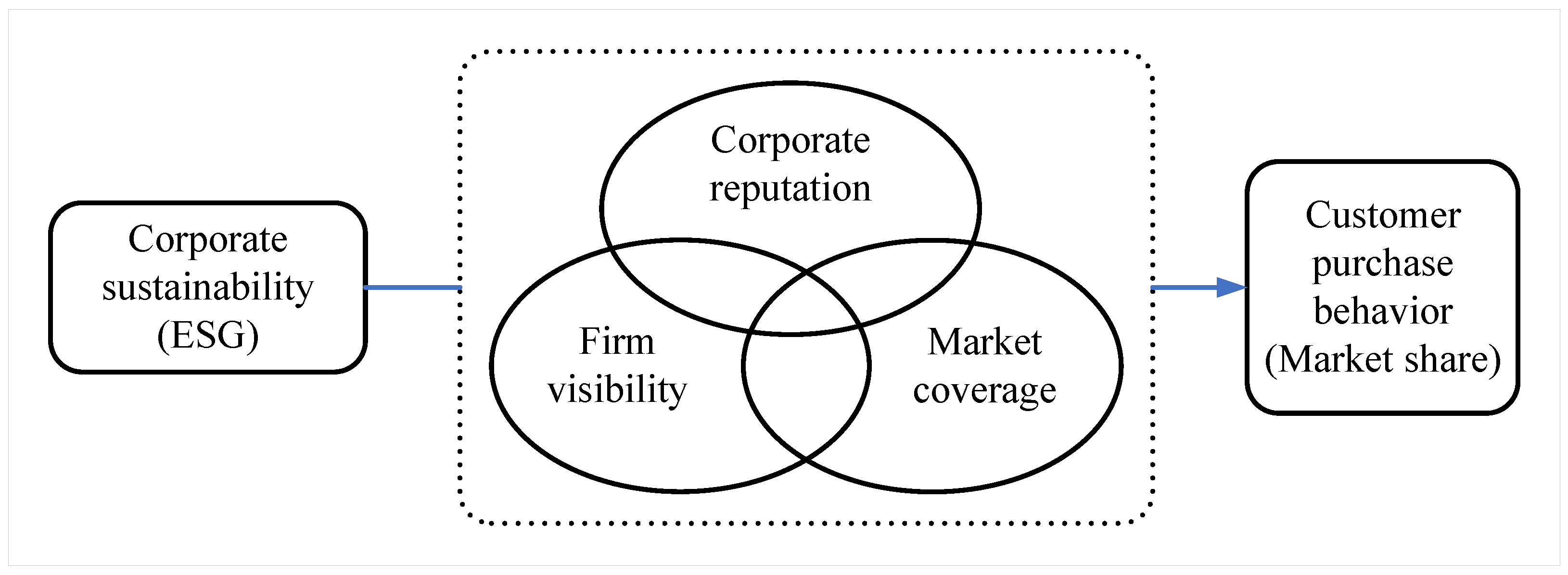
38]. However, these studies largely overlook the customer side. The effects from the customer side primarily come from consumers and downstream firms. Once ESG information is received by customers, it influences their purchase behavior, which in turn affects corporate market share. Therefore, the theoretical model constructed in this study explains the impact of ESG on market share from the customer side, as shown in
Figure 1.
According to stakeholder theory [
39,
40] and signaling theory [
23], customer interests are crucial for long-term corporate development. Companies therefore use ESG performance to enhance their reputation and brand image, sending market signals that shape customers’ perceptions and evaluations of the firm and its products, ultimately influencing purchasing behavior [
41]. From a microeconomic perspective, market share is essentially the aggregate result of individual purchasing decisions [
7]. From the perspective of brand switching, customer purchase behavior drives the flow of market share between brands. When customers switch from other brands to a specific brand, the company’s market share increases; the opposite occurs when customers switch away [
30]. Based on these theoretical arguments, we propose the first hypothesis:
Hypothesis 1 (H1)
. Corporate ESG performance positively affects market share through customer purchase behavior.
Corporate ESG information is first disclosed, then disseminated, and ultimately influences customers’ purchasing decisions. However, the diffusion of ESG information differs significantly from traditional communication processes. In traditional communication frameworks such as agenda-setting theory [
42], information primarily spreads through mass media reports and spontaneous public sharing and discussion. However, the diffusion of ESG information aligns more closely with Rogers’ diffusion of innovations theory [
43].
Rogers’ diffusion of innovations theory was first proposed by Everett M. Rogers in his seminal book Diffusion of Innovations (1962). This theory is one of the foundational theories in communication studies. According to Rogers’ theory, the rate and extent to which an innovation is adopted depend on five key attributes: relative advantage, compatibility, complexity, trialability, and observability. Relative advantage refers to the degree to which an innovation is perceived as better than the idea it supersedes. Compatibility is the degree to which an innovation is perceived as consistent with the existing values, past experiences, and needs of potential adopters. Complexity indicates how difficult an innovation is to understand and use. Trialability captures the extent to which an innovation can be experimented with on a limited basis. Finally, observability is the degree to which the results of an innovation are visible to others. However, the diffusion of ESG information differs from traditional innovation diffusion. There is no complexity or trialability issue in ESG information transmission. For ESG information diffusion, relative advantage can be simply viewed as a firm’s ESG rating. A higher ESG rating leads to stronger corporate reputation. Compatibility refers to the alignment between disclosed ESG information and customers’ values and expectations. Information that is more compatible with customers will be more widely discussed. Observability is relatively intuitive. In the ESG context, it refers to the number of customers who receive the ESG information.
After Rogers’ seminal work, researchers have investigated information diffusion in various contexts, particularly in the domain of corporate ESG information diffusion and its subsequent effects. Corporate reputation corresponds to relative advantage in Rogers’ framework. Signaling theory suggests that ESG performance enhances corporate reputation by signaling credibility and trustworthiness to customers. A strong reputation reduces perceived risk and increases customer purchase intentions [
4,
13,
15]. Firm visibility corresponds to compatibility in Rogers’ framework. Customer-based brand equity theory suggests that visible ESG information creates meaningful brand associations through repeated exposure, shaping customer responses [
14]. Higher ESG visibility from rating agencies and mandatory disclosure makes ESG information more accessible and detectable, thereby influencing customer purchase behavior [
16,
17]. Market coverage corresponds to observability in Rogers’ framework. A larger firm scale reaches a broader customer base, increasing the number of potential observers of ESG information and thereby enhancing economic returns [
8]. However, firm size alone is an imperfect proxy; internationalization depth and width more precisely capture the geographical scope of customer coverage, determining how widely ESG information can be observed and acted upon [
18,
19]. Based on the above reasoning, we propose the following hypotheses:
Hypothesis 2 (H2)
. Corporate ESG performance positively affects market share through customer purchase behavior, mediated by corporate reputation.
Hypothesis 3 (H3)
. Corporate ESG performance positively affects market share through customer purchase behavior, mediated by firm visibility.
Hypothesis 4 (H4)
. Corporate ESG performance positively affects market share through customer purchase behavior, mediated by market coverage.
Rogers’ theory not only identifies five key attributes but also suggests that these attributes may reinforce each other. Subsequent empirical research has further validated the interdependencies among these five attributes; such positive reinforcement across different channels is a common phenomenon in information dissemination [
44]. These interdependencies, or multiplicative effects, can be captured by examining the mediating role of interaction terms [
45,
46]. Accordingly, we propose the fifth hypothesis:
Hypothesis 5 (H5)
. Corporate ESG performance positively affects market share through customer purchase behavior, mediated by the interactions among corporate reputation, firm visibility, and market coverage.
4. Empirical Analysis
4.1. Empirical Model
Following related practice in panel data studies of Chinese listed companies, this study employs two-way fixed effects regression with year and industry fixed effects [
5]. Firm-level fixed effects are not included because they would largely reduce the degrees of freedom. Given the research interest in how corporate sustainability affects customer purchase behavior, the empirical equation is given by Equation (
1). The dependent variable
measures customer purchase behavior; the key explanatory variable
is the ESG performance index; the matrix
includes all the other explanatory variables and
is the corresponding coefficients of the explanatory variables;
c is the industry fixed effect and
is the time fixed effect;
is the residual term.
This paper employs a combined approach of the three-step mediation method and the Sobel test to identify the mediation mechanism. The three-step mediation method consists of three regressions, all of which are two-way fixed-effects regressions in this paper. We choose to use the Sobel test for supplementary analysis for two reasons. First, while the three-step mediation method is not entirely objective in determining the mechanism, the Sobel test tests the significance of the joint distribution of the relevant estimators. Second, the three-step mediation method does not identify economic significance, whereas the Sobel test provides the proportion of the mediation effect to the total effect.
4.2. Data Sources and Sample Selection
The study sample consists of annual panel data of Chinese listed companies from 2009 to 2023. Companies with Special Treatment, Delisting Risk, and Suspension of Trading (ST, ST*, and PT) were excluded, resulting in a final sample of 5405 listed companies. Variable information for the empirical analysis is presented in
Table 1. Corporate financial data are obtained from the China Stock Market & Accounting Research Database (CSMAR). To further investigate the mechanisms underlying customer purchase behavior, we identified mediation variables related to corporate reputation, firm visibility, and market coverage from the existing literature. These variables were constructed using data from other databases, following the methods in the relevant literature. In addition to the variables listed in
Table 1, this paper also uses the major industry classification (primary classification, 19 categories) and the sub-industry classification (secondary classification, 84 categories) issued by the China Securities Regulatory Commission (CSRC) in 2012.
Corporate reputation reflects how customers perceive a firm’s reliability and, consequently, the quality of information about its products. Tadelis (1999) defines corporate goodwill as a tradable intangible asset [
50]. Rogerson (1983) states that reputation serves as a “guarantee mechanism” for the quality of corporate products [
51]. Therefore, corporate reputation can be measured through two dimensions: corporate goodwill and social trust. For Chinese listed companies, corporate goodwill (
) is primarily calculated using principal component analysis based on 12 financial indicators, including asset value, revenue performance, profitability, and stability indicators [
47]. Social trust (
and
) is measured using data from the China General Social Survey (CGSS), capturing the trust embedded in peer and stakeholder evaluations [
9].
Firm visibility reflects the extent to which information about a company reaches the market and investors. Related research [
52,
53] typically measures firm visibility using two main indicators: the number of financial analysts covering the firm and the frequency of media coverage. For Chinese listed companies, analyst attention (
) is typically obtained through web scraping to collect the number of analyst reports from the Eastmoney website (
www.eastmoney.com (accessed on 11 May 2025); East Money Information Co., Ltd.) [
6]. Most related studies on Chinese listed companies use print media coverage (
), measured by the number of newspaper reports [
49]. These data are available from the Chinese Research Data Services Platform (CNRDS). CNRDS also provides data on the number of online media reports, which recent studies have used as a measure of online media coverage (
) [
48,
49].
Market coverage captures the observability dimension of ESG information diffusion, as it determines how many customers can potentially receive and observe a firm’s ESG information. Related research [
54] shows that, when studying international market size, a company’s degree of internationalization captures market coverage and competitiveness more effectively than traditional indicators such as the foreign sales-to-total-sales ratio (FSTS). Given data availability, Liu et al. (2024) measure corporate internationalization across two dimensions—the depth and width of internationalization (
and
)—by calculating the number of overseas subsidiaries and the number of countries where these subsidiaries are located, using data from China Deep Data (CNDD) [
3]. In addition, some studies suggest that the product of the two (
) is a more appropriate measure of corporate internationalization.
All data analyses were performed using StataMP 16 (StataCorp LLC, College Station, TX, USA). The descriptive statistics for the variables used in the empirical analysis are presented in
Table 2. The number of observations for
and
is approximately 60,000, whereas our key variables
and
each have more than 10,000 missing observations. Further investigation reveals that many firms, especially in the early years after listing, did not disclose their principal revenue or ESG performance. Therefore, although our research sample is slightly unbalanced, the missing data are unlikely to cause significant bias in the estimation results. In addition, the descriptive statistics show that the minimum value of
is negative. Upon checking, we found that only four observations among more than 60,000 have negative operating revenue. These four negative values arise because the firms temporarily suspended certain operations and experienced substantial returns of previously sold goods.
4.3. Baseline Regressions
Based on the research sample, the effect of corporate ESG performance on market share is estimated using the year–industry two-way fixed effects method. The estimation results are presented in
Table 3. The control variables are the debt-to-assets ratio (
), return on total assets (
), and cash flow ratio (
). As shown in
Table 3, Regressions (1) and (2) are OLS estimations without year or industry fixed effects. Regressions (3) and (4) include industry fixed effects based on the major industry classification (19 categories), whereas Regressions (5) and (6) use the more detailed sub-industry classification (84 categories).
The results in
Table 3 first show that ESG performance has a significant positive effect on market share, consistent with theoretical expectations. The inclusion of control variables does not substantially change the estimated coefficient of ESG, suggesting that there is no significant endogeneity between ESG performance and the control variables. Comparing the adjusted R2 values in Regressions (2), (4), and (6)—which are 0.008, 0.143, and 0.395, respectively—reveals that the large number of intercept terms generated by the fixed effects explain most of the variation in market share. Using a more detailed industry classification effectively improves regression fit without significantly reducing degrees of freedom, unlike firm-level fixed effects. The adjusted R2 values in Regressions (1) and (2) are 0.004 and 0.008, respectively, indicating that the explanatory power of corporate ESG is comparable to that of the three commonly used control variables combined. Thus, corporate ESG is an important determinant of market share, providing a foundation for further mechanism analysis.
4.4. Robustness Checks
Since market shares are ratios and ESG performance has upper and lower bounds, neither variable exhibits a time trend. Therefore, the estimated effect of ESG performance on market share is not driven by spurious regression due to time trends. However, spurious correlation may also arise from confounding bias. For example, if a factor C simultaneously affects ESG performance and market share while ESG performance and market share are not causally related, the coefficient on ESG could still appear significant. To test this possibility, we take the first difference of all variables and regress the one-period lagged ESG difference term. The results are shown in Regression (7) in
Table 4. Clearly, after differencing, the effect of ESG performance on market share remains positively significant. We also tested non-lagged, second-lag, and third-lag terms for ESG, but the effects on market share were insignificant. These findings provide strong evidence against confounding bias.
In Regression (8), we substitute the dependent variable market share () with Tobin’s Q index (). The results show that ESG performance has a significant positive effect on . This aligns with our theoretical inference that companies with good ESG performance tend to attract customers not only as consumers but also as investors. City fixed effects are introduced in Regression (9), while Regression (10) uses a 50% random sample. The coefficients on ESG and the adjusted R2 do not change significantly in either regression, strongly supporting the robustness of the baseline results. Compared with the adjusted R2 in Regression (6), the inclusion of city fixed effects in Regression (9) does not bring much additional goodness-of-fit. There are 5394 cities in our sample. Given the trade-off between degrees of freedom and explanatory power, city fixed effects are not included in the following analysis.
4.5. Sub-Group Analysis
Many studies have revealed clear differences in trust across different types of firms. ESG performance is an important indicator of corporate sustainability, yet people tend to place greater trust in companies such as state-owned enterprises and large corporations. A moderating effect may be at play here. In simple terms, factors such as firm type, size, and age may interact with ESG performance in influencing customer purchase behavior. However, as this is not the main focus of this study, we briefly verify this through sub-group analysis.
Comparing the results of Regressions (11) and (12) in
Table 5 shows that the effect of ESG on market share is considerably larger for state-owned firms. Similarly, comparing Regressions (13) and (14) reveals that the ESG effect on market share is substantially larger for large firms than for small- and medium-sized ones.
As shown in
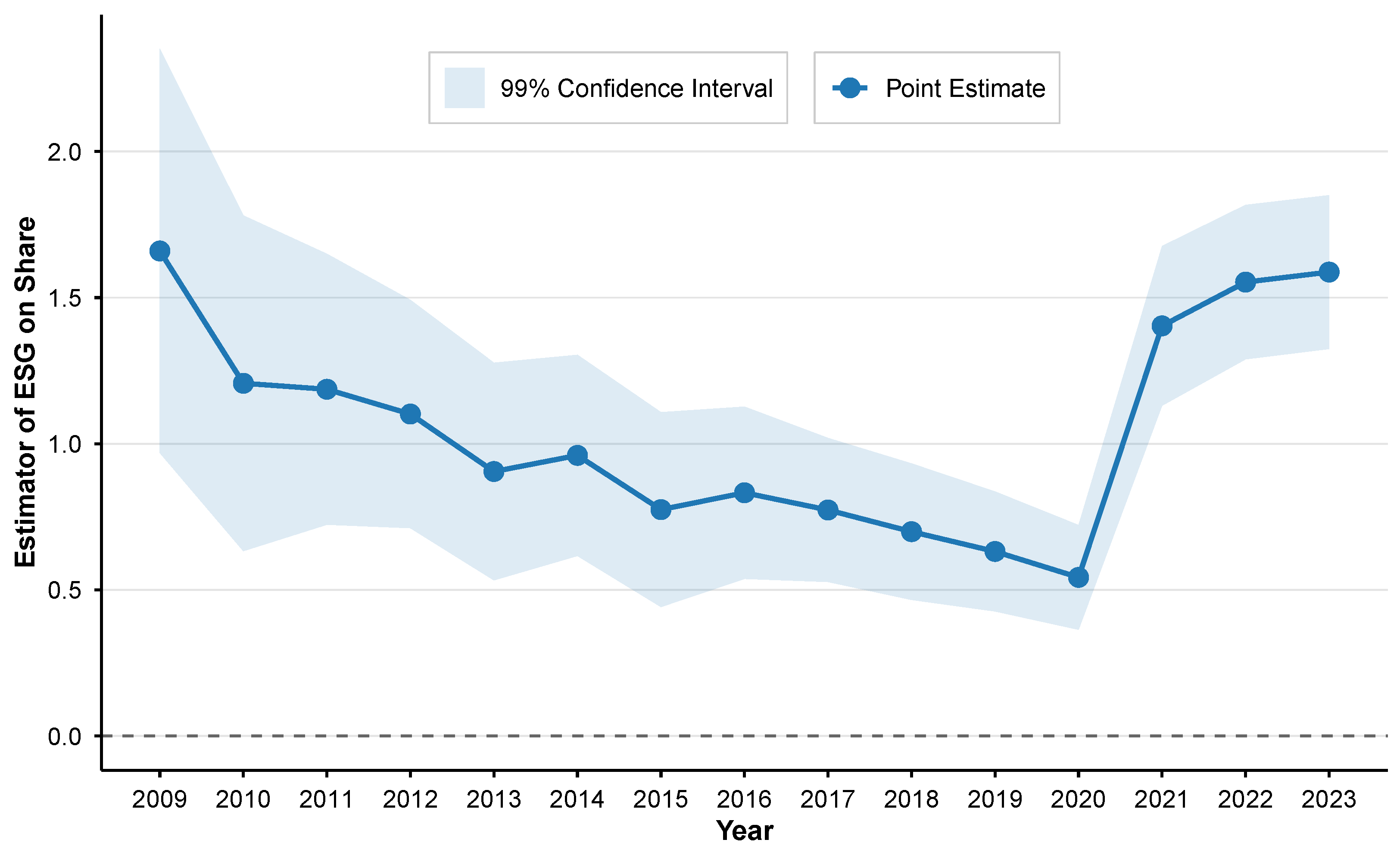
Figure 2, we also estimated the effect of ESG performance on market share by year. Between 2009 and 2020, the ESG estimators on
show a steady decline, decreasing from 1.7 to 0.55. This decrease is highly likely caused by the lack of uniformity in ESG disclosure standards. During this period, corporate information disclosure systems were imperfect, but many ESG indicators were published by various institutions. The reported ESG performances of the same corporation varied, gradually reducing public trust in ESG indicators. On the contrary, a sharp increase in the ESG estimator appeared from 2020 to 2023. This rapid growth is likely related to a series of policy changes. In 2020, Chinese President Xi Jinping announced China’s carbon peaking and carbon neutrality goals at the 75th UN General Assembly. Subsequently, also in 2020, the Chinese government reviewed and approved the “Reform Plan for the Legal Disclosure System of Environmental Information”, which is a signal that ESG disclosure gradually shifted from voluntary to mandatory. Furthermore, the National Carbon Emission Trading Market was officially established in 2021, making corporate carbon emission costs explicit and strengthening the pricing role of environmental factors in ESG.
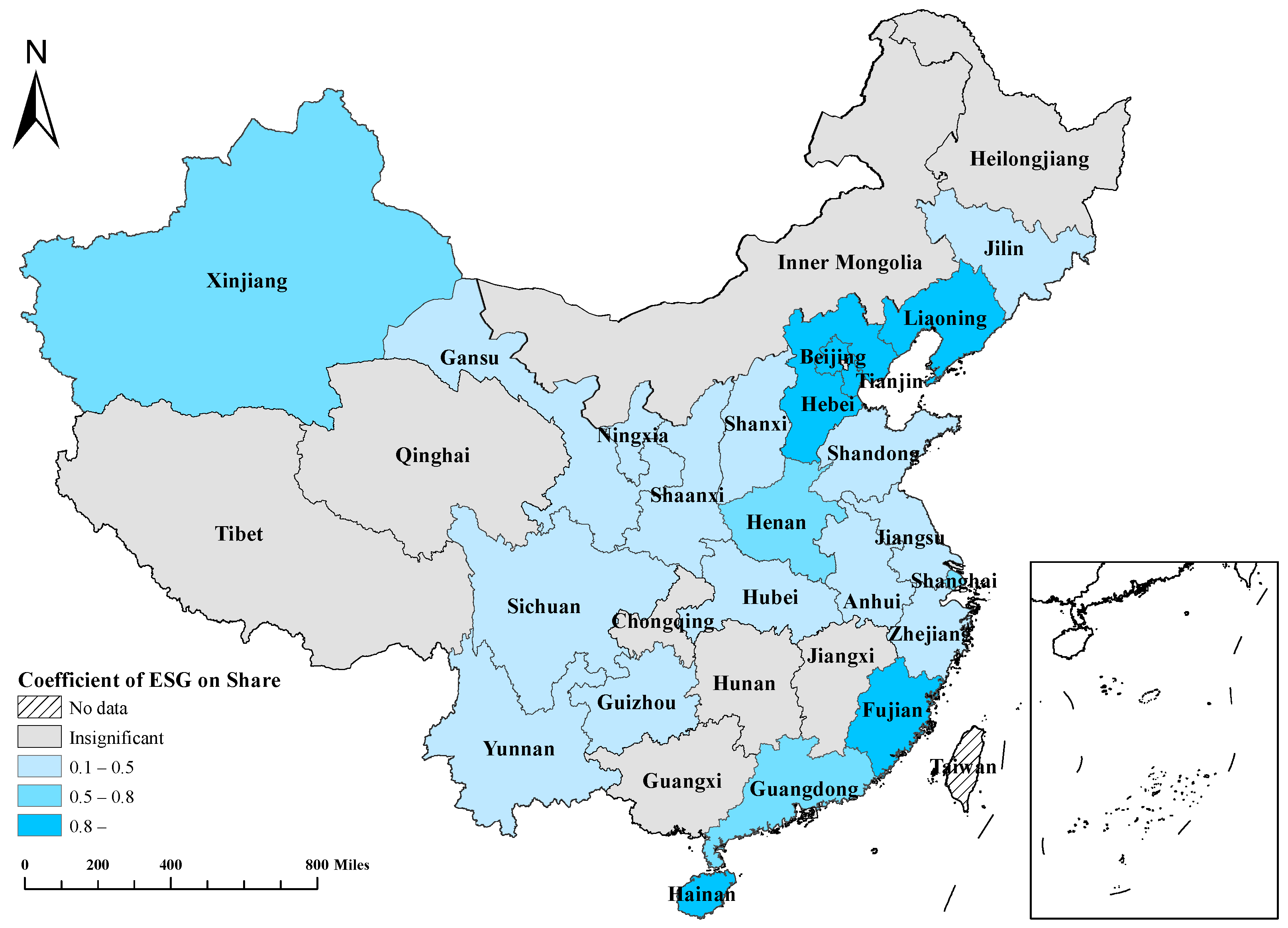
The effects of ESG performance on market share across different provinces are also estimated, as shown in
Figure 3. The ESG coefficients for some provinces are insignificant, marked in gray; however, most are significant, with three shades of blue indicating the magnitude of the effect. The geographic distribution in
Figure 3 shows no strong spatial pattern. It is important to note that China’s economic development, measured by GDP per capita, is significantly higher in the southeast and lower in the northwest. In contrast, environmental quality is significantly lower in the southeast and higher in the northwest. Many economic variables exhibit strong spatial patterns. Therefore, the absence of a clear spatial pattern in the figure at least suggests that the significance of the ESG coefficients is not driven by spatial spillover or panel correlation.
In this subsection, we perform sub-group regressions to further examine the robustness of the main effect. The results show that the positive effect of ESG on market share remains stable across periods. Moreover, we performed similar time-based sub-group regressions for the subsequent mediation analyses (not reported in the main text), which show a consistent pattern and confirm that changes in sample composition (e.g., firm delisting and new listings) do not materially affect our conclusions.
4.6. Mechanism Analysis
In this section, we explore the mechanisms through which ESG performance affects customer purchase behavior. Unlike related studies that focus on customer psychology and intentions, our theoretical framework is built on information transmission theory and innovation diffusion theory. Accordingly, we analyze ESG information across three interconnected dimensions: relative advantage, compatibility, and observability. These dimensions are expected to shape customer purchase decisions at the macro level, thereby determining market share.
4.6.1. Corporate Reputation
The Baron–Kenny three-step mediation approach is used to estimate the three mediation variables (
,
, and
), yielding nine regression results. Since the first step is the same as Regression (6), it is not presented in this section. The remaining regression results are shown in
Table 6. The Sobel test results for the three mediation variables are all significantly positive. The proportion of the total effect mediated by corporate goodwill is 66%. These results indicate that corporate reputation is one of the key transmission mechanisms in the effect of ESG performance on market share. This supports the view that corporate sustainability enhances corporate reputation through ESG disclosures, thereby increasing customer purchases.
4.6.2. Firm Visibility
The three-step mediation approach is used to estimate the three mediation variables (
,
, and
), with results presented in
Table 7. The Sobel test results are significantly positive for all three variables, indicating that each mediation pathway is statistically significant. Moreover, the estimated proportions of the mediated effects are substantial, suggesting that firm visibility plays an important economic role in this pathway. Overall, the evidence indicates that both analysts and the media are attracted to firms with better ESG performance, and that strong firm visibility increases customer purchases and thus market share.
4.6.3. Market Coverage
To examine the mediation pathways of the three variables (
,
, and
) in the effect of ESG performance on market share, we apply the three-step mediation approach and the Sobel test, with results shown in
Table 8. One point should be mentioned first. Since the interaction term (
) incorporates the partial effects of
and
, these two terms should also be included as controls when the interaction term is regressed. The Sobel test results indicate that the mediation effects of all three variables are significant. The corresponding proportions for
and
are approximately 10%, which is not negligible. One possible reason is that internationalization may not be a perfect proxy for market coverage, as a large number of Chinese listed companies have no overseas operations. Although the estimated results do not fully meet our expectations, we believe they support the view that market coverage is an important transmission mechanism in the effect of ESG performance on customer purchase behavior, as reflected by market share.
4.6.4. Interaction Effects Among the Three Pathways
As discussed in the theoretical section, the three pathways are not independent. Therefore, in this subsection, we examine the mediation effects of the interactions among corporate reputation, firm visibility, and market coverage. Because there are multiple mediation variables within each of the three mechanisms, for simplicity we select one from each category. Specifically, we select the variables with larger proportions of the total effect: corporate goodwill (), analyst attention (), and the width of internationalization (). These three variables generate four interaction terms: , , , and . Note that the component terms of each interaction must be included in the regression to avoid estimation bias caused by their partial effects.
In
Table 9, only the results of the third-step regressions for the four interaction terms are presented to save space. Consistent with expectations, three of the four interaction terms are significantly positive. Surprisingly, the mediation effect of the interaction between corporate reputation and firm visibility (
) is significantly negative, with a relatively large proportion. This implies that ESG performance reduces this interaction term (
), which in turn reduces market share; for instance, if corporate goodwill is linearly related to ESG performance, analyst attention may have a diminishing relationship with ESG. One possible interpretation is exposure fatigue: firms with high ESG performance already receive extensive analyst coverage, so additional reports attract less attention.
6. Conclusions
In this study, the effect of corporate sustainability on customer purchase behavior is analyzed both theoretically and empirically. Drawing on the related literature, we develop a theoretical framework that illustrates the transmission mechanisms through which ESG affects market share via corporate reputation, firm visibility, market coverage, and their interactions. Empirical analysis is conducted using panel data of Chinese listed companies from 2009 to 2023, employing two-way fixed effects regression, the three-step mediation approach, and the Sobel test. The results show that (i) corporate ESG has a significant positive effect on market share; (ii) this effect is correlated with policy intensity, with an upward trend in ESG coefficients after 2020; (iii) the ESG coefficients are relatively larger for state-owned and large-scale firms; and (iv) corporate reputation, firm visibility, market coverage, and their interactions all have significant mediation effects, although the proportions of the interaction effects are quite small.
Accordingly, several policy implications are offered. First, the Chinese government should, on the one hand, continue to strengthen mandatory ESG disclosure requirements for firms while, on the other hand, enhancing supervision over ESG rating agencies. Second, corporations should, on the one hand, recognize future development trends and genuinely improve their ESG performance; on the other hand, they should gradually develop ESG communication and marketing skills. Inaccurate ESG disclosure may bring short-term benefits but is harmful to long-term development. Only by proactively integrating ESG into corporate strategy can firms achieve sustainable development. Third, customers should be encouraged to shift their focus from personal surplus to social surplus. In this way, customers and firms with strong ESG performance can form positive interactions. Within such a more sustainable system, both parties can achieve win-win outcomes.