Article

Flood Risk Assessment Considering the Spatial and Temporal Characteristics of Disaster-Causing Factors

1
Guangdong Research Institute of Water Resources and Hydropower, Guangzhou 510635, China
2
Guangdong Key Laboratory of Hydrodynamic Research, Guangzhou 510635, China
3
State and Local Joint Engineering Laboratory of Estuarine Hydraulic Technology, Guangzhou 510635, China
4
College of Geography and Environmental Science, Hainan Normal University, Haikou 571158, China
*
Author to whom correspondence should be addressed.
Sustainability 2026, 18(7), 3646; https://doi.org/10.3390/su18073646
Submission received: 10 February 2026 / Revised: 19 March 2026 / Accepted: 31 March 2026 / Published: 7 April 2026

Abstract

Refined urban flood risk assessment serves as a fundamental safeguard for urban sustainability. However, most studies based on scenario analysis method tend to rely on a single risk evaluation criterion, with limited consideration of applicability differences arising from underlying computational principles. Furthermore, as flood events are inherently dynamic spatial–temporal processes, most studies often overlook the three-dimensional characteristics of flood risk, particularly the connectivity of risk in physically adjacent spaces. To address these issues, this paper proposes a comprehensive flood risk assessment framework that integrates the spatial–temporal characteristics of disaster-causing factors. An improved analysis method for grid-scale flood assessment is proposed based on the comprehensive mechanical analysis method and the drowning factor. In addition, a quantitative approach for characterizing the spatial aggregation of urban flood risk is established using risk thresholds and aggregation area thresholds. These methods are then integrated through a combination weighting–cluster analysis framework for comprehensive flood risk assessment. The results show that the improved analysis method can better reflect the change in risk of flow velocity and water depth combined. Spatiotemporally, the Yinshan Road and western section of the Dongzhong Road, exhibiting high localized risk, moderate overall risk, high risk on the time scale and high spatial agglomeration status, are comprehensively assessed as extremely high-risk flooded zones. The proposed framework effectively characterizes the spatial–temporal distribution of disaster-causing factors, providing a scientific basis for disaster prevention and contributing to urban sustainability.

1. Introduction

Floods are among the most frequent and devastating natural disasters worldwide [1,2]. A series of urban flood disasters have resulted in severe casualties, economic losses, traffic disruptions, and public health issues, posing a significant challenge to the sustainable development of societies and economies [3,4]. Under the dual pressures of climate change and urbanization, extreme weather events in urban areas are becoming increasingly frequent and intense, leading to a continual rise in urban flood risk and creating considerable difficulties for urban managers in flood mitigation [5,6]. In 2015, the Sendai Framework of Disaster Risk Reduction 2015–2030 was launched, which emphasizes that effective disaster risk management is crucial for achieving sustainable development. It calls for “The substantial reduction of disaster risk and losses in lives, livelihoods and health and in the economic, physical, social, cultural and environmental assets of persons, businesses, communities and countries” [7]. As a crucial tool in flood defense, reliable and accurate urban flood risk assessment can effectively support disaster prevention and management, thereby reducing the destruction and losses caused by urban flooding and contributing to long-term urban sustainability [8].
Current flood risk assessment methodologies can be broadly categorized into four main approaches: (1) the historical disaster mathematical statistics method [9,10]; (2) the multi-criteria decision-making method [11]; (3) the remote sensing impact assessment method [12]; and (4) the scenario simulation analysis method [13]. The historical disaster mathematical statistics method offers computational efficiency but requires long-term flood records for reliable assessments [14]. The multi-criteria decision-making method offers advantages in data accessibility and computational simplicity [15]. However, standardization deficits in indicator system construction cause significant regional discrepancies in parameter selection. Moreover, resolution-dependent outcomes constrain this approach primarily to large-scale applications, as spatial resolution critically influences assessment validity [2]. The remote sensing impact assessment method provides timely support for rapid large-scale inundation mapping [16], yet demands high-resolution imagery and primarily extracts flood extents rather than critical disaster parameters like flow velocity or detailed inundation duration [17]. In recent years, with the rapid advancement of deep learning technologies, significant progress has been made in computer vision-based flood disaster identification methods. By utilizing multi-source data such as remote sensing imagery and social media images, these approaches enable rapid identification of flood inundation depths and building damage conditions [18,19]. The scenario simulation method is usually based on a physical mechanism of hydrological and hydrodynamic models, combined with different rainfall and underlying surface scenarios to explicitly characterize the spatial–temporal distribution of flood hazards (e.g., water depth, flow velocity, inundation extent, and duration). With advances in big data, hydrodynamic modeling, and parallel computing, this approach has gradually become the dominant paradigm in flood risk assessment [20,21].
Common flood risk assessment criteria employed in the scenario simulation analysis method mainly include the submergence depth and time threshold (SDTT) method, empirical formula (EF) method, and comprehensive mechanical analysis (CMA) method. The SDTT method evaluates risk through empirical combinations of water depth and inundation duration yet only identifies hazards under high-depth or prolonged-duration conditions [22]. The EF method derives risk formulas from hydraulic experiments (flume/channel) and statistical analysis [23] yet exhibits potential risk underestimation in steep terrain [22]. The CMA method evaluates the state of hydrodynamic forces to predict human slip instability [24], offering superior flow velocity hazard characterization compared to empirical formulas but neglecting drowning mechanisms during high-water depth events. Collectively, the distinct computational principles underlying different flood risk assessment criteria engender significant variations in their risk identification capabilities [16]. Consequently, the comprehensive integration of disaster-inducing factors’ (e.g., water depth, flow velocity) impacts on the human body constitutes a critical prerequisite for ensuring the validity of flood risk assessment outcomes. Furthermore, Ma et al. [25] demonstrated that contiguous road inundation during storm floods substantially exacerbates mobility disruption. Wang et al. [26] further indicated that extensive road flooding intensifies flood risks, necessitating focused attention on risk amplification driven by synergistic physical–geographic drivers. However, existing studies predominantly characterize the spatial distribution of flooding and associated risks through qualitative descriptions, inundation percentages, or spatial density metrics [27,28,29], lacking explicit quantitative analyses that capture the connectivity and clustering of flood risk based on physical spatial adjacency. Notably, as flood events constitute inherently dynamic spatial–temporal processes [30,31], their risk manifestations inherently exhibit three-dimensional characteristics. Effectively capturing the spatiotemporal dynamics of flood risk facilitates the understanding of risk evolution patterns and enhances the precision and foresight of urban disaster response, thereby providing scientific support for urban disaster management and sustainable development [32].
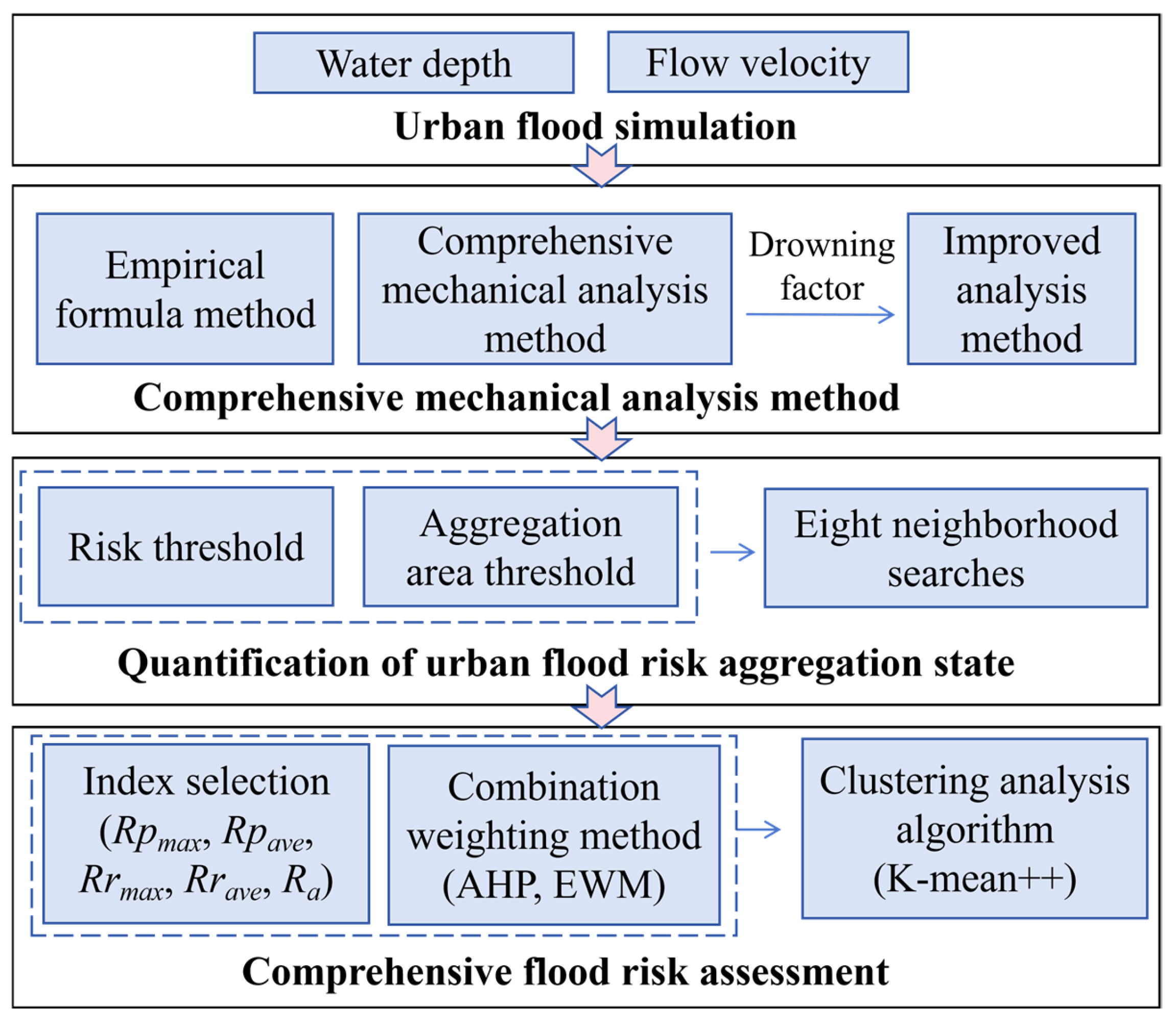
Therefore, the aim of this paper is to propose a comprehensive flood risk assessment framework incorporating the spatial–temporal characteristics of disaster-causing factors. The following three questions are addressed in this paper: (1) How can we enhance sensitivity in classifying disaster-causing factors? (2) How can we quantitatively characterize spatial aggregation features of flood risk? (3) How can we comprehensively synthesize the spatial–temporal attributes of disaster-causing factors for flood risk assessment? An overview of the proposed framework for a comprehensive risk assessment of urban floods is presented in Figure 1. Methodologically, the CMA method is refined to improve its sensitivity to water depth factors. Subsequently, the spatial aggregation states of flood risk are quantified using two threshold indicators (the risk threshold and the aggregation area threshold). Moreover, integrating risk state variations across local/overall spatial scales and temporal dimensions, the combination weighting–cluster analysis method is introduced to provide a comprehensive assessment of flood risk. Finally, the proposed methodology is applied to a 16.2 km2 urban area to evaluate its effectiveness for flood risk assessment in urbanized regions.

2. Study Area and Data Sets

2.1. Study Area

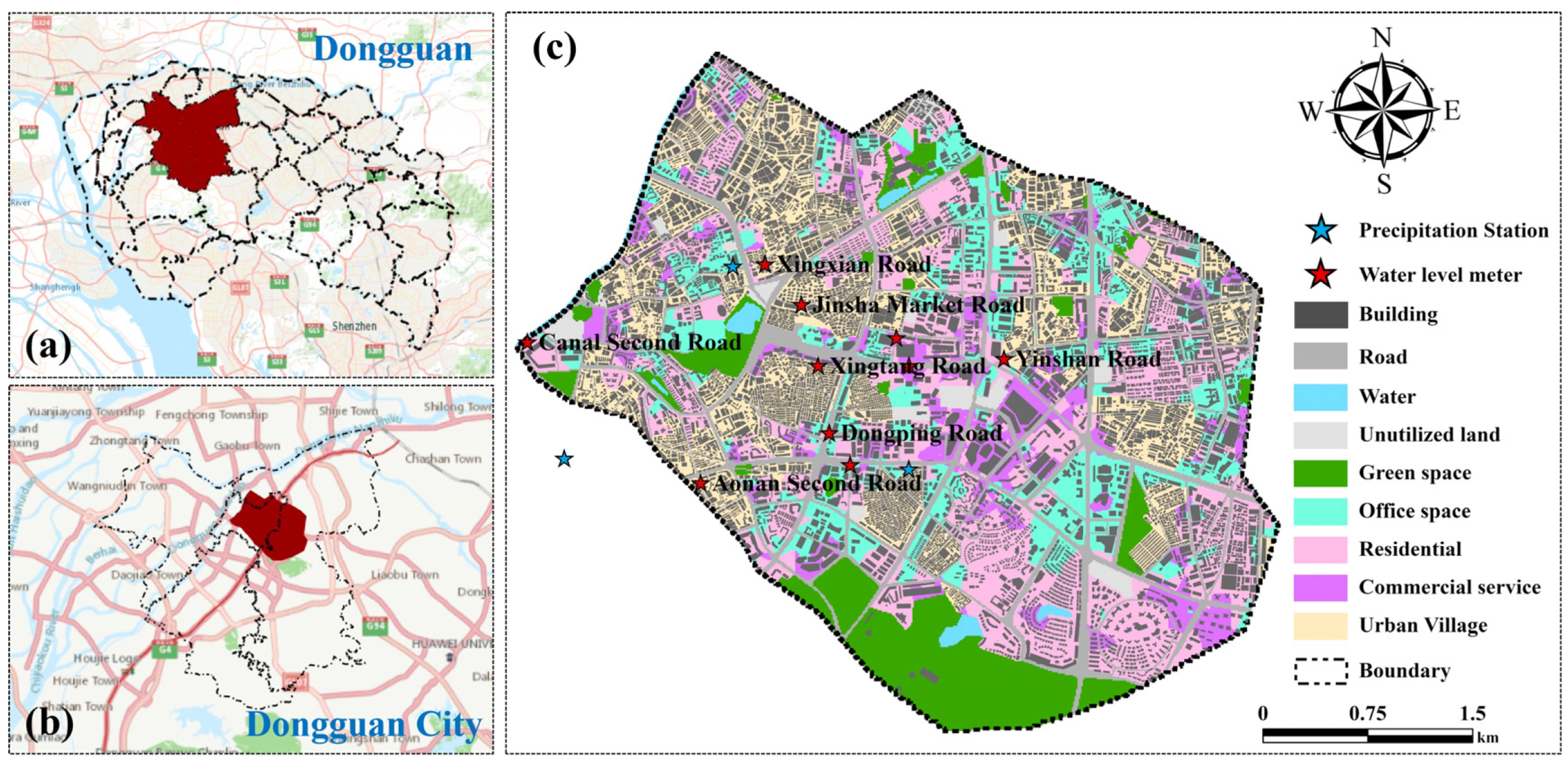
This study was conducted in a 16.2 km2 urban catchment located in the northern part of Dongguan City, China (Figure 2). To prevent surface water exchange between the study area and its surroundings, the model boundary was defined along the downhill section [33].

2.2. Distributed Data

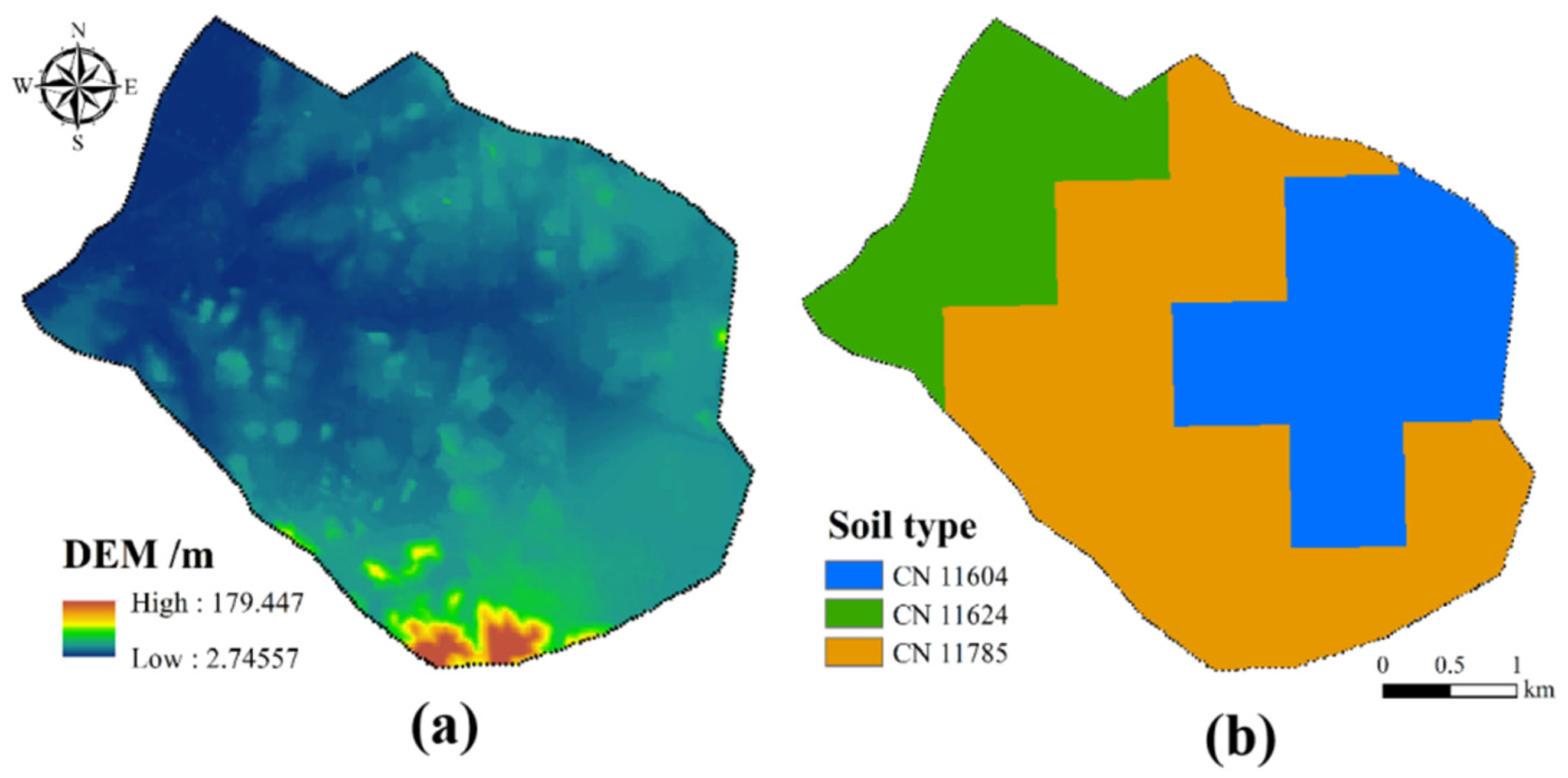
Elevation data were derived from approximately 54,253 measured terrain points, which were used to generate a Digital Elevation Model (DEM) with a spatial resolution of 10 m using ArcGIS 10.6 software (Figure 3a).
Land use/cover data were derived from visual interpretation of high-resolution remote sensing imagery and satellite maps. Based on the classification types adopted in previous studies [34], the study area was categorized into eight types: commercial service, office space, unutilized land, green space, water, residential, urban village, and road (Figure 2c).
Soil type data were derived from the HWSD global database [35] (URL: https://www.fao.org/soils-portal/data-hub/soil-maps-and-databases/harmonized-world-soil-database-v12/en/, accessed on 1 May 2024) (Figure 3b). The saturated hydraulic conductivity was calculated by using the soil hydraulic characteristics calculator [36]. The infiltration damping coefficient and soil porosity were determined based on formulas established in previous research [33]. The corresponding soil parameter values are presented in Table 1.
Building boundary data were obtained from BigMap, and the geometric positions of building features were manually corrected using high-resolution remote sensing images (Figure 2c).

2.3. Hydrologic Data

Three flood events occurring on 6 May, 11 May, and 20 May 2015 were incorporated for model calibration and validation. The water level data were obtained from electronic water level meters, and the basic characteristics of these events are presented in Table 2.
Rainfall data were derived from the average measurements at three automatic precipitation stations within the study area at a temporal resolution of 30 min.
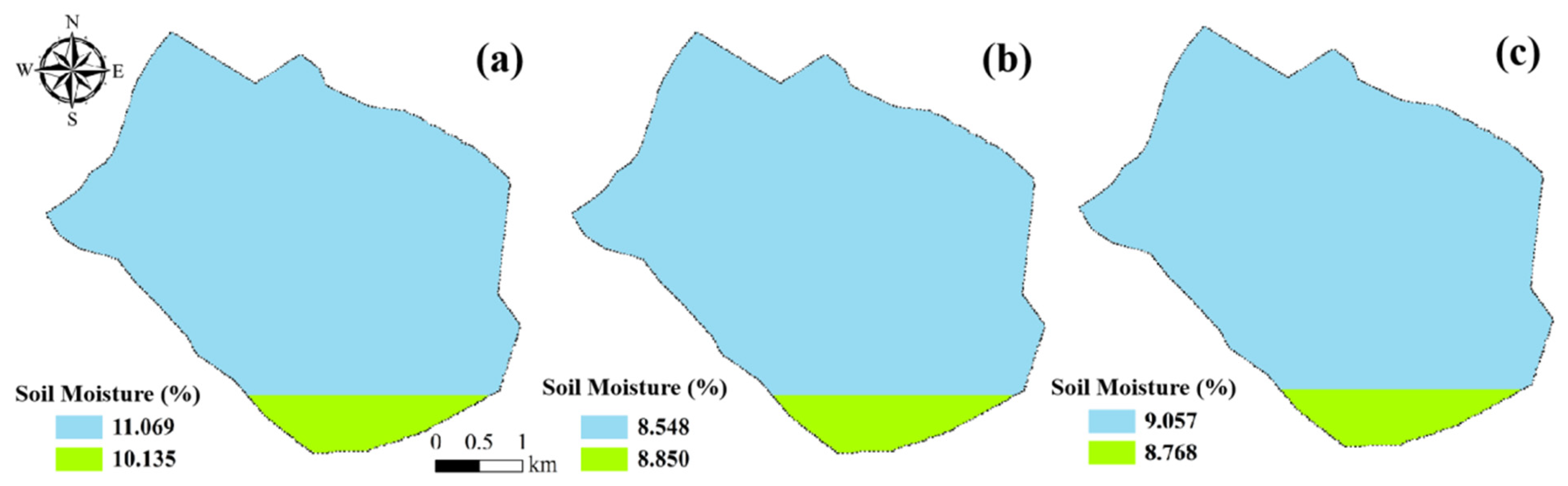
Initial soil water content data were derived from the Soil Moisture Active Passive Product (SMAP_L4_SM) (URL: https://nsidc.org/data/smap/smap-data.html, accessed on 1 May 2024) [37], and top-layer soil moisture (0–5 cm) was adopted to represent the initial soil moisture content of the entire soil layer [38]. Detailed values from the most recent product immediately preceding each flood event are shown in Figure 4.
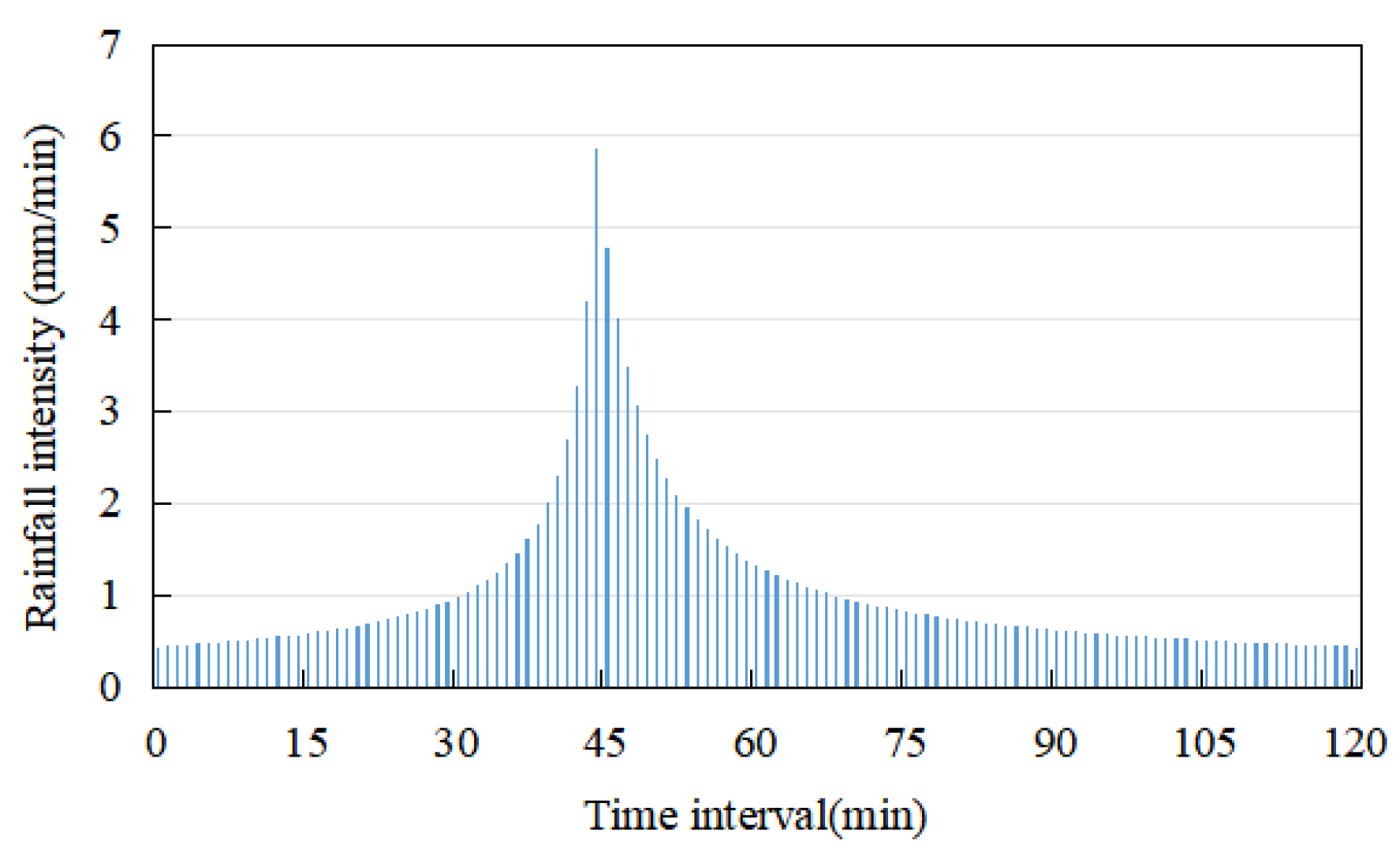
Following the waterlogging prevention standard for megacities, which is typically defined by a 50-year return period, this study conducts a flood risk assessment aligned with this criterion. Accordingly, the design rainstorm for waterlogging prevention in Dongguan was derived using the Dongguan storm intensity formula in conjunction with the Chicago hyetograph method. The rainfall duration and peak coefficient were set to 2 h and 0.35, respectively, yielding the hyetograph shown in Figure 5. Furthermore, based on observed data from three historical flood events in Guancheng District, during which the initial soil moisture remained close to 10%, this value was adopted as the initial moisture condition in the risk assessment under the waterlogging prevention standard.
q = 2094.861 × ( 1 + 0.506 lg T ) ( t + 8.875 ) 0.633
where q [unit: L/(s.hm2)] is the design rainstorm intensity; T represents the return period of rainfall; and t represents rainfall duration.

3. Methodology

3.1. Urban Flood Modeling

The Urban Flood Prediction Model under heavy precipitation was published by Wang et al. [33] and later improved by Xu et al. [39] by introducing the constant infiltration rate method to generalize the drainage capacity of pipe systems and embedding the influence of buildings on flow confluence in urbanized areas. Flow direction is determined according to the instantaneous height of the grid and the influence of buildings. Subsequently, the momentum equation of Saint-Venant was used to estimate outflow velocity under heavy precipitation [40,41,42,43]. The calculation formula is as follows:
{ g ( S h x ) = ( C D + C D b ) u 2 h   Water   flows   in   an   other   direction with   the   lowest   instantaneous   height i f ( P a r a l l e l f l o w : W p i < Cellsize   D i a g o n a l f l o w : W p i < 2 Cellsize   ) i f (   P a r a l l e l f l o w : W p i = Cellsize     D i a g o n a l f l o w : W p i = 2 Cellsize   the   special   scenario   of   diagonalflow )
where g is gravity acceleration with a rate of 9.8 m/s2; S = sinθ represents the bottom slope, and θ (unit: %) is the bottom slope angle for a slice of river channel defined by dx; h represents the water depth (unit: m); ∂h/∂x represents the water depth at the deepest point for a slice of river channel defined by dx (unit: m) and it varies with location; u is the water velocity (unit: m/s); C D is a drag coefficient in the river channel; C D b represents the building resistance;   W p i (unit: m) represents the projected width of any building in the grid in a certain flow direction; and Cellsize (unit: m) represents the width of the grid.
The model employs the infiltration curve method to account for the impervious nature of runoff generation [44,45], using the following formula:
R t = R t 1 + P t + R t 1 R t 1 ( 1     Imp ) · f c D r a
where R t (unit: mm) and R t - 1 (unit: mm) represent the surface water depth of the grid cell at time t and t − 1, respectively; R t - 1 (unit: mm) and R t - 1 (unit: mm) represent the water depth of inflow and outflow of the grid cell from t − 1 to t, respectively; f c (unit: mm) and Pt (unit: mm) represent soil infiltration and precipitation of the grid cell at time t, respectively; and Dra (unit: mm) represents the drainage capacity of the pipe system.

3.2. Improved PSO Algorithm

The particle swarm optimization (PSO) algorithm is a global search algorithm first proposed by James Kennedy and Russell Eberhart [46,47]. Previous studies have shown that adjusting the values of inertia weight and acceleration coefficients during the PSO search process can improve the algorithm’s performance [48]. The strategies employed in this paper are described below.

3.2.1. Inertia Weight ω

The inertia weight ω is a PSO parameter that affects the global search capability [49]. Previous studies have proposed inertia weight improvement strategies that can better balance local and global search capabilities, such as the linearly decreasing inertia weight (LDIW) strategy [50], the adaptive adjustment strategy [51], random inertia weight [52] and fuzzy inertia weight [53]. The LDIW strategy was employed to improve the inertia factor in this paper, and the equation is as follows:
ω = ω m a x t ( ω m a x ω m i n ) T
where ω m a x and ω m i n represent the upper and lower limits of the inertia weight factor, with values of 0.9 and 0.4, respectively; t is the current evolution number; and T is the maximum number of evolutions.

3.2.2. Acceleration Coefficients C1 and C2

The acceleration coefficients C1 and C2 are key parameters for adjusting the weights of local and global optimal values in the PSO algorithm. At present, the linear strategy [51], concave function strategy [54] and inverse cosine function strategy [50] are employed to improve the acceleration coefficients. In this study, the inverse cosine function strategy is employed to determine the values of acceleration coefficients. The equations are listed below.
C 1 = C 1 m i n + ( C 1 m a x C 1 m i n ) × [ 1 a r c c o s ( 2 × t T + 1 ) π ]
C 2 = C 2 m i n + ( C 2 m a x C 2 m i n ) × [ 1 a r c c o s ( 2 × t T + 1 ) π ]
where C 1 m a x and C 1 m i n represent the upper and lower limits of C1, with values of 2.75 and 1.25, respectively; C 2 m a x and C 2 m i n represent the upper and lower limits of C2, with values of 2.5 and 0.5, respectively; t is the current evolution number; and T is the maximum number of evolutions.
To eliminate the influence of differences in water level among waterlogging points on parameter optimization results, the mean peak water level error is selected as the adaptive function of the PSO algorithm, and the equation is as follows:
F i n t n e s s V a l u e = m i n ( 1 n × i = 1 n | W i o b s W i s i m | W i o b s )
where n is the number of waterlogging points in the flood event, and W i o b s (unit: m) and W i s i m (unit: m) represent the observed value and simulated value of the i-th waterlogging point, respectively.

3.3. Parameter Setting

The impermeable rate and drainage coefficient for each land use/cover type are selected as variables of the improved PSO algorithm for optimization. Meanwhile, the optimization algorithm excludes the impermeable parameters of roads and water (fully consider surface runoff generation) to reduce the dimensionality of the optimization parameters. The optimization range of impermeable parameters for unutilized land, green space, office space, residential space, commercial services and urban villages refers to previous research settings [39,55]. The optimization range of drainage capacity is set to 10–50 mm/h according to previous research [56], and a reduction factor of 0.5 is employed for the drainage capacity of urban villages, taking into account their relatively poor pipeline systems. The range of values for each parameter in this paper are shown in Table 3.
Considering both the efficiency and effectiveness of the PSO algorithm, the particle number was set to 10, the maximum evolution number was set to 30, and the maximum velocity of each particle was set to 0.1 times the upper and lower limits of each parameter. In addition, the resistance coefficient of various land use/cover types will change correspondingly with the variation in their impermeability parameters according to previous studies [33].
To investigate the adaptability of the improved PSO algorithm in flood modeling, this study also established the parameter migration scenario. Parameter migration involves transferring calibrated parameters from one or more gauged watersheds to data-poor regions, thereby providing a foundational data basis for regional flood simulation. In this paper, the impervious parameters corresponding to urban land use types in Haizhu District, Guangdong Province, were adopted from previous work [39], and the specific values are detailed in Table 4.

3.4. Grid Scale Flood Risk Assessment

3.4.1. Empirical Formula Method

Previous studies have shown that both water depth and flow velocity are important disaster-causing factors in flood disasters [57,58]. Based on experiments and data observations [59,60], the commonly used risk empirical formula is expressed as follows, and the corresponding risk levels are explained in Table 5.
R E t = h t × ( v t + c ) + f t
where R E t   represents the risk index at time t; h t (unit: m) and v t   (unit: m/s) represent the depth and velocity of water at time t, respectively; c is an empirical constant, usually taken as 0.5; f t is the water depth hazard factor at time t. When f t   ≤ 0.15 m, the value is set to 0.5, and when f t > 0.15 m, the value is set to 1.

3.4.2. Comprehensive Mechanical Analysis Method

The instability effect caused by high flow velocity is one of the main causes of floods. Xia et al. [24] proposed a formula to calculate the incipient velocity of people in floodwaters based on comprehensive mechanical analysis. Meanwhile, the flow velocity risk index (RV) is used to determine the degree of impact on the human body during flood disasters (the critical flow velocity threshold is compared to the actual flow velocity). This study uses the equidistant method to divide the interval of RV at [0, 0.25), [0.25, 0.5), [0.5, 0.75), and [0.75, 1] into four levels: low risk, medium risk, high risk, and extremely high risk. The instability calculation parameters for adults and children during floods are listed in Table 6.
U c = α p ( h f h p ) β p m p ρ f h f 2 ( a 1 h p 2 + b 1 h f h p ) × ( a 2 m p + b 2 )
R V = m i n ( 1.0 ,   U f U c )
where U c (unit: m/s) is the incipient flow velocity; U f (unit: m/s) and h f (unit: m) represent the flow velocity and depth of water, respectively; h p and mp represent the height and weight of a human, respectively; ρ f is the density of water; α p , β p , a 1 , a 2 , b 1 and b 2 are empirical coefficients describing human body characteristics.

3.4.3. Improved Analysis Method

Water depth has always been one of the most important disaster-causing factors in flood disasters. The drowning depth limits can be established based on human body dimensions to ensure that the head remains completely above the water surface. Drillis et al. [61] proposed that the head can be considered to constitute 1/8 of the entire body height. Building on this, Milanesi et al. [62] suggested that the critical drowning depth of a human during floods can be calculated based on neck height. In order to ensure that the neck of the human body can be exposed above the water surface, the water depth should not exceed 13/16 of the height of the human body. Accordingly, the drowning risk i n d e x ( R d ) is proposed by referring to the comprehensive mechanical analysis method (the critical drowning depth is compared to the actual water depth) in this study. The equations are listed below.
H c = h p × 13 16
R d = m i n ( 1.0 ,   h f H c )
where H c (unit: m) is the critical drowning depth; h p represents the height of a human body, and the parameters of adults and children in Table 6 are used in this method; h f (unit: m) represents water depth.
Since   R V and   R d   are dimensionless parameters within the interval [0, 1], the two indicators can be compared, with the larger value serving as the comprehensive risk index ( R c ). If the index R d is larger, the drowning risk caused by water depth has exceeded the instability risk caused by flow velocity; otherwise, instability induced by flow velocity is the dominant hazard factor. In this study, the equidistant method is also used to divide the interval of R c at [0, 0.25), [0.25, 0.5), [0.5, 0.75), and [0.75, 1] into four levels: low risk, medium risk, high risk, and extremely high risk.
R c = m a x ( R d ,   R V )
where R V is the flow velocity risk index; R d     represents the drowning risk index.

3.5. Quantification of Urban Flood Risk Aggregation State

The grid-scale flood risk contains hazard information related to both water depth and flow velocity. Based on the distribution information of grid scale flood risk, the risk threshold (Rn) and the aggregation area threshold (An) are used to further quantify the aggregation state of risk in two-dimensional space. Among them, Rn represents the risk basic point that begins to be greatly affected during the flood period, and An represents the range basic point at which the grid satisfies the risk threshold and is continuously in two-dimensional space, leading to an increase in disaster risk.
Generally, the low flood risk level is characterized by shallow water depth or slow flow velocity, posing minimal threat to human safety. In this study, we tentatively set Rn at the lower limit value of the medium risk level (0.25) to further investigate the flood risk aggregation state. In accordance with the waterlogging disaster classification standards adopted in cities such as Beijing, Shanghai, and Shenzhen (URL: https://swj.sz.gov.cn/gkmlpt/content/9/9541/post_9541090.html#3646, accessed on 5 May 2024), a ponding event is classified as a severe waterlogging disaster when the inundated area exceeds 1000 m2. Accordingly, we set An to 1000 m2. The quantification steps of urban flood risk aggregation state are as follows:
  • Extract all grids within the region that satisfy the risk threshold Rn.
  • According to the D8 method in hydrology, perform eight neighborhood searches on the selected grids and fuse the spatial adjacent grids that satisfy the conditions.
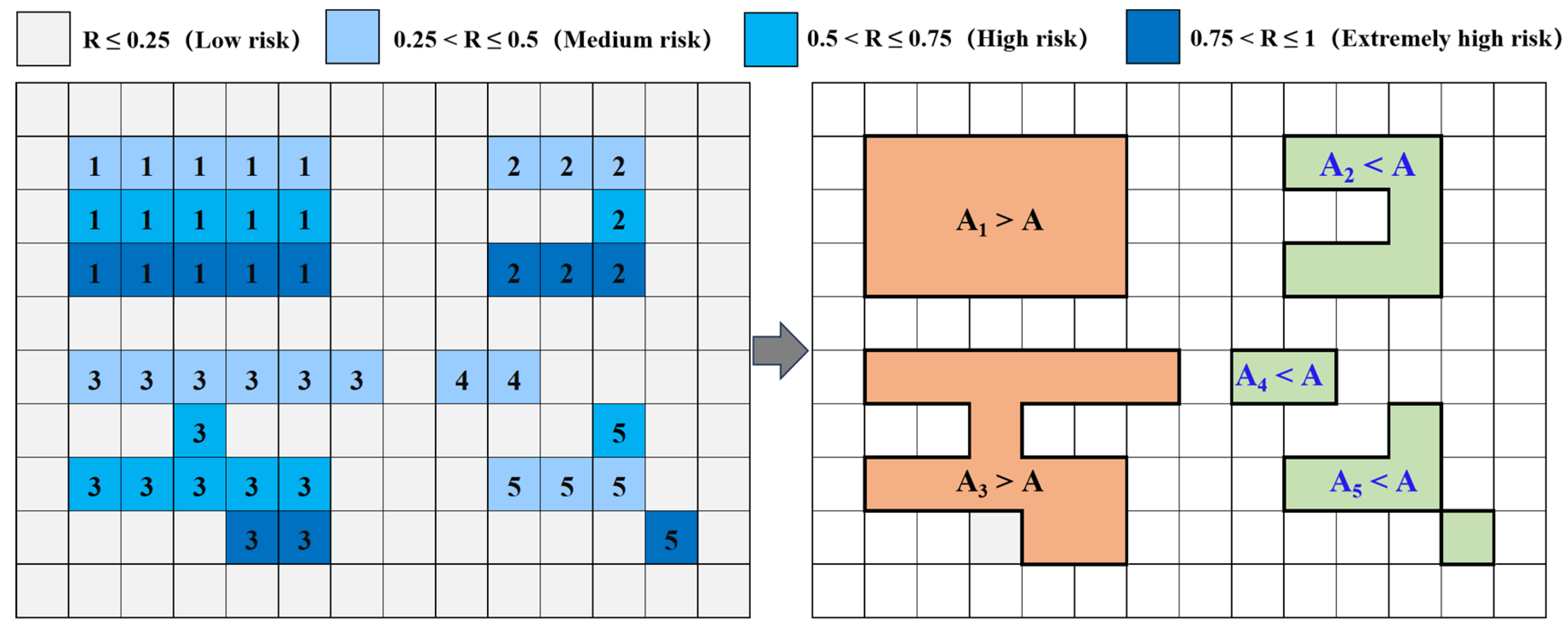
  • Statistically analyze the area of the fusion regions. Meanwhile, when the area exceeds An, divide it into flooded zones (the flood risk in this region has a high spatial agglomeration state, which leads to the aggravation of disaster risk); otherwise, divide it into flooded points.
  • The illustration of quantifying flood risk agglomeration states is shown in Figure 6. Five independent regions are identified in the figure, among which A1 and A3 are divided into flooded zones, and A2, A4 and A5 are divided into flooded points.

3.6. Combination Weighting–Cluster Analysis Method

Flood disasters are essentially a continuous three-dimensional dynamic process [30,31]. Information on flood risk includes the state change over time. In this study, considering the changes in risk on local and overall time scales, the combination weighting–cluster analysis method is used to comprehensively evaluate the risk of the independent flood agglomeration regions (flooded zones and flooded points) extracted above. The evaluation system includes several steps, which are briefly explained below.

3.6.1. Index Selection

Five comprehensive indexes are used to describe the risk characteristics corresponding to different flooded regions in this paper. The descriptions and equations are listed below.
Rp max   : Local maximum risk (the maximum risk value of a danger point on the time scale, representing the highest risk state of local–regional areas during floods, and the danger point represents the maximum cumulative risk on the time scale in the region).
R p a v e : Local average risk (the average risk value of the danger point on the time scale, representing the average risk state of the local–regional areas during floods).
R r m a x : Overall maximum risk (the maximum risk value of the whole region on the time scale, representing the maximum risk state of the whole region during floods).
R r a v e : Overall average risk (the average risk value of the whole region on the time scale, representing the average risk state of the whole region during floods).
Ra : The area of the aggregation region.
L o a = m a x [ t = 0 t n R k ( i , t ) ]
  R p m a x = m a x [ R l o a ( t ) ]
R p a v e = 1 t n t = 0 t n R l o a ( t )
  R r m a x = m a x [ 1 n i = 1 n R k ( i , t ) ]
  R r a v e = 1 t n × n t = 0 t n i = 1 n R k ( i , t )
where L o a is the location of the danger point within the region; t n is the duration of the flood event; n is the number of grids within the region; R l o a ( t ) represents the risk value of the danger point in the region during the flood event; R k ( i , t ) represents the risk value of grid i within the k-th flooded zone or flooded point during the flood event.

3.6.2. Combination Weighting Method

The Analytic Hierarchy Process (AHP) is a weight calculation method which is widely used due to its inclusion of empirical judgments and simple steps [63]. However, the importance of the indicator may be exaggerated or reduced due to excessive subjectivity. The entropy weight method (EWM) determines weights from data variability, thereby reducing bias introduced by subjective weighting [64]; however, it may partially neglect the intrinsic importance of the indices themselves. To comprehensively consider the subjective and objective factors covered by the index, the combination weighting method is adopted to improve the rationality of the weighting assignment [65]. The calculation formula is as follows:
W j = α W j + ( 1 α ) ω j
where W j is the combination weight; W j   and ω j represent the weight of the EWM and AHP; α is the importance coefficient, which is taken as 0.5 in this paper.

3.6.3. Clustering Analysis Algorithm

The K-means clustering algorithm is a classic unsupervised learning algorithm which is widely used because of its speed and simplicity in classification [66,67]. Since the choice of initial cluster centers has a large impact on the convergence of the K-means method, Arthur et al. [68] optimized the K-means method, making the choice of initial cluster centers more efficient and robust (K-means++). The steps of the algorithm are as follows:
  • Randomly select K initial cluster centers.
  • Compute the similarity measure between each sample and the k initial cluster center, and then assign the sample to one of the classes whose center is the closest according to the calculated similarity.
  • Compute the centroid of all points in each class as the new cluster centers.
  • Repeat steps 2 and 3 until the position of the cluster centers no longer changes.
In this study, the optimal value of K was determined using visualization (t-SNE method) and the silhouette coefficient [69,70]. Euclidean distance was chosen as the similarity measure.

4. Results and Discussion

4.1. Parameter Optimization of the Urban Flood Model

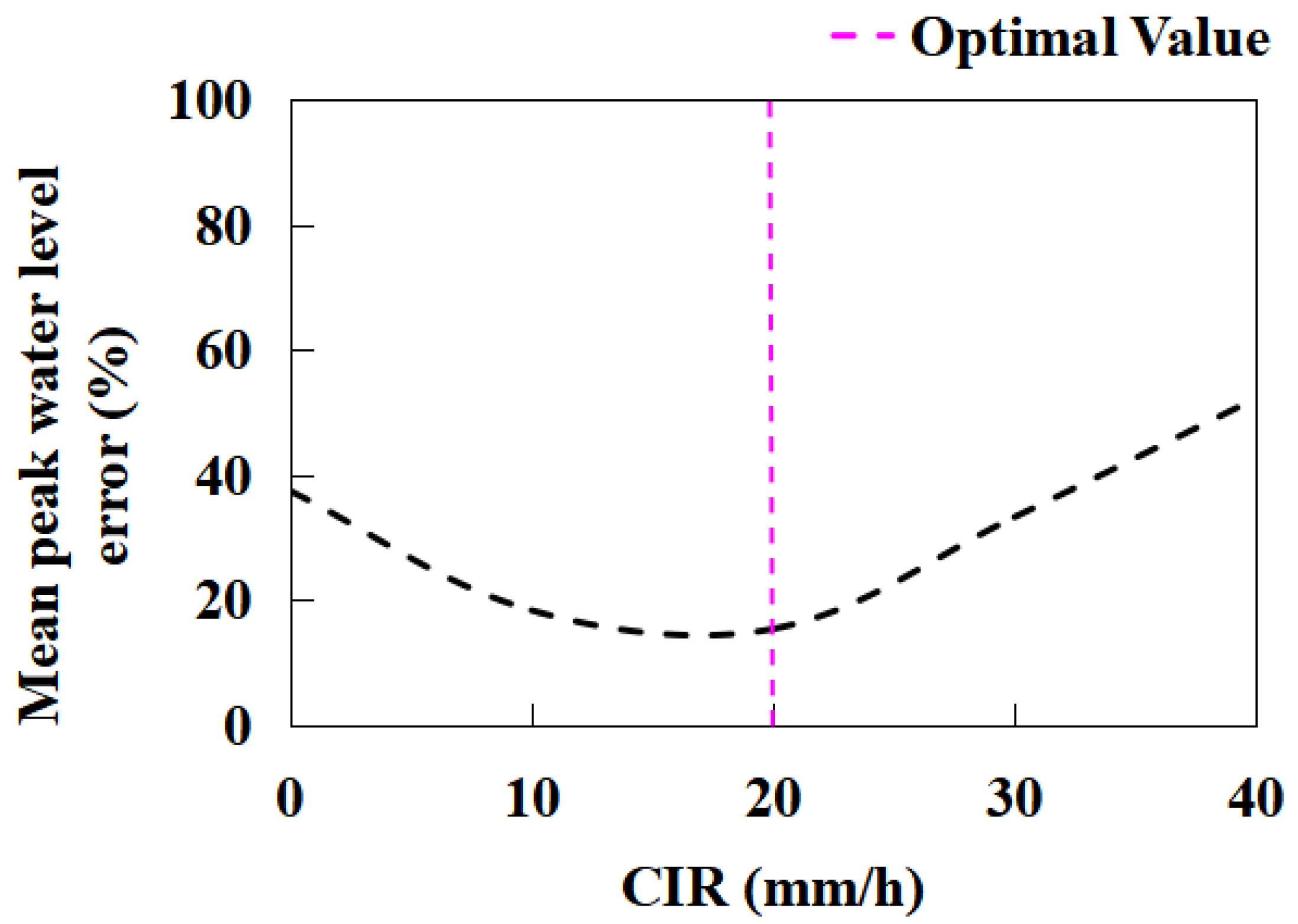
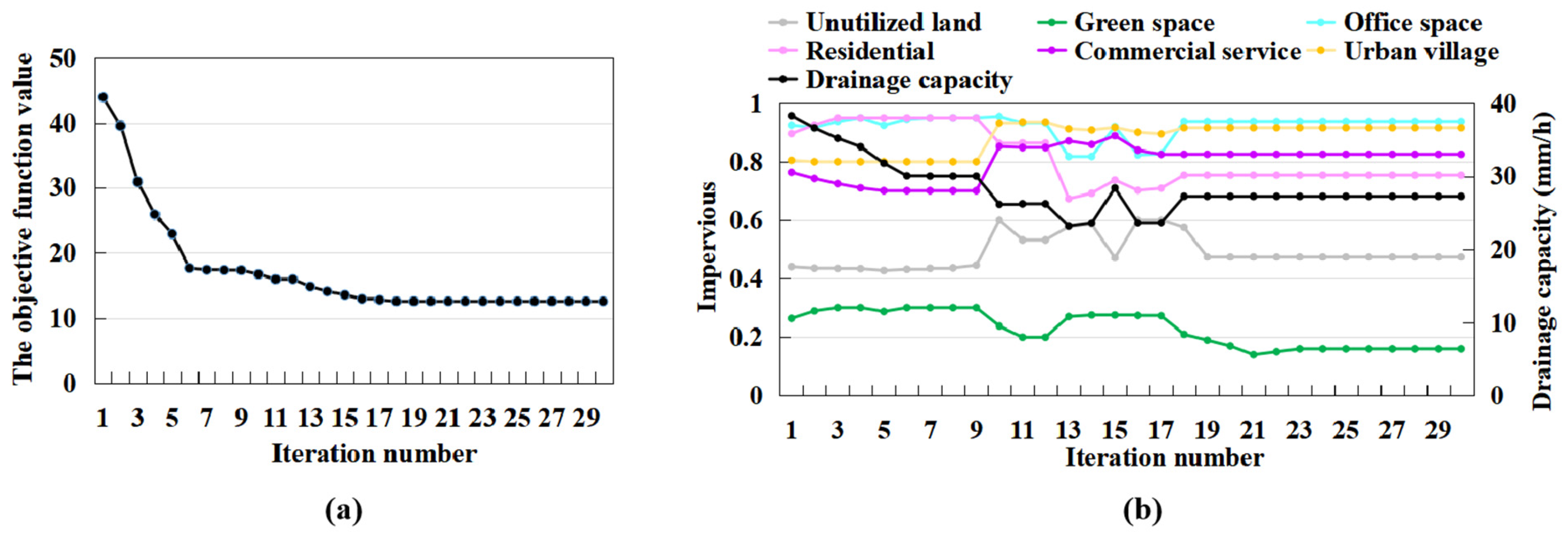
The calibration results for the two parameter setting scenarios are shown in Figure 7 and Figure 8. Under the parameter migration scenario, the model achieved its best calibration performance when the drainage coefficient was set to 20 mm/h. Compared with the parameter migration scenario, parameter optimization reduced only the impervious ratio for green space, whereas the impervious ratios for the other land use types increased to varying degrees. In addition, the drainage coefficient increased to 27.24 mm/h. Furthermore, the figures also show that after 20 evolutionary iterations using the improved PSO algorithm, the objective function approached a stable value. This indicates that the improved PSO algorithm converges efficiently during parameter optimization of the urban flood model.
The observed and simulated maximum water depths at various waterlogging points during three flood events were statistically compared. Model performance during the calibration and validation periods under different parameter scenarios is presented in Table 7 and Table 8. Under the parameter transplantation scenario, the maximum water level errors at all waterlogging points during the calibration period were acceptable except for Xinxing South Road, where the error exceeded 10 cm; the mean peak water level error was 15.37%, and the RMSE was 10.291. During the validation period, simulation results for the two flood events at all waterlogging points were reasonable except for Xingxian Road, where model performance remained poor; the mean peak water level errors were 26.73% and 33.68%, with corresponding RMSE values of 8.852 and 7.637. Compared to the parameter transplantation scenario, the maximum water level simulation errors at the waterlogging points during both the calibration and validation periods were further reduced after model parameters were optimized using the improved PSO algorithm. Specifically, during the calibration period, the mean peak water level error decreased by 2.86%, and the RMSE decreased by 0.422. For the two validation events, the mean peak water level errors decreased by 1.37% and 12.77%, with corresponding RMSE reductions of 1.425 and 2.523, respectively.
Overall, model accuracy improved after parameter optimization. This indicates that conducting parameter optimization in urban flood modeling is necessary, as it can reduce parameter uncertainty and improve simulation performance. Moreover, after optimization, the urban flood model for Guancheng District remained relatively stable and was therefore considered suitable for subsequent flood risk analysis.

4.2. Grid-Scale Flood Risk Comparison

Table 9 presents the results of different grid-scale flood risk assessment methods (the EF method, the CMA method, and the improved analysis method). The results show that the medium- and high-risk areas identified by the EF method are substantially larger than those identified by the CMA method and improved analysis method. For adults, the medium- and high-risk areas derived from the CMA method are 11.24 hm2 and 11.22 hm2 smaller compared to those from the EF method. For children, the corresponding reductions are 6.29 hm2 and 8.38 hm2. Similarly, under the improved analysis method, the medium- and high-risk areas for adults are 8.97 hm2 and 10.99 hm2 smaller than those from the EF method, whereas the corresponding decreases for children are 2.66 hm2 and 7.38 hm2.
In contrast, the extremely high-risk areas identified by the EF method are notably smaller than those produced by the other two methods. Under the urban waterlogging prevention standard, the extremely high-risk area based on the EF method is only 0.23 hm2. By comparison, both the CMA and improved analysis methods classified an area of 0.71 hm2 for adults under the same conditions. The discrepancy in extremely high-risk areas is even more pronounced for children. Specifically, the CMA and improved analysis methods identified extremely high-risk areas of 2.29 hm2 and 2.33 hm2, respectively, which are considerably larger than the area estimated by the EF method.
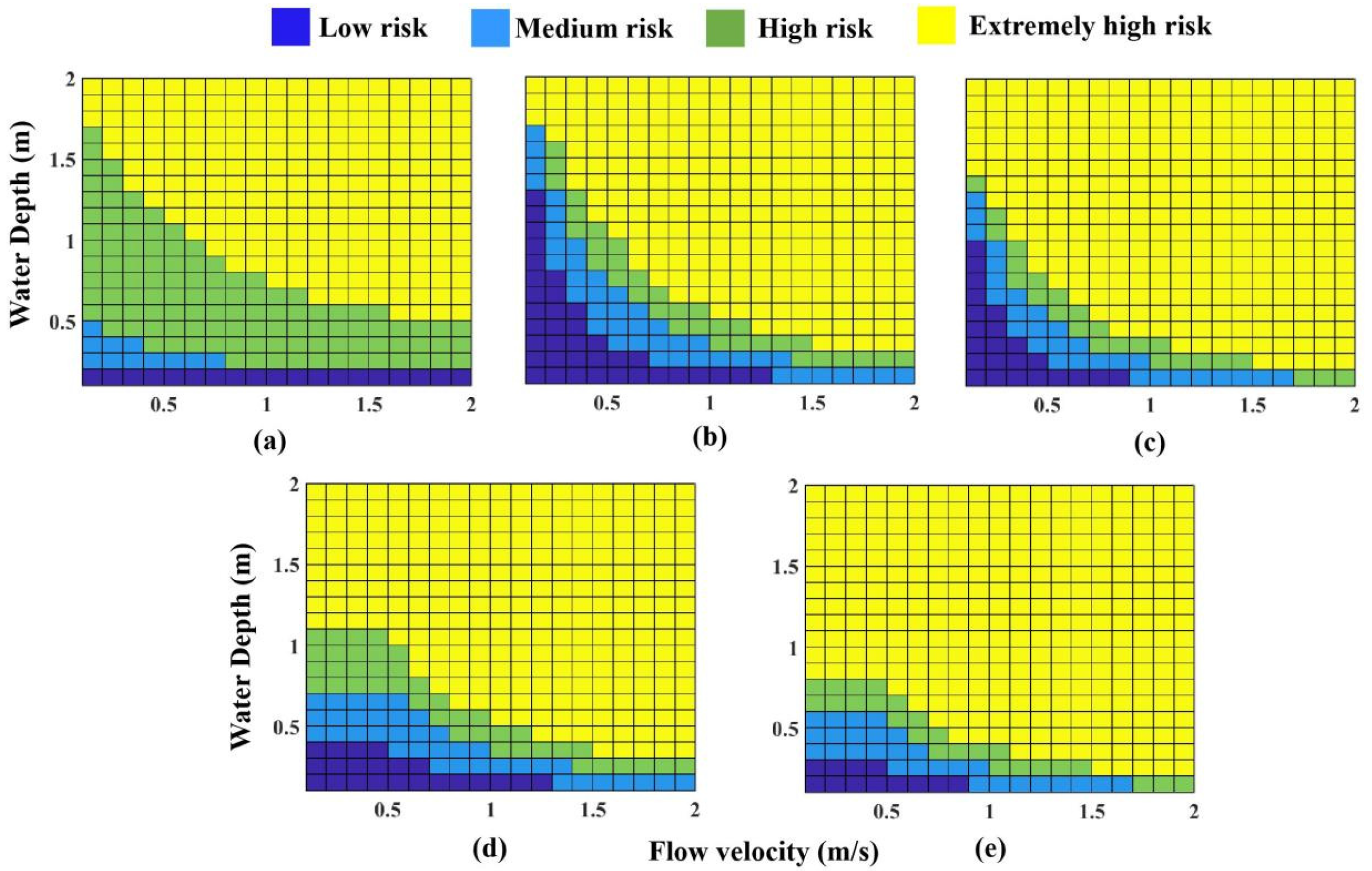
To further explore the reasons for the classification differences among the grid-scale flood risk assessment methods, risk categorization was performed for each method and exposed object (adults and children) across combinations of flow velocity (0.1–2 m/s at 0.1 m/s intervals) and water depth (0.1–2 m at 0.1 m intervals), as illustrated in Figure 9.
Under shallow water conditions (0.1 m depth), the EF method maintains a low risk level regardless of variations in flow velocity (Figure 9a). However, when water depth ranges between 0.1 m and 0.4 m, the risk is classified as medium or high across the entire velocity spectrum of 0.1–2 m/s. Overall, the EF method exhibits a stronger response to water depth but lower sensitivity to flow velocity. Consequently, under the current threshold classification scheme, the EF method evaluates significantly larger areas of medium or high risk in the combined scenarios of flow velocity and water depth compared to the CMA method and the improved analysis method (including both adults and children). Conversely, the area classified as extremely high risk is notably smaller. Xu et al. [22] similarly noted the relatively low sensitivity of the EF method to flow velocity, which may lead to risk underestimation in areas with steeper slopes.
For the CMA method, sensitivity to flow velocity and water depth shows roughly synchronized variation, and the risk level responds sensitively to both hazard factors. Nevertheless, its capacity to classify risk under high-depth, low-velocity combinations remains limited. Specifically, adults are assessed as low or medium-risk at a water depth of 1.3 m under low flow velocities (0.1–0.2 m/s) (Figure 9b), while children similarly remain at low or medium-risk at approximately 1 m depth under the same low-velocity conditions (Figure 9c). This represents a notable limitation, given that existing research indicates critical drowning thresholds of about 1.3 m for adults and 1 m for children [62], suggesting that the CMA method may substantially underestimate risk in such scenarios. By incorporating a drowning factor—yielding the improved analysis method—adults are classified as extremely high-risk once water depth exceeds 1.1 m, and for children the threshold is 0.8 m, irrespective of flow velocity (Figure 9d,e). This enhancement significantly improves risk recognition under high-depth, low-velocity conditions.
To quantify the improvement in risk classification capability of the improved analysis method over the CMA method, we compared their risk classifications across all 400 combinations of flow velocity (0.1–2 m/s at 0.1 m/s intervals) and water depth (0.1–2 m at 0.1 m intervals). According to Equation (13), the improved analysis method incorporates a drowning factor; therefore, the risk level assigned by the CMA method is never higher than that assigned by the improved analysis method. Consequently, classification differences arise when the CMA method assigns a lower risk level to a given combination while the improved analysis method assigns a higher risk level. These risk escalations are grouped into three patterns for statistical analysis: (1) escalation to medium risk (from low to medium); (2) escalation to high risk (from low or medium to high); and (3) escalation to extremely high risk (from low, medium, or high to extremely high). Table 10 presents the frequencies and proportions of these risk escalation patterns across the 400 combinations. The results indicate that, for adults, the improved analysis method enhances risk classification capability by 2%, 3%, and 3.25% in the medium-risk, high-risk, and extremely high-risk categories, respectively. Correspondingly, for children, the improvements are 1.75%, 1.25%, and 3% across the same risk categories.
According to the hydrodynamic equations, water depth and flow velocity are generally correlated, with greater depths typically corresponding to higher velocities. However, in steep-gradient areas or roads receiving considerable upstream inflow, hazardous combinations of low water depth and relatively high flow velocity may occur. The CMA method demonstrates higher accuracy than the EF method in identifying risk states in such regions [22]. Conversely, in low-lying areas or densely built-up districts, situations may arise where water depths are high but flow velocities remain low [71,72]; here, the risk classification performance of the CMA method requires further improvement. Overall, by incorporating the drowning factor, the improved analysis method effectively characterizes risk states across all combinations of flow velocity and water depth. It retains the flow velocity sensitivity of the CMA method under low-depth and high-velocity conditions, while also providing the heightened sensitivity necessary for high-depth, low-velocity scenarios commonly encountered in low-lying or densely built-up areas. Moreover, this enhanced risk classification capability supports more targeted flood mitigation by informing differentiated strategies, including prioritizing evacuation in areas with high water depth and implementing flow control measures in zones with high flow velocity, thereby contributing to more resilient urban flood risk governance.

4.3. Flood Risk Aggregation State Quantification

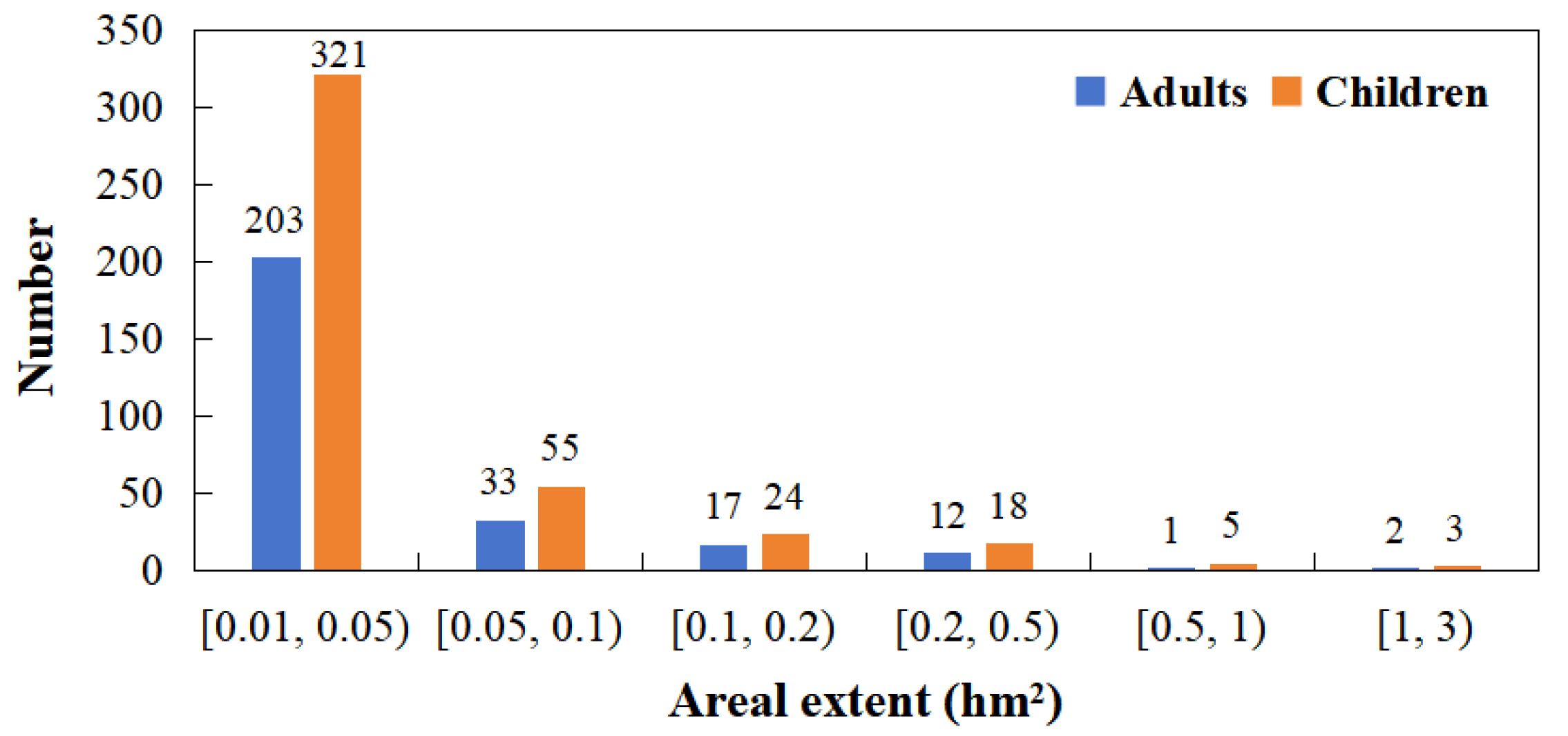
Based on the grid-scale flood risk assessment results obtained through the improved analysis method, the spatial aggregation of flood risk was quantified using two criteria—risk threshold and aggregation area threshold—and subsequently classified into discrete flooded points and flooded zones. To further characterize the internal risk aggregation states of these features, they were subdivided into six categories according to the area of the aggregated region: 0.01–0.05 hm2, 0.05–0.1 hm2, 0.1–0.2 hm2, 0.2–0.5 hm2, 0.5–1 hm2, and 1–3 hm2.
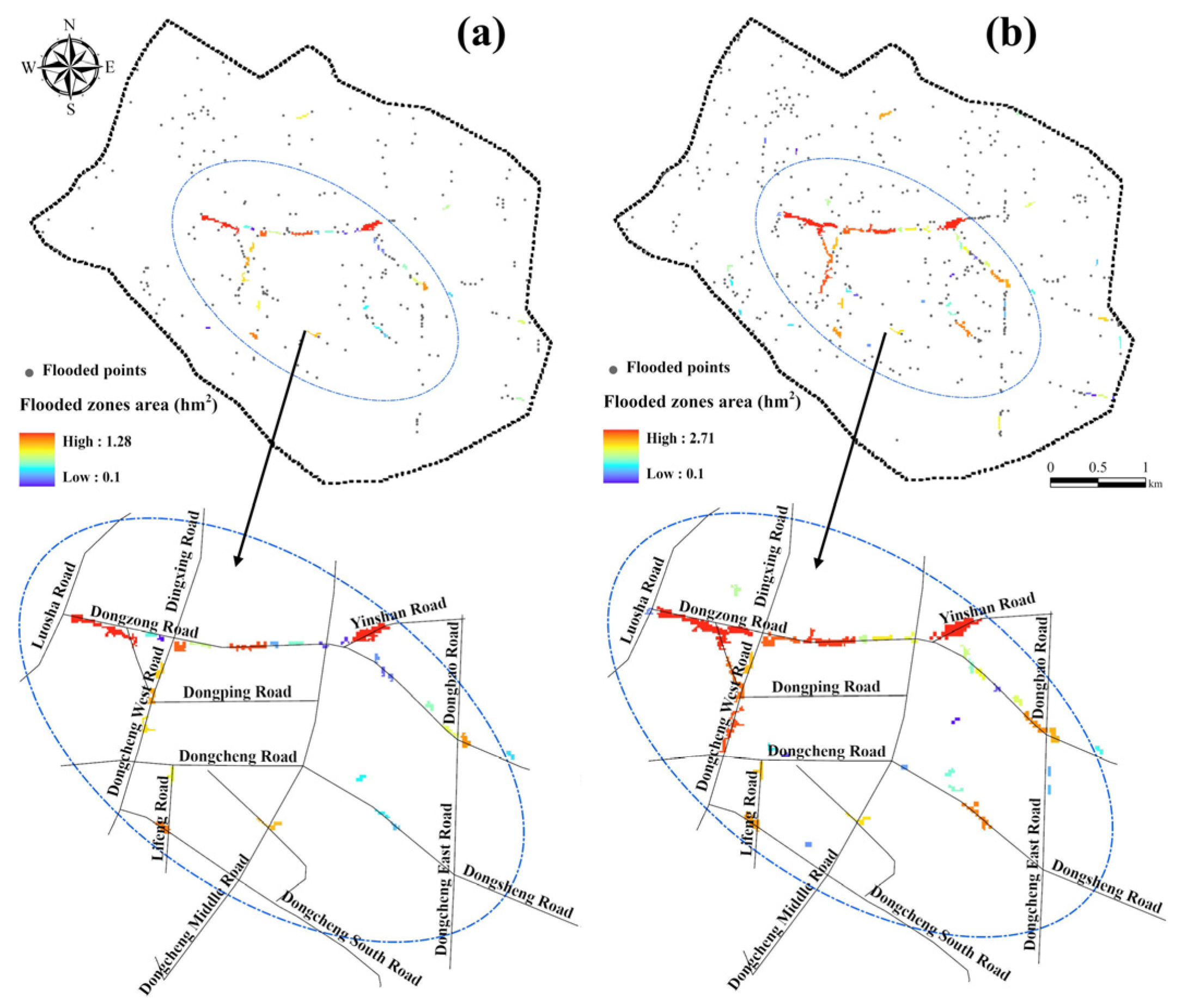
Figure 10 presents the numbers of flooded points and flooded zones under the urban waterlogging prevention standard in Guancheng District. The results show that for adults, 236 flooded points and 32 flooded zones were identified. Compared with the adult baseline, children exhibited an additional 140 flooded points and 18 flooded zones. Overall, the aggregation areas of flooded points for both categories were predominantly below 0.05 hm2, whereas flooded zones were mainly distributed between 0.1 and 0.5 hm2. Due to the limited spatial aggregation scale of flooded points, Figure 11 annotates only the grid coordinates of individual hazard points for each flooded point, while flooded zones are labeled sequentially according to area in descending order to illustrate the spatial heterogeneity of risk aggregation intensity across the study area. Spatially, flood risk in Guancheng District exhibits pronounced central clustering. For adults, the flooded zones with higher flood risk agglomeration occur sequentially at the western section of Dongzong Road (1.28 hm2), Yinshan Road (1.18 hm2), the mid-section of Dongzong Road (0.56 hm2), the intersection of Dongzong Road and Dongcheng West Road (0.37 hm2), and the intersection of Lifeng Road and Dongcheng South Road (0.33 hm2). Children demonstrate significantly greater risk aggregation owing to their higher sensitivity to water depth and flow velocity, which is particularly evident along the western and central sections of Dongzong Road. Relative to adults, the five major flooded zones for children show increases in aggregated area of 1.43 hm2, 0.40 hm2, 0.64 hm2, 0.39 hm2, and 0.15 hm2.
These disparities in risk aggregation between children and adults necessitate differentiated flood management strategies. For areas where children face disproportionately higher risk—such as the western section of Dongzong Road—priority should be given to child-specific protective measures including enhanced early warning systems and safety barriers. In flooded zones posing high risk to both objects, structural interventions such as drainage improvements should be combined with evacuation planning to enhance overall urban flood resilience.

4.4. Comprehensive Flood Risk Assessment

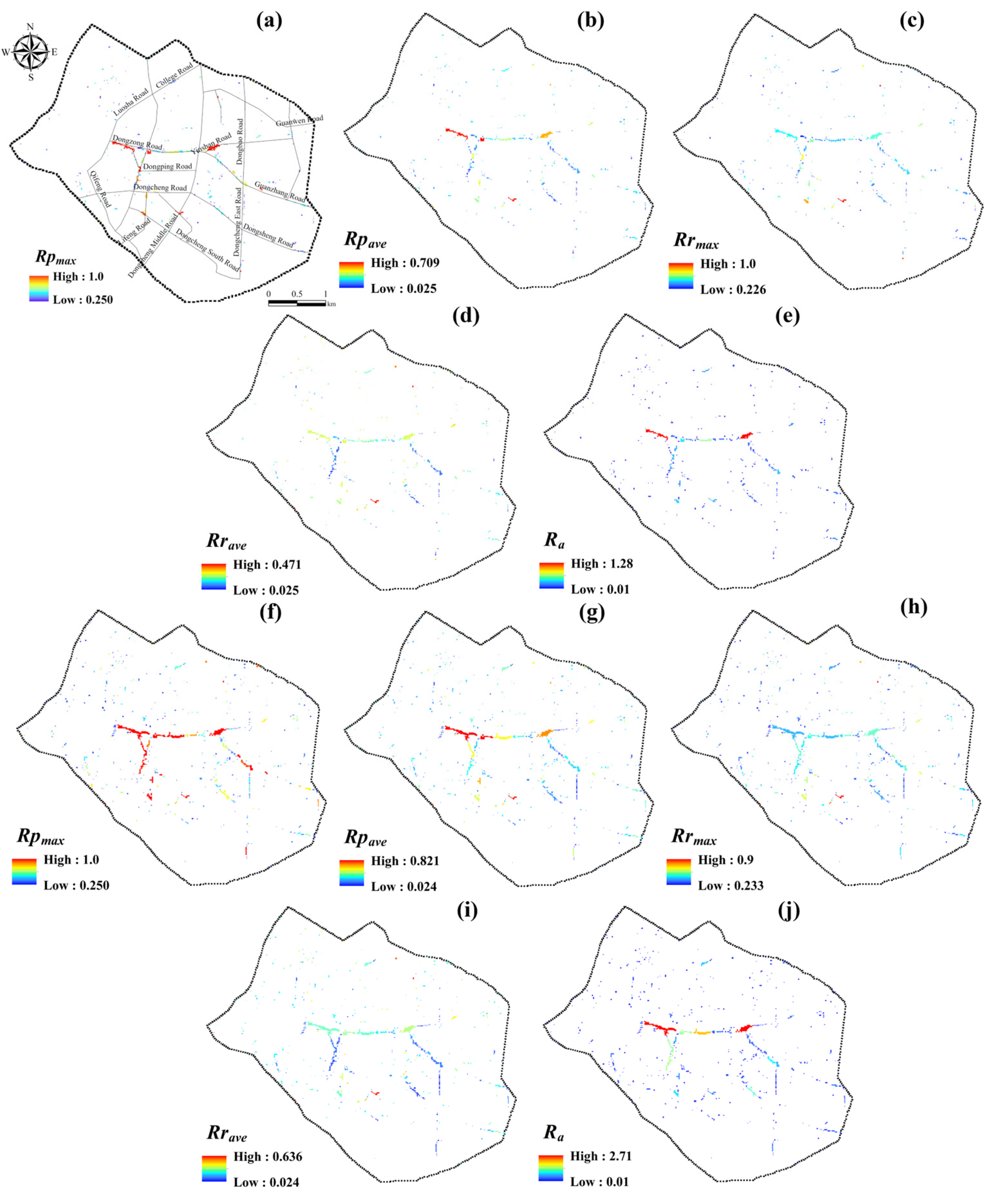
Based on the divided flooded points and flooded zones, five evaluation indicators were calculated for both adults and children under the urban waterlogging prevention standard: local maximum risk ( R p m a x ), local average risk ( R p a v e ), overall maximum risk ( R r m a x ), overall average risk ( R r a v e ), and the area of aggregation region ( R a ). The spatial distributions of these indicators are illustrated in Figure 12.
As described in Section 3, the AHP was applied to determine the relative significance of each indicator. Five experts in urban flooding were invited to rank the significance of evaluation indicators. To reflect that flooded zones focus on the overall risk situation while flooded points emphasize local risk characteristics, this study conducted independent assessments for the two types. Based on the significance of flood risk indices obtained from experts’ knowledge and experience, the judgment matrices of the indices were determined (Table 11). Among them, the evaluation indicators have a consistency ratio CR = 0.02 < 0.1; therefore, the judgment matrices are reasonable. Furthermore, the EWM was used to determine the target weight according to the degree of variability within the index. The resulting combined weights are shown in Table 12.
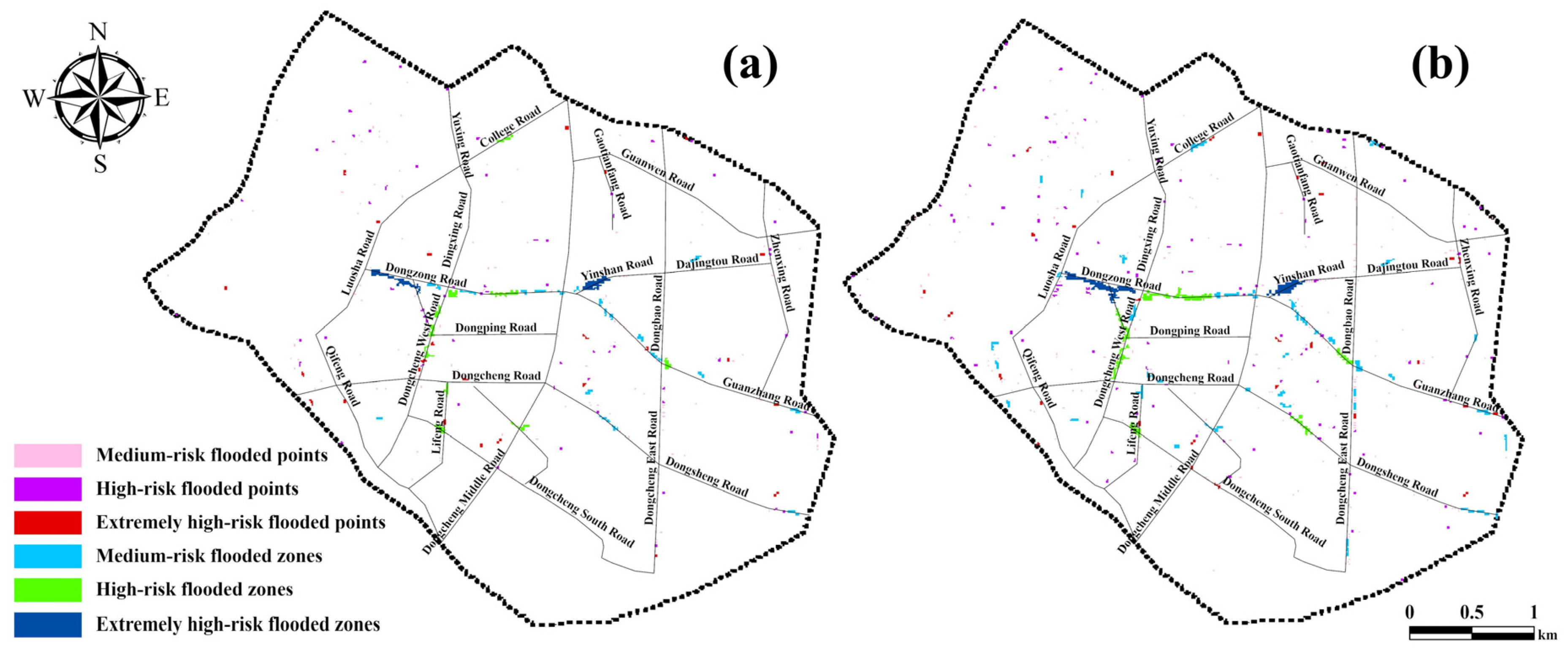
Based on the K-means++ algorithm, the optimal number of clusters for both flooded zones and flooded points was determined to be three for adults and children. Since the risk threshold (Rn) set during the extraction of flooded zones and flooded points corresponded to the lower limit of the medium-risk category, the final indicator values were comprehensively evaluated in ascending order and classified into three risk levels: medium risk, high risk, and extremely high risk. The comprehensive flood risk assessments for adults and children are illustrated in Figure 13, and the numbers of regions in each risk category are listed in Table 13.
The comprehensive assessment indicates that, under the urban waterlogging prevention standard, flooded points for adults are classified into 149 medium-risk, 62 high-risk, and 25 extremely high-risk locations. In comparison, flooded points for children comprise 236 medium-risk, 111 high-risk, and 29 extremely high-risk locations. Spatially (Figure 13), extremely high-risk flooded points for adults are primarily concentrated around Luosha Road, Qifeng Road, and Dongcheng West Road. In contrast, extremely high-risk flooded points for children are more widely distributed, with notable expansions observed northwest of Luosha Road. Furthermore, areas adjacent to Qifeng Road and Dongcheng West Road have transitioned from flooded points to flooded zones due to intensified risk aggregation. In the assessment of flooded zones, adults exhibit 20 medium-risk, 10 high-risk, and 2 extremely high-risk flooded zones, whereas children present 41 medium-risk, 7 high-risk, and 2 extremely high-risk flooded zones. Both adults and children show minimal variation in the number of high- and extremely high-risk flooded zones. All extremely high-risk flooded zones are exclusively located at Yinshan Road and the western section of Dongzong Road, while high-risk flooded zones are mainly concentrated at the intersection of Dongping Road and Dongcheng West Road, the intersection of Dongzong Road and Dongcheng West Road, the mid-section of Dongzong Road, and the intersection of Lifeng Road and Dongcheng South Road.
Further analysis integrating the spatial distribution of indicators (Figure 12) shows that the western section of Dongzong Road and Yinshan Road share similar risk characteristics: both regions exhibit high localized risk, moderate overall risk, high risk on the time scale and high spatial agglomeration status. The four intersections—Dongping Road/Dongcheng West Road, Dongzong Road/Dongcheng West Road, the mid-section of Dongzong Road, and Lifeng Road/Dongcheng South Road—exhibit risk metrics comparable to those of western Dongzong Road and Yinshan Road, yet their spatial agglomeration status is markedly lower. It is noteworthy that while risk locations for children largely coincide with those for adults, the corresponding risk indicators and agglomeration statuses show consistent amplification. Particularly pronounced differences are observed along Dongcheng West Road and the mid-section of Dongzong Road (Figure 13).
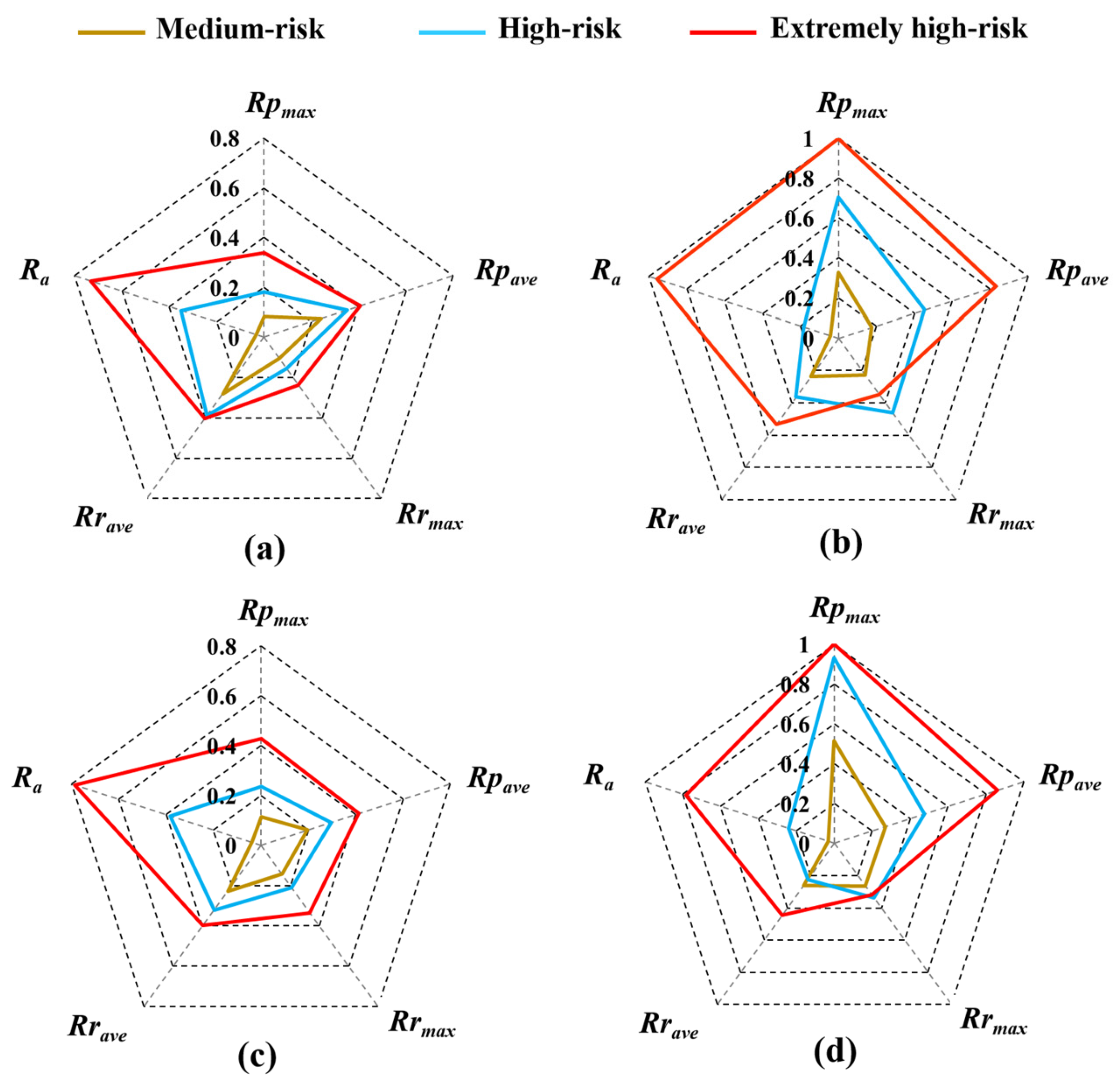
To further verify the rationality of the comprehensive risk classification, Figure 14 presents radar charts showing the mean values of each indicator under different risk levels. As illustrated, all five evaluation indicators for flooded points (for both adults and children) increase progressively with rising risk levels. For flooded zones, most indicators increase substantially as risk rises. The exceptions are the overall maximum risk (Rrmax) and overall average risk (Rrave), which exhibit relatively small differences between the high- and extremely high-risk categories. The limited variation in overall risk indicators can be largely explained by the significant differences in the spatial agglomeration status of flooded zones across risk levels, as larger aggregation areas tend to average out these metrics.

5. Conclusions

This paper proposes a comprehensive framework for urban flood risk assessment, which systematically integrates grid-scale risk analysis with the spatiotemporal characteristics of disaster-causing factors, thereby enabling a more holistic evaluation of flood risk. The main findings are summarized as follows:
  • The improved PSO algorithm effectively enhances the performance of urban flood modeling. Compared with the parameter transplantation scenario, it achieved reductions of 2.86% in the mean peak water level error and 0.422 in the RMSE during calibration. In the validation phase, the peak water level errors for two flood events decreased by 1.37% and 12.77%, accompanied by RMSE reductions of 1.424 and 2.523, respectively.
  • The empirical formula method exhibits low sensitivity to flow velocity variations. In contrast, the comprehensive mechanical analysis method demonstrates superior responsiveness to risk fluctuations induced by flow conditions, yet underperforms in risk identification under combined high-water-depth and low-velocity scenarios. The improved analysis method incorporates drowning factors to better capture risk changes across flow velocity and water depth combinations, achieving enhanced classification rates for adults (2%, 3%, and 3.25% in medium-, high-, and extremely high-risk categories) and children (1.75%, 1.25%, and 3%, respectively).
  • Under the return period of the waterlogging prevention standard, the area of aggregation regions of flooded points in Guancheng District was predominantly below 0.05 hm2, while flooded zones primarily ranged between 0.1 and 0.5 hm2. Critical regions exhibiting elevated spatial clustering of flood risk for adults encompass the western section of Dongzong Road (1.28 hm2), Yinshan Road (1.18 hm2), the mid-section of Dongzong Road (0.56 hm2), the intersection of Dongzong Road and Dongcheng West Road (0.37 hm2), and the intersection of Lifeng Road and Dongcheng South Road (0.33 hm2). For children, these clustered areas demonstrate significant expansions with additional increments of 1.43 hm2, 0.40 hm2, 0.64 hm2, 0.39 hm2, and 0.15 hm2, respectively, at the corresponding locations.
  • Yinshan Road and the western section of Dongzhong Road show characteristics of high localized risk, moderate overall risk, high risk on the time scale and high spatial agglomeration status, and are comprehensively assessed as extremely high-risk flooded zones.
The accuracy of input variables (i.e., flow velocity and water depth) obtained from numerical flood simulations is critical to the proposed flood risk assessment framework. However, the spatiotemporal resolution of input data, including rainfall, land use/cover, soil type, topography, and validated flood events, can substantially influence model outcomes, thereby introducing uncertainties into flood risk assessment. Striking a balance between precision and computational efficiency in large-scale numerical flood modeling remains a key direction for future research. In addition, this study only considered general risk criteria applicable to adults and children, without accounting for vulnerable populations or other specific groups exposed to flood hazards. Therefore, future research should incorporate a broader range of receptor types to comprehensively assess their risk. Furthermore, the robustness of the risk parameters within the framework warrants further investigation. For cities with different backgrounds (e.g., population density, urban development level, and climatic contexts), the spatiotemporal patterns of flood risk may exhibit differences. Subsequent research should systematically evaluate the sensitivity of these risk parameters to the comprehensive flood risk assessment, thereby improving the framework’s applicability to other urban contexts.

Author Contributions

Conceptualization, S.X.; methodology, S.X. and D.L.; software, S.X.; validation, S.X., D.L. and H.C.; formal analysis, S.X. and D.L.; investigation, S.X. and L.C.; resources, S.X. and L.C.; data curation, H.C., G.H., C.H. and L.C.; writing—original draft preparation, S.X.; writing—review and editing, D.L., H.C., G.H. and C.H.; visualization, S.X.; supervision, D.L.; project administration, D.L., H.C., G.H. and C.H.; funding acquisition, D.L., G.H. and L.C. All authors have read and agreed to the published version of the manuscript.

Funding

This work was supported by the Provincial Science and Technology Innovation Strategy Special Fund Research Project (Grant No. gdsky 2023-03), the National Natural Science Foundation of China (Grant No. 52509089), and the Hainan Provincial Natural Science Foundation of China (Grant No. 425QN302).

Institutional Review Board Statement

Not applicable.

Informed Consent Statement

Not applicable.

Data Availability Statement

The original contributions presented in this study are included in the article. Further inquiries can be directed to the corresponding author(s).

Conflicts of Interest

The authors declare no conflicts of interest regarding the publication of this paper.

References

  1. Azareh, A.; Sardooi, E.R.; Choubin, B.; Barkhori, S.; Shamshirband, S. Incorporating multi-criteria decision-making and fuzzy-value functions for flood susceptibility assessment. Geocarto Int. 2021, 36, 2345–2365. [Google Scholar] [CrossRef]
  2. Gao, L.; Gao, Y.; Liu, Y.; Wu, M. Assessment of flood risk under Polder-Type flood control measure using improved projection pursuit model. Ecol. Indic. 2025, 170, 113038. [Google Scholar] [CrossRef]
  3. Pham, B.T.; Luu, C.; Phong, T.V.; Nguyen, H.D.; Prakash, I. Flood risk assessment using hybrid artificial intelligence models integrated with multi-criteria decision analysis in Quang Nam Province, Vietnam. J. Hydrol. 2021, 592, 125815. [Google Scholar] [CrossRef]
  4. Shirzadi, A.; Salvati, A.; Tahan, M.H.; Shahabi, H.; Nodoushan, E.J.; Ramezani, M.; Hashim, M.; Clague, J.J. Urban flood susceptibility mapping using deep and machine learning algorithms as a management tool: A case study of Sanandaj City, Iran. Ecol. Indic. 2025, 178, 113886. [Google Scholar] [CrossRef]
  5. Barneveld, H.J.; Frings, R.M.; Mosselman, E.; Venditti, J.G.; Kleinhans, M.G.; Blom, A.; Schielen, R.M.J.; Toonen, W.H.J.; Meijer, D.; Paarlberg, A.J.; et al. Extreme river flood exposes latent erosion risk. Nature 2025, 644, 1476–4687. [Google Scholar] [CrossRef]
  6. Rentschler, J.; Avner, P.; Marconcini, M.; Su, R.; Strano, E.; Vousdoukas, M.; Hallegatte, S. Global evidence of rapid urban growth in flood zones since 1985. Nature 2023, 622, 1476–4687. [Google Scholar] [CrossRef]
  7. Ward, P.J.; Buijs, S.L.; Ciurean, R.; Claassen, J.N.; Daniell, J.; De Polt, K.; Duncan, M.; Gottardo, S.; Hochrainer-Stigler, S.; Šakić Trogrlić, R.; et al. Reducing risk together: Moving towards a more holistic approach to multi-hazard and multi-risk assessment and management. Nat. Hazards Earth Syst. Sci. 2026, 26, 1325–1345. [Google Scholar] [CrossRef]
  8. Gu, X.; Liu, X. Planning scale flood risk assessment and prediction in ultra-high density urban environments: The case of Hong Kong. Ecol. Indic. 2024, 162, 112000. [Google Scholar] [CrossRef]
  9. Adikari, Y.; Osti, R.; Noro, T. Flood-related disaster vulnerability: An impending crisis of megacities in Asia. J. Flood Risk Manag. 2010, 3, 185–191. [Google Scholar] [CrossRef]
  10. Tehrany, M.S.; Kumar, L.; Jebur, M.N.; Shabani, F. Evaluating the application of the statistical index method in flood susceptibility mapping and its comparison with frequency ratio and logistic regression methods. Geomat. Nat. Hazards. Risk 2019, 10, 79–101. [Google Scholar] [CrossRef]
  11. Chen, X.; Zhang, H.; Chen, W.; Huang, G. Urbanization and climate change impacts on future flood risk in the Pearl River Delta under shared socioeconomic pathways. Sci. Total. Environ. 2020, 762, 143144. [Google Scholar] [CrossRef]
  12. Wang, X.; Xie, H. A Review on Applications of Remote Sensing and Geographic Information Systems (GIS) in Water Resources and Flood Risk Management. Water 2018, 10, 608. [Google Scholar] [CrossRef]
  13. Shrestha, B.B.; Kawasaki, A. Quantitative assessment of flood risk with evaluation of the effectiveness of dam operation for flood control: A case of the Bago River Basin of Myanmar. Int. J. Disaster. Risk. Reduct. 2020, 50, 101707. [Google Scholar] [CrossRef]
  14. Siahkamari, S.; Haghizadeh, A.; Zeinivand, H.; Tahmasebipour, N.; Rahmati, O. Spatial prediction of flood-susceptible areas using frequency ratio and maximum entropy models. Geocarto Int. 2018, 33, 927–941. [Google Scholar] [CrossRef]
  15. 15. Ali, S.A.; Parvin, F.; Pham, Q.B.; Vojtek, M.; Vojteková, J.; Costache, R.; Linh, N.T.T.; Nguyen, H.Q.; Ahmad, A.; Ghorbani, M.A. GIS-based comparative assessment of flood susceptibility mapping using hybrid multi-criteria decision-making approach, naïve Bayes tree, bivariate statistics and logistic regression: A case of Topľa basin, Slovakia. Ecol. Indic. 2020, 117, 106620. [Google Scholar] [CrossRef]
  16. Xu, Z.; Cheng, T.; Hong, S.; Wang, L. Review on applications of remote sensing in urban flood modeling. Chin. Sci. Bull. 2018, 63, 2156–2166. [Google Scholar] [CrossRef]
  17. Tellman, B.; Sullivan, J.A.; Kuhn, C.; Kettner, A.J.; Slayback, D.A. Satellite imaging reveals increased proportion of population exposed to floods. Nature 2021, 596, 80–86. [Google Scholar] [CrossRef]
  18. Wu, L.; Liu, Y.; Zhang, J.; Zhang, B.; Wang, Z.; Tong, J.; Li, M.; Zhang, A. Identification of flood depth levels in urban waterlogging disaster caused by rainstorm using a CBAM-improved ResNet50. Expert Syst Appl. 2024, 255, 124382. [Google Scholar] [CrossRef]
  19. Wu, L.; Tong, J.; Wang, Z.; Li, J.; Li, M.; Li, H.; Feng, Y. Post-flood disaster damaged houses classification based on dual-view image fusion and Concentration-Based Attention Module. Sustain. Cities Soc. 2024, 103, 105234. [Google Scholar] [CrossRef]
  20. Dong, B.; Xia, J.; Wang, X. Comprehensive flood risk assessment in highly developed urban areas. J. Hydrol. 2025, 648, 132391. [Google Scholar] [CrossRef]
  21. Zhu, W.; Cao, Z.; Kawaike, K.; Luo, P.; Yamanoi, K.; Koshiba, T.J. A novel urban flood risk assessment framework based on refined numerical simulation technology. J. Hydrol. 2024, 645, 132152. [Google Scholar] [CrossRef]
  22. Xu, Z.; Chen, H.; Ren, M.; Cheng, T. Progress on disaster mechanism and risk assessment of urban flood/waterlogging disasters in China. Adv. Water Sci. 2020, 31, 713–724. [Google Scholar] [CrossRef]
  23. Surendran, S.; Gibbs, G.; Wade, S.; Udale-Clarke, H. Supplementary Note on Flood Hazard Ratings and Thresholds for Development Planning and Control Purpose; Environment Agency: Bristol, UK; HR Wallingford: London, UK, 2008. [Google Scholar]
  24. Xia, J.; Falconer, R.A.; Wang, Y.; Xiao, X. New criterion for the stability of a human body in floodwaters. J. Hydraul. Res. 2014, 52, 93–104. [Google Scholar] [CrossRef]
  25. Ma, C.; Chen, Z.; Zhao, K.; Xu, H.; Qi, W. Improved urban flood risk assessment based on spontaneous-triggered risk assessment conceptual model considering road environment. J. Hydrol. 2022, 608, 127693. [Google Scholar] [CrossRef]
  26. Wang, W.; Yang, S.; Gao, J.; Hu, F.; Zhao, W.; Stanley, H.E. An Integrated Approach for Assessing the Impact of Large-Scale Future Floods on a Highway Transport System. Risk Anal. 2020, 40, 1780–1794. [Google Scholar] [CrossRef]
  27. Cai, X.; Zhao, Z.; Zhang, W.; Shao, Y.; Chen, H.; Luo, M. Spatial prediction of emergency supply demand under urban flood disaster events: A case study of the “23·7” rainstorm in Beijing. Urban Clim. 2026, 65, 102740. [Google Scholar] [CrossRef]
  28. Du, J.; Sha, H.; Wang, Z.; Zeng, Z.; Tan, C.; Zhao, B.; Hu, N.; Lai, C. Refined impact assessment of rainfall-induced urban flood in a densely populated and built-up watershed. J. Hydrol. Reg. Stud. 2025, 62, 102927. [Google Scholar] [CrossRef]
  29. Ma, X.; Wang, Y.; Tang, Z.; Li, S. Urban Flood Risk Assessment Based on DEMATEL-ANP Hybrid Fuzzy Evaluation and Hydrodynamic Model. Water 2025, 17, 1494. [Google Scholar] [CrossRef]
  30. Berkhahn, S.; Neuweiler, I. Data driven real-time prediction of urban floods with spatial and temporal distribution. J. Hydrol. X. 2024, 22, 100167. [Google Scholar] [CrossRef]
  31. Zhao, G.; Xiao, Y.; Xu, C.; Li, B.; Huang, Z.; Zhang, T.; Gualtieri, C. Spatial-temporal correlation-based analysis of multi-source flood coincidence risks: A case study of the middle and lower Yangtze River basin. J. Hydrol. Reg. Stud. 2025, 58, 102265. [Google Scholar] [CrossRef]
  32. Schlumberger, J.; Stolte, T.R.; Garcia, H.M.; Sebastian, A.; Jäger, W.; Ward, P.J.; de Ruiter, M.C.; Trogrlić, R.Š.; Tijssen, A.; de Brito, M.M. Review article: Exploring methods capturing vulnerability dynamics in the context of flood hazard research. EGUsphere 2026, preprint. [Google Scholar] [CrossRef]
  33. Wang, X.; Kinsland, G.; Poudel, D.; Fenech, A. Urban flood prediction under heavy precipitation. J. Hydrol. 2019, 577, 123984. [Google Scholar] [CrossRef]
  34. Liu, X.; He, J.; Yao, Y.; Zhang, J.; Liang, H.; Wang, H.; Hong, Y. Classifying urban land use by integrating remote sensing and social media data. Int. J. Geogr. Inf. Sci. 2017, 31, 1675–1696. [Google Scholar] [CrossRef]
  35. Nachtergaele, F.; Van Velthuizen, H.; Verelst, L.; Batjes, N.; Dijkshoorn, K.; van Engelen, V.; Fischer, G.; Jones, A.; Montanarela, L.; Prieler, M.; et al. Harmonized World Soil Database. In Proceedings of the 19th World Congress of Soil Science, Soil Solutions for a Changing World; International Union of Soil Sciences: Brisbane, Australia, 2010. [Google Scholar]
  36. Arya, L.M.; Paris, J.F. A Physicoempirical Model to Predict the Soil Moisture Characteristic from Particle-Size Distribution and Bulk Density Data. Soil Sci. Soc. Am. J. 1981, 45, 1023–1030. [Google Scholar] [CrossRef]
  37. Babaeian, E.; Sadeghi, M.; Jones, S.B.; Montzka, C.; Vereecken, H.; Tuller, M. Ground, Proximal, and Satellite Remote Sensing of Soil Moisture. Rev. Geophys. 2019, 57, 530–616. [Google Scholar] [CrossRef]
  38. Hossain Anni, A.; Cohen, S.; Praskievicz, S. Sensitivity of urban flood simulations to stormwater infrastructure and soil infiltration. J. Hydrol. 2020, 588, 125028. [Google Scholar] [CrossRef]
  39. Xu, S.; Chen, Y.; Zhang, Y.; Chen, L.; Sun, H.; Liu, J. Developing a framework for urban flood modeling in Data-poor regions. J. Hydrol. 2023, 617, 128985. [Google Scholar] [CrossRef]
  40. Bates, P.D.; Roo, A.P.J.D. A simple raster-based model for flood inundation simulation. J. Hydrol. 2000, 236, 54–77. [Google Scholar] [CrossRef]
  41. Chen, Y.; Ren, Q.; Huang, F.; Xu, H.; Cluckie, I. Liuxihe Model and Its Modeling to River Basin Flood. J. Hydrol. Eng. 2011, 16, 33–50. [Google Scholar] [CrossRef]
  42. Rujner, H.; Leonhardt, G.; Marsalek, J.; Viklander, M. High-resolution modelling of the grass swale response to runoff inflows with Mike SHE. J. Hydrol. 2018, 562, 411–422. [Google Scholar] [CrossRef]
  43. Wang, H.; Chen, Y. Identifying Key Hydrological Processes in Highly Urbanized Watersheds for Flood Forecasting with a Distributed Hydrological Model. Water 2019, 11, 1641. [Google Scholar] [CrossRef]
  44. Guan, M.; Sillanpää, N.; Koivusalo, H. Storm runoff response to rainfall pattern, magnitude and urbanization in a developing urban catchment. Hydrol. Process. 2015, 30, 543–557. [Google Scholar] [CrossRef]
  45. Oudin, L.; Salavati, B.; Furusho-Percot, C.; Ribstein, P.; Saadi, M. Hydrological impacts of urbanization at the catchment scale. J. Hydrol. 2018, 559, 774–786. [Google Scholar] [CrossRef]
  46. Eberhart, R.; Kennedy, J. A new optimizer using particle swarm theory. In Proceedings of the MHS’95 Sixth International Symposium on Micro Machine & Human Science, Nagoya, Japan, 4–6 October 1995. [Google Scholar]
  47. Kennedy, J.; Eberhart, R. Particle swarm optimization. In Proceedings of the ICNN95—International Conference on Neural Networks, Perth, WA, Australia, 27 November–1 December 1995. [Google Scholar]
  48. Acharjee, P.; Goswami, S.K. Chaotic particle swarm optimization based robust load flow. Int J. Elec Power. 2010, 32, 141–146. [Google Scholar] [CrossRef]
  49. Shi, Y. A modified particle swarm optimizer. In Proceedings of the IEEE International Conference on Evolutionary Computation, Anchorage, AK, USA, 4–9 May 1998. [Google Scholar]
  50. Chen, Y.; Li, J.; Xu, H. Improving flood forecasting capability of physically based distributed hydrological models by parameter optimization. Hydrol. Earth Syst. Sci. 2016, 20, 375–392. [Google Scholar] [CrossRef]
  51. Ratnaweera, A.; Halgamuge, S.K.; Watson, H.C. Self-Organizing Hierarchical Particle Swarm Optimizer with Time-Varying Acceleration Coefficients. IEEE Trans Evol Comput. 2004, 8, 240–255. [Google Scholar] [CrossRef]
  52. Eberhart, R.C.; Shi, Y. Tracking and optimizing dynamic systems with particle swarms. In Proceedings of the Congress on Evolutionary Computation (CEC), Seoul, Republic of Korea, 27–30 May 2001. [Google Scholar]
  53. Shi, Y.; Eberhart, R.C. Fuzzy adaptive particle swarm optimization. In Proceedings of the 2001 Congress on Evolutionary Computation CEC2001, Seoul, Republic of Korea, 27–30 May 2001. [Google Scholar]
  54. Chen, G. Study on the Strategy of Decreasing Inertia Weight in Particle Swarm Optimization Algorithm. J. Xi′Jiaotong Univ. 2006, 40, 53. [Google Scholar]
  55. Cao, X.; Lyu, H.; Ni, G.; Tian, F.; Ma, Y.; Grimmond, C.S.B. Spatial Scale Effect of Surface Routing and Its Parameter Upscaling for Urban Flood Simulation Using a Grid-Based Model. Water Resour. Res. 2020, 56, e2019WR025468. [Google Scholar] [CrossRef]
  56. Wang, Y.; Chen, A.S.; Fu, G.; Djordjević, S.; Zhang, C.; Savić, D.A. An integrated framework for high-resolution urban flood modelling considering multiple information sources and urban features. Environ. Model. Softw. 2018, 107, 85–95. [Google Scholar] [CrossRef]
  57. Teng, J.; Jakeman, A.J.; Vaze, J.; Croke, B.F.W.; Dutta, D.; Kim, S. Flood inundation modelling: A review of methods, recent advances and uncertainty analysis. Environ. Model. Softw. 2017, 90, 201–216. [Google Scholar] [CrossRef]
  58. Geng, Y.; Zheng, X.; Wang, Z.; Wang, Z. Flood risk assessment in Quzhou City (China) using a coupled hydrodynamic model and fuzzy comprehensive evaluation (FCE). Nat. Hazards 2020, 100, 133–149. [Google Scholar] [CrossRef]
  59. Baky, M.A.A.; Islam, M.; Paul, S. Flood Hazard, Vulnerability and Risk Assessment for Different Land Use Classes Using a Flow Model. Earth Syst. Environ. 2019, 4, 225–244. [Google Scholar] [CrossRef]
  60. Li, G.; Liu, J.; Shao, W. Flood Risk Assessment Using TELEMAC-2D Models Integrated with Multi-Index Analysis in Shenzhen River Basin, China. Water 2022, 14, 2513. [Google Scholar] [CrossRef]
  61. Drillis, R.; Contini, R.; Bluestein, M. Body Segment Parameters: A Survey of Measurement Techniques. Artif. Limbs. 1964, 25, 44–66. [Google Scholar]
  62. Milanesi, L.; Pilotti, M.; Ranzi, R. A conceptual model of people’s vulnerability to floods. Water Resour. Res. 2015, 51, 182–197. [Google Scholar] [CrossRef]
  63. Saaty, T.L.; Kearns, K.P. The analytic hierarchy process. In Analytical Planning; Elsevier: Amsterdam, The Netherlands, 1985. [Google Scholar]
  64. Shannon, C.E. A Mathematical Theory of Communication. Bell Syst. Tech. J. 1948, 27, 623–656. [Google Scholar] [CrossRef]
  65. Wei, Q.; Wei, Q.; Li, S.; Xu, J.; Yang, Z.; Liu, Z.; Chen, P.; Liu, Y.; Ding, Y.; Tan, J.; et al. Evaluation of surface water quality in Heilongjiang Province, China: Based on different quantities of water quality indicators. Ecol. Indic. 2023, 154, 110472. [Google Scholar] [CrossRef]
  66. Hartigan, J.A.; Wong, M.A. Algorithm AS 136: A k-means clustering algorithm. J. R. Stat. Soc. C 1979, 28, 100–108. [Google Scholar] [CrossRef]
  67. Kapoor, A.; Singhal, A. A comparative study of K-Means, K-Means++ and Fuzzy C-Means clustering algorithms. In Proceedings of the 2017 3rd International Conference on Computational Intelligence & Communication Technology (CICT), Ghaziabad, India, 9–10 February 2017; pp. 1–6. [Google Scholar]
  68. Arthur, D.; Vassilvitskii, S. k-Means ++: The advantages of careful seeding. In Proceedings of the Eighteenth Annual ACM-SIAM Symposium on Discrete Algorithms; Society for Industrial and Applied Mathematics: Philadelphia, PA, USA, 2007; pp. 1027–1035. [Google Scholar]
  69. Pham, D.T.; Dimov, S.S.; Nguyen, C.D. Selection of K in K-means clustering. Proc. Inst. Mech. Eng. Part C J. Mech. Eng. Sci. 2005, 219, 103–119. [Google Scholar] [CrossRef]
  70. Rousseeuw, P.J. Silhouettes: A graphical aid to the interpretation and validation of cluster analysis. J. Comput. Appl. Math. 1987, 20, 53–65. [Google Scholar] [CrossRef]
  71. Testa, G.; Zuccalà, D.; Alcrudo, F.; Mulet, J.; Soares-Frazão, S. Flash flood flow experiment in a simplified urban district. J. Hydraul. Res. 2010, 45, 37–44. [Google Scholar] [CrossRef]
  72. Dong, B.; Xia, J.; Zhou, M.; Deng, S.; Ahmadian, R.; Falconer, R.A. Experimental and numerical model studies on flash flood inundation processes over a typical urban street. Adv. Water Resour. 2021, 147, 103824. [Google Scholar] [CrossRef]
Figure 1. The methodological framework for a comprehensive risk assessment of urban floods.
Sustainability 18 03646 g001
Figure 2. (a) Location of Dongguan City in Dongguan. (b) Location of study area in Dongguan City. (c) Land cover of study area and locations of precipitation station and water level meter.
Sustainability 18 03646 g002
Figure 3. (a) DEM of study area. (b) Soil type data of study area.
Sustainability 18 03646 g003
Figure 4. Spatial distribution of soil moisture content for different flood events. (a) E20150506 event, (b) E2015011 event, and (c) E20150520 event.
Sustainability 18 03646 g004
Figure 5. Rainfall distribution under urban waterlogging prevention standard.
Sustainability 18 03646 g005
Figure 6. Illustration of quantifying flood risk agglomeration states (grid size: 10 m × 10 m).
Sustainability 18 03646 g006
Figure 7. Calibration results of CIR under parameter migration scenario.
Sustainability 18 03646 g007
Figure 8. Calibration results of parameter optimization of improved PSO algorithm. (a) Changing curve of objective function. (b) Parameter evolution process.
Sustainability 18 03646 g008
Figure 9. Sensitivity of risk classification based on different assessment criteria. (a) EF method, (b,c) CMA method—adults and children, and (d,e) improved analysis method—adults and children.
Sustainability 18 03646 g009
Figure 10. Number of flooded zones and flooded points under urban waterlogging prevention standard.
Sustainability 18 03646 g010
Figure 11. Spatial distribution of flooded zones and flooded points under urban waterlogging prevention standard. (a) Adults; (b) Children.
Sustainability 18 03646 g011
Figure 12. Spatial distribution of each assessment indicator under urban waterlogging prevention standard. (ae) Adults; (fj) Children.
Sustainability 18 03646 g012
Figure 13. Spatial distribution of comprehensive risk assessment for flooded zones and flooded points under urban waterlogging prevention standard. (a) Adults; (b) children.
Sustainability 18 03646 g013
Figure 14. Mean values of assessment indicators under different risk levels (after normalization). (a) Flooded points for adults, (b) flooded zones for adults, (c) flooded points for children, and (d) flooded zones for children.
Sustainability 18 03646 g014
Table 1. The values of soil-related parameters.
Soil TypeThickness of Soil Layer (mm)Saturated Hydraulic Conductivity (mm·h−1)Damping Coefficient Porosity
Silt Loam (CN 11604 and CN 11624)100012.749.9280.485
Clay (CN 11785)10001.1310.0200.482
Table 2. Basic characteristics of three flood events in study area.
EventObservation PlaceWater Depth Peak (cm)Amount of Rainfall (mm)
Parameter
calibration
E20150520Dongzong Road50144.6
Aonan Second Road35
Yonghuating Community50
Dongping Road35
Xinxing South Road80
Xintang Road20
Xinxian Road60
Model
validation
E20150506Yonghuating Community30147.4
Xinxian Road30
Canal Second Road20
Yinshan Road20
E20150511Yonghuating Community3071.3
Aonan Second Road20
Jinsha Market Lane20
Table 3. Values of parameter optimization scenario.
Land Use/CoverImperviousCDCIR (mm/h)
Road10.005X
Water10.003X
Unutilized land0.3~0.60.008~0.011(0.3~0.6) × X
Green space0~0.30.12(0~0.3) × X
Office space0.75~0.950.005~0.008(0.75~0.95) × X
Residential space0.6~0.950.005~0.008(0.60~0.95) × X
Commercial service 0.75~0.950.005~0.008(0.75~0.95) × X
Urban village0.75~0.950.005~0.008(0.75~0.95) × 0.5 × X
Table 4. Values of parameter migration scenario.
Land Use/CoverImperviousCDCIR (mm/h)
Road10.005X
Water10.003X
Unutilized land0.40.0110.4 × X
Green space0.20.120.2 × X
Office space0.80.0050.8 × X
Residential space0.650.0080.65 × X
Commercial service 0.80.0050.8 × X
Urban village0.80.0050.8 × 0.5 × X
Table 5. Risk grading of EF method.
Risk IndexRisk LevelDescription
R ≤ 0.75LowShallow water depth or slow flow velocity
0.75 < R ≤ 1.25MediumWater depth and flow velocity are moderate, posing a threat to vulnerable objects
1.25 < R ≤ 2HighLarger water depth or flow velocity poses a threat to all objects
R > 2Extremely highWater depth and flow velocity are very large, which can easily cause significant losses
Table 6. Calculation parameters for flood instability of different objects.
Objecthp
(m)
mp
(kg)
ρf
(kg × m−3)
αp
(m0.5 × s−1)
βpa1b1a2b2
Adults1.76010003.4720.1880.6330.3671.014 × 10−3−4.927 × 10⁻³
Children1.2625.510003.4720.1880.6330.3671.014 × 10−3−4.927 × 10⁻³
Table 7. Simulation error statistics of the calibration period under different parameter setting scenarios.
Observation LocationObserved Value (cm)Original ParametersParameter Optimization
Simulated Value (cm)Mean Relative Error (%)RMSESimulated Value (cm)Mean Relative Error (%)RMSE
Dongzong Road5052.0715.3710.29147.5512.519.869
Aonan Second Road3543.5642.72
Yonghuating Community5041.7146.04
Dongping Road3528.8728.79
Xinxing South Road8056.8256.51
Xingtang Road2021.8219.95
Xinxian Road6064.163.19
Table 8. Simulation error statistics of the validation period under different parameter setting scenarios.
Flood EventObservation LocationObserved Value
(cm)
Original ParametersParameter Optimization
Simulated Value
(cm)
Mean Relative Error (%)RMSESimulated Value
(cm)
Mean Relative Error (%)RMSE
E20150506Yonghuating Community3029.99826.738.85228.77325.377.427
Xinxian Road3015.17018.149
Canal Second Road2029.45228.206
Yinshan Road2022.04423.368
E20150511Yonghuating Community3022.97633.687.63723.19920.925.114
Aonan Second Road2010.64416.191
Jinsha Market Road2013.82915.794
Table 9. The area of risk grade classified by each grid-scale flood risk assessment method under the urban waterlogging prevention standard.
Grid-Scale Flood Risk Assessment MethodLow Risk (hm2)Medium Risk (hm2)High Risk (hm2)Extremely High Risk (hm2)
Empirical formula1578.3720.9812.880.23
Comprehensive mechanical analysis (Adults)1600.359.741.660.71
Comprehensive mechanical analysis (Children)1590.9814.694.502.29
Improved analysis (Adults)1597.8512.011.890.71
Improved analysis (Children)1585.8318.805.502.33
Table 10. Risk increase according to CMA method and improved analysis method under combined scenarios.
Patterns of Risk EscalationAdultsChildren
NumberProportions (%)NumberProportions (%)
Escalation to medium risk8271.75
Escalation to high risk12351.25
Escalation to extremely high risk133.25123
Table 11. Significance comparison matrix of different flood risk aggregation categories.
IndicatorFlooded ZonesFlooded Points
RpmaxRpaveRrmaxRraveRaRpmaxRpaveRrmaxRraveRa
Rpmax121/41/31/212345
Rpave1/211/51/41/31/21234
Rrmax451231/31/2123
Rrave341/2121/41/31/212
Ra231/31/211/51/41/31/21
Table 12. Combined weight of different flood risk aggregation categories.
ObjectMethodIndicator
RpmaxRpaveRrmaxRraveRa
Flooded points (Adults)AHP0.4190.2630.1600.0970.062
EWM0.2470.1100.1490.1100.384
Combined weight0.3330.1860.1550.1040.223
Flooded zones (Adults)AHP0.0970.0620.4190.2630.160
EWM0.1200.2010.1100.1590.410
Combined weight0.1090.1310.2640.2110.285
Flooded points (Children)AHP0.4190.2630.1600.0970.062
EWM0.2360.1140.1710.1130.366
Combined weight0.3270.1880.1650.1050.214
Flooded zones (Children)AHP0.0970.0620.4190.2630.160
EWM0.0960.1500.1080.1340.513
Combined weight0.0970.1060.2630.1980.336
Table 13. Comprehensive risk assessment of flooded zones and flooded points.
Comprehensive AssessmentAdultsChildren
Flooded PointsFlooded ZonesFlooded PointsFlooded Zones
Medium risk1492023641
High risk62101117
Extremely high risk252292
Disclaimer/Publisher’s Note: The statements, opinions and data contained in all publications are solely those of the individual author(s) and contributor(s) and not of MDPI and/or the editor(s). MDPI and/or the editor(s) disclaim responsibility for any injury to people or property resulting from any ideas, methods, instructions or products referred to in the content.