1. Introduction
1.1. Background and Research Context
The incorporation of environmental, social, and governance (ESG) principles into financial systems has increasingly positioned sustainable finance as a key instrument for enhancing long-term economic stability and environmental stewardship [
1,
2]. Beyond regulatory compliance, sustainable finance reshapes how financial institutions allocate capital, manage risk, and create long-term value in alignment with sustainability objectives [
3,
4]. In this context, banks play a strategic role not only as financial intermediaries but also as governance actors whose internal structures and organizational practices shape the direction of sustainable economic development.
Despite its growing prominence, the implementation of sustainable finance remains uneven across institutional and country contexts, particularly in emerging markets. Banks operating in these environments are increasingly required to comply with sustainability related regulations while simultaneously facing organizational and structural constraints [
5,
6,
7]. Small-capital banks are especially exposed to these challenges due to limited human capital, constrained technological resources, and restricted innovation capacity. Prior research indicates that regulatory pressure alone often results in symbolic compliance rather than substantive changes in financial practices, particularly in resource-constrained institutions [
8].
In Indonesia, this issue is particularly salient. The mandatory implementation of sustainable finance policies across the banking sector has created a strategic imperative for all banks, including small-capital banks classified as KBMI 1. However, many of these institutions continue to face limitations in organizational readiness, sustainability-related expertise, and digital infrastructure. This misalignment between regulatory expectations and internal organizational capacity raises a critical question regarding how sustainable finance can be effectively operationalized within small-capital banking institutions.
From an organizational perspective, recent scholarship emphasizes that sustainability outcomes are shaped not only by external regulations but also by internal capabilities. Capacity building is widely regarded as a foundational mechanism for enhancing organizational readiness to address complex sustainability challenges [
9,
10,
11]. Capacity building refers to systematic efforts to develop employee competencies, institutional processes, and organizational learning structures that support sustainability-oriented decision-making. In the banking sector, such efforts are expected to strengthen understanding of environmental and social risks, facilitate the development of sustainable financial products, and reinforce responsible risk management practices [
12]. Nevertheless, empirical evidence directly linking capacity building to sustainable finance outcomes remains limited, particularly among small-capital banks.
At the individual level, sustainability research highlights green human capital as a critical driver of organizational transformation. Green competencies defined as employees’ environmental knowledge, skills, attitudes, and values enable individuals to recognize sustainability opportunities and integrate environmental considerations into organizational processes [
13,
14,
15]. While prior studies generally confirm the positive relationship between green competencies and green innovation [
16], their direct contribution to sustainable finance outcomes remains less clearly established. In highly regulated sectors such as banking, individual competencies may not translate into substantive financial decisions without supportive organizational structures and governance mechanisms [
17].
Beyond human capital considerations, financial technology has emerged as a potential enabler of sustainability-oriented transformation in the financial sector. Digital systems and fintech applications enhance data transparency, environmental and social risk assessment, monitoring, and sustainability reporting, thereby improving decision-making quality and operational efficiency [
18]. However, empirical findings regarding the role of financial technology in sustainability-oriented innovation remain mixed, particularly in resource-constrained organizations [
19,
20]. This suggests that the effectiveness of financial technology in advancing sustainable finance depends on its alignment with human capital and governance structures.
1.2. Theoretical Positioning and Research Gap
Prior studies indicate that organizational resources, human capital, and digital capabilities interact in shaping sustainability outcomes rather than operating independently [
21,
22,
23,
24]. However, the theoretical linkages among these elements remain insufficiently developed, particularly in the context of sustainable finance. To address this limitation, this study draws on the Natural Resource-Based View (NRBV) and sustainability capability theory to explain how integrated internal capabilities drive sustainability-oriented financial outcomes. The NRBV emphasizes that sustained competitive advantage arises from firm-specific capabilities that enable the effective deployment and transformation of environmentally oriented resources [
25]. In this context, capacity building is conceptualized as a higher-order organizational capability that enhances learning, absorptive capacity, and resource reconfiguration toward sustainability objectives, consistent with the dynamic capability perspective [
21].
Complementing this perspective, sustainability capability theory highlights that sustainability performance depends on the integration of organizational, human, and technological capabilities [
22,
23]. Within this framework, green competencies represent micro-level human capital capabilities that enable employees to interpret and implement environmental strategies [
13,
26], while financial technology constitutes a technological capability that enhances transparency, reduces information asymmetry, and supports ESG data integration [
27,
28].
Accordingly, capacity building, green competencies, and financial technology are conceptualized as organizational, human, and technological capabilities within the NRBV and sustainability capability framework, which collectively drive sustainable finance outcomes. This theoretical integration provides the basis for hypothesizing both direct and indirect relationships among the constructs in the proposed model.
From a financial perspective, sustainable outcomes are also shaped by market efficiency, liquidity, and risk dynamics [
29,
30,
31]. Instruments such as green bonds illustrate how environmental capabilities can be translated into financial value, although this process is often mediated by organizational and institutional factors [
32]. Moreover, sustainable finance development is increasingly linked to digital transformation and systemic risk considerations within banking systems [
33,
34]. These insights suggest that sustainability-oriented financial outcomes depend on both internal capabilities and broader financial system conditions.
The development of sustainable finance is also closely linked to broader institutional, legal, and economic governance frameworks. In particular, European perspectives emphasize the role of financial instruments, regulatory structures, and economic security in shaping sustainable financial systems. Studies highlight that the conceptualization and use of securities, as well as the evolution of financial governance, influence how sustainability principles are integrated into financial decision-making [
35]. Moreover, sustainable finance is increasingly associated with economic security, strategic resilience, and institutional stability, particularly within the context of evolving economic governance frameworks [
36]. These perspectives suggest that sustainability outcomes in financial institutions are not only driven by internal capabilities but also shaped by broader legal and economic environments.
Despite these advancements, the existing literature largely examines organizational capabilities, green innovation, and financial outcomes in isolation. Consequently, limited attention has been given to how capacity building, green competencies, and financial technology jointly shape sustainable finance practices. More importantly, it remains unclear whether green innovation functions as a necessary transmission mechanism linking internal capabilities to financial outcomes or as a parallel organizational outcome [
37,
38].
To address this gap, this study proposes an integrated framework in which sustainable finance outcomes emerge from the alignment of organizational, human, and technological capabilities, with green innovation positioned as a potential mediating mechanism. However, in highly regulated sectors such as banking, this transformation process may be non-linear, as regulatory constraints, resource limitations, and systemic risks can alter capability-outcome relationships.
This theoretical ambiguity is particularly pronounced in small-capital banks, where structural constraints and regulatory pressures may limit the effectiveness of capability development and innovation processes. Accordingly, this study contributes by examining whether green innovation functions as a transmission mechanism or a parallel outcome, thereby extending the NRBV and sustainability capability perspectives into the context of sustainable finance in constrained banking environments.
1.3. Green Innovation as a Potential Mediating Mechanism
Within sustainability and innovation scholarship, green innovation is frequently positioned as a mechanism through which organizational resources are transformed into sustainability-related outcomes [
39,
40,
41]. Through green innovation, banks may develop environmentally oriented financial products, processes, and services that support sustainable finance objectives.
However, emerging evidence suggests that this mediating role may not be universally applicable, particularly in highly regulated and financially constrained environments. In such contexts, innovation does not consistently function as an effective transmission channel between organizational capabilities and sustainability performance [
33,
42].
In the banking and financial sector, sustainability outcomes are often shaped not only by innovation activities but also by regulatory frameworks, risk management requirements, and financial system dynamics [
32,
34]. In highly regulated settings, sustainable finance practices may be implemented through standardized governance mechanisms, compliance structures, and digital infrastructures, rather than through innovation-led transformation.
Moreover, financial market conditions, such as liquidity, risk exposure, and systemic stability, may influence how sustainability initiatives are translated into financial outcomes [
29,
30,
31]. These factors suggest that the relationship between internal capabilities and sustainable finance may not necessarily depend on innovation as an intermediary mechanism.
This raises an important question of whether green innovation functions as a necessary mediating mechanism linking internal capabilities to sustainable finance outcomes, or whether it operates as a parallel or even symbolic outcome that does not significantly influence financial decision-making processes.
This theoretical ambiguity is particularly relevant in small-capital banks, where resource constraints and regulatory pressures may limit the depth of innovation integration. As a result, green innovation may remain incremental, compliance-oriented, or symbolic, rather than serving as a strategic mechanism for sustainability transformation. Therefore, this study examines whether green innovation mediates the relationship between internal capabilities and sustainable finance, or whether sustainable finance is driven directly by organizational readiness and technological capabilities.
1.4. Conceptual Framework and Hypotheses Development
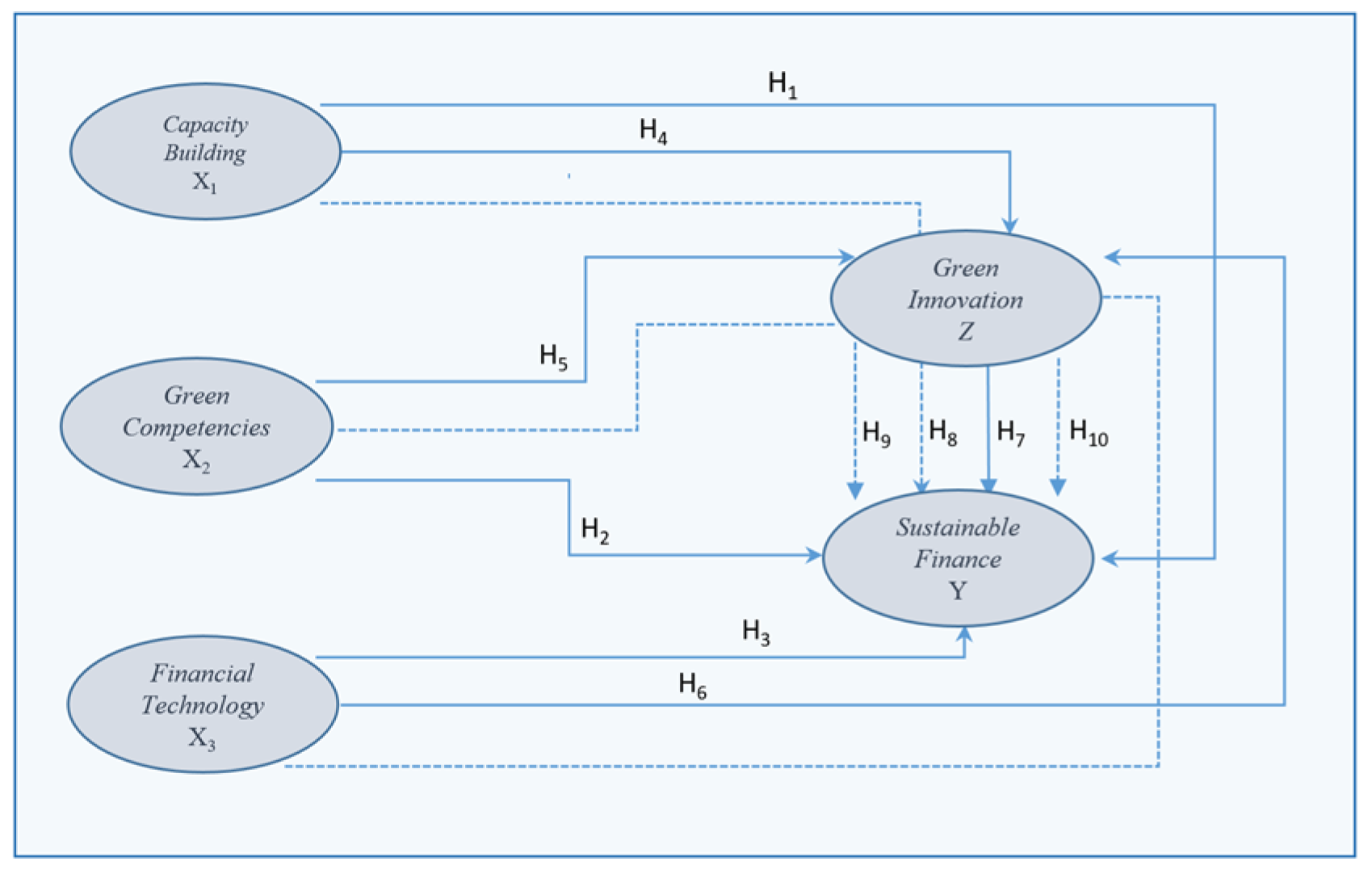
Based on the theoretical arguments and empirical evidence discussed above, this study proposes an integrated conceptual framework that examines capacity building, green competencies, and financial technology as key organizational drivers of sustainable finance, while assessing the mediating role of green innovation.
Capacity building is expected to enhance both green innovation and sustainable finance by strengthening organizational readiness and learning capabilities. Green competencies are hypothesized to foster environmentally oriented innovation and support sustainability-related decision-making. Financial technology is posited to enhance sustainable finance directly by improving transparency, efficiency, and risk assessment and potentially by enabling green innovation.
Accordingly, the following hypotheses are proposed:
H1. Capacity building has a positive and significant effect on sustainable finance.
H2. Green competencies have a positive and significant effect on sustainable finance.
H3. Financial technology has a positive and significant effect on sustainable finance.
H4. Capacity building has a positive and significant effect on green innovation.
H5. Green competencies have a positive and significant effect on green innovation.
H6. Financial technology has a positive and significant effect on green innovation.
H7. Green innovation has a positive and significant effect on sustainable finance.
H8. Green innovation mediates the relationship between capacity building and sustainable finance.
H9. Green innovation mediates the relationship between green competencies and sustainable finance.
H10. Green innovation mediates the relationship between financial technology and sustainable finance.
Figure 1 illustrates the conceptual framework of this study, depicting the direct relationships between organizational drivers and sustainable finance, as well as the indirect pathways mediated by green innovation.
1.5. Research Novelty and Contribution
This study offers three key contributions to the sustainable finance and sustainable governance literature. First, it advances an integrated organizational perspective by simultaneously examining capacity building, green competencies, and financial technology as parallel drivers of sustainable finance. Second, it critically reassesses the role of green innovation as a mediating mechanism within a highly regulated banking context, addressing an unresolved theoretical ambiguity in prior research. Third, by focusing on small-capital banks in an emerging market setting, this study provides novel empirical evidence from an underexplored institutional context, thereby extending the applicability of sustainability and innovation theories to resource-constrained financial institutions.
3. Results
3.1. Respondent Profile
A total of 102 valid responses were obtained from permanent employees of conventional commercial banks classified as KBMI 1 and listed on the Indonesia Stock Exchange. The sample was distributed proportionally across 21 banks using proportionate stratified sampling, ensuring that each bank was represented according to its relative number of employees. The number of respondents per bank ranged from 2 to 10, reflecting the variation in organizational size.
Respondents represented various functional areas, including operations, credit, risk management, compliance, and other supporting units related to sustainability and digital banking. In addition, respondents came from different job levels, including both managerial and non-managerial (staff) positions, allowing the study to capture perspectives across organizational hierarchies.
This distribution indicates that respondents possessed adequate knowledge and involvement in organizational processes related to sustainable finance implementation. Furthermore, the inclusion of diverse job roles and proportional representation across banks helps enhance the representativeness of the sample and reduces potential bias associated with single-level or single-institution perspectives.
3.2. Research Methods
This study applies several general scientific research methods to support the analytical framework and interpretation of findings. The method of analysis is used to examine the relationships among variables, particularly in identifying how capacity building, green competencies, and financial technology influence sustainable finance. The method of synthesis is employed to integrate theoretical perspectives, including the Natural Resource-Based View (NRBV) and the sustainability capability framework, in developing the conceptual model.
Deductive reasoning is used in the formulation of hypotheses, where theoretical foundations are translated into testable relationships among constructs. In contrast, inductive reasoning is applied in interpreting empirical findings, particularly in explaining unexpected results such as the absence of mediation effects. The method of comparison is used to evaluate the consistency between theoretical expectations and empirical results, as well as to relate the findings to prior studies. These methods complement the quantitative approach based on Partial Least Squares Structural Equation Modeling (PLS-SEM), ensuring both theoretical rigor and empirical validity.
3.3. Measurement Model Assessment
The measurement model was evaluated to assess convergent validity, reliability, and discriminant validity prior to testing the structural relationships. Convergent validity was examined using the Average Variance Extracted (AVE), while internal consistency reliability was assessed using Cronbach’s alpha and composite reliability.
As shown in
Table 1, green innovation achieves an AVE value above the recommended threshold of 0.50, indicating satisfactory convergent validity. In contrast, capacity building (0.443), financial technology (0.397), green competencies (0.477), and sustainable finance (0.426) exhibit AVE values slightly below the recommended threshold. Although these values fall marginally below 0.50, convergent validity can still be considered acceptable in the context of PLS-SEM under certain conditions.
According to [
47], AVE values below 0.50 may be tolerated when composite reliability exceeds the recommended threshold of 0.70, indicating that the construct explains a sufficient proportion of variance in its indicators. In this study, all constructs demonstrate composite reliability values above 0.70, confirming satisfactory internal consistency and supporting the adequacy of the measurement model.
Furthermore, the constructs examined in this study represent complex and multidimensional concepts, such as sustainable finance, green competencies, and financial technology, which may inherently exhibit lower shared variance among indicators. In exploratory research contexts, particularly in emerging areas such as sustainable finance in small-capital banks, slightly lower AVE values are considered acceptable when supported by strong reliability and theoretical grounding.
Furthermore, all constructs demonstrate satisfactory internal consistency reliability, with Cronbach’s alpha values ranging from 0.774 to 0.939 and composite reliability values exceeding the recommended threshold of 0.70. These results indicate that the measurement model is reliable and acceptable for further structural analysis.
Discriminant validity was assessed using both the Fornell–Larcker criterion and the heterotrait–monotrait (HTMT) ratio. The Fornell–Larcker results in
Table 2 indicate that the square root of the AVE for each construct is greater than its correlations with other constructs, supporting discriminant validity.
Furthermore, the HTMT values reported in
Table 3 are all below the conservative threshold of 0.90, confirming that discriminant validity is satisfactorily established.
3.4. Structural Model Assessment
The structural model was evaluated to assess its explanatory power, predictive relevance, and overall adequacy in explaining the relationships among constructs.
First, the explanatory power of the model was examined using the coefficient of determination (R
2). As presented in
Table 4, the model explains 41.7% of the variance in green innovation and 40.4% of the variance in sustainable finance. These values indicate moderate explanatory power, suggesting that the proposed model is capable of explaining a substantial proportion of variance in the endogenous constructs.
In addition to explanatory power, predictive relevance was assessed using the Stone–Geisser’s Q2 value obtained through the blindfolding procedure. The results show that green innovation (Q2 = 0.263) and sustainable finance (Q2 = 0.157) both have Q2 values greater than zero, indicating that the model has predictive relevance. Based on commonly accepted thresholds, these values suggest moderate predictive capability, confirming that the model performs adequately in predicting endogenous constructs.
Furthermore, model fit was evaluated using the Standardized Root Mean Square Residual (SRMR), which measures the discrepancy between observed and model-implied correlations. The SRMR value obtained in this study is 0.091, which is within the recommended threshold. In PLS-SEM, model fit indices such as SRMR are considered supplementary and primarily support the evaluation of predictive capability (
Table 5).
Overall, the structural model demonstrates acceptable explanatory and predictive performance, as evidenced by moderate R2 values and positive Q2 values. These findings indicate that the model is suitable for examining the proposed relationships and provides a reliable basis for hypothesis testing in the context of sustainable finance in small-capital banks.
3.5. Hypotheses Testing Results
Hypothesis testing was conducted using a bootstrapping procedure. The results of the direct and indirect effects are presented in
Table 6.
Hypothesis testing was conducted using a bootstrapping procedure to assess the significance of the structural relationships.
Table 5 reports the path coefficients, t-values,
p-values, effect sizes (f
2), and bootstrap confidence intervals, providing a comprehensive evaluation of the structural model.
The results indicate that capacity building (β = 0.262, p < 0.05, CI [0.012, 0.487]) and green competencies (β = 0.429, p < 0.001, CI [0.215, 0.634]) have significant positive effects on green innovation, supporting H4 and H5. In contrast, financial technology does not significantly influence green innovation (β = 0.059, p > 0.05, CI [−0.118, 0.214]), leading to the rejection of H6. The effect size analysis further shows that green competencies exert a moderate effect (f2 = 0.213), while capacity building has a small effect (f2 = 0.070), and financial technology has a negligible contribution (f2 = 0.004).
With respect to sustainable finance, capacity building (β = 0.250, p < 0.05, CI [0.010, 0.468]) and financial technology (β = 0.320, p < 0.05, CI [0.005, 0.612]) demonstrate significant positive effects, supporting H1 and H3. Meanwhile, green competencies (β = 0.122, p > 0.05, CI [−0.095, 0.321]) and green innovation (β = 0.099, p > 0.05, CI [−0.201, 0.352]) do not show significant relationships, resulting in the rejection of H2 and H7. The effect size results indicate that financial technology has a relatively stronger contribution to sustainable finance (f2 = 0.121), while capacity building has a small effect (f2 = 0.058), and green competencies have a negligible effect (f2 = 0.014).
Furthermore, the indirect effect analysis reveals that green innovation does not mediate the relationships between capacity building, green competencies, financial technology, and sustainable finance, as all indirect paths are statistically insignificant. This finding is supported by the bootstrap confidence intervals, which include zero for all indirect effects, confirming the absence of mediation. Therefore, H8, H9, and H10 are not supported.
The predictive relevance of the model was assessed using Q2 values obtained through the blindfolding procedure. The results indicate that green innovation (Q2 = 0.263) and sustainable finance (Q2 = 0.157) both demonstrate predictive relevance, as their values exceed zero. According to established thresholds, these values indicate moderate predictive capability, suggesting that the model has adequate out-of-sample predictive power.
Overall, the structural model demonstrates acceptable explanatory and predictive performance, as evidenced by moderate R2 values, meaningful effect sizes for key relationships, and positive Q2 values. These findings suggest that while not all hypothesized relationships are supported, the model provides a robust explanation of sustainable finance dynamics, particularly highlighting the roles of capacity building and financial technology as primary drivers, while innovation plays a more limited and non-mediating role in this context. These results provide support for the capability-based perspective, indicating that organizational and technological capabilities exert more direct effects on sustainable finance outcomes than innovation-driven mechanisms in highly regulated banking environments.
3.6. Summary of Results
These results highlight the importance of human capital development and organizational readiness in driving sustainable finance within resource-constrained banking contexts. The findings indicate that sustainable finance in small-capital banks is primarily driven by organizational and technological capabilities rather than innovation-based mechanisms. Financial technology emerges as the most influential driver of sustainable finance, followed by capacity building, highlighting the importance of digital infrastructure and organizational readiness in supporting sustainability-oriented financial practices.
While green competencies significantly enhance green innovation, their effects do not translate directly into sustainable finance outcomes. Similarly, financial technology contributes directly to sustainable finance but does not significantly foster green innovation. These results suggest that innovation does not function as a transmission mechanism in this context, but rather operates as a parallel outcome of capability development.
The results support the capability based perspective by demonstrating that organizational and technological capabilities exert more direct effects on sustainable finance than innovation driven processes, particularly in resource-constrained and highly regulated banking environments.
4. Discussion
This study examines the roles of green human capital and digital capabilities in shaping the implementation of sustainable finance within small-capital banks operating under regulatory pressure and resource constraints. By empirically testing the relationships among capacity building, green competencies, financial technology, green innovation, and sustainable finance, the findings provide a clearer understanding of how internal organizational capabilities drive sustainability practices in highly regulated banking environments. The discussion is organized into five subsections: determinants of green innovation, drivers of sustainable finance, the absence of mediation effects, theoretical implications, and practical implications.
The results of hypothesis testing indicate that several proposed relationships are supported, while others are not. Capacity building demonstrates a significant positive effect on both green innovation and sustainable finance, while green competencies significantly influence green innovation but not sustainable finance. Financial technology shows a significant effect on sustainable finance but does not significantly affect green innovation.
Furthermore, green innovation does not significantly influence sustainable finance, and none of the indirect effects are supported, indicating the absence of mediation effects. These findings suggest that sustainable finance in small-capital banks is primarily driven by organizational capacity and digital infrastructure rather than innovation mechanisms.
4.1. Determinants of Green Innovation
The findings indicate that capacity building and green competencies significantly enhance green innovation, whereas financial technology does not exhibit a significant effect. These results highlight the primacy of human and organizational capabilities over technological adoption in fostering sustainability-oriented innovation within small-capital banks. This is consistent with the Technology Organization Environment (TOE) framework, which emphasizes that technological readiness alone is insufficient without adequate organizational capability and human readiness [
56,
57].
In regulated industries such as banking, innovation processes are strongly shaped by institutional pressures, regulatory compliance, and governance requirements, which limit the extent to which technology alone can drive innovation [
32,
33,
58]. As a result, green innovation is more likely to emerge from internal capability development, particularly through human capital and organizational learning. Prior research suggests that sustainability-oriented innovation requires organizational commitment and employee engagement to translate environmental objectives into operational practices [
38,
59]. Evidence from resource-constrained and service-based organizations further indicates that internal capabilities and human capital development play a more decisive role in driving green innovation than technological inputs alone [
60,
61].
The significant effect of capacity building underscores the importance of structured investments in employee development. Capacity building initiatives strengthen internal learning mechanisms, enhance absorptive capacity, and improve problem-solving capabilities, enabling organizations to operationalize sustainability objectives despite structural and technological constraints [
62,
63,
64].
Similarly, the strong effect of green competencies confirms that employees’ environmental knowledge, skills, and values serve as critical micro foundations of green innovation. Empirical studies show that green human resource practices and green competencies enhance innovation performance by enabling organizations to integrate environmental knowledge into innovation processes, particularly through knowledge sharing and organizational learning [
26,
39,
65].
In contrast, the non-significant effect of financial technology suggests that digitalization alone does not automatically foster green innovation. While fintech adoption improves operational efficiency and data processing, it does not stimulate sustainability-oriented innovation unless environmental objectives are embedded within digital strategies and organizational routines [
20,
28]. Recent studies highlight that human capital and organizational capabilities remain more influential than technological adoption in promoting green innovation in constrained environments [
66,
67]. This finding reinforces the TOE perspective, emphasizing the need for alignment between technological tools and organizational capabilities. From a sustainability perspective, green innovation in small-capital banks is more likely to occur through incremental organizational change rather than technology-driven transformation.
4.2. Drivers of Sustainable Finance
The results indicate that capacity building (CB) and financial technology (FT) have significant positive effects on sustainable finance (SF), while green competencies (GC) and green innovation (GI) do not exhibit significant influences. These findings suggest that the implementation of sustainable finance in small-capital banks is primarily driven by organizational readiness and digital infrastructure, rather than by innovation outputs or environmentally oriented competencies.
In the banking sector, sustainable finance adoption is often shaped by regulatory frameworks and supervisory expectations, which emphasize standardized reporting, ESG integration, and compliance driven governance mechanisms [
68,
69]. Within this context, financial technology plays a critical role in supporting compliance-related activities, including ESG data management, environmental and social risk assessment, and sustainability reporting [
70]. Digital systems enhance transparency, traceability, and operational efficiency, thereby facilitating the operationalization of sustainable finance practices within banking institutions. Thus, the positive effect of financial technology reflects its role as an enabling infrastructure for regulatory compliance and governance, rather than as a direct driver of sustainability-oriented innovation.
Furthermore, the significant influence of capacity building highlights the importance of institutional capability in embedding ESG principles into financial decision-making processes. Capacity building initiatives improve employees’ understanding of sustainability regulations and internal governance requirements, enabling banks to translate regulatory expectations into concrete lending and investment practices [
71]. From a strategic perspective, sustainable finance represents a long-term value creation approach that integrates financial performance with social and environmental objectives [
4]. Financial institutions with stronger human capital and internal governance structures are therefore better positioned to internalize sustainability considerations in credit assessment and portfolio management [
72].
An important conceptual consideration relates to how capacity building is interpreted within this study. While capacity building may reflect aspects of organizational maturity, it is conceptualized here as a distinct and dynamic organizational resource rather than merely a proxy for overall maturity. Capacity building encompasses deliberate and structured efforts to enhance individual and organizational capabilities, including skills development, system strengthening, and performance measurement.
In contrast, organizational maturity represents a broader and relatively stable condition reflecting the overall level of institutional development. Although capacity building may contribute to maturity over time, it is positioned in this study as an actionable capability that can be actively developed and mobilized to support sustainable finance implementation. This distinction is important in explaining why capacity building demonstrates a direct and significant effect on sustainable finance outcomes in small-capital banks.
In contrast, the non-significant effect of green innovation suggests a disconnect between innovation activities and core financial decision-making in small-capital banks. In highly regulated sectors such as banking, innovation outcomes do not necessarily translate into sustainability performance, as compliance requirements and risk management considerations often dominate strategic priorities [
58].
Additionally, the results indicate that green competencies do not significantly influence sustainable finance, suggesting that individual-level environmental knowledge and skills may not yet be sufficiently translated into organizational financial practices. Moreover, the insignificant effect of green innovation on sustainable finance (H7), along with the absence of significant mediating effects (H8–H10), further indicates that innovation does not serve as a mechanism linking internal capabilities to sustainable finance implementation. This implies that, in small-capital banks, sustainability practices are more compliance-driven rather than innovation-driven.
4.3. The Absence of Mediation Effects
The mediation analysis reveals that green innovation does not mediate the relationships between capacity building, green competencies, financial technology, and sustainable finance. This finding challenges the assumption that green innovation serves as a universal transmission mechanism linking internal capabilities to sustainability outcomes.
A more context-specific explanation can be considered in the setting of small-capital banks (KBMI 1), where sustainable finance practices may not yet be driven by innovation-oriented transformation. Instead, these banks tend to rely more on institutional capacity development, internal readiness, and compliance with regulatory requirements [
72].
In highly regulated banking environments, standardized sustainability frameworks, disclosure requirements, and reporting guidelines enable banks to implement sustainable finance practices without necessarily relying on innovation outputs as intermediary mechanisms [
4]. As a result, capacity building and financial technology can exert direct effects on sustainable finance by strengthening regulatory compliance, governance alignment, and risk management processes, thereby reducing the role of green innovation as a mediating pathway.
Furthermore, this result may also reflect the nature of green innovation in small-capital banks, which is often still limited in scope and tends to be incremental or symbolic. In many cases, green innovation initiatives are concentrated on activities such as green publicity, sustainability reporting, or limited environmental programs, rather than being fully embedded in core banking functions such as credit evaluation, ESG based risk assessment, or sustainable financial product development. Consequently, green innovation may not yet operate as a strategic mechanism that effectively translates organizational capabilities into sustainable finance outcomes.
These findings can also be interpreted in light of the notion of symbolic compliance, as highlighted in the Introduction. In the context of small-capital banks, sustainable finance practices may be implemented primarily to meet regulatory expectations and signaling requirements rather than to drive substantive organizational transformation. As a result, initiatives labeled as “green innovation” may function more as symbolic actions such as sustainability reporting, green branding, or compliance driven programs without being deeply embedded in core banking activities. This helps explain why green innovation does not act as an effective mediating mechanism, as it may not yet reflect substantive changes in operational processes or decision-making systems related to sustainable finance.
Moreover, the absence of mediation effects may indicate that these banks are still at an early stage of sustainability transformation. Innovation diffusion theory suggests that innovations require time, organizational support, and conducive institutional conditions to generate systemic impact, particularly during the early stages of adoption [
73]. In resource-constrained banks, green innovation may not yet be sufficiently mature or integrated into financial decision-making processes to influence sustainable finance outcomes.
Overall, these findings highlight that sustainability pathways in banking institutions are context dependent and shaped by regulatory environments, organizational readiness, and resource constraints. This is consistent with prior studies showing that the adoption and implementation of green finance practices vary across institutional settings and are often driven more by regulatory pressures and internal capabilities than by innovation-led transformation [
74].
4.4. Theoretical Implications
This study contributes to the sustainable finance and green human capital literature by demonstrating differentiated pathways through which organizational, human, and technological capabilities influence sustainability outcomes in small-capital banks. Grounded in the Natural Resource Based View (NRBV), the findings extend prior research by showing that sustainability outcomes are not driven by isolated resources, but by the alignment of internal capabilities. In particular, capacity building emerges as a higher order organizational capability that directly influences both green innovation and sustainable finance, while green competencies primarily strengthen innovation capability at the micro level.
These findings challenge the implicit assumption of linear capability–innovation–performance relationships commonly suggested in the sustainability and innovation literature. Instead, the results highlight that the effectiveness of internal capabilities is contingent upon organizational context, particularly in highly regulated and resource-constrained banking environments. This extends the NRBV by demonstrating that capability deployment may follow non-linear and context-dependent pathways rather than uniform mechanisms across sectors.
The findings also refine the application of the Technology Organization Environment (TOE) framework by confirming that technological adoption alone is insufficient to drive sustainability-oriented innovation or financial outcomes. Rather, organizational readiness and human capability play a more decisive role in shaping sustainability performance.
Furthermore, the absence of mediation effects contributes to innovation diffusion theory by suggesting that innovation does not always function as an immediate transmission mechanism between internal capabilities and performance outcomes. In highly regulated sectors such as banking, sustainability practices may be implemented through direct capability-based and compliance driven mechanisms, rather than through innovation-led transformation. This finding provides a more nuanced understanding of sustainability pathways, particularly in contexts characterized by institutional constraints and limited resources.
While the findings provide important theoretical insights, it is necessary to interpret them in light of the model’s moderate explanatory power. The R2 values for green innovation and sustainable finance indicate that a considerable proportion of variance remains unexplained, suggesting that additional factors beyond the current model may also influence sustainability outcomes.
Therefore, the theoretical implications of this study should be understood as context-specific rather than universally generalizable. The results primarily reflect the dynamics of small-capital banks operating under regulatory pressure and resource constraints, where sustainability practices are shaped by institutional and compliance-driven mechanisms.
4.5. Practical Implications
From a managerial perspective, the findings suggest that small-capital banks should prioritize capacity building initiatives as a foundational strategy for sustainable finance implementation. Given that capacity building directly influences both green innovation and sustainable finance, investments in employee training, organizational learning, and ESG-related competencies can enhance institutional readiness and enable banks to operationalize sustainability practices effectively, even in the absence of advanced innovation capabilities.
The significant role of financial technology further indicates that investments in digital infrastructure are critical for supporting sustainable finance. Fintech systems enhance data quality, transparency, and ESG reporting, thereby facilitating compliance with regulatory requirements and improving decision-making processes. However, the results also suggest that fintech alone is insufficient to foster green innovation. Without alignment with human capital development and organizational strategies, digital transformation may remain operational rather than innovation driven.
From a policy and regulatory perspective, the findings highlight the need for differentiated sustainability strategies across banking segments. Regulators and policymakers should consider providing targeted capacity building programs, technical assistance, and digital infrastructure support tailored to small-capital banks. Such interventions can reduce implementation gaps, enhance compliance capabilities, and promote more inclusive participation in sustainable finance initiatives.
Importantly, the findings suggest that sustainable finance in small-capital banks is more effectively achieved through capability development and governance alignment rather than innovation-led transformation. This provides practical guidance for both managers and policymakers in prioritizing resource allocation and designing sustainability strategies within constrained and highly regulated banking environments.
4.6. Research Limitations
This study has several limitations that should be acknowledged. First, the model demonstrates moderate explanatory power, indicating that a substantial proportion of variance in green innovation and sustainable finance remains unexplained. This suggests that additional factors, such as regulatory intensity, market competition, or institutional pressures, may also play an important role in shaping sustainability outcomes and should be considered in future research.
Second, this study focuses exclusively on small-capital banks (KBMI 1), which operate under specific resource constraints and regulatory conditions. As a result, the findings may not be fully generalizable to larger banking institutions or financial systems with different structural characteristics. Future studies may extend the analysis to other banking segments to enable broader comparative insights.
Third, the use of cross sectional survey data limits the ability to capture the dynamic and evolving nature of sustainability transformation. The relationships among organizational capabilities, innovation, and sustainable finance may change over time as institutions adapt to regulatory developments and market pressures. Longitudinal research is therefore recommended to better understand these temporal dynamics.
Fourth, the findings indicate the absence of mediation effects, which may reflect the early-stage development and limited integration of green innovation in small-capital banks. However, this interpretation is based on quantitative measures and may not fully capture the depth and quality of innovation practices. Future research could incorporate qualitative approaches or mixed methods to provide a more comprehensive understanding of how green innovation is implemented in practice.
Despite these limitations, this study provides valuable insights into the role of organizational, human, and technological capabilities in shaping sustainable finance, particularly within resource-constrained and highly regulated banking environments.
5. Conclusions
This study examined how internal organizational capacity building, green competencies, and financial technology shape sustainable finance practices in small-capital banks, with green innovation assessed as a potential mediating mechanism. Using evidence from small-capital banks in an emerging market context, the findings clarify how sustainability-oriented finance can be operationalized under regulatory pressure and resource constraints.
The results demonstrate that capacity building is the most consistent driver of both green innovation and sustainable finance, underscoring the importance of organizational learning, training systems, and institutional support in strengthening banks readiness to implement sustainability principles. Green competencies significantly enhance green innovation but do not directly influence sustainable finance, suggesting that individual sustainability skills primarily contribute to innovation outcomes rather than core financial decision-making. Financial technology, in contrast, directly supports sustainable finance implementation by facilitating ESG integration, data management, and environmental and social risk assessment, while its role in fostering green innovation remains limited. Importantly, green innovation neither directly affects sustainable finance nor mediates the relationships between internal organizational drivers and sustainable finance, indicating that sustainability outcomes in small-capital banks are driven more by capability development and governance-oriented digital enablement than by innovation-led mechanisms.
From a sustainability perspective, this study advances the sustainable finance literature by shifting the focus from technology or regulation centric explanations toward an organizational capability perspective. The findings highlight that sustainability transitions in the banking sector are context-dependent and that, in resource-constrained institutions, sustainable finance can be achieved through capacity development and institutional alignment even in the absence of strong innovation effects.
Practically, the results suggest that policymakers and banking practitioners should prioritize capacity building programs and targeted digital investments as core sustainability strategies to accelerate inclusive sustainable finance adoption among small-capital banks. Such approaches can strengthen the role of banks as sustainability enablers, supporting long-term economic resilience, environmental stewardship, and social responsibility in emerging markets.
Future research could employ longitudinal or comparative designs to capture the dynamic evolution of green capabilities and sustainable finance across different institutional contexts. Additionally, exploring the moderating roles of leadership commitment, organizational culture, or regulatory intensity may further enrich understanding of sustainability transformation in the banking sector.