Flipped Classroom Design as a Driver of Digital Transformation and Sustainable Education in Higher Education: A Systematic Review of Reviews



Abstract
1. Introduction
2. Conceptual and Theoretical Base
3. Methodology
- Identifying the initial research questions.
- Identifying relevant studies.
- Study selection.
- Charting the data.
- Collating, summarizing and reporting the results.
3.1. Identifying the Initial Research Questions
3.2. Identifying Relevant Studies
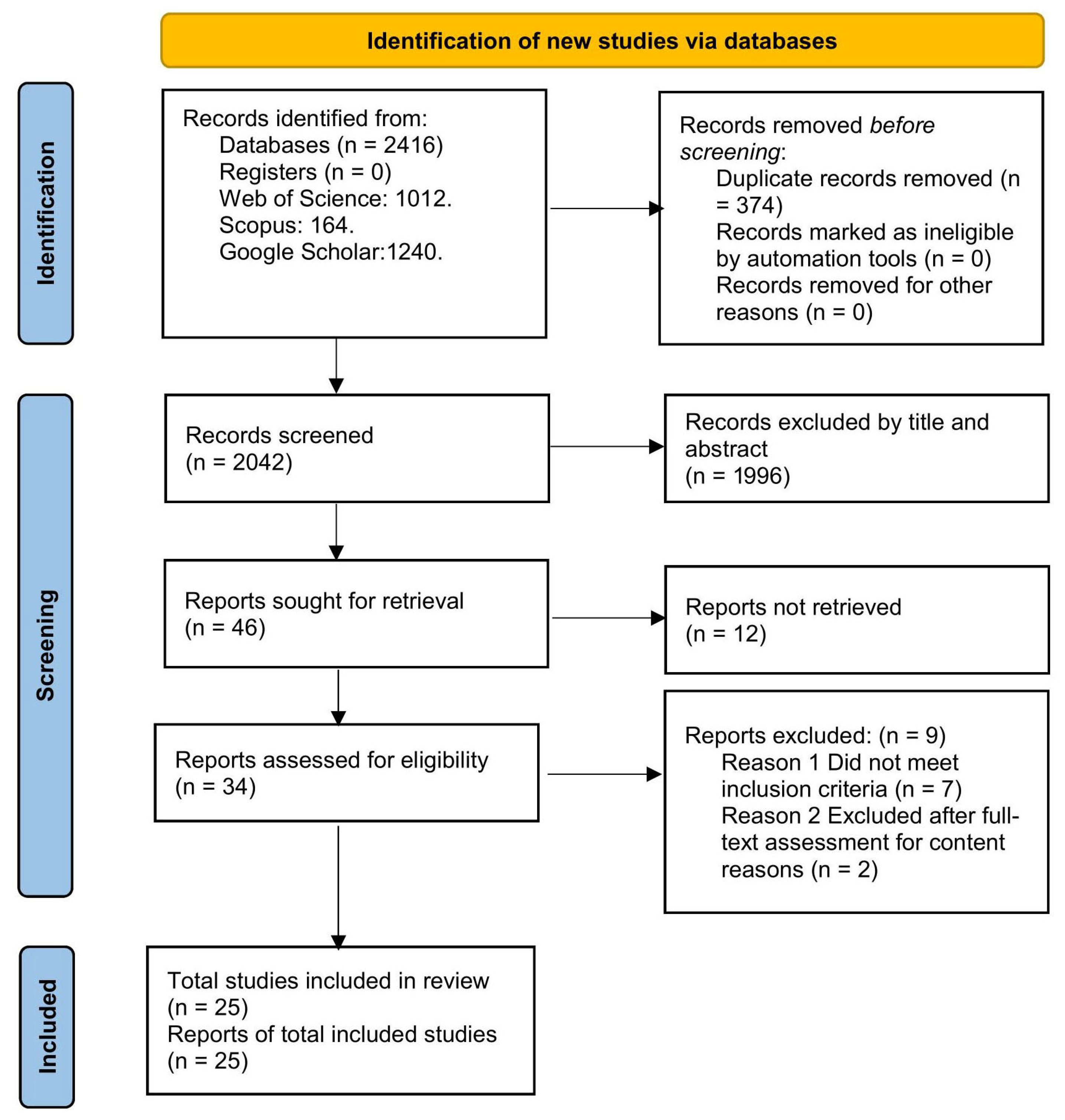
3.3. Study Selection
3.4. Data Charting, Collation and Documentation
4. Results
4.1. RQ 1. What Are the Descriptive Characteristics of the FC Review Studies (Year of Publication, Disciplines, and from What Country/Region)?
4.1.1. Year of Publication
4.1.2. Disciplinary Focus of the FC Review Studies
4.1.3. The First Author’s Affiliation Region and Country of the Review Studies
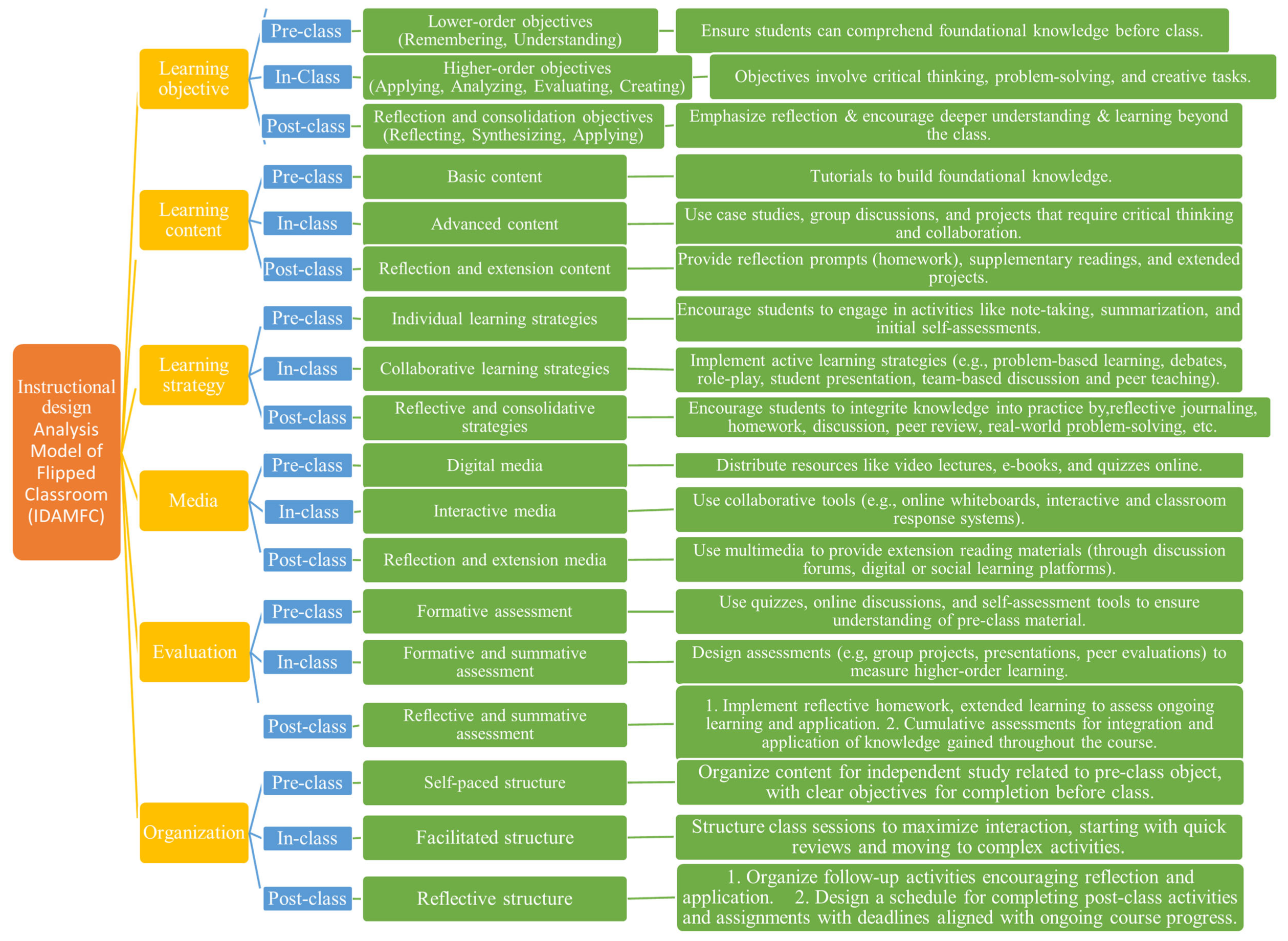
4.2. RQ 2. What Are the Instructional Design Characteristics Being Studied in Available FC Review Studies?
4.3. RQ 3. What Theoretical Framework(s) Are Being Discussed in FC Review Studies to Describe, Explain and Predict the Expected Impact of Flipped Classrooms?
- Active Learning Facilitation: In-class time leverages active learning methods through discussions, feedback, and collaborative work.
- Self-Regulated Learning (SRL): Pre-class preparation enhances autonomy, metacognition skills and responsibility for pacing.
- Student-Centered Learning: FC promotes flexibility and individualized learning pathways via differentiated media and strategy integration.
- Reflective Consolidation: Post-class activities reinforce concept learning and understanding through metacognitive reflection and structured feedback (e.g., journaling, feedback, and extension tasks).
- Technology Readiness: The availability and quality of digital resources affect FC implementation success.
- Instructor Preparation: Effective FC requires substantial upfront planning with digital tools familiarity, assessments and in-class facilitation.
- Student Motivation and Preparation: Learner motivation and pre-class preparation critically impact outcomes. Sustained engagement hinges on learners’ readiness to reflect, plan, and act.
- Cognitive: Enhanced academic performance, critical thinking, and problem-solving.
- Affective: Higher levels of motivation, engagement and satisfaction.
- Behavioral: Improved participation, attendance, and self-discipline.
- Professional skills: Strengthened collaboration, communication, and independent learning.
4.4. RQ 4. How Do the FC Research Designs Evolve over Time as Reflected in the FC Review Studies (Research Objectives and Questions, Samples, Procedure, Methodology and Instruments)?
4.5. RQ 5. What Are the Key Outcomes Being Studied in the FC Review Studies?
4.6. RQ 6. What Is the Average Effect Size of FC Interventions, Building on Available Statistical Information Reported in FC Review Studies?
4.7. RQ 7. What Are the Challenges Reported in FC Review Studies?
5. Discussion
6. Limitations
7. Conclusions
Supplementary Materials
Author Contributions
Funding
Institutional Review Board Statement
Informed Consent Statement
Data Availability Statement
Acknowledgments
Conflicts of Interest
Abbreviations
| BL | Blended learning |
| FC | Flipped classroom |
| ID | instructional design |
| ADDIE model | analysis, design, development, implementation, evaluation |
| FCDA model | Flipped Classroom Design Approach |
| SRL | Self-Regulated Learning |
| IDAMFC | Instructional Design Analysis Model for Flipped Classrooms |
| TAT-FC | Transformative Activation Theory for Flipped Classrooms |
Appendix A

| Author/Year/ Country | Journal | Fields/Number of Review Samples | Participants/Range | Research Questions | Research Objectives | Methodology–Data Analysis | Method | Answers of the Questions | Future Research |
|---|---|---|---|---|---|---|---|---|---|
| 1. Bishop & Verleger/2013/USA [51] | ASEE Annual Conference and Exposition | Multidiscipline/ 24 (2000–2012)/ 2000: 2; 2002: 1; 2005: 1; 2006: 2; 2007: 1; 2008: 3; 2009: 4; 2010: 5; 2012: 5. | Higher education (Grade level: undergraduate)/7–1074 | 1. What are the types of in-class and out-of-class activities? 2. What are the measures used to evaluate the study, and methodological characteristics for each study? | Provide a comprehensive survey of prior and ongoing research of the FC. | Qualitative–Descriptive | Survey | 1. In-class: SGA, Q, HW, L, Out-of-class: HW, Q, VL, CM, RA. Post-Test; Matched Pretest–Posttest; Unmatched Pre- and Post-Measures; Mid- and Post-Semester Measures. 2. Subjective Opinion Survey or Informal Assessment; Objective Performance Test. | 1. To employ controlled studies objectively examine student performance throughout a semester. 2. To employ FC to leverage the existing research and theoretical frameworks to guide their use and design of in-class activities. 3. To clearly describe the activities used for both in- and out-class activities. |
| 2. O’Flaherty & Phillips/2015/ Australia [41] | The Internet and higher education | Multidiscipline/ 28 (1994–2014)/ 2000: 1; 2007: 1 2012: 2: 2013: 12; 2014: 12. | Higher education (Undergraduate)/ 20–150 | 1. What technologies are being used to engage students? 2. What considerations are pertaining to the economic and time constraints for implementing a FC? 3. What is the pedagogical acceptance by staff and students? 4. What are the educational outcomes? 5. What is the conceptual framework used to design a FC? | Provide overview regarding the emergence of FC and the links to pedagogy and educational outcomes, identifying any gaps in the literature which could inform future design and evaluation. | Qualitative–Descriptive | Scoping review-Arksey and O’Malley’s (2005) [46] | 1. Podcasts/vodcasts, screencasts, annotated notes and captured videos, prereading, automated tutoring systems and study guides interactive videos from an online repository, Smartphone apps, tablets, think pair-and-share activities, clicker. 2. Lead in time for faculty was intense. FC requires funding to cover the cost of pre-class resources and ongoing IT support. 3. The lecture method. 4. Increases student satisfaction, academic performance, attendance, communication skills, preferences for working, teacher encouragement, and student’s empowerment. 5. Under-utilization of conceptual frameworks. | 1. To consider the relationship of other indicators of student engagement in FC (not just examination scores). 2. Need stronger evidence in evaluation of student learning outcomes that particularly improved student learning and development. 3. To stimulate higher-order thinking through the use of creative technologies and applied learning. 4. Need a guideline of current approaches to assessment and feedback, e.g., writing quality learning checkpoints (in pre- and/or F2F sessions). |
| 3. Presti/2016/USA [30] | Journal of Nursing Education | Nursing education/13 (2010–2015)/ 2010: 1; 2013: 2; 2014: 4; 2015: 5; 2016: 1. | Higher education (Undergraduate, graduate and postgraduate)/46–589 | What is known about the use of the FC approach in undergraduate, graduate, and postgraduate nursing education? | To examine the application of the pedagogical methodology—the FC in nursing education. | Qualitative– Syntheses–descriptive | Literature review | 1. Positive: FC approach can yield positive outcomes on students’ satisfaction... 2. Negative: Lack of quantifiable, significant changes in nursing students’ knowledge, skills, and attitudes. | 1. Further development of the theoretical underpinnings of the FC approach in nursing education is merited. 2. The examination of the methods used successfully by other disciplines should be considered. |
| 4. Betihavas et al./2016/Australia [49] | Nurse Education Today | Nursing education/5 (2013–2015)/ 2013: 2; 2015: 3. | Higher education (Undergraduate and graduate)/20–589 | How has the FC been applied in nursing education and outcomes associated with this style of teaching? | To examine how the FC has been applied in nursing education and outcomes associated with this style of teaching. | Qualitative Systematic review | Systematic review | 1. FC yields neutral or positive academic outcomes and mixed results for satisfaction. 2. The lack of evidence about FC in nursing vs other health disciplines. 3. Offers transformative potential to reform nursing education. 4. Provides flexibility to increase opportunities for students to develop and apply critical thinking skills, pre-requisite for contemporary nursing practice. 5. Variations result between student satisfaction and academic performance. | 1. To examine the implementation process, value of pre- and within-class active learning strategies and the outcomes of the FC using alternative measures. 2. To study the variations in the relationship between student satisfaction and academic performance with the FC model. |
| 5. Zainuddin & Halili/2016/Indonesia [52] | International Review of Research in Open and Distributed Learning | Multidiscipline/20 (2013–2015)/ 2013: 7; 2014: 9; 2015: 4. | Higher education (Undergraduate) | 1. What methodologies have been frequently employed in FC research? 2. What areas of FC studies have been researched? 3. What technology tools or online platforms have been used for implementing the FC? 4. What are the most commonly used key words in FC research? 5. What are the most frequently work cited references in FC research? 6. What are the impacts of applying the FC on students’ learning? 7. What are the challenges? | To analyze the trends and contents of FC research. | Qualitative—Content analysis (using descriptive analysis, percentages, and frequencies) | Content analysis-Descriptive analysis | 1. The mixed-method approach. 2. In various areas. 3. Diverse technology tools or online platforms, e.g., Wikis and Blogs; screencasts; the LaTeX beamer package, YouTube. 4. 7 key words, active learning, blended learning, flipped learning, technology integration, pedagogical issues and e-learning. 5. Bergmann and Sams (2012) [3]; Lage, Platt and Treglia (2000) [1], both 8 times. 6. Positive impacts in students’ achievement, students’ motivation, engagement, and interaction. 7. No evidence proved flipped learning had improved students’ grades; more time would be spent on designing good content; poor quality of video. | 1. Need literature on the suitability of the FC for poor quality video lectures and untrained instructors. 2. To focus on both outside class activities and in-class activities. 3. May use a variety of research designs, e.g., experimental research, case study, ethnography, indeed design and developmental research (DDR) or design-based research (DBR). |
| 6. Ramnanan & Pound/2017/ Canada [33] | Advances in medical education and practice | Medical education/26 (2012–2016)/ 2012: 2; 2013: 2; 2014: 3; 2015: 7; 2016: 12. | Higher education (Undergraduate) | 1. What subject matter has been delivered using the FC approach? 2. Which tools and teaching methods have been used for pre-class and during-class phases in medical school? 3. How do medical students perceive (both strengths and caveats) the FC approach? 4. What is the impact of the FC on medical student learning? | 1. To identify trends on both pre-class and in-class phases of FC. 2. Focus on and define medical student perceptions (strengths and caveats) and the impact of FC on student learning. | Qualitative–Data synthesized | Scoping review-Arksey and O’Malley (2005) [46] | 1. Medical: Biochemistry, the anatomical sciences, medical anatomy, humanities, epidemiology, rheumatology, hematology, and point-of-care ultrasound. Clinical: medical education, geriatric medicine, disaster medicine, advanced cardiac life support, medicine as a business. 2. Pre-class: Online content videos, slide presentations, audio-based resources, e-learning tools, text-based resources. During class: small group activities, problem-based learning, team-based learning, student-driven workshops, discussion-based activities. 3. Strengthened student performance. But it did not improve lower cognitive skills. Caveats: Time-intensiveness; ability to access and ask questions and interact with classmates; pre-class learning tools need to be appropriately aligned; some subject matter was overly complex. 4. The incorporation of self-directed learning, active learning, and exercises that facilitate peer interaction; accountability; activities; attitudes. | 1. Need to determine the effectiveness of FC approaches for this level of medical learner. 2. To confirm whether long-term lifelong learning competencies are actually enhanced by FC innovations in medical school. |
| 7. Tan et al. /2017/ China [32] | Chinese Nursing Research | Nursing education/29 (2014–2016)/ 2015: 5; 2016: 24. | Higher education (Associated degree students and Undergraduate)/ 36–320 | 1. What effects of the FC have been reported in nursing education? 2. To what extent do the effects of FC relate to knowledge, skills and attitudes compared with traditional lectures in nursing education? 3. What is the rating of self-report questionnaires as to the effectiveness of the FC? | To identify the robust available evidence about the effectiveness of FC in nursing education. | Mixed— Descriptive statistical analyses | Systematic review- PRISMA standards of quality | 1. FC improved students’ academic performance in knowledge, in skills: self-learning, study enthusiasm, accelerated communication between faculty and students, satisfaction, interest, and critical thinking. 2. Knowledge: standardized mean difference of 1.13; Skill: standardized mean difference (SMD) of 1.68; Attitude: a relatively higher rating. 3. At least 90.4%. | 1. To strengthen the instructional framework of flipped classroom pedagogy and formulating unified evaluation criteria. 2. Need rigorous randomized controlled trial (RCT) designs for future studies to reduce the heterogeneity of the included articles. 3. Researchers perform a meta-regression analysis to explore the sources of heterogeneity in included studies. |
| 8. Chen et al. /2017/USA [50] | Medical education | Medical education/9 (2012–2016)/ 2013: 1; 2015: 2; 2016: 6. | Higher education (Undergraduate) | 1. What is the scope of the studies that have been published on FCs in medical education? 2. What is the research quality of the studies examined? 3. What are the effects of the FC, as reported by controlled studies? | 1. To examine the scope and quality of studies on the FC teaching approach and to assess the effects of FCs on medical learning. | Qualitative–Descriptive (Using Kirkpatrick’s Framework) | Systematic review–Kirkpatrick’s classification measures (survey, exams) | 1. Obstetrics and gynecology, general medicine, radiology and surgery, anesthesiology, anatomy, neuroanatomy and palliative medicine. 2. A gradual but steady increase in quality studies on FC in medical education. 3. The effects of the FC are inconsistent, with some purported benefits and some reports of negligible improvement over traditional teaching methods | 1. Need solid evidence on the effect on changes in knowledge and skills in learner’s motivation and engagement. 2. To exam long-term effects of FC on knowledge retention and transfer to professional practice and patient care. 3. To evaluate the higher levels of Kirkpatrick’s framework. 4. To focus on change in knowledge and potential differential effects of FC on knowledge requiring different levels of cognitive processes. |
| 9. Karabulut-Ilgu et al. /2018/USA [54] | British Journal of Educational Technology | Engineering Education/62 (2000–2015)/ 2003: 1; 2006: 1; 2008: 2; 2009: 2; 2010: 1; 2011: 1; 2012: 3; 2013: 12; 2014: 33; 2015: 6. | Higher education | 1. What are the trends in FC in engineering education research? 2. What kinds of theoretical frameworks and evaluation methods have been adopted in EER investigating flipped learning? 3. Is flipped learning effective in teaching engineering according to prior research? 4. What are benefits and challenges of flipped learning as reported in EER? | To describe the current state of knowledge and practice in the FC approach in engineering education and to provide guidance for practitioners by critically appraising and summarizing existing research. | Qualitative—A qualitative synthesis | Systematic review–Borrego, Foster, and Froyd (2014)’s systematic review steps [101] | 1. Conference proceedings are mainstream (66%). 2. Transactional theory, The Thayer system, Problem-based learning and collaborative learning, Cooperative education. Evaluation method: Most quantitative. 3. Flipped is more effective with 50% agreement. 4. Benefit: flexibility, improvement in interaction, professional skills and student engagement. Challenge: For Instructor: the heavy workload prior to and during class. For student: uninteresting online material, technical issues, insufficient knowledge of the new approach. | 1. To focus more on what specific aspects of active learning might be complemented in a FC and how that could help engineering students. 2. Need longitudinal studies investigating student experience over a longer period of time. 3. To study the phenomena of flipped learning at broader levels (i.e., program, discipline) instead of specific course. 4. To investigate whether or not flipped learning enhances professional skills, e.g., life-long learning, self-regulation, inter-personal. |
| 10. Akçayır, G., & Akçayır, M. /2018/Turkey [5] | Computers and Education | Multidiscipline/ 71 (1980–2016)/ 2000: 1; 2012: 1; 2013: 6; 2014: 7; 2015: 24; 2016: 32. | Higher education | 1. What advantages of the FC are indicated in the studies in the SSCI-indexed journals? 2. What challenges imposed by the FC are indicated in the studies? 3. Which activities (in-class and out-of-class) were used in FC in the studies? | 1. Examining the advantages and challenges for both students and instructors. 2. And to note potentially useful areas of future research on the flipped model’s in in- and out-of-class activities. | Mixed—Content analysis method and the software program ATLAS.ti 7. | Systematic review- the manuscript selection process; the data coding and analysis processes | 1. a. Learning outcomes: FC improves student learning performance, satisfaction, engagement, motivation, knowledge. b. Pedagogical Contributions: Flexible learning, enables individualized learning, enhances enjoyment, and better preparation before class. Fosters autonomy. c. More efficiency in class time and practice. d. Dispositions: Positive feedback perceptions and attitude from students. e. Interaction: Students-Instructor, interaction (General), students-Students. f. Less anxiety, cost effective. 2.Challenges: Pedagogical: Limited student preparation before class. Time consuming for students and teachers. Technical and technological quality of videos and parental bias for teachers. 3. a. In-class activity: discussion, small group activities, feedback, problem-solving and collaborative group work. b. Out-of-class activities: Information transmission, readings and quizzes. | 1. To focus on more course to see whether FC is suitable for large-scale and longer-term applications. 2. To explore why some studies, conclude that these aspects for students are advantages (encourage better preparation; positive perceptions) and others label them as challenges (limited preparation; low preference)? 3. To explore strategies and technologies to produce high quality videos when one has less technical ability and time. 4. It suggests instructors provide more interaction tools to help students to obtain feedback/help when doing homework out-of-class; to examine students’ technology availability and competency before implementing FC. |
| 11. Hew & Lo /2018/China [8] | BMC medical education | Medical education/28 (2012–2017)/ 2012: 1; 2013: 2; 2014: 4; 2015: 5; 2016: 14; 2017: 2. | Higher education | 1. Does using the flipped classroom approach in health professions education really improves student learning? | Examine the findings of comparative articles through a meta-analysis in order to summarize the overall effects of teaching with the FC approach. | Mixed—Descriptive and A meta-analysis | Systematic review-PRISMA guidelines; Comprehensive meta-analysis Version 3 | 1. An overall significant effect in favor of FC over traditional classrooms. 2. FC was more effective when instructors used quizzes at the start of each in-class session. 3. FC yields a significant improvement in student learning compared with traditional teaching methods. | 1. To examine the possible effect of specific types of teaching method or presentation on student learning. 2. To examine the impact of vide styles. 3. To investigate how different video styles may impact student learning. 4. To conduct longitudinal studies to examine whether FC approach can foster learning retention over a long period of time. |
| 12. Ward et al. /2018/USA [53] | Nurse education in practice | Nursing education/14 (2013–2016)/ 2013: 2; 2014: 1; 2015: 6; 2016: 5. | Higher education/589 | 1. Does incorporating the FC into nursing curricula enhance students learning outcomes and critical thinking skills of nursing students? 2. What is the impact of incorporating the FC into nursing curriculum? | To discuss outcome measures reported on the effectiveness of using FC | Qualitative–Descriptive | Systematic literature review | 1. FC had a positive impact on student grades and critical thinking skills. But future research needs to quantify the FC’s effect on nursing students’ critical thinking and problem-solving skills. 2. a. Positive: 59% of students preferred FC. e.g., FC increases comprehension of the subject; FC enhances interaction, engagement in in-class activities; Videos enhances learning. b. Passive: FC occupied more time than TC in preparation. | Future studies need to quantify the FC’s effect on nursing students’ critical thinking and problem-solving skills with vigorous design methodologies, adequate samples sizes, quantifiable outcome measures. |
| 13. Giannakos et al./ 2018/Norway [31] | Digital technologies: Sustainable innovations for improving teaching and learning | Multidiscipline/37 (2000–2015)/ 2000: 2; 2002: 1; 2006: 1; 2007: 1; 2008: 1; 2010: 1; 2012: 6; 2013: 15; 2014: 9. | Higher education/Most <100, few >200 | 1. What are the most common technologies used in the flipped classroom? 2. Which are the most common subject areas to implement a flipped class? 3. What are the main measures used to evaluate flipped classroom experiences? 4. What are the main benefits and challenges known about frameworks used to design and implement flipped classroom? | To provide a review of the FC approach in order to summarize the findings and guide future studies. | Qualitative—A systematic analysis | Systematic literature review-quality assessment | 1. Video lectures, animated readings, simulations. 2. Computer Science (CS) and Information Technology (IT) subjects are dominant in flipped-learning research. 3. Attitudinal, learning performance, students’ attendance, skills, fail rate. 4. Benefits: a. FC increases learning performance. b. Positive students attitudes and high engagement. c Increases students discussions. d. Increases cooperative learning. e. Improves students’ learning habits. Challenges: high initial cost and time consuming for instructor; encounter students’ initial unreceptive behavior; decrease students’ attendance. | 1. To describe FC approach in detail, performing controlled experiments, and triangulating data from diverse sources. 2. To better indicate which aspects and ingredients of a FC work better and under which circumstances and student groups. 3. To focus more on the in-class part. 4. To expand the sample to primary and secondary education. 5. To investigate how instructors can motivate and engage students, and how technology can assist in active participation and critical discussions. 6. To focus on the pedagogical strategies in current FC studies. |
| 14. Lundin et al./2018/ Sweden [20] | International Journal of Educational Technology in higher education | Multidiscipline/ 31 (2000-Mid June, 2016)/ 2000: 1; 2008: 1; 2012: 6; 2013: 16; 2014: 5; 2015: 2. | Higher education/20–40 | How can the field of interest around the FC approach be described and problematized based on the most cited publications? | To investigate what constitutes the research on FCs and examine the knowledge contributions and relate them to the wider research topic of educational technology in higher education. | Mixed—Descriptive and quantitative mapping and aggregated analyze. | Systematic literature review- Following the nine tasks for systematic reviews suggested by Gough (2007) [102] | It can be described as growing fast, with a slight conference preference and a focus on higher education and STEM area contributions, with the US as the predominant geographical context. | 1. More systematic, cumulative and empirically grounded knowledge is needed to build a stronger evidence base. 2. A better anchoring in learning theory or instructional design or in established research methodologies from educational technology research traditions could improve the quality and usefulness of the FC approach. |
| 15. Zainuddin et al. /2019/ China [48] | On the Horizon | Multidiscipline/48 (2017–2018)/ 2017: 31; 2018: 17. | Higher education | 1. What are the positive impacts of FC implementation? 2. What are the challenges encountered in FC implementation? | To review and analyze the trends and contents of FC research, to respond to a lack of empirical evidence about the different impacts revealed by the implementation of FC. | Qualitative–Descriptive analysis (Content analysis) | A systematic literature review. Content analyses were used | 1. Positive impacts: students’ learning activities, e.g., academic performance, learning motivation and/or engagement, social interaction and self-directed learning skills. 2. The most significant challenges encountered by the instructors are a lack of students’ motivation to watch the pre-recorded video lectures or to study the contents outside of class time. | 1. To explore more variables and/or cases to enrich the literature in FC research than autonomy, intrinsic motivation, engagement. 2. To extensively integrate a gamified learning strategy into the FC. 3. There is still a lack of literature or research that has really addressed the employment of the two issues of FC and gamification in one unified study. |
| 16. Chung et al. /2019/China [38] | Interactive Learning Environments | Nursing education/33 (2010–2017)/ 2013: 4; 2014: 3; 2015: 9; 2016: 4 2017: 13. | Higher education | 1. What are the major forms of learning materials, approaches to evaluating learning status, learning platforms and online discussion in the before-class activities? 2. What are the major learning strategies and technologies adopted in the in-class activities? 3. What are the major learning strategies adopted in the after-class activities? 4. What are the application domains, measurement issues, research methods and participants of flipped nursing education? 5. What are the nationalities of the flipped nursing education researchers? | Analyzed the learning performances in flipped nursing education, including the cognitive aspect, the affective aspect, the psychomotor aspect, and learning behaviors. | Qualitative—Coding schemes | Literature review-the review model of technology- based learning modified by Lin and Hwang (2018) [79] based on the framework proposed by Hsu et al. (2012) [103] | 1. a. Digital materials: instructional videos, animation or e-books, and printed materials before the class. b. The approaches: testing; learning sheets, and mixed. 2. a. Strategy: issue discussion; problem-based learning, practicing or doing exercises, group projects. b. Technology: 7 studies use mobile phones and/or tablet computers; 22 studies using “traditional” in-class learning approaches. 3. Strategy: majority of nursing education papers did not have after-class activities. 4. a. Domain: Professional knowledge training; clinical nursing skills and techniques courses. b. Analyzed the learning performances from the cognitive, the affective, the psychomotor, and learning behaviors aspect. c. Method: data collection and analysis. d. Participants: Most are students, 1 studied working adults. 5. Scholars in the USA | 1. To design after-class activities for nursing courses and to investigate the impact of the activities on students’ learning performances and perceptions. 2. To investigate learning behavior. |
| 17. Xu et al. /2019/ China [60] | Nurse education today | Nursing education/22 (2015–2018)/ 2015: 1; 2016: 6; 2017: 13; 2018: 2. | Higher education/82–538 | What is the effect of a flipped classroom versus a traditional classroom on their skill competence? | To examine the effect of a FC versus a traditional classroom on their skill competence. | Mixed—Descriptive and meta-analysis | Systematic literature review–quality assessment and meta-analysis method | The FC increased students’ skills score, the cooperative spirit and sense of teamwork, practical ability, enjoyment of the course, communication, the curriculum’s effects, interest in participation, ability to think and analyze problems, and resolution and resilience. | 1. To adopt strict inclusion criteria and rigorous methods of quality assessment. 2. A large sample and high-quality studies are needed. |
| 18. Vanka et al. /2020/Kingdom of Saudi Arabia [57] | Eur J Dent Educ | Medical education/17 (2012–2019)/ 2012: 1; 2015: 1; 2016: 2; 2017: 5; 2018: 7; 2019: 1. | Higher education/24–1259 | 1. What are the perceptions of undergraduate dental students on the FC approach? 2. What are the pre-class and in-class activities (promoting active learning) performed in FC implemented in dental schools? 3. What are the educational outcomes arising from a flipped classroom? | To explore the characteristics of the FC model implemented in undergraduate dental education. | Qualitative Descriptive | Scoping review–Reported under the PRISMA extension for scoping review guidelines | 1. FC improves student satisfaction in majority of studies. 2. Pre-class activity: online resources (Specific videos), instructor guidance. Negative: student’s preparation score is very low. In-class activity: Assessing knowledge and providing feedback on questions from pre-class material followed by instruction by faculty. Group-based activities, e.g., discussions, projects, presentations, assignments and small group tasks. 3. Modest improvement. | Flipped classroom effect on academic scores, particularly for skill development, needs more research. |
| 19. Zou et al. /2020/China [55] | Computer Assisted Language Learning | Languages/34 (2015–2020)/ 2015: 1; 2016: 3; 2017: 8; 2018: 13; 2019: 7 2020: 2. | Higher education/25–64 or >64 | 1. What theoretical frameworks, concepts, models, or instructional approaches were involved in the research on flipped language classrooms? 2. Who were the main participants? 3. What were the main learning activities? 4. What were the main learning tools? 5. What were the outcomes and how were they evaluated? 6. What topics were investigated? | To conduct an in-depth analysis of the theoretical foundations, educational activities, and tools of flipped language classrooms, as well as to provide directions for educators in their implementation of flipped teaching. | Qualitative Content analysis | Systematic review- Bottom-up coding method | 1. Self-regulated learning, student-centered learning, technology acceptance model (TAM), gamification, game-based learning, mastery-based leaning, active learning, socio-cultural theory, just-in-time teaching and peer instruction, cognitive elaboration theory, cognitive load theory, depth of processing. 2 Mainly university students or post-graduates. 3. The comprehensive practice of language knowledge and skills. 4. Pre-class and in-class: Video; After-class: Online platform. 5. FC increases students’ motivation, engagement, satisfaction, academic performance, perceptions, and cultivates learning autonomy and self-regulation, more confident, improves higher-order thinking skills. They were evaluated by test, questionnaire, and interview. 6. Students’ academic performance, motivation, satisfaction, perceptions and engagement, the effects of external factors on FC. | 1. To conduct longitudinal studies to explore teachers’ and students’ experience. 2. To focus on the cognitive and affective domains. 3. To further explore the sustainability of flipped classrooms in the long term. 4. To study personalized and collaborative learning in flipped language classrooms. |
| 20. Gómez-García et al. /2020/ Spain [59] | Sustainability | Informational Teaching/11 (2013–2020)/ 2014: 1; 2015: 1; 2016: 3; 2018: 5; 2019: 1. | Higher education | 1. What are the main experiences from the international context in which the FC method is being implemented to achieve information literacy development? 2. In what areas or disciplines of knowledge do these types of studies redound? 3. Which journals have published scientific papers on this subject? 4. What was the objective of implementing the FC methodology? 5. How was the implementation of the methodology carried out? 6. What effects have I observed on the students analyzed and on their information competence? | To locate quality educational experiences that applied the flipped classroom method to promote information literacy in higher education classrooms. | Mixed—Descriptive and quantify the data. | Systematic literature review | 1. Positive results of the application of FC in the different teaching rooms. 2. Information Science and Library Science. 3. The journal of information literacy; Journal of the Medical Library Association; Journal of the Medical Library Association; The Journal of Academic Librarianship. 4. To observe the possible multifunctionality of the methodology. 5. It was carried out in different ways, e.g., the use of video tutorials, animated videos, training modules, interactive presentations, or the elaboration of video guides, 6. Students’ information skills improved, motivation indexes, autonomy, self-regulation, interactivity among peers, interest towards the content or subject taught. | Need to continue deepening this thematic line through empirical studies that verify the effectiveness of the FC method in the development of informational skills and the subsequent meta-analytical studies. |
| 21. Al-Samarraie/2020/ UK [40] | Educational Technology Research and Development | Multidiscipline/85 (2009–2018)/ 2009: 2; 2012: 2; 2013: 8; 2014: 13; 2015: 25; 2016: 20; 2017: 8; 2018: 7. | Higher education/113–1320 | 1. What is the effect of using FC on students’ learning across university disciplines?’ 2. What are the opportunities and challenges from using the FC model in these disciplines? 3. What are the major extensions to the traditional FC model? | To gain a comprehensive understanding of the FC implementation in a university context. | Mixed—Unit analysis | Systematic review | 1. FC positively promotes students’ engagement, attitudes, perceptions, metacognition skills (critical thinking and retention), performance, understanding and achievements. 2. Opportunities: FC can foster students’ engagement; master topics; save time; transfer their knowledge; ask question and get answer form others; offer a meaningful solution; underpin the practical procedures. For teachers: FC can provide multiple visual inputs; enable student to invest their time; decrease the preparation time and deliver class content to large classroom. Challenge: The length of the video; time required for students to master the learning material; the lack of immediate feedback; course structure. 3. FC models are remarkably effective in teaching engineering and medical subjects by fostering learning strategies that enhance post-phase knowledge, engagement, and understanding. | 1. The use of FC for the promotion of students’ problem-solving, motivation, involvement, time commitment, interaction, and self-directed were the least studies topics across all disciplines. 2. Future studies can and must change in these directions in order to provide a wider range of perspectives that facilitate students’ development in these areas. |
| 22. Jiang et al. /2020/ China [47] | Computer Assisted Language Learning | Language education/33 (2015–2018)/ 2015: 2; 2016: 7; 2017: 11; 2018: 13. | Higher education | 1. What are the overall features of research in flipped language education (FLE) in terms of time span, setting, methodology, unit of analysis, and sample? 2. What are the research foci in flipped language education? 3. What is the role of technology in flipped language education? 4. How do studies integrate theories, models, or strategies of language teaching and learning into flipped language education? | The study aims to: 1. address the need to analyze and appraise the literature pertaining to language education that adopts FCA. 2. propose a framework for designing flipped language courses. | Qualitative—Synthesizes (coding and network analysis) | Scoping review–Arksey and O’Malley (2005) [46] | 1. a. The times pan of the articles published in FLE is relatively narrow. b. English (EFL/L2) courses constitute the body of FLE (93.9%). c. More empirical studies than non-empirical. d. Most is quantitative with small sample size. 2. Personal characters, learner preference, learner perception, learning attitude, learner satisfaction, online community based. 3. Technology was mainly integrated in pre-class activities, while the in-class activities primarily involved technology-free face-to-face interactions. 4. Domain-specific FL/L2 teaching theories, models, or strategies were rarely included in course design, largely ignoring the uniqueness of FL/L2 classrooms. | 1. To focus on the out-of-class self-regulated learning process in flipped FL/L2 classrooms. 2. Future studies may use for reference some specified theoretical frameworks. |
| 23. Hendrik & Hamzah/2021/ Indonesia [58] | iJET | Computer science/32 (2015–2019)/ 2015: 8; 2016: 8; 2017: 4; 2018: 6; 2019: 6. | Higher education | 1. In which educational level, the FC most adopted in programming courses? 2. How is the FC approach implemented in programming courses? 3. What are the in-class activities and out-of-class activities used in FC for programming classes? | To explore the strategy of FC implementation in the programming class. | Qualitative Synthesis | Systematic Literature Review–adopting guidelines of Kitchenham (2004) [104] | 1. Higher education. 2. Pilot, Solitary, mixed and fused implementation. 3. In-class activities: Hands-on experiments; small briefings; quizzes; assignments with teacher assistance; questions and answers; Discussion; out-of-class: Videos; quizzes; online modules; self-exercise; readings. | 1. To investigate how those four flipped modes can assist in the strategy of FC implementation. 2. Can examine the distinction among those modes in the matter of effectiveness and efficiency of FC utilization. |
| 24. Youhasan et al./2021/ New Zealand [61] | BMC nursing | Nursing education/27 (2013–2019)/ 2020: 2013: 1; 2015: 3; 2016: 3; 2017: 8; 2018: 6; 2019: 6. | Higher education | 1. The pedagogical structure of the flipped classroom? 2. The influence of flipped classroom on nursing students’ learning? | To investigate the literature pertaining to the development, implementation and effectiveness of FC pedagogy in undergraduate nursing education. | A qualitative synthesis | Systematic review-A PRISMA systematic review protocol was implemented | 1. Pre-classroom activities, in-classroom activities and post-classroom activities. 2. On the students’ knowledge and skill, skill development, performance evaluation score, core competencies, confidence. problem-solving skills and the outcome of therapeutic communication. | Should consider developing and implementing FCs for the limited-resourced undergraduate nursing educational environment by using a compatible instructional system designing model. |
| 25. Silverajah et al. /2022/Malaysia [56] | IEEE Access | Multidiscipline/ 32 (2015–2021)/ 2015: 1 2016: 2 2017: 5 2018: 6 2019: 5 2020: 7 2021: 6. | Higher education | 1. The characteristics of included studies? 2. The effects of SRL measures in FC? 3. The effects of SRL in FC on academic outcomes? 4. The SRL measurement methods used in FC? 5. The direction of future studies to explore SRL in FC? | To explore students’ self-regulation strategies and the SRL skills developed through FC. | Mixed—Quantitative and Qualitative | Systematic review | 1. Most of the studies originated from the U.S.; the most frequently studied field is STEM related. The most frequently used research methodology is the quantitative approach. Pre-class activity: video. In-class activity: collaborative group work/discussion. 2. FC group shows a significantly positive effect on self-control and self-observation skills, higher self-efficacy, and self-reflection skills than TL. 3. A more positive effect of SRL processes on learning performance. 4. SRL promotes personal growth through self-evaluation of interpersonal skills, learners’ engagement patterns and learning strategies in FC. 5.To capture real-time learning processes using SRL microanalysis measures. | 1. A larger sample size. 2. To increase the duration of study. 3. To find ways to improve the nature of task design. 4. Most of the studies suggested future research to explore integrating multiple data collection methods. 5. To capture real-time learning processes using SRL microanalysis measures. |
References
- Lage, M.J.; Platt, G.J.; Treglia, M. Inverting the Classroom: A Gateway to Creating an Inclusive Learning Environment. J. Econ. Educ. 2000, 31, 30–43. [Google Scholar] [CrossRef]
- Lage, M.J.; Platt, G. The Internet and the Inverted Classroom. J. Econ. Educ. 2000, 31, 11. [Google Scholar] [CrossRef]
- Bergmann, J.; Sams, A. Before You Flip, Consider This. Phi Delta Kappan 2012, 94, 25. [Google Scholar] [CrossRef]
- Galindo-Dominguez, H. Flipped Classroom in the Educational System. Educ. Technol. Soc. 2021, 24, 44–60. [Google Scholar]
- Akçayır, G.; Akçayır, M. The Flipped Classroom: A Review of Its Advantages and Challenges. Comput. Educ. 2018, 126, 334–345. [Google Scholar] [CrossRef]
- Baig, M.I.; Yadegaridehkordi, E. Flipped Classroom in Higher Education: A Systematic Literature Review and Research Challenges. Int. J. Educ. Technol. High. Educ. 2023, 20, 61. [Google Scholar] [CrossRef]
- Tang, T.; Abuhmaid, A.M.; Olaimat, M.; Oudat, D.M.; Aldhaeebi, M.; Bamanger, E. Efficiency of Flipped Classroom with Online-Based Teaching under COVID-19. Interact. Learn. Environ. 2020, 31, 1077–1088. [Google Scholar] [CrossRef]
- Hew, K.F.; Lo, C.K. Flipped Classroom Improves Student Learning in Health Professions Education: A Meta-Analysis. BMC Med. Educ. 2018, 18, 38. [Google Scholar] [CrossRef]
- Hew, K.F.; Bai, S.; Dawson, P.; Lo, C.K. Meta-Analyses of Flipped Classroom Studies: A Review of Methodology. Educ. Res. Rev. 2021, 33, 100393. [Google Scholar] [CrossRef]
- Låg, T.; Sæle, R.G. Does the Flipped Classroom Improve Student Learning and Satisfaction? A Systematic Review and Meta-Analysis. AERA Open 2019, 5, 233285841987048. [Google Scholar] [CrossRef]
- Ni, A.; Cheung, A.C.K.; Shi, J. The Impact of Flipped Classroom Teaching on College English Language Learning: A Meta-Analysis. Int. J. Educ. Res. 2023, 121, 102230. [Google Scholar] [CrossRef]
- Elgamal, H.; Zawacki-Richter, O. Insights From an Umbrella Review of Flipped Learning in Higher Education. Int. Rev. Res. Open Distrib. Learn. 2025, 26, 141–171. [Google Scholar] [CrossRef]
- Leal Filho, W.; Brandli, L.L.; Becker, D.; Skanavis, C.; Kounani, A.; Sardi, C.; Papaioannidou, D.; Paço, A.; Azeiteiro, U.; de Sousa, L.O.; et al. Sustainable Development Policies as Indicators and Pre-Conditions for Sustainability Efforts at Universities: Fact or Fiction? Int. J. Sustain. High. Educ. 2018, 19, 85–113. [Google Scholar] [CrossRef]
- Sterling, S. Higher Education, Sustainability, and the Role of Systemic Learning. In Higher Education and the Challenge of Sustainability: Problematics, Promise, and Practice; Springer: Dordrecht, The Netherlands, 2004; pp. 47–70. [Google Scholar]
- United Nations Educational Science and Culture Organization. Education for Sustainable Development Goals: Learning Objectives; UNESCO Publishing: Paris, France, 2017.
- Lim, C.K.; Haufiku, M.S.; Tan, K.L.; Farid Ahmed, M.; Ng, T.F. Systematic Review of Education Sustainable Development in Higher Education Institutions. Sustainability 2022, 14, 13241. [Google Scholar] [CrossRef]
- Ross-Gordon, J.M. Reseach on Adult Learners: Supporting the needs of a student population that is no longer nontraditional. Peer Rev. 2011, 13, 26–30. [Google Scholar]
- Allen, I.E.; Seaman, J. Changing Course Ten Years of Tracking Online Education in the United States; Sloan Consortium: Newburyport, MA, USA, 2013. [Google Scholar]
- Sajid, M.R.; Laheji, A.F.; Abothenain, F.; Salam, Y.; AlJayar, D.; Obeidat, A. Can Blended Learning and the Flipped Classroom Improve Student Learning and Satisfaction in Saudi Arabia? Int. J. Med. Educ. 2016, 7, 281–285. [Google Scholar] [CrossRef]
- Lundin, M.; Rensfeldt, A.B.; Hillman, T.; Lantz-Andersson, A.; Peterson, L. Higher Education Dominance and Siloed Knowledge: A Systematic Review of Flipped Classroom Research. Int. J. Educ. Technol. High. Educ. 2018, 15, 20. [Google Scholar] [CrossRef]
- Chen, M.R.A.; Hwang, G.J. Effects of a Concept Mapping-Based Flipped Learning Approach on EFL Students’ English Speaking Performance, Critical Thinking Awareness and Speaking Anxiety. Br. J. Educ. Technol. 2020, 51, 817–834. [Google Scholar] [CrossRef]
- Reiser, R.A. A History of Instructional Design and Technology: Part II: A History of Instructional Design. Educ. Technol. Res. Dev. 2001, 49, 57–67. [Google Scholar] [CrossRef]
- An, Y. A History of Instructional Media, Instructional Design, and Theories. Int. J. Technol. Educ. 2021, 4, 1–21. [Google Scholar] [CrossRef]
- Gash, H. Constructing Constructivism. Constr. Found. 2014, 9, 302–310. [Google Scholar] [CrossRef]
- Ausubel, D.P.; Novak, J.D.; Hanesian, H. Educational Psychology: A Cognitive View. Contemp. Psychol. A J. Rev. 1978, 23, 1016. [Google Scholar] [CrossRef]
- Bandura, A.; Walters, R.H. Social Learning Theory; Prentice-Hall: Englewood Cliffs, NJ, USA, 1977. [Google Scholar]
- Knowles, M.S. Andragogy: Adult Learning Theory in Perspective. Community Coll. Rev. 1978, 5, 9–20. [Google Scholar] [CrossRef]
- Shnai, I. The Technology of Flipped Classroom: Assessments, Resources and Systematic Design; LUT University Press: Lappeenranta, Finland, 2020. [Google Scholar]
- Van Alten, D.C.; Phielix, C.; Janssen, J.; Kester, L. Effects of flipping the classroom on learning outcomes and satisfaction: A meta-analysis. Educ. Res. Rev. 2019, 28, 100281. [Google Scholar] [CrossRef]
- Presti, C.R. The Flipped Learning Approach in Nursing Education: A Literature Review. J. Nurs. Educ. 2016, 55, 252–257. [Google Scholar] [CrossRef]
- Giannakos, M.; Krogstie, J. Digital Technologies: Sustainable Innovations for Improving Teaching and Learning. In Digital Technologies: Sustainable Innovations for Improving Teaching and Learning; Springer: Berlin/Heidelberg, Germany, 2018. [Google Scholar] [CrossRef]
- Tan, C.; Yue, W.-G.; Fu, Y. Effectiveness of Flipped Classrooms in Nursing Education: Systematic Review and Meta-Analysis. Chin. Nurs. Res. 2017, 4, 192–200. [Google Scholar] [CrossRef]
- Ramnanan, C.J.; Pound, L.D. Advances in Medical Education and Practice: Student Perceptions of the Flipp Ed Classroom. Adv. Med. Educ. Pract. 2017, 8, 317–320. [Google Scholar] [CrossRef]
- Moore, M.G. The Theory of Transactional Distance. In Handbook of Distance Education; Keegan, D., Ed.; Taylor & Francis: Abingdon, UK, 2013; pp. 66–85. [Google Scholar]
- Abrahamson, S.; Barrows, H.S. Undergraduate and Postgraduate Teaching of Neurology; Final Report; University of Southern California: Los Angeles, CA, USA, 1969. [Google Scholar]
- Rogers, C. Freedom to Learn; Charles E. Merrill: Columbus, OH, USA, 1969. [Google Scholar]
- Deci, E.L.; Ryan, R.M. Handbook of Self-Determination Research; University Rochester Press: Rochester, NY, USA, 2004. [Google Scholar]
- Chung, C.J.; Hwang, G.J.; Lai, C.L. A Review of Experimental Mobile Learning Research in 2010–2016 Based on the Activity Theory Framework. Comput. Educ. 2019, 129, 1–13. [Google Scholar] [CrossRef]
- Hsu, S.-D.; Chen, C.-J.; Chang, W.-K.; Hu, Y.-J. An Investigation of the Outcomes of PGY Students’ Cognition of and Persistent Behavior in Learning through the Intervention of the Flipped Classroom in Taiwan. PLoS ONE 2016, 11, e0167598. [Google Scholar] [CrossRef]
- Al-Samarraie, H.; Shamsuddin, A.; Alzahrani, A.I. A Flipped Classroom Model in Higher Education: A Review of the Evidence across Disciplines. Educ. Technol. Res. Dev. 2020, 68, 1017–1051. [Google Scholar] [CrossRef]
- O’Flaherty, J.; Phillips, C. The Use of Flipped Classrooms in Higher Education: A Scoping Review. Internet High. Educ. 2015, 25, 85–95. [Google Scholar] [CrossRef]
- Smith, V.; Devane, D.; Begley, C.M.; Clarke, M. Methodology in Conducting a Systematic Review of Systematic Reviews of Healthcare Interventions. Med. Reasearch Methodol. 2011, 11, 15. [Google Scholar] [CrossRef] [PubMed]
- Sutton, A.; Clowes, M.; Preston, L.; Booth, A. Meeting the Review Family: Exploring Review Types and Associated Information Retrieval Requirements. Health Inf. Libr. J. 2019, 36, 202–222. [Google Scholar] [CrossRef] [PubMed]
- Becker, L.A.; Oxman, A.D. 22 Overviews of Reviews. Cochrane Handb. Syst. Rev. Interv. 2008, 607, 607–631. [Google Scholar]
- Page, M.J.; McKenzie, J.E.; Bossuyt, P.M.; Boutron, I.; Hoffmann, T.C.; Mulrow, C.D.; Shamseer, L.; Tetzlaff, J.M.; Akl, E.A.; Brennan, S.E.; et al. The PRISMA 2020 Statement: An Updated Guideline for Reporting Systematic Reviews. BMJ 2021, 372, 71. [Google Scholar] [CrossRef]
- Arksey, H.; O’Malley, L. Scoping Studies: Towards a Methodological Framework. Int. J. Soc. Res. Methodol. 2005, 8, 19–32. [Google Scholar] [CrossRef]
- Jiang, M.Y.-C.; Jong, M.S.-Y.; Lau, W.W.-F.; Chai, C.-S.; Liu, K.S.-X.; Park, M. A Scoping Review on Flipped Classroom Approach in Language Education: Challenges, Implications and an Interaction Model. Comput. Assist. Lang. Learn. 2020, 35, 1218–1249. [Google Scholar] [CrossRef]
- Zainuddin, Z.; Haruna, H.; Li, X.; Zhang, Y.; Chu, S.K.W. A Systematic Review of Flipped Classroom Empirical Evidence from Different Fields: What Are the Gaps and Future Trends? On the Horizon 2019, 27, 72–86. [Google Scholar] [CrossRef]
- Betihavas, V.; Bridgman, H.; Kornhaber, R.; Cross, M. The Evidence for “Flipping out”: A Systematic Review of the Flipped Classroom in Nursing Education. Nurse Educ. Today 2016, 38, 15–21. [Google Scholar] [CrossRef]
- Chen, F.; Lui, A.M.; Martinelli, S.M. A Systematic Review of the Effectiveness of flipped Classrooms in Medical Education. Med. Educ. 2017, 51, 585–597. [Google Scholar] [CrossRef]
- Bishop, J.L.; Verleger, M.A. The Flipped Classroom: A Survey of the Research. In Proceedings of the 2013 ASEE Annual Conference & Exposition, Atlanta, Georgia, 23–26 June 2013. [Google Scholar] [CrossRef]
- Zainuddin, Z.; Halili, S.H. Flipped Classroom Research and Trends from Different Fields of Study. Int. Rev. Res. Open Distance Learn. 2016, 17, 313–340. [Google Scholar] [CrossRef]
- Ward, M.; Knowlton, M.C.; Laney, C.W. The Flip Side of Traditional Nursing Education: A Literature Review. Nurse Educ. Pract. 2018, 29, 163–171. [Google Scholar] [CrossRef]
- Karabulut-Ilgu, A.; Jaramillo Cherrez, N.; Jahren, C.T. A Systematic Review of Research on the Flipped Learning Method in Engineering Education. Br. J. Educ. Technol. 2018, 49, 398–411. [Google Scholar] [CrossRef]
- Zou, D.; Luo, S.; Xie, H.; Hwang, G.J. A Systematic Review of Research on Flipped Language Classrooms: Theoretical Foundations, Learning Activities, Tools, Research Topics and Findings. Comput. Assist. Lang. Learn. 2020, 35, 1811–1837. [Google Scholar] [CrossRef]
- Silverajah, V.S.G.; Wong, S.L.; Govindaraj, A.; Khambari, M.N.M.; Rahmat, R.W.B.O.K.; Deni, A.R.M. A Systematic Review of Self-Regulated Learning in Flipped Classrooms: Key Findings, Measurement Methods, and Potential Directions. IEEE Access 2022, 10, 20270–20294. [Google Scholar] [CrossRef]
- Vanka, A.; Vanka, S.; Wali, O. Flipped Classroom in Dental Education: A Scoping Review. Eur. J. Dent. Educ. 2020, 24, 213–226. [Google Scholar] [CrossRef] [PubMed]
- Hendrik, H.; Hamzah, A. Flipped Classroom In Programming Course: A Systematic Literature Review. Int. J. Emerg. Technol. Learn. 2021, 16, 220–236. [Google Scholar] [CrossRef]
- Gómez-García, G.; Hinojo-Lucena, F.J.; Cáceres-Reche, M.P.; Navas-Parejo, M.R. The Contribution of the Flipped Classroom Method to the Development of Information Literacy: A Systematic Review. Sustainability 2020, 12, 7273. [Google Scholar] [CrossRef]
- Xu, P.; Chen, Y.; Nie, W.; Wang, Y.; Song, T.; Li, H.; Li, J.; Yi, J.; Zhao, L. The Effectiveness of a Flipped Classroom on the Development of Chinese Nursing Students’ Skill Competence: A Systematic Review and Meta-Analysis. Nurse Educ. Today 2019, 80, 67–77. [Google Scholar] [CrossRef]
- Youhasan, P.; Chen, Y.; Lyndon, M.; Henning, M.A. Exploring the Pedagogical Design Features of the Flipped Classroom in Undergraduate Nursing Education: A Systematic Review. BMC Nurs. 2021, 20, 50. [Google Scholar] [CrossRef]
- Schön, D.A. Educating the Reflective Practitioner; Jossey-Bass: San Francisco, CA, USA, 1987. [Google Scholar]
- Anderson, L.W.; Krathwohl, D.R.; Airasian, P.W.; Cruikshank, K.A.; Mayer, R.E.; Pintrich, P.R.; Raths, J.; Wittrock, M.C. A Taxonomy for Teaching, Learning, and Assessment; Longman: New York, NY, USA, 2001. [Google Scholar]
- Luo, H.; Yang, T.; Xue, J.; Zuo, M. Impact of Student Agency on Learning Performance and Learning Experience in a Flipped Classroom. Br. J. Educ. Technol. 2019, 50, 819–831. [Google Scholar] [CrossRef]
- Cameron, C.E.; Connor, C.M.D.; Morrison, F.J. Effects of Variation in Teacher Organization on Classroom Functioning. J. Sch. Psychol. 2005, 43, 61–85. [Google Scholar] [CrossRef]
- Chung, C.J.; Lai, C.L.; Hwang, G.J. Roles and Research Trends of Flipped Classrooms in Nursing Education: A Review of Academic Publications from 2010 to 2017. Interact. Learn. Environ. 2021, 29, 883–904. [Google Scholar] [CrossRef]
- Julie, A. Maynard Transformational Teaching & Learning Modeled in a Flipped Classroom Environment; The Ohio State University: Columbus, OH, USA, 2019. [Google Scholar]
- Collis, B.; Margaryan, A. Applying Activity Theory to Computer-Supported Collaborative Learning and Work-Based Activities in Corporate Settings. Educ. Technol. Res. Dev. 2004, 52, 38–52. [Google Scholar] [CrossRef]
- Einstein, A.; Infeld, L.; Hoffmann, B. The Gravitational Equations and the Problem of Motion. Ann. Math. 1938, 39, 65–100. [Google Scholar] [CrossRef]
- Hadamard, J. On the Three-Cusped Hypocycloid. Math. Gaz. 1945, 29, 66–67. [Google Scholar] [CrossRef]
- Snyder, H. Literature Review as a Research Methodology: An Overview and Guidelines. J. Bus. Res. 2019, 104, 333–339. [Google Scholar] [CrossRef]
- Kline, R.B. Beyond Significance Testing: Reforming Data Analysis Methods in Behavioral Research. Psychol. Can. 2004, 45, 317–319. [Google Scholar] [CrossRef]
- Turner, H.M.I.; Bernard, R.M. Calculating and Synthesizing Effect Sizes. Contemp. issues Commun. Sci. Disord. 2006, 33, 42–55. [Google Scholar] [CrossRef]
- Coe, R. What Is an Effect Size? A Brief Introduction; CEM Centre: Durham, UK, 2000. [Google Scholar]
- Hao, Y. Exploring Undergraduates’ Perspectives and Flipped Learning Readiness in Their Flipped Classrooms. Comput. Hum. Behav. 2016, 59, 82–92. [Google Scholar] [CrossRef]
- Shin, J.C.; Cummings, W.K. Multilevel Analysis of Academic Publishing across Disciplines: Research Preference, Collaboration, and Time on Research. Scientometrics 2010, 85, 581–594. [Google Scholar] [CrossRef]
- Yıldız, E.; Doğan, U.; Özbay, Ö.; Seferoğlu, S.S. Flipped Classroom in Higher Education: An Investigation of Instructor Perceptions through the Lens of TPACK. Educ. Inf. Technol. 2022, 27, 10757–10783. [Google Scholar] [CrossRef]
- Allen, M.W. Designing Successful E-Learning: Forget What You Know About Instructional Design and Do Something Interesting; John Wiley & Sons. Inc: Hoboken, NJ, USA, 2011; Volume 2. [Google Scholar]
- Lin, C.J.; Hwang, G.J. A Learning Analytics Approach to Investigating Factors Affecting EFL Students’ Oral Performance in a Flipped Classroom. Educ. Technol. Soc. 2018, 21, 205–219. [Google Scholar]
- Cheng, L.; Ritzhaupt, A.D.; Antonenko, P. Effects of the Flipped Classroom Instructional Strategy on Students’ Learning Outcomes: A Meta-Analysis; Springer: New York, NY, USA, 2019; Volume 67. [Google Scholar]
- Kim, M.K.; Kim, S.M.; Khera, O.; Getman, J. The Experience of Three Flipped Classrooms in an Urban University: An Exploration of Design Principles. Internet High. Educ. 2014, 22, 37–50. [Google Scholar] [CrossRef]
- Yilmaz, R.M.; Baydas, O. An Examination of Undergraduates’ Metacognitive Strategies in Pre-Class Asynchronous Activity in a Flipped Classroom. Educ. Technol. Res. Dev. 2017, 65, 1547–1567. [Google Scholar] [CrossRef]
- Porcaro, P.A.; Jackson, D.E.; McLaughlin, P.M.; O’Malley, C.J. Curriculum Design of a Flipped Classroom to Enhance Haematology Learning. J. Sci. Educ. Technol. 2016, 25, 345–357. [Google Scholar] [CrossRef]
- Freeman, S.; Eddy, S.L.; McDonough, M.; Smith, M.K.; Okoroafor, N.; Jordt, H.; Wenderoth, M.P. Active Learning Increases Student Performance in Science, Engineering, and Mathematics. Proc. Natl. Acad. Sci. USA 2014, 111, 8410–8415. [Google Scholar] [CrossRef]
- Spence, C. Collaborative Learning: The Science behind It, and Why It Works; Cambridge University Press: Cambridge, UK, 2022. [Google Scholar]
- Creemers, B.; Kyriakides, L. Situational Effects of the School Factors Included in the Dynamic Model of Educational Effectiveness. S. Afr. J. Educ. 2009, 29, 293–315. [Google Scholar] [CrossRef]
- Kulasegaram, K.; Rangachari, P.K. Beyond “Formative”: Assessments to Enrich Student Learning. Adv. Physiol. Educ. 2018, 42, 5–14. [Google Scholar] [CrossRef]
- Fridayani, J.A.; Pranatasari, F.D. Application of Flipped Learning Model As Implementation of Basic Management Functions. Manag. Sustain. Dev. J. 2020, 2, 62–78. [Google Scholar] [CrossRef]
- Xuan, T.T.H.; Thanh, N.B.H.; Nhi, N.T. Factors Affecting the Flipped Classroom in the Educational Context of Vietnam. J. Educ. e-Learning Res. 2023, 10, 99–110. [Google Scholar] [CrossRef]
- Castro, R. Blended Learning in Higher Education: Trends and Capabilities. Educ. Inf. Technol. 2019, 24, 2523–2546. [Google Scholar] [CrossRef]
- Hattie, J.; Timperley, H. The Power of Feedback. Rev. Educ. Res. 2007, 77, 81–112. [Google Scholar] [CrossRef]
- Johnson, D.W.; Johnson, R.T.; Smith, K.A. Cooperative Learning: Improving University Instruction by Basing Practice on Validated Theory. J. Excell. Coll. Teach. 2014, 25, 3–4. [Google Scholar]
- Prince, M. Does Active Learning Work? A Review of the Research. J. Eng. Educ. 2004, 93, 223–231. [Google Scholar] [CrossRef]
- Barr, R.B.; Tagg, J. From Teaching to Learning: A New Paradigm for Under Adigm for Undergraduate Education. Change Mag. High. Learn. 1995, 27, 12–26. [Google Scholar] [CrossRef]
- Cai, J.; Hwang, S.; Hiebert, J.; Hohensee, C.; Morris, A.; Robison, V. Communicating the Significance of Research Questions: Insights from Peer Review at a Flagship Journal. Int. J. Sci. Math. Educ. 2020, 18, 11–24. [Google Scholar] [CrossRef]
- Munn, Z.; Peters, M.D.; Stern, C.; Tufanaru, C.; McArthur, A.; Aromataris, E. Systematic Review or Scoping Review? Guidance for Authors When Choosing between a Systematic or Scoping Review Approach. BMC Med. Res. Methodol. 2018, 18, 143. [Google Scholar] [CrossRef]
- Bryan, J.E.; Karshmer, E. Assessment in the One-Shot Session: Using Pre- and Post-Tests to Measure Innovative Instructional Strategies among First-Year Students. Coll. Res. Libr. 2013, 74, 574–586. [Google Scholar] [CrossRef][Green Version]
- Horn, M. The Transformational Potential of Flipped Classrooms: Different Strokes for Different Folks. Educ. Next 2013, 13, 78–79. [Google Scholar]
- Borenstein, M.; Hedges, L.V.; Higgins, J.P.; Rothstein, H.R. Introduction to Meta-Analysis; John Wiley & Sons: Hoboken, NJ, USA, 2021. [Google Scholar]
- Higgins, J.P.T.; Green, S. Cochrane Handbook for Systematic Reviews of Interventions; John Wiley & Sons: Hoboken, NJ, USA, 2008. [Google Scholar]
- Borrego, M.; Foster, M.J.; Froyd, J.E. Systematic literature reviews in engineering education and other developing interdisciplinary fields. J. Eng. Educ. 2014, 103, 45–76. [Google Scholar] [CrossRef]
- Gough, D. Weight of evidence: A framework for the appraisal of the quality and relevance of evidence. Res. Pap. Educ. 2007, 22, 213–228. [Google Scholar] [CrossRef]
- Hsu, Y.C.; Ho, H.N.J.; Tsai, C.C.; Hwang, G.J.; Chu, H.C.; Wang, C.Y.; Chen, N.S. Research trends in technology-based learning from 2000 to 2009: A content analysis of publications in selected journals. Educ. Technol. Soc. 2012, 15, 354–370. [Google Scholar]
- Kitchenham, B. Procedures for Performing Systematic Reviews; Keele University: Keele, UK, 2004; pp. 1–26. [Google Scholar]

| Inclusion Criteria | Exclusion Criteria |
|---|---|
| Higher education (undergraduates) | Other educational levels |
| Published year 2000–2024 | Out of this time window |
| Systematic or scoping review Review studies with meta-analysis or without | Narrative analysis or synthesis of FC |
| General focus on internet-based technologies to support online learning | Studies about specific technological tools to support online learning |
| Reviews indexed in WoS/Scopus/Google Scholar | Reviews not indexed in these databases |
| Containing concrete information about the nature of online/offline activities | Theoretical reflection and/or general FC discussion without concrete discussion of online/offline activities |
| Future research directions are clear | Future research directions unavailable |
| Published in English | Published in other languages |
| Reviews | 1980 | 1981 | 1982 | 1983 | 1984 | 1985 | 1986 | 1987 | 1988 | 1989 | 1991 | 1992 | 1993 | 1994 | 1995 | 1996 | 1997 | 1998 | 1999 | 2000 | 2001 | 2002 | 2003 | 2004 | 2005 | 2006 | 2007 | 2008 | 2009 | 2010 | 2011 | 2012 | 2013 | 2014 | 2015 | 2016 | 2017 | 2018 | 2019 | 2020 | 2021 | 2022 | 2023 | 2024 |
|---|---|---|---|---|---|---|---|---|---|---|---|---|---|---|---|---|---|---|---|---|---|---|---|---|---|---|---|---|---|---|---|---|---|---|---|---|---|---|---|---|---|---|---|---|
| Review 1 | 2 | 1 | 1 | 2 | 1 | 3 | 4 | 5 | 5 | |||||||||||||||||||||||||||||||||||
| Review 2 | 1 | 1 | 2 | 12 | 12 | |||||||||||||||||||||||||||||||||||||||
| Review 3 | 1 | 2 | 4 | 5 | 1 | |||||||||||||||||||||||||||||||||||||||
| Review 4 | 2 | 3 | ||||||||||||||||||||||||||||||||||||||||||
| Review 5 | 7 | 9 | 4 | |||||||||||||||||||||||||||||||||||||||||
| Review 6 | 2 | 2 | 3 | 7 | 12 | |||||||||||||||||||||||||||||||||||||||
| Review 7 | 5 | 24 | ||||||||||||||||||||||||||||||||||||||||||
| Review 8 | 1 | 2 | 6 | |||||||||||||||||||||||||||||||||||||||||
| Review 9 | 1 | 1 | 2 | 2 | 1 | 1 | 3 | 12 | 33 | 6 | ||||||||||||||||||||||||||||||||||
| Review 10 | 1 | 1 | 6 | 7 | 24 | 32 | ||||||||||||||||||||||||||||||||||||||
| Review 11 | 1 | 2 | 4 | 5 | 14 | 2 | ||||||||||||||||||||||||||||||||||||||
| Review 12 | 2 | 1 | 6 | 5 | ||||||||||||||||||||||||||||||||||||||||
| Review 13 | 2 | 1 | 1 | 1 | 1 | 1 | 6 | 15 | 9 | |||||||||||||||||||||||||||||||||||
| Review 14 | 1 | 1 | 6 | 16 | 5 | 2 | ||||||||||||||||||||||||||||||||||||||
| Review 15 | 31 | 17 | ||||||||||||||||||||||||||||||||||||||||||
| Review 16 | 4 | 3 | 9 | 4 | 13 | |||||||||||||||||||||||||||||||||||||||
| Review 17 | 1 | 6 | 13 | 2 | ||||||||||||||||||||||||||||||||||||||||
| Review 18 | 1 | 1 | 2 | 5 | 7 | 1 | ||||||||||||||||||||||||||||||||||||||
| Review 19 | 1 | 3 | 8 | 13 | 7 | 2 | ||||||||||||||||||||||||||||||||||||||
| Review 20 | 1 | 1 | 3 | 5 | 1 | |||||||||||||||||||||||||||||||||||||||
| Review 21 | 2 | 2 | 8 | 13 | 25 | 20 | 8 | 7 | ||||||||||||||||||||||||||||||||||||
| Review 22 | 2 | 7 | 11 | 13 | ||||||||||||||||||||||||||||||||||||||||
| Review 23 | 8 | 8 | 4 | 6 | 6 | |||||||||||||||||||||||||||||||||||||||
| Review 24 | 1 | 3 | 3 | 8 | 6 | 6 | ||||||||||||||||||||||||||||||||||||||
| Review 25 | 1 | 2 | 5 | 6 | 5 | 7 | 6 | |||||||||||||||||||||||||||||||||||||
| The total amount of the reviewed studies | 7 | 2 | 1 | 1 | 4 | 3 | 7 | 8 | 8 | 1 | 29 | 92 | 104 | 121 | 152 | 108 | 82 | 26 | 2 | 6 |
Disclaimer/Publisher’s Note: The statements, opinions and data contained in all publications are solely those of the individual author(s) and contributor(s) and not of MDPI and/or the editor(s). MDPI and/or the editor(s) disclaim responsibility for any injury to people or property resulting from any ideas, methods, instructions or products referred to in the content. |
© 2026 by the authors. Licensee MDPI, Basel, Switzerland. This article is an open access article distributed under the terms and conditions of the Creative Commons Attribution (CC BY) license.
Share and Cite
Yang, J.; Valcke, M. Flipped Classroom Design as a Driver of Digital Transformation and Sustainable Education in Higher Education: A Systematic Review of Reviews. Sustainability 2026, 18, 3582. https://doi.org/10.3390/su18073582
Yang J, Valcke M. Flipped Classroom Design as a Driver of Digital Transformation and Sustainable Education in Higher Education: A Systematic Review of Reviews. Sustainability. 2026; 18(7):3582. https://doi.org/10.3390/su18073582
Chicago/Turabian StyleYang, Jinbao, and Martin Valcke. 2026. "Flipped Classroom Design as a Driver of Digital Transformation and Sustainable Education in Higher Education: A Systematic Review of Reviews" Sustainability 18, no. 7: 3582. https://doi.org/10.3390/su18073582
APA StyleYang, J., & Valcke, M. (2026). Flipped Classroom Design as a Driver of Digital Transformation and Sustainable Education in Higher Education: A Systematic Review of Reviews. Sustainability, 18(7), 3582. https://doi.org/10.3390/su18073582